What Peter Megdal’s World Hour Record Reveals About Aging, Fitness, and Cardiovascular Recovery
For decades, human athletic performance was assumed to follow a largely linear decline beginning in early adulthood. Conventional physiological models predicted that the cardiovascular system, pulmonary capacity, and skeletal muscle function would steadily deteriorate as cellular senescence accumulated.
The rise of elite masters athletes has fundamentally challenged that narrative.
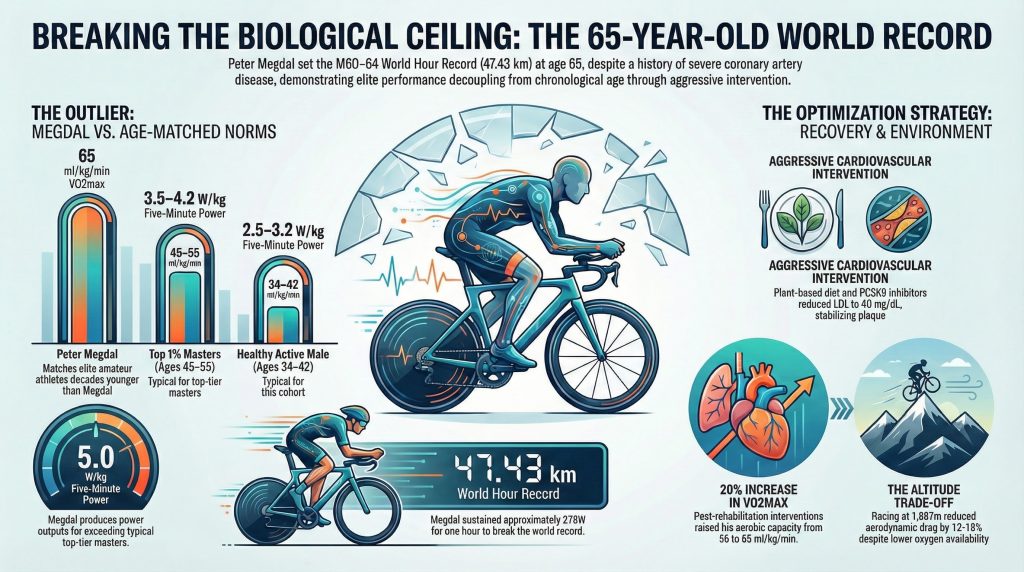
Among the most striking examples is Peter Megdal, an elite masters cyclist who, at age 65, set the M60–64 World Hour Record by covering 47.430 km at the Bicentenario Velodrome in Aguascalientes, Mexico—surpassing the previous mark of 47.360 km.¹ What makes this performance especially notable is that it occurred after Megdal had been diagnosed with severe coronary artery disease and undergone coronary stenting.¹
His case provides a rare real-world dataset for examining how training continuity, intensive lipid management, and modern cardiovascular therapy can meaningfully alter the expected trajectory of age-related performance decline.
The Hour Record: A Unique Physiological Stress Test
The World Hour Record is cycling’s purest endurance challenge. The rider must sustain the highest possible steady-state power output for 60 minutes on a banked velodrome—alone, without drafting, pacing variability, or tactical recovery.
Physiologically, the effort closely tracks the athlete’s maximal lactate steady state (MLSS), which in highly trained endurance athletes typically occurs at a high fraction of VO₂max (often ~80–90%), depending on training status and testing methodology.²
For masters athletes, the challenge is compounded by well-documented age-related changes:
- Declining maximal heart rate
- Reduced stroke volume
- Decreased skeletal muscle oxidative capacity
Yet Megdal’s 47.43 km performance demonstrates that these declines are not absolute and can be substantially mitigated under optimal conditions.¹
Why Aguascalientes Matters: Altitude as a Strategic Lever
Aguascalientes sits at 1,887 meters (6,191 feet) above sea level. At this altitude:
- Air density is lower, reducing aerodynamic drag
- Oxygen availability is reduced, impairing aerobic capacity
For trained athletes, VO₂max typically declines by ~6–9% at this elevation.³ However, under typical track conditions (≈25–35 °C), air density is commonly ~0.95–1.05 kg·m⁻³, yielding an estimated 12–18% reduction in aerodynamic drag compared with sea level.⁴⁻⁶
The hour record at altitude is therefore a calculated trade-off: aerodynamic gain versus physiological loss. Megdal’s average speed of 47.43 km·h⁻¹ suggests precise pacing, thermal management, and aerobic durability.
The steeply banked turns of the Bicentenario velodrome (reported at ~42°) impose elevated normal and lateral forces, increasing musculoskeletal and core stabilization demands during prolonged high-speed riding—an often overlooked stressor in hour-record attempts.¹,⁷
The 350-Watt Benchmark: Contextualizing an Outlier Performance
At age 65, Megdal reported sustaining 350 W for five minutes at a body mass of ~70 kg (5.0 W·kg⁻¹).¹ In cycling physiology, five-minute maximal power is widely used as a proxy for VO₂max-related power.⁸
Using commonly applied ACSM-derived cycling metabolic equations (~10–12 ml·min⁻¹·W⁻¹ in trained cyclists), this power output corresponds closely with Megdal’s clinically measured VO₂max of ~65 ml·kg⁻¹·min⁻¹ following rehabilitation.⁹
Contextual comparison:
| Cohort | Age | 5-min Power (W·kg⁻¹) | VO₂max (ml·kg⁻¹·min⁻¹) |
| World-Tour Professional | 22–32 | 6.5–7.5 | 80–90 |
| Category 1/2 Amateur | 20–40 | 5.0–5.8 | 65–75 |
| Peter Megdal | 65 | 5.0 | ~65 |
| Top 1% Masters (60–69) | 60–69 | 3.5–4.2 | 45–55 |
| Healthy Active Male | 60–69 | 2.5–3.2 | 34–42 |
Megdal’s values are comparable to highly trained younger endurance athletes and vastly exceed age-matched norms derived from large population registries.¹⁰
Cardiovascular Disease—and the Removal of a Performance Ceiling
In 2014, Megdal was diagnosed with severe obstructive coronary artery disease, including a significant lesion in the left anterior descending artery that required stenting.¹ Standard post-procedural care reduced acute risk but did not fully restore performance.
Drawing on both his scientific training and the cardiovascular literature, Megdal adopted an intensive intervention strategy:
- A low-fat whole-food plant-based diet
- Aggressive LDL-cholesterol lowering, including a PCSK9 inhibitor (evolocumab)
- Continued high-volume endurance training¹¹⁻¹³
This approach reduced LDL cholesterol to ~40 mg·dL⁻¹ and was associated with a ~20% increase in VO₂max (from ~56 to ~65 ml·kg⁻¹·min⁻¹).¹ Intensive LDL lowering has been shown to promote plaque stabilization and modest regression, improving coronary perfusion and exercise tolerance in high-risk patients.¹³,¹⁴
Aging, VO₂max Decline, and the “Elite Trajectory”
In sedentary adults, VO₂max declines by roughly 10% per decade after age 30.⁹ In contrast, elite masters athletes who maintain training volume and intensity can reduce this decline to ~5–6% per decade.¹⁵
Exercise economy—the oxygen cost of producing a given power output—remains remarkably stable with age in trained cyclists, allowing older athletes to retain efficiency even as absolute aerobic capacity declines.²,¹⁶
Megdal’s data strongly suggest he is tracking along this elite aging trajectory, supported by preserved stroke volume, expanded blood volume, and maintained mitochondrial function.¹⁷
Modeling Past and Future Performance (Assumptions Explicit)
Using conservative elite-athlete decay assumptions (~6% per decade), Megdal’s current VO₂max implies a modeled youthful peak of ~83 ml·kg⁻¹·min⁻¹, consistent with international-level endurance athletes.¹⁰,¹⁷
Modeled projections (assuming continued elite training and health):
| Age | Status | VO₂max (ml·kg⁻¹·min⁻¹) | 5-min Power (W) | W·kg⁻¹ |
| 25 | Modeled peak | 83.3 | 448 | 6.4 |
| 65 | Measured | 65.0 | 350 | 5.0 |
| 75 | Projected | 60.1 | 324 | 4.6 |
| 85 | Projected | 54.1 | 292 | 4.2 |
Biological Age vs. Chronological Age
VO₂max is one of the strongest predictors of functional capacity, disease risk, and mortality.⁹ Epigenetic fitness-integrated models (e.g., DNAmFitAge) show that high cardiorespiratory fitness is associated with substantially younger biological age estimates, though causality remains under investigation.¹⁸
Megdal’s VO₂max provides a large functional reserve. Activities of daily living typically require only 12–15 ml·kg⁻¹·min⁻¹, meaning he operates far below physiological limits in normal life.¹⁹
Endurance training is also associated with longer telomere length and preserved mitochondrial density in older athletes, though these relationships remain associative rather than causal.²⁰,²¹
Translating Physiology into a 47.43 km Hour
At Aguascalientes altitude, a rider traveling at 47.43 km·h⁻¹ (13.18 m·s⁻¹) with a competitive aerodynamic profile (CdA ≈ 0.20 m²) would require an estimated 260–280 W to overcome aerodynamic drag, rolling resistance, and drivetrain losses.⁴⁻⁶
Sustaining ~275 W corresponds to ~78–85% of maximal aerobic power, well within the range observed in elite hour-record performances.²
What the Megdal Case Really Shows
Peter Megdal’s hour record is not merely a feat of aging athleticism. It is a case study in aggressive healthy aging, demonstrating that:
- Many “age-related” declines are actually disease-mediated
- Cardiovascular limitations can meaningfully constrain performance long before symptoms appear
- With sustained training and modern medical management, biological performance can be partially decoupled from chronological age
Megdal’s journey—from coronary stenting to a world record—challenges both athletes and clinicians to rethink the ceiling of post-rehabilitation potential.
The aging heart, it turns out, is not on a fixed timetable.
References
- Megdal P. Peter Megdal sets new World Hour Record. Boston Heart Disease Consultation. Available from: https://www.curingheartdisease.com/peter-megdal-hour-record-2022/
- Jones AM, Carter H. The effect of endurance training on parameters of aerobic fitness. Sports Med. 2000;29(6):373-386. doi:10.2165/00007256-200029060-00001
- Fulco CS, Rock PB, Cymerman A. Maximal and submaximal exercise performance at altitude. Aviat Space Environ Med. 1998;69(8):793-801.
- Wilson DG. Bicycling Science. 2nd ed. Cambridge (MA): MIT Press; 1982.
- Kyle, C.R. & Burke, E.R. (1984) Improving the racing bicycle.Mechanical Engineering,106(9), 34–35.
- Martin JC, Milliken DL, Cobb JE, McFadden KL, Coggan AR. Validation of a Mathematical Model for Road Cycling Power. J Appl Biomech. 1998;14(3):276-291. doi:10.1123/jab.14.3.276
- New England Bicycle Club. Peter Megdal’s National Hour Record Attempt in Aguascalientes. Available from: http://www.nebc.us/race-report/peter-megdals-national-hour-record-attempt-in-aguascalientes/
- Allen H, Coggan AR, McGregor S. Training and Racing with a Power Meter. 2nd ed. Boulder (CO): VeloPress; 2010.
- American College of Sports Medicine. ACSM’s Guidelines for Exercise Testing and Prescription. 11th ed. Philadelphia (PA): Wolters Kluwer; 2021.
- Kaminsky LA, Arena R, Myers J. Reference Standards for Cardiorespiratory Fitness Measured With Cardiopulmonary Exercise Testing: Data From the Fitness Registry and the Importance of Exercise National Database. Mayo Clin Proc. 2015;90(11):1515-1523. doi:10.1016/j.mayocp.2015.07.026
- Ornish D, Brown SE, Scherwitz LW, et al. Can lifestyle changes reverse coronary heart disease? The Lifestyle Heart Trial. Lancet. 1990;336(8708):129-133. doi:10.1016/0140-6736(90)91656-u
- Esselstyn CB Jr, Ellis SG, Medendorp SV, Crowe TD. A strategy to arrest and reverse coronary artery disease: a 5-year longitudinal study of a single physician’s practice. J Fam Pract. 1995;41(6):560-568.
- Sabatine MS, Giugliano RP, Keech AC, et al. Evolocumab and Clinical Outcomes in Patients with Cardiovascular Disease. N Engl J Med. 2017;376(18):1713-1722. doi:10.1056/NEJMoa1615664
- Nicholls SJ, Puri R, Anderson T, et al. Effect of Evolocumab on Progression of Coronary Disease in Statin-Treated Patients: The GLAGOV Randomized Clinical Trial. JAMA. 2016;316(22):2373-2384. doi:10.1001/jama.2016.16951
- Tanaka H, Seals DR. Endurance exercise performance in Masters athletes: age-associated changes and underlying physiological mechanisms. J Physiol. 2008;586(1):55-63. doi:10.1113/jphysiol.2007.141879
- Lucia A, Hoyos J, Santalla A, Earnest C, Chicharro JL. Tour de France versus Vuelta a España: which is harder?. Med Sci Sports Exerc. 2003;35(5):872-878. doi:10.1249/01.MSS.0000064999.82036.B4
- Coyle EF, Coggan AR, Hopper MK, Walters TJ. Determinants of endurance in well-trained cyclists. J Appl Physiol (1985). 1988;64(6):2622-2630. doi:10.1152/jappl.1988.64.6.2622
- McGreevy KM, Radak Z, Torma F, et al. DNAmFitAge: biological age indicator incorporating physical fitness. Aging (Albany NY). 2023;15(10):3904-3938. doi:10.18632/aging.204538
- Paterson DH, Warburton DE. Physical activity and functional limitations in older adults: a systematic review related to Canada’s Physical Activity Guidelines. Int J Behav Nutr Phys Act. 2010;7:38. Published 2010 May 11. doi:10.1186/1479-5868-7-38
- Østhus IB, Sgura A, Berardinelli F, et al. Telomere length and long-term endurance exercise: does exercise training affect biological age? A pilot study. PLoS One. 2012;7(12):e52769. doi:10.1371/journal.pone.0052769
- Holloszy JO, Coyle EF. Adaptations of skeletal muscle to endurance exercise and their metabolic consequences. J Appl Physiol Respir Environ Exerc Physiol. 1984;56(4):831-838. doi:10.1152/jappl.1984.56.4.831