
Pathophysiological Progression and Systemic Functional Impact of Subclinical Atherosclerosis
A Life-Course Analysis from Youth to Mid-Life
Resumo
Aterosclerótico doença cardiovascularDoença cardiovascular é o termo abrangente para problemas no coração e nos vasos sanguíneos, incluindo ataques cardíacos, derrames e artérias das pernas bloqueadas. (ASCVD) remains the leading cause of mortality worldwide, and its clinical manifestations represent the late-stage culmination of a biological trajectory that begins decades earlier — often in fetal life and certainly by the second decade. This review integrates structural vascular biology, hemodynamics, lipid causality, inflamaçãoA inflamação é a resposta do seu sistema imunológico a uma lesão ou a algo que ele trata como um invasor. Ela traz inchaço, calor e células de limpeza., sex-specific phenotypes, neurodegeneration, and lifestyle reversibility into a unified framework for understanding aterosclerose subclínicaAterosclerose subclínica significa que há presença de placa, mas ela ainda não causou nenhum sintoma ou evento. as an active, progressive, and modifiable disease. We examine regional heterogeneity in arterial wall architecture and the role of vasa vasorumThe vasa vasorum are tiny blood vessels that supply the wall of a larger artery. The name means "vessels of the vessels.", the divergence of large-artery ateroscleroseA aterosclerose é a doença por trás da maioria dos ataques cardíacos e de muitos acidentes vasculares cerebrais. Partículas de colesterol ficam presas na parede de uma artéria, o corpo envia células imunológicas para limpar e, ao longo dos anos, essa bagunça endurece, transformando-se em placa. from cerebral small vessel disease, the hemodynamic determinants of placaPlaca é o acúmulo de colesterol, células imunológicas, tecido cicatricial e cálcio dentro da parede de uma artéria. localization, and the longitudinal evidence from PDAYPDAY, short for Pathobiological Determinants of Atherosclerosis in Youth, examined the arteries of young people aged 15 to 34 who died of other causes., Bogalusa, CárdiaCARDIA has followed young adults from their twenties into later life, tracking fitness, cholesterol, blood pressure, and what eventually happened to them., MESAMESA, the Multi-Ethnic Study of Atherosclerosis, followed thousands of adults with no known heart disease, scanning their arteries and tracking outcomes., and the FELIC fetal series that anchor disease initiation in early life. We synthesize Mendelian-randomization, population-genetic, and intervention-trial evidence establishing apolipoproteínaUma apolipoproteina é uma proteína ligada a uma partícula transportadora de gordura no sangue. A gordura e a água não se misturam, portanto, essas proteínas agem como um invólucro que permite que a gordura viaje com segurança pela corrente sanguínea. B–containing lipoproteínasUma lipoproteína é um pequeno pacote que transporta gordura e colesterol através da sua corrente sanguínea. Como a gordura não se dissolve em água, ela precisa de um invólucro de proteína para viajar. as the necessary causal driver of aterogêneseAtherogenesis is the step-by-step process of a plaque forming., and we situate Lp(a), inflammation, clonal hematopoiesis, disfunção endotelialEndothelial dysfunction is when that thin lining stops doing its job well. Vessels don't widen properly, and the barrier gets leakier., microvascular rarefaction, and arterial stiffening within this framework. We close with the imaging and biomarcadorUm biomarcador é algo mensurável no corpo que informa sobre saúde ou doença — um valor laboratorial, o resultado de um exame de imagem, uma leitura da pressão arterial. tools that allow detection during the long pre-clinical window, the sex-specific phenotypes that have historically been under-recognized, and the trial evidence — most prominently the Lifestyle Heart TrialThe Lifestyle Heart Trial, led by Dean Ornish, was a small randomized study testing an intensive lifestyle intervention — very low-fat plant-based diet, exercise, stress management, and group support — using serial coronary angiography; the intervention group's measured arterial narrowing improved slightly while controls worsened, but technical limitations of angiography, reference-segment narrow…, the Esselstyn case series, STARS, and the IVUS-documented estatinaUma estatina desacelera a enzima que seu fígado usa para produzir colesterol. Seu fígado responde puxando mais colesterol do que está no seu sangue, que é de onde vem o verdadeiro benefício. and PCSK9-inhibitor regression trials (REVERSALO estudo REVERSAL comparou a terapia com estatinas moderada e intensiva, utilizando ultrassom intravascular para medir o que aconteceu com a placa coronariana., ASTEROIDEO ASTEROID foi um estudo clínico que administrou aos pacientes a maior dose de rosuvastatina e fotografou suas placas coronarianas com ultrassom intravascular antes e depois., SaturnoSATURN compared the two strongest statins head to head at maximum dose, measuring coronary plaque with intravascular ultrasound., GLAGOVGLAGOV added a PCSK9 inhibitor to statin therapy and measured coronary plaque with intravascular ultrasound before and after., PACMAN-AMIPACMAN-AMI gave a PCSK9 inhibitor to patients immediately after a heart attack and imaged their non-culprit arteries with three different catheter techniques., HuygensHUYGENS used optical coherence tomography — a very high-resolution imaging catheter — to see whether a PCSK9 inhibitor changed plaque structure after a heart attack.) — supporting the conclusion that subclinical atherosclerosis is, when addressed early and aggressively, a reversible disease.
Keywords
Subclinical atherosclerosis; apolipoprotein B; lipoproteína(a)Lipoproteína(a), escrita como Lp(a) e pronunciada como "L-P-minúsculo-a", é uma partícula semelhante ao LDL com uma proteína extra pegajosa anexada.; endothelial dysfunction; vasa vasorum; cerebral small vessel disease; coronary artériaUma artéria é um vaso sanguíneo que transporta o sangue do coração para o resto do corpo. calcium; velocidade de onda de pulsoPulse wave velocity measures how fast the pressure wave from each heartbeat travels along your arteries. Stiffer arteries carry it faster.; regressão de placaA regressão da placa significa que a placa existente realmente diminui de tamanho, em vez de apenas crescer mais devagar.; whole-food dieta à base de plantasUma dieta à base de plantas, ou predominantemente vegetal, é construída principalmente em torno de vegetais, frutas, feijões, grãos integrais, nozes e sementes, com alimentos de origem animal limitados ou ausentes..
1. Introdução
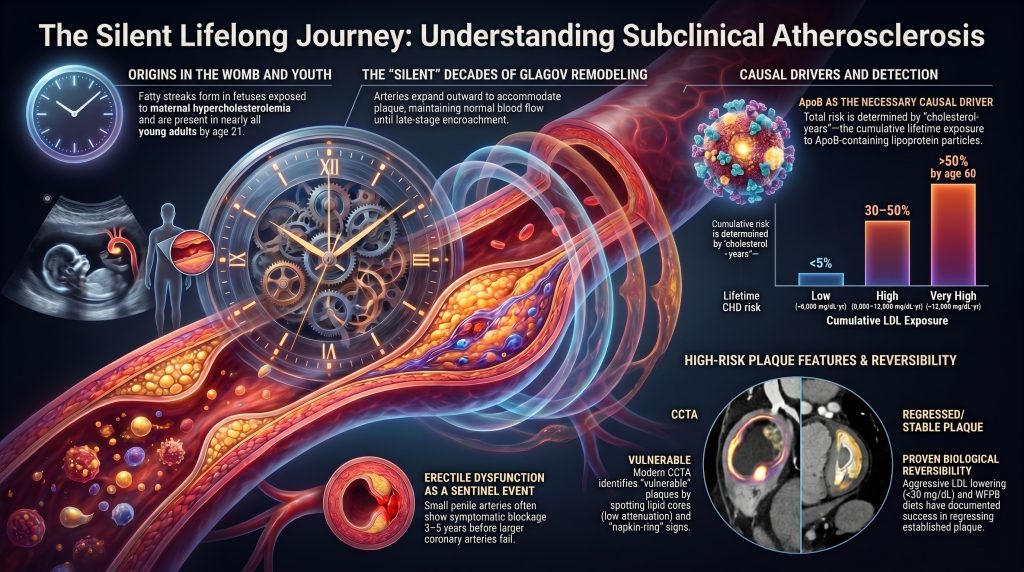
The emergence of clinical ASCVD is the culmination of a silent, multi-decadal biological trajectory that often begins in the second decade of life — and in the case of fetuses exposed to maternal hipercolesterolemiaHipercolesterolemia é um nível anormalmente elevado de partículas transportadoras de colesterol no sangue, tipicamente causado em experimentos com primatas pela alimentação com uma dieta rica em colesterol dietético e gordura saturada, e associada à formação acelerada de placas nas paredes das artérias., even before birth. Subclinical atherosclerosis refers to the presence of structural arterial wall alterations — including espessamento intimalIntimal thickening is an early adaptive or pathological increase in the thickness of the innermost layer of an artery (the intima), which can reflect either normal developmental changes or the accumulation of smooth muscle cells, lipids, and inflammatory cells that precede overt plaque formation. It is measurable non-invasively by carotid intima-media thickness ultrasound., lipoprotein retention, foam-cell accumulation, and early plaque formation — that precede overt symptomatic manifestations such as anginaAngina is chest discomfort that happens when the heart muscle isn't getting enough oxygen. People describe it as pressure, tightness, squeezing, or burning, and it can spread to the arm, neck, or jaw., infarto do miocárdioVeja Ataque Cardíaco para o verbete completo., acidente vascular cerebral isquêmicoUm acidente vascular cerebral isquêmico ocorre quando o fluxo sanguíneo para uma parte do cérebro é bloqueado e o tecido cerebral começa a morrer., peripheral claudication, or vascular dementia. This silent progression is governed by a tightly coupled interplay between hemodynamic forces, structural variations in the arterial wall, lipoprotein flux, immune activation, and metabolic stress.
Although traditionally framed as a disease of senescence, longitudinal cohort studies and autopsy data have fundamentally shifted the focus toward young adults and adolescents, revealing that subtle everyday functional deficits — ranging from diminished cognitive processing speed to impaired renal and erectile reserve — emerge long before the traditional clinical thresholds for diagnosis are met. The most rigorous formulation of this life-course concept is the cumulative-exposure or “anos de colesterolColesterol-anos é uma métrica de exposição cumulativa que multiplica o nível médio de LDL-C de uma pessoa (em mg/dL) pelo número de anos em que ela manteve esse nível, de forma análoga aos maços-anos para o tabaco. O conceito sustenta que é a carga total ao longo da vida de lipoproteínas contendo apoB, e não uma única leitura, que determina quando e com que gravidade a aterosclerose se desenvolve.” model, in which the integral of plasma apoB-particle concentration over time predicts both the timing and severity of clinical events [7], [9].
This review provides a comprehensive synthesis of the pathophysiology, anatomical distribution, and functional consequences of subclinical vascular disease across the human arterial tree, with particular attention to (i) the divergent biology of large-artery atherosclerosis and cerebral small vessel disease; (ii) the causal centrality of apoB-containing lipoproteins and the contribution of Lp(a), inflammation, and clonal hematopoiesis; (iii) sex-specific phenotypes; (iv) emerging detection modalities; and (v) the trial-based evidence that subclinical disease is reversible when addressed early and aggressively.
2. Apolipoprotein B–Containing Lipoproteins as the Necessary Causal Driver
2.1 The Mendelian-Randomization Synthesis
Randomização mendelianaA randomização mendeliana é um método de pesquisa inteligente que usa os genes com os quais as pessoas nasceram como um experimento natural. (MR) provides one of the most rigorous forms of causal inference available outside ensaios clínicos randomizadosUm ensaio clínico randomizado e controlado distribui os participantes entre um grupo de tratamento e um grupo de comparação de forma puramente aleatória e, em seguida, acompanha ambos os grupos.. By exploiting the random allocation of alleles at conception, MR studies estimate the lifelong effect of a genetically determined exposure unconfounded by causalidade reversaCausação reversa é quando a seta aponta para o outro lado — a doença causou a exposição em vez de a exposição causar a doença., lifestyle covariates, or measurement error. Ference and colleagues analyzed 50 polymorphisms across nine LDL-related genes in 312,321 participants and established that each 1 mmol/L (≈38.7 mg/dL) genetically lower LDL-C confers a risco relativoRelative risk compares two groups: this group had 30 percent fewer heart attacks than that group. reduction of approximately 54.5 percent for doença cardíaca coronarianaA doença arterial coronariana é o estreitamento ou bloqueio das artérias que fornecem sangue para o músculo cardíaco, causado pelo acúmulo de placa aterosclerótica; é a principal causa de ataque cardíaco e morte cardíaca em todo o mundo. — an effect roughly three times larger per unit LDLO LDL, ou lipoproteína de baixa densidade, é a principal partícula que transporta colesterol pelo sangue — e a principal que fica presa nas paredes das artérias. than that of statins initiated in mid-life [1].
O relação dose-respostaA dose-response relationship describes how the magnitude of a biological effect changes as the amount of an exposure (such as weekly exercise minutes) increases; in this article, resistance training shows a non-linear dose-response for mortality, with benefits plateauing around 120 minutes per week and a J-shaped curve emerging at very high volumes in older women. is log-linear with no detectable threshold, supporting a cumulative-exposure model. A second MR study using polymorphisms in PCSK9A PCSK9 é uma proteína produzida pelo seu fígado que destrói os pontos de ancoragem que o fígado usa para retirar o colesterol do seu sangue., HMGCRHMGCR is the gene for HMG-CoA reductase, the enzyme that performs the rate-limiting step in making cholesterol. It is the exact target of every statin., e NPC1L1NPC1L1 is the transporter in your intestine that absorbs cholesterol from food and bile. Ezetimibe blocks it. demonstrated that risk reduction tracks closely with the magnitude and duration of LDL-C lowering, supporting the conclusion that integrated lifetime exposure to apoB-containing lipoproteins is a central determinant of atherogenesis, while the specific molecular pathway through which LDL-C is lowered is less important for ASCVD risk reduction [3]. A 2017 European Atherosclerosis Society Consensus Statement reviewed more than 200 genetic, prospective epidemiologic, and randomized intervention studies and concluded that LDL fulfills the Critérios de Bradford HillThe Bradford Hill criteria are a set of nine principles—including strength of association, consistency, biological plausibility, and dose-response—used to evaluate whether an observed statistical association between an exposure and a disease is likely to be causal. for causality in ASCVD [4], and the 2020 EAS update extended this conclusion to apoB-containing lipoproteins generally [19].
2.2 ApoB as the Unifying Particle
Each major atherogenic lipoprotein particle — VLDLVLDL, ou lipoproteína de muito baixa densidade, é a partícula que seu fígado produz para enviar triglicerídeos para o resto do corpo., IDLIDL, or intermediate-density lipoprotein, is a particle that forms partway through the process of a big triglyceride-carrying particle shrinking down into an LDL particle., LDL, Lp(a), and quilomícroA chylomicron is a very large particle that carries fat from a meal out of your intestines and into your bloodstream. remnants — carries a single apolipoprotein B molecule: apoB-100ApoB-100 é a forma de comprimento total da apolipoproteína B encontrada nas lipoproteínas LDL, VLDL, IDL e remanescentes; seus domínios de aminoácidos carregados positivamente ligam-se ionicamente às cadeias laterais de proteoglicanos carregadas negativamente na parede arterial, prendendo fisicamente a partícula na íntima e iniciando a formação de placas. for hepatically derived particles and apoB-48ApoB-48 é uma isoforma truncada da apolipoproteína B produzida no intestino e encontrada exclusivamente nos quilomícrons e seus remanescentes; ao contrário da ApoB-100, ela não é medida pelos ensaios clínicos padrão de ApoB em estado de jejum, o মানে que os testes de rotina de ApoB refletem a carga de partículas aterogênicas de lipoproteínas derivadas do fígado em vez da absorção de gordura da dieta. for intestinal remnants. ApoBApoB é uma proteína presente na parte externa de cada partícula de colesterol que pode ficar presa na parede da sua artéria e causar placa. Cada uma dessas partículas carrega exatamente uma ApoB. therefore counts partículas aterogênicasPartículas aterogênicas são as lipoproteínas contendo ApoB — incluindo LDL, IDL, VLDL e a lipoproteína(a) — que podem entrar e ficar retidas na parede arterial para iniciar e sustentar o crescimento da placa; o artigo usa o termo para descrever o que deve ser reduzido de forma substancial e sustentável para alcançar a regressão da placa., whereas LDL-C measures a cargo whose ratio to the carrier varies with metabolic state. In the UK BiobankUK Biobank holds detailed genetic, lifestyle, and health data on half a million British volunteers, linked to their medical records. analysis of 389,529 participants, apoB was the dominant predictor of myocardial infarction; LDL-C and non-HDL-C lost statistical significance after adjustment for apoB [5]. In states of discordânciaConsulte Discordância de ApoB para ver o verbete completo. — where LDL-C is normal but particle number is high, as in síndrome metabólicaA síndrome metabólica é um conjunto de cinco problemas que tendem a ocorrer juntos: cintura grande, triglicerídeos altos, HDL baixo, pressão arterial alta e açúcar no sangue alto. Ter três ou mais conta. e resistência à insulinaA resistência à insulina é quando as suas células param de responder bem à insulina, fazendo com que o seu pâncreas precise produzir cada vez mais para fazer o mesmo trabalho. — apoB unmasks substantial atherogenic risk that an LDL-C-only strategy would miss [6].
2.3 Cumulative Exposure and the “Cholesterol-Years” Concept
The cumulative-exposure model treats ASCVD risk as a function of the integral of plasma LDL-C concentration over time, analogous to “maços-anoPack-years is a standardized measure of cumulative tobacco exposure calculated by multiplying the number of packs smoked per day by the number of years of smoking; the article uses it as the conceptual model for thinking about cumulative apoB exposure, noting that both metrics are imperfect summaries of lifetime exposure that carry more prognostic weight than a single current measurement.” for tobacco. Several analyses support a dose–time relationship between LDL-C exposure and ASCVD events. The “threshold” for clinically apparent disease in men has been described in some analyses as approximately 5,000 mg/dL·years — for example, LDL 125 mg/dL × 40 years, corresponding to age ~50 in modern Western populations — but the exact LDL-year value at which clinical disease emerges is model-dependent and should be presented as illustrative rather than as a universal biological cutoff [7], [9].
The “LDL anos-placaPlaque-years is a measure of cumulative lifetime exposure to LDL cholesterol, calculated as the integral of LDL-C concentration over time (approximated as LDL-C × age), used to quantify the total atherogenic burden an artery wall has experienced. Research has identified heuristic thresholds—around 5,000 for low risk and above 14,000 for very high risk—that correspond to progressively greater prob…” framework reframes prevention quantitatively around cumulative burden. For example, lifelong LDL of 70 mg/dL × 80 years yields ≈5,600 mg/dL·years; LDL 130 mg/dL × 50 years yields ≈6,500 mg/dL·years; and untreated heterozygous hipercolesterolemia familiarFamilial hypercholesterolemia, or FH, is an inherited condition where the liver cannot clear cholesterol from the blood properly. Levels are very high from birth. patients with LDL of 250 mg/dL exceed common illustrative thresholds by their early thirties. These calculations are useful for communicating dose–time biology and for explaining why untreated heterozygous FH carries a high lifetime CHD risk, but they should not be presented as validated individual-risk thresholds [7], [8], [9].
| Categoria | Cumulative LDL exposure | Approximate trajectory | Illustrative lifetime CHD risk |
| Baixo | <5,000 mg/dL·yr | LDL 70 × 70 yr | <5% |
| Intermediário | 5,000–8,000 mg/dL·yr | LDL 100 × 60 yr | 10–20% |
| Alto | 8,000–12,000 mg/dL·yr | LDL 130 × 65 yr | 30–50% |
| Very high | >12,000 mg/dL·yr | LDL 190 × 65 yr (HeFH) | >50% by age 60 |
Tabela 1. Illustrative cumulative LDL-cholesterol exposure categories and approximate lifetime coronary heart disease risk. Adapted from Ference et al. and Domanski et al. [7], [8], [9]. These categories are illustrative communication aids, not guideline-validated individual-risk thresholds.
2.4 Tsimane and Hadza: The Natural Experiment of Lifelong Low LDL
Kaplan and colleagues examined CAC scores in 705 TsimaneThe Tsimane are an indigenous forager-horticulturalist population of the Bolivian Amazon whose traditional lifestyle—characterized by high physical activity and low average LDL cholesterol of around 91 mg/dL—is associated with markedly low rates of coronary calcification, with 85 percent of adults over 40 showing no detectable coronary calcium. forager-horticulturalists of the Bolivian Amazon aged 40 to 94. The mean LDL-C was 91 mg/dL, and 85 percent of adults aged 40 and older had a CAC of zero, compared with approximately 50 percent of US adults of similar age in MESA. Sixty-five percent of those over 75 had a CAC of zero — the lowest level of coronary atherosclerosis ever measured in any population — and only 8 percent had a CAC ≥100, versus more than 50 percent in age-matched US populations [10].
This natural experiment supports the conclusion that maintaining relatively low LDL-C across the life course, combined with high physical activity and minimal tabagismoFumar danifica o revestimento dos vasos sanguíneos, aumenta a pressão arterial, faz o sangue coagular mais facilmente e acelera o crescimento de placas., is associated with very low prevalence of coronary calcificaçãoCalcification is when calcium gets deposited into a plaque, turning part of it hard and bony.. It should not be framed as proving that LDL-C ≤90 mg/dL virtually eliminates coronary atherosclerosis, because the Tsimane phenotype reflects multiple lifelong exposures and not LDL-C in isolation. The Hadza of Tanzania have been described as a physically active hunter-gatherer population with favorable cardiometabolic features in available studies, but direct CAC imaging has not been performed in this group; conclusions about the absence of clinical coronary disease in the Hadza are therefore inferential rather than direct [11].
2.5 Genetic Lifelong Low LDL: PCSK9 and ANGPTL3
Cohen and colleagues identified naturally occurring loss-of-function mutations in PCSK9 (R46L, Y142X, C679X) that lower LDL by 15–40 percent across the life course. Carriers of selected variants exhibited large reductions in CHD events, with the most striking estimates — including reductions approaching 88 percent for some variants — reflecting effect sizes that vary by variant and ancestry [12]. Such effect sizes far exceed what any pharmacologic intervention initiated in mid-life can achieve. Similarly, homozygous loss-of-function variants in ANGPTL3ANGPTL3 é uma proteína que desacelera a quebra de partículas ricas em triglicerídeos no sangue. produce hypobetalipoproteinemia with very low LDL and triglicerídeosTriglycerides are the main form of fat in your blood and in your body's storage.; epidemiologic series describe markedly reduced ASCVD risk and favorable perfis lipídicosUm painel de exame de sangue que mede o colesterol total, o colesterol LDL, o colesterol HDL e os triglicerídeos, utilizado para avaliar o risco cardiovascular e monitorar o efeito de intervenções dietéticas ou medicamentosas. in such carriers, although event rates have not been quantified in randomized cohorts [13].
These genetic experiments establish a useful boundary condition: when lifelong apoB-particle burden is genetically low, atherosclerosis appears markedly suppressed even without pharmacologic intervention. Pharmacologic mimicry of these phenotypes — through PCSK9 monoclonal antibodies, siRNA agents, and ANGPTL3 inhibitors — has demonstrated additive event reduction on top of statin therapy. Analyses of FourierFOURIER tested evolocumab, a PCSK9 inhibitor, in patients who already had cardiovascular disease and were on statins. and the FOURIER open-label extension support progressively lower event rates among patients achieving very low LDL, including LDL <20 mg/dL, without an excess safety signal over available follow-up [18].
2.6 Why Sustained Very Low LDL Markedly Reduces Atherogenesis
Endothelial transcitoseTranscytosis is the process by which a cell picks something up on one side, carries it across, and releases it on the other. of LDL into the íntimaThe intima is the innermost layer of an artery wall, sitting just beneath the smooth lining. is concentration-dependent, and proteoglycan-mediated retention — the response-to-retention paradigm of Tabas, Williams, and Borén — becomes less likely as apoB-particle flux falls [83]. Newborns have LDL-C ≈30 mg/dL, and atherosclerotic lesõesNa cardiologia, uma lesão refere-se a uma área delimitada de placa aterosclerótica que estreita uma artéria coronária, normalmente descrita pela porcentagem de obstrução luminal que causa. O artigo descreve quatro lesões residuais cujo diâmetro do vaso é pequeno demais para permitir a implantação de um stent após o tratamento da lesão mais crítica. are not typically detected at this stage; this should be interpreted as evidence that very low lifelong LDL-C is incompatible with the early steps of atherogenesis on a population scale, rather than as a claim that atherosclerosis is biologically impossible at any single LDL-C value. Cohorts with lifelong LDL <70 mg/dL (PCSK9 LOF, ANGPTL3 LOF, treated FH) demonstrate marked reductions in event rates, with IVUS-documented plaque regression at on-treatment LDL <60 mg/dL across the REVERSAL, ASTEROID, SATURN, and GLAGOV trials [14], [15], [16], [17].
FOURIER-OLEThe open-label extension of the FOURIER trial, which tracked patients treated with evolocumab for seven or more years and found sustained cognitive stability even among those maintaining LDL-C below 20 mg/dL. extended evolocumabeEvolocumabe é um medicamento injetável para o colesterol da família dos inibidores da PCSK9, geralmente administrado a cada duas a quatro semanas. follow-up for a median of approximately 5 years and reported continued event reduction at on-treatment LDL <20 mg/dL with no excess safety signal over available follow-up [18]. A formal demonstration of dose-respostaA dose-response relationship means more of something produces more of an effect, in a consistent gradient. without plateau at these very low LDL levels has not been firmly established, but available data are consistent with continued benefit and no offsetting toxicity through the lowest LDL achieved in trial populations to date.
2.7 Acknowledging and Rebutting the LDL-Skeptic Position
A small group of authors — most prominently Ravnskov, Diamond, and Kendrick — have argued that LDL is non-causal, citing observational studies in elderly populations in which LDL appears non-predictive (the so-called “lipid paradoxThe lipid paradox refers to the observation in people in their 80s and 90s that the usual positive association between LDL cholesterol and heart disease weakens or even reverses, an apparent anomaly explained by reverse causation from illness lowering cholesterol, survivorship selection, and competing causes of death rather than any change in LDL's underlying biology.”). The standard rebuttals are well established. First, reverse causality dominates in late life: chronic illness, malabsorption, and frailty lower LDL, biasing the LDL–mortality association in cross-sectional analyses. Second, viés de sobrevivênciaSurvivor bias in the elderly paradox refers to the statistical artifact whereby people who reach old age with high LDL may represent a genetically hardy subset who were never vulnerable to LDL-driven atherosclerosis, making high LDL appear safe in that age group when the susceptible individuals already died younger. selects for genetically protected individuals among those reaching age 80 with high LDL. Third, attenuation of relative risk with age does not imply attenuation of risco absolutoO risco absoluto é a chance real de que algo aconteça com você, expressa como uma porcentagem. Se o seu risco absoluto de ter um ataque cardíaco nos próximos dez anos for de 12%, isso significa que cerca de 12 em cada 100 pessoas como você teriam um.; the absolute event rate increases dramatically with age. Fourth, the genetic and pharmacologic evidence is mutually corroborative across approximately twenty independent lines of investigation, satisfying triangulation criteria for causality [4], [6], [19]. The skeptic position rests almost entirely on observational data while ignoring the convergent genetic and randomized-trial evidence.
3. Structural Determinants and the Role of Vasa Vasorum in Atherogenesis
3.1 Critical Depth and the Lamellar Unit
In large-caliber systemic arteries, the metabolic demands of the thick wall exceed the capacity for simple oxygen diffusion from the lúmenThe lumen is the open channel inside a blood vessel where blood actually flows.. The “critical depth” is defined as the physiological limit of oxygen and nutrient diffusion from luminal blood, established by Geiringer at approximately 0.5 mm (≈500 μm), or roughly 29–30 lamellar units of the medial wall [78], [79]. Each lamellar unit consists of an elastic lamina and its associated layer of smooth-muscle cells and matriz extracelularThe extracellular matrix is the scaffolding of collagen and other fibers that holds tissue together and gives an artery wall its strength., approximately 15 μm thick. Wall segments thicker than this threshold require an intrinsic microvascular network — the vasa vasorum — to maintain viability of the outer media and adventitiaA adventícia é a camada mais externa e resistente de uma artéria, composta principalmente de tecido conjuntivo, nervos e pequenos vasos que alimentam a parede..
Vasa vasorum are categorized into vasa vasorum interna, which arise directly from the arterial lumen, and vasa vasorum externa, which originate from remote branches and penetrate the adventitia. Geiringer’s investigations established that vasa vasorum are abundant in the adventitia and outer third of the media, while the inner ≈0.5 mm (≈30 lamellar units) of the wall remains avascular and is supplied solely by luminal diffusion [79]. When the wall thickens because of atherosclerotic plaque or hypertensive hyperplasia, the diffusion distance increases, generating a hypoxic environment in the deeper layers. Hypoxia triggers HIF-1α–dependent angiogenic signaling, leading to proliferation of vasa vasorum that can penetrate the internal elastic lamina and enter the plaque itself, where they serve both as conduits for inflammatory cells and as fragile sources of hemorragia intraplacaIntraplaque hemorrhage is bleeding inside a plaque, from the fragile little vessels that grew into it..
3.2 Extracranial vs. Intracranial Vascular Nourishment
The intracranial vasculature presents a unique architectural profile compared with the systemic circulation. Healthy intracranial arteries are characterized by a thinner tunica media, less abundant adventitia, and a relative paucity of elastic fibrasA fibra é a parte do alimento vegetal que seu corpo não consegue digerir. Ela é encontrada em feijões, aveia, vegetais, frutas e grãos integrais.; many lack a well-defined external elastic lamina. A primary distinguishing feature is that intracranial vessels are bathed in nutrient-rich cerebrospinal fluid, which provides metabolic support through external diffusion and partly compensates for the relative absence of vasa vasorum early in life.
Modern autopsy and imaging studies have refined the historical view that vasa vasorum are absent in the brain. In one autopsy series of 50 cases, vasa vasorum were identified in 72 percent of patients, localized primarily in the tunica adventitia. Their distribution is markedly non-uniform: vasa vasorum are more frequently found in proximal segments — the vertebral arteries, basilar artery, and intracranial portion of the internal carotid arteryThe carotid arteries run up either side of your neck and supply blood to your brain. — than in distal segments such as the middle cerebral or anterior cerebral arteries. Although atherosclerosis can occur in the absence of vasa vasorum, their development is strongly associated with the progression of intracranial disease: in the intracranial vertebral artery, the presence of adventitial vasa vasorum correlates with greater plaque load, denser intraplaque calcification, and more severe luminal estenoseStenosis is narrowing — usually described as a percentage, like a 70 percent blockage..
| Vessel type | Wall thickness | Vasa vasorum (early life) | Nutritional source |
| AortaA aorta é a maior artéria do seu corpo. Ela transporta sangue para fora do coração e para baixo através do peito e do abdômen, enviando ramificações para toda parte. / large systemic | >1.0 mm (often 1.5–2.0 mm) | Abundant in adventitia and outer media | Luminal diffusion + VV |
| Extracranial carotid | ≈0.6–1.0 mm | Present in adventitia | Luminal diffusion + VV |
| Intracranial ICA / VA | ≈0.2–0.3 mm | Sparse; mostly proximal segments | Luminal diffusion + CSF |
| Distal MCA / ACA | <0.2 mm; lacks EEL | Absent or rare | Luminal diffusion + CSF |
| Penetrating arterioles | 40–200 μm diameter | Ausente | Luminal diffusion + interstitial fluid |
Tabela 2. Comparative architecture of arterial wall thickness, vasa vasorum density, and nutritional source across the systemic and cerebral circulations. EEL, external elastic lamina; ICA, internal carotid artery; VA, vertebral artery; MCA, middle cerebral artery; ACA, anterior cerebral artery; VV, vasa vasorum; CSF, cerebrospinal fluid.
4. Hemodynamic Forces and Plaque Localization
4.1 Laminar versus Disturbed Shear Stress
The focal nature of atherosclerosis is dictated by the interaction between blood flow and arterial geometry. The endotélioO endotélio é o revestimento ultrafino e escorregadio no interior de cada vaso sanguíneo. Ele tem a espessura de apenas uma célula. serves as a mechanosensor, translating physical stress into biological signaling through primary cilia, integrins, glycocalyx-mediated mecanotransduçãoA mecanotransdução é o processo biológico pelo qual as células convertem estímulos mecânicos — como alongamento, pressão ou tensão de cisalhamento — em sinais bioquímicos que alteram o comportamento celular e a expressão gênica., and ion channels (notably Piezo1Piezo1 is a mechanosensitive ion channel protein found in arterial endothelial and smooth muscle cells that converts physical forces such as pressure and wall stretch into intracellular chemical signals, a process called mechanotransduction. and TRPV4). In straight arterial segments, flow is laminar, generating high, unidirectional wall shear stressWall shear stress is the frictional force exerted by flowing blood on the inner surface of an artery; low, oscillatory, or multidirectional shear stress at arterial bends and bifurcations promotes endothelial dysfunction and plaque initiation, whereas high, uniform shear stress in straight segments is generally protective. (typically 1–7 Pa, or 10–70 dyn/cm²). This environment maintains an atheroresistant endothelial phenotype characterized by sustained activation of endothelial nitric oxide synthase (eNOS)Endothelial nitric oxide synthase is the enzyme in artery-lining cells responsible for producing nitric oxide, which relaxes blood vessels and suppresses clot formation; in insulin resistance, impaired insulin-receptor signaling downregulates eNOS, reducing nitric oxide availability and promoting an adhesive, pro-inflammatory arterial surface., phosphorylation of KLF2 and KLF4 transcription factors, and suppression of NF-κB signaling, with the result that óxido nítricoNitric oxide is a gas your blood vessel lining makes to tell the vessel to relax and widen. production is high, adesão leucocitáriaThe process by which white blood cells attach to the endothelial surface of blood vessels, a key early step in atherogenesis; nitric oxide and an intact glycocalyx normally suppress this adhesion. is suppressed, and intimal permeability remains low [85].
In contrast, at branch points, bifurcations, and areas of high curvature, flow becomes “disturbed.” These atheroprone zones experience low time-averaged wall shear stress (often <0.4 Pa) and high oscillatory shear index, with the direction of frictional force reversing during the cardiac cycle. In disturbed-flow regions, the endothelium undergoes a phenotypic switch: tight junctions loosen, allowing increased transcytosis of LDL into the intima; expression of VCAM-1VCAM-1 is a sticky molecule that appears on an inflamed vessel lining and grabs passing white blood cells so they can burrow into the wall., ICAM-1ICAM-1 is a molecule that appears on the surface of the blood vessel lining and acts like Velcro, catching passing immune cells., E-selectin, and MCP-1 captures circulating monocytes and T-cells; espécies reativas de oxigênioReactive oxygen species are unstable oxygen-containing molecules produced as a by-product of normal metabolism. generation rises through NADPH oxidase activation; and the protective KLF2/eNOS axis is suppressed.
The seminal computational fluid dynamic study by Ku and colleagues at the human carotid bifurcation demonstrated tight spatial concordance between low-shear regions and intimal thickening — the founding empirical study of the hemodynamic theory of atherogenesis [71]. This pattern recurs at every branching point of the arterial tree: the proximal segments of the LAD and LCx, the carotid bulb, the abdominal aortic bifurcation, and the renal artery ostia all exhibit this geometry-dependent vulnerability.
4.2 Cellular Behavior in the Plaque Microenvironment
Once retained in the intima, LDL undergoes oxidative modification by myeloperoxidase, lipoxygenase, and reactive oxygen species. LDL oxidadasLDL oxidada é uma partícula de LDL que foi quimicamente danificada após ficar presa na parede de uma artéria. is recognized by scavenger receptors (CD36, SR-A) on resident and newly recruited macrófagosUm macrófago é uma grande célula imune que engole detritos e invasores. O nome significa literalmente "comedor grande".", which internalize it and become células espumosasUma célula espumosa é uma célula imunológica que ingeriu tanto colesterol preso que se expande e assume uma aparência espumosa sob o microscópio.. In early subclinical lesions, foam-cell death is balanced by efferocytosisEfferocytosis is the housekeeping process by which immune cells clear away other cells that have died. — the clearance of apoptotic cells by neighboring macrophages — but as the microenvironment becomes increasingly toxic, efferocytosis fails, apoptotic and necrotic debris accumulates, and a núcleo necróticoThe necrotic core is the dead, mushy center of an advanced plaque, built from immune cells that ate trapped cholesterol and then died in place. forms. Vascular smooth-muscle cells (VSMCs) simultaneously switch from a contractile to a synthetic phenotype, migrating from the media into the intima where they secrete a collagen-rich cápula fibrosaThe fibrous cap is the tough layer of tissue covering a plaque, separating its greasy core from the bloodstream. that initially stabilizes the lesion. The balance between cap-thickening repair and core-expanding inflammation defines whether a plaque remains stable or progresses to vulnerability [82], [83], [84].
5. Endothelial Dysfunction as the Earliest Detectable Lesion
Endothelial dysfunction precedes any structural lesion detectable by carotid intima-media thickness (CIMT)Carotid intima-media thickness is an ultrasound measurement of the combined thickness of the inner two layers of the carotid artery wall in the neck; a faster rate of thickening indicates accelerating atherosclerosis, and it is used as a surrogate marker for cardiovascular risk in trials such as ELITE., coronary artery calcium scoring, or angiography. It is functional, dynamic, and partially reversible — and therefore represents the earliest practical window for primordial intervention.
5.1 Flow-Mediated Dilation
Brachial dilatação mediada pelo fluxo (DMF)Flow-mediated dilation is a non-invasive ultrasound measurement of how much a conduit artery — typically the brachial artery — widens in response to increased blood flow, serving as a marker of endothelial nitric oxide signaling and endothelial function., measured by ultrasound after a 5-minute forearm cuff oclusãoOcclusion is the partial or complete blockage of a blood vessel, preventing normal blood flow; a coronary occlusion reduces or cuts off oxygen delivery to the heart muscle supplied by that artery., quantifies endothelium-dependent (largely nitric-oxide-mediated) vasodilation. Lower FMD is associated with increased cardiovascular risk, but FMD is protocol-dependent and no single universal cutoff applies across laboratories; values below approximately 5–7 percent are commonly treated as abnormal in research contexts. In the Multi-Ethnic Study of Atherosclerosis, FMD added independent prognostic information beyond Framingham risk and CIMT [33]. FMD is impaired in subjects with even mildly elevated LDL, insulinaInsulin is a hormone made by your pancreas. Its main job is letting sugar move out of your blood and into your cells for fuel. resistance, untreated hipertensãoHipertenção é o termo médico para pressão arterial alta., or chronic exposure to particulate air pollution.
5.2 Reactive Hyperemia Index
The reactive hyperemia index (RHI), measured non-invasively by digital plethysmography (EndoPAT), reflects microvascular função endotelialA capacidade do revestimento interno dos vasos sanguíneos de regular o tônus vascular, a inflamação e a coagulação; células endoteliais saudáveis liberam óxido nítrico para manter as artérias relaxadas e resistentes à formação de placas. in the fingertip after reactive hyperemia. An RHI threshold around 1.67 has been used to identify coronary endothelial dysfunction or early coronary atherosclerosis in selected cohorts; sensitivity and specificity depend on the population and the reference standard [34]. RHI is operator-independent, has good reproducibility, and has been used as an outcome in lifestyle and pharmacologic intervention trials.
5.3 Glycocalyx Degradation
O glicocálice endotelialThe endothelial glycocalyx is a thin, gel-like layer of glycoproteins and proteoglycans lining the inner surface of blood vessels; it acts as a selective barrier that limits direct contact between circulating lipoproteins and the arterial wall, and is vulnerable to disruption by disturbed or high-velocity blood flow. is a 0.5–3 μm gel-like surface layer composed of proteoglycans (heparan sulfatoHeparan sulfate is a negatively charged glycosaminoglycan, similar to chondroitin sulfate, found on proteoglycans in the arterial extracellular matrix; alongside chondroitin sulfate, it participates in the electrostatic binding of ApoB-100–containing lipoproteins that initiates plaque formation., sulfato de condroitinaChondroitin sulfate is a negatively charged glycosaminoglycan chain attached to arterial proteoglycans such as biglycan and versican; it binds ionically to the positively charged ApoB-100 protein on LDL particles, anchoring them in the subendothelial space and initiating the atherosclerotic process.), glycoproteins (syndecan-1), and adsorbed plasma proteínasA proteína é o nutriente que o seu corpo usa para construir e reparar músculos e tecidos.. It modulates LDL transcytosis, leukocyte rolling, and shear-stress mechanotransduction. GlycocalyxThe glycocalyx is a delicate sugar-rich coating on the inner surface of blood vessels, a kind of gel layer between the blood and the cells. degradation — driven by oxidized LDL, hiperglicemiaAbnormally elevated blood glucose concentration; included as one of the modifiable risk factors in the PDAY scoring system because it accelerates arterial lesion progression in adolescents and young adults., TNF-α, and reactive oxygen species — exposes adhesion molecules and increases intimal lipoprotein flux. Glycocalyx thinning, detectable by sublingual sidestream dark-field imaging and by elevated plasma syndecan-1 and hyaluronan, occurs before measurable FMD impairment and is among the earliest detectable abnormalities in subclinical disease [35], [36].
5.4 Microvascular Dysfunction Preceding Macrovascular Disease
Reserva de fluxo coronarianoCoronary flow reserve compares blood flow through the heart's arteries at rest with flow when the heart is working hard. (CFR) below 2.0 by tomografia por emissão de pósitronsPositron emission tomography, or PET, uses a mildly radioactive tracer to show which tissues are metabolically busy., below 2.5 by transthoracic Doppler, or below 2.0 by cardiac magnetic resonance is independently predictive of cardiovascular events even in the absence of obstructive epicardial disease. Microvascular endothelial dysfunction can occur with normal coronary angiografiasUm angiograma é um exame em que os médicos inserem um tubo fino nas artérias e injetam um contraste, para que o interior das artérias apareça em um raio-X., providing the substrate for the syndrome of isquemiaIsquemia é quando um tecido não está recebendo sangue e oxigênio suficientes para o que lhe está sendo exigido. with non-obstructive artérias coronáriasAs artérias coronárias são os pequenos vasos que envolvem a parte externa do seu coração e alimentam o próprio músculo cardíaco. (INOCA), discussed in Section 8 [37].
6. Anatomical Mapping of Subclinical Vascular Disease
Atherosclerosis is a systemic but non-uniform disease, favoring specific anatomical sites characterized by complex geometry and disturbed flow. Precise mapping across vascular beds reveals the predictable, geometry-dependent pattern of plaque localization.
6.1 Cerebrovascular and Cervical Beds
In the neck, the carotid bifurcation and the proximal internal carotid artery are the primary sites for early plaque development, owing to flow separation, recirculation, and low oscillatory shear at the carotid bulb. Within the cranium, disease is most frequently observed in the intracranial ICA (carotid siphon) and the proximal segments of the major branches of the circle of Willis. Autopsy series indicate that intracranial atherosclerosis lags extracranial disease by approximately 15 to 20 years; stable lesions are more common in the ICA, while more dynamic, progressive lesions are found in the MCA, ACA, and posterior cerebral arteries.
Importantly, intracranial atherosclerotic disease (ICAD)Intracranial atherosclerotic disease is the buildup of atherosclerotic plaque within the arteries inside the skull, narrowing vessels that supply brain tissue and contributing to stroke, chronic hypoperfusion, and cognitive impairment. accounts for approximately 9 percent of derramesUm AVC ocorre quando o fluxo sanguíneo para uma parte do cérebro é interrompido, seja por um bloqueio ou por sangramento. in white populations but 30 to 50 percent of strokes in East Asian, Black, and Hispanic populations [73], [74]. This racial disparity persists after adjustment for traditional fatores de riscoUm fator de risco é algo que aumenta a sua chance de desenvolver uma doença — partículas de colesterol alto, pressão alta, tabagismo, diabetes, histórico familiar., suggesting underlying genetic and structural contributions. The SAMMPRIS trial established medical management as superior to stenting for symptomatic ICAD with ≥70 percent stenosis [73].
6.2 Coronary Vasculature and Aorta
Coronary atherosclerosis typically initiates in the proximal segments of the epicardial arteries, with the proximal LAD showing the highest plaque prevalence — particularly within the first 40 mm — owing to its acute take-off angle and the high flow disturbance generated at the bifurcations of diagonal and septal branches. Bifurcations of the LAD with diagonals, the LCx with obtuse marginals, and the RCA with the posterior descending artery all show predilection at the lateral, low-shear walls of the side branches.
The Pathobiological Determinants of Atherosclerosis in Youth (PDAY) study confirmed that estrias gordurosasA fatty streak is the earliest visible stage of atherosclerosis — a flat yellow smear of cholesterol-filled immune cells just under the artery lining. and raised lesions are present in the coronaries of individuals as young as 15–34 years. In the aorta, a clear gradient of susceptibility exists: the abdominal aorta is more severely affected than the thoracic aorta, with the highest concentration of plaques occurring in the distal abdominal aorta and at the aortic bifurcation.
6.3 Renal and Mesenteric Arteries
Atherosclerotic renal artery stenosis (ARAS) accounts for approximately 90 percent of renal artery stenosis cases and primarily involves the renal artery ostia and the proximal 2 cm of the main renal artery. By contrast, fibromuscular dysplasia, which accounts for the remaining ≈10 percent, typically affects the middle and distal segments or intrarenal branches. Mesenteric artery disease — involving the celiac trunk and the superior and inferior mesenteric arteries — also occurs most often at the aortic origins, where flow turbulence is greatest.
6.4 Lower Extremity and Pelvic Arteries
Peripheral arterial disease follows a predictable progression from elastic to muscular arteries. Atherosclerosis typically appears first in the suprainguinal elastic arteries (aorta and iliacs) before progressing to the infrainguinal muscular arteries (femoral, popliteal, and tibial). Pelvic vascular disease frequently involves the internal pudendal artery (IPA), where significant stenosis or occlusion has been documented in approximately 54 percent of men screened for doença arterial coronarianaA doença arterial coronariana é o acúmulo de placas nas artérias que irrigam o músculo cardíaco. — an extraordinary prevalence reflecting the small caliber and shared risk-factor exposure of these vessels. The distal branches of the IPA, including the cavernosal arteries, are uniquely susceptible because of their small diameter (0.5–1 mm), as discussed in Section 9.
7. Differentiation of Large-Artery Atherosclerosis and Cerebral Small Vessel Disease
The distinction between classic atherosclerosis and cerebral small vessel disease (cSVD)Cerebral small vessel disease refers to a spectrum of pathological changes affecting the small arteries, arterioles, capillaries, and venules of the brain, distinct from large-artery atherosclerosis in its drivers and manifestations. It produces white-matter lesions, lacunar infarcts, and contributes to cognitive decline and vascular dementia. is fundamental to understanding the divergent mechanisms of vascular injury across the human body.
7.1 Why Penetrating Arterioles Do Not Develop Classic Atherosclerosis
The penetrating arterioles (40–200 μm in diameter) that supply the deep brain — basal ganglia, thalamus, internal capsule, and periventricular white matter — do not exhibit the eccentric, placas ricas em lipídiosAn atherosclerotic lesion whose core is dominated by cholesterol esters and inflammatory lipids rather than calcium or fibrous tissue; the article notes that such plaques are highly responsive to intensive treatment and that the dramatic 65-percentage-point regression at the diagonal branch origin is consistent with reversal of a lipid-rich lesion. typical of large-vessel atherosclerosis. Three structural and biological factors explain this divergence:
First, structural simplicity: these vessels lack the multi-layered lamellar structure and the well-defined internal and external elastic laminae that support classic plaque architecture. Second, barreira hematoencefálicaThe blood–brain barrier is a highly selective cellular interface lining the brain's blood vessels that blocks lipoprotein particles from entering the central nervous system, meaning the brain must synthesize all of its own cholesterol locally. specialization: the células endoteliaisA fina camada de células que reveste a superfície interna de todos os vasos sanguíneos; elas regulam o tônus vascular, previnem a coagulação e controlam a passagem de substâncias para a parede da artéria — e sua disfunção é um passo inicial e crítico na aterosclerose. of these vessels are specialized components of the neurovascular unit, with tight junctions formed by claudin-5, occludin, and ZO-1, supported by pericytes, astrocyte end-feet, and a unique metabolic environment that differs fundamentally from systemic vessels. Third, the absence of vasa vasorum: these vessels rely entirely on luminal and external diffusion and do not possess the intrinsic microvascular network that can be co-opted for plaque nourishment in larger arteries.
7.2 The Spectrum of Small Vessel Pathology
Instead of classic atherosclerosis, penetrating arterioles develop a distinct set of pathologies collectively termed cerebral small vessel disease. Lipohyalinosis, originally characterized by C. Miller Fisher as “segmental arteriolar wall disorganization,” involves accumulation of waxy, glassy lipid and protein aggregates within the vessel wall, fibrinoid necrosis of medial smooth-muscle cells, and luminal narrowing. It is driven primarily by chronic hypertension and is the principal substrate of lacunar infarcts in the lenticulostriate, thalamoperforating, and pontine penetrating arterioles.
Hyperplastic arteriolosclerosis involves concentric “onion-skin” thickening of the wall due to smooth-muscle proliferation and basement-membrane duplication and is more characteristic of malignant or accelerated hypertension. Microatheroma refers to occlusive lesions in larger penetrating vessels (200–800 μm); these share some features with atherosclerosis (foam cells, lipid retention) but typically occur at the proximal origin of the perforator and reflect the spillover of large-artery disease into branches.
Cerebral amyloid angiopathy (CAA)Cerebral amyloid angiopathy is a condition in which amyloid-beta protein deposits accumulate in the walls of small blood vessels in the brain, weakening them and predisposing to microbleeds and impaired blood flow. involves progressive deposition of β-amyloid (Aβ) — predominantly Aβ40 and to a lesser extent Aβ42 — in the media and adventitia of cortical and leptomeningeal arterioles (typically <2 mm in caliber). CAA is independent of hypertension and is a major contributor to lobar microbleeds, superficial siderosis, and convexity subarachnoid hemorrhage [23], [24]. Pathologically advanced cSVD frequently shows a transition from endothelial dysfunction to BBB disruption: failure of the BBB allows toxic serum components — fibrinogen, IgG, complement — to extravasate into the brain, triggering perivascular inflammation, “forced dilatation,” and connective-tissue accumulation that leaves downstream vessels vulnerable to high-pressure damage.
8. Early-Life Evidence and Longitudinal Risk Trajectories
8.1 Napoli/FELIC: Fetal Fatty Streaks
The earliest documented atherosclerotic lesion in humans is fetal. Napoli and colleagues, in the FELIC (Fate of Early Lesions in Children) study, demonstrated that fatty streaks form in the aortic intima of fetuses, with intimal accumulation of LDL and its oxidation preceding monocyte recruitment. Fetal fatty-streak formation was greatly enhanced by maternal hypercholesterolemia during pregnancy, suggesting that the maternal lipid environment programs offspring vascular vulnerability decades before clinical disease [52].
These observations transformed the conception of atherosclerosis from a disease of mid-life to a life-course disease initiated in utero, with the prenatal environment establishing the trajectory of subsequent intimal LDL accumulation.
8.2 PDAY and the Bogalusa Heart Study
O Estudo PDAYThe Pathobiological Determinants of Atherosclerosis in Youth (PDAY) study was a pathological study that examined the coronary arteries and aortas of young people aged 15–34 who died from unrelated causes such as accidents; it demonstrated that early atherosclerotic lesions — fatty streaks and more advanced plaques — were already present in most adolescents and young adults, decades before any cli… performed standardized autopsies on more than 3,000 individuals aged 15–34 who died of trauma, cataloguing the prevalence and extent of fatty streaks and raised lesions in the coronary arteries and aorta. Fatty streaks were present in essentially all aortas and in the coronaries of a majority by the late twenties; raised lesions appeared in approximately 20 percent of men aged 30–34. The study developed the PDAY risk score, which demonstrated that smoking, colesterol não-HDLNon-HDL cholesterol is a simple calculation: your total cholesterol minus your HDL. What's left is the cholesterol riding in all the particles that can harm your arteries., and hypertension in youth are strong predictors of advanced calcification decades later.
O Estudo do Coração de BogalusaThe Bogalusa Heart Study examined the arteries of children and young adults who died in accidents in a Louisiana town. extended these observations to a longitudinal community-based cohort, demonstrating that risk factors measured at ages 5–17 predict subclinical morbidity in adulthood. Berenson and colleagues, in autopsy data from 204 youths aged 2–39 who died of trauma, documented aortic fatty streaks in approximately half of children aged 2–15, rising to nearly 100 percent by age 21; coronary fatty streaks in 8 percent of children aged 2–15 and 69 percent of those aged 26–39; and coronary raised lesions in 3 percent of those aged 6–15 and 30 percent of those aged 26–39. The number of cardiovascular risk factors directly correlated with the extent of both fatty streaks and fibrous plaques [53].
8.3 The CARDIA Study
The Coronary Artery Risk Development in Young Adults (CARDIA) study followed 5,115 participants from ages 18–30 across more than 35 years of follow-up. Several findings have shaped contemporary preventive cardiology. First, sustained exposure to even modestly elevated LDL-C and pressão arterialA pressão arterial é a força do sangue empurrando as paredes das artérias. Ela é escrita como dois números, como 120/80. O número superior é a pressão quando o coração se contrai, o inferior é quando ele relaxa. during the twenties and thirties contributes to ASCVD risk independently of risk levels later in life. Second, by Year 25 (mean age 50), approximately 27.7 percent of participants had detectable coronary artery calcium and approximately 53 percent had abdominal aortic calcium. Third, participants who adopted healthy habits — diet, exercise, smoking cessation, weight maintenance — during young adulthood had significantly less subclinical disease in middle age, with absolute reductions in event risk substantially larger than what mid-life intervention can achieve.
8.4 Pediatric and Adolescent Atherosclerosis: Familial Hypercholesterolemia
Heterozygous familial hypercholesterolemia (HeFH; prevalence ≈1:250) presents with LDL-C of 190–400 mg/dL from birth, the result of pathogenic variantsA pathogenic variant is a gene mutation that has been demonstrated to cause or substantially increase the risk of a specific disease; in the context of inherited cardiac risk, it refers to mutations in genes such as those underlying Familial Hypercholesterolemia that markedly elevate lifetime heart disease probability. in LDLRLDLR é o gene que fabrica o receptor de LDL, a porta de encaixe que seu fígado usa para retirar partículas de colesterol da circulação., APOB, or rarely PCSK9. Untreated, HeFH carries an approximately 50 percent CHD risk by age 50 in men. CIMT is significantly elevated in HeFH children by age 8–10. The landmark trial by Wiegman and colleagues demonstrated that statin initiation between ages 8 and 18 normalized CIMT progression compared with peers [54]. The 20-year follow-up of that cohort (Luirink and colleagues) showed that early statin treatment reduced MI risk by approximately 75 percent compared with untreated parents — among the strongest demonstrations in any field of medicine that early, sustained intervention can fundamentally alter a genetically determined disease trajectory [55].
9. Functional Impact of Subclinical Vascular Disease in Young and Middle-Aged Adults
Subclinical atherosclerosis is often described as “silent,” yet rigorous research demonstrates measurable functional deficits well before traditional clinical thresholds are reached.
9.1 Cognitive Function and Neurovascular Decay
In the CARDIA cohort, higher levels of CAC and abdominal aortic calcium at ages 43–55 were significantly associated with worse scores on tests of psychomotor speed (Digit Symbol Substitution Test), sustained attention, and verbal memory. This relationship persists after adjustment for age, sex, education, and traditional risk factors, suggesting that advanced calcified lesions in mid-life reflect a lifetime of vascular stress that also affects the brain microvasculature and white-matter integrity. Intelligence at age 19 has been found to inversely correlate with carotid plaque status at age 60, an association likely mediated by the long-term influence of cognitive ability on socioeconomic status, healthcare access, and adesãoAdesão significa realmente tomar o seu medicamento da forma como ele foi prescrito, dia após dia. to healthy lifestyles.
9.2 Aerobic Capacity and Exercise Tolerance
The relationship between physical activity and subclinical disease is bidirectional. High aptidão cardiorrespiratóriaCardiorespiratory fitness is how well your heart, lungs, and muscles work together to use oxygen during hard exercise. It is often measured as VO2 max. in young adulthood protects against the development of CAC and increased CIMT 15 to 25 years later. Conversely, the presence of subclinical atherosclerosis subtly impairs exercise tolerance: subclinical disease reduces vascular reserve — the ability of arteries to dilate and increase flow during peak exertion — contributing to earlier fatigue and reduced V̇O₂ peak. Individuals with low cardiorespiratory fitness are two to three times more likely to die prematurely from ASCVD even when matched for traditional risk factors.
9.3 Sleep, Fatigue, and Mood
Extreme sleep durations (<6 or >8 hours) and poor subjective sleep quality are associated with increased CAC prevalence and higher pulse-wave velocity. Sleep-duration irregularity — variation greater than 120 minutes across a week — is linked to a 33 percent higher prevalence of high CAC burden. Circadian misalignment drives chronic low-grade inflammation and sympathetic nervous system activation, predisposing individuals to subclinical atherosclerosis. Although direct causal links to mood disorders are still emerging, the combination of vascular-driven fatigue, impaired sleep, and chronic inflammation contributes to reduced quality of life.
9.4 Erectile Dysfunction as a Sentinel Event: The Artery-Size Hypothesis
Erectile dysfunction (ED) is often the first clinical manifestation of systemic vascular disease. The internal pudendal artery (1–2 mm) and its cavernosal branches (0.5–1 mm) are markedly smaller than the proximal coronary arteries (3–4 mm), the internal carotid (5–7 mm), or the femoral artery (6–8 mm). According to the artery-size hypothesis articulated by Montorsi and colleagues, equivalent atherosclerotic carga de placaPlaque burden is the total amount of plaque in your arteries, everywhere — not just at the single worst spot. produces estenose hemodinamicamente significativaA degree of coronary artery narrowing sufficient to reduce blood flow and cause downstream ischemia during stress, conventionally defined as 70% or greater luminal diameter reduction; below this threshold, standard stress tests typically read as normal even if dangerous soft plaque is present. in small vessels first, so the cavernosal circulation reaches the threshold for symptomatic compromise years before the coronary circulation does [80].
Men with vascular ED have a markedly higher prevalence of subclinical CAD; the COBRA trial reported that vasculogenic ED preceded the symptomatic onset of CAD by a mean of approximately 3 years (range 2 to 5 years) [80]. This temporal relationship makes ED a clinically actionable sentinel: every man presenting with vasculogenic ED warrants formal cardiovascular risk assessment, often including CAC scoring, lipid profiling with apoB and Lp(a), and consideration of antiplatelet and lipid-lowering therapy.
9.5 Renal Function and Renal Reserve
In young, non-hypertensive adults, renal function (estimated filtração glomerularGlomerular filtration is the process by which the kidney's glomeruli — tiny capillary networks — filter waste products and small molecules, including TMAO, from the bloodstream into the urine; adequate glomerular filtration clears fish-derived TMAO within roughly 24 hours, whereas chronic kidney disease reduces this clearance and allows TMAO to accumulate. rate, eGFR) is independently associated with rigidez arterialArterial stiffness is a measure of how much an artery's wall resists expansion with each pulse of blood; it increases with age as elastin is lost and collagen accumulates, and manifests clinically as a rising systolic blood pressure alongside a falling or stable diastolic blood pressure after about age 60. measured by brachial-ankle pulse wave velocity (baPWV). Mediation analysis indicates that eGFR mediates the relationship between both systolic and diastolic blood pressureDiastolic blood pressure is the bottom number in a blood pressure reading. It is the pressure in your arteries while the heart is relaxing between beats. and subclinical atherosclerosis, particularly in males, suggesting that elevated blood pressure influences cardiovascular health partly through early reduction in renal reserve, with secondary endocrine and oxidative changes that accelerate atherosclerotic progression.
10. Sex-Specific Differences in Subclinical Atherosclerosis
Cardiovascular disease has historically been studied in male-predominant cohorts, and the recognition of distinct female phenotypes has lagged the corresponding biology by decades. Several mechanisms produce sex-specific differences in subclinical disease.
10.1 Coronary Microvascular Dysfunction
Women are disproportionately affected by coronary microvascular dysfunction (CMD)Coronary microvascular dysfunction is impaired function of the tiny arterioles and capillaries supplying the heart muscle, resulting in reduced blood flow and exercise intolerance even when the major coronary arteries appear normal on angiography., which is the dominant mechanism of ischemia in 50–60 percent of women with angina and non-obstructive coronary arteries. The Women’s Ischemia Syndrome Evaluation (WISE) study established CMD as a major sex-specific subclinical phenotype with prognostic implications equivalent to obstructive CAD [38].
10.2 INOCA and MINOCA
Ischemia with non-obstructive coronary arteries (INOCA) refers to symptomatic ischemia in the presence of <50 percent coronary stenosis; approximately 70 percent of patients are women. MI with non-obstructive coronary arteries (MINOCA) refers to MI with <50 percent stenosis, accounts for 5–15 percent of all MIs, and is two to three times more common in women than men. Mechanisms include disfunção microvascularMicrovascular dysfunction is disease in the smallest blood vessels of the heart, too small to see on any angiogram., plaque erosionPlaque erosion is when the lining over a plaque simply wears away and a clot forms, without the cap tearing open. (rather than rupture), epicardial vasospasm, and spontaneous coronary artery dissection. Diagnosis requires invasive coronary functional testing — acetylcholine provocation, adenosine-induced flow reserve, and intravascular imaging — modalities still inconsistently available outside specialized centers [39].
10.3 Pregnancy as a Vascular Stress Test
Adverse pregnancy outcomes — preeclampsiaPreeclampsia is dangerously high blood pressure developing during pregnancy, often with protein in the urine., gestational hypertension, gestational diabetesGestational diabetes is high blood sugar that appears during pregnancy and usually resolves after delivery., preterm delivery — confer a 2- to 4-fold lifetime increase in cardiovascular events. Pregnancy is now recognized as a “physiological teste de estresseA stress test watches your heart while you exercise on a treadmill or bike, sometimes with imaging added.” that exposes latent vascular and metabolic dysfunction; preeclampsia in particular is associated with elevated CIMT, increased PWV, and altered endothelial function years to decades after the index pregnancy [40]. A 2020 American Heart Association scientific statement recommends incorporating pregnancy history into routine cardiovascular risk assessment for women.
10.4 Menopause Transition and Accelerated Subclinical Progression
The Study of Women’s Health Across the Nation (SWAN) demonstrated accelerated CIMT progression and arterial stiffening across the late perimenopause and early postmenopause, with median CIMT progression approximately doubling in the year before to year after the final menstrual period. EstrogênioEstrogen is a hormone, present at much higher levels in women before menopause, that affects blood vessels, cholesterol, and bone. withdrawal removes its tonic effects on lipid metabolism, endothelial function, and vascular smooth-muscle phenotype. The SWAN findings have driven the recognition that the menopausaMenopause is when a woman's periods stop permanently, usually around age 51, as estrogen levels fall. transition is a vulnerable window for prevenção primáriaPrimary prevention is treating someone who has never had a heart attack or stroke, to keep the first one from happening. rather than a static post-event endpoint [41].
10.5 Spontaneous Coronary Artery Dissection
Dissecção espontânea da artéria coronária (DEAC)A non-atherosclerotic tearing of the inner wall of a coronary artery that creates a false channel compressing the true lumen, particularly affecting younger and middle-aged women; angiographic appearances can be subtle and may require intracoronary imaging to confirm. is responsible for a disproportionate share of síndromes coronarianas agudasSíndrome coronariana aguda (SCA) é o termo guarda-chuva para qualquer queda repentina no fluxo sanguíneo para o coração — desde a angina instável até um ataque cardíaco completo — causada pela ruptura ou erosão súbita de uma placa. in young women: more than 90 percent of SCAD cases occur in women, particularly in the peripartum period and in those aged 40–55. Approximately half of SCAD patients have coexisting fibromuscular dysplasia. SCAD is non-atherosclerotic, but its identification has reshaped the differential diagnosis of MI in young women [42].
| Phenotype | Female-predominant? | Mecanismo | Detection |
| INOCA | Yes (~70%) | Microvascular dysfunction; vasospasm | Acetylcholine provocation; CFR |
| MINOCA | Yes (2–3×) | Plaque erosion; SCAD; vasospasm | OCT; IVUS |
| SCAD | Yes (>90%) | Intramural hematoma in coronary wall | Coronary angio + OCT |
| Preeclampsia legacy | Female-only | Endothelial sensitization; HTN risk | Lifetime BP; CIMT |
| Menopause-accelerated CIMT | Sim | Estrogen withdrawal | Serial CIMT; PWV |
Tabela 3. Female-predominant subclinical and clinical phenotypes of cardiovascular disease. CFR, coronary flow reserve; OCT, tomografia de coerência ópticaOptical coherence tomography, or OCT, threads a light-based probe into a coronary artery. It sees roughly ten times finer detail than ultrasound.; IVUS, ultrassom intravascularIntravascular ultrasound, or IVUS, uses a tiny ultrasound probe threaded inside a coronary artery to photograph the wall from within.; SCAD, spontaneous coronary artery dissection; CIMT, carotid espessura intimal-medialIntima-media thickness, or IMT, is a measurement of how thick the inner layers of an artery have become, usually taken in the neck with ultrasound.; PWV, pulse wave velocity.
11. The Vascular–Neurodegenerative Interface: Atherosclerosis and Alzheimer’s Disease
The historical binary distinction between vascular dementia and Alzheimer’s disease (AD) is increasingly untenable. Vascular factors — both large-vessel atherosclerosis and small vessel disease — are now recognized as central contributors to the development and trajectory of AD pathology, and a substantial fraction of clinically diagnosed AD has mixed vascular and neurodegenerative pathology at autopsy.
11.1 Oligemia and Amyloid Clearance
Severe atherosclerosis of the circle of Willis is significantly more prevalent in AD brains than in age-matched controls. Reduced cerebral perfusion — “oligemia” rather than frank ischemia — facilitates accumulation of β-amyloid (Aβ) by both increasing its production and impairing its clearance through perivascular and glymphatic pathways. Aβ itself is vasoactive, producing constriction of cerebral arteries and further aggravating the oligemic state in a self-reinforcing cycle of neurovascular decay.
11.2 Blood–Brain Barrier and Hippocampal Damage
Recent work has documented that systemic atherosclerosis is associated with amyloid and tau pathology mediated by BBB dysfunction in the hippocampus [23]. Vascular damage produces endothelial and smooth-muscle apoptosis, exacerbating cerebral amyloid angiopathy and promoting perivascular tau accumulation. Macrophages within atherosclerotic plaques can process platelet-derived amyloid precursor protein into Aβ40 and Aβ42, providing a direct biological link between systemic ApoB-driven atherosclerosis and neurodegenerative disease.
12. Inflammation in Subclinical Atherogenesis
12.1 hs-CRP and Residual Inflammatory Risk
Proteína C-reativa de alta sensibilidade (hs-PCR)Um exame de sangue que detecta inflamação sistêmica de baixo grau (tipicamente 0,5–10 mg/L) medindo a PCR com maior precisão do que os testes padrão; níveis acima de 3,0 mg/L indicam alto risco cardiovascular, e um estudo de 30 anos com quase 28.000 mulheres descobriu que ele previu eventos cardíacos com mais intensidade do que o colesterol LDL. integrates upstream interleukin-6 signaling and has been validated as an preditor independenteA variable that statistically forecasts an outcome—such as mortality—even after accounting for other known risk factors like age, BMI, and cholesterol through multivariable analysis. of vascular events in JúpiterJUPITER tested a statin in people whose cholesterol was normal but whose CRP was elevated, suggesting hidden inflammation. and multiple subsequent trials [28]. In statin-treated patients, “risco inflamatório residualResidual inflammatory risk refers to the persistent elevation of cardiovascular event rates in patients who have already achieved guideline-recommended LDL-C targets but continue to have elevated inflammatory markers such as hsCRP; it represents a second, parallel pathway of atherogenesis that lipid-lowering alone does not address.” — defined as hs-CRP ≥2 mg/L despite LDL <70 mg/dL — remains a powerful predictor of recurrent events; in many secondary-prevention cohorts, residual inflammatory risk now exceeds residual colesterolO colesterol é uma substância cerosa de que seu corpo precisa. Ele vai para as paredes celulares, hormônios, vitamina D e a bile que digere sua comida. Você morreria sem ele. risk in magnitude [29].
12.2 The IL-1β / IL-6 Axis: CANTOS
O CanacinumabeCanakinumab is a monoclonal antibody that targets interleukin-1β (IL-1β), a key inflammatory signaling protein; it was the active drug in the CANTOS trial, where it reduced cardiovascular events without affecting LDL cholesterol. Anti-Inflammatory TromboseTrombose é um coágulo sanguíneo que se forma dentro de um vaso sanguíneo. Outcome Study (CANTOSCANTOS (Canakinumab Anti-inflammatory Thrombosis Outcomes Study) was a large randomized trial that tested canakinumab, a drug blocking the inflammatory signal IL-1β, against placebo; at its prespecified 150 mg dose it reduced major cardiovascular events by roughly 15% without lowering LDL cholesterol, providing direct human evidence that inflammation drives heart attacks through a pathway indepen…) provided randomized evidence that targeting inflammation in the absence of any LDL-lowering effect can reduce cardiovascular events. Canakinumab — a monoclonal antibody against IL-1β — reduced the primary eventos cardiovasculares adversos maioresA major adverse cardiovascular event, or MACE, is a bundle of bad outcomes counted together in a study — typically cardiovascular death, heart attack, and stroke. (MACE) endpoint by approximately 15 percent at the 150 mg dose without lowering LDL-C, with the greatest benefit in those with the largest reduction in IL-6A interleucina-6, ou IL-6, é uma molécula de sinalização que o sistema imunológico usa para espalhar uma mensagem inflamatória pelo corpo. [30]. The trial supports the conclusion that inflammatory signaling contributes to recurrent events through mechanisms not fully captured by LDL-C reduction alone, and it identifies the Inflamassomo NLRP3O inflamassoma NLRP3 é um complexo proteico intracelular em células imunológicas que, quando ativado por cristais de colesterol, lipídios oxidados ou outros sinais de perigo dentro de uma placa aterosclerótica, desencadeia a liberação das citocinas inflamatórias interleucina-1β e interleucina-6, acelerando o crescimento e a instabilidade da placa. → IL-1β → IL-6 → CRP axis as a clinically tractable therapeutic target. Atherosclerosis is now best framed as a disease driven by parallel and partially independent processes — apoB-particle retention and innate immune activation — both of which can be addressed for optimal event reduction.
12.3 Clonal Hematopoiesis of Indeterminate Potential
Clonal hematopoiesis of indeterminate potential (CHIP) refers to the presence of acquired somatic mutations in hematopoietic stem cells — most commonly in DNMT3A, TET2, ASXL1, and JAK2 — without overt hematologic malignancy. CHIP is detectable in fewer than 1 percent of young adults but in approximately 10 percent of individuals over age 70. Jaiswal and colleagues demonstrated that CHIP carriers have approximately 2-fold increased risk of coronary heart disease and earlier MI (by 5–10 years) [31]. Mechanistically, mutant myeloid cells secrete excess IL-1β and IL-6, accelerating vascular inflammation; consistent with this, several studies have reported greater subclinical atherosclerotic burden or progression in CHIP carriers, although effect sizes vary by mutation, cohort, and imaging endpoint. CHIP represents a major emerging axis of cardiovascular risk that is not detected by traditional risk-factor measurement.
12.4 Neutrophil-to-Lymphocyte Ratio
The neutrophil-to-lymphocyte ratio (NLR), readily computable from any complete blood count, is an inexpensive marker of systemic inflammation. Reviews and meta-analyses associate higher NLR with increased cardiovascular risk and accelerated subclinical atherosclerosis, but cutoffs vary by population and clinical setting; the commonly cited NLR threshold of >3.0 is best presented as a research-context cutoff rather than as a guideline-endorsed diagnostic threshold [32].
13. Lipoprotein(a) as an Independent Causal Risk Factor
13.1 Genetic and Mendelian Evidence
Lipoprotein(a) [Lp(a)] is predominantly genetically determined by variation at the LPA locus on chromosome 6q26-q27. The Copenhagen General Population StudyA very large Danish study that measured lipids, including Lp(a) and remnant cholesterol, in tens of thousands of people and followed their health for years. demonstrated a stepwise dose-response relationship between LPA kringle IV-2 copy-number variation and myocardial infarction risk; Mendelian-randomization studies have confirmed causality with effect sizes greater per unit than those of LDL-C [20], [21], [27].
13.2 Mechanisms of Pathogenicity
Lp(a) consists of an LDL-like particle (one apoB-100 molecule, cholesterol, phospholipids) covalently linked via a single disulfide bond between Cys4326 of apoB and Cys4057 of apolipoprotein(a) [apo(a)]. Apo(a) is structurally homologous to plasminogênioUma proteína sanguínea que é convertida na enzima plasmina, que dissolve coágulos; a apo(a) na Lp(a) compartilha forte homologia estrutural com o plasminogênio, permitindo que a Lp(a) interfira competitivamente na degradação de coágulos., possessing 10 kringle IV repeats and a single kringle V domain, but lacks proteolytic activity. Multiple mechanisms of pathogenicity converge:
First, Lp(a) is the principal carrier of oxidized phospholipids on apoB lipoproteins; approximately 85 percent of plasma OxPL associated with apoB are bound to Lp(a). OxPL activate endothelial cells, monocytes, and plaquetasPlatelets are small, anucleate cell fragments in the blood whose primary role is to clump together at sites of vascular injury to form a clot and stop bleeding; because they cannot synthesize new protein, aspirin's irreversible inhibition of their clotting enzyme lasts for the platelet's entire 7–10 day lifespan. [22]. Second, the kringle IV-10 lysine-binding site of apo(a) competes with plasminogen for fibrin, impairing fibrinolysisThe physiological process by which the body dissolves blood clots through the enzyme plasmin; Lp(a) impairs this process by competing with plasminogen for fibrin-binding sites, reducing clot clearance and increasing the risk of an occlusive cardiac event. and rendering Lp(a) prothrombotic [23]. Third, Lp(a) induces IL-6, IL-8, and MCP-1 expression in vascular cells, contributing to the pro-inflammatory phenotype. Fourth, Lp(a) is associated with calcific valva aórticaThe aortic valve is the one-way gate between the heart's main pumping chamber and the aorta. stenosis, with Mendelian-randomization data establishing a causal link [24].
13.3 Prevalence and Clinical Implications
Approximately 20 percent of the global population has Lp(a) >50 mg/dL (>125 nmol/L), the threshold above which cardiovascular risk is materially elevated; approximately 1 in 5 individuals with premature MI have elevated Lp(a) [25], [26]. Distribution differs by ancestry: highest in West Africans, intermediate in Europeans, and lowest in East Asians.
Elevated Lp(a) should be treated as an independent causal risk factor that can coexist with absent, mild, or advanced coronary artery calcium. In MESA and the Dallas Heart Study, elevated Lp(a) and CAC were each independently associated with ASCVD risk, and participants with both elevated Lp(a) and CAC ≥100 had the highest observed risk [87]. Once-in-a-lifetime Lp(a) measurement is now supported by contemporary EAS/ESC guidance and by the 2024 National Lipid Association focused update on Lp(a) in clinical practice [25], [86]. Subclinical disease evaluation should include consideration of Lp(a)-driven phenotypes when CAC, plaque burden, aortic valve calcification, or events occur out of proportion to traditional risk factors. Emerging therapeutics — antisense oligonucleotides (pelacarsenPelacarsen is an RNA-targeted therapy (an antisense oligonucleotide) designed to lower lipoprotein(a) by reducing its production in the liver; it is given by intravenous or subcutaneous injection every few weeks and is currently in late-stage trials to determine whether Lp(a) reduction translates into fewer cardiovascular events.) and siRNA agents targeting LPA mRNA — can lower Lp(a) by 80–98 percent and are currently in phase 3 cardiovascular outcome trials.
14. Microvascular Contributions and Capillary Rarefaction
14.1 Capillary Density Loss in Hypertension
Capillary rarefactionCapillary rarefaction is the age-related loss of capillary density within skeletal muscle, which increases the distance oxygen must travel from blood to muscle fibers and reduces the efficiency of oxygen extraction during exercise. — a reduction in the number of perfused capillaries per unit tissue volume — is a hallmark of essential hypertension and precedes the development of fixed BP elevation. Antonios and colleagues demonstrated approximately 14 percent reduction in dorsal-finger densidade capilarCapillary density refers to the number of tiny blood vessels per unit of muscle tissue; regular endurance exercise increases capillary density, improving oxygen and nutrient delivery to working muscles, an adaptation that drugs cannot produce. in hypertensives versus normotensives [56]. Rarefaction increases peripheral vascular resistance and contributes to organ dysfunction across the kidneys, retina, and heart.
14.2 Coronary Microvascular Dysfunction
Coronary microvascular dysfunction (CMD) affects approximately half of women with chest pain and a quarter of men. Diagnosis is based on PET-derived coronary flow reserve <2.0 or invasively measured index of microcirculatory resistance (IMR) >25. The long-term prognosis is sobering: even in the absence of obstructive epicardial disease, CMD doubles the risk of MACE. The Estudo ISCHEMIAThe International Study of Comparative Health Effectiveness with Medical and Invasive Approaches randomized 5,179 patients with stable coronary artery disease and moderate-to-severe ischemia to an upfront invasive strategy or medical therapy alone, finding no significant difference in the primary composite cardiovascular endpoint. substudy and the WISE-CVD continuation studies have established CMD as a clinically important entity [37], [38].
14.3 Retinal Microvasculature as a Window
Retinal arteriolar narrowing — quantified by lower arteriole-to-venule ratio on fundoscopy or by optical coherence tomography angiography — predicts cardiovascular events independently of traditional risk factors. The retina is the only vascular bed directly visualizable in vivo and provides a non-invasive read-out of systemic microvascular health [57].
15. Mechanisms of Asymptomatic Progression: Glagov Remodeling and Vulnerable Plaque
15.1 Outward Remodeling and the Glagov Phenomenon
Glagov and colleagues, in 1987, demonstrated that human coronary arteries undergo a two-stage remodeling process in response to plaque accumulation. In the compensatory phase, while plaque area remains less than approximately 40 percent of the area bounded by the internal elastic lamina, the total vessel area increases such that the lumen area remains approximately constant or even slightly increases [77]. Este remodelação externaOutward remodeling (also called compensatory or positive remodeling) is the process by which an artery expands its outer diameter to accommodate growing plaque, preserving the inner lumen even as the artery wall becomes more diseased; because of this, standard tests that measure only the lumen opening can miss substantial atherosclerosis. allows substantial plaque burden to coexist with no restriction of resting blood flow — and thus no symptoms and no abnormality on standard luminography. Only in the encroachment phase, when plaque area exceeds ≈40 percent of the IEL area, does the vessel become unable to expand further, and the lumen begins to narrow rapidly. This biology explains why coronary angiography systematically underestimates plaque burden and why a single negative coronary angiogram does not exclude clinically meaningful subclinical disease.
15.2 Flow Reserve and Collateralization
The cardiovascular system possesses substantial functional reserve. In the coronary and renal beds, resting blood flow is typically maintained until stenosis exceeds 60–70 percent of luminal diameter; in skeletal-muscle beds, flow reserves are even higher. Slow progression of subclinical disease often allows the development of collateral circulationA circulação colateral é uma rede de pequenos vasos sanguíneos de reserva que podem se desenvolver ao redor de uma artéria bloqueada, como um desvio em torno de uma estrada fechada. — alternative vascular pathways that bypass obstructive lesions — further masking the primary disease and contributing to the asymptomatic course.
15.3 The Vulnerable Plaque Concept
Not all plaques are equally dangerous. The Virmani–Stary classification defined the “fibroateroma de teto finoA thin-cap fibroatheroma is an advanced atherosclerotic lesion in which inflammatory proteolysis has reduced the fibrous cap thickness to below 65 micrometers over a necrotic core, making it the plaque phenotype most associated with rupture and acute coronary thrombosis.” (TCFA) as a plaque with a fibrous cap thinner than 65 μm overlying a large núcleo necrótico rico em lipídiosO núcleo necrótico rico em lipídios é o interior macio, repleto de gordura e células inflamatórias, de uma placa aterosclerótica avançada; é o compartimento mais propenso à ruptura e o mais responsivo à redução de lipídios, o qual pode encolhê-lo e estabilizá-lo mesmo quando o tecido calcificado ao redor permanece. (>10 percent of volume da placaO volume de placa é a quantidade física total de placa em um trecho de artéria, medida em milímetros cúbicos.), with macrophage infiltration of the cap, intraplaque hemorrhage, and positive (outward) remodeling [81], [82]. The PROSPECT trial used three-vessel intravascular ultrasound with virtual histology to characterize 697 patients with acute coronary syndromes and showed that lesões culpadasThe specific site within a coronary artery identified as the originating source of the acute ischemic event, which in MINOCA may represent plaque disruption, erosion, thrombus, or dissection detectable by intracoronary imaging even when angiography appears unobstructed. of subsequent events were predominantly TCFAs with plaque burden ≥70 percent and minimum lumen area ≤4.0 mm² [72].
| Recurso | Threshold | Razão de riscoUma razão de risco compara a rapidez com que os eventos ocorrem em dois grupos. Uma razão de 0,75 significa que os eventos ocorreram a três quartos da taxa no grupo tratado. for MACE |
| Fibrous cap thickness | <65 μm (TCFA) | ≈5–7× |
| Necrotic core volume | >10% of plaque volume | ≈2–3× |
| Plaque burden | ≥70% cross-section | ≈5× (PROSPECT) |
| Minimum lumen area (IVUS) | ≤4.0 mm² | ≈3× |
| Positive remodelingAn outward expansion of the arterial wall that accommodates growing atherosclerotic plaque while preserving the inner lumen diameter; the artery appears unobstructed on tests that only assess lumen narrowing, masking a structurally vulnerable plaque. index | ≥1.10 | ≈2.5× |
| Placa de baixa atenuaçãoLow-attenuation plaque is the very darkest, fattiest plaque on a CT scan — soft enough that X-rays pass through it easily. (CCTA) | <30 HU | ≈2.5–3× |
| Napkin-ring signThe napkin-ring sign is a distinctive pattern on a CT scan: a dark, fatty plaque core surrounded by a bright rim, so the cross-section resembles a ring. (CCTA) | Qualitative | ≈5× |
Tabela 4. Vulnerable-plaque features and approximate hazard ratios for major adverse cardiovascular events. Ranges synthesized from PROSPECT, ICONIC, SCOT-HEART, and CRISP-CT data [63], [64], [65], [67], [72].
16. Pulse Wave Velocity, Arterial Stiffness, and Vascular Calcification
16.1 Two Distinct Calcification Phenotypes
Vascular calcification is not monolithic. Two distinct phenotypes coexist with different mechanisms, prognoses, and therapeutic implications. Intimal calcification occurs within lipid-rich atherosclerotic plaques and is the substrate quantified by the Agatston-method escore de cálcio das artérias coronáriasA coronary artery calcium score, or CAC score, comes from a quick CT scan that measures how much hardened plaque is in your heart's arteries. No dye, no needles, about ten minutes.; it is apoB-driven and predicts events. Medial calcification, classically described by Mönckeberg, occurs within the tunica media independently of lipids and is driven by osteogenic transdifferentiation of vascular smooth-muscle cells; it is most prominent in doença renal crônicaChronic kidney disease is a lasting reduction in the kidneys' ability to filter waste from the blood., tipo 2 diabetesO diabetes é uma condição em que o açúcar no sangue permanece muito alto, seja porque o corpo produz pouca insulina ou porque para de responder à insulina que produz., and aging [58].
16.2 Elastin Fragmentation
Aortic elastinaElastin is a structural protein in the arterial wall that allows blood vessels to stretch and recoil with each heartbeat; with age it degrades and is replaced by stiffer collagen, contributing to arterial stiffening and rising systolic blood pressure. has a half-life of approximately 70 years and is essentially non-renewable in the adult vasculature. Cyclic mechanical stress, MMP-2/MMP-9 activity, and elastolytic enzymes such as cathepsins S and K cause elastin fragmentation that directly increases pulse wave velocity. Loss of elastin recoil shifts mechanical load to collagen — a fiber 100 to 1000 times stiffer than elastin — producing the progressive aortic stiffening characteristic of envelhecimento vascularThe progressive structural and functional deterioration of arteries over time, characterized by loss of elasticity, increased stiffness, and accumulation of microscopic damage that makes arterial walls more susceptible to lipid deposition and chronic inflammation..
16.3 Calcium-Phosphate Crystallization
In CKD, hyperphosphatemia drives VSMC apoptosis and matrix-vesicle release, which nucleate hydroxyapatite crystals. Pyrophosphate, fetuin-A, and matrix Gla protein are physiological inhibitors that decline with age and CKD. Klotho — a transmembrane and circulating protein expressed in kidney that serves as co-receptor for FGF23 — declines with age, and klotho deficiency directly accelerates vascular calcification. FGF23 itself is independently associated with hipertrofia ventricular esquerdaPathological thickening of the muscular wall of the left ventricle, most commonly caused by sustained high blood pressure forcing the heart to work harder; even after blood pressure is normalized, some degree of structural hypertrophy may persist., vascular calcification, and cardiovascular mortality [58], [59].
16.4 Pulse Wave Velocity Cutoffs
Pulse wave velocity, the gold-standard non-invasive measure of arterial stiffness, has well-established prognostic thresholds. Carotid–femoral PWV (cfPWV) is the gold standard; the European Society of Hypertension/European Society of Cardiology consensus document established >10 m/s as the threshold for elevated cardiovascular risk after correction for the actual travel path of the pulse wave [60]. Brachial–ankle PWV (baPWV), used predominantly in East Asian populations, has a commonly applied threshold of >14 m/s for elevated risk and >18 m/s for severe arterial stiffening [61].
16.5 Augmentation Index and CAVI
Augmentation index (AIx@75), derived from pulse wave analysis, reflects wave reflection from the periphery and is elevated in arterial stiffening; thresholds >25 percent are associated with elevated risk [60]. The cardio-ankle vascular index (CAVI) is a BP-independent measure of arterial stiffness, with values >9 indicating elevated risk [62].
17. Detection Modalities for Subclinical Vascular Disease
17.1 Coronary Artery Calcium Scoring
Non-contrast CT scanning of the heart with computation of the Escore de AgatstonO escore de Agatston é a fórmula específica usada para converter uma tomografia computadorizada de cálcio em um único número, ponderando cada depósito de cálcio de acordo com sua densidade e tamanho. remains the most widely validated single test for subclinical coronary disease. CAC of zero in asymptomatic adults confers a very low 10-year MACE risk, and CAC is incorporated as a risk-decision tool in the 2018 AHA/ACC cholesterol guidelines and the 2019 ESC/EAS dislipidemiaDyslipidemia is the medical word for an unhealthy pattern of fats in the blood. It can mean high LDL, high triglycerides, low HDL, or some combination. guidelines. The radiation dose is approximately 1 mSv, comparable to natural background exposure for several months.
17.2 Coronary CT Angiography and High-Risk Plaque Features
Angiotomografia coronarianaA angiografia coronária por tomografia computadorizada, ou CCTA, é um exame de tomografia computadorizada realizado com a injeção de um contraste nas veias, que produz imagens detalhadas das artérias do coração. (CCTA) provides whole-vessel morphology and the ability to identify high-risk plaque features that are not captured by Agatston scoring alone. These features include low-attenuation plaque (<30 HU within plaque, indicating lipid-rich necrotic core; HR for MACE ≈2.5–3.0); positive remodeling (remodeling index ≥1.10); spotty calcification; and the napkin-ring sign (central low attenuation surrounded by a rim of higher attenuation; HR ≈5) [63], [64].
The five-year SCOT-HEART analysis demonstrated that CCTA-guided management reduced fatal and non-fatal MI by 41 percent compared with standard care in symptomatic patients [65]. The PROMISE and CONFIRM2 registries have provided further prognostic validation.
17.3 Pericoronary Fat Attenuation Index
Pericoronary fat attenuation index (FAI), introduced by Antonopoulos and colleagues, quantifies CT attenuation of pericoronary adipose tissue within a defined radial zone. Inflamed coronary segments shift the local adipose attenuation toward less negative HU values (less lipid, more aqueous), reflecting paracrine inflammatory signaling between coronary plaque and surrounding fat [66]. The CRISP-CT study demonstrated that elevated perivascular FAI predicts cardiac mortality independently of plaque burden, with the strongest signal observed for high FAI around the proximal right coronary artery [67]. FAI-derived metrics are now incorporated into commercial post-processing platforms; U.S. FDA clearance has been reported for some products in this family (e.g., CaRi-Plaque), while CaRi-Heart/FAI-Score has regulatory clearance in selected non-U.S. markets and remains in evolving regulatory status in the United States, so specific labeling claims should be verified by product and date.
17.4 AI-Quantitative CCTA
AI-enhanced and deep-learning quantitative coronary CT angiography (AI-QCT) — exemplified by the Cleerly and HeartFlow Plaque Analysis platforms — automates segmentation of total plaque volume; calcified, non-calcified, and low-attenuation components; remodeling indices; and pericoronary fat attenuation. A 2022 international multicenter study by Lin and colleagues validated a deep-learning CCTA pipeline against expert readers and demonstrated favorable reproducibility and prognostic performance for plaque, stenosis, and previsão de riscoRisk prediction in cardiovascular medicine refers to the use of clinical variables — such as age, blood pressure, cholesterol, and smoking status — or direct measurements such as imaging to estimate an individual's probability of suffering a heart attack or stroke within a defined time horizon. [88]. AI-QCT methods are increasingly used clinically, but specific platform claims should be matched to platform-specific validation data.
17.5 Vessel Wall MRI
High-resolution 3-Tesla vessel-wall MRI with black-blood sequences (DANTE-prepared T1, SPACE, MERGE) directly images the arterial wall, allowing differentiation of intracranial atherosclerosis (eccentric, peripheral enhancement) from vasculitis (concentric enhancement) and dissection (intramural hematoma). VW-MRI detects plaque before luminal narrowing and is particularly valuable in evaluating intracranial atherosclerotic disease [69].
17.6 Optical Coherence Tomography
Intravascular optical coherence tomography (OCT) provides 10-μm-resolution cross-sectional imaging of coronary plaques, capable of measuring fibrous cap thickness directly and identifying microcalcificationsMicroscopic calcium deposits within atherosclerotic plaque that fall below the resolution threshold of conventional CT; unlike dense macrocalcification, microcalcifications can generate mechanical stress within the fibrous cap and increase plaque rupture susceptibility., plaque erosion, and intracoronary thrombus. OCT is the imaging modality of choice when characterizing plaque morphology in MINOCA and SCAD.
17.7 Ultrasound Microvascular Imaging
Contrast-enhanced ultrasound and super-resolution ultrasound localization microscopy (ULM) image vasa vasorum neovascularizationNeovascularization is the growth of new blood vessels. Inside a plaque, they sprout from the vessels feeding the artery's own wall. within carotid plaques and detect microvascular rarefaction at micron-scale resolution, providing a functional read-out of plaque inflammation and tissue microcirculation [70].
17.8 Carotid Intima-Media Thickness, Ankle-Brachial Index, and Renal Doppler
Carotid intima-media thickness >0.9 mm (and focal IMT >1.5 mm defining plaque) on high-resolution B-mode ultrasound predicts cardiovascular events and is widely used in pediatric and FH research. Ankle-brachial index <0.9 indicates significant peripheral arterial disease and confers elevated cardiovascular risk irrespective of symptoms. Renal Doppler with peak systolic velocity >180–200 cm/s at the renal ostium and renal-aortic ratio >3.5 is the screening test of choice for renal artery stenosis.
| Vascular bed | Preferred modality | Key parameter / threshold |
| Coronário | Non-contrast CT (Agatston) | CAC score >0 indicates subclinical disease |
| Coronário | CCTA | LAP, NRS, PR; FAI; AI-QCT plaque volumes |
| Carotid | Ultrasound | CIMT >0.9 mm; plaque defined as focal IMT >1.5 mm |
| Lower limb | Ankle-brachial index | ABI <0.9 indicates significant PAD |
| Brain (large) | Vessel-wall MRI | Eccentric wall thickening; contrast enhancement |
| Systemic | Pulse wave velocity | cfPWV >10 m/s; baPWV >14 m/s |
| Renal | Duplex ultrasound / MRA | PSV >180–200 cm/s; renoaortic ratio >3.5 |
| Endothelial | Brachial FMD; EndoPAT RHI | FMD <7%; RHI <1.67 |
Table 5. Preferred imaging and physiological modalities for detection of subclinical vascular disease across the arterial tree. CAC, coronary artery calcium; CCTA, coronary CT angiography; LAP, low-attenuation plaque; NRS, napkin-ring sign; PR, positive remodeling; FAI, pericoronary fat attenuation index; AI-QCT, AI-quantitative coronary CT; CIMT, carotid intima-media thickness; PWV, pulse wave velocity; FMD, flow-mediated dilation; RHI, reactive hyperemia index.
18. Genetic Factors and Polygenic Risk
18.1 The 9p21 Locus
The chromosome 9p21.3 locus was identified by genome-wide association in 2007 as the first robustly replicated CHD susceptibility region. Each risk allele confers approximately 25 percent increased CHD risk, independent of all known traditional risk factors. The locus contains the long non-coding RNA ANRIL and lies adjacent to the CDKN2A/CDKN2B tumor-suppressor genes; the proposed mechanism involves dysregulation of vascular smooth-muscle proliferation and senescence [75].
18.2 LDLR, APOB, and PCSK9 Variants
Familial hypercholesterolemia is caused by pathogenic variants in LDLR (>2,000 mutations described), APOB (R3500Q the canonical variant of familial defective apoB), or, rarely, gain-of-function variants in PCSK9. The prevalence of heterozygous FH is approximately 1 in 250 in most populations; homozygous FH is roughly 1 in 300,000. Loss-of-function variants in PCSK9 (R46L, Y142X, C679X) reduce LDL across the life course and confer 30–88 percent reductions in CHD [12].
18.3 Polygenic Risk Scores
Khera and colleagues constructed a polygenic risk scoreA polygenic risk score adds up the effects of many small genetic variants to estimate your inherited risk of a disease. comprising 6.6 million variants and demonstrated that the top 8 percent of the population have a 3-fold increased CHD risk — an effect equivalent in magnitude to monogenic FH. Polygenic scores add incremental prognostic information beyond traditional risk factors and Mendelian variants and are increasingly being incorporated into multi-layered risk-stratification models [76].
19. Lifestyle Reversibility and Plaque Regression: The Trial Evidence
A central question for the practicing clinician is whether subclinical atherosclerosis can be reversed once established. The available imaging-based randomized and case-series evidence supports the conclusion that, with sufficient reduction in apoB-particle exposure and inflammation, both functional and structural plaque regression is achievable.
19.1 The Lifestyle Heart Trial (Ornish)
The Lifestyle Heart Trial randomized 48 patients with angiographically documented CAD to a comprehensive lifestyle intervention or usual care. The intervention combined a whole-food plant-based (WFPB) diet (≈10 percent of calories from fat), exercício aeróbicoExercício aeróbico é uma atividade contínua que faz você respirar com mais intensidade por um tempo, como caminhar rápido, andar de bicicleta, nadar ou correr., stress management with yoga and meditation, group support, and smoking cessation. Angiografia coronariana quantitativaQuantitative coronary angiography is a way of measuring artery narrowing precisely from angiogram images, rather than eyeballing it. at 1 year showed mean percent estenose diametralDiameter stenosis is an angiographic measure of how much a coronary artery's lumen has been narrowed by plaque, expressed as a percentage of the vessel's original diameter; it is used in clinical trials as an objective marker of plaque progression or regression. decreased from 40.0 percent to 37.8 percent in the experimental group versus an increase from 42.7 percent to 46.1 percent in controls (between-group p<0.001) [43]. At 5-year follow-up, the experimental group showed continued regression to 37.3 percent versus control progression to 51.9 percent, with approximately 2.5-fold fewer eventos cardíacosClinically significant heart-related occurrences—including myocardial infarction, unstable angina, and cardiac death—used as outcome endpoints in cardiovascular trials. in the intervention group [44]. The Lifestyle Heart Trial is among the best-known randomized lifestyle interventions to demonstrate regressão angiográficaA regressão angiográfica refere-se a uma diminuição mensurável no tamanho de uma obstrução da artéria coronária, conforme visto em exames de imagem por raio-X das artérias coronárias; o artigo cita o Lifestyle Heart Trial por demonstrar que uma dieta baseada em vegetais e mudanças intensivas no estilo de vida podem produzir esse efeito. of coronary atherosclerosis.
19.2 The Esselstyn Case Series
Esselstyn and colleagues prospectively followed 198 consecutive self-selected patients with established CAD who adopted an oil-free WFPB diet. Of these, 177 (89.4 percent) were adherent over a mean 3.7 years of follow-up. Adherent patients experienced a 0.6 percent recurrent event rate, while non-adherent patients experienced a 62 percent event rate, and several patients showed angiographically documented coronary regression. The principal limitations are well recognized: the absence of a concurrent control group, self-selected participants, adherence-related selection effects, and reliance on chart-based outcome ascertainment. The findings are best presented as supportive and hypothesis-generating, consistent with the intensive lifestyle-trial evidence above, rather than as proof that WFPB intervention is uniquely effective [45].
19.3 STARS and the Heidelberg Trial
The St Thomas’ Atherosclerosis Regression Study (STARS) randomized 90 men with CAD to usual care, a lipid-lowering diet, or diet plus cholestyramine. Quantitative angiography at 39 months showed regression in 38 percent of the diet group, 33 percent of the diet + drug group, and only 4 percent of usual-care patients, with progression in 15 percent, 12 percent, and 46 percent respectively [46]. The Heidelberg Trial (Schuler and colleagues) demonstrated, with a multifactorial intervention combining a low-fat diet and structured exercise, reduced angiographic progression and modest regression at 1 year [47].
19.4 IVUS-Documented Statin and PCSK9-Inhibitor Regression Trials
Beginning with REVERSAL in 2004, intravascular ultrasound has provided high-resolution quantification of changes in volume percentual de ateromaPercent atheroma volume, or PAV, is the share of an artery segment taken up by plaque rather than open channel. (PAV) e volume total de ateromaTotal atheroma volume is an IVUS-derived absolute measure of the total three-dimensional volume of plaque within an imaged coronary segment, reported in cubic millimeters. Unlike PAV, TAV is not normalized to vessel size, so it captures the raw amount of disease removed or added over time. in response to lipid-lowering therapy. The cumulative dataset establishes a clear dose–response: progressively lower on-treatment LDL produces progressively greater plaque regression.
| Avaliação | Ano | Therapy | LDL achieved | Resultado |
| Lifestyle Heart | 1990, 1998 | WFPB + multimodal lifestyle | ≈95 mg/dL | Stenosis −7.9% (relative); ~2.5× fewer events |
| Esselstyn series | 1999, 2014 | Oil-free WFPB diet | Variable; intensive LDL lowering | 0.6% recurrent events in adherents over mean 3.7 yr; uncontrolled, self-selected |
| STARS | 1992 | Diet ± cholestyramine | ≈125 mg/dL | 38% regression vs. 4% usual care |
| REVERSAL | 2004 | AtorvastatinaAtorvastatin, sold as Lipitor, is one of the two strongest statins and among the most prescribed medicines in the world. 80 mg | 79 mg/dL | PAV stable (Δ −0.4%) |
| ASTEROIDE | 2006 | RosuvastatinaA rosuvastatina, vendida como Crestor, é a estatinas mais potente disponível e permanece em grande parte no fígado em vez de se espalhar pelo corpo. 40 mg | 60.8 mg/dL | PAV −0.98%, TAV −6.8% |
| Saturno | 2011 | Rosuva 40 vs. atorva 80 | 62 / 70 mg/dL | PAV −1.22% / −0.99% |
| GLAGOV | 2016 | Evolocumab + statin | 36.6 mg/dL | PAV −0.95% vs. +0.05% |
| PACMAN-AMI | 2022 | AlirocumabeAlirocumab, vendido como Praluent, é um anticorpo injetável que bloqueia a PCSK9, administrado a cada duas a quatro semanas. + statin | 23.5 mg/dL | PAV −2.13%; ↑ fibrous cap thickness |
| Huygens | 2022 | Evolocumab + statin | 28.1 mg/dL | Fibrous cap thickness +42.7 μm |
Table 6. Imaging-verified plaque regression trials, organized by intervention intensity and on-treatment LDL-C. PAV, percent ateromaAtheroma is another word for the fatty deposit inside an artery wall — essentially a synonym for plaque, used more often in research writing. volume; TAV, total atheroma volume; WFPB, whole-food plant-based [14], [15], [16], [17], [43], [44], [45], [46], [48], [49].
REVERSAL demonstrated essentially halted progression at LDL ≈79 mg/dL with high-dose statin therapy [14]. ASTEROID was the first trial to demonstrate clear regression — PAV reduced by 0.98 percent and TAV reduced by 6.8 percent — at on-treatment LDL of 60.8 mg/dL with rosuvastatin 40 mg [15]. SATURN extended the comparison to include atorvastatin 80 mg [16]. GLAGOV randomized 968 patients on optimized statin therapy to evolocumab or placeboUm placebo é um tratamento falso — uma pílula de açúcar ou uma injeção de solução salina — administrado para que os pesquisadores possam determinar o que um medicamento real realmente faz. and demonstrated PAV regression of 0.95 percent in the evolocumab arm at on-treatment LDL of 36.6 mg/dL [17]. PACMAN-AMI, in patients post-acute MI, demonstrated PAV reduction of 2.13 percent and concurrent stabilization of plaque morphology — increased fibrous cap thickness, decreased lipid pool — at on-treatment LDL of 23.5 mg/dL with alirocumab on top of estatina de alta intensidadeA high-intensity statin is a dose expected to cut LDL by 50 percent or more — in practice, higher doses of atorvastatin or rosuvastatin. [48]. HUYGENS, using OCT to measure fibrous-cap thickness directly, demonstrated an increase of 42.7 μm at on-treatment LDL of 28.1 mg/dL — converting many plaques from the TCFA to the thick-cap fibroatheromaA fibroatheroma is an intermediate-to-advanced atherosclerotic lesion defined by the presence of a true necrotic core beneath a fibrous cap; it represents progression beyond the fatty streak and pathologic intimal thickening stages toward the plaque architecture associated with clinical events. classification [49].
The combined message of these trials is that plaque regression and stabilization have been repeatedly observed with intensive LDL-C lowering, especially when achieved LDL-C is well below 70 mg/dL; the magnitude of regression varies by baseline plaque burden, imaging modality, achieved apoB/LDL-C, and background therapy.
19.5 The Subclinical Phase as the Optimal Intervention Window
Once a placa vulnerávelUma placa vulnerável é aquela com alto risco de se romper: uma capa fina, um grande núcleo gorduroso, inflamação ativa e, frequentemente, abaulamento para fora da artéria. has formed — with its necrotic core, thin fibrous cap, and positive remodeling — even aggressive therapy can reduce and stabilize risk but does not eliminate all residual events, even at very low achieved LDL-C [18]. Conversely, prevenção primordialA prevenção primordial é uma estratégia destinada a impedir o desenvolvimento de fatores de risco cardiovascular desde o início — em vez de tratar fatores de risco ou doenças já existentes —, mantendo as exposições aterogênicas perto de zero desde o nascimento ou início da vida. Ela se distingue da prevenção primária, que tem como alvo pessoas que já possuem fatores de risco, mas nenhuma doença clínica. — preventing the first transcytosis–retention event by maintaining low apoB exposure across the life course — more closely approximates the large lifetime benefit observed in genetically lower-LDL states. The operational implication is direct: start early, lower sufficiently, and sustain risk-factor control indefinitely.
19.6 The CAC Paradox
Statin therapy has been observed to increase the volume of coronary calcium even while reducing event rates. This does not necessarily indicate harmful progression: statins can increase plaque calcium density (a marker associated with healing and stabilization) while reducing the lipid-rich, vulnerable component of plaque. Because the Agatston score weights calcium density (assigning higher scores to denser calcium), a stabilizing lesion may yield a higher Agatston score even as event risk falls. The CAC density and volume score, developed by Criqui and colleagues, addresses this paradox by demonstrating that, at any given total Agatston score, higher CAC density predicts fewer events [50], [51]. The clinical implication is that serial CAC scoring during statin therapy must be interpreted with reference to density and morphology, not the Agatston number alone.
20. Synthesis and Implications for Practice
Subclinical atherosclerosis is not a passive state of aging but an active, progressive biological syndrome with measurable consequences in early adulthood — and, increasingly, in childhood and even in utero. The body of evidence reviewed here supports several integrated conclusions.
First, atherogenesis is causally driven by apoB-containing lipoproteins. The convergence of Mendelian-randomization, familial-genetic, and randomized-trial evidence across approximately twenty independent lines of investigation establishes apoB causality with rigor unmatched in most areas of medicine. Risk is proportional to the integral of apoB-particle exposure over time. The corollary is that primordial prevention — maintaining low apoB across the life course — yields the largest possible event reduction.
Second, parallel non-lipid pathways amplify or modulate apoB-driven atherogenesis. Lp(a), inflammation (NLRP3O NLRP3 é um sistema de alarme dentro das células imunológicas. Quando ele detecta algo que trata como uma ameaça, ele desencadeia uma explosão de sinalização inflamatória. → IL-1β → IL-6 → CRP), clonal hematopoiesis, hypertension, glycemic dysregulation, and arterial stiffening each contribute mechanistically distinct components of risk. Comprehensive prevention addresses all of these axes, not LDL alone.
Third, the divergence between large-artery atherosclerosis and cerebral small vessel disease reflects a fundamental structural and hemodynamic threshold. Vessel-wall complexity and the presence of vasa vasorum permit lipid-core plaque formation; the simpler architecture of penetrating arterioles favors lipohyalinosis, microatheroma, and amyloid angiopathy instead. Each pathology has its own risk-factor profile and optimal therapeutic approach.
Fourth, the “clinical silence” of subclinical disease is maintained by adaptive remodeling — the Fenômeno de GlagovThe Glagov phenomenon (also called compensatory or outward remodeling) is the tendency of an arterial wall to expand outward as atherosclerotic plaque accumulates, thereby preserving the inner lumen diameter until plaque burden becomes very large. Because lumen size stays normal during this compensatory phase, standard stress tests and angiograms can appear normal even in the presence of substant… — and by physiological reserve in flow capacity. This silence is regularly punctured by subtle functional decays in cognitive processing speed, sleep regularity, exercise tolerance, and erectile function. These functional signals, properly recognized, provide a clinically actionable window for intervention years before the first overt event.
Fifth, sex-specific phenotypes — INOCA, MINOCA, SCAD, preeclampsia legacy effects, menopause-accelerated CIMT progression — have historically been under-diagnosed and require dedicated clinical pathways.
Sixth, the trial evidence — from the Lifestyle Heart Trial through the modern IVUS regression trials with Inibidores da PCSK9Um inibidor da PCSK9 é um medicamento que bloqueia essa proteína destruidora de colesterol, deixando mais pontos de ancoragem disponíveis para remover partículas do sangue. — supports the conclusion that subclinical atherosclerosis is, when addressed early and aggressively, partially reversible. Plaque can be stabilized, fibrous caps thickened, and event rates reduced. Whole-food plant-based dietary patterns and pharmacologic LDL-lowering both produce regression in their respective trial contexts; comprehensive lifestyle intervention complements rather than replaces appropriate pharmacologic therapy.
The life-course perspective provided by Napoli/FELIC, Bogalusa, PDAY, CARDIA, MESA, and the Tsimane natural experiment carries one practical message: the vascular integrity of late life is built on the risk exposures of youth. Early detection through CAC scoring, pulse wave velocity, vessel-wall MRI, FAI, and emerging AI-augmented imaging, combined with aggressive risk-factor management addressing apoB, Lp(a), inflammation, blood pressure, glycemia, sleep, fitness, and tobacco exposure, offers the realistic possibility of compressing cardiovascular morbidity to the very end of life. The goal of preventive cardiology is no longer the deferral of the first event by a decade; it is the elimination of clinical atherosclerotic disease as a routine cause of human suffering.
Referências
- Ference BA, Yoo W, Alesh I, et al. Effect of long-term exposure to lower low-density lipoprotein cholesterol beginning early in life on the risk of coronary heart disease: a Mendelian randomization analysis. J Am Coll Cardiol. 2012;60(25):2631-2639. doi:10.1016/j.jacc.2012.09.017
- Ference BA, Kastelein JJP, Catapano AL. Lipids and Lipoproteins in 2020. JAMA. 2020;324(6):595-596. doi:10.1001/jama.2020.5685
- Ference BA, Robinson JG, Brook RD, et al. Variation in PCSK9 and HMGCR and Risk of Cardiovascular Disease and Diabetes. N Engl J Med. 2016;375(22):2144-2153. doi:10.1056/NEJMoa1604304
- Ference BA, Ginsberg HN, Graham I, et al. Low-density lipoproteins cause atherosclerotic cardiovascular disease. 1. Evidence from genetic, epidemiologic, and clinical studies. A consensus statement from the European Atherosclerosis Society Consensus Panel. Eur Heart J. 2017;38(32):2459-2472. doi:10.1093/eurheartj/ehx144
- Marston NA, Giugliano RP, Melloni GEM, et al. Association of Apolipoprotein B-Containing Lipoproteins and Risk of Myocardial Infarction in Individuals With and Without Atherosclerosis: Distinguishing Between Particle Concentration, Type, and Content. JAMA Cardiol. 2022;7(3):250-256. doi:10.1001/jamacardio.2021.5083
- Sniderman AD, Thanassoulis G, Glavinovic T, et al. Apolipoprotein B Particles and Cardiovascular Disease: A Narrative Review. JAMA Cardiol. 2019;4(12):1287-1295. doi:10.1001/jamacardio.2019.3780
- Ference BA, Bhatt DL, Catapano AL, et al. Association of Genetic Variants Related to Combined Exposure to Lower Low-Density Lipoproteins and Lower Systolic Blood Pressure With Lifetime Risk of Cardiovascular Disease. JAMA. 2019;322(14):1381-1391. doi:10.1001/jama.2019.14120
- Vogel RA. The new cholesterol guidelines: finally more light than heat. J Am Coll Cardiol. 2014;64(9):920-921. doi:10.1016/j.jacc.2014.06.1168
- Domanski MJ, Tian X, Wu CO, et al. Time Course of LDL Cholesterol Exposure and Cardiovascular Disease Event Risk. J Am Coll Cardiol. 2020;76(13):1507-1516. doi:10.1016/j.jacc.2020.07.059
- Kaplan H, Thompson RC, Trumble BC, et al. Coronary atherosclerosis in indigenous South American Tsimane: a cross-sectional cohort study. Lancet. 2017;389(10080):1730-1739. doi:10.1016/S0140-6736(17)30752-3
- Pontzer H, Wood BM, Raichlen DA. Hunter-gatherers as models in public health. Obes Rev. 2018;19 Suppl 1:24-35. doi:10.1111/obr.12785
- Cohen JC, Boerwinkle E, Mosley TH Jr, Hobbs HH. Sequence variations in PCSK9, low LDL, and protection against coronary heart disease. N Engl J Med. 2006;354(12):1264-1272. doi:10.1056/NEJMoa054013
- Stitziel NO, Khera AV, Wang X, et al. ANGPTL3 Deficiency and Protection Against Coronary Artery Disease. J Am Coll Cardiol. 2017;69(16):2054-2063. doi:10.1016/j.jacc.2017.02.030
- Nissen SE, Tuzcu EM, Schoenhagen P, et al. Effect of intensive compared with moderate lipid-lowering therapy on progression of coronary atherosclerosis: a randomized controlled trial. JAMA. 2004;291(9):1071-1080. doi:10.1001/jama.291.9.1071
- Nissen SE, Nicholls SJ, Sipahi I, et al. Effect of very high-intensity statin therapy on regression of coronary atherosclerosis: the ASTEROID trial. JAMA. 2006;295(13):1556-1565. doi:10.1001/jama.295.13.jpc60002
- Nicholls SJ, Ballantyne CM, Barter PJ, et al. Effect of two intensive statin regimens on progression of coronary disease. N Engl J Med. 2011;365(22):2078-2087. doi:10.1056/NEJMoa1110874
- Nicholls SJ, Puri R, Anderson T, et al. Effect of Evolocumab on Progression of Coronary Disease in Statin-Treated Patients: The GLAGOV Randomized Clinical Trial. JAMA. 2016;316(22):2373-2384. doi:10.1001/jama.2016.16951
- Gaba P, O’Donoghue ML, Park JG, et al. Association Between Achieved Low-Density Lipoprotein Cholesterol Levels and Long-Term Cardiovascular and Safety Outcomes: An Analysis of FOURIER-OLE. Circulation. 2023;147(16):1192-1203. doi:10.1161/CIRCULATIONAHA.122.063399
- Borén J, Chapman MJ, Krauss RM, et al. Low-density lipoproteins cause atherosclerotic cardiovascular disease: pathophysiological, genetic, and therapeutic insights: a consensus statement from the European Atherosclerosis Society Consensus Panel. Eur Heart J. 2020;41(24):2313-2330. doi:10.1093/eurheartj/ehz962
- Kamstrup PR, Tybjaerg-Hansen A, Steffensen R, Nordestgaard BG. Genetically elevated lipoprotein(a) and increased risk of myocardial infarction. JAMA. 2009;301(22):2331-2339. doi:10.1001/jama.2009.801
- Clarke R, Peden JF, Hopewell JC, et al. Genetic variants associated with Lp(a) lipoprotein level and coronary disease. N Engl J Med. 2009;361(26):2518-2528. doi:10.1056/NEJMoa0902604
- Tsimikas S. A Test in Context: Lipoprotein(a): Diagnosis, Prognosis, Controversies, and Emerging Therapies. J Am Coll Cardiol. 2017;69(6):692-711. doi:10.1016/j.jacc.2016.11.042
- Koschinsky ML, Marcovina SM. Structure-function relationships in apolipoprotein(a): insights into lipoprotein(a) assembly and pathogenicity. Curr Opin Lipidol. 2004;15(2):167-174. doi:10.1097/00041433-200404000-00009
- Thanassoulis G, Campbell CY, Owens DS, et al. Genetic associations with valvular calcification and aortic stenosis. N Engl J Med. 2013;368(6):503-512. doi:10.1056/NEJMoa1109034
- Kronenberg F, Mora S, Stroes ESG, et al. Lipoprotein(a) in atherosclerotic cardiovascular disease and aortic stenosis: a European Atherosclerosis Society consensus statement. Eur Heart J. 2022;43(39):3925-3946. doi:10.1093/eurheartj/ehac361
- Nordestgaard BG, Chapman MJ, Ray K, et al. Lipoprotein(a) as a cardiovascular risk factor: current status. Eur Heart J. 2010;31(23):2844-2853. doi:10.1093/eurheartj/ehq386
- Kamstrup PR, Benn M, Tybjaerg-Hansen A, Nordestgaard BG. Extreme lipoprotein(a) levels and risk of myocardial infarction in the general population: the Copenhagen City Heart Study. Circulation. 2008;117(2):176-184. doi:10.1161/CIRCULATIONAHA.107.715698
- Ridker PM, Danielson E, Fonseca FA, et al. Rosuvastatin to prevent vascular events in men and women with elevated C-reactive protein. N Engl J Med. 2008;359(21):2195-2207. doi:10.1056/NEJMoa0807646
- Ridker PM. How Common Is Residual Inflammatory Risk?. Circ Res. 2017;120(4):617-619. doi:10.1161/CIRCRESAHA.116.310527
- Ridker PM, Everett BM, Thuren T, et al. Antiinflammatory Therapy with Canakinumab for Atherosclerotic Disease. N Engl J Med. 2017;377(12):1119-1131. doi:10.1056/NEJMoa1707914
- Jaiswal S, Natarajan P, Silver AJ, et al. Clonal Hematopoiesis and Risk of Atherosclerotic Cardiovascular Disease. N Engl J Med. 2017;377(2):111-121. doi:10.1056/NEJMoa1701719
- Bhat T, Teli S, Rijal J, et al. Neutrophil to lymphocyte ratio and cardiovascular diseases: a review. Expert Rev Cardiovasc Ther. 2013;11(1):55-59. doi:10.1586/erc.12.159
- Yeboah J, Folsom AR, Burke GL, et al. Predictive value of brachial flow-mediated dilation for incident cardiovascular events in a population-based study: the multi-ethnic study of atherosclerosis. Circulation. 2009;120(6):502-509. doi:10.1161/CIRCULATIONAHA.109.864801
- Bonetti PO, Pumper GM, Higano ST, Holmes DR Jr, Kuvin JT, Lerman A. Noninvasive identification of patients with early coronary atherosclerosis by assessment of digital reactive hyperemia. J Am Coll Cardiol. 2004;44(11):2137-2141. doi:10.1016/j.jacc.2004.08.062
- van den Berg BM, Spaan JA, Rolf TM, Vink H. Atherogenic region and diet diminish glycocalyx dimension and increase intima-to-media ratios at murine carotid artery bifurcation. Am J Physiol Heart Circ Physiol. 2006;290(2):H915-H920. doi:10.1152/ajpheart.00051.2005
- Becker BF, Chappell D, Bruegger D, Annecke T, Jacob M. Therapeutic strategies targeting the endothelial glycocalyx: acute deficits, but great potential. Cardiovasc Res. 2010;87(2):300-310. doi:10.1093/cvr/cvq137
- Taqueti VR, Di Carli MF. Coronary Microvascular Disease Pathogenic Mechanisms and Therapeutic Options: JACC State-of-the-Art Review. J Am Coll Cardiol. 2018;72(21):2625-2641. doi:10.1016/j.jacc.2018.09.042
- Shaw LJ, Bairey Merz CN, Pepine CJ, et al. Insights from the NHLBI-Sponsored Women’s Ischemia Syndrome Evaluation (WISE) Study: Part I: gender differences in traditional and novel risk factors, symptom evaluation, and gender-optimized diagnostic strategies. J Am Coll Cardiol. 2006;47(3 Suppl):S4-S20. doi:10.1016/j.jacc.2005.01.072
- Tamis-Holland JE, Jneid H, Reynolds HR, et al. Contemporary Diagnosis and Management of Patients With Myocardial Infarction in the Absence of Obstructive Coronary Artery Disease: A Scientific Statement From the American Heart Association. Circulation. 2019;139(18):e891-e908. doi:10.1161/CIR.0000000000000670
- Bellamy L, Casas JP, Hingorani AD, Williams DJ. Pre-eclampsia and risk of cardiovascular disease and cancer in later life: systematic review and meta-analysis. BMJ. 2007;335(7627):974. doi:10.1136/bmj.39335.385301.BE
- El Khoudary SR, Aggarwal B, Beckie TM, et al. Menopause Transition and Cardiovascular Disease Risk: Implications for Timing of Early Prevention: A Scientific Statement From the American Heart Association. Circulation. 2020;142(25):e506-e532. doi:10.1161/CIR.0000000000000912
- Hayes SN, Kim ESH, Saw J, et al. Spontaneous Coronary Artery Dissection: Current State of the Science: A Scientific Statement From the American Heart Association. Circulation. 2018;137(19):e523-e557. doi:10.1161/CIR.0000000000000564
- Ornish D, Brown SE, Scherwitz LW, et al. Can lifestyle changes reverse coronary heart disease? The Lifestyle Heart Trial. Lancet. 1990;336(8708):129-133. doi:10.1016/0140-6736(90)91656-u
- Ornish D, Scherwitz LW, Billings JH, et al. Intensive lifestyle changes for reversal of coronary heart disease. JAMA. 1998;280(23):2001-2007. doi:10.1001/jama.280.23.2001
- Esselstyn CB Jr, Gendy G, Doyle J, Golubic M, Roizen MF. A way to reverse CAD?. J Fam Pract. 2014;63(7):356-364b.
- Watts GF, Lewis B, Brunt JN, et al. Effects on coronary artery disease of lipid-lowering diet, or diet plus cholestyramine, in the St Thomas’ Atherosclerosis Regression Study (STARS). Lancet. 1992;339(8793):563-569. doi:10.1016/0140-6736(92)90863-x
- Schuler G, Hambrecht R, Schlierf G, et al. Regular physical exercise and low-fat diet. Effects on progression of coronary artery disease. Circulation. 1992;86(1):1-11. doi:10.1161/01.cir.86.1.1
- Räber L, Ueki Y, Otsuka T, et al. Effect of Alirocumab Added to High-Intensity Statin Therapy on Coronary Atherosclerosis in Patients With Acute Myocardial Infarction: The PACMAN-AMI Randomized Clinical Trial. JAMA. 2022;327(18):1771-1781. doi:10.1001/jama.2022.5218
- Nicholls SJ, Kataoka Y, Nissen SE, et al. Effect of Evolocumab on Coronary Plaque Phenotype and Burden in Statin-Treated Patients Following Myocardial Infarction. JACC Cardiovasc Imaging. 2022;15(7):1308-1321. doi:10.1016/j.jcmg.2022.03.002
- Criqui MH, Denenberg JO, Ix JH, et al. Calcium density of coronary artery plaque and risk of incident cardiovascular events. JAMA. 2014;311(3):271-278. doi:10.1001/jama.2013.282535
- Henein M, Granåsen G, Wiklund U, et al. High dose and long-term statin therapy accelerate coronary artery calcification. Int J Cardiol. 2015;184:581-586. doi:10.1016/j.ijcard.2015.02.072
- Napoli C, D’Armiento FP, Mancini FP, et al. Fatty streak formation occurs in human fetal aortas and is greatly enhanced by maternal hypercholesterolemia. Intimal accumulation of low density lipoprotein and its oxidation precede monocyte recruitment into early atherosclerotic lesions. J Clin Invest. 1997;100(11):2680-2690. doi:10.1172/JCI119813
- Berenson GS, Srinivasan SR, Bao W, Newman WP 3rd, Tracy RE, Wattigney WA. Association between multiple cardiovascular risk factors and atherosclerosis in children and young adults. The Bogalusa Heart Study. N Engl J Med. 1998;338(23):1650-1656. doi:10.1056/NEJM199806043382302
- Wiegman A, Hutten BA, de Groot E, et al. Efficacy and safety of statin therapy in children with familial hypercholesterolemia: a randomized controlled trial. JAMA. 2004;292(3):331-337. doi:10.1001/jama.292.3.331
- Luirink IK, Wiegman A, Kusters DM, et al. 20-Year Follow-up of Statins in Children with Familial Hypercholesterolemia. N Engl J Med. 2019;381(16):1547-1556. doi:10.1056/NEJMoa1816454
- Antonios TF, Singer DR, Markandu ND, Mortimer PS, MacGregor GA. Rarefaction of skin capillaries in borderline essential hypertension suggests an early structural abnormality. Hypertension. 1999;34(4 Pt 1):655-658. doi:10.1161/01.hyp.34.4.655
- Wong TY, Klein R, Sharrett AR, et al. Retinal arteriolar narrowing and risk of coronary heart disease in men and women. The Atherosclerosis Risk in Communities Study. JAMA. 2002;287(9):1153-1159. doi:10.1001/jama.287.9.1153
- Demer LL, Tintut Y. Vascular calcification: pathobiology of a multifaceted disease. Circulation. 2008;117(22):2938-2948. doi:10.1161/CIRCULATIONAHA.107.743161
- Gutiérrez OM, Mannstadt M, Isakova T, et al. Fibroblast growth factor 23 and mortality among patients undergoing hemodialysis. N Engl J Med. 2008;359(6):584-592. doi:10.1056/NEJMoa0706130
- Van Bortel LM, Laurent S, Boutouyrie P, et al. Expert consensus document on the measurement of aortic stiffness in daily practice using carotid-femoral pulse wave velocity. J Hypertens. 2012;30(3):445-448. doi:10.1097/HJH.0b013e32834fa8b0
- Munakata M. Brachial-Ankle Pulse Wave Velocity: Background, Method, and Clinical Evidence. Pulse (Basel). 2016;3(3-4):195-204. doi:10.1159/000443740
- Shirai K, Utino J, Otsuka K, Takata M. A novel blood pressure-independent arterial wall stiffness parameter; cardio-ankle vascular index (CAVI). J Atheroscler Thromb. 2006;13(2):101-107. doi:10.5551/jat.13.101
- Motoyama S, Ito H, Sarai M, et al. Plaque Characterization by Coronary Computed Tomography Angiography and the Likelihood of Acute Coronary Events in Mid-Term Follow-Up. J Am Coll Cardiol. 2015;66(4):337-346. doi:10.1016/j.jacc.2015.05.069
- Maurovich-Horvat P, Ferencik M, Voros S, Merkely B, Hoffmann U. Comprehensive plaque assessment by coronary CT angiography. Nat Rev Cardiol. 2014;11(7):390-402. doi:10.1038/nrcardio.2014.60
- SCOT-HEART Investigators, Newby DE, Adamson PD, et al. Coronary CT Angiography and 5-Year Risk of Myocardial Infarction. N Engl J Med. 2018;379(10):924-933. doi:10.1056/NEJMoa1805971
- Antonopoulos AS, Sanna F, Sabharwal N, et al. Detecting human coronary inflammation by imaging perivascular fat. Sci Transl Med. 2017;9(398):eaal2658. doi:10.1126/scitranslmed.aal2658
- Oikonomou EK, Marwan M, Desai MY, et al. Non-invasive detection of coronary inflammation using computed tomography and prediction of residual cardiovascular risk (the CRISP CT study): a post-hoc analysis of prospective outcome data. Lancet. 2018;392(10151):929-939. doi:10.1016/S0140-6736(18)31114-0
- Min JK, Leipsic J, Pencina MJ, et al. Diagnostic accuracy of fractional flow reserve from anatomic CT angiography. JAMA. 2012;308(12):1237-1245. doi:10.1001/2012.jama.11274
- Kang N, Qiao Y, Wasserman BA. Essentials for Interpreting Intracranial Vessel Wall MRI Results: State of the Art. Radiology. 2021;300(3):492-505. doi:10.1148/radiol.2021204096
- Christensen-Jeffries K, Couture O, Dayton PA, et al. Super-resolution Ultrasound Imaging. Ultrasound Med Biol. 2020;46(4):865-891. doi:10.1016/j.ultrasmedbio.2019.11.013
- Ku DN, Giddens DP, Zarins CK, Glagov S. Pulsatile flow and atherosclerosis in the human carotid bifurcation. Positive correlation between plaque location and low oscillating shear stress. Arteriosclerosis. 1985;5(3):293-302. doi:10.1161/01.atv.5.3.293
- Stone GW, Maehara A, Lansky AJ, et al. A prospective natural-history study of coronary atherosclerosis. N Engl J Med. 2011;364(3):226-235. doi:10.1056/NEJMoa1002358
- Chimowitz MI, Lynn MJ, Derdeyn CP, et al. Stenting versus aggressive medical therapy for intracranial arterial stenosis. N Engl J Med. 2011;365(11):993-1003. doi:10.1056/NEJMoa1105335
- Wang Y, Meng R, Liu G, et al. Intracranial atherosclerotic disease. Neurobiol Dis. 2019;124:118-132. doi:10.1016/j.nbd.2018.11.008
- Helgadottir A, Thorleifsson G, Manolescu A, et al. A common variant on chromosome 9p21 affects the risk of myocardial infarction. Science. 2007;316(5830):1491-1493. doi:10.1126/science.1142842
- Khera AV, Chaffin M, Aragam KG, et al. Genome-wide polygenic scores for common diseases identify individuals with risk equivalent to monogenic mutations. Nat Genet. 2018;50(9):1219-1224. doi:10.1038/s41588-018-0183-z
- Glagov S, Weisenberg E, Zarins CK, Stankunavicius R, Kolettis GJ. Compensatory enlargement of human atherosclerotic coronary arteries. N Engl J Med. 1987;316(22):1371-1375. doi:10.1056/NEJM198705283162204
- Wolinsky H, Glagov S. A lamellar unit of aortic medial structure and function in mammals. Circ Res. 1967;20(1):99-111. doi:10.1161/01.res.20.1.99
- Okita Y. An intimal cylinder in the descending aorta. J Thorac Cardiovasc Surg. 2015;150(3):e35-e36. doi:10.1016/j.jtcvs.2015.06.043
- Montorsi P, Ravagnani PM, Galli S, et al. Association between erectile dysfunction and coronary artery disease. Role of coronary clinical presentation and extent of coronary vessels involvement: the COBRA trial. Eur Heart J. 2006;27(22):2632-2639. doi:10.1093/eurheartj/ehl142
- Fuster V, Moreno PR, Fayad ZA, Corti R, Badimon JJ. Atherothrombosis and high-risk plaque: part I: evolving concepts. J Am Coll Cardiol. 2005;46(6):937-954. doi:10.1016/j.jacc.2005.03.074
- Virmani R, Burke AP, Farb A, Kolodgie FD. Pathology of the vulnerable plaque. J Am Coll Cardiol. 2006;47(8 Suppl):C13-C18. doi:10.1016/j.jacc.2005.10.065
- Tabas I, Williams KJ, Borén J. Subendothelial lipoprotein retention as the initiating process in atherosclerosis: update and therapeutic implications. Circulation. 2007;116(16):1832-1844. doi:10.1161/CIRCULATIONAHA.106.676890
- Hansson GK. Inflammation, atherosclerosis, and coronary artery disease. N Engl J Med. 2005;352(16):1685-1695. doi:10.1056/NEJMra043430
- Gimbrone MA Jr, García-Cardeña G. Endothelial Cell Dysfunction and the Pathobiology of Atherosclerosis. Circ Res. 2016;118(4):620-636. doi:10.1161/CIRCRESAHA.115.306301
- Koschinsky ML, Bajaj A, Boffa MB, et al. A focused update to the 2019 NLA scientific statement on use of lipoprotein(a) in clinical practice. J Clin Lipidol. 2024;18(3):e308-e319. doi:10.1016/j.jacl.2024.03.001
- Mehta A, Vasquez N, Ayers CR, et al. Independent Association of Lipoprotein(a) and Coronary Artery Calcification With Atherosclerotic Cardiovascular Risk. J Am Coll Cardiol. 2022;79(8):757-768. doi:10.1016/j.jacc.2021.11.058
- Lin A, Manral N, McElhinney P, et al. Deep learning-enabled coronary CT angiography for plaque and stenosis quantification and cardiac risk prediction: an international multicentre study. Lancet Digit Health. 2022;4(4):e256-e265. doi:10.1016/S2589-7500(22)00022-X