
Uma história familiar negativa de doença coronariana modifica o risco em indivíduos com LDL-C e ApoB elevados?
Separando Exposição Causal, Susceptibilidade Herdada e Doença Expressa
Introdução
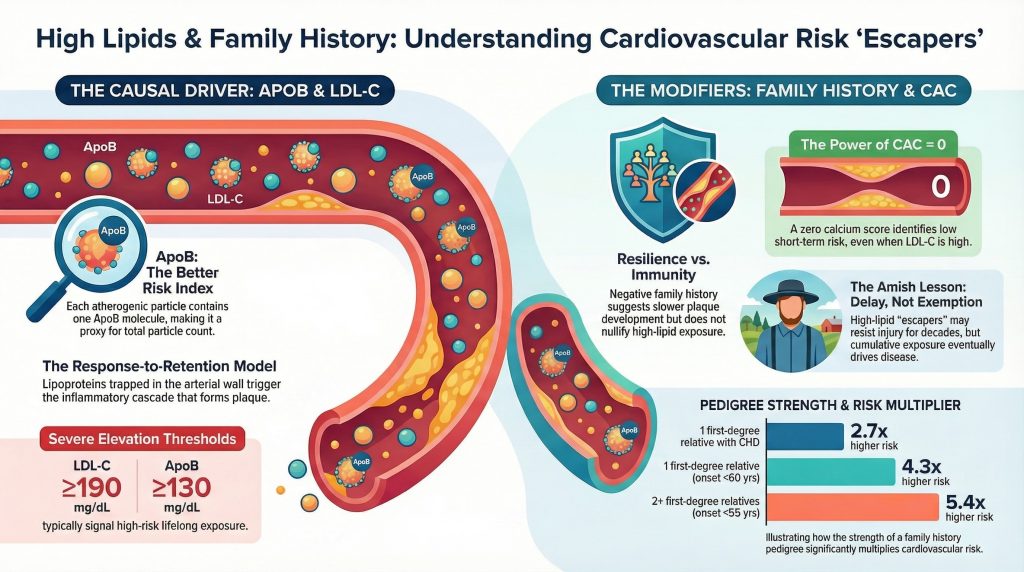
O modelo contemporâneo de aterosclerótico doença cardiovascular (ASCVD) sustenta que a circulação apolipoproteína B (ApoB)-contendo lipoproteínas são causais em aterogênese, e esse risco é uma função tanto da magnitude quanto da duração da exposição.1,2 Dentro deste contexto, a lipoproteína de baixa densidade colesterol (LDL-C) continua sendo o principal alvo clínico, enquanto a ApoB é frequentemente a medida mais informativa mecanicamente, porque cada partícula aterogênica carrega uma única molécula de ApoB e, portanto, a ApoB serve como um índice direto de número de partículas aterogênicas.3
No entanto, trata-se de dois tipos diferentes de afirmação, e a distinção importa para tudo o que se segue. O papel causal da exposição cumulativa à ApoB é uma alegação mecanicista e genética apoiada por evidências concordantes de Randomização mendeliana, ensaios randomizados e coortes observacionais.1,3 Os limiares usados para agir sobre essa alegação são convenções de diretrizes. O 2026 ACC/AHA/Multisociety Dislipidemia A diretriz, que aposenta e substitui a diretriz de 2018, define hipercolesterolemia grave como LDL-C ≥190 mg/dL, não-HDL-C >220 mg/dL e/ou ApoB >140 mg/dL, e a trata como um grupo de manejo distinto no qual causas secundárias devem ser excluídas e maximamente toleradas estatina a terapia é recomendada (Classe 1).2 Adultos que se enquadram nesta definição também são avaliados adequadamente para hipercolesterolemia familiar (HF), particularmente na presença de tendão xantomas, uma genealogia sugestiva ou elevação documentada desde o início da vida.2,4
Contra esse pano de fundo, a prática clínica encontra repetidamente um subgrupo que parece contradizer o modelo: indivíduos com LDL-C ou ApoB acentuadamente elevados que chegam à meia-idade ou além sem infarto do miocárdio, doença coronariana clinicamente manifesta ou coronariopatia detectável calcificação. Isso levanta uma questão específica para a cardiologia preventiva: um resultado fortemente negativo histórico familiar da doença coronariana — particularmente uma que abrange várias gerações sem eventos prematuros — compensa significativamente o risco associado à alta exposição à ApoB?
A resposta defensível a partir das evidências atuais é mais restrita do que a pergunta. Um pedigree negativo é melhor compreendido como um marcador de menor observado susceptibilidade familiar. Não é um mecanismo de proteção demonstrado, e a magnitude de qualquer vantagem que confere dentro do grave hipercolesterolemia a população não foi quantificada diretamente. O ApoB alto permanece causalmente a montante; a história familiar descreve algo sobre o contexto no qual essa exposição é expressa.1,3
A reformulação clinicamente útil, portanto, não é se um heredograma negativo prova que o LDL-C alto é inofensivo, mas se ele ajuda a identificar um fenótipo no qual a coronariana placa desenvolve-se mais lentamente — e, em caso afirmativo, se esse fenótipo pode ser confirmado por medição direta da doença, em vez de ser inferido apenas a partir da estrutura familiar. Essa questão pode ser abordada, porque escore de cálcio coronariano (ECC) fornece uma leitura direta de placa calcificada encargo acumulado até a data.2,5
Ao longo desta revisão, são utilizados três níveis de evidência, que não devem ser confundidos entre si:
| Nível | O que mede | Força da inferência |
| Exposição cumulativa à ApoB | Motorista causal ao longo da vida | Forte; causal |
| Histórico familiar e outros marcadores de suscetibilidade hereditária | Fatores associados ao risco manifestado em parentes | Indireto; heterogêneo; mal quantificado na direção inversa |
| CAC | Doença coronariana calcificada diagnosticada até o momento | Forte para doenças calcificadas relatadas até o momento; não mede a exposição futura nem placa não calcificada |
A primazia mecanicista da ApoB na aterogênese
A aterogênese é melhor descrita pela modelo de resposta à retenção.6 As lipoproteínas que contêm ApoB atravessam a barreira endotelial e entram na artéria íntima, e são retidas por meio da interação com os proteoglicanos da parede arterial. As partículas retidas sofrem modificações oxidativas e enzimáticas, o que promove a ativação endotelial, o recrutamento de monócitos, macrófago infiltração, formação de células espumosas, migração do músculo liso, núcleo necrótico desenvolvimento e, eventualmente, a progressão e a calcificação da placa.6 A concentração de colesterol no plasma é importante nesse contexto principalmente como um indicador da quantidade de partículas capazes de penetrar e ficar retidas na parede do vaso sanguíneo.
É por isso que a ApoB e o LDL-C podem apresentar divergências clinicamente significativas. Um paciente pode apresentar um grande número de partículas, mas com baixo teor de colesterol LDL partículas, produzindo um efeito aterogênico mais intenso carga de partículas do que o LDL-C por si só sugere; outra pode transportar menos partículas, porém mais ricas em colesterol. A ApoB, portanto, melhora a discriminação de risco em síndrome metabólica, hipertrigliceridemia, resistência à insulina, e diabetes, onde o LDL-C tende a subestimar a exposição real.3 A diretriz de 2026 reflete isso, recomendando a medição seletiva da ApoB para avaliar risco residual e aprimorar as decisões terapêuticas, mantendo o LDL-C como a principal meta, uma vez que as metas das diretrizes e a grande maioria dos ensaios clínicos de resultados se baseiam nele.2,3
Se a elevação ao longo da vida da ApoB for o principal fator impulsionador da aterogênese, então qualquer proteção aparente deve atuar a jusante da exposição, em vez de anulá-la. Vários mecanismos poderiam, em princípio, explicar uma manifestação mais lenta da doença para uma determinada carga de partículas: permeabilidade endotelial reduzida à entrada de lipoproteínas, menor espessura da íntima retenção de proteoglicanos, adesão atenuada dos monócitos ou amplificação inflamatória, composição mais favorável da placa ou resposta trombótica reduzida a ruptura da placa.
Essas são hipóteses, e não explicações comprovadas para o histórico familiar negativo. Nenhum estudo comprovou que indivíduos com histórico familiar normal e níveis elevados de ApoB apresentem qualquer uma dessas características. Elas são apresentadas aqui como mecanismos possíveis que seriam consistentes com o fenótipo observado e que definem questões passíveis de teste, e não como uma explicação do que está ocorrendo nesses pacientes.1,6
Evidências genéticas da modificação do risco de ASCVD
Humano genética estabelece que a variação hereditária pode alterar substancialmente o risco cardiovascular. O exemplo mais claro é PCSK9. A PCSK9 promove a degradação da proteína hepática Receptores de LDL; as variantes de perda de função preservam a reciclagem do receptor e reduzem o LDL-C ao longo da vida. No estudo de Cohen et al., os negros portadores de variantes sem sentido apresentaram um nível de LDL-C aproximadamente 28% mais baixo e um risco 88% menor de doença cardíaca coronariana, enquanto os indivíduos de raça branca portadores da variante R46L apresentaram um nível de LDL-C aproximadamente 15% mais baixo e um risco 47% menor.7
É preciso fazer aqui uma distinção importante, pois essas evidências são frequentemente utilizadas de forma equivocada. As variantes do PCSK9 não demonstram efeito protetor apesar de níveis elevados de ApoB. Eles reduzem a própria exposição causal, e fazem isso desde o nascimento. A redução desproporcional do risco em relação à modesta diferença no LDL-C constitui uma evidência contundente da importância de duração de exposição — trata-se de um argumento a favor da primazia da ApoB cumulativa, e não de um argumento de que a biologia hereditária possa neutralizá-la.1,7
Outros loci sugerem que o risco também pode ser modificado por meio de vias que não são puramente uma função da concentração de LDL-C. Um mendeliano randomização Uma análise da via do receptor da interleucina-6 (IL6R) revelou que a variante Asp358Ala, que altera IL-6 A sinalização inflamatória foi associada a uma redução modesta no risco de doença cardíaca coronariana, corroborando uma contribuição causal da sinalização inflamatória para a progressão da placa, independentemente dos níveis lipídicos.8 Variantes em APOC3 e ANGPTL3, por outro lado, são frequentemente agrupados com o IL6R nesse contexto, mas não deveriam ser: seu principal efeito é reduzir os ricos em triglicerídeos partículas remanescentes e, portanto, a exposição total a partículas aterogênicas.3 Esses são mais exemplos de redução da exposição, e não de resiliência diante de uma exposição fixa. As evidências sobre o IL6R, portanto, fornecem um exemplo mais claro de modificação do risco que ocorre a jusante da carga de partículas.
O que essas observações, em conjunto, sustentam é uma afirmação menos forte, mas ainda assim significativa: dois indivíduos com níveis idênticos de LDL-C podem seguir trajetórias clínicas diferentes, devido a fatores hereditários que envolvem a Lp(a), o metabolismo dos resíduos, a sinalização inflamatória, função endotelial, e trombose variam independentemente do LDL-C. Um fenótipo vascular comparativamente resiliente continua sendo uma hipótese organizadora razoável para essa heterogeneidade, mas ainda não foi demonstrado como uma entidade discreta e mensurável, e nenhum exame clínico o identifica. Um histórico familiar negativo é, no máximo, um indício rudimentar e indireto de que um paciente pode situar-se na extremidade favorável dessa distribuição — ele não permite identificar qual via está envolvida, nem estabelecer se alguma vantagem é duradoura ou se apenas retarda a manifestação.1,8
Um exemplo de população fundadora: o APOB R3500Q entre os Amish da Velha Ordem
Os Amish da Pensilvânia variante do fundador em APOB oferece um experimento natural instrutivo, embora sua generalização seja limitada e isso deva ser deixado claro desde o início. ApoB-100 defeituosa de origem familiar devido ao fato de que a variante R3500Q (p.Arg3527Gln) causa elevação do LDL ao longo da vida em uma população com um background genético excepcionalmente homogêneo, um estilo de vida comum e fisicamente ativo, e uma frequência de portadores de aproximadamente 12% — em comparação com 0,1% a 0,4% em populações europeias brancas.9
Exames de imagem transversal em crianças e jovens adultos da comunidade Amish portadores dessa variante revelaram níveis elevados de LDL-C e aumento de número de partículas de LDL sem que se detecte aterosclerose pela carótida espessura intimal-medial ou velocidade da onda de pulso.10 Esse achado é frequentemente citado como evidência de tolerância vascular. Sua relevância deve ser avaliada em função do desenho do estudo: a coorte foi composta por 13 heterozigotos, 3 homozigotos e 9 irmãos não afetados com a mesma faixa etária, e os desfechos de imagem foram medidas substitutas em crianças. A ausência de doença subclínica detectável em uma coorte desse tamanho e faixa etária é consistente com resiliência vascular, mas isso também está de acordo com o simples fato de que a aterosclerose leva décadas para se tornar mensurável por meio dessas técnicas.10
Os dados de portadores adultos são consideravelmente mais informativos e apontam na direção oposta. Em um estudo de associação do genoma completo com replicação, envolvendo 1.504 participantes Amish, dos quais 1.018 foram submetidos a exame de CAC, os portadores da mutação R3500Q apresentaram níveis de LDL-C, em média, 58 mg/dL mais elevados do que os não portadores, uma probabilidade 4,41 vezes maior de CAC detectável (IC 95% 2,69–7,21) e uma probabilidade 9,28 vezes maior de CAC extensa.9 A variante foi responsável por 26% da variação no LDL-C e por 7% da variação no CAC.9
Duas conclusões se impõem, além de uma terceira advertência. Primeiro, em uma população com estilo de vida favorável e perfil genético homogêneo, a elevação do LDL ao longo da vida ainda resultou em um grande excesso de doença coronariana subclínica na meia-idade. Qualquer tolerância sugerida pelos dados de exames de imagem pediátricos não persistiu. Em segundo lugar, esse padrão é consistente com um atraso, e não com uma isenção: a parede vascular pode resistir a lesões mensuráveis por décadas, mas a exposição é contínua. Em terceiro lugar, e mais importante, uma correspondência publicada observou que a proporção de portadores e não portadores que relataram histórico de eventos cardiovasculares clínicos foi semelhante nessa coorte11 — o sinal de calcificação foi forte, enquanto o sinal de eventos graves nessa população relativamente jovem, avaliada transversalmente, não o foi. Isso limita até que ponto os dados da comunidade Amish podem ser utilizados para formular conclusões sobre desfechos clínicos.
A relevância desse exemplo para o histórico familiar negativo é real, mas limitada. Ele mostra que um contexto genético e ambiental favorável pode coexistir com um acúmulo substancial de doenças subclínicas. A extrapolação a partir de um população fundadora A comparação entre uma variante específica da ApoB e a população geral de pacientes com hipercolesterolemia grave serve mais para gerar hipóteses do que para confirmá-las.9,10
O que o histórico familiar contribui para a avaliação de risco
O histórico familiar é um indicador clínico condensado que reflete simultaneamente a herança genética compartilhada, os comportamentos compartilhados e o ambiente compartilhado. Um histórico familiar positivo de doença coronariana, particularmente doença precoce, é um fator de aumento de risco bem estabelecido, e seu poder preditivo varia de acordo com o rigor da definição do pedigree. No Estudo de Histórico Familiar de Newcastle II, a razão de chances estimada para um evento coronariano agudo aumentou de aproximadamente 2,7 para pelo menos um parente de primeiro grau com doença cardíaca coronariana em qualquer idade; para 4,3, no caso de pelo menos um parente de primeiro grau afetado antes dos 60 anos; e para 5,4, no caso de dois ou mais parentes de primeiro grau afetados antes dos 55 anos.12 Análises no Coorte Framingham Offspring da mesma forma, demonstrou que as doenças cardiovasculares dos pais eram um fator preditivo de eventos nos filhos, após o ajuste para os fatores convencionais fatores de risco.13
Essas estimativas quantificam o risco adicional associado a um histórico familiar positivo. Elas não fornecem a estimativa inversa — a proteção conferida por um histórico familiar negativo entre pacientes com LDL-C ≥ 190 mg/dL. Essa grandeza inversa não foi medida diretamente na população com hipercolesterolemia grave e não pode ser obtida pela inversão de uma razão de chances estimada em um estudo de caso-controle realizado na população geral. Essa é a limitação mais importante do argumento sobre o histórico familiar protetor e se aplica a todas as inferências clínicas apresentadas a seguir.
O histórico familiar também está relacionado à doença subclínica, e não apenas aos eventos clínicos. No Estudo Multiétnico de Aterosclerose, um histórico familiar de doença cardíaca coronariana prematura foi associado a maior prevalência e extensão da doença coronariana artéria calcificação após o ajuste para os fatores de risco tradicionais.14 Isso reforça a interpretação do histórico familiar como um marcador de suscetibilidade que se manifesta precocemente no curso da doença, e é parte do motivo pelo qual a ausência desse histórico em um paciente com níveis elevados de ApoB e sem cálcio é internamente coerente, e não paradoxal.
A interpretação clínica razoável é, portanto, moderada: em um paciente com LDL-C ou ApoB marcadamente elevados, um histórico familiar fortemente negativo indica a ausência de um fator adicional reconhecido de aumento do risco; o histórico familiar de ASCVD prematura está entre os fatores que a diretriz de 2026 orienta os médicos a levar em consideração além da estimativa de risco calculada.2 Isso não comprova uma menor suscetibilidade hereditária, pois a suscetibilidade não é observada diretamente — apenas sua manifestação nos parentes é observada.
Vários modos de falha na interpretação da árvore genealógica merecem atenção específica neste momento, em vez de serem tratados como uma advertência final, pois influenciam se o sinal tem algum significado para um determinado paciente:
- Ocultação do tratamento. Parentes que receberam tratamento eficaz com estatinas, anti-hipertensivos, ou revascularização antes de um evento possa fazer com que um pedigree de alto risco real apresente um resultado superficialmente negativo.
- Família pequena. Uma árvore genealógica com poucos parentes de primeiro grau tem capacidade limitada de indicar o risco familiar, mesmo quando esse risco existe.
- Mortalidade concorrente. A morte por outras causas pode suprimir a expressão coronariana nas gerações anteriores.
- Ambiental confundível. Comportamentos favoráveis compartilhados podem ser confundidos com proteção hereditária, e comportamentos adversos compartilhados, com risco hereditário.
- Qualidade da recuperação e da documentação. O histórico familiar relatado pelo próprio paciente é imperfeito e, em particular, a identificação de eventos prematuros costuma não ser confiável.
Histórico familiar e risco poligênico: o que pode e o que não pode ser inferido
É tentador interpretar um histórico familiar negativo como evidência de baixa carga poligênica agregada. Essa inferência não tem fundamento. O histórico familiar e escores de risco poligênico estão correlacionados, mas são distintos: o histórico familiar reflete a concentração observada da doença, incluindo seus determinantes ambientais e comportamentais, enquanto escores poligênicos estimar a carga hereditária a partir de variantes medidas diretamente. Cada uma delas contribui com informações que a outra não possui, e não se pode presumir que uma árvore genealógica negativa represente uma baixa pontuação poligênica em qualquer paciente específico.13,15
O que a literatura sobre poligenia de fato aponta é que variantes comuns de pequeno efeito influenciam significativamente tanto a idade de início quanto a probabilidade de doença coronariana, e que esse risco pode ser modificado pelo estilo de vida.15 Portanto, é biologicamente plausível que um paciente com níveis elevados de LDL-C e baixa suscetibilidade hereditária agregada permaneça sem eventos por um período substancialmente mais longo do que um paciente com os mesmos níveis de LDL-C e alta carga poligênica. Para comprovar isso em um determinado paciente, é necessário medir a pontuação poligênica, e não inferi-la a partir da árvore genealógica.
Também vale a pena distinguir, na lista de fatores que influenciam a forma como uma determinada carga de ApoB se manifesta, os fatos comprovados dos que são meras suposições:
- Comprovados, mensuráveis e associados de forma independente a eventos: Lp(a), pressão arterial, estado glicêmico, tabagismo, carga de remanentes ricos em triglicerídeos, hs-CRP e — como medida da doença acumulada, e não da suscetibilidade — CAC.
- Biologicamente plausíveis, mas não mensuráveis rotineiramente nem validados como modificadores em nível individual: permeabilidade endotelial, capacidade de retenção da íntima, ponto de equilíbrio inflamatório, composição da placa e responsividade trombótica.
Ambos os conjuntos são reais; porém, atualmente, apenas o primeiro pode orientar o tratamento de um paciente específico. Essa assimetria é o principal argumento para priorizar a medição direta da doença em detrimento da inferência a partir do histórico genético.
CAC: Medição direta da placa coronariana calcificada
Quando a questão é saber se um determinado paciente com níveis elevados de LDL-C apresenta, atualmente, aterosclerose coronariana, a pontuação de CAC responde a essa pergunta de forma mais direta do que qualquer histórico familiar. Isso é particularmente importante na hipercolesterolemia grave, em que a estimativa baseada nos lipídios pode superestimar de curto prazo risco em alguns pacientes, embora continue correto no que diz respeito ao risco ao longo da vida.
Os dados mais diretamente relevantes provêm do MESA análise de Sandesara et al.5 Entre os 246 participantes do estudo MESA sem doença cardiovascular clínica e com LDL-C basal ≥190 mg/dL (idade média de 63 ± 9,4 anos; LDL-C médio de 215 ± 27 mg/dL), 37% apresentavam CAC = 0. Idade mais jovem, sexo feminino e ausência de diabetes foram associados a CAC = 0. Ao longo de um acompanhamento mediano de 13,2 anos, aqueles com CAC = 0 apresentaram uma taxa de eventos cardiovasculares de 4,7 por 1.000 pessoas-ano (risco em 10 anos: 3,7%), em comparação com 26,4 por 1.000 pessoas-ano (risco em 10 anos: 20%) entre aqueles com CAC > 0, correspondendo a um risco ajustado razão de riscos de 0,25 (IC 95% de 95%, 0,10–0,66).5
A razão de risco ajustada, e não a razão de taxa de incidência bruta, é a estimativa ajustada adequada do efeito. Isso não significa que a elevação grave do LDL se torne benigna na ausência de cálcio. Significa, sim, que CAC = 0 identifica um subgrupo com taxas observadas de eventos a curto prazo substancialmente mais baixas, apesar da elevação grave do LDL. É precisamente nesse contexto que um histórico familiar negativo se torna clinicamente coerente: os dois achados são marcadores concordantes de um fenótipo observado mais favorável, apesar da hipercolesterolemia grave.
Três limitações restringem essa inferência, e a terceira é frequentemente ignorada:
- O CAC identifica a placa calcificada, e não toda a placa. Pacientes com CAC = 0 podem apresentar placa não calcificada ou mista, e eventos realmente ocorrem nesse grupo — a uma taxa de aproximadamente 0,41 TP9T por ano na população descrita acima,5 que é baixo, mas não é zero.
- A coorte do estudo MESA era composta por pessoas de meia-idade a idosas. Um CAC igual a 0 aos 63 anos, após décadas de exposição, é um achado substancialmente mais tranquilizador do que um CAC igual a 0 aos 40 anos, idade em que talvez simplesmente não tenha decorrido tempo suficiente para que a calcificação se desenvolvesse. A idade no momento do exame altera significativamente o significado do resultado.
- O protocolo de adiamento baseado no CAC e o protocolo para hipercolesterolemia grave não são intercambiáveis. Nas diretrizes de 2026, a pontuação seletiva do CAC para reclassificar o risco e, potencialmente, adiar a terapia hipolipemiante está inserida no âmbito de prevenção primária para adultos com risco limítrofe ou intermediário de ASCVD a 10 anos, segundo o estudo PREVENT-ASCVD, sendo recomendado a repetição do exame em 3 a 7 anos caso o tratamento seja adiado.2 A hipercolesterolemia grave com LDL-C ≥ 190 mg/dL é tratada como um grupo de manejo separado, no qual a terapia com estatinas na dose máxima tolerada recebe uma recomendação de Classe 1 e as equações de risco para a população em geral não são explicitamente utilizadas.2 Um CAC igual a 0 refina a estimativa de atual doença nesse paciente; isso não o encaminha para o processo de adiamento.
O CAC e o histórico familiar podem, portanto, ajudar a caracterizar o risco a curto prazo e servir de base para tomada de decisão compartilhada sobre a implementação do tratamento e a avaliação adicional de risco; elas não devem ser utilizadas para determinar um baixo risco ao longo da vida nem para fornecer uma justificativa baseada em evidências para a suspensão da terapia.2,5
Lp(a), hs-CRP e contexto metabólico
Os argumentos a favor de um perfil de risco observado mais baixo são mais sólidos quando um histórico familiar negativo é acompanhado por valores medidos favoráveis biomarcadores.
A Lp(a) é o mais importante desses marcadores, pois confere risco aterogênico e protrombótico independentemente do LDL-C e é, em grande parte, determinada geneticamente. A atualização direcionada da National Lipid Association recomenda a medição da Lp(a) pelo menos uma vez em todos os adultos, sendo que valores abaixo de 75 nmol/L (ou <30 mg/dL) são considerados de baixo risco e valores ≥125 nmol/L (ou ≥50 mg/dL) são tratados como fatores de aumento do risco.16 A diretriz da ACC/AHA de 2026 também recomenda a realização universal de uma única medição de Lp(a) ao longo da vida e considera os níveis de 125 nmol/L (50 mg/dL) ou superiores como fatores de aumento do risco, associados a um aumento de aproximadamente 1,4 vezes no risco de ASCVD, com um aumento de cerca de 2 vezes a partir de 250 nmol/L (100 mg/dL) ou mais.2 Um paciente com LDL-C elevado, mas Lp(a) baixo, não apresenta um importante fator hereditário que acelera a progressão da placa e a trombose — e, notavelmente, um fator que é diretamente mensurável, em vez de inferido.
Proteína C-reativa de alta sensibilidade (hs-PCR) fornece um indicador aproximado da ativação inflamatória sistêmica e é reconhecido como um dos fatores que aumentam o risco nas diretrizes de 2026;2 O limite de ≥2,0 mg/L, comumente utilizado, deriva da convenção estabelecida na diretriz anterior.4 Um nível persistentemente baixo de hs-CRP é, em princípio, favorável, mas não indica a ausência de doença arterial inflamação, e isso não deve ser interpretado como indício de resiliência vascular. Nos casos em que há histórico familiar negativo, juntamente com baixos níveis de Lp(a), baixos níveis de hs-CRP, pressão arterial normal, glicemia normal, baixos triglicerídeos, e com CAC = 0, a afirmação correta é que o perfil de risco geral medido do paciente é mais favorável do que o valor do LDL-C por si só indica — e não que tenha sido constatada uma trajetória aterosclerótica mais lenta.
O contexto metabólico contribui de maneira semelhante. Em insulina resistência e hipertrigliceridemia, a ApoB frequentemente revela um excesso de partículas que o LDL-C oculta. Por outro lado, um paciente com elevação isolada do LDL, triglicerídeos baixos e parâmetros cardiometabólicos favoráveis em outros aspectos pode apresentar um perfil de risco observado a curto prazo menor do que um paciente com o mesmo nível de LDL-C, mas inserido em um quadro mais amplo de disfunção metabólica. A distinção, em todo o contexto, está entre o ritmo e a causalidade: um contexto metabólico favorável pode estar associado a uma manifestação mais lenta da doença, sem que isso torne inofensiva a elevação da ApoB ao longo da vida.2,3
Interpretação clínica e os limites do argumento da proteção
A síntese mais sólida e defensável é a seguinte: um histórico familiar negativo pode identificar pacientes com risco menor em comparação com pacientes semelhantes que apresentam histórico familiar de ASCVD precoce, mas a magnitude dessa diferença na população com hipercolesterolemia grave é mal quantificada e não foi estimada diretamente. Isso justifica uma abordagem menos alarmista em relação ao risco a curto prazo. Não justifica, porém, a afirmação de que a hipercolesterolemia grave seja segura quando não tratada ao longo da vida.2,5,12
Risco observado. Nos dados de coorte mais recentes disponíveis, adultos assintomáticos com LDL-C ≥ 190 mg/dL e CAC = 0 apresentaram uma taxa observada de eventos cardiovasculares de aproximadamente 0,41 TP9T por ano.5 Os dados disponíveis não permitem estabelecer uma taxa de incidência específica para o fenótipo mais seletivo de CAC = 0, combinado com histórico familiar negativo, baixos níveis de Lp(a) e fatores favoráveis saúde metabólica. O risco ao longo da vida, no entanto, continua elevado, pois a exposição cumulativa à ApoB continua a aumentar.
Tratamento. A recomendação das diretrizes para este paciente permanece inalterada em relação ao exposto acima: devem-se excluir causas secundárias, e recomenda-se terapia com estatinas na dose máxima tolerada (Classe 1), com metas de LDL-C definidas de acordo com a presença de HF, aterosclerose subclínica, ou fatores de risco adicionais.2 Nenhum estudo clínico avaliou uma estratégia de monitoramento serial em substituição à terapia hipolipemiante em pacientes com LDL-C ≥190 mg/dL e CAC = 0. Na ausência de tais evidências, marcadores favoráveis podem, razoavelmente, contribuir para a formulação da decisão compartilhada, para a avaliação adicional do risco e para a consideração de um intervalo para a repetição do exame de imagem — mas não constituem uma base fundamentada em evidências para suspender a terapia hipolipemiante recomendada pelas diretrizes. Apresentá-los como tal excederia o que os dados comprovam.
Conclusão
Um histórico familiar fortemente negativo de doença coronariana pode identificar indivíduos nos quais a manifestação clínica do risco associado aos lipídios é tardia ou menos pronunciada. Isso deve ser interpretado como um indicador de menor suscetibilidade familiar observada, e não como um mecanismo protetor comprovado, e não neutraliza a exposição à ApoB ao longo da vida.
Os mecanismos propostos anteriormente continuam sendo hipóteses. Nenhum deles se mostrou capaz de explicar os quadros clínicos observados na prática clínica, e nenhum é atualmente mensurável em um paciente específico.1,8,16
A conclusão prática é uma divisão de tarefas entre três fontes distintas de informação:
A exposição cumulativa à ApoB descreve o risco causal ao longo da vida. O CAC descreve a extensão da doença coronariana calcificada que realmente se manifestou até o momento. O histórico familiar fornece informações adicionais, porém indiretas, sobre a suscetibilidade e não pode indicar proteção.
Pacientes com hipercolesterolemia grave e CAC = 0 podem, no entanto, apresentar baixas taxas observadas de eventos a curto prazo.5 Um histórico familiar negativo e biomarcadores medidos favoráveis fornecem informações adicionais sobre o risco, mas seu efeito incremental nesse subgrupo com CAC = 0 ainda não foi quantificado diretamente. A exposição causal, no entanto, continua atuando em segundo plano; é por isso que os cuidados baseados nas diretrizes continuam a tratar o LDL-C ≥190 mg/dL como uma categoria de manejo distinta, que justifica tratamento, independentemente do risco calculado para 10 anos.2 Um histórico familiar negativo pode estar associado a uma manifestação tardia e atenuada do risco de hipercolesterolemia; no entanto, isso não elimina os mecanismos biológicos que tornam perigosa a exposição prolongada à ApoB.
Referências
- Ference BA, Ginsberg HN, Graham I, et al. Low-density lipoproteins cause atherosclerotic cardiovascular disease. 1. Evidence from genetic, epidemiologic, and clinical studies. A consensus statement from the European Atherosclerosis Society Consensus Panel. Eur Heart J. 2017;38(32):2459-2472. doi:10.1093/eurheartj/ehx144
- Writing Committee. 2026 ACC/AHA/AACVPR/ABC/ACPM/ADA/AGS/APhA/ASPC/NLA/PCNA Guideline on the Management of Dyslipidemia: A Report of the American College of Cardiology/American Heart Association Joint Committee on Clinical Practice Guidelines. Circulation. 2026. doi:10.1161/CIR.0000000000001423. (Simultaneous publication: J Am Coll Cardiol. doi:10.1016/j.jacc.2025.11.016)
- Soffer DE, Marston NA, Maki KC, et al. Role of apolipoprotein B in the clinical management of cardiovascular risk in adults: An Expert Clinical Consensus from the National Lipid Association. J Clin Lipidol. 2024;18(5):e647-e663. doi:10.1016/j.jacl.2024.08.013
- Grundy SM, Stone NJ, Bailey AL, et al. 2018 AHA/ACC/AACVPR/AAPA/ABC/ACPM/ADA/AGS/APhA/ASPC/NLA/PCNA Guideline on the Management of Blood Cholesterol. Circulation. 2019;139(25):e1082-e1143. doi:10.1161/CIR.0000000000000625. [Retired and replaced by reference 2; retained here for historical reference only.]
- Sandesara PB, Mehta A, O’Neal WT, et al. Clinical significance of zero coronary artery calcium in individuals with LDL cholesterol ≥190 mg/dL: The Multi-Ethnic Study of Atherosclerosis. Atherosclerosis. 2020;292:224-229. doi:10.1016/j.atherosclerosis.2019.09.014
- Williams KJ, Tabas I. The response-to-retention hypothesis of early atherogenesis. Arterioscler Thromb Vasc Biol. 1995;15(5):551-561. doi:10.1161/01.atv.15.5.551
- Cohen JC, Boerwinkle E, Mosley TH Jr, Hobbs HH. Sequence variations in PCSK9, low LDL, and protection against coronary heart disease. N Engl J Med. 2006;354(12):1264-1272. doi:10.1056/NEJMoa054013
- Interleukin-6 Receptor Mendelian Randomisation Analysis (IL6R MR) Consortium, Swerdlow DI, Holmes MV, et al. The interleukin-6 receptor as a target for prevention of coronary heart disease: a mendelian randomisation analysis. Lancet. 2012;379(9822):1214-1224. doi:10.1016/S0140-6736(12)60110-X
- Shen H, Damcott CM, Rampersaud E, et al. Familial defective apolipoprotein B-100 and increased low-density lipoprotein cholesterol and coronary artery calcification in the Old Order Amish. Arch Intern Med. 2010;170(20):1850-1855. doi:10.1001/archinternmed.2010.384
- Williams KB, Horst M, Young M, et al. Clinical characterization of familial hypercholesterolemia due to an Amish founder mutation in apolipoprotein B. BMC Cardiovasc Disord. 2022;22(1):109. doi:10.1186/s12872-022-02539-3
- Ahmad Z, Garg A. Lack of cardiovascular disease among Old Order Amish with familial defective apolipoprotein B. Arch Intern Med. 2011;171(11):1039-1040. doi:10.1001/archinternmed.2011.238
- Silberberg JS, Wlodarczyk J, Fryer J, Robertson R, Hensley MJ. Risk associated with various definitions of family history of coronary heart disease. The Newcastle Family History Study II. Am J Epidemiol. 1998;147(12):1133-1139. doi:10.1093/oxfordjournals.aje.a009411
- Lloyd-Jones DM, Nam BH, D’Agostino RB Sr, et al. Parental cardiovascular disease as a risk factor for cardiovascular disease in middle-aged adults: a prospective study of parents and offspring. JAMA. 2004;291(18):2204-2211. doi:10.1001/jama.291.18.2204
- Nasir K, Budoff MJ, Wong ND, et al. Family history of premature coronary heart disease and coronary artery calcification: Multi-Ethnic Study of Atherosclerosis (MESA). Circulation. 2007;116(6):619-626. doi:10.1161/CIRCULATIONAHA.107.688739
- Khera AV, Emdin CA, Drake I, et al. Genetic risk, adherence to a healthy lifestyle, and coronary disease. N Engl J Med. 2016;375(24):2349-2358. doi:10.1056/NEJMoa1605086
- Koschinsky ML, Bajaj A, Boffa MB, et al. A focused update to the 2019 NLA scientific statement on use of lipoprotein(a) in clinical practice. J Clin Lipidol. 2024;18(3):e308-e319. doi:10.1016/j.jacl.2024.03.001