
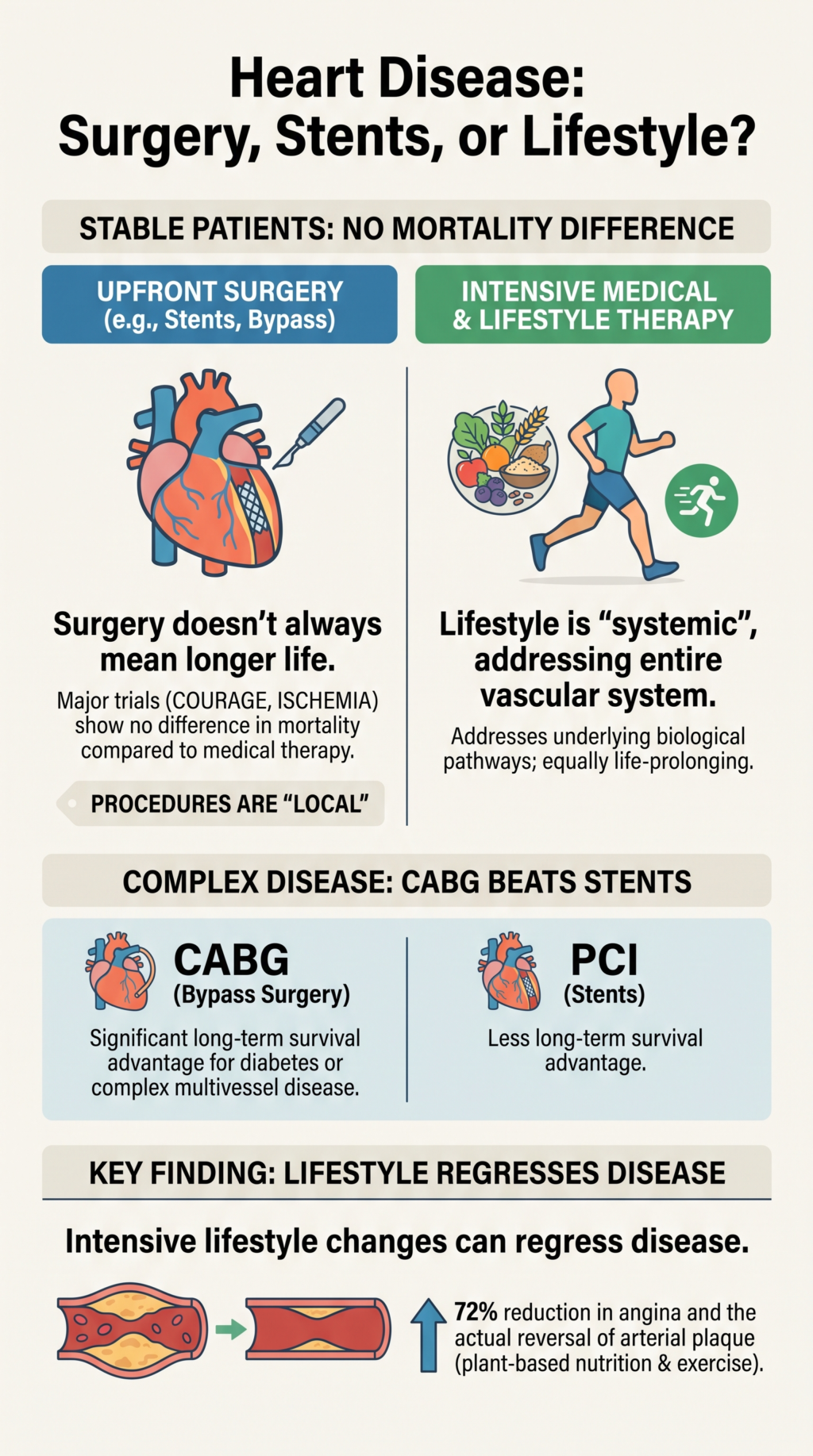
动脉粥样硬化性冠状动脉疾病血运重建方式与强化生活方式医学的临床、生理及病理生理学比较结果
摘要
在过去的二十年里,来自 随机对照试验 已将稳定型(慢性)冠状动脉综合征的管理模式从反射性干预范式重新构建为这样一种模式:在此模式下,指南指导下的药物治疗和强化生活方式干预被认为是许多稳定型疾病患者的核心管理策略。本综述综合了三个治疗领域的长期比较证据:(1)前期 血运重建 对比稳定期药物治疗 冠状动脉疾病; (2) 直接比较 经皮冠状动脉介入治疗 以及 冠状动脉旁路移植术(CABG); ;以及(3)强化生活方式疗法,包括全食物植物性营养,作为主要和辅助治疗。在COURAGE中,, 缺血, ,FAME 2 和 MASS II,对于稳定型疾病,常规血运重建并不能减少 全因死亡率 相对于最佳药物治疗,尽管它改善了 心绞痛 并减少了紧急血运重建。在解剖学复杂的的多支血管病变和糖尿病患者中,与PCI相比,CABG具有长期的生存优势。强化生活方式干预可减少心绞痛、炎症标志物,并在特定队列中, 血管造影消退 疾病。关于特定生活方式可减少支架内再狭窄或 支架 血栓形成 这些观点没有经过同行评议的原始数据支持,并且已被明确指出。建议与本综述中引用的 ACC/AHA 和 ESC 指南相对应。.
1. 一线治疗策略的比较性长期临床疗效
在过去的二十年里,稳定型慢性冠心病的处理方式发生了实质性的转变。历史上,限流性心外膜 狭窄 被视为进行机械血运重建以预防的指征 心肌梗死 并延长寿命。然而,现代随机试验数据表明,对于大多数病情稳定的患者,在初始血运重建与基于指南的药物治疗的保守治疗之间,存在广泛的临床均势。.
1.1 勇气
COURAGE(使用血运重建和积极药物治疗的临床结果)试验将 2,287 名病情稳定的冠心病患者随机分配至 动脉 疾病(CAD)以及心肌缺血的客观证据,在经皮冠状动脉介入治疗(PCI)加 最佳药物治疗 或仅至 OMT。在中位随访 4.6 年时,主要终点没有统计学上的显著差异 复合端点 全因死亡率或非致死性心肌梗死(MI)。1] 入组时间为1999年至2004年,主要采用 金属裸支架 且没有常规 血流储备分数 (血流储备分数)指导,批评者经常引用的局限性;约三分之二的参与者存在多支血管病变。1]
对COURAGE队列中1,211名患者(约53%,主要来自美国退伍军人事务部系统)进行的中位随访11.9年(最长随访达15年)的长期生存监测,证实了这种平衡状态的持续存在。 全因死亡率方面未见统计学上的显著差异,经调整后 风险比 (HR) 为 1.03(95% 置信区间 0.83–1.21)。[2] 在整个随访期间,生存曲线基本保持重合。.
1.2 缺血
医学与侵入性方法比较国际健康有效性研究(ISCHEMIA)通过强制采用当代临床实践,解决了对 COURAGE 试验的技术性质疑。ISCHEMIA 随机纳入了 5,179 名经无创负荷试验确诊为稳定型冠心病(CAD)且伴有中重度缺血的患者,将其分配至初始侵入性策略组(行血管造影,随后进行经皮冠状动脉介入治疗[PCI]并植入药物洗脱支架[DES]或冠状动脉旁路移植术[CABG],联合最佳药物治疗[OMT])或单纯 OMT 的初始保守策略组。3在3.2年的中位随访期间,包含五个成分的主要终点(心血管死亡、心肌梗死或因……住院) 不稳定型心绞痛, 心力衰竭, ,或已复苏 心脏骤停) 组间无显著差异。3]
1.3 ISCHEMIA-EXTEND
观察扩展,, ISCHEMIA-EXTEND, ,对存活的受试者进行了中位数为5.7年(最长达7年)的随访,期间共记录557例死亡——几乎是初始阶段死亡人数的两倍。 7年累计全因死亡率在积极治疗组为12.7%,在保守治疗组为13.4%(调整后HR 1.00;95% CI 0.85–1.18)。[4]
在死亡率各组成部分中出现了差异。侵入性治疗策略与7年时心血管死亡率的统计学显著相对降低相关(6.4% 对比 8.6%;调整后危险比 0.78; 95%置信区间 0.63–0.96),这相当于7年心血管死亡率的绝对差异为2.2个百分点。 这一获益被侵入性组中非心血管死亡率的统计学显著上升所抵消(5.6% 对比 4.4%;调整后HR 1.44; 95% 置信区间 1.08–1.91),因此对总生存率的净效应为中性。[4]
这里有两个注意事项。这些特定原因的死亡率发现在随机阶段结束后收集的观察性延长随访期间获得,因此它们是产生假设的结果,而不是随机比较。此外,非心血管死亡率信号的生物学基础仍无法解释且未经裁定。4]
1.4 FAME 2
Fractional Flow Reserve Versus Angiography for Multivessel Evaluation 2 (FAME 2) 试验对比了 FFR 指导的 PCI 加 OMT 与单纯 OMT 在患有稳定型冠心病且具有生理意义狭窄(FFR ≤ 0.80)的患者中的疗效;共纳入 1,220 名患者,其中 888 名患者至少有一处显著狭窄 病变 被随机分配。5] 5年随访时,以FFR为指导的PCI组在死亡、心肌梗死或紧急血运重建组成的主要复合终点发生率显著较低(13.9% 对比 27.0%; HR 0.46;95% CI 0.34–0.63;P < 0.001),该差异主要源于紧急再血管化,而死亡或心肌梗死两者的单独发生率均无统计学显著差异。[6]
随后报告了10年随访结果(中位数为11.2年),并采用“胜率”框架进行了分析。 主要复合终点结果显示PCI策略更具优势(获胜比1.25;95%置信区间1.01–1.56;P = 0.043),这再次主要归因于紧急血运重建率的显著降低(该组成部分的获胜比为4.57; 95% 置信区间 2.53–8.24),而死亡率这一组成部分则未显示出 PCI 的优势。[7因此,FAME 2研究的持久信号是随后紧急血运重建术的减少,而不是死亡率或自发性心肌梗死的统计学显著降低。.
1.5 质量 II
第二医学,, 血管成形术, ,或外科研究(MASS II)随机入选了 611 名患有稳定性多支冠状动脉病变(CAD)且心功能保存的患者 左心室射血分数 与冠状动脉旁路移植术(CABG)、经皮冠状动脉介入治疗(PCI)或单纯药物治疗相比。 10年时,各组的全因生存率在统计学上无显著差异:CABG组为74.9%,PCI组为75.1%,药物治疗组为69.0%(P = 0.089)。[8] 药物治疗组的10年心肌梗死(MI)累积发生率更高(20.7%,而冠状动脉旁路移植术组为10.3%,经皮冠状动脉介入治疗组为13.3%;P < 0.010)。 随访期间再次血运重建的发生率在CABG组最低(7.4%),而在PCI组(41.9%)和药物治疗组(39.4%)均较高; P < 0.001),这反映出外科血运重建在避免重复手术方面具有持久性优势。[8]
表 1. 主要治疗策略试验:稳定性冠心病患者血运重建与药物治疗的对比。.
| 试用 | 同类群组 / 对比 | 后续 | 主要发现 |
| 勇气 | N = 2,287;病情稳定的冠心病(CAD)伴缺血;PCI + OMT 对比 OMT | 4.6年;子集至15年 | 在4.6年时,死亡/心肌梗死无显著差异。.
延长(中位 11.9 年):调整后死亡 HR 1.03(0.83–1.21)。. |
| 缺血 | N = 5,179;中度至重度缺血;有创与保守治疗 | 3.2年 | 5个成分的主要终点没有显着差异。. |
| ISCHEMIA-EXTEND | 同队列;观察性扩展 | 5.7岁(至7岁) | 7年全因死亡率:12.7% 对比 13.4%(调整后风险比 1.00;绝对风险差 0.7 个百分点)。.
心血管死亡率:6.4% 对比 8.6%(HR 0.78; 绝对风险差 2.2 个百分点);非心血管死亡 5.6% 对比 4.4%(HR 1.44);净效应中性(观察性研究)。. |
| FAME 2 | N = 1,220;FFR ≤ 0.80;FFR指导的PCI与OMT对比 | 5年;10年(中位数为11.2年) | 5年复合终点13.9%与27.0%(HR 0.46;ARD 13.1个百分点),主要归因于紧急血运重建。.
10年期获胜比1.25;未显著降低死亡率或心肌梗死发生率。. |
| 质量 II | N = 611;多支病变,射血分数保留;CABG与PCI与MT对比 | 10年 | 10年生存率分别为74.9%、75.1%和69.0%(P = 0.089)。.
在冠状动脉旁路移植术(CABG)(10.3%)、经皮冠状动脉介入治疗(PCI)(13.3%)和药物治疗(MT)(20.7%)中,MI发生率最低。. |
OMT,最佳药物治疗;MT,药物治疗;EF,, 射血分数; HR,风险比(括号内为95%置信区间);ARD,, 绝对风险 比较组之间的差异(百分点)。.
2. 血运重建方式:直接对比分析
对于解剖结构复杂或多支病变的冠心病患者,血运重建方式的选择至关重要。多项大型随机对照试验及其扩展随访研究,直接对比了使用当代药物洗脱支架的经皮冠状动脉介入治疗(PCI)与冠状动脉旁路移植术(CABG)。.
2.1 句法 / 句法系统
The Synergy Between PCI with TAXUS and Cardiac Surgery (SYNTAX) trial randomized 1,800 patients with de novo three-vessel disease (3VD) or left main coronary artery disease (LMCAD) to PCI with first-generation paclitaxel-eluting stents or to CABG. [9] In the 10-year SYNTAX Extended Survival (SYNTAXES) study, overall all-cause mortality did not differ significantly between arms (27% with PCI vs. 24% with CABG; P = 0.092), but a significant treatment-by-anatomy interaction was present. In the 3VD cohort, CABG conferred a survival advantage (mortality 28% with PCI vs. 21% with CABG), whereas in the LMCAD cohort there was no statistically significant difference (26% with PCI vs. 28% with CABG; P for interaction = 0.019). [10]
Completeness of revascularization was a determinant of long-term survival: incomplete revascularization was more common after PCI than CABG, and patients undergoing PCI with incomplete revascularization had higher 10-year mortality than those undergoing CABG with complete revascularization. [10]
2.2 FREEDOM
The Future Revascularization Evaluation in Patients with 糖尿病 Mellitus (FREEDOM) trial randomized 1,900 patients with diabetes and multivessel CAD to PCI with first-generation DES or to CABG, on a background of OMT. At 5 years, the primary composite of death, MI, or 中风 was significantly lower with CABG (18.7% vs. 26.6%; P = 0.005), driven by reductions in all-cause mortality (10.9% vs. 16.3%) and MI (6.0% vs. 13.9%; P < 0.001). Stroke was more frequent in the CABG arm (5.2% vs. 2.4%; P = 0.03). [11]
In the FREEDOM Follow-On study, a subgroup of 943 patients was tracked for a median of 7.5 years (up to 13.2 years). CABG maintained a survival advantage, with all-cause mortality of 18.3% versus 24.3% with PCI (HR 1.36; 95% CI 1.07–1.74; P = 0.01). [12]
2.3 Left Main Disease: PRECOMBAT, EXCEL, and NOBLE
The 10-year PRECOMBAT trial randomized 600 patients with LMCAD to PCI with sirolimus-eluting stents or to CABG. There were no statistically significant differences in the primary composite of major adverse cardiac or cerebrovascular events (MACCE; 29.8% with PCI vs. 24.7% with CABG; HR 1.25; 95% CI 0.93–1.69), all-cause mortality (14.5% vs. 13.8%; HR 1.13; 95% CI 0.75–1.70), or the hard composite of death, MI, or stroke (18.2% vs. 17.5%). Ischemia-driven target-vessel revascularization was approximately twofold higher after PCI (16.1% vs. 8.0%; HR 1.98; 95% CI 1.21–3.21). [13]
The Evaluation of XIENCE versus CABG for Effectiveness of Left Main Revascularization (EXCEL) trial randomized 1,905 patients with LMCAD of low or intermediate anatomical complexity to PCI with everolimus-eluting stents or to CABG. At 5 years, the primary composite of death, stroke, or MI did not differ significantly (22.0% with PCI vs. 19.2% with CABG; P = 0.13). All-cause mortality was higher in the PCI group (13.0% vs. 9.9%; odds ratio 1.38; 95% CI 1.03–1.85), a finding that was contested because cardiovascular mortality did not differ significantly (5.0% vs. 4.5%). [14]
The EXCEL results generated substantial controversy. Much of the disagreement centered on the definition of myocardial infarction used to adjudicate events: the trial’s protocol definition emphasized post-procedural 生物标志物 thresholds, whereas critics argued that applying the Third Universal Definition of MI would have shifted the relative MI counts between arms and, with them, the interpretation of the primary composite. Periprocedural versus spontaneous MI weighting, and how those events map onto long-term prognosis, remained the crux of the dispute. [14], [15]
The Nordic–Baltic–British Left Main Revascularisation Study (NOBLE) randomized 1,201 patients with LMCAD to PCI with biolimus-eluting stents or to CABG. In the updated analysis, PCI was associated with worse 5-year MACCE outcomes than CABG (28.4% vs. 19.0%; HR 1.58; 95% CI 1.24–2.01; P = 0.0002), driven by higher rates of non-procedural MI (7.6% vs. 2.7%) and repeat revascularization (17.1% vs. 10.2%). All-cause mortality did not differ significantly between groups. [16], [17]
2.4 BEST
The Randomized Comparison of Bypass Surgery Versus Everolimus-Eluting Stent Implantation for Multivessel Coronary Artery Disease (BEST) trial randomized 880 patients to PCI with everolimus-eluting stents or to CABG. At an extended median follow-up of 11.8 years, the primary endpoint of death, MI, or target-vessel revascularization occurred in 34.5% of the PCI group and 30.3% of the CABG group (HR 1.18; 95% CI 0.88–1.56; P = 0.26). All-cause mortality (20.5% vs. 19.9%) and stroke (5.3% vs. 5.7%) were similar, but repeat revascularization remained higher after PCI (22.6% vs. 12.7%; HR 1.92; P < 0.001), and spontaneous MI was more frequent after PCI. [18], [19]
2.5 FAME 3
The FAME 3 trial randomized 1,500 patients with three-vessel CAD to FFR-guided PCI with zotarolimus-eluting stents or to CABG. It did not meet its prespecified 1-year non-inferiority margin for the composite of death, MI, stroke, or repeat revascularization. [20] At 3 years, the composite of death, MI, or stroke did not differ significantly (12.0% with PCI vs. 9.2% with CABG; HR 1.30; 95% CI 0.98–1.83; P = 0.07), although MI (7.0% vs. 4.2%) and repeat revascularization (11.1% vs. 5.9%) were higher after PCI, while all-cause mortality was similar. [21]
Table 2. Head-to-head trials of PCI versus CABG (extended follow-up where available).
| 试用 | Focus (N) | Mortality (PCI vs. CABG) | Durability / safety |
| SYNTAXES | 3VD or LMCAD (1,800) | 10-y: 27% vs. 24% (P = 0.092; ARD 3 pp).
3VD: 28% vs. 21% (ARD 7 pp). LMCAD: 26% vs. 28% (NS). |
Incomplete revascularization more common after PCI; associated with higher 10-y death. |
| FREEDOM | Diabetes + multivessel (1,900) | 7.5-y: 24.3% vs. 18.3% (HR 1.36; 1.07–1.74; ARD 6.0 pp). | 5-y MI 13.9% vs. 6.0%; stroke higher with CABG (5.2% vs. 2.4%). |
| PRECOMBAT | LMCAD (600) | 10-y: 14.5% vs. 13.8% (HR 1.13; 0.75–1.70; ARD 0.7 pp). | Ischemia-driven TVR 16.1% vs. 8.0% (HR 1.98). |
| EXCEL | LMCAD, low/intermediate complexity (1,905) | 5-y: 13.0% vs. 9.9% (OR 1.38; 1.03–1.85; ARD 3.1 pp). | Composite 22.0% vs. 19.2% (P = 0.13); revascularization 16.9% vs. 10.0%. |
| NOBLE | LMCAD (1,201) | All-cause mortality not significantly different. | 5-y MACCE 28.4% vs. 19.0% (HR 1.58; P = 0.0002; ARD 9.4 pp); non-procedural MI 7.6% vs. 2.7%. |
| BEST | Multivessel (880) | 11.8-y: 20.5% vs. 19.9% (P = 0.86; ARD 0.6 pp). | Primary composite 34.5% vs. 30.3% (HR 1.18; P = 0.26); repeat revascularization 22.6% vs. 12.7%. |
| FAME 3 | 3VD (1,500) | 3-y all-cause mortality similar. | 3-y death/MI/stroke 12.0% vs. 9.2% (HR 1.30; P = 0.07; ARD 2.8 pp); MI 7.0% vs. 4.2%. |
TVR, target-vessel revascularization; OR, odds ratio; MACCE, major adverse cardiac or cerebrovascular events; NS, not significant; ARD, absolute risk difference between the compared arms (percentage points).
3. Clinical Evidence for Whole-Food Plant-Based Nutrition and Intensive Lifestyle Therapy
Whereas revascularization and pharmacotherapy address obstructive lesions and modifiable 风险因素, intensive lifestyle therapy favorably modifies several biological pathways involved in 动脉粥样硬化. A limited but influential body of randomized and observational evidence supports its role in symptom reduction, biomarker improvement, and, in selected cohorts, angiographic stabilization or regression.
3.1 The Lifestyle Heart Trial
Ornish and colleagues conducted the 生活方式心脏试验, a small randomized controlled trial (48 patients; 28 in the experimental group and 20 controls) evaluating a comprehensive program comprising a 10%-fat whole-foods 素食, moderate 有氧运动, stress management (including yoga and meditation), 吸烟 cessation, and group psychosocial support, without lipid-lowering medication. [22]
定量冠状动脉造影 of 195 lesions showed that after 1 year, average percent 直径狭窄 in the experimental group regressed from 40.0% to 37.8%, while the control group progressed from 42.7% to 46.1%; experimental-group 低密度脂蛋白胆固醇 fell by approximately 37%. [22] At 5 years, the divergence widened: experimental-group stenosis measured 37.3% (from a baseline of 40.7% in that analysis) versus 51.9% in controls (P = 0.001 between groups), and a direct relationship between 坚持 and the degree of regression was observed across both 1 and 5 years. [23] Reported anginal frequency fell by 72% in the experimental group, and the 5-year 相对危险度 of any cardiac event was 2.47 times higher in the control group (95% CI 1.48–4.20). Positron emission tomography at 5 years showed improved 心肌灌注 in the experimental group and worsening perfusion in controls. [23]
3.2 The Esselstyn Cohorts
Esselstyn investigated a strict 10–15%-fat whole-food 以植物为主的饮食 (WFPBD) excluding all animal products and added oils, combined with low-dose lipid-lowering therapy. In an initial 纵向研究 of severely ill CAD patients who had collectively sustained 49 心脏事件 in the 8 years before enrollment, adherent patients achieved a mean 总胆固醇 reduction from approximately 246 mg/dL to 137 mg/dL, and none experienced a recurrent cardiac event over the 12-year follow-up; serial angiography in the subset imaged demonstrated regression in several patients. [24], [25]
A subsequent uncontrolled 观察性研究 followed 198 consecutive volunteers with established 心血管疾病 who were counseled to adopt a WFPBD; because participants effectively self-selected into adherent and nonadherent groups, this design cannot establish causality. Over a mean follow-up of 3.7 years, 177 of 198 (89%) adhered. A major recurrent cardiovascular event occurred in 0.6% of adherent participants (1 of 177, a single 缺血性卒中), compared with 62% of nonadherent participants (13 of 21). [26] Given the small nonadherent subgroup and the absence of 随机化, these findings are hypothesis-generating rather than definitive.
3.3 EVADE CAD
To test short-term anti-inflammatory and lipid effects under randomized conditions, the Effects of a Vegan Versus the AHA-Recommended Diet in Coronary Artery Disease (EVADE CAD) trial randomized 100 patients with angiographically defined CAD on guideline-directed medical therapy to 8 weeks of a whole-food plant-based vegan diet or an AHA-recommended diet. The primary endpoint, 高敏感C反应蛋白(hs-CRP), was 32% lower with the vegan diet (95% CI for the ratio 0.47–0.94; P = 0.02). [27] Differences in 低密度脂蛋白 胆固醇, glycemic markers, and 身体质量指数 between the diets did not reach statistical significance over this short interval. [27]
3.4 Intensive Cardiac Rehabilitation
Outpatient intensive 心脏康复 programs that pair structured exercise with intensive nutrition and lifestyle education have been associated with improvements in functional capacity, anthropometrics, 血脂检查, and health-related quality of life in enrolled cohorts. Comparative effects on hard outcomes such as mortality and hospital readmission are less clearly established in the peer-reviewed literature; reported reductions in those endpoints should be interpreted cautiously pending controlled data, and program-specific marketing figures are not treated as evidence in this review.
Table 3. Representative biomarker and physiological changes with intensive lifestyle therapy.
| 参数 | 基准 | Post-intervention | Source / mechanism |
| hs-CRP (炎症) | 1.66 mg/L (AHA-diet arm) | 1.13 mg/L (vegan arm) | EVADE CAD [27]. Randomized between-group difference at 8 weeks (≈32% lower with the vegan diet), not a within-group baseline-to-post change. |
| 总胆固醇 | ~246 mg/dL | ~137 mg/dL | Esselstyn cohorts [24,25]. Reduced 膳食胆固醇/饱和脂肪; hepatic LDL-receptor upregulation. |
| 低密度脂蛋白胆固醇 | 基准 | ~37% reduction at 1 y | Ornish 1-year [22]. Reduced saturated-fat intake. |
| Diameter stenosis (QCA) | 40.7% | 37.3% at 5 y | Ornish 5-year [23]. Plaque stabilization/regression. |
| Myocardial perfusion | Regional deficits | Improved at 5 y | Ornish/Gould PET [23]. Improved endothelial-dependent vasodilation. |
| Angina frequency | 高 | 72% reduction at 5 y | Ornish 5-year [23]. Improved vascular reactivity and perfusion. |
QCA, quantitative coronary angiography; PET, positron emission tomography. Values are drawn from the cited primary studies and differ in population and design.
4. Atherosclerosis Regression: Evidence That Coronary Disease Can Be Modified
A central premise of conservative, non-procedural management is that atherosclerosis is not an inexorably progressive disease. A consistent body of angiographic and intravascular-imaging evidence shows that coronary atherosclerosis can be slowed, halted, and—to a measurable degree—regressed with intensive 降脂 and lifestyle modification. The magnitude of regression is generally modest in absolute terms, and its principal clinical value lies in 斑块 stabilization and event reduction rather than in large-scale restoration of the 流明; nonetheless, the demonstration that disease is modifiable is what justifies offering an adequate trial of medical and lifestyle therapy before elective invasive procedures in stable disease. [1], [3]
4.1 Preclinical and Pharmacologic Regression
The possibility of regression was first demonstrated in experimental models. In nonhuman primates, withdrawal of dietary cholesterol and other lipid-lowering interventions produced measurable shrinkage of established atherosclerotic plaque, establishing that lesions are not permanent fixtures. [28] Subsequent primate work confirmed that diet-induced coronary and carotid lesions can regress toward normal, although they require longer to do so than lesions in other arterial segments [29], and comprehensive reviews of the animal literature concluded that 斑块消退 is a reproducible phenomenon across multiple species. [30]
Early human angiographic trials then established that lipid-lowering therapy can produce regression. In the Cholesterol Lowering Atherosclerosis Study (CLAS), combined colestipol-niacin therapy reduced progression and increased regression of native coronary lesions and venous bypass grafts relative to 安慰剂. [31] In patients with 家族性高胆固醇血症, combined drug regimens that markedly lowered LDL cholesterol produced angiographic regression of coronary lesions. [32] With the advent of 高强度他汀类药物, , ASTEROID 试验 used serial 血管内超声 to show that very high-intensity 瑞舒伐他汀—achieving a mean LDL cholesterol near 60 mg/dL—regressed coronary 动脉粥样硬化斑块, ,减少 粥样斑块体积百分比 across the measured segments. [33] Serial quantitative angiography in lipid-lowering trials likewise documented measurable regression of coronary lesions. [34] A synthesis of the Cholesterol Lowering Atherosclerosis Study and the Monitored Atherosclerosis Regression Study (MARS) concluded that lipid lowering can halt progression and produce angiographically detectable regression, while emphasizing that the absolute changes in lumen diameter are small relative to the accompanying reduction in clinical events. [35]
The timing of pharmacologic regression has been synthesized systematically. A 系统评价 of the time course of plaque regression found that, in studies documenting regression with 他汀 therapy, measurable regression appeared after an average of approximately 19.7 months of treatment, consistent with a gradual process of plaque lipid depletion and stabilization rather than rapid 反转. [36] Because measurable regression often requires many months to about two years, an adequate therapeutic trial—not a brief one—is needed before concluding that medical therapy has failed to modify disease.
4.2 Lifestyle-Based Regression
Intensive lifestyle programs have likewise been associated with angiographic regression. As described in Section 3, the Lifestyle Heart Trial documented net regression of percent diameter stenosis in the intervention group at 1 and 5 years, with progression in controls [22], [23], and the Esselstyn cohorts reported regression in imaged patients adopting a whole-food plant-based diet. [24], [26]
A series of prospective Indian trials combining diet, exercise, and yoga-based stress management has added to this evidence. A randomized trial by Manchanda and colleagues found that a yoga lifestyle intervention over one year retarded coronary atherosclerosis and reduced anginal episodes in angiographically proven CAD. [37] The prospective, controlled Caring Heart Project reported regression of coronary lesions and improved myocardial perfusion with a yoga-based lifestyle program. [38] The Mount Abu Open Heart Trial, an open trial of a comprehensive low-fat vegetarian diet, moderate exercise, and Rajyoga meditation, reported that the most adherent patients regressed percent diameter stenosis by approximately 18 absolute percentage points and experienced fewer cardiac events than the least adherent. [39] These trials are limited by small size and, in most cases, open or non-randomized designs, and the benefit was strongly adherence-dependent; they are best read as supportive and hypothesis-generating rather than definitive.
4.3 Magnitude and Clinical Interpretation
Two points temper and clarify this evidence. First, the absolute magnitude of regression is modest: imaging trials typically show small reductions in percent atheroma volume or stenosis, not wholesale reopening of occluded vessels. Second, the prognostic benefit of lipid lowering and lifestyle change derives less from luminal gain than from compositional plaque stabilization—lipid depletion, reduced inflammation, and a more robust 纤维帽—which lowers the risk of 斑块破裂 and clinical events. [36] At the cellular level, regression reflects reduced retention of 载脂蛋白 含硼 脂蛋白 in the arterial wall, efflux of cholesterol from plaque, and clearance of necrotic debris by 巨噬细胞—processes that depend on robustly and durably improving the lipoprotein profile. [40] Understood this way, regression is a marker that disease is being modified; the clinical objective of an initial medical and lifestyle strategy in stable disease is event reduction and symptom control, with regression and stabilization as the underlying mechanism. Comprehensive reviews of the regression literature reach the same conclusion: with sufficient and sustained lipid lowering, atherosclerosis can be arrested and partially regressed, though the clinical dividend is dominated by plaque stabilization rather than large luminal gain. [41]
Note: Some widely circulated reports of dramatic “reversal” are not relied upon here. The Indo-Mediterranean Diet Heart Study, for example, is the subject of a formal published expression of concern regarding the reliability of its data and is therefore excluded from this synthesis.
4.4 Combined Dietary and Pharmacologic Therapy: Adjunct or Standalone Strategy
The regression evidence falls into two streams that are most powerful in combination. Intensive dietary and lifestyle programs and lipid-lowering pharmacotherapy each reduce the atherogenic burden, but through complementary routes; the largest reductions in apolipoprotein B–containing lipoproteins—the proximate driver of plaque growth—are achieved when intensive nutrition is paired with aggressive drug therapy. The Lifestyle Heart Trial achieved regression with intensive lifestyle change alone, without lipid-lowering drugs [22], [23], whereas the Esselstyn program explicitly combined a whole-food plant-based diet with lipid-lowering medication, targeting total cholesterol below 150 mg/dL and reporting arrest and selective regression of disease [24], [26], [42]. The pharmacologic regression trials show what drug therapy contributes on its own [31], [32], [33].
Two practical points follow. First, the combined approach—whole-food plant-based nutrition together with guideline-directed lipid-lowering therapy (a high-intensity statin, with 依折麦布, 贝普多酸, or a PCSK9 抑制剂 added as needed to reach apolipoprotein B targets)—is the most robust non-procedural strategy for modifying disease, and is valuable as an adjunct after revascularization. Second, in stable disease this same combination can serve as the initial standalone strategy in place of an elective procedure, with revascularization reserved for the indications noted below. Diet is not positioned here as an alternative to medication, nor medication as an alternative to diet; the evidence for arresting and regressing disease is strongest when the two are used together.
4.5 Implication: An Initial Therapeutic Trial as a Legitimate First Option in Stable Disease
Taken together with the outcome trials in Sections 1 and 2, this evidence reframes the initial management of stable coronary disease. Because routine revascularization does not reduce death or myocardial infarction in stable disease, and because intensive medical and lifestyle therapy can halt progression, stabilize plaque, and modestly regress disease, an adequate trial of guideline-directed medical therapy combined with intensive lifestyle modification is a legitimate first-line option in appropriately selected patients—not merely an adjunct layered on top of a procedure. [1], [3]
Framing this as a genuine first option has direct implications for 共同决策. A patient with stable disease can be offered, and can reasonably choose, a defined period of intensive therapy with objective monitoring—symptoms, achievement of LDL cholesterol and apolipoprotein B targets, and functional capacity—with elective revascularization considered if symptoms remain refractory despite optimal therapy or if objective markers fail to improve. This sequence does not apply to 急性冠状动脉综合征, to significant left-main or other high-risk anatomy, to diabetes with multivessel disease, or to significantly reduced left ventricular function, where revascularization improves outcomes and should not be delayed. The aim is not to withhold a needed procedure but to ensure that patients with stable disease are not moved to an elective intervention before they have had a real opportunity to modify the underlying disease.
5. Lifestyle Therapy and Pharmacologic Secondary Prevention After Revascularization
PCI and CABG are localized treatments applied to a systemic, progressive vascular disease. Implanting a stent or constructing a bypass graft does not halt the underlying atherosclerotic process, which is why 二级预防 is central to long-term outcomes after revascularization.
5.1 The Limits of the Current Evidence
A note on direct outcome claims. Specific figures sometimes circulated—for example, that a whole-food plant-based diet reduces in-stent restenosis to 2–3% (versus 10–20% in omnivores) or eliminates early stent thrombosis—are not supported by peer-reviewed primary data. The claim appears to derive from a non-indexed report describing unpublished, single-center observations; because that source provides no controlled comparative data, it should not be treated as evidence. Accordingly, this review does not assert a diet-specific restenosis or stent-thrombosis rate. What can be stated is mechanistic and indirect: dietary and lifestyle changes plausibly support post-procedural vascular health through established pathways, and aggressive lipid lowering after revascularization has documented benefits on graft patency and clinical events.
5.2 Plausible Mechanisms with Peer-Reviewed Support
Several mechanisms by which plant-predominant nutrition may favorably influence the post-revascularization vascular bed have biological support, although their translation into procedural outcomes has not been demonstrated in controlled trials:
- 一氧化氮 signaling. Diets rich in vegetables provide dietary nitrate and 精氨酸 substrate for nitric oxide production. Nitric oxide inhibits leukocyte and platelet adhesion, limits vascular smooth-muscle-cell proliferation, and promotes endothelial integrity—processes relevant to 新生内膜增生 and endothelial healing; a direct link to restenosis outcomes has not been established in controlled trials.
- Systemic inflammation. Plant-based dietary patterns are associated with lower hs-CRP, as shown in EVADE CAD; effects on interleukin-6 and tumor necrosis factor-α are more variable. [27]
- 氧化三甲胺(氧化三甲胺) pathway. Dietary 肉碱, 胆碱, and phosphatidylcholine are metabolized by gut microbiota to trimethylamine, which is oxidized hepatically to TMAO. TMAO has been associated experimentally with impaired 胆固醇逆转运, macrophage foam-cell formation, and platelet hyperreactivity; a shift toward high-fiber plant-based intake alters the microbiome and lowers TMAO, although human causal effects remain debated. [43], [44], [45]
Claims that lifestyle change preserves telomere length or protects mitochondrial function derive from small, non-randomized pilot studies conducted in men with low-risk prostate cancer, not in coronary patients, and should not be extrapolated to cardiovascular endpoints. [46], [47]
5.3 Graft Patency and Lipid Lowering After CABG
Long-term outcomes after CABG depend heavily on graft patency. The left internal mammary artery-to-left anterior descending anastomosis is durable, with 10-year patency exceeding 90%, whereas saphenous vein grafts are more vulnerable: roughly 10–20% fail within the first postoperative year and 40–50% are occluded by 10 years. [48]
The NHLBI Post Coronary Artery Bypass Graft (Post-CABG) trial demonstrated that aggressive LDL-lowering (targeting roughly 60–85 mg/dL with lovastatin, with cholestyramine as needed) reduced angiographic progression in saphenous vein grafts compared with moderate lowering: 27% of grafts progressed in the aggressive arm versus 39% in the moderate arm (P < 0.001), an approximately 31% relative reduction. [49] Longer-term clinical follow-up associated the aggressive strategy with reductions in revascularization and composite clinical events. [50]
5.4 Contemporary Pharmacologic Secondary Prevention
Beyond statins, several agents with proven cardiovascular benefit are increasingly used after revascularization, complementing rather than replacing lifestyle therapy. 前蛋白转化酶 枯草杆菌蛋白酶/Kexin 9型(PCSK9) monoclonal antibodies achieve substantial additional LDL-cholesterol lowering and reduce recurrent events: 依洛尤单抗 reduced major cardiovascular events in patients with established atherosclerotic disease on statin therapy [51], and 依洛尤单抗 reduced events after acute coronary syndrome. [52] 英克利西兰, a small interfering RNA that suppresses hepatic PCSK9 synthesis, produces durable LDL-cholesterol reductions with twice-yearly dosing. [53] Bempedoic acid, an ATP-citrate lyase inhibitor, reduced 主要不良心血管事件 in statin-intolerant patients. [54] Among glucagon-like peptide-1 receptor agonists, 司美格鲁肽 reduced major adverse cardiovascular events by approximately 20% in patients with established cardiovascular disease and overweight or 肥胖 but without diabetes. [55]
These therapies act on lipid and cardiometabolic pathways that intensive lifestyle modification also influences. Reduction of saturated-fat intake supports the achievement of aggressive LDL cholesterol and apolipoprotein B targets, while exercise, weight management, and smoking cessation address the systemic substrate of disease in both grafted and native vessels. Contemporary secondary prevention therefore integrates pharmacotherapy with dietary and behavioral intervention, rather than treating either as a substitute for the other.
6. Subgroup Analysis and Patient-Level Risk Stratification
The relative value of revascularization versus intensive medical and lifestyle therapy depends on patient-specific anatomy and clinical characteristics. Stratification helps identify the optimal pathway.
6.1 Diabetes
In FREEDOM, patients with type 2 diabetes and multivessel disease randomized to CABG had significantly lower 5-year rates of death, MI, and stroke than those receiving PCI (18.7% vs. 26.6%; P = 0.005), consistent across insulin-dependent and non-insulin-dependent subgroups. [11] In BARI 2D, the advantage of prompt revascularization over medical therapy was concentrated in the stratum selected for CABG, where major cardiovascular events were reduced; in the PCI-selected stratum, prompt revascularization did not differ significantly from medical therapy. [56] The consistent signal is thus the superiority of CABG over PCI in diabetic multivessel disease, rather than a broad superiority of any revascularization over optimal medical therapy. Intensive lifestyle and weight-management programs can induce remission of type 2 diabetes—demonstrated, for example, by the DiRECT trial using a structured low-calorie program rather than a plant-based diet specifically—providing a rationale for combining metabolic optimization with revascularization in diabetic patients. [57]
6.2 Chronic Kidney Disease
The ISCHEMIA-CKD trial randomized 777 patients with advanced 慢性肾脏病 (eGFR < 30 mL/min/1.73 m² or dialysis) and moderate-to-severe ischemia to an initial invasive or conservative strategy. Over a median follow-up of 2.2 years, the primary endpoint of death or nonfatal MI did not differ significantly between groups. [58] Given the elevated risk of contrast-associated kidney injury and procedural complications in this population, an initial conservative strategy with intensive medical therapy may be reasonable in many such patients, with invasive management reserved for refractory symptoms.
6.3 Left Ventricular Function
Patients with preserved ejection fraction and stable CAD do not derive a survival benefit from routine revascularization over OMT. In contrast, for ischemic 心肌病 with severely reduced systolic function (LVEF ≤ 35%), the STICH/STICHES program demonstrated a long-term mortality benefit with CABG by 10 years, even though the 5-year intention-to-treat result was neutral. [59], [60]
6.4 Stable Disease versus Acute Coronary Syndromes
In acute coronary syndromes (STEMI and high-risk NSTE-ACS), urgent revascularization is guideline-directed and, in appropriate settings, life-saving; intensive lifestyle therapy has no role as primary acute treatment. In stable chronic coronary syndromes, by contrast, routine revascularization does not improve survival or reduce spontaneous myocardial infarction relative to intensive medical and lifestyle therapy, making conservative management a reasonable strategy for many patients.
6.5 Anatomical Complexity and Completeness of Revascularization
Patients with low anatomical complexity (low SYNTAX score) generally do equally well with PCI or CABG, whereas those with moderate or high complexity derive a long-term survival advantage from CABG. A 10-year pooled analysis of individual patient data from multivessel and left-main trials found higher long-term mortality with PCI than CABG among patients with higher anatomical complexity. [61] For complex three-vessel disease, SYNTAXES confirmed a 10-year survival benefit with CABG. [10] The completeness of revascularization is closely tied to this difference; when complete or near-complete revascularization cannot be achieved percutaneously, CABG is favored.
6.6 Conduit Choice in CABG
Conduit strategy influences durability. Use of a radial-artery graft instead of a saphenous vein graft improved clinical outcomes in a pooled analysis of randomized trials. [62] By contrast, the Arterial Revascularization Trial did not show a statistically significant intention-to-treat survival advantage for bilateral over single internal-thoracic-artery grafting at 10 years, tempering earlier expectations for routine bilateral mammary grafting. [63]
7. Guideline Recommendations
The following items summarize how the evidence above maps onto the ACC/AHA and ESC guidance cited in this review. Class and level-of-evidence (LOE) designations are stated as published; where US and European documents differ, both are noted.
7.1 Class I (Recommended)
- Healthy dietary patterns emphasizing vegetables, fruits, legumes, nuts, whole grains, and fish to reduce atherosclerotic cardiovascular disease risk (ACC/AHA 初级预防: Class I, LOE B-R). [64]
- Exercise-based cardiac rehabilitation for secondary prevention after MI, CABG, PCI, or in stable angina, to reduce cardiovascular morbidity (secondary-prevention guidance; Class I). [65]
- CABG in preference to PCI for patients with diabetes and multivessel CAD of intermediate-to-high anatomical complexity, to improve survival (ACC/AHA Revascularization: Class 1, LOE A). [65]
- High-intensity statin therapy, with addition of non-statin agents as needed, after CABG or PCI. The ESC/EAS target for very-high-risk patients is LDL cholesterol < 55 mg/dL (Class I, LOE A); the 2018 AHA/ACC framework intensifies therapy at an LDL threshold of ≥ 70 mg/dL rather than specifying a < 55 mg/dL goal. [66], [67]
7.2 Class IIa (Reasonable)
- Invasive functional testing (FFR or instantaneous wave-free ratio) to evaluate intermediate-severity stenoses before revascularization in chronic coronary syndromes. [65]
- PCI as an alternative to CABG in selected patients with left main disease of low-to-medium anatomical complexity in whom equivalent revascularization can be achieved, to improve survival (ACC/AHA Revascularization: Class 2a, LOE B-NR). [65]
7.3 Class IIb / Class III (Limited or No Benefit)
- For stable multivessel CAD with normal left ventricular function, the 2021 ACC/AHA/SCAI guideline distinguishes the two modes when the goal is to improve survival: CABG may be reasonable to improve survival (Class 2b), whereas the usefulness of PCI to improve survival is uncertain (Class 2b). Both reflect the attenuation of any survival advantage in the ISCHEMIA era. [65]
- PCI performed solely to improve survival in patients with stable coronary disease, normal left ventricular function, and no left-main or other high-risk anatomic indication is not recommended (Class III). [65]
Note: A recommendation to substitute plant 蛋白质 for animal protein on the basis of hs-CRP is not part of the ACC/AHA or ESC guidance cited here and is not asserted in this review. hs-CRP appears in these guidelines as a risk-enhancing factor, not a dietary treatment target.
7.4 Current European Guidance (2024 ESC Chronic Coronary Syndromes)
The 2024 ESC Guidelines for the management of chronic coronary syndromes, endorsed by the European Association for Cardio-Thoracic Surgery, are the current European standard for stable disease and are consistent with the framework above. They reserve coronary revascularization for symptoms refractory to medical therapy or for high-risk anatomy (left-main, proximal left anterior descending, or multivessel disease), and they make optimized lifestyle and risk-factor modification together with disease-modifying medical therapy the foundation of care. For significant left-main disease at low surgical risk, CABG is recommended over medical therapy to improve survival and as the preferred mode over PCI; for severely reduced left ventricular function, the choice between revascularization and medical therapy is individualized by the Heart Team. The guideline also broadens the conception of chronic coronary syndromes to encompass angina or ischemia with non-obstructive 冠状动脉. [68]
8. Areas of Clinical Uncertainty
- The ISCHEMIA-EXTEND non-cardiovascular mortality signal. The mechanism for the increase in non-cardiovascular deaths in the invasive arm (5.6% vs. 4.4%; adjusted HR 1.44) is unexplained and unadjudicated, and the finding arose during observational follow-up, precluding a definitive safety interpretation. [4]
- Absence of large-scale trials of diet-induced regression. Although small randomized trials and prospective registries report angiographic stabilization or regression and low event rates, adequately powered multicenter trials evaluating a whole-food plant-based diet as a standalone primary therapy for stable CAD are lacking. [22], [23], [26]
- Tissue-engineered vascular conduits. Decellularized plant scaffolds (for example, spinach-leaf cellulose) have shown proof-of-concept perfusability and 内皮化 in preclinical work, but their mechanical durability under human arterial pressures is untested clinically; this remains an experimental, preclinical line of inquiry. [69]
9. Strategic Decision Synthesis
9.1 When is PCI the best primary therapy?
For ST-elevation and many high-risk non–ST-elevation acute coronary syndromes, urgent revascularization—most often PCI—is a primary, evidence-based treatment that limits myocardial necrosis and reduces mortality. In stable disease, PCI is preferred for refractory angina despite maximal medical and lifestyle therapy when anatomy is of low complexity and complete or near-complete revascularization can be achieved with few stents, and as a less-invasive alternative to CABG in selected left-main disease of low-to-medium complexity, particularly in patients at high surgical risk or advanced age.
9.2 When is CABG the best primary therapy?
CABG remains the standard for complex multivessel disease (higher SYNTAX score) where complete percutaneous revascularization is not feasible; for diabetes with multivessel CAD; for ischemic cardiomyopathy with LVEF ≤ 35%; and for complex left-main or proximal-LAD multivessel disease, where the durability of the internal-mammary-to-LAD graft supports superior long-term outcomes. [10], [11], [60]
9.3 When is intensive lifestyle plus medical therapy the best primary strategy?
Intensive lifestyle therapy combined with optimal medical therapy is an appropriate first-line strategy for stable chronic coronary syndromes without left-main disease or severely reduced LVEF, where upfront revascularization does not reduce death or MI; for single-vessel or low-complexity disease; for advanced chronic 肾病, where revascularization does not improve survival but carries high procedural risk; and for patients with diffuse or non-bypassable disease unsuitable for mechanical revascularization. [3], [4], [58]
9.4 What does lifestyle therapy add after revascularization?
After revascularization, intensive lifestyle therapy is best understood as comprehensive secondary prevention. Its documented contributions are reduction of inflammatory markers (for example, hs-CRP), support for achieving aggressive LDL cholesterol and apolipoprotein B targets alongside pharmacotherapy, and improvement in angina and functional capacity. [27], [49] It should not be presented as producing specific reductions in in-stent restenosis or stent thrombosis, for which controlled evidence is absent.
10. 结论
For patients with stable (chronic) coronary disease, the evidence reviewed here supports a clear sequencing principle: an adequate trial of guideline-directed medical therapy and intensive lifestyle modification should generally precede elective invasive revascularization in appropriately selected stable patients without high-risk anatomy. Three findings converge on this conclusion. First, in stable disease, routine revascularization added to medical therapy does not reduce death or myocardial infarction relative to medical therapy alone. [1], [3], [4] Second, atherosclerosis is modifiable: intensive lipid lowering and lifestyle change can halt progression, stabilize plaque, and produce measurable regression. [33], [39] Third, because regression and stabilization often develop over many months to about two years, the therapeutic trial should be of adequate duration and intensity before medical therapy is judged to have failed. [36]
This sequencing is bounded by important exceptions. It does not apply to acute coronary syndromes, where urgent revascularization is guideline-directed and frequently life-saving; nor should it delay revascularization in patients with refractory symptoms despite optimal therapy, significant left main or complex multivessel disease, diabetes with multivessel disease, or significantly reduced left ventricular function, for whom revascularization—often CABG—improves outcomes. [11], [60]
Within those boundaries, the implication for practice and shared decision-making is straightforward. Patients with stable coronary disease deserve a genuine opportunity to modify their disease with medicines and lifestyle change—an approach that, in randomized trials, has not been associated with higher rates of death or myocardial infarction, carries no procedural risk, and addresses the systemic biology of atherosclerosis—before elective procedures are undertaken. Revascularization remains an essential tool, to be deployed when symptoms or anatomy warrant it, rather than as a reflexive first response to a stable stenosis.
Funding and Disclosures
This review was prepared by Curing Heart Disease, LLC, an independent cardiovascular health–education platform, and received no external commercial or grant funding. The author is the founder and operator of Curing Heart Disease, LLC, which produces educational content, tools, and related services in the area of cardiovascular disease prevention; readers should consider this affiliation when interpreting the review. The content reflects the peer-reviewed literature cited herein and is provided for educational purposes only. It is not medical advice; for diagnosis or treatment, consult a qualified healthcare professional.
参考文献
- Boden WE, O’Rourke RA, Teo KK, et al. Optimal medical therapy with or without PCI for stable coronary disease. N Engl J Med. 2007;356(15):1503-1516. doi:10.1056/NEJMoa070829
- Sedlis SP, Hartigan PM, Teo KK, et al. Effect of PCI on Long-Term Survival in Patients with Stable Ischemic Heart Disease. N Engl J Med. 2015;373(20):1937-1946. doi:10.1056/NEJMoa1505532
- Maron DJ, Hochman JS, Reynolds HR, et al. Initial Invasive or Conservative Strategy for Stable Coronary Disease. N Engl J Med. 2020;382(15):1395-1407. doi:10.1056/NEJMoa1915922
- Hochman JS, Anthopolos R, Reynolds HR, et al. Survival After Invasive or Conservative Management of Stable Coronary Disease. Circulation. 2023;147(1):8-19. doi:10.1161/CIRCULATIONAHA.122.062714
- De Bruyne B, Pijls NH, Kalesan B, et al. Fractional flow reserve-guided PCI versus medical therapy in stable coronary disease. N Engl J Med. 2012;367(11):991-1001. doi:10.1056/NEJMoa1205361
- Xaplanteris P, Fournier S, Pijls NHJ, et al. Five-Year Outcomes with PCI Guided by Fractional Flow Reserve. N Engl J Med. 2018;379(3):250-259. doi:10.1056/NEJMoa1803538
- Collet C, Mahendiran T, Fearon WF, et al. Fractional flow reserve-guided percutaneous coronary intervention versus medical therapy for stable coronary artery disease: long-term results of the FAME 2 trial. Nat Med. 2026;32(1):318-324. doi:10.1038/s41591-025-04132-5
- Hueb W, Lopes N, Gersh BJ, et al. Ten-year follow-up survival of the Medicine, Angioplasty, or Surgery Study (MASS II): a randomized controlled clinical trial of 3 therapeutic strategies for multivessel coronary artery disease. Circulation. 2010;122(10):949-957. doi:10.1161/CIRCULATIONAHA.109.911669
- Mohr FW, Morice MC, Kappetein AP, et al. Coronary artery bypass graft surgery versus percutaneous coronary intervention in patients with three-vessel disease and left main coronary disease: 5-year follow-up of the randomised, clinical SYNTAX trial. Lancet. 2013;381(9867):629-638. doi:10.1016/S0140-6736(13)60141-5
- Thuijs DJFM, Kappetein AP, Serruys PW, et al. Percutaneous coronary intervention versus coronary artery bypass grafting in patients with three-vessel or left main coronary artery disease: 10-year follow-up of the multicentre randomised controlled SYNTAX trial. Lancet. 2019;394(10206):1325-1334. doi:10.1016/S0140-6736(19)31997-X
- Farkouh ME, Domanski M, Sleeper LA, et al. Strategies for multivessel revascularization in patients with diabetes. N Engl J Med. 2012;367(25):2375-2384. doi:10.1056/NEJMoa1211585
- Farkouh ME, Domanski M, Dangas GD, et al. Long-Term Survival Following Multivessel Revascularization in Patients With Diabetes: The FREEDOM Follow-On Study. J Am Coll Cardiol. 2019;73(6):629-638. doi:10.1016/j.jacc.2018.11.001
- Park DW, Ahn JM, Park H, et al. Ten-Year Outcomes After Drug-Eluting Stents Versus Coronary Artery Bypass Grafting for Left Main Coronary Disease: Extended Follow-Up of the PRECOMBAT Trial. Circulation. 2020;141(18):1437-1446. doi:10.1161/CIRCULATIONAHA.120.046039
- Stone GW, Kappetein AP, Sabik JF, et al. Five-Year Outcomes after PCI or CABG for Left Main Coronary Disease. N Engl J Med. 2019;381(19):1820-1830. doi:10.1056/NEJMoa1909406
- Gregson J, Stone GW, Ben-Yehuda O, et al. Implications of Alternative Definitions of Peri-Procedural Myocardial Infarction After Coronary Revascularization. J Am Coll Cardiol. 2020;76(14):1609-1621. doi:10.1016/j.jacc.2020.08.016
- Holm NR, Mäkikallio T, Lindsay MM, et al. Percutaneous coronary angioplasty versus coronary artery bypass grafting in the treatment of unprotected left main stenosis: updated 5-year outcomes from the randomised, non-inferiority NOBLE trial. Lancet. 2020;395(10219):191-199. doi:10.1016/S0140-6736(19)32972-1
- Mäkikallio T, Holm NR, Lindsay M, et al. Percutaneous coronary angioplasty versus coronary artery bypass grafting in treatment of unprotected left main stenosis (NOBLE): a prospective, randomised, open-label, non-inferiority trial. Lancet. 2016;388(10061):2743-2752. doi:10.1016/S0140-6736(16)32052-9
- Park SJ, Ahn JM, Kim YH, et al. Trial of everolimus-eluting stents or bypass surgery for coronary disease. N Engl J Med. 2015;372(13):1204-1212. doi:10.1056/NEJMoa1415447
- Kim H, Kang DY, Ahn JM, et al. Everolimus-Eluting Stents or Bypass Surgery for Multivessel Disease in Diabetics: The BEST Extended Follow-Up Study. JACC Cardiovasc Interv. 2023;16(19):2412-2422. doi:10.1016/j.jcin.2023.07.028
- Fearon WF, Zimmermann FM, De Bruyne B, et al. Fractional Flow Reserve-Guided PCI as Compared with Coronary Bypass Surgery. N Engl J Med. 2022;386(2):128-137. doi:10.1056/NEJMoa2112299
- Zimmermann FM, Ding VY, Pijls NHJ, et al. Fractional Flow Reserve-Guided PCI or Coronary Bypass Surgery for 3-Vessel Coronary Artery Disease: 3-Year Follow-Up of the FAME 3 Trial. Circulation. 2023;148(12):950-958. doi:10.1161/CIRCULATIONAHA.123.065770
- Ornish D, Brown SE, Scherwitz LW, et al. Can lifestyle changes reverse coronary heart disease? The Lifestyle Heart Trial. Lancet. 1990;336(8708):129-133. doi:10.1016/0140-6736(90)91656-u
- Ornish D, Scherwitz LW, Billings JH, et al. Intensive lifestyle changes for reversal of coronary heart disease. JAMA. 1998;280(23):2001-2007. doi:10.1001/jama.280.23.2001
- Esselstyn CB Jr, Ellis SG, Medendorp SV, Crowe TD. A strategy to arrest and reverse coronary artery disease: a 5-year longitudinal study of a single physician’s practice. J Fam Pract. 1995;41(6):560-568.
- Esselstyn CB Jr. Updating a 12-year experience with arrest and reversal therapy for coronary heart disease (an overdue requiem for palliative cardiology). Am J Cardiol. 1999;84(3):339-A8. doi:10.1016/s0002-9149(99)00290-8
- Esselstyn CB Jr, Gendy G, Doyle J, Golubic M, Roizen MF. A way to reverse CAD?. J Fam Pract. 2014;63(7):356-364b.
- Shah B, Newman JD, Woolf K, et al. Anti-Inflammatory Effects of a Vegan Diet Versus the American Heart Association-Recommended Diet in Coronary Artery Disease Trial. J Am Heart Assoc. 2018;7(23):e011367. doi:10.1161/JAHA.118.011367
- Malinow MR. Atherosclerosis. Regression in nonhuman primates. Circ Res. 1980;46(3):311-320. doi:10.1161/01.res.46.3.311
- Strong JP, Bhattacharyya AK, Eggen DA, et al. Long-term induction and regression of diet-induced atherosclerotic lesions in rhesus monkeys. II. Morphometric evaluation of lesions by light microscopy in coronary and carotid arteries. Arterioscler Thromb. 1994;14(12):2007-2016. doi:10.1161/01.atv.14.12.2007
- Wissler RW, Vesselinovitch D. Can atherosclerotic plaques regress? Anatomic and biochemical evidence from nonhuman animal models. Am J Cardiol. 1990;65(12):33F-40F. doi:10.1016/0002-9149(90)91253-3
- Blankenhorn DH, Nessim SA, Johnson RL, Sanmarco ME, Azen SP, Cashin-Hemphill L. Beneficial effects of combined colestipol-niacin therapy on coronary atherosclerosis and coronary venous bypass grafts. JAMA. 1987;257(23):3233-3240.
- Kane JP, Malloy MJ, Ports TA, Phillips NR, Diehl JC, Havel RJ. Regression of coronary atherosclerosis during treatment of familial hypercholesterolemia with combined drug regimens. JAMA. 1990;264(23):3007-3012.
- Nissen SE, Nicholls SJ, Sipahi I, et al. Effect of very high-intensity statin therapy on regression of coronary atherosclerosis: the ASTEROID trial. JAMA. 2006;295(13):1556-1565. doi:10.1001/jama.295.13.jpc60002
- Blankenhorn DH. Angiographic assessment of atherosclerosis during lipid-lowering therapy. Cardiology. 1989;76 Suppl 1:75-82. doi:10.1159/000174549
- Hodis HN. Reversibility of atherosclerosis–evolving perspectives from two arterial imaging clinical trials: the cholesterol lowering atherosclerosis regression study and the monitored atherosclerosis regression study. J Cardiovasc Pharmacol. 1995;25 Suppl 4:S25-S31.
- Noyes AM, Thompson PD. A systematic review of the time course of atherosclerotic plaque regression. Atherosclerosis. 2014;234(1):75-84. doi:10.1016/j.atherosclerosis.2014.02.007
- Manchanda SC, Narang R, Reddy KS, et al. Retardation of coronary atherosclerosis with yoga lifestyle intervention. J Assoc Physicians India. 2000;48(7):687-694.
- Yogendra J, Yogendra HJ, Ambardekar S, et al. Beneficial effects of yoga lifestyle on reversibility of ischaemic heart disease: caring heart project of International Board of Yoga. J Assoc Physicians India. 2004;52:283-289.
- Gupta SK, Sawhney RC, Rai L, et al. Regression of coronary atherosclerosis through healthy lifestyle in coronary artery disease patients–Mount Abu Open Heart Trial. Indian Heart J. 2011;63(5):461-469.
- Feig JE. Regression of atherosclerosis: insights from animal and clinical studies. Ann Glob Health. 2014;80(1):13-23. doi:10.1016/j.aogh.2013.12.001
- Schell WD, Myers JN. Regression of atherosclerosis: a review. Prog Cardiovasc Dis. 1997;39(5):483-496. doi:10.1016/s0033-0620(97)80041-2
- Esselstyn CB Jr. Resolving the Coronary Artery Disease Epidemic Through Plant-Based Nutrition. Prev Cardiol. 2001;4(4):171-177. doi:10.1111/j.1520-037x.2001.00538.x
- Wang Z, Klipfell E, Bennett BJ, et al. Gut flora metabolism of phosphatidylcholine promotes cardiovascular disease. Nature. 2011;472(7341):57-63. doi:10.1038/nature09922
- Koeth RA, Wang Z, Levison BS, et al. Intestinal microbiota metabolism of L-carnitine, a nutrient in red meat, promotes atherosclerosis. Nat Med. 2013;19(5):576-585. doi:10.1038/nm.3145
- Zhu W, Gregory JC, Org E, et al. Gut Microbial Metabolite TMAO Enhances Platelet Hyperreactivity and Thrombosis Risk. Cell. 2016;165(1):111-124. doi:10.1016/j.cell.2016.02.011
- Ornish D, Lin J, Daubenmier J, et al. Increased telomerase activity and comprehensive lifestyle changes: a pilot study. Lancet Oncol. 2008;9(11):1048-1057. doi:10.1016/S1470-2045(08)70234-1
- Ornish D, Lin J, Daubenmier J, et al. Increased telomerase activity and comprehensive lifestyle changes: a pilot study. Lancet Oncol. 2008;9(11):1048-1057. doi:10.1016/S1470-2045(08)70234-1
- Fitzgibbon GM, Kafka HP, Leach AJ, Keon WJ, Hooper GD, Burton JR. Coronary bypass graft fate and patient outcome: angiographic follow-up of 5,065 grafts related to survival and reoperation in 1,388 patients during 25 years. J Am Coll Cardiol. 1996;28(3):616-626. doi:10.1016/0735-1097(96)00206-9
- Post Coronary Artery Bypass Graft Trial Investigators. The effect of aggressive lowering of low-density lipoprotein cholesterol levels and low-dose anticoagulation on obstructive changes in saphenous-vein coronary-artery bypass grafts. N Engl J Med. 1997;336(3):153-162. doi:10.1056/NEJM199701163360301
- Knatterud GL, Rosenberg Y, Campeau L, et al. Long-term effects on clinical outcomes of aggressive lowering of low-density lipoprotein cholesterol levels and low-dose anticoagulation in the post coronary artery bypass graft trial. Post CABG Investigators. Circulation. 2000;102(2):157-165. doi:10.1161/01.cir.102.2.157
- Sabatine MS, Giugliano RP, Keech AC, et al. Evolocumab and Clinical Outcomes in Patients with Cardiovascular Disease. N Engl J Med. 2017;376(18):1713-1722. doi:10.1056/NEJMoa1615664
- Schwartz GG, Steg PG, Szarek M, et al. Alirocumab and Cardiovascular Outcomes after Acute Coronary Syndrome. N Engl J Med. 2018;379(22):2097-2107. doi:10.1056/NEJMoa1801174
- Ray KK, Wright RS, Kallend D, et al. Two Phase 3 Trials of Inclisiran in Patients with Elevated LDL Cholesterol. N Engl J Med. 2020;382(16):1507-1519. doi:10.1056/NEJMoa1912387
- Nissen SE, Lincoff AM, Brennan D, et al. Bempedoic Acid and Cardiovascular Outcomes in Statin-Intolerant Patients. N Engl J Med. 2023;388(15):1353-1364. doi:10.1056/NEJMoa2215024
- Lincoff AM, Brown-Frandsen K, Colhoun HM, et al. Semaglutide and Cardiovascular Outcomes in Obesity without Diabetes. N Engl J Med. 2023;389(24):2221-2232. doi:10.1056/NEJMoa2307563
- BARI 2D Study Group, Frye RL, August P, et al. A randomized trial of therapies for type 2 diabetes and coronary artery disease. N Engl J Med. 2009;360(24):2503-2515. doi:10.1056/NEJMoa0805796
- Lean ME, Leslie WS, Barnes AC, et al. Primary care-led weight management for remission of type 2 diabetes (DiRECT): an open-label, cluster-randomised trial. Lancet. 2018;391(10120):541-551. doi:10.1016/S0140-6736(17)33102-1
- Bangalore S, Maron DJ, O’Brien SM, et al. Management of Coronary Disease in Patients with Advanced Kidney Disease. N Engl J Med. 2020;382(17):1608-1618. doi:10.1056/NEJMoa1915925
- Velazquez EJ, Lee KL, Deja MA, et al. Coronary-artery bypass surgery in patients with left ventricular dysfunction. N Engl J Med. 2011;364(17):1607-1616. doi:10.1056/NEJMoa1100356
- Velazquez EJ, Lee KL, Jones RH, et al. Coronary-Artery Bypass Surgery in Patients with Ischemic Cardiomyopathy. N Engl J Med. 2016;374(16):1511-1520. doi:10.1056/NEJMoa1602001
- Head SJ, Milojevic M, Daemen J, et al. Mortality after coronary artery bypass grafting versus percutaneous coronary intervention with stenting for coronary artery disease: a pooled analysis of individual patient data. Lancet. 2018;391(10124):939-948. doi:10.1016/S0140-6736(18)30423-9
- Gaudino M, Benedetto U, Fremes S, et al. Radial-Artery or Saphenous-Vein Grafts in Coronary-Artery Bypass Surgery. N Engl J Med. 2018;378(22):2069-2077. doi:10.1056/NEJMoa1716026
- Taggart DP, Benedetto U, Gerry S, et al. Bilateral versus Single Internal-Thoracic-Artery Grafts at 10 Years. N Engl J Med. 2019;380(5):437-446. doi:10.1056/NEJMoa1808783
- Arnett DK, Blumenthal RS, Albert MA, et al. 2019 ACC/AHA Guideline on the Primary Prevention of Cardiovascular Disease: A Report of the American College of Cardiology/American Heart Association Task Force on Clinical Practice Guidelines. Circulation. 2019;140(11):e596-e646. doi:10.1161/CIR.0000000000000678
- Lawton JS, Tamis-Holland JE, Bangalore S, et al. 2021 ACC/AHA/SCAI Guideline for Coronary Artery Revascularization: A Report of the American College of Cardiology/American Heart Association Joint Committee on Clinical Practice Guidelines. Circulation. 2022;145(3):e18-e114. doi:10.1161/CIR.0000000000001038
- Mach F, Baigent C, Catapano AL, et al. 2019 ESC/EAS Guidelines for the management of dyslipidaemias: lipid modification to reduce cardiovascular risk. Eur Heart J. 2020;41(1):111-188. doi:10.1093/eurheartj/ehz455
- Grundy SM, Stone NJ, Bailey AL, et al. 2018 AHA/ACC/AACVPR/AAPA/ABC/ACPM/ADA/AGS/APhA/ASPC/NLA/PCNA Guideline on the Management of Blood Cholesterol: A Report of the American College of Cardiology/American Heart Association Task Force on Clinical Practice Guidelines. Circulation. 2019;139(25):e1082-e1143. doi:10.1161/CIR.0000000000000625
- Vrints C, Andreotti F, Koskinas KC, et al. 2024 ESC Guidelines for the management of chronic coronary syndromes. Eur Heart J. 2024;45(36):3415-3537. doi:10.1093/eurheartj/ehae177
- Gershlak JR, Hernandez S, Fontana G, et al. Crossing kingdoms: Using decellularized plants as perfusable tissue engineering scaffolds. Biomaterials. 2017;125:13-22. doi:10.1016/j.biomaterials.2017.02.011