Chronic Exercise and the Structural Evolution of Coronary Atheroma: A Critical Appraisal of Regression, Remodeling, and the Athlete’s Paradox
The quest to determine whether physical exertion can fundamentally reverse the progression of مرض الشريان التاجيمرض الشريان التاجي هو تراكم اللويحات في الشرايين التي تغذي عضلة القلب. has transitioned from early epidemiological observations to a highly technical discourse centered on the micro-architecture of the vessel wall. In the modern era of cardiology, characterized by rapid advancements in artificial intelligence–enabled quantitative coronary التصوير المقطعي المحوسبالتصوير المقطعي المحوسب، أو (CT)، يلتقط صور بالأشعة السينية من زوايا عديدة ويعيد بناءها لتصبح مقاطع عرضية للجسم. angiography (AI-QCTA) and high-resolution intravascular imaging, the traditional metric of luminal تضيقالـتـضـيـق هـو ضـيـق — يُـوصـف عـادةً كـنـسـبـة مـئـويـة، مـثـل انـسـدَاد بنسبة 70 بالمائة. is increasingly viewed as an insufficient silhouette of a far more complex biological process [1]. The fundamental tension in preventive cardiology today lies in whether the undisputed cardiovascular benefits of exercise are realized through the actual reduction of لوحةاللويحات هي تراكم الكوليسترول، والخ الخلايا المناعية، والنسيج الندبي، والكالسيوم داخل جدار الشريان. mass — true regression — or whether exercise serves as a master regulator of vascular remodeling and استقرار اللويحةاستقرار اللويحة هو جعل اللويحة الموجودة أقل عرضة للتمزق — عن طريق ثخانة غطائها، وتقليص لبها الدهني، وتخفيف التهابها الداخلي., effectively mitigating the risk of clinical events without necessarily eliminating the underlying disease burden [2].
This report critically evaluates the evidence surrounding this tension, prioritizing high-fidelity imaging data from الموجات فوق الصوتية داخل الأوعية الدمويةالموجات فوق الصوتية داخل الأوعية، أو ما يُعرف بـ IVUS، تستخدم مسباراً دقيقاً للموجات فوق الصوتية يتم إدخاله داخل الشريان التاجي لتصوير الجدار من الداخل. (IVUS), التصوير المقطعي للترابط البصريالتصوير المقطعي التوافقي البصري، أو ما يُعرف بـ (OCT)، يدخل مسباراً يعتمد على الضوء في الشريان التاجي. وهو يرى تفاصيل أدق بنحو عشرة أضعاف مقارنة بالموجات فوق الصوتية. (OCT), and coronary computed tomography angiography (CCTA). By synthesizing data from matched cohorts, longitudinal athlete registries, and mechanistic models of shear stress, this analysis tests the hypothesis that exercise primarily functions as a stabilizer and remodeler of the coronary tree rather than a primary agent of تراجع اللويحةتعني تراجع اللويحات أن اللويحة الموجودة تصبح أصغر حجماً بالفعل، بدلاً من مجرد نموها بشكل أبطأ..
Plaque Volume versus Lumen Size: The Glagovian Context
The accurate assessment of exercise-induced changes in the الشرايين التاجيةالشريان التاجي هو وعاء دموي صغير يلتف حول الجزء الخارجي من قلبك ويغذي عضلة القلب نفسها. requires a nuanced understanding of the relationship between the vessel’s external boundaries and its internal لومنالمجرى هو القناة المفتوحة داخل الأوعية الدموية حيث يتدفق الدم فعلياً.. For decades, the gold standard for diagnosing coronary شريانالشريان هو وعاء دموي يحمل الدم بعيداً عن القلب إلى باقي الجسم. disease was invasive coronary angiography, which provides a two-dimensional map of the lumen — a “lumenogram.” However, this approach is fundamentally limited by the Glagov phenomenonThe Glagov phenomenon (also called compensatory or outward remodeling) is the tendency of an arterial wall to expand outward as atherosclerotic plaque accumulates, thereby preserving the inner lumen diameter until plaque burden becomes very large. Because lumen size stays normal during this compensatory phase, standard stress tests and angiograms can appear normal even in the presence of substant…, أو إعادة تشكيل إيجابيةAn outward expansion of the arterial wall that accommodates growing atherosclerotic plaque while preserving the inner lumen diameter; the artery appears unobstructed on tests that only assess lumen narrowing, masking a structurally vulnerable plaque., wherein the coronary artery undergoes a progressive enlargement of its الغشاء المرن الخارجيالغشاء المرن الخارجي هو الفاصل بين الجدار العضلي للشريين والأنسجة الضامة المحيطة به؛ وفي التصوير داخل الأوعية الدموية، تُستخدم المساحة المحاطة بالغشاء المرن الخارجي لتحديد الكم الإجمالي لحجم الوعاء الدموي، بما في ذلك القناة المفتوحة واللويحة داخل الجدار. in response to the accumulation of plaque [3].
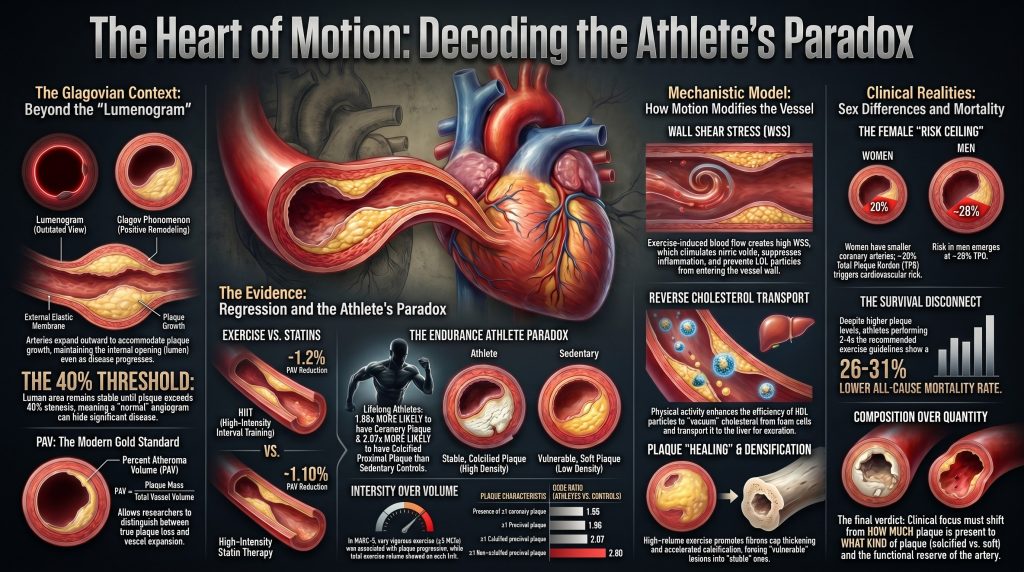
This compensatory expansion allows the vessel to maintain its luminal cross-sectional area even as a significant عصيديعصيدة الشرايين هي مصطلح آخر للترسبات الدهنية داخل جدار الشريان - وهي في الأساس مرادف للبلاك، وتُستخدم بشكل أكثر شيوعاً في الكتابات البحثية. develops. In Glagov’sأضافت دراسة GLAGOV مثبطاً لـ PCSK9 إلى العلاج بالستاتين وقاست اللويحة التاجية باستخدام الموجات فوق الصوتية داخل الأوعية قبل وبعد ذلك. seminal histologic study of 136 autopsied left main coronary arteries, lumen area did not decrease as a function of percent stenosis between 0 and 40 percent, but diminished markedly above that threshold (r = −0.73, P < 0.001) [3]. This implies that an angiographically normal vessel may harbor a substantial, and potentially vulnerable, عبء اللويحاتعبء اللويحات هو الكمية الإجمالية للويحات في الشرايين، في كل مكان، وليس فقط في أسوأ نقطة منفردة.. The PROSPECT IVUS sub-analysis confirmed in vivo that EEM cross-sectional areas increase in proportion to plaque-and-media area in 552 left main coronary arteries (r = 0.61, P < 0.0001 overall, rising to r = 0.88 when plaque burden was at or below 20 percent) [4].
Exercise is a potent stimulus for vascular remodeling. Chronic aerobic training induces sustained increases in blood flow and shear stress, which activate endothelial pathways that increase nitric-oxide bioavailability and the structural caliber of conduit arteries [5]. Consequently, any study claiming that exercise reduces تصلب الشرايينتصلب الشرايين هو المرض الكامن وراء معظم النوبات القلبية والعديد من السكتات الدماغية. عالقة جزيئات الكوليسترول في جدار الشريان، فيرسل الجسم خلايا مناعية للتنظيف، وعلى مدى سنوات تتصلب هذه الفوضى لتتحول إلى لويحات. based solely on luminal diameter is likely measuring a combination of actual plaque loss and compensatory vessel expansion. To distinguish between these effects, researchers rely on حجم العصيدة النخامية المئويحجم العصيدة المئوي، أو PAV، هو نسبة جزء الشريان الذي تشغله اللويحات بدلاً من القناة المفتوحة. (PAV), which normalizes plaque mass to the total volume of the vessel. PAV is calculated as the sum of (EEM area − lumen area) divided by the sum of EEM area, expressed as a percentage. This metric ensures that if a vessel grows larger (increased EEM) but the plaque area remains constant, PAV decreases, reflecting a relative reduction in the occluded proportion of the artery, even when absolute إجمالي حجم اللويحة العصيديةإجمالي حجم التصلب العصيدي هو مقياس مطلق مستمد من التصوير بالموجات فوق الصوتية داخل الأوعية لإجمالي الحجم ثلاثي الأبعاد للويحات داخل قطاع الشريان التاجي المُصوَّر، ويُعبر عنه بالمليمترات المكعبة. وعلى عكس النسبة المئوية لحجم التصلب (PAV)، فإن إجمالي حجم التصلب (TAV) لا تتم تسويته بناءً على حجم الوعاء، لذا فهو يلتقط الكمية الخام للمرض التي تم إزالتها أو إضافتها بمرور الوقت. remains stable [6].
Evidence for True Plaque Regression: Benchmarking against Pharmacotherapy
When evaluating the capacity of exercise to induce regression, it is necessary to establish a benchmark using lipid-lowering therapies (LLTs), which have the most robust data for reducing PAV and TAV. A comprehensive تحليل تلويالتحليل التلوي يجمع إحصائياً نتائج العديد من الدراسات المنفصلة في تقدير إجمالي واحد. of 51 studies involving 9,113 adults demonstrated that LLTs as a class reduce PAV by a mean of −1.10 percent (95% CI −1.63 to −0.56, P < 0.01) and reduce TAV by −5.84 mm³ (95% CI −8.64 to −3.04, P < 0.01); أستاتين عالية الشدةالستاتين عالي الشدة هو جرعة متوقعة لخفض الكوليسترول الضار (LDL) بنسبة 50 بالمائة أو أكثر - وفي الممارسة العملية، الجرعات الأعلى من أتورفاستاتين أو روزوڤاستاتين. drove the largest TAV effect (−7.60 mm³; 95% CI −11.89 to −3.31, P < 0.01) [6]. Direct head-to-head plaque-imaging evidence from the GLAGOV randomized trial further demonstrates that PCSK9PCSK9 هو بروتين ينتجه الكبد يعمل على تدمير مواقع الإرساء التي يستخدمها الكبد لسحب الكوليسترول من دمك. inhibition added to ستاتينتعمل الستاتينات على إبطاء الإنزيم الذي يستخدمه كبدك لتصنيع الكوليسترول. يستجيب كبدك عن طريق سحب المزيد من الكوليسترول من دمك، وهذا هو مصدر الفائدة الحقيقية. therapy produces incremental PAV regression in patients with established coronary artery disease [2].
In comparison, the direct evidence for exercise-induced regression is emerging but remains modest. The تجربة سِينِتThe CENIT (Coronary Disease and the Effect of High-Intensity Interval Training) trial was a randomized study of 60 patients with stable coronary artery disease that used intravascular ultrasound to measure whether six months of supervised HIIT at 85–95% of peak heart rate changed plaque volume compared with standard care. It found HIIT reduced percent atheroma volume by 1.2% and total normalized… (Coronary Disease and the Effect of High-Intensity Interval Training) provided critical longitudinal data by randomizing 60 patients with stable coronary artery disease, all of whom underwent percutaneous coronary intervention, to either six months of supervised high-intensity interval training (HIIT)High-intensity interval training is a structured exercise method that alternates short bouts of near-maximal effort (typically 85–95% of peak heart rate) with periods of active recovery or rest. In the cardiovascular context, HIIT protocols have been studied as a non-pharmacological intervention to reduce plaque burden and improve heart function. at 85–95 percent of peak معدل ضربات القلبمعدل ضربات القلب هو عدد مرات نبض القلب في الدقيقة. or to contemporary preventive guidelines [7]. The study used IVUS to measure changes in PAV and TAV in residual coronary segments.
| معامل | HIIT Group (n=30) | Control Group (n=30) | Between-Group Difference |
| Change in PAV (%) | −1.2 (95% CI: −2.1 to −0.2; P=0.017) | +0.2 (95% CI: −0.7 to 1.1; P=0.616) | −1.4 (95% CI: −2.7 to −0.1; P=0.036) [7] |
| Change in TAVnorm (mm³) | −9.0 (95% CI: −14.7 to −3.4; P=0.002) | — | −12.0 (95% CI: −19.9 to −4.2; P=0.003) [7] |
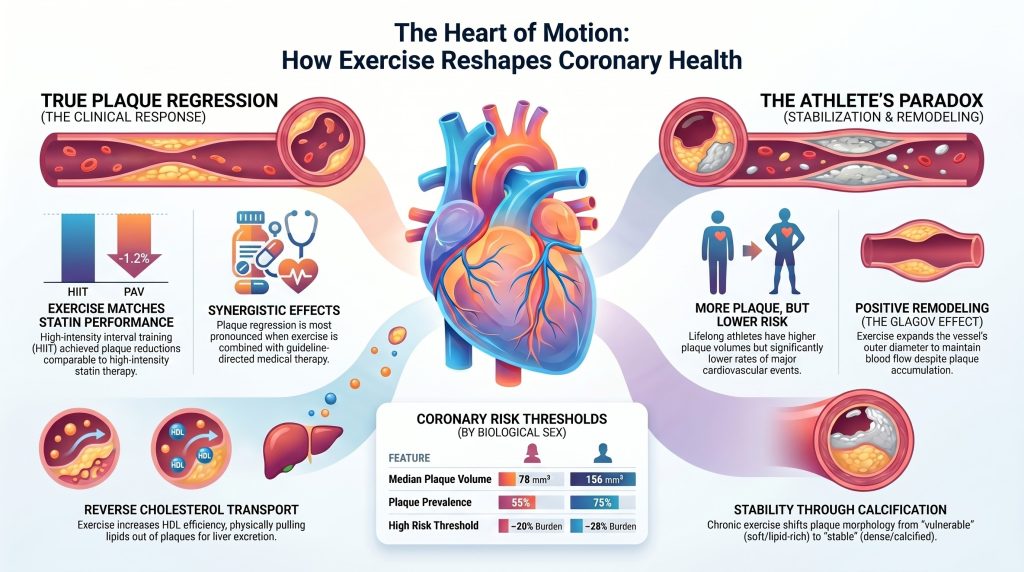
The CENIT results are notable because they demonstrate that exercise can achieve PAV reductions of a magnitude comparable to lipid-lowering therapy (−1.2% vs. −1.10%) [6], [7]. Importantly, this regression was observed in a population already receiving guideline-directed medical therapy, making it difficult to isolate the independent contribution of exercise from a synergistic interaction with statins.
The Endurance Athlete Paradox
While interventional trials in patients with established coronary artery disease suggest the potential for regression, observational data from healthy veteran athletes present a challenging paradox. Large registries, including MARC (Measuring Athlete’s Risk of Cardiovascular Events) and Master@Heart, consistently report that lifelong endurance athletes have a higher prevalence of coronary atherosclerotic plaque and higher كالسيوم الشريان التاجيإلتهاب الشريان التاجي هو مقياس لترسبات اللويحات المتكلسة في جدران الشرايين التاجية، والتي يتم قياسها بواسطة التصوير المقطعي المحوسب والتعبير عنها بنقاط أغاتستون؛ تشير النقاط الأعلى إلى عبء أكبر من اللويحات التراكمية وتتنبأ بأحداث قلبي وعائية مستقبلية. scores than less active individuals with comparable cardiovascular risk profiles [8], [9].
الـ دراسة ماستر@هارتأظهرت دراسة "ماستر آت هارت" (Master@Heart)، وهي دراسة محكومة أجريت على رياضيين ذكور مارسوا رياضات التحمل طوال حياتهم، أنهم يحملون كمية أكبر إجمالاً من اللويحات التاجية مقارنة بغير الرياضيين الأصحاء والنشطين - بما في ذلك المزيد من اللويحات المتكلسة وغير المتكلسة في قطع الشرايين القريبة - مما يثير تساؤلات حول ما إذا كان التدريب الشاق على التحمل مدى الحياة يحفز تصلب الشرايين حتى في غياب عوامل الخطر التقليدية., a prospective observational cohort analysis of 191 lifelong master endurance athletes, 191 late-onset athletes (initiating endurance sports after age 30), and 176 healthy non-athletic controls (all male, low cardiovascular risk profile, median age 55 years), reported the following adjusted associations for lifelong endurance sports relative to a healthy non-athletic lifestyle [9]:
- ≥1 coronary plaque: OR 1.86 (95% CI 1.17–2.94)
- ≥1 proximal plaque: OR 1.96 (95% CI 1.24–3.11)
- ≥1 لويحة متكلسةاللويحة المتكلسة هي الجزء الصلب الممتلئ بالكالسيوم من اللويحة. وتظهر بشكل ساطع في التصوير المقطعي المحوسب، وهو ما يقيسه فحص الكالسيوم.: OR 1.58 (95% CI 1.01–2.49)
- ≥1 calcified proximal plaque: OR 2.07 (95% CI 1.28–3.35)
- ≥1 لوحة غير متكلسةالترسبة غير المتكلسة هي الجزء الدهني اللين من الترسبة الذي لم يتصلب بالكالسيوم. وتظهر بلون داكن في التصوير المقطعي المحوسب.: OR 1.95 (95% CI 1.12–3.40)
- ≥1 non-calcified proximal plaque: OR 2.80 (95% CI 1.39–5.65)
- ≥1 mixed plaque: OR 1.78 (95% CI 1.06–2.99)
The finding of higher odds of non-calcified (lipid-rich) plaques in proximal segments is particularly notable, as such plaques are typically associated with higher near-term risk than purely calcified آفاتفي أمراض القلب، تشير الآفة إلى منطقة منفصلة من اللويحة تصلب الشرايين تضيق الشريان التاجي، وعادة ما توصف من خلال نسبة انسداد التجويف الذي تسببه. تصف المقالة أربع آفات متبقية أصغر من أن تقبل الدعامة في قطر الوعاء الدموي بعد علاج الآفة الأكثر أهمية. [9].
الـ دراسة MARC-2MARC-2 (Male Athlete's Risk of Cardiovascular disease) is a clinical study that examined the relationship between vigorous exercise habits and coronary plaque burden in male athletes, finding an association between high-intensity training and greater calcified plaque. added longitudinal granularity by distinguishing exercise volume from intensity in 289 middle-aged and older male athletes (median age 54 years) followed for a mean of 6.3 years [8]. Total exercise volume (MET-hours/week) showed no association with progression of CAC or plaque. By contrast, exercise intensity stratified by metabolic equivalents — vigorous (6–9 METs) versus very vigorous (≥9 METs) — was significantly associated with imaging outcomes:
| Exercise Intensity | Effect on CAC Score (β per 10% increase) | Plaque Progression |
| Vigorous (6–9 METs) | −0.05 (95% CI −0.09 to −0.01; P=0.02) [8] | Less progression |
| Very Vigorous (≥9 METs) | +0.05 (95% CI 0.01 to 0.09; P=0.01) [8] | aOR 1.09 (95% CI 1.01–1.18) per 10% increase [8] |
| Total Volume | No significant association [8] | No significant association [8] |
That intensity rather than volume drives plaque and CAC progression in athletes suggests a العتبة الفسيولوجيةThe exercise intensity beyond which the body can no longer sustain aerobic energy production and begins to accumulate fatigue products rapidly, making it impossible to maintain that effort level; exceeding it early in a race causes premature collapse in pace. beyond which exercise may exert pro-atherogenic effects. Proposed mechanisms include exercise systolic blood pressuresضغط الدم الانقباضي هو الرقم العلوي — وهو الضغط في الشرايين أثناء انقباض قلبك. that can exceed 200 mmHg in well-trained athletes during near-maximal effort [25], repetitive mechanical stress on the coronary wall, and inflammatory signaling pathways implicated in athlete-related vascular تکلسالتكلس هو ترسب الكالسيوم في اللويحة، مما يجعل جزءاً منها صلباً وعظمياً. [10].
The defining feature of the athlete’s paradox, however, is that despite higher plaque burden, endurance athletes have lower rates of الأحداث القلبية الوعائية السلبية الكبرىحدث قلبي وعائي سلبي كبير، أو ما يُعرف بـ (MACE)، هو مجموعة من النتائج السيئة التي يتم حسابها معاً في دراسة ما - وعادة ما تشمل الوفاة القلبية الوعائية، والنوبة القلبية، والسكتة الدماغية. (MACE) than the general population. Although the rank order of plaque morphology (calcified > mixed > non-calcified) is broadly similar across active and sedentary populations, lifelong endurance athletes who harbor plaque are more likely than sedentary controls to harbor exclusively calcified lesions, which are considered more stable [12]. This phenotypic enrichment for dense, calcified (stable) lesions — rather than for mixed or non-calcified vulnerable lesions — suggests that high-volume exercise may accelerate the natural healing or densification process of atherosclerosis [10], [11].
Matched Cohort Evidence and Socioeconomic Confounders
A critical requirement for validating the impact of exercise is the control of social and economic متغيرات مربكةالمتغير المُربِك هو متغير مرتبط بكل من التعرض المدروس (مثل TMAO) والنتيجة (مثل أمراض القلب)، مما يجعل الأمر يبدو وكأن أحدهما يسبب الآخر بينما يكون هناك عامل ثالث هو المسؤول في الواقع. تُدرج المقالة وظيفة الكلى، ومقاومة الأنسولين، والالتهاب الجهازوي، والعمر باعتبارها عوامل مربكة رئيسية تضخم خطر القلب والأوعية الدموية الظاهري لارتفاع مركب TMAO في.... Higher socioeconomic status (SES) is independently associated with both greater القدرة على التمرينالقدرة على ممارسة الرياضة هي مقياس كمي للجهد البدني الأقصى الذي يمكن للشخص القيام به، وعادة ما يتم تقييمها أثناء اختبار الإجهاد المتدرج كحد أقصى لحمل العمل بالواط، أو الحد الأقصى لاستهلاك الأكسجين (VO2 max)، أو المكافئات الاكتسابية (METs). في المقالة، أشر الانخفاض في القدرة على ممارسة الرياضة بعد أربعة أشهر من تركيب الدعامات إلى أن الإجراء وحده لم يحل المرض الكامن. and improved cardiovascular outcomes [13]. In the Heart and Soul Study, an analysis of 943 men and women with stable مرض الشريان التاجيمرض الشريان التاجي هو تضيق أو انسداد الشرايين التي تغذي عضلة القلب بالدم، والذي يحدث بسبب تراكم اللويحات تصلب الشرايين؛ وهو السبب الرئيسي للنوبة القلبية والوفاة القلبية في جميع أنحاء العالم., exercise capacity decreased in a graded fashion across categories of income, education, housing, and occupation. After multivariable adjustment, the difference in exercise capacity between the highest and lowest categories was 2.4 METs for household income, 1.8 METs for education, 2.3 METs for housing, and 1.3 METs for occupation (P < 0.001 for all trends) [13].
Spousal Concordance and Partner Studies
Cohabiting partners share a micro-environment encompassing diet, socioeconomic stress, and access to healthcare. In a US nationwide cohort of 5,364 married or domestic-partner couples, within-couple concordance exceeded 50 percent for every component of the American Heart Association’s Life’s Simple 7 framework, ranging from 53 percent for الكوليسترول الكلييجمع الكوليسترول الكلي الكوليسترول الموجود في جميع جزيئاتك، الضارة والمفيدة على حد سواء. to 95 percent for healthy diet score; concordance for متلازمة الأيضمتلازمة الأيض هي مجموعة من خمس مشكلات تميل للظهور معاً: محيط الخصر الكبير، ارتفاع الدهون الثلاثية، انخفاض الكوليسترول النافع، ارتفاع ضغط الدم، وارتفاع سكر الدم. ويُشترط وجود ثلاث مشكلات منها أو أكثر لتشخيصها. reached 73 percent [14]. Despite this strong concordance for behaviors and عوامل الخطرعامل الخطر هو شيء يزيد من احتمالية إصابتك بمرض ما – مثل جزيئات الكوليسترول المرتفعة، وارتفاع ضغط الدم، والتدخين، ومرض السكري، والتاريخ العائلي., marital status itself, when adjusted for cardiovascular risk factors, was not independently associated with subclinical coronary atherosclerosis on CCTA in a study of 9,288 asymptomatic individuals [15]. Together, these findings suggest that the shared environment of a partnership produces a background risk level, but the trajectory of plaque burden is more heavily influenced by individual health behaviors — including the choice to exercise regularly — than by partnership status itself.
Occupational Activity as a Controlled Environment
The London Transport Workers Study remains the canonical example of an occupational analog [16]. By comparing conductors and drivers within the same transport system — men of similar age and social class — Jeremy Morris was able to isolate occupational physical activity from most confounders. Morris and colleagues studied tens of thousands of London bus and postal workers and reported that physically active conductors, who climbed and descended hundreds of stairs per shift, experienced approximately half the rate of acute and sudden coronary deaths observed among the sedentary drivers [16], [17]. This natural experiment provides some of the earliest robust evidence that occupational physical activity independently modifies the clinical expression of coronary disease, even when the macro-environment is held constant.
Dose-Response Relationships and the Mortality Curve
The relationship between exercise dose and mortality is widely regarded as curvilinear, with the most substantial risk reductions occurring as individuals move from sedentary to moderately active. The مراجعة منهجيةتبحث المراجعة المنهجية عن كل دراسة حول سؤال ما باستخدام طريقة معلن عنها مسبقاً، ثم تقيمها وفقاً لمعايير متسقة. and meta-analysis by Blond and colleagues, encompassing 48 دراسة أترابية استباقيةتضم دراسة الأتراب الاستباقية أشخاصاً أصحاء، وتسجل خصائصهم، ثم تنتظر لمعرفة ما سيحدث. studies, used random-effects restricted cubic spline استجابة الجرعةتعني العلاقة بين الجرعة والاستجابة أن زيادة كمية الشيء تؤدي إلى زيادة التأثير، بدرجة متسقة. modeling to estimate نسب الخطرنسبة الخطر تقارن مدى سرعة حدوث الأحداث في مجموعتين. تعني النسبة البالغة 0.75 أن الأحداث حدثت بثلاثة أرباع المعدل في المجموعة المعالجة. across the full exposure range. Compared with the recommended physical activity dose (750 MET-min/week), risk continued to decrease beyond recommendations: at 5,000 MET-min/week, hazard ratios were approximately 0.86 for الوفيات لجميع الأسبابمعدل الوفيات الإجمالي يعني الموت بسبب أي سبب كان، وليس فقط أمراض القلب - وهي النتيجة الأوسع نطاقاً والأصعب في التلاعب بها والتي يمكن لأي دراسة قياسها. and 0.73 for cardiovascular mortality. No excess risk was observed at the highest exposure levels examined [18].
The Lee et al. Circulation analysis of 116,221 adults pooled from the Nurses’ Health Study and the Health Professionals Follow-up Study, with up to 30 years of follow-up and approximately 47,000 deaths, examined long-term physical activity intensity in detail [19]. Compared with no leisure-time vigorous physical activity (VPA), participants meeting the guideline (75–149 min/week of VPA) had hazard ratios of 0.81 (95% CI 0.76–0.87) for all-cause mortality, 0.69 (95% CI 0.60–0.78) for CVD mortality, and 0.85 (95% CI 0.79–0.92) for non-CVD/non-cancer mortality. Participants performing two to four times the recommended minimum had a 21–23 percent lower all-cause mortality for VPA (150–299 min/week) and a 26–31 percent lower all-cause mortality for moderate physical activity (300–599 min/week) [19]. Higher long-term doses (≥300 min/week VPA or ≥600 min/week moderate activity) did not provide further mortality reduction, but no excess risk was observed [19].
This mortality benefit persists despite the athlete’s paradox of increased CAC, supporting the conclusion that the plaques found in highly active individuals are compositionally more benign in their clinical manifestation [10], [11].
Mechanistic Model: How Exercise Modifies Plaque
The biological mechanisms by which exercise potentially reduces plaque burden or facilitates stabilization act both systemically and locally.
Fluid Mechanics and Wall Shear Stress
Plaque development is governed by patterns of blood flow. Laminar flow produces high إجهاد قص الجدارWall shear stress is the frictional force exerted by flowing blood on the inner surface of an artery; low, oscillatory, or multidirectional shear stress at arterial bends and bifurcations promotes endothelial dysfunction and plaque initiation, whereas high, uniform shear stress in straight segments is generally protective. (WSS), which maintains endothelial homeostasis through the mechanosensitive transcription-factor axis (KLF2 and KLF4) and downstream activation of endothelial أكسيد النيتريكأكسيد النيتريك هو غاز ينتجه بطانة الأوعية الدموية ليخبر الوعاء بالاسترخاء والتوسع. synthase. Disturbed or oscillatory flow, common at coronary bifurcations, produces low WSS that promotes an atherogenic endothelial phenotype, including upregulation of NF-κB-driven adhesion molecules, monocyte recruitment, and increased endothelial التبرعم الخلويالارتشاف الخلوي هو العملية التي تلتقط بها الخلية شيئاً من أحد الجانبين، وتحمله عبرها، وتطلقه في الجانب الآخر. من البروتين الدهني منخفض الكثافةإن البروتينات الدهنية منخفضة الكثافة (LDL)، أو ما يُعرف بالبروتين الدهني منخفض الكثافة، هي الجسيم الرئيسي الذي ينقل الكوليسترول عبر الدم، والجسيم الرئيسي الذي يترسب في جدران الشرايين. [20]. Exercise-induced increases in flow rate directly enhance the protective frictional force at the vessel wall. Direct molecular evidence in human coronary arteries has shown that regular physical activity in patients with coronary artery disease increases phosphorylation of endothelial nitric oxide synthase at Ser1177, the key regulatory site governing nitric oxide production [5].
Reverse Cholesterol Transport and HDL Functionality
Exercise facilitates the removal of lipids from plaque via the النقل العكسي للكوليسترولReverse cholesterol transport is the process of moving cholesterol out of tissues, including artery walls, and back to the liver for disposal. HDL particles do the hauling. pathway, beginning with كوليسترولالكوليسترول هو مادة شمعية يحتاجها جسمك. وهو يدخل في تكوين جدران الخلايا، والهرمونات، وفيتامين د، والصفراء التي تهضم طعامك. كنت ستتموت دونه. efflux from خلايا رغويةالخلية الرغوية هي خلية مناعية ابتلت كمية كبيرة من الكوليسترول المحاصر لدرجة أنها تتورم وتظهر بمظهر رغوي تحت المجهر. إلى HDLHDL، أو البروتين الدهني عالي الكثافة، هو الجسيم الذي يُعرف غالبًا باسم "الكوليسترول الجيد". فهو يلتقط الكوليسترول من الأنسجة وينقله إلى الكبد. particles, which transport lipids to the liver for hepatobiliary excretion. A randomized exercise-dosing trial measuring multiple HDL functional metrics has shown that increasing both exercise intensity and dose produces dose-responsive improvements in HDL cholesterol efflux capacityCholesterol efflux capacity is a laboratory test of how well someone's HDL actually pulls cholesterol out of cells — a measure of function rather than quantity., anti-oxidant capacity, and anti-inflammatory function — effects that are largely independent of changes in HDL cholesterol concentration alone [22].
Plaque Stabilization, Matrix Metalloproteinases, and the Fibrous Cap
Beyond regression, exercise promotes structural stabilization through fibrous-cap thickening, mediated in part by reduced intra-plaque مصفوفة ميتالوبروتيازMatrix metalloproteinases are enzymes that cut through the collagen scaffolding of tissue. Immune cells inside plaques release them. activity. Animal studies in أبروليپوبروتينالبروتين الدهني المساعد هو بروتين مرتبط بجزيء ناقل للدهون في دمك. لا تختلط الدهون بالماء، لذا تعمل هذه البروتينات وكأنها غلاف يسمح للدهون بالانتقال بأمان عبر مجرى الدم. E knockout mice show that تمرين هوائيالتمرين الهوائي هو نشاط منتظم يجعل تنفسك أسرع لفترة من الوقت، مثل المشي السريع، أو ركوب الدراجات، أو السباحة، أو الجري الخفيف. training reduces intra-plaque MMP-8 and MMP-9 activity, increases tissue inhibitor of metalloproteinases (TIMP-1, TIMP-2), increases fibrous-cap thickness, and reduces the relative size of the necrotic لب لبنيThe lipid core is the soft, greasy center of a plaque, made of cholesterol and the debris of dead immune cells. [23]. Human systematic-review evidence links chronic physical activity to favorable changes in circulating MMP-9, البروتين الدهني منخفض الكثافة المؤكسدالبروتين الدهني منخفض الكثافة المؤكسد هو جسيم بروتين دهني منخفض الكثافة تعرّض لتلف كيميائي بعد أن علق في جدار الشريان., and inflammatory mediators relevant to plaque vulnerability [21]. Concurrent reductions in systemic التهابالالتهاب هو استجابة جهازك المناعي للإصابة أو لأي شيء يعتبره جسماً غريباً. إنه يجلب التورم، والحرارة، وخلايا تنظيف., بما في ذلك البروتين التفاعلي Cبروتين سي التفاعلي، أو اختصاراً CRP، هو مادة يصنعها الكبد عندما يوجد التهاب في مكان ما في جسمك. تُستخدم نسخة حساسة من الاختبار، وهي (hs-CRP)، لتقدير خطر الإصابة بأمراض القلب., may further contribute to plaque stabilization [11], [21]. The net effect in chronically active individuals is a transition from compositionally vulnerable to compositionally stable plaque morphology, even when total حجم اللويحةحجم اللويحة هو الكمية الفيزيائية الإجمالية للويحة في امتداد من الشريان، ويُقاس بالمليمترات المكعبة. increases [10], [12].
Sex-Specific Differences in Plaque Risk
A crucial refinement in modern preventive cardiology is the recognition that plaque burden carries different prognostic implications in men and women. In a recent analysis of the تجربة «PROMISE»A large randomized trial that evaluated CT angiography versus functional stress testing in symptomatic patients with stable chest pain; findings cited here showed that 16.5% of zero-CAC participants had non-obstructive coronary artery disease and 1.5% had obstructive disease, illustrating residual risk despite a zero calcium score. CCTA arm (4,267 patients, approximately 51 percent women, median follow-up 26 months), women had lower coronary plaque prevalence than men (55 percent versus 75 percent; P < 0.001) and lower median total plaque volume, yet a similar incidence of major adverse cardiovascular events (2.3 percent versus 3.4 percent) [24]. Critically, when MACE risk was modeled against total plaque burden using sex-stratified spline Cox regression, the hazard ratio crossed unity at a substantially lower plaque-burden threshold in women than in men.
| ميزة | نساء | رجال | Implication |
| Plaque prevalence | 55% | 75% | Lower prevalence in women [24] |
| Plaque volume | Lower (median) | Higher (median) | Smaller absolute burden in women [24] |
| Total plaque burden at HR=1.0 | ≈20% | ≈28% | Risk emerges at a lower burden in women [24] |
| Total plaque burden at HR=1.5 | ≈32% | ≈42% | Steeper risk trajectory in women [24] |
These data indicate that uniform thresholds for high-risk plaque underestimate risk in women: because women have smaller coronary arteries, a smaller absolute plaque volume produces a larger relative plaque burden and a more rapid acceleration of MACE risk [24]. This implies that for female athletes, the ceiling for compositionally benign subclinical plaque may be considerably lower than for their male counterparts.
Testing the Hypothesis: Remodeling or Regression?
The hypothesis under examination is that exercise does not meaningfully reduce total coronary plaque burden but rather improves vessel caliber and plaque stability. The evidence supports a population-dependent answer:
In patients with established CAD on guideline-directed therapy: Exercise can meaningfully reduce total plaque burden. The CENIT trial demonstrated a between-group PAV difference of −1.4 percent and a TAVnorm reduction of −12 mm³ after six months of HIIT [7].
In healthy lifelong endurance athletes: Exercise does not reduce total plaque burden but is associated with higher prevalence and burden across all plaque types [9]. In this population, the hypothesis is largely supported: the cardiovascular benefit of exercise is realized through vascular remodeling and stabilization (calcification) rather than removal.
Apparent versus true benefits: Increased lumen size in trained individuals reflects a real physiological adaptation (positive remodeling) that confers significant clinical protection through enhanced احتياطي التدفق التاجيCoronary flow reserve compares blood flow through the heart's arteries at rest with flow when the heart is working hard. [3], [4]. This remodeling benefit is distinct from the discrete benefit of true plaque regression, and the two effects operate on different timescales.
Final Verdict: Regression, Progression, or Stabilization?
The totality of the evidence indicates that chronic exercise is a multi-modal modifier of coronary atherosclerosis. True regression — measurable reductions in PAV and TAV — is achievable through high-intensity exercise interventions, particularly in populations with existing coronary artery disease, where the magnitude approaches that of intensive lipid-lowering therapy [2], [6], [7]. Among individuals without known disease, moderate exercise appears to slow the progression of soft, vulnerable, لويحات غنية بالدهونآفة تصلب شرايينيهيمن على لبها إسترات الكوليسترول والدهون الالتهابية بدلاً من الكالسيوم أو الأنسجة الليفية؛ ويشير المقال إلى أن مثل هذه اللويحات شديدة الاستجابة للعلاج المكثف، وأن الانحسار الدراماتيكي بنسبة 65 نقطة مئوية عند منشأ الفرع القطري يتسق مع عكس (أو تراجع) آفة غنية بالدهون. through favorable lipid metabolism, enhanced HDL cholesterol efflux capacity, and reduced systemic inflammation [21], [22]. In high-volume endurance athletes, exercise functions primarily as a stabilizing agent, paradoxically accelerating calcification while expanding vessel caliber through positive remodeling — yielding a compositionally benign atherosclerotic burden that does not translate into elevated clinical risk [9], [10], [12].
Critically, the survival benefit of exercise is decoupled from absolute plaque volume: extreme athletes have more plaque yet exhibit substantially lower all-cause and CVD mortality than the general population [18], [19]. The clinical emphasis should therefore shift from quantifying how much plaque is present toward characterizing what kind of plaque is present and what functional reserve the individual’s coronary tree retains.
المراجع
- Narula J, Stuckey TD, Nakazawa G, et al. Prospective deep learning-based quantitative assessment of coronary plaque by computed tomography angiography compared with intravascular ultrasound: the REVEALPLAQUE study. Eur Heart J Cardiovasc Imaging. 2024;25(9):1287-1295. doi:10.1093/ehjci/jeae115
- Nicholls SJ, Puri R, Anderson T, et al. Effect of Evolocumab on Progression of Coronary Disease in Statin-Treated Patients: The GLAGOV Randomized Clinical Trial. JAMA. 2016;316(22):2373-2384. doi:10.1001/jama.2016.16951
- Glagov S, Weisenberg E, Zarins CK, Stankunavicius R, Kolettis GJ. Compensatory enlargement of human atherosclerotic coronary arteries. N Engl J Med. 1987;316(22):1371-1375. doi:10.1056/NEJM198705283162204
- Inaba S, Mintz GS, Shimizu T, et al. Compensatory enlargement of the left main coronary artery: insights from the PROSPECT study. Coron Artery Dis. 2014;25(2):98-103. doi:10.1097/MCA.0000000000000074
- Hambrecht R, Adams V, Erbs S, et al. Regular physical activity improves endothelial function in patients with coronary artery disease by increasing phosphorylation of endothelial nitric oxide synthase. Circulation. 2003;107(25):3152-3158. doi:10.1161/01.CIR.0000074229.93804.5C
- Rivera FB, Cha SW, Varona MC, et al. Atherosclerotic coronary plaque regression from lipid-lowering therapies: A meta-analysis and meta-regression. Am J Prev Cardiol. 2024;18:100645. Published 2024 Mar 11. doi:10.1016/j.ajpc.2024.100645
- Vesterbekkmo EK, Aksetøy IA, Follestad T, et al. High-intensity interval training induces beneficial effects on coronary atheromatous plaques: a randomized trial. Eur J Prev Cardiol. 2023;30(5):384-392. doi:10.1093/eurjpc/zwac309
- Aengevaeren VL, Mosterd A, Bakker EA, et al. Exercise Volume Versus Intensity and the Progression of Coronary Atherosclerosis in Middle-Aged and Older Athletes: Findings From the MARC-2 Study. Circulation. 2023;147(13):993-1003. doi:10.1161/CIRCULATIONAHA.122.061173
- De Bosscher R, Dausin C, Claus P, et al. Lifelong endurance exercise and its relation with coronary atherosclerosis. Eur Heart J. 2023;44(26):2388-2399. doi:10.1093/eurheartj/ehad152
- Hsu JJ, Tintut Y, Demer LL. Paradox of Exercise and Coronary Artery Calcification: Potential Underlying Mechanisms. Circ Res. 2025;137(2):335-349. doi:10.1161/CIRCRESAHA.125.326011
- Aengevaeren VL, Mosterd A, Sharma S, et al. Exercise and Coronary Atherosclerosis: Observations, Explanations, Relevance, and Clinical Management. Circulation. 2020;141(16):1338-1350. doi:10.1161/CIRCULATIONAHA.119.044467
- Aengevaeren VL, Mosterd A, Braber TL, et al. Relationship Between Lifelong Exercise Volume and Coronary Atherosclerosis in Athletes. Circulation. 2017;136(2):138-148. doi:10.1161/CIRCULATIONAHA.117.027834
- Cohen B, Vittinghoff E, Whooley M. Association of socioeconomic status and exercise capacity in adults with coronary heart disease (from the Heart and Soul Study). Am J Cardiol. 2008;101(4):462-466. doi:10.1016/j.amjcard.2007.09.093
- Shiffman D, Louie JZ, Devlin JJ, Rowland CM, Mora S. Concordance of Cardiovascular Risk Factors and Behaviors in a Multiethnic US Nationwide Cohort of Married Couples and Domestic Partners. JAMA Netw Open. 2020;3(10):e2022119. Published 2020 Oct 1. doi:10.1001/jamanetworkopen.2020.22119
- Ann SH, Lee H, Park KS, et al. Marital Status and Subclinical Coronary Atherosclerosis in Asymptomatic Individuals. J Am Heart Assoc. 2022;11(11):e024942. doi:10.1161/JAHA.121.024942
- Morris JN, Heady JA, Raffle PA, Roberts CG, Parks JW. Coronary heart-disease and physical activity of work. Lancet. 1953;262(6795):1053-1057. doi:10.1016/s0140-6736(53)90665-5
- Morris JN, Kagan A, Pattison DC, Gardner MJ. Incidence and prediction of ischaemic heart-disease in London busmen. Lancet. 1966;2(7463):553-559. doi:10.1016/s0140-6736(66)93034-0
- Blond K, Brinkløv CF, Ried-Larsen M, Crippa A, Grøntved A. Association of high amounts of physical activity with mortality risk: a systematic review and meta-analysis. Br J Sports Med. 2020;54(20):1195-1201. doi:10.1136/bjsports-2018-100393
- Lee DH, Rezende LFM, Joh HK, et al. Long-Term Leisure-Time Physical Activity Intensity and All-Cause and Cause-Specific Mortality: A Prospective Cohort of US Adults. Circulation. 2022;146(7):523-534. doi:10.1161/CIRCULATIONAHA.121.058162
- Niu N, Xu S, Xu Y, Little PJ, Jin ZG. Targeting Mechanosensitive Transcription Factors in Atherosclerosis. Trends Pharmacol Sci. 2019;40(4):253-266. doi:10.1016/j.tips.2019.02.004
- Palmefors H, DuttaRoy S, Rundqvist B, Börjesson M. The effect of physical activity or exercise on key biomarkers in atherosclerosis–a systematic review. Atherosclerosis. 2014;235(1):150-161. doi:10.1016/j.atherosclerosis.2014.04.026
- Sarzynski MA, Ruiz-Ramie JJ, Barber JL, et al. Effects of Increasing Exercise Intensity and Dose on Multiple Measures of HDL (High-Density Lipoprotein) Function. Arterioscler Thromb Vasc Biol. 2018;38(4):943-952. doi:10.1161/ATVBAHA.117.310307
- Kadoglou NP, Moustardas P, Kapelouzou A, et al. The anti-inflammatory effects of exercise training promote atherosclerotic plaque stabilization in apolipoprotein E knockout mice with diabetic atherosclerosis. Eur J Histochem. 2013;57(1):e3. Published 2013 Mar 25. doi:10.4081/ejh.2013.e3
- Brendel JM, Mayrhofer T, Karády J, et al. Risk in Women Emerges at Lower Coronary Plaque Burden Than in Men: PROMISE Trial. Circ Cardiovasc Imaging. 2026;19(3):e019011. doi:10.1161/CIRCIMAGING.125.019011
- Currie KD, Floras JS, La Gerche A, Goodman JM. Exercise Blood Pressure Guidelines: Time to Re-evaluate What is Normal and Exaggerated?. Sports Med. 2018;48(8):1763-1771. doi:10.1007/s40279-018-0900-x