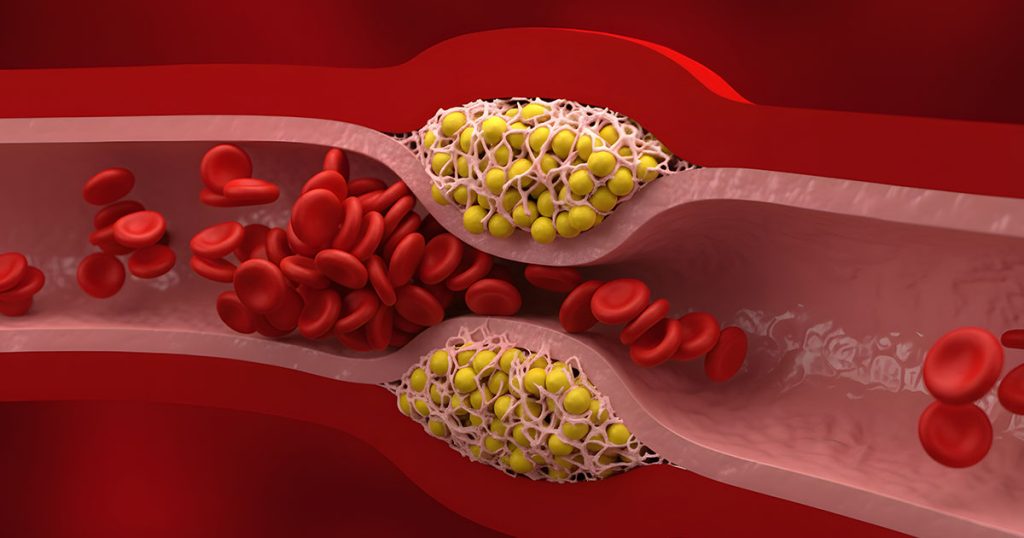
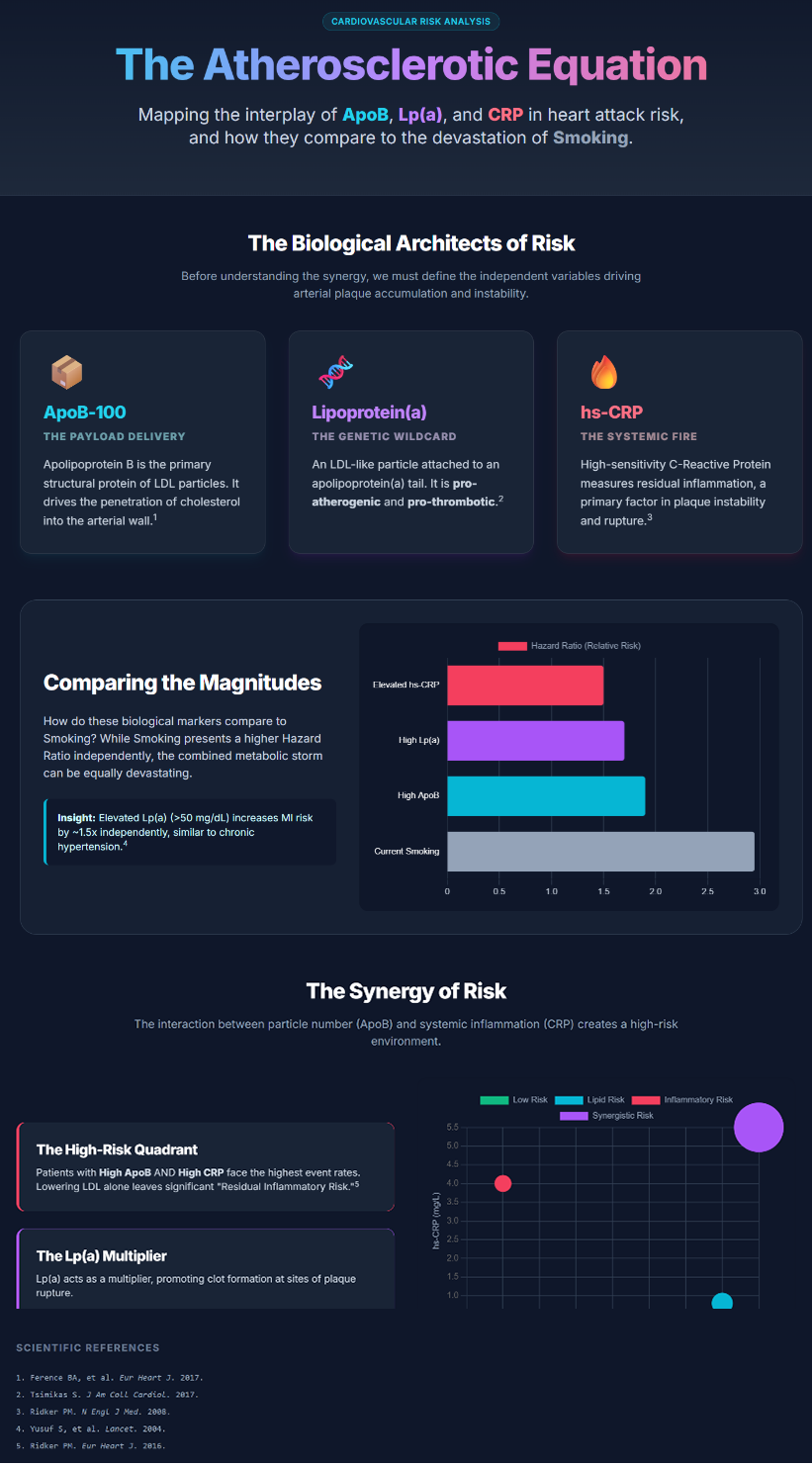
हृदय संबंधी जोखिम के बारे में हम जिस तरह से सोचते हैं, उसमें काफी बदलाव आया है। पहले हम ध्यान केंद्रित करते थे कुल कोलेस्ट्रॉल और बाद में एलडीएल कोलेस्ट्रॉल (एलडीएल-सी) को मुख्य खलनायक के रूप में। अब, तस्वीर अधिक सटीक है: जोखिम इस बात से तय होता है कि कितने एथोजेनिक कण प्रसारित हो रहे हैं, कौन से आनुवंशिक रूप से “उच्च-जोखिम” वाले कण मौजूद हैं, और कितनी मात्रा में सूजन वेसल की दीवार में सक्रिय है। इस नए दृष्टिकोण के केंद्र में एक व्यावहारिक त्रय है जैव-सूचक: एपोलिपोप्राटीन बी-100 (अपोबी), जो एथोजेनिक की संख्या की गणना करता है लाइपोप्रोटीन कण;¹ लाइपोप्रोटीन (ए) [एलपी(ए)], थ्रॉम्बोटिक जोखिम से जुड़ा हुआ एक मुख्य रूप से आनुवंशिक एलडीएल जैसा कण;² और उच्च-संवेदनशीलता सी-रिएक्टिव प्रोटीन (hsCRP), एक मार्कर जो प्रणालीगत और संवहन सूजन को ट्रैक करता है।³
LDL-C अभी भी महत्वपूर्ण है और मानक चिकित्सीय लक्ष्य बना रहता है, लेकिन नैदानिक अनुभव (और बढ़ते प्रमाण) से पता चलता है कि LDL-C महत्वपूर्ण जोखिम से चूक सकता है—विशेष रूप से तब जब ApoB उच्च हो, Lp(a) बढ़ा हुआ हो, या hsCRP चल रही सूजन का संकेत दे। कई रोगियों में, ये तीनों कारक एक साथ मिलकर ऐसा जोखिम पैदा करते हैं जो पारंपरिक लिपिड पैनल की तुलना में “अनुपातिक रूप से अधिक” प्रतीत होता है। जब आप इस बायोकेमिकल और आनुवंशिक जोखिम प्रोफ़ाइल की तुलना सिगरेट जैसे व्यवहारिक नुकसानों से करते हैं धूम्रपान, जोखिम का पदानुक्रम और भी अधिक सूक्ष्म हो जाता है, जो प्राथमिक और दोनों में व्यक्तिगत रोकथाम रणनीतियों की आवश्यकता को पुख्ता करता है द्वितीयक रोकथाम.⁵
अपोलिपोप्रोटीन बी-100 की आणविक संरचना और कण रोगजन्यता
एथेरोस्क्लेरोसिस शुरू नहीं होता क्योंकि रक्त में “बहुत अधिक" होता है कोलेस्ट्रॉल”सार में। यह इसलिए शुरू होता है क्योंकि बहुत अधिक एथेरोजेनिक कण परिसंचारी होते हैं, और उनमें से एक अंश फँस जाता है। धमनी दीवार।⁶ इसे समझने का सबसे अच्छा तरीका केवल कोलेस्ट्रॉल द्रव्यमान के बजाय कण संख्या के संदर्भ में सोचना है।⁶
एपोलिपोप्रोटीन बी (एपोबी) प्रमुख संरचनात्मक है। प्रोटीन सभी संभावित एथेरोजेनिक लिपोप्रोटीन पर: बहुत कम घनत्व वाले लिपोप्रोटीन (वीएलडीएल), मध्यम-घनत्व वाले लिपोप्रोटीन (आईडीएल), निम्न-घनत्व वाले लिपोप्रोटीन (एलडीएल), और लिपोप्रोटीन(ए) भी।⁸ इनमें से प्रत्येक कण ठीक एक को वहन करता है एपोबी-100 अणु, जो ApoB को एक सुविधाजनक जैविक “काउंटर” बनाता है: प्लाज्मा में ApoB की सांद्रता आपको बताती है कि कितने एथेरोजेनिक कण मौजूद हैं।⁷
यही कारण है कि कुछ सामान्य नैदानिक परिदृश्यों में केवल एलडीएल-सी पर निर्भर रहना भ्रामक हो सकता है—विशेषकर हाइपरट्राइग्लिसराइडिमिया में।, मेटाबोलिक सिंड्रोम, और प्रकार 2 मधुमेह.⁶ इन राज्यों में, एलडीएल कण अक्सर प्रति कण कम कोलेस्ट्रॉल ले जाते हैं, जिससे वे छोटे, घने एलडीएल (sdLDL) की ओर झुकते हैं। इसका मतलब है कि एक रोगी में एलडीएल-सी का मान “स्वीकार्य” दिख सकता है, जबकि उसके पास एलडीएल कणों की संख्या अधिक होती है—एक पैटर्न जिसे अक्सर के रूप में वर्णित किया जाता है एलडीएल-सी/एपोबी असंगति.⁹ एपोबी मापन उस सीमा को दरकिनार करता है क्योंकि यह सीधे प्रतिबिंबित करता है कण भार, जो धमनी में लिपोप्रोटीन के प्रवेश की संभावना को बेहतर ढंग से दर्शाता है इंटिमा.⁷
सबएंडोथेलियल घुसपैठ और प्रतिधारण की क्रियाविधि
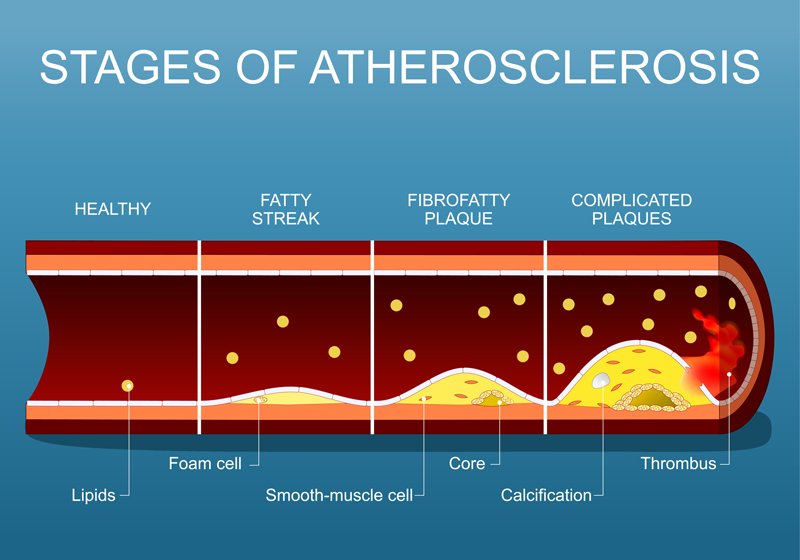
एथेरोस्क्लेरोसिस तब शुरू होता है जब एंडोथेलियम—सामान्यतः एक चिकना अवरोध—अधिक पारगम्य या दोषपूर्ण हो जाता है, अक्सर काटन तनाव, ऑक्सीडेटिव क्षति, चयापचय विकार, या रासायनिक संपर्क (तम्बाकू के धुएँ सहित) के कारण।¹¹ एक बार वह अवरोध क्षतिग्रस्त हो जाता है, एपोबी-युक्त कण धमनी की इंटिमा में प्रवेश कर सकता है।¹⁰
अब जो मायने रखता है वह केवल प्रवेश ही नहीं, बल्कि प्रतिधारण भी है। में उपएन्डोथीलियल स्थान, एपोबी कणों की परस्पर क्रिया एक्स्ट्रासेलुलर मैट्रिक्स केवल सांद्रता ढालों के अनुसार बह जाने के बजाय। ApoB-100 में सकारात्मक आवेशित क्षेत्र होते हैं जो धमनी के प्रोटीओग्लिकन्स पर नकारात्मक आवेशित सल्फेट समूहों से बंधते हैं। यह विद्युतस्थैतिक अंतःक्रिया उन कारणों में से एक है जिनकी वजह से कण रक्तवाहिनी की दीवार में “अटके” रहते हैं—एक आवश्यक प्रारंभिक कदम पट्टिका गठन.¹⁰ एक बार फँस जाने पर, कण ऑक्सीडेटिव और एंजाइमैटिक संशोधन से गुजरते हैं, जिससे ऑक्सीकृत लिपोप्रोटीन उत्पन्न होते हैं जो मूल कणों की तुलना में कहीं अधिक सूजनकारी और प्रतिरक्षा-उत्प्रेरक होते हैं।¹³
ये संशोधित कण खतरे के संकेतों की तरह कार्य करते हैं। वे मोनोसाइट्स को आकर्षित करते हैं, बढ़ावा देते हैं। मैक्रोफेज स्कैवेन्जर रिसेप्टर्स के माध्यम से अवशोषण, और लिपिड-युक्त के निर्माण को बढ़ावा फ़ोम कोशिकाएं—एथेरोस्क्लेरोटिक के शुरुआती हिस्टोलॉजिक लक्षणों में से एक घाव.¹³
एपोबी की स्टोइकियोमेट्री और निदानात्मक सटीकता
ApoB का चिकित्सीय लाभ केवल सैद्धांतिक नहीं है—यह व्यावहारिक भी है। रूटीन LDL-C रिपोर्टिंग का अधिकांश हिस्सा अभी भी गणनात्मक तरीकों पर निर्भर करता है, सबसे आम तौर पर फ्रीडवाल्ड समीकरण:¹⁴
यह दृष्टिकोण तब कम सटीक हो जाता है जब ट्राइग्लिसराइड्स बढ़े हुए होते हैं (आमतौर पर जब TG ~3.5–4 mmol/L से अधिक हो जाते हैं) या जब बिना उपवास के स्थिति में रक्त लिया जाता है।¹⁴ इसके विपरीत, ApoB को इम्यूनोअस्से (इम्यूनोटरबिडिमेट्रिक या इम्यूनोनेफेल्लोमेट्रिक विधियों) के माध्यम से सीधे मापा जाता है, जिन्हें अंतरराष्ट्रीय स्तर पर मानकीकृत किया गया है।¹⁵ व्यवहार में, ApoB में गणना किए गए लिपिड मापों की तुलना में कम विश्लेषणात्मक पक्षपात और बेहतर पुनरुत्पादकता होती है, यही कारण है कि कण-संचालित जोखिम का आकलन करने के लिए इसे तेजी से प्राथमिकता दी जा रही है।⁷
| शारीरिक मापक | निदान विधि | उपवास के प्रति संवेदनशीलता |
| एलडीएल-सी | कोलेस्ट्रॉल द्रव्यमान | गणना (फ्रीडवाल्ड) |
| एपोबी-100 | कणों की संख्या (1:1 अनुपात) | प्रत्यक्ष मापन |
| गैर-एचडीएल-सी | सभी एथेरोजेनिक कोलेस्ट्रॉल | गणना (टीसी − एचडीएल-सी) |
| एलपी(ए) | आनुवंशिक कण उपप्रकार | प्रतिरक्षा-अपवर्णमितीय |
लिपोप्रोटीन(ए): एथेरोथ्रोम्बोसिस का आनुवंशिक अग्रदूत
एलपी(ए) सबसे चिकित्सकीय रूप से महत्वपूर्ण (और निराशाजनक) लिपोप्रोटीन में से एक है क्योंकि यह काफी हद तक आनुवंशिक रूप से निर्धारित होता है और जीवनशैली में बदलाव से न्यूनतम रूप से प्रभावित होता है। संरचनात्मक रूप से, Lp(a) एक अतिरिक्त प्रोटीन—एपोलिपोप्रोटीन(a) [apo(a)]—से जुड़े हुए एक LDL कण जैसा दिखता है, जो ApoB-100 से एक डाइसल्फाइड बंध द्वारा जुड़ा होता है।² यह अतिरिक्त apo(a) घटक ही Lp(a) को जैविक रूप से विशिष्ट और अक्सर मानक LDL की तुलना में अधिक खतरनाक बनाता है। कुछ अनुमान बताते हैं कि यह एक चालक के रूप में कई गुना अधिक शक्तिशाली हो सकता है हृदय रोग केवल एलडीएल की तुलना में.¹⁶
आनुवंशिक नियमन और क्रिंगल IV जटिलता
एलपी(ए) का स्तर मुख्य रूप से द्वारा नियंत्रित होता है। एलपीए जीन क्रोमोसोम 6q26–q27 पर। एलपी(ए) की सांद्रता आमतौर पर 70% से 90% तक आनुवंशिक होती है और जीवन भर अपेक्षाकृत स्थिर रहती है, जबकि एलडीएल-सी भोजन के साथ काफी बदल सकता है।, वजन घटाना, और दवाओं.¹⁷ व्यक्तियों के बीच Lp(a) में आश्चर्यजनक परिवर्तनशीलता—कभी-कभी 1000 गुना की सीमा तक—मुख्य रूप से कॉपी-संख्या भिन्नता के कारण होती है। क्रिंगल IV प्रकार 2 (KIV2) पुनरावृत्तियाँ एपो(ए) के भीतर।¹⁸
क्रिंगल डोमेन डिसल्फाइड बंधों द्वारा स्थिर की गई लूप जैसी संरचनाएँ हैं। एपो(a) में कई क्रिंगल उपप्रकार (KIV1–KIV10) होते हैं, लेकिन KIV2 वह है जो लोगों में व्यापक रूप से भिन्न होता है। जिनमें KIV2 की पुनरावृत्तियाँ कम होती हैं, वे सामान्यतः छोटे apo(a) आइसोफॉर्म बनाते हैं और उनकी प्लाज्मा Lp(a) सांद्रता अधिक होती है। apo(a) के आकार और Lp(a) सांद्रता के बीच यह विपरीत संबंध Lp(a) से होने वाले हृदय संबंधी जोखिम में आनुवंशिक योगदान का बड़ा हिस्सा समझाता है।¹⁹
एलपी(ए) की रोगजन्यता के दोहरे तंत्र
एलपी(ए) दो मुख्य मार्गों के माध्यम से जोखिम बढ़ाता है जो वास्तविक दुनिया की बीमारियों में एक-दूसरे से ओवरलैप करते हैं: एक प्रो-एथेरोजेनिक/प्रो-इंफ्लेमेटरी मार्ग और एक प्रो-थ्रोम्बोटिक/एंटी-फाइब्रिनोलिटिक मार्ग।²²
एथेरोजेनिक और प्रदाह-प्रेरक प्रेरक: अन्य ApoB कणों की तरह, Lp(a) एंडोथीलियम को पार कर इंटिमा में जमा हो सकता है। लेकिन Lp(a) प्लाज्मा में ऑक्सीडाइज़्ड फॉस्फोलिपिड्स (OxPL) का एक प्रमुख वाहक भी है।²⁰ ऑक्सिडाइज़्ड फॉस्फोलिपिड्स (OxPL) शक्तिशाली सूजनजन्य लिगैंड की तरह व्यवहार करते हैं, जो एंडोथीलियल सक्रियण, चिकनी मांसपेशियों के प्रसार, मैक्रोफेज की कार्यक्षमता में कमी और कभी-कभी अपोप्टोसिस को बढ़ावा देते हैं—ये सभी लक्षण प्लाक के विकास और अस्थिरता में योगदान करते हैं।²⁰
थ्रोम्बोटिक और एंटी-फाइब्रिनोलिटिक हस्तक्षेप: एपो(ए) में महत्वपूर्ण संरचनात्मक समानता है प्लास्मिनोजेन.²¹ इस समानता के कारण, Lp(a) फाइब्रिन पर बाइंडिंग साइटों के लिए प्लास्मिनोजेन के साथ प्रतिस्पर्धा कर सकता है, जिससे प्लास्मिन के उत्पादन में हस्तक्षेप होता है और बाधित होता है। फाइब्रिनोलिसिस.²² प्रभावी रूप से, एलपी(ए) थ्रोम्बस के बने रहने को प्रोत्साहित करता है, जिससे इस बात की संभावना बढ़ जाती है कि प्लैक रप्चर जिससे एक चिकित्सकीय रूप से महत्वपूर्ण रुकावटी घटना होती है, जैसे मायोकार्डियल इंफार्क्शन.दो दो
प्रणालीगत सूजन और एचएससीआरपी की प्रहरी भूमिका
एथेरोस्क्लेरोसिस को अब व्यापक रूप से एक पुरानी सूजन संबंधी स्थिति के रूप में समझा जाता है जो धमनी की दीवार को प्रभावित करती है।²³ चिकित्सकीय रूप से उपलब्ध सूजन संबंधी बायोमार्करों में, उच्च संवेदनशील सी-प्रतिक्रियाशील प्रोटीन (hsCRP) अब तक का सबसे अधिक उपयोग किया जाने वाला और सर्वश्रेष्ठ मानकीकृत बायोमार्कर बना हुआ है।³ hsCRP यह नहीं बताता कि सूजन कहाँ से हो रही है, लेकिन लगातार कम-स्तर की वृद्धि रक्तवाहिनी संबंधी सूजन के जोखिम से दृढ़तापूर्वक संबंधित है।³
एनएलआरपी3 इन्फ्लेमसोम और सीआरपी प्रेरण
कब कोलेस्ट्रॉल क्रिस्टल और ऑक्सीकृत एपोबी कण इंटिमा में जमा हो जाते हैं, वे प्रतिरक्षा मार्गों को सक्रिय करते हैं, जिनमें शामिल हैं एनएलआरपी3 इन्फ्लामासोम मैक्रोफेज में।²⁴ इससे प्रो-इंटरल्यूकिन-1β और प्रो-IL-18 का सक्रिय साइटोकाइनों में संसाधन होता है।²⁴ ये साइटोकाइन निम्नलिखित को उत्तेजित करते हैं आईएल-६ संकेत, जो यकृत को सीआरपी का संश्लेषण और विमोचन करने के लिए प्रेरित करता है।²⁵
संक्रमण के दौरान सीआरपी में नाटकीय रूप से वृद्धि हो सकती है, लेकिन लगातार बढ़ा हुआ एचएससीआरपी (अक्सर एचएससीआरपी ≥ 2 मिलीग्राम/लीटर के रूप में परिभाषित) चल रही संवहनी सूजन और भविष्य के हृदय संबंधी घटनाओं के लिए एक “धुआं डिटेक्टर” की तरह काम करता है।³
जुपिटर ट्रायल से सबक
द ज्यूपिटर ट्रायल यह एक निर्णायक मोड़ था क्योंकि इसने दिखाया कि सूजन संबंधी जोखिम उच्च-जोखिम वाले रोगियों की पहचान कर सकता है, भले ही एलडीएल-सी ठीक दिखे।²⁶ इस अध्ययन में उन व्यक्तियों को शामिल किया गया जिनका एलडीएल-सी सामान्य उपचार सीमा (<130 मिलीग्राम/डीएल) से कम था, लेकिन जिनका उच्च संवेदनशील सी-प्रतिक्रियाशील प्रोटीन (hsCRP) ≥2.0 मिलीग्राम/लीटर था। प्रतिभागी जो प्राप्त कर रहे थे रोसुवास्टेटिन 20 मिलीग्राम प्रतिदिन लेने से प्रमुख हृदय संबंधी घटनाओं में 44% की कमी देखी गई।²⁶ चिकित्सकीय दृष्टि से निष्कर्ष सरल था: कुछ रोगियों में सूजन के कारण पर्याप्त जोखिम बना रहता है, भले ही वे केवल एलडीएल-सी के आधार पर “हाइपरलिपिडेमिक” न दिखें।.
परस्पर क्रिया का मानचित्रण: सहक्रियात्मक जोखिम और रोगजनक संवाद
ApoB, Lp(a), और hsCRP अलग-थलग काम नहीं करते। इनका संबंध पारस्परिक है, जिसमें ओवरलैपिंग तंत्र एक-दूसरे को और अधिक हानिकारक बना सकते हैं।⁴
उच्च ApoB का अर्थ है कि अधिक कण रक्तवाहिनी की दीवार में प्रवेश करते हैं और ऑक्सीडेटिव संशोधन के लिए अधिक सब्सट्रेट उपलब्ध हो जाता है। ये संशोधित कण सूजन को तीव्र करते हैं, जिससे hsCRP बढ़ता है। फिर सूजन और अधिक विघटन करती है। एंडोथेलियल फ़ंक्शन, जिससे अतिरिक्त ApoB कणों के प्रवेश को आसान बनाता है—एक आत्म-सुदृढ़ीकरण लूप बनाता है।²³
यह सहक्रिया बड़े जनसंख्या अध्ययनों में स्पष्ट रूप से दिखाई देती है। 320,000 से अधिक के एक अध्ययन में यूके बायोबैंक प्रतिभागी, एलडीएल-सी, एलपी(ए), और एचएससीआरपी प्रत्येक स्वतंत्र रूप से संबंधित थे प्रमुख प्रतिकूल हृदय संबंधी घटनाएं (MACE), लेकिन संयुक्त प्रभाव किसी भी एक मार्कर से कहीं अधिक था।⁴
| बायोमार्कर जोखिम श्रेणियाँ | मेस जोखिम वृद्धि (गैर-उपयोगकर्ताओं का स्टेटिन) |
| सभी मार्कर कम हैं | 1.00 (संदर्भ) |
| केवल उच्च एलडीएल-सी | +13% जोखिम प्रति SD |
| केवल उच्च एलपी(ए) | +8% जोखिम प्रति एसडी |
| केवल उच्च hsCRP | प्रति SD +6% जोखिम |
| त्रि-उन्नयन | +77% जोखिम (एचआर 1.77) |
बायोमार्कर जोखिमों की धूम्रपान के रोगजनक प्रभाव से तुलना
धूम्रपान सबसे आक्रामक हृदय-संबंधी विषाक्त पदार्थों में से एक बना हुआ है क्योंकि यह उत्पन्न करता है ऑक्सीडेटिव तनाव, धूम्रपान पुरानी सूजन को बढ़ावा देता है और सीधे एंडोथीलियम को नुकसान पहुँचाता है।²⁷ चिकित्सक अक्सर यह सवाल पूछते हैं: धूम्रपान की तुलना लिपिड और बायोमार्कर जोखिम से कैसे की जाती है?
इंटरहार्ट यह सबसे उपयोगी तुलनाओं में से एक प्रदान करता है क्योंकि इसमें 52 देशों की विविध आबादी शामिल थी।⁵ इसने दिखाया कि वर्तमान धूम्रपान में एमआई के लिए व्यक्तिगत ऑड्स अनुपात में से एक सबसे अधिक था, लेकिन डिस्लिपिडिमिया (द्वारा मापा गया एपोबी/एपोए1 अनुपात) में आबादी-आरोपित जोखिम और भी अधिक था, क्योंकि डिसलिपिडेमिया विश्व स्तर पर बहुत आम है।²⁸
| जोखिम कारक | अनुपात (OR) एमआई के लिए | जनसंख्या-आरोपित जोखिम (PAR) |
| वर्तमान धूम्रपान | 3.63 | 35.7% (वैश्विक) |
| उच्च एपोबी/एपोए1 अनुपात | 3.43 | 54.1% (वैश्विक) |
| मधुमेह | 3.42 | 16.4% |
| उच्च रक्तचाप | 1.89 | 10.7% |
नारी विरोधाभास: लिंग-विशिष्ट जोखिम संवेदनशीलताएँ
विशाल समूहों से पता चलता है कि महिलाओं में कुछ जोखिम कारकों, विशेष रूप से धूम्रपान और चयापचय विकार से मायोकार्डियल इन्फार्क्शन (MI) के जोखिम में अधिक सापेक्ष वृद्धि हो सकती है।²⁹ यूके बायोबैंक में, वर्तमान धूम्रपान को एक Hazard ratio का हिंदी में अनुवाद है: **खतरा अनुपात** (या 'हेजर्ड रेशियो') महिलाओं में 3.46 की MI की तुलना में पुरुषों में 2.23, जिससे एक जोखिम अनुपातों का अनुपात (RHR) के 1.55.²⁹
नैदानिक निहितार्थ: अवशिष्ट जोखिम त्रय का प्रबंधन
उत्कृष्ट स्टैटिन चिकित्सा और एलडीएल-सी में मजबूत कमी के बावजूद, हृदय संबंधी घटनाएँ अभी भी होती हैं। इसे अक्सर कहा जाता है अवशिष्ट जोखिम, और यह आमतौर पर अवशिष्ट कण जोखिम (एपोबी), आनुवंशिक जोखिम (एलपी(ए)), और अवशिष्ट सूजन का जोखिम (hsCRP).³⁰
स्टैटिन एलडीएल-सी को कम करते हैं और घटनाओं को घटाते हैं, लेकिन इनका एलपी(ए) पर बहुत कम प्रभाव होता है, और कई अध्ययनों से पता चलता है कि स्टैटिन एलपी(ए) को मध्यम रूप से (अक्सर ~10–20%) बढ़ा सकते हैं।³¹ PCSK9 अवरोधक एलडीएल-सी को काफी कम करें और एलपी(ए) को भी लगभग ~27%.³² तक कम करें।
सबसे आशाजनक भविष्य की रणनीति एंटीसेंस ओलिगोन्यूक्लियोटाइड्स (ASOs) या siRNA प्लेटफ़ॉर्म का उपयोग करके सीधे Lp(a) को कम करना है, जिन्होंने प्रारंभिक अध्ययनों में 80–90% तक की कमी दिखाई है।³³ अंत में, सूजन-केंद्रित परीक्षण जैसे कैंटोस यह प्रदर्शित किया गया कि सूजन संबंधी संकेतन (लिपिड्स से स्वतंत्र) को कम करने से MACE को कम किया जा सकता है, जो इस नैदानिक वास्तविकता को पुष्ट करता है कि सूजन केवल एक दर्शक मात्र नहीं है।³⁴
निष्कर्ष: एकीकृत जोखिम मानचित्र
रोकथाम संबंधी हृदय रोग विज्ञान तेजी से एकल-मार्कर “कोलेस्ट्रॉल परिकल्पना” से एक अधिक एकीकृत दृष्टिकोण की ओर बढ़ रहा है। व्यावहारिक रूप से, ApoB आपको कण भार बताता है, Lp(a) आपको आनुवंशिक एथेरोथ्रोम्बोटिक जोखिम बताता है, और hsCRP आपको सूजन संबंधी सक्रियण के बारे में बताता है। जब ये जोखिम एक साथ आते हैं, तो “अच्छे” LDL-C आंकड़ों के बावजूद घटनाएँ हो सकती हैं।.
एक साथ उपयोग किए जाने पर, ये मार्कर चिकित्सा की तीव्रता और उभरते लक्षित उपचारों के बारे में अधिक व्यक्तिगत निर्णय लेने में सहायता करते हैं—जिसका उद्देश्य हृदय-रक्तवाहिनी संबंधी जोखिम में यथासंभव अधिकतम कमी लाना है।.
संदर्भ
- Nicholls SJ, Nelson AJ. Current perspectives on Lp(a)-lowering therapies: Who may benefit?. Kardiol Pol. 2025;83(6):688-694. doi:10.33963/v.phj.106327
- Tsimikas S. A Test in Context: Lipoprotein(a): Diagnosis, Prognosis, Controversies, and Emerging Therapies. J Am Coll Cardiol. 2017;69(6):692-711. doi:10.1016/j.jacc.2016.11.042
- Ridker PM. High-sensitivity C-reactive protein: potential adjunct for global risk assessment in the primary prevention of cardiovascular disease. Circulation. 2001;103(13):1813-1818. doi:10.1161/01.cir.103.13.1813
- Markus MRP, Ittermann T, Mariño Coronado J, et al. Low-density lipoprotein cholesterol, lipoprotein(a) and high-sensitivity C-reactive protein are independent predictors of cardiovascular events. Eur Heart J. 2025;46(39):3863-3874. doi:10.1093/eurheartj/ehaf281
- Yusuf S, Hawken S, Ounpuu S, et al. Effect of potentially modifiable risk factors associated with myocardial infarction in 52 countries (the INTERHEART study): case-control study. Lancet. 2004;364(9438):937-952. doi:10.1016/S0140-6736(04)17018-9
- Sniderman AD, Navar AM, Thanassoulis G. Apolipoprotein B vs Low-Density Lipoprotein Cholesterol and Non-High-Density Lipoprotein Cholesterol as the Primary Measure of Apolipoprotein B Lipoprotein-Related Risk: The Debate Is Over. JAMA Cardiol. 2022;7(3):257-258. doi:10.1001/jamacardio.2021.5080
- Contois JH, McConnell JP, Sethi AA, et al. Apolipoprotein B and cardiovascular disease risk: position statement from the AACC Lipoproteins and Vascular Diseases Division Working Group on Best Practices. Clin Chem. 2009;55(3):407-419. doi:10.1373/clinchem.2008.118356
- Pearson GJ, Thanassoulis G, Anderson TJ, et al. 2021 Canadian Cardiovascular Society Guidelines for the Management of Dyslipidemia for the Prevention of Cardiovascular Disease in Adults. Can J Cardiol. 2021;37(8):1129-1150. doi:10.1016/j.cjca.2021.03.016
- Otvos JD, Mora S, Shalaurova I, Greenland P, Mackey RH, Goff DC Jr. Clinical implications of discordance between low-density lipoprotein cholesterol and particle number. J Clin Lipidol. 2011;5(2):105-113. doi:10.1016/j.jacl.2011.02.001
- Tabas I, Williams KJ, Borén J. Subendothelial lipoprotein retention as the initiating process in atherosclerosis: update and therapeutic implications. Circulation. 2007;116(16):1832-1844. doi:10.1161/CIRCULATIONAHA.106.676890
- Messner B, Bernhard D. Smoking and cardiovascular disease: mechanisms of endothelial dysfunction and early atherogenesis. Arterioscler Thromb Vasc Biol. 2014;34(3):509-515. doi:10.1161/ATVBAHA.113.300156
- Borén J, Williams KJ. The central role of arterial retention of cholesterol-rich apolipoprotein-B-containing lipoproteins in the pathogenesis of atherosclerosis: a triumph of simplicity. Curr Opin Lipidol. 2016;27(5):473-483. doi:10.1097/MOL.0000000000000330
- Miller YI, Choi SH, Wiesner P, et al. Oxidation-specific epitopes are danger-associated molecular patterns recognized by pattern recognition receptors of innate immunity. Circ Res. 2011;108(2):235-248. doi:10.1161/CIRCRESAHA.110.223875
- Friedewald WT, Levy RI, Fredrickson DS. Estimation of the concentration of low-density lipoprotein cholesterol in plasma, without use of the preparative ultracentrifuge. Clin Chem. 1972;18(6):499-502.
- Albers JJ, Marcovina SM. Standardization of apolipoprotein B and A-I measurements. Clin Chem. 1989;35(7):1357-1361.
- Kamstrup PR, Benn M, Tybjaerg-Hansen A, Nordestgaard BG. Extreme lipoprotein(a) levels and risk of myocardial infarction in the general population: the Copenhagen City Heart Study. Circulation. 2008;117(2):176-184. doi:10.1161/CIRCULATIONAHA.107.715698
- Boerwinkle E, Leffert CC, Lin J, Lackner C, Chiesa G, Hobbs HH. Apolipoprotein(a) gene accounts for greater than 90% of the variation in plasma lipoprotein(a) concentrations. J Clin Invest. 1992;90(1):52-60. doi:10.1172/JCI115855
- Sandholzer C, Hallman DM, Saha N, et al. Effects of the apolipoprotein(a) size polymorphism on the lipoprotein(a) concentration in 7 ethnic groups. Hum Genet. 1991;86(6):607-614. doi:10.1007/BF00201550
- Koschinsky ML, Marcovina SM. Structure-function relationships in apolipoprotein(a): insights into lipoprotein(a) assembly and pathogenicity. Curr Opin Lipidol. 2004;15(2):167-174. doi:10.1097/00041433-200404000-00009
- Bergmark C, Dewan A, Orsoni A, et al. A novel function of lipoprotein [a] as a preferential carrier of oxidized phospholipids in human plasma. J Lipid Res. 2008;49(10):2230-2239. doi:10.1194/jlr.M800174-JLR200
- McLean JW, Tomlinson JE, Kuang WJ, et al. cDNA sequence of human apolipoprotein(a) is homologous to plasminogen. Nature. 1987;330(6144):132-137. doi:10.1038/330132a0
- Boffa MB, Marcovina SM, Koschinsky ML. Lipoprotein(a) as a risk factor for atherosclerosis and thrombosis: mechanistic insights from animal models. Clin Biochem. 2004;37(5):333-343. doi:10.1016/j.clinbiochem.2003.12.007
- Libby P. Inflammation in atherosclerosis. Nature. 2002;420(6917):868-874. doi:10.1038/nature01323
- Duewell P, Kono H, Rayner KJ, et al. NLRP3 inflammasomes are required for atherogenesis and activated by cholesterol crystals. Nature. 2010;464(7293):1357-1361. doi:10.1038/nature08938
- Ridker PM. From C-Reactive Protein to Interleukin-6 to Interleukin-1: Moving Upstream To Identify Novel Targets for Atheroprotection. Circ Res. 2016;118(1):145-156. doi:10.1161/CIRCRESAHA.115.306656
- Ridker PM, Danielson E, Fonseca FA, et al. Rosuvastatin to prevent vascular events in men and women with elevated C-reactive protein. N Engl J Med. 2008;359(21):2195-2207. doi:10.1056/NEJMoa0807646
- Ambrose JA, Barua RS. The pathophysiology of cigarette smoking and cardiovascular disease: an update. J Am Coll Cardiol. 2004;43(10):1731-1737. doi:10.1016/j.jacc.2003.12.047
- McQueen MJ, Hawken S, Wang X, et al. Lipids, lipoproteins, and apolipoproteins as risk markers of myocardial infarction in 52 countries (the INTERHEART study): a case-control study. Lancet. 2008;372(9634):224-233. doi:10.1016/S0140-6736(08)61076-4
- Millett ERC, Peters SAE, Woodward M. Sex differences in risk factors for myocardial infarction: cohort study of UK Biobank participants. BMJ. 2018;363:k4247. Published 2018 Nov 7. doi:10.1136/bmj.k4247
- Ridker PM. Residual inflammatory risk: addressing the obverse side of the atherosclerosis prevention coin. Eur Heart J. 2016;37(22):1720-1722. doi:10.1093/eurheartj/ehw024
- Tsimikas S, Gordts PLSM, Nora C, Yeang C, Witztum JL. Statin therapy increases lipoprotein(a) levels. Eur Heart J. 2020;41(24):2275-2284. doi:10.1093/eurheartj/ehz310
- Sabatine MS, Giugliano RP, Keech AC, et al. Evolocumab and Clinical Outcomes in Patients with Cardiovascular Disease. N Engl J Med. 2017;376(18):1713-1722. doi:10.1056/NEJMoa1615664
- Tsimikas S, Karwatowska-Prokopczuk E, Gouni-Berthold I, et al. Lipoprotein(a) Reduction in Persons with Cardiovascular Disease. N Engl J Med. 2020;382(3):244-255. doi:10.1056/NEJMoa1905239
- Ridker PM, Everett BM, Thuren T, et al. Antiinflammatory Therapy with Canakinumab for Atherosclerotic Disease. N Engl J Med. 2017;377(12):1119-1131. doi:10.1056/NEJMoa1707914