हृदय रोगहृदय वाहिनी रोग हृदय और रक्त वाहिकाओं से जुड़ी समस्याओं के लिए एक व्यापक शब्द है, जिसमें दिल का दौरा, स्ट्रोक और पैर की धमनियों का अवरुद्ध होना शामिल है।. (सीवीडी) आधुनिक युग की सबसे विकट सार्वजनिक स्वास्थ्य चुनौती बनी हुई है, जो वैश्विक स्तर पर मृत्यु दर का प्रमुख कारण है और दुनिया भर में होने वाली कुल मौतों का लगभग एक तिहाई हिस्सा है।1की प्रामाणिक समझ धमनी काठिन्यएथेरोस्क्लेरोसिस वह बीमारी है जो अधिकांश दिल के दौरों और कई स्ट्रोक के पीछे होती है। कोलेस्ट्रॉल के कण धमनी की दीवार में फंस जाते हैं, शरीर उन्हें साफ करने के लिए प्रतिरक्षा कोशिकाओं को भेजता है, और वर्षों में वह मलबा पट्टिका (प्लाक) के रूप में सख्त हो जाता है।.—फाइब्रोफैटी के माध्यम से धमनी वाहिकाओं का प्रगतिशील, कपटी संकीर्णन और सख्त होना पट्टिकाप्लाक धमनी की दीवार के अंदर कोलेस्ट्रॉल, प्रतिरक्षा कोशिकाओं, निशान ऊतक और कैल्शियम का निर्माण है।. डिपोज़ीशन—पैथोजेनेसिस का श्रेय मुख्य रूप से परिवर्तनीय, सुस्थापित कारकों के एक समूह को देता है जोखिम कारकजोखिम कारक वह है जो आपके किसी बीमारी से पीड़ित होने की संभावना को बढ़ाता है — उच्च कोलेस्ट्रॉल कण, उच्च रक्तचाप, धूम्रपान, मधुमेह, परिवार का इतिहास।.. इन क्लासिकल निर्धारकों में प्रणालीगत उच्च रक्तचापहाइपरटेंशन उच्च रक्तचाप के लिए चिकित्सीय शब्द है।., डिस्लिपिडिमियाडyslipidemia रक्त में वसा के एक अस्वस्थ पैटर्न के लिए चिकित्सीय शब्द है। इसका मतलब उच्च एलडीएल (LDL), उच्च ट्राइग्लिसराइड्स, कम एचडीएल (HDL), या इनका कोई संयोजन हो सकता है।. (विशेष रूप से बढ़ा हुआ कम घनत्व वाला लाइपोप्रोटीनलाइपोप्रोटीन एक छोटा पैकेट है जो आपके रक्तप्रवाह के माध्यम से वसा और कोलेस्ट्रॉल ले जाता है। चूंकि वसा पानी में नहीं घुलती है, इसलिए इसे यात्रा करने के लिए एक प्रोटीन आवरण की आवश्यकता होती है।. कोलेस्ट्रॉलकोलेस्ट्रॉल एक मोमी पदार्थ है जिसकी आपके शरीर को आवश्यकता होती है। यह कोशिका की दीवारों, हार्मोनों, विटामिन डी और आपके भोजन को पचाने वाले पित्त में जाता है। इसके बिना आपकी मृत्यु हो जाएगी।.), टाइप 2 मधुमेहमधुमेह एक ऐसी स्थिति है जिसमें रक्त शर्करा बहुत अधिक बनी रहती है, या तो इसलिए कि शरीर बहुत कम इंसुलिन बनाता है या इसलिए कि यह अपने द्वारा बनाए जाने वाले इंसुलिन का जवाब देना बंद कर देता है।. मेलाइटस, मोपापनमोटपा का अर्थ स्वास्थ्य को प्रभावित करने के लिए पर्याप्त मात्रा में अतिरिक्त शरीर की चर्बी होना है।., शारीरिक निष्क्रियता, बढ़ती उम्र, और तंबाकू का सेवन।1] हालांकि, एक लगातार और गहराई से भ्रम में डालने वालासंभ्रम तब होता है जब एक छिपा हुआ तीसरा कारक दो असंबंधित चीज़ों को जुड़ा हुआ दिखाता है।. महामारी विज्ञान संबंधी विरोधाभास लंबे समय से इस पारंपरिक प्रतिमान की पूर्ण समावेशिता को चुनौती देता रहा है: पहली बार होने वाली हृदय संबंधी रोग घटनाओं में से लगभग 15%, जिसमें विनाशकारी घटनाएँ भी शामिल हैं। मायोकार्डियल इन्फार्क्शनपूर्ण प्रविष्टि के लिए हार्ट अटैक देखें।. और सेरेब्रॉवास्कुलर एक्सीडेंट, ऐसे रोगियों में होते हैं जो इन स्थापित जोखिम कारकों की पूर्ण और पूर्ण अनुपस्थिति के साथ उपस्थित होते हैं।1]
इस गंभीर नैदानिक विसंगति को क्रॉस-स्पीशीज़ तुलनात्मक कार्डियोलॉजी के क्षेत्र द्वारा और अधिक जटिल और स्पष्ट किया जाता है। जब व्यापक स्तनधारी साम्राज्य का अवलोकन किया जाता है, तो एथेरोमैटस द्वारा संचालित स्वाभाविक रूप से होने वाली कोरोनरी थ्रोम्बोसिस और मायोकार्डियल infarctions प्लैक रप्चरप्लाक रप्चर तब होता है जब प्लाक के ऊपर का सुरक्षात्मक आवरण फट जाता है, जिससे उसकी सामग्री रक्तप्रवाह में मिल जाती है।. मनुष्यों के अलावा अन्य प्रजातियों में लगभग नगण्य हैं।1यह प्रतिरोध हमारे सबसे करीबी विकासात्मक रिश्तेदारों, यानी गैर-मानव होमिनिड्स में भी उल्लेखनीय रूप से सत्य साबित होता है। बंदी chimpanzees में अक्सर मनुष्यों जैसी सुस्त जीवनशैली होती है और वे उल्लेखनीय रूप से इसी तरह के शारीरिक विकारों को प्रदर्शित करते हैं, जिसमें गंभीर हाइपरलिपिडिमिया, उन्नत आयु और प्रणालीगत उच्च रक्तचाप शामिल हैं।1फिर भी, मानव जैसी सीवीडी-जोखिम-प्रवण रक्त होने के बावजूद लिपिड प्रोफाइलएक रक्त परीक्षण पैनल जो कुल कोलेस्ट्रॉल, एलडीएल कोलेस्ट्रॉल, एचडीएल कोलेस्ट्रॉल और ट्राइग्लिसराइड्स को मापता है, जिसका उपयोग हृदय संबंधी जोखिम का आकलन करने और आहार या दवा के हस्तक्षेप के प्रभाव की निगरानी के लिए किया जाता है।. और हल्के, शुरुआती चरण के एथेरोस्क्लेरोसिस के प्रमाण के बावजूद, ये प्राइमेट्स शायद ही कभी टर्मिनल एथेरोस्क्लोरोटिक सीवीडी घटनाओं से पीड़ित होते हैं।2जब विनाशकारी हृदय संबंधी घटनाएंहृदय संबंधी नैदानिक रूप से महत्वपूर्ण घटनाएं—जिनमें मायोकार्डियल इंफार्क्शन, अस्थिर एनजाइना और हृदय संबंधी मृत्यु शामिल हैं—कार्डियोवैस्कुलर परीक्षणों में परिणाम समापन बिंदुओं के रूप में उपयोग की जाती हैं।. चैंपियनज़ी आबादी में होते हैं, कठोर मरणोपरांत विश्लेषण से पता चलता है कि उनके दिल के दौरेहार्ट अटैक तब होता है जब हृदय की मांसपेशियों के एक हिस्से में रक्त का प्रवाह रुक जाता है और वह मांसपेशी मरने लगती है।. मुख्य रूप से एक ऐसे कारक द्वारा संचालित होते हैं जिसकी अभी तक व्याख्या नहीं की गई है इंटरस्टीशियल मायोकार्डियल फाइब्रोसिसInterstitial myocardial fibrosis is the diffuse scarring and replacement of heart muscle cells with fibrous connective tissue throughout the myocardium; in chimpanzees, fatal cardiac events are caused by this process rather than by atheromatous plaque rupture, distinguishing their heart disease pattern from that of humans.हृदय की मांसपेशियों के एक विसृत घाव (डिफ्यूज़ स्कारिंग) — न कि कैनरिकल एथेरोमैटस प्लेक रप्चर और उसके बाद के थ्रोम्बोसिसथ्रॉम्बोसिस रक्त वाहिका के अंदर बनने वाला रक्त का थक्का है।. मानव रोगियों में देखा गया।2इसके अलावा, जबकि भारी लाल मांसRed meat includes beef, pork, and lamb. मानव आबादी में सीवीडी (CVD) के जोखिम का सेवन सार्वभौमिक रूप से स्वीकृत महामारी संबंधी एम्पलीफायर है, यह सटीक आहार पैटर्न भड़काता नहीं है एथरोएजेनेसिसएथेरोलोजेनेसिस प्लाक के बनने की चरण-दर-चरण प्रक्रिया है।. अन्य मांसाहारी या सर्वाहारी स्तनधारियों में।2]
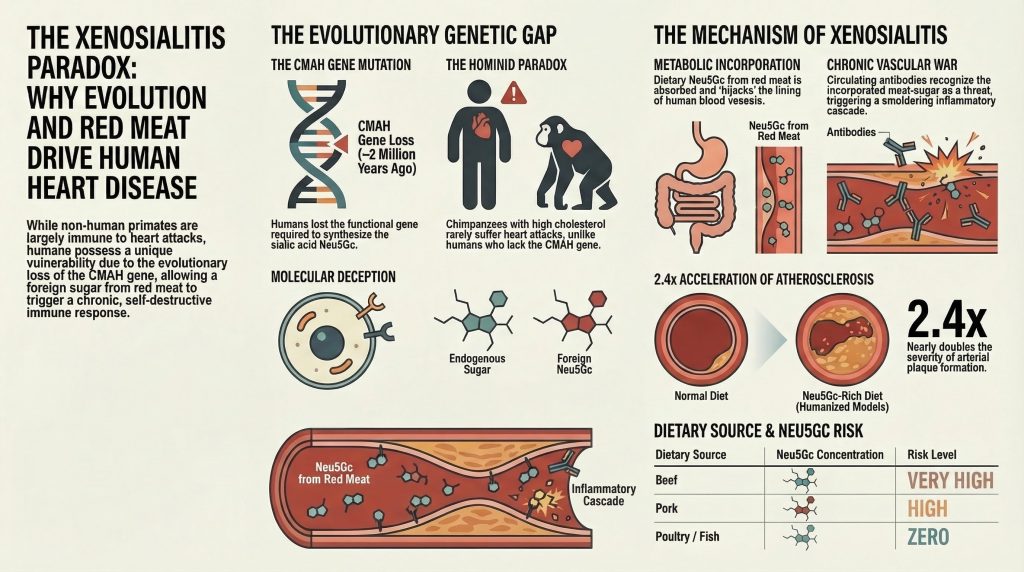
यह गहरा विचलन अनिवार्य रूप से मनुष्यों में एथेरोस्क्लेरोसिस के प्रति प्रजाति-विशिष्ट, आंतरिक आनुवंशिक प्रवृत्ति की ओर इशारा करता है।1इस अनूठी संवेदनशीलता का सार कड़ाई से केवल लिपिड चयापचय, हेमोडायनामिक कतरनी तनाव, या व्यवहार संबंधी चर में नहीं है, बल्कि कोशिका-सतह की मौलिक जीव विज्ञान से जुड़ी एक प्राचीन विकासात्मक आनुवंशिक असामान्यता में निहित है। ग्लाइकैनA carbohydrate chain or sugar molecule attached to proteins or lipids on cell surfaces; Neu5Gc is incorporated into human cell-surface glycans after red meat consumption, where it is recognized by the immune system as foreign.. विशेष रूप से, मानव हृदय संबंधी संवेदनशीलता संश्लेषण करने की क्षमता के विकास संबंधी नुकसान से अटूट रूप से जुड़ी हुई है। एन-ग्लाइकॉसिलन्यूरैमिनिक एसिड (Neu5Gc)A non-human sialic acid sugar molecule found on the cell surfaces of most mammals, including cattle, pigs, and sheep, but not synthesized by humans; it can be absorbed from red meat and incorporated into human tissues, where it may trigger an immune response., एक सर्वव्यापी स्तनधारी सियालिक एसिड।1इस गंभीर आनुवंशिक कमी के बावजूद, Neu5Gc-युक्त लाल मांस के मानव उपभोग के परिणामस्वरूप इस गैर-मानवीय ग्लाइкан का चयापचय समावेश सीधे मानव ऊतकों में होता है, जो कि सबसे विशेष रूप से संवहनी (वैस्कुलर) प्रणाली में होता है। एंडोथेलियमएंडोथेलियम हर रक्त वाहिका के अंदर की अति-पतली, चिकनी परत है। यह केवल एक कोशिका मोटी होती है।..[3,4] इस समाहित शर्करा की बाद की प्रतिरक्षा संबंधी पहचान एक “ज़ेनो-ऑटोएंटीजनA xeno-autoantigen is a foreign molecule that, once incorporated into the body's own tissues, is targeted by the immune system as if it were both self and non-self simultaneously; Neu5Gc functions as a xeno-autoantigen when it is metabolically embedded into the human vascular endothelium after red meat consumption.” एक दीर्घकालिक, सुलगती हुई सूजन संबंधी कैस्केड को ट्रिगर करता है जिसे “ज़ेनोसियालिटिसक्सीनोसिएलाइटिस पुरानी, सुलगती संवनीय सूजन की एक स्थिति है जो तब उत्पन्न होती है जब लाल मांस से आहार संबंधी Neu5Gc को मानव एंडोथेलियल ऊतक में शामिल किया जाता है और बाद में शरीर के अपने एंटी-Neu5Gc एंटीबॉडी द्वारा उस पर हमला किया जाता है, जो इसे एक बाहरी 'क्सीनो-ऑटोएंटीजन' के रूप में पहचानते हैं।'.”[5]
यह विस्तृत शोध रिपोर्ट ज़ेनोसियालाइटिस परिकल्पना के अंतრიह अत्यधिक जटिल विकासवादी, जैव रासायनिक और प्रतिरक्षा संबंधी तंत्रों को स्पष्ट करती है। के जीनोमिक विलोपन की खोज करके सीएमएएच जीनThe gene encoding the enzyme CMP-N-acetylneuraminic acid hydroxylase, which converts Neu5Ac to Neu5Gc in most mammals; humans carry an inactivating mutation in this gene and therefore cannot synthesize Neu5Gc., आहार का जटिल माइक्रोबायोम-मध्यस्थता पाचन Neu5GcNeu5Gc एक शर्करा अणु है जो लाल मांस में पाया जाता है। मनुष्यों ने लाखों साल पहले इसे बनाने की क्षमता खो दी थी, लेकिन जब हम बीफ़, पोर्क या मेमना खाते हैं तो हम इसे अभी भी अवशोषित कर लेते हैं।., मानव अंतःकोशिकीय ग्लाइकोसिylation मार्गों के आणविक अपहरण, और परिणामी पॉलीक्लोनल एंटीबॉडी-मध्यस्थता से होने वाले एंडोथेलियल विनाश के माध्यम से, यह विश्लेषण इस बात की एक व्यापक समझ प्रदान करता है कि मनुष्य लाल मांस से जुड़े एथेरोस्क्लेरोसिस के प्रति विशिष्ट रूप से क्यों संवेदनशील हैं, और ठीक कैसे यह तंत्र जीवन भर हृदय संबंधी जोखिम को मात्रात्मक रूप से बढ़ाता है।.
विकासवादी प्रतिमान: CMAH जीन उत्परिवर्तन और मानव की उत्पत्ति
सियालिक एसिड की मौलिक जीव विज्ञान
मानو आनुवंशिक दोष के परिमाण और परिणाम को सटीक रूप से समझने के लिए, सबसे पहले यह स्थापित करना होगा कि शारीरिक और संरचनात्मक भूमिका क्या है सियालिक एसिडSialic acids are a family of nine-carbon monosaccharides that cap the outermost ends of cell-surface glycan chains; their strong negative charge and exposed position make them key mediators of immune self-recognition, pathogen binding, and endothelial stability. कशेरुकी जीवविज्ञान के भीतर। सभी कशेरुकी कोशिकाओं की सतहें घनी, जटिल और अत्यधिक विनियमित चीनी श्रृंखलाओं की एक सरणी से घनिष्ठ रूप से सजी होती हैं, जो मुख्य रूप से अभिन्न झिल्ली से जुड़ी होती हैं प्रोटीनप्रोटीन वह पोषक तत्व है जिसका उपयोग आपका शरीर मांसपेशियों और ऊतकों को बनाने और उनकी मरम्मत करने के लिए करता है।. और सतह के लिपिड (lipids) बनाते हैं ग्लाइकोकैलिक्सग्लाइकोकैलिक्स रक्त वाहिकाओं की आंतरिक सतह पर चीनी से भरपूर एक नाजुक आवरण है, जो रक्त और कोशिकाओं के बीच एक प्रकार की जेल परत है।..[6,7मानव परिसंचरण से गुजरने वाले अधिकांश घुलनशील स्रावित प्रोटीनों पर भी इसी प्रकार की विशेष शर्कराओं (ग्लाइकेन) की सजावट होती है।6,7साइलिक एसिड अत्यधिक संशोधित मोनोसैकेराइड का एक विविध परिवार है जो नौ-कार्बन बैकबोर्न पर बना है, और वे आमतौर पर इन ग्लाइकेन श्रृंखलाओं के सबसे बाहरी, टर्मिनल सिरों पर पाए जाते हैं।6,7]
ग्लैकोप्रोटीन और ग्लाइकोलिपिड पर उनकी दूरस्थ स्थिति के कारण, शारीरिक पीएच पर उनके मजबूत इलेक्ट्रोनेगेटिव चार्ज के साथ मिलकर, सियालिक एसिड सेल-टू-सेल आसंजन को मध्यस्थता करने, रिसेप्टर-लिैंड इंटरैक्शन को मॉड्युलेट करने, स्थिर करने में अनिवार्य और बहुआयामी भूमिका निभाते हैं। एंडोथेलियल ग्लाइकोकेलिक्सएंडोथेलियल ग्लाइकोकेलिक्स ग्लाइकोप्रोटीन और प्रोटीोग्लाइकोन की एक पतली, जेल जैसी परत है जो रक्त वाहिकाओं की आंतरिक सतह को रेखाबद्ध करती है; यह एक चयनात्मक बाधा के रूप में कार्य करती है जो परिसंचारी लिपोप्रोटीन और धमनी की दीवार के बीच सीधे संपर्क को सीमित करती है, और अशांत या उच्च-वेग वाले रक्त प्रवाह द्वारा विघटन के प्रति संवेदनशील होती है।. अवरोध, और विशिष्ट सियालिक एसिड-बाइंडिंग लेक्टिन (सिग्लेक्स) के माध्यम से प्रतिरक्षा आत्म-मान्यता को विनियमित करना।6,8]
स्तनधारियों की विशाल बहुलता में, और वास्तव में अधिकांश स्थलीय कशेरुकियों में, सियालिक एसिड के दो प्रमुख रूप एन-एसिटाइलन्यूरमिनिक एसिड (Neu5Ac) और इसका प्रत्यक्ष हाइड्रॉक्सीकृत व्युत्पन्न, एन-ग्लाइकोलाइलन्यूरमिनिक एसिड (Neu5Gc) हैं।6,7संरचनात्मक रूप से ये दोनों अणु लगभग समान हैं, और इनमें केवल एक ऑक्सीजन परमाणु की उपस्थिति का अंतर है।5] पूर्वगामी Neu5Ac से व्युत्पन्न Neu5Gc में जैव रासायनिक संक्रमण विशेष रूप से एक एकल, अत्यधिक विशिष्ट एंजाइम द्वारा उत्प्रेरित होता है: साइटिडाइन मोनोफॉस्फेट-एन-एसिटाइलन्यूरामिक एसिड हाइड्रॉक्सीलेज (CMAH)।1,3] यह महत्वपूर्ण एंजाइम सेलुलर साइटोसोल के भीतर न्यूक्लियोटाइड-शुगर डोनर सीएमपी-न्यू5एसी पर कार्य करता है, जो एक मोनो-ऑक्सीजिनेज प्रतिक्रिया को सुविधाजनक बनाता है जो सीएमपी-न्यू5जीसी उत्पन्न करने के लिए एक हाइड्रॉक्सिल समूह जोड़ता है।[6,7CMP-Neu5Ac और CMP-Neu5Gc दोनों को बाद में साइटोसोल से अंदर ले जाया जाता है ल्युमेनल्यूमेन रक्त वाहिका के अंदर का वह खुला चैनल है जहाँ वास्तव में रक्त बहता है।. गॉल्जी उपकरण के, जहाँ वे नए संश्लेषित में जोड़े जाने के लिए प्राथमिक न्यूक्लियोटाइड-शर्करा दाता के रूप में कार्य करते हैं ग्लाइकोकॉन्जुगेट्सGlycoconjugates are molecules—typically proteins (glycoproteins) or lipids (glycolipids)—to which sugar chains are covalently attached; sialic acids, including Neu5Gc from dietary red meat, are added to glycoconjugates in the Golgi apparatus and then displayed on cell surfaces..[6,7परिणामस्वरूप, सामान्य स्तनधारी ऊतक अपनी सेलुलर सतहों पर Neu5Ac और Neu5Gc दोनों का एक समृद्ध, अंतःस्थापित और अत्यधिक कार्यात्मक मोज़ेक प्रदर्शित करते हैं।6,7]
| विशेषता | एन-एसिटाइलन्यूरामिक एसिड (Neu5Ac) | एन-ग्लाइकॉसिलन्यूरैमिनिक एसिड (Neu5Gc) |
| संरचनात्मक रीढ़ | 9-कार्बन मोनोसैकराइड | 9-कार्बन मोनोसैकराइड |
| रासायनिक अंतर | इसमें एन-एसिटाइल समूह होता है | एन-ग्लाइकोसाइल समूह (एक ऑक्सीजन परमाणु का जुड़ना) |
| जैविक उत्पत्ति | सभी कशेरुकी जीवों में डी नोवो संश्लेषित। | CMAH एंजाइम के माध्यम से Neu5Ac से संश्लेषित |
| मनुष्यों में स्थिति | प्रमुख, अंतर्जात मानव सियालिक एसिड | आनुवंशिक रूप से अनुपस्थित; “विदेशी” माना जाता है” क्सीनो-एंटीजनA foreign molecular structure recognized by the immune system as non-self; dietary Neu5Gc incorporated into human cell surfaces acts as a xeno-antigen because the human body naturally produces antibodies against it. |
| स्तनधारी वितरण | स्तनधारी जातियों में सर्वव्यापी | गैर-मानव स्तनधारियों में सर्वव्यापी; मनुष्यों में अनुपस्थित |
आलू-मध्यस्थ स्यूडोजीनीकरण घटना
हालाँकि, स्तनधारी वंश के भीतर मनुष्य एक स्पष्ट और परिणामी विसंगति का प्रतिनिधित्व करते हैं। सामान्य, स्वस्थ मानव ऊतक आनुवंशिक रूप से और मौलिक रूप से Neu5Gc को संश्लेषित करने में असमर्थ हैं।5यह बायोकेमिकल ट्रंकेशन कोई विनियामक दमन नहीं है, बल्कि CMAH जीन के भीतर ही एक प्रजाति-विशिष्ट, अपरिवर्तनीय म्यूटेशन का सीधा परिणाम है।1,3]
पेलियोजेनोमिक अनुमान और तुलनात्मक फ़ाइलोजीनेटिक विश्लेषण दर्शाते हैं कि लगभग 2 से 3 मिलियन वर्ष पहले—एक ऐसा काल जो जीनस के उद्भव से मेल खाता है होमो हमारे होमिनिन पूर्वजों से—एक महत्वपूर्ण जीनोमिक घटना घटी।1,9,12] एक अलू ट्रांसपोज़ेबल तत्वAn Alu element is a type of short, repetitive 'jumping gene' abundant in primate genomes that can insert itself into new genomic locations; the insertion of an Alu element into the CMAH locus caused the 92-base-pair deletion that permanently inactivated Neu5Gc synthesis in ancestral humans., प्राइमेट जीनोम में आम “जंपिंग जीन” के एक प्रकार ने, CMAH आनुवंशिक लोकस में प्रवेश किया। इस प्रविष्टि ने CMAH जीन के भीतर एक महत्वपूर्ण 92-बेस-पेयर एक्सॉन के एक विनाशकारी फ्रेम-शिफ्ट विलोपन को मध्यस्थता दी, जिसके परिणामस्वरूप एक समय से पहले स्टॉप कॉडन और कुल छद्मीकरणPseudogenization is the mutational inactivation of a gene so that it can no longer produce a functional protein; the CMAH gene in humans underwent pseudogenization via a frameshift deletion, leaving an intact but nonfunctional gene sequence inherited by all modern humans. (लोकस का पूर्ण अक्रियीकरण)।9,12CMP-Neu5Ac से CMP-Neu5Gc तक की एंजाइमी प्रतिक्रिया कड़ाई से एकतरफा (यूनिडायरेक्शनल) है और पूरी तरह से CMAH पर निर्भर है, इसलिए इस एक ही एंजाइम के नुकसान ने जैवसंश्लेषण मार्ग (बायोसिंथेटिक पाथवे) को हमेशा के लिए तोड़ दिया।1,3परिणामस्वरूप, आधुनिक मनुष्य केवल पूर्ववर्ती, Neu5Ac का उत्पादन करते हैं, जिससे उनकी कोशिकीय सतहें पूरी तरह से अंतर्जात Neu5Gc से रहित हो जाती हैं और मानव जीव के जैव रासायनिक परिदृश्य में नाटकीय रूप से बदलाव आता है।1,3]
विकासवादी चयन दबाव: रोगज़नक़ और प्रजनन अलगाव
प्राथमिक, सर्वव्यापी कोशिका-सतह के अणु के संश्लेषण के लिए उत्तरदायी एक जीन में कार्य-हानि उत्परिवर्तन (लॉस-ऑफ-फंक्शन म्यूटेशन) का स्थिर हो जाना एक असाधारण विकासवादी घटना है। मेज़بان ग्लाइकोकैलिक्स में इस तरह के भारी और अचानक बदलाव को अत्यधिक तीव्र विकासवादी चयन दबावों द्वारा संचालित किया जाना चाहिए, क्योंकि केवल यादृच्छिक आनुवंशिक बहाव (स्टोकेस्टिक जेनेटिक ड्रिफ्ट) के आधार पर इस तरह के मौलिक जैव रासायनिक परिवर्तन के पूर्ण, समष्टि-व्यापी स्थिरीकरण की संभावना अत्यधिक कम है।12वर्तमान विकासात्मक जीव विज्ञान पूर्वज होमिनिड आबादी में CMAH नल एलील के तेजी से स्थिरीकरण के लिए एक बहु-कारकीय मॉडल प्रस्तुत करता है।.
प्रमुख और सबसे आक्रामक रूप से शोध की गई परिकल्पना में एक क्रूर मेज़بان-रोगाणु विकासवादी हथियारों की दौड़ शामिल है, विशेष रूप से मलेरिया पैदा करने वाले के पूर्वजों से जुड़े हुए प्लास्मोडियम परजीवी।9,12स्तनधारी कोशिकाओं की सतह पर मौजूद सियालिक एसिड विभिन्न वायरल, बैक्टीरियल और परजीवी रोगजनकों के लिए प्राथमिक डॉकिंग रिसेप्टर्स और पहचान मोटिफ के रूप में कार्य करते हैं।6,7जीनोमिक चयन के हस्ताक्षरों के आधार पर, यह अत्यधिक संभावित है कि प्राचीन होमिनिन “गैर-मानव होमिनिड” (NHH) मलेरिया के एक अत्यधिक उग्र उपभेद द्वारा तबाह हो गए थे, जो सेलुलर प्रवेश प्राप्त करने के लिए Neu5Gc-समृद्ध एरिथ्रोसाइट्स से अधिमानतः जुड़ा था।9,12Alu-मध्यस्थता द्वारा CMAH जीन की हानि, हालांकि अन्य दृष्टियों से संभावित रूप से हानिकारक थी, उत्परिवर्तन को वहन करने वाले दुर्लभ व्यक्तियों को एक अचानक, जीवन रक्षक उत्तरजीविता लाभ प्रदान करती है। रोगज़नक़ के पसंदीदा कोशिका-सतह रिसेप्टर से मेज़बान को प्रभावी ढंग से वंचित करके, CMAH-रहित होमिनिन प्रचलित मलेरिया के खतरे से बचने में सक्षम थे, जिससे एक व्यापक चयनात्मक स्वीप हुआ जिसने जीवित रहने वाली आबादी में नल म्यूटेशन को स्थापित कर दिया।9,12हालाँकि, गहरे समय के विशाल परिप्रेक्ष्य में, यह विकासात्मक विजय अस्थायी थी।. प्लास्मोडियम फाल्सीपेरम—वह अत्यधिक घातक एजेंट जो आधुनिक मानव घातक मलेरिया के लिए ज़िम्मेदार है—ने अंततः नए सर्वव्यापक, मानव-विशिष्ट Neu5Ac-समृद्ध एरिथ्रोसाइट्स से प्राथमिकता से जुड़ने की क्षमता विकसित कर ली, जिससे मेज़बान-रोगज़नक़ गतिशीलता फिर से स्थापित हो गई।6,7,12]
एक दूसरी, फिर भी समान रूप से आकर्षक और पूरक परिकल्पना में प्रजनन अलगाव और महिला प्रतिरक्षा प्रणाली द्वारा मध्यस्थता वाली “आपदात्मक चयन” शामिल है।12स्तनधारी शुक्राणु अत्यधिक सियालाइकृत होते हैं, जो मादा जनन तंत्र के माध्यम से निषेचन स्थल तक की अपनी खतरनाक यात्रा के दौरान शुक्राणु के जीवित रहने को बढ़ाने, इम्युनोजेनिक प्रोटीनों को छिपाने और कार्य को अनुकूलित करने के लिए जटिल सतह ग्लाइकान का उपयोग करते हैं।12दुर्लभ CMAH-null उत्परिवर्तन को वहन करने वाली एक महिला होमिनिन में पर्यावरणीय या आहार संबंधी Neu5Gc के जन्म के बाद के संपर्क में आने पर स्वाभाविक रूप से परिसंचारी एंटी-Neu5Gc एंटीबॉडी विकसित हो जाएंगी, क्योंकि उसकी प्रतिरक्षा प्रणाली इस अणु को गैर-स्वयं के रूप में पहचान लेगी।10,12,18यदि इस म्यूटेंट मादा ने बाद में एक वाइल्ड-टाइप (CMAH-पॉजिटिव) नर के साथ सहवास किया, तो इसके परिसंचारी एंटीबॉडी आक्रामक रूप से Neu5Gc-युक्त पैतृक शुक्राणु को लक्षित करेंगे और उसे बेअसर कर देंगे, जिससे इसकी प्रजनन सफलता गंभीर रूप से कम हो जाएगी और इस जोड़ी की व्यवहार्यता प्रभावी रूप से नष्ट हो जाएगी।12हजारों पीढ़ियों से, पितृपक्षीय Neu5Gc के खिलाफ इस महिला प्रतिरक्षा-मध्यस्थता चयन से म्यूटेंट और वाइल्ड-टाइप आबादी के बीच एक तीव्र, अटूट प्रजनन अवरोध पैदा हो जाएगा, जिससे CMAH-न 1 जीनोटाइप का तेजी से निर्धारण होगा और संभावित रूप से उस प्रजाति-निर्माण घटना में सीधे योगदान मिलेगा जिसने अंततः मानव पूर्वजों को अन्य होमिनिड्स से अलग कर दिया।12]
आहार संबंधी बेमेल: बाहरी सियालिक एसिड का पाचन और माइक्रोबियल प्रसंस्करण
CMAH जीन के विकासवादी नुकसान ने Neu5Gc को आधुनिक मानव जीव के लिए जैव रासायनिक रूप से पूरी तरह से विदेशी बना दिया है।5फिर भी, इस गहरी आनुवंशिक कमी के बावजूद, आधुनिक मानव आहार—विशेष रूप से पश्चिमी समाजों में—इस अणु से भरपूर है। Neu5Gc स्तनधारी स्रोतों से प्राप्त लाल मांस, विशेष रूप से गोमांस (बीफ), सूअर का मांस (पोर्क), और भेड़ के मांस (लैंब) में अत्यधिक केंद्रित है, जो वैश्विक खपत का मुख्य हिस्सा बने हुए हैं।3,8,22इसके अलावा, इन स्तनधारियों से प्राप्त डेयरी उत्पादों में भी गैर-मानवी सियालिक एसिड की मापने योग्य, हालांकि कम, मात्रा होती है।8]
कठोर जैव रासायनिक परख और उच्च-निष्पादन तरल क्रोमैटोग्राफी ने Neu5Gc एक्सपोजर के आहार संबंधी परिदृश्य को स्पष्ट रूप से परिभाषित किया है। अनुसंधान से पता चलता है कि गोमांस में इस अणु का स्तर सबसे अधिक होता है, जिसमें लगभग 30.1 µg/g Neu5Gc होता है, इसके ठीक बाद 25.5 µg/g पर सूअर का मांस आता है।7,8इसके विपरीत, पक्षी प्रजातियाँ (जैसे कि मुर्गी पालन) और विविध मछलियों के वंश स्तनधारी वृक्ष से सीएमएएच (CMAH) जीन के विकास से बहुत पहले अलग हो गए, या स्वतंत्र रूप से इसे खो दिया, और इसलिए पूरी तरह से और स्वाभाविक रूप से Neu5Gc से रहित हैं।7,8यह कड़ा जैव रासायनिक द्विभाजन आहार संबंधी Neu5Gc के सेवन को स्तनधारी लाल मांस के सेवन तक अत्यधिक विशिष्ट बनाता है।7,8]
| आहार स्रोत | Neu5Gc सामग्री वर्गीकरण | विशिष्ट Neu5Gc सांद्रता |
| बीफ़ | बहुत अधिक | ~ 30.1 µg/g |
| सूअर का मांस | उच्च | ~ 25.5 µg/g |
| मेमना / खरगोश | उच्च | बीफ/पोर्क के तुलनीय |
| डेयरी उत्पाद | मध्यम | चर (वेरिएबल), दूध के ग्लाइकोप्रोटीन में मौजूद |
| पोल्ट्री (चिकन, टर्की) | शून्य (जैविक रूप से अनुपस्थित) | 0.0 µg/g |
| मछली और समुद्री भोजन | शून्य (जैविक रूप से अनुपस्थित) | 0.0 µg/g |
आंत के माइक्रोबायोम की महत्वपूर्ण भूमिका
आहार संबंधी Neu5Gc का जठर गुहा (गैस्ट्रिक लुमेन) में रखे हुए उपभोग किए गए खाद्य पदार्थ से अवशोषित, प्रणालीगत रूप से सक्रिय जैव रासायनिक इकाई में संक्रमण, मेज़बान (होस्ट) के जठरांत्र संबंधी माइक्रोबायोम द्वारा कड़ाई से विनियमित होता है। आहार संबंधी Neu5Gc को आम तौर पर एक स्वतंत्र मोनोसैकराइड के रूप में नहीं खाया जाता है; बल्कि, इसका सेवन मुख्य रूप से ग्लाइकोसिडिक रूप से बंधे हुए रूप में किया जाता है, जो जटिल ग्लाइकोप्रोटीन, म्यूसिन और ग्लाइकोलिपिड्स में गहराई से एकीकृत होता है जो स्तनधारी ऊतक (जैसे पोरसीन सबमैक्सिलरी म्यूसिन) बनाते हैं।8,17बद्ध और मुक्त सियालिक एसिड के बीच का यह अंतर अत्यधिक शारीरिक महत्व रखता है। हालाँकि मुक्त, अनबंधारित (अबाउंड) Neu5Gc तकनीकी रूप से आंतों की बाधा के पार अवशोषित किया जा सकता है, इसे शरीर द्वारा एक छोटे, अत्यधिक घुलनशील और अनुपयोगी अणु के रूप में पहचाना जाता है। परिणामस्वरूप, मुक्त Neu5Gc को वृक्क (गुर्दे) प्रणाली द्वारा तेजी से साफ कर दिया जाता है और मूत्र में कुशलतापूर्वक उत्सर्जित कर दिया जाता है, जो दीर्घकालिक ऊतक संचय या विकृति का कारण बनने में पूरी तरह से विफल रहता है।11,16यह केवल संरचनात्मक रूप से बंधा हुआ Neu5Gc है, जो जटिल वृहदाणु सरणी में प्रस्तुत होता है, जो चयापचय निगमन की खतरनाक प्रक्रिया से गुजरता है।11,16,17]
मानव और मूरिन (चूहों) के मेटाजेनोमिक अनुक्रमण में हालिया प्रगति आंत माइक्रोबायोमThe gut microbiome is the enormous community of bacteria living in your intestines. There are trillions of them, and they are not passive passengers. से पता चला है कि निवासी माइक्रोबियल फ्लोरा Neu5Gc-युक्त आहार पर गतिशील और तेज़ी से प्रतिक्रिया करता है।17विशेष रूप से, उन आबादी से संबंधित जो इन गणों (ऑर्डर्स) के अंतर्गत आती हैं बैक्टीरोइडल्स और क्लोस्ट्रीडिएलेस लाल मांस से जुड़े के संपर्क में आने पर महत्वपूर्ण फेनोटाइपिक विस्तार से गुजरना कार्बोहाइड्रेटकार्बोहाइड्रेट भोजन में शर्करा और स्टार्च हैं — ब्रेड, चावल, पास्ता, फल, आलू, मिठाइयाँ।..[17ये विशिष्ट जीवाणु क्लेड्स अत्यधिक विशिष्ट जीवाणु सियालिडेस (न्यूरामिनिडेस) व्यक्त करने के लिए विकसित हुए हैं जो विशेष रूप से मेज़बान श्लेष्म मूसिन और, विशेष रूप से, आहार संबंधी ग्लाइकोप्रोटीन से टर्मिनल सियालिक एसिड को अलग करने के लिए डिज़ाइन किए गए हैं।17,20,21]
ऐतिहासिक रूप से, यह माना जाता था कि बैक्टीरियल सियालिडेज़ विशेष रूप से मेज़बान-अंतर्जात Neu5Ac को पसंद करते थे, क्योंकि यह मानव आंत में सबसे प्रचुर मात्रा में पाया जाने वाला सब्सट्रेट है। हालाँकि, उन्नत एक्स-रे क्रिस्टलोग्राफी का उपयोग करने वाले गहन संरचनात्मक अध्ययनों ने कुछ बैक्टीरियल सियालिडेज़ के भीतर विशिष्ट, पहले से अनदेखे अमीनो एसिड विन्यासों की पहचान की है जो Neu5Gc-युक्त ग्लाइकेन्स के लिए एक असामान्य रूप से उच्च-आत्मीयता सब्सट्रेट प्राथमिकता प्रदान करते हैं।17ये विशिष्ट आंत के सूक्ष्मजीव माइक्रोबायोम के भीतर एक जटिल क्रॉस-फीडिंग गतिशीलता का समन्वय करते हैं, जिसमें वे ऊर्जा और कार्बन स्रोत के लिए क्लीव किए गए सियालिक एसिड को सक्रिय रूप से कैटोबोलाइज करने के लिए Nan आनुवंशिक मार्ग का उपयोग करते हैं।20,21दिलचस्प बात यह है कि, Neu5Ac के डाउनस्ट्रीम कैटाबॉलिज्म (अपचय) से उप-उत्पाद के रूप में एसिटिक एसिड का उत्पादन होता है, जबकि Neu5Gc के बैक्टीरियल मेटाबॉलिज्म (पचय) से ग्लाइकोलिक एसिड प्राप्त होता है।20,21चयापचय उप-उत्पादों में ये अंतर कोलन की उपकला (epithelium) के स्थानीय पीएच और चयापचय परिदृश्य को सूक्ष्म रूप से बदल सकते हैं, जिससे व्यापक भड़काऊ वातावरण (inflammatory milieu) में योगदान मिलता है।20,21]
इन सूक्ष्मजीविया सियालिडेस द्वारा विशाल मांस ग्लाइकोप्रोटीन से Neu5Gc का एंजाइमैटिक विमोचन छोटे, विशिष्ट ओलिगोसेकेराइड टुकड़ों (जैसे GalNGc) में, गैर-मानव शर्करा के बाद के आंतों के अवशोषण और प्रणालीगत वितरण के लिए आवश्यक पहला चरण होने का अत्यधिक संदेह है।8,17]
सेलुलर हाईजैकिंग: मेटाबोलिक इनकॉर्पोरेटेड की क्रियाविधि
एक बार जब आहार संबंधी, ग्लाइकोसाइडिक रूप से जुड़ा हुआ Neu5Gc (या इसके माइक्रोबायोम-मुक्त ओलिगोसैकराइड मध्यवर्ती) जटिल आंतों के उपकला को पार कर जाता है, तो यह प्रणालीगत परिसंचरण में प्रवेश करता है। साक्ष्य प्रदर्शित करते हैं कि लाल मांस के भोजन के बाद, ये ज़ीनो-ग्लाइकन एक स्थिर- अवस्था के स्तर पर मानव परिसंचरण में दिखाई देते हैं जो कई घंटों तक बनी रहती है, जो ऊतक अंतःक्रिया के लिए पर्याप्त अवसर प्रदान करती है।11,15,16जिस प्रक्रिया के माध्यम से यह पूरी तरह से बाहरी आहार संबंधी अणु स्थायी रूप से मानव ऊतकों में एकीकृत हो जाता है, वह मानव जैव रसायन में एक आकर्षक और अत्यधिक खतरनाक कमज़ोरी का प्रतिनिधित्व करता है। मूल समस्या आणविक धोखे की है: हमारी अत्यधिक संरक्षित इंट्रासेल्युलर ग्लाइकोसिलेशन मशीनरी स्वदेशी अग्रदूत (Neu5Ac) और बाहरी, गैर-मानव एनालॉग (Neu5Gc) के बीच अंतर करने में पूरी तरह असमर्थ है।3,5,11] केवल एक छोटे से ऑक्सीजन परमाणु से भिन्न, ये अणु कोशिकीय निर्माण के लिए उत्तरदायी एंजाइमों को एक जैसे प्रतीत होते हैं।3,5]
एन्डोसाइटिक और लाइसोसोमल पाथवे
चूँकि मानव कोशिकाओं में बाह्य कोशिकीय स्थान से मुक्त सियालिक एसिड के ग्रहण के लिए विशेष रूप से डिज़ाइन किया गया कोई समर्पित प्लाज्मा झिल्ली ट्रांसपोर्टर पूरी तरह से नहीं होता है, इसलिए परिसंचारी Neu5Gc-ग्लाइकोकॉन्जुगेट्स का आंतरिककरण वैकल्पिक मार्गों के माध्यम से होना चाहिए।11,13,16यह अपटेक मुख्य रूप से फ्लूइड-फेज़ एंडोसाइटोसिस और मैक्रोपिनोसाइटोसिस द्वारा संचालित होता है—ऐसी प्रक्रियाएँ जहाँ कोशिका अनिवार्य रूप से अपने आसपास के बाह्यकोशिकीय द्रव और उसमें घुले पदार्थों को “पीती” है।11,12,16]
अंतर्ग्रहण (इंटरनलाइजेशन) पर, ये बाहरी अणु एंडोसोम में समाहित हो जाते हैं और सावधानीपूर्वक लाइसोसोम के अत्यधिक अम्लीय, डिग्रेडेटिव (अपघटनी) वातावरण में पहुँचाए जाते हैं।11,16लाइसोसोम के भीतर, मेज़बान-व्युत्पन्न लाइसोसोमल सियालिडेज़ एंजाइम जटिल आहार ग्लाइकोकॉन्जुगेट्स को एनजाइमी रूप से विभाजित करते हैं, अंततः कोशिका के भीतर गहराई से मुक्त Neu5Gc मोनोसेकेराइड जारी करते हैं।11,16]
इस अणु के बाद के निगमन के लिए महत्वपूर्ण, अपरिहार्य प्रवेश द्वार लाइसोसोमल सियालिक एसिड ट्रांसपोर्टर है, एक प्रोटीन जिसे सियालिन के रूप में जाना जाता है (जो इसके द्वारा एन्कोड किया गया है SLC17A5 जीन)।11,13,16सियालिन एक अत्यधिक संरक्षित ट्रांसमेम्ब्रेन प्रोटीन है जिसकी सामान्य शारीरिक भूमिका लाइसोसोम में निम्नीकृत ग्लाइकोप्रोटीन से अंतर्जात होस्ट Neu5Ac का बचाव और पुनर्चक्रण करना है, और पुनरुपयोग के लिए उन्हें वापस साइटोसोल में पंप करना है।11,16हालाँकि, सियालिन पूरी तरह से चयनात्मक नहीं है; यह लाल मांस से प्राप्त मुक्त Neu5Gc अणुओं को आसानी से स्वीकार करता है और उन्हें सक्रिय रूप से साइटोसोलिक स्थान में पहुँचाता है, जो प्रभावी रूप से कोशिका की अंतिम आंतरिक बाधा को तोड़ देता है।11,12,16]
डी नोवो संश्लेषण और एंडोथेलियल अभिव्यक्ति
एक बार साइटोसोल की अपेक्षाकृत सुरक्षा के भीतर, बाहरी Neu5Gc परपोषी कोशिका के डी नोवो सियालिक एसिड सिंथेटिक मार्ग में प्रवेश करता है, जो जैव रासायनिक हाईजैकिंग के अंतिम चरणों की शुरुआत करता है। अणु पर साइटिडाइन मोनोफॉस्फेट (CMP)-सियालिक एसिड सिंथेस द्वारा कार्रवाई की जाती है, जो एक उच्च-ऊर्जा CMP न्यूक्लियोटाइड को जोड़कर मोनोसैकाराइड को सक्रिय करता है, जिससे दाता परिसर CMP-Neu5Gc बनता है।6,7यह सक्रिय शर्करा-न्यूक्लियोटाइड दाता तब सक्रिय रूप से गॉल्जी उपकरण के लुमेन में पहुँचाया जाता है, जो कोशिका का केंद्रीय छंटाई और संशोधन केंद्र है।6,7]
गोल्जी के भीतर, मानव ग्लाइकोसिलट्रांसफ़ेरेज—वे सटीक एंजाइम जो नव-संश्लेषित प्रोटीनों और लिपिडों पर जटिल, शाखित ग्लाइकेन ट्री बनाने के लिए उत्तरदायी हैं—अंधाधुंध रूप से प्रचुर मात्रा में उपलब्ध सीएमपी-न्यू5जीसी डोनर्स का उपयोग ऐसे करते हैं मानो वे सही, अंतर्जात सीएमपी-न्यू5एसी हों।3,5,11परिणामस्वरूप, Neu5Gc सहसंयोजक रूप से और स्थायी रूप से नव-निर्मित ग्लाइकोप्रोटीन और ग्लाइकोलिपिड से जुड़ा होता है। ये नव-संयोषित, ज़ेनो-साइलेटेड अणु तब स्रावी वेसिकल्स के माध्यम से कोशिका की सतह पर ले जाए जाते हैं, जहाँ वे प्लाज्मा झिल्ली में एकीकृत हो जाते हैं।3,5]
इस जटिल जैव रासायनिक मार्ग के माध्यम से, मानव कोशिकाएं अनिवार्य रूप से एक आहार यौगिक को हाईजैक कर लेती हैं और अनजाने में अपनी ही कोशिका की सतहों को हथियार बना लेती हैं। हालांकि विभिन्न मानव ऊतकों में Neu5Gc का संचय देखा गया है, जिसमें खोखले अंगों की परत बनाने वाली एपिथेलिया भी शामिल है (जो विभिन्न कार्सिनोमा के साथ इसके मजबूत महामारी विज्ञान के संबंध को स्पष्ट करता है), यह संवहनी एंडोथेलियम — सभी रक्त वाहिकाओं की नाजुक, सबसे अंतरंग परत — के लिए एक गहन, अत्यधिक चयनात्मक ट्रॉपिज्म (अभिवृत्ति) प्रदर्शित करता है।5,22मानव शव परीक्षा के नमूनों के कठोर इम्युनohistochemical सर्वेक्षण, जिनमें अत्यधिक विशिष्ट, मोनोस्पेसिफिक चिकन एंटी-Neu5Gc एंटीबॉडी और एफिनिटी-प्यूरीफाइड मानव सीरम दोनों का उपयोग किया गया है, ने सामान्य दिखने वाले मानव में तीव्र Neu5Gc अभिव्यक्ति को निश्चित रूप से प्रदर्शित किया है महाधमनीमहाधमनी आपके शरीर की सबसे बड़ी धमनी है। यह हृदय से रक्त को बाहर निकालकर छाती और पेट के रास्ते नीचे ले जाती है, और हर जगह शाखाएँ भेजती है।., कोलोन और प्लेसेंटा के घने माइक्रovasculature में, और महत्वपूर्ण रूप से, सीधे सक्रिय एथेरोस्क्लेरोटिक पट्टिकाओं के ऊपर स्थित एंडोथेलियम में।5]
इम्यूनोलॉजिकल जेनेसिस: कॉममेंसल प्राइमिंग और ज़ेनो-ऑटोएंटीबॉडीज़
मानવ ऊतकों से सहसंयोजक रूप से बंधे हुए एक गैर-मानव अणु की उपस्थिति एक विशिष्ट रूप से खतरनाक प्रतिरक्षा संबंधी विरोधाभास पैदा करती है, जिसे साहित्य में औपचारिक रूप से “क्सिनो-ऑटोएंटीजन” के रूप में वर्गीकृत किया गया है।5चूँकि हमारे विकासवादी इतिहास के कारण Neu5Gc जैविक रूप से विदेशी (“क्सिनो”) है, इसलिए मानव प्रतिरक्षा प्रणाली इसे विदेशी के रूप में पहचानती है, भले ही यह अंतःच्छद सतह पर मेजबान के अपने स्व-संबद्ध आणविक पैटर्न के अंतरंग संदर्भ के भीतर भौतिक रूप से एम्बेडेड हो।5,6]
प्रतिरक्षा प्रतिक्रिया का ऑन्टोजेनी
व्यापक प्रतिरक्षा संबंधी निगरानी और महामारी संबंधी परीक्षण एक चौंकाने वाला तथ्य उजागर करते हैं: अनिवार्य रूप से सभी सामान्य, स्वस्थ वयस्क मनुष्यों में परिसंचर्यी, अत्यधिक सक्रिय पॉलीक्लोनल एंटी-Neu5Gc एंटीबॉडी मौजूद होते हैं।5,6,10ये अत्यधिक विविध एंटीबॉडी रिपर्टोइस में इम्युनोग्लोबुलिन जी (IgG), IgA, और IgM आइसोटाइप शामिल हैं, जो न्यू5जीसी (Neu5Gc)-युक्त एपिटोप्स की एक विस्तृत श्रृंखला को लक्षित करते हैं जो आमतौर पर मनुष्यों में पाए जाते हैं एंडोथेलियल कोशिकाएंसभी रक्त वाहिकाओं की आंतरिक सतह को अस्तर करने वाली कोशिकाओं की पतली परत; वे संवहनी स्वर को नियंत्रित करती हैं, थक्के जमने से रोकती हैं, और धमनी की दीवार में पदार्थों के मार्ग को नियंत्रित करती हैं — और उनका कार्यकुशल न होना एथेरोस्क्लेरोसिस में एक प्रारंभिक, महत्वपूर्ण कदम है।..[5,6,10महत्वपूर्ण रूप से, ये एंटीबॉडी जर्म-लाइन द्वारा एन्कोडेड “प्राकृतिक” एंटीबॉडी नहीं हैं (जैसे कि वे जो ABO रक्त समूह प्रणाली को निर्धारित करते हैं, जो विशिष्ट संपर्क से स्वतंत्र रूप से मौजूद होते हैं)।5,10,18बल्कि, उन्हें अपनी उच्च बंधन क्षमताओं को प्राप्त करने के लिए विशिष्ट प्रसवोत्तर एंटीजेनिक उत्तेजना की आवश्यकता होती है और वे क्लासिक एफिनिटी परिपक्वता से गुजरते हैं।10,18]
शिशु के गर्भनाल के रक्त के विस्तृत विश्लेषण से जन्म के समय एंटी-Neu5Gc एंटीबॉडी (विशेष रूप से IgM) की पूर्ण और संपूर्ण अनुपस्थिति का पता चलता है।10,18जीवन के पहले कुछ महीनों तक टiter स्तर अदृश्य बने रहते हैं, जो दीर्घकालिक प्रतिरक्षा के प्राथमिक स्रोत के रूप में ट्रांसप्लासेंटल (गर्भजरायु) स्थानांतरण के खिलाफ दृढ़ता से तर्क देते हैं।10,18हालाँकि, ये एंटीबॉडी टाइटर्स जीवन के छह महीने के आसपास तेज़ी से और लगातार बढ़ने लगते हैं।10,18यह सटीक समय-सीमा गाय के दूध पर आधारित फॉर्मूला, डेयरी उत्पादों और ठोस आहार पर सामान्य वीनिंग प्रक्रिया के साथ पूरी तरह से मेल खाती है, जो आहार संबंधी Neu5Gc के प्रति शिशु के बिल्कुल पहले प्रणालीगत संपर्क को चिह्नित करती है।8,10,18इसके अलावा, व्यापक पर्यावरणीय संपर्कों का परीक्षण करने वाले महामारी विज्ञान के अध्ययनों से पता चला है कि सक्रिय खेतों में पले-बढ़े बच्चों में, जो संभवतः पशु-जनित एंटीजन के काफी उच्च परिवेशी स्तर के संपर्क में आते हैं, गैर-कृषि, शहरी क्षेत्रों में रहने वाले बच्चों की तुलना में संचलन करने वाले एंटी-Neu5Gc IgG का सांख्यिकीय रूप से उच्च स्तर प्रदर्शित होता है।8,18]
बैक्टीरियल प्राइमिंग के माध्यम से हीमोफिलस इन्फ्लूएंजा
एक महत्वपूर्ण और तंत्र-संबंधी प्रश्न उठता है: मानव प्रतिरक्षा प्रणाली एक साधारण आहार संबंधी शर्करा के खिलाफ इतनी मजबूत, आजीवन और एफ़िनिटी-मैच्योर एंटीबॉडी प्रतिक्रिया कैसे उत्पन्न करती है, खासकर यह देखते हुए कि मुक्त Neu5Gc, जब अलग किया जाता है, तो अपने आप में केवल कमजोर रूप से इम्युनोजेनिक होता है?
उत्तर सूक्ष्मजीवों के कपटी आणविक मिमिक्री (अनुकरण) और बैक्टीरियल क्लोकिंग (छिपाव) की परिघटना में निहित है। जबकि जीवन के वृक्ष पर किसी भी जीवाणु, विषाणु या कवक रोगाणु में अंतर्जात Neu5Gc के आनुवंशिक संश्लेषण को कभी भी प्रलेखित नहीं किया गया है, कुछ अत्यधिक अनुकूलित सहभोजी मानव रोगजनक कुशल आणविक मचान (स्कैवेंजर्स) के रूप में कार्य करते हैं।14,21नॉनटाइपेबल हीमोफिलस इन्फ्लूएंजा (एनटीआई), एक सर्वव्यापी, मानव-विशिष्ट कमसेंशल जीवाणु और अवसरवादी श्वसन रोगजनक जो ओटिटिस मीडिया और श्वसन संबंधी एक्सऐर्बेशन के लिए जिम्मेदार है, में एक अत्यधिक विशिष्ट ट्रिपार्टाइट एटीपी-स्वतंत्र पेरिप्लाज्मिक (टीआरएपी) ट्रांसपोर्टर होता है।14,21यह विशिष्ट परिवहन प्रणाली मेज़बान के म्यूकोसल वातावरण से आहार संबंधी Neu5Gc की ट्रेस मात्रा को कुशलतापूर्वक साफ़ करती है।14,21]
एक बार मेज़बान से प्राप्त होने के बाद, NTHi चयापचय रूप से इस Neu5Gc को सीधे अपने स्वयं के कोशिका सतह लाइपोलिगोसैकराइड्स (LOS) में शामिल कर लेता है।14,19,21] यह जीवाणु साइऐलीकरण इस जीव को एक बहुत बड़ा, लगभग अभेद्य उत्तरजीविता लाभ प्रदान करता है। इसके सुरक्षात्मक बायोफिल्म में Neu5Gc का एकीकरण, मेजबान की जन्मजात प्रतिरक्षा प्रणाली द्वारा पूरक-मध्यस्थता से होने वाले विनाश के प्रति जीवाणु के प्रतिरोध को काफी हद तक बढ़ा देता है।[14,21यह मुख्य रूप से पूरक सक्रियण के पारंपरिक मार्ग को निरस्त करके, सक्रिय रूप से परपोषी (होस्ट) IgM एंटीबॉडी को जीवाणु की सतह से बंधने और लसीका (लाइसिस) शुरू करने से रोककर ऐसा करता है।14,21]
हालाँकि, जीवाणु के इस परिष्कृत आवरण तंत्र की मानव मेज़बान को एक भारी और दीर्घकालिक कीमत चुकानी पड़ती है। किसी जीवाणु रोगज़नक़ की अत्यधिक सूजन पैदा करने वाली, रोगज़नक़ से जुड़ी सतह पर Neu5Gc एंटीजन की उपस्थिति एक तीव्र, प्राकृतिक प्रतिरक्षा विज्ञान संबंधी सहायक (एडजुवेंट) के रूप में कार्य करती है।10,14,21जब मानव प्रतिरक्षा प्रणाली संक्रमण को साफ करने के लिए एनटीआई बैक्टीरिया के खिलाफ अनिवार्य रूप से एक जोरदार, प्रणालीगत प्रतिक्रिया शुरू करती है, तो यह साथ ही क्रॉस-प्रतिक्रियाशील एंटी-Neu5Gc एंटीबॉडी का एक विशाल भंडार उत्पन्न करती है।10,14,21क्षेत्र में अब यह बात व्यापक रूप से स्वीकार कर ली जाती है कि यह प्रसवोत्तर, रोगज़नक़-मध्यस्थता वाला प्राइमिंज़, जो दैनिक आहार संबंधी रेड मीट के संपर्क के साथ निरंतर तालमेल में काम करता है, ज़ेनो-ऑटोएंटीबॉडीज़ के आजीवन उत्पादन और रखरखाव के लिए आवश्यक, अत्यधिक भड़काऊ संकेत प्रदान करता है।5,10,14,18]
ज़ेनोसियालाइटिस: एथरोजेनेसिस की कार्यप्रणाली
चयापचय संमेलन (व्यापक एंडोथेलियल एंटीजन प्रदान करना) और माइक्रोबियल प्राइミング (परिसंचारी, उच्च-आइसोएफ़िनिटी एंटीबॉडी प्रदान करना) का विनाशकारी अभिसरण संवहनी की एक निरंतर, सुलगती हुई स्थिति में समाप्त होता है सूजनसूजन, चोट या किसी ऐसी चीज़ के प्रति आपकी प्रतिरक्षा प्रणाली (इम्यून सिस्टम) की प्रतिक्रिया है जिसे वह बाहरी आक्रमणकारी मानती है। यह अपने साथ सूजन, गर्मी और सफाई करने वाली कोशिकाओं को लाती है।. औपचारिक रूप से “ज़ेनोसियालिटिस” कहा जाता है।5यह रोग संबंधी प्रक्रिया अनूठे रूप से कपटी है क्योंकि जीवन भर खाए जाने वाले हर लाल मांस के भोजन के साथ एंटीजन लगातार भरता रहता है, जिससे यह सुनिश्चित होता है कि सूजन का चक्र कभी भी जैविक समाधान तक नहीं पहुँच पाता है।.
ज़ेनोसियालाइटिस की सटीक पैथोफिज़ियोलॉजी, विशेष रूप से एथेरोस्क्लेरोसिस को तेज करने के प्रत्यक्ष संदर्भ में, सेलुलर विनाश के एक अत्यधिक समन्वित, क्रमिक कैस्केड में सामने आती है:5]
- एंटीजन-एंटीबॉडी बंधन परिसंचारी पॉलीक्लोनल ह्यूमन एंटी-Neu5Gc एंटीबॉडी (मुख्य रूप से IgG और IgA आइसोकाइप्स) लगातार संवहनी एंडोथेलियम की जांच करते हैं क्योंकि रक्त धमनी वृक्ष के माध्यम से बहता है। नाजुक एंडोथेलियल ग्लाइकोकेलिक्स पर प्रदर्शित चयापचय रूप से शामिल Neu5Gc एपिटोप का सामना करने पर, एंटीबॉडी उच्च आत्मीयता के साथ बांधते हैं, जिससे एक घना बनता है यथास्थान सीधे वाहिका दीवार पर इम्यून कॉम्प्लेक्स।5]
- कॉम्प्लीमेंट कैस्केड सक्रियण एंडोथेलियल सतह पर IgG और IgA अणुओं का स्थानिक क्लस्टरिंग उनके Fc (फ्रैगमेंट क्रिस्टलाइज़ेबल) क्षेत्रों को रक्तप्रवाह के सामने लाता है। यह सामने आया एरे C1q प्रोटीन कॉम्प्लेक्स के लिए एक आदर्श बाइंडिंग साइट प्रदान करता है, जो कॉम्प्लीमेंट सिस्टम का प्रवर्तक है।5,15] This triggers the classical complement cascade, leading to the aggressive, sub-lytic deposition of complement proteins (such as C3b and the membrane attack complex) directly onto the intact, otherwise healthy endothelium.[5]
- Profound Endothelial Activation: The heavy deposition of complement proteins, combined with the mechanical cross-linking of surface receptors by the antibodies, forcefully pushes the endothelial cell from its normal, quiescent, non-thrombogenic state into a highly activated, pro-inflammatory phenotype.[5] Sophisticated इन विट्रो models demonstrate that the simple incubation of high-titer human sera with Neu5Gc-fed endothelial cells directly causes massive intracellular signaling changes, resulting in the rapid exocytosis of Weibel-Palade bodies and the rapid de novo transcription of inflammatory genes.[5]
- Cytokine Secretion and Selectin Upregulation: The newly activated endothelium begins to secrete copious amounts of pro-inflammatory cytokines, creating a localized chemotactic gradient designed to summon immune cells.[5] Simultaneously, the cells rapidly upregulate the surface expression of critical adhesion molecules, specifically E-selectin and P-selectin.[5] P-selectin, in particular, is a potent, well-recognized mediator of recurrent thromboembolism and cardiovascular disorders, operating to facilitate the initial, rolling tethering of circulating leukocytes to the vessel wall.[23]
- Leukocyte Extravasation and Plaque Formation: The heavy presence of selectins and the disrupted glycocalyx leads to Neu5Gc-dependent monocyte binding.[5] The circulating monocytes roll along the activated endothelium, firmly adhere via integrin interactions, and actively diapedese (squeeze) into the उपएन्डोथीलियल स्थानसबेंडोथेलियल स्पेस धमनी की आंतरिक परत के ठीक नीचे, कोशिकाओं की उस एकल परत और नीचे की मांसपेशी के बीच का संकीर्ण अंतराल है।. (the tunica इंटिमाइन्टिमा धमनी की दीवार की सबसे wewnętr (भीतरी) परत होती है, जो ठीक चिकनी परत के नीचे स्थित होती है।.). Once trapped inside the arterial wall, these hyperactive monocytes transform into resident मैक्रोफेजमैक्रोफेज एक बड़ी प्रतिरक्षा कोशिका है जो मलबे और घुसपैठियों को निगल जाती है। इस नाम का शाब्दिक अर्थ है "बड़ा खाने वाला।", begin to aggressively engulf oxidized low-density lipoproteins (एलडीएलएलडीएल, या कम घनत्व वाले लिपोप्रोटीन, मुख्य कण हैं जो आपके रक्त के माध्यम से कोलेस्ट्रॉल ले जाते हैं — और मुख्य कण हैं जो धमनी की दीवारों में फंस जाते हैं।.), and swell into massive फ़ोम कोशिकाएंफोम सेल एक ऐसी प्रतिरक्षा कोशिका है जिसने इतने सारे फँसे हुए कोलेस्ट्रॉल को खा लिया है कि वह सूज जाती है और माइक्रोस्कोप के नीचे झागदार दिखाई देती है।.. The accumulation and subsequent apoptotic death of these foam cells forms the foundational, highly thrombogenic नेक्रोटिक कोरनेक्रोटिक कोर एक उन्नत पट्टिका (प्लाक) का मृत, गूदेदार केंद्र है, जो उन प्रतिरक्षा कोशिकाओं से बना है जिन्होंने फँसे हुए कोलेस्ट्रॉल को खा लिया था और फिर वहीं मर गईं।. of the atherosclerotic plaque.[5]
- Synergistic Amplification Loops: This destructive cascade does not operate in a vacuum; it is further amplified by systemic inflammatory states. The presence of Tumor Necrosis Factor-alpha (TNF-α), a ubiquitous, highly potent pro-inflammatory cytokine typically upregulated during flares of general vascular damage or मेटाबोलिक सिंड्रोममेटाबोलिक सिंड्रोम पांच समस्याओं का एक समूह है जो एक साथ होने की प्रवृत्ति रखते हैं: बड़ा कमर घेरा, उच्च ट्राइग्लिसराइड्स, कम एचडीएल, उच्च रक्तचाप और उच्च रक्त शर्करा। इनमें से तीन या अधिक का होना।., selectively and powerfully enhances the reactivity of human anti-Neu5Gc antibodies, creating a compounding, positive feedback loop of vascular destruction.[5] Additionally, हीम आयरनहीमोग्लोबिन और मायोएग्लोबिन से जुड़ा आयरन का वह रूप जो पशु ऊतकों में पाया जाता है, और पौधे से मिलने वाले नॉन-हीम आयरन की तुलना में अधिक कुशलता से अवशोषित होता है; इसे लाल मांस के उन संभावित हानिकारक घटकों में से एक के रूप में उद्धृत किया गया है जो हृदय रोग और कैंसर के जोखिम में योगदान करते हैं।., highly concentrated in red meat, exerts its own independent pro-inflammatory and oxidative effects that compound the endothelial distress initiated by the glycans.[22,23]
| Stage of Pathogenesis | Cellular/Molecular Actor | Action and Consequence |
| 1. Target Identification | Endothelial Neu5Gc & Circulating IgG/IgA | Formation of in situ immune complexes on the otherwise healthy arterial wall. |
| 2. Cascade Initiation | Complement Protein C1q | Binding to antibody Fc regions, triggering classical complement deposition. |
| 3. Cellular Shift | Endothelial Cell | Transition from a quiescent state to an activated, pro-inflammatory phenotype. |
| 4. Surface Alteration | E-selectin & P-selectin | Massive upregulation on the cell surface, acting as tethering hooks for immune cells. |
| 5. Infiltration | Monocytes / Macrophages | Tethering, diapedesis into the tunica intima, and subsequent transformation into lipid-laden foam cells. |
| 6. Plaque Maturation | Foam Cells & Cytokines | Accumulation creates the necrotic core; cytokine release (TNF-α) amplifies further antibody reactivity. |
Quantifying the Risk: Incontestable Evidence from Humanized Mouse Models
To rigorously isolate, verify, and quantify the specific contribution of the CMAH evolutionary loss to cardiovascular disease—expressly separating it from the myriad confounding lifestyle factors inherent to modern human existence (such as धूम्रपानधूम्रपान आपकी रक्त वाहिकाओं की परत को नुकसान पहुँचाता है, रक्तचाप बढ़ाता है, रक्त को अधिक आसानी से थक्का बनाता है, और पट्टिका (प्लाक) के विकास को तेज़ करता है।., sedentarism, and refined sugar consumption)—researchers engineered a profound, highly specific transgenic animal model: the human-like Cmah^-/- एलडीएलआरLDLR वह जीन है जो LDL रिसेप्टर का निर्माण करता है, वह डॉकिंग पोर्ट जिसका उपयोग आपका लिवर परिसंचरण से कोलेस्ट्रॉल कणों को बाहर निकालने के लिए करता है।.^-/- mouse.[1]
Wild-type laboratory mice (Cmah^+/+) naturally and abundantly produce Neu5Gc and, like virtually all other mammals, do not suffer from xenosialitis.[1] To accurately recreate the human condition, researchers utilized genetic engineering to knock out both the Cmah gene (perfectly mimicking the human evolutionary loss 2 to 3 million years ago) and the एलडीएलआर (Low-Density Lipoprotein Receptor) gene. The एलडीएलआर knockout is a standard procedure required to induce baseline susceptibility to diet-driven atherosclerosis in mice, allowing the researchers to measure variations in plaque formation over reasonable experimental timeframes.[1]
The experimental data derived from these models yielded two distinct, highly significant quantifications of disease progression, beautifully separating the risk into two components: the intrinsic risk multiplier (the genetic penalty of being human) and the extrinsic risk multiplier (the dietary penalty of consuming red meat).
The Intrinsic Risk (The Baseline Human Penalty)
In the meticulously controlled first phase of the experiment, researchers fed both the wild-type control Cmah^+/+ mice and the human-like Cmah^-/- knockout mice an identical, highly controlled high-fat diet that was entirely devoid of all sialic acids (a Sias-free diet).[1] The results were staggering: even in the absolute, complete absence of dietary Neu5Gc, the human-like Cmah^-/- mice suffered a highly significant 1.9-fold increase in atherogenesis compared directly to the wild-type controls.[1]
This near-doubling of plaque formation in a controlled environment isolated the intrinsic biological cost of the CMAH mutation.[1] Extensive histological and biochemical analyses revealed that the loss of the gene fundamentally altered the baseline physiology of the organism. The Cmah^-/- mice exhibited highly elevated macrophage cytokine expression, rendering their white blood cells inherently hyperactive, hypersensitive, and prone to inflammatory overreactions even without a specific antigen trigger.[1] Furthermore, the mutation directly induced enhanced हाइपरग्लाइसीमियाAbnormally elevated blood glucose concentration; included as one of the modifiable risk factors in the PDAY scoring system because it accelerates arterial lesion progression in adolescents and young adults. and a strong metabolic tendency toward diabetes, significantly elevating their HOMA-IRHOMA-IR (Homeostatic Model Assessment of Insulin Resistance) is a calculated index derived from fasting blood glucose and fasting insulin levels used to estimate a person's degree of insulin resistance; lower values indicate better insulin sensitivity. (Homeostatic Model Assessment for Insulin Resistanceइंसुलिन रेजिस्टेंस तब होता है जब आपकी कोशिकाएं इंसुलिन का अच्छी तरह से जवाब देना बंद कर देती हैं, इसलिए आपके अग्नाशय (पैंक्रियास) को वही काम करने के लिए और अधिक इंसुलिन का उत्पादन करना पड़ता है।.) scores.[1] This baseline, intrinsic systemic dysfunction elegantly explains why even strict human vegetarians and vegans—who consume absolutely zero red meat and often lack traditional risk factors like high cholesterol—remain significantly more prone to unexplained heart attacks and स्ट्रोक्सस्ट्रोक तब होता है जब मस्तिष्क के किसी हिस्से में रक्त का प्रवाह रुक जाता है, जो या तो किसी रुकावट के कारण होता है या खून बहने के कारण।. than captive chimpanzees with poor diets.[1,2] We are genetically wired for higher inflammation.
The Extrinsic Risk (The Red Meat Penalty)
In the critical second phase of the study, researchers sought to replicate the full, compounding mechanism of human red meat consumption and xenosialitis. They first immunized the human-like Cmah^-/- mice with specialized Neu5Gc-bearing antigens (utilizing complete Freund’s adjuvant) to generate circulating, affinity-matured anti-Neu5Gc antibodies, perfectly mimicking the human immune profile developed after weaning.[1] Subsequently, these immunized, humanized mice were fed a high-fat diet specifically enriched with high levels of Neu5Gc (mimicking a heavy, sustained red meat diet).[1]
The pathological results were dramatic and unequivocal. The immunized, Neu5Gc-fed mice suffered a massive 2.4-fold increase in the severity of atherosclerosis compared to control mice fed either a Neu5Ac-rich or a completely Sias-free high-fat diet.[1] Rigorous quantification of the aortic atherosclerosis was conducted: mice were euthanized, perfused, and their aortas dissected and pinned flat. Staining with Sudan IV to measure total lipid burden, alongside serial cryosections of the aortic sinus stained with Masson’s trichrome, revealed substantially more advanced घावहृदय रोग विज्ञान में, एक घाव (लेशन्) एथेरोस्क्लेरोटिक प्लाक के एक अलग क्षेत्र को संदर्भित करता है जो कोरोनरी धमनी को सिकोड़ता है, जिसे आमतौर पर इसके कारण होने वाले लुमिनल अवरोध के प्रतिशत से वर्णित किया जाता है। लेख चार ऐसे अवशिष्ट घावों का वर्णन करता है जो सबसे महत्वपूर्ण का इलाज किए जाने के बाद स्टेंट स्वीकार करने के लिए पोत के व्यास में बहुत छोटे हैं।., highly expansive necrotic core areas, and dense, pathological collagen फ़ाइबरफ़ाइबर पौधे के भोजन का वह हिस्सा है जिसे आपका शरीर पचा नहीं सकता है। यह बीन्स, ओट्स, सब्जियों, फलों और साबुत अनाज में पाया जाता है।. deposition.[1]
Critically, this aggressive 2.4-fold acceleration of plaque formation could not be explained by downstream changes in blood lipoprotein levels, कुल कोलेस्ट्रॉलकुल कोलेस्ट्रॉल आपके सभी कणों में मौजूद कोलेस्ट्रॉल को एक साथ जोड़ता है, जो हानिकारक और मददगार दोनों होते हैं।. parameters, or ग्लूकोजग्लोकोज़ वह शुगर (शर्करा) है जिसे आपका रक्त आपकी कोशिकाओं को ऊर्जा देने के लिए ले जाता है।. metrics.[1] The blood lipids remained virtually identical between the experimental cohorts; the massive cardiovascular destruction was entirely, explicitly driven by the localized, antibody-mediated inflammatory destruction of the endothelium—the pure, unadulterated manifestation of xenosialitis.[1]
Clinical Correlates and Broader Systemic Pathologies
The insidious nature of Neu5Gc integration and subsequent xenosialitis extends far beyond the microscopic parameters of isolated mouse models; it manifests broadly in observable clinical phenomena and contributes to a wide spectrum of human systemic pathologies. The mechanism is not isolated to the major कोरोनरी धमनियांकोरोनरी धमनियां वे छोटी रक्त वाहिकाएं हैं जो आपके हृदय के बाहरी हिस्से को घेरती हैं और स्वयं हृदय की मांसपेशियों को पोषण देती हैं।. but affects the entire vascular tree.
Diagnostic Indicators: Frank’s Sign and Microvascular Degradation
The systemic, ubiquitous nature of the endothelial damage caused by xenosialitis may actually be reflected in highly visible, external microvascular beds. Clinically, the presence of a diagonal earlobe crease (DELC)—known eponymously in medical literature as Frank’s sign—has been firmly and repeatedly established as an स्वतंत्र पूर्वानुमानकर्ताA variable that statistically forecasts an outcome—such as mortality—even after accounting for other known risk factors like age, BMI, and cholesterol through multivariable analysis. का कोरोनरी धमनी रोगकोरोनरी धमनी रोग (कोरोनरी आर्टरी डिज़ीज़) हृदय की मांसपेशी को रक्त पहुँचाने वाली धमनियों में प्लाक का जमाव है।. and peripheral vascular disease.[25,26] This correlation holds true entirely independent of commonly known risk factors such as hypertension, diabetes, hyperlipidemia, and smoking.[25,26]
The underlying etiology of Frank’s sign is heavily hypothesized to be a parallel process of systemic microvascular disease and the accelerated, age-related weakening of इलास्टिनइलास्टिन धमनी की दीवार में एक संरचनात्मक प्रोटीन है जो रक्त वाहिकाओं को प्रत्येक दिल की धड़कन के साथ फैलने और वापस सिकुड़ने की अनुमति देता है; उम्र के साथ यह क्षय हो जाता है और इसकी जगह सख्त कोलेजन ले लेता है, जिससे धमनियों का सख्त होना और सिस्टोलिक रक्तचाप का बढ़ना होता है।. and collagen fibers occurring simultaneously in both the vascular beds of the earlobe and the coronary arteries.[25,26] Given the wide systemic distribution of Neu5Gc in the human glycocalyx, particularly in dense microvasculature, the chronic, low-grade inflammation of xenosialitis likely accelerates this precise mechanism of microvascular degradation.[5] The continuous immune complex formation and complement deposition degrade the delicate collagen-elastin ratio, providing a highly plausible, unifying biochemical link to this visible, macroscopic diagnostic marker.[25,26]
Circulating Antibodies and Acute Systemic Vasculitis
The pathogenic potential of anti-Neu5Gc antibodies is further evidenced in acute, devastating human vascular diseases. Elevated titers of anti-Neu5Gc antibodies are prominently and consistently observed in Kawasaki disease, an acute, febrile, and often severe childhood systemic vasculitis that primarily affects the coronary arteries.[24] Notably, higher circulating antibody levels are detected in patients exhibiting morphologically normal coronary arteries compared to those suffering from severe, late-stage complications like massive aneurysms or dilated coronaries.[24] This seemingly inverse correlation suggests a consumptive pathogenesis: during acute, massive inflammatory phases, large volumes of circulating anti-Neu5Gc antibodies may be rapidly consumed, binding heavily and sequestering at the sites of active vascular damage in the coronary walls. This effectively lowers the measurable circulating titer in the blood draw while the antibodies actively drive the pathology deep within the arterial wall.[24]
Furthermore, elevated levels of IgA class antibodies specifically directed against dietary antigens have been directly identified in the sera of severely atherosclerotic subjects compared to highly selected, healthy controls.[27] This finding underscores the intimate, inseparable link between gut-derived dietary antigens, systemic immune hypersensitivity, and the ultimate धमनी पट्टिकाA deposit within the artery wall made up of lipids, immune cells, cellular debris, and fibrous tissue that accumulates over time and can narrow or block blood flow; also called an atherosclerotic lesion or atheroma. burden.[27] The mechanism is not confined to cardiovascular disease; the incorporation of Neu5Gc is also heavily implicated in cancer biology. Because Neu5Gc preferentially accumulates in malignant tissues due to rapid tumor growth rates, increased rates of micropinocytosis, and the hypoxic upregulation of the sialin transporter, xenosialitis provides a chronic inflammatory tumor microenvironment that directly promotes carcinogenesis, एंजियोजेनेसिसAngiogenesis is the sprouting of new capillaries from existing microvessels, driven primarily by tissue hypoxia through HIF-1α–mediated transcription of vascular endothelial growth factor (VEGF). Because capillaries lack a muscular wall, they improve local oxygen diffusion but cannot compensate for a significant obstruction in a large coronary artery., and metastasis.[8,22]
The Imminent Threat of Viral Cross-Reactivity
An emerging, highly critical area of study involves the interaction of the pre-existing xenosialitis paradigm with severe, acute viral infections. When humans mount massive, desperate antibody responses to enveloped viral pathogens (such as SARS-CoV-2 or Influenza A), the resulting neutralizing antiviral antibodies may inadvertently exacerbate underlying vascular disease.[15] Because enveloped viruses utilize the host’s own cellular glycosylation machinery to synthesize their viral envelopes, the newly formed virions become coated in whatever sialic acids the host cell is expressing.[15] In a human consuming red meat, these viral envelopes will be laced with Neu5Gc.[15]
Consequently, the massive wave of neutralizing antiviral antibodies produced during the infection may indiscriminately cross-react with xenosialylated (Neu5Gc-containing) epitopes scattered across the host’s own healthy endothelial tissues.[15] This massive, systemic antibody cross-reactivity has the potential to supercharge the pre-existing state of xenosialitis.[15] The resulting hyper-inflammatory storm leads to severe, disseminated coagulopathies, fatal cytokine storms, and profound, widespread endothelial damage.[15] This hypothesis elegantly explains why baseline cardiovascular health and dietary habits are such profound, overriding determinants of mortality during acute viral respiratory syndromes, as the viral infection essentially ignites the latent powder keg of diet-induced xenosialitis.[15]
Therapeutic Interventions and Future Scientific Horizons
Understanding the intricate mechanics of Neu5Gc integration not only resolves a massive evolutionary and epidemiological puzzle but also opens highly novel, actionable therapeutic avenues. These interventions aim to actively mitigate cardiovascular risk beyond the current paradigm of traditional स्टैटिनएक स्टैटिन उस एंजाइम को धीमा कर देता है जिसका उपयोग आपका यकृत (लिवर) कोलेस्ट्रॉल बनाने के लिए करता है। आपका यकृत आपके रक्त से अधिक कोलेस्ट्रॉल खींचकर प्रतिक्रिया करता है, और यहीं से वास्तविक लाभ मिलता है।. therapy, platelet inhibition, and रक्तचापरक्तचाप आपके धमनी की दीवारों के खिलाफ दबाव बनाने वाले रक्त का बल है। इसे दो संख्याओं के रूप में लिखा जाता है, जैसे 120/80। ऊपर की संख्या तब का दबाव होती है जब आपका हृदय सिकुड़ता है, और नीचे की संख्या तब होती है जब वह आराम करता है।. management.
Dietary Sialic Acid Interventions and Competitive Inhibition
The most immediate, biologically sound intervention is the direct modulation of the dietary sialic acid profile. Experimental data unequivocally demonstrates that intervening in the biochemical pathway can rapidly halt or even reverse the atherosclerotic acceleration.[4] In the heavily validated Cmah^-/- human-like mouse model, simply switching the subjects from a Neu5Gc-rich high-fat diet to a Neu5Gc-free high-fat diet actively protected against accelerated atherogenesis.[4]
Remarkably, adding a massive, five-fold excess of Neu5Ac (the safe, endogenous human sialic acid) to a high-fat diet effectively outcompeted the dangerous Neu5Gc for cellular uptake and utilization, effectively mitigating the inflammatory risk.[4] Furthermore, feeding a Neu5Ac-enriched diet intrinsically protected against atherosclerosis in एलडीएलआर^-/- mice even in the absolute absence of dietary Neu5Gc, provided the host possessed the human-like Cmah-null genetic background, suggesting that flooding the system with the “correct” sugar actively stabilizes the human endothelium.[4]
Sources of highly concentrated, bioavailable Neu5Ac are currently being aggressively investigated. Collocalia mucoid extracts, commonly known as edible bird’s nest, are extraordinarily rich in natural Neu5Ac.[4] Biochemical digestion studies show that proper culinary preparation, specifically controlling the stewing temperature, maximizes the breakdown of the high-molecular-weight glycopeptides within the nest into highly absorbable, low-molecular-weight free Neu5Ac fragments.[4] This optimizes its bioavailability, allowing it to enter the bloodstream in high concentrations to serve as a competitive inhibitor against dietary Neu5Gc.[4]
Microbiome Engineering and Industrial Enzymatic Cleavage
A second, highly innovative therapeutic horizon involves the direct manipulation of the food supply using the very biochemical mechanisms evolved by the gut microbiome. The recent discovery of specific bacterial sialidases (derived from बैक्टीरोइडल्स और क्लोस्ट्रीडिएलेस) that exhibit an overwhelming, highly specific enzymatic preference for cleaving Neu5Gc over Neu5Ac presents a massive industrial and medical opportunity.[17]
These powerful enzymes, capable of efficiently liberating bound Neu5Gc from complex red meat glycoproteins, could be utilized in the industrial processing of meat products prior to retail sale.[17] By pre-treating mammalian red meat with these specific recombinant bacterial sialidases, the meat could be effectively “stripped” of bound Neu5Gc.[17] Because free, unbound Neu5Gc is poorly absorbed by the gut and is rapidly, safely cleared by the renal system through the urine, converting the dangerous, bound Neu5Gc into harmless, free Neu5Gc directly in the खाद्य मैट्रिक्सThe food matrix refers to the physical and chemical structure of a whole food—cell walls, fiber, protein networks—that surrounds and interacts with its nutrients; fats consumed within an intact food matrix, such as whole almonds versus almond oil, are absorbed more slowly and less completely than the same fats in extracted, purified form. could drastically reduce the risk of inflammatory diseases.[11,16] This approach would effectively sever the biochemical chain that leads to xenosialitis without requiring total population-level dietary abstinence from red meat.[17,20]
निष्कर्ष
The profound intersection of evolutionary biology, intracellular glycosylation mechanics, immunology, and modern dietary habits provides a comprehensive, molecularly precise explanation for the uniquely human predisposition to cardiovascular disease. The human cardiovascular system operates under a permanent, intrinsic genetic penalty—the indelible legacy of the Alu-mediated CMAH pseudogenization that occurred millions of years ago. While this dramatic mutation likely saved our hominin ancestors from catastrophic, malaria-driven parasitic extinction, it left the modern human glycocalyx permanently altered and highly vulnerable.
The regular consumption of mammalian red meat introduces massive, unnatural quantities of the “lost” sialic acid, Neu5Gc, directly into the human gastrointestinal tract. There, specialized bacterial sialidases liberate the molecule, allowing it to be absorbed. Through a tragic case of molecular mimicry, the human cellular machinery indiscriminately incorporates this foreign glycan via the sialin transporter, covalently presenting it on the luminal surface of the vascular endothelium. Primed by early-life dietary exposure and continuous molecular scavenging by commensal pathogens like Nontypeable हीमोफिलस इन्फ्लूएंजा, the human immune system recognizes the altered endothelium as a foreign threat. The resulting relentless, lifelong barrage of polyclonal IgG and IgA antibodies triggers classical complement deposition, massive selectin expression, monocyte extravasation, and continuous, smoldering plaque formation.
This highly validated mechanism, termed xenosialitis, beautifully and completely explains the 15% of clinical atherosclerosis cases occurring in patients utterly devoid of traditional risk factors. It flawlessly accounts for the massive 2.4-fold acceleration of atherogenesis seen in controlled animal models upon red meat consumption, and it clarifies why chimpanzees—our closest evolutionary relatives with identical lipid profiles—remain immune to coronary atherosclerosis. Moving forward, interventions targeting competitive Neu5Ac supplementation and the industrial enzymatic cleavage of Neu5Gc from the food supply offer the unprecedented promise of nullifying this ancient evolutionary trade-off, fundamentally altering the landscape of cardiovascular preventative medicine and redefining our understanding of diet-induced pathology.
संदर्भ
- Kawanishi K, Dhar C, Do R, Varki N, Gordts PLSM, Varki A. Human species-specific loss of CMP-N-acetylneuraminic acid hydroxylase enhances atherosclerosis via intrinsic and extrinsic mechanisms. Proc Natl Acad Sci U S A. 2019;116(32):16036-16045. doi:10.1073/pnas.1902902116
- Baldessari A, Snyder J, Ahrens J, Murnane R. Fatal myocardial fibrosis in an aged chimpanzee (Pan troglodytes).
- Banda K, Gregg CJ, Chow R, Varki NM, Varki A. Metabolism of vertebrate amino sugars with N-glycolyl groups: mechanisms underlying gastrointestinal incorporation of the non-human sialic acid xeno-autoantigen N-glycolylneuraminic acid.
- Kawanishi K, Coker JK, Grunddal KV, et al. Dietary Neu5Ac Intervention Protects Against Atherosclerosis Associated With Human-Like Neu5Gc Loss-Brief Report.
- Dhar C, Sasmal A, Varki A. From “Serum Sickness” to “Xenosialitis”: Past, Present, and Future Significance of the Non-human Sialic Acid Neu5Gc.
- Lewis AL, Chen X, Schnaar RL, Varki A. Sialic Acids and Other Nonulosonic Acids. In: Varki A, Cummings RD, Esko JD, et al., eds.
- Varki A. Sialic acids in human health and disease.
- Altman MO, Gagneux P. Absence of Neu5Gc and Presence of Anti-Neu5Gc Antibodies in Humans-An Evolutionary Perspective. Front Immunol. 2019;10:789. Published 2019 Apr 30. doi:10.3389/fimmu.2019.00789
- Varki A. Colloquium paper: uniquely human evolution of sialic acid genetics and biology. Proc Natl Acad Sci U S A. 2010;107 Suppl 2(Suppl 2):8939-8946. doi:10.1073/pnas.0914634107
- Padler-Karavani V, Yu H, Cao H, et al. Diversity in specificity, abundance, and composition of anti-Neu5Gc antibodies in normal humans: potential implications for disease. Glycobiology. 2008;18(10):818-830. doi:10.1093/glycob/cwn072
- Bardor M, Nguyen DH, Diaz S, Varki A. Mechanism of uptake and incorporation of the non-human sialic acid N-glycolylneuraminic acid into human cells. J Biol Chem. 2005;280(6):4228-4237. doi:10.1074/jbc.M412040200
- Varki A. Multiple changes in sialic acid biology during human evolution. Glycoconj J. 2009;26(3):231-245. doi:10.1007/s10719-008-9183-z
- Dubois L, Pietrancosta N, Cabaye A, et al. Amino Acids Bearing Aromatic or Heteroaromatic Substituents as a New Class of Ligands for the Lysosomal Sialic Acid Transporter Sialin. J Med Chem. 2020;63(15):8231-8249. doi:10.1021/acs.jmedchem.9b02119
- Apicella MA. Nontypeable Haemophilus influenzae: the role of N-acetyl-5-neuraminic acid in biology. Front Cell Infect Microbiol. 2012;2:19. Published 2012 Mar 13. doi:10.3389/fcimb.2012.00019
- Taylor RE, Gregg CJ, Padler-Karavani V, et al. Novel mechanism for the generation of human xeno-autoantibodies against the nonhuman sialic acid N-glycolylneuraminic acid. J Exp Med. 2010;207(8):1637-1646. doi:10.1084/jem.20100575
- Verheijen FW, Verbeek E, Aula N, et al. A new gene, encoding an anion transporter, is mutated in sialic acid storage diseases. Nat Genet. 1999;23(4):462-465. doi:10.1038/70585
- Zaramela LS, Martino C, Alisson-Silva F, et al. Gut bacteria responding to dietary change encode sialidases that exhibit preference for red meat-associated carbohydrates. Nat Microbiol. 2019;4(12):2082-2089. doi:10.1038/s41564-019-0564-9
- Padler-Karavani V, Hurtado-Ziola N, Pu M, et al. Human xeno-autoantibodies against a non-human sialic acid serve as novel serum biomarkers and immunotherapeutics in cancer. Cancer Res. 2011;71(9):3352-3363. doi:10.1158/0008-5472.CAN-10-4102
- Vimr ER, Kalivoda KA, Deszo EL, Steenbergen SM. Diversity of microbial sialic acid metabolism. Microbiol Mol Biol Rev. 2004;68(1):132-153. doi:10.1128/MMBR.68.1.132-153.2004
- Tailford LE, Crost EH, Kavanaugh D, Juge N. Mucin glycan foraging in the human gut microbiome. Front Genet. 2015;6:81. Published 2015 Mar 19. doi:10.3389/fgene.2015.00081
- Samraj AN, Pearce OM, Läubli H, et al. A red meat-derived glycan promotes inflammation and cancer progression. Proc Natl Acad Sci U S A. 2015;112(2):542-547. doi:10.1073/pnas.1417508112
- Hull SC, Mszar R, Ostfeld RJ, et al. Diet and Prevention of Cardiovascular Disease and Cancer: JACC: CardioOncology State-of-the-Art Review. JACC CardioOncol. 2025;7(6):649-667. doi:10.1016/j.jaccao.2025.07.008
- Evrengül H, Dursunoğlu D, Kaftan A, et al. Bilateral diagonal earlobe crease and coronary artery disease: a significant association. Dermatology. 2004;209(4):271-275. doi:10.1159/000080847
- Padler-Karavani V, Tremoulet AH, Yu H, Chen X, Burns JC, Varki A. A simple method for assessment of human anti-Neu5Gc antibodies applied to Kawasaki disease. PLoS One. 2013;8(3):e58443. doi:10.1371/journal.pone.0058443
- Shmilovich H, Cheng VY, Rajani R, et al. Relation of diagonal ear lobe crease to the presence, extent, and severity of coronary artery disease determined by coronary computed tomography angiography. Am J Cardiol. 2012;109(9):1283-1287. doi:10.1016/j.amjcard.2011.12.024
- Gakovic B, Neskovic SA, Vranic I, et al. The relationship of diagonal earlobe crease (Frank’s sign) and obstructive coronary artery disease in patients undergoing coronary angiography. Wien Klin Wochenschr. 2023;135(23-24):667-673. doi:10.1007/s00508-023-02297-y
- Muscari A, Volta U, Bonazzi C, et al. Association of serum IgA antibodies to milk antigens with severe atherosclerosis. Atherosclerosis. 1989;77(2-3):251-256. doi:10.1016/0021-9150(89)90088-9