मास्टर एथलीटों में अनुदैर्ध्य प्रदर्शन में गिरावट के हृदय संबंधी तंत्र:
A वर्णनात्मक समीक्षा बढ़ती उम्र, कोरोनरी धमनी रोग, मूक मायोकार्डियल इस्किमिया, और अपरिचित मायोकार्डियल इन्फार्क्शन
सारांश
यह नैरेटिव समीक्षा 50 से 80 वर्ष की आयु के मास्टर एथलीटों में अनुदैर्ध्य प्रदर्शन में गिरावट के अंतर्निहित हृदय संबंधी और शारीरिक तंत्रों पर चुनिंदा सहकर्मी-समीक्षा साक्ष्य को संश्लेषित करती है। संबोधित विषयों में (1) स्वीडिश पॉपुलेशन कोहॉर्ट फॉर फिजिकल एक्टिविटी एंड फिटनेस (SPAF) अध्ययन से शारीरिक क्षमता का प्राकृतिक प्रक्षेपवक्र शामिल है [1]; (2) मास्टर-एथलीट और गतिहीन V̇O के बीच का अंतर2अधिकतम गिरावट2][3][4]; (3) V̇O₂ के केंद्रीय और परिधीय हृदय संबंधी तंत्र2अधिकतम क्षरण; (4) सबक्लीनिकल कोरोनरी का विरोधाभास धमनी काठिन्य जीवन भर के धीरज (एंड्योरेंस) वाले एथलीटों में; (5) मूक मायोकार्डियल इस्किमिया और अनपहचाना मायोकार्डियल infarction — जिसमें शामिल हैं महामारी विज्ञान, तंत्र, पूर्वानुमान, और नैदानिक दृष्टिकोण; (6) कोरोनरी माइक्रोवैस्कुलर डिसफंक्शन चयनित वृद्ध एथलीटों में व्यायाम असहिष्णुता में योगदानकर्ता के रूप में; और (7) इसके आधार पर समकालीन खेल-हृदय रोग विज्ञान (स्पोर्ट्स-कार्डियोलॉजी) स्क्रीनिंग विचार 2020 ईएससी स्पोर्ट्स कार्डियोलॉजी गाइडलाइन. यह संश्लेषण संपूर्ण होने के बजाय व्याख्यात्मक है; विशिष्ट खोज रणनीति और दायरे का वर्णन साहित्य पहचान अनुभाग में किया गया है।.
1. परिचय
मानव में उम्र बढ़ने की प्रक्रिया अनिवार्य रूप से शारीरिक क्षमता में क्रमिक गिरावट से जुड़ी हुई है, फिर भी इस गिरावट की दर और प्रक्षेपवक्र नियमित शारीरिक गतिविधि से काफी हद तक प्रभावित होते हैं। जो व्यक्ति छठी, सातवीं और आठवीं दशकों तक उच्च स्तर के सहनशक्ति प्रशिक्षण को बनाए रखते हैं - जिन्हें आमतौर पर मास्टर एथलीट कहा जाता है - उनमें अधिकतम एरोबिक क्षमता (V̇O2मैक्स) और सहनशक्ति प्रदर्शन मानव उम्र बढ़ने की सीमाओं का अध्ययन करने के लिए एक अद्वितीय जैविक मॉडल प्रदान करता है[2]. जबकि मास्टर एथलीट लगातार बेहतर प्रदर्शन करते हैं हृदय-श्वसन क्षमता (CRF) अपने सुस्त (शारीरिक रूप से निष्क्रिय) साथियों की तुलना में, वे उन बुनियादी जैविक प्रक्रियाओं से अछूते नहीं हैं जो समय के साथ हृदय संबंधी कार्यप्रणाली को कम करती हैं3][4].
50 से 80 वर्ष की आयु के बीच अनुदैर्ध्य (लॉन्गीट्यूडिनल) प्रदर्शन में गिरावट, केंद्रीय हृदय संबंधी सीमाओं, परिधीय संवहनी और माइटोकॉन्ड्रियल क्षय, और उपклиनिकल (सबक्लिनिकल) हृदय संबंधी विकृतियों के विरोधाभासी उद्भव के एक जटिल अंतःक्रिया द्वारा नियंत्रित होती है। इनमें कोरोनरी शामिल हैं धमनी जीवन भर के सहनशक्ति वाले एथलीटों में बीमारी13][14][15और व्यापक वृद्ध आबादी में, साइलेंट मायोकार्डियल इस्किमिया, अपरिचित मायोकार्डियल इंफार्क्शन, और कोरोनरी माइक्रोवास्कुलर डिसफंक्शन (सीएमडी)[21][22]. इन तंत्रों को संदर्भ में समझने के लिए, पहले SPAF अनुदैर्ध्य समूह से जनसंख्या-स्तरीय आधार रेखा स्थापित करना सहायक होता है[1और फिर जीवन भर के सहनशक्ति वाले एथलीटों में देखे गए विशिष्ट शारीरिक अनुकूलनों - और रोग संबंधी जोखिमों - के साथ उस बेसलाइन की तुलना करना।.
2. साहित्य पहचान
यह लेख एक कथात्मक समीक्षा (नैरेटिव रिव्यू) है। साहित्य की पहचान मुख्य रूप से पबमेड और एमबेस खोज (1990-2026) के माध्यम से और मास्टर एथलीटों, एरोबिक क्षमता में उम्र से संबंधित गिरावट, धीरज (एंड्योरेंस) एथलीटों में कोरोनरी एथेरोस्क्लेरोसिस, साइलेंट मायोकॉर्डियल इस्किमिया, अज्ञात मायोकॉर्डियल इंफार्क्शन, कोरोनरी माइक्रोवास्कुलर डिसफंक्शन और स्पोर्ट्स-कार्डियोलॉजी स्क्रीनिंग को संबोधित करने वाले प्रासंगिक प्राथमिक अध्ययनों, मेटा-विश्लेषणों और प्रमुख-सोसायटी मार्गदर्शन दस्तावेजों की पिछ (बैकवर्ड) संदर्भ समीक्षा द्वारा की गई थी। मूल कोहोर्ट अध्ययनों, यादृच्छिक (रैंडमयुक्त) परीक्षणों को प्राथमिकता दी गई थी, व्यवस्थित समीक्षाएं, मेटा-विश्लेषण और आधिकारिक दिशानिर्देश वक्तव्य। चूंकि यह एक प्रोटोकॉल-संचालित व्यवस्थित समीक्षा नहीं थी, इसलिए अध्ययन का चयन गुणात्मक था और संश्लेषण की व्याख्या इस प्रकार की जानी चाहिए विस्तृत के बजाय व्याख्यात्मक. कोई औपचारिक मेटा-विश्लेषणात्मक पूलिंग नहीं की गई थी; मात्रात्मक मानों को बिना किसी पुन: विश्लेषण के उद्धृत प्राथमिक स्रोतों से पुनरुत्पादित किया जाता है।.
3. सामान्य जनसंख्या आधार रेखा: वेस्टर्सटाहल एस.पी.ए.एफ. अध्ययन से अंतर्दृष्टि
वेस्टर्स्टहॉल और उनके सहयोगियों द्वारा रिपोर्ट किया गया 47-वर्षीय अनुदैर्ध्य एसपीएएफ (SPAF) अध्ययन, एक प्रतिनिधि सामान्य-जनसंख्या समूह में किशोरावस्था से लेकर शुरुआती बुढ़ापे तक शारीरिक क्षमता में कैसे बदलाव आता है, इसका सबसे व्यापक मूल्यांकन प्रदान करता है।11958 में जन्मे 427 व्यक्तियों पर नज़र रखते हुए, इस अध्ययन में 16 से 63 वर्ष की आयु तक एरोबिक क्षमता, मांसपेशियों की सहनशक्ति और विस्फोटक शक्ति के बार-बार किए गए वस्तुनिष्ठ मूल्यांकनों का उपयोग किया गया।1यह डेटासेट जानकारीपूर्ण है क्योंकि यह एक ऐसी आबादी में गिरावट की प्राकृतिक दर की पहचान करता है जहाँ शारीरिक गतिविधि मानकीकृत नहीं है, जो कुलीन एथलेटिक स्थिति की परवाह किए बिना जैविक उम्र बढ़ने की तेज प्रकृति को उजागर करता है।.
शारीरिक दक्षता आमतौर पर 26 से 36 वर्ष की आयु के बीच, पूर्ण एरोबिक क्षमता और मांसपेशीय सहनशक्ति दोनों के लिए, प्राप्त की जाती थी।1]. विशेष रूप से, पुरुषों ने 35 वर्ष की आयु में अपनी चरम पूर्ण एरोबिक क्षमता हासिल की (3.26 L·min−१), जबकि महिलाओं का पीक 36 वर्ष की आयु में (2.61 L·min−१)[1इन चोटियों के बाद, प्रति वर्ष लगभग 0.3–0.61 टीपी9टी की गिरावट शुरू हुई और जैसे-जैसे प्रतिभागी अपनी साठ की उम्र के करीब पहुँचे, यह प्रति वर्ष लगभग 2.0–2.51 टीपी9टी तक तेज हो गई।163 वर्ष की आयु तक, चरम स्तर से कुल मिलाकर ऑक्सीजन क्षमता में कमी पुरुषों में लगभग 33% और महिलाओं में 30% थी।1].
सारणी 1. 47-वर्षीय SPAF अनुदैर्ध्य समूह से शारीरिक क्षमता प्रक्षेपवक्र।.
| पैरामीटर | पुरुष (शीर्ष आयु 35–36) | महिलाएं (पीक आयु 36) | कुल गिरावट 63 |
| पूर्ण एरोबिक क्षमता (L·min⁻¹) | 3.26 | 2.61 | 30–33% |
| सापेक्ष एरोबिक क्षमता (mL·kg⁻¹·min⁻¹) | 26 की उम्र में 42.2 | 31 वर्ष की आयु में 39.7 | 37–40% |
| वर्टिकल जंप (सेमी) | 27 की उम्र में 45.5 | 19 वर्ष की आयु में 33.0 | 41–48% |
| मांसपेशियों की सहनशक्ति (बेंच प्रेस, पुनरावृत्ति) | 36 की उम्र में 52.7 | 34 की उम्र में 39.7 | 32–35% |
वेस्टर्सटाह्ल एम, एट अल। जे कैक्सिया सारकोपेनिया मांसपेशी। 2025[1]. मूल्य संकेतित आयु पर समूह औसत हैं। SPAF = शारीरिक गतिविधि और फिटनेस के लिए स्वदेशी जनसंख्या समूह।.
एसपीएफ (SPAF) डेटा ने इन प्रक्षेपवक्रों को संशोधित करने में जीवन शैली के कारकों की भूमिका को भी रेखांकित किया। 16 वर्ष की आयु में खाली समय में अधिक शारीरिक गतिविधि और वयस्कता के दौरान एक सक्रिय जीवन शैली जीवन भर सभी मीट्रिक्स में बेहतर प्रदर्शन से जुड़ी थी।1.] उच्च शैक्षणिक स्तर, स्वास्थ्य-सम्बन्धी व्यवहार के माध्यम से, उच्च पूर्ण एरोबिक क्षमता और पेशीय सहनशक्ति से जुड़ा हुआ था। हालाँकि, इन सुरक्षात्मक कारकों के बावजूद, 40 वर्ष की आयु के बाद गिरावट में तेजी आना एक सुसंगत निष्कर्ष था, जो इस अवधारणा को पुष्ट करता है कि जैविक उम्र बढ़ना कार्यात्मक क्षमता पर एक प्रगतिशील शारीरिक बाधा लगाता है जो नैदानिक रूप से महत्वपूर्ण होने से बहुत पहले ही काम करना शुरू कर देती है।.
4. तुलनात्मक गिरावट: मास्टर एथलीट बनाम आम आबादी
SPAF बेसलाइन की तुलना मास्टर एथलीटों के अनुदैर्ध्य (लॉन्गीट्यूडिनल) डेटा से करने पर, शुरुआती ऊंचाई और V̇O के ढलान में एक स्पष्ट अंतर उभर कर आता है2अधिकतम गिरावट। मास्टर एंड्यूरेंस एथलीट एक ऐसा समूह हैं जिन्होंने अनुकूलक क्षमता को अधिकतम किया है और वे V̇O को वहन कर सकते हैं260 की आयु में अधिकतम जो कि एक सुस्त जीवनशैली वाले 40 वर्षीय व्यक्ति के माध्य से अधिक है2]. इस लाभ के बावजूद, V̇O में अपरिहार्य गिरावट2बढ़ती उम्र के एथलीटों में सहनशक्ति के प्रदर्शन में कमी से जुड़ा मुख्य शारीरिक तंत्र मैक्स (Max) बना रहता है3][4].
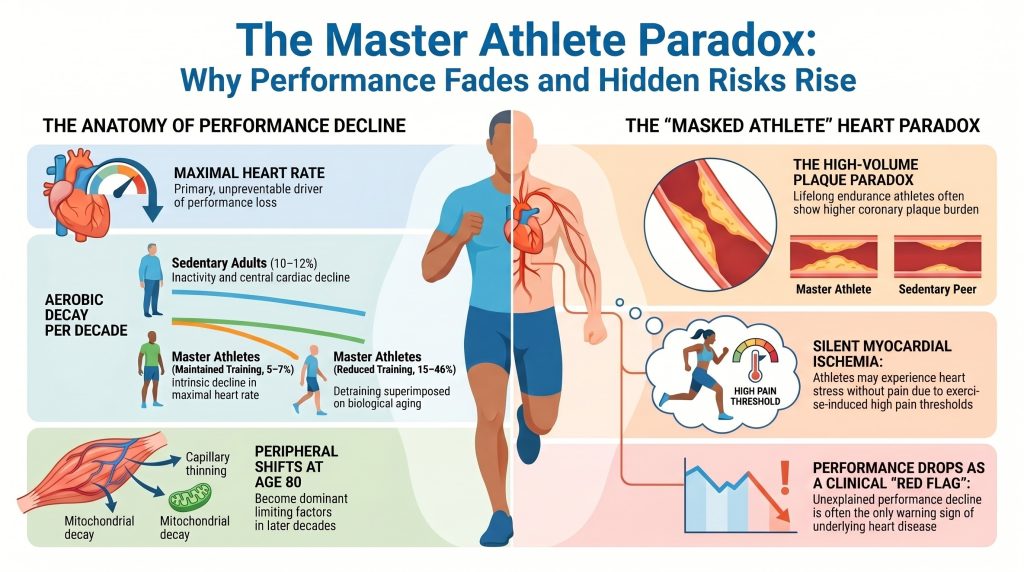
अनुदैर्ध्य मूल्यांकन इंगित करते हैं कि जो मास्टर एथलीट उच्च-तीव्रता, उच्च-मात्रा वाले प्रशिक्षण को बनाए रखते हैं, वे V̇O की दर को कम करते हैं2प्रति दशक लगभग 5–7% की गिरावट, जबकि आयु-समूह के अनुसार मेल खाने वाले निष्क्रिय व्यक्तियों में यह प्रति दशक 10–12% होती है।2][3][4]. हालाँकि, यह प्रशिक्षण-क्षीण गिरावट कमज़ोर है; प्रतिगमन विश्लेषण से पता चलता है कि V̇O में विचरण का एक बड़ा हिस्सा2मास्टर एथलीटों में अधिकतम गिरावट सीधे प्रशिक्षण की मात्रा और तीव्रता में कमी के कारण होती है, जिसमें उन एथलीटों में सबसे तीव्र गिरावट (प्रति दशक 15–46%) देखी गई है जिन्होंने प्रशिक्षण में काफी कमी की है।3][4].
सारणी 2. $\dot{V}O_2$ की दशकीय दरें2समूह द्वारा अधिकतम गिरावट.
| समूह | दशकवार गिरावट | प्राथमिक चालक |
| आरामदेह जीवन बिताने वाले वयस्क | 10–12% | सार्कोपेनिया (मांसपेशियों की क्षति), निष्क्रियता, केंद्रीय हृदय पतन |
| मास्टर एथलीट (नियमित प्रशिक्षण प्राप्त) | 5–7% | अधिकतम में आंतरिक गिरावट हार्ट रेट |
| मास्टर एथलीट (कम हुआ प्रशिक्षण) | 15–46% | बुढ़ापे पर आरोपित डीट्रेनिंग |
5. एरोबिक क्षमता क्षरण के हृदय संबंधी तंत्र
V̇O₂ का क्षरण2मैक्स को गणितीय रूप से इसके द्वारा वर्णित किया गया है फिक का सिद्धांत: V̇O2max = Q̇ × (a–v)O2 अंतर, जहाँ $\dot{Q}$ कार्डियक आउटपुट (हृदय का निकास) है और (a–v)$O_2$2 यह धमनी-शिरा ऑक्सीजन सामग्री का अंतर है। मास्टर एथलीटों में, केंद्रीय हृदय संबंधी कारकों (हृदय गति और स्ट्रोक वॉल्यूमआयु के साथ परिधीय कारकों (ऑक्सीजन निष्कर्षण) की तुलना में) बदल जाता है8][9].
5.1 केंद्रीय तंत्र: उम्र बढ़ने वाला पंप
V̇O के सबसे लगातार और काफी हद तक अपरिवर्तनीय चालक2अधिकतम गिरावट अधिकतम हृदय गति (HR) में आयु से संबंधित कमी है।मैक्स). व्यापक रूप से उद्धृत तनाका समीकरण — मानव संसाधनमैक्स ≈ 208 − 0.7 × आयु — का तात्पर्य लगभग 0.7 बीट्स·मिनट की औसत गिरावट से है।−१ प्रति वर्ष7यह मुख्य रूप से आंतरिक इलेक्ट्रोफिजियोлогия में होने वाले परिवर्तनों द्वारा संचालित होता है। साइनोट्रायल नोड और कम किया हुआ बीटा-एड्रेनेर्जिक प्रतिक्रियाशीलता उम्र के साथ। जबकि सहनशक्ति (एंड्यूरेंस) का प्रशिक्षण विश्राम के समय हृदय गति को कम कर सकता है और पैरासिम्पेथेटिक टोन को बढ़ा सकता है, लेकिन पूर्ण परिश्रम के दौरान अधिकतम हृदय गति को बनाए रखने में इसकी सीमित क्षमता होती है।.
स्ट्रोक वॉल्यूम (SV) एक अधिक सूक्ष्म कहानी प्रदान करता है। गतिहीन व्यक्तियों में, बढ़ी हुई मायोकार्डियल कठोरता, कम वेंट्रिकुलर अनुपालन, और बिगड़े हुए डायस्टोलिक भरने के कारण SV में गिरावट आती है[10मास्टर एथलीटों में, दीर्घकालिक सहनशक्ति प्रशिक्षण से एक्सेंट्रिक वेंट्रिकल रीमॉडलिंग होती है, जो बड़े चैंबर आयामों और संवर्धित मायोकार्डियल अनुपालन की विशेषता है।10][11]. यह अनुकूलन एथलीटों को इसके माध्यम से उच्च SV बनाए रखने की अनुमति देता है फ्रैंक-स्टार्लिंग तंत्र. फिर भी, अत्यधिक उच्च हृदय गति पर डायस्टोलिक भरने के समय के असामान्य रूप से कम होने के कारण मास्टर एथलीटों को व्यायाम के चरम पर कम स्ट्रोक वॉल्यूम (SV) का अनुभव हो सकता है, जहाँ डायस्टोलिक अंतराल संपूर्ण वेंट्रिकुलर भरने के लिए बहुत कम होता है।.
5.2 परिधीय तंत्र: ऑक्सीजन निष्कर्षण और माइटोकॉन्ड्रियल क्षय
जबकि गिरावट के शुरुआती चरणों में केंद्रीय सीमाएँ हावी होती हैं, जैसे-जैसे एथलीट 80 वर्ष की आयु के करीब पहुँचते हैं, परिधीय कारक उत्तरोत्तर अधिक सीमित करते जाते हैं9]. तीन परिधीय प्रक्रियाएँ सबसे अधिक महत्वपूर्ण हैं:
- एरीट्रीओवीनस ओ2 अधिकतम (a–v)O2 मास्टर एथलीटों में उम्र के साथ अंतर मामूली रूप से कम हो जाता है, जिसका मुख्य कारण केशिका विरलता — व्यक्तिगत मांसपेशियों को आपूर्ति करने वाले केशिका नेटवर्क का पतला होना फाइबर — जो ऑक्सीजन के लिए विसरण दूरी को बढ़ाता है9].
- माइटोकॉन्ड्रिया का कार्य. बढ़ती उम्र (या उम्र बढ़ने) के साथ कमी जुड़ी होती है माइटोकॉन्ड्रियल घनत्व और साइट्रेट सिंथेस और सक्सिटिनेट डिहाइड्रोजनेज जैसे प्रमुख ऑक्सीडेटिव एंजाइमों की गतिविधि में [2मास्टर एथलीटों में उच्च-तीव्रता वाले प्रशिक्षण का रखरखाव माइटोकॉन्ड्रियल गुणवत्ता को संरक्षित करता है, लेकिन प्रशिक्षण मात्रा में कमी से ऑक्सीडेटिव क्षमता में तीव्र, लगभग-रैखिक गिरावट आती है।.
- टाइप II (फास्ट-ट्विच) तंतुओं का चयनात्मक शोष (एट्रोफी) और कुल मांसपेशी-द्रव्यमान का नुकसान चयापचय संबंधी मांग और व्यायाम आउटपुट को कम करता है, एक ऐसा प्रभाव जो एसपीएएफ (SPAF) समूह और अन्य जगहों पर प्रलेखित है [1].
6. मास्टर एथलीटों में कोरोनरी एथेरोस्क्लेरोसिस: कैल्सीफिकेशन विरोधाभास
आधुनिक खेल हृदयविज्ञान में सबसे चुनौतीपूर्ण निष्कर्षों में से एक उच्च खेल का स्पष्ट विरोधाभास है कोरोनरी धमनी कैल्शियम जीवन भर के धीरज वाले एथलीटों में स्कोर। मास्टर@हार्ट समूह सहित अनुप्रस्थ आंकड़ों से पता चला है कि जीवन भर के धीरज वाले एथलीटों (मुख्य रूप से पुरुष) में अक्सर कोरोनरी की अधिक व्यापकता होती है पट्टिकाएँ और समान जोखिम प्रोफ़ाइल वाले निष्क्रिय साथियों की तुलना में उच्च CAC स्कोर[13][14][15][16][17].
6.1 पट्टिका आकारिकी और वितरण
द मास्टर@हार्ट अध्ययन डी बॉस्चर और उनके साथियों ने 191 आजीवन एथलीटों, 191 देर से शुरुआत करने वाले एथलीटों और 176 स्वस्थ गैर-एथलीटों (सभी पुरुष) को शामिल किया और प्रदर्शित किया कि आजीवन एथलीटों में सबसे अधिक कोरोनरी प्लाक का बोझ[15]. इस बोझ में न केवल शामिल था कैल्सीफाइड प्लेक्स — आम तौर पर स्थिर माना जाता है — लेकिन गैर-कैल्सीफाइड और मिश्रित पट्टिकाएँ (plaques) भी समीपस्थ कोरोनरी खंड[15].
तालिका 3. मास्टर@हार्ट कोहोर्ट से कोरोनरी पट्टिका (प्लाक) के निष्कर्ष।.
| समूह | ≥1 कोरोनरी पट्टिका (OR) | ≥1 समीपस्थ पट्टिका (या) | ≥50% ल्यूमिनल स्टेनोसिस |
| गैर-एथलीट (संदर्भ) | 1.00 | 1.00 | ≈संदर्भ |
| देर से शुरुआत करने वाले एथलीट | मध्यवर्ती | मध्यवर्ती | कम |
| आजीवन सहनशक्ति एथलीट | 1.86 | 1.96 | असामान्य, लेकिन नियंत्रण समूह की तुलना में अधिक |
स्रोत: डी बॉशर आर, और अन्य। यूर हार्ट जे। 2023[15]. OR = गैर-एथलीट संदर्भ के सापेक्ष ऑड्स अनुपात; मान समायोजित अनुमान हैं। सभी प्रतिभागी पुरुष थे; औसत आयु लगभग 60 वर्ष। अवरोधक (≥50%) संकीर्णता सभी समूहों में निरपेक्ष रूप से दुर्लभ थी; जीवनभर एथलीट समूह में सटीक रिपोर्ट की गई प्रसार दर को अंतिम टाइपसेटिंग से पहले प्राथमिक प्रकाशन से सत्यापित किया जाना चाहिए।.
मास्टर@हार्ट में, आजीवन एथलीटों में भी असमान रूप से अधिक संभावना थी कि उन्हें गैर-कैल्सीफाइड पट्टिकाएं गैर-एथलीटों की तुलना में निकटस्थ खंडों में15]. निकटवर्ती स्थिति चिकित्सकीय दृष्टि से प्रासंगिक है क्योंकि ऐसी पट्टिकाएँ बड़े मायोकार्डियल क्षेत्रों में रक्त प्रवाह को नियंत्रित करती हैं। जबकि कुछ विश्लेषणों में उच्च कार्डियोरेस्पिरेटरी फिटनेस स्थिर पट्टिका संरचना से जुड़ी होती है, इनकी पूर्ण उपस्थिति घाव सुझाव देता है कि उच्च-मात्रा वाली सहनशक्ति प्रशिक्षण पारंपरिक के साथ परस्पर क्रिया कर सकती है। जोखिम कारक पूर्व-मौजूदा उपनैदानिक रोग की प्रगति को तेज करना16][17].
6.2 प्रस्तावित यांत्रिक चालक
मास्टर एथलीटों में सीएडी का विकास अब भी पूरी तरह समझा नहीं जा सका है। वर्तमान प्रेक्षणीय साहित्य कई प्रस्तावित तंत्र, जिन्हें स्थापित कारणिक मार्गों के बजाय संभावित परिकल्पनाओं के रूप में समझा जाना चाहिए:
- रक्तगतिकीय अपघर्षण तनाव. तीव्र व्यायाम अतिगतिशील कोरोनरी प्रवाह उत्पन्न करता है। विक्षिप्त या उथल-पुथल वाले प्रवाह के स्थलों पर, यांत्रिक बल योगदान कर सकते हैं। एन्डोथेलियल डिसफंक्शन[13][17].
- ऑक्सीडेटिव तनाव. अल्ट्रा-एंड्योरेंस प्रशिक्षण की अत्यधिक चयापचय संबंधी मांगें अस्थायी रूप से उत्पन्न कर सकती हैं प्रतिक्रियाशील ऑक्सीजन स्पीशीज़ से अधिक एंटीऑक्सीडेंट क्षमता, संभावित बाद के प्रभावों के साथ एंडोथेलियल फ़ंक्शन और लाइपोप्रोटीन बरकरार रखना17].
- व्यायाम-प्रेरित उच्च रक्तचाप. हाल ही में पुरुष मास्टर सहनशक्ति एथलीटों के एक समूह में, छिप हुई विश्राम और व्यायाम-प्रेरित उच्च रक्तचाप प्रचलित था और यह अधिक कोरोनरी पट्टिका भार से जुड़ा हुआ था।18अतिशयोक्तिपूर्ण व्यायाम सिस्टोलिक रक्तचाप प्रतिक्रियाओं को चिकित्सकीय रूप से क्रियाशील लक्षण-रूप के रूप में तेजी से पहचाना जा रहा है।.
- पारंपरिक जोखिम कारकों के साथ अंतःक्रियाएँ।. एथलीटों में भी, पारंपरिक जोखिम कारक — एलडीएल-कोलेस्ट्रॉल, एपोलिपोप्राटीन बी, लाइपोप्रोटीन (ए), उच्च रक्तचाप, पारिवारिक इतिहास — एथेरोस्क्लेरोसिस के प्रमुख चालक बने रहते हैं[49][50].
7. मौन हृदयपेशी इस्कीमिया और अनपहचाना हृदयघात
7.1 परिभाषाएँ और मुख्य अंतर
मौन मायोकार्डियल इस्कीमिया (एसएमआई) के वस्तुनिष्ठ साक्ष्य का संदर्भ देता है अस्थायी प्रेरित इस्कीमिया — आमतौर पर चलने-फिरने या व्यायाम ईसीजी पर एसटी-सेगमेंट डिप्रेशन, या स्ट्रेस इमेजिंग पर प्रेरित पर्फ्यूज़न असामान्यता — एंजाइनल लक्षणों की पूर्ण अनुपस्थिति में[21][22]. अनपहचाना मायोकार्डियल इन्फार्क्शन (यूएमआई) उस पूर्ण इन्फार्क्शन को संदर्भित करता है, जिसका होने के समय चिकित्सकीय रूप से निदान नहीं किया गया था।28][29][30][31]. देर से गैडोलीनियम संवर्धन (एलजीई) पर कार्डियक मैग्नेटिक रेजोनेंस (CMR) विशेषता बताता है पूर्व मायोकार्डियल चोट — दाग, फाइब्रोसिस, या पूर्ण इन्फार्क्शन — और इसलिए यह सक्रिय इस्कीमिया के लिए प्राथमिक परीक्षण के बजाय UMI के लिए संदर्भ मानक इमेजिंग मोडैलिटी है।30][36]. इस भेद को इस अनुभाग के शेष भाग में बनाए रखा गया है।.
7.2 मौन इस्कीमिया और अनजान एमआई की महामारी विज्ञान
मौन या अनपहचाने एमआई महामारी विज्ञान संबंधी समूहों में सभी मायोकार्डियल इन्फार्क्शन का एक महत्वपूर्ण हिस्सा होते हैं। मूल फ्रेमिंगहम हार्ट स्टडी यह रिपोर्ट किया गया कि नियमित द्विवार्षिक परीक्षा के दौरान पहली बार पता चलने पर लगभग एक-चौथाई एमआई (मायोकार्डियल इंफार्क्शन) अनपहचाने रह गए।28समुदायों में एथेरोस्क्लेरोसिस का जोखिम (एआरआईसीएक अध्ययन में पाया गया कि मौन एमआई का अनुपात, जिन्हें केवल ईसीजी द्वारा ही पता लगाया जा सकता था, लगभग 22% था, जिसमें पता लगाने में लिंग और जाति के आधार पर पर्याप्त भिन्नता थी।29]. वृद्ध सामुदायिक-निवासी वयस्कों के कार्डियोवैस्कुलर हेल्थ स्टडी में, उम्र बढ़ने के साथ UMI की प्रसार दर बढ़ी[31].
के आगमन हृदय एमआरआई एलजीई के साथ यूएमआई की प्रसार दर के अनुमान काफी बढ़ गए हैं। शेलबर्ट और सहयोगियों द्वारा किए गए ICELAND-MI अध्ययन में पाया गया कि CMR-LGE द्वारा पता लगाई गई UMI एक वृद्ध सामुदायिक समूह में ECG द्वारा पता लगाई गई UMI की तुलना में दोगुनी से भी अधिक आम थी, और ECG द्वारा पता लगाई गई UMI सभी CMR-पता लगाई गई घटनाओं का केवल एक अंश ही थी[30]. MESA समूह, सीएमआर-निदानित मायोकार्डियल निशान 45–84 वर्ष की आयु के लक्षण रहित वयस्कों में, जिनका मायोकार्डियल इंफार्क्शन का कोई नैदानिक इतिहास नहीं था, लगभग 7.9% में इसकी पहचान हुई।33].
संयुक्त राज्य अमेरिका की महामारी विज्ञान के अनुसार, संयुक्त राज्य अमेरिका में प्रतिवर्ष होने वाले लगभग 805,000 मायोकार्डियल इन्फार्क्शन में से, ईसीजी-आधारित सामुदायिक निगरानी से पता चलता है कि लगभग 170,000 (≈21%) घटना के समय चिकित्सकीय रूप से मौन या अनपहचाने रहते हैं — यह आंकड़ा ARIC और फ्रेमिंगहम अनुपातों के अनुरूप है[28][29][31]. क्योंकि CMR-आधारित पहचान ने पुराने सामुदायिक समूहों में ECG की तुलना में दो गुना से भी अधिक UMI की पहचान की है[30], 170,000 का ईसीजी-आधारित अनुमान सबसे अच्छी तरह एक के रूप में व्याख्या किया जाता है निचला सीमा संयुक्त राज्य अमेरिका में चिकित्सकीय रूप से अनजान मायोकार्डियल इन्फार्क्शन के वास्तविक वार्षिक बोझ पर।.
7.3 कुछ मायोकार्डियल इस्कीमिया और इन्फार्क्शन मौन क्यों रहते हैं: प्रस्तावित तंत्र
इस्कीमिया या इन्फार्क्शन के दौरान दर्द की अनुपस्थिति कई कारकों पर निर्भर करती है। साहित्य में आठ व्यापक तंत्र प्रस्तावित किए गए हैं:
- स्वायत्त तंत्रिका क्षति।. कार्डियक नोसिसेप्टिव संकेतों को संप्रेषित करने वाले एफ़रेंट सिम्पैथेटिक और वेगल फाइबर क्षतिग्रस्त हो सकते हैं। मधुमेह मधुमेह, उम्र-संबंधी स्वायत्त तंत्रिका क्षति, या पूर्व हृदय शल्यचिकित्सा, जो इस्कीमिक दर्द की अनुभूति को कम या समाप्त कर देती है।21].
- उच्च दर्द सहनशीलता।. व्यक्तियों में आधारभूत शारीरिक दर्द सहनशीलता में काफी भिन्नता होती है, और इस्कीमिया के दस्तावेजीकृत कुछ रोगियों में प्रयोगशाला के दर्द उत्तेजकों के लिए स्पष्ट रूप से उच्च सहनशीलता देखी गई है।34].
- एंडोजेनस ओपिओइड और एंडोकैनाबिनॉयड प्रणालियाँ. परिचालित बीटा-एंडॉर्फिन और संबंधित ओपिओइड कुछ रोगियों में बढ़े हुए होते हैं। साइलेंट इस्किमिया और हृदय दर्द की अनुभूति के केंद्रीय नियमन में संलिप्त पाए गए हैं[34].
- व्यायाम-प्रेरित हाइपोअल्जेसिया (ईआईएच). नियमित सहनशक्ति प्रशिक्षण अंतर्जात ओपिओइड और एंडोकैनाबिनॉइड प्रणालियों को सक्रिय करता है और प्रयोगशाला परीक्षणों में लगातार उच्च दर्द सहनशीलता और सहिष्णुता से जुड़ा होता है।25][26मास्टर एथलीटों में, EIH संभवतः मांग-प्रेरित इस्कीमिया के दौरान चेतावनी लक्षणों की अनुपस्थिति में योगदान देता है।.
- छोटे इन्फार्क्ट का आकार और सीमित ट्रांसम्यूरल विस्तार।. छोटे सबएंडोकार्डियल या नॉन-ट्रांसम्यूरल इन्फार्क्ट्स शायद चेतनात्मक धारणा की सीमा पार करने के लिए पर्याप्त एफ़रेंट संकेत उत्पन्न नहीं करते।32].
- शारीरिक वितरण. इन्फेरियर-वॉल इस्कीमिया और पोस्टेरियर-वॉल इस्कीमिया, एंटेरियर-वॉल घटनाओं की तुलना में अधिक बार मौन रहती हैं, संभवतः एफ़रेंट इनरवेशन घनत्व में अंतर के कारण।21].
- प्रतिज्ञापत्र परिसंचरण. नियमित व्यायाम कोरोनरी सहायक रक्तवाहिनियों के विकास को बढ़ावा देता है, जो आराम की स्थिति में और हल्के से मध्यम परिश्रम के दौरान संकीर्णता से दूर रक्त प्रवाह को बनाए रख सकती हैं, इस प्रकार इस्कीमिया और दर्द को तब तक रोकती हैं जब तक चरम मांग सहायक क्षमता से अधिक न हो जाए।27].
- इस्केमिक प्रीकंडीशनिंग. बार-बार होने वाले अल्पकालिक उपनैदानिक इस्कीमिया के प्रकरण संरक्षण कर सकते हैं। हृदयपेशी बाद की अपमानजनक टिप्पणियों के खिलाफ और संवेदी दर्द संकेत को भी मंद कर सकता है।35].
7.4 लक्षण — और लक्षणों का अभाव
परिभाषा के अनुसार, क्लासिक परिश्रमी एनजाइना मौन इस्कीमिया और अनपहचानी एमआई में अनुपस्थित है। हालांकि, यह शब्द मौन कभी-कभी यह एक गलत नामकरण होता है। सावधानीपूर्वक पूर्वव्यापी पूछताछ करने पर, प्रतीत होने वाले मौन घटनाओं वाले रोगियों के एक हिस्से में उस समय सूक्ष्म लक्षणों का वर्णन मिलता है — सबसे आम तौर पर अनपेक्षित सांस फूलना, कार्यभार के अनुपात से अधिक परिश्रम संबंधी थकान, अपच या मांसपेशी-हड्डी संबंधी कारणों से होने वाला असामान्य छाती का असुविधा, बेहोशी या लगभग बेहोशी, या व्यायाम सहनशीलता में बिना स्पष्ट कारण के कमी।21][22][32]. तथाकथित एंजाइना के समतुल्य लक्षण ये विशेष रूप से उत्कृष्ट एथलीटों में महत्वपूर्ण हैं, जिनमें प्रदर्शन में गिरावट — छाती में दर्द के बजाय — एकमात्र नैदानिक चेतावनी हो सकती है। जब किसी भी रूप में कोई लक्षण रिपोर्ट नहीं किए जाते, तो घटना वास्तव में लक्षणरहित होती है और केवल स्क्रीनिंग, आकस्मिक इमेजिंग या बाद की जांच के दौरान ही पता चलती है।.
7.5 पूर्वानुमान
मौन इस्कीमिया और अनपहचाने मायोकार्डियल इंफार्क्शन (MI) हानिरहित नहीं हैं। ICELAND-MI समूह के दीर्घकालिक अनुवर्ती अध्ययन में, CMR द्वारा पता लगाया गया UMI मृत्यु दर से जुड़ा था, जो चिकित्सकीय रूप से पहचाने गए MI के समान थी।30]. कई समूहों में, UMI वाले व्यक्तियों में … का बढ़ा हुआ जोखिम होता है हार्ट फेलियर, पुनरावर्ती एमआई, और अचानक हृदय गति बंद होने से मौत[29][30][31विशेष रूप से सहनशक्ति एथलीटों में, इस्कीमिक-पैटर्न एलजीई की उपस्थिति को बाद में होने वाले प्रमुख प्रतिकूल घटनाओं के उल्लेखनीय रूप से बढ़े हुए जोखिम से जोड़ा गया है। हृदय संबंधी घटनाएं अचानक हृदय मृत्यु सहित36].
7.6 निदान
SMI बनाम UMI के लिए निदानात्मक दृष्टिकोण भिन्न होते हैं:
- मौन इस्कीमिया के लिए, मूलभूत विधियाँ हैं एम्बुलेटरी (हॉल्टर) ईसीजी, व्यायाम ईसीजी, और स्ट्रेस इमेजिंग (स्ट्रेस इकोकार्डियोग्राफी, सिंगल-फोटॉन इमिशन सीटी, पॉज़िट्रॉन उत्सर्जन टोमोग्राफी, या तनाव सीएमआर परफ्यूजन)[21][22].
- अनपहचाने एमआई के लिए, विराम 12-लीड ईसीजी सीमित संवेदनशीलता रखता है, केवल सीएमआर-पुष्ट घटनाओं का एक अंश ही पता लगाता है।30]. एलजीई के साथ सीएमआर सबसे संवेदनशील है। गैर-आक्रामक परीक्षण और गैर-तीव्र दाग का पता लगाने के लिए संदर्भ मानक है।30][36]. इकोकार्डियोग्राफिक क्षेत्रीय दीवार-गति असामान्यताएँ और उच्च-संवेदनशीलता का बढ़ा हुआ स्तर ट्रोपोनिन गैर-तीव्र संदर्भों में भी संदेह पैदा हो सकता है।.
7.7 मास्टर-एथलीट-विशिष्ट बोझ: “मास्क्ड एथलीट” घटना
एक महत्वपूर्ण अनुप्रस्थ अध्ययन, कैट्ज़ेल और सहयोगियों ने पाया कि लगभग 16% पुरुष मास्टर एथलीटों (औसत आयु 60 वर्ष) में लक्षण-सीमित क्रमिक व्यायाम परीक्षण पर साइलेंट इस्कीमिया पाई गई, जो सांख्यिकीय रूप से समान आयु के निष्क्रिय नियंत्रणों में देखी गई दर के तुलनीय है।23]. एथलेटिक स्थिति ने इस्कीमिक बोझ की व्यापकता को कम नहीं किया; बल्कि, इसने उस बोझ की धारणा को बदल दिया। EIH साहित्य के साथ संयुक्त रूप से[25][26], ये निष्कर्ष की अवधारणा का समर्थन करते हैं मुखौटा पहने एथलीट — एक ऐसा व्यक्ति जिसकी उच्च कार्डियोरेस्पिरेटरी फिटनेस और बढ़ी हुई दर्द सहनशीलता इस्कीमिया की अनुभूति को तब तक टाल सकती है, जब तक कि व्यायाम की मांग कोरोनरी आपूर्ति की सीमाओं के करीब न पहुँच जाए।.
मास्टर एंड्योरेंस एथलीटों में CMR-LGE की प्रसार दर विभिन्न अध्ययनों में अलग-अलग बताई गई है, जो युवा मैराथन धावकों में लगभग 11% से लेकर वृद्ध एंड्योरेंस एथलीट समूहों में काफी अधिक आंकड़ों तक है।37][38]. इस्कीमिक-पैटर्न एलजीई (कोरोनरी वितरण में उपएंडोकार्डियल वृद्धि) और गैर-इस्कीमिक एलजीई (दाहिने वेंट्रिकुलर हिंज पॉइंट्स या मध्य मायोकार्डियम में फोकल पैची वृद्धि) के अलग-अलग यांत्रिक निहितार्थ और अलग-अलग पूर्वानुमानात्मक भार होते हैं।36]. प्रदर्शन या V̇O में अचानक या अस्पष्ट गिरावट2इसलिए, पहले से स्थिर मास्टर एथलीट में अधिकतम स्तर को एक नैदानिक चेतावनी संकेत माना जाना चाहिए, जिसके लिए उन्नत इमेजिंग पर विचार किया जाना चाहिए।.
8. कोरोनरी माइक्रोवैस्कुलर डिसफंक्शन
कोरोनरी माइक्रोवैस्कुलर डिसफंक्शन (सीएमडी) कुछ वृद्ध एथलीटों में व्यायाम असहिष्णुता का एक संभावित कारण है, लेकिन मास्टर-एथलीट समूहों में प्रासंगिक साक्ष्य आधार सीमित है और निष्कर्षों का वर्णन सावधानीपूर्वक किया जाना चाहिए।39][40]. असामान्य व्यायाम परीक्षणों वाले एथलीटों के एक चयनित समूह में, लेकिन बिना अवरोधक एपिकार्डियल सीएडी के कोरोनरी सीटी एंजियोग्राफी, फौल्क्स और सहयोगियों ने काफी कम रिपोर्ट किया कोरोनरी प्रवाह आरक्षित (नियंत्रण समूह में 4.2 की तुलना में 3.3) और एंडोथेलिन-1 का बढ़ा हुआ स्तर[39]. एथलीटों में विशेष रूप से कई तंत्र प्रस्तावित किए गए हैं, जिनमें एक संभावित “कैपिलरी-टू-मायोसाइट मिसमैच” का सिद्धांत शामिल है, जिसमें प्रशिक्षण-प्रेरित हाइपरट्रॉफी सूक्ष्मवाहिकीय विस्तार की तुलना में तेज़ी से बढ़ती है। इन निष्कर्षों की सर्वोत्तम व्याख्या इस प्रकार है प्रारंभिक और परिकल्पना-उत्पादक इसके बजाय कि यह इस बात का प्रमाण हो कि CMD व्यापक रूप से मास्टर-एथलीट आबादी में प्रदर्शन में गिरावट की व्याख्या करता है।.
सीएमडी असामान्य लक्षणों के साथ प्रकट हो सकता है, जिसमें कमी शामिल है। व्यायाम क्षमता, उप-अधिकतम प्रयास के दौरान असामान्य रूप से बढ़ी हुई हृदय गति, और क्लासिक सीने में दर्द के बजाय परिश्रम से होने वाली सांस फूलना[40निदान के लिए आमतौर पर विशेष परीक्षणों (पीईटी-आधारित कोरोनरी फ्लो रिज़र्व, बोलस थर्मोडिल्यूशन के साथ आक्रामक कोरोनरी फिजियोलॉजी, या स्ट्रेस सीएमआर) की आवश्यकता होती है, जो अनुभवी केंद्रों में उपलब्ध हैं।.
9. मास्टर एथलीट में स्क्रीनिंग और जोखिम वर्गीकरण
बुजुर्ग एथलीटों में उपनैदानिक कोरोनरी धमनी रोग और मौन इस्कीमिया की उच्च प्रसार दर को देखते हुए, पारंपरिक स्क्रीनिंग उपकरणों में महत्वपूर्ण सीमाएँ हैं। विश्राम अवस्था में 12-लीड ईसीजी, यद्यपि विद्युत विकारों का पता लगाने में मूल्यवान है, की संवेदनशीलता कम है। सबक्लिनिकल एथरोस्क्लेरोसिस[45]. व्यायाम ट्रेडमिल परीक्षण लक्षणरहित एथलीटों में यह उच्च झूठी-सकारात्मक दरों के कारण सीमित है।44]. महत्वपूर्ण रूप से, व्यक्तिगत परीक्षणों का चयन पूछे जा रहे नैदानिक प्रश्न के अनुसार किया जाना चाहिए — शरीर रचना, प्रेरित इस्कीमिया, पूर्व निशान, या सूक्ष्मवास्कुलर कार्य — न कि इन विभिन्न क्षेत्रों में समेकित प्रदर्शन मापदंडों के आधार पर।.
सारणी 4. वरिष्ठ मास्टर एथलीटों में हृदय निदान विधियाँ, प्रत्येक परीक्षण द्वारा उत्तर दिए जाने वाले नैदानिक प्रश्न के अनुसार व्यवस्थित।.
| प्रकार | मुख्य प्रश्न का उत्तर दिया गया | मुख्य शक्ति | मुख्य सीमा |
| विश्राम अवस्था में 12-लीड ईसीजी | विद्युत रोग; पूर्व की Q-तरंग हृदयाघात | व्यापक रूप से उपलब्ध आधारभूत परीक्षण | मौन सीएडी या पूर्व एमआई (गैर-क्यू-वेव) के लिए कम संवेदनशीलता |
| व्यायाम ट्रेडमिल ईसीजी | व्यायाम-प्रेरित ईसीजी असामान्यताएँ; लक्षण सहसंबंध | कार्यात्मक उत्तेजना; व्यायाम बीपी प्रतिक्रिया प्रकट करती है। | मास्टर एथलीटों में झूठे सकारात्मक और झूठे नकारात्मक दोनों आम हैं: झूठे नकारात्मक इसलिए होते हैं क्योंकि उच्च कार्डियोरेस्पिरेटरी रिज़र्व और कोलैटरल फ्लो कुछ एथलीटों को प्रेरित इस्कीमिया के बावजूद उच्च व्यायाम तीव्रता तक कार्यभार बनाए रखने की अनुमति दे सकते हैं। |
| कोरोनरी सीटी एंजियोग्राफी (CCTA) | कोरोनरी संरचना; प्लाक का बोझ और संकीर्णता | प्लाक/स्टेनोसिस की मजबूत शारीरिक परिभाषा | सीधे तौर पर प्रेरित इस्कीमिया स्थापित नहीं करता |
| तनाव इकोकार्डियोग्राफी / तनाव पرفیजन इमेजिंग (SPECT, PET, तनाव CMR) | प्रेरित इस्कीमिया | इस्कीमिक भार का कार्यात्मक आकलन | प्रदर्शन प्रोटोकॉल और छवि गुणवत्ता पर निर्भर करता है। |
| एलजीई के साथ सीएमआर | पूर्व इन्फार्क्शन / दाग / फाइब्रोसिस पैटर्न (यूएमआई) | ऊतक वर्गीकरण का उच्च मान; गैर-तीव्र दाग के लिए स्वर्ण मानक | अवरोधक कोरोनरी धमनी रोग के लिए प्राथमिक परीक्षण नहीं |
| कोरोनरी फ्लो रिज़र्व के साथ पीईटी | प्रेरित इस्कीमिया और माइक्रोवैस्कुलर कार्य | विशेषीकृत केंद्रों में सीएमडी मूल्यांकन के लिए उपयोगी | सीमित उपलब्धता; उच्च जटिलता |
स्रोत: संदर्भ [40][44][45]. CCTA = कोरोनरी सीटी एंजियोग्राफी; CMR = कार्डियक मैग्नेटिक रेज़ोनेंस; LGE = लेट गैडोलिनियम एन्हांसमेंट; UMI = अनपहचाना मायोकार्डियल इन्फार्क्शन; CMD = कोरोनरी माइक्रोवैस्कुलर डिसफंक्शन; SPECT = सिंगल-फोटॉन इमिशन कंप्यूटेड टोमोग्राफी; PET = पोजिट्रॉन उत्सर्जन टोमोग्राफी। तालिका को जानबूझकर क्लिनिकल प्रश्न के आधार पर संरचित किया गया है, न कि पूल की गई संवेदनशीलता/विशिष्टता के आधार पर, क्योंकि विभिन्न संदर्भ-मानक प्रश्नों का उत्तर देने वाले परीक्षण सीधे तुलना योग्य नहीं होते।.
द इस्केमिया परीक्षण इसका सारांश इस रूप में नहीं निकाला जाना चाहिए कि व्यायाम क्षमता कोरोनरी संरचना या इस्कीमिया की गंभीरता से अधिक महत्वपूर्ण है। ISCHEMIA कार्यक्रम से एक अधिक ठोस निष्कर्ष यह है कि स्थिर पुराने कोरोनरी रोग में, एक प्रारंभिक आक्रामक रणनीति ने एक प्रारंभिक रूढ़िवादी रणनीति की तुलना में प्रमुख हृदय संबंधी घटनाओं में समग्र कमी नहीं लाई, और पूर्व-निर्धारित विश्लेषणों में रोग के बोझ के अनुसार रोगानुमान भिन्न था[41][42]. कार्डियोरेस्पिरेटरी फिटनेस की मृत्यु दर का एक मजबूत पूर्वानुमानकर्ता होने की व्यापक बात ISCHEMIA कार्यक्रम के बाहर के कार्डियोपल्मोनरी व्यायाम परीक्षण साहित्य द्वारा मजबूती से समर्थित है[43]. मास्टर एथलीटों के लिए, व्यावहारिक निहितार्थ यह है कि प्रदर्शन या V̇O में अचानक या अस्पष्ट गिरावट2मैक्स को एक क्लिनिकल संकेत माना जाना चाहिए, जिसके लिए संरचित मूल्यांकन आवश्यक है।47].
10. लिंग संबंधी अंतर और महिला मास्टर एथलीट
मास्टर-एथलीट कोरोनरी साहित्य का एक बड़ा हिस्सा पुरुष समूहों से लिया गया है, जिसमें मास्टर@हार्ट भी शामिल है, जिसमें केवल पुरुषों को नामांकित किया गया था।15]. महिला मास्टर एथलीटों में, समान आयु और प्रशिक्षण अनुभव वाले पुरुष समकक्षों की तुलना में CAC की प्रसार दर आमतौर पर कम होती है, और जीवन भर की सहनशक्ति प्रशिक्षण से जुड़ा कोरोनरी फेनोटाइप कम अच्छी तरह से वर्णित है।482020 ESC स्पोर्ट्स कार्डियोलॉजी गाइडलाइन महिला मास्टर एथलीटों में व्यक्तिगत जोखिम मूल्यांकन पर जोर देती है, जिसमें पारंपरिक जोखिम कारकों, रजोनिवृत्ति की स्थिति और व्यायाम पर ध्यान दिया जाता है। रक्तचाप प्रतिक्रिया[47]. जब तक समानांतर डेटा उपलब्ध नहीं हो जाता, पुरुष समूह के निष्कर्षों को महिला मास्टर एथलीटों पर सामान्यीकृत करना अनुचित है।.
11. वृद्ध उत्कृष्ट एथलीट के लिए नैदानिक सिद्धांत
वर्तमान साक्ष्य समर्थन करते हैं व्यक्तिगत प्रशिक्षण और हृदय संबंधी जोखिम प्रबंधन मास्टर एथलीटों में कोरोनरी प्लाक को रोकने के लिए एकल प्रमाणित प्रशिक्षण सूत्र के बजाय। प्राथमिक साहित्य और प्रमुख-समाज मार्गदर्शन द्वारा समर्थित व्यावहारिक सिद्धांतों में शामिल हैं:
- व्यक्ति के लिए उपयुक्त तीव्रता और मात्रा पर नियमित सहनशक्ति गतिविधि बनाए रखें, यह स्वीकार करते हुए कि प्रशिक्षण बंद करने से V̇O में तेजी से कमी आती है।2केवल जैविक उम्र बढ़ने से होने वाली गिरावट से अधिक अधिकतम गिरावट2][3].
- शामिल करें प्रतिरोध प्रशिक्षण बुढ़ापे की प्रक्रिया में मांसपेशियों के द्रव्यमान और कार्य को बनाए रखने में मदद करने के लिए।.
- वर्तमान रोकथाम दिशानिर्देशों के अनुसार पारंपरिक हृदय-रक्तवाहिनी जोखिम कारकों — एलडीएल-कोलेस्ट्रॉल या एपोलिपोप्रोटीन बी, जहाँ उपलब्ध हो लिपोप्रोटीन(ए), रक्तचाप, ग्लाइसेमिया, और तंबाकू के संपर्क — का आक्रामक रूप से प्रबंधन करें।45][49][50].
- मास्टर एथलीटों में अत्यधिक व्यायाम रक्तचाप प्रतिक्रियाओं का मूल्यांकन, जो स्वतंत्र रूप से उच्च कोरोनरी प्लाक भार से संबंधित हैं।18].
- “मास्क्ड एथलीट” घटना को ध्यान में रखते हुए, अस्पष्टीकृत प्रदर्शन गिरावट को एक चिकित्सीय संकेत मानकर संरचित मूल्यांकन करना चाहिए।23][25].
- क्लिनिकल संदर्भ, व्यायाम के निष्कर्षों, और पारंपरिक जोखिम प्रोफ़ाइल से निर्देशित होकर, उन्नत इमेजिंग (सीसीटीए, स्ट्रेस इमेजिंग, एलजीई के साथ सीएमआर) का चयनपूर्वक उपयोग करें।47].
ध्रुवीकृत प्रशिक्षण वितरण (आमतौर पर लगभग 80/20 कम से उच्च तीव्रता के रूप में वर्णित) उपयोगी हो सकते हैं। प्रदर्शन अनुकूलन ढाँचे हैं लेकिन नहीं भविष्योन्मुखी रूप से यह दिखाया गया है कि यह CAC संचय को रोकता है या तथाकथित को कम करता है। एथलीट विरोधाभास, और इन्हें निवारक नुस्खे के रूप में प्रस्तुत नहीं किया जाना चाहिए[51][52].
12. संश्लेषण और चर्चा
12.1 अपरिहार्य बनाम संशोधनीय क्षय
SPAF अध्ययन पुष्टि करता है कि शारीरिक क्षमता में वृद्धि और गिरावट मानव जीवन की एक संरचनात्मक विशेषता है।1]. 40 वर्ष की आयु के बाद चरम प्रदर्शन की आयु और गिरावट की तीव्रता आबादी के अनुसार काफी हद तक अपरिवर्तित प्रतीत होती है। हालांकि, मास्टर एथलीट यह दर्शाते हैं कि प्रदर्शन का निरपेक्ष स्तर और V̇O की दशकीय दर2प्रशिक्षण की मात्रा और तीव्रता को बनाए रखने से अधिकतम हानि अत्यधिक परिवर्तनीय होती है।2][3][4].
12.2 केंद्रीय कारकों का प्रभुत्व
50 से 80 वर्ष की आयु के बीच मास्टर एथलीटों में प्रदर्शन गिरावट का मुख्य कारण केंद्रीय है: हृदय दर में निरंतर गिरावट।मैक्स चरम परिश्रम के दौरान कुल हृदयगत आउटपुट को कम करता है, एक ऐसी सीमा जिसे आक्रामक प्रशिक्षण भी उलट नहीं सकता।7हालांकि एथलीट निष्क्रिय समकक्षों की तुलना में स्ट्रोक वॉल्यूम को बेहतर बनाए रखते हैं, उम्र से संबंधित मायोकार्डियल सख्तता अंततः उच्च हृदय गति पर डायस्टोलिक भराई को सीमित कर देती है।10][11].
12.3 रोगवैज्ञानिक विरोधाभास
जीवन भर का सहनशक्ति प्रशिक्षण कुछ प्रेक्षणीय समूहों में अनुकूल हृदय-रक्तवाहिनी अनुकूलन और उपनैदानिक कोरोनरी एथेरोस्क्लेरोसिस की बढ़ी हुई प्रचलन दोनों से संबंधित प्रतीत होता है।15][16][17एथेरोस्क्लेरोटिक बोझ — व्यायाम-प्रेरित हाइपोएलजेसिया के दर्द-निवारक प्रभावों के साथ मिलकर — मौन इस्कीमिया और अनपहचानी मायोकार्डियल इंफार्क्शन को चिकित्सकीय रूप से महत्वपूर्ण जोखिम बनाता है, जिनके लिए व्यक्तिगत स्क्रीनिंग और प्रबंधन आवश्यक है।23][25][26].
12.4 मानव वृद्धावस्था की सीमा पर परिधीय तंत्र
जैसे-जैसे एथलीट 80 वर्ष की आयु के करीब पहुँचते हैं, V̇O के निर्धारक के रूप में परिधीय निष्कर्षण केंद्रीय कारकों को तेजी से पीछे छोड़ देता है।2अधिकतम केशिका विरलता और माइटोकॉन्ड्रियल क्षय मांसपेशी की प्रदान की गई ऑक्सीजन का उपयोग करने की क्षमता को कम करते हैं — यह प्रभाव तब तीव्र हो जाता है जब प्रशिक्षण की मात्रा कम की जाती है।2][9].
मुख्य चिकित्सीय निष्कर्ष
| • एरोबिक क्षमता 30 की उम्र के मध्य से घटनी शुरू होती है और 60 की उम्र में इसमें तेजी से गिरावट आती है।. प्रशिक्षण बनाए रखने वाले मास्टर एथलीट गिरावट की दर को निष्क्रिय साथियों की तुलना में लगभग आधा कर देते हैं; प्रशिक्षण बंद करने पर गिरावट कई गुना तेज हो जाती है।.
• आजीवन सहनशक्ति प्रशिक्षण कोरोनरी एथेरोस्क्लेरोसिस के प्रति प्रतिरक्षा प्रदान नहीं करता है।. मास्टर@हार्ट और संबंधित समूह जीवनभर के एथलीटों में निष्क्रिय समकक्षों की तुलना में अधिक कोरोनरी कैल्शियम और निकटस्थ प्लाक भार दिखाते हैं; प्लाक की संरचना अधिक अनुकूल हो सकती है, लेकिन यह जोखिम को पूरी तरह समाप्त नहीं करती।. • वृद्ध एथलीटों में साइलेंट इस्कीमिया और अनजान मायोकार्डियल इन्फार्क्शन असामान्य नहीं हैं।. लगभग प्रत्येक छह पुरुष मास्टर एथलीटों में से एक में क्रमागत व्यायाम परीक्षण के दौरान प्रेरित इस्कीमिया पाई जाती है; सामुदायिक समूहों में CMR द्वारा पता लगाई गई घाव ECG द्वारा पता लगाई गई घाव से 2:1 से अधिक है।. • लक्षण अनुपस्थित, असामान्य, या प्रदर्शन में कमी के रूप में व्यक्त हो सकते हैं।. एक वृद्ध एथलीट में दौड़ के समय में बिना स्पष्ट कारण के गिरावट, परिश्रम से होने वाली सांस फूलना, या व्यायाम सहनशीलता में कमी को संरचित हृदय मूल्यांकन के लिए प्रेरित करना चाहिए — न कि आश्वासन के लिए।. • नैदानिक प्रश्न के अनुरूप निदान परीक्षण चुनें।. एनाटॉमी (CCTA), प्रेरित इस्कीमिया (तनाव इमेजिंग), पूर्व निशान (LGE के साथ CMR), और माइक्रोवैस्कुलर कार्य (CFR के साथ PET) अलग-अलग प्रश्नों का उत्तर देते हैं और परस्पर प्रतिस्थापन योग्य नहीं हैं।. • मानक हृदय-संबंधी जोखिम-कारक प्रबंधन ही आधार बना रहता है।. एलडीएल-सी का आक्रामक रूप से प्रबंधन करें।अपोबी, जहाँ उपलब्ध हो लिपोप्रोटीन(ए), रक्तचाप (अत्यधिक व्यायाम प्रतिक्रियाओं सहित), ग्लाइसेमिया, और तंबाकू का संपर्क। किसी भी प्रशिक्षण वितरण ने संभावित रूप से CAC संचय को रोकने में सक्षम होने का प्रमाण नहीं दिखाया है।. • जीवन भर व्यायाम करने के समग्र स्वास्थ्य लाभ पर्याप्त रहते हैं।. नैदानिक कार्य तीव्रता का समायोजन, निगरानी और जोखिम कारकों पर नियंत्रण करना है — प्रशिक्षण से बचना नहीं।. |
13. निष्कर्ष
50 से 80 वर्ष की आयु के मास्टर एथलीटों के लिए, सहनशक्ति प्रदर्शन को बनाए रखने के लिए निरंतर प्रशिक्षण (V̇O को संरक्षित करने के लिए) और सावधानीपूर्वक संतुलन आवश्यक है।2अधिकतम और कंकाल-मांसपेशी ऑक्सीडेटिव क्षमता) और व्यक्तिगत हृदय-रक्तवाहिनी जोखिम प्रबंधन। सक्रिय स्थिति से निष्क्रिय स्थिति में संक्रमण V̇O उत्पन्न करता है।2अधिकतम गिरावट केवल उम्र बढ़ने की तुलना में काफी अधिक तीव्र है।2][3].
हालांकि, मुखौटा पहने एथलीट यह अवधारणा आत्मसंतोष की बजाय सतर्कता की मांग करती है। वृद्ध सहनशक्ति एथलीटों में क्लासिक एंजाइना के बजाय प्रदर्शन क्षमता में कमी, परिश्रम से होने वाली सांस फूलना या अन्य असामान्य लक्षण देखे जा सकते हैं, और प्रदर्शन में बिना स्पष्ट कारण के गिरावट संरचित नैदानिक पुनर्मूल्यांकन की मांग करती है।23][25][47].
उपलब्ध साहित्य दीर्घकालिक व्यायाम के समग्र स्वास्थ्य लाभों का पर्याप्त समर्थन करता है।43][53]. कुछ सबूत बताते हैं कि पट्टिका फेनोटाइप जीवन भर एथलीट रहे लोगों में, कुल प्लाक भार के लिए समायोजित करने पर, अधिक कैल्सीफाइड और कम मिश्रित/गैर-कैल्सीफाइड घावों की ओर झुकाव होता है, जो समान CAC स्कोर वाले निष्क्रिय रोगियों की तुलना में सापेक्ष स्थिरता प्रदान कर सकता है।16]. उस अवलोकन को स्वीकार करने के बावजूद, वर्तमान साक्ष्य आधार यह दावा करने का औचित्य नहीं देता कि कोरोनरी कैल्सीफ़िकेशन मास्टर एथलीटों में यह समान रूप से सौम्य है, या यह कि मृत्यु दर में लाभ प्लाक फेनोटाइप की परवाह किए बिना भी बने रहते हैं — मास्टर एथलीटों के लिए विशिष्ट CAC-वर्गीकृत मृत्यु दर डेटा सीमित है। साक्ष्यों के आधार पर अधिक सुसंगत निष्कर्ष यह है कि आजीवन व्यायाम और उपनैदानिक कोरोनरी रोग एक साथ मौजूद रह सकते हैं।, कि प्लाक की मात्रा के साथ-साथ प्लाक की संरचना भी महत्वपूर्ण हो सकती है, और वृद्ध एथलीटों में व्यक्तिगत जोखिम का आकलन आवश्यक है।.
14. सीमाएँ
यह एक वर्णनात्मक समीक्षा है। कोई व्यवस्थित खोज प्रोटोकॉल या औपचारिक मेटा-विश्लेषणात्मक पूलिंग नहीं की गई। मास्टर@हार्ट कोहोर्ट और आजीवन सहनशक्ति एथलीटों में कई अन्य प्रमुख कोरोनरी-इमेजिंग अध्ययन सभी पुरुष हैं, जो महिला मास्टर एथलीटों पर सामान्यीकरण को सीमित करते हैं। मास्टर एथलीटों के लिए CAC-आधारित मृत्यु दर के विशिष्ट आंकड़े अभी भी सीमित हैं, और लक्षणहीन एथलीटों में CCTA पर आकस्मिक रूप से पाए गए गैर-कैल्सीफाइड प्रॉक्सिमल प्लाक का पूर्वानुमानात्मक महत्व अभी तक स्थापित नहीं हुआ है। मास्टर एथलीटों में प्रासंगिक CMD साहित्य रेफरल पर किए गए छोटे चयनित समूहों से प्राप्त है और इसे सामान्यीकृत नहीं किया जाना चाहिए।.
प्रकटीकरण और अन्तर्वस्तु
हितों का टकराव
लेखक इस पांडुलिपि के विषय से संबंधित किसी भी वित्तीय हितों के टकराव की सूचना नहीं देते हैं। लेखक CuringHeartDisease.com के संचालक हैं, जो एक चिकित्सक-शिक्षक मंच है जो पूरक विपणन या व्यावसायिक प्रायोजन के बिना सहकर्मी-समीक्षित हृदय-स्वास्थ्य सामग्री प्रदान करता है।.
वित्त पोषण
इस पांडुलिपि की संकल्पना, मसौदा तैयार करने, या प्रकाशन में किसी भी बाहरी वित्त पोषण, प्रायोजन, या संस्थागत समर्थन का योगदान नहीं था।.
डेटा उपलब्धता
इस वर्णनात्मक समीक्षा के लिए कोई नए डेटासेट उत्पन्न नहीं किए गए। सभी उद्धृत साक्ष्य प्रकाशित साहित्य में निहित हैं और उद्धृत संदर्भों के माध्यम से सुलभ हैं।.
नैतिकता
नैतिकता अनुमोदन और सूचित सहमति आवश्यक नहीं थी क्योंकि यह पांडुलिपि पहले प्रकाशित साहित्य की समीक्षा है और इसमें नए मानव-विषय अनुसंधान की रिपोर्ट नहीं है।.
पूर्व प्रसार
इस पांडुलिपि का कोई भी संस्करण पूर्व में प्रकाशित या सार्वजनिक रूप से उपलब्ध नहीं कराया गया है, जिसमें प्रीप्रिंट सर्वर और लेखक का शैक्षिक प्लेटफ़ॉर्म शामिल हैं। CuringHeartDisease.com इच्छित प्रकाशन स्थल है।.
लेखक योगदान
पीएम ने पांडुलिपि की रूपरेखा तैयार की, साहित्य की पहचान की, पाठ का मसौदा तैयार किया और संशोधित किया, तथा प्रकाशन के लिए अंतिम संस्करण को मंजूरी दी।.
धन्यवाद
लेखक उन बाहरी समीक्षकों का धन्यवाद करते हैं, जिनकी टिप्पणियों ने वर्तमान संशोधन को सूचित किया।.
संदर्भ
संदर्भों को पाठ में पहली बार उल्लेख होने के क्रम में, NLM/वैंकूवर सम्मेलन के अनुसार सूचीबद्ध किया गया है। सभी प्रविष्टियाँ PubMed-सूचीबद्ध प्राथमिक अध्ययन, मेटा-विश्लेषण, व्यवस्थित समीक्षाएँ, या प्रमुख-समाज दिशानिर्देश हैं। सात या अधिक लेखकों वाली लेखक सूचियाँ पहले छह लेखकों के बाद “et al.” से संक्षिप्त की जाती हैं।”
- Westerståhl M, Jörnåker G, Jansson E, et al. Rise and Fall of Physical Capacity in a General Population: A 47-Year Longitudinal Study. J Cachexia Sarcopenia Muscle. 2025;16(6):e70134. doi:10.1002/jcsm.70134
- Trappe S. Master athletes. Int J Sport Nutr Exerc Metab. 2001;11 Suppl:S196-S207. doi:10.1123/ijsnem.11.s1.s196
- Pollock ML, Mengelkoch LJ, Graves JE, et al. Twenty-year follow-up of aerobic power and body composition of older track athletes. J Appl Physiol (1985). 1997;82(5):1508-1516. doi:10.1152/jappl.1997.82.5.1508
- Tanaka H, Seals DR. Endurance exercise performance in Masters athletes: age-associated changes and underlying physiological mechanisms. J Physiol. 2008;586(1):55-63. doi:10.1113/jphysiol.2007.141879
- Hawkins S, Wiswell R. Rate and mechanism of maximal oxygen consumption decline with aging: implications for exercise training. Sports Med. 2003;33(12):877-888. doi:10.2165/00007256-200333120-00002
- Joyner MJ, Coyle EF. Endurance exercise performance: the physiology of champions. J Physiol. 2008;586(1):35-44. doi:10.1113/jphysiol.2007.143834
- Tanaka H, Monahan KD, Seals DR. Age-predicted maximal heart rate revisited. J Am Coll Cardiol. 2001;37(1):153-156. doi:10.1016/s0735-1097(00)01054-8
- Levine BD. .VO2max: what do we know, and what do we still need to know?. J Physiol. 2008;586(1):25-34. doi:10.1113/jphysiol.2007.147629
- Proctor DN, Joyner MJ. Skeletal muscle mass and the reduction of VO2max in trained older subjects. J Appl Physiol (1985). 1997;82(5):1411-1415. doi:10.1152/jappl.1997.82.5.1411
- Pelliccia A, Caselli S, Sharma S, et al. European Association of Preventive Cardiology (EAPC) and European Association of Cardiovascular Imaging (EACVI) joint position statement: recommendations for the indication and interpretation of cardiovascular imaging in the evaluation of the athlete’s heart. Eur Heart J. 2018;39(21):1949-1969. doi:10.1093/eurheartj/ehx532
- La Gerche A, Burns AT, Mooney DJ, et al. Exercise-induced right ventricular dysfunction and structural remodelling in endurance athletes. Eur Heart J. 2012;33(8):998-1006. doi:10.1093/eurheartj/ehr397
- Levine BD. Can intensive exercise harm the heart? The benefits of competitive endurance training for cardiovascular structure and function. Circulation. 2014;130(12):987-991. doi:10.1161/CIRCULATIONAHA.114.008142
- Aengevaeren VL, Mosterd A, Braber TL, et al. Relationship Between Lifelong Exercise Volume and Coronary Atherosclerosis in Athletes. Circulation. 2017;136(2):138-148. doi:10.1161/CIRCULATIONAHA.117.027834
- Möhlenkamp S, Lehmann N, Breuckmann F, et al. Running: the risk of coronary events : Prevalence and prognostic relevance of coronary atherosclerosis in marathon runners. Eur Heart J. 2008;29(15):1903-1910. doi:10.1093/eurheartj/ehn163
- De Bosscher R, Dausin C, Claus P, et al. Lifelong endurance exercise and its relation with coronary atherosclerosis. Eur Heart J. 2023;44(26):2388-2399. doi:10.1093/eurheartj/ehad152
- Aengevaeren VL, Mosterd A, Sharma S, et al. Exercise and Coronary Atherosclerosis: Observations, Explanations, Relevance, and Clinical Management. Circulation. 2020;141(16):1338-1350. doi:10.1161/CIRCULATIONAHA.119.044467
- Merghani A, Maestrini V, Rosmini S, et al. Prevalence of Subclinical Coronary Artery Disease in Masters Endurance Athletes With a Low Atherosclerotic Risk Profile. Circulation. 2017;136(2):126-137. doi:10.1161/CIRCULATIONAHA.116.026964
- O’Driscoll J, Parry-Williams G, Moser J, et al. Resting and exercise-induced occult hypertension and coronary atherosclerosis in male masters endurance athletes. Br J Sports Med. Published online May 14, 2026. doi:10.1136/bjsports-2025-111347
- Heidbuchel H, Adami PE, Antz M, et al. Recommendations for participation in leisure-time physical activity and competitive sports in patients with arrhythmias and potentially arrhythmogenic conditions: Part 1: Supraventricular arrhythmias. A position statement of the Section of Sports Cardiology and Exercise from the European Association of Preventive Cardiology (EAPC) and the European Heart Rhythm Association (EHRA), both associations of the European Society of Cardiology. Eur J Prev Cardiol. 2021;28(14):1539-1551. doi:10.1177/2047487320925635
- Sharma S, Drezner JA, Baggish A, et al. International recommendations for electrocardiographic interpretation in athletes. Eur Heart J. 2018;39(16):1466-1480. doi:10.1093/eurheartj/ehw631
- Cohn PF, Fox KM, Daly C. Silent myocardial ischemia. Circulation. 2003;108(10):1263-1277. doi:10.1161/01.CIR.0000088001.59265.EE
- Deedwania PC, Carbajal EV. Silent ischemia during daily life is an independent predictor of mortality in stable angina. Circulation. 1990;81(3):748-756. doi:10.1161/01.cir.81.3.748
- Katzel LI, Fleg JL, Busby-Whitehead MJ, et al. Exercise-induced silent myocardial ischemia in master athletes. Am J Cardiol. 1998;81(3):261-265. doi:10.1016/s0002-9149(97)00898-9
- Sheps DS, Maixner W, Hinderliter AL. Mechanisms of pain perception in patients with silent myocardial ischemia. Am Heart J. 1990;119(4):983-987. doi:10.1016/s0002-8703(05)80351-5
- Koltyn KF. Analgesia following exercise: a review. Sports Med. 2000;29(2):85-98. doi:10.2165/00007256-200029020-00002
- Naugle KM, Fillingim RB, Riley JL 3rd. A meta-analytic review of the hypoalgesic effects of exercise. J Pain. 2012;13(12):1139-1150. doi:10.1016/j.jpain.2012.09.006
- Heaps CL, Parker JL. Effects of exercise training on coronary collateralization and control of collateral resistance. J Appl Physiol (1985). 2011;111(2):587-598. doi:10.1152/japplphysiol.00338.2011
- Kannel WB, Abbott RD. Incidence and prognosis of unrecognized myocardial infarction. An update on the Framingham study. N Engl J Med. 1984;311(18):1144-1147. doi:10.1056/NEJM198411013111802
- Zhang ZM, Rautaharju PM, Prineas RJ, et al. Race and Sex Differences in the Incidence and Prognostic Significance of Silent Myocardial Infarction in the Atherosclerosis Risk in Communities (ARIC) Study. Circulation. 2016;133(22):2141-2148. doi:10.1161/CIRCULATIONAHA.115.021177
- Schelbert EB, Cao JJ, Sigurdsson S, et al. Prevalence and prognosis of unrecognized myocardial infarction determined by cardiac magnetic resonance in older adults. JAMA. 2012;308(9):890-896. doi:10.1001/2012.jama.11089
- Sheifer SE, Manolio TA, Gersh BJ. Unrecognized myocardial infarction. Ann Intern Med. 2001;135(9):801-811. doi:10.7326/0003-4819-135-9-200111060-00010
- Acharya T, Aspelund T, Jonasson TF, et al. Association of Unrecognized Myocardial Infarction With Long-term Outcomes in Community-Dwelling Older Adults: The ICELAND MI Study. JAMA Cardiol. 2018;3(11):1101-1106. doi:10.1001/jamacardio.2018.3285
- Turkbey EB, Nacif MS, Guo M, et al. Prevalence and Correlates of Myocardial Scar in a US Cohort. JAMA. 2015;314(18):1945-1954. doi:10.1001/jama.2015.14849
- Sheps DS, Adams KF, Hinderliter A, et al. Endorphins are related to pain perception in coronary artery disease. Am J Cardiol. 1987;59(6):523-527. doi:10.1016/0002-9149(87)91161-1
- Murry CE, Jennings RB, Reimer KA. Preconditioning with ischemia: a delay of lethal cell injury in ischemic myocardium. Circulation. 1986;74(5):1124-1136. doi:10.1161/01.cir.74.5.1124
- Małek ŁA, Miłosz-Wieczorek B, Marczak M. Diagnostic Yield of Cardiac Magnetic Resonance in Athletes with and without Features of the Athlete’s Heart and Suspected Structural Heart Disease. Int J Environ Res Public Health. 2022;19(8):4829. Published 2022 Apr 15. doi:10.3390/ijerph19084829
- Möhlenkamp S, Leineweber K, Lehmann N, et al. Coronary atherosclerosis burden, but not transient troponin elevation, predicts long-term outcome in recreational marathon runners. Basic Res Cardiol. 2014;109(1):391. doi:10.1007/s00395-013-0391-8
- Breuckmann F, Möhlenkamp S, Nassenstein K, et al. Myocardial late gadolinium enhancement: prevalence, pattern, and prognostic relevance in marathon runners. Radiology. 2009;251(1):50-57. doi:10.1148/radiol.2511081118
- van de Sande DAJP, Barneveld PC, Hoogsteen J, Doevendans PA, Kemps HMC. Coronary microvascular function in athletes with abnormal exercise test results. Neth Heart J. 2019;27(12):621-628. doi:10.1007/s12471-019-01336-6
- Camici PG, Crea F. Coronary microvascular dysfunction. N Engl J Med. 2007;356(8):830-840. doi:10.1056/NEJMra061889
- Maron DJ, Hochman JS, Reynolds HR, et al. Initial Invasive or Conservative Strategy for Stable Coronary Disease. N Engl J Med. 2020;382(15):1395-1407. doi:10.1056/NEJMoa1915922
- Reynolds HR, Shaw LJ, Min JK, et al. Outcomes in the ISCHEMIA Trial Based on Coronary Artery Disease and Ischemia Severity. Circulation. 2021;144(13):1024-1038. doi:10.1161/CIRCULATIONAHA.120.049755
- Mandsager K, Harb S, Cremer P, Phelan D, Nissen SE, Jaber W. Association of Cardiorespiratory Fitness With Long-term Mortality Among Adults Undergoing Exercise Treadmill Testing. JAMA Netw Open. 2018;1(6):e183605. Published 2018 Oct 5. doi:10.1001/jamanetworkopen.2018.3605
- Knuuti J, Ballo H, Juarez-Orozco LE, et al. The performance of non-invasive tests to rule-in and rule-out significant coronary artery stenosis in patients with stable angina: a meta-analysis focused on post-test disease probability. Eur Heart J. 2018;39(35):3322-3330. doi:10.1093/eurheartj/ehy267
- Knuuti J, Wijns W, Saraste A, et al. 2019 ESC Guidelines for the diagnosis and management of chronic coronary syndromes. Eur Heart J. 2020;41(3):407-477. doi:10.1093/eurheartj/ehz425
- Maron BJ, Zipes DP, Kovacs RJ. Eligibility and Disqualification Recommendations for Competitive Athletes With Cardiovascular Abnormalities: Preamble, Principles, and General Considerations: A Scientific Statement From the American Heart Association and American College of Cardiology. J Am Coll Cardiol. 2015;66(21):2343-2349. doi:10.1016/j.jacc.2015.09.032
- Pelliccia A, Sharma S, Gati S, et al. 2020 ESC Guidelines on sports cardiology and exercise in patients with cardiovascular disease. Eur Heart J. 2021;42(1):17-96. doi:10.1093/eurheartj/ehaa605
- Parry-Williams G, Sharma S. The effects of endurance exercise on the heart: panacea or poison?. Nat Rev Cardiol. 2020;17(7):402-412. doi:10.1038/s41569-020-0354-3
- Tsimikas S. A Test in Context: Lipoprotein(a): Diagnosis, Prognosis, Controversies, and Emerging Therapies. J Am Coll Cardiol. 2017;69(6):692-711. doi:10.1016/j.jacc.2016.11.042
- Sniderman AD, Thanassoulis G, Glavinovic T, et al. Apolipoprotein B Particles and Cardiovascular Disease: A Narrative Review. JAMA Cardiol. 2019;4(12):1287-1295. doi:10.1001/jamacardio.2019.3780
- Seiler S. What is best practice for training intensity and duration distribution in endurance athletes?. Int J Sports Physiol Perform. 2010;5(3):276-291. doi:10.1123/ijspp.5.3.276
- Stöggl T, Sperlich B. Polarized training has greater impact on key endurance variables than threshold, high intensity, or high volume training. Front Physiol. 2014;5:33. Published 2014 Feb 4. doi:10.3389/fphys.2014.00033
- Eijsvogels TMH, Thompson PD, Franklin BA. The “Extreme Exercise Hypothesis”: Recent Findings and Cardiovascular Health Implications. Curr Treat Options Cardiovasc Med. 2018;20(10):84. Published 2018 Aug 28. doi:10.1007/s11936-018-0674-3
- Eijsvogels TMH, Thompson PD, Franklin BA. The “Extreme Exercise Hypothesis”: Recent Findings and Cardiovascular Health Implications. Curr Treat Options Cardiovasc Med. 2018;20(10):84. Published 2018 Aug 28. doi:10.1007/s11936-018-0674-3