क्या उच्च कार्डियक कैल्शियम स्कोर सहनशक्ति एथलीटों के लिए हानिकारक हैं?
एथलीट विरोधाभास: कोरोनरी धमनी कैल्शियम का नैदानिक प्रतिमान: लक्षणरहित आबादी में जोखिम का आकलन
प्रिवेंटिव कार्डियोलॉजी (निवारक हृदय विज्ञान) के क्षेत्र में सबक्लिनिकल इमेजिंग (उप-नैदानिक इमेजिंग) के उद्भव के साथ एक गहरा परिवर्तन आया है, विशेष रूप से quantification of कोरोनरी धमनी कैल्शियम. दशकों से, हृदय संबंधी जोखिम मूल्यांकन लगभग पूरी तरह से जनसंख्या-व्यापी अवलोकनात्मक डेटा से प्राप्त संभाव्य मॉडल पर निर्भर था। जबकि जैसे उपकरण फ्रेमघम जोखिम स्कोर और समूहबद्ध कोहोर्ट समीकरण के लिए एक आधार प्रदान किया है प्राथमिक रोकथाम, वे जोखिम के अप्रत्यक्ष मापदंड बने रहते हैं, जो रोग की संभावना का अनुमान लगाते हैं प्रतिस्थापक मार्कर पसंद कोलेस्ट्रॉल स्तर और रक्तचाप. CAC स्कोरिंग का नैदानिक अभ्यास में एकीकरण रोग-आधारित दृष्टिकोण की ओर एक बदलाव का प्रतिनिधित्व करता है, जहाँ एथेरोस्क्लेरोटिक भार का प्रत्यक्ष दृश्य अत्यधिक व्यक्तिगत जोखिम वर्गीकरण की अनुमति देता है। सामान्य आबादी में, कोरोनरी कैल्शियम की उपस्थिति और सीमा एक मजबूत और स्वतंत्र पूर्वानुमानकर्ता भविष्य का मायोकार्डियल इंफार्क्शन और हृदय संबंधी मृत्यु दर।¹ हालांकि, बढ़ते साक्ष्यों ने मास्टर्स सहनशक्ति एथलीटों में एक विरोधाभासी घटना की पहचान की है: ये व्यक्ति, जो अक्सर श्रेष्ठ हृदय-श्वसन क्षमता और कम समग्र मृत्यु दर वाले, अक्सर उच्च CAC स्कोर और अधिक कोरोनरी पट्टिका अपने निष्क्रिय साथियों की तुलना में.² यह रिपोर्ट CAC स्कोरिंग की तकनीकी नींव, सामान्य आबादी में इसकी पूर्वानुमानात्मक क्षमता, एथलेटिक विरोधाभास को समझाने के लिए प्रस्तावित जैविक तंत्र, और अन्य आधुनिक तरीकों के साथ इसकी तुलनात्मक उपयोगिता की पड़ताल करती है। जोखिम पूर्वानुमान उपकरण.
Technical Foundations of Coronary Artery Calcium Scoring
कोरोनरी धमनी calcium (CAC) is a highly specific marker of coronary धमनी काठिन्य and a practical surrogate for overall coronary प्लाक का बोझ.¹,³ The development of कैल्सीफाइड प्लाक में कोरोनरी धमनियां is an active, regulated biological process rather than a passive accumulation of minerals. It typically reflects more advanced phases of the atherosclerotic cascade and correlates with total plaque burden in the epicardial coronary arteries.¹,³ Because कैल्सीफ़िकेशन reflects only a portion of total atherosclerosis, the presence of detectable calcium generally implies a larger underlying burden that can include both calcified and non-calcified एथेरोमा.¹,³
Mechanics of Computed Tomography and the Agatston Method
The standard method for assessing coronary calcium is through non-contrast, electrocardiogram (ECG)-gated कंप्यूटेड टोमोग्राफी (CT) of the chest. To ensure high-quality imaging and minimize motion artifacts from the cardiac cycle, scans are typically acquired during a single breath-hold using prospective ECG triggering.³ This synchronization allows the scanner to capture images primarily during diastole, when the heart is most still.³ Modern multidetector computed tomography (MDCT) systems have largely replaced earlier electron beam computed tomography (EBCT) due to their widespread availability and high स्थानिक विभेदन.³
The quantification of coronary calcium is most commonly achieved through the अगाटस्टन स्कोर, a semi-quantitative method originally described in 1990.³ To be classified as a calcified घाव, a coronary focus must typically have an attenuation of ≥130 Hounsfield units (HU) and an area of ≥3 contiguous pixels (≈1 mm²) on standard acquisition parameters.³ The Agatston score for a single lesion is calculated by multiplying lesion area by a weighted density factor based on peak attenuation within that lesion: a factor of 1 for 130–199 HU, 2 for 200–299 HU, 3 for 300–399 HU, and 4 for ≥400 HU.³ The total Agatston score is the cumulative sum of scores across the left main, left anterior descending, circumflex, and right coronary arteries.³ While other measures such as calcium volume and mass scores exist, major clinical guidelines and the bulk of outcome evidence continue to prioritize Agatston scoring for routine preventive risk assessment.⁴,⁵
Safety, Cost, and Incidental Findings
Radiation exposure from CAC scanning is generally low, but varies by scanner and protocol. Estimates for CAC screening radiation dose and associated risk have been published, and typical contemporary protocols are often cited around ~1 mSv under optimized conditions.⁶ The field of view includes portions of the lungs, mediastinum, and upper abdomen, so extracardiac incidental findings are not uncommon and may drive downstream testing depending on local reporting practices.³,⁵
Predictive Accuracy and the “Power of Zero” in the General Population
The clinical utility of CAC scoring has been established through large longitudinal cohorts including the एथेरोस्क्लेरोसिस का बहु-नस्लीय अध्ययन (MESA), supporting CAC’s ability to refine risk beyond traditional factors.⁷

The Prognostic Impact of a Zero Score
A CAC (Agatston) score of 0 indicates no detectable calcified plaque and is associated with very low short- to intermediate-term event rates in many asymptomatic adults, often supporting downward risk reclassification in appropriate contexts.⁴,⁵,⁷
Why “CAC = 0” can still miss plaque (the key percentages)
CAC detects calcified plaque, not बिना-कैल्शियम वाला प्लाक. In symptomatic cohorts evaluated with कोरोनरी सीटी एंजियोग्राफी (CCTA), clinically meaningful plaque can exist despite CAC=0.
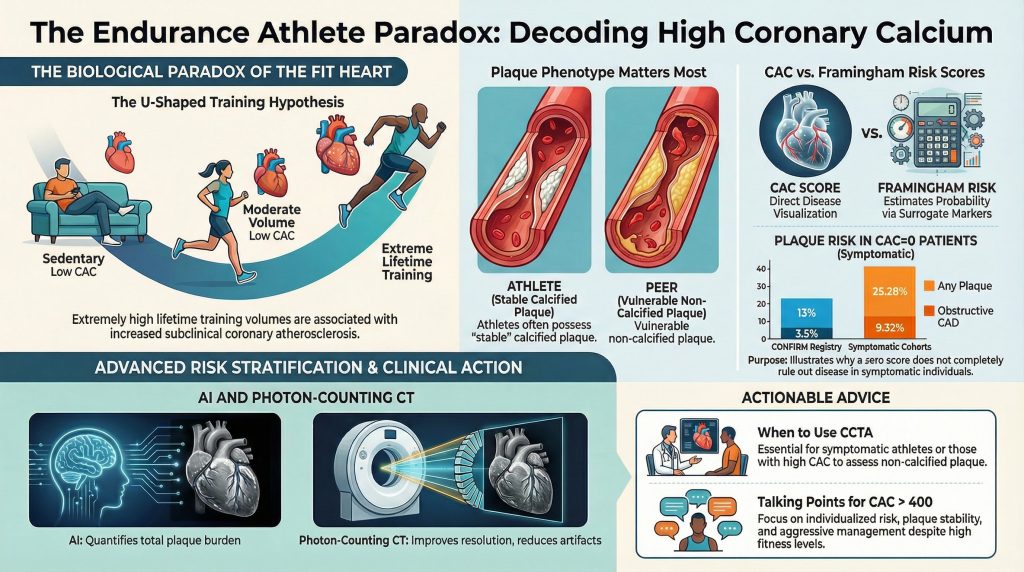
में रजिस्ट्री की पुष्टि करें analysis of symptomatic patients undergoing CCTA, among those with CAC=0, 13% had nonobstructive CAD, 3.5% had ≥50% स्टेनोसिस, and 1.4% had ≥70% stenosis.⁸
In a large symptomatic कोहर्ट अध्ययन focused on CAC=0 patients undergoing CCTA, 25.28% had any plaque and 9.32% had obstructive CAD.¹⁰
Age materially modifies the “rule-out” value of CAC=0, with younger symptomatic patients more likely to have non-calcified disease.⁹
These findings are the practical reason CAC=0 should not be interpreted as “no coronary disease,” particularly when symptoms are present.
Risk Reclassification and Ethnicity
पारंपरिक जोखिम कैलकुलेटर provide population-based estimates and may misclassify individuals. Adding CAC can improve discrimination and reclassification, especially among patients initially categorized as borderline or intermediate risk.⁴,⁵,⁷
The Paradox of the Endurance Athlete: High CAC in Highly Fit Individuals
The relationship between exercise and heart health is not purely linear. Cardiac imaging studies of masters athletes (often defined as individuals >35 years with years of high-intensity training) have shown that some long-term endurance athletes have higher CAC prevalence and/or greater plaque burden than risk-factor–matched controls.²
Research from the Master@Heart Cohort
में Master@Heart study, lifelong endurance athletes demonstrated higher coronary atherosclerosis burden compared with controls, emphasizing that increased fitness does not uniformly equate to lower measured plaque burden on imaging.² This has contributed to “U-shaped” or “reverse J-shaped” hypotheses proposing that while moderate exercise is protective, very high lifetime training volumes may be associated with increased subclinical coronary atherosclerosis in some individuals.²

Plaque Phenotype, Fitness, and Event Rates
A key paradox is that despite higher CAC in some endurance athletes, many studies observe favorable outcomes influenced by high cardiorespiratory fitness and overall risk-factor profiles.⁴,¹¹ Still, a high CAC score in an athlete should be interpreted as evidence of underlying atherosclerosis requiring clinical attention and individualized risk discussion—not dismissed as “benign athletic calcification.”²,¹¹
Comparative Analysis: CAC vs. Other Risk Prediction Tools
CAC complements traditional risk scores by providing a direct, disease-based measure. Guidelines support CAC particularly when treatment decisions (e.g., स्टैटिन initiation) are uncertain in borderline/intermediate-risk patients.⁴,⁵ CCTA directly visualizes both calcified and non-calcified plaque and is therefore better suited to symptomatic evaluation and plaque characterization, but is more complex and typically requires iodinated contrast.³,⁹
Future Directions: Photon-Counting CT and AI-Enabled Plaque Quantification
Photon-counting CT (PCCT) is an emerging CT detector technology that can improve spatial resolution and reduce खिलता अवशेष, potentially improving calcium quantification and plaque characterization in select settings.¹²,¹³
In parallel, AI-enabled quantitative plaque analysis on CCTA has been evaluated in peer-reviewed studies, including पट्टिका का अनावरण करें, supporting automated plaque quantification as a step toward more granular anatomic risk assessment beyond a single calcium sum.¹⁴
निष्कर्ष
द कोरोनरी धमनी कैल्शियम स्कोर is an important tool for cardiovascular risk stratification. By moving beyond statistical probability and visualizing disease burden, CAC enables more individualized primary prevention and साझा निर्णय-निर्माण.⁴,⁵,⁷ Its “power of zero” can identify individuals at very low near-term risk in the appropriate (asymptomatic) context; however, CAC=0 does not exclude non-calcified plaque, and symptomatic patients can still harbor meaningful plaque and even obstructive disease on CCTA.⁸–¹⁰
In masters endurance athletes, CAC highlights a complex reality: some lifelong athletes demonstrate greater plaque burden and higher CAC, but outcomes are influenced by fitness, risk-factor profiles, and plaque characteristics that vary by cohort.²,¹¹ The practical takeaway remains that CAC is best interpreted in clinical context—useful as a risk modifier and decision aid, not as a stand-alone verdict.⁴,⁵
Corrected References
- Parikh P, Shah N, Ahmed H, Schoenhagen P, Fares M. Coronary artery calcium scoring: Its practicality and clinical utility in primary care. Cleve Clin J Med. 2018;85(9):707-716. doi:10.3949/ccjm.85a.17097
- De Bosscher R, Dausin C, Claus P, et al. Lifelong endurance exercise and its relation with coronary atherosclerosis. Eur Heart J. 2023;44(26):2388-2399. doi:10.1093/eurheartj/ehad152
- Vatsa N, Faaborg-Andersen C, Dong T, Blaha MJ, Shaw LJ, Quintana RA. Coronary Atherosclerotic Plaque Burden Assessment by Computed Tomography and Its Clinical Implications. Circ Cardiovasc Imaging. 2024;17(8):e016443. doi:10.1161/CIRCIMAGING.123.016443
- Grundy SM, Stone NJ, Bailey AL, et al. 2018 AHA/ACC/AACVPR/AAPA/ABC/ACPM/ADA/AGS/APhA/ASPC/NLA/PCNA Guideline on the Management of Blood Cholesterol: A Report of the American College of Cardiology/American Heart Association Task Force on Clinical Practice Guidelines. Circulation. 2019;139(25):e1082-e1143. doi:10.1161/CIR.0000000000000625
- Foraker R, Sperling L, Bratzke L, et al. Opportunistic Detection of Coronary Artery Calcium on Noncardiac Chest Computed Tomography: An Emerging Tool for Cardiovascular Disease Prevention: A Scientific Statement From the American Heart Association. Circulation. 2025;152(19):e391-e401. doi:10.1161/CIR.0000000000001382
- Kim KP, Einstein AJ, Berrington de González A. Coronary artery calcification screening: estimated radiation dose and cancer risk. Arch Intern Med. 2009;169(13):1188-1194. doi:10.1001/archinternmed.2009.162
- Bild DE, Bluemke DA, Burke GL, et al. Multi-Ethnic Study of Atherosclerosis: objectives and design. Am J Epidemiol. 2002;156(9):871-881. doi:10.1093/aje/kwf113
- Villines TC, Hulten EA, Shaw LJ, et al. Prevalence and severity of coronary artery disease and adverse events among symptomatic patients with coronary artery calcification scores of zero undergoing coronary computed tomography angiography: results from the CONFIRM (Coronary CT Angiography Evaluation for Clinical Outcomes: An International Multicenter) registry. J Am Coll Cardiol. 2011;58(24):2533-2540. doi:10.1016/j.jacc.2011.10.851
- Mortensen MB, Gaur S, Frimmer A, et al. Association of Age With the Diagnostic Value of Coronary Artery Calcium Score for Ruling Out Coronary Stenosis in Symptomatic Patients. JAMA Cardiol. 2022;7(1):36-44. doi:10.1001/jamacardio.2021.4406
- Yu YT, Hou ZH, Lu B, et al. Prevalence of coronary artery disease in symptomatic patients with zero coronary artery calcium score in different age population. Int J Cardiovasc Imaging. 2021;37(2):723-729. doi:10.1007/s10554-020-02028-8
- DeFina LF, Radford NB, Barlow CE, et al. Association of All-Cause and Cardiovascular Mortality With High Levels of Physical Activity and Concurrent Coronary Artery Calcification. JAMA Cardiol. 2019;4(2):174-181. doi:10.1001/jamacardio.2018.4628
- Symons R, Sandfort V, Mallek M, Ulzheimer S, Pourmorteza A. Coronary artery calcium scoring with photon-counting CT: first in vivo human experience. Int J Cardiovasc Imaging. 2019;35(4):733-739. doi:10.1007/s10554-018-1499-6
- Flohr T, Schmidt B, Ulzheimer S, Alkadhi H. Cardiac imaging with photon counting CT. Br J Radiol. 2023;96(1152):20230407. doi:10.1259/bjr.20230407
- Ramasamy A, Sokooti H, Zhang X, et al. Novel near-infrared spectroscopy-intravascular ultrasound-based deep-learning methodology for accurate coronary computed tomography plaque quantification and characterization. Eur Heart J Open. 2023;3(5):oead090. Published 2023 Oct 30. doi:10.1093/ehjopen/oead090