
持久系アスリートなら、このような瞬間を経験したことがあるでしょう。あなたの体力は確かです—安静時 心拍数心拍数とは、心臓が1分間に鼓動する回数のことです。. は低く、VO₂は高く、あなたのトレーニングログはまるで芸術作品のよう——それなのに、血液検査の結果は LDLLDL(低密度リポ蛋白)は、コレステロールを血液中に運ぶ主要な粒子であり、動脈壁に詰まる主原因となるものです。. “悪い コレステロールコレステロールは、体が必要とするロウ状の物質です。細胞壁、ホルモン、ビタミンD、そして食べ物を消化する胆汁の材料となります。コレステロールがなければ私たちは生きていけません。.”)は予想よりも高い.
それは不公平に感じられるかもしれません。また、非常に特有の恐怖を引き起こすこともあります:
“もし私が スタチンスタチンは、肝臓がコレステロールを作るのに使う酵素の働きを遅らせます。肝臓は血液中からより多くのコレステロールを取り除くことでこれに反応し、そこに真の利益があります。., 性能は低下しますか?”
この記事は、コレステロール(特にLDL)を下げるための、実践的でアスリート向けのガイドです。 アポリポ蛋白BアポBは、動脈の壁に詰まってプラークを引き起こす可能性のあるコレステロール粒子のすべての外側に存在するタンパク質です。それらの粒子はそれぞれ、正確に1個のアポBを運んでいます。.—最も大切なものを守りながら、 トレーニングやレースにおけるあなたの気分とパフォーマンス。.
簡単な注意ですが、これは教育目的であり、個別の医学的アドバイスではありません。脂質に関する決定は年齢に大きく左右されます、, 家族の歴史Family history means whether your close relatives developed heart disease, and how young they were when it happened., 血圧血圧とは、血液が動脈の壁を押す力ののことです。120/80のように2つの数字で表されます。上の数字は心臓が収縮するときの圧力で、下の数字は弛緩するときの圧力です。., 糖尿病糖尿病は、体が十分なインスリンを作らないか、あるいは作られたインスリンに反応しなくなることで、血糖値が常に高すぎる状態になる疾患です。. ステータス、カルシウムスコア、過去の心臓発作の既往など。これらを利用して、担当医とより的確な対話を行いましょう。.
1つのアイデアが他のすべてを理にかなうものにする:LDLを下げることでリスクが低下する
スタチンが世界中で第一選択薬となっているのには理由があります: 低下 LDLコレステロールLDLコレステロール(LDL-C)は、LDL粒子内に存在するコレステロールの量です。これは、ほとんどすべての標準的な検査報告書に記載されている数値です。. 主要な血管イベントのリスクを軽減する (心臓発作心臓発作は、心筋の一部への血流が遮断され、その筋肉が壊死し始めることで起こります。., 脳卒中脳卒中は、脳の一部への血流が詰まりまたは出血によって止まるときに起こります。., 血行再建術血行再建術とは、閉塞または狭窄した冠動脈の血流を回復させるために行われる医療または外科的処置(冠動脈バイパス術や経皮的冠動脈インターベンションなど)であり、根底にあるアテローム性動脈硬化のプロセスではなく、物理的な閉塞に対処するものである。.Cholesterol Treatment Trialists’ Collaborationによる大規模なメタ分析からは、「高リスク」ではない人においても、LDLを低下させることが心血管イベントを意味のある形で減少させることが示されている。1]
アスリートが選択肢を求める場合において、さらに重要なのは、その関係性が「魔法のスタチン」ではないということだ。それは主に LDL値の低下, スタチンやその他のLDL受容体標的療法など、どのような方法で行うかに関係なく。JAMA メタ分析メタアナリシスは、多数の個別研究の結果を統計的に統合して1つの全体的な推定値を算出します。. LDLコレステロールの約1 mmol/L(38.7 mg/dL)の低下が、スタチンおよびいくつかの非スタチン系LDL低下療法において、主要血管イベントの同様の相対的減少と関連していることが見出された。2]
翻訳 LDLやApoBを本当に下げる必要がある場合、あなたと担当医は複数の治療戦略の中から選ぶことができます。その目的は単に「スタチンを服用する」ことではなく、「より安全なLDL/ApoBのレベルを達成し、それを維持する」ことです。“
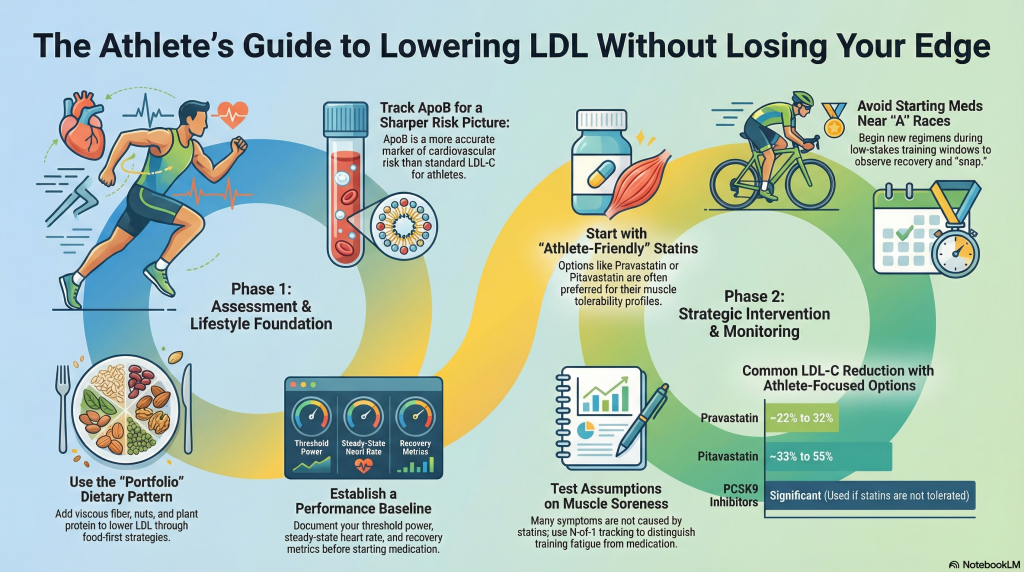
2)「コレステロール」では曖昧すぎます。アスリートはApoB(または少なくとも非HDLコレステロール)を追跡すべきです。
ほとんどの標準的な脂質パネルは、LDL-C、HDL-C、, 中性脂肪トリグリセリド(中性脂肪)は、血液中および体内の蓄積脂肪の主要な形態です。.. 役に立つが、アスリート(特に持久系アスリート)は、もう一つの指標から恩恵を受けることができる:
- アポリポ蛋白B のプロキシです 数 動脈硬化惹起性粒子動脈硬化惹起性粒子とは、LDL、IDL、VLDL、リポ蛋白(a)といったアポB含有リポ蛋白のことであり、動脈壁に侵入・停滞してプラークの成長を開始・持続させます。本論文では、プラークの退縮を達成するために大幅かつ持続的に低下させなければならない対象を指す言葉としてこの用語を使用しています。. (LDL粒子など)は、LDL-C単独よりもコレステロール起因のリスクをより明確に示す指標となることが多く、特にLDL-Cと粒子数が一致しない場合に有効です。主要な生理学的レビューでは、なぜApoBがより正確なリスクマーカーとなるのかを解説しています。3]
ApoBが利用できない場合は、, 非HDLコレステロールNon-HDL cholesterol is a simple calculation: your total cholesterol minus your HDL. What's left is the cholesterol riding in all the particles that can harm your arteries. まともな「次善の」選択肢である(すべての動脈硬化性コレステロールを捕捉するため)。.
アスリートの要点: 主治医にアポB(および場合によっては)について相談してください リポ蛋白(a)) は日常的なモニタリングの一環であるべきです—特に、あなたが痩せていて、十分にトレーニングを積んでいるにもかかわらず、依然として高いLDL値が見られる場合はなおさらです。.
3)アスリートの土台:どれだけハードにトレーニングしても、食事はやはり重要である
トレーニングによって多くの心血管代謝マーカーは改善されますが、特に 遺伝学Genetics is the study of what you inherit from your parents. 強い、あるいは食事が偏っている場合 飽和脂肪酸飽和脂肪酸は、バター、赤身肉の脂肪、ココナッツオイル、パーム油など、室温で固体のままでいる種類の脂肪です。. (一部の高カロリーな持久系エネルギー補給パターンで一般的).
アメリカ心臓協会の食生活指針は、野菜、果物、全粒穀物、豆類、健康的な食事パターン全体に焦点を当てています。 タンパク質タンパク質は、体内の筋肉や組織の構築と修復に使用される栄養素です。., 、および飽和脂肪酸、ナトリウム、 添加糖添加糖とは、果物や牛乳に自然に含まれている糖分ではなく、加工や調理の際食品に加えられる糖のことです。.. [4彼らの広範な科学的指針はまた、単一の「完璧なマクロ比率」を追い求めるのではなく、心血管の健康をサポートする食生活のパターンを築くことを強調しています。5]
極めて効果的な「食品優先」のLDL対策:ポートフォリオ・ダイエタリー・パターン
その ポートフォリオ・ダイエットThe Portfolio diet is a plant-based dietary pattern designed specifically to lower LDL cholesterol by combining several evidence-based food components—including soy protein, viscous fiber, plant sterols, and nuts—each of which independently lowers LDL, with additive effect when combined. いくつかのコレステロール低下食品(粘性/水溶性)を組み合わせる ファイバー食物繊維は、体内で消化できない植物性食品の部分です。豆類、オーツ麦、野菜、果物、全粒穀物に含まれています。., 植物性タンパク質、ナッツ、 植物ステロール植物ステロールはコレステロールの植物版であり、ナッツ類、種子類、植物油に含まれており、一部のマーガリンにも添加されています。.). A システマティックレビューシステマティックレビューは、事前に宣言された方法を用いてある問いに関するすべての研究を検索し、一貫した基準によってそれらを評価する。. コントロールされた試験のメタ分析により、それがLDL-Cおよびその他の心血管代謝に関する臨床的に意味のある改善をもたらすことが判明した 危険因子危険因子とは、高コレステロール粒子、高血圧、喫煙、糖尿病、家族歴など、病気にかかる可能性を高めるものです。.. [6]
アスリートとしての実践的な活用法:
完全に植物由来の食事にする必要はありません。多くのアスリートは、単に以下のものを加えるだけで良好な結果を出しています。
- 毎日の粘性食物繊維源(オーツ麦、大麦、サイリウム)
- ほとんど毎日ナッツ
- 豆類、大豆製品、またはプラントベース(植物中心)の食事を増やす
- 飽和脂肪酸の摂取量を控えめに保つこと(特にバター, ココナッツオイルココナッツオイルは、飽和脂肪酸が非常に多いにもかかわらず、スーパーフードとして売り出された調理用油脂です。., 、高脂肪乳製品、脂肪分の多い 赤身肉Red meat includes beef, pork, and lamb.)
4)ライフスタイルだけでは不十分な場合(またはリスクが高い場合):スタチンに関するアスリートの現実
スタチンを勧められた場合、通常は以下の2つのグループのいずれかに属しています:
- 一次予防一次予防とは、これまでに心臓発作や脳卒中を起こしたことのない人に対して治療を行い、最初の発作を防ぐことです。.: 心血管イベントは起きていませんが、LDL/ApoB(または総合的なリスク)が十分に高いため、薬物療法を行うのが妥当です。.
- 二次予防二次予防とは、すでに心臓発作、脳卒中、またはステント治療を経験した患者に対して、次の発作を防ぐために治療を行うことです。.: 冠動脈疾患または過去の発作の既往歴がある場合、リスクはより高く、 脂質低下脂質低下とは、食事、薬、あるいはその両方によって、血中のアポBを運ぶ有害な粒子を減らすことを意味します。. 通常、より大きいです。.
アスリートは予防の理屈には納得することが多いが、筋肉への不安から、実際に実行に移すことをためらってしまう。.
そこで、アスリートたちが実際に気にかけている疑問が浮かび上がります:
スタチンはパフォーマンスを低下させますか?
エリート持久系アスリートを対象とした単一の完璧な研究というものはありませんが、全体として得られている最も確実な証拠は安心できるものです:
- 米国心臓病学会(ACC)は、スタチンと運動能力について具体的に取り上げた、アスリート向けのレビューを公表している。そこでは次のように述べられている。 スタチン関連筋症状(SAMS)Statin-associated muscle symptoms is the clinical umbrella term for the spectrum of muscle-related complaints — pain, weakness, cramps, and fatigue — reported by patients taking statins, ranging from mild discomfort driven largely by the nocebo effect to rare serious myopathy. アスリートや非常に活動的な人により多く報告されています, しかし、同時に、削減されたという証拠も強調している 有酸素能力VO2max(最大酸素摂取量)とは、全力疾走などの運動中に身体が利用できる酸素の最大量のことです。心肺体力を測定するための標準的な指標です。. 決定的なものではありません。[7]
- の STOMP試験A randomized, placebo-controlled trial that tested high-dose atorvastatin in healthy, physically active participants; it found increased muscle symptoms and creatine kinase levels but no significant reduction in muscle strength or exercise performance over six months. (無作為化プラセボ対照試験)、高用量 アトルバスタチンAtorvastatin, sold as Lipitor, is one of the two strongest statins and among the most prescribed medicines in the world. 筋肉の症状の悪化および クレアチンキナーゼ(CK)An enzyme released into the bloodstream when muscle cells are damaged; elevated CK levels are used as a biomarker of skeletal muscle injury, and statin use—especially around intense exercise—can raise CK beyond the elevation caused by training alone., しかし筋力や運動パフォーマンスは低下させなかった 健常被験者において6か月以上にわたり。[8]
だからアスリートは今でも悩むのだろうか? なぜなら、エリートレベルのパフォーマンスは非常に繊細だからだ。トレーニングのリズムや回復、あるいは「キレ」に何かしらの違和感を覚えるために、実験室で測定されるような劇的な衰えなど必要ないのだ。“
5) 筋症状は実在する…しかしその多くはスタチンが原因ではない
これはトラブルシューティングの方法が変わるため重要です。.
大規模な個人参加者を対象としたメタ分析において、 ランセット ランダム化スタチン試験における筋肉症状を調査し、スタチンが引き起こすのはわずか わずかな超過 筋症状対 プラセボプラセボとは、本物の薬が実際にどのような効果をもたらすかを研究者が知るために投与される、偽の治療法(砂糖の錠剤や生理食塩水の注射など)である。.; 報告されている症状の多くは、実際にはスタチンに起因するものではありません。9]
アスリートにとってさらに「関連性の高い」こととして、次のようなものがある。 n-of-1試験A blinded, randomized crossover trial conducted in a single individual who alternates between active treatment and placebo in multiple cycles, allowing attribution of symptoms to drug versus expectation within that person rather than relying on population averages. デザイン—二重盲検下でスタチンとプラセボを交互に服用するものである。スタチン不耐症であると信じている人々を対象としたBMJの著名なランダム化n-of-1試験シリーズでは、スタチン服用期間中とプラセボ服用期間中で症状の強さが同様であることが判明しており、これは多くの個人にとって強いノセボ効果の存在と一致している。10]
これがアスリートにとって意味すること:
症状を真剣に受け止めるべきですが、同時に自分の仮定を検証することも大切です。ハードなトレーニング期間中は、筋肉痛が生じるものです。問題は、スタチンがそれに明確で繰り返し現れるパターンを加えているかどうかです。.
6) 耐久アスリートのニュアンス:極度の努力は筋損傷のシグナルを増幅させる可能性がある
アスリートが知っておくべき点として、スタチンが管理された研究においてVO₂maxを低下させないとしても、それは muscle-damage response to very hard endurance events in some people.
A study of Boston Marathon runners found statin users had higher skeletal muscle injury markers (including CK isoenzymes) around the marathon compared with controls. [11]
これはします ではない prove statins ruin endurance performance. But it supports a common real-world athlete experience:
some athletes feel “fine” day-to-day, but notice worse recovery cost after major efforts.
7) Choosing a statin like an athlete: start with strategy, not superstition
Clinicians often talk about statins by “intensity.” Athletes should also think in terms of:
- minimum effective dose
- tolerability
- consistency
- interaction profile (if you’re on multiple meds)
- how it fits your training calendar
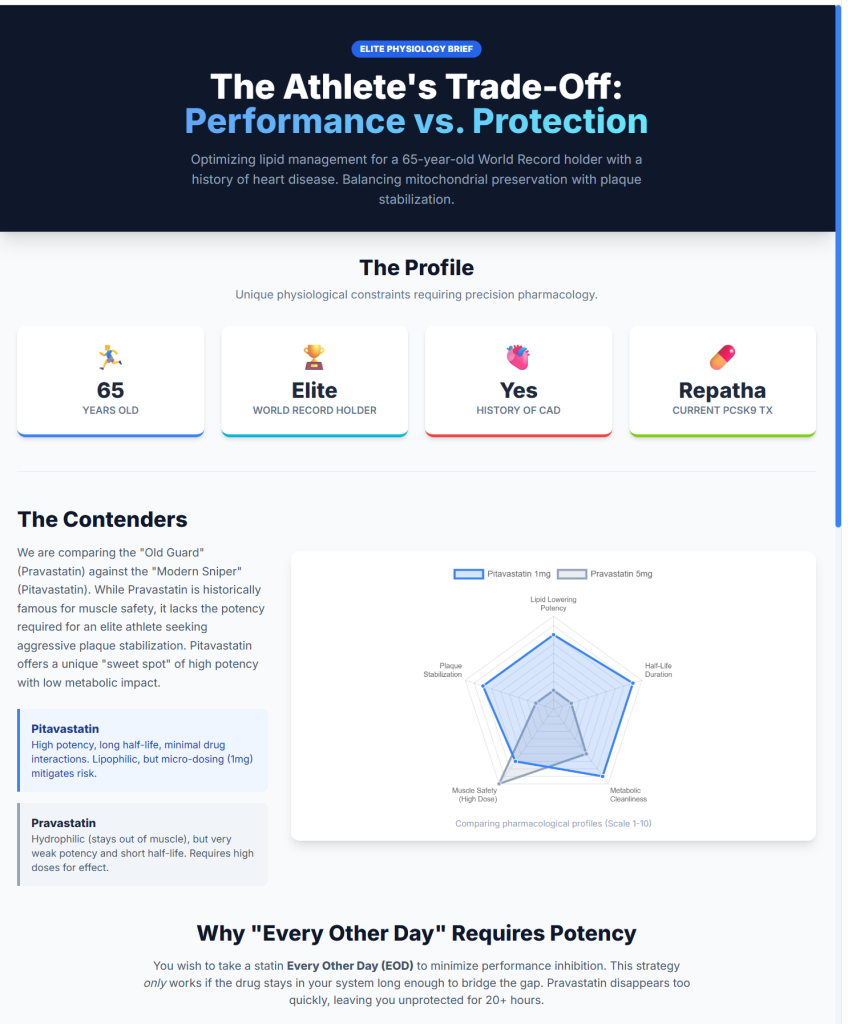
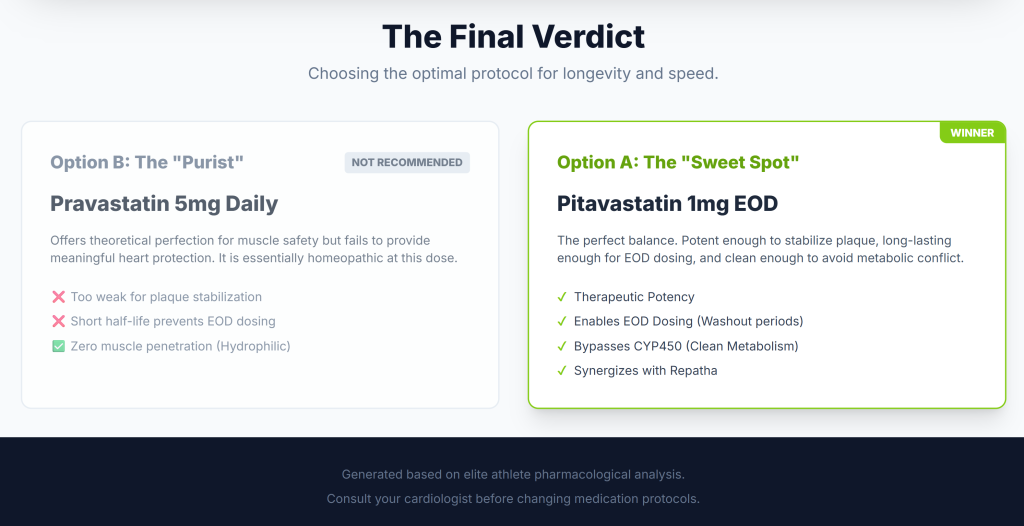
PravastatinA moderate-intensity statin that lowers LDL-C roughly 22–32% across common licensed doses; because it is not metabolized through the CYP3A4 pathway and is hydrophilic, it is often preferred when muscle tolerability is a concern. (often considered “athlete-friendly”)
Pravastatin is commonly used when muscle tolerability is a concern. In a Cochrane review, pravastatin reduced LDL-C in a dose-dependent manner (roughly ~22% to ~32% across common licensed doses). [12]
Athlete framing: pravastatin is a reasonable “start low and see” option, especially if your risk isn’t extreme and you’re highly concerned about muscle symptoms.
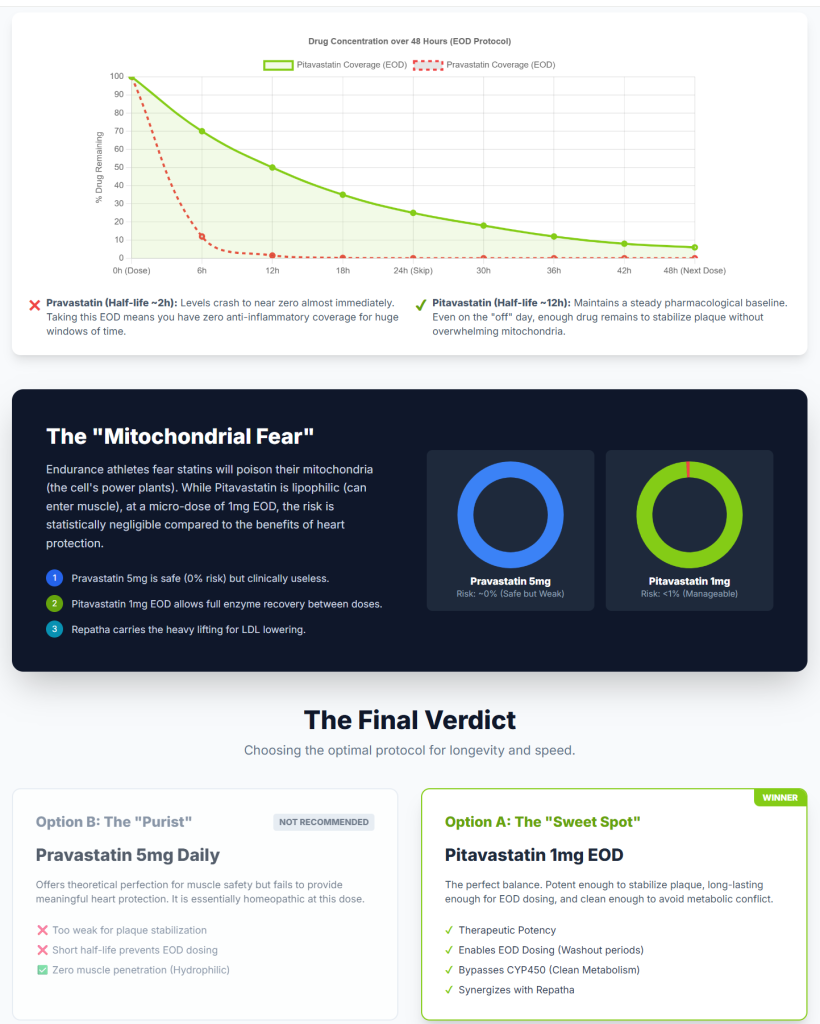
PitavastatinA statin notable for being highly potent per milligram, lowering LDL-C approximately 33–55% across its dose range of 1–16 mg/day and outperforming pravastatin at equivalent milligram doses in head-to-head studies. (a potent option at low milligram doses)
Pitavastatin is less commonly discussed in casual athlete circles, but it has a notable feature: it’s potent per milligram. A Cochrane review found pitavastatin 1–16 mg/day lowered LDL-C roughly ~33% to ~55% depending on dose. [13]
Head-to-head data in older adults show pitavastatin (1–4 mg) produced greater LDL lowering than pravastatin (10–40 mg) over 12 weeks. [14]
Athlete framing: pitavastatin can be a “small pill, meaningful LDL effect” option—useful when you want LDL/ApoB down without escalating to large statin doses. (Whether that translates into better tolerability is individual.)
8) “Micro-dosing” and alternate-day dosing: a real-world tool, but don’t overpromise it
Some athletes do best on very low doses or non-daily schedules—especially if they’re symptom-prone.
Alternate-day dosingスタチンの連日投与ではなく隔日投与とする処方戦略であり、特に半減期の長いスタチンにおいて、LDL低下効果の大部分を維持しつつ、忍容性のない患者の筋症状を軽減する目的で臨床的に用いられる。. has been discussed in clinical literature as a way to maintain LDL improvements while improving tolerability for some patients. The American College of Cardiology reviewed alternate-day dosing and notes that LDL lowering can remain meaningful in many cases, but that outcome-level evidence is less definitive and the approach is often used pragmatically. [15] A review in The American Journal of Medicine similarly summarized that LDL reduction with alternate-day dosing can be close to daily dosing in some studies. [15]
Athlete approach:
If you and your clinician use alternate-day dosing, treat it like training experimentation:
- measure LDL/ApoB response
- track symptoms and performance markers
- adjust with data, not vibes
9) What about PCSK9 inhibitors (like Repatha/evolocumab)? Big LDL reductions, proven outcomes
PCSK9阻害薬 can be game-changers for athletes who:
- have familial hypercholesterolemia or very high LDL/ApoB
- have established coronary disease and need very low LDL
- can’t tolerate sufficient statin therapy
その FOURIER試験The FOURIER trial evaluated the PCSK9 inhibitor evolocumab added to statin therapy and demonstrated that aggressively lowering ApoB-containing particles reduced cardiovascular events; analysis also showed that patients who achieved very low LDL-C but retained high hs-CRP still faced elevated residual risk, supporting the dual-risk model of atherogenesis. (NEJM) showed that adding evolocumab to statin therapy lowered LDL dramatically そして reduced cardiovascular events compared with placebo. [16]
One subtle—but important—point for athletes who assume “lower LDL = less 炎症炎症は、怪我や侵入物とみなしたものに対する免疫システムの反応です。これにより腫れや熱、そして浄化細胞がもたらされます。.”:
In a Circulation analysis from フーリエFOURIER tested evolocumab, a PCSK9 inhibitor, in patients who already had cardiovascular disease and were on statins., baseline 超高感度CRP stratification showed that hsCRP levels were not altered by evolocumab, yet cardiovascular benefit was consistent across inflammation strata. [17]
アスリートの要点: PCSK9PCSK9 is a protein made by your liver that destroys the docking ports your liver uses to pull cholesterol out of your blood. inhibitors are powerful LDL tools with outcomes data. They may not substitute for every statin “pleiotropic” theory, but they do what matters most: lower LDL a lot, and reduce events.
10) An athlete-friendly cholesterol-lowering playbook (put this on one page)
Here’s a clean, practical regimen to discuss with your clinician. Not a prescription—think of it as a framework.
Step 1: Get the right baseline numbers
Ask for:
- LDL-C, non-HDL-C, triglycerides, HDL-C
- ApoB (if possible)
- Consider リポタンパク質リポタンパク質とは、脂肪とコレステロールを血流に乗せて運ぶ小さなカプセルのことです。脂肪は水に溶けないため、移動するにはタンパク質の包みが必要です。.(a) if family history or early disease
- If you’re starting medication and you’re an intense trainer, consider documenting a baseline CK (interpretation is athlete-specific).
Step 2: Do a 6–12 week “LDL diet block” like you’d do a training block
Use AHA-style dietary patterns as your base. [4], [5]
Layer in Portfolio components if LDL is stubborn. [6]
Step 3: If meds are indicated, start with the minimum effective plan
Common athlete-minded strategies clinicians may consider:
- Low-dose daily statin
- Low-dose statin + nonstatin add-on (to avoid high statin doses)
- Alternate-day statin if symptoms are an issue (with lab follow-up) [15]
Step 4: Don’t start a new statin the week of your A race
Start medication in a lower-stakes training window when you can observe recovery patterns.
Step 5: Track performance like an experiment
Pick 2–3 stable markers:
- a threshold session you repeat
- a steady-state HR/pace or HR/power relationship
- recovery metrics (sleep, soreness, HRV if you use it consistently)
Step 6: Know the red flags (rare, but serious)
Stop and get medical help urgently if you have:
- profound weakness
- dark urine
- severe muscle pain with systemic symptoms (fever, malaise)
Bottom line for athletes
- LDL lowering matters for long-term cardiovascular risk, and the benefit scales with the amount of LDL reduction. [1], [2]
- Statins do not reliably reduce measured performance in controlled trials, but athletes may be more likely to notice symptoms or recovery changes, and extreme endurance events can amplify muscle-damage signals in some statin users. [7], [8], [11]
- If you need medication, you and your clinician can often design an approach that protects both your 動脈 and your athletic engine—using dose selection, monitoring, and (when appropriate) combination therapy like PCSK9 inhibitors. [14], [16]
参考文献
- Cholesterol Treatment Trialists’ (CTT) Collaboration. The effects of lowering LDL cholesterol with statin therapy in people at low risk of vascular disease: meta-analysis of individual data from 27 randomised trials. The Lancet (2012). (The Lancet)
- Silverman MG, et al. Association Between Lowering LDL-C and Cardiovascular Risk Reduction Among Different Therapeutic Interventions: A Systematic Review and Meta-analysis. JAMA (meta-regression of 49 trials). (JAMA Network)
- Hegele RA, Sniderman AD. Physiological Bases for the Superiority of Apolipoprotein B vs LDL-C and non-HDL-C in risk assessment (incl. reference to 2019 ESC/EAS position on apoB). Journal of the American Heart Association (JAHA). (American Heart Association Journals)
- American Heart Association. Diet and Lifestyle Recommendations (heart-healthy eating pattern guidance). (www.heart.org)
- American College of Cardiology summary of AHA Scientific Statement. 2021 AHA Dietary Guidance to Improve Cardiovascular Health: Key points. (American College of Cardiology)
- Chiavaroli L, et al. Portfolio Dietary Pattern and Cardiovascular Disease: A Systematic Review and Meta-analysis of Controlled Trials. Progress in Cardiovascular Diseases (2018). (ScienceDirect)
- Chiampas K, et al. American College of Cardiology. I Am an Athlete: Will This Statin Affect My Performance? (2024). (American College of Cardiology)
- Parker BA, et al. Effect of Statins on Skeletal Muscle Function and Performance (STOMP study). Circulation (AHA). (American Heart Association Journals)
- Cholesterol Treatment Trialists’ Collaboration. Effect of statin therapy on muscle symptoms: an individual participant data meta-analysis of large-scale, randomised, double-blind trials. The Lancet (2022). (The Lancet)
- Wood FA, et al. Statin treatment and muscle symptoms: series of randomised, placebo controlled n-of-1 trials. The BMJ (2021). (BMJ)
- Effect of Statins on Creatine Kinase Levels Before and After a Marathon Race (Boston Marathon cohort). American Journal of Cardiology (2011). (AJC Online)
- Cochrane. Pravastatin for lowering lipids (dose-response effects on LDL-C). (Cochrane)
- Cochrane. Pitavastatin for lowering lipids (dose-response effects on LDL-C). (Cochrane)
- Stender S, et al. Pitavastatin shows greater lipid-lowering efficacy over 12 weeks than pravastatin in elderly patients with hypercholesterolaemia/mixed dyslipidaemia. European Journal of Preventive Cardiology (2013). (OUP Academic)
- American College of Cardiology. Alternate-Day Dosing With Statins (review and points to remember), plus supporting review in The American Journal of Medicine. (American College of Cardiology)
- Sabatine MS, et al. Evolocumab and Clinical Outcomes in Patients with Cardiovascular Disease (FOURIER). New England Journal of Medicine (2017). (New England Journal of Medicine)
- Bohula EA, et al. Inflammatory and Cholesterol Risk in the FOURIER Trial (hsCRP stratification; hsCRP not altered by evolocumab; benefit consistent across strata). Circulation (Europe PMC record). (Europe PMC)