
It’s the prestige metric on every fitness watch and a key benchmark for vitality.
But does a high VO₂ max actually make you live longer? Or is it just a sign that you’re already doing the right things?
As a medical engineer (PhD) and lifelong athlete, I’ve studied the biology of performance for decades. The evidence is compelling, but it’s also nuanced.
Let’s unpack the science: Correlation vs. Causation.
The Undeniable Link
Across decades of research, a higher VO₂ max is strongly associated with lower all-cause mortality.
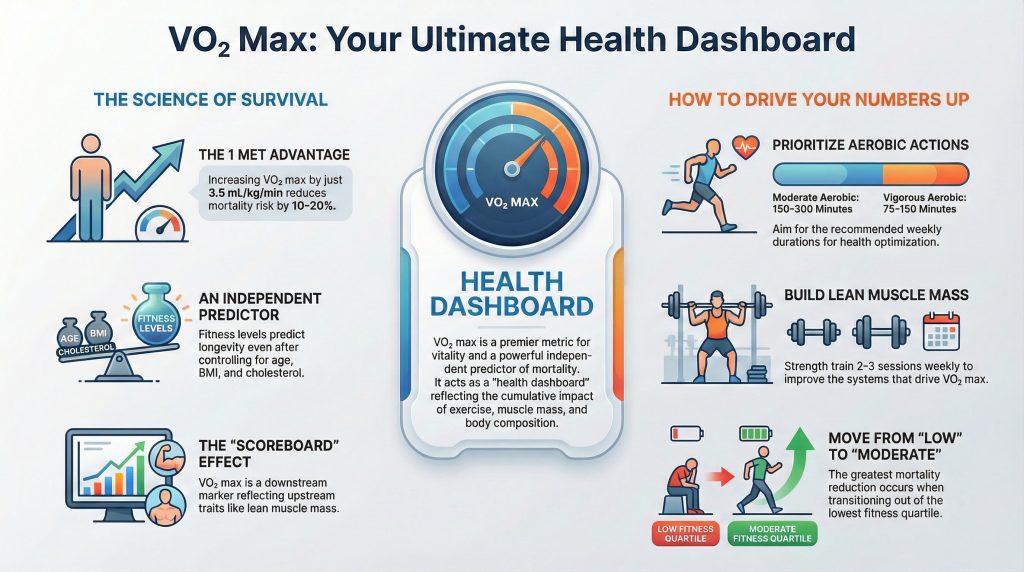
- Independent Predictor: It’s been shown to be a strong predictor of mortality, even after controlling for factors like age, BMI, and cholesterol.
- Massive Data: In one landmark study of 122,000 patients, the lowest fitness quartile had dramatically higher mortality.
- Quantified Benefit: An increase of just 1 MET (≈3.5 mL/kg/min) in VO₂ max is linked to roughly a 10–20% reduction in mortality risk.
Physiologically, this makes sense. VO₂ max is a snapshot of how well your heart, lungs, blood vessels, and muscles work together.
The Key Question: Marker or Mover?
Here’s the scientific crux: Correlation isn’t causation.
People with high VO₂ max tend to live longer. But does the number itself grant longevity, or does it just mirror a lifestyle that does (exercise, good nutrition, healthy weight)?
In other words, VO₂ max might not be the lever—it might be the scoreboard.
What Intervention & Genetic Studies Reveal
While perfect trials are impossible, we have strong clues:
- Cardiac Rehab: Patients who improve VO₂ max after a heart attack do have lower mortality. This is our clearest causal hint (though they change many behaviors at once).
- Longitudinal Studies: People who improve their fitness over time see significantly lower mortality rates than those who stay unfit. This supports causality.
- Genetics (The Twist): Recent Mendelian randomization studies found no direct genetic link. Instead, the genes for high VO₂ max are for upstream traits like lower body fat and higher lean mass—which also drive longevity.
This suggests VO₂ max is a powerful downstream marker, not the root cause.
My Assessment: VO₂ Max is a Dashboard, Not the Destination.
Has it been proven that raising VO₂ max extends life? Not directly.
But if you raise it by applying interventions proven to improve health (consistent training, strength work, weight management), you will almost certainly lower your mortality risk.
Here’s how to translate the science into action:
1️⃣ Prioritize the ACTIONS, Not the Number
Aim for 150-300 min/week of moderate or 75-150 min/week of vigorous aerobic exercise.
2️⃣ Build and Maintain Muscle
Strength train 2-3x/week. Lean mass is a key upstream driver of both VO₂ max and longevity.
3️⃣ Optimize Body Composition
Reducing excess body fat improves both aerobic efficiency and lifespan.
4️⃣ Use VO₂ Max as a Health DASHBOARD
Track it. If it’s rising, your systems are improving. If it’s falling, it’s time to reassess.
5️⃣ Know Where the Biggest Wins Are
The greatest mortality reduction occurs when moving from low to moderate fitness. You don’t need an elite athlete’s VO₂ max to gain major longevity benefits.
Final Word
VO₂ max is one of the most powerful biomarkers we have. It reflects the sum of your choices, habits, and physiology.
Improve the systems that raise it—move more, stay lean, build strength—and the number will follow.
So will your lifespan.
What are your thoughts? Do you track your VO₂ max? Do you see it as a goal to pursue or a simple reflection of your training?
References
- Blair SN, Kohl HW 3rd, Paffenbarger RS Jr, Clark DG, Cooper KH, Gibbons LW. Physical fitness and all-cause mortality. A prospective study of healthy men and women. JAMA. 1989;262(17):2395-2401. doi:10.1001/jama.262.17.2395
- Kodama S, Saito K, Tanaka S, et al. Cardiorespiratory fitness as a quantitative predictor of all-cause mortality and cardiovascular events in healthy men and women: a meta-analysis. JAMA. 2009;301(19):2024-2035. doi:10.1001/jama.2009.681
- Levine BD. .VO2max: what do we know, and what do we still need to know?. J Physiol. 2008;586(1):25-34. doi:10.1113/jphysiol.2007.147629
- Mandsager K, Harb S, Cremer P, Phelan D, Nissen SE, Jaber W. Association of Cardiorespiratory Fitness With Long-term Mortality Among Adults Undergoing Exercise Treadmill Testing. JAMA Netw Open. 2018;1(6):e183605. Published 2018 Oct 5. doi:10.1001/jamanetworkopen.2018.3605
- Myers J, Kaminsky LA, Lima R, Christle JW, Ashley E, Arena R. A Reference Equation for Normal Standards for VO2 Max: Analysis from the Fitness Registry and the Importance of Exercise National Database (FRIEND Registry). Prog Cardiovasc Dis. 2017;60(1):21-29. doi:10.1016/j.pcad.2017.03.002
- Ross R, Blair SN, Arena R, et al. Importance of Assessing Cardiorespiratory Fitness in Clinical Practice: A Case for Fitness as a Clinical Vital Sign: A Scientific Statement From the American Heart Association. Circulation. 2016;134(24):e653-e699. doi:10.1161/CIR.0000000000000461