
C'est l'indicateur phare de toutes les montres connectées de sport et un repère essentiel pour mesurer la vitalité.
Mais est-ce qu’une VO₂ max élevée en fait vous permet-il de vivre plus longtemps ? Ou est-ce simplement le signe que vous faites déjà ce qu'il faut ?
En tant qu’ingénieur médical (titulaire d’un doctorat) et sportif de longue date, j’étudie la biologie de la performance depuis des décennies. Les données sont convaincantes, mais elles comportent également des nuances.
Analysons les données scientifiques : Corrélation vs. Causalité.
Le lien indéniable
Au fil de plusieurs décennies de recherche, il est apparu qu’une VO₂ max plus élevée est vivement associé à une baisse de mortalité toutes causes confondues.
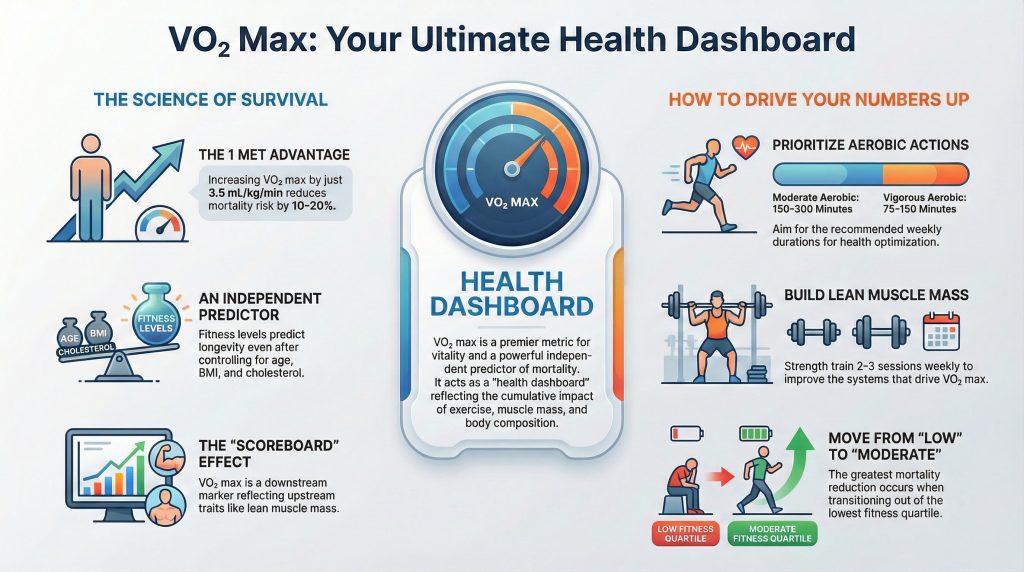
- Prédicteur indépendant: Il a été démontré qu'il s'agissait d'un facteur prédictif puissant de mortalité, même après prise en compte de facteurs tels que l'âge, l'IMC et cholestérol.
- Données massives : Dans une étude phare portant sur 122 000 patients, le niveau de forme physique le plus faible quartile présentaient un taux de mortalité nettement plus élevé.
- Avantage quantifié : Une augmentation de seulement 1 MET (≈3,5 ml/kg/min) de la VO₂ max est associée à une réduction du risque de mortalité de l'ordre de 10 à 20%.
D'un point de vue physiologique, cela est tout à fait logique. La VO₂ max donne un aperçu de la façon dont votre cœur, vos poumons, vos vaisseaux sanguins et vos muscles fonctionnent ensemble.
La question clé : un indicateur ou un moteur ?
Voici le nœud de la question d'un point de vue scientifique : La corrélation n'implique pas un lien de causalité.
Les personnes ayant une VO₂ max élevée ont tendance à vivre plus longtemps. Mais ce chiffre lui-même prolonge-t-elle la vie, ou est-ce simplement miroir un mode de vie qui intègre (l'activité physique, une bonne alimentation, un poids équilibré) ?
En d'autres termes, la VO₂ max n'est peut-être pas la levier— ce serait peut-être le tableau d'affichage.
Ce que révèlent les études d’intervention et les études génétiques
Même si les procès parfaits sont impossibles, nous disposons d'indices solides :
- Rééducation cardiaque : Les patients qui améliorent leur VO₂ max après un crise cardiaque faire présentent un taux de mortalité plus faible. C'est là notre indice causal le plus évident (même s'ils modifient plusieurs comportements à la fois).
- Études longitudinales : Les gens qui améliorer Les personnes qui entretiennent leur condition physique au fil du temps affichent des taux de mortalité nettement inférieurs à ceux qui ne le font pas. Cela confirme l’existence d’un lien de causalité.
- Génétique (Le rebondissement) : Récents Randomisation mendélienne des études n'ont révélé aucune direct lien génétique. Au contraire, les gènes associés à une VO₂ max élevée sont ceux qui déterminent en amont des caractéristiques telles qu'un faible taux de graisse corporelle et un taux plus élevé de masse maigre—ce qui également prolonger la durée de vie du disque.
Cela laisse penser que la VO₂ max est un indicateur puissant marqueur en aval, et non la cause profonde.
Mon avis : la VO₂ max est un indicateur, pas un objectif en soi.
Ça fait-il éprouvé Que l'augmentation de la VO₂ max prolonge la vie ? Pas directement.
Mais si vous l'augmentez en mettant en place des mesures éprouvé En améliorant votre santé (entraînement régulier, renforcement musculaire, gestion du poids), vous réduirez très certainement votre risque de mortalité.
Voici comment mettre ces connaissances scientifiques en pratique :
1️⃣ Privilégiez les ACTIONS, pas le nombre
Visez 150 à 300 minutes par semaine d'activité physique modérée ou 75 à 150 minutes par semaine d'activité physique intense exercice aérobie.
2️⃣ Développer et entretenir sa masse musculaire
Faites de la musculation 2 à 3 fois par semaine. La masse maigre est un facteur clé en amont tant pour la VO₂ max que pour la longévité.
3️⃣ Optimiser la composition corporelle
La réduction de l'excès de graisse corporelle améliore à la fois l'efficacité aérobie et l'espérance de vie.
4️⃣ Utilisez la VO₂ max comme TABLEAU DE BORD de santé
Suivez cette tendance. Si elle est à la hausse, cela signifie que vos systèmes s'améliorent. Si elle est à la baisse, il est temps de réévaluer la situation.
5️⃣ Sachez où se trouvent les plus gros gains
C'est en passant d'un niveau de condition physique faible à modéré que l'on observe la plus forte baisse de la mortalité. Il n'est pas nécessaire d'avoir la VO₂ max d'un athlète de haut niveau pour bénéficier d'avantages significatifs en termes de longévité.
Conclusion
La VO₂ max est l'un des indicateurs les plus pertinents biomarqueurs C'est ce que nous sommes. Cela reflète l'ensemble de vos choix, de vos habitudes et de votre physiologie.
Améliorer le systèmes qui permettent de l'augmenter — bouger davantage, rester mince, se muscler — et les résultats suivront.
Il en sera de même pour votre espérance de vie.
Qu'en pensez-vous ? Suivez-vous votre VO₂ max ? La considérez-vous comme un objectif à atteindre ou comme un simple reflet de votre entraînement ?
Références
- Blair SN, Kohl HW 3rd, Paffenbarger RS Jr, Clark DG, Cooper KH, Gibbons LW. Physical fitness and all-cause mortality. A prospective study of healthy men and women. JAMA. 1989;262(17):2395-2401. doi:10.1001/jama.262.17.2395
- Kodama S, Saito K, Tanaka S, et al. Cardiorespiratory fitness as a quantitative predictor of all-cause mortality and cardiovascular events in healthy men and women: a meta-analysis. JAMA. 2009;301(19):2024-2035. doi:10.1001/jama.2009.681
- Levine BD. .VO2max: what do we know, and what do we still need to know?. J Physiol. 2008;586(1):25-34. doi:10.1113/jphysiol.2007.147629
- Mandsager K, Harb S, Cremer P, Phelan D, Nissen SE, Jaber W. Association of Cardiorespiratory Fitness With Long-term Mortality Among Adults Undergoing Exercise Treadmill Testing. JAMA Netw Open. 2018;1(6):e183605. Published 2018 Oct 5. doi:10.1001/jamanetworkopen.2018.3605
- Myers J, Kaminsky LA, Lima R, Christle JW, Ashley E, Arena R. A Reference Equation for Normal Standards for VO2 Max: Analysis from the Fitness Registry and the Importance of Exercise National Database (FRIEND Registry). Prog Cardiovasc Dis. 2017;60(1):21-29. doi:10.1016/j.pcad.2017.03.002
- Ross R, Blair SN, Arena R, et al. Importance of Assessing Cardiorespiratory Fitness in Clinical Practice: A Case for Fitness as a Clinical Vital Sign: A Scientific Statement From the American Heart Association. Circulation. 2016;134(24):e653-e699. doi:10.1161/CIR.0000000000000461

