العلاجات الأيضية القائمة على الإنكريتين في طب القلب والأوعية الدموية
مراجعة شاملة للنتائج السريرية، والآليات المرضية الفسيولوجية، والآفاق المستقبلية
كلمات مفتاحية — تصلب الشرايينتصلب الشرايين هو المرض الكامن وراء معظم النوبات القلبية والعديد من السكتات الدماغية. عالقة جزيئات الكوليسترول في جدار الشريان، فيرسل الجسم خلايا مناعية للتنظيف، وعلى مدى سنوات تتصلب هذه الفوضى لتتحول إلى لويحات., طب القلب والأيض، حماية القلب والكلى، تجارب النتائج القلبية الوعائية، مثبطات ثنائي ببتيديل بيبيداز-4،, ناهض مستقبلات ثنائي غيب/غلوكاغون-1A dual GIP/GLP-1 receptor agonist is a drug — tirzepatide being the leading example — that simultaneously activates receptors for both glucagon-like peptide-1 and glucose-dependent insulinotropic polypeptide, two incretin hormones, producing greater weight loss, lipid improvement, and metabolic benefit than GLP-1 receptor agonism alone., ناهه مستقبل الببتيد-1 الشبيه بالاجلوكاجون, فشل القلبقصور القلب يعني أن القلب لا يستطيع الضخ بشكل جيد بما يكفي لتلبية احتياجات الجسم. الاسم مضلل فهو لا يعني أن القلب قد توقف. مع المحافظة عليها كسر القذفEjection fraction is the percentage of blood the main pumping chamber squeezes out with each beat. A normal value is somewhere around 55 to 70 percent., استقرار اللويحةاستقرار اللويحة هو جعل اللويحة الموجودة أقل عرضة للتمزق — عن طريق ثخانة غطائها، وتقليص لبها الدهني، وتخفيف التهابها الداخلي., سيماغلوتايدSemaglutide is the medicine sold as Ozempic and Wegovy. It mimics a gut hormone that reduces appetite and improves blood sugar., تيرزيباتيدTirzepatide, sold as Mounjaro and Zepbound, acts on two gut hormone receptors rather than one., ، النوع 2 مرض السكريمرض السكري هو حالة يبقى فيها سكر الدم مرتفعاً للغاية، إما لأن الجسم ينتج كمية قليلة جداً من الإنسولين أو لأنه يتوقف عن الاستجابة للإنسولين الذي ينتجه..
اختصارات
| أبوبروتين بالـ ApoB هو بروتين يوجَد على السطح الخارجي لكل جزيء كوليسترول يمكن أن يلتصق بجدار الشريان ويسبب اللويحات. ويحمل كل جزيء من هذه الجزيئات بروتين ApoB واحداً بالضبط. أبروليپوبروتينالبروتين الدهني المساعد هو بروتين مرتبط بجزيء ناقل للدهون في دمك. لا تختلط الدهون بالماء، لذا تعمل هذه البروتينات وكأنها غلاف يسمح للدهون بالانتقال بأمان عبر مجرى الدم. B
آر آر إيه الخطر المطلقالخطر المطلق هو الاحتمال الحقيقي لحدوث أمر ما لك، مُعبَّراً عنه كنسبة مئوية. إذا كان خطر إصابتك بنوبة قلبية في السنوات العشر القادمة يبلغ 12 بالمئة، فهذا يعني أن حوالي 12 شخصاً من كل 100 شخص مثلك سيصابون بها. تخفيض المرض القلبي الوعائي تصلب الشرايين صلب الشرايين أمراض القلب والأوعية الدمويةأمراض القلب والأوعية الدموية هي مصطلح شامل للمشكلات المتعلقة بالقلب والأوعية الدموية، بما في ذلك النوبات القلبية، والسكتات الدماغية، وانسداد شرايين الساق. مؤشر كتلة الجسم مؤشر كتلة الجسم تصوير الأوعية الدموية التاجية المقطعي المحوسب تاجلي التصوير المقطعي المحوسبالتصوير المقطعي المحوسب، أو (CT)، يلتقط صور بالأشعة السينية من زوايا عديدة ويعيد بناءها لتصبح مقاطع عرضية للجسم. تصوير الأوعية الدموية تكامل مستمر فترة الثقةA confidence interval is the range of values that are statistically compatible with what a study found. المرض الكلوي المزمن مرض الكلى المزمنمرض الكلى المزمن هو انخفاض دائم في قدرة الكلى على تصفية الفضلات من الدم. السيرة الذاتية قلبي وعائي المرض القلبي الوعائي أمراض القلب والأوعية الدموية تجربة النتائج القلبية الوعائية تجربة النتائج القلبية الوعائية ثنائي ببتيديل بيريداز 4 ثنائي ببتيديل بيبيدايد-4 معدل الترشيح الكبيبي المقدر المقدر الترشيح الكبيبيGlomerular filtration is the process by which the kidney's glomeruli — tiny capillary networks — filter waste products and small molecules, including TMAO, from the bloodstream into the urine; adequate glomerular filtration clears fish-derived TMAO within roughly 24 hours, whereas chronic kidney disease reduces this clearance and allows TMAO to accumulate. معدل أكسيد النيتريك البطاني بطاني أكسيد النيتريكأكسيد النيتريك هو غاز ينتجه بطانة الأوعية الدموية ليخبر الوعاء بالاسترخاء والتوسع. إنزيم المُصْلِعَة جيب عديد الببتيد الإنسولينوتروبي المعتمد على الجلوكوز GIP/GLP-1RA ثنائي GIP/ناهض مستقبلات الببتيد-1 الشبيه بالـجلوكاغونGLP-1 receptor agonists are injectable medicines — semaglutide and tirzepatide are the best known — that copy a gut hormone controlling appetite and blood sugar. (على سبيل المثال، تيرزيباتيد) GLP-1 الببتيد-1 شبيه الجلوكاجون م ن ه - 1 (GLP-1RA) ناهض مستقبلات الببتيد-1 الشبيه بالـجلوكاغون الهيموجلوبين السكري الهيموجلوبين السكري HDL-C عالي الكثافة بروتين دهنيالبروتين الدهني عبارة عن حزمة صغيرة تحمل الدهون والكوليسترول عبر مجرى الدم. وبما أن الدهون لا تذوب في الماء، فإنها تحتاج إلى غلاف بروتيني لتنتقل. كوليسترولالكوليسترول هو مادة شمعية يحتاجها جسمك. وهو يدخل في تكوين جدران الخلايا، والهرمونات، وفيتامين د، والصفراء التي تهضم طعامك. كنت ستتموت دونه. HF فشل القلب قصور القلب مع انقباض محفوظ قصور القلب مع حفظ كسور القذف الموارد البشرية نسبة الخطرنسبة الخطر تقارن مدى سرعة حدوث الأحداث في مجموعتين. تعني النسبة البالغة 0.75 أن الأحداث حدثت بثلاثة أرباع المعدل في المجموعة المعالجة. البروتين التفاعلي C عالي الحساسية عالي الحساسية البروتين التفاعلي Cبروتين سي التفاعلي، أو اختصاراً CRP، هو مادة يصنعها الكبد عندما يوجد التهاب في مكان ما في جسمك. تُستخدم نسخة حساسة من الاختبار، وهي (hs-CRP)، لتقدير خطر الإصابة بأمراض القلب. |
الكاكام-1ICAM-1 is a molecule that appears on the surface of the blood vessel lining and acts like Velcro, catching passing immune cells. جزيء الالتصاق بين الخلايا 1
إنترلوكين-6إنترلوكين-6، أو IL-6، هو جزيء إشارة يستخدمه الجهاز المناعي لنشر رسالة التهابية في جميع أنحاء الجسم. إنترلوكين-6 الموجات فوق الصوتية داخل الأوعية الدموية الموجات فوق الصوتية داخل الأوعية الدمويةالموجات فوق الصوتية داخل الأوعية، أو ما يُعرف بـ IVUS، تستخدم مسباراً دقيقاً للموجات فوق الصوتية يتم إدخاله داخل الشريان التاجي لتصوير الجدار من الداخل. KCCQ-CSS كانساس سيتي اعتلال عضلة القلباعتلال عضلة القلب هو مرض يصيب عضلة القلب نفسها، وليس الشرايين المغذية لها. موجز النتائج السريرية للاستبيان البروتين الدهني منخفض الكثافة (LDL-C) كوليسترول البروتين الدهني منخفض الكثافة الكسر القذفي للبُطين الأيسر كسر القذيفة البطيني الأيسرالنسبة المئوية للدم المضخوك من حجرة الضخ الرئيسية في القلب مع كل نبضة؛ القيمة الطبيعية هي 55 بالمך أو أكثر، والارتفاع في الكسر القذفي بعد الإصابة بمرض قلبي يعد علامة قابلة للقياس تدل على التعافي القلبي. صولجان الأحداث القلبية الوعائية السلبية الكبرىحدث قلبي وعائي سلبي كبير، أو ما يُعرف بـ (MACE)، هو مجموعة من النتائج السيئة التي يتم حسابها معاً في دراسة ما - وعادة ما تشمل الوفاة القلبية الوعائية، والنوبة القلبية، والسكتة الدماغية. مي احشاء عضلة القلبراجع "نوبة قلبية" للاطلاع على المقالة الكاملة. عامل نووي كابا بي العامل النووي كابا بي تصنيف جمعية القلب في نيويورك جمعية قلب نيويورك باد مرض الشرايين المحيطيةPeripheral artery disease is plaque narrowing the arteries in your legs. PCSK9PCSK9 هو بروتين ينتجه الكبد يعمل على تدمير مواقع الإرساء التي يستخدمها الكبد لسحب الكوليسترول من دمك. كونفيرتاز البروتيين الطليعيProprotein convertases are enzymes that activate other proteins by cutting them. PCSK9 belongs to this family — its full name is proprotein convertase subtilisin/kexin type 9. النوع 9 من سابتليسين/كيكسين بي كيه إيه بروتينالبروتين هو العنصر الغذائي الذي يستخدمه جسمك لبناء وإصلاح العضلات والأنسجة. كيناز أ RRR الخطر النسبيالخطر النسبي يقارن بين مجموعتين: هذه المجموعة سجلت نسبة أقل بـ 30 في المائة من النوبات القلبية مقارنة بتلك المجموعة. تخفيض بنك الدولة الباكستاني ضغط الدم الانقباضيضغط الدم الانقباضي هو الرقم العلوي — وهو الضغط في الشرايين أثناء انقباض قلبك. نظام التحكم الصناعي تحت الجلد م inhibitors Na+/glucose co-transporter 2 مُحَبِّط الناقل المشترك للصوديوم والجلوكوز-2 النوع الثاني من السكري مرض السكري من النوع الثاني عامل نخر الورم ألفا عامل نخر الورم ألفا نسبة الألبومين إلى الكرياتينين في البول نسبة الألبومين إلى الكرياتينين في البول جزيء التصاق الخلايا الوعائية-1VCAM-1 is a sticky molecule that appears on an inflamed vessel lining and grabs passing white blood cells so they can burrow into the wall. جزيء التصاق الخلايا الوعائية 1 VSMC وعائي خلية عضلية ملساءSmooth muscle cells make up the middle layer of an artery and control how much the vessel tightens or relaxes. اختبار المشي لمدة 6 دقائق مسافة المشي لمدة 6 دقائق |
ملخص
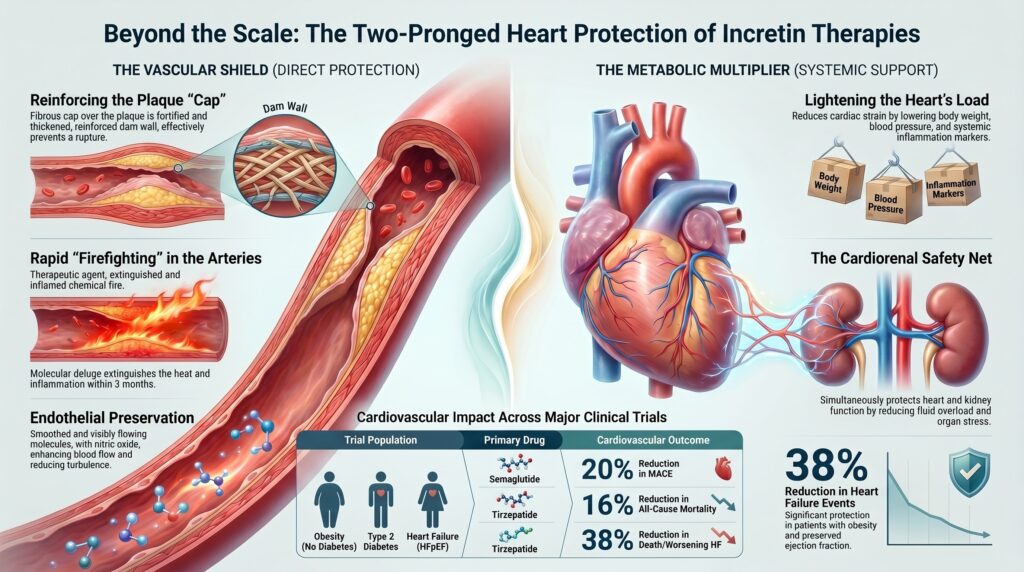
المُهْبِطَاتُ لمُسْتَقْبِلاتِ البِبْتِيدِ-1 الشَّبِيهِ بالغْلُوكَاغُون (GLP-1RAs) والمُهْبِطَاتُ المَازِجَةُ لمُسْتَقْبِلاتِ الجِيبِ/البِبْتِيدِ-1 الشَّبِيهِ بالغْلُوكَاغُون (GIP/GLP-1RAs) قد خَضَعَت لِلتَّقْيِيم عبر نطاق واسع تجربة النتائج القلبية الوعائيةA cardiovascular outcomes trial is a large, long-term randomized controlled trial specifically designed to measure whether a drug reduces major cardiovascular events such as heart attack, stroke, or cardiovascular death, rather than only improving a lab value or surrogate marker; regulators began requiring them for diabetes drugs after 2008. برنامج. تجارب التفوق المُحكَمَة بالدواء الوهمي في داء السكري من النوع الثاني (T2D) — LEADER و SUSTAIN-6 و REWIND و SOUL — وفي السمنةتعني السمنة وجود كمية زائدة من دهون الجسم بدرجة تؤثر على الصحة. أظهرت دراسة «SELECT» الخاصة بالأشخاص غير المصابين بداء السكري انخفاضًا ذا دلالة إحصائية في الأحداث القلبية الوعائية السلبية الكبرى (MACE) بنسبة تتراوح بين 12% و26% [3], [4], [10]–[12أثبتت دراسة PIONEER 6 الأمان القلب الوعائي مع تقدير نقطي ملائم وغير ذي دلالة إحصائية13]. في إعداد المقارنة النشطة، كان تيرزيباتيد غير أدنى من دولاغلوتايد لـ 3 نقاط MACE في SURPASS-CVOTSURPASS-CVOT was a randomized active-comparator trial comparing tirzepatide with the GLP-1 receptor agonist dulaglutide in patients with type 2 diabetes and established cardiovascular disease; tirzepatide was noninferior for 3-point MACE (HR 0.92) and reduced all-cause mortality by 16%, though it did not achieve statistical superiority for MACE. (نسبة الخطر 0.92؛ القيمة الاحتمالية P = 0.09 لتفوق) وأدى إلى انخفاض الوفيات لجميع الأسبابمعدل الوفيات الإجمالي يعني الموت بسبب أي سبب كان، وليس فقط أمراض القلب - وهي النتيجة الأوسع نطاقاً والأصعب في التلاعب بها والتي يمكن لأي دراسة قياسها. بقلم 16% [6]. في حالات قصور القلب مع الحفاظ على نسبة الطرد (HFpEF) المصحوبة بالسمنة، أظهرت دراسة SUMMIT انخفاضًا بنسبة 38% في المؤشر المركب للوفاة القلبية الوعائية وتفاقم قصور القلب، مما يكمل برنامج STEP-HFpEF [5], [20], [21أظهرت تجربة (FLOW) فائدة قلبية كلوية في الحالات المزمنة مرض الكلىKidney disease means the kidneys have lost some of their ability to filter waste from your blood. (مرض الكلى المزمن) مع السكري من النوع الثاني [22].
السؤال السريري السائد هو ما إذا كانت هذه الفوائد هي عواقب لاحقة لـ فقدان الوزنفقدان الوزن يعني تقليل دهون الجسم، سواء من خلال تغييرات في الطعام، أو التمارين الرياضية، أو الأدوية، أو الجراحة., ، وتحسين سكر الدم، وخفض ضغط الدم، أم أنها تعكس تأثيرات مباشرة متعددة التأثيرات على جدار الأوعية الدموية و عضلة القلبThe myocardium is the muscular wall of the heart — the part that actually squeezes to push blood around your body.. تدعم البيانات المتراكمة تفسيراً متعدد العوامل: إذ يقل العبء القلبي الاستقلابي، في حين أن التباعد السريع لمنحنیات حوادث القلب والأوعية الدموية الرئيسية (MACE) في التجارب المُحكاة بالدواء الوهمي — في غضون أشهر وقبل حدوث فقدان كبير في الوزن — إلى جانب أدلة التصوير الخاصة بـ لوحةاللويحات هي تراكم الكوليسترول، والخ الخلايا المناعية، والنسيج الندبي، والكالسيوم داخل جدار الشريان. الاستقرار وانخفاض الشريان التاجي التهابالالتهاب هو استجابة جهازك المناعي للإصابة أو لأي شيء يعتبره جسماً غريباً. إنه يجلب التورم، والحرارة، وخلايا تنظيف., تدعم بشكل معقول إساهم الآليات المضادة للالتهابات الوعائية المباشرة وآليات بطانة الأوعية الدموية9], [24], [25]. تلخص هذه المراجعة الآليات الخلوية والفسيولوجية، وتقارن بين العلاجات القائمة على الإنكريتين والعلاج الدوائي خافض للدهون، وتلخص التجارب العشوائية الرئيسية، وتقيم التمييز بين تراجع اللويحةتعني تراجع اللويحات أن اللويحة الموجودة تصبح أصغر حجماً بالفعل، بدلاً من مجرد نموها بشكل أبطأ. وتثبيت اللويحات، ويوجز الأسئلة التي لم تُحل واعتبارات التطبيق السريري.
1. الآليات الخلوية والفسيولوجية
تُعبَّر مستقبلات GLP-1 في خلايا بيتا البنكرياسية، ومراكز الشهية في الجهاز العصبي المركزي، وبكثافة أقل بكثير في أذينَي القلب، والأوعية الدموية بطانة الأوعية الدمويةال بطانة الأوعية الدموية هي الغشاء الدقيق جداً والزلق الموجود على الجدار الداخلي لكل وعاء دموي. وهي بسمك خلية واحدة فقط., ، العضلات الملساء، والخلايا المناعية، والنيفرون الكلوي [13], [14]. كان من الصعب تأكيد التعبير المباشر للمستقبلات في الخلايا البطانية وخلايا العضلات الملساء الشتاجية البشرية باستخدام أجسام مضادة معتمدة، مما يثير احتمال أن بعض التأثيرات “وعائية” يتم بوساطة غير مباشرة عبر الخلايا المناعية المتداولة، أو إشارات الكبد، أو مسارات الجهاز العصبي المركزي [14يستفيد التحفيز المزدوج لمستقبلات GIP و GLP-1 من تأثيرات استقلابية متكاملة: تحفيز إشارات عديد الببتيد الأنسوليني المعتمد على الجلوكوز (GIP) يعزز التعامل مع الدهون و حساسية الأنسولينحساسية الأنسولين هي مدى استجابة خلاياك للأنسولين. وهي عكس مقاومة الأنسولين. في الأنسجة الدهنية، في حين أن إشارات GLP-1 تحفز شبعThe feeling of fullness and suppression of appetite following a meal; protein is the most satiating macronutrient per calorie, and higher-protein diets exploit this property to reduce total energy intake and support weight loss., معتمد على الجلوكوز الأنسولينالإنسولين هو هرمون ينتجه البنكرياس. وتتمثل وظيفته الأساسية في السماح للسكر بالانتقال من دمك إلى خلاياك ليوفر لها الطاقة. إفراز، وال الجزء الأكبر من التأثيرات القلبية الوعائية بوساطة الإنكريتين2], [6]. يربط الجدول الأول الأنسجة المستهدفة بالشلالات الجزيئية، السريرية المؤشرات الحيويةالمؤشر الحيوي هو شيء قابل للقياس في الجسم يخبرك عن الصحة أو المرض - مثل قيمة مخبرية، أو نتيجة مسح، أو قراءة ضغط الدم., والنتائج القلبية الوعائية المقابلة التي تظهر في الدراسات السريرية.
الجدول الأول. الآليات الخلوية والفسيولوجية للحماية القلبية بوساطة الإنكريتين.
| الأنسجة / الجهاز المستهدف | مستقبل | سلسلة جزيئية | المؤشر الحيوي / البديل | النتائج القلبية الوعائية |
| بطانة الأوعية الدموية | مستقبلات GLP-1 | استعادة اقتران إنزيم أكسيد النيتريك البطاني (eNOS)؛ تقليل إنتاج جذور الأكسيد الفائق؛ زيادة التوافر الحيوي لأكسيد النيتريك. | تحسن التوسع الناتج عن التدفق؛ وانخفاض مستويات ICAM-1 وVCAM-1 القابلة للذوبان. | توسع الأوعية الدموية الدقيقة التاجية؛ محفوظ الوظيفة البطانيةقدرة البطانة الداخلية للأوعية الدموية على تنظيم توتر الأوعية الدموية، والالتهاب، والتجلط؛ حيث تطلق خلايا البطانة السليم أكسيد النيتريك للحفاظ على استرخاء الشرايين ومقاومتها لتكون اللويحات.; تقليل التصاق الخلايا أحادية النوى. |
| الخلايا المناعية الوعائية والدورية | مستقبلات GLP-1 | تنشيط cAMP / PKA؛ تثبيط انتقال NF-κB؛ انخفاض بالعمىالبالعة الكبيرة هي خلية مناعية ضخمة تبتلع الفضلات والغزاة. الاسم يعني حرفياً "آكل كبير"." تفعيل. | خفض بروتين التفاعل السي عالي الحساسية، والإنترلوكين-6، وورم أرومة النفاويات-ألفا. | تثبيط تجنيد الخلايا الأحادية إلى جدار الأوعية الدموية؛ وانخفاض تكوين الخلايا الرغوية والتهاب اللويحات. |
| العضلات الملساء الشريانية ومصفوفة اللويحات | مستقبلات GLP-1 | تقليل تكاثف خلايا العضلات الملساء الوعائية؛ تعديل مصفوفة ميتالوبروتيازMatrix metalloproteinases are enzymes that cut through the collagen scaffolding of tissue. Immune cells inside plaques release them. التعبير؛ زيادة ترسب الكولاجين. | زيادة حجم اللويحات الليفية في تصوير الأوعية المرجلة بالشرايين التاجية بالأشعة المقطعيةتصوير الشرايين التاجية بالأشعة المقطعية، أو (CCTA)، هو فحص بالأشعة المقطعية يتم إجراؤه باستخدام صبغة في الأوردة لإنتاج صور مفصلة لشرايين قلبك.; أكثر سمكاً غِلاف ليفيالغطاء الليفي هو طبقة صلبة من الأنسجة تغطي اللويحة، تفصل لبها الدهني عن مجرى الدم. عن التصوير داخل الأوعية الدموية. | استقرار لوحة عصيدية عرضة للخطراللويحة العرضة للخطر هي التي تملك احتمالية عالية للتصدع أو التمزق: غطاء رقيق، ولب دهني كبير، واتهاب نشط، وغالباً ما يرافقها بروز نحو الخارج في الشريان. العمارة؛ انخفاض التمزق والتآكل. |
| العضلة القلبية والدورة الدموية الدقيقة في الشرايين التاجية | مستقبلات GLP-1 | زيادة عضلة القلب جلوكوزالجلوكوز هو السكر الذي يحمله دمك لتغذية خلاياك. الامتصاص تحت الإجهاد؛ تقليل موت الخلايا المبرمج لخلايا عضلة القلب عبر تثبيط مسار الكاسبيس-3. | Reduced NT-proBNPNT-proBNP (N-terminal pro-B-type natriuretic peptide) is a cardiac biomarker released into the bloodstream when the heart muscle is under mechanical stress or pressure overload; elevated levels in otherwise asymptomatic adults can signal early heart failure or advancing cardiovascular disease before any symptoms appear. و تروبونينTroponin is a protein that leaks into the blood when heart muscle is damaged. A blood test for it is how heart attacks are confirmed.; preserved LVEF in selected populations. | Mitigation of ischemia-reperfusion injury; improved diastolic function; reduced HF progression. |
| Adipose tissue and liver | GLP-1R and GIPR | Central appetite suppression; reduced hepatic lipogenesis and ectopic fatEctopic fat refers to lipid deposits that accumulate in organs not designed for fat storage — including the liver, pancreas, skeletal muscle, and myocardium — causing local lipotoxicity and impairing organ function when subcutaneous storage capacity is overwhelmed. deposition; improved insulin sensitivity. | 5%–15% body-weight reduction; lower محيط الخصرمحيط الخصر هو ببساطة القياس حول منتصف جسمك، والمأخوذ عند مستوى سرة بطنك.; improved مؤشر مقاومة الانسولين (HOMA-IR)HOMA-IR (Homeostatic Model Assessment of Insulin Resistance) is a calculated index derived from fasting blood glucose and fasting insulin levels used to estimate a person's degree of insulin resistance; lower values indicate better insulin sensitivity.. | Reduced cardiac preload/afterload; عكسقارنت دراسة REVERSAL بين العلاج المعتدل والمكثف بالستاتين، باستخدام الموجات فوق الصوتية داخل الأوعية الدموية لقياس ما حدث لترسبات الشرايين التاجية. of obesity-related systemic inflammation. |
| Renal nephron and hemodynamics | GLP-1R and GIPR | Proximal-tubule sodium-hydrogen exchanger (NHE3) inhibition; natriuresis; reduced glomerular hyperfiltration. | 2–5 mmHg reduction in systolic ضغط الدمضغط الدم هو قوة دفع الدم ضد جدران الشرايين. ويُكتب على شكل رقمين، مثل 120/80. الرقم العلوي هو الضغط عندما ينقبض قلبك، والفل السفلي هو عندما يسترخي.; preserved eGFR slope. | Reduced myocardial wall stress; mitigation of cardiorenal syndrome. |
2. Drug-Class Comparison: Incretin-Based vs. Lipid-Lowering Therapies
Traditional lipid-lowering therapies — ستاتينتعمل الستاتينات على إبطاء الإنزيم الذي يستخدمه كبدك لتصنيع الكوليسترول. يستجيب كبدك عن طريق سحب المزيد من الكوليسترول من دمك، وهذا هو مصدر الفائدة الحقيقية., إزيتيمايبEzetimibe is a pill that blocks your intestines from absorbing cholesterol., proprotein convertase subtilisin/kexin type 9 (PCSK9) inhibitors, إِنْكِليصيرانإينكليسيبران هو حقنة خفض الكوليسترول تُعطى مرتين فقط في السنة بعد الجرعتين الأوليين., ، و حمض البيمبيدويكحمض البيمبيدويك هو حبوب خفض الكوليسترول التي تعمل في الكبد، في نقطة تسبق تماماً النقطة التي تعمل فيها الستاتينات. — primarily reduce circulating apolipoprotein B (ApoB)–containing lipoproteins, which both retards new تكون العصيد الشريانيتكون العصيد الشرياني هو العملية تدريجية لتشكل اللويحة. and, at sufficient magnitude, drives angiographic plaque regression [15]–[17]. Incretin-based therapies operate on a different axis: they exert modest effects on the lipid panel but substantial effects on systemic inflammation, vascular biology, body composition, blood pressure, and renal hemodynamics [2], [18]. Table II summarizes the comparative profile in terms of low-density lipoprotein cholesterol (LDL-C), high-density lipoprotein cholesterol (HDL-C), and MACE outcomes. The clinical implication is not substitution but combination: aggressive ApoB lowering to address the lipid driver of atherogenesis, paired with incretin therapyIncretin therapies are a class of drugs — including GLP-1 receptor agonists such as semaglutide and tirzepatide — that mimic gut hormones to lower blood sugar, reduce appetite, and promote weight loss. The article identifies them as central to the 'cardiometabolic revolution' likely to shape the next era of cardiovascular prevention. to address residual cardiometabolic and inflammatory risk.
Table II. Pharmacological and clinical profiles: incretin-based vs. lipid-lowering therapies.
| Drug class (example) | Primary molecular target | Lipid effects (typical) | Impact on MACE and HF | Secondary metabolic benefits |
| GLP-1 receptor agonists (semaglutide, liraglutide, dulaglutide) | GLP-1 receptor | LDL-C ↓ ~2%–5%; الدهون الثلاثيةالدهون الثلاثية هي الشكل الأساسي للدهون في دمك وفي تخزين جسمك. ↓ ~12%–18%; HDL-C ↑ ~3%–5%; modest ApoB reduction. | MACE relative risk reduction approximately 12%–26% across positive placebo-controlled CVOTs (LEADER 13%, REWIND 12%, SOUL 14%, SELECT 20%, SUSTAIN-6 26%). PIONEER 6 was a noninferiority safety trial with a nonsignificant favorable point estimate. Favorable HF symptom and functional outcomes in HFpEF. | Weight loss 6%–15%; SBP ↓ 2–5 mmHg; significant hs-CRP reduction; eGFR preservation. |
| GIP/GLP-1 receptor agonist (tirzepatide) | GIP and GLP-1 receptors | LDL-C ↓ ~5%–8%; triglycerides ↓ ~20%–25%; HDL-C ↑ ~5%–8%; greater ApoB reduction than GLP-1RA monotherapy. | Noninferior to dulaglutide for 3-point MACE (HR 0.92, 95.3% CI 0.83–1.01; P = 0.09 for superiority) in SURPASS-CVOT, with 16% reduction in all-cause mortality. 38% reduction in HF-event composite and 46% reduction in worsening HF events in SUMMIT (HFpEF + obesity). | Weight loss 11%–22%; HbA1c reduction 1.5%–2.0%; SBP ↓ 3–5 mmHg; favorable eGFR slope. |
| Statins (إنزيم HMG-CoA المختزلHMG-CoA reductase is the rate-limiting enzyme in the liver's cholesterol biosynthetic (mevalonate) pathway; statins work by competitively blocking it, reducing the liver's own cholesterol production and prompting it to pull more LDL out of the bloodstream. inhibitors) | Hepatic HMG-CoA reductase | LDL-C ↓ 30%–55%; triglycerides ↓ 10%–25%; HDL-C ↑ 5%–10%; ApoB ↓ 30%–50%. | Approximately 22% MACE relative risk reduction per 1.0 mmol/L (38.7 mg/dL) LDL-C reduction (CTT تحليل تلويالتحليل التلوي يجمع إحصائياً نتائج العديد من الدراسات المنفصلة في تقدير إجمالي واحد.); neutral on HF. | Direct plaque stabilization; modest hs-CRP reduction; pleiotropic endothelial effects. |
| إزيتيميب | NPC1L1NPC1L1 is the transporter in your intestine that absorbs cholesterol from food and bile. Ezetimibe blocks it. cholesterol transporter | LDL-C ↓ 15%–22%; triglycerides ↓ ~5%; HDL-C ↑ ~1%–3%; ApoB ↓ ~10%–15%. | ~6% MACE relative risk reduction added to statin therapy (IMPROVE-ITIMPROVE-IT added ezetimibe to a statin after a heart attack, testing whether lowering LDL by a non-statin mechanism would help.); neutral on HF. | Localized intestinal effects; favorable safety profile. |
| مثبطات PCSK9مثبطات بي سي إس كيه 9 (PCSK9) هي دواء يمنع البروتين الذي يدمر الكوليسترول، مما يترك المزيد من مواقع الارتباط المتاحة لتخليص الدم من الجسيمات. (أليروكومابأليροكوماب، الذي يُباع تحت اسم برالونت، هو جسم مضاد حقني يمنع PCSK9، ويُعطى كل أسبوعين إلى أربعة أسابيع., إيفولوكومابإيفولوكوماب هو دواء لخفض الكوليسترول يتم حقنه، ينتمي إلى عائلة مثبطات PCSK9، وعادة ما يُعطى كل أسبوعين إلى أربعة أسابيع.) and inclisiran | Circulating PCSK9 (mAb) or hepatic PCSK9 mRNA (siRNA) | LDL-C ↓ 50%–60%; ApoB ↓ 40%–50%; Lp(a) ↓ 20%–30%; modest triglyceride reduction. | ~15% MACE relative risk reduction added to statin therapy (فورييهاختبرت دراسة فورييه (FOURIER) إيفولوكوماب، وهو مثبط لـ PCSK9، في المرضى الذين يعانون مسبقاً من أمراض قلبية وعائية وكانوا يتناولون الستاتين., أوديسياختبرت دراسة ODYSSEY OUTCOMES عقار أليروكوماب في المرضى الذين تعافوا من نوبة قلبية حديثة. OUTCOMES); neutral on HF. | Drives coronary plaque regression on الموجات فوق الصوتية داخل الأوعية الدموية المتسلسلةتقنية تصوير الأوعية الدموية بالصدى داخل الأوعية لنفس قطاعات الشريان التاجي في نقطتي زمنيتين أو أكثر -عادة بفارق 18 إلى 24 شهراً- بحيث يمكن قياس التغيرات في حجم اللويحة وأبعاد الوعاء الدموي بدقة لدى المريض نفسه بمرور الوقت. (غلاغوفأضافت دراسة GLAGOV مثبطاً لـ PCSK9 إلى العلاج بالستاتين وقاست اللويحة التاجية باستخدام الموجات فوق الصوتية داخل الأوعية قبل وبعد ذلك.); rare adverse events. |
| حمض البيمبيدويك | Hepatic ATP-citrate lyase | LDL-C ↓ 17%–28%; minor effect on triglycerides and HDL-C; ApoB ↓ ~15%. | 13% MACE relative risk reduction in statin-intolerant patients (نتائج CLEARكانت تجربة CLEAR Outcomes تجربة واسعة النطاق اختبرت عقار بيمبيدويك أسيد لدى الأشخاص الذين لم يتحملوا الستاتينات، لمعرفة ما إذا كان يقلل من خطر الإصابة بالنوبات القلبية والسكتات الدماغية بالطريقة التي تفعلها الستاتينات.); neutral on HF. | ~20% hs-CRP reduction; neutral on glycemia. |
3. Evidence From Major Randomized Trials
The cardiovascular efficacy of incretin-based therapies has been established across a sequence of large prospective CVOTs. The trial program has evolved from glycemic-safety and outcomes studies in T2D (the LEADER, SUSTAIN-6, REWIND, EXSCEL, and PIONEER 6 era [10]–[13], [19]), to outcomes trials in expanded populations including obesity without diabetes (SELECT [3]), HFpEF with obesity (SUMMIT [5], with a companion semaglutide program in STEP-HFpEF [20], [21]), CKD (FLOW [22]), and an active-comparator setting (SURPASS-CVOT [6]). For navigability, the trials are summarized in two tables grouped by enrollment population: Table III covers T2D CVOTs; Table IV covers trials in obesity, HFpEF, and CKD. The next sections discuss what these trials reveal about mechanism: the time course of benefit, the imaging signature of plaque stabilization, and the limits of inference from each trial design.
Table III. Cardiovascular outcomes trials in type 2 diabetes.
Abbreviations used in this table: ASCVD = atherosclerotic cardiovascular disease; CV = cardiovascular; CVD = cardiovascular disease; HR = hazard ratio; SC = subcutaneous; SGLT2i = sodium-glucose cotransporter-2 inhibitor.
| Trial (publication) | Intervention vs. comparator | Population and N | Follow-up | Primary cardiovascular outcome (HR, 95% CI) | Key secondary effects and notable limitations |
| LEADER (Marso et al., NEJM 2016) [10] | Liraglutide 1.8 mg SC daily vs. دواء موهمالعلاج الوهمي (البلاسيبو) هو علاج شكلي - كحبة سكر أو حقنة محلول ملحي - يتم إعطاؤه لكي يتمكن الباحثون من معرفة ما يفعله الدواء الحقيقي بالفعل., on standard care. | T2D with high CV risk (≥80% with established CVD). N = 9,340. | Median 3.8 years. | 3-point MACE: HR 0.87 (0.78–0.97), P = 0.01 for superiority. CV death: HR 0.78 (0.66–0.93). | All-cause mortality HR 0.85; nonfatal MI and سكتة دماغيةتحدث السكتة الدماغية عندما يتوقف تدفق الدم إلى جزء من الدماغ، إما بسبب انسداد أو بسبب نزيف. numerically lower (not individually significant). GI adverse events most common discontinuation reason. |
| SUSTAIN-6 (Marso et al., NEJM 2016) [11] | Semaglutide 0.5 mg or 1.0 mg SC weekly vs. placebo. | T2D with high CV risk. N = 3,297. | 104 weeks. | 3-point MACE: HR 0.74 (0.58–0.95), P < 0.001 for noninferiority, P = 0.02 for superiority. Nonfatal stroke: HR 0.61 (0.38–0.99). | Statistically significant increase in retinopathy complications (HR 1.76, 1.11–2.78); small sample size limits stroke-subtype precision. |
| REWIND (Gerstein et al., Lancet 2019) [12] | Dulaglutide 1.5 mg SC weekly vs. placebo. | T2D, ~68% without established CVD (broad primary-prevention cohort). N = 9,901. | Median 5.4 years. | 3-point MACE: HR 0.88 (0.79–0.99), P = 0.026 for superiority. | Benefit consistent in primary- and secondary-prevention subgroups; first GLP-1RA CVOT to show benefit in a predominantly primary-prevention population. |
| PIONEER 6 (Husain et al., NEJM 2019) [13] | Oral semaglutide 14 mg daily vs. placebo. | T2D ≥50 years with established CVD or CKD. N = 3,183. | Median 15.9 months. | 3-point MACE: HR 0.79 (0.57–1.11); P < 0.001 for noninferiority (not powered for superiority). | CV safety trial; favorable but nonsignificant point estimate. Cardiovascular and all-cause mortality numerically lower. |
| SOUL (McGuire et al., NEJM 2025) [4] | Oral semaglutide titrated to 14 mg daily vs. placebo, on standard care (~27% on baseline SGLT2i). | T2D ≥50 years with established ASCVD, CKD, or both. N = 9,650. | Median 49.5 months. | 3-point MACE: HR 0.86 (0.77–0.96), P = 0.006 for superiority. | Driven primarily by 26% reduction in nonfatal MI; benefit preserved regardless of baseline or in-trial SGLT2i use. GI events most common adverse-event class. |
| SURPASS-CVOT (Nicholls et al., NEJM 2025) [6] | Tirzepatide (max tolerated up to 15 mg) SC weekly vs. dulaglutide 1.5 mg SC weekly (active comparator). | T2D with established ASCVD. N = 13,165 (6,586 vs. 6,579). | Median 4.0 years. | 3-point MACE: HR 0.92 (95.3% CI 0.83–1.01); P = 0.003 for noninferiority, P = 0.09 for superiority. Expanded 4-point MACE: HR 0.88 (0.80–0.96). All-cause mortality HR 0.84 (0.75–0.94). | Active-comparator design narrows margin for showing superiority. Tirzepatide produced ~7%–8% greater weight loss and ~0.8% greater HbA1c reduction; favorable eGFR-slope trend. |
Table IV. Trials in obesity, heart failure with preserved ejection fraction, and chronic kidney disease.
Abbreviations used in this table: ARR = absolute risk reduction; BMI = body-mass index; CV = cardiovascular; HR = hazard ratio; KCCQ-CSS = Kansas City Cardiomyopathy Questionnaire Clinical Summary Score; LVEF = left ventricular ejection fraction; NYHA = New York Heart Association functional class; PAD = peripheral شريانالشريان هو وعاء دموي يحمل الدم بعيداً عن القلب إلى باقي الجسم. disease; SC = subcutaneous; UACR = urine albumin-to-creatinine ratio.
| Trial (publication) | Intervention vs. comparator | Population and N | Follow-up | Primary outcome (HR or treatment difference) | Key secondary effects and notable limitations |
| SELECT (Lincoff et al., NEJM 2023) [3] | Semaglutide 2.4 mg SC weekly vs. placebo, all on standard CV care. | BMI ≥27 kg/m², established CVD (prior MI, stroke, or symptomatic PAD), no diabetes. N = 17,604. | Mean 39.8 months. | 3-point MACE: HR 0.80 (0.72–0.90), P < 0.001 for superiority. ARR 1.5%. | Prespecified time-to-benefit analysis: nominally significant MACE reduction at 3 months (HR 0.63, 95% CI 0.41–0.95) and 6 months (HR 0.60), before substantial weight loss [25]. Cardioprotection consistent across baseline HbA1c, weight, and waist-circumference categories. GI events drove ~17% discontinuation. |
| SUMMIT (Packer et al., NEJM 2025) [5] | Tirzepatide titrated to maximum tolerated dose (5, 10, or 15 mg) SC weekly vs. placebo. | HFpEF (LVEF ≥50%), NYHA II–IV, BMI ≥30 kg/m², with or without diabetes. N = 731. | Median 104 weeks. | CV death or worsening HF (composite): HR 0.62 (0.41–0.95), P = 0.026. Worsening HF events: HR 0.54 (0.34–0.85). | KCCQ-CSS between-group difference +6.9 (3.3–10.6); 6-minute walk distance +18 m; weight loss treatment difference −11.6%; hs-CRP −34.9%. Modest sample size; CV death events too few to interpret individually. |
| STEP-HFpEF (Kosiborod et al., NEJM 2023) [20] | Semaglutide 2.4 mg SC weekly vs. placebo. | HFpEF (LVEF ≥45%), BMI ≥30 kg/m², no diabetes. N = 529. | 52 weeks. | Dual primary endpoints: KCCQ-CSS change +16.6 vs. +8.7 (between-group +7.8, 95% CI 4.8–10.9, P < 0.001); body weight −13.3% vs. −2.6% (between-group −10.7%, P < 0.001). | Six-minute walk distance and CRP also improved with semaglutide. Symptom and exercise-capacity trial; not powered for hard CV endpoints. |
| STEP-HFpEF DM (Kosiborod et al., Lancet 2024) [21] | Semaglutide 2.4 mg SC weekly vs. placebo. | HFpEF (LVEF ≥45%), BMI ≥30 kg/m², with T2D. N = 616. | 52 weeks. | Dual primary endpoints: KCCQ-CSS change +13.7 vs. +6.4 (between-group +7.3, P < 0.001); body weight −9.8% vs. −3.4% (between-group −6.4%, P < 0.001). | Six-minute walk distance and CRP improved with semaglutide; absolute weight loss smaller than non-diabetic STEP-HFpEF. Not powered for hard CV endpoints. |
| FLOW (Perkovic et al., NEJM 2024) [22] | Semaglutide 1.0 mg SC weekly vs. placebo (trial terminated early for efficacy). | T2D with CKD (eGFR 50–75 with elevated UACR, or eGFR 25–50). N = 3,533. | Median 3.4 years. | Composite major kidney disease events (kidney failure, sustained ≥50% eGFR reduction, kidney or CV death): HR 0.76 (0.66–0.88), P = 0.0003. | MACE: HR 0.82 (0.68–0.98). CV death: HR 0.71 (0.56–0.89). Demonstrated cardiorenal benefit in CKD with T2D. |
4. Plaque Stabilization vs. Atherosclerotic Regression
A central mechanistic question is whether the MACE reduction observed with GLP-1RA therapy is mediated by physical regression of total عصيديعصيدة الشرايين هي مصطلح آخر للترسبات الدهنية داخل جدار الشريان - وهي في الأساس مرادف للبلاك، وتُستخدم بشكل أكثر شيوعاً في الكتابات البحثية. volume or by qualitative remodeling that stabilizes the existing عبء اللويحاتعبء اللويحات هو الكمية الإجمالية للويحات في الشرايين، في كل مكان، وليس فقط في أسوأ نقطة منفردة.. Intensive lipid-lowering with أستاتين عالية الشدةالستاتين عالي الشدة هو جرعة متوقعة لخفض الكوليسترول الضار (LDL) بنسبة 50 بالمائة أو أكثر - وفي الممارسة العملية، الجرعات الأعلى من أتورفاستاتين أو روزوڤاستاتين. and PCSK9 inhibitors has been shown on serial intravascular ultrasound (IVUS) and coronary computed tomography angiography (CCTA) to reduce both total atheroma volume and لويحة غنية بالدهونآفة تصلب شرايينيهيمن على لبها إسترات الكوليسترول والدهون الالتهابية بدلاً من الكالسيوم أو الأنسجة الليفية؛ ويشير المقال إلى أن مثل هذه اللويحات شديدة الاستجابة للعلاج المكثف، وأن الانحسار الدراماتيكي بنسبة 65 نقطة مئوية عند منشأ الفرع القطري يتسق مع عكس (أو تراجع) آفة غنية بالدهون. components [15], [17], [23]. The imaging signature of incretinIncretins are gut-derived hormones — principally GLP-1 and GIP — released after eating that amplify insulin secretion in a glucose-dependent manner; the drug classes discussed throughout this article are designed to mimic or enhance incretin signaling, hence the umbrella term 'incretin-based therapies.' therapy is different.
In the observational, prospective CCTA study of Hjuler Boesgaard and colleagues, 204 asymptomatic patients with T2D (55 receiving liraglutide as part of clinical care, 149 not) underwent baseline and 1-year CCTA [9]. The change in total atheroma volume did not differ between groups (38 ± 180 mm³ in the liraglutide group vs. −1 ± 160 mm³ in the comparator group, P = 0.13). However, the liraglutide group showed a significantly greater increase in fibrous-plaque volume. In the context of plaque biology, fibrous-plaque expansion is a favorable structural change: dense, collagen-rich fibrous tissue forms a thicker cap that insulates the thrombogenic لب لبنيThe lipid core is the soft, greasy center of a plaque, made of cholesterol and the debris of dead immune cells. from circulating coagulation factors. The shift toward fibrous composition resembles the qualitative plaque change observed with statin therapy and is the structural substrate of plaque stabilization [9], [15]. The observational design of this study limits causal inference; a randomized CCTA trial addressing this question remains an evidence gap.
Complementary in-vivo evidence for a direct anti-inflammatory vascular action comes from the LIRAFLAME تصوير المقطعي بالإصدار البوزيترونيPositron emission tomography, or PET, uses a mildly radioactive tracer to show which tissues are metabolically busy. / computed tomography (PET/CT) substudy [24]. Thirty randomly selected participants from the parent LIRAFLAME trial underwent paired [⁶⁴Cu]Cu-DOTATATE PET/CT imaging of the الشرايين التاجيةالشريان التاجي هو وعاء دموي صغير يلتف حول الجزء الخارجي من قلبك ويغذي عضلة القلب نفسها. at baseline and after 26 weeks. The tracer binds somatostatin receptor 2, which is highly expressed on activated macrophages. Coronary tracer uptake decreased significantly in the liraglutide arm (assessed as both maximum and mean-of-maximum standardized uptake values) at the participant level and the individual coronary-segment level; no such reduction was seen with placebo. The change in coronary tracer uptake correlated with the change in systemic البروتين التفاعلي C عالي الحساسيةA blood test that detects low-grade systemic inflammation (typically 0.5–10 mg/L) by measuring CRP with greater precision than standard assays; levels above 3.0 mg/L indicate high cardiovascular risk, and a 30-year study of nearly 28,000 women found it predicted heart events more strongly than LDL cholesterol., linking a systemic anti-inflammatory effect to a regional reduction in macrophage activity within the coronary vessel wall [24]. Preclinical work in apolipoprotein-E–deficient and LDL-receptor–deficient mouse models, and in Watanabe heritable hyperlipidemic rabbits, has shown analogous effects: reduced macrophage accumulation, inhibited foam-cell formation, and thicker fibrous caps [14], [18]. Taken together, the human imaging and animal data are most consistent with plaque stabilization rather than gross atheroma regression, though the causal mechanism remains an inference rather than a directly proven pathway.
5. Mechanistic Basis for the Rapid Onset of Cardioprotective Benefit
The MACE event curves in SELECT diverged early. The trial’s primary result was a 20% reduction in 3-point MACE over a mean follow-up of 39.8 months (HR 0.80, 95% CI 0.72–0.90) [3]. In a prespecified time-to-benefit secondary analysis presented at the European Congress on Obesity in 2025 and subsequently published, semaglutide produced a nominally significant reduction in MACE within the first 3 months (HR 0.63, 95% CI 0.41–0.95) and the first 6 months (HR 0.60, 95% CI 0.44–0.81), with curve separation visible within approximately 3 weeks of عشوائيةالعروبة هي عملية تعيين المشاركين في التجربة إلى مجموعات العلاج أو المجموعة الضابطة عن طريق الصدفة، مما يضمن توزيع العوامل المُربكة المعروفة وغير المعروفة بالتساوي؛ وعندما يفشل التوزيع العشوائي -كما وجد المدققون أنه حدث في دراسة "بريديميد" (PREDIMED)- قد تختلف المجموعات بطرق تشوه تأثير العلاج الظاهري. [25], [26]. At 3 months, the mean placebo-adjusted body-weight difference was only approximately 3.6%, and patients were still in the protocol dose-escalation phase. The onset of clinical benefit in this secondary analysis therefore precedes substantial weight loss and predates the achievement of target maintenance dosing, although the time-to-benefit estimates carry wider confidence intervals than the primary endpoint.
Several non-weight-dependent mechanisms could plausibly explain this early cardioprotection:
Endothelial preservation. GLP-1RAs reduce reactive-oxygen-species generation and prevent أكسيد النيتريك البطاني المولد للنوتريهEndothelial nitric oxide synthase is the enzyme in artery-lining cells responsible for producing nitric oxide, which relaxes blood vessels and suppresses clot formation; in insulin resistance, impaired insulin-receptor signaling downregulates eNOS, reducing nitric oxide availability and promoting an adhesive, pro-inflammatory arterial surface. uncoupling, increasing local nitric-oxide bioavailability. The net effect is improved coronary microvascular vasodilation and local antithrombotic / antiplatelet tone.
Rapid suppression of plaque-local inflammation. Macrophages in vulnerable plaques produce inflammatory cytokines (tumor necrosis factor alpha [TNF-α], interleukin-6 [IL-6]) and matrix metalloproteinases that degrade the fibrous cap. GLP-1R activation downregulates the nuclear factor kappa-B (NF-κB) cascade within days to weeks, preserving cap integrity and reducing the substrate for erosion and rupture.
Myocardial substrate optimization. Under ischemic and high-stress conditions, GLP-1R activation increases myocardial glucose uptake and glycolytic flux while inhibiting caspase-3–mediated cardiomyocyte apoptosis. This improves the oxygen-efficiency of energy production and reduces infarct expansion and arrhythmic substrate.
These pathways are consistent with the observation that the early MACE reduction in SELECT was driven principally by reductions in nonfatal myocardial infarction (MI) and heart-failure–related events rather than by changes that require months of weight loss to materialize [25], [27]. Direct causal demonstration in human coronary tissue remains an evidence gap.
6. The DPP-4 Inhibitor Discrepancy
A clarifying contrast comes from dipeptidyl peptidase-4 (DPP-4) inhibitors, which act by preventing degradation of endogenous active GLP-1. These agents produce modest improvements in glycated hemoglobin (HbA1c) of approximately 0.5%–0.8% and a neutral profile on weight and blood pressure [28]. Across the major CVOTs — SAVOR-TIMI 53 (saxagliptin), EXAMINE (alogliptin), TECOS (sitagliptin), CARMELINA (linagliptin), and CAROLINA (linagliptin vs. glimepiride) — مثبطات إنزيم ثنائي ببتيديل بيبيدايز-4A DPP-4 inhibitor is an oral medication that blocks the enzyme dipeptidyl peptidase-4, which normally degrades the body's own GLP-1; by slowing GLP-1 breakdown, these pills raise endogenous GLP-1 levels by only two- to threefold — far less than injectable GLP-1 receptor agonists — and large trials such as SAVOR-TIMI 53 found they do not reduce cardiovascular events. have demonstrated cardiovascular safety but no MACE reduction; SAVOR-TIMI 53 additionally showed an increase in heart-failure hospitalization with saxagliptin [28]–[31].
This therapeutic divergence is reconciled by drug-exposure pharmacology. Endogenous GLP-1 is secreted in small amounts from intestinal L-cells in response to nutrient stimuli and has a circulating half-life of less than two minutes due to rapid DPP-4–mediated degradation. DPP-4 inhibition extends this half-life and increases circulating active GLP-1 by approximately 2- to 3-fold, which is sufficient to engage high-density pancreatic islet receptors and produce glucose-dependent insulin secretion and glucagon suppression. Receptor density in cardiovascular and immune tissues is, however, markedly lower than in the pancreas, and the modest physiological increment in GLP-1 produced by DPP-4 inhibition does not appear sufficient to drive the downstream signaling needed for anti-inflammatory, endothelial, or plaque-modifying effects [13], [14], [28].
Engineered GLP-1RAs achieve supra-physiological active-drug exposure for extended periods. Semaglutide has a plasma half-life of approximately 155–184 hours (≈ one week), driven by albumin binding via a C18 fatty-diacid side chain [32]. Once-weekly dosing therefore produces sustained drug concentrations that are an order of magnitude or more above physiologic baseline. The implication is mechanistically important: cardiovascular benefit appears to require pharmacological-level direct receptor activation, not merely augmentation of physiologic incretin signaling.
7. Practical Clinical Implications
7.1 Population-Specific Cardiorenal Efficacy
Type 2 diabetes with established ASCVD or CKD. GLP-1RAs (subcutaneous semaglutide, liraglutide, dulaglutide) and the GIP/GLP-1RA tirzepatide are evidence-based additions to lipid-lowering and علاج مضاد للصفيحاتAntiplatelet therapy uses drugs that make platelets less likely to clump — aspirin, clopidogrel, ticagrelor.. Oral semaglutide titrated to 14 mg daily reduced 3-point MACE by 14% in SOUL (HR 0.86, 95% CI 0.77–0.96), with the principal driver a 26% reduction in nonfatal MI; benefit was preserved in the prespecified subgroup receiving sodium-glucose cotransporter-2 inhibitors (SGLT2i) at baseline, which supports combined GLP-1RA + SGLT2i use as a supported option pursuing complementary pathways [4], [33].
Overweight or obesity without diabetes, with established CVD. In SELECT, semaglutide 2.4 mg subcutaneously weekly reduced MACE by 20% (HR 0.80, 95% CI 0.72–0.90) with a 1.5% absolute risk reduction over a mean follow-up of 39.8 months [3]. The cardioprotective effect was consistent across baseline HbA1c (normoglycemic and prediabetic strata) and across baseline weight and waist categories; a mediation analysis estimated that only approximately one third of the MACE benefit was attributable to waist-circumference reduction, indicating substantial weight-independent benefit [34], [35]. Therapy should therefore not be discontinued in patients with established CVD who do not achieve the weight-loss targets observed in التجارب السريريةالتجربة السريرية هي دراسة يقوم فيها الباحثون بإعطاء مجموعة واحدة علاجاً ومجموعة أخرى دواءً وهمياً أو رعاية قياسية، ثم يقارنون بين ما يحدث..
HFpEF with obesity. In SUMMIT, tirzepatide reduced the composite of cardiovascular death or worsening heart-failure events by 38% (HR 0.62, 95% CI 0.41–0.95) and worsening HF events alone by 46% (HR 0.54, 95% CI 0.34–0.85), with a +6.9-point between-group improvement in the Kansas City Cardiomyopathy Questionnaire Clinical Summary Score (KCCQ-CSS), an 18-meter improvement in 6-minute walk distance (6MWD), and a placebo-adjusted weight loss of −11.6% [5]. The companion STEP-HFpEF and STEP-HFpEF DM programs demonstrated semaglutide-mediated improvements in KCCQ-CSS, body weight, and 6MWD in similar populations with and without diabetes [20], [21]. Incretin therapy is a supported, evidence-based option in obese HFpEF.
Chronic kidney disease. In SOUL, oral semaglutide reduced MACE in CKD subgroups consistent with the overall trial; in SURPASS-CVOT, tirzepatide slowed estimated glomerular filtration rate (eGFR) decline relative to dulaglutide [4], [6]. The dedicated FLOW trial of subcutaneous semaglutide in T2D-related CKD showed a 24% reduction in the composite of major kidney disease events (HR 0.76, 95% CI 0.66–0.88) and significant reductions in cardiovascular outcomes [22], supporting GLP-1RA therapy as an evidence-based addition for cardiorenal protection in this population.
7.2 Integration With Lipid Management
Statins, ezetimibe, PCSK9 inhibitors, inclisiran, and bempedoic acid remain foundational therapy for atherogenic-lipoprotein reduction. The lipid-modifying effects of GLP-1RAs are modest in comparison: the SELECT lipid analysis reported net placebo-adjusted reductions of approximately 2% in LDL-C and 15% in triglycerides [34]. The implication for practice is that incretin therapy is not a substitute for ApoB-lowering therapy in established ASCVD but is complementary: aggressive ApoB lowering addresses the lipid driver of atherogenesis, while incretin therapy addresses residual inflammatory, vascular, and metabolic risk. The combination is a supported, evidence-based approach for الوقاية الثانويةالوقاية الثانوية هي علاج شخص أصيب بالفعل بنوبة قلبية أو سكتة دماغية أو دعامة، وذلك لمنع حدوث النوبة التالية. in cardiometabolically high-risk patients.
8. Open Research Questions
8.1 Direct Vascular Receptor Signaling vs. Indirect Systemic Effects
Whether the cardiovascular benefits of GLP-1RAs depend on direct receptor activation in vascular and myocardial tissue — or are mediated by indirect systemic effects on adipose-tissue inflammation, hepatic lipid handling, neurohumoral tone, and intestinal signaling — remains incompletely resolved. Validated immunohistochemistry has had difficulty confirming high-density GLP-1R expression in human coronary endothelium and smooth muscle, raising the possibility that the “vascular” effects are substantially indirect [14]. Resolving this question is more than academic: it determines whether the next generation of incretin-based molecules should be designed for receptor-selective vascular targeting or for refined systemic-metabolic activity.
8.2 The “Saturation” Hypothesis From SURPASS-CVOT
SURPASS-CVOT compared tirzepatide directly with dulaglutide and met its prespecified noninferiority margin but not formal superiority (HR 0.92, 95.3% CI 0.83–1.01; P = 0.09) [6]. Tirzepatide produced substantially greater weight loss (~7–8% additional) and superior ضبط السكر في الدمالسيطرة على سكر الدم هي مدى انتظام الحفاظ على نسبة السكر في الدم ضمن النطاق الصحي بمرور الوقت. (~0.8% additional HbA1c reduction), yet the additional cardiovascular benefit over an already-active comparator was modest. One interpretation is a “saturation effect”: once the GLP-1 axis is fully engaged, additional metabolic improvement and GIP receptor activation may yield diminishing returns on hard macrovascular endpoints. Alternative interpretations include (a) trial design (active comparator narrows the margin to detect superiority) and (b) underlying biology that limits incremental benefit on plaque stabilization beyond a threshold. The companion finding of a significant 16% all-cause mortality reduction with tirzepatide and benefit on the expanded 4-point MACE endpoint suggests that additional risk reduction may exist but is more diffusely distributed than the 3-point MACE composite captures [6]. Adequately powered placebo-controlled trials of next-generation triple-incretin agonists will be needed to resolve this question.
8.3 Long-Term Efficacy and Combination Regimens
Prospective randomized data on multi-pathway combination regimens — GLP-1RA + SGLT2i, GLP-1RA + finerenone, GLP-1RA + intensive ApoB-lowering — remain limited. Although the SOUL prespecified analysis showed preserved MACE benefit in the SGLT2i-treated subgroup, that analysis was non-randomized for the SGLT2i exposure [33]. Dedicated factorial trials would clarify whether these complementary pathways produce additive, supra-additive, or attenuated effects on hard outcomes.
8.4 Tolerability and Real-World Adherence
Gastrointestinal adverse events drive treatment discontinuation in clinical trials. In SUMMIT, diarrhea (18.4% vs. 6.3%), nausea (17.0% vs. 6.5%), and adverse events leading to discontinuation (6.3% vs. 1.4%) were more frequent with tirzepatide than with placebo [5]. SOUL reported overall serious adverse events in 47.9% of the oral-semaglutide arm vs. 50.3% in placebo, with GI events the most common [4]. Real-world discontinuation rates are typically higher than clinical-trial rates. Long-term cardiovascular benefit depends on sustained therapy; improving titration protocols and identifying patient-level predictors of intolerance are practical research priorities.
Disclosures
The LEADER, SUSTAIN-6, REWIND, PIONEER 6, SELECT, SOUL, STEP-HFpEF (with and without diabetes), and FLOW trials were sponsored by Novo Nordisk. The SUMMIT and SURPASS-CVOT trials were sponsored by Eli Lilly. These industry sponsorships are routine for cardiovascular outcomes trials in the incretin therapeutic area; results have been published in peer-reviewed journals with adjudicated endpoints. The author declares no financial conflicts related to the manufacturers cited.
المراجع
- Luconi M, Cantini G, Ceriello A, Mannucci E. Perspectives on cardiovascular effects of incretin-based drugs: From bedside to bench, return trip. Int J Cardiol. 2017;241:302-310. doi:10.1016/j.ijcard.2017.02.126
- Ibe T, Borlaug BA. Glucagon-Like Peptide 1 Receptor Agonists and Cardiovascular Disease. Annu Rev Med. 2026;77(1):1-15. doi:10.1146/annurev-med-043024-011141
- Lincoff AM, Brown-Frandsen K, Colhoun HM, et al. Semaglutide and Cardiovascular Outcomes in Obesity without Diabetes. N Engl J Med. 2023;389(24):2221-2232. doi:10.1056/NEJMoa2307563
- McGuire DK, Marx N, Mulvagh SL, et al. Oral Semaglutide and Cardiovascular Outcomes in High-Risk Type 2 Diabetes. N Engl J Med. 2025;392(20):2001-2012. doi:10.1056/NEJMoa2501006
- Packer M, Zile MR, Kramer CM, et al. Tirzepatide for Heart Failure with Preserved Ejection Fraction and Obesity. N Engl J Med. 2025;392(5):427-437. doi:10.1056/NEJMoa2410027
- Nicholls SJ, Pavo I, Bhatt DL, et al. Cardiovascular Outcomes with Tirzepatide versus Dulaglutide in Type 2 Diabetes. N Engl J Med. 2025;393(24):2409-2420. doi:10.1056/NEJMoa2505928
- Borlaug BA, Zile MR, Kramer CM, et al. Effects of tirzepatide on circulatory overload and end-organ damage in heart failure with preserved ejection fraction and obesity: a secondary analysis of the SUMMIT trial. Nat Med. 2025;31(2):544-551. doi:10.1038/s41591-024-03374-z
- Borlaug BA, Zile MR, Kramer CM, et al. Impact of Body Mass Index, Central Adiposity, and Weight Loss on the Benefits of Tirzepatide in HFpEF: The SUMMIT Trial. J Am Coll Cardiol. 2025;86(4):242-255. doi:10.1016/j.jacc.2025.04.059
- Heinsen LJ, Pararajasingam G, Andersen TR, et al. Liraglutide treatment is associated with progression of coronary artery fibrous plaque: a prospective 1-year follow-up study in asymptomatic patients with type 2 diabetes. BMC Cardiovasc Disord. 2023;23(1):214. Published 2023 Apr 28. doi:10.1186/s12872-023-03228-5
- Marso SP, Daniels GH, Brown-Frandsen K, et al. Liraglutide and Cardiovascular Outcomes in Type 2 Diabetes. N Engl J Med. 2016;375(4):311-322. doi:10.1056/NEJMoa1603827
- Marso SP, Bain SC, Consoli A, et al. Semaglutide and Cardiovascular Outcomes in Patients with Type 2 Diabetes. N Engl J Med. 2016;375(19):1834-1844. doi:10.1056/NEJMoa1607141
- Gerstein HC, Colhoun HM, Dagenais GR, et al. Dulaglutide and cardiovascular outcomes in type 2 diabetes (REWIND): a double-blind, randomised placebo-controlled trial. Lancet. 2019;394(10193):121-130. doi:10.1016/S0140-6736(19)31149-3
- Husain M, Birkenfeld AL, Donsmark M, et al. Oral Semaglutide and Cardiovascular Outcomes in Patients with Type 2 Diabetes. N Engl J Med. 2019;381(9):841-851. doi:10.1056/NEJMoa1901118
- Pyke C, Heller RS, Kirk RK, et al. GLP-1 receptor localization in monkey and human tissue: novel distribution revealed with extensively validated monoclonal antibody. Endocrinology. 2014;155(4):1280-1290. doi:10.1210/en.2013-1934
- Cholesterol Treatment Trialists’ (CTT) Collaboration, Baigent C, Blackwell L, et al. Efficacy and safety of more intensive lowering of LDL cholesterol: a meta-analysis of data from 170,000 participants in 26 randomised trials. Lancet. 2010;376(9753):1670-1681. doi:10.1016/S0140-6736(10)61350-5
- Cannon CP, Blazing MA, Giugliano RP, et al. Ezetimibe Added to Statin Therapy after Acute Coronary Syndromes. N Engl J Med. 2015;372(25):2387-2397. doi:10.1056/NEJMoa1410489
- Nicholls SJ, Puri R, Anderson T, et al. Effect of Evolocumab on Progression of Coronary Disease in Statin-Treated Patients: The GLAGOV Randomized Clinical Trial. JAMA. 2016;316(22):2373-2384. doi:10.1001/jama.2016.16951
- Park B, Bakbak E, Teoh H, et al. GLP-1 receptor agonists and atherosclerosis protection: the vascular endothelium takes center stage. Am J Physiol Heart Circ Physiol. 2024;326(5):H1159-H1176. doi:10.1152/ajpheart.00574.2023
- Holman RR, Bethel MA, Mentz RJ, et al. Effects of Once-Weekly Exenatide on Cardiovascular Outcomes in Type 2 Diabetes. N Engl J Med. 2017;377(13):1228-1239. doi:10.1056/NEJMoa1612917
- Kosiborod MN, Abildstrøm SZ, Borlaug BA, et al. Semaglutide in Patients with Heart Failure with Preserved Ejection Fraction and Obesity. N Engl J Med. 2023;389(12):1069-1084. doi:10.1056/NEJMoa2306963
- Kosiborod MN, Deanfield J, Pratley R, et al. Semaglutide versus placebo in patients with heart failure and mildly reduced or preserved ejection fraction: a pooled analysis of the SELECT, FLOW, STEP-HFpEF, and STEP-HFpEF DM randomised trials. Lancet. 2024;404(10456):949-961. doi:10.1016/S0140-6736(24)01643-X
- Perkovic V, Tuttle KR, Rossing P, et al. Effects of Semaglutide on Chronic Kidney Disease in Patients with Type 2 Diabetes. N Engl J Med. 2024;391(2):109-121. doi:10.1056/NEJMoa2403347
- Nissen SE, Nicholls SJ, Sipahi I, et al. Effect of very high-intensity statin therapy on regression of coronary atherosclerosis: the ASTEROID trial. JAMA. 2006;295(13):1556-1565. doi:10.1001/jama.295.13.jpc60002
- Jensen JK, Zobel EH, von Scholten BJ, et al. Effect of 26 Weeks of Liraglutide Treatment on Coronary Artery Inflammation in Type 2 Diabetes Quantified by [64Cu]Cu-DOTATATE PET/CT: Results from the LIRAFLAME Trial. Front Endocrinol (Lausanne). 2021;12:790405. Published 2021 Nov 30. doi:10.3389/fendo.2021.790405
- Garvey WT, Blüher M, Osorto Contreras CK, et al. Coadministered Cagrilintide and Semaglutide in Adults with Overweight or Obesity. N Engl J Med. 2025;393(7):635-647. doi:10.1056/NEJMoa2502081
- Hussain M, Miras AD. Peptidhormonanaloga basierte medikamentöse Adipositastherapie ist effektiv : Was ist die Evidenz zu harten Endpunkten und zum Langzeitverlauf? [Peptide hormone analogue-based pharmacotherapy for obesity is effective : What is the evidence on hard end points and the long-term course?]. Chirurgie (Heidelb). 2026;97(1):11-20. doi:10.1007/s00104-025-02402-z
- Deanfield J, Verma S, Scirica BM, et al. Semaglutide and cardiovascular outcomes in patients with obesity and prevalent heart failure: a prespecified analysis of the SELECT trial. Lancet. 2024;404(10454):773-786. doi:10.1016/S0140-6736(24)01498-3
- Scirica BM, Bhatt DL, Braunwald E, et al. Saxagliptin and cardiovascular outcomes in patients with type 2 diabetes mellitus. N Engl J Med. 2013;369(14):1317-1326. doi:10.1056/NEJMoa1307684
- Green JB, Bethel MA, Armstrong PW, et al. Effect of Sitagliptin on Cardiovascular Outcomes in Type 2 Diabetes. N Engl J Med. 2015;373(3):232-242. doi:10.1056/NEJMoa1501352
- Rosenstock J, Perkovic V, Johansen OE, et al. Effect of Linagliptin vs Placebo on Major Cardiovascular Events in Adults With Type 2 Diabetes and High Cardiovascular and Renal Risk: The CARMELINA Randomized Clinical Trial. JAMA. 2019;321(1):69-79. doi:10.1001/jama.2018.18269
- Rosenstock J, Kahn SE, Johansen OE, et al. Effect of Linagliptin vs Glimepiride on Major Adverse Cardiovascular Outcomes in Patients With Type 2 Diabetes: The CAROLINA Randomized Clinical Trial. JAMA. 2019;322(12):1155-1166. doi:10.1001/jama.2019.13772
- Lau J, Bloch P, Schäffer L, et al. Discovery of the Once-Weekly Glucagon-Like Peptide-1 (GLP-1) Analogue Semaglutide. J Med Chem. 2015;58(18):7370-7380. doi:10.1021/acs.jmedchem.5b00726
- Marx N, Deanfield JE, Mann JFE, et al. Oral Semaglutide and Cardiovascular Outcomes in People With Type 2 Diabetes, According to SGLT2i Use: Prespecified Analyses of the SOUL Randomized Trial. Circulation. 2025;151(23):1639-1650. doi:10.1161/CIRCULATIONAHA.125.074545
- Lingvay I, Deanfield J, Kahn SE, et al. Semaglutide and Cardiovascular Outcomes by Baseline HbA1c and Change in HbA1c in People With Overweight or Obesity but Without Diabetes in SELECT. Diabetes Care. 2024;47(8):1360-1369. doi:10.2337/dc24-0764
- Deanfield J, Lincoff AM, Kahn SE, et al. Semaglutide and cardiovascular outcomes by baseline and changes in adiposity measurements: a prespecified analysis of the SELECT trial. Lancet. 2025;406(10516):2257-2268. doi:10.1016/S0140-6736(25)01375-3