हृदय-रक्तवाहिनी चिकित्सा में इंक्रेटिन-आधारित चयापचय उपचार
नैदानिक परिणामों, रोगजनन संबंधी तंत्रों, और भविष्य के नए क्षेत्रों की एक व्यापक समीक्षा
सूचकांक शब्द — धमनी काठिन्य, कार्डियोमेटाबोलिक चिकित्सा, कार्डियोरेनल सुरक्षा, कार्डियोवैस्कुलर परिणाम परीक्षण, डाइपेप्टिडाइल पेप्टिडेस-4 अवरोधक, द्वैध GIP/GLP-1 रिसेप्टर एगोनिस्ट, ग्लूकागन-सदृश पेप्टाइड-1 रिसेप्टर एगोनिस्ट, हार्ट फेलियर संरक्षित के साथ इजेक्शन अंश, पट्टिका स्थिरीकरण, सेमाग््लूटाइड, टिर्ज़ेपाटाइड, प्रकार 2 मधुमेह.
संक्षिप्त रूप
| अपोबी एपोलिपोप्राटीन B
वार्षिक राजस्व पूर्ण जोखिम अपवर्तन एएससीवीडी एथेरोस्क्लेरोटिक हृदय रोग बीएमआई शरीर द्रव्यमान सूचकांक CCTA कोरोनरी कंप्यूटेड टोमोग्राफी एंजियोग्राफी सीआई विश्वास अंतराल दीर्घकालिक गुर्दा रोग क्रोनिक किडनी डिजीज जीवन-परिचय हृदय-रक्तवाहिनी संबंधी सीवीडी हृदय रोग सीवीओटी हृदय-रक्तवाहिनी परिणामों का परीक्षण डीपीपी-4 डाइपेप्टिडाइल पेप्टिडेज़-4 ईजीएफआर अनुमानित ग्लोमेर्ुलर निस्पंदन दर ईएनओएस एंडोथीलियल नाइट्रिक ऑक्साइड सिंथेज़ जीआईपी ग्लूकोज-निर्भर इंसुलिनोट्रोपिक पॉलीपेप्टाइड जीआईपी/जीएलपी-1आरए द्वैध जीआईपी/जीएलपी-1 रिसेप्टर एगोनिस्ट (जैसे, टिरज़ेपाटाइड) GLP-1 ग्लूकागन-सदृश पेप्टाइड-1 जीएलपी-1आरए जीएलपी-1 रिसेप्टर एगोनिस्ट एचबीए1सी ग्लाइकेटेड हीमोग्लोबिन एचडीएल-सी उच्च-घनत्व लाइपोप्रोटीन कोलेस्ट्रॉल उच्च आवृत्ति हार्ट फेलियर HFpEF संरक्षित इजेक्शन फ्रैक्शन के साथ हृदय विफलता मानव संसाधन Hazard ratio का हिंदी में अनुवाद है: **खतरा अनुपात** (या 'हेजर्ड रेशियो') एचएस-सीआरपी उच्च संवेदनशीलता सी-रिएक्टिव प्रोटीन |
आईसीएएम-1 अंतरकोशिकीय आसंजन अणु 1
आईएल-६ इंटरल्यूकिन-6 आईवीयूएस इंट्रावैस्कुलर अल्ट्रासाउंड केसीसीक्यू-सीएसएस कंसास सिटी कार्डियोमायोपैथी प्रश्नावली नैदानिक सारांश स्कोर एलडीएल-सी कम घनत्व वाला लिपोप्रोटीन कोलेस्ट्रॉल एलवीईएफ बाएँ निलय का निष्कासन अनुपात मेस प्रमुख प्रतिकूल हृदय संबंधी घटनाएं एमआई मायोकार्डियल इंफार्क्शन एनएफ-कॉफ़ेक्टर बी न्यूक्लियर फैक्टर काप्पा-बी एनवाईएचए न्यूयॉर्क हार्ट एसोसिएशन पीएडी परिधीय धमनी रोग PCSK9 प्रोप्रोटीन कन्वर्टेस सुटबिलिन/केक्सिन टाइप 9 पीकेए प्रोटीन किनेज़ ए आरआरआर सापेक्ष जोखिम अपवर्तन एसबीपी सिस्टोलिक रक्तचाप एससी उपचर्मीय एसजीएलटी2आई सोडियम-ग्लूकोज सह-परिवहक-2 अवरोधक टाइप 2 मधुमेह टाइप 2 मधुमेह टीएनएफ-α ट्यूमर नेक्रोसिस फैक्टर अल्फा यूएसीआर मूत्र में एल्ब्यूमिन-क्रिएटिनिन अनुपात VCAM-1 रक्तवाहिनी कोशिका आसंजन अणु 1 वीएसएमसी रक्तवाहिनी संबंधी चिकनी पेशी कोशिका 6 मील चलने की क्षमता 6 मिनट की पैदल दूरी |
सारांश
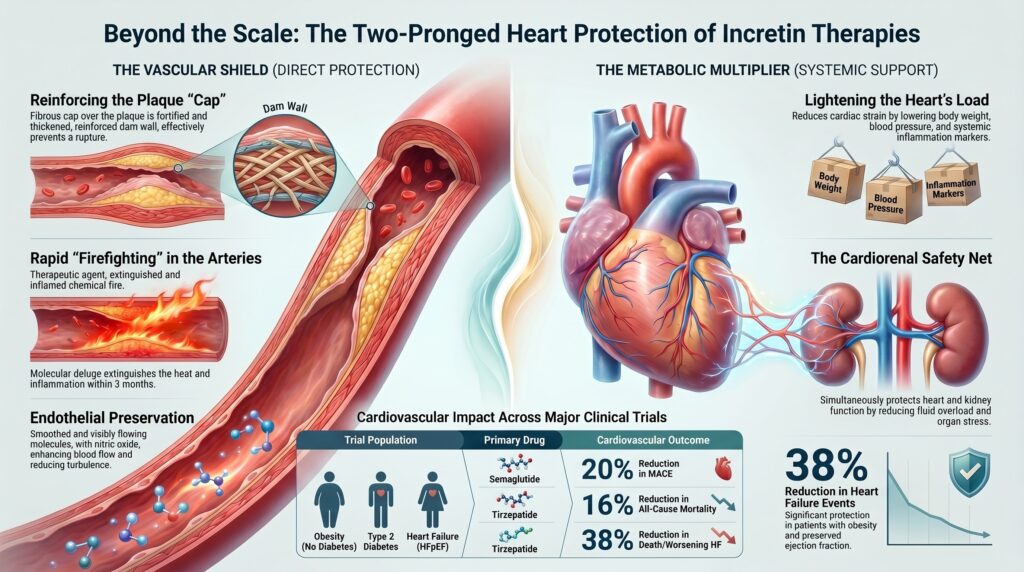
ग्लूकागन-सदृश पेप्टाइड-1 रिसेप्टर एगोनिस्ट (GLP-1RAs) और द्वैध GIP/GLP-1 रिसेप्टर एगोनिस्ट (GIP/GLP-1RAs) का व्यापक रूप से मूल्यांकन किया गया है। हृदय-रक्तवाहिनी परिणाम परीक्षण (CVOT) कार्यक्रम। टाइप 2 मधुमेह (T2D) में प्लेसबो-नियंत्रित श्रेष्ठता परीक्षण — LEADER, SUSTAIN-6, REWIND, और SOUL — और में मोपापन बिना मधुमेह (SELECT) ने प्रमुख प्रतिकूल हृदय संबंधी घटनाओं (MACE) में लगभग 12%–26% की सांख्यिकीय रूप से महत्वपूर्ण कमी दिखाई [3], [4], [10]–[12]. पायनियर 6 ने एक अनुकूल गैर-महत्त्वपूर्ण बिंदु अनुमान के साथ हृदय-संबंधी सुरक्षा स्थापित की [13सक्रिय-तुलनाकारक सेटिंग में, 3-बिंदु MACE के लिए टिरज़ेपाटाइड डुलाग्लुटाइड से कमतर नहीं था। सर्पास-सीवोट (एचआर 0.92; श्रेष्ठता के लिए P = 0.09) और कम सभी कारणों से होने वाली मृत्यु दर 16% द्वारा [6]. मोटापे के साथ संरक्षित इजेक्शन फ्रैक्शन (HFpEF) वाली हृदय विफलता में, SUMMIT ने कार्डियोवैस्कुलर मृत्यु और बिगड़ती हृदय विफलता के संयुक्त परिणाम में 38% की कमी दिखाई, जो STEP-HFpEF कार्यक्रम का पूरक है।5], [20], [21]. FLOW परीक्षण ने पुरानी स्थिति में कार्डियोरेनल लाभ प्रदर्शित किया। गुर्दे की बीमारी (सीकेडी) टाइप 2 मधुमेह के साथ [22].
प्रमुख नैदानिक प्रश्न यह है कि क्या ये लाभ … के परिणामस्वरूप होते हैं। वजन घटाना, ग्लाइसेमिक सुधार, और रक्तचाप में कमी, या क्या वे संवहनी दीवार पर प्रत्यक्ष बहुविध क्रियाओं को दर्शाते हैं और हृदयपेशी. संचित डेटा बहु-कारक व्याख्या का समर्थन करते हैं: कार्डियोमेटाबोलिक बोझ कम होता है, जबकि प्लेसबो-नियंत्रित परीक्षणों में MACE घटना वक्रों का कुछ ही महीनों में और पर्याप्त वजन घटने से पहले तीव्र पृथक्करण — इमेजिंग साक्ष्यों के साथ पट्टिका स्थिरीकरण और कम कोरोनरी सूजन, संभावित रूप से प्रत्यक्ष संवहनी सूजन-रोधी और एंडोथीलियल तंत्रों से एक योगदान का समर्थन करते हैं [9], [24], [25यह समीक्षा कोशिकीय और शारीरिक तंत्रों का संश्लेषण करती है, इंक्रेटिन-आधारित उपचारों की तुलना लिपिड-घटाने वाली औषधोपचार से करती है, प्रमुख यादृच्छिक परीक्षणों का सारांश प्रस्तुत करती है, और अंतर का मूल्यांकन करती है। पट्टिका प्रतिगमन और प्लाक स्थिरीकरण, और अनसुलझे प्रश्नों तथा नैदानिक-अमल संबंधी विचारों की रूपरेखा प्रस्तुत करता है।.
1. कोशिकीय और शारीरिक तंत्र
GLP-1 रिसेप्टर्स अग्न्याशय की बी-कोशिकाओं में, केंद्रीय तंत्रिका तंत्र के भूख केंद्रों में, और — काफी कम घनत्व पर — हृदय के एट्रिया और रक्तवाहिनी में व्यक्त होते हैं। एंडोथेलियम, चिकनी मांसपेशी, प्रतिरक्षा कोशिकाएं, और गुर्दे का नेफ्रॉन [13], [14मानव कोरोनरी एंडोथीलियल और स्मूथ-मसल कोशिकाओं में प्रत्यक्ष रिसेप्टर अभिव्यक्ति को मान्य एंटीबॉडीज़ का उपयोग करके पुष्टि करना कठिन रहा है, जिससे यह संभावना उत्पन्न होती है कि कुछ “रक्तवाहिनी” प्रभाव अप्रत्यक्ष रूप से परिसंचारी प्रतिरक्षा कोशिकाओं, यकृत संकेतन, या केंद्रीय तंत्रिका तंत्र मार्गों के माध्यम से मध्यस्थता किए जाते हैं।14]. द्वैध GIP/GLP-1 रिसेप्टर अगोनिज़्म पूरक चयापचय क्रियाओं का लाभ उठाता है: ग्लूकोज-निर्भर इंसुलिनोट्रोपिक पॉलीपेप्टाइड (GIP) संकेत वसा प्रबंधन को बढ़ाता है और इंसुलिन संवेदनशीलता अवसायी ऊतक में, जबकि GLP-1 संकेत प्रेरित करता है तृप्ति, ग्लूकोज-निर्भर इंसुलिन स्राव, और इंक्रेटिन-मध्यस्थता वाले हृदय संबंधी प्रभावों का अधिकांश भाग [2], [6]. तालिका I लक्षित ऊतकों को आणविक श्रृंखलाओं, नैदानिक से जोड़ती है जैव-सूचक, और नैदानिक अध्ययनों में उभरने वाले संबंधित हृदय-संबंधी परिणाम।.
तालिका I. इंक्रेटिन-मध्यस्थ हृदय-संरक्षण की कोशिकीय और शारीरिक क्रियाविधि।.
| लक्षित ऊतक / प्रणाली | रिसेप्टर | अणु-श्रृंखला | जैवचिह्न / प्रतिनिधि | हृदय-रक्तवाहिनी परिणाम |
| रक्तवाहिनी एंडोथीलियम | जीएलपी-1आर | eNOS युग्मन की पुनर्स्थापना; सुपरऑक्साइड उत्पादन में कमी; नाइट्रिक ऑक्साइड की जैवउपलब्धता में वृद्धि।. | प्रवाह-मध्यस्थता वाले फैलाव में सुधार; घुलनशील ICAM-1 और VCAM-1 में कमी।. | कोरोनरी सूक्ष्मवास्कुलर वासोडायलेशन; संरक्षित एंडोथेलियल फ़ंक्शन; मोनोसाइट चिपकन में कमी।. |
| रक्तवाहिनी और परिसंचारी प्रतिरक्षा कोशिकाएँ | जीएलपी-1आर | cAMP / PKA सक्रियण; दमित NF-κB स्थानांतरण; कम मैक्रोफेज सक्रियण. | निम्न उच्च-संवेदनशीलता सी-रिएक्टिव प्रोटीन, आईएल-6, और टीएनएफ-α।. | रक्तवाहिनी की दीवार में मोनोसाइट्स के प्रवेश को दबाया; फोम-सेल के निर्माण और प्लाक की सूजन को कम किया।. |
| धमनी की चिकनी मांसपेशी और पट्टिका मैट्रिक्स | जीएलपी-1आर | VSMC प्रसार में कमी; का मॉड्यूलेशन मैट्रिक्स मेटालोपroteinase अभिव्यक्ति; कोलेजन का बढ़ता जमाव।. | पर बढ़ी हुई रेशेदार-पट्टिका की मात्रा कोरोनरी सीटी एंजियोग्राफी; मोटा फाइब्रस कैप रक्तवाहिनी इमेजिंग पर।. | का स्थिरीकरण संवेदनशील पट्टिका वास्तुकला; कम टूट-फूट और क्षरण।. |
| मायोकार्डियम और कोरोनरी सूक्ष्म परिसंचरण | जीएलपी-1आर | वृद्ध हृदयक ग्लूकोज तनाव के तहत अवशोषण; कैस्पेस-3 मार्ग अवरोधन के माध्यम से कार्डियोमायोसाइट अपोप्टोसिस में कमी।. | घटा हुआ एनटी-प्रोबीएनपी और ट्रोपोनिन; चयनित आबादी में संरक्षित LVEF।. | इस्केमिया-रिपरफ्यूजन चोट का शमन; बेहतर डायस्टोलिक कार्य; हृदय विफलता की प्रगति में कमी।. |
| चर्बीयुक्त ऊतक और यकृत | जीएलपी-1आर और जीआईपीआर | केंद्रीय भूख दमन; यकृत में लिपोनेजेनिस की कमी और अस्थानिक वसा डिपोजिशन; बेहतर इंसुलिन संवेदनशीलता।. | 5%–15% शरीर-वजन में कमी; कम कमर की परिधि; सुधार हुआ HOMA-IR. | हृदय का पूर्वभार/पश्चातभार कम; उलटफेर मोटապாठा से संबंधित प्रणालीगत सूजन की।. |
| वृक्कीय नेफ्रॉन और हेमोडायनामिक्स | जीएलपी-1आर और जीआईपीआर | प्रॉक्सिमल ट्यूब्यूल सोडियम-हाइड्रोजन एक्सचेंजर (NHE3) का अवरोध; सोडियूरिया; ग्लोमेरुलर हाइपरफिल्ट्रेशन में कमी।. | सिस्टोलिक में 2–5 मिमी एचजी की कमी रक्तचाप; संरक्षित ईजीएफआर ढलान।. | मायोकार्डियल दीवार तनाव में कमी; कार्डियोरेनल सिंड्रोम का शमन।. |
2. दवा-वर्ग की तुलना: इंक्रेटिन-आधारित बनाम लिपिड-घटाने वाली थेरेपी
परंपरागत लिपिड-घटाने वाली थेरेपी — स्टैटिन, एज़ेटिमाइब, प्रोप्रोटीन कन्वर्टस सब्टिलिसिन/केक्सिन टाइप 9 (PCSK9) अवरोधक, इन्क्लिसिराइन, और बेंपेडोइक एसिड — मुख्य रूप से परिसंचारी एपोलिपोप्रोटीन बी (एपोबी) युक्त लिपोप्रोटीनों को कम करते हैं, जो नए को धीमा करते हैं एथरोएजेनेसिस और, पर्याप्त परिमाण पर, एंजियोग्राफिक पट्टिका प्रतिगमन को प्रेरित करता है।15]–[17]. इंक्रेटिन-आधारित उपचार एक अलग धुरी पर काम करते हैं: वे लिपिड पैनल पर मामूली प्रभाव डालते हैं, लेकिन प्रणालीगत सूजन, संवहनी जीवविज्ञान, शरीर की संरचना, रक्तचाप और गुर्दे की हेमोडायनामिक्स पर महत्वपूर्ण प्रभाव डालते हैं [2], [18]. तालिका II निम्न-घनत्व लिपोप्रोटीन कोलेस्ट्रॉल (LDL-C), उच्च-घनत्व लिपोप्रोटीन कोलेस्ट्रॉल (HDL-C) और MACE परिणामों के संदर्भ में तुलनात्मक प्रोफ़ाइल का सारांश प्रस्तुत करती है। इसका चिकित्सीय निहितार्थ प्रतिस्थापन नहीं बल्कि संयोजन है: एथेरोजेनेसिस के लिपिड चालक को संबोधित करने के लिए ApoB में आक्रामक कमी, जो के साथ युग्मित है इंसुलिन संवर्धक चिकित्सा शेष कार्डियोमेटाबोलिक और सूजन संबंधी जोखिम को संबोधित करने के लिए।.
तालिका II. औषधीय और नैदानिक प्रोफ़ाइल: इंक्रेटिन-आधारित बनाम लिपिड-घटाने वाली थेरेपी।.
| दवा वर्ग (उदाहरण) | प्राथमिक आणविक लक्ष्य | लिपिड प्रभाव (आम) | MACE और HF पर प्रभाव | द्वितीयक चयापचय लाभ |
| जीएलपी-1 रिसेप्टर एगोनिस्ट (सेमाग्लुटाइड, लिराग्लुटाइड, डुलाग्लुटाइड) | जीएलपी-1 रिसेप्टर | एलडीएल-सी ↓ ~2%–5%; ट्राइग्लिसराइड्स ↓ ~12%–18%; HDL-C ↑ ~3%–5%; अपोबी में मामूली कमी।. | सकारात्मक प्लेसबो-नियंत्रित CVOTs (लीडर 13%, रिवाइंड 12%, सोल 14%, सेलेक्ट 20%, SUSTAIN-6 26%). PIONEER 6 एक गैर-इनफीरियरिटी सुरक्षा परीक्षण था जिसमें एक गैर-महत्वपूर्ण अनुकूल बिंदु अनुमान था। HFpEF में अनुकूल हृदय संबंधी लक्षण और कार्यात्मक परिणाम।. | वजन में कमी 6%–15%; SBP ↓ 2–5 mmHg; उच्च संवेदनशील सी-प्रतिक्रियाशील प्रोटीन में महत्वपूर्ण कमी; eGFR संरक्षण।. |
| जीआईपी/जीएलपी-1 रिसेप्टर एगोनिस्ट (टिर्ज़ेपाटाइड) | जीआईपी और जीएलपी-1 रिसेप्टर्स | एलडीएल-सी ↓ ~5%–8%; ट्राइग्लिसराइड्स ↓ ~20%–25%; एचडीएल-सी ↑ ~5%–8%; GLP-1RA मोनोथेरेपी की तुलना में ApoB में अधिक कमी।. | 3-पॉइंट MACE के लिए डुलाग्लुटाइड से कमतर नहीं (HR 0.92, 95.3% CI 0.83–1.01; उत्कृष्टता के लिए P = 0.09) SURPASS-CVOT में, सभी कारणों से मृत्यु में 16% की कमी के साथ। SUMMIT (HFpEF + मोटापा) में हृदय-विफलता घटनाओं के संयुक्त परिणाम में 38% की कमी और बिगड़ती हृदय-विफलता घटनाओं में 46% की कमी।. | वजन में कमी 11%–22%; HbA1c में कमी 1.5%–2.0%; SBP ↓ 3–5 mmHg; अनुकूल eGFR ढलान।. |
| स्टैटिन (एचएमजी-कोए रिडक्टेज रोधक) | यकृत HMG-CoA रिडक्टेज़ | एलडीएल-सी ↓ 30%–55%; ट्राइग्लिसराइड्स ↓ 10%–25%; एचडीएल-सी ↑ 5%–10%; एपोबी ↓ 30%–50%. | लगभग 22% MACE सापेक्ष जोखिम में कमी प्रति 1.0 mmol/L (38.7 mg/dL) LDL-C में कमी (CTT) मेटा-विश्लेषण); एचएफ पर तटस्थ।. | प्रत्यक्ष प्लाक स्थिरीकरण; मामूली एचएस-सीआरपी कमी; बहुविध एंडोथीलियल प्रभाव।. |
| एज़ेटीमीब | NPC1L1 कोलेस्ट्रॉल परिवहक | एलडीएल-सी ↓ 15%–22%; ट्राइग्लिसराइड्स ↓ ~5%; एचडीएल-सी ↑ ~1%–3%; एपोबी ↓ ~10%–15%. | स्टैटिन थेरेपी में जोड़ा गया ~6% मेस सापेक्ष जोखिम में कमी (IMPROVE-IT); एचएफ पर तटस्थ।. | स्थानीय आंत संबंधी प्रभाव; अनुकूल सुरक्षा प्रोफ़ाइल।. |
| PCSK9 अवरोधक (एलिरोकूमाब, इवोलोक्यूमैब) और इन्क्लिसिरान | परिचालित PCSK9 (mAb) या यकृत PCSK9 mRNA (siRNA) | एलडीएल-सी ↓ 50%–60%; एपोबी ↓ 40%–50%; एलपी(ए) ↓ 20%–30%; मामूली ट्राइग्लिसराइड कमी।. | स्टैटिन थेरेपी में जोड़ा गया ~15% मेस सापेक्ष जोखिम में कमी (फूरियर, ओडिसी परिणाम; एचएफ पर तटस्थ।. | पर कोरोनरी पट्टिका का क्षय प्रेरित करता है सीरियल आईवीयूएस (GLAGOV); दुर्लभ प्रतिकूल घटनाएँ।. |
| बेम्पेडोइक एसिड | यकृत एटीपी-साइट्रेट लाइज़ | एलडीएल-सी ↓ 17%–28%; ट्राइग्लिसराइड्स और एचडीएल-सी पर मामूली प्रभाव; एपोबी ↓ ~15%।. | स्टैटिन-असहिष्णु रोगियों में 13% MACE सापेक्ष जोखिम में कमी (CLEAR परिणाम); एचएफ पर तटस्थ।. | ~20% एचएस-सीआरपी में कमी; ग्लाइसेमिया पर तटस्थ।. |
3. प्रमुख यादृच्छिक परीक्षणों से साक्ष्य
इन्क्रेटिन-आधारित उपचारों की हृदय-संवहनी प्रभावकारिता बड़े संभावित CVOTs की एक श्रृंखला में स्थापित की जा चुकी है। यह परीक्षण कार्यक्रम टाइप 2 डायबिटीज (T2D) में ग्लाइसेमिक सुरक्षा और परिणाम अध्ययनों से विकसित हुआ है (LEADER, SUSTAIN-6, REWIND, EXSCEL, और PIONEER 6 युग [10]–[13], [19]), मधुमेह के बिना मोटापे सहित विस्तारित आबादी में परिणाम परीक्षणों तक (SELECT [3]), मोटापे के साथ HFpEF (SUMMIT [5], STEP-HFpEF में एक साथी सेमाग्लूटाइड कार्यक्रम के साथ [20], [21]), सीकेडी (प्रवाह [22]), और एक सक्रिय-तुलनाकार सेटिंग (SURPASS-CVOT [6नेविगेशन की सुविधा के लिए, परीक्षणों का सारांश दो तालिकाओं में दिया गया है, जिन्हें नामांकन जनसंख्या के आधार पर समूहित किया गया है: तालिका III में T2D CVOTs शामिल हैं; तालिका IV में मोटापा, HFpEF, और CKD में किए गए परीक्षण शामिल हैं। अगले अनुभागों में चर्चा की गई है कि ये परीक्षण तंत्र के बारे में क्या प्रकट करते हैं: लाभ का समयक्रम, प्लाक स्थिरीकरण का इमेजिंग हस्ताक्षर, और प्रत्येक परीक्षण डिज़ाइन से निष्कर्ष निकालने की सीमाएँ।.
तालिका III. टाइप 2 मधुमेह में हृदय संबंधी परिणाम परीक्षण।.
इस तालिका में प्रयुक्त संक्षिप्ताक्षर: ASCVD = एथेरोस्क्लेरोटिक कार्डियोवैस्कुलर रोग; CV = कार्डियोवैस्कुलर; CVD = कार्डियोवैस्कुलर रोग; HR = जोखिम अनुपात; SC = उपचर्म; SGLT2i = सोडियम-ग्लूकोज कोट्रांसपोर्टर-2 अवरोधक।.
| परीक्षण (प्रकाशन) | हस्तक्षेप बनाम तुलनाकार | जनसंख्या और एन | अनुवर्ती | प्राथमिक हृदय-संवहनी परिणाम (एचआर, 95% विश्वास अंतराल) | मुख्य द्वितीयक प्रभाव और उल्लेखनीय सीमाएँ |
| लीडर (मार्सो एट अल., एनईजेएम 2016) [10] | लिराग्लुटाइड 1.8 मिलीग्राम प्रतिदिन उपचर्मिक बनाम. प्लैसबो, मानक देखभाल पर।. | उच्च CV जोखिम वाले T2D (≥80% स्थापित CVD वाले)। N = 9,340।. | माध्यिका 3.8 वर्ष।. | 3-बिंदु MACE: HR 0.87 (0.78–0.97), श्रेष्ठता के लिए P = 0.01। हृदय संबंधी मृत्यु: HR 0.78 (0.66–0.93)।. | सभी कारणों से मृत्यु का HR 0.85; घातक नहीं मायोकार्डियल इन्फार्क्शन और आघात संख्यात्मक रूप से कम (व्यक्तिगत रूप से महत्वपूर्ण नहीं)। जीआई प्रतिकूल घटनाएं सबसे आम उपचार बंद करने का कारण।. |
| सस्टेन-6 (मार्सो एट अल., एनईजेएम 2016) [11] | सेमाग्लुटाइड 0.5 मिलीग्राम या 1.0 मिलीग्राम साप्ताहिक उपचर्म (SC) बनाम प्लेसबो।. | उच्च हृदय संबंधी जोखिम वाला टाइप 2 मधुमेह। N = 3,297।. | 104 सप्ताह।. | 3-बिंदु MACE: HR 0.74 (0.58–0.95), गैर-निम्नतरता के लिए P < 0.001, श्रेष्ठता के लिए P = 0.02। गैर-घातक स्ट्रोक: HR 0.61 (0.38–0.99)।. | रेटिनोपैथी जटिलताओं में सांख्यिकीय रूप से महत्वपूर्ण वृद्धि (एचआर 1.76, 1.11–2.78); छोटे नमूना आकार के कारण स्ट्रोक-उपप्रकार की सटीकता सीमित है।. |
| रीवाइंड (गर्स्टीन एट अल., लैंसेट 2019) [12] | डुलाग्लुटाइड 1.5 मिलीग्राम साप्ताहिक उपचर्म इंजेक्शन बनाम प्लेसबो।. | T2D, स्थापित सीवीडी के बिना ~68% (व्यापक प्राथमिक-रोकथाम समूह)। N = 9,901।. | माध्यिका 5.4 वर्ष।. | 3-बिंदु MACE: HR 0.88 (0.79–0.99), श्रेष्ठता के लिए P = 0.026।. | प्राथमिक और द्वितीयक रोकथाम उपसमूहों में लाभ सुसंगत; प्रमुख रूप से प्राथमिक रोकथाम आबादी में लाभ दिखाने वाला पहला GLP-1RA CVOT।. |
| पायनियर 6 (हुसेन एट अल., एनईजेएम 2019) [13] | ओरल सेमाग्लुटाइड 14 मिलीग्राम प्रतिदिन बनाम प्लेसबो।. | स्थापित सीवीडी या सीकेडी के साथ टाइप 2 डायबिटीज और 50 वर्ष या उससे अधिक आयु। N = 3,183।. | माध्यिका 15.9 महीने।. | 3-बिंदु MACE: HR 0.79 (0.57–1.11); गैर-निम्नतरता के लिए P < 0.001 (उत्कृष्टता के लिए पर्याप्त शक्ति नहीं)।. | सीवी सुरक्षा परीक्षण; अनुकूल लेकिन गैर-महत्वपूर्ण बिंदु अनुमान। हृदय संबंधी और सभी कारणों से होने वाली मृत्यु संख्यात्मक रूप से कम।. |
| सोल (मैक्ग्वायर एट अल., एनईजेएम 2025) [4] | मानक उपचार (बेसलाइन SGLT2i पर ~27%) के साथ प्लेसबो की तुलना में, दैनिक 14 मिलीग्राम तक टitrated मौखिक सेमाग्लुटाइड।. | स्थापित ASCVD, CKD, या दोनों के साथ टाइप 2 मधुमेह ≥50 वर्ष। N = 9,650।. | माध्यिका 49.5 महीने।. | 3-पॉइंट MACE: HR 0.86 (0.77–0.96), श्रेष्ठता के लिए P = 0.006।. | मुख्य रूप से गैर-घातक मायोकार्डियल इंफार्क्शन में 26% की कमी से प्रेरित; लाभ बेसलाइन या परीक्षण के दौरान SGLT2i के उपयोग की परवाह किए बिना बना रहता है। गैस्ट्रोइंटेस्टाइनल घटनाएँ सबसे आम प्रतिकूल घटना वर्ग हैं।. |
| सर्पास-सीवीओटी (निकोल्स एट अल., एनईजेएम 2025) [6] | टिरज़ेपाटाइड (अधिकतम सहन होने तक 15 मिलीग्राम) साप्ताहिक उपचर्मिक बनाम डुलाग्लुटाइड 1.5 मिलीग्राम साप्ताहिक उपचर्मिक (सक्रिय तुलनाकर्ता). | स्थापित ASCVD के साथ टाइप 2 मधुमेह। N = 13,165 (6,586 बनाम 6,579)।. | माध्यिका 4.0 वर्ष।. | 3-पॉइंट MACE: HR 0.92 (95.3% CI 0.83–1.01); गैर-निम्नतरता के लिए P = 0.003, श्रेष्ठता के लिए P = 0.09। विस्तारित 4-बिंदु MACE: HR 0.88 (0.80–0.96). सभी कारणों से मृत्यु HR 0.84 (0.75–0.94). | सक्रिय तुलनात्मक डिज़ाइन श्रेष्ठता दिखाने के लिए आवश्यक अंतर को संकीर्ण करता है। टिरज़ेपटिड ने लगभग 7%–8% अधिक वजन कमी और लगभग 0.8% अधिक HbA1c कमी उत्पन्न की; eGFR-ढलान में अनुकूल प्रवृत्ति।. |
तालिका IV. मोटापा, संरक्षित निष्कासन अंश के साथ हृदय विफलता, और पुरानी गुर्दा रोग में परीक्षण।.
इस तालिका में प्रयुक्त संक्षिप्ताक्षर: ARR = निरपेक्ष जोखिम कमी; BMI = शरीर द्रव्यमान सूचकांक; CV = हृदय-रक्तवाहिनी; HR = जोखिम अनुपात; KCCQ-CSS = कान्सास सिटी कार्डियोमायोपैथी प्रश्नावली क्लिनिकल सारांश स्कोर; LVEF = बाएँ वेंट्रिकल निष्कासन अंश; NYHA = न्यूयॉर्क हार्ट एसोसिएशन कार्यात्मक श्रेणी; PAD = परिधीय धमनी रोग; SC = उपचर्म; UACR = मूत्र अल्ब्यूमिन-टू-क्रिएटिनिन अनुपात।.
| परीक्षण (प्रकाशन) | हस्तक्षेप बनाम तुलनाकार | जनसंख्या और एन | अनुवर्ती | प्राथमिक परिणाम (एचआर या उपचार अंतर) | मुख्य द्वितीयक प्रभाव और उल्लेखनीय सीमाएँ |
| चुनें (लिन्कोफ़ एट अल., एनईजेएम 2023) [3] | सेमाग्लुटाइड 2.4 मिलीग्राम साप्ताहिक उपचर्म (SC) बनाम प्लेसबो, सभी मानक हृदय संबंधी देखभाल पर।. | बीएमआई ≥27 किग्रा/मी², स्थापित सीवीडी (पूर्व में हुआ एमआई, स्ट्रोक, या लक्षणयुक्त पीएडी), मधुमेह नहीं। N = 17,604।. | औसत 39.8 महीने।. | 3-बिंदु MACE: HR 0.80 (0.72–0.90), श्रेष्ठता के लिए P < 0.001। ARR 1.5%।. | पूर्वनिर्धारित लाभ-प्राप्ति समय विश्लेषण: नाममात्र रूप से महत्वपूर्ण MACE में कमी 3 महीनों में (HR 0.63, 95% CI 0.41–0.95) और 6 महीनों में (HR 0.60), पर्याप्त वजन ह्रास से पहले [25]. बेसलाइन HbA1c, वजन और कमर परिधि श्रेणियों में कार्डियोप्रोटेक्शन सुसंगत रहा। GI घटनाओं ने ~17% विराम का कारण बनीं।. |
| समिट (पैकर एट अल., एनईजेएम 2025) [5] | टिर्ज़ेपेटाइड को अधिकतम सहनशील खुराक (5, 10, या 15 मिलीग्राम) तक साप्ताहिक त्वचा के नीचे (SC) टाइट्रेट किया गया, प्लेसबो की तुलना में।. | HFpEF (LVEF ≥50%), NYHA II–IV, BMI ≥30 किग्रा/मी², मधुमेह के साथ या बिना। N = 731।. | माध्यिका 104 सप्ताह।. | सीवी मृत्यु या बिगड़ती हृदय विफलता (संयुक्त): HR 0.62 (0.41–0.95), P = 0.026। बिगड़ती हृदय विफलता घटनाएँ: HR 0.54 (0.34–0.85)।. | KCCQ-CSS समूहों के बीच अंतर +6.9 (3.3–10.6); 6-मिनट वॉक दूरी +18 मीटर; वजन घटाने के उपचार का अंतर −11.6%; hs-CRP −34.9%. मध्यम नमूना आकार; सीवी मृत्यु घटनाएँ व्यक्तिगत रूप से व्याख्या करने के लिए बहुत कम।. |
| स्टेप-एचएफपीईएफ (कोसिबरोड एट अल., एनईजेएम 2023) [20] | सेमाग्लुटाइड 2.4 मिलीग्राम साप्ताहिक उपचर्म इंजेक्शन बनाम प्लेसबो।. | HFpEF (LVEF ≥45%), BMI ≥30 किग्रा/मी², मधुमेह नहीं। N = 529।. | ५२ सप्ताह।. | द्वैध प्राथमिक परिणाम बिंदु: KCCQ-CSS परिवर्तन +16.6 बनाम +8.7 (समूहों के बीच +7.8, 95% CI 4.8–10.9, P < 0.001); शरीर का वजन −13.3% बनाम −2.6% (समूहों के बीच −10.7%, P < 0.001). | सेमाग्लुटाइड से छह मिनट की पैदल दूरी और सीआरपी में भी सुधार हुआ। लक्षण और व्यायाम क्षमता परीक्षण; कठोर हृदय संबंधी अंतबिंदुओं के लिए पर्याप्त शक्ति नहीं।. |
| स्टेप-एचएफपीईएफ डीएम (कोसिबोरॉड एट अल., लैंसेट 2024) [21] | सेमाग्लुटाइड 2.4 मिलीग्राम साप्ताहिक उपचर्म इंजेक्शन बनाम प्लेसबो।. | HFpEF (LVEF ≥45%), BMI ≥30 kg/m², T2D के साथ। N = 616।. | ५२ सप्ताह।. | द्वैध प्राथमिक परिणाम बिंदु: KCCQ-CSS परिवर्तन +13.7 बनाम +6.4 (समूहों के बीच +7.3, P < 0.001); शरीर का वजन −9.8% बनाम −3.4% (समूहों के बीच −6.4%, P < 0.001). | सेमाग्लुटाइड से छह मिनट की पैदल दूरी और सीआरपी में सुधार हुआ; निरपेक्ष वजन हानि गैर-मधुमेही STEP-HFpEF की तुलना में कम थी। कठोर हृदय संबंधी अंतबिंदुओं के लिए यह अध्ययन पर्याप्त रूप से शक्तिशाली नहीं था।. |
| फ्लो (पर्कोविच एट अल., एनईजेएम 2024) [22] | सेमाग्लुटाइड 1.0 मिलीग्राम साप्ताहिक उपचर्म इंजेक्शन बनाम प्लेसबो (प्रभावकारिता के कारण परीक्षण समयपूर्व समाप्त)।. | क्रोनिक किडनी रोग (सीकेडी) के साथ टाइप 2 मधुमेह (eGFR 50–75 के साथ बढ़ा हुआ UACR, या eGFR 25–50)। N = 3,533।. | माध्यिका 3.4 वर्ष।. | संयुक्त प्रमुख गुर्दे रोग घटनाएँ (गुर्दा विफलता, निरंतर ≥50% eGFR में कमी, गुर्दे या हृदय संबंधी मृत्यु): HR 0.76 (0.66–0.88), P = 0.0003।. | MACE: HR 0.82 (0.68–0.98). सीवी मृत्यु: HR 0.71 (0.56–0.89). T2D के साथ CKD में कार्डियोरेनल लाभ प्रदर्शित।. |
4. प्लाक स्थिरीकरण बनाम एथेरोस्क्लेरोटिक प्रतिगमन
एक केंद्रीय क्रियाविधि संबंधी प्रश्न यह है कि क्या GLP-1RA चिकित्सा के साथ देखी गई MACE में कमी कुल की शारीरिक प्रतिगमन द्वारा मध्यस्थता की जाती है। एथेरोमा आयतन या गुणात्मक पुनर्निर्माण द्वारा जो मौजूदा को स्थिर करता है प्लाक का बोझ. के साथ गहन लिपिड-घटाने वाला उपचार हाई-इंटेंसिटी स्टैटिन और पीसीएसके9 अवरोधकों को सीरियल इंट्रावास्कुलर अल्ट्रासाउंड (IVUS) और कोरोनरी कंप्यूटेड टोमोग्राफी एंजियोग्राफी (CCTA) पर कुल एथेरोमा आयतन और लिपिड-युक्त प्लाक घटक [15], [17], [23]. की इमेजिंग सिग्नेचर इन्क्रीटिन थेरेपी अलग है।.
ह्यूलेर बोएसगार्ड और सहयोगियों के प्रेक्षणीय, संभाव्य CCTA अध्ययन में, 204 लक्षणरहित टाइप 2 मधुमेह (T2D) वाले रोगियों (55 जिन्हें नैदानिक देखभाल के हिस्से के रूप में लिराग्लुटाइड प्राप्त हुआ, 149 जिन्हें नहीं) ने आधारभूत और 1-वर्षीय CCTA की जांच करवाई।9कुल एथेरोमा आयतन में परिवर्तन समूहों के बीच भिन्न नहीं था (लिरैग्लुटाइड समूह में 38 ± 180 मिमी³ बनाम तुलना समूह में −1 ± 160 मिमी³, P = 0.13)। हालाँकि, लिरैग्लुटाइड समूह में फाइब्रोस-प्लैक आयतन में उल्लेखनीय वृद्धि देखी गई। प्लैक जीवविज्ञान के संदर्भ में, फाइब्रोस-प्लैक का विस्तार एक अनुकूल संरचनात्मक परिवर्तन है: घना, कोलेजन-समृद्ध फाइब्रोस ऊतक एक मोटी परत बनाता है जो थ्रोम्बोजेनिक लिपिड कोर परिसंचारी थक्केदार कारकों से। रेशेदार संरचना की ओर यह बदलाव, स्टेटिन चिकित्सा के साथ देखी गई गुणात्मक धब्बेदार परिवर्तन के समान है और यह धब्बे के स्थिरीकरण का संरचनात्मक आधार है।9], [15इस अध्ययन की प्रेक्षणीय डिज़ाइन कारण-आधारित निष्कर्ष निकालने में सीमित करती है; इस प्रश्न को संबोधित करने वाला एक यादृच्छिक CCTA परीक्षण अभी भी साक्ष्य की कमी के रूप में बना हुआ है।.
प्रत्यक्ष सूजन-रोधी संवहनी क्रिया के लिए पूरक इन-विवो साक्ष्य LIRAFLAME से प्राप्त होते हैं। पॉज़िट्रॉन उत्सर्जन टोमोग्राफी / कंप्यूटेड टोमोग्राफी (पीईटी/सीटी) उप-अध्ययन [24]. मूल LIRAFLAME परीक्षण से यादृच्छिक रूप से चयनित तीस प्रतिभागियों ने युग्मित [⁶⁴Cu]Cu-DOTATATE PET/CT इमेजिंग की कोरोनरी धमनियां शुरुआती स्तर पर और 26 सप्ताह बाद। यह ट्रेसर सोमाटोस्टैटिन रिसेप्टर 2 से बंधता है, जो सक्रिय मैक्रोफेज पर अत्यधिक व्यक्त होता है। लिराग्लुटाइड समूह में कोरोनरी ट्रेसर का अवशोषण प्रतिभागी स्तर और व्यक्तिगत कोरोनरी खंड स्तर पर (अधिकतम तथा अधिकतम का औसत मानकीकृत अवशोषण मानों के रूप में आंका गया) में उल्लेखनीय रूप से कम हुआ; प्लेसीबो में ऐसा कोई कमी नहीं देखी गई। कोरोनरी ट्रेसर अवशोषण में परिवर्तन प्रणालीगत परिवर्तन से सहसंबद्ध था। उच्च-संवेदनशीलता सी-प्रतिक्रियाशील प्रोटीन (hs-CRP), एक प्रणालीगत सूजन-रोधी प्रभाव को कोरोनरी धमनियों की दीवार में मैक्रोफेज की गतिविधि में क्षेत्रीय कमी से जोड़ते हुए [24]. अपोलिपोप्रोटीन-ई-रहित और एलडीएल-रिसेप्टर-रहित चूहे के मॉडल तथा वतनाबे वंशानुगत हाइपरलिपिडेमिक खरगोशों में किए गए प्रीक्लिनिकल अध्ययनों ने समान प्रभाव दिखाए हैं: मैक्रोफेज संचय में कमी, फोम-सेल निर्माण का अवरोध, और मोटे रेशेदार आवरण [14], [18कुल मिलाकर, मानव इमेजिंग और पशु डेटा बड़े पैमाने पर एथेरोमा के प्रतिगमन की बजाय प्लाक स्थिरीकरण के साथ अधिक सुसंगत हैं, हालांकि कारण संबंधी तंत्र प्रत्यक्ष रूप से सिद्ध मार्ग की बजाय एक अनुमान ही बना हुआ है।.
5. हृदय-संरक्षणात्मक लाभ की तीव्र शुरुआत के लिए क्रियात्मक आधार
SELECT में MACE घटना वक्र जल्दी अलग हो गए। परीक्षण का प्राथमिक परिणाम 39.8 महीनों के औसत अनुवर्ती अवधि में 3-बिंदु MACE में 20%% की कमी था (HR 0.80, 95% CI 0.72–0.90) [3]. 2025 में यूरोपियन कांग्रेस ऑन ओबेसिटी में प्रस्तुत और बाद में प्रकाशित एक पूर्वनिर्धारित समय-से-लाभ द्वितीयक विश्लेषण में, सेमाग्लुटाइड ने पहले 3 महीनों के भीतर MACE में नाममात्र रूप से महत्वपूर्ण कमी दिखाई (HR 0.63, 95% CI 0.41–0.95) और पहले 6 महीनों (HR 0.60, 95% CI 0.44–0.81), जिसमें वक्र पृथक्करण लगभग 3 सप्ताह के भीतर दिखाई दिया यादृच्छिकीकरण [25], [263 महीने पर, औसत प्लेसबो-समायोजित शरीर-वजन अंतर केवल लगभग 3.6% था, और रोगी अभी भी प्रोटोकॉल खुराक-वृद्धि चरण में थे। इसलिए इस द्वितीयक विश्लेषण में नैदानिक लाभ की शुरुआत पर्याप्त वजन ह्रास से पहले और लक्षित रखरखाव खुराक प्राप्त करने से पूर्व होती है, हालांकि लाभ प्राप्ति के समय के अनुमानों के विश्वास अंतराल प्राथमिक समाप्ति बिंदु की तुलना में व्यापक हैं।.
कई गैर-वजन-निर्भर तंत्र संभावित रूप से इस प्रारंभिक हृदय-संरक्षण की व्याख्या कर सकते हैं:
एंडोथीलियल संरक्षण।. जीएलपी-1आरए प्रतिक्रियाशील ऑक्सीजन प्रजातियों के उत्पादन को कम करते हैं और रोकते हैं। एन्डोथेलियल नाइट्रिक ऑक्साइड सिंथेस (eNOS) अनकपलिंग, स्थानीय नाइट्रिक ऑक्साइड की जैवउपलब्धता में वृद्धि। कुल प्रभाव बेहतर कोरोनरी माइक्रोवास्कुलर वासोडायलेशन और स्थानीय एंटीथ्रोम्बोटिक/एंटीप्लेटलेट टोन है।.
प्लाक-स्थानीय सूजन का त्वरित दमन।. संवेदनशील धब्बों में मैक्रोफेज सूजनजन्य साइटोकाइन्स (ट्यूमर नेक्रोसिस फैक्टर अल्फा [TNF-α], इंटरल्यूकिन-6 [IL-6]) और मैट्रिक्स मेटालोप्रोटीनेज़ उत्पन्न करते हैं जो रेशेदार टोपी को क्षयित करते हैं। GLP-1R सक्रियण कुछ दिनों से कुछ हफ्तों के भीतर न्यूक्लियर फैक्टर काप्पा-बी (NF-κB) कैस्केड को डाउन-रेगुलेट करता है, जिससे कैप की अखंडता बनी रहती है और क्षरण व फटने के लिए सब्सट्रेट कम हो जाता है।.
मायोकार्डियल सब्सट्रेट अनुकूलन।. इस्केमिक और उच्च तनाव की स्थितियों में, GLP-1R सक्रियण मायोकार्डियल ग्लूकोज अवशोषण और ग्लाइकोलिटिक प्रवाह को बढ़ाता है, साथ ही कैस्पेस-3-मध्यस्थ कार्डियोमायोसाइट अपोप्टोसिस को रोकता है। यह ऊर्जा उत्पादन में ऑक्सीजन दक्षता में सुधार करता है और इन्फार्क्ट के विस्तार तथा एरिदम सब्सट्रेट को कम करता है।.
ये मार्ग उस अवलोकन के अनुरूप हैं कि SELECT में प्रारंभिक MACE कमी मुख्य रूप से गैर-घातक मायोकार्डियल इन्फार्क्शन (MI) और हृदय-विफलता-संबंधी घटनाओं में कमी से प्रेरित थी, न कि उन परिवर्तनों से जिन्हें साकार होने में महीनों के वजन घटाने की आवश्यकता होती है।25], [27]. मानव कोरोनरी ऊतक में प्रत्यक्ष कारणीभूत प्रदर्शन अभी भी साक्ष्य की कमी है।.
6. डीपीपी-4 अवरोधक विसंगति
एक स्पष्ट अंतर डाइपेप्टिडाइल पेप्टिडेज़-4 (DPP-4) अवरोधकों से आता है, जो अंतर्जात सक्रिय GLP-1 के अपघटन को रोककर कार्य करते हैं। ये एजेंट ग्लाइकेटेड हीमोग्लोबिन (HbA1c) में लगभग 0.5%–0.8% की मामूली सुधार करते हैं और वजन तथा रक्तचाप पर तटस्थ प्रोफ़ाइल रखते हैं [28]. प्रमुख CVOTs — SAVOR-TIMI 53 (सैक्साग्लिप्टिन), EXAMINE (अलोग्लिप्टिन), TECOS (सिटैग्लिप्टिन), CARMELINA (लिनाग्लिप्टिन), और CAROLINA (लिनाग्लिप्टिन बनाम ग्लाइमेपिराइड) — DPP-4 अवरोधक कार्डियोवैस्कुलर सुरक्षा का प्रदर्शन किया है लेकिन MACE में कमी नहीं; SAVOR-TIMI 53 ने अतिरिक्त रूप से सैक्साग्लिप्टिन के साथ हृदय-विफलता के अस्पताल में भर्ती में वृद्धि दिखाई [28]–[31].
इस चिकित्सीय विचलन को दवा-प्रभाव फार्माकोलॉजी द्वारा सुलझाया जाता है। अंतःस्रावी GLP-1 पोषक तत्वों के उत्तेजन पर आंतों की L-कोशिकाओं से थोड़ी मात्रा में स्रावित होता है और तीव्र DPP-4-मध्यस्थ अपघटन के कारण इसका परिसंचारी अर्ध-आयु दो मिनट से भी कम होती है। DPP-4 अवरोध इस अर्ध-आयु को बढ़ाता है और परिसंचारी सक्रिय GLP-1 को लगभग 2 से 3 गुना तक बढ़ा देता है, जो अग्न्याशय के उच्च-घनत्व वाले द्वीपीय रिसेप्टर्स को सक्रिय करने और ग्लूकोज-निर्भर इंसुलिन स्राव तथा ग्लूकागन दमन उत्पन्न करने के लिए पर्याप्त है। हालांकि, हृदय-संबंधी और प्रतिरक्षा ऊतकों में रिसेप्टर की घनता अग्न्याशय की तुलना में काफी कम होती है, और DPP-4 अवरोध द्वारा उत्पन्न GLP-1 में मामूली शारीरिक वृद्धि, सूजन-रोधी, एंडोथीलियल, या पट्टिका-परिवर्तनकारी प्रभावों के लिए आवश्यक डाउनस्ट्रीम सिग्नलिंग को प्रेरित करने के लिए पर्याप्त नहीं लगती है [13], [14], [28].
इंजीनियर्ड GLP-1RAs विस्तारित अवधि के लिए शारीरिक-सीमा से परे सक्रिय-दवा के संपर्क को प्राप्त करते हैं। सेमाग्लुटाइड की प्लाज्मा अर्ध-आयु लगभग 155–184 घंटे (≈ एक सप्ताह) है, जो C18 फैटी-डाइएसिड साइड चेन के माध्यम से एल्ब्युमिन बाइंडिंग द्वारा संचालित होती है।32इसलिए साप्ताहिक एक बार की खुराक से दवा की सांद्रता बनी रहती है जो शारीरिक आधार रेखा से दस गुना या उससे अधिक होती है। इसका यांत्रिक दृष्टिकोण से महत्वपूर्ण निहितार्थ है: हृदय-रक्तवाहिनी संबंधी लाभ के लिए फार्माकोलॉजिकल स्तर पर प्रत्यक्ष रिसेप्टर सक्रियण आवश्यक प्रतीत होता है, न कि केवल शारीरिक इंक्रेटिन संकेत में वृद्धि।.
7. व्यावहारिक नैदानिक निहितार्थ
7.1 जनसंख्या-विशिष्ट कार्डियोरेनल प्रभावकारिता
स्थापित ASCVD या CKD के साथ टाइप 2 मधुमेह।. जीएलपी-1आरए (त्वचा के नीचे दिए जाने वाले सेमाग्लुटाइड, लिराग्लुटाइड, डुलाग्लुटाइड) और जीआईपी/जीएलपी-1आरए टिरज़ेपाटाइड लिपिड-घटाने और एंटीप्लेटलेट थेरेपी. मौखिक सेमाग्लुटाइड को दैनिक 14 मिलीग्राम तक समायोजित करने पर SOUL में 3-बिंदु MACE में 14% की कमी आई (HR 0.86, 95% CI 0.77–0.96), जिसमें मुख्य रूप से गैर-घातक मायोकार्डियल इन्फार्क्शन (MI) में 26% की कमी शामिल थी; बेनेफ़िट बेसलाइन पर सोडियम-ग्लूकोज कोट्रांसपोर्टर-2 इनहिबिटर्स (SGLT2i) प्राप्त करने वाले पूर्वनिर्धारित उपसमूह में भी बरकरार रहा, जो पूरक मार्गों का अनुसरण करते हुए एक समर्थित विकल्प के रूप में संयुक्त GLP-1RA + SGLT2i के उपयोग का समर्थन करता है [4], [33].
मधुमेह के बिना अधिक वजन या मोटापा, स्थापित हृदय रोग के साथ।. SELECT में, सेमाग्लुटाइड 2.4 मिलीग्राम साप्ताहिक उपचर्म रूप से MACE को 20% (HR 0.80, 95% CI 0.72–0.90) औसत 39.8 महीने के अनुवर्ती काल में 1.5% पूर्ण जोखिम में कमी के साथ [3]. हृदय-संरक्षणात्मक प्रभाव आधारभूत HbA1c (नॉर्मोग्लाइसेमिक और प्रीडायबिटिक श्रेणियाँ) और आधारभूत वजन एवं कमर श्रेणियों में सुसंगत था; एक मध्यस्थता विश्लेषण अनुमान लगाया गया कि MACE लाभ का केवल लगभग एक तिहाई भाग कमर-परिधि में कमी के कारण था, जो पर्याप्त वजन-स्वतंत्र लाभ को इंगित करता है।34], [35]. इसलिए स्थापित सीवीडी वाले रोगियों में, जो देखे गए वजन-घटाने के लक्ष्यों को प्राप्त नहीं करते, चिकित्सा बंद नहीं की जानी चाहिए। नैदानिक परीक्षण.
मोटापे के साथ एचएफपीईएफ. SUMMIT में, टिरज़ेपेटाइड ने कार्डियोवैस्कुलर मृत्यु या बिगड़ती हृदय-विफलता घटनाओं के संयुक्त परिणाम को 38% से कम किया (HR 0.62, 95% CI 0.41–0.95) और केवल बिगड़ती एचएफ घटनाओं में 46% की कमी (HR 0.54, 95% CI 0.34–0.85), साथ ही कान्सास सिटी कार्डियोमायोपैथी क्वेश्चनियर क्लिनिकल समरी स्कोर (KCCQ-CSS) में समूहों के बीच +6.9-पॉइंट का सुधार, 6-मिनट वॉक दूरी (6MWD) में 18-मीटर का सुधार, और प्लेसबो-समायोजित वजन हानि −11.6% [5]. साथी STEP-HFpEF और STEP-HFpEF DM कार्यक्रमों ने समान आबादी में, मधुमेह वाले और बिना मधुमेह वाले, सेमाग्लुटाइड-मध्यस्थ सुधार दिखाए, जिनमें KCCQ-CSS, शरीर का वजन और 6MWD शामिल हैं [20], [21]. इंक्रेटिन चिकित्सा मोटापे वाले HFpEF में एक समर्थित, साक्ष्य-आधारित विकल्प है।.
दीर्घकालिक गुर्दा रोग. SOUL में, मौखिक सेमाग्लूटाइड ने CKD उपसमूहों में MACE को कम किया, जो समग्र परीक्षण के अनुरूप था; SURPASS-CVOT में, टिरज़ेपाटाइड ने डुलाग्लुटाइड की तुलना में अनुमानित ग्लोमेरुलर फ़िल्ट्रेशन दर (eGFR) में गिरावट को धीमा किया [4], [6]. टाइप 2 मधुमेह-संबंधित क्रॉनिक किडनी डिजीज (CKD) में उपचर्म सेमाग्लुटाइड के समर्पित FLOW परीक्षण ने प्रमुख गुर्दा रोग घटनाओं के संयुक्त परिणाम में 24% की कमी दिखाई (HR 0.76, 95% CI 0.66–0.88) और हृदय संबंधी परिणामों में महत्वपूर्ण कमी पाई [22], इस आबादी में कार्डियोरेनल सुरक्षा के लिए साक्ष्य-आधारित अतिरिक्त उपाय के रूप में GLP-1RA चिकित्सा का समर्थन करते हुए।.
7.2 लिपिड प्रबंधन के साथ एकीकरण
स्टैटिन, एज़ेटिमाइब, पीसीएसके9 अवरोधक, इंकलिसिरन और बेंपेडॉइक एसिड एथेरोजेनिक-लिपोप्रोटीन को कम करने के लिए मौलिक उपचार बने हुए हैं। GLP-1RAs के लिपिड-संशोधक प्रभाव तुलनात्मक रूप से मध्यम हैं: SELECT लिपिड विश्लेषण में प्लेसबो-समायोजित आधार पर LDL-C में लगभग 2% और ट्राइग्लिसराइड्स में 15% की कमी रिपोर्ट की गई [34]. अभ्यास के लिए इसका निहितार्थ यह है कि इंक्रेटिन चिकित्सा स्थापित ASCVD में ApoB-घटाने वाली चिकित्सा का विकल्प नहीं है, बल्कि पूरक है: आक्रामक ApoB-घटाने वाली चिकित्सा एथेरोजेनेसिस के लिपिड चालक को संबोधित करती है, जबकि इंक्रेटिन चिकित्सा शेष सूजन संबंधी, संवहनी और चयापचय संबंधी जोखिम को संबोधित करती है। यह संयोजन एक समर्थित, साक्ष्य-आधारित दृष्टिकोण है। द्वितीयक रोकथाम कार्डियोमेटाबोलिक रूप से उच्च-जोखिम वाले रोगियों में।.
8. खुले शोध प्रश्न
8.1 प्रत्यक्ष संवहनी रिसेप्टर संकेतन बनाम अप्रत्यक्ष प्रणालीगत प्रभाव
GLP-1RAs के हृदय-रक्तवाहिनी संबंधी लाभों का निर्भर होना — संवहनी और हृदयपेशीय ऊतकों में प्रत्यक्ष रिसेप्टर सक्रियण पर, या वसा ऊतक की सूजन, यकृत में लिपिड प्रबंधन, न्यूरोह्यूमरल टोन और आंत संबंधी संकेतन पर अप्रत्यक्ष प्रणालीगत प्रभावों द्वारा — अभी तक पूरी तरह स्पष्ट नहीं है। मान्य इम्यूनोहिस्टोकेमिस्ट्री को मानव कोरोनरी एंडोथीलियम और चिकनी मांसपेशी में उच्च-घनत्व GLP-1R अभिव्यक्ति की पुष्टि करने में कठिनाई हुई है, जिससे यह संभावना उठती है कि “रक्तवाहिनी” प्रभाव काफी हद तक अप्रत्यक्ष हैं [14इस प्रश्न का समाधान केवल अकादमिक नहीं है: यह निर्धारित करता है कि अगली पीढ़ी के इंक्रेटिन-आधारित अणुओं को रिसेप्टर-चयनात्मक संवहनी लक्षितकरण के लिए डिज़ाइन किया जाना चाहिए या परिष्कृत प्रणालीगत-चयापचय गतिविधि के लिए।.
8.2 SURPASS-CVOT से “सैचुरेशन” परिकल्पना
SURPASS-CVOT ने टिरज़ेपाटाइड की तुलना सीधे डुलाग्लुटाइड से की और अपनी पूर्वनिर्धारित गैर-इनफ़ेरियरिटी सीमा को पूरा किया, लेकिन औपचारिक श्रेष्ठता नहीं (HR 0.92, 95.3% CI 0.83–1.01; P = 0.09) [6]. टिरज़ेपैटाइड ने काफी अधिक वजन घटाव (~7–8% अतिरिक्त) और श्रेष्ठ ग्लाइसेमिक नियंत्रण (~0.8% अतिरिक्त HbA1c कमी), फिर भी पहले से सक्रिय तुलनात्मक उपचार की तुलना में अतिरिक्त हृदय संबंधी लाभ मामूली था। एक व्याख्या “संतृप्ति प्रभाव” है: एक बार GLP-1 अक्ष पूरी तरह से सक्रिय हो जाने पर, अतिरिक्त चयापचय सुधार और GIP रिसेप्टर सक्रियण से कठोर मैक्रोवास्कुलर परिणामों पर घटते प्रतिफल मिल सकते हैं। वैकल्पिक व्याख्याओं में शामिल हैं (क) परीक्षण का डिज़ाइन (सक्रिय तुलनाकर्ता श्रेष्ठता का पता लगाने के लिए अंतर को संकीर्ण करता है) और (ख) अंतर्निहित जीव विज्ञान जो एक सीमा से परे प्लाक स्थिरीकरण पर क्रमिक लाभ को सीमित करता है। टिर्ज़ेपेटाइड के साथ सभी-कारणों से होने वाली मृत्यु में महत्वपूर्ण 16% की कमी और विस्तारित 4-पॉइंट MACE समाप्ति बिंदु पर लाभ का साथी निष्कर्ष यह सुझाव देता है कि अतिरिक्त जोखिम में कमी मौजूद हो सकती है, लेकिन यह 3-पॉइंट MACE समग्र से अधिक फैली हुई है [6इस प्रश्न का समाधान करने के लिए अगली पीढ़ी के ट्रिपल-इन्क्रिटिन एगोनिस्ट्स के पर्याप्त शक्तिशाली प्लेसबो-नियंत्रित परीक्षणों की आवश्यकता होगी।.
8.3 दीर्घकालिक प्रभावकारिता और संयोजन उपचार
बहु-मार्ग संयोजन उपचारों — GLP-1RA + SGLT2i, GLP-1RA + फिनारेनोन, GLP-1RA + गहन ApoB-घटाने वाले — पर संभावित यादृच्छिक डेटा सीमित ही है। हालाँकि SOUL पूर्वनिर्धारित विश्लेषण ने SGLT2i-उपचारित उपसमूह में MACE लाभ को संरक्षित दिखाया, वह विश्लेषण SGLT2i के संपर्क के लिए गैर-यादृच्छिक था [33समर्पित फैक्टोरियल परीक्षण यह स्पष्ट करेंगे कि क्या ये पूरक मार्ग कठिन परिणामों पर योजक, अति-योजक, या कमजोर प्रभाव उत्पन्न करते हैं।.
8.4 सहनशीलता और वास्तविक-विश्व अनुपालन
क्लिनिकल परीक्षणों में उपचार बंद करने का मुख्य कारण जठरांत्र संबंधी प्रतिकूल घटनाएँ हैं। SUMMIT में, दस्त (18.4% बनाम 6.3%), मतली (17.0% बनाम 6.5%), और उपचार बंद करने का कारण बनने वाली प्रतिकूल घटनाएँ (6.3% बनाम 1.4%) प्लेसबो की तुलना में टिरज़ेपाटाइड के साथ अधिक बार देखी गईं [5]. SOUL ने ओरल-सेमाग्लुटाइड समूह में कुल गंभीर प्रतिकूल घटनाओं की दर 47.9% और प्लेसीबो समूह में 50.3% बताई, जिसमें पाचन संबंधी घटनाएँ सबसे आम थीं [4वास्तविक दुनिया में उपचार बंद करने की दरें आमतौर पर नैदानिक परीक्षणों की दरों से अधिक होती हैं। दीर्घकालिक हृदय-रक्तवाहिनी संबंधी लाभ निरंतर उपचार पर निर्भर करता है; खुराक समायोजन प्रोटोकॉल में सुधार करना और असहिष्णुता के रोगी-स्तरीय पूर्वानुमानकों की पहचान करना व्यावहारिक अनुसंधान प्राथमिकताएँ हैं।.
प्रकटीकरण
LEADER, SUSTAIN-6, REWIND, PIONEER 6, SELECT, SOUL, STEP-HFpEF (मधुमेह के साथ और बिना), और FLOW परीक्षणों को नोवो नॉर्डिस्क द्वारा प्रायोजित किया गया था। SUMMIT और SURPASS-CVOT परीक्षणों को एली लिली द्वारा प्रायोजित किया गया था। इनक्रेटिन चिकित्सीय क्षेत्र में हृदय-रक्तवाहिनी परिणाम परीक्षणों के लिए ये उद्योग प्रायोजन सामान्य हैं; परिणामों को निर्णय-निर्णित समाप्ति बिंदुओं के साथ सहकर्मी-समीक्षित पत्रिकाओं में प्रकाशित किया गया है। लेखक घोषित करता है कि उद्धृत निर्माताओं से संबंधित कोई वित्तीय हितों का टकराव नहीं है।.
संदर्भ
- Luconi M, Cantini G, Ceriello A, Mannucci E. Perspectives on cardiovascular effects of incretin-based drugs: From bedside to bench, return trip. Int J Cardiol. 2017;241:302-310. doi:10.1016/j.ijcard.2017.02.126
- Ibe T, Borlaug BA. Glucagon-Like Peptide 1 Receptor Agonists and Cardiovascular Disease. Annu Rev Med. 2026;77(1):1-15. doi:10.1146/annurev-med-043024-011141
- Lincoff AM, Brown-Frandsen K, Colhoun HM, et al. Semaglutide and Cardiovascular Outcomes in Obesity without Diabetes. N Engl J Med. 2023;389(24):2221-2232. doi:10.1056/NEJMoa2307563
- McGuire DK, Marx N, Mulvagh SL, et al. Oral Semaglutide and Cardiovascular Outcomes in High-Risk Type 2 Diabetes. N Engl J Med. 2025;392(20):2001-2012. doi:10.1056/NEJMoa2501006
- Packer M, Zile MR, Kramer CM, et al. Tirzepatide for Heart Failure with Preserved Ejection Fraction and Obesity. N Engl J Med. 2025;392(5):427-437. doi:10.1056/NEJMoa2410027
- Nicholls SJ, Pavo I, Bhatt DL, et al. Cardiovascular Outcomes with Tirzepatide versus Dulaglutide in Type 2 Diabetes. N Engl J Med. 2025;393(24):2409-2420. doi:10.1056/NEJMoa2505928
- Borlaug BA, Zile MR, Kramer CM, et al. Effects of tirzepatide on circulatory overload and end-organ damage in heart failure with preserved ejection fraction and obesity: a secondary analysis of the SUMMIT trial. Nat Med. 2025;31(2):544-551. doi:10.1038/s41591-024-03374-z
- Borlaug BA, Zile MR, Kramer CM, et al. Impact of Body Mass Index, Central Adiposity, and Weight Loss on the Benefits of Tirzepatide in HFpEF: The SUMMIT Trial. J Am Coll Cardiol. 2025;86(4):242-255. doi:10.1016/j.jacc.2025.04.059
- Heinsen LJ, Pararajasingam G, Andersen TR, et al. Liraglutide treatment is associated with progression of coronary artery fibrous plaque: a prospective 1-year follow-up study in asymptomatic patients with type 2 diabetes. BMC Cardiovasc Disord. 2023;23(1):214. Published 2023 Apr 28. doi:10.1186/s12872-023-03228-5
- Marso SP, Daniels GH, Brown-Frandsen K, et al. Liraglutide and Cardiovascular Outcomes in Type 2 Diabetes. N Engl J Med. 2016;375(4):311-322. doi:10.1056/NEJMoa1603827
- Marso SP, Bain SC, Consoli A, et al. Semaglutide and Cardiovascular Outcomes in Patients with Type 2 Diabetes. N Engl J Med. 2016;375(19):1834-1844. doi:10.1056/NEJMoa1607141
- Gerstein HC, Colhoun HM, Dagenais GR, et al. Dulaglutide and cardiovascular outcomes in type 2 diabetes (REWIND): a double-blind, randomised placebo-controlled trial. Lancet. 2019;394(10193):121-130. doi:10.1016/S0140-6736(19)31149-3
- Husain M, Birkenfeld AL, Donsmark M, et al. Oral Semaglutide and Cardiovascular Outcomes in Patients with Type 2 Diabetes. N Engl J Med. 2019;381(9):841-851. doi:10.1056/NEJMoa1901118
- Pyke C, Heller RS, Kirk RK, et al. GLP-1 receptor localization in monkey and human tissue: novel distribution revealed with extensively validated monoclonal antibody. Endocrinology. 2014;155(4):1280-1290. doi:10.1210/en.2013-1934
- Cholesterol Treatment Trialists’ (CTT) Collaboration, Baigent C, Blackwell L, et al. Efficacy and safety of more intensive lowering of LDL cholesterol: a meta-analysis of data from 170,000 participants in 26 randomised trials. Lancet. 2010;376(9753):1670-1681. doi:10.1016/S0140-6736(10)61350-5
- Cannon CP, Blazing MA, Giugliano RP, et al. Ezetimibe Added to Statin Therapy after Acute Coronary Syndromes. N Engl J Med. 2015;372(25):2387-2397. doi:10.1056/NEJMoa1410489
- Nicholls SJ, Puri R, Anderson T, et al. Effect of Evolocumab on Progression of Coronary Disease in Statin-Treated Patients: The GLAGOV Randomized Clinical Trial. JAMA. 2016;316(22):2373-2384. doi:10.1001/jama.2016.16951
- Park B, Bakbak E, Teoh H, et al. GLP-1 receptor agonists and atherosclerosis protection: the vascular endothelium takes center stage. Am J Physiol Heart Circ Physiol. 2024;326(5):H1159-H1176. doi:10.1152/ajpheart.00574.2023
- Holman RR, Bethel MA, Mentz RJ, et al. Effects of Once-Weekly Exenatide on Cardiovascular Outcomes in Type 2 Diabetes. N Engl J Med. 2017;377(13):1228-1239. doi:10.1056/NEJMoa1612917
- Kosiborod MN, Abildstrøm SZ, Borlaug BA, et al. Semaglutide in Patients with Heart Failure with Preserved Ejection Fraction and Obesity. N Engl J Med. 2023;389(12):1069-1084. doi:10.1056/NEJMoa2306963
- Kosiborod MN, Deanfield J, Pratley R, et al. Semaglutide versus placebo in patients with heart failure and mildly reduced or preserved ejection fraction: a pooled analysis of the SELECT, FLOW, STEP-HFpEF, and STEP-HFpEF DM randomised trials. Lancet. 2024;404(10456):949-961. doi:10.1016/S0140-6736(24)01643-X
- Perkovic V, Tuttle KR, Rossing P, et al. Effects of Semaglutide on Chronic Kidney Disease in Patients with Type 2 Diabetes. N Engl J Med. 2024;391(2):109-121. doi:10.1056/NEJMoa2403347
- Nissen SE, Nicholls SJ, Sipahi I, et al. Effect of very high-intensity statin therapy on regression of coronary atherosclerosis: the ASTEROID trial. JAMA. 2006;295(13):1556-1565. doi:10.1001/jama.295.13.jpc60002
- Jensen JK, Zobel EH, von Scholten BJ, et al. Effect of 26 Weeks of Liraglutide Treatment on Coronary Artery Inflammation in Type 2 Diabetes Quantified by [64Cu]Cu-DOTATATE PET/CT: Results from the LIRAFLAME Trial. Front Endocrinol (Lausanne). 2021;12:790405. Published 2021 Nov 30. doi:10.3389/fendo.2021.790405
- Garvey WT, Blüher M, Osorto Contreras CK, et al. Coadministered Cagrilintide and Semaglutide in Adults with Overweight or Obesity. N Engl J Med. 2025;393(7):635-647. doi:10.1056/NEJMoa2502081
- Hussain M, Miras AD. Peptidhormonanaloga basierte medikamentöse Adipositastherapie ist effektiv : Was ist die Evidenz zu harten Endpunkten und zum Langzeitverlauf? [Peptide hormone analogue-based pharmacotherapy for obesity is effective : What is the evidence on hard end points and the long-term course?]. Chirurgie (Heidelb). 2026;97(1):11-20. doi:10.1007/s00104-025-02402-z
- Deanfield J, Verma S, Scirica BM, et al. Semaglutide and cardiovascular outcomes in patients with obesity and prevalent heart failure: a prespecified analysis of the SELECT trial. Lancet. 2024;404(10454):773-786. doi:10.1016/S0140-6736(24)01498-3
- Scirica BM, Bhatt DL, Braunwald E, et al. Saxagliptin and cardiovascular outcomes in patients with type 2 diabetes mellitus. N Engl J Med. 2013;369(14):1317-1326. doi:10.1056/NEJMoa1307684
- Green JB, Bethel MA, Armstrong PW, et al. Effect of Sitagliptin on Cardiovascular Outcomes in Type 2 Diabetes. N Engl J Med. 2015;373(3):232-242. doi:10.1056/NEJMoa1501352
- Rosenstock J, Perkovic V, Johansen OE, et al. Effect of Linagliptin vs Placebo on Major Cardiovascular Events in Adults With Type 2 Diabetes and High Cardiovascular and Renal Risk: The CARMELINA Randomized Clinical Trial. JAMA. 2019;321(1):69-79. doi:10.1001/jama.2018.18269
- Rosenstock J, Kahn SE, Johansen OE, et al. Effect of Linagliptin vs Glimepiride on Major Adverse Cardiovascular Outcomes in Patients With Type 2 Diabetes: The CAROLINA Randomized Clinical Trial. JAMA. 2019;322(12):1155-1166. doi:10.1001/jama.2019.13772
- Lau J, Bloch P, Schäffer L, et al. Discovery of the Once-Weekly Glucagon-Like Peptide-1 (GLP-1) Analogue Semaglutide. J Med Chem. 2015;58(18):7370-7380. doi:10.1021/acs.jmedchem.5b00726
- Marx N, Deanfield JE, Mann JFE, et al. Oral Semaglutide and Cardiovascular Outcomes in People With Type 2 Diabetes, According to SGLT2i Use: Prespecified Analyses of the SOUL Randomized Trial. Circulation. 2025;151(23):1639-1650. doi:10.1161/CIRCULATIONAHA.125.074545
- Lingvay I, Deanfield J, Kahn SE, et al. Semaglutide and Cardiovascular Outcomes by Baseline HbA1c and Change in HbA1c in People With Overweight or Obesity but Without Diabetes in SELECT. Diabetes Care. 2024;47(8):1360-1369. doi:10.2337/dc24-0764
- Deanfield J, Lincoff AM, Kahn SE, et al. Semaglutide and cardiovascular outcomes by baseline and changes in adiposity measurements: a prespecified analysis of the SELECT trial. Lancet. 2025;406(10516):2257-2268. doi:10.1016/S0140-6736(25)01375-3