
このページは自動翻訳されています。相違がある場合は、英語版が優先されます。.

心臓病は年齢とともに進行します。

著:ピーター・メグダル博士

この記事の使い方

医療上の免責事項: この記事は教育目的のものであり、医学的な助言ではありません。個別の指導については、必ずかかりつけの医師にご相談ください。.

読みやすい

動脈はなぜ老化するのか — そして実際に何が有効なのか

心臓発作心臓発作は、心筋の一部への血流が遮断され、その筋肉が壊死し始めることで起こります。. そして 脳卒中脳卒中は、脳の一部への血流が詰まりまたは出血によって止まるときに起こります。. 高齢者に多く見られる。それは誰もが知っていることだ。あまり知られていないのは なぜ そしてその答えによって、それに対してどうすべきかが変わる。.

可能性は2つあります。.

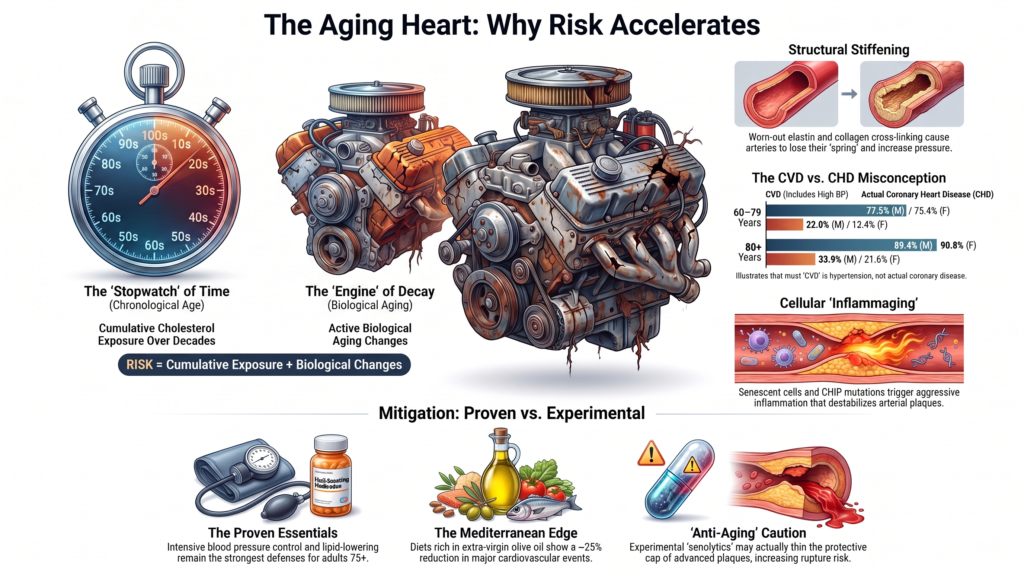
最初のものは単なる算数です。. プラークプラークとは、動脈の壁の内側にコレステロール、免疫細胞、瘢痕組織、カルシウムが蓄積したものです。. 長期間の曝露により動脈内に蓄積する コレステロール運搬粒子 血中にある。80歳には80年分の、30歳には30年分の曝露があった。80歳でより多くの病気が見られるのは、単に時計の針が長く回ったからかもしれない。この見方に立てば、老化は本質的な原因ではない。それはストップウォッチなのだ。.

2番目のものは、さらに別のことが起きていると伝えています。80歳の 動脈動脈は、心臓から全身へ血液を送り出す血管です。. それは、走行距離が余計に延びた30歳の動脈とは違います。より硬く、より炎症を起こしており、細胞の損傷修復能力も劣っています。この見方に立てば、加齢とは単に時間が加わるだけでなく、新たな問題が加わることなのです。.

どちらも事実であることが判明しています。以下に、私たちが実際に知っていること、そして同様に重要なこととして、どこから知識の限界が来るのかを解説します。.

まず、訂正すべき統計データが1つあります

あなたも次のようなものを見たことがあるでしょう: “「80歳以上の人のうち、約90%人が 心血管疾患心血管疾患とは、心臓発作、脳卒中、下肢の動脈閉塞など、心臓や血管に関する問題の総称です。..”

その数値は事実ですが、ミスリーディングです。それが由来する調査において、「心血管疾患」“ ハイを含む 血圧血圧とは、血液が動脈の壁を押す力ののことです。120/80のように2つの数字で表されます。上の数字は心臓が収縮するときの圧力で、下の数字は弛緩するときの圧力です。. —高齢者には非常に一般的である。.

実際のデータに絞り込む 冠動脈疾患冠状動脈疾患は、心筋に栄養を送る動脈にプラークが蓄積する病気です。., 、まったく同じ調査データを用いると、80歳以上の男性では約34%、女性では22%に減少する。.

まだ深刻ではある。しかし、「80歳以上の男性の3人に1人」は「ほぼ全員」とはまったく異なるメッセージだ。“

超高齢者におけるコレステロールの謎

ネット上で多くの議論を引き起こす研究結果があります:80代や90代の人々において、 コレステロールコレステロールは、体が必要とするロウ状の物質です。細胞壁、ホルモン、ビタミンD、そして食べ物を消化する胆汁の材料となります。コレステロールがなければ私たちは生きていけません。. そして心臓病のリスクは低くなります。時には逆転することさえあり、コレステロール値が高い方が 保護的な.

それでコレステロールの話が覆るわけではありません。しかし、その理由は理解する価値があります。.

病気をするとコレステロール値が下がる。. フレイル、がん、慢性感染症, 心不全心不全とは、心臓が体の要求を満たすのに十分なほど血液を送り出せない状態を指します。心不全という名前は誤解を招きやすいですが、心臓が停止したという意味ではありません。., 、および 体重減少Weight loss means reducing body fat, whether through food changes, exercise, medication, or surgery. すべてがコレステロール値を下げる。そのため、90代のグループにおいて、低コレステロール値はしばしば、その人が 病気, 、だからといって彼らが守られているわけではない。彼らはその病気で亡くなり、統計にはコレステロール値が低かったことが記録される。.

最も脆弱な人々はすでにいなくなっている。. 85歳になる頃には、コレステロールの処理が最も苦手だった人々の多くはすでに心筋症(心臓発作)を起こしています。残っているのは、生物学的に通常よりも上手にコレステロールに対処できる体質を持つ、選別された人々です。.

他の要因が死因として競合している。. 90歳ともなると、がんと感染症、そして認知症のすべてが起こりうる状態であり、それは数学的に見て、個々の 危険因子危険因子とは、高コレステロール粒子、高血圧、喫煙、糖尿病、家族歴など、病気にかかる可能性を高めるものです。. 重要であるようです。.

85での測定値は、45の時点での曝露量については何も教えてくれません。. これが一番直感的で、通常は省かれてしまいます。.

動脈を傷つけるのは、何十年にもわたるコレステロールへの曝露の蓄積である。しかし、高齢者を対象とした研究のほとんどはコレステロールを測定している かつて, .

それらは同じものではありません。コレステロールは中年期にかけて上昇し、男性では50代か60代、女性では60代か70代のどこかでピークを迎えます。そして高齢期になると、実際には低下し . 50歳から93歳までの成人を対象としたある長期追跡研究によると、すべての年齢層において、コレステロール値は年間およそ1%低下した。.

それでは、今日どちらも180という数値を示す2人の85歳の高齢者を想像してみてください。1人は40年間260で過ごし、そこから低下してきました。もう1人は40年間150で過ごし、そこから上昇してきました。数値は同じです。しかし、生涯における曝露量はまったく異なります。.

その測定結果が病気の本当の原因の代理指標としてあまりにも不十分である場合、データ上の関係性は平坦化されてしまいます。生物学的な変化は何も起こっていません。ただ測定が劣っているだけなのです。.

コレステロールが心疾患を引き起こすという強力な証拠は、そもそもこうした高齢期の相関関係に基づいていたわけではない。その根拠は 遺伝学Genetics is the study of what you inherit from your parents. 生涯にわたってコレステロール値が低い生まれの人や、すでに血管疾患を持つ75歳以上の高齢者を含めたランダム化試験において、心疾患の発症が少ないことが分かっている。.

加齢に伴う動脈の実際の変化

最も重要な変更は3つあります。.

動脈が硬くなる。. 何十年もの間脈打ち続け、摩耗する エラスチンElastin is a structural protein in the arterial wall that allows blood vessels to stretch and recoil with each heartbeat; with age it degrades and is replaced by stiffer collagen, contributing to arterial stiffening and rising systolic blood pressure., 、 タンパク質タンパク質は、体内の筋肉や組織の構築と修復に使用される栄養素です。. それが血管に弾みを与えている。体はより硬いコラーゲンで修復を行う。. 血糖値Blood sugar, or glucose, is the fuel your cells run on. Your body works hard to keep it in a narrow range. それはまた、時間の経過とともにこうした寿命の長いタンパク質にも結合し、それらをさらに架空結合させます。その結果は血圧計で見ることができます。60歳頃を過ぎると、上側の数値が上昇し、下側の数値は低下することがよくあるのです。.

細胞分裂が停止し、炎症を引き起こし始める。. 損傷した細胞は老化と呼ばれる状態に入ります。分裂をやめるだけで死にはしません。その代わりに炎症性のシグナルを漏れ出させます。手術で摘出したヒト組織において、これらの細胞はプラークの部位に集まり、近くの健康な範囲にはほとんど存在しません。本質的に、小さな永久的な 炎症炎症は、怪我や侵入物とみなしたものに対する免疫システムの反応です。これにより腫れや熱、そして浄化細胞がもたらされます。. 動脈の壁に埋め込まれた発信器.

造血幹細胞は変異を取り込む。. 加齢に伴い、骨髄には変異が蓄積していきます。 時には、そのうちの1つが細胞の増殖を促進し、その子孫が血液中において測定可能な割合を占めるようになることがあります。これはCHIPと呼ばれ、比較的よく見られる現象です――40歳未満では1%未満、70歳以降では約10%です。こうした変異した免疫細胞はより攻撃的に振る舞い、CHIPはおよそ2倍になります。 冠動脈疾患冠状動脈疾患は、アスケロスクレロティック・プラーク(動脈硬化性プラーク)の蓄積によって心筋に血液を供給する動脈が狭窄または閉塞する疾患であり、世界中で心筋梗塞および心臓死の主要な原因となっています。. リスク.

1つ注意点として、これについてはネット上で情報が混乱することがあります。「CHIPが心疾患のリスクを12倍に高める」という記述を目にするかもしれませんが、その数字はCHIP全般ではなく、JAK2という特定の変異にのみ当てはまるものです。一般的な変異では、リスクはおよそ2倍となります。.

「アンチエイジング」サプリメントに関する重要な警告

人を殺す薬 老化細胞Cellular senescence is a state in which damaged cells permanently stop dividing but remain metabolically active, secreting inflammatory signals that can promote local tissue damage; in aging arteries, senescent cells cluster at plaque sites and contribute to chronic low-grade vascular inflammation. セノリティックスはアンチエイジング化合物として販売されています。動脈のデータを見れば、立ち止まって考えさせられるはずです。.

マウスの場合、結果は病気がすでにどの程度進行しているかに大きく依存します。初期の病気では、老化細胞を取り除くことが役立ちました。しかし、 上級 プラークと持続的な高コレステロール、セノリティック薬 ナビトクラックスNavitoclax is an experimental senolytic drug that promotes apoptosis in senescent cells; in animal studies of advanced atherosclerosis it reduced the cells maintaining the fibrous cap, leading to thinner caps and increased mortality — an outcome opposite to its intended benefit. 維持しているまさにその細胞を奪い去った 線維性被膜The fibrous cap is the tough layer of tissue covering a plaque, separating its greasy core from the bloodstream. プラークが破裂するのを防ぐ保護層。被膜が薄くなった。より多くの動物が死亡した。.

それは望ましい結果とは真逆であり、既存の疾患を持つ高齢者に最もよく似た状況でまさにそれが起こった。.

セノリティック(老化細胞除去薬)が心疾患の転帰に対してヒトで試験された臨床試験はまだありません。それが実施されるまでは、これらを投機的に服用することは、確認する手段がないまま、自分が早期疾患群に属していることに賭けることを意味します。.

実際に効くのは何か

証拠の質の高い順に並べると、結局のところ、最も退屈なものから最も刺激的なものへと並べたことになります。.

血圧コントロール. 本当の高齢者におけるあらゆることに対する最も強力な証拠があります。ある試験では、80歳以上の患者の高血圧治療により、脳卒中、心不全、および死亡が減少しました。別の試験では、75歳以上の人々における厳格な血圧管理により、心臓発作と死亡が減少し、それは虚弱な参加者の間でも維持され、多くの人々を驚かせました。.

コレステロールを下げること. すでに血管疾患を発症している人においては、, スタチン 75歳以上のグループで働き、年齢とともに効果が薄れる兆候は見られない。75歳以上の方々においても いいえ 既存の疾患がある場合、スタチンの開始については本当に未解決の問題であり、2件の大規模試験が進行中であるがまだ結果が報告されていない。また、次に関する新しいランダム化エビデンスもある。 停止中 75歳以降のスタチンについては、3年間で死亡率に差がないという結果が出ており、主治医と話し合う価値があります。自分で勝手に服用をやめてよいというお墨付きではありません。.

ダイエット. 最高のエビデンスを持つランダム化比較試験は、以下を比較しました: 地中海式ダイエットThe Mediterranean diet emphasizes vegetables, fruit, beans, whole grains, nuts, and olive oil, with fish and little red meat. ~に富んだ オリーブオイルオリーブオイルは地中海式食生活における主要な脂肪であり、一価不飽和脂肪が豊富で、エキストラバージンオイルの形態では、ポリフェノールと呼ばれる植物化合物も豊富に含まれています。. 既存の心臓病を持つ1,002人を対象に、7年間にわたり低脂肪食を摂取させた。 地中海式食事群では、心血管イベントが約25%件少なかった。知っておくべき点:参加者の平均年齢は59歳で、83%人が男性であったため、この結果を85歳の人にそのまま適用するのは無理がある。.

運動しないこと 喫煙喫煙は血管の内壁を傷つけ、血圧を上げ、血液を凝固しやすくし、プラークの成長を早めます。.. 地味で、手厚いサポートがあり、無料。.

低用量 コルヒチンColchicine is an old, cheap anti-inflammatory drug, used for centuries in gout, now repurposed for heart disease., 古い抗炎症薬であるこの薬剤は、ある臨床試験では安定狭心症に効果を示したものの、別の試験では心筋梗塞後には効果を示さなかった。その理由はまだ誰も解明していない。また、この薬は一般的な複数の薬剤と相互作用を起こすため、自己判断で服用を開始するのではなく、医師に相談すべきものである。.

要点

長年にわたるコレステロールへの曝露がいまだに基礎であり続けています。加齢はその上に、血管の硬化、炎症、変異した免疫細胞といったさらなるメカニズムを積み重ねますが、この研究のいかなる要素も基本に取って代わるものではありません。.

本当に役立つリストは退屈なものだ。血圧をコントロールし、コレステロール値への曝露を抑え、禁煙し、管理する 糖尿病糖尿病は、体が十分なインスリンを作らないか、あるいは作られたインスリンに反応しなくなることで、血糖値が常に高すぎる状態になる疾患です。., 、適度に食べ、動き続けなさい。.

変わったのは、私たちが理解したということです なぜ the boring advice works. That understanding is where better treatments will eventually come from. They aren’t here yet.

This article summarizes published research and is not medical advice. Decisions about statins, colchicine, blood pressure targets, or supplements should be made with your physician.

ディープダイブ

Age-Associated Atherosclerosis: Mechanisms of Vascular Aging, Cellular Senescence, and Multimodal Mitigation

narrative review の日本語訳: ナラティブレビューA narrative review is a type of scientific article that synthesizes existing research on a topic through expert selection and interpretation rather than through a pre-registered, exhaustive search with formal bias scoring; unlike a systematic review or meta-analysis, its conclusions can reflect the authors' editorial judgment in choosing which studies to emphasize.

抄録

アテローム性動脈硬化の 心血管疾患心血管疾患とは、心臓発作、脳卒中、下肢の動脈閉塞など、心臓や血管に関する問題の総称です。. rises sharply with advancing age, but chronological age is not a single causal exposure. This narrative review examines how cumulative アポリポ蛋白アポリポ蛋白とは、血液中の脂肪を運ぶ粒子に結合しているタンパク質です。脂肪と水は混ざらないため、これらのタンパク質は脂肪が血流の中を安全に移動できるようにする包みのような役割を果たします。. B-containing リポタンパク質リポタンパク質とは、脂肪とコレステロールを血流に乗せて運ぶ小さなカプセルのことです。脂肪は水に溶けないため、移動するにはタンパク質の包みが必要です。. exposure interacts with age-associated vascular remodeling, cellular senescenceCellular senescence is a state in which damaged cells permanently stop dividing but remain metabolically active, secreting inflammatory signals that can promote local tissue damage; in aging arteries, senescent cells cluster at plaque sites and contribute to chronic low-grade vascular inflammation., mitochondrial dysfunction, impaired mitochondrial quality control, and clonal hematopoiesis. Evidence is separated explicitly into randomized human, human observational/histologic/genetic, and preclinical tiers. Human data support age-associated extracellular-matrix remodeling, arterial stiffening, senescence-related phenotypes, and clonal hematopoiesis as contributors to vascular risk, whereas several mitochondrial and senotherapeutic mechanisms remain predominantly preclinical. Clinical mitigation remains multimodal: randomized evidence supports 脂質低下脂質低下とは、食事、薬、あるいはその両方によって、血中のアポBを運ぶ有害な粒子を減らすことを意味します。.二次予防二次予防とは、すでに心臓発作、脳卒中、またはステント治療を経験した患者に対して、次の発作を防ぐために治療を行うことです。., blood-pressure control in older adults, and selected dietary and anti-inflammatory strategies in defined populations, while dedicated evidence for スタチンスタチンは、肝臓がコレステロールを作るのに使う酵素の働きを遅らせます。肝臓は血液中からより多くのコレステロールを取り除くことでこれに反応し、そこに真の利益があります。. initiation in 一次予防一次予防とは、これまでに心臓発作や脳卒中を起こしたことのない人に対して治療を行い、最初の発作を防ぐことです。. beyond age 75 remains limited. SenolyticsSenolytics are a class of drugs or compounds designed to selectively kill senescent cells; they are under investigation as potential anti-aging therapies but have not been tested in human trials for cardiovascular outcomes, and animal studies suggest they may worsen plaque stability in advanced disease., mitophagyMitophagy is the cellular process by which damaged or dysfunctional mitochondria are selectively identified and broken down, serving as a quality-control mechanism; impaired mitophagy has been proposed as a contributor to vascular aging, though the evidence in humans remains largely preclinical. enhancers, and other geroprotective strategies have not demonstrated clinical atherosclerotic outcome benefit in humans. 血管の老化The progressive structural and functional deterioration of arteries over time, characterized by loss of elasticity, increased stiffness, and accumulation of microscopic damage that makes arterial walls more susceptible to lipid deposition and chronic inflammation. adds mechanisms to, rather than replaces, cumulative lipoprotein-mediated アテローム発生アテローム性動脈硬化形成は、プラークが形成される段階的なプロセスです。., and evidence strength varies substantially across the proposed pathways.

キーワード 動脈硬化動脈硬化は、ほとんど的心筋梗塞と多くの脳卒中の背景にある病気です。コレステロールの粒子が動脈の壁に入り込み、体がそれを掃除するために免疫細胞を送り込み、何年もかけてその堆積物が硬化してプラークになります。.; vascular aging; cellular senescence; clonal hematopoiesis; mitochondrial dysfunction; older adults; cardiovascular prevention.

Review approach and evidence grading

This is a narrative rather than a システマティックレビューシステマティックレビューは、事前に宣言された方法を用いてある問いに関するすべての研究を検索し、一貫した基準によってそれらを評価する。.. Sources were selected to represent the principal mechanistic and clinical literatures bearing on age-associated atherosclerosis, and quantitative claims were checked against primary publications when available rather than accepted from secondary or review-level citation.

Claims are drawn from three tiers, kept separable throughout: (i) randomized trial evidence in humans; (ii) human observational, histologic, and genetic-epidemiological evidence; and (iii) mechanistic and preclinical evidence in cell and animal models. Tier (iii) findings are labeled preclinical wherever they appear and are not clinically actionable. Human observational associations are not interpreted as establishing causal mediation unless supported by intervention, genetic, or convergent experimental evidence. Evidence-tier labels within tables refer to the sources cited in that row, not to the field generally.

This narrative review involved no original enrollment of human participants or animals and no generation of identifiable participant-level data.

1. Epidemiological kinetics and late-life disease burden

Atherosclerosis is a progressive inflammatory disease of the arterial wall that initiates early in life, and the incidence of clinically manifest atherosclerotic events rises steeply with advancing age [2]. Age-associated changes in the vessel wall — matrix remodeling, senescence, mitochondrial dysfunction and impaired mitochondrial quality control, and clonal hematopoiesis among them — have been implicated in atherogenesis and, in experimental models and human observational studies, in features associated with 歯垢プラークとは、動脈の壁の内側にコレステロール、免疫細胞、瘢痕組織、カルシウムが蓄積したものです。. vulnerability. This does not establish that the longitudinal rate of human plaque accumulation itself increases non-linearly with chronological age; that proposition has not been demonstrated, and clinically meaningful thresholds for coronary plaque progression remain unsettled.

Age is among the strongest contributors to absolute predicted ASCVD risk in contemporary risk models [32]. This is a statement about weight within risk models, not a demonstration that age outranks cumulative lipid exposure as a causal driver; the two are not commensurable, because age partly integrates exposure time. Fatty streaks脂肪条斑はアテローム性動脈硬化の最も初期の目に見える段階であり、動脈の内壁のすぐ下にある、コレステロールを含んだ免疫細胞の平らな黄色いしみである。. and diffuse 内膜肥厚内膜肥厚は、動脈の内層(内膜)の厚さにおける初期の適応的または病的な増加であり、正常な発達的変化、あるいは明白なプラーク形成に先行する平滑筋細胞、脂質、炎症性細胞の蓄積のいずれかを反映しうる。これは、頸動脈内膜中膜複合体厚の超音波検査によって非侵襲的に測定可能である。. develop in adolescence and early adulthood, whereas clinically obstructive, unstable, and calcified 病変循環器学において、病変とは冠動脈を狭窄させるアテローム性動脈硬化プラークの不連続な領域を指し、通常はそれが引き起こす内腔閉塞のパーセンテージによって記述される。この記事では、最も重要な病変が治療された後、血管径が小さすぎてステントを受け入れることができない4つの遺残病変について述べている。. become increasingly prevalent beyond the sixth decade [2].

The contribution of additional age-associated mechanisms may become increasingly relevant across the lifespan [2]. In young and middle-aged adults, atherogenesis requires 累積暴露Cumulative exposure is the total amount of harmful cholesterol particles your arteries have been soaked in across your entire life — how high, multiplied by how long. to apolipoprotein B-containing lipoproteins [6] and is driven importantly by that exposure together with 喫煙喫煙は血管の内壁を傷つけ、血圧を上げ、血液を凝固しやすくし、プラークの成長を早めます。., 血圧血圧とは、血液が動脈の壁を押す力ののことです。120/80のように2つの数字で表されます。上の数字は心臓が収縮するときの圧力で、下の数字は弛緩するときの圧力です。., 糖尿病糖尿病は、体が十分なインスリンを作らないか、あるいは作られたインスリンに反応しなくなることで、血糖値が常に高すぎる状態になる疾患です。., and other causal factors, against a background of relatively intact vascular repair [2]. The relative contribution of these exposures cannot be ranked from the data assembled here. In older adults, the lipid-driven process continues and is superimposed on cell-autonomous vascular senescence, hematopoietic somatic mutation, impaired autophagic quality control, and extracellular-matrix degradation [2]. The distinction is one of added mechanism, not substituted mechanism.

The age bands used in this review — 20-39, 40-59, 60-79, and 80 years and older — are an illustrative organizing framework rather than empirically derived biological thresholds. No inflection point in the mechanisms discussed has been mapped to a specific chronological age in humans; the bands are a device for exposition and correspond broadly to commonly reported surveillance strata.

1.0 What “acceleration” denotes in this review

Because the term is used inconsistently, accelerated atherosclerosis is defined operationally here as atherosclerotic burden, vascular dysfunction, a biological-aging signature, or clinical ASCVD occurring earlier, to a greater degree, or progressing more rapidly than expected for chronological age and measured conventional risk-factor exposure.

These are alternative operational phenotypes of accelerated vascular and atherosclerotic aging rather than manifestations of a single validated construct. They are not interchangeable, are measured by different instruments, and a person may satisfy one and not another. Vascular functional impairment and biological-aging signatures are not measures of atherosclerotic burden; they are grouped here only because the same terminology is applied to them in the literature. Throughout this review, vascular aging denotes age-associated structural and functional change in the 動脈動脈は、心臓から全身へ血液を送り出す血管です。. wall irrespective of plaque; atherosclerotic aging denotes the subset of that change bearing on plaque formation or composition; and accelerated atherosclerosis is reserved for the operational phenotypes defined above.

Table 1. Alternative operational phenotypes grouped under “accelerated atherosclerosis.” These are distinct constructs with distinct measurement bases; the table is not a staging system, and no threshold is clinically validated for individual decision-making.

Phenotype Typical measurement basis What an abnormal result establishes Principal limitation
Excess anatomic burden for age Coronary artery calcium score冠動脈カルシウムスコア、またはCACスコアは、心臓の動脈にどれだけの硬化したプラークがあるかを測定する迅速なCTスキャンから得られます。造影剤も注射針も使わず、約10分で終わります。., carotid plaque area or number, CCTA プラーク体積プラーク体積とは、動脈の一区間におけるプラークの総物理量であり、立方ミリメートル単位で測定されます。. Burden exceeds an age- and sex-referenced distribution; some reference sets are additionally stratified by race or ethnicity Percentile position is not a progression rate; reference distributions are cohort-specific
Accelerated structural progression Serial IMT, serial CAC, serial CCTA plaque volume, primarily in research settings Change over time exceeds that observed in an appropriate reference population or a prespecified research threshold Requires two standardized measurements; change may approach or fall below the resolution of an individual examination
Vascular functional impairment Pulse wave velocityPulse wave velocity measures how fast the pressure wave from each heartbeat travels along your arteries. Stiffer arteries carry it faster., flow-mediated dilation, central pressure augmentation Arterial stiffening or 内皮機能障害血管内皮機能障害とは、その薄い内側の裏打ちが十分に機能しなくなる状態です。血管が適切に拡張せず、バリア機能がより漏れやすくなります。. exceeding an age reference Functional measures correlate imperfectly with プラーク負荷プラーク負荷とは、単に最も状態の悪い一箇所だけでなく、動脈全体に存在するプラークの総量のことです。.
Biological-aging signature Epigenetic and proteomic age estimators, telomere length, senescence markers A biological-aging estimator indicates greater age-associated molecular change than expected for chronological age Research measures; no validated treatment threshold
Premature clinical ASCVD Event occurring at an unusually young age according to the study or guideline definition used Clinical disease earlier than population expectation An event is a discrete endpoint, not a rate

1.1 Prevalence and incidence — with attention to case definition

Prevalence figures for “cardiovascular disease” in older adults are routinely quoted without the definitional caveat that drives them. In American Heart Association surveillance, the composite CVD category includes 高血圧Hypertension is the medical term for high blood pressure.. Using NHANES 2015-2018 data as reported in AHA surveillance, CVD prevalence at ages 60-79 years is 77.5% in males and 75.4% in females, rising to 89.4% and 90.8%, respectively, at age 80 years and older [3]. Narrowing the case definition to 冠動脈疾患冠状動脈疾患は、アスケロスクレロティック・プラーク(動脈硬化性プラーク)の蓄積によって心筋に血液を供給する動脈が狭窄または閉塞する疾患であり、世界中で心筋梗塞および心臓死の主要な原因となっています。. in the same data yields substantially lower figures: 22.0% of males and 13.4% of females at ages 60-79, and 33.9% and 21.6% at age 80 and older [3]. Because this review concerns atherosclerosis rather than blood pressure, the coronary heart disease figures are more directly relevant; widely circulated estimates near 86-90% should be understood as hypertension-inclusive.

The 2015-2018 NHANES cycle is used because it provides the sex- and age-stratified comparison required here. More recent surveillance is available in the 2026 Statistical Update [4]. Age-specific rates of first cardiovascular events likewise rise markedly across later decades of life [4]. Absolute rates are sex-, calendar-period-, ascertainment-, and case-definition-specific, so no single set of point estimates is quoted here.

1.2 The “lipid paradox” in the very old

An epidemiological nuance in octogenarians and nonagenarians is attenuation, and sometimes inversion, of traditional risk-factor associations — the so-called 脂質パラドックスThe lipid paradox refers to the observation in people in their 80s and 90s that the usual positive association between LDL cholesterol and heart disease weakens or even reverses, an apparent anomaly explained by reverse causation from illness lowering cholesterol, survivorship selection, and competing causes of death rather than any change in LDL's underlying biology., described in early form three decades ago [5] and still debated [34]. Three explanations dominate and are not mutually exclusive: 逆因果関係Reverse causation is when the arrow points the other way — the illness caused the exposure rather than the exposure causing the illness. そして 交絡Confounding is when a hidden third factor makes two unrelated things look connected. by illness, because frailty, occult malignancy, chronic infection, 心不全心不全とは、心臓が体の要求を満たすのに十分なほど血液を送り出せない状態を指します。心不全という名前は誤解を招きやすいですが、心臓が停止したという意味ではありません。., and protein-energy wasting can lower コレステロールコレステロールは、体が必要とするロウ状の物質です。細胞壁、ホルモン、ビタミンD、そして食べ物を消化する胆汁の材料となります。コレステロールがなければ私たちは生きていけません。. [5]; survivorship selection, because those most susceptible to LDL-driven atherogenesis may disproportionately have experienced events or died before the ninth decade; and competing risk, because a rising hazard of non-atherosclerotic death changes observed cause-specific and cumulative-incidence relationships.

Attenuation of an observational association in the very old is not evidence against LDLLDL(低密度リポ蛋白)は、コレステロールを血液中に運ぶ主要な粒子であり、動脈壁に詰まる主原因となるものです。. causality. Genetic evidence supports LDL causality across the life course, and randomized statin evidence demonstrates reduction in major vascular events among older adults, particularly those with established vascular disease [6,7]. Absolute ASCVD burden remains highest in older adults [3,4], reflecting age-associated vascular remodeling superimposed on decades of lipoprotein exposure [2].

1.3 Risk models and biological thresholds

Contemporary prediction frameworks incorporate age as a continuous covariate and do not specify a discrete biological age threshold. This is a property of model structure rather than a finding about vascular biology: the absence of a threshold term in a prediction equation is not evidence that no biological inflection exists, and a strong age coefficient is not evidence that one does.

Table 2. Age-stratified disease burden and illustrative mechanisms. Prevalence values are drawn from AHA surveillance [3] and are shown only for the strata that source reports directly; an em dash indicates that no directly reported age- and sex-stratified value was available. Age assignments are illustrative and do not indicate biological onset, exclusivity, or a validated staging system.

Age cohort (years) CVD prevalence, hypertension-inclusive [3] CHD prevalence [3] Mechanisms highlighted in this age band (Sec.) Common ASCVD manifestations
20-39 Endothelial dysfunction, diffuse intimal thickening, early lipid retention (2.1) Silent fatty streaks, early lipid-rich lesions
40-59 The above, plus cumulative アポBアポBは、動脈の壁に詰まってプラークを引き起こす可能性のあるコレステロール粒子のすべての外側に存在するタンパク質です。それらの粒子はそれぞれ、正確に1個のアポBを運んでいます。. exposure, VSMC migration and phenotype switching (1, 2.2) Stable 狭心症狭心症は、心筋に十分な酸素が供給されていないときに起こる胸の不快感です。圧迫感、締めつけ感、絞られるような感じ、または灼熱感と表現され、腕、首、または顎に広がることがあります。., 急性冠症候群急性冠症候群(ACS)は、プラークの突然の破綻やびらんによって引き起こされる、不安定狭心症から完全な心筋梗塞に至るまで、心臓への血流が急激に低下する状態全般を指す包括的な用語です。.
60-79 77.5% M / 75.4% F 22.0% M / 13.4% F The above, plus vascular senescence, stiffening, mitochondrial ROS, 石灰化石灰化とは、カルシウムがプラークに沈着し、その一部が硬く骨状になることです。. (2.1-2.4) Myocardial infarction詳しい項目については心臓発作をご覧ください。., 虚血性脳卒中虚血性脳卒中は、脳の一部への血流が遮断され、脳組織が壊死し始めることで起こります。., claudication
80+ 89.4% M / 90.8% F 33.9% M / 21.6% F The above, plus rising CHIP prevalence, cumulative エラスチンElastin is a structural protein in the arterial wall that allows blood vessels to stretch and recoil with each heartbeat; with age it degrades and is replaced by stiffer collagen, contributing to arterial stiffening and rising systolic blood pressure. and matrix remodeling, and age-associated impairment of vascular repair (2.5-2.6) Complex multivessel CAD; ischemic 脳卒中脳卒中は、脳の一部への血流が詰まりまたは出血によって止まるときに起こります。.; peripheral or multiterritory atherosclerotic disease

2. Intrinsic and extrinsic mechanisms of vascular aging

2.1 Extracellular matrix remodeling, glycation, and hemodynamic shear stress

Aging alters the mechanical properties of central elastic arteries, establishing a biophysical feedback loop proposed to promote atherogenesis [8]. Chronic pulsatile stress triggers elastolysis, elastase up-regulation, and fraying of elastin fibrils, with compensatory collagen deposition and cross-linking [8]. Cumulative glycemic exposure contributes to formation and accumulation of advanced glycation end-products (AGEs)AGEsは、タンパク質や脂肪が糖分や高温の調理にさらされることで生成される化合物であり、高温で調理された肉の中では血管細胞上のRAGEと呼ばれる受容体に結合し、炎症性カスケードを引き起こします。この記事では、AGEsが、飽和脂肪酸やヘム鉄とともに、TMAOとは無関係に心血管の健康を損なう可能性のある赤身肉のいくつかの成分の一つとして挙げられています。. on long-lived structural タンパク質タンパク質は、体内の筋肉や組織の構築と修復に使用される栄養素です。.; these modifications are subject to slow turnover rather than being strictly irreversible [8]. AGE cross-linking of collagen impairs compliance [8], while AGE-RAGE engagement activates endothelial NF-kB signaling and amplifies inflammatory and adhesion-molecule expression [61]. AGE accumulation is one contributor among several to age-related arterial stiffening.

The hemodynamic consequence is stiffening, manifest as rising carotid-femoral pulse wave velocity and central systolic pressure, with diastolic pressure typically falling at the population level after the sixth decade and pulse pressure widening [8].

Regions exposed to low or oscillatory endothelial shear stress (ESS) — the tangential frictional force of flowing blood, expressed in dyn/cm2 — are preferentially atheroprone [9]. Reported physiological and low-ESS ranges vary by vessel, methodology, species, and temporal averaging and should be treated as experimental reference ranges rather than universal thresholds. Values of roughly 15-70 dyn/cm2 have been reported for relatively straight segments under pulsatile unidirectional flow, whereas disturbed-flow regions at bifurcations, curvatures, and outer branch walls may show time-averaged magnitudes below approximately 10-12 dyn/cm2 or oscillatory ESS with a near-zero time average [9]. Low ESS down-regulates eNOS, up-regulates VCAM-1VCAM-1 is a sticky molecule that appears on an inflamed vessel lining and grabs passing white blood cells so they can burrow into the wall. そして ICAM-1ICAM-1 is a molecule that appears on the surface of the blood vessel lining and acts like Velcro, catching passing immune cells., and facilitates lipoprotein retention and monocyte transendothelial migration [9].

An aging-specific qualification is important. Aging dilates and stiffens arteries [8], and low-ESS regions are atheroprone [9], but the composite claim that aging enlarges low-ESS territory has not been clearly demonstrated in aging-specific human hemodynamic studies. Age-related geometric and mechanical change may expand low-ESS zones; testing this directly in age-stratified 冠動脈CTアンギオグラフィー冠動脈CTアンギオグラフィー(CCTA)は、静脈に造影剤を入れて行うCT検査であり、心臓の動脈の詳細な画像を作成します。. cohorts with computational fluid dynamics would be informative.

2.2 Local renin-angiotensin signaling in the aged arterial wall

Two facts are commonly conflated in secondary literature and are separated here. First, arterial-wall angiotensin II (Ang-II) is locally regulated and can differ substantially from circulating levels [10]. Tissue and plasma measurements are not methodologically equivalent, so this should be understood as compartmental separation rather than as a simple concentration ratio. That separation is present across adult life and is not itself an age-related increase.

Second, multiple components of the local renin-angiotensin system — including angiotensinogen, ACE and chymase activity, Ang-II abundance, and AT1-receptor signaling — have been reported to increase in aged arterial tissue across animal models and human tissue studies, whereas plasma renin activity and circulating Ang-II tend to fall with age [10,11]. The intramural age-associated increase should not be conflated with the tissue-to-plasma compartmental difference.

Local Ang-II acts as a mitogen and pressor agent, driving vascular smooth-muscle cell (VSMC) hypertrophy, synthetic phenotype switching, migration, and マトリックスメタロプロテイナーゼMatrix metalloproteinases are enzymes that cut through the collagen scaffolding of tissue. Immune cells inside plaques release them. secretion, particularly MMP-2 [10,11].

In 16-year longitudinal follow-up of the Malmö Diet and Cancer cohort, mean common carotid 中内膜厚Intima-media thickness, or IMT, is a measurement of how thick the inner layers of an artery have become, usually taken in the neck with ultrasound. progressed at 0.011 mm/year in men and 0.010 mm/year in women, with faster progression at the bifurcation (0.036 and 0.030 mm/year, respectively) [12]. Approximately 0.01 mm/year, or 0.1 mm per decade for the common carotid, is therefore a reasonable summary of these longitudinal data. Cross-sectional age-reference studies report larger between-age differences [8,13], but cross-sectional and longitudinal quantities should not be arithmetically converted into one another. Carotid IMT also incorporates non-atherosclerotic medial hypertrophy and adaptive wall thickening and is therefore a structural readout rather than a direct measure of plaque accumulation.

2.3 Cellular senescence and the senescence-associated secretory phenotype

DNA damage, telomere attrition, and chronic 酸化ストレス酸化ストレスとは、有害な活性分子と、それらを中和する身体の能力との間の不均衡です。. up-regulate the cyclin-dependent kinase inhibitors p16INK4a and p21CIP1/WAF1, producing durable replicative arrest in vascular 内皮細胞すべての血管の内面を覆う薄い細胞層であり、血管緊張の調節、血液凝固の防止、および動脈壁への物質の通過の制御を行います。また、その機能障害はアテローム性動脈硬化における初期の極めて重要な段階です。. and VSMCs [1,14]. In human atherectomy and endarterectomy specimens, cells displaying senescence-associated beta-galactosidase positivity together with shortened telomeres concentrate at atherosclerotic sites and are largely absent from adjacent non-diseased tissue [14]. Neither marker is individually specific for senescence, so these findings identify a senescence-associated phenotype rather than definitively identifying 老化細胞Cells that have permanently stopped dividing in response to stress or damage and instead secrete a cocktail of inflammatory cytokines, proteases, and growth factors; in the arterial wall, their accumulation with age drives chronic inflammation and accelerates plaque growth..

Senescent cells develop a pro-inflammatory senescence-associated secretory phenotype (SASP), including secretion of IL-6Interleukin-6, or IL-6, is a signaling molecule the immune system uses to spread an inflammatory message through the body., IL-1beta, TNF-alpha, MCP-1/CCL2, and matrix-degrading enzymes such as MMP-2 and MMP-9 [1,15]. Human observational data show senescence-associated markers co-localizing with advanced lesion regions and intraplaque calcification [14-16]. Animal studies show that genetic or pharmacological senescent-cell targeting can reduce SASP-related signaling, matrix degradation, calcification, or vascular dysfunction [15,45]. Fibrous-cap thinning and impaired re-endothelialization are mechanistically coherent consequences, but causal sequences are not established in humans [15].

Senescence in plaque is not uniformly deleterious. VSMCs are essential for fibrous-cap matrix and stability, whereas VSMC senescence impairs proliferative and matrix-producing repair [15]. Accordingly, effects of senescent-cell clearance are stage- and model-dependent. In Ldlr-/- mice, p16-directed genetic clearance reduced plaque burden and increased cap thickness, while ナビトクラックスNavitoclax is an experimental senolytic drug that promotes apoptosis in senescent cells; in animal studies of advanced atherosclerosis it reduced the cells maintaining the fibrous cap, leading to thinner caps and increased mortality — an outcome opposite to its intended benefit. reduced aortic plaque burden [57]. In Apoe-/- mice, p16-driven clearance did not reduce plaque burden, cap thickness, or 壊死核壊死性コアは、捕捉されたコレステロールを食べてその場で死亡した免疫細胞から形成された、進行したプラークの死滅したドロドロとした中心部である。. area and increased apoptotic cells and 炎症炎症は、怪我や侵入物とみなしたものに対する免疫システムの反応です。これにより腫れや熱、そして浄化細胞がもたらされます。., while navitoclax reduced lesion size without increasing cap thickness [58]. In Apoe-/- mice with advanced lesions and persistent hyperlipidemia, navitoclax reduced smooth-muscle-derived cells within the 線維性被膜The fibrous cap is the tough layer of tissue covering a plaque, separating its greasy core from the bloodstream., decreased cap thickness, and increased mortality [59]. Thus, pharmacological senolysis in advanced experimental atherosclerosis can deplete reparative cap cells and compromise plaque stability, materially qualifying therapeutic inference.

2.4 Mitochondrial dysfunction, mitophagy, and vascular inflammaging

In murine vascular-aging models, aged arterial tissue exhibits declining mtDNA copy number and reduced expression of the copy-number regulators TFAM, PGC-1alpha, and the mtDNA helicase Twinkle [17]. These changes track with reduced mitochondrial respiration, decreased carotid compliance and distensibility, and rising aortic pulse wave velocity [17]. Transgenic Twinkle overexpression increases mtDNA copy number, improves arterial respiration, and delays vascular aging in that model, whereas polymerase-gamma-mutant mice with degraded mtDNA integrity age faster [17]. In ApoE-/- mice, related mitochondrial rescue reduces necrotic-core area and increases relative fibrous-cap thickness [18]. This evidence base is predominantly murine; equivalent longitudinal human vascular Twinkle data do not exist.

Damaged mitochondria are cleared through mitophagy. In the canonical PINK1/Parkin pathway, depolarization stabilizes PINK1 on the outer membrane and recruits Parkin, which ubiquitylates outer-membrane proteins including MFN1, MFN2, and VDAC1 and targets the organelle for autophagic-lysosomal degradation [19]. Parkin-independent pathways also exist.

The relationship between aging and mitophagic flux in the vessel wall is more complicated than a simple decline. In aged murine 大動脈The aorta is the biggest artery in your body. It carries blood out of the heart and down through the chest and belly, sending branches everywhere., Parkin protein and mitophagy markers are increased alongside elevated IL-6 and impaired respiration, consistent with compensatory or stalled mitophagy responding to a rising burden of damaged organelles rather than simple pathway loss [19]. Increased pathway markers do not establish increased successful flux. Global autophagic capacity declines with age in many tissues, and available data are consistent with clearance becoming insufficient relative to damaged-organelle burden in the aged artery [50]. Persistent damaged mitochondria can generate mitochondrial 活性酸素種Reactive oxygen species are unstable oxygen-containing molecules produced as a by-product of normal metabolism. and release mitochondrial damage-associated molecular patterns, including unmethylated CpG mtDNA, into the cytosol [19].

Cytosolic mitochondrial damage-associated molecular patterns engage NLRP3インフラマソームThe NLRP3 inflammasome is an intracellular protein complex in immune cells that, when activated by cholesterol crystals, oxidized lipids, or other danger signals within an atherosclerotic plaque, triggers the release of the inflammatory cytokines interleukin-1β and interleukin-6, accelerating plaque growth and instability. and TLR9/MyD88 signaling. In the murine model in which this pathway was demonstrated, this signaling contributes to a feed-forward IL-6-associated inflammatory loop linking mitochondrial dysfunction to increased atherogenesis [19]. An equivalent longitudinal causal sequence has not been demonstrated in humans.

2.5 Clonal hematopoiesis of indeterminate potential (CHIP)

Clonal hematopoiesis of indeterminate potential (CHIP) denotes age-related acquisition of somatic mutations in leukemia-associated driver genes within hematopoietic stem and progenitor cells, traditionally operationalized by detection of a driver mutation at variant allele fraction (VAF) >=2% in the absence of persistent unexplained cytopenia and without a diagnosable hematologic neoplasm [20]. When persistent otherwise unexplained cytopenia coexists with clonality, current classifications designate clonal cytopenia of undetermined significance (CCUS), which carries a different malignant-progression risk [21]. The cardiovascular literature summarized here concerns CHIP, not CCUS. Prevalence rises from <1% below age 40 to approximately 10% among adults older than 70 in early sequencing cohorts, with higher estimates when deep sequencing detects clones below the 2% threshold [20]. The 2% VAF cutoff is an assay and reporting convention, not a biological boundary.

Dominant drivers include DNMT3A, TET2, and ASXL1, with JAK2 V617F less common but functionally distinctive [20,22]. In Tet2-deficient murine マクロファージマクロファージは、ゴミや侵入者を飲み込む大きなどん欲な免疫細胞です。その名前は文字通り「大食い」を意味します。", loss of function augments IL-1beta and IL-6 signaling in association with NLRP3NLRP3 is an alarm system inside immune cells. When it detects something it treats as a threat, it triggers a burst of inflammatory signaling. inflammasome activation [23].

Effect sizes require precision. CHIP carriers had approximately 1.9- to 2.0-fold the risk of incident coronary heart disease in nested case-control analyses of the BioImage and Malmö Diet and Cancer cohorts and approximately 4-fold higher odds of early-onset myocardial infarction in ATVB and PROMIS [22]. The often-quoted ~12-fold figure applies specifically to JAK2 V617F carriers in the original cohort estimate, whereas DNMT3A, TET2, and ASXL1 were associated with roughly 1.7- to 2.0-fold risk [22]. It is gene-specific, not clone-size-specific, and should not be restated as “VAF above 10% confers a 12-fold increase.” Larger clones (VAF >=10%) are separately associated with greater cardiovascular and all-cause risk in observational cohorts, and CHIP carriers show higher coronary artery カルシウムスコアカルシウムスコア(冠動脈カルシウムスコア)とは、CTスキャンから算出される数値であり、冠動脈内の石灰化したプラークの総量を数値化したものです。スコアがゼロの場合は検出可能な石灰化プラークがないことを示し、より高いスコアはプラークの蓄積が多く、心血管疾患のリスクが高いことを反映しています。. than noncarriers [20,22].

Biological causality is supported in mice: in hyperlipidemic Ldlr-/- animals, reconstitution with Tet2-deficient bone marrow increases lesion size and necrotic-core burden [23]. These experiments establish that the mechanism can operate, not the magnitude or universality of a causal effect in humans.

In an exploratory genomic substudy of カントスCANTOS (Canakinumab Anti-inflammatory Thrombosis Outcomes Study) was a large randomized trial that tested canakinumab, a drug blocking the inflammatory signal IL-1β, against placebo; at its prespecified 150 mg dose it reduced major cardiovascular events by roughly 15% without lowering LDL cholesterol, providing direct human evidence that inflammation drives heart attacks through a pathway indepen…, 338 sequenced participants (8.6%) carried clonal hematopoiesis; TET2 carriers appeared to derive greater MACE reduction from カナキヌマブCanakinumab is a monoclonal antibody that targets interleukin-1β (IL-1β), a key inflammatory signaling protein; it was the active drug in the CANTOS trial, where it reduced cardiovascular events without affecting LDL cholesterol. than noncarriers [24]. This is hypothesis-generating subgroup evidence, not a demonstrated treatment-effect modifier.

Counter-evidence remains important. In a pooled analysis of 63,700 participants from five randomized cardiovascular outcome trials, CHIP carriage was not significantly associated with major cardiovascular events (adjusted HR 1.07, 95% CI 0.99-1.16) [25]. PESA cohortPESA (Progression of Early Subclinical Atherosclerosis) is a Spanish prospective cohort of asymptomatic adults aged 40 to 54 in which multisite vascular imaging detected subclinical atherosclerosis in 63 percent of participants, demonstrating the high burden of silent arterial disease in middle age., baseline clonal hematopoiesis was associated with subsequent de novo femoral atherosclerosis over approximately six years, whereas atherosclerotic burden did not measurably accelerate mutant-clone expansion over the same period [26]. These findings support a predominant direction from clonal hematopoiesis toward atherosclerosis while not excluding reciprocal effects in other settings. CHIP remains biologically compelling and experimentally supported; its independent prognostic value in intensively treated secondary-prevention populations is less certain than community-cohort literature implies.

2.6 Endothelial progenitor cells and proteotoxic stress

Circulating cell populations historically classified as 内皮前駆細胞Bone-marrow-derived precursor cells that circulate in the bloodstream and home to sites of endothelial injury, where they participate in re-endothelialization and microvascular repair; their mobilization is enhanced by statins, aerobic exercise, and whole-food plant-based nutrition. show age-associated reductions in number or function in some assays, but findings depend on assay and surface-marker phenotype [1]. “Endothelial progenitor cell” does not denote a single defined lineage. Many populations given that label are hematopoietic or angiogenic cells rather than bona fide endothelial progenitors, and endothelial colony-forming cells are not equivalent to CD34/KDR flow-cytometric or culture-based assays. The association between reduced progenitor measures and vascular dysfunction in older adults is reasonably consistent; the inference that progenitor failure causes impaired repair is not established.

Experimental and observational evidence also suggests that aging can compromise vascular proteostasisThe cellular maintenance of a stable, functional protein pool through the coordinated balance of protein synthesis, folding, and degradation pathways including autophagy and the ubiquitin-proteasome system; its impairment with age allows damaged proteins to accumulate and is linked to neurodegeneration and other age-related diseases.: declining ubiquitin-proteasome activity and impaired chaperone function may permit accumulation of misfolded and aggregated proteins in endothelial cells and VSMCs, promoting proteotoxic stress, unfolded-protein responses, and ER-stress-mediated apoptosis [1]. Individual steps are better established in nonvascular tissue than in the human arterial wall, so this sequence is presented as a mechanistic model rather than a demonstrated human pathway.

Table 3. Mechanisms of vascular aging, mediators, and atherosclerosis-related phenotype or effect.

Biological mechanism Primary molecular mediators Direct vascular consequence Atherosclerosis-related phenotype or effect Evidence tier (as cited)
Matrix degradation and AGE cross-linking [8,9] Collagen cross-linkingA biochemical process in which collagen fibers within arterial walls form stable chemical bonds between adjacent molecules, reducing tissue elasticity and contributing to irreversible arterial stiffening; it is accelerated by sedentary behavior and advancing age., AGE-RAGE, elastase, MMPs Stiffening, rising PWV and systolic BP, reduced compliance Lipoprotein retention and monocyte entry in low-ESS regions (<10-12 dyn/cm2 is a commonly used research definition; method-dependent) Human observational + mechanistic
Local Ang-II signaling [10,11] Locally regulated intramural Ang-II; ACE, chymase, AT1 VSMC hypertrophy, synthetic switching, MMP-2 activation Age-associated 動脈リモデリングRemodeling is the way an artery changes shape as plaque builds up. Often the artery bulges outward to make room, keeping the opening in the middle wide enough for blood to pass.; carotid IMT increases longitudinally by ~0.01 mm/yr in population data [12] Animal + human tissue
Cellular senescence and SASP [1,14-16] p16INK4a, p21CIP1, SA-beta-gal, MMP-2/9, IL-6, IL-1beta Replicative arrest, ECM degradation, paracrine spread Co-localization with calcified and advanced lesion regions in human tissue; causal effects primarily in animal models, with cap effects model- and stage-dependent Human histology [14] + animal [15,45]
Mitochondrial dysfunction and dysregulated or insufficient mitophagic quality control [17-19,50] Reduced mtDNA copy number, TFAM, PGC-1alpha, Twinkle; PINK1/Parkin dysregulation; mtDAMPs Elevated mROS, NLRP3 and TLR9/MyD88 activation Feed-forward IL-6/mROS signaling in animal models; reduced compliance; necrotic core [18] Animal primary; human inferred
CHIP [20,22-24] TET2, DNMT3A, ASXL1, JAK2 V617F (VAF >=2%) Driver-dependent myeloid skewing, monocyte hyper-reactivity, IL-1beta/IL-6 excess ~2x CHD; ~4x early-onset MI; JAK2 V617F ~12x CHD risk in the original cohort estimate; higher CAC; lesion growth in mice 人間 流行病学Epidemiology is the study of health patterns in large groups of people — who gets sick, where, and what they had in common. + causal animal model + longitudinal human imaging; prognostic magnitude heterogeneous in treated trial populations [25,26]
Progenitor decline and proteotoxicity [1] Heterogeneous progenitor populations, telomere attrition, UPS dysfunction, UPR Association with impaired endothelial repair; intracellular proteotoxicity Barrier disruption and apoptosis (model, not demonstrated pathway) Human observational, methodologically heterogeneous

3. Therapeutic mitigation strategies

3.1 Nutritional therapeutics: the CORDIOPREV evidence

The randomized, single-blind CORDIOPREV trialCORDIOPREV is a randomized controlled trial that compared a Mediterranean diet to a modestly low-fat diet (approximately 28–30% of calories from fat) in patients with established coronary artery disease; it confirmed Mediterranean dietary superiority over that comparator but did not test the ultra-low-fat ( enrolled 1,002 patients with established coronary heart disease and followed them for a median of 7 years, comparing a Mediterranean dietary pattern enriched in extra-virgin オリーブオイルオリーブオイルは地中海式食生活における主要な脂肪であり、一価不飽和脂肪が豊富で、エキストラバージンオイルの形態では、ポリフェノールと呼ばれる植物化合物も豊富に含まれています。. (EVOO; 35% total fat, 22% monounsaturated fatty acids, <50% 炭水化物炭水化物は、パン、米、パスタ、果物、ジャガイモ、お菓子などの、食べ物に含まれる糖分やデンプンです。.) with a low-fat diet (28% fat, 12% monounsaturated fatty acids, >55% -omplex carbohydrate) [27,28]. The cohort had a mean age of 59.5 years (SD 8.7) and was 82.5% male [28], so extension to octogenarians is extrapolation. It. Is important to note that the low fat arm herein is substantially higher than other diets and is only slightly lower than the EVOO component.

Among 939 participants with baseline carotid imaging, the 地中海式ダイエットThe Mediterranean diet emphasizes vegetables, fruit, beans, whole grains, nuts, and olive oil, with fish and little red meat. decreased common carotid IMT at 5 years (-0.027 +/- 0.008 mm; P<0.001) and maintained the reduction at 7 years (-0.031 +/- 0.008 mm; P<0.001) relative to baseline; the low-fat diet produced no change [27]. Maximum carotid plaque height was reduced in the Mediterranean arm relative to the low-fat arm across follow-up, whereas plaque number did not differ [27]. These are group-level structural changes. Common carotid IMT progression is not a validated surrogate for cardiovascular-event reduction; in the PROG-IMT individual-participant メタ分析メタアナリシスは、多数の個別研究の結果を統計的に統合して1つの全体的な推定値を算出します。., IMT progression did not independently predict cardiovascular events [54].

その コディオプレブCORDIOPREV compared a Mediterranean diet against a low-fat diet in people who already had coronary disease, following them for seven years. primary endpoint was a prespecified composite of myocardial infarction, 血行再建術血行再建術とは、閉塞または狭窄した冠動脈の血流を回復させるために行われる医療または外科的処置(冠動脈バイパス術や経皮的冠動脈インターベンションなど)であり、根底にあるアテローム性動脈硬化のプロセスではなく、物理的な閉塞に対処するものである。., ischemic stroke, 末梢動脈疾患Peripheral artery disease is plaque narrowing the arteries in your legs., and cardiovascular death [28], not the same MACE definition used in many pharmacological trials. Events occurred in 198 participants: 87 in the Mediterranean arm and 111 in the low-fat arm (28.1 versus 37.7 per 1,000 person-years; log-rank P=0.039) [28]. Multivariable-adjusted ハザード比ハザード比は、2つのグループでイベントが起こる速さを比較するものです。比率が0.75の場合、治療群でのイベント発生率が4分の一減少し、対照群の4分の3であったことを意味します。. across model specifications ranged from 0.719 (95% CI 0.541-0.957) to 0.753 (95% CI 0.568-0.998), corresponding to approximately 25-28% lower estimated hazard [28]. The upper confidence bound in the least favorable model approaches unity, and the trial was single-center and unblinded to participants.

Long-term consumption of the EVOO-rich Mediterranean diet was also associated with slower decline in estimated 糸球体ろ過Glomerular filtration is the process by which the kidney's glomeruli — tiny capillary networks — filter waste products and small molecules, including TMAO, from the bloodstream into the urine; adequate glomerular filtration clears fish-derived TMAO within roughly 24 hours, whereas chronic kidney disease reduces this clearance and allows TMAO to accumulate. rate, with a larger difference among participants with type 2 diabetes or mild renal impairment [29]. This is a secondary renal-function outcome, not a demonstrated renoprotective clinical effect. MEDLIFE analyses are observational within the randomized cohort and are discussed in Section 3.4.

CORDIOPREV tested a whole dietary pattern and cannot attribute effects to isolated EVOO components. バイオマーカーバイオマーカーとは、健康や病気の状態について教えてくれる、体内で測定可能なもののことであり、例えば、検査値、スキャン画像の結果、血圧の数値などが挙げられます。. substudies demonstrate modulation of circulating AGEs in association with IMT change but do not establish a component-specific mechanism [31]. Assertions that individual ポリフェノールポリフェノールは抗酸化作用を持つ植物由来の化合物の総称であり、エキストラバージンオリーブオイルにはこれが特に豊富に含まれています。ハードな心血管エンドポイントを測定した臨床試験では意味のある臨床的利益は確認されていないものの、精製オリーブオイルよりも保護効果が高い可能性がある理由として、ポリフェノールがしばしば挙げられます。. suppress SASP secretion require separate primary experimental evidence and are not supported by the 治験臨床試験とは、研究者が一方のグループに治療法を施し、もう一方のグループにはプラセボ(偽薬)または標準治療を施して、その結果を比較する研究のことです。. それ自体.

3.2 Pharmacological interventions

The March 2026 ACC/AHA/Multisociety 脂質異常症Dyslipidemia is the medical word for an unhealthy pattern of fats in the blood. It can mean high LDL, high triglycerides, low HDL, or some combination. Guideline replaced the 2018 blood cholesterol guideline. It adopts the 数式を防ぐThe PREVENT (Predicting Risk of Cardiovascular Disease EVENTs) equations are a cardiovascular risk model adopted in the 2026 ACC/AHA guidelines that estimate both 10-year and 30-year lifetime risk of ASCVD, replacing the older Framingham-based Pooled Cohort Equations and enabling earlier risk stratification beginning at age 30. to guide primary-prevention lipid-lowering decisions, restores LDL-C and non-HDL-C treatment goals with lower targets for higher-risk groups, expands the role of coronary artery calcium scoring for risk 再分類心血管リスク評価において、「再分類」とは、CACスキャンやApoB測定などの追加検査により、患者があるリスクカテゴリーから別のリスクカテゴリーへと移行し、標準的なリスク計算ツールだけでは引き起こされなかった治療方針の変更につながるプロセスを指します。., recommends measuring リポ蛋白(a)リポタンパク(a)(Lp(a)と表記され、「L-P-リトル-a」と発音される)は、余分な粘着性のあるタンパク質が付着したLDL様粒子です。. at least once, and states that after age 75 years LDL-C-lowering pharmacotherapy can be considered in conjunction with lifestyle interventions to reduce ASCVD risk [32]. Thus, the post-75 population does not lack contemporary guidance; what remains limited is dedicated randomized evidence specifically addressing statin initiation for primary prevention after age 75.

In the Cholesterol Treatment Trialists’ Collaboration meta-analysis of 28 trials, statin therapy produced a significant proportional reduction in major vascular events per 1.0 mmol/L LDL-C reduction in participants older than 75 with pre-existing vascular disease, with no evidence that proportional benefit is abolished by age [7]. Higher baseline event rates can translate preserved relative effects into larger absolute benefits, although realized benefit depends on competing risk, 固守服薬遵守とは、処方されたとおりに日々、実際に薬を服用することを意味します。., and treatment horizon [7,34].

Dedicated randomized evidence for primary prevention after age 75 remains limited. STAREE (NCT02099123) randomized 9,971 community-dwelling Australians aged >=70 years (mean 74.7; 40% >=75; 52% women; mean baseline LDL-C 126 mg/dL) without clinical cardiovascular disease, diabetes, or dementia to アトルバスタチンAtorvastatin, sold as Lipitor, is one of the two strongest statins and among the most prescribed medicines in the world. 40 mg or プラセボプラセボとは、本物の薬が実際にどのような効果をもたらすかを研究者が知るために投与される、偽の治療法(砂糖の錠剤や生理食塩水の注射など)である。., with co-primary endpoints of disability-free survival and major cardiovascular events [35]. Recruitment ran from July 2015 through March 2023. As of August 13, 2026, no peer-reviewed primary-outcome report had been published.

PREVENTABLE (NCT04262206) is randomizing 20,000 US adults aged >=75 years without clinically evident cardiovascular disease, disability, or dementia to atorvastatin 40 mg or placebo across approximately 100 sites. Its primary outcome is survival free of new dementia or persisting disability; cardiovascular events are secondary outcomes [36]. No peer-reviewed primary results had been published as of August 13, 2026. The endpoint asymmetry matters: PREVENTABLE’s primary endpoint is a geriatric functional composite rather than conventional MACE. The US Preventive Services Task Force continues to judge evidence insufficient to assess benefits and harms of statin initiation for primary prevention in adults aged 76 years and older [37].

A separate 2026 French pragmatic, open-label non-inferiority trial addressed discontinuation rather than initiation. Among 1,160 adults aged >=75 years who had taken a statin for at least one year for primary prevention and had no ASCVD history, three-year 全因死亡率全死因死亡とは、心疾患に限らず、あらゆる原因による死亡を意味し、研究が測定できる最も広範で、ごまかしが最も効かない結果です。. was 7.2% after discontinuation versus 7.9% with continuation, meeting the prespecified non-inferiority criterion [55]. This finding does not establish cardiovascular-event equivalence, does not answer the initiation question, and should be interpreted in light of open-label design and lower-than-anticipated mortality.

Age-related pharmacokinetic changes are heterogeneous. Reduced total body water and 除脂肪体重The portion of body weight attributable to muscle, bone, and organs rather than fat; higher lean mass is associated with better metabolic health and is identified in the article as an upstream genetic driver of both VO₂ max and longevity., lower functional hepatic volume, and declining renal function can alter distribution and clearance [33,38]. Renal clearance contributes more to several hydrophilic statins, whereas atorvastatin and simvastatin rely predominantly on hepatic metabolism and transporter-mediated handling [38]. Older adults report statin-associated muscle symptoms more frequently in observational settings, but this does not establish greater statin-attributable muscle toxicity because multimorbidity, interacting medications, background musculoskeletal symptoms, and ascertainment differ [38]. The SAMS-CI can support structured assessment [39]. サムソンSAMSON was an unusual trial in which patients who had quit statins because of side effects took, in random order, the statin, an identical placebo, and no pill at all. n-of-1 crossover trial, most of the excess symptom burden participants attributed to statins was also observed during placebo exposure [40]. Management options include dose reduction, alternate-day dosingスタチンの連日投与ではなく隔日投与とする処方戦略であり、特に半減期の長いスタチンにおいて、LDL低下効果の大部分を維持しつつ、忍容性のない患者の筋症状を軽減する目的で臨床的に用いられる。., agent switching, and non-statin add-on therapy [38]. In 木星JUPITER tested a statin in people whose cholesterol was normal but whose CRP was elevated, suggesting hidden inflammation., ロスバスタチンRosuvastatin, sold as Crestor, is the most potent statin available and stays largely in the liver rather than spreading through the body. was associated with a 28% relative increase in incident diabetes among participants with at least one major diabetes 危険因子危険因子とは、高コレステロール粒子、高血圧、喫煙、糖尿病、家族歴など、病気にかかる可能性を高めるものです。., with no significant excess among those without such risk factors; vascular events and deaths prevented exceeded incident diabetes cases in that population [41].

CANTOS demonstrated that quarterly canakinumab reduced recurrent cardiovascular events in post-myocardial-infarction patients with hsCRP >=2 mg/L independently of lipid lowering [42]. A secondary analysis associated larger on-treatment hsCRP reductions with greater event reduction, but because it stratified by post-randomization response it does not establish a predictive biomarker strategy [60]. Canakinumab increased fatal infection and is not approved for a cardiovascular indication.

LoDoCo2 showed that コルヒチンColchicine is an old, cheap anti-inflammatory drug, used for centuries in gout, now repurposed for heart disease. 0.5 mg once daily reduced its primary 複合エンドポイント複合のエンドポイントは、いくつかの異なる転帰を一つにまとめ、最初に発生したものをカウントします。. in chronic coronary disease (HR 0.69, 95% CI 0.57-0.83) [43], with a numerical excess of non-cardiovascular death that remains incompletely explained. By contrast, CLEAR SYNERGY (OASIS 9) found no reduction in cardiovascular death, recurrent myocardial infarction, stroke, or ischemia-driven revascularization after acute MI treated with PCI: 9.1% versus 9.3% with placebo (HR 0.99, 95% CI 0.85-1.16; P=0.93) [56]。 不一致詳細についてはアポB不適合(ApoB Discordance)の項目をご覧ください。. does not support a uniform benefit narrative. Differences in disease phase, dose regimen, background therapy, event rates, and trial conduct have been proposed but not established as explanations.

Colchicine safety is particularly relevant in geriatric polypharmacy. Renal or hepatic impairment and concomitant strong CYP3A4 or P-glycoprotein inhibitors materially affect toxicity and dosing. Interacting drugs include clarithromycin, several azole antifungals, verapamil, diltiazem, and cyclosporine; current product labeling and the 2023 chronic coronary disease guideline should be consulted [44]. The guideline assigns low-dose colchicine a Class 2b recommendation in chronic coronary disease [44]. LoDoCo2 did not select patients by hsCRP or another inflammatory biomarker; it should therefore not be described as biomarker-directed.

3.3 Geroprotective strategies: preclinical status

All approaches in this section are preclinical or early-phase with respect to atherosclerotic endpoints. None is clinically indicated for atherosclerosis.

Dasatinib plus quercetin and the BCL-2-family inhibitor navitoclax can preferentially induce apoptosis in certain senescent-cell populations. “Senolytic” is not a mechanism with a predictable class effect: these agents differ substantially in molecular target and in the senescent-cell populations they deplete. In aged and atherosclerotic mice, chronic senolytic treatment can alleviate vasomotor dysfunction and reduce aortic calcification and intrinsic wall stiffness [45]. Effects on plaque stability, however, are stage- and model-dependent. In advanced lesions, navitoclax has reduced smooth-muscle-derived fibrous-cap cells, decreased cap thickness, and increased mortality, conflicting with earlier reports of cap thickening [57-59]. Human experience is confined to small open-label and early-phase studies in idiopathic pulmonary fibrosis [46] and diabetic 腎臓病Kidney disease means the kidneys have lost some of their ability to filter waste from your blood. [47], with physical-function or senescent-cell-burden endpoints. No human trial has tested a senolytic against an atherosclerotic clinical endpoint.

Oral spermidine improved aortic pulse wave velocity and nitric-oxide-mediated endothelial dilation and reduced aortic AGEs, collagen I, nitrotyrosine, and superoxide in aged mice [48]. In aged hyperlipidemic mice, spermidine attenuated mitochondrial dysfunction and atherogenesis [19]. In ApoE-/- mice, spermidine reduced necrotic-core formation and lipid accumulation without changing plaque size or cellular composition, and the effect required intact smooth-muscle オートファジーAutophagy is a cellular housekeeping process by which cells break down and recycle damaged proteins and organelles; in arterial macrophages, it helps clear lipid debris and prevents the accumulation of plaque. The article's 2024 Nature Metabolism finding suggests that high single-meal protein doses may suppress autophagy in these immune cells, potentially worsening atherosclerosis in animal model… [49].

Metformin has been proposed as a geroprotective agent, and the Targeting Aging with Metformin (TAME) concept remains a framework for testing whether intervention on aging biology can delay multimorbidity [51]. TAME remains a design proposal rather than a completed study, and no TAME efficacy data had been published as of August 13, 2026. No clinical evidence demonstrates that metformin improves atherosclerotic outcomes through a distinct geroprotective mechanism. mTOR inhibitors attenuate mitochondrial ROS and modulate SASP in model systems, but vascular-specific evidence is thinner and rapalogs carry immunosuppressive and dyslipidemic effects that are non-trivial in older adults.

3.4 Hemodynamic and lifestyle mitigation

Psychosocial stress is associated with adverse cardiovascular outcomes through interacting behavioral, autonomic, neuroendocrine, inflammatory, and hemodynamic pathways [62]. The contribution of individual vascular-aging mechanisms in humans remains uncertain.

Blood-pressure control has direct randomized support in older adults. In HYVET, 降圧薬An antihypertensive is any drug used to lower high blood pressure. The article distinguishes antihypertensives — which became widely used from the 1970s onward — from statins, noting that blood-pressure drugs contributed to coronary mortality decline well before statin therapy was available. treatment in patients aged 80 years and older reduced stroke, heart failure, and all-cause mortality [52]. スプリントSPRINT tested whether pushing systolic blood pressure below 120 was better than the usual target of under 140. subgroup aged >=75 years, intensive systolic targeting reduced major cardiovascular events and all-cause mortality, with broadly consistent findings across frailty strata [53]. Intensive treatment requires monitoring for hypotension, syncope, electrolyte abnormalities, and acute kidney injury; SPRINT did not demonstrate an excess of injurious falls [53]. Renin-angiotensin-aldosterone system inhibition additionally reduces Ang-II signaling and can favorably affect vascular remodeling and central hemodynamics [8,10], but HYVET and SPRINT do not establish that these vascular-aging mechanisms mediate clinical benefit.

In a five-year prospective analysis of 851 CORDIOPREV participants, high MEDLIFE adherence (>13 points) was associated with lower adjusted odds of developing メタボリックシンドロームMetabolic syndrome is a cluster of five problems that tend to travel together: a large waist, high triglycerides, low HDL, high blood pressure, and high blood sugar. Having three or more counts. (OR 0.37, 95% CI 0.19-0.75) and higher odds of reversing pre-existing metabolic syndrome (OR 2.08, 95% CI 1.11-3.91) versus the low-adherence group (<12 points) [30]. These are observational associations within a randomized cohort: participants were not randomized to the lifestyle index, adherence was self-reported, and residual confoundingThe bias that remains in an observational study even after statistical adjustment, because some shared risk factors — such as poverty, smoking, or diabetes — cannot be fully measured or removed; with a modest relative risk like 1.20, residual confounding alone could plausibly explain the entire observed association. is likely. Regular aerobic activity is associated with better-preserved 血管内皮機能血管の内側を覆う内膜が血管の緊張、炎症、血液凝固を調節する能力。健康な内視細胞は一酸化窒素を放出し、動脈をリラックスさせ、プラーク形成に対する抵抗力を保ちます。. in older adults [1]. Proposed mechanisms — including shear-related eNOS signaling, lower circulating inflammatory cytokines, and improved mitochondrial quality control — are supported chiefly by physiological and animal studies rather than randomized vascular-outcome data.

Table 4. Mitigation strategies by domain, mechanism, outcome, and evidence tier. Evidence-tier labels describe the sources cited in each row.

ドメイン 介入 Targeted mechanism Principal outcome Evidence tier (as cited)
Nutritional [27-29,31] EVOO-rich Mediterranean dietary pattern Whole-pattern anti-inflammatory and endothelial effects; AGE modulation CORDIOPREV adjusted HR 0.719-0.753 (~25-28% lower estimated hazard) for the prespecified cardiovascular composite; IMT-CC -0.031 mm at 7 yr (group-level structural outcome, not a validated event surrogate); slower eGFR decline as a secondary outcome RCT (mean age 59.5 yr; extrapolation to older adults)
Lipid management [7,32,35-38,55] Moderate/高強度スタチン高強度のスタチンとは、LDLコレステロールを50%以上減少させることが期待される投与量であり、実際にはアトルバスタチンやロスバスタチンの高用量がこれに該当する。. and other LDL-lowering therapy as appropriate HMG-CoA還元酵素HMG-CoA reductase is the rate-limiting enzyme in the liver's cholesterol biosynthetic (mevalonate) pathway; statins work by competitively blocking it, reducing the liver's own cholesterol production and prompting it to pull more LDL out of the bloodstream. inhibition, apoB lowering, プラーク安定化プラークの安定化とは、既存のプラークが破裂しにくくすることであり、被膜を厚くし、脂質のコアを縮小させ、内部の炎症を鎮めることである。. Established secondary-prevention benefit in older adults; 2026 guideline permits consideration of LDL-C-lowering pharmacotherapy after 75; dedicated initiation trials pending; discontinuation trial did not establish cardiovascular equivalence or answer initiation RCT/meta-analysis + current guideline
Anti-inflammatory [42-44,56] Colchicine 0.5 mg daily; canakinumab (not approved for CV use) Microtubule-dependent inflammatory signaling; IL-1beta/NLRP3-related pathways LoDoCo2: HR 0.69 in chronic coronary disease; CLEAR SYNERGY: 9.1% vs 9.3% after MI; neither colchicine trial biomarker-selected RCT (discordant) + guideline (Class 2b)
Geroprotective [15,19,45-51,57-59] Senolytics, spermidine, metformin, rapalogs Senescent-cell clearance, autophagy/mitophagy modulation, mTOR inhibition Preclinical effects include reduced necrotic core, calcification, or vasomotor dysfunction; cap effects are stage- and model-dependent and conflicting; no demonstrated human atherosclerotic outcome benefit Preclinical; early-phase human in other indications
Hemodynamic [8,10,52,53] Antihypertensive therapy; ACE inhibition/ARB BP lowering; blockade of intramural Ang-II signaling HYVET and SPRINT >=75 subgroup: reduced clinical events and mortality RCT + mechanistic
Lifestyle [1,30] MEDLIFE adherence, 有酸素運動有酸素運動は、早歩き、サイクリング、水泳、ジョギングのように、しばらくの間呼吸が激しくなるような持続的な運動のことです。. Favorable endothelial shear-related signaling, eNOS up-regulation, reduced 炎症老化A chronic, low-grade, sterile inflammatory state that develops with advancing age as the immune system loses its ability to fully resolve acute inflammatory responses; in the arteries it promotes endothelial dysfunction, lipid retention, and plaque progression. MEDLIFE observational associations: incident metabolic syndrome OR 0.37; 反転REVERSAL compared moderate and intensive statin therapy, using intravascular ultrasound to measure what happened to coronary plaque. OR 2.08 Observational within randomized cohort

4. Limitations

First, this is a narrative review. Sources were selected for representativeness rather than by a prespecified search and screening protocol, and selection bias toward well-cited mechanistic literature cannot be excluded.

Second, the mechanistic architecture of vascular aging rests substantially on rodent and nonhuman-primate work. For several pathways, human evidence remains predominantly cross-sectional tissue, biomarker, or associative data rather than direct longitudinal intervention.

Third, the randomized dietary evidence anchoring Section 3.1 comes from a single-center trial with a predominantly male, middle-aged cohort, and its generalization to geriatric populations is inferential.

Fourth, the CHIP literature remains in flux. Causal animal data are strong, community- and population-based cohort associations are robust, and treated-trial-population data are comparatively null. Endpoint heterogeneity, clone composition, background therapy, 統計的検出力Statistical power is a study's ability to detect a real effect if one exists. It depends mostly on how many events occur., and selection into randomized trials all differ across these datasets; attributing discordance to any single explanation would be premature.

Fifth, carotid IMT is used as a structural readout, but IMT progression has not been shown to predict events independently in individual-participant meta-analysis [54]; structural regression should not be equated with event reduction.

5. Conclusions

The incidence of clinical atherosclerotic events rises steeply with advancing age [4]. Age-related vascular mechanisms may contribute to earlier clinical disease and to greater atherosclerotic burden than would be predicted from measured conventional risk factors alone — two of the operational phenotypes defined in Section 1.0. Whether the longitudinal rate of human plaque accumulation itself accelerates with chronological age remains undemonstrated. The rise in event incidence among older adults is best understood as age-associated vascular processes superimposed on cumulative apoB exposure rather than replacement of lipoprotein-mediated atherogenesis [2,6].

In the aging vessel wall, matrix degradation, AGE cross-linking, altered intramural angiotensin II signaling, mitochondrial dysfunction, impaired mitochondrial quality control, and cellular senescence constitute candidate or experimentally supported pathways capable of promoting atherogenesis or contributing to features associated with plaque vulnerability [16]. Evidence strength is not uniform: human tissue and histologic data support matrix, angiotensin-II, and senescence pathways, whereas mitochondrial and mitophagy evidence is primarily murine and lacks an equivalent longitudinal human vascular counterpart.

Age-related somatic mutation in hematopoietic stem cells, manifesting as CHIP, can promote driver-dependent inflammatory signaling and is causally sufficient to accelerate atherogenesis in experimental models. Human imaging supports a predominant direction from clonal hematopoiesis toward atherosclerosis, without excluding reciprocal contribution, while CHIP’s independent prognostic weight in intensively treated human populations remains contested [22-26].

Mitigation is multimodal. CORDIOPREV supports a Mediterranean dietary pattern in secondary prevention but was not a geriatric trial [27,28]. Statin therapy has established secondary-prevention benefit in older adults, and the 2026 multisociety guideline states that LDL-C-lowering pharmacotherapy can be considered after age 75 alongside lifestyle intervention; STAREE and PREVENTABLE are intended to inform remaining primary-prevention uncertainty [32,35,36]. Low-dose colchicine reduced events in LoDoCo2 in chronic coronary disease but was neutral in CLEAR SYNERGY after myocardial infarction [43,56]. Blood-pressure lowering has direct randomized support in adults aged 75 years and older [52,53]. Senotherapeutic and mitophagy-directed strategies remain investigational, with no demonstrated clinical atherosclerotic outcome benefit in humans [15,19,45-51,57-59].

Current management therefore remains centered on lowering exposure to apoB-containing lipoproteins, blood-pressure control, smoking avoidance and cessation, management of diabetes and related metabolic risk where applicable, dietary quality, and physical activity. Low-dose colchicine may be considered in appropriately selected patients with chronic coronary disease according to contemporary guidelines and patient-specific contraindications.

宣言

資金調達. This work received no specific grant from any funding agency in the public, commercial, or not-for-profit sectors.

Conflicts of interest. The author declares no competing interests.

データの可用性. Not applicable. This article is a narrative review and reports no original participant-level data.

Ethics approval. Not applicable. This narrative review involved no original enrollment of human participants or animals and no generation of identifiable participant-level data.

Use of generative AI. The author used a large language model to assist with drafting, editing, and reference formatting. The author reviewed and verified all content, is responsible for all scientific claims and citations, and takes full responsibility for the integrity and accuracy of the submitted work.

参考文献

  1. Head T, Daunert S, Goldschmidt-Clermont PJ. The aging risk and atherosclerosis: a fresh look at arterial homeostasis. Front Genet. 2017;8:216.
  2. Tyrrell DJ, Goldstein DR. Ageing and atherosclerosis: vascular intrinsic and extrinsic factors and potential role of IL-6. Nat Rev Cardiol. 2021;18(1):58-68.
  3. Virani SS, Alonso A, Aparicio HJ, Benjamin EJ, Bittencourt MS, Callaway CW, et al. Heart disease and stroke statistics-2021 update: a report from the American Heart Association. Circulation. 2021;143(8):e254-e743.
  4. Palaniappan LP, Allen NB, Almarzooq ZI, Anderson CAM, Arora P, Avery CL, et al. 2026 heart disease and stroke statistics: a report of US and global data from the American Heart Association. Circulation. 2026;153(9):e275-e906.
  5. Hazzard WR, Ettinger WH Jr. Aging and atherosclerosis: changing considerations in cardiovascular disease prevention as the barrier to immortality is approached in old age. Am J Geriatr Cardiol. 1995;4(4):16-36.
  6. Ference BA, Ginsberg HN, Graham I, et al. Low-density lipoproteins cause atherosclerotic cardiovascular disease: evidence from genetic, epidemiologic, and clinical studies. A consensus statement from the European Atherosclerosis Society Consensus Panel. Eur Heart J. 2017;38(32):2459-2472.
  7. Cholesterol Treatment Trialists’ Collaboration. Efficacy and safety of statin therapy in older people: a meta-analysis of individual participant data from 28 randomised controlled trials. Lancet. 2019;393(10170):407-415.
  8. Fleg JL, Strait J. Age-associated changes in cardiovascular structure and function: a fertile milieu for future disease. Heart Fail Rev. 2012;17(4-5):545-554.
  9. Chatzizisis YS, Coskun AU, Jonas M, Edelman ER, Feldman CL, Stone PH. Role of endothelial shear stress in the natural history of coronary atherosclerosis and vascular remodeling: molecular, cellular, and vascular behavior. J Am Coll Cardiol. 2007;49(25):2379-2393.
  10. Lakatta EG, Wang M, Najjar SS. Arterial aging and subclinical arterial disease are fundamentally intertwined at macroscopic and molecular levels. Med Clin North Am. 2009;93(3):583-604.
  11. Wang M, Takagi G, Asai K, et al. Aging increases aortic MMP-2 activity and angiotensin II in nonhuman primates. Hypertension. 2003;41(6):1308-1316.
  12. Rosvall M, Persson M, Östling G, et al. Risk factors for the progression of carotid intima-media thickness over a 16-year follow-up period: the Malmö Diet and Cancer Study. Atherosclerosis. 2015;239(2):615-621.
  13. Ebrahim S, Papacosta O, Whincup P, et al. Carotid plaque, intima-media thickness, cardiovascular risk factors, and prevalent cardiovascular disease in men and women: the British Regional Heart Study. Stroke. 1999;30(4):841-850.
  14. Minamino T, Miyauchi H, Yoshida T, Ishida Y, Yoshida H, Komuro I. Endothelial cell senescence in human atherosclerosis: role of telomere in endothelial dysfunction. Circulation. 2002;105(13):1541-1544.
  15. Molnár ÁÁ, Pásztor DT, Tarcza Z, Merkely B. Cells in atherosclerosis: focus on cellular senescence from basic science to clinical practice. Int J Mol Sci. 2023;24(24):17129.
  16. Chakrabarti A, Goldstein DR, Sutton NR. Age-associated arterial calcification: the current pursuit of aggravating and mitigating factors. Curr Opin Lipidol. 2020;31(5):265-272.
  17. Foote K, Reinhold J, Yu EPK, Figg NL, Finigan A, Murphy MP, et al. Restoring mitochondrial DNA copy number preserves mitochondrial function and delays vascular aging in mice. Aging Cell. 2018;17(4):e12773.
  18. Yu EPK, Reinhold J, Yu H, et al. Mitochondrial respiration is reduced in atherosclerosis, promoting necrotic core formation and reducing relative fibrous cap thickness. Arterioscler Thromb Vasc Biol. 2017;37(12):2322-2332.
  19. Tyrrell DJ, Blin MG, Song J, et al. Age-associated mitochondrial dysfunction accelerates atherogenesis. Circ Res. 2020;126(3):298-314.
  20. Jaiswal S, Fontanillas P, Flannick J, et al. Age-related clonal hematopoiesis associated with adverse outcomes. N Engl J Med. 2014;371(26):2488-2498.
  21. Khoury JD, Solary E, Abla O, et al. The 5th edition of the World Health Organization classification of haematolymphoid tumours: myeloid and histiocytic/dendritic neoplasms. Leukemia. 2022;36(7):1703-1719.
  22. Jaiswal S, Natarajan P, Silver AJ, et al. Clonal hematopoiesis and risk of atherosclerotic cardiovascular disease. N Engl J Med. 2017;377(2):111-121.
  23. Fuster JJ, MacLauchlan S, Zuriaga MA, et al. Clonal hematopoiesis associated with TET2 deficiency accelerates atherosclerosis development in mice. Science. 2017;355(6327):842-847.
  24. Svensson EC, Madar A, Campbell CD, et al. TET2-driven clonal hematopoiesis and response to canakinumab: an exploratory analysis of the CANTOS randomized clinical trial. JAMA Cardiol. 2022;7(5):521-528.
  25. Marston NA, Pirruccello JP, Melloni GEM, et al. Clonal hematopoiesis, cardiovascular events and treatment benefit in 63,700 individuals from five TIMI randomized trials. Nat Med. 2024;30(9):2641-2647.
  26. Díez-Díez M, Ramos-Neble BL, de la Barrera J, et al. Unidirectional association of clonal hematopoiesis with atherosclerosis development. Nat Med. 2024;30(10):2857-2866.
  27. Jimenez-Torres J, Alcala-Diaz JF, Torres-Peña JD, et al. Mediterranean diet reduces atherosclerosis progression in coronary heart disease: an analysis of the CORDIOPREV randomized controlled trial. Stroke. 2021;52(11):3440-3449.
  28. Delgado-Lista J, Alcala-Diaz JF, Torres-Peña JD, et al.; CORDIOPREV Investigators. Long-term secondary prevention of cardiovascular disease with a Mediterranean diet and a low-fat diet (CORDIOPREV): a randomised controlled trial. Lancet. 2022;399(10338):1876-1885.
  29. Podadera-Herreros A, Alcala-Diaz JF, Gutierrez-Mariscal FM, et al. Long-term consumption of a Mediterranean diet or a low-fat diet on kidney function in coronary heart disease patients: the CORDIOPREV randomized controlled trial. Clin Nutr. 2022;41(2):552-559.
  30. Romero-Cabrera JL, Garcia-Rios A, Sotos-Prieto M, et al. Adherence to a Mediterranean lifestyle improves metabolic status in coronary heart disease patients: a prospective analysis from the CORDIOPREV study. J Intern Med. 2023;293(5):574-588.
  31. Gutierrez-Mariscal FM, Lopez-Moreno A, Torres-Peña JD, et al. Modulation of circulating levels of advanced glycation end products and its impact on intima-media thickness of both common carotid arteries: CORDIOPREV randomised controlled trial. Cardiovasc Diabetol. 2024;23(1):361.
  32. Blumenthal RS, Morris PB, Gaudino M, Johnson HM, Anderson TS, Bittner VA, et al. 2026 ACC/AHA/AACVPR/ABC/ACPM/ADA/AGS/APhA/ASPC/NLA/PCNA guideline on the management of dyslipidemia: a report of the American College of Cardiology/American Heart Association Joint Committee on Clinical Practice Guidelines. J Am Coll Cardiol. 2026;87(19):2624-2757.
  33. Nguyen TN, Woodward M, Butt JH, McMurray JJV, Lip GYH, Kaski JC. Optimizing cardiovascular pharmacotherapy in older adults with frailty. Nat Rev Cardiol. 2026;23:433-443.
  34. Baratta F, Moscucci F, Lospinuso I, Cocomello N, Bruno G, Cangemi R, et al. Lipid-lowering therapy and cardiovascular prevention in elderly. Drugs. 2025;85(6):801-812.
  35. Zoungas S, Curtis A, Tonkin A, et al. Baseline characteristics of participants in STAREE: a randomized trial for primary prevention of cardiovascular disease events and prolongation of disability-free survival in older people. J Am Heart Assoc. 2024;13(23):e036357.
  36. Joseph J, Pajewski NM, Dolor RJ, et al.; PREVENTABLE Trial Research Group. Pragmatic evaluation of events and benefits of lipid lowering in older adults (PREVENTABLE): trial design and rationale. J Am Geriatr Soc. 2023;71(6):1701-1713.
  37. US Preventive Services Task Force. Statin use for the primary prevention of cardiovascular disease in adults: US Preventive Services Task Force recommendation statement. JAMA. 2022;328(8):746-753.
  38. Stone J, Kumar M, Orkaby AR. The role of statin therapy in older adults: best practices and unmet challenges. Expert Rev Cardiovasc Ther. 2024;22(7):301-311.
  39. Rosenson RS, Miller K, Bayliss M, et al. The Statin-Associated Muscle Symptom Clinical Index (SAMS-CI): revision for clinical use, content validation, and inter-rater reliability. Cardiovasc Drugs Ther. 2017;31(2):179-186.
  40. Wood FA, Howard JP, Finegold JA, et al. N-of-1 trial of a statin, placebo, or no treatment to assess side effects. N Engl J Med. 2020;383(22):2182-2184.
  41. Ridker PM, Pradhan A, MacFadyen JG, Libby P, Glynn RJ. Cardiovascular benefits and diabetes risks of statin therapy in primary prevention: an analysis from the JUPITER trial. Lancet. 2012;380(9841):565-571.
  42. Ridker PM, Everett BM, Thuren T, et al.; CANTOS Trial Group. Antiinflammatory therapy with canakinumab for atherosclerotic disease. N Engl J Med. 2017;377(12):1119-1131.
  43. Nidorf SM, Fiolet ATL, Mosterd A, et al.; LoDoCo2 Trial Investigators. Colchicine in patients with chronic coronary disease. N Engl J Med. 2020;383(19):1838-1847.
  44. Virani SS, Newby LK, Arnold SV, et al. 2023 AHA/ACC/ACCP/ASPC/NLA/PCNA guideline for the management of patients with chronic coronary disease. Circulation. 2023;148(9):e9-e119.
  45. Roos CM, Zhang B, Palmer AK, et al. Chronic senolytic treatment alleviates established vasomotor dysfunction in aged or atherosclerotic mice. Aging Cell. 2016;15(5):973-977.
  46. Justice JN, Nambiar AM, Tchkonia T, et al. Senolytics in idiopathic pulmonary fibrosis: results from a first-in-human, open-label, pilot study. EBioMedicine. 2019;40:554-563.
  47. Hickson LJ, Langhi Prata LGP, Bobart SA, et al. Senolytics decrease senescent cells in humans: preliminary report from a clinical trial of dasatinib plus quercetin in individuals with diabetic kidney disease. EBioMedicine. 2019;47:446-456.
  48. LaRocca TJ, Gioscia-Ryan RA, Hearon CM, Seals DR. The autophagy enhancer spermidine reverses arterial aging. Mech Ageing Dev. 2013;134(7-8):314-320.
  49. Michiels CF, Kurdi A, Timmermans JP, De Meyer GRY, Martinet W. Spermidine reduces lipid accumulation and necrotic core formation in atherosclerotic plaques via induction of autophagy. Atherosclerosis. 2016;251:319-327.
  50. Zeng Y, Buonfiglio F, Li J, Pfeiffer N, Gericke A. Mechanisms underlying vascular inflammaging: current insights and potential treatment approaches. Aging Dis. 2025;16(4):1889-1917.
  51. Barzilai N, Crandall JP, Kritchevsky SB, Espeland MA. Metformin as a tool to target aging. Cell Metab. 2016;23(6):1060-1065.
  52. Beckett NS, Peters R, Fletcher AE, et al.; HYVET Study Group. Treatment of hypertension in patients 80 years of age or older. N Engl J Med. 2008;358(18):1887-1898.
  53. Williamson JD, Supiano MA, Applegate WB, et al.; SPRINT Research Group. Intensive vs standard blood pressure control and cardiovascular disease outcomes in adults aged >=75 years: a randomized clinical trial. JAMA. 2016;315(24):2673-2682.
  54. Lorenz MW, Polak JF, Kavousi M, et al.; PROG-IMT Study Group. Carotid intima-media thickness progression to predict cardiovascular events in the general population (the PROG-IMT collaborative project): a meta-analysis of individual participant data. Lancet. 2012;379(9831):2053-2062.
  55. Bonnet F, Poulizac P, Rousselot N, Couffinhal T, Galli G, Berdaï D, et al.; SAGA/SITE Study Group. Discontinuation of statins for primary prevention of atherosclerotic cardiovascular disease in adults aged 75 years or older (SAGA/SITE): a multicentre, open-label, pragmatic, non-inferiority randomised trial. Lancet Healthy Longev. 2026;7:100884.
  56. Jolly SS, d’Entremont MA, Lee SF, et al.; CLEAR Investigators. Colchicine in acute myocardial infarction. N Engl J Med. 2025;392(7):633-642.
  57. Childs BG, Baker DJ, Wijshake T, Conover CA, Campisi J, van Deursen JM. Senescent intimal foam cells are deleterious at all stages of atherosclerosis. Science. 2016;354(6311):472-477.
  58. Garrido AM, Kaistha A, Uryga AK, et al. Efficacy and limitations of senolysis in atherosclerosis. Cardiovasc Res. 2022;118(7):1713-1727.
  59. Karnewar S, Karnewar V, Shankman LS, Owens GK. Treatment of advanced atherosclerotic mice with ABT-263 reduced indices of plaque stability and increased mortality. JCI Insight. 2024;9:e173863.
  60. Ridker PM, MacFadyen JG, Everett BM, Libby P, Thuren T, Glynn RJ; CANTOS Trial Group. Relationship of C-reactive protein reduction to cardiovascular event reduction following treatment with canakinumab: a secondary analysis from the CANTOS randomised controlled trial. Lancet. 2018;391(10118):319-328.
  61. Basta G, Lazzerini G, Massaro M, et al. Advanced glycation end products activate endothelium through signal-transduction receptor RAGE: a mechanism for amplification of inflammatory responses. Circulation. 2002;105(7):816-822.
  62. Levine GN, Cohen BE, Commodore-Mensah Y, et al. Psychological health, well-being, and the mind-heart-body connection: a scientific statement from the American Heart Association. Circulation. 2021;143(10):e763-e783.


透明性に関する注記: この記事はAIツールの支援を受けて作成されました。最終的なコンテンツは著者によって慎重に確認および編集されており、その正確性については著者が責任を負います。提供される情報は教育目的のみのものであり、医学的なアドバイスを構成するものではありません。.

AIアプリ

心臓病リスク計算ツール

Hスコアのインサイト、視覚的な家系図入力、共有可能なPDFレポートを備えた、教育用の家族歴心臓病リスク計算ツール。.

このアプリが非常に重要である理由をここでご覧ください。.