
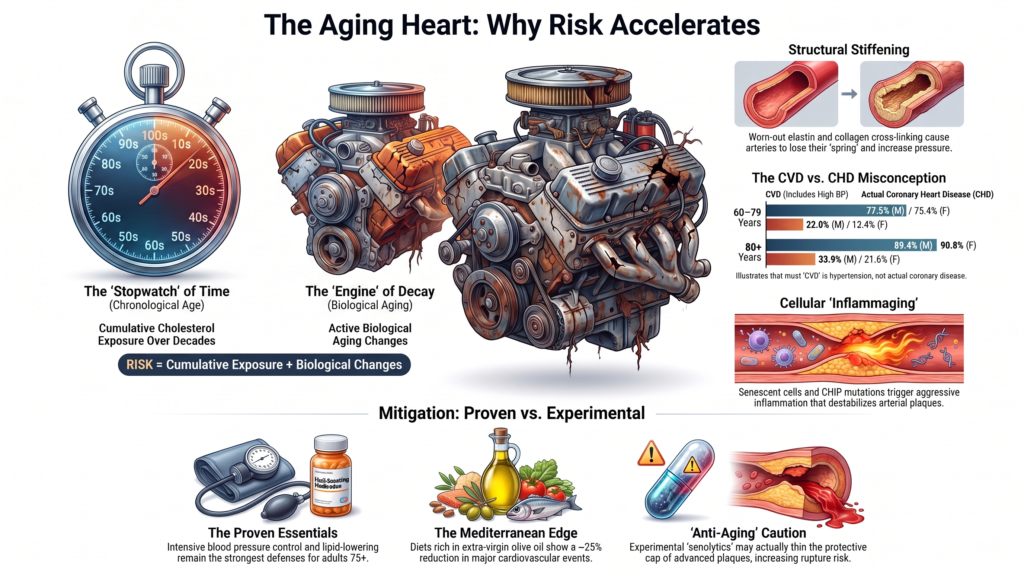
Altersassoziierte Atherosklerose: Mechanismen der vaskulären Alterung, zelluläre Seneszenz und multimodale Minderung
Narrativer Übersichtsartikel
Zusammenfassung
atherosklerotisch Herz-Kreislauf-Erkrankung steigt mit fortschreitendem Alter stark an, aber das chronologische Alter ist keine einzelne kausale Exposition. Diese narrative Übersichtsarbeit untersucht, wie kumulative Apolipoprotein borhaltig Lipoprotein Die Exposition interagiert mit dem altersbedingten Gefäßumbau, Zellseneszenz, mitochondriale Dysfunktion, gestörte mitochondriale Qualitätskontrolle und klonale Hämatopoese. Die Evidenz wird explizit in randomisierte humanbiologische, humane beobachtende/histologische/genetische sowie präklinische Ebenen unterteilt. Humandaten unterstützen altersassoziierte Umbauprozesse der extrazellulären Matrix, arterielle Versteifung, seneszenzbezogene Phänotypen und klonale Hämatopoese als Beitragfaktoren zum vaskulären Risiko, während mehrere mitochondriale und senotherapeutische Mechanismen überwiegend präklinisch bleiben. Die klinische Linderung bleibt multimodal: randomisierte Evidenz unterstützt lipidsenkend in Sekundärprävention, die Blutdruckkontrolle bei älteren Erwachsenen sowie ausgewählte Ernährungs- und entzündungshemmende Strategien in bestimmten Bevölkerungsgruppen, während spezifische Erkenntnisse zu Statin Einführung in Primärprävention ab einem Alter von 75 Jahren bleibt begrenzt. Senolytika, Mitophagie Verstärker und andere geroprotektive Strategien haben beim Menschen keinen klinischen Nutzen hinsichtlich des atherosklerotischen Krankheitsverlaufs gezeigt. Vaskuläre Alterung ergänzt die kumulativen, durch Lipoproteine vermittelten Mechanismen, anstatt sie zu ersetzen Atherogenese, und die Evidenzstärke variiert erheblich zwischen den vorgeschlagenen Pfaden.
Schlüsselwörter Atherosklerose; Gefäßalterung; zelluläre Seneszenz; klonale Hämatopoese; mitochondriale Dysfunktion; ältere Erwachsene; kardiovaskuläre Prävention.
Vorgehensweise bei der Überprüfung und Einstufung der Evidenz
Dies ist eher eine Erzählung als ein systematische Übersichtsarbeit. Die Quellen wurden so ausgewählt, dass sie die wichtigsten mechanistischen und klinischen Fachartikel zum Thema altersbedingte Atherosklerose abdecken, und quantitative Angaben wurden, soweit verfügbar, anhand der Primärpublikationen überprüft, anstatt sie aus Sekundärliteratur oder Übersichtsartikeln ungeprüft zu übernehmen.
Die Aussagen stammen aus drei Ebenen, die durchgehend voneinander getrennt bleiben: (i) Erkenntnisse aus randomisierten Studien am Menschen; (ii) Beobachtungsdaten sowie histologische und genetisch-epidemiologische Erkenntnisse am Menschen; und (iii) mechanistische und präklinische Erkenntnisse aus Zell- und Tiermodellen. Befunde der Stufe (iii) werden überall, wo sie erscheinen, als präklinisch gekennzeichnet und sind klinisch nicht umsetzbar. Beobachtungsbezogene Zusammenhänge beim Menschen werden nicht als Nachweis einer kausalen Vermittlung interpretiert, es sei denn, sie werden durch Interventions-, genetische oder konvergente experimentelle Belege gestützt. Die Kennzeichnungen der Evidenzstufen in den Tabellen beziehen sich auf die in der jeweiligen Zeile zitierten Quellen, nicht auf das Fachgebiet im Allgemeinen.
Im Rahmen dieser narrativen Übersichtsarbeit wurden weder menschliche Probanden noch Tiere neu in die Studie aufgenommen, noch wurden identifizierbare Daten auf Teilnehmerebene erhoben.
1. Epidemiologische Kinetik und Krankheitslast im fortgeschrittenen Lebensalter
Atherosklerose ist eine fortschreitende entzündliche Erkrankung der Arterienwand, die bereits in jungen Jahren beginnt, und die Häufigkeit klinisch manifester atherosklerotischer Ereignisse steigt mit zunehmendem Alter stark an [2]. Altersbedingte Veränderungen der Gefäßwand – darunter Matrixumbau, Seneszenz, mitochondriale Dysfunktion und eine beeinträchtigte mitochondriale Qualitätskontrolle sowie klonale Hämatopoese – wurden mit der Atherogenese in Verbindung gebracht und in experimentellen Modellen sowie in Beobachtungsstudien am Menschen auch mit Merkmalen, die mit Plaque Anfälligkeit. Dies bedeutet jedoch nicht, dass die langfristige Rate der Plaquebildung beim Menschen selbst nichtlinear mit dem chronologischen Alter zunimmt; diese These wurde nicht nachgewiesen, und klinisch relevante Schwellenwerte für das Fortschreiten der koronaren Plaquebildung sind nach wie vor ungeklärt.
Das Alter gehört in aktuellen Risikomodellen zu den stärksten Einflussfaktoren für das absolute prognostizierte ASCVD-Risiko [32]. Dies ist eine Aussage zur Gewichtung innerhalb von Risikomodellen und kein Beweis dafür, dass das Alter als kausaler Faktor eine höhere Bedeutung hat als die kumulative Lipidexposition; die beiden sind nicht vergleichbar, da das Alter die Expositionsdauer teilweise mit einbezieht. Fettstreifen und diffus Intimaverdickung entstehen im Jugendalter und im frühen Erwachsenenalter, während klinisch obstruktive, instabile und verkalkte Läsionen ab dem sechsten Lebensjahrzehnt immer häufiger auftreten [2].
Der Einfluss weiterer altersbedingter Mechanismen könnte im Laufe des Lebens zunehmend an Bedeutung gewinnen [2]. Bei jungen und mittleren Erwachsenen setzt die Atherogenese voraus, dass kumulative Exposition zu Apolipoprotein-B-haltigen Lipoproteinen [6] und wird maßgeblich durch diese Präsenz sowie Rauchen, Blutdruck, Diabetes, sowie weitere ursächliche Faktoren vor dem Hintergrund einer relativ intakten Gefäßregeneration [2]. Der relative Beitrag dieser Risikofaktoren lässt sich anhand der hier zusammengetragenen Daten nicht einstufen. Bei älteren Erwachsenen setzt sich der durch Lipide bedingte Prozess fort und überlagert die zellautonome Gefäßseneszenz, somatische Mutationen im blutbildenden System, eine beeinträchtigte autophagische Qualitätskontrolle sowie den Abbau der extrazellulären Matrix [2]. Der Unterschied besteht darin, dass es sich um einen zusätzlichen Mechanismus handelt, nicht um einen ersetzenden Mechanismus.
Die in dieser Übersicht verwendeten Altersgruppen – 20–39, 40–59, 60–79 und 80 Jahre und älter – dienen eher als anschauliches Ordnungsschema als als empirisch abgeleitete biologische Schwellenwerte. Es wurde kein Wendepunkt in den diskutierten Mechanismen einem bestimmten chronologischen Alter beim Menschen zugeordnet; die Altersgruppen dienen der Darstellung und entsprechen im Großen und Ganzen den üblicherweise angegebenen Erhebungsgruppen.
1.0 Was unter “Beschleunigung” in dieser Rezension zu verstehen ist
Da der Begriff uneinheitlich verwendet wird, wird „beschleunigte Atherosklerose“ hier operativ definiert als atherosklerotische Belastung, vaskuläre Dysfunktion, ein biologisches Alterungsmerkmal oder klinische ASCVD, die früher auftritt, in stärkerem Ausmaß vorliegt oder schneller fortschreitet, als es angesichts des chronologischen Alters und der gemessenen Exposition gegenüber herkömmlichen Risikofaktoren zu erwarten wäre.
Es handelt sich hierbei um alternative funktionelle Phänotypen einer beschleunigten vaskulären und atherosklerotischen Alterung und nicht um Manifestationen eines einzigen validierten Konstrukts. Sie sind nicht austauschbar, werden mit unterschiedlichen Instrumenten gemessen, und eine Person kann das eine Kriterium erfüllen, das andere jedoch nicht. Gefäßfunktionsstörungen und biologische Alterungsmerkmale sind keine Maßstäbe für die atherosklerotische Belastung; sie werden hier nur deshalb zusammengefasst, weil in der Literatur dieselbe Terminologie für sie verwendet wird. In dieser Übersichtsarbeit bezeichnet „gefäßbedingte Alterung“ altersbedingte strukturelle und funktionelle Veränderungen im Arterie Gefäßwand unabhängig von Plaque; unter „atherosklerotischer Alterung“ wird der Teil dieser Veränderung verstanden, der sich auf die Plaquebildung oder -zusammensetzung auswirkt; und der Begriff „beschleunigte Atherosklerose“ ist den oben definierten operativen Phänotypen vorbehalten.
Tabelle 1. Alternative operative Phänotypen, zusammengefasst unter dem Begriff “beschleunigte Atherosklerose”.” Es handelt sich hierbei um unterschiedliche Konstrukte mit unterschiedlichen Messgrundlagen; die Tabelle ist kein Staging-System, und es gibt keinen klinisch validierten Schwellenwert für die individuelle Entscheidungsfindung.
| Phänotyp | Typische Messgrundlage | Was ein abnormales Ergebnis bedeutet | Wesentliche Einschränkung |
| Für das Alter übermäßige anatomische Belastung | Koronararterien-Kalzium-Score, Fläche oder Anzahl der Karotis-Plaques, CCTA Plaquevolumen | Die Belastung weicht von einer alters- und geschlechtsspezifischen Verteilung ab; einige Referenzgruppen sind zusätzlich nach Rasse oder ethnischer Zugehörigkeit unterteilt. | Die Perzentilposition ist kein Fortschrittswert; die Referenzverteilungen sind kohortenspezifisch. |
| Beschleunigtes Fortschreiten der Erkrankung | Serielle IMT, serielle CAC, serielles CCTA-Plaquevolumen, vor allem im Forschungsbereich | Die Veränderung im Zeitverlauf übersteigt den Wert, der in einer geeigneten Referenzpopulation oder an einem vorab festgelegten Forschungsschwellenwert beobachtet wurde. | Erfordert zwei standardisierte Messungen; die Veränderung kann sich der Auflösung einer einzelnen Untersuchung annähern oder unter diese fallen |
| Gefäßfunktionsstörung | Pulswellengeschwindigkeit, durchblutungsbedingte Dilatation, zentraler Druckanstieg | Arterienverhärtung oder Endotheliale Dysfunktion Überschreitung eines Altersgrenzwerts | Funktionsmaße korrelieren nur unvollständig mit Plaquebelastung |
| Signatur des biologischen Alterns | Epigenetische und proteomische Altersschätzgrößen, Telomerlänge, Seneszenzmarker | Ein Schätzwert für die biologische Alterung deutet auf stärkere altersbedingte molekulare Veränderungen hin, als es für das chronologische Alter zu erwarten wäre | Forschungsmaßnahmen; kein validierter Behandlungsschwellenwert |
| Vorzeitige klinische ASCVD | Ereignis, das gemäß der herangezogenen Studie oder Leitliniendefinition in ungewöhnlich jungem Alter auftritt | Klinischer Krankheitsbeginn früher als von der Bevölkerung erwartet | Ein Ereignis ist ein diskreter Endpunkt, keine Rate. |
1.1 Prävalenz und Inzidenz – unter Berücksichtigung der Falldefinition
Prävalenzzahlen für “Herz-Kreislauf-Erkrankungen” bei älteren Erwachsenen werden regelmäßig zitiert, ohne dass dabei der definitorische Vorbehalt erwähnt wird, der ihnen zugrunde liegt. In der Erhebung der American Heart Association umfasst die zusammengesetzte Kategorie der Herz-Kreislauf-Erkrankungen Bluthochdruck. Unter Verwendung der NHANES-Daten für 2015–2018, wie sie in der AHA-Überwachung ausgewiesen sind, liegt die Prävalenz von Herz-Kreislauf-Erkrankungen im Alter von 60 bis 79 Jahren bei Männern bei 77,51 TP9T und bei Frauen bei 75,41 TP9T; im Alter von 80 Jahren und älter steigt sie auf 89,41 TP9T bzw. 90,81 TP9T [3]. Die Eingrenzung der Falldefinition auf koronare Herzkrankheit Die Auswertung derselben Daten ergibt deutlich niedrigere Werte: 22,01 TP9T bei Männern und 13,41 TP9T bei Frauen im Alter von 60 bis 79 Jahren sowie 33,91 TP9T und 21,61 TP9T im Alter von 80 Jahren und älter [3]. Da sich diese Übersicht eher auf Atherosklerose als auf den Blutdruck bezieht, sind die Zahlen zur koronaren Herzkrankheit von direkterer Relevanz; die weit verbreiteten Schätzwerte von etwa 86–90% sind so zu verstehen, dass sie auch Bluthochdruck einschließen.
Der NHANES-Zyklus 2015–2018 wird herangezogen, da er den hier erforderlichen, nach Geschlecht und Alter aufgeschlüsselten Vergleich liefert. Aktuellere Daten liegen im „Statistical Update 2026“ vor [4]. Die altersspezifischen Raten für erste kardiovaskuläre Ereignisse steigen ebenfalls in den späteren Lebensjahrzehnten deutlich an [4]. Da die absoluten Raten geschlechts-, zeitraum-, Erhebungs- und Falldefinitionsspezifisch sind, wird hier kein einzelner Satz von Punktschätzungen angegeben.
1.2 Das “Lipid-Paradoxon” bei hochbetagten Menschen
Eine epidemiologische Besonderheit bei Achtzig- und Neunzigjährigen ist die Abschwächung und manchmal sogar Umkehrung der traditionellen Zusammenhänge zwischen Risikofaktoren – die sogenannte Lipid-Paradoxon, das vor drei Jahrzehnten in einer frühen Form beschrieben wurde [5] und wird nach wie vor diskutiert [34]. Es gibt drei vorherrschende Erklärungsansätze, die sich nicht gegenseitig ausschließen: umgekehrte Kausalität und verwirrend durch Krankheit, etwa aufgrund von Gebrechlichkeit, einer okkulten bösartigen Erkrankung, einer chronischen Infektion, Herzinsuffizienz, und Protein-Energie-Verlust kann zu einer Verringerung führen Cholesterin [5]; Überlebensselektion, da diejenigen, die am anfälligsten für eine LDL-bedingte Atherogenese sind, möglicherweise überproportional häufig bereits vor dem neunten Lebensjahrzehnt einen Herz-Kreislauf-Ereignis erlitten haben oder verstorben sind; sowie konkurrierende Risiken, da ein steigendes Risiko für nicht-atherosklerotische Todesfälle die beobachteten ursachenspezifischen und kumulativen Inzidenzverhältnisse verändert.
Die Abschwächung eines beobachteten Zusammenhangs bei sehr alten Menschen ist kein Gegenbeweis für LDL Kausalität. Genetische Befunde stützen die Kausalität von LDL über den gesamten Lebensverlauf hinweg, und randomisierte Studien zu Statinen belegen eine Verringerung schwerwiegender vaskulärer Ereignisse bei älteren Erwachsenen, insbesondere bei denen mit einer bereits bestehenden Gefäßerkrankung [6,7]. Die absolute ASCVD-Belastung ist bei älteren Erwachsenen nach wie vor am höchsten [3,4], was auf eine altersbedingte Gefäßumgestaltung hindeutet, die durch jahrzehntelange Exposition gegenüber Lipoproteinen verstärkt wird [2].
1.3 Risikomodelle und biologische Schwellenwerte
Moderne Vorhersagemodelle beziehen das Alter als kontinuierliche Kovariate ein und legen keinen diskreten Schwellenwert für das biologische Alter fest. Dies ist eher eine Eigenschaft der Modellstruktur als eine Erkenntnis aus der Gefäßbiologie: Das Fehlen eines Schwellenwertterms in einer Vorhersagegleichung ist kein Beweis dafür, dass kein biologischer Wendepunkt existiert, und ein starker Alterskoeffizient ist kein Beweis dafür, dass ein solcher existiert.
Tabelle 2. Nach Altersgruppen aufgeschlüsselte Krankheitslast und exemplarische Mechanismen. Die Prävalenzwerte stammen aus der AHA-Überwachung [3] und werden nur für die Schichten angezeigt, für die in den Quellen direkt Angaben vorliegen; ein Gedankenstrich bedeutet, dass kein direkt gemeldeter, nach Alter und Geschlecht aufgeschlüsselter Wert verfügbar war. Die Alterszuordnungen dienen lediglich der Veranschaulichung und geben keinen Aufschluss über den biologischen Beginn, die Exklusivität oder ein validiertes Stadiierungssystem.
| Alterskohorte (Jahre) | Prävalenz von Herz-Kreislauf-Erkrankungen, einschließlich Bluthochdruck [3] | Prävalenz von CHD [3] | In dieser Altersgruppe hervorgehobene Mechanismen (Sec.) | Häufige Erscheinungsformen der ASCVD |
| 20-39 | — | — | Endotheliale Dysfunktion, diffuse Intimaverdickung, frühe Lipidablagerung (2.1) | Silente Fettstreifen, frühe lipidreiche Läsionen |
| 40-59 | — | — | Das Vorstehende sowie kumulativ ApoB Exposition, VSMC-Migration und Phänotypwechsel (1, 2.2) | Stall Angina, akute Koronarsyndrome |
| 60-79 | 77,51 TP9T M / 75,41 TP9T F | 22,01 TP9T M / 13,41 TP9T F | Die oben genannten Faktoren sowie vaskuläre Seneszenz, Gefäßverhärtung, mitochondriale ROS, Verkalkung (2.1-2.4) | Herzinfarkt, ischämischer Schlaganfall, Claudicatio |
| 80+ | 89,41 TP9T M / 90,81 TP9T F | 33,91 TP9T M / 21,61 TP9T F | Das oben Genannte sowie die steigende CHIP-Prävalenz, kumulativ Elastin sowie den Matrixumbau und die altersbedingte Beeinträchtigung der Gefäßreparatur (2.5–2.6) | Komplexe multivaskuläre koronare Herzkrankheit; ischämisch Schlaganfall; periphere oder mehrere Körperregionen betreffende atherosklerotische Erkrankung |
2. Innere und äußere Mechanismen der Gefäßalterung
2.1 Umbau der extrazellulären Matrix, Glykierung und hämodynamische Scherspannung
Das Altern verändert die mechanischen Eigenschaften der zentralen elastischen Arterien und führt so zu einem biophysikalischen Rückkopplungskreislauf, von dem angenommen wird, dass er die Atherogenese fördert [8]. Chronische pulsierende Belastung löst eine Elastolyse, eine Hochregulation der Elastase und ein Ausfransen der Elastinfibrillen aus, begleitet von einer kompensatorischen Kollagenablagerung und Vernetzung [8]. Die kumulative glykämische Belastung trägt zur Bildung und Anreicherung von fortgeschrittene Glykationsendprodukte (AGEs) bei langlebigen Bauwerken Proteine; diese Veränderungen vollziehen sich eher langsam und sind nicht streng genommen irreversibel [8]. Die AGE-Vernetzung von Kollagen beeinträchtigt die Nachgiebigkeit [8], während die Bindung von AGE an RAGE die NF-κB-Signalübertragung in Endothelzellen aktiviert und die Expression von Entzündungs- und Adhäsionsmolekülen verstärkt [61]. Die AGE-Anreicherung ist einer von mehreren Faktoren, die zur altersbedingten Arterienverhärtung beitragen.
Die hämodynamische Folge ist eine Versteifung, die sich in einer steigenden Pulswellengeschwindigkeit zwischen Karotis und Femoralis sowie einem Anstieg des zentralen systolischen Blutdrucks äußert, wobei der diastolische Blutdruck auf Populationsebene typischerweise ab dem sechsten Lebensjahr sinkt und sich der Pulsdruckunterschied vergrößert [8].
Regionen, die einer geringen oder schwankenden endothelialen Scherspannung (ESS) ausgesetzt sind – der tangentialen Reibungskraft des fließenden Blutes, ausgedrückt in dyn/cm² – sind besonders anfällig für Atherosklerose [9]. Die angegebenen physiologischen und niedrigen ESS-Bereiche variieren je nach Gefäß, Methodik, Spezies und zeitlicher Mittelung und sollten eher als experimentelle Referenzbereiche denn als universelle Schwellenwerte betrachtet werden. Für relativ gerade Gefäßabschnitte unter pulsierender unidirektionaler Strömung wurden Werte von etwa 15–70 dyn/cm² berichtet, während Bereiche mit gestörter Strömung an Verzweigungen, Krümmungen und an den Außenwänden von Ästen zeitlich gemittelte Werte unter etwa 10–12 dyn/cm² oder oszillierende ESS-Werte mit einem zeitlichen Mittelwert nahe Null aufweisen können [9]. Ein niedriger ESS-Wert führt zu einer Herunterregulierung von eNOS und zu einer Hochregulierung von VCAM-1 und ICAM-1, und fördert die Retention von Lipoproteinen sowie die transendotheliale Migration von Monozyten [9].
Eine altersspezifische Einstufung ist wichtig. Mit zunehmendem Alter erweitern sich die Arterien und werden steifer [8], und Regionen mit niedrigem ESS sind anfällig für Arteriosklerose [9], doch die allgemeine Behauptung, dass sich der Bereich mit niedrigem ESS mit zunehmendem Alter vergrößert, wurde in altersspezifischen hämodynamischen Studien am Menschen nicht eindeutig nachgewiesen. Altersbedingte geometrische und mechanische Veränderungen könnten zu einer Ausdehnung der Zonen mit niedrigem ESS führen; dies direkt in nach Alter stratifizierten Koronare CT-Angiographie Kohortenanalysen unter Einbeziehung der numerischen Strömungsmechanik wären aufschlussreich.
2.2 Lokale Renin-Angiotensin-Signalübertragung in der arteriellen Wand älterer Menschen
Zwei Sachverhalte werden in der Sekundärliteratur häufig miteinander verwechselt und werden hier voneinander getrennt. Erstens wird Angiotensin II (Ang-II) in der Arterienwand lokal reguliert und kann erheblich von den Konzentrationen im Blutkreislauf abweichen [10]. Da Gewebe- und Plasmamessungen methodisch nicht gleichwertig sind, sollte dies eher als Trennung der Kompartimente denn als einfaches Konzentrationsverhältnis verstanden werden. Diese Trennung besteht während des gesamten Erwachsenenalters und stellt an sich keinen altersbedingten Anstieg dar.
Zweitens wurde berichtet, dass mehrere Komponenten des lokalen Renin-Angiotensin-Systems – darunter Angiotensinogen, ACE- und Chymase-Aktivität, Ang-II-Konzentration sowie die AT1-Rezeptor-Signalübertragung – in Tiermodellen und Studien an menschlichem Gewebe im gealterten arteriellen Gewebe erhöht, während die Plasma-Renin-Aktivität und das zirkulierende Ang-II mit zunehmendem Alter tendenziell abnehmen [10,11]. Der altersbedingte Anstieg im intramuralen Kompartiment sollte nicht mit dem Unterschied zwischen Gewebe und Plasma verwechselt werden.
Lokales Ang-II wirkt als Mitogen und blutdrucksteigerndes Mittel und fördert die Hypertrophie der glatten Gefäßmuskelzellen (VSMC), den Wechsel des synthetischen Phänotyps, die Migration und Matrix-Metalloproteinase Sekretion, insbesondere von MMP-2 [10,11].
In einer 16-jährigen Langzeitbeobachtung der Malmö-Diät- und Krebs-Kohorte betrug der Mittelwert der gemeinsamen Halsschlagader Intima-Media-Dicke Die Progression betrug bei Männern 0,011 mm/Jahr und bei Frauen 0,010 mm/Jahr, wobei die Progression an der Bifurkation schneller verlief (0,036 bzw. 0,030 mm/Jahr) [12]. Etwa 0,01 mm/Jahr bzw. 0,1 mm pro Jahrzehnt für die A. carotis communis ist daher eine angemessene Zusammenfassung dieser Längsschnittdaten. Querschnittsstudien mit Altersreferenz geben größere Unterschiede zwischen den Altersgruppen an [8,13], jedoch sollten Querschnitts- und Längsschnittwerte nicht arithmetisch ineinander umgerechnet werden. Die IMT der Halsschlagader umfasst auch nicht-atherosklerotische mediale Hypertrophie und adaptive Wandverdickung und ist daher eher ein struktureller Indikator als ein direktes Maß für die Plaque-Akkumulation.
2.3 Zelluläre Seneszenz und der seneszenzassoziierte sekretorische Phänotyp
DNA-Schäden, Telomerverkürzung und chronische oxidativer Stress die Cyclin-abhängigen Kinase-Inhibitoren p16INK4a und p21CIP1/WAF1 hochregulieren und so einen dauerhaften Replikationsstillstand in den Gefäßen bewirken Endothelzellen und VSMCs [1,14]. In Proben aus Atherektomien und Endarteriektomien beim Menschen konzentrieren sich Zellen, die eine Seneszenz-assoziierte Beta-Galaktosidase-Positivität sowie verkürzte Telomere aufweisen, an atherosklerotischen Stellen und fehlen weitgehend im angrenzenden, nicht erkrankten Gewebe [14]. Da keiner der beiden Marker für sich genommen spezifisch für die Seneszenz ist, weisen diese Ergebnisse eher auf einen seneszenzassoziierten Phänotyp hin, anstatt eindeutig festzustellen, dass seneszente Zellen.
Seneszente Zellen entwickeln einen proinflammatorischen, seneszenzassoziierten sekretorischen Phänotyp (SASP), der unter anderem die Sekretion von IL-6, IL-1beta, TNF-alpha, MCP-1/CCL2 sowie matrixabbauende Enzyme wie MMP-2 und MMP-9 [1,15]. Beobachtungsdaten am Menschen zeigen, dass seneszenzassoziierte Marker in Bereichen mit fortgeschrittenen Läsionen und intraplakulären Verkalkungen vorkommen [14-16]. Tierversuche zeigen, dass eine gezielte Beeinflussung seneszenter Zellen durch genetische oder pharmakologische Maßnahmen SASP-bedingte Signalwege, den Abbau der extrazellulären Matrix, Verkalkung oder Gefäßfunktionsstörungen verringern kann [15,45]. Die Ausdünnung der Faserkappe und die beeinträchtigte Reendothelialisierung sind mechanistisch zusammenhängende Folgen, doch kausale Zusammenhänge sind beim Menschen noch nicht nachgewiesen [15].
Die Seneszenz in der Plaque ist nicht durchweg schädlich. VSMCs sind für die Matrix und die Stabilität der fibrösen Kappe unerlässlich, während die Seneszenz der VSMCs die proliferative und matrixbildende Reparatur beeinträchtigt [15]. Dementsprechend sind die Auswirkungen der Beseitigung seneszenter Zellen stufen- und modellabhängig. Bei Ldlr-/--Mäusen führte die p16-gesteuerte genetische Beseitigung zu einer Verringerung der Plaque-Belastung und einer Zunahme der Kap-Dicke, während Navitoclax verringerte Plaque-Belastung der Aorta [57]. Bei Apoe-/--Mäusen führte der durch p16 vermittelte Abbau weder zu einer Verringerung der Plaque-Belastung noch der Kap-Dicke noch nekrotischer Kern Fläche sowie eine erhöhte Anzahl apoptotischer Zellen und Entzündung, während Navitoclax die Größe der Läsion verringerte, ohne die Kapillardicke zu erhöhen [58]. Bei Apoe-/--Mäusen mit fortgeschrittenen Läsionen und anhaltender Hyperlipidämie reduzierte Navitoclax die Anzahl der aus glatten Muskelzellen stammenden Zellen innerhalb der faserige Kappe, eine geringere Kappe-Dicke und eine erhöhte Sterblichkeit [59]. Somit kann eine pharmakologische Senolyse bei fortgeschrittener experimenteller Atherosklerose zu einem Verlust reparativer Cap-Zellen führen und die Stabilität der Plaques beeinträchtigen, was die therapeutischen Schlussfolgerungen erheblich einschränkt.
2.4 Mitochondriale Dysfunktion, Mitophagie und vaskuläres Inflammaging
In Mausmodellen zur Gefäßalterung weist gealtertes arterielles Gewebe eine abnehmende mtDNA-Kopienzahl sowie eine verminderte Expression der Kopienzahlregulatoren TFAM, PGC-1alpha und der mtDNA-Helikase Twinkle auf [17]. Diese Veränderungen gehen einher mit einer verminderten mitochondrialen Atmung, einer verminderten Compliance und Dehnbarkeit der Halsschlagader sowie einer steigenden Pulswellengeschwindigkeit in der Aorta [17]. Die transgene Twinkle-Überexpression erhöht in diesem Modell die mtDNA-Kopienzahl, verbessert die arterielle Atmung und verzögert die Gefäßalterung, während Mäuse mit einer Polymerase-Gamma-Mutation und beeinträchtigter mtDNA-Integrität schneller altern [17]. Bei ApoE-/--Mäusen führt eine entsprechende mitochondriale Rettung zu einer Verringerung der Fläche des nekrotischen Kerns und zu einer Zunahme der relativen Dicke der fibrösen Kappe [18]. Diese Evidenzbasis stammt überwiegend aus Versuchen an Mäusen; entsprechende Längsschnittdaten zu Twinkle bei menschlichen Gefäßen liegen nicht vor.
Beschädigte Mitochondrien werden durch Mitophagie abgebaut. Im kanonischen PINK1/Parkin-Signalweg stabilisiert die Depolarisation PINK1 an der Außenmembran und rekrutiert Parkin, das Außenmembranproteine wie MFN1, MFN2 und VDAC1 ubiquitiniert und die Organelle für den autophago-lysosomalen Abbau markiert [19]. Es gibt auch Parkin-unabhängige Signalwege.
Der Zusammenhang zwischen Alterung und dem mitophagischen Fluss in der Gefäßwand ist komplexer als ein bloßer Rückgang. Bei gealterten Mäusen Aorta, Parkin-Protein und Mitophagie-Marker sind erhöht, begleitet von erhöhten IL-6-Werten und einer beeinträchtigten Zellatmung, was eher auf eine kompensatorische oder ins Stocken geratene Mitophagie als Reaktion auf eine zunehmende Belastung durch beschädigte Organellen hindeutet als auf einen einfachen Verlust des Stoffwechselwegs [19]. Erhöhte Markerwerte für den Stoffwechselweg lassen nicht auf einen erhöhten erfolgreichen Stofffluss schließen. Die globale autophagische Kapazität nimmt in vielen Geweben mit zunehmendem Alter ab, und die vorliegenden Daten deuten darauf hin, dass die Clearance im Vergleich zur Belastung durch geschädigte Organellen in der gealterten Arterie unzureichend wird [50]. Anhaltend geschädigte Mitochondrien können mitochondriale Reaktive Sauerstoffspezies und setzen mit mitochondrialen Schäden assoziierte molekulare Muster, darunter unmethylierte CpG-mtDNA, ins Zytosol frei [19].
Zytosolische, mit einer Schädigung der Mitochondrien assoziierte molekulare Muster aktivieren NLRP3-Inflammasom sowie die TLR9/MyD88-Signalübertragung. In dem Mausmodell, in dem dieser Signalweg nachgewiesen wurde, trägt diese Signalübertragung zu einer vorwärtsgerichteten, IL-6-assoziierten Entzündungsschleife bei, die eine mitochondriale Dysfunktion mit einer verstärkten Atherogenese verknüpft [19]. Eine entsprechende kausale Abfolge im Zeitverlauf wurde beim Menschen bislang nicht nachgewiesen.
2.5 Klonale Hämatopoese mit unbestimmtem Potenzial (CHIP)
Der Begriff „klonale Hämatopoese mit unbestimmtem Potenzial“ (CHIP) bezeichnet den altersbedingten Erwerb somatischer Mutationen in leukämieassoziierten Treibergenen innerhalb hämatopoetischer Stamm- und Vorläuferzellen und wird traditionell durch den Nachweis einer Treibermutation mit einem Variantenallelfraktion (VAF) von ≥ 2% bei Fehlen einer anhaltenden, ungeklärten Zytopenie und ohne diagnostizierbares hämatologisches Neoplasma [20]. Wenn eine anhaltende, ansonsten unerklärliche Zytopenie mit Klonalität einhergeht, wird dies nach der aktuellen Klassifikation als klonale Zytopenie unbestimmter Signifikanz (CCUS) bezeichnet, die mit einem unterschiedlichen Risiko für eine maligne Progression verbunden ist [21]. Die hier zusammengefasste kardiovaskuläre Fachliteratur bezieht sich auf CHIP, nicht auf CCUS. Die Prävalenz steigt in frühen Sequenzierungskohorten von <1% unter 40 Jahren auf etwa 10% bei Erwachsenen über 70 Jahren an, wobei die Schätzwerte höher ausfallen, wenn bei der Tiefensequenzierung Klone unterhalb des Schwellenwerts von 2% nachgewiesen werden [20]. Der 2%-VAF-Grenzwert ist eine Konvention für die Untersuchung und die Berichterstattung, keine biologische Grenze.
Zu den dominanten Treibern zählen DNMT3A, TET2 und ASXL1, wobei JAK2 V617F zwar seltener auftritt, sich jedoch funktionell deutlich unterscheidet [20,22]. Bei Tet2-defizienten Mäusen Makrophagen, ein Funktionsverlust verstärkt die IL-1beta- und IL-6-Signalübertragung in Verbindung mit NLRP3 Aktivierung des Inflammasoms [23].
Effektstärken erfordern Präzision. In verschachtelten Fall-Kontroll-Analysen der BioImage- und Malmö-Diet-and-Cancer-Kohorten wiesen CHIP-Träger ein etwa 1,9- bis 2,0-fach erhöhtes Risiko für eine neu auftretende koronare Herzerkrankung auf und in den Studien ATVB und PROMIS eine etwa 4-fach höhere Wahrscheinlichkeit für einen früh auftretenden Myokardinfarkt [22]. Der oft zitierte Wert von etwa dem 12-Fachen bezieht sich in der ursprünglichen Kohortenschätzung speziell auf JAK2-V617F-Träger, während DNMT3A, TET2 und ASXL1 mit einem etwa 1,7- bis 2,0-fachen Risiko assoziiert waren [22]. Dies gilt gen-spezifisch, nicht klongrößen-spezifisch, und sollte nicht umformuliert werden als “Ein VAF über 10% führt zu einer 12-fachen Erhöhung.” Größere Klone (VAF ≥ 10%) sind in Beobachtungskohorten separat mit einem höheren kardiovaskulären Risiko und einem höheren Gesamtsterberisiko assoziiert, und CHIP-Träger weisen eine höhere koronare Arterien Kalzium-Scores als Nichtträger [20,22].
Bei Mäusen lässt sich ein biologischer Kausalzusammenhang nachweisen: Bei hyperlipidämischen Ldlr-/--Tieren führt die Rekonstitution mit Tet2-defizientem Knochenmark zu einer Vergrößerung der Läsionen und einer Zunahme der nekrotischen Kerne [23]. Diese Experimente belegen, dass der Mechanismus funktionieren kann, nicht jedoch das Ausmaß oder die Allgemeingültigkeit eines kausalen Effekts beim Menschen.
In einer explorativen genomischen Teilstudie zu Gesänge, 338 sequenzierte Teilnehmer (8,61 TP9T) wiesen eine klonale Hämatopoese auf; TET2-Träger schienen eine stärkere Verringerung der MACE durch Canakinumab als Nichtträger [24]. Hierbei handelt es sich um hypothesenbildende Erkenntnisse aus Untergruppen, nicht um einen nachgewiesenen Modifikator des Behandlungseffekts.
Gegenbeweise sind nach wie vor wichtig. In einer gepoolten Analyse von 63.700 Teilnehmern aus fünf randomisierten Studien zu kardiovaskulären Endpunkten zeigte sich kein signifikanter Zusammenhang zwischen dem CHIP-Trägerstatus und schweren kardiovaskulären Ereignissen (bereinigtes HR 1,07, 95%-KI 0,99–1,16) [25]. Im PESA-Kohorte, Die klonale Hämatopoese zu Studienbeginn stand über einen Zeitraum von etwa sechs Jahren in Zusammenhang mit einer später auftretenden de-novo-Atherosklerose der Oberschenkelarterien, während die atherosklerotische Belastung die Ausbreitung des mutierten Klons im gleichen Zeitraum nicht messbar beschleunigte [26]. Diese Ergebnisse stützen die Annahme, dass von der klonalen Hämatopoese eine vorwiegend in Richtung Atherosklerose gerichtete Wirkung ausgeht, schließen jedoch wechselseitige Effekte in anderen Kontexten nicht aus. CHIP ist nach wie vor biologisch überzeugend und experimentell belegt; sein unabhängiger prognostischer Wert bei intensiv behandelten Populationen in der Sekundärprävention ist jedoch weniger sicher, als die Literatur zu Bevölkerungskohorten vermuten lässt.
2.6 Endotheliale Vorläuferzellen und proteotoxischer Stress
Zellpopulationen im Blutkreislauf, die in der Vergangenheit klassifiziert wurden als Endotheliale Vorläuferzellen weisen in einigen Tests altersbedingte Einbußen hinsichtlich Anzahl oder Funktion auf, doch hängen die Ergebnisse vom jeweiligen Test und vom Phänotyp der Oberflächenmarker ab [1]. Der Begriff “endotheliale Vorläuferzelle” bezeichnet keine einzige, genau definierte Zelllinie. Viele unter dieser Bezeichnung zusammengefasste Zellpopulationen sind eher hämatopoetische oder angiogene Zellen als echte endotheliale Vorläuferzellen, und endotheliale koloniebildende Zellen sind nicht gleichbedeutend mit CD34/KDR-Assays mittels Durchflusszytometrie oder Kulturverfahren. Der Zusammenhang zwischen verminderten Vorläuferzellwerten und vaskulären Funktionsstörungen bei älteren Erwachsenen ist weitgehend konsistent; die Schlussfolgerung, dass ein Versagen der Vorläuferzellen eine beeinträchtigte Reparatur verursacht, ist jedoch nicht belegt.
Experimentelle und beobachtende Befunde deuten zudem darauf hin, dass das Altern die Gefäße beeinträchtigen kann Proteostase: Eine nachlassende Ubiquitin-Proteasom-Aktivität und eine beeinträchtigte Chaperon-Funktion könnten die Anreicherung fehlgefalteter und aggregierter Proteine in Endothelzellen und glatten Muskelzellen (VSMCs) begünstigen und so proteotoxischen Stress, Unfolded-Protein-Reaktionen sowie durch ER-Stress vermittelte Apoptose fördern [1]. Die einzelnen Schritte sind im nichtvaskulären Gewebe besser erforscht als in der menschlichen Arterienwand, weshalb diese Abfolge eher als mechanistisches Modell denn als nachgewiesener menschlicher Signalweg dargestellt wird.
Tabelle 3. Mechanismen der Gefäßalterung, Mediatoren und atherosklerosebezogene Phänotypen oder Auswirkungen.
| Biologischer Mechanismus | Primäre molekulare Mediatoren | Unmittelbare vaskuläre Folge | Atherosklerose-bezogener Phänotyp oder Effekt | Evidenzgrad (wie zitiert) |
| Matrixabbau und AGE-Vernetzung [8,9] | Kollagenvernetzung, AGE-RAGE, Elastase, MMPs | Versteifung, Anstieg der PWV und des systolischen Blutdrucks, verminderte Compliance | Lipoproteinretention und Monozyteneintritt in Regionen mit niedrigem ESS-Wert (<10–12 dyn/cm² ist eine in der Forschung häufig verwendete Definition; methodenabhängig) | Beobachtungsstudien am Menschen + mechanistische Ansätze |
| Lokale Ang-II-Signalübertragung [10,11] | Lokal reguliertes intrazelluläres Ang-II; ACE, Chymase, AT1 | VSMC-Hypertrophie, synthetische Umschaltung, MMP-2-Aktivierung | Altersbedingt arterielles Remodeling; Die IMT der Halsschlagader nimmt laut Bevölkerungsdaten im Zeitverlauf um ca. 0,01 mm/Jahr zu [12] | Tier- und menschliches Gewebe |
| Zelluläre Seneszenz und SASP [1,14-16] | p16INK4a, p21CIP1, SA-beta-gal, MMP-2/9, IL-6, IL-1beta | Replikationsstillstand, Abbau der extrazellulären Matrix, parakrine Ausbreitung | Kolokalisierung mit verkalkten und fortgeschrittenen Läsionsbereichen in menschlichem Gewebe; kausale Effekte vorwiegend in Tiermodellen, wobei die Obergrenzen modell- und stadiumsabhängig sind | Humanhistologie [14] + Tier [15,45] |
| Mitochondriale Dysfunktion und eine gestörte oder unzureichende mitophagische Qualitätskontrolle [17-19,50] | Verringerte mtDNA-Kopienzahl, TFAM, PGC-1alpha, Twinkle; Dysregulation von PINK1/Parkin; mtDAMPs | Erhöhte mROS-Werte, NLRP3- und TLR9/MyD88-Aktivierung | Vorwärtsgerichtete IL-6/mROS-Signalübertragung in Tiermodellen; verminderte Compliance; nekrotischer Kern [18] | Tier als Ausgangsbasis; auf den Menschen übertragen |
| CHIP [20,22-24] | TET2, DNMT3A, ASXL1, JAK2 V617F (VAF >=2%) | Treiberabhängige Verschiebung hin zu myeloiden Zellen, Hyperreaktivität der Monozyten, Überschuss an IL-1beta/IL-6 | ~2-faches Risiko für eine koronare Herzkrankheit (KHK); ~4-faches Risiko für einen früh auftretenden Herzinfarkt; JAK2 V617F: ~12-faches KHK-Risiko gemäß Schätzung der ursprünglichen Kohorte; höherer CAC-Wert; Läsionswachstum bei Mäusen | Mensch Epidemiologie + kausales Tiermodell + Längsschnittuntersuchungen am Menschen mittels Bildgebung; heterogene prognostische Aussagekraft in den behandelten Studienpopulationen [25,26] |
| Rückgang der Vorläuferzellen und Proteotoxizität [1] | Heterogene Vorläuferzellpopulationen, Telomerverkürzung, UPS-Dysfunktion, UPR | Zusammenhang mit einer beeinträchtigten Endothelregeneration; intrazelluläre Proteotoxizität | Barrierezerstörung und Apoptose (Modell, nicht nachgewiesener Signalweg) | Beobachtungsstudien am Menschen, methodisch heterogen |
3. Therapeutische Strategien zur Schadensminderung
3.1 Ernährungstherapie: Die CORDIOPREV-Ergebnisse
Die randomisierte, einfachblinde CORDIOPREV-Studie Es wurden 1.002 Patienten mit nachgewiesener koronarer Herzkrankheit in die Studie aufgenommen und über einen Median von 7 Jahren beobachtet, wobei eine mediterrane Ernährungsweise, die reich an nativem Olivenöl extra war, Olivenöl (EVOO; 35% Gesamtfett, 22% einfach ungesättigte Fettsäuren, <50% Kohlenhydrat) mit einer fettarmen Ernährung (28% Fett, 12% einfach ungesättigte Fettsäuren, >55% komplexe Kohlenhydrate) [27,28]. Die Kohorte hatte ein Durchschnittsalter von 59,5 Jahren (SD 8,7) und bestand zu 82,5% aus Männern [28], sodass die Hochrechnung auf Achtzigjährige eine Extrapolation darstellt. Es ist wichtig zu beachten, dass der Anteil an fettarmen Lebensmitteln hier deutlich höher ist als bei anderen Ernährungsweisen und nur geringfügig unter dem Anteil an nativem Olivenöl extra liegt.
Unter den 939 Teilnehmern, bei denen zu Beginn der Studie eine Bildgebung der Halsschlagadern durchgeführt wurde, war die Mittelmeer-Diät Die IMT der A. carotis communis war nach 5 Jahren verringert (-0,027 ± 0,008 mm; P < 0,001) und blieb auch nach 7 Jahren auf diesem niedrigeren Niveau (-0,031 ± 0,008 mm; P < 0,001) im Vergleich zum Ausgangswert; die fettarme Ernährung führte zu keiner Veränderung [27]. Die maximale Höhe der Karotis-Plaques war im Mittelmeer-Arm im Vergleich zum fettarmen Arm über den gesamten Nachbeobachtungszeitraum hinweg geringer, während sich die Anzahl der Plaques nicht unterschied [27]. Hierbei handelt es sich um strukturelle Veränderungen auf Gruppenebene. Das Fortschreiten der IMT der A. carotis communis ist kein validierter Surrogatmarker für die Verringerung kardiovaskulärer Ereignisse; in der PROG-IMT-Studie auf Einzelteilnehmer-Ebene Meta-Analyse, Die IMT-Progression war kein unabhängiger Prädiktor für kardiovaskuläre Ereignisse [54].
Der CORDIOPREV Der primäre Endpunkt war ein vorab festgelegter zusammengesetzter Endpunkt, bestehend aus Myokardinfarkt, Revaskularisation, ischämischer Schlaganfall, periphere arterielle Verschlusskrankheit, sowie kardiovaskuläre Todesfälle [28], nicht dieselbe MACE-Definition, die in vielen pharmakologischen Studien verwendet wird. Bei 198 Teilnehmern traten Ereignisse auf: 87 in der Mittelmeer-Gruppe und 111 in der fettarmen Gruppe (28,1 gegenüber 37,7 pro 1.000 Personenjahre; Log-Rank-Test P = 0,039) [28]. Multivariabel adjustiert Hazard Ratios über alle Modellspezifikationen hinweg reichte von 0,719 (95%-KI 0,541–0,957) bis 0,753 (95%-KI 0,568–0,998), was einem um etwa 25–28% niedrigeren geschätzten Hazard entspricht [28]. Die obere Konfidenzgrenze im ungünstigsten Modell nähert sich dem Wert 1, und die Studie wurde an einem einzigen Zentrum durchgeführt und war für die Teilnehmer nicht verblindet.
Die langfristige Einhaltung der an nativem Olivenöl extra (EVOO) reichen mediterranen Ernährung ging zudem mit einem langsameren Rückgang der geschätzten glomeruläre Filtration Rate, wobei der Unterschied bei Teilnehmern mit Typ-2-Diabetes oder leichter Nierenfunktionsstörung größer war [29]. Hierbei handelt es sich um einen sekundären Endpunkt zur Nierenfunktion, nicht um eine nachgewiesene renoprotektive klinische Wirkung. Die MEDLIFE-Analysen sind Beobachtungsstudien innerhalb der randomisierten Kohorte und werden in Abschnitt 3.4 erörtert.
Im Rahmen der CORDIOPREV-Studie wurde ein gesamtes Ernährungsmuster untersucht, sodass keine Wirkungen auf einzelne Bestandteile von nativem Olivenöl extra zurückgeführt werden können. Biomarker Teilstudien belegen eine Modulation der zirkulierenden AGEs in Verbindung mit einer Veränderung der IMT, können jedoch keinen komponentespezifischen Mechanismus nachweisen [31]. Behauptungen, dass einzelne Polyphenole Die Unterdrückung der SASP-Sekretion erfordert gesonderte primäre experimentelle Belege und wird durch die klinische Studie selbst.
3.2 Pharmakologische Maßnahmen
Die ACC/AHA/Multisociety-Leitlinien vom März 2026 Dyslipidämie Die Leitlinie ersetzt die Leitlinie zum Cholesterinspiegel im Blut aus dem Jahr 2018. Sie übernimmt die PREVENT-Gleichungen als Leitfaden für Entscheidungen zur primären Lipidsenkung, legt neue Behandlungsziele für LDL-C und Non-HDL-C mit niedrigeren Zielwerten für Gruppen mit höherem Risiko fest und erweitert die Rolle des Koronarkalk-Scorings bei der Risikobewertung Umklassifizierung, empfiehlt, zu messen Lipoprotein(a) mindestens einmal, und besagt, dass ab einem Alter von 75 Jahren eine medikamentöse Therapie zur Senkung des LDL-C-Spiegels in Verbindung mit Maßnahmen zur Änderung des Lebensstils in Betracht gezogen werden kann, um das ASCVD-Risiko zu senken [32]. Somit mangelt es der Bevölkerungsgruppe ab 75 Jahren nicht an aktuellen Leitlinien; was jedoch nach wie vor nur in begrenztem Umfang vorliegt, sind spezifische randomisierte Studien, die sich gezielt mit der Einleitung einer Statintherapie zur Primärprävention ab dem 75. Lebensjahr befassen.
In der Metaanalyse der ’Cholesterol Treatment Trialists’ Collaboration“, die 28 Studien umfasste, führte die Statintherapie bei Teilnehmern über 75 Jahren mit vorbestehender Gefäßerkrankung zu einer signifikanten proportionalen Verringerung schwerer vaskulärer Ereignisse pro 1,0 mmol/l Senkung des LDL-C-Spiegels, wobei keine Hinweise darauf vorlagen, dass dieser proportionale Nutzen mit zunehmendem Alter wegfällt [7]. Höhere Ereignisraten zu Studienbeginn können dazu führen, dass erhaltene relative Effekte sich in größeren absoluten Vorteilen niederschlagen, wobei der tatsächlich erzielte Nutzen von konkurrierenden Risiken abhängt, Einhaltung, und Behandlungshorizont [7,34].
Spezifische randomisierte Studienergebnisse zur Primärprävention ab dem 75. Lebensjahr sind nach wie vor begrenzt. Im Rahmen der STAREE-Studie (NCT02099123) wurden 9.971 zu Hause lebende Australier im Alter von ≥ 70 Jahren (Mittelwert 74,7; 40% ≥ 75; 52% Frauen; mittlerer LDL-C-Ausgangswert 126 mg/dl) ohne klinische kardiovaskuläre Erkrankung, Diabetes oder Demenz in folgende Gruppen ein: Atorvastatin 40 mg oder Placebo, mit den gemeinsamen primären Endpunkten „Überleben ohne Behinderung“ und „schwerwiegende kardiovaskuläre Ereignisse“ [35]. Die Rekrutierung erfolgte von Juli 2015 bis März 2023. Bis zum 13. August 2026 war noch kein von Fachkollegen begutachteter Bericht über die Primärendpunkte veröffentlicht worden.
Im Rahmen der Studie PREVENTABLE (NCT04262206) werden an rund 100 Standorten 20.000 Erwachsene in den USA im Alter von ≥ 75 Jahren ohne klinisch nachweisbare Herz-Kreislauf-Erkrankung, Behinderung oder Demenz randomisiert und erhalten entweder 40 mg Atorvastatin oder ein Placebo. Der primäre Endpunkt ist das Überleben ohne neue Demenz oder anhaltende Behinderung; kardiovaskuläre Ereignisse sind sekundäre Endpunkte [36]. Bis zum 13. August 2026 waren keine begutachteten Primärdaten veröffentlicht worden. Die Asymmetrie der Endpunkte ist von Bedeutung: Der primäre Endpunkt von PREVENTABLE ist ein geriatrischer Funktionskompositindex und nicht das herkömmliche MACE. Die US Preventive Services Task Force stuft die Evidenz weiterhin als unzureichend ein, um Nutzen und Risiken einer Statin-Einstiegstherapie zur Primärprävention bei Erwachsenen ab 76 Jahren zu bewerten [37].
Eine separate französische pragmatische, offene Nichtunterlegenheitsstudie aus dem Jahr 2026 befasste sich eher mit dem Absetzen als mit dem Beginn der Behandlung. Bei 1.160 Erwachsenen im Alter von ≥ 75 Jahren, die mindestens ein Jahr lang ein Statin zur Primärprävention eingenommen hatten und keine ASCVD in der Anamnese aufwiesen, betrug die Dreijahres- Gesamtmortalität betrug nach Absetzen des Medikaments 7,21 TP9T gegenüber 7,91 TP9T bei fortgesetzter Einnahme, womit das vorab festgelegte Nichtunterlegenheitskriterium erfüllt wurde [55]. Diese Erkenntnis belegt keine Äquivalenz hinsichtlich kardiovaskulärer Ereignisse, gibt keine Antwort auf die Frage nach dem Behandlungsbeginn und sollte vor dem Hintergrund des offenen Studiendesigns und der geringer als erwartet ausgefallenen Mortalität interpretiert werden.
Altersbedingte pharmakokinetische Veränderungen sind heterogen. Ein verringertes Gesamtkörperwasser und magere Masse, ein verringertes funktionelles Lebervolumen und eine nachlassende Nierenfunktion können die Verteilung und die Clearance beeinflussen [33,38]. Bei einigen hydrophilen Statinen spielt die renale Clearance eine größere Rolle, während Atorvastatin und Simvastatin überwiegend über den Leberstoffwechsel und den Transporter-vermittelten Abbau abgebaut werden [38]. Ältere Erwachsene berichten in Beobachtungsstudien häufiger über statinbedingte Muskelsymptome, was jedoch nicht bedeutet, dass die auf Statine zurückzuführende Muskeltoxizität tatsächlich stärker ausgeprägt ist, da Multimorbidität, Wechselwirkungen zwischen Medikamenten, vorbestehende muskuloskelettale Symptome und die Erfassungsmethoden unterschiedlich sind [38]. Der SAMS-CI kann eine strukturierte Beurteilung unterstützen [39]. Im SAMSON In der n-of-1-Crossover-Studie wurde der Großteil der zusätzlichen Symptombelastung, die die Teilnehmer den Statinen zuschrieben, auch während der Placebo-Behandlung beobachtet [40]. Zu den Behandlungsmöglichkeiten gehören eine Dosisreduktion, tätägige Dosierung, Wechsel des Wirkstoffs und Zusatztherapie mit Nicht-Statinen [38]. In Jupiter, Rosuvastatin war mit einem relativen Anstieg der Diabetes-Neuerkrankungen um 28% bei Teilnehmern mit mindestens einer schweren Diabeteserkrankung verbunden Risikofaktor, wobei bei denjenigen ohne solche Risikofaktoren kein signifikanter Anstieg zu verzeichnen war; die Zahl der verhinderten vaskulären Ereignisse und Todesfälle überstieg die Zahl der neu auftretenden Diabetesfälle in dieser Bevölkerungsgruppe [41].
Die CANTOS-Studie zeigte, dass eine vierteljährliche Gabe von Canakinumab bei Patienten nach einem Myokardinfarkt mit einem hsCRP-Wert von ≥ 2 mg/l die Häufigkeit wiederkehrender kardiovaskulärer Ereignisse unabhängig von einer Lipidsenkung reduzierte [42]. Eine Sekundäranalyse brachte eine stärkere Senkung des hsCRP-Wertes während der Behandlung mit einer stärkeren Verringerung der Ereignisse in Verbindung; da die Analyse jedoch nach dem Ansprechen nach der Randomisierung stratifiziert war, lässt sich daraus keine Strategie für prädiktive Biomarker ableiten [60]. Canakinumab führte zu einer Zunahme tödlicher Infektionen und ist nicht für eine kardiovaskuläre Indikation zugelassen.
LoDoCo2 hat gezeigt, dass Colchicin 0,5 mg einmal täglich reduzierten dessen primären zusammengesetzter Endpunkt bei chronischer Koronarerkrankung (HR 0,69, 95 %-Konfidenzintervall 0,57–0,83) [43], wobei die zahlenmäßige Zunahme der nicht-kardiovaskulären Todesfälle nach wie vor nicht vollständig geklärt ist. Im Gegensatz dazu zeigte die CLEAR-SYNERGY-Studie (OASIS 9) keine Verringerung der kardiovaskulären Todesfälle, der wiederkehrenden Myokardinfarkte, der Schlaganfälle oder der ischämiebedingten Revaskularisationen nach einem akuten MI, der mit einer PCI behandelt wurde: 9,1% gegenüber 9,3% unter Placebo (HR 0,99, 95% KI 0,85–1,16; P = 0,93) [56]. Das Unstimmigkeit lässt keine einheitliche Erklärung für den Nutzen zu. Als mögliche Erklärungen wurden Unterschiede hinsichtlich des Krankheitsstadiums, des Dosierungsschemas, der Hintergrundtherapie, der Ereignisraten und der Durchführung der Studien vorgeschlagen, diese wurden jedoch nicht bestätigt.
Die Sicherheit von Colchicin ist insbesondere bei der Polypharmazie im geriatrischen Bereich von Bedeutung. Nieren- oder Leberfunktionsstörungen sowie die gleichzeitige Einnahme starker CYP3A4- oder P-Glykoprotein-Hemmer haben erhebliche Auswirkungen auf die Toxizität und die Dosierung. Zu den Wechselwirkungen neigenden Arzneimitteln zählen Clarithromycin, mehrere Azol-Antimykotika, Verapamil, Diltiazem und Cyclosporin; die aktuellen Produktinformationen sowie die Leitlinie zur chronischen Koronarerkrankung aus dem Jahr 2023 sollten konsultiert werden [44]. Die Leitlinie stuft niedrig dosiertes Colchicin bei chronischer Koronarerkrankung als Empfehlung der Klasse 2b ein [44]. Bei LoDoCo2 erfolgte die Patientenauswahl nicht anhand von hsCRP oder eines anderen Entzündungsbiomarkers; die Studie sollte daher nicht als biomarkerorientiert bezeichnet werden.
3.3 Geroprotektive Strategien: präklinischer Stand
Alle in diesem Abschnitt beschriebenen Ansätze befinden sich in Bezug auf atherosklerotische Endpunkte noch in der präklinischen Phase oder in einer frühen Entwicklungsphase. Keiner davon ist klinisch für die Behandlung von Atherosklerose indiziert.
Dasatinib in Kombination mit Quercetin und dem BCL-2-Familien-Inhibitor Navitoclax kann in bestimmten Populationen seneszenter Zellen bevorzugt Apoptose auslösen. “Senolytisch” ist kein Mechanismus mit einem vorhersehbaren Klasseneffekt: Diese Wirkstoffe unterscheiden sich erheblich hinsichtlich ihres molekularen Zielmoleküls und der seneszenten Zellpopulationen, die sie dezimieren. Bei gealterten und atherosklerotischen Mäusen kann eine chronische senolytische Behandlung vasomotorische Dysfunktionen lindern und die Aortenverkalkung sowie die intrinsische Wandsteifigkeit verringern [45]. Die Auswirkungen auf die Plaquestabilität sind jedoch vom Stadium und vom Modell abhängig. Bei fortgeschrittenen Läsionen führte Navitoclax zu einer Verringerung der aus glatten Muskelzellen stammenden Zellen der fibrösen Kappe, einer Abnahme der Kappendicke und einer erhöhten Mortalität, was im Widerspruch zu früheren Berichten über eine Verdickung der Kappe steht [57-59]. Die Erfahrungen beim Menschen beschränken sich auf kleine, offene Studien und Studien der frühen Phasen zur idiopathischen Lungenfibrose [46] und Diabetiker Nierenerkrankung [47], mit Endpunkten wie körperlicher Funktionsfähigkeit oder der Belastung durch seneszente Zellen. Bislang wurde in keiner klinischen Studie am Menschen ein Senolytikum im Hinblick auf einen atherosklerotischen klinischen Endpunkt getestet.
Oral verabreichtes Spermidin verbesserte bei älteren Mäusen die Pulswellengeschwindigkeit der Aorta sowie die durch Stickstoffmonoxid vermittelte Endothel-Dilatation und senkte die Konzentrationen von AGEs, Kollagen I, Nitrotyrosin und Superoxid in der Aorta [48]. Bei älteren Mäusen mit Hyperlipidämie milderte Spermidin die mitochondriale Dysfunktion und die Atherogenese [19]. Bei ApoE-/--Mäusen reduzierte Spermidin die Bildung nekrotischer Kerne und die Lipidansammlung, ohne die Plaquegröße oder die zelluläre Zusammensetzung zu verändern, wobei dieser Effekt intakte glatte Muskulatur erforderte Autophagie [49].
Metformin wurde als geroprotektives Mittel vorgeschlagen, und das Konzept „Targeting Aging with Metformin“ (TAME) dient nach wie vor als Rahmen, um zu untersuchen, ob eine Intervention in die Alterungsbiologie die Multimorbidität verzögern kann [51]. TAME ist nach wie vor eher ein Studienkonzept als eine abgeschlossene Studie, und bis zum 13. August 2026 waren noch keine Daten zur Wirksamkeit von TAME veröffentlicht worden. Es gibt keine klinischen Belege dafür, dass Metformin atherosklerotische Verläufe durch einen spezifischen geroprotektiven Mechanismus verbessert. mTOR-Hemmer dämpfen mitochondriale ROS und modulieren das SASP in Modellsystemen, doch die vaskulärspezifischen Belege sind spärlicher, und Rapaloge haben immunsuppressive und dyslipidämische Wirkungen, die bei älteren Erwachsenen nicht unerheblich sind.
3.4 Hämodynamische und lebensstilbezogene Maßnahmen zur Risikominderung
Psychosozialer Stress steht durch Wechselwirkungen zwischen Verhaltens-, autonomen, neuroendokrinen, entzündlichen und hämodynamischen Signalwegen mit unerwünschten kardiovaskulären Ereignissen in Zusammenhang [62]. Der Beitrag einzelner Mechanismen der Gefäßalterung beim Menschen ist nach wie vor unklar.
Die Blutdruckkontrolle wird bei älteren Erwachsenen durch randomisierte Studien direkt belegt. In der HYVET-Studie, antihypertensiv Die Behandlung bei Patienten im Alter von 80 Jahren und älter führte zu einem Rückgang von Schlaganfällen, Herzinsuffizienz und der Gesamtmortalität [52]. Im Sprint In der Untergruppe der >=75-Jährigen führte eine intensive systolische Zielwertsteuerung zu einer Verringerung schwerer kardiovaskulärer Ereignisse und der Gesamtmortalität, wobei die Ergebnisse über alle Frailty-Stufen hinweg weitgehend übereinstimmten [53]. Bei einer intensiven Behandlung muss auf Hypotonie, Synkopen, Elektrolytstörungen und akutes Nierenversagen geachtet werden; die SPRINT-Studie ergab keine erhöhte Häufigkeit von Stürzen mit Verletzungsfolge [53]. Die Hemmung des Renin-Angiotensin-Aldosteron-Systems reduziert zudem die Ang-II-Signalübertragung und kann sich positiv auf die Gefäßumgestaltung und die zentrale Hämodynamik auswirken [8,10], doch die Studien HYVET und SPRINT belegen nicht, dass diese Mechanismen der Gefäßalterung den klinischen Nutzen vermitteln.
In einer prospektiven Fünfjahresanalyse von 851 CORDIOPREV-Teilnehmern war eine hohe MEDLIFE-Therapietreue (>13 Punkte) mit einer geringeren adjustierten Wahrscheinlichkeit verbunden, an folgendem zu erkranken: Metabolisches Syndrom (OR 0,37, 95%-KI 0,19–0,75) sowie eine höhere Wahrscheinlichkeit, ein bereits bestehendes metabolisches Syndrom rückgängig zu machen (OR 2,08, 95%-KI 1,11–3,91), im Vergleich zur Gruppe mit geringer Therapietreue (<12 Punkte) [30]. Hierbei handelt es sich um beobachtete Zusammenhänge innerhalb einer randomisierten Kohorte: Die Teilnehmer wurden nicht nach dem Lebensstilindex randomisiert, die Einhaltung der Vorgaben wurde selbst angegeben, und verbleibende Störfaktoren ist wahrscheinlich. Regelmäßige aerobe Bewegung geht mit einer besseren Erhaltung einher Endothelfunktion bei älteren Erwachsenen [1]. Die vorgeschlagenen Mechanismen – darunter die scherbedingte eNOS-Signalübertragung, niedrigere Konzentrationen zirkulierender Entzündungszytokine und eine verbesserte mitochondriale Qualitätskontrolle – werden vor allem durch physiologische Studien und Tierversuche gestützt und weniger durch randomisierte Daten zu vaskulären Endpunkten.
Tabelle 4. Minderungsstrategien nach Bereich, Wirkmechanismus, Ergebnis und Evidenzstufe. Die Kennzeichnungen der Evidenzstufen beschreiben die in den einzelnen Zeilen zitierten Quellen.
| Bereich | Intervention | Zielgerichteter Mechanismus | Primäres Ergebnis | Evidenzgrad (wie zitiert) |
| Ernährungsbezogene [27-29,31] | Mittelmeerdiät mit hohem Anteil an nativem Olivenöl extra | Entzündungshemmende und endotheliale Wirkungen im Gesamtkontext; AGE-Modulation | CORDIOPREV: bereinigtes HR 0,719–0,753 (um ca. 25–281 TP9T geringeres geschätztes Risiko) für den vorab festgelegten kardiovaskulären Kompositendpunkt; IMT-CC -0,031 mm nach 7 Jahren (strukturelles Ergebnis auf Gruppenebene, kein validierter Ereignis-Surrogatmarker); langsamere Abnahme der eGFR als sekundäres Ergebnis | RCT (Durchschnittsalter 59,5 Jahre; Hochrechnung auf ältere Erwachsene) |
| Fettstoffwechsel [7,32,35-38,55] | Mäßig/hochdosiertes Statin sowie gegebenenfalls weitere Therapien zur Senkung des LDL-Spiegels | HMG-CoA-Reduktase Hemmung, Senkung des ApoB-Spiegels, Plaquestabilisierung | Nachgewiesener Nutzen der Sekundärprävention bei älteren Erwachsenen; die Leitlinie von 2026 erlaubt die Erwägung einer LDL-C-senkenden medikamentösen Therapie ab dem 75. Lebensjahr; spezielle Studien zur Einleitung der Therapie stehen noch aus; eine Studie zum Absetzen der Therapie konnte weder die kardiovaskuläre Äquivalenz nachweisen noch die Frage nach der Einleitung der Therapie klären | RCT/Metaanalyse + aktuelle Leitlinie |
| Entzündungshemmend [42-44,56] | Colchicin 0,5 mg täglich; Canakinumab (nicht für die kardiovaskuläre Anwendung zugelassen) | Mikrotubuli-abhängige Entzündungssignalwege; IL-1beta/NLRP3-bezogene Signalwege | LoDoCo2: HR 0,69 bei chronischer Koronarerkrankung; CLEAR SYNERGY: 9,1% gegenüber 9,3% nach MI; bei keiner der beiden Colchicin-Studien erfolgte eine Auswahl anhand von Biomarkern | RCT (diskordant) + Leitlinie (Klasse 2b) |
| Geroprotektiv [15,19,45-51,57-59] | Senolytika, Spermidin, Metformin, Rapaloge | Beseitigung seneszenter Zellen, Modulation von Autophagie/Mitophagie, mTOR-Hemmung | Zu den präklinischen Wirkungen zählen eine Verringerung des nekrotischen Kerns, der Verkalkung oder der vasomotorischen Dysfunktion; die Auswirkungen auf die Kapillaren sind stufen- und modellabhängig und widersprüchlich; ein nachweisbarer Nutzen hinsichtlich des atherosklerotischen Verlaufs beim Menschen wurde nicht nachgewiesen | Vorklinisch; frühe Phase der klinischen Prüfung am Menschen bei anderen Indikationen |
| Hämodynamik [8,10,52,53] | Blutdrucksenkende Therapie; ACE-Hemmer/ARB | Blutdrucksenkung; Hemmung der intramuralen Ang-II-Signalübertragung | HYVET- und SPRINT-Untergruppe mit einem Wert von ≥ 75: geringere klinische Ereignisse und Mortalität | RCT + mechanistisch |
| Lebensstil [1,30] | MEDLIFE-Therapietreue, Aerobic-Training | Günstige, von der endothelialen Scherbeanspruchung abhängige Signalübertragung, Hochregulierung von eNOS, verminderte Inflammaging | MEDLIFE-Beobachtungsstudien: neues metabolisches Syndrom OR 0,37; Umkehrung OR 2.08 | Beobachtungsstudie innerhalb einer randomisierten Kohorte |
4. Einschränkungen
Zunächst einmal handelt es sich hierbei um eine narrative Übersichtsarbeit. Die Quellen wurden eher nach ihrer Repräsentativität als nach einem vorab festgelegten Such- und Auswahlprotokoll ausgewählt, und eine Verzerrung der Auswahl zugunsten häufig zitierter mechanistischer Literatur kann nicht ausgeschlossen werden.
Zweitens stützt sich das mechanistische Modell der Gefäßalterung im Wesentlichen auf Forschungsergebnisse an Nagetieren und nichtmenschlichen Primaten. Für mehrere Signalwege liegen beim Menschen nach wie vor überwiegend Querschnittsdaten zu Gewebe und Biomarkern sowie assoziative Daten vor, anstatt direkter Längsschnittstudien mit Interventionen.
Drittens stammen die randomisierten Ernährungsdaten, auf denen Abschnitt 3.1 basiert, aus einer Einzelzentrumsstudie mit einer überwiegend männlichen Kohorte mittleren Alters, und ihre Verallgemeinerung auf geriatrische Populationen ist nur eine Schlussfolgerung.
Viertens befindet sich die CHIP-Literatur nach wie vor im Wandel. Die kausalen Tierdaten sind aussagekräftig, die Assoziationen in gemeinden- und bevölkerungsbasierten Kohorten sind robust, während die Daten aus behandelten Studienpopulationen vergleichsweise nicht aussagekräftig sind. Heterogenität der Endpunkte, Klonzusammensetzung, Hintergrundtherapie, statistische Power, und auch die Auswahl für randomisierte Studien unterscheidet sich in diesen Datensätzen; es wäre verfrüht, die Diskrepanz auf eine einzige Ursache zurückzuführen.
Fünftens wird die IMT der Halsschlagader als struktureller Messwert herangezogen, doch wurde in einer Metaanalyse auf individueller Teilnehmer-Ebene nicht nachgewiesen, dass eine Zunahme der IMT Ereignisse unabhängig vorhersagt [54]; Strukturelle Regression sollte nicht mit einer Verringerung der Ereignisse gleichgesetzt werden.
5. Schlussfolgerungen
Die Häufigkeit klinischer atherosklerotischer Ereignisse steigt mit zunehmendem Alter stark an [4]. Altersbedingte vaskuläre Mechanismen könnten zu einem früheren klinischen Krankheitsbeginn und zu einer stärkeren atherosklerotischen Belastung beitragen, als allein anhand der gemessenen konventionellen Risikofaktoren zu erwarten wäre – zwei der in Abschnitt 1.0 definierten operativen Phänotypen. Ob sich die longitudinale Rate der Plaquebildung beim Menschen mit zunehmendem chronologischen Alter selbst beschleunigt, ist bislang nicht nachgewiesen. Der Anstieg der Ereignisinzidenz bei älteren Erwachsenen lässt sich am besten als altersassoziierte vaskuläre Prozesse verstehen, die sich auf die kumulative ApoB-Exposition überlagern, und nicht als Ersatz der lipoproteinvermittelten Atherogenese [2,6].
In der alternden Gefäßwand stellen der Abbau der Matrix, AGE-Vernetzungen, eine veränderte intramurale Angiotensin-II-Signalübertragung, mitochondriale Dysfunktion, eine beeinträchtigte mitochondriale Qualitätskontrolle sowie zelluläre Seneszenz mögliche oder experimentell belegte Signalwege dar, die die Atherogenese fördern oder zu Merkmalen beitragen können, die mit der Plaque-Vulnerabilität in Verbindung stehen [16]. Die Aussagekraft der Belege ist nicht einheitlich: Daten aus menschlichem Gewebe und histologische Befunde stützen die Matrix-, Angiotensin-II- und Seneszenz-Signalwege, während die Belege für mitochondriale und mitophagische Prozesse hauptsächlich aus Versuchen an Mäusen stammen und es keine vergleichbare langfristige Beobachtung am menschlichen Gefäßsystem gibt.
Altersbedingte somatische Mutationen in hämatopoetischen Stammzellen, die sich als CHIP manifestieren, können treiberabhängige Entzündungssignale fördern und sind in Versuchsmodellen ursächlich ausreichend, um die Atherogenese zu beschleunigen. Bildgebende Untersuchungen am Menschen stützen eine vorwiegende Richtung von der klonalen Hämatopoese hin zur Atherosklerose, ohne einen wechselseitigen Beitrag auszuschließen, während die eigenständige prognostische Bedeutung von CHIP bei intensiv behandelten Patientengruppen weiterhin umstritten ist [22-26].
Die Prävention erfolgt auf mehreren Ebenen. CORDIOPREV befürwortet in der Sekundärprävention eine mediterrane Ernährungsweise, war jedoch keine geriatrische Studie [27,28]. Die Statintherapie hat bei älteren Erwachsenen einen nachgewiesenen Nutzen in der Sekundärprävention, und die multisozietäre Leitlinie von 2026 besagt, dass eine LDL-C-senkende medikamentöse Therapie ab dem 75. Lebensjahr zusätzlich zu einer Lebensstilintervention in Betracht gezogen werden kann; die Studien STAREE und PREVENTABLE sollen Aufschluss über die verbleibenden Unsicherheiten in der Primärprävention geben [32,35,36]. Eine niedrig dosierte Colchicin-Therapie führte in der LoDoCo2-Studie bei chronischer Koronarerkrankung zu einer Verringerung der Ereignisse, zeigte jedoch in der CLEAR SYNERGY-Studie nach einem Myokardinfarkt keine Wirkung [43,56]. Die Blutdrucksenkung wird durch randomisierte Studien bei Erwachsenen ab 75 Jahren direkt belegt [52,53]. Senotherapeutische und auf Mitophagie ausgerichtete Strategien befinden sich noch im Forschungsstadium; ein klinischer Nutzen hinsichtlich des Verlaufs der Atherosklerose beim Menschen wurde bislang nicht nachgewiesen [15,19,45-51,57-59].
Die derzeitige Behandlung konzentriert sich daher weiterhin auf die Senkung der Exposition gegenüber ApoB-haltigen Lipoproteinen, die Blutdruckkontrolle, die Vermeidung und Entwöhnung vom Rauchen, die Behandlung von Diabetes und damit verbundenen metabolischen Risiken, sofern vorhanden, eine gesunde Ernährung sowie körperliche Aktivität. Bei entsprechend ausgewählten Patienten mit chronischer koronarer Herzkrankheit kann gemäß den aktuellen Leitlinien und unter Berücksichtigung patientenspezifischer Kontraindikationen die Gabe von Colchicin in niedriger Dosierung in Betracht gezogen werden.
Erklärungen
Finanzierung. Für diese Arbeit wurden keine spezifischen Fördermittel von einer Förderinstitution aus dem öffentlichen, kommerziellen oder gemeinnützigen Sektor gewährt.
Interessenkonflikte. Der Autor erklärt, dass keine Interessenkonflikte bestehen.
Verfügbarkeit der Daten. Nicht zutreffend. Bei diesem Artikel handelt es sich um eine narrative Übersichtsarbeit, in der keine eigenen Daten auf Teilnehmerebene vorgestellt werden.
Ethikgenehmigung. Nicht zutreffend. Im Rahmen dieser narrativen Übersichtsarbeit wurden weder menschliche Teilnehmer noch Tiere neu in eine Studie aufgenommen, noch wurden identifizierbare Daten auf Teilnehmerebene erhoben.
Einsatz generativer KI. Der Autor hat ein großes Sprachmodell zur Unterstützung beim Verfassen, Bearbeiten und Formatieren der Quellenangaben verwendet. Der Autor hat den gesamten Inhalt überprüft und verifiziert, ist für alle wissenschaftlichen Aussagen und Zitate verantwortlich und übernimmt die volle Verantwortung für die Integrität und Richtigkeit der eingereichten Arbeit.
Referenzen
- Head T, Daunert S, Goldschmidt-Clermont PJ. The aging risk and atherosclerosis: a fresh look at arterial homeostasis. Front Genet. 2017;8:216.
- Tyrrell DJ, Goldstein DR. Ageing and atherosclerosis: vascular intrinsic and extrinsic factors and potential role of IL-6. Nat Rev Cardiol. 2021;18(1):58-68.
- Virani SS, Alonso A, Aparicio HJ, Benjamin EJ, Bittencourt MS, Callaway CW, et al. Heart disease and stroke statistics-2021 update: a report from the American Heart Association. Circulation. 2021;143(8):e254-e743.
- Palaniappan LP, Allen NB, Almarzooq ZI, Anderson CAM, Arora P, Avery CL, et al. 2026 heart disease and stroke statistics: a report of US and global data from the American Heart Association. Circulation. 2026;153(9):e275-e906.
- Hazzard WR, Ettinger WH Jr. Aging and atherosclerosis: changing considerations in cardiovascular disease prevention as the barrier to immortality is approached in old age. Am J Geriatr Cardiol. 1995;4(4):16-36.
- Ference BA, Ginsberg HN, Graham I, et al. Low-density lipoproteins cause atherosclerotic cardiovascular disease: evidence from genetic, epidemiologic, and clinical studies. A consensus statement from the European Atherosclerosis Society Consensus Panel. Eur Heart J. 2017;38(32):2459-2472.
- Cholesterol Treatment Trialists’ Collaboration. Efficacy and safety of statin therapy in older people: a meta-analysis of individual participant data from 28 randomised controlled trials. Lancet. 2019;393(10170):407-415.
- Fleg JL, Strait J. Age-associated changes in cardiovascular structure and function: a fertile milieu for future disease. Heart Fail Rev. 2012;17(4-5):545-554.
- Chatzizisis YS, Coskun AU, Jonas M, Edelman ER, Feldman CL, Stone PH. Role of endothelial shear stress in the natural history of coronary atherosclerosis and vascular remodeling: molecular, cellular, and vascular behavior. J Am Coll Cardiol. 2007;49(25):2379-2393.
- Lakatta EG, Wang M, Najjar SS. Arterial aging and subclinical arterial disease are fundamentally intertwined at macroscopic and molecular levels. Med Clin North Am. 2009;93(3):583-604.
- Wang M, Takagi G, Asai K, et al. Aging increases aortic MMP-2 activity and angiotensin II in nonhuman primates. Hypertension. 2003;41(6):1308-1316.
- Rosvall M, Persson M, Östling G, et al. Risk factors for the progression of carotid intima-media thickness over a 16-year follow-up period: the Malmö Diet and Cancer Study. Atherosclerosis. 2015;239(2):615-621.
- Ebrahim S, Papacosta O, Whincup P, et al. Carotid plaque, intima-media thickness, cardiovascular risk factors, and prevalent cardiovascular disease in men and women: the British Regional Heart Study. Stroke. 1999;30(4):841-850.
- Minamino T, Miyauchi H, Yoshida T, Ishida Y, Yoshida H, Komuro I. Endothelial cell senescence in human atherosclerosis: role of telomere in endothelial dysfunction. Circulation. 2002;105(13):1541-1544.
- Molnár ÁÁ, Pásztor DT, Tarcza Z, Merkely B. Cells in atherosclerosis: focus on cellular senescence from basic science to clinical practice. Int J Mol Sci. 2023;24(24):17129.
- Chakrabarti A, Goldstein DR, Sutton NR. Age-associated arterial calcification: the current pursuit of aggravating and mitigating factors. Curr Opin Lipidol. 2020;31(5):265-272.
- Foote K, Reinhold J, Yu EPK, Figg NL, Finigan A, Murphy MP, et al. Restoring mitochondrial DNA copy number preserves mitochondrial function and delays vascular aging in mice. Aging Cell. 2018;17(4):e12773.
- Yu EPK, Reinhold J, Yu H, et al. Mitochondrial respiration is reduced in atherosclerosis, promoting necrotic core formation and reducing relative fibrous cap thickness. Arterioscler Thromb Vasc Biol. 2017;37(12):2322-2332.
- Tyrrell DJ, Blin MG, Song J, et al. Age-associated mitochondrial dysfunction accelerates atherogenesis. Circ Res. 2020;126(3):298-314.
- Jaiswal S, Fontanillas P, Flannick J, et al. Age-related clonal hematopoiesis associated with adverse outcomes. N Engl J Med. 2014;371(26):2488-2498.
- Khoury JD, Solary E, Abla O, et al. The 5th edition of the World Health Organization classification of haematolymphoid tumours: myeloid and histiocytic/dendritic neoplasms. Leukemia. 2022;36(7):1703-1719.
- Jaiswal S, Natarajan P, Silver AJ, et al. Clonal hematopoiesis and risk of atherosclerotic cardiovascular disease. N Engl J Med. 2017;377(2):111-121.
- Fuster JJ, MacLauchlan S, Zuriaga MA, et al. Clonal hematopoiesis associated with TET2 deficiency accelerates atherosclerosis development in mice. Science. 2017;355(6327):842-847.
- Svensson EC, Madar A, Campbell CD, et al. TET2-driven clonal hematopoiesis and response to canakinumab: an exploratory analysis of the CANTOS randomized clinical trial. JAMA Cardiol. 2022;7(5):521-528.
- Marston NA, Pirruccello JP, Melloni GEM, et al. Clonal hematopoiesis, cardiovascular events and treatment benefit in 63,700 individuals from five TIMI randomized trials. Nat Med. 2024;30(9):2641-2647.
- Díez-Díez M, Ramos-Neble BL, de la Barrera J, et al. Unidirectional association of clonal hematopoiesis with atherosclerosis development. Nat Med. 2024;30(10):2857-2866.
- Jimenez-Torres J, Alcala-Diaz JF, Torres-Peña JD, et al. Mediterranean diet reduces atherosclerosis progression in coronary heart disease: an analysis of the CORDIOPREV randomized controlled trial. Stroke. 2021;52(11):3440-3449.
- Delgado-Lista J, Alcala-Diaz JF, Torres-Peña JD, et al.; CORDIOPREV Investigators. Long-term secondary prevention of cardiovascular disease with a Mediterranean diet and a low-fat diet (CORDIOPREV): a randomised controlled trial. Lancet. 2022;399(10338):1876-1885.
- Podadera-Herreros A, Alcala-Diaz JF, Gutierrez-Mariscal FM, et al. Long-term consumption of a Mediterranean diet or a low-fat diet on kidney function in coronary heart disease patients: the CORDIOPREV randomized controlled trial. Clin Nutr. 2022;41(2):552-559.
- Romero-Cabrera JL, Garcia-Rios A, Sotos-Prieto M, et al. Adherence to a Mediterranean lifestyle improves metabolic status in coronary heart disease patients: a prospective analysis from the CORDIOPREV study. J Intern Med. 2023;293(5):574-588.
- Gutierrez-Mariscal FM, Lopez-Moreno A, Torres-Peña JD, et al. Modulation of circulating levels of advanced glycation end products and its impact on intima-media thickness of both common carotid arteries: CORDIOPREV randomised controlled trial. Cardiovasc Diabetol. 2024;23(1):361.
- Blumenthal RS, Morris PB, Gaudino M, Johnson HM, Anderson TS, Bittner VA, et al. 2026 ACC/AHA/AACVPR/ABC/ACPM/ADA/AGS/APhA/ASPC/NLA/PCNA guideline on the management of dyslipidemia: a report of the American College of Cardiology/American Heart Association Joint Committee on Clinical Practice Guidelines. J Am Coll Cardiol. 2026;87(19):2624-2757.
- Nguyen TN, Woodward M, Butt JH, McMurray JJV, Lip GYH, Kaski JC. Optimizing cardiovascular pharmacotherapy in older adults with frailty. Nat Rev Cardiol. 2026;23:433-443.
- Baratta F, Moscucci F, Lospinuso I, Cocomello N, Bruno G, Cangemi R, et al. Lipid-lowering therapy and cardiovascular prevention in elderly. Drugs. 2025;85(6):801-812.
- Zoungas S, Curtis A, Tonkin A, et al. Baseline characteristics of participants in STAREE: a randomized trial for primary prevention of cardiovascular disease events and prolongation of disability-free survival in older people. J Am Heart Assoc. 2024;13(23):e036357.
- Joseph J, Pajewski NM, Dolor RJ, et al.; PREVENTABLE Trial Research Group. Pragmatic evaluation of events and benefits of lipid lowering in older adults (PREVENTABLE): trial design and rationale. J Am Geriatr Soc. 2023;71(6):1701-1713.
- US Preventive Services Task Force. Statin use for the primary prevention of cardiovascular disease in adults: US Preventive Services Task Force recommendation statement. JAMA. 2022;328(8):746-753.
- Stone J, Kumar M, Orkaby AR. The role of statin therapy in older adults: best practices and unmet challenges. Expert Rev Cardiovasc Ther. 2024;22(7):301-311.
- Rosenson RS, Miller K, Bayliss M, et al. The Statin-Associated Muscle Symptom Clinical Index (SAMS-CI): revision for clinical use, content validation, and inter-rater reliability. Cardiovasc Drugs Ther. 2017;31(2):179-186.
- Wood FA, Howard JP, Finegold JA, et al. N-of-1 trial of a statin, placebo, or no treatment to assess side effects. N Engl J Med. 2020;383(22):2182-2184.
- Ridker PM, Pradhan A, MacFadyen JG, Libby P, Glynn RJ. Cardiovascular benefits and diabetes risks of statin therapy in primary prevention: an analysis from the JUPITER trial. Lancet. 2012;380(9841):565-571.
- Ridker PM, Everett BM, Thuren T, et al.; CANTOS Trial Group. Antiinflammatory therapy with canakinumab for atherosclerotic disease. N Engl J Med. 2017;377(12):1119-1131.
- Nidorf SM, Fiolet ATL, Mosterd A, et al.; LoDoCo2 Trial Investigators. Colchicine in patients with chronic coronary disease. N Engl J Med. 2020;383(19):1838-1847.
- Virani SS, Newby LK, Arnold SV, et al. 2023 AHA/ACC/ACCP/ASPC/NLA/PCNA guideline for the management of patients with chronic coronary disease. Circulation. 2023;148(9):e9-e119.
- Roos CM, Zhang B, Palmer AK, et al. Chronic senolytic treatment alleviates established vasomotor dysfunction in aged or atherosclerotic mice. Aging Cell. 2016;15(5):973-977.
- Justice JN, Nambiar AM, Tchkonia T, et al. Senolytics in idiopathic pulmonary fibrosis: results from a first-in-human, open-label, pilot study. EBioMedicine. 2019;40:554-563.
- Hickson LJ, Langhi Prata LGP, Bobart SA, et al. Senolytics decrease senescent cells in humans: preliminary report from a clinical trial of dasatinib plus quercetin in individuals with diabetic kidney disease. EBioMedicine. 2019;47:446-456.
- LaRocca TJ, Gioscia-Ryan RA, Hearon CM, Seals DR. The autophagy enhancer spermidine reverses arterial aging. Mech Ageing Dev. 2013;134(7-8):314-320.
- Michiels CF, Kurdi A, Timmermans JP, De Meyer GRY, Martinet W. Spermidine reduces lipid accumulation and necrotic core formation in atherosclerotic plaques via induction of autophagy. Atherosclerosis. 2016;251:319-327.
- Zeng Y, Buonfiglio F, Li J, Pfeiffer N, Gericke A. Mechanisms underlying vascular inflammaging: current insights and potential treatment approaches. Aging Dis. 2025;16(4):1889-1917.
- Barzilai N, Crandall JP, Kritchevsky SB, Espeland MA. Metformin as a tool to target aging. Cell Metab. 2016;23(6):1060-1065.
- Beckett NS, Peters R, Fletcher AE, et al.; HYVET Study Group. Treatment of hypertension in patients 80 years of age or older. N Engl J Med. 2008;358(18):1887-1898.
- Williamson JD, Supiano MA, Applegate WB, et al.; SPRINT Research Group. Intensive vs standard blood pressure control and cardiovascular disease outcomes in adults aged >=75 years: a randomized clinical trial. JAMA. 2016;315(24):2673-2682.
- Lorenz MW, Polak JF, Kavousi M, et al.; PROG-IMT Study Group. Carotid intima-media thickness progression to predict cardiovascular events in the general population (the PROG-IMT collaborative project): a meta-analysis of individual participant data. Lancet. 2012;379(9831):2053-2062.
- Bonnet F, Poulizac P, Rousselot N, Couffinhal T, Galli G, Berdaï D, et al.; SAGA/SITE Study Group. Discontinuation of statins for primary prevention of atherosclerotic cardiovascular disease in adults aged 75 years or older (SAGA/SITE): a multicentre, open-label, pragmatic, non-inferiority randomised trial. Lancet Healthy Longev. 2026;7:100884.
- Jolly SS, d’Entremont MA, Lee SF, et al.; CLEAR Investigators. Colchicine in acute myocardial infarction. N Engl J Med. 2025;392(7):633-642.
- Childs BG, Baker DJ, Wijshake T, Conover CA, Campisi J, van Deursen JM. Senescent intimal foam cells are deleterious at all stages of atherosclerosis. Science. 2016;354(6311):472-477.
- Garrido AM, Kaistha A, Uryga AK, et al. Efficacy and limitations of senolysis in atherosclerosis. Cardiovasc Res. 2022;118(7):1713-1727.
- Karnewar S, Karnewar V, Shankman LS, Owens GK. Treatment of advanced atherosclerotic mice with ABT-263 reduced indices of plaque stability and increased mortality. JCI Insight. 2024;9:e173863.
- Ridker PM, MacFadyen JG, Everett BM, Libby P, Thuren T, Glynn RJ; CANTOS Trial Group. Relationship of C-reactive protein reduction to cardiovascular event reduction following treatment with canakinumab: a secondary analysis from the CANTOS randomised controlled trial. Lancet. 2018;391(10118):319-328.
- Basta G, Lazzerini G, Massaro M, et al. Advanced glycation end products activate endothelium through signal-transduction receptor RAGE: a mechanism for amplification of inflammatory responses. Circulation. 2002;105(7):816-822.
- Levine GN, Cohen BE, Commodore-Mensah Y, et al. Psychological health, well-being, and the mind-heart-body connection: a scientific statement from the American Heart Association. Circulation. 2021;143(10):e763-e783.