那块没人理会的牌匾
试想一位患者在经历……几天后 心脏病发作. 被屏蔽的 动脉 已开放,一个 支架 将其固定到位后,胸痛便消失了。人们自然会认为问题已经解决了。但事实并非如此。支架只治疗了一条动脉上的一个病灶。而在冠状动脉树的其余部分,还散布着其他 斑块, 其中大多数太小,在……上看起来并不令人担忧 血管造影术, ,而未来许多心脏病发作都将源于这些地方。.
这并非猜测。该 PROSPECT研究 在……之后,对697名患者进行了为期三年的随访 急性冠状动脉综合征. 在三年多时间里,该研究中复合指标的累计发生率为 主要不良心血管事件 为20.4%,约占五分之一;该数据综合了心脏性死亡、, 心脏骤停, 、心肌梗死,或因不稳定或进行性病情而再次住院 心绞痛, ,而不仅仅是心肌梗死。可追溯至原始病灶部位的事件发生在12.9%的患者中,可追溯至先前未治疗的斑块的事件发生在11.6%的患者中;部分患者同时存在这两种情况,因此两者的总和不等于总数,且并非所有事件都源自先前未治疗的斑块。 后来引发问题的未治疗斑块中,大多数在最初的血管造影中仅表现为轻度狭窄 [8].
因此,心脏病发作后真正的问题不仅在于“支架是否起作用?”,更在于“在引发下一次事件之前,我们能否改变疾病的其他方面?”本文将根据现有证据探讨这一问题:当……时,斑块内部会发生什么? 低密度脂蛋白胆固醇 风险被控制到非常低的水平,但这究竟能否减少心脏病发作的数量?多低才算足够低?以及为什么风险永远无法降至零?.
简短的回答。. 在急性冠状动脉事件后的随机影像学研究中,强化降低低密度脂蛋白胆固醇(LDL-C)水平显著改善了某些斑块易损性指标,包括斑块帽厚度和脂质含量,而平均降低幅度相对较小, 斑块体积. 多项独立的随机结局试验表明,降低低密度脂蛋白胆固醇(LDL-C)可减少心血管事件的发生,但并未证实所观察到的斑块成像变化是介导这一益处的原因。冠心病并不会因此消失。.
参见第1部分中的图1。.
证据一览
| 问题 | 证据显示的内容 | 我们有多确定? |
| 极低的低密度脂蛋白胆固醇(LDL-C)会改变斑块吗? | 是的。斑块边缘变厚,脂质信号减弱,斑块体积略有下降。. | 在针对特定影像学指标的随机影像学试验中已得到证实;并非经验证的事件替代指标 |
| 降低低密度脂蛋白胆固醇(LDL-C)能否预防心脏病发作,以及 中风? | 是的。大型临床试验表明,心肌梗死发生率较低,, 缺血性脑卒中, ,以及相关程序。. | 已在大型随机试验中得到证实 |
| 这能降低死亡人数吗? | “是”表示 他汀类药物 在汇总试验中;对于辅助治疗药物,仅在名义分析或开放标签分析中。. | 他汀类药物已证实有效;辅助治疗则有初步迹象 |
| 低于20甚至10 mg/dL时,数值越低越好吗? | 较低的实际水平与较低的风险相关,这与益处相符,但受以下因素影响: 混杂的 以及数据的不精确性;在所研究的人群和随访中,未发现任何一致的重大安全信号。. | 具有提示性(未按这些水平进行随机分组) |
| 时间重要吗? | 是的。随着时间的推移,其益处会逐渐显现,且终身低低密度脂蛋白胆固醇(LDL-C)水平的人群患冠心病的风险要低得多。. | 强烈支持 |
| 风险能降至零吗? | 不。即使低密度脂蛋白胆固醇(LDL-C)水平极低,心血管事件仍会发生。. | 所有数据保持一致 |
| 斑块的变化是否导致了事件发生率的下降? | 这种说法看似合理,但尚未得到证实。. | 推论 |
心脏病发作的内幕
要理解什么是 惠更斯 在测量时,了解危险的斑块长什么样会很有帮助。.
参见第1部分的图2。.
斑块是动脉壁内形成的沉积物,而不是附着在管道内壁上的沉积物。它由几个部分组成:
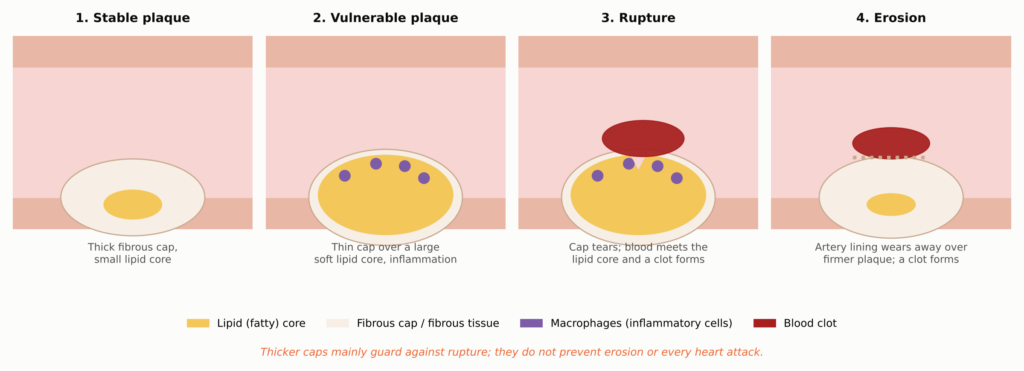
- 富含脂质或 坏死核心: 一批 胆固醇, 胆固醇结晶, ,以及死细胞的残骸。它质地柔软,机械强度低,一旦有血液渗入,就会强烈促进血凝块的形成。.
- 纤维帽: 一层胶原蛋白层,由……构成 平滑肌细胞, ,该结构将心肌核心与血液循环隔开。在对突发性冠心病死亡病例的尸检研究中,破裂的包膜厚度通常小于约65微米(μm),大致相当于一根细发丝的宽度 [25].
- 巨噬细胞: 吞噬胆固醇并转化为“泡沫细胞.。”它们会释放出能够分解胶囊中胶原蛋白的酶。.
- 钙: 矿物质沉积。活跃斑块中零星分布的小块钙化可能导致应力集中,而大片致密的钙化层通常表明病变较老且纤维化程度较高。大范围的钙化仍是……的标志 斑块负荷 以及风险。.
大多数心脏病发作始于一层薄薄的覆盖膜破裂,导致血液接触到易形成血栓的核心。较小一部分则始于 侵蚀, ,在此过程中,动脉内膜逐渐磨损,露出其下更坚硬、脂肪含量更低的斑块 [26]. 这一区别在后续会变得重要,因为加固帽体主要是为了防止破裂。.
胆固醇是如何进入血管壁的
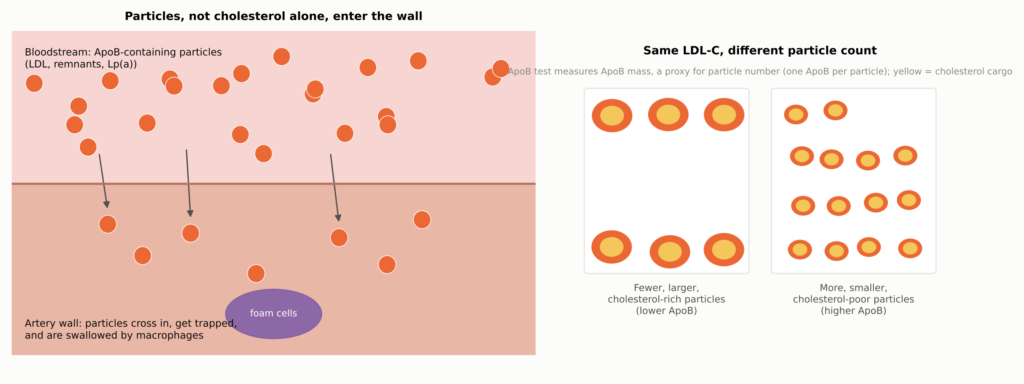
低密度脂蛋白 胆固醇不会以游离脂肪的形式漂浮进入动脉壁。它是附着在颗粒上运输的,正是这些颗粒穿过动脉内皮,被困住,并被巨噬细胞吞噬。这些颗粒——无论是低密度脂蛋白(LDL)、富含甘油三酯的残余颗粒,还是Lp(a)——每颗都携带一个 蛋白质 呼叫 载脂蛋白 B (载脂蛋白B): 载脂蛋白B-100 作用于肝脏产生的颗粒上,且时间越短 载脂蛋白B-48 开启 乳糜微粒 肠道中的残留物。.
参见第1部分的图3。.
通俗地说:ApoB 相当于交通流量;LDL-C 相当于胆固醇货物。. 标准实验室指标LDL-C用于测量LDL颗粒所携带的胆固醇量。ApoB检测则测量ApoB的质量浓度,该指标可作为颗粒数量的替代指标,因为每种主要 致动脉粥样硬化颗粒 携带一个ApoB-100分子;它并非字面意义上地计数颗粒。通常这两者会同步移动。当它们出现不一致时——例如在高 甘油三酯, 糖尿病, 肥胖, ,或者说是小密度脂蛋白(LDL)微粒,ApoB 可能更能反映有多少微粒能够进入动脉壁。.
对于使用国际单位的读者,以下是本文所讨论的低密度脂蛋白胆固醇(LDL-C)水平的大致换算值(已四舍五入;例如,40 mg/dL 约等于 1.03 mmol/L,因此四舍五入后的数值并非完全等同于阈值):
| 低密度脂蛋白胆固醇 (mg/dL) | 70 | 55 | 40 | 30 | 20 | 10 |
| LDL-C(mmol/L) | 1.8 | 1.4 | 1.0 | 0.78 | 0.52 | 0.26 |
一窥活体动脉内部
在心脏病学发展的大部分历史中,人们无法在活体上观察到纤维帽。血管造影仅能显示开放通道的轮廓。随着能够从内部成像动脉的导管的出现,这一情况发生了改变。.
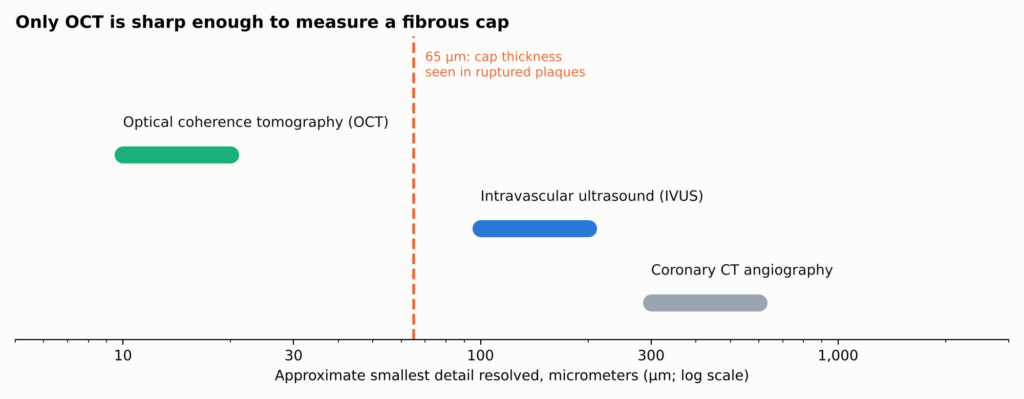
图10。. 的大致分辨率约为 冠状动脉成像 方法(典型范围;因系统而异)。只有OCT能分辨出比易损纤维帽更细微的细节,因此纤维帽厚度数据来自OCT,而斑块体积数据则来自IVUS,后者可穿透整个血管壁进行观察。 近红外光谱(NIRS,图中未显示)检测的是脂质的化学特征,而非其结构。这些方法均非显微镜:对组织特征的判定均基于推断。.
| 成像工具 | 它的优势在于 | 它不擅长什么 |
| OCT(光) | 测量盖子的厚度,, 脂质弧, 巨噬细胞样信号、钙、血凝块 | 无法看到脂质后方的斑块总体积 |
| IVUS(超声) | 测量斑块体积以及动脉的重塑情况 | 太粗了,无法测量瓶盖 |
| 近红外光谱(NIRS) | 检测脂质的化学特征 | 无法单独测量瓶盖或容量 |
| 冠状动脉CT | 显示整个心脏均存在斑块,且未使用导管 | 无法看到大写字母或细微细节 |
这些都不是显微镜。它们得出的组织标记,都是根据光或声音的行为特征推断出来的。OCT显示的内膜厚度增加、NIRS显示的脂质减少以及IVUS显示的斑块体积减少,这些发现是互补的,而非可以互换的。.
“惠更斯”实验
HUYGENS(全球范围内的冠状动脉斑块高分辨率评估) 依洛尤单抗 这项随机研究旨在回答一个问题:如果在心肌梗死后立即将低密度脂蛋白胆固醇降至极低水平,心脏其他部位那些看似危险的斑块会发生变化吗?这是一项III期、多中心、随机、双盲、安慰剂对照的影像学试验[9, 1]. 生产依洛尤单抗的安进公司为该研究提供了资金,且多名研究者报告称与该公司存在经济利益关系 [9].
参与者
研究人员有针对性地选择了那些残留斑块已呈现不稳定迹象的患者。这些患者曾发生非ST段抬高型心肌梗死(NSTEMI),并接受了血管造影及对罪犯动脉的介入治疗。 他们的低密度脂蛋白胆固醇(LDL-C)水平需高于一个阈值,该阈值取决于其他汀类药物的使用情况(未服用他汀类药物时至少为130 mg/dL;服用低或中强度他汀类药物时为80 mg/dL;或服用 高强度他汀类药物),以及一段长度至少为40毫米、未接受治疗的动脉段,其表现为 富脂斑块 关于OCT:帽层厚度不超过120 μm,且脂质弧度大于90度 [9].
所有受试者均服用了最大耐受剂量的他汀类药物。其中一半受试者还被随机分配至 依洛尤单抗 420 毫克, 一个注入的 PCSK9 抑制剂, ,另一半则归于 安慰剂 注射,每月一次,持续至第48周,并在第50至52周左右重复进行OCT和IVUS检查 [9]. 惠更斯包括 161例随机分组并接受治疗的患者(80例接受依洛尤单抗,81例接受安慰剂). 在接受治疗的患者中,有135例在随访时获得了可评估的影像学数据,其中一小部分患者还进行了配对的血管内超声(IVUS)检查, 该注册研究结果报告了全部161名接受治疗患者的完整分析集的OCT终点数据,其中119名患者具有主要终点的配对OCT测量值,因此分析并未直接对全部161名患者进行重新成像;IVUS结果则来自一个较小的子集[1]. 参与者的平均年龄为60.5岁,其中女性占28.6%。.
低密度脂蛋白(LDL)降到了多低
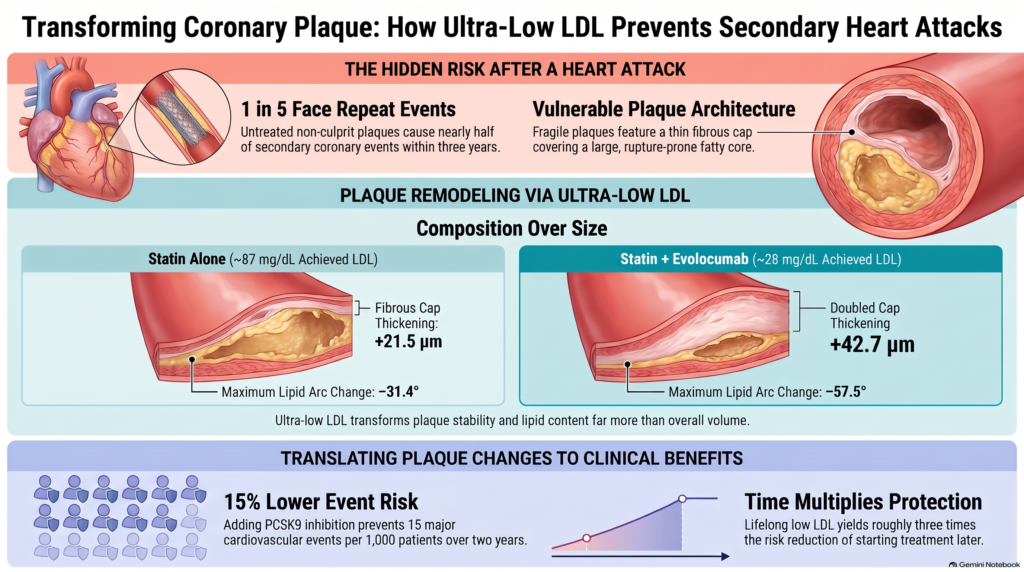
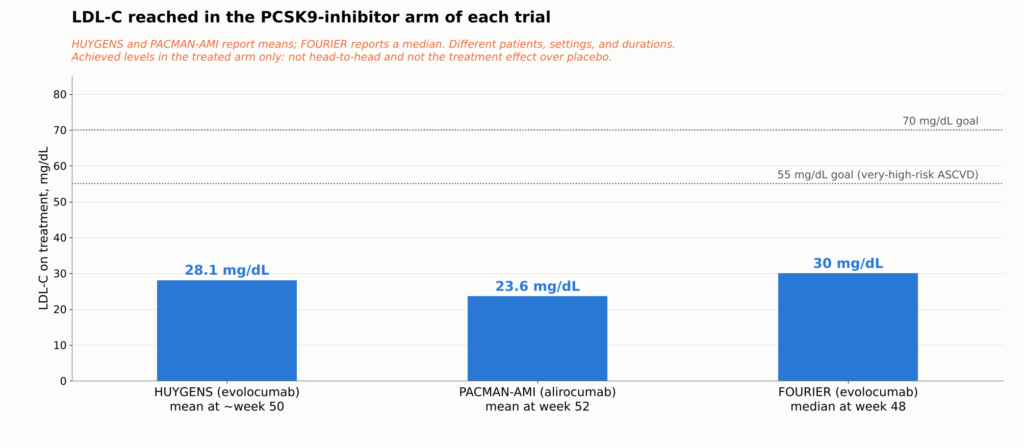
入组时的平均低密度脂蛋白胆固醇(LDL-C)水平为 141.3 毫克/分升. 在随访时,情况是 使用依洛尤单抗组的水平为28.1 mg/dL,而安慰剂组为87.2 mg/dL [1]. 安慰剂组并非未接受治疗:许多患者入组时未服用他汀类药物或仅服用低剂量,因此其血糖水平从约141 mg/dL降至87 mg/dL,主要反映了开始服用或增加他汀类药物剂量的效果。HUYGENS研究中的每项比较都是 他汀类药物与他汀类药物联合依洛尤单抗的比较.
那块牌匾怎么了
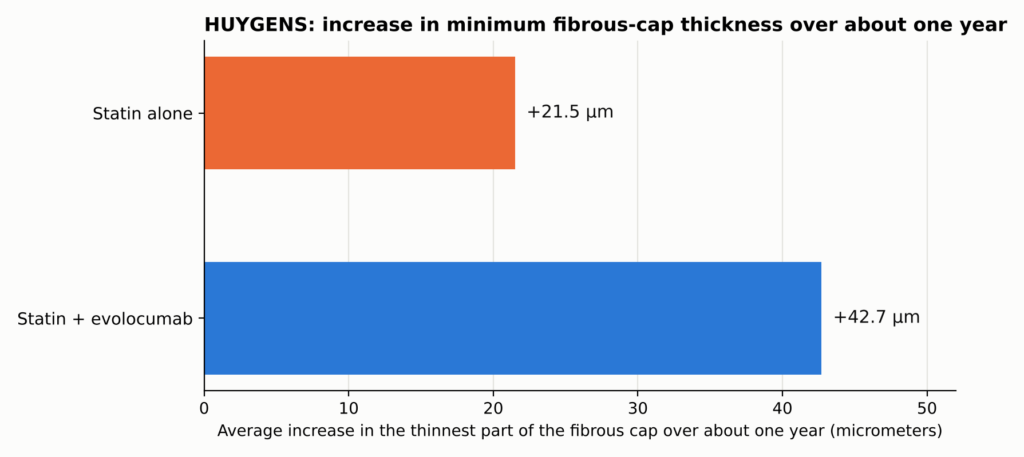
参见第1部分的图4。.
保护帽的厚度平均增加了 使用依洛尤单抗组为+42.7 μm,而安慰剂组为+21.5 μm, 最小二乘均值 根据该试验对所有161名接受治疗的患者(根据试验注册结果,即完整分析集)进行的协方差分析;差异为21.2 μm(95%置信区间 4.7–37.7;P=0.015)[1]. 脂质弧的收缩幅度更大(−57.5 度与 −31.4 度相比),巨噬细胞信号的下降幅度也更大。在探索性亚组中,通过血管内超声(IVUS)测量的斑块体积变化仅为轻微: 粥样斑块体积百分比 变化为−2.29与−0.61个百分点,算术差为−1.68个百分点(这不是经调整的对比结果,且无法与 PACMAN-AMI的 (基于模型的估计)。.
通俗地说。. 使用依洛尤单抗后,心肌壁厚增加的平均幅度约为其他治疗方式的两倍。这里比较的是增加幅度的大小,而非心肌壁本身,这并不意味着心肌梗死风险减半。. 最大的变化在于铭牌的材质,而不是它的尺寸。. 这些结果描述的是经影像学检查的、已选定的非病变段,而非冠状动脉树中的每一处斑块。.
试验研究者进行的一项二次分析还显示,接受依洛尤单抗治疗的患者中,治疗后出现极薄斑块(厚度低于65 μm)的比例较低 [27]. HUYGENS 结果的完整表格见技术附录。.
HUYGENS研究中随后进行的两项分析试图寻找疗效反应不同的患者。Lp(a)水平较高的患者在依洛尤单抗组与安慰剂组之间,冠状动脉内膜增厚程度的差异更为显著 [28], 且ApoB水平降得更低的患者,其斑块检查结果比未达到该水平的患者更理想 [29]. 这两项均为规模较小的事后亚组分析:研究对象并未被随机分配至这些水平,这些结果需要进一步验证,且未能确立独立的治疗目标或机制。详情见技术附录。.
惠更斯无法告诉我们的事情
HUYGENS研究提供了随机对照证据,表明在非ST段抬高型心肌梗死(NSTEMI)后,在他汀类药物治疗基础上加用依洛尤单抗,可改善特定非罪犯冠状动脉中与斑块易损性相关的若干OCT特征。 病变. 这并不能证明这些影像学改变直接预防了后续的心血管事件。.
惠更斯 该试验并非旨在降低心脏病发作、中风或死亡的发生率. 这需要数万名患者,而不是161名。该研究仅在研究开始时和一年后进行了成像,因此无法判断帽层变化的速度。研究对象是那些因斑块已呈现易损状态而被选中的患者。而且,该研究无法证明较厚的帽层会导致后续事件发生率的下降。要证明这一点,我们需要其他类型的临床试验。.
并非个案:其他试验也出现了同样的情况
如果只是一项涉及161名患者的试验,人们很容易就将其置之不理。但HUYGENS研究之所以具有说服力,是因为其他采用不同药物和不同成像技术的试验也观察到了相同的模式。.
PACMAN-AMI 随机化 300名心脏病发作患者 到 依洛尤单抗, 另一个 PCSK9 抗体或安慰剂,两者均在 瑞舒伐他汀, 从……开始 在紧急经皮冠状动脉介入治疗(PCI)后24小时内 针对心肌梗死,并采用互补的成像方法对非罪犯斑块进行了评估。 在300名随机分组的受试者中,265名获得了配对的IVUS数据;NIRS脂质分析纳入了263名患者,OCT帽层厚度分析纳入了221名患者(105名接受阿利西尤单抗,116名接受安慰剂),这些患者均存在 纤维粥样斑块 在两个时间点上。这三项测量数据均来自同一项随机试验。LDL-C降至 23.6 毫克/分升 与 74.4 毫克/分升. 在同一项试验中,对部分重叠的受试者采用三种互补的成像方法进行测量,结果显示出一致的积极变化:百分比 动脉粥样硬化斑块 体积下降幅度更大(差值为−1.21个百分点),NIRS脂质信号下降幅度更大(差值为−41.24),而帽层厚度上升幅度更大(+62.67 与 +33.19 μm;差值为+29.65 μm)[7]. 这些差异是该试验基于模型的估计结果。当光、声和化学信号在单次试验中结果一致时,这一发现比任何单一指标都更具说服力,尽管这仍仅是一次试验。.
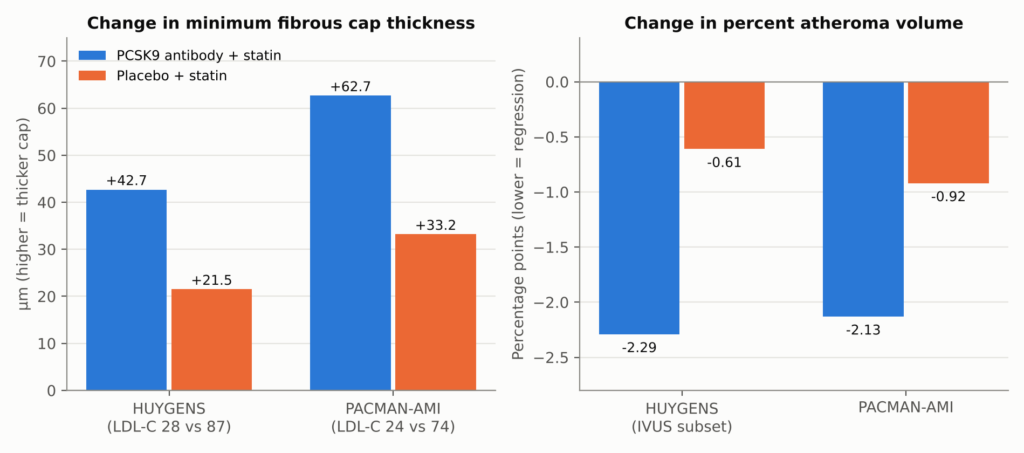
图11。. HUYGENS 和 PACMAN-AMI:各治疗组在约一年内进行了方案调整。这两项试验均在他汀类药物治疗的基础上,追加了 PCSK9 抗体(HUYGENS 试验中为依洛尤单抗,PACMAN-AMI 试验中为阿利鲁单抗),此后 心肌梗死. 柱状图表示报告中的组内平均变化值;组间差异分别为+21.2 μm(P=0.015)和+29.65 μm (11.75–47.55);动脉粥样硬化斑块体积百分比的组间差异分别为−1.68(算术平均值)和−1.21(−1.78 至 −0.65)个百分点。 对于PACMAN-AMI研究,单纯减去两组均值可得29.48 μm,这与该试验经模型调整后的29.65 μm略有差异,因为该试验的混合效应模型考虑了重复测量以及每位患者中成像的多条动脉;正文中采用的是调整后的数值。 这两个图表采用不同的单位,不应相互比较。HUYGENS动脉粥样硬化体积百分比是IVUS子集中的探索性终点。 不同指标的分析人群各不相同:HUYGENS 帽层结果是基于 161 名接受治疗的患者(其中 119 名配对 OCT 数据;135 名具有任何可评估随访影像)的完整分析集得出的模型估计值,其动脉粥样硬化斑块体积(PAV)则来自规模较小的 IVUS 子集; PACMAN-AMI研究的PAV数据源自265例具有配对IVUS数据的患者,其帽厚度数据则源自221例在两个时间点均存在纤维粥样斑块的患者。来源:[1, 7].
GLAGOV 随机化 968名患者 (846例,其中846例具有可评估的随访血管内超声检查数据)患有稳定性冠心病的患者,接受依洛尤单抗或安慰剂治疗76周,主要血管内超声检查于第78周进行。低密度脂蛋白胆固醇(LDL-C)平均值为 36.6 与 93.0 mg/dL. 与安慰剂组相比,依洛尤单抗组的动脉粥样硬化斑块体积变化率为−0.95个百分点,而安慰剂组为+0.05个百分点(组间差异为−1.0个百分点;95%置信区间为−1.8至−0.64,此数据完全照录自已发表的临床试验),且 64% 与 47% 的对比 其中部分患者出现了可测量的病灶缩小 [30]. 这些数据包括组内变化以及试验报告的组间对比结果,而非斑块质量的百分比减少量。在一项探索性亚组研究中,当斑块质量降至约24 mg/dL时,81%显示出斑块消退。 GLAGOV研究也揭示了其局限性:约三分之一的受试者未出现病变消退,且一项组织分析子研究发现斑块成分无显著差异 [31].
尽早使用他汀类药物和 依折麦布 多项临床试验在较高LDL-C水平下得出了相同的结论:LDL-C水平越低,斑块生长越少或出现轻微逆转 [32, 33, 34, 35], 且在OCT上可见更厚的帽层 [36]. YELLOW III 研究记录了在 26 周内斑块成像测量值在个体内部的积极变化;由于该研究为非对照研究,因此无法确定这些变化中有多少是由于依洛尤单抗所致 [37]. 一项于2025年开展的、针对依洛尤单抗的单臂CT/PET研究显示,其 非钙化斑块 以及更低 微钙化 活动,而 钙化斑块 体积增加;其影像学终点衡量的是不同的指标,应分别解读 [38]. 并非每项试验的结果都是积极的: 奥德赛 J-IVUS研究发现,在36周内,其斑块终点指标未见显著差异 [39].
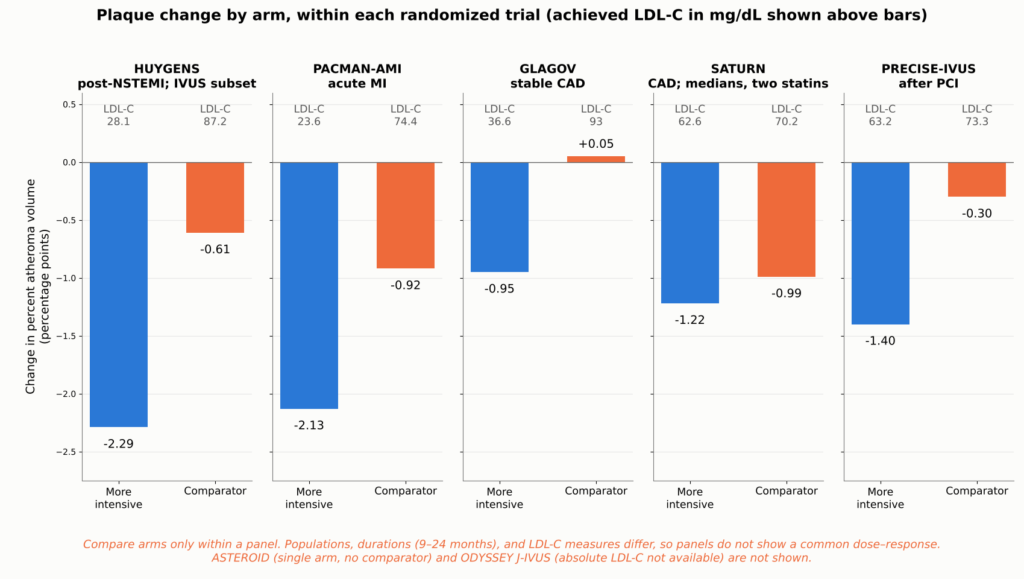
图12。. 五项随机成像试验中各研究组的IVUS动脉粥样硬化斑块体积百分比变化情况(每项试验一个图板),并标注各研究组达到的LDL-C水平。 仅比较同一组内的各研究组:研究人群、研究时长(9至24个月)及LDL-C测量方法(GLAGOV采用时间加权法)均存在差异,因此这些组别不能作为存在共同剂量-反应关系的证据。HUYGENS研究的数据源自一项探索性IVUS子集分析。. 土星 报告了中位数变化值和时间加权低密度脂蛋白胆固醇(LDL-C)水平,而其他试验则报告了平均值。. 小行星 因该研究未设对照组而被省略;ODYSSEY J-IVUS研究则因所查阅的文献中未提供最终达到的LDL-C绝对值而被省略。来源:[34, 35, 30, 1, 7].
牙菌斑体积减少1个单位意味着什么? 动脉粥样硬化斑块体积百分比(PAV)是指斑块所占血管面积的比例。 从40%变为39%,表示下降了一个百分点。这并不意味着总斑块中有1%消失了,也不意味着狭窄处扩张了同等幅度。.
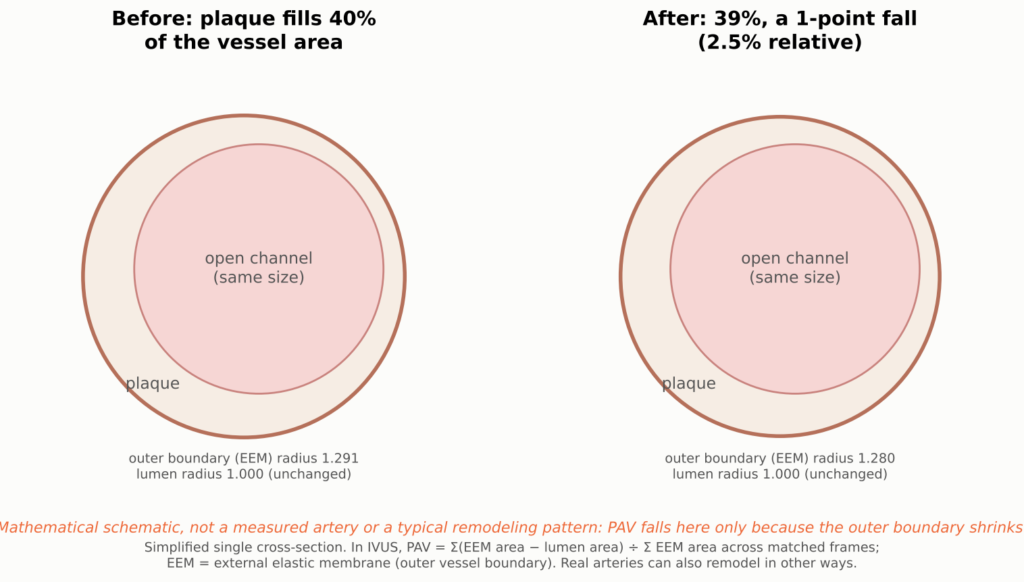
图13。. 动脉粥样硬化斑块体积百分比(PAV)变化1个百分点所对应规模的概念示意图;开放通道(流明) 在两个图板中绘制的大小相同,而血管外周界略有缩小。PAV 是指斑块所占血管面积的比例,该比例是沿血管段计算的平均值。 从40%降至39%是IVUS试验中的变化幅度。这并非指所有斑块中有1%消失,也不意味着通畅管腔相应地扩大了相同幅度,因为动脉也会发生重塑。.
技术附录中列出了所有成像试验的对照表。.
不同,但没小多少
如果斑块体积几乎没有变化,斑块为何会更不容易破裂?力学理论给出了一个合理的解释。当应力集中在覆盖在柔软核心上的薄帽层上时,就会发生破裂。 即使斑块大小几乎相同,脂质含量减少且外层更厚,也应能降低这种应力。这为以下现象提供了一个合理的解释:为何临床结局试验能显示事件发生率有显著下降,而影像学试验却仅显示斑块体积有微小变化——尽管这仍是一种推测,而非已被证实的因果关系。.
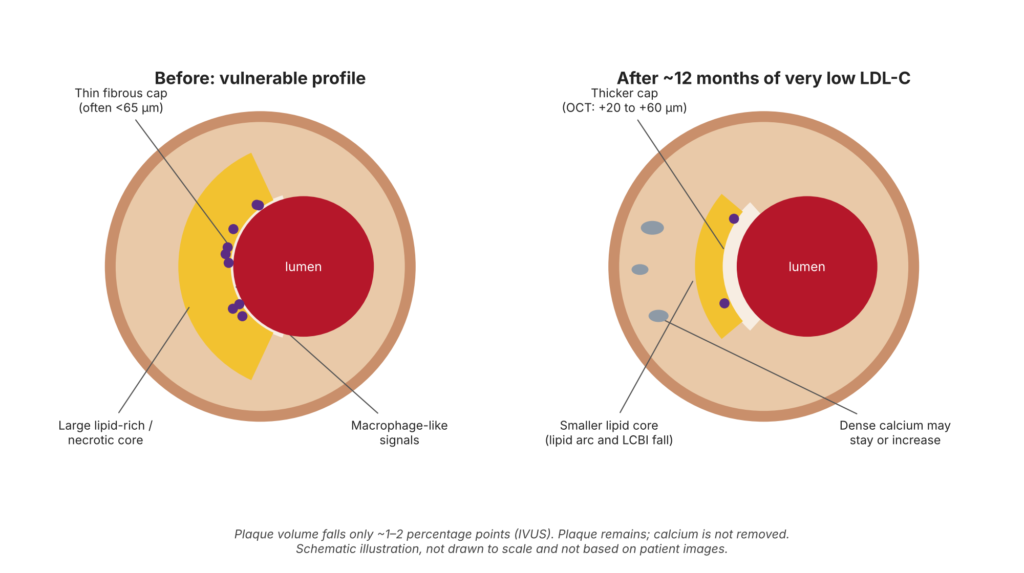
图14。. 示意图——并非实际观察到的患者,亦不保证治疗反应。概念图示: 斑块稳定:图中比例不准确,且未基于患者影像资料绘制。 随机影像学试验显示:斑块帽增厚、脂质减少、巨噬细胞样信号减少,以及斑块体积略有下降。钙化程度的变化和病变解剖结构仅为示意,并非对单个斑块的量化变化。随机试验未显示斑块消除、钙质清除或常规管腔扩大。.
从低密度脂蛋白胆固醇(LDL-C)水平降低到心肌梗死发生率降低这一推理链中包含多个环节。其中一些环节是直接测量的,另一些则是推断出来的。.
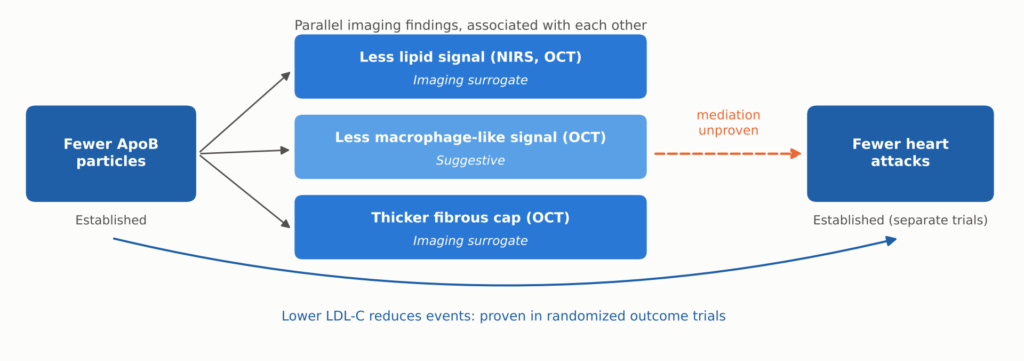
图15。. 低密度脂蛋白胆固醇(LDL-C)水平降低与斑块成像及临床事件之间的关系。ApoB颗粒数量减少与临床事件发生率降低均已得到证实,其中后者是在大型结局试验中证实的。脂质、巨噬细胞样及帽状结构的发现是并行测量的成像替代指标,而非已证实的序列。这些成像变化是否介导了临床事件发生率的降低,目前尚未确定。.
观测成像结果支持了这些特征至关重要的观点。在CLIMA研究中,同时具备四项高危OCT特征的未治疗斑块,其一年内发生事件的风险高出数倍[40]. 然而,将某个特征与风险联系起来,并不等同于证明改变该特征就能降低风险。.
以下三点提醒有助于保持客观:
- 帽檐更厚并不一定能保证。. 65 μm这一阈值源自尸检研究 [25]. 较厚的囊壁仍可能破裂,此类薄结构的OCT测量结果存在差异,且囊壁厚度沿其长度方向也会发生变化。.
- 侵蚀则不同。. 侵蚀性心肌梗死主要由动脉内膜损伤引起,并且 炎症 比通过疏枝更有效 [26]. 斑块增厚主要与破裂有关,这也是为何即使在极低的低密度脂蛋白胆固醇(LDL-C)水平下,仍会发生事件的原因之一。.
- 钙水平可能会升高,而不是降低。. 高剂量他汀类药物在减少斑块体积的同时,增加了静脉内超声血管成像(IVUS)测得的钙化指标 [41],而在PARADIGM CT队列中,他汀类药物使用者非钙化斑块的增长速度较慢,但钙化斑块的增长速度较快 [42]. 不断上升的 钙化积分 治疗期间的钙化情况本身并不意味着治疗失败,且连续测定的钙化评分并非一种经过验证的治疗效果评估方法。关于降低低密度脂蛋白(LDL)可“溶解钙化”的说法缺乏依据。.
病变逆转也不一定能重新开通动脉。动脉粥样硬化斑块体积百分比的减少,并不一定意味着管腔直径会相应增加。. 冠状动脉 可以向外或向内改造,并且 斑块消退 这种情况可能发生,而血管造影所显示的狭窄程度并未出现具有临床意义的变化。本文讨论的影像学试验并未证实可常规逆转已固化的冠状动脉狭窄。.
从牙菌斑外观改善到心脏病发作减少
影像学试验揭示了斑块的变化情况。而结果试验则招募了数千名患者,统计了实际发生的心肌梗死、中风和死亡病例,从而揭示了这些变化是否具有临床意义。这是该报道中最有力的证据。.
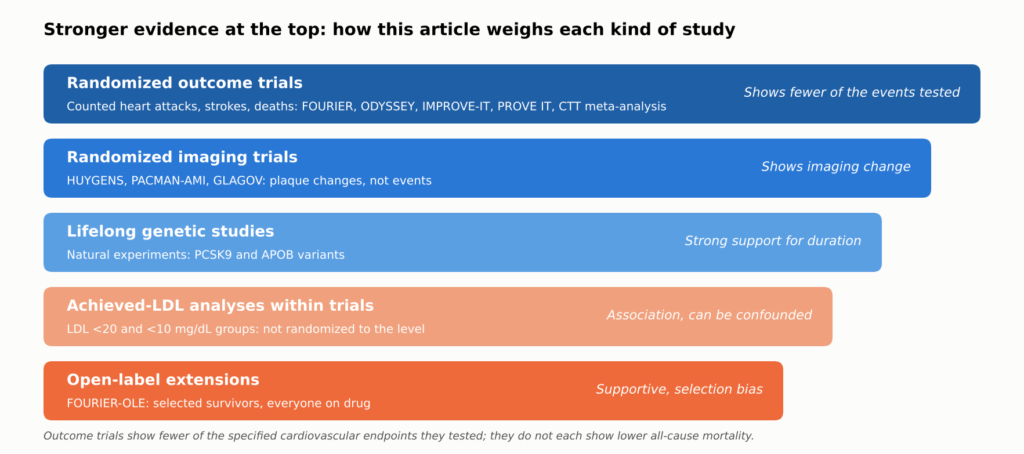
图16。. 本文中证据的权重如何确定。 随机结局试验证实,降低低密度脂蛋白胆固醇(LDL-C)可预防其所测试的事件;随机影像学试验表明,这会改变斑块的影像学指标;其余级别的证据虽能支持,但无法单独证明关于极低目标值、长期影响及终身获益的论点。正文中的每项论点均标注了其背后的证据类型。.
对患者而言至关重要的数字
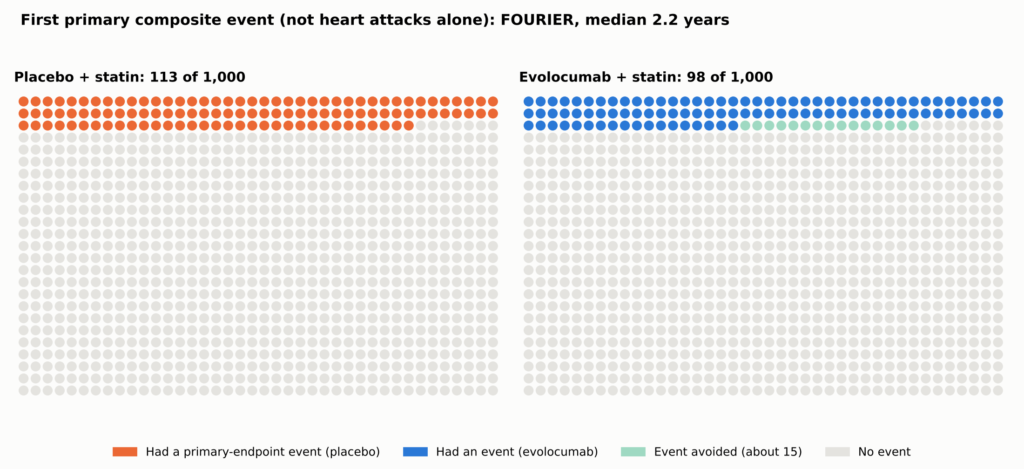
相对减少量听起来很大;绝对减少量则显示了一个人获得了多少。在 傅里叶, ,主要复合终点(心血管死亡、心肌梗死、脑卒中、因 不稳定型心绞痛, ,或冠状动脉 血运重建) 在中位数为2.2年的随访期间,接受依洛尤单抗治疗的患者发生率为9.8%,而接受安慰剂治疗的患者为11.3%:相对危险度降低了15%,绝对差异约为1.5个百分点,即约 每1,000人减少15人 [2]. 该复合终点并非仅指心脏病发作的风险,而原始的 FOURIER 试验 未证实死亡率有所下降。.
参见第1部分的图5。.
| 试用 | 测试内容 | 后续 | 事件发生率:治疗组与对照组比较 | 每1,000人的差异(人;; 傅里叶-奥勒: 每1,000人年的发生率) |
| MIRACL [43] | 高剂量他汀类药物与安慰剂的比较,于住院期间开始治疗 | 16周 | 14.8% 与 17.4% | 大约26 |
| PROVE IT–TIMI 22 [10] | 高强度与中强度他汀类药物 | 2年 | 22.4% 与 26.3% | 约39 |
| IMPROVE-IT [4] | 在他汀类药物基础上加用依折麦布 | 7年 | 32.7% 与 34.7% | 大约20 |
| ODYSSEY OUTCOMES [3] | 急性冠心病后加用阿利罗库单抗 | 中位数为2.8年 | 9.5% 与 11.1% | 大约16 |
| 傅里叶2] | 加用依洛尤单抗,疾病稳定 | 中位数为2.2年 | 9.8% 与 11.3% | 大约15 |
| FOURIER-OLE [14](开放标签扩展研究;非随机试验终点) | 早期与晚期使用依洛尤单抗(开放标签) | 中位数再过5年 | 心血管死亡、心肌梗死或脑卒中:每100人年分别为2.05与2.58 | 每1,000人年约减少5.3例(为率差,而非人数) |
每项试验均在其各自的研究人群中,根据各自的随访时间统计了特定事件组合的数据,因此这些行并不代表排名。FOURIER-OLE 研究比较了选定幸存者中最初的随机分组情况,这些受试者均接受了开放标签的依洛尤单抗治疗。包含相对效应、LDL-C 水平及死亡率的该表格详细版本,见技术附录。.
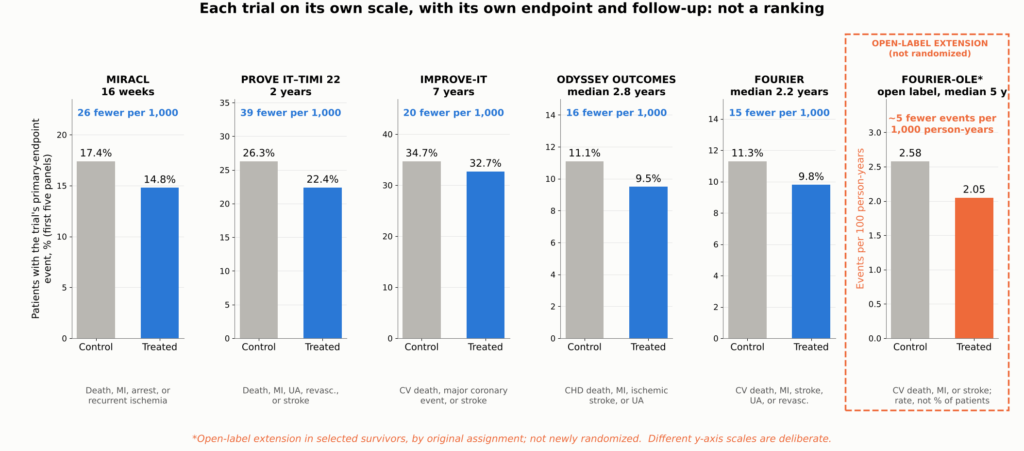
图17。. 主要结局试验中的绝对获益,以小倍数图形式展示:每个子图的y轴刻度分别显示一项试验中对照组和治疗组的主要终点事件发生率,其差异以每1,000名接受治疗的患者为单位表示。每项试验采用不同的 复合端点, 研究人群、对照组及随访期各不相同,因此这些图表不能相互比较,也不应被视为排名;它们仅展示了各试验中获益的程度。 *FOURIER-OLE 展示了开放标签延长期内的心血管死亡、心肌梗死或中风事件,比较了最初被分配至依洛尤单抗组与安慰剂组的患者(每100人年分别为2.58例和2.05例); 由于这是发生率而非患者比例,该图表的y轴标注独立于其他图表;这是一项针对选定幸存者的探索性比较,并非新的随机试验。来源:[43, 10, 4, 3, 2, 14].
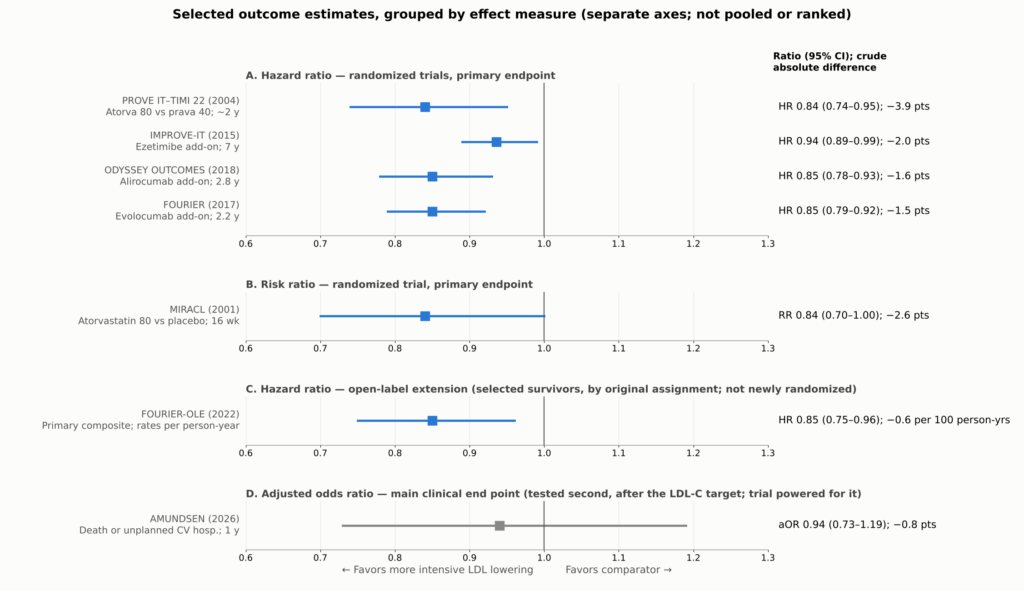
图18。. 本文讨论的试验中选定的结果估计值:随机试验的主要终点、FOURIER-OLE试验的开放标签扩展研究比较,以及AMUNDSEN试验的主要临床终点。每项试验采用的复合终点、研究人群和随访方案各不相同,且报告的效果指标也不同(风险比、, 风险比, ,或调整后的比值比),因此每个效应量均单独展示在一个子图中,并配有独立的坐标轴,仅供参考,未进行合并或排序。 绝对差异是指各试验在其自身随访期间报告的事件发生率之间的粗差异(对于FOURIER-OLE试验,单位为每100人年)。FOURIER-OLE并非一项新的随机结局比较:该试验在开放标签扩展研究期间,根据原始分组将选定的存活受试者进行比较,该扩展研究中所有受试者均接受了依洛尤单抗治疗。 AMUNDSEN(灰色)展示的是其主要临床终点,该终点在试验预先设定的优先级中排在LDL-C目标终点之后,位列第二;该试验的样本量设计即以此终点为依据。 PROVE IT–TIMI 22 的区间源自其报告的 16%(5%–26%)相对降低率。MIRACL 的 相对危险度 该数据按试验报告所示呈现,系根据Cox比例风险模型估算得出。来源:[43, 10, 4, 3, 2, 14, 24].
心脏病发作和中风减少;但死亡却更难避免
其获益主要体现在非致命性事件方面。 在FOURIER研究中,心肌梗死发生率从4.6%降至3.4%,脑卒中发生率从1.9%降至1.5%,冠状动脉介入治疗率从7.0%降至5.5% [2]. ODYSSEY OUTCOMES 和 IMPROVE-IT 研究显示,心肌梗死和缺血性脑卒中的发生率均呈现类似程度的下降 [3, 4]. 这些是支持主要研究结果的二次分析。.
在各项补充试验(IMPROVE-IT、ODYSSEY OUTCOMES 和 FOURIER)中,没有一项试验在预先设定的规则下显示出具有统计学意义的死亡率降低。 ODYSSEY OUTCOMES 试验中全因死亡率的降低仅为名义上的。这并不证明这些药物不存在降低死亡率的益处;而是意味着不应宣称这些药物单独使用时已证实具有降低死亡率的益处。.
统计每一项活动
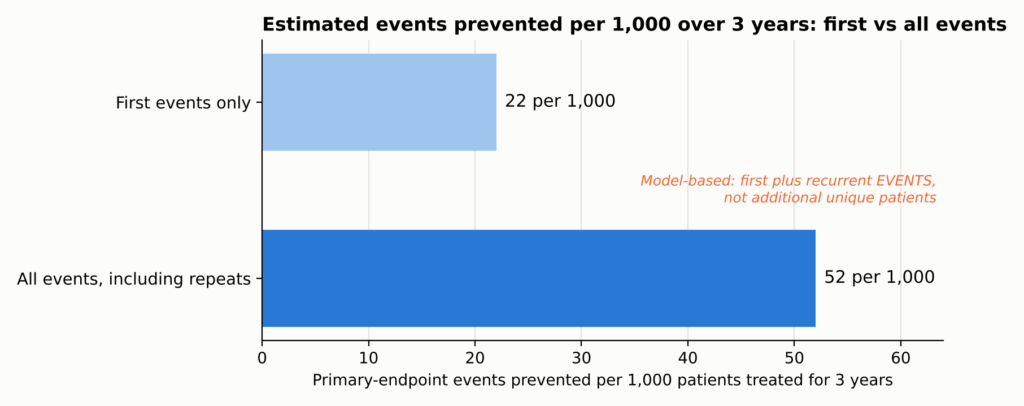
临床试验通常只统计每位患者的首次事件。但经历过一次心肌梗死的患者往往还会发生第二次心肌梗死、中风或需要植入支架。当FOURIER试验将每次事件都计入统计时,估计的预防事件数增加了一倍多,尽管相对风险降低幅度并未随之增加:约22例首次事件,但 每1,000名接受三年治疗的患者中,共预防了52例事件, 统计首次事件和重复事件而非新增人数的做法有所帮助(事件总数:率比 0.82,95% 置信区间 0.75–0.90;首次事件:风险比 0.85)[11].
参见第1部分的图6。.
全局视野
胆固醇治疗试验者联盟汇总了来自26项他汀类药物试验的个体数据,涉及约17万人。每项 低密度脂蛋白胆固醇(LDL-C)每降低38.7 mg/dL(1 mmol/L),主要血管事件的发生率便降低约22%, ,且全因死亡率每毫摩尔/升下降约10%,且癌症或其他非心血管疾病死亡率并未增加 [12]. 一项针对随机对照试验的荟萃分析发现,他汀类药物、依折麦布和PCSK9抑制剂(这些药物均通过LDL受体通路发挥作用)在每降低1单位LDL-C时的风险降低比例总体上相似 [13]. 这支持了存在一种由低密度脂蛋白(LDL)介导的共同机制,但这并不意味着每种药物的临床效果或安全性特征都完全相同。.
通俗地说。. 低密度脂蛋白胆固醇(LDL-C)的绝对降幅及其持续时间是疗效的主要决定因素,但不同疗法在循证依据、治疗时机、脱靶效应和耐受性方面存在差异。.
斑块的变化能否解释这一益处?从理论上讲,部分原因可能如此。在成像试验中,当低密度脂蛋白胆固醇(LDL-C)水平相近时,同一类药物可改善斑块状况;而在结局试验中,这些药物也能降低不良事件发生率。但成像试验和结局试验纳入的研究对象不同,且迄今为止尚无任何试验表明,成像变化能解释不良事件发生率的降低。. 斑块检查结果使该疗效在生物学上具有合理性;结局试验则证实了该疗效在所测试终点上的有效性。.
时间是那隐藏的秘方
最新数据中最重要的启示或许在于:效益会随着时间的推移而逐渐积累。.
延迟效应
在FOURIER研究中,第一年心血管死亡、心肌梗死或中风的相对减少率约为16%,第一年之后约为25% [2]. 早期的他汀类药物试验也显示出同样的规律:治疗时间越长,获益越大。这与斑块逐渐趋于稳定的现象相一致,尽管并不能证明这一点。.
“遗产效应”
在FOURIER试验中,其随机阶段的中位随访时间为2.2年,期间未显示出显著的心血管死亡率获益。此后,6,635名选择继续参与的存活受试者进入了开放标签扩展研究FOURIER-OLE,该研究中所有受试者均接受了依洛尤单抗治疗; 扩展研究的随访中位时间为5.0年,主试验和扩展研究期间依洛尤单抗的最大暴露时间约为8.4年;扩展研究期间低密度脂蛋白胆固醇(LDL-C)的中位值约为30 mg/dL [14].
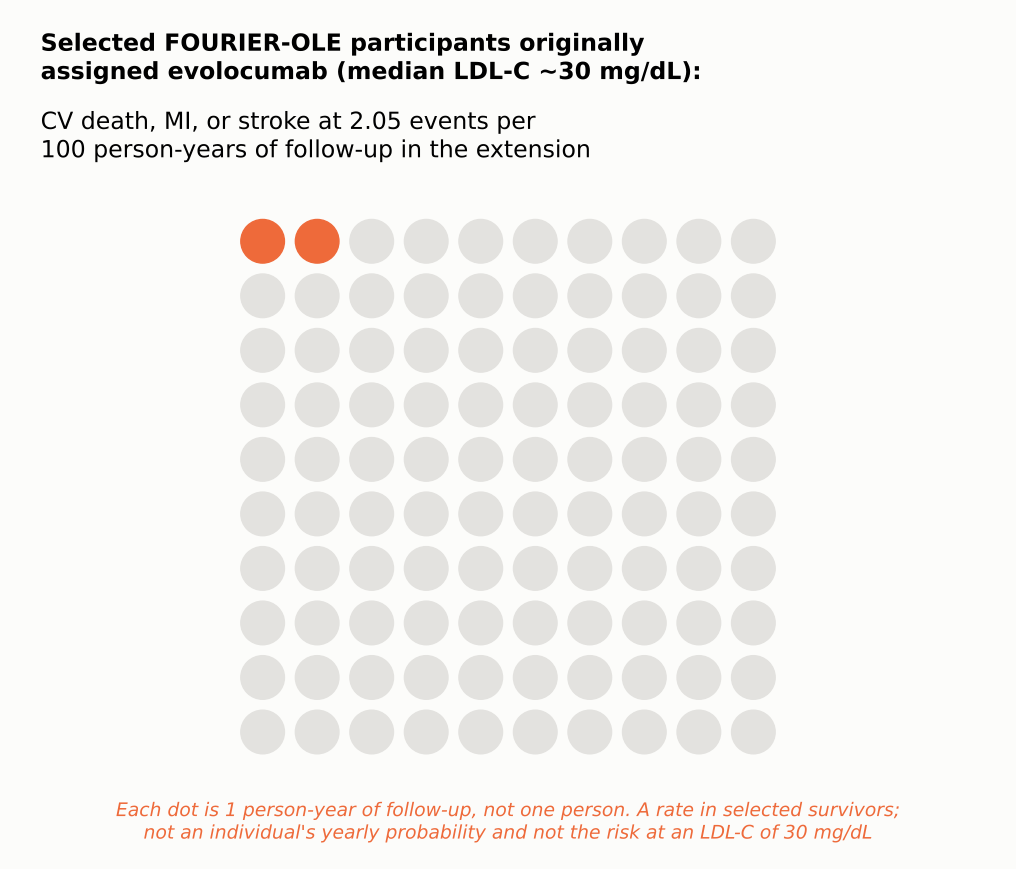
尽管两组患者目前均服用同一种药物,且低密度脂蛋白胆固醇(LDL-C)水平相近,但约两年前最初被分配使用依洛尤单抗的那组患者,后续发生的不良事件较少。心血管死亡、心肌梗死或中风的发生率为 每100人年分别为2.05例和2.58例 (HR 0.80;95% 置信区间 0.68–0.93),心血管死亡率在 每100人年分别为0.68和0.90 (HR 0.77;95% 置信区间 0.60–0.99),如 FOURIER-OLE 主要研究论文的结果表中所述,其中事件是在扩展随访期间根据原始随机分组情况进行统计的 [14]. 这是一项针对开放标签随访中选定幸存者进行的探索性比较,而非一项新的盲法随机试验,因此仅凭此研究无法证实其对降低死亡率的益处。 该结果与早期长期降低低密度脂蛋白(LDL)带来的遗留效应相符,但进入扩展研究及接受开放标签治疗的受试者选择偏倚意味着,该研究无法证明早期治疗是造成差异的原因,也无法阐明这一益处是如何延续下来的。.
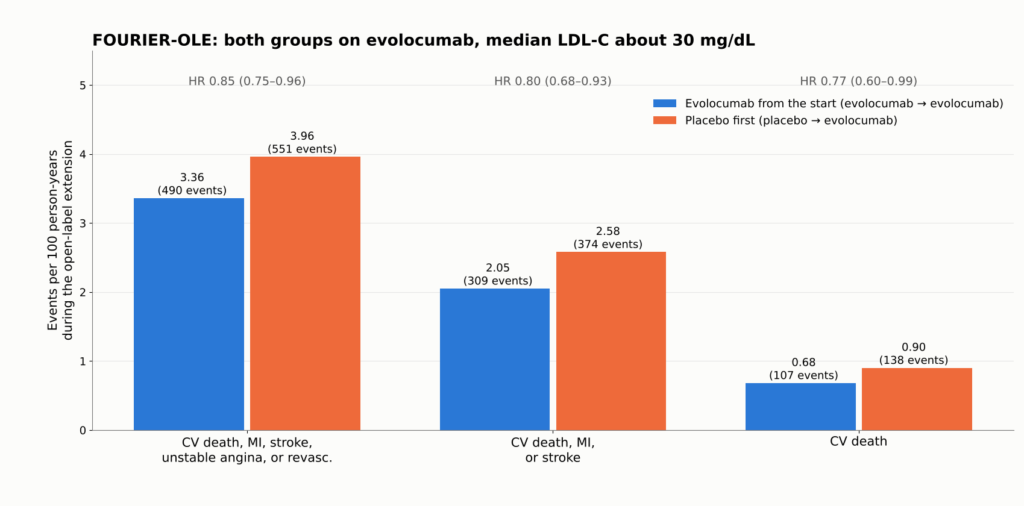
图19。. FOURIER-OLE:在开放标签延长研究期间,每100人年的事件发生率,当时所有6,635名受试者均接受了依洛尤单抗治疗,且低密度脂蛋白胆固醇(LDL-C)的中位数约为30 mg/dL。最初被随机分配至依洛尤单抗组的患者,其低LDL-C暴露时间比其他组多出2.2年。 即使在该组中,心血管死亡、心肌梗死或中风的发生率也约为每100人年2例。扩展研究参与者均为经筛选的存活患者,且治疗为开放标签。来源:[14]. 这些数据来自一项“选择性生存者”开放标签扩展研究中的事件发生率;它们无法证明随机化研究中存在死亡率获益。.
世事变迁之快
- LDL-C 使用PCSK9抗体治疗后,LDL-C水平在数天内下降;而使用他汀类药物治疗后,则在两到四周内下降。在AMUNDSEN研究中,在植入支架前开始使用依洛尤单抗六周后,LDL-C中位数为16 mg/dL,而标准治疗组为56 mg/dL [24].
- 斑块 在随机影像学试验中,约9至24个月后对变化进行了测量。YELLOW III研究记录了第26周时的个体内部变化,但该研究为非对照研究,因此无法确定该药物的效应大小或效应何时开始 [37]. 一项仅在研究开始时和一年后进行成像的试验,无法证明帽膜是在数天内开始增厚的。.
- 临床事件: MIRACL研究显示,在16周内复发性缺血事件的发生率较低 [43]; 傅里叶曲线在约六个月内出现了分化 [2]; FOURIER-OLE 研究中观察到的心血管死亡率差异仅在开放标签延长期出现 [14].
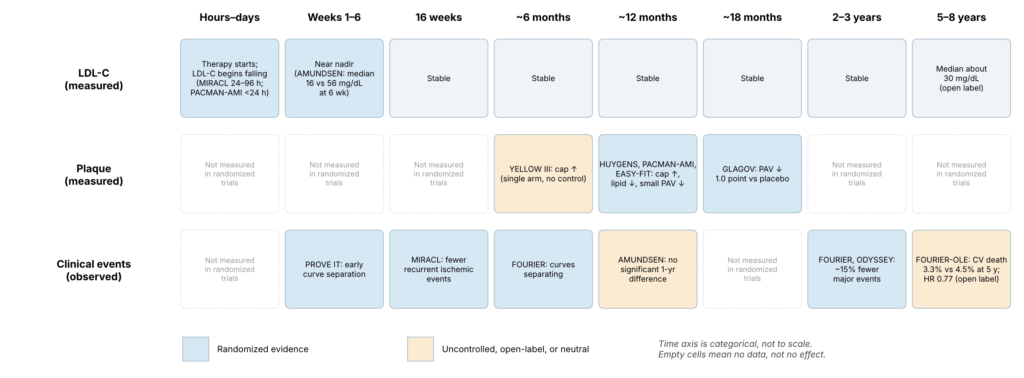
图20。. 时间轴展示了测得的低密度脂蛋白胆固醇(LDL-C)变化、测得的斑块变化以及观察到的临床获益之间的关系。每个单元格显示的是研究中进行测量的时间点,而非生物学效应开始的时间;该图无法显示稳定化何时开始,且未对未测量的时间点进行外推。 研究测量的时间点并不一定就是生物学效益开始的时间;临床效益可能在重复成像检查之前就已经开始,且不暗示存在固定的生物学滞后时间。空白单元格表示未进行测量,而非无效应。.
终生暴露
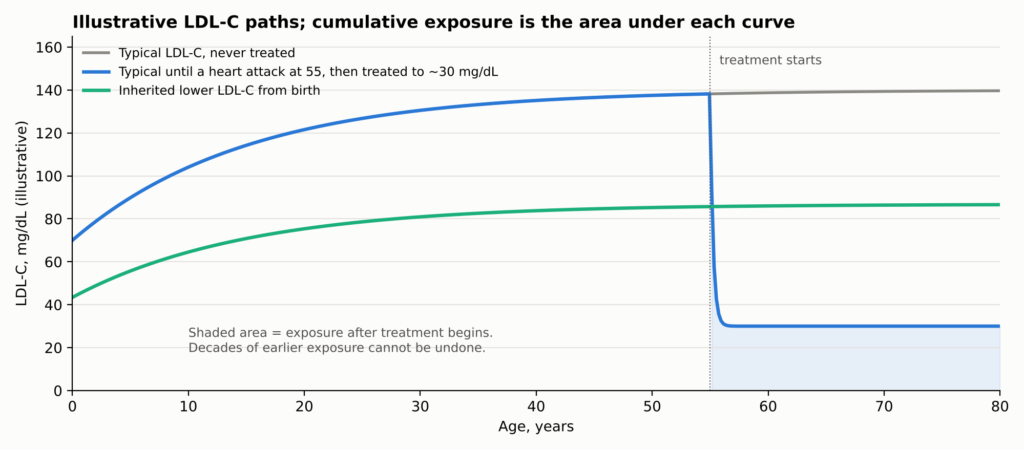
为什么时间如此重要?因为 动脉粥样硬化 反映了动脉壁在整个生命周期内累计暴露于ApoB颗粒的总量。遗传学研究表明, 累积暴露 导致风险 [44]. 心脏病发作后接受治疗的人,虽然未来的心脏病风险会降低,但过去数十年的心脏病风险及其形成的斑块依然存在。.
参见第1部分的图7。.
患者能获得多少收益,取决于以下三个方面的综合影响: 基线风险、LDL-C下降幅度以及该水平能维持多长时间。. 对于高危患者而言,同等程度的低密度脂蛋白(LDL)降低可预防更多事件的发生,而更大且持续的降低则能预防更多事件。.
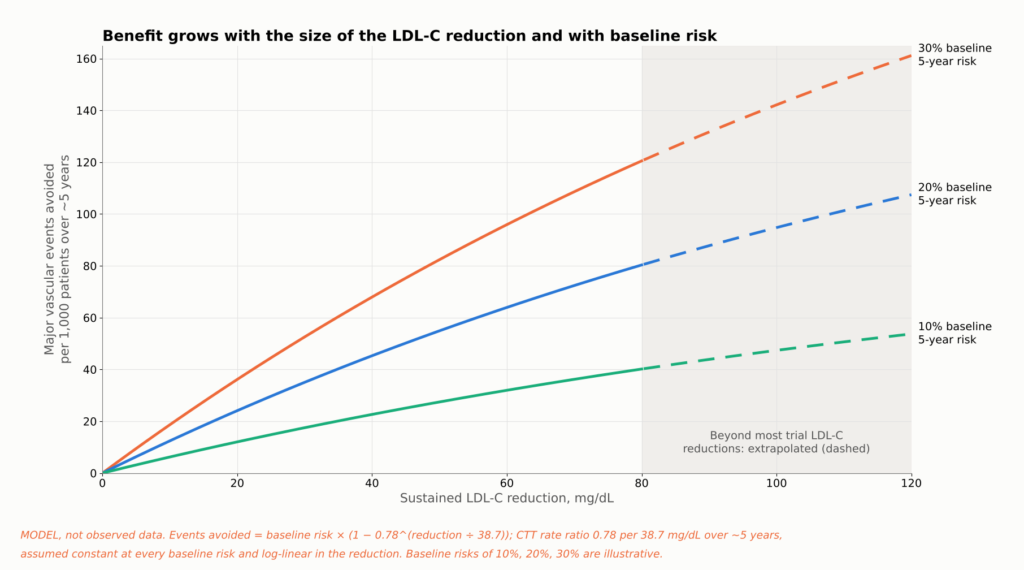
图21。. 证据摘要,并非针对特定患者的预测。图中数据基于胆固醇治疗试验者联盟(Cholesterol Treatment Trialists)的估算:低密度脂蛋白胆固醇(LDL-C)每降低38.7 mg/dL(1 mmol/L),约五年内发生重大血管事件的风险降低22% [12] 对应三个具有代表性的基线五年风险水平。相同的低密度脂蛋白胆固醇(LDL-C)降低幅度在高风险患者中可预防更多事件,而更大且持续的降低幅度则能预防更多事件。治疗时间越长,其带来的获益将超出五年估计值所示的范围(参见终身暴露量图)。 超过约80 mg/dL的降幅已超出大部分临床试验数据的范围。假设:CTT率比(来自 元分析, (而非试验风险比)在每个基线风险水平上均一地应用,并随LDL-C的降低呈对数线性变化。这并非针对患者的 风险计算器.
低密度脂蛋白(LDL)应降至多低?
患者经常询问,40是否足够好,还是20或10更好。坦率地说,答案取决于你接受何种证据,因为数值越低,证据的基础就越是从随机对照试验转向观察性研究。.
| 低密度脂蛋白胆固醇(LDL-C)水平 | 证据呈现的样貌 | 底线 |
| 低于 70 mg/dL | 随机对照试验(PROVE IT、他汀类药物影像学试验) | 针对达到这些水平的给药方案而设立(并非随机分配至该阈值) |
| 低于 55 mg/dL | 随机对照试验(IMPROVE-IT、ODYSSEY、FOURIER) | 针对达到这些水平的给药方案而设立(并非随机分配至该阈值) |
| 低于 40 mg/dL | 随机试验组均达到了这一目标(FOURIER 约 30;GLAGOV 36.6) | 强烈支持 |
| 低于 30 mg/dL | 影像学试验(HUYGENS 28、PACMAN-AMI 24);达到水平分析 | 支持牙菌斑假说;研究结果为观察性研究 |
| 低于 20 毫克/分升 | 在 FOURIER 和 FOURIER-OLE 研究中,有数千名患者达到了该标准,但并未被随机分配至该组 | 风险较低,未发现明显的安全信号;观察性研究 |
| 低于 10 mg/dL | FOURIER、FOURIER-OLE 和 ODYSSEY 的子集 | 表现稳定但统计上不稳健 |
此处引用的试验中,均未将心肌梗死后患者随机分配至低密度脂蛋白胆固醇(LDL-C)目标值低于55 mg/dL的不同组别。. 药物临床试验中的受试者是被随机分配到不同药物组的,而不是被随机分配到“20组与40组”之间。这是该领域最关键的一点。.
在这些限制范围内,数据指向一个方向。 在FOURIER研究中,截至第4周,有2,669名受试者低密度脂蛋白胆固醇(LDL-C)水平降至20 mg/dL(0.5 mmol/L)以下;在研究范围内,LDL-C水平越低,心血管风险就越低;且在随机分组期间,严重不良事件与达到的LDL-C水平无关[17]. 在FOURIER-OLE研究中,约有1,604名受试者将低密度脂蛋白胆固醇(LDL-C)维持在20 mg/dL以下;较低的LDL-C水平仍与较低的风险相关,且在扩展研究的随访期间未观察到严重不良事件的增加 [18]. 在ODYSSEY OUTCOMES研究中,经调整的事后分析显示,血糖水平曾短暂降至15 mg/dL以下的患者,后续不良事件发生率较低(HR 0.72; 95%置信区间 0.51–0.997),但这并不能证明将目标值设定在15 mg/dL以下更优 [45].
通俗地说。. 在所研究的各个范围(包括极低水平)内,较低的低密度脂蛋白胆固醇(LDL-C)水平通常与较低的事件发生率相关。所回顾的研究尚未确定一个明确的下限阈值;在极端的LDL-C水平下,证据变得稀少,且基于实际达标水平的分析无法确定最佳目标值。 目前尚无随机对照试验表明,将目标值设定为10或20 mg/dL优于设定为30或40 mg/dL。.
风险能降到多低?
在“LDL应该降到多低”这个问题背后,还隐藏着另一个问题。假设LDL-C被降至接近零的水平,心脏病发作、中风和心血管死亡的发生率能降到多低?对于已经患有冠心病的人和从出生起LDL-C水平就较低的人来说,答案有着显著差异。.
对于已患有动脉粥样硬化的患者
这并非一项关于LDL-C目标值的随机对照研究:患者是自行分入不同LDL达标组的,因此只能部分调整选择偏倚和混杂因素,且该分析并不能证明不存在生物学下限。 在此限制范围内,经同行评审的FOURIER-OLE研究中关于低密度脂蛋白胆固醇达标水平的分析发现,风险随低密度脂蛋白胆固醇水平的降低而稳步下降,直至研究中的最低水平——低于20 mg/dL [18].
由此得出两点结论。在研究中观察到的最低水平下,风险最低,这是一种观察性关联。而且 地板的温度远高于零度:在入选FOURIER-OLE研究的受试者中,最初被分配至依洛尤单抗组(即治疗时间最长的组别)的受试者,其随访期间每100人年发生心血管死亡、心肌梗死或脑卒中的事件数为2.05例; 该数据是根据最初随机分组得出的发生率,而非低密度脂蛋白胆固醇(LDL-C)水平为30 mg/dL时的风险 [14].
这些是试验内的观察性比较;达到最低水平的患者可能存在某些差异,而这些差异无法通过统计调整完全消除。.
地板为何存在
- 纪念牌匾已经竖立起来了。. 这些患者体内积聚了数十年的斑块,而血管内超声(IVUS)显示,斑块负荷仅下降了几个百分点。.
- 短曝光。. 两到八年的极低低密度脂蛋白胆固醇(LDL-C)水平,无法抵消四十年或更长时间的高水平暴露带来的影响。.
- 其他途径。. Lp(a)、甘油三酯富集残余颗粒以及残留炎症仍然存在。在 坎托斯, COLCOT 和 LoDoCo2 研究显示,对于已服用降脂药的患者,抗炎治疗可降低不良事件的发生率 [19, 20, 46].
- 其他原因。. 有些中风是由心脏或微血管引起的,有些心脏病发作则是由于动脉侵蚀、动脉破裂或来自其他部位的血栓所致。. 吸烟, 血压, 糖尿病,以及 肾病 同时也继续加剧风险。.
大自然的实验:先天低LDL的人群
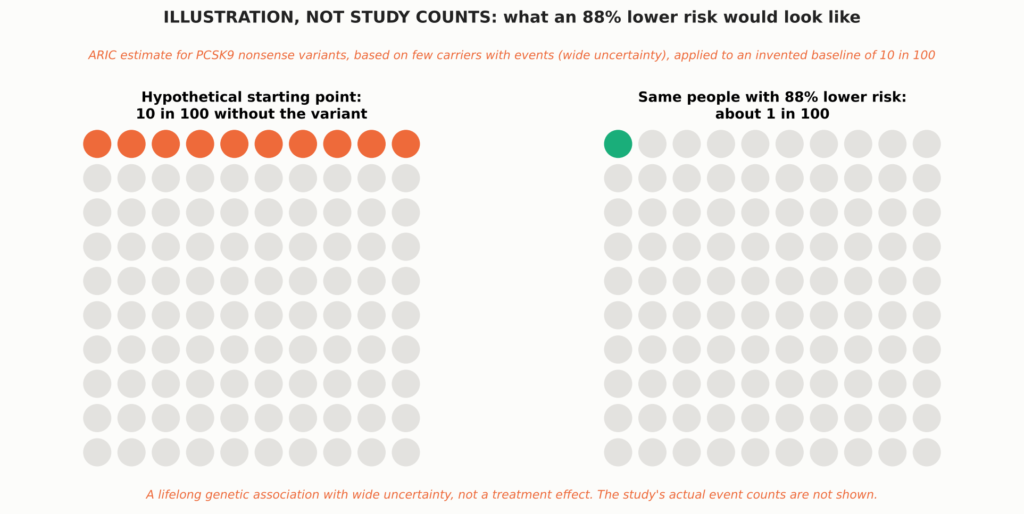
有些人天生就…… 基因变异 这些变异从出生起就能降低低密度脂蛋白胆固醇(LDL-C)水平。由于这些变异是在受孕时就已确定的,且在很大程度上与生活方式无关,因此它们的作用就像是天然的随机实验。其结果令人瞩目。.
参见第1部分的图8。.
- PCSK9 nonsense variants. 在 ARIC study, Black participants carrying inactivating PCSK9 variants had about 28% lower LDL-C and an 88% lower risk of 冠心病 over 15 years. White participants with a milder variant had about 15% lower LDL-C and 47% lower risk [5]. Few carriers had events, so the estimate is imprecise (hazard ratio 0.11; 95% CI 0.02–0.81).
- APOB truncating variants. Carriers had 43 mg/dL lower LDL-C and 72% lower odds of early coronary disease [47].
- PCSK9 R46L in large studies. This common variant lowers LDL-C only modestly, yet it was associated with less coronary or 缺血性心脏病 [48, 15] and lower cardiovascular mortality [16].
- Across nine variants in six genes (312,321 people), each 38.7 mg/dL of lifelong lower LDL-C was associated with 5% lower coronary risk, about three times the effect per unit of statins started later in life; this is an illustrative comparison across different study designs, not causal equivalence [6].
The genetic data also mark limits. The same R46L variant that lowered coronary risk was not associated with lower ischemic stroke [15], and lifelong lower LDL-C from PCSK9 variants was associated with lower cardiovascular but not 全因死亡率 [16]. Across these datasets, reductions in ischemic stroke or all-cause mortality were not consistently demonstrated; estimates differ by variant, population, endpoint, and statistical precision. These are observational genetic associations with population-specific uncertainty. Effect sizes differ across variants, populations, and endpoints, and because they reflect lifelong exposure, their scale cannot be equated with a drug treatment effect started in adulthood; quantitative comparisons with trials are illustrative.
People who inherit two inactivating PCSK9 variants are extremely rare. The best-documented case is a 32-year-old woman with no detectable PCSK9 and LDL-C of 14 mg/dL who was healthy, fertile, and working as an aerobics instructor [49]. She was described at a single point in time; nobody knows her long-term cardiovascular outcome.
Putting the Two Together
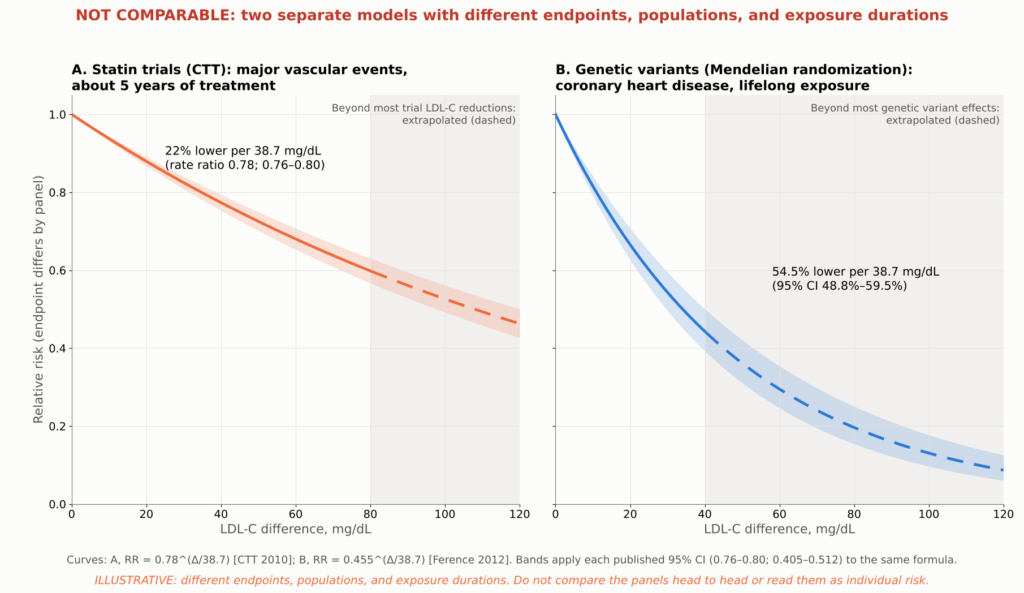
Figure 22. Illustrative model, not trial data or a patient risk calculator. Lines show two published log-linear associations with different endpoints, populations, and exposure durations: the Cholesterol Treatment Trialists’ rate ratio of 0.78 (95% CI 0.76–0.80) for major vascular events per 38.7 mg/dL over about five years of statin treatment [12], and the 孟德尔随机化 estimate of 54.5% (95% CI 48.8%–59.5%) lower coronary heart disease risk per 38.7 mg/dL of lifelong exposure, from 312,321 participants and 9 variants in 6 genes [6]. Each curve is ratio^(LDL-C difference/38.7); shaded bands carry each published 95% 置信区间 through the same formula and are not observed trial confidence bands. Extrapolated segments are dashed: in panel B beyond about 40 mg/dL, past the range of most genetic variants, and in panel A beyond about 80 mg/dL, past most trial LDL-C reductions, and the model assumes the 对数线性关系 holds at extreme exposures, which has not been shown. The two estimates are shown in separate panels, without individual study or trial points, because their endpoints and populations differ; they must not be read as a head-to-head comparison of statin therapy with lifelong genetic LDL reduction or as a prediction of individual lifetime risk.
The figure compares two published estimates. Applied to a difference of about 75 mg/dL, the statin-trial estimate predicts roughly 38% fewer major vascular events over about five years, while the genetic estimate predicts roughly 78% fewer coronary events over a lifetime. Both are extrapolations, especially the genetic one. They illustrate why duration matters, not what any individual should expect.
The defensible conclusion. Early, sustained, very low exposure to ApoB particles probably drives atherosclerotic coronary events toward a low floor. But no human data show near-zero cardiovascular events, the genetic data suggest stroke and total mortality would remain above zero, and in people who already have coronary disease, events still occur even at extremely low LDL-C.
极低的低密度脂蛋白(LDL)水平安全吗?
A natural worry is that the body needs cholesterol. It does, but cells make their own, and the evidence so far is reassuring, with honest limits.
- Memory and thinking. In EBBINGHAUS, 1,204 FOURIER patients underwent formal cognitive testing over a median 19 months, with no difference between evolocumab and placebo and no link to achieved LDL-C [21]. Longer follow-up found no excess of reported cognitive events [18], though that relies on adverse-event reports.
- Bleeding strokes. 大剂量 阿托伐他汀 after stroke modestly increased 出血性卒中 in SPARCL [50]. FOURIER, ODYSSEY OUTCOMES, and the very-low-LDL analyses showed no significant excess [2, 17, 18], though such strokes are uncommon.
- Statins modestly raise the risk of new diabetes, about 9% in relative terms, mostly in people already near the threshold [22]. PCSK9 inhibitors and very low LDL-C have not shown a comparable increase [2, 17].
- The adrenal glands and gonads can make their own cholesterol and also take it up from circulating 脂蛋白, and large PCSK9 programs have not shown a clinically important hormonal signal.
Achieved-LDL analyses are observational within trials and subject to selection and 残余混杂因素; any isolated nominal findings are hypothesis-generating, and very long-term safety at extreme levels remains incompletely characterized.
Drug side effects are a separate matter: PCSK9 antibodies cause slightly more injection-site reactions (2.1% vs 1.6% in FOURIER) [2], and statins can cause muscle symptoms, though true muscle injury is rare. Randomized safety data for PCSK9 antibodies cover about two to three years; open-label exposure reached about 8.4 years [14]. In selected FOURIER extension participants, very low achieved LDL-C was not associated with a detected increase in several prespecified safety outcomes over the parent trial and its open-label extension [18]. That is reassuring but limited by participant selection, observational comparisons, and the inability to exclude rare or lifelong effects. Unlimited lifelong safety at extremely low levels has not been, and cannot yet be, established.
What Guidelines Recommend
Guidelines turn many trials into practical goals. The 2026 U.S. multisociety 血脂异常 guideline reintroduced explicit LDL-C goals and divides people with atherosclerotic 心血管疾病 (ASCVD) into two groups [23]. Very-high-risk ASCVD means multiple major ASCVD events, or one major event plus multiple high-risk conditions; a recent heart attack alone does not automatically qualify.
| Who | What the 2026 U.S. guideline recommends |
| ASCVD, not very high risk | High-intensity statin; LDL-C below 70 mg/dL and non-HDL-C below 100 mg/dL (recommended) |
| ASCVD, not very high risk | Add ezetimibe, a PCSK9 antibody, or 贝普多酸 if needed to reach below 70 mg/dL |
| ASCVD, not very high risk | Going further, to below 55 mg/dL (non-HDL-C below 85) (reasonable) |
| Very-high-risk ASCVD | High-intensity statin; LDL-C below 55 mg/dL and non-HDL-C below 85 mg/dL (recommended) |
| Very-high-risk ASCVD | Add ezetimibe and/or a PCSK9 antibody if needed to reach those goals |
| Very-high-risk ASCVD | Bempedoic acid is a further add-on option |
“Recommended” and “reasonable” are shown only for the LDL-C and non-HDL-C goals, where they follow the guideline’s own wording for stronger and moderate recommendations. For add-on drugs, the guideline’s recommendation tables give the formal classes, evidence levels, and eligibility criteria, and separate recommendations apply in special situations such as 严重高胆固醇血症 [23].
The 2025 U.S. acute coronary syndrome guideline recommends high-intensity statin therapy and timely addition of nonstatin therapy for those above recommended levels [51]. European guidance after a heart attack recommends at least a 50% reduction and LDL-C below 55 mg/dL [52], and allows a goal below 40 mg/dL after a second vascular event within two years [53]. None of these specific targets was directly tested against another in a randomized target trial; they are expert judgments built on the evidence above.
Should a Second Drug Start in the Hospital?
AMUNDSEN randomized 2,161 heart attack patients and demonstrated that a strategy of giving the first evolocumab injection before PCI substantially improved attainment of the combined LDL-C target at 12 months (82% versus 40%). However, the difference in the trial’s main clinical end point (tested second in the prespecified order, after the LDL-C target), death or unplanned cardiovascular hospitalization, was not statistically significant at one year (14.6% versus 15.4%; adjusted OR 0.94, 95% CI 0.73–1.19). The trial therefore supports faster, more reliable target attainment, but does not demonstrate an additional short-term clinical-event benefit from this initiation strategy [24]. Standard care permitted a PCSK9 inhibitor when indicated, but only 3.8% of the standard-care group received one. The trial was powered (80%) to detect an odds ratio of 0.68 for this end point, so it argues against a large early clinical effect of starting a PCSK9 inhibitor in the catheterization laboratory; it does not exclude a smaller benefit or one that emerges with longer treatment. A prespecified per-protocol analysis suggested fewer events with evolocumab (10.2% versus 14.3%), but the investigators caution that this is likely affected by selection bias. A one-year result does not refute the longer outcome trials. EVOLVE-MI, testing evolocumab within 10 days of a heart attack, had not reported by the search cutoff. For now, early combination therapy is 证明 to reach lower LDL-C sooner and, in PACMAN-AMI, to improve one-year plaque changes; it is not yet proven to prevent more events than adding the same drug weeks later.
Where ApoB Fits
The guideline gives ApoB a role in assessing 剩余风险. ApoB is most useful when it and LDL-C disagree, as in people with high triglycerides, diabetes, or obesity, where LDL-C can look “at goal” while particle number remains high. No randomized trial reviewed here has compared ApoB treatment targets with LDL-C targets, so ApoB is best used as an added measure of remaining 颗粒物负荷 rather than as a proven separate target.
底线
If someone has already had a heart attack, how much can intensive 降脂 change the disease and lower the chance of another event?
The disease: Within about a year, lowering LDL-C to roughly 25 to 30 mg/dL produces about twice the cap thickening seen with a statin alone, reduces imaging markers of lipid in untreated plaques, and adds roughly a 1.2 to 1.7 percentage-point reduction in percent atheroma volume compared with control groups. The plaque does not disappear, calcium does not dissolve, and the artery is not restored to normal.
The risk: In randomized trials after an acute coronary syndrome, relative reductions in each trial’s main composite endpoint were roughly 15%, with absolute benefits that differ by trial and follow-up. Across the pooled statin trials, each 38.7 mg/dL of LDL-C lowering reduced major vascular events by about 22%. Heart attacks and ischemic strokes are clearly reduced; a reduction in death is proven for statins in pooled analyses, but for add-on therapies only in nominal or open-label analyses.
How low can risk go: The studies reviewed have not identified a clear lower threshold, evidence becomes sparse at extreme LDL-C, and achieved-level analyses cannot define the optimal target; but events still occur even at extremely low LDL-C. People with lifelong low LDL-C have far less coronary disease, which points to duration of exposure as a major lever, but reductions in ischemic stroke and total mortality were not consistently shown. No evidence shows that cardiovascular events can be driven to zero.
| Well established | 暗示性的 | Still unresolved |
| Lowering LDL-C after a heart attack reduces repeat heart attack, ischemic stroke, and procedures, in proportion to the LDL reduction | Benefit and safety at sustained LDL-C below 20 and even below 10 mg/dL | Whether starting a PCSK9 inhibitor in the hospital prevents more events than starting it weeks later |
| The benefit continues below 70 and 55 mg/dL in randomized comparisons | A lasting legacy benefit from earlier treatment (open-label, selected survivors) | Whether any target below 55 mg/dL beats another in a randomized trial |
| Intensive LDL lowering improves plaque composition and modestly reduces plaque volume over about a year | Far greater protection from lifelong low LDL-C | The true floor of risk with lifelong near-zero LDL-C |
| For statins, ezetimibe, and PCSK9 antibodies, benefits generally outweigh recognized harms in the populations studied | A cardiovascular-mortality benefit from adding PCSK9 inhibition | Lifelong safety at extremely low LDL-C |
| That plaque changes explain part of the benefit; that ApoB and Lp(a) modify the plaque response | How to prevent heart attacks caused by erosion; whether imaging-guided therapy helps |
Practical Points to Discuss With Your Cardiologist
- Start or continue high-intensity statin therapy during the hospital stay after an acute coronary syndrome, unless it is contraindicated or not tolerated.
- Know your numbers and your risk category. The 2026 U.S. guideline recommends an LDL-C goal below 55 mg/dL for people with ASCVD classified as very high risk and below 70 mg/dL for those who are not, with a goal below 55 mg/dL reasonable in selected patients who are not at very high risk; European ACS guidance generally recommends at least a 50% reduction and LDL-C below 55 mg/dL after an acute coronary syndrome. Ask your clinician which category you are in and what your goal is. If you are not at goal on a statin, ask about adding ezetimibe or a PCSK9 inhibitor.
- Ask for a one-time Lp(a) test, and consider ApoB, especially if your triglycerides are high or you have diabetes.
- Do not read a rising calcium score as failure on its own. Discuss what it means in your case.
- Treat the whole picture. Stop smoking, control blood pressure and 血糖, attend 心脏康复, and take prescribed 抗血小板治疗.
- Stay on therapy. LDL-C rises when treatment stops, and the benefit depends on how long it stays low.
免责声明: This article is for educational purposes and summarizes published research. It is not medical advice and does not replace individualized care from your physician. Do not start, stop, or change any medication without talking to your doctor.
Technical Appendix
About This Review
这 叙述性综述 selectively summarizes landmark peer-reviewed studies available through October 2026 and is not a 系统评价 or meta-analysis. Where full text was not available, I used the peer-reviewed abstract only when it contained enough detail to support the specific statement. Press releases, registry pages, and news coverage were not used as evidence. Numbers not supported by the sources consulted were excluded. Every value plotted in a data figure was checked against the published abstract or primary report, as listed in the companion figure register; supplementary tables were not used. The bibliographic details of all 54 references (authors, title, journal, year, volume, and pages) were checked against the Crossref registry.
A1. HUYGENS Results
| HUYGENS measure (change over about one year) | 依洛尤单抗 + 他汀类药物 | Placebo + statin | Difference* | P value |
| Achieved LDL-C, mg/dL | 28.1 | 87.2 | about −59 | <0.001 |
| Minimum fibrous cap thickness, μm (primary endpoint) | +42.7 | +21.5 | +21.2 | 0.015 |
| Maximum lipid arc, degrees (secondary) | −57.5 | −31.4 | −26.1 | 0.04 |
| Macrophage index, mm (exploratory) | −3.17 | −1.45 | −1.72 | 0.04 |
| Percent atheroma volume, percentage points (IVUS subset; exploratory) | −2.29 | −0.61 | −1.68 | 0.009 |
| Microchannels and calcium (exploratory) | 无显著差异 | NS |
*Values and P values are as reported in the published HUYGENS abstract; 135 treated patients had evaluable imaging at follow-up. The cap-thickness values are least-squares means from the trial’s analysis of covariance in the full analysis set of 161 treated patients, 119 with paired OCT (registry results: difference 21.2 μm, 95% CI 4.7–37.7); IVUS values come from a smaller subset. Other differences are simple arithmetic on the reported group means; the P values come from the trial’s own models. Source: [1].
The protocol prespecified the absolute change in minimum cap thickness as the primary endpoint; secondary endpoints were the percent change in minimum cap thickness, the change in average minimum cap thickness, and the change in maximum lipid arc; IVUS plaque burden, macrophages, and microchannels were exploratory. The trial planned about 150 patients so that 125 would complete paired imaging, with 90% power to detect a 51 μm benefit; the observed adjusted benefit, 21.2 μm, was less than half that assumption yet still statistically significant [9]. Imaging trials can only measure patients who survive, stay in the study, and undergo a second catheterization with usable images, so missing follow-up imaging can introduce selection bias.
A2. HUYGENS Subgroup Analyses
These small, post hoc findings are hypothesis-generating and do not establish separate treatment thresholds or independently causal mechanisms. They were based on subsets and not adjusted for multiple comparisons.
- 脂蛋白(a). In HUYGENS, the difference in cap thickening between evolocumab and placebo appeared larger in patients with high Lp(a) than in those with lower Lp(a), partly because the placebo-plus-statin group with high Lp(a) showed a smaller response [28]. Evolocumab lowered Lp(a) only modestly, and the analysis does not show that lowering Lp(a) caused the benefit. In PACMAN-AMI, baseline Lp(a) did not modify the plaque-volume or cap-thickness response to alirocumab, although patients with the highest Lp(a) had a smaller reduction in the plaque lipid signal [54].
- Patients who reached lower ApoB levels showed more favorable OCT findings than those who did not [29]. Achieved ApoB was not randomized, and the full adjustment model could not be examined, so this does not establish an optimal ApoB target or an independent causal effect.
- Achieved LDL-C. Pooling both arms, lower achieved LDL-C and larger LDL-C reductions were associated with greater cap thickening [1]; also non-randomized.
A3. Plaque-Imaging Trials
| 试用 | 人口 | Treatment vs comparator | Achieved LDL-C, mg/dL (mmol/L) | Imaging, duration | Main plaque finding | Key limitations |
| HUYGENS (2022) [1] | 161 post-NSTEMI | Evolocumab vs placebo, both + statin | 28.1 vs 87.2 (0.73 vs 2.25) | OCT; IVUS subset; 50 wk | Cap +42.7 vs +21.5 μm; lipid arc −57.5° vs −31.4°; PAV −2.29 vs −0.61 | 135 with evaluable follow-up imaging; denominators vary by endpoint; selected plaque |
| PACMAN-AMI (2022) [7] | 300 acute MI, started <24 h after PCI | Alirocumab vs placebo, both + rosuvastatin 20 | 23.6 vs 74.4 (0.61 vs 1.92) | IVUS + NIRS + OCT; 52 wk | PAV diff −1.21; LCBI diff −41.24; cap diff +29.65 μm | 265 paired IVUS; 81% men |
| GLAGOV (2016) [30] | 968 stable CAD on statin | Evolocumab vs placebo | 36.6 vs 93.0 (0.95 vs 2.41) | IVUS; 76 wk treatment, week-78 IVUS | PAV −0.95 vs +0.05; regression 64% vs 47% | Not post-MI; composition substudy neutral |
| REVERSAL (2004) [32] | 654 stable CAD | Atorvastatin 80 vs 普伐他汀 40 | 79 vs 110 (2.0 vs 2.8) | IVUS; 18 mo | Progression halted vs continued | Moderate LDL levels |
| ASTEROID (2006) [33] | 507 CAD | Rosuvastatin 40, single arm | 60.8 (1.57) | IVUS; 24 mo | PAV −0.98 | No control; attrition |
| SATURN (2011) [34] | 1,385 CAD randomized; 1,039 with follow-up IVUS | Rosuvastatin 40 vs atorvastatin 80 | 62.6 vs 70.2 (1.62 vs 1.82) | IVUS; 104 wk | Median PAV −1.22 vs −0.99 (P=0.17) | No significant difference between the two statins; both regressed; no placebo arm |
| PRECISE-IVUS (2015) [35] | 246 after PCI, Japan | Atorvastatin + ezetimibe vs atorvastatin | 63.2 vs 73.3 (1.63 vs 1.90) | IVUS; 9–12 mo | PAV −1.4 vs −0.3; regression 78% vs 58% | Open label |
| EASY-FIT (2014) [36] | 70 unstable angina | Atorvastatin 20 vs 5 | 69 vs 78 (1.78 vs 2.02) | OCT; 12 mo | Cap +69% vs +17% | Small; low-dose comparator |
| ODYSSEY J-IVUS (2019) [39] | 206 recent ACS, Japan | Alirocumab vs standard care | Not shown | IVUS; 36 wk | No significant difference in primary plaque endpoint | Neutral; short duration |
| YELLOW III (2026) [37] | 110 stable CAD, lipid-rich plaque | Evolocumab + statin, single arm | Not reported in sources reviewed | OCT + NIRS-IVUS; 26 wk | Cap 70.9 → 97.7 μm; maxLCBI4mm 306.8 → 213.1; PAV −1.38 points | No control group |
| CCTA/PET study (2025) [38] | 47 stable, noncalcified plaque | Evolocumab, single arm | Not reported in sources reviewed | CCTA + PET; 18 mo | Noncalcified plaque fell; calcified plaque rose | No control group |
Values are not directly comparable across trials. PACMAN-AMI “diff” values are model-based between-group differences; other entries are within-arm changes as reported. PAV, percent atheroma volume; TAV, total atheroma volume; LCBI, 脂质核心 burden index.
A4. Major Outcome Trials in Detail
| 试用 | Population, timing, follow-up | Treatment vs comparator | LDL-C, mg/dL (baseline; achieved) | Primary endpoint | 结果 | Mortality |
| MIRACL (2001) [43] | 3,086 unstable angina or non-Q-wave MI; 24–96 h; 16 wk | Atorvastatin 80 vs placebo | ~124; 72 vs 135 at 16 wk | Death, MI, resuscitated arrest, or recurrent 缺血 with rehospitalization | 14.8% vs 17.4%; RR 0.84 (0.70–1.00) | No significant reduction in death or MI; benefit driven mainly by fewer rehospitalizations for symptomatic ischemia |
| PROVE IT–TIMI 22 (2004) [10] | 4,162 ACS; within 10 days; mean 24 mo | Atorvastatin 80 vs pravastatin 40 | 106; 62 vs 95 | Death, MI, UA rehospitalization, revascularization, or stroke | 22.4% vs 26.3%; 16% reduction (5%–26%) | Death 2.2% vs 3.2%; P=0.07 |
| IMPROVE-IT (2015) [4] | 18,144 ACS; within 10 days; median ~6 y | Simvastatin + ezetimibe vs simvastatin | 93.8; 53.7 vs 69.5 | CV death, major coronary event, or nonfatal stroke | 32.7% vs 34.7% at 7 y; HR 0.936 (0.89–0.99) | No difference |
| ODYSSEY OUTCOMES (2018) [3] | 18,924 ACS 1–12 mo earlier; median 2.8 y | Alirocumab vs placebo + statin | ~92 (mean); ~40 vs ~93 at 4 mo | CHD death, MI, ischemic stroke, or UA hospitalization | 9.5% vs 11.1%; HR 0.85 (0.78–0.93) | All-cause death 3.5% vs 4.1%, nominal only |
| FOURIER (2017) [2] | 27,564 stable ASCVD; median 2.2 y | Evolocumab vs placebo + statin | 92 (median); 30 with evolocumab at 48 wk, 56 mg/dL lower than placebo | CV death, MI, stroke, UA hospitalization, or revascularization | 9.8% vs 11.3%; HR 0.85 (0.79–0.92) | CV death HR 1.05 (0.88–1.25) |
| FOURIER-OLE (2022) [14] | 6,635 FOURIER completers; median 5 more years | Original evolocumab vs original placebo, all on open-label drug | Median ~30 at extension week 12, on open-label evolocumab | Same as FOURIER | 3.36 vs 3.96 per 100 person-years; HR 0.85 (0.75–0.96) | CV death 0.68 vs 0.90 per 100 person-years, HR 0.77 (0.60–0.99); exploratory |
| AMUNDSEN (2026) [24] | 2,161 STEMI/NSTEMI (1,087 vs 1,074); open label; 12 mo | Evolocumab before PCI + standard care vs standard care (PCSK9 inhibitor permitted; used in 3.8%) | Median 16 vs 56 at 6 wk | LDL-C <55 and ≥50% reduction; main clinical end point tested second in a prespecified hierarchy (80% power for OR 0.68) | 792/970 (82%) vs 370/934 (40%); aOR 5.54 (4.50–6.82). Clinical composite 159/1,087 (14.6%) vs 165/1,074 (15.4%); aOR 0.94 (0.73–1.19) | Not significant |
Event rates are Kaplan–Meier estimates for PROVE IT–TIMI 22 and IMPROVE-IT and observed proportions for the others. Endpoints, populations, and follow-up differ, so these figures should not be compared across trials. AMUNDSEN was checked against the full primary JAMA article. CV, cardiovascular; CHD, coronary heart disease; UA, unstable angina.
| Endpoint (treatment vs control) | IMPROVE-IT (7 y) [4] | ODYSSEY OUTCOMES (median 2.8 y) [3] | FOURIER (median 2.2 y) [2] |
| 心肌梗死 | 13.1% vs 14.8% | 6.6% vs 7.6% | 3.4% vs 4.6% (HR 0.73) |
| Stroke (trial-specific definition) | Ischemic stroke 3.4% vs 4.1% | Ischemic stroke 1.2% vs 1.6% | Any stroke 1.5% vs 1.9% (HR 0.79) |
| Coronary revascularization | 21.8% vs 23.4% (not significant) | Ischemia-driven, lower with alirocumab | 5.5% vs 7.0% (HR 0.78) |
| Cardiovascular death | 无显著差异 | Not significant (HR 0.88) | No difference (HR 1.05) |
| 全因死亡 | 无显著差异 | 3.5% vs 4.1% (HR 0.85), nominal only | No difference |
These components are secondary or nominal analyses, not multiplicity-controlled results.
A5. Limitations of the Evidence
- Small imaging trials. HUYGENS randomized 161 patients, 135 of whom had evaluable follow-up imaging; PACMAN-AMI randomized 300, with 265 having paired IVUS. Both selected particular segments, had missing follow-up imaging, and enrolled mostly men. HUYGENS selected patients with already vulnerable-looking plaque.
- Imaging is not histology. OCT can mistake fibrous tissue for lipid, and macrophage signals are indirect.
- 行业资助. Amgen funded HUYGENS, GLAGOV, and FOURIER; Sanofi and Regeneron supported ODYSSEY OUTCOMES, and Sanofi, Regeneron, and Infraredx funded PACMAN-AMI; Merck funded IMPROVE-IT; AstraZeneca funded SATURN. The major outcome trials used blinded treatment and independent event 裁决, which limits but does not eliminate the concern.
- Different populations. The outcome trials differ in timing, background therapy, and endpoint definitions.
- Achieved-LDL and open-label analyses are vulnerable to selection and confounding.
- Genetic studies estimate lifelong effects of specific variants; their effect sizes cannot be transferred directly to drugs started in adulthood.
- Abstract-level sources. The following were reviewed at the abstract or published-summary level rather than in full text: the HUYGENS primary report (supplemented by its registry results) and ApoB analysis, Cohen 2006 (PCSK9 variants), Peloso 2019 (APOB variants), Benn 2010 and Benn 2019 (PCSK9 R46L), and Ference 2012 (Mendelian 随机化). These are also marked in the reference list.
- Sources of figure data. Each data figure plots values reported in the study cited in its caption; conceptual and model figures are labeled as illustrative.
- Review method. This narrative review is based on selected peer-reviewed studies and guidelines rather than a registered systematic search. Some findings were extracted from peer-reviewed abstracts or published summaries. Numbers not supported by the sources consulted were excluded. Figure values were checked against the published abstracts or primary reports listed in the companion figure register, and each statement in the text is supported by its cited source at the level indicated above (abstract or full text).
参考文献
- Nicholls SJ, Kataoka Y, Nissen SE, et al. Effect of evolocumab on coronary plaque phenotype and burden in statin-treated patients following myocardial infarction (HUYGENS). JACC Cardiovasc Imaging. 2022;15(7):1308-1321. doi:10.1016/j.jcmg.2022.03.002. PubMed: https://pubmed.ncbi.nlm.nih.gov/35431172/
- Sabatine MS, Giugliano RP, Keech AC, et al. Evolocumab and clinical outcomes in patients with cardiovascular disease (FOURIER). N Engl J Med. 2017;376:1713-1722. doi:10.1056/NEJMoa1615664. PubMed: https://pubmed.ncbi.nlm.nih.gov/28304224/
- Schwartz GG, Steg PG, Szarek M, et al. Alirocumab and cardiovascular outcomes after acute coronary syndrome (ODYSSEY OUTCOMES). N Engl J Med. 2018;379:2097-2107. doi:10.1056/NEJMoa1801174. PubMed: https://pubmed.ncbi.nlm.nih.gov/30403574/
- Cannon CP, Blazing MA, Giugliano RP, et al. Ezetimibe added to statin therapy after acute coronary syndromes (IMPROVE-IT). N Engl J Med. 2015;372:2387-2397. doi:10.1056/NEJMoa1410489. PubMed: https://pubmed.ncbi.nlm.nih.gov/26039521/
- Cohen JC, Boerwinkle E, Mosley TH Jr, Hobbs HH. Sequence variations in PCSK9, low LDL, and protection against coronary heart disease. N Engl J Med. 2006;354:1264-1272. doi:10.1056/NEJMoa054013 [abstract reviewed]
- Ference BA, Yoo W, Alesh I, et al. Effect of long-term exposure to lower low-density lipoprotein cholesterol beginning early in life on the risk of coronary heart disease: a Mendelian randomization analysis. J Am Coll Cardiol. 2012;60:2631-2639. doi:10.1016/j.jacc.2012.09.017 [abstract summary reviewed]
- Räber L, Ueki Y, Otsuka T, et al. Effect of alirocumab added to high-intensity statin therapy on coronary atherosclerosis in patients with acute myocardial infarction: the PACMAN-AMI randomized clinical trial. JAMA. 2022;327:1771-1781. doi:10.1001/jama.2022.5218
- Stone GW, Maehara A, Lansky AJ, et al. A prospective natural-history study of coronary atherosclerosis (PROSPECT). N Engl J Med. 2011;364:226-235. doi:10.1056/NEJMoa1002358
- Nicholls SJ, Nissen SE, Prati F, et al. Assessing the impact of PCSK9 inhibition on coronary plaque phenotype with optical coherence tomography: rationale and design of the randomized, placebo-controlled HUYGENS study. Cardiovasc Diagn Ther. 2021;11(1):120-129. doi:10.21037/cdt-20-684. PMCID: PMC7944215. PubMed: https://pubmed.ncbi.nlm.nih.gov/33708484/
- Cannon CP, Braunwald E, McCabe CH, et al. Intensive versus moderate lipid lowering with statins after acute coronary syndromes (PROVE IT–TIMI 22). N Engl J Med. 2004;350:1495-1504. doi:10.1056/NEJMoa040583. PubMed: https://pubmed.ncbi.nlm.nih.gov/15007110/
- Murphy SA, Pedersen TR, Gaciong ZA, et al. Effect of the PCSK9 inhibitor evolocumab on total cardiovascular events in patients with cardiovascular disease: a prespecified analysis from the FOURIER trial. JAMA Cardiol. 2019;4:613-619. doi:10.1001/jamacardio.2019.0886
- Cholesterol Treatment Trialists’ (CTT) Collaboration. Efficacy and safety of more intensive lowering of LDL cholesterol: a meta-analysis of data from 170,000 participants in 26 randomised trials. Lancet. 2010;376:1670-1681. doi:10.1016/S0140-6736(10)61350-5. PubMed: https://pubmed.ncbi.nlm.nih.gov/21067804/
- Silverman MG, Ference BA, Im K, et al. Association between lowering LDL-C and cardiovascular risk reduction among different therapeutic interventions: a systematic review and meta-analysis. JAMA. 2016;316:1289-1297. doi:10.1001/jama.2016.13985
- O’Donoghue ML, Giugliano RP, Wiviott SD, et al. Long-term evolocumab in patients with established atherosclerotic cardiovascular disease (FOURIER-OLE). Circulation. 2022;146:1109-1119. doi:10.1161/CIRCULATIONAHA.122.061620
- Hopewell JC, Malik R, Valdés-Márquez E, Worrall BB, Collins R; METASTROKE Collaboration of the ISGC. Differential effects of PCSK9 variants on risk of coronary disease and ischaemic stroke. Eur Heart J. 2018;39:354-359. doi:10.1093/eurheartj/ehx373
- Benn M, Tybjærg-Hansen A, Nordestgaard BG. Low LDL cholesterol by PCSK9 variation reduces cardiovascular mortality. J Am Coll Cardiol. 2019;73:3102-3114. doi:10.1016/j.jacc.2019.03.517 [abstract reviewed]
- Giugliano RP, Pedersen TR, Park JG, et al. Clinical efficacy and safety of achieving very low LDL-cholesterol concentrations with the PCSK9 inhibitor evolocumab: a prespecified secondary analysis of the FOURIER trial. Lancet. 2017;390:1962-1971. doi:10.1016/S0140-6736(17)32290-0
- Gaba P, O’Donoghue ML, Park JG, et al. Association between achieved low-density lipoprotein cholesterol levels and long-term cardiovascular and safety outcomes: an analysis of FOURIER-OLE. Circulation. 2023;147:1192-1203. doi:10.1161/CIRCULATIONAHA.122.063399
- Ridker PM, Everett BM, Thuren T, et al. Antiinflammatory therapy with canakinumab for atherosclerotic disease (CANTOS). N Engl J Med. 2017;377:1119-1131. doi:10.1056/NEJMoa1707914
- Tardif JC, Kouz S, Waters DD, et al. Efficacy and safety of low-dose colchicine after myocardial infarction (COLCOT). N Engl J Med. 2019;381:2497-2505. doi:10.1056/NEJMoa1912388
- Giugliano RP, Mach F, Zavitz K, et al. Cognitive function in a randomized trial of evolocumab (EBBINGHAUS). N Engl J Med. 2017;377:633-643. doi:10.1056/NEJMoa1701131. PubMed: https://pubmed.ncbi.nlm.nih.gov/28813214/
- Sattar N, Preiss D, Murray HM, et al. Statins and risk of incident diabetes: a collaborative meta-analysis of randomised statin trials. Lancet. 2010;375:735-742. doi:10.1016/S0140-6736(09)61965-6
- Blumenthal RS, et al. 2026 ACC/AHA/AACVPR/ABC/ACPM/ADA/AGS/APhA/ASPC/NLA/PCNA guideline on the management of dyslipidemia. Circulation. 2026;153(17). doi:10.1161/CIR.0000000000001423. Copublished in J Am Coll Cardiol. 2026;87(19):2624-2757. doi:10.1016/j.jacc.2025.11.016. PubMed: https://pubmed.ncbi.nlm.nih.gov/41824552/
- Montalescot G, Ferrari E, Souteyrand G, et al. LDL cholesterol lowering with evolocumab before percutaneous coronary intervention for acute myocardial infarction: the AMUNDSEN randomized clinical trial. JAMA. Published online August 29, 2026. doi:10.1001/jama.2026.17302. PubMed: https://pubmed.ncbi.nlm.nih.gov/42666092/
- Burke AP, Farb A, Malcom GT, et al. Coronary risk factors and plaque morphology in men with coronary disease who died suddenly. N Engl J Med. 1997;336:1276-1282. doi:10.1056/NEJM199705013361802
- Jia H, Abtahian F, Aguirre AD, et al. In vivo diagnosis of plaque erosion and calcified nodule in patients with acute coronary syndrome by intravascular optical coherence tomography. J Am Coll Cardiol. 2013;62:1748-1758. doi:10.1016/j.jacc.2013.05.071
- Fujino M, Nicholls SJ. PCSK9 inhibitors and coronary atherosclerosis: insights from recent intravascular imaging clinical trials. Cardiometab Syndr J. 2023;3(2):103-109. doi:10.51789/cmsj.2023.3.e14
- Di Giovanni G, et al. Impact of evolocumab on plaque phenotypic changes in patients with acute coronary syndrome and elevated lipoprotein(a) levels: a HUYGENS secondary analysis. Eur J Prev Cardiol. 2026;33(11):2047-2054. doi:10.1093/eurjpc/zwaf211
- Fujino M, et al. Achieved levels of apolipoprotein B and plaque composition after acute coronary syndromes: insights from HUYGENS. Atherosclerosis. 2025;403:119145. doi:10.1016/j.atherosclerosis.2025.119145 [abstract reviewed]
- Nicholls SJ, Puri R, Anderson T, et al. Effect of evolocumab on progression of coronary disease in statin-treated patients: the GLAGOV randomized clinical trial. JAMA. 2016;316:2373-2384. doi:10.1001/jama.2016.16951. PubMed: https://pubmed.ncbi.nlm.nih.gov/27846344/
- Nicholls SJ, et al. Effect of evolocumab on coronary plaque composition. J Am Coll Cardiol. 2018;72:2012-2021. doi:10.1016/j.jacc.2018.06.078
- Nissen SE, Tuzcu EM, Schoenhagen P, et al. Effect of intensive compared with moderate lipid-lowering therapy on progression of coronary atherosclerosis: a randomized controlled trial (REVERSAL). JAMA. 2004;291:1071-1080. doi:10.1001/jama.291.9.1071
- Nissen SE, Nicholls SJ, Sipahi I, et al. Effect of very high-intensity statin therapy on regression of coronary atherosclerosis: the ASTEROID trial. JAMA. 2006;295:1556-1565. doi:10.1001/jama.295.13.jpc60002
- Nicholls SJ, Ballantyne CM, Barter PJ, et al. Effect of two intensive statin regimens on progression of coronary disease (SATURN). N Engl J Med. 2011;365:2078-2087. doi:10.1056/NEJMoa1110874. PubMed: https://pubmed.ncbi.nlm.nih.gov/22085316/
- Tsujita K, Sugiyama S, Sumida H, et al. Impact of dual lipid-lowering strategy with ezetimibe and atorvastatin on coronary plaque regression in patients with percutaneous coronary intervention: the multicenter randomized controlled PRECISE-IVUS trial. J Am Coll Cardiol. 2015;66:495-507. doi:10.1016/j.jacc.2015.05.065. PubMed: https://pubmed.ncbi.nlm.nih.gov/26227186/
- Komukai K, Kubo T, Kitabata H, et al. Effect of atorvastatin therapy on fibrous cap thickness in coronary atherosclerotic plaque as assessed by optical coherence tomography: the EASY-FIT study. J Am Coll Cardiol. 2014;64:2207-2217. doi:10.1016/j.jacc.2014.08.045
- Kini AS, Vengrenyuk Y, Liu J, et al. Intracoronary imaging and transcriptomic characteristics before and after maximum lipid-lowering therapy: YELLOW-III study of evolocumab and maximum statin therapy in chronic coronary disease. JACC Cardiovasc Imaging. 2026;19(4):516-534. doi:10.1016/j.jcmg.2025.12.013. PubMed: https://pubmed.ncbi.nlm.nih.gov/41758107/
- Han D, et al. Effects of evolocumab on coronary plaque composition and microcalcification activity by coronary PET and CT angiography. JACC Cardiovasc Imaging. 2025;18:589-599. doi:10.1016/j.jcmg.2025.01.005. PubMed: https://pubmed.ncbi.nlm.nih.gov/40178463/
- Ako J, Hibi K, Tsujita K, et al. Effect of alirocumab on coronary atheroma volume in Japanese patients with acute coronary syndrome: the ODYSSEY J-IVUS trial. Circ J. 2019;83(10):2025-2033. doi:10.1253/circj.CJ-19-0412
- Prati F, Romagnoli E, Gatto L, et al. Relationship between coronary plaque morphology of the left anterior descending artery and 12 months clinical outcome: the CLIMA study. Eur Heart J. 2020;41:383-391. doi:10.1093/eurheartj/ehz520
- Puri R, Nicholls SJ, Shao M, et al. Impact of statins on serial coronary calcification during atheroma progression and regression. J Am Coll Cardiol. 2015;65:1273-1282. doi:10.1016/j.jacc.2015.01.036
- Lee SE, Chang HJ, Sung JM, et al. Effects of statins on coronary atherosclerotic plaques: the PARADIGM study. JACC Cardiovasc Imaging. 2018;11:1475-1484. doi:10.1016/j.jcmg.2018.04.015
- Schwartz GG, Olsson AG, Ezekowitz MD, et al. Effects of atorvastatin on early recurrent ischemic events in acute coronary syndromes: the MIRACL study. JAMA. 2001;285:1711-1718. doi:10.1001/jama.285.13.1711. PubMed: https://pubmed.ncbi.nlm.nih.gov/11277825/
- Ference BA, Ginsberg HN, Graham I, et al. Low-density lipoproteins cause atherosclerotic cardiovascular disease. 1. Evidence from genetic, epidemiologic, and clinical studies. A consensus statement from the European Atherosclerosis Society Consensus Panel. Eur Heart J. 2017;38:2459-2472. doi:10.1093/eurheartj/ehx144
- Schwartz GG, Szarek M, Bittner VA, et al. Transiently achieved very low LDL-cholesterol levels by statin and alirocumab after acute coronary syndrome are associated with cardiovascular risk reduction: the ODYSSEY OUTCOMES trial. Eur Heart J. 2023;44:1408-1417. doi:10.1093/eurheartj/ehad144. PubMed: https://pubmed.ncbi.nlm.nih.gov/36879424/
- Nidorf SM, Fiolet ATL, Mosterd A, et al. Colchicine in patients with chronic coronary disease (LoDoCo2). N Engl J Med. 2020;383:1838-1847. doi:10.1056/NEJMoa2021372
- Peloso GM, Nomura A, Khera AV, et al. Rare protein-truncating variants in APOB, lower low-density lipoprotein cholesterol, and protection against coronary heart disease. Circ Genom Precis Med. 2019;12:e002376. doi:10.1161/CIRCGEN.118.002376 [abstract reviewed]
- Benn M, Nordestgaard BG, Grande P, Schnohr P, Tybjaerg-Hansen A. PCSK9 R46L, low-density lipoprotein cholesterol levels, and risk of ischemic heart disease: 3 independent studies and meta-analyses. J Am Coll Cardiol. 2010;55:2833-2842. doi:10.1016/j.jacc.2010.02.044 [abstract reviewed]
- Zhao Z, Tuakli-Wosornu Y, Lagace TA, et al. Molecular characterization of loss-of-function mutations in PCSK9 and identification of a compound heterozygote. Am J Hum Genet. 2006;79(3):514-523. doi:10.1086/507488. PMCID: PMC1559532
- Amarenco P, Bogousslavsky J, Callahan A 3rd, et al. High-dose atorvastatin after stroke or transient ischemic attack (SPARCL). N Engl J Med. 2006;355:549-559. doi:10.1056/NEJMoa061894
- Rao SV, O’Donoghue ML, Ruel M, et al. 2025 ACC/AHA/ACEP/NAEMSP/SCAI guideline for the management of patients with acute coronary syndromes. J Am Coll Cardiol. 2025;85:2135-2237. doi:10.1016/j.jacc.2024.11.009. PubMed: https://pubmed.ncbi.nlm.nih.gov/40013746/
- Byrne RA, Rossello X, Coughlan JJ, et al. 2023 ESC guidelines for the management of acute coronary syndromes. Eur Heart J Acute Cardiovasc Care. 2024;13:55-161. doi:10.1093/ehjacc/zuad107. PubMed: https://pubmed.ncbi.nlm.nih.gov/37740496/
- Mach F, Baigent C, Catapano AL, et al. 2019 ESC/EAS guidelines for the management of dyslipidaemias: lipid modification to reduce cardiovascular risk. Atherosclerosis. 2019;290:140-205. doi:10.1016/j.atherosclerosis.2019.08.014. PubMed: https://pubmed.ncbi.nlm.nih.gov/31591002/
- Koskinas KC, Häner J, Ueki Y, et al. Association of lipoprotein(a) with changes in coronary atherosclerosis in patients treated with alirocumab. Circ Cardiovasc Imaging. 2024;17:e016683. doi:10.1161/CIRCIMAGING.124.016683. PubMed: https://pubmed.ncbi.nlm.nih.gov/39561225/