
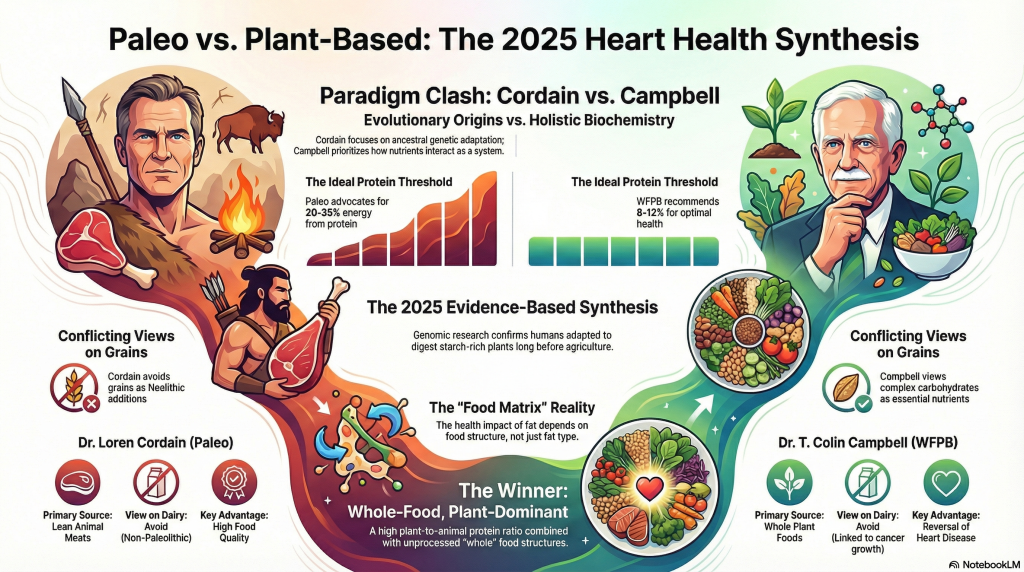
To truly settle the long-running “cold war” between Dr. Loren Cordain’s Paleo camp and Dr. T. Colin Campbell’s plant-based paradigm, we have to look past the slogans and focus on the biological mechanisms of disease. For decades, we’ve been told it’s a binary choice. But the research from late 2024 and 2025 has given us a far more interesting “middle way.” One side holds the crown for heart health, while the other was right to sound the alarm about food quality all along.
Q: Were we ever really “meat-only” hunters?
Probably not; at least not in the way the “Man the Hunter” myth suggests. Breakthrough genomic research has significantly revised our ancestral story. A massive 2024 study published in Science confirmed that the duplication of the AMY1 gene, which allows us to digest starch efficiently, dates back nearly 800,000 years [1].
This happened hundreds of thousands of years before agriculture and even before Homo sapiens fully emerged. This means starch-rich plants weren’t some unnatural Neolithic addition; they were a core energy strategy that likely fueled the expansion of the human brain long before we ever planted a crop.
Q: Does science actually support a plant-dominant diet for heart health?
 The evidence here is remarkably consistent. When you look at cardiovascular disease (CVD) and longevity, the data increasingly leans toward Dr. Campbell’s whole-food, plant-based (WFPB) model.
The Nurses’ Health Study (2024) tracked participants for decades and found that higher plant protein intake in midlife is a major predictor of “healthy aging”—meaning you reach old age without major chronic disease or cognitive decline [2]. The key takeaway? It’s not just about getting “enough” protein; it’s about where that protein comes from. Swapping even a small amount of animal or dairy protein for plant sources like legumes or nuts is linked to significantly better vascular health [2]. While Cordain correctly identified that sugar is a villain, he likely underestimated how certain growth signals in animal protein can contribute to long-term arterial damage.
Q: Is saturated fat the villain Campbell claimed, or a “non-issue”?
The reality is nuanced. We’ve moved into the era of the “Food Matrix.” Researchers like Dr. Arne Astrup have shown that saturated fats don’t operate in a vacuum; their effect on your heart depends entirely on the structure of the food they’re in [4].
Saturated fat from fermented dairy (like yogurt) or minimally processed foods doesn’t carry the same heart-disease risk as the saturated fat found in ultra-processed industrial products [4]. This shifts the focus away from blanket fat bans and toward a more practical question: What is the food, and how much has it been messed with?
Q: What about the “Blue Zones” and longevity?
This is where the narrative gets a reality check. Demographer Saul Newman, who won an Ig Nobel in 2024, has raised serious questions about the “Blue Zone” data. His research suggests that many claims of extreme longevity in places like Okinawa or Sardinia may be linked to poor record-keeping or even pension fraud rather than a “miracle” diet [3]. While plant-rich diets are undeniably healthy, the mythology of “longevity secrets” in these regions deserves a healthy dose of skepticism [3]. But although the longest lived individuals are in question, there is no doubt these populations on whole are healthier than meat based diet cultures.
Q: Where does Dr. Cordain still have the upper hand?
On food quality, unequivocally. One of the biggest mistakes we make today is assuming “plant-based” is a synonym for “healthy.”
Ultra-processed vegan foods—refined breads, industrial meat substitutes, and sugary cereals—carry the same cardiovascular risks as their processed animal counterparts. This validates Cordain’s original warning: industrial processing, not just the choice of plant vs. animal, is a primary driver of modern disease. This “Paleo” suspicion of industrial food fits perfectly with our modern understanding of the food matrix [4].
The Final Verdict: Who Won?
- For Heart Health and Longevity: Dr. T. Colin Campbell. A diet centered on minimally processed plant foods, with plant protein doing the heavy lifting, remains the gold standard for protecting your arteries [2].
- For Dietary Quality: Dr. Loren Cordain. He was right to be suspicious of the modern food industry. The healthiest diet isn’t just about the “source” (plants)—it’s about the “structure” (whole foods).
- The debate was not about processed foods though so overall overwhelmingly Campbell wins on the fact that plant based nutrition wins with overall health and heart health. To me the data is clear! So no surprises herein….
The 2025 winner is a synthesis: A Whole-Food, Plant-Dominant diet. It’s a way of eating that respects our evolutionary ability to eat starches while protecting our heart through a high plant-to-animal protein ratio.
References
- Yilmaz F, Karageorgiou C, Kim K, et al. Reconstruction of the human amylase locus reveals ancient duplications seeding modern-day variation. Science. 2024;386(6724):eadn0609. doi:10.1126/science.adn0609
- Ardisson Korat AV, Shea MK, Jacques PF, et al. Dietary protein intake in midlife in relation to healthy aging – results from the prospective Nurses’ Health Study cohort. Am J Clin Nutr. 2024;119(2):271-282. doi:10.1016/j.ajcnut.2023.11.010
- Buettner D, Skemp S. Blue Zones: Lessons From the World’s Longest Lived. Am J Lifestyle Med. 2016;10(5):318-321. Published 2016 Jul 7. doi:10.1177/1559827616637066
- Astrup A, Magkos F, Bier DM, et al. Saturated Fats and Health: A Reassessment and Proposal for Food-Based Recommendations: JACC State-of-the-Art Review. J Am Coll Cardiol. 2020;76(7):844-857. doi:10.1016/j.jacc.2020.05.077
The Protein Debate: Dr. Loren Cordain vs. Dr. T. Colin Campbell
Originally Published: March 19, 2008
Participants: * Dr. Loren Cordain: Professor, Colorado State University; Author of The Paleo Diet.
- Dr. T. Colin Campbell: Professor Emeritus, Cornell University; Author of The China Study.
Part I: The Case for High Protein (Dr. Loren Cordain)
The Evolutionary Argument
Dr. Cordain argues that human nutritional requirements are genetically determined by the process of natural selection. He posits that for over 2 million years, the genus Homo consumed significant amounts of animal protein.
- Fossil Evidence: Stone tools appearing 2.6 million years ago (MYA) show clear evidence of butchery and marrow extraction.
- Genetic Adaptations: Humans have a reduced ability to synthesize certain nutrients found in meat (like taurine and certain long-chain fatty acids) because they were so prevalent in our ancestral diet.
- Isotopic Data: Analysis of Neanderthal and early Homo sapiens remains indicates they functioned as “top-level carnivores.”
- Ethnographic Data: Analysis of 229 hunter-gatherer societies shows a median subsistence of 56–65% from animal foods.
Health and Clinical Evidence
Cordain asserts that “high protein” (20–30% of energy) and “very high protein” (30–40%) diets are the biological norm.
- Cardiovascular Health: Clinical trials show lean animal protein improves blood lipid profiles and lowers blood pressure.
- Weight Regulation: Protein is more satiating than fats or carbs, aiding in weight loss and insulin sensitivity.
- Bone Health: While protein increases urinary calcium, it also increases intestinal calcium absorption, resulting in a neutral or positive bone balance.
- Kidney Function: Studies show no adverse effects on the kidneys of healthy individuals; the kidney adapts to higher protein loads.
Part II: The Case for Low Protein (Dr. T. Colin Campbell)
The Nutritional Requirement
Dr. Campbell focuses on the Recommended Daily Allowance (RDA), which suggests 0.8g of protein per kg of body weight—roughly 9–10% of total calories.
- Protein History: The cultural “reverence” for animal protein dates back to the 19th century, often driven by personal bias rather than health outcomes.
- The 10% Threshold: Campbell argues that 10% protein is adequate for 98% of the population. Most Americans consume 11–22%.
Risks of Excess Animal Protein
Campbell contends that animal-based proteins (specifically) act on biological systems in ways that promote disease:
- Metabolic Acidosis: Animal protein creates an acid load that may lead to bone calcium loss.
- Hormonal Shift: High protein intake increases growth hormones like IGF-1 and IGF-2, which are linked to cancer promotion.
- Cancer Studies: Campbell’s research on rodents showed that the milk protein casein could “turn on” tumor growth when fed at levels above 10%, and “turn off” growth when reduced.
- Holistic Health: He advocates for a Whole Food Plant-Based (WFPB) diet, arguing that the health benefits attributed to plant diets come from the synergy of plant nutrients and the absence of animal-based “promoters.”
Part III: Rebuttals
Cordain’s Rebuttal to Campbell
- Minimal vs. Optimal: Cordain argues that Campbell confuses the “minimum” needed to survive with the “optimal” amount for health.
- Cereal Grains: He criticizes Campbell’s reliance on grains, noting they are a recent addition to the human diet and cause issues like celiac disease.
- Casein vs. Meat: He argues Campbell’s cancer findings on casein (milk protein) cannot be generalized to the proteins found in lean muscle meats (actin and myosin).
Campbell’s Rebuttal to Cordain
- Philosophy of Nutrition: Campbell rejects Cordain’s “reductionist” approach. He believes nutrition is a holistic system that cannot be understood by looking at isolated nutrients.
- The Evolutionary “Trap”: He cites evolutionary psychologists who argue that just because ancestors ate something to survive and reproduce doesn’t mean it’s the optimal diet for long-term health (longevity).
- Clinical Trials vs. Reality: Campbell dismisses randomized controlled trials as the “gold standard” for lifestyle nutrition, favoring broad population observations.
Summary Comparison Table
| Feature | Dr. Loren Cordain (Paleo) | Dr. T. Colin Campbell (WFPB) |
| Ideal Protein % | 20% – 35% | 8% – 12% |
| Primary Source | Lean Animal Meats | Whole Plant Foods |
| Key Paradigm | Evolutionary Adaptation | Holistic Biochemistry |
| View on Grains | Avoid (Inconsistent with evolution) | Essential (Complex carbohydrates) |
| View on Dairy | Avoid (Non-Paleolithic) | Avoid (Cancer promoter/Casein) |