
Ernährungs- und klinische Strategien für den alternden Ausdauersportler
Ausgleich Sarkopenie Prävention, kardiovaskuläre Sicherheit und onkologisches Risiko bei Menschen über 65 Jahren
Das Altern stellt für Leistungssportler im Ausdauersport eine komplexe physiologische Herausforderung dar. Ab dem 65. Lebensjahr erfordert das Zusammenspiel von körperlicher Leistungsfähigkeit, altersbedingter Sarkopenie und den Signalwegen der Zelllebensdauer eine sorgfältig abgestimmte Ernährungsstrategie.[1] Erhaltung der Skelettmuskelmasse und der funktionellen Leistungsfähigkeit bei gleichzeitiger Minderung der Risiken von Herz-Kreislauf-Erkrankung und die Onkogenese erfordert ein differenziertes Verständnis der Aminosäurekinetik, der intrazellulären Signalübertragung und der metabolischen Schwellenwerte.[2] In diesem Bericht werden die physiologischen Anforderungen, die Sicherheit und die Optimierung eines Ernährungsplans für einen über 65-jährigen Ausdauersportler der Meisterklasse mit einem Gewicht von 170 lb (77,11 kg) bewertet, der sich überwiegend vegetarische Ernährung ergänzt durch Hähnchen, Protein Isolate und freies L-Leucin.
Durchgehend werden die Aussagen nach der Evidenzstufe eingestuft. Die stärkste Evidenz gibt es für eine ausreichende Gesamtproteinaufnahme, eine sinnvolle Verteilung der Mahlzeiten und die Kombination von Proteinzufuhr mit regelmäßiger körperlicher Aktivität – insbesondere Krafttraining.[2] Behauptungen, die sich auf Mechanismen der Langlebigkeit, die Krebsbiologie oder immunmetabolische Signalwege beziehen, stützen sich größtenteils auf Beobachtungsdaten, mechanistische Erkenntnisse oder Tierversuchsdaten und werden eher als biologischer Kontext denn als klinischer Beweis für einen bestimmten Ernährungsplan dargestellt.[1,20]
Sarkopenie, anabole Resistenz und das Paradoxon des „Master-Athleten“
Der fortschreitende Verlust an Skelettmuskelmasse und funktioneller Kraft – auch als Sarkopenie bezeichnet – beginnt bereits im dritten Lebensjahrzehnt und beschleunigt sich ab dem 60. Lebensjahr.[3] Bei untrainierten Personen können akute Ereignisse wie ein Krankenhausaufenthalt oder Muskelinaktivität eine katabole Krise und einen raschen, oft nur unvollständig reversiblen Muskelabbau auslösen. Für den erfahrenen Ausdauersportler ist der Erhalt der Muskelmasse nicht nur für die Leistung und Regeneration von entscheidender Bedeutung, sondern auch als bestimmender Faktor für systemische Stoffwechselgesundheit und lebenslange funktionelle Selbstständigkeit.[2]
Der Hauptmechanismus, der die Sarkopenie verursacht, ist “anabole Resistenz”—eine abgeschwächte Reaktion der Skelettmuskelproteinsynthese (MPS) auf beides Hyperaminoazidämie und körperliche Betätigung.[4] Auf molekularer Ebene beschränkt sich diese Desensibilisierung auf das mechanistische Ziel von Rapamycin Der mTORC1-Signalweg, der mechanische, hormonelle und Aminosäure-Signale integriert, um die Translationsinitiierung über die nachgeschaltete Phosphorylierung von p70S6K1 und 4E-BP1.[5]
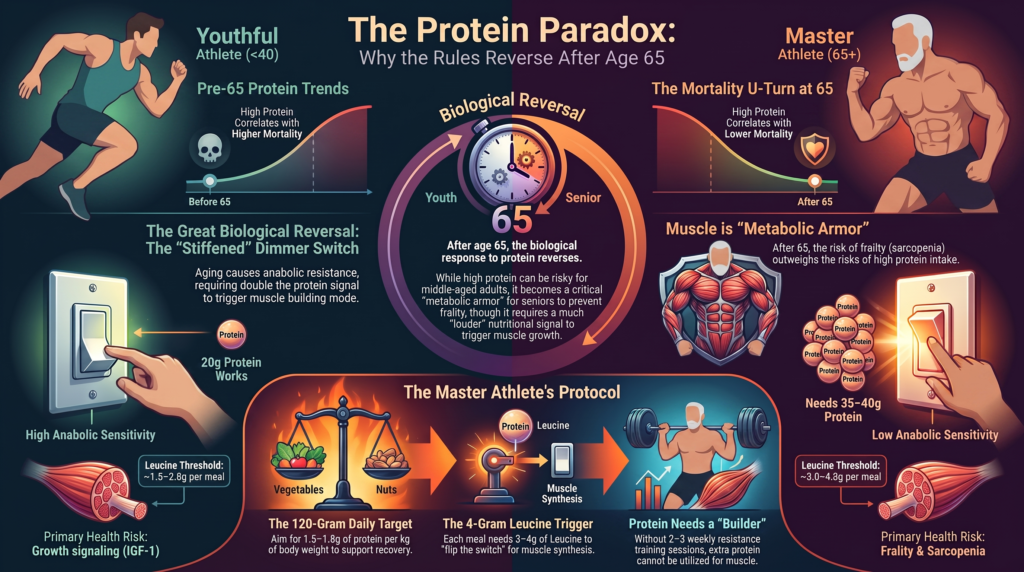
Bei jüngeren Personen führt eine moderate Proteindosis (≈20 g) zu einem Plasma- Leucin Dieser Anstieg reicht aus, um mTORC1 an der Lysosomenmembran zu rekrutieren und zu aktivieren, und zwar über den Sestrin2–GATOR2–Leucyl-tRNA-Synthetase-Achse. Bei älteren Erwachsenen ist eine höhere intrazelluläre Leucin-Konzentration erforderlich, um den altersbedingten “Dimmerschalter” der anabolen Resistenz zu überwinden und gleichwertige Translationsinitiationsraten zu erreichen – den erhöhten “Leucin-Auslöser”.[4,6]
Die Rolle der lebenslangen Weiterbildung
Ob lebenslanges Ausdauertraining im Wettkampfsport Masters-Sportler vor einer anabolen Resistenz bewahrt, ist nach wie vor umstritten. Regelmäßiger Sport stellt die Empfindlichkeit der Muskeln gegenüber der Proteinzufuhr teilweise wieder her, doch sind auch Masters-Sportler nicht vor dem chronologischen Altern gefeit.[7] Intensives Ausdauertraining führt zu myofibrillären Mikroschäden und erhöht die Aminosäureoxidation in der Skelettmuskulatur (die in glykogenarmen Zuständen noch weiter ansteigt), wodurch sich der Grundbedarf an Proteinen für die Gewebereparatur erhöht.[8] Klinische Untersuchungen deuten zudem darauf hin, dass ältere Muskeln eine verlangsamte Regenerationskinetik nach dem Training aufweisen, was eine gezielte, leucinreiche Nahrungsaufnahme nach dem Training erforderlich macht, um den Kontraktionsapparat vollständig wiederherzustellen.[7]
| Physiologischer Parameter | Jugendlicher Phänotyp (<40) | Geriatrischer Phänotyp (≥ 65) | Klinische Bedeutung für Sportler |
| Basale MPS-Rate | Pflege | Relativ gut erhalten | Der Grundumsatz der Muskeln bleibt mit zunehmendem Alter weitgehend funktionsfähig. |
| Reaktion des MPS auf eine geringe Proteinzufuhr (<20 g) | Robust | Abgeschwächt / fehlend | Mahlzeiten unterhalb des Schwellenwerts lösen bei älteren Erwachsenen keine Muskelregeneration aus. |
| Leucin-Schwellenwert bei der Mahlzeit | ~1,5–2,0 g | ~3,0–4,0 g | Ältere Muskeln benötigen etwa doppelt so viel Leucin, um mTORC1 zu aktivieren. |
| mTORC1-Empfindlichkeit | Hoch | Gering / abgeschwächt | Erfordert präzise Ernährungsstrategien, um die Translation anzuregen. |
| Sensibilisierung nach dem Training | Anhaltend über 24–48 Stunden | Abgeschwächt | Master-Sportler benötigen eine schnelle und gezielte Ernährung zur Regeneration. |
Hinweis: Die Leucin-Schwellenwerte sind Richtwerte, die aus MPS-Studien mit stabilen Isotopen bei jüngeren und älteren Erwachsenen abgeleitet wurden; die individuellen Schwellenwerte variieren je nach Trainingszustand, Zusammensetzung der Mahlzeiten und Gesundheitszustand.
Protein als einer von mehreren entscheidenden Faktoren
Es sollte klargestellt werden, dass Eiweiß nur ein Faktor für den Erhalt der Muskelmasse ist und selten der ausschlaggebende. Schlafqualität und -dauer, eine ausreichende Gesamtenergiezufuhr, Krafttraining und allgemeine körperliche Aktivität, chronische Erkrankungen, systemische Entzündung, der endokrine Status und die Einnahme von Medikamenten haben alle einen erheblichen Einfluss auf die Muskelproteinsynthese und die Netto-Proteinbilanz bei älteren Erwachsenen.[2,3] Eine Optimierung der Proteinaufnahme kann Defizite in diesen anderen Bereichen nicht vollständig ausgleichen, und eine Ernährungsempfehlung, die isoliert von diesen Bereichen gegeben wird, wird wahrscheinlich nicht die beabsichtigte Wirkung erzielen. In der klinischen Praxis profitiert ein Sportler, der zu wenig schläft, sich unzureichend ernährt oder mit einer entzündlichen Erkrankung zu kämpfen hat, in der Regel mehr davon, diese Faktoren anzugehen, als von einer weiteren Feinabstimmung des Leucin-Gehalts pro Mahlzeit.
Tägliche Proteinzufuhr im Vergleich zur Verteilung auf einzelne Mahlzeiten
Um die ideale Proteinverteilung für einen 77,11 kg schweren Masters-Sportler zu ermitteln, muss der pauschale Tagesbedarf mit der Dosierung pro Mahlzeit in Einklang gebracht werden. Es besteht eine offensichtliche Diskrepanz zwischen einem in g/kg/Tag ausgedrückten Tagesbedarf und einem festen Zielwert von ca. 40 g pro Mahlzeit.
Die Arithmetik
Tägliche Proteinzufuhr bei 1,2 g/kg/Tag = 77,11 kg × 1,2 g/kg = 92,53 g/Tag
Drei Mahlzeiten × 40 g = 120 g/Tag
Relative Tagesaufnahme = 120 g ÷ 77,11 kg ≈ 1,56 g/kg/Tag
Der Verzehr von 40 g pro Mahlzeit bei drei Mahlzeiten ergibt somit ≈1,56 g/kg/Tag, was über dem häufig für sitzende oder mäßig aktive ältere Erwachsene genannten “Optimalwert” von ~1,2 g/kg/Tag liegt.[2]
Die Lösung des Paradoxons für Ausdauersportler
Zwar sorgt eine Zufuhr von ~1,2 g/kg/Tag bei älteren Menschen mit sitzender Lebensweise für einen ausgeglichenen Stickstoffhaushalt, doch ist es unwahrscheinlich, dass diese Menge für hochaktive Ausdauersportler im fortgeschrittenen Alter optimal ist.[2,9] Studien zur Indikator-Aminosäure-Oxidation (IAAO) bei ausdauertrainierten Erwachsenen haben den Bedarf während der Erholungsphase nach dem Training auf etwa 1,6–1,8 g/kg/Tag geschätzt.[10] Diese Studie wurde an ausdauertrainierten Erwachsenen und nicht speziell an Sportlern über 65 Jahren durchgeführt, und es wurde nicht direkt nachgewiesen, ob dieselbe Empfehlung auch für diese ältere Bevölkerungsgruppe gilt. Eine altersbedingte anabole Resistenz in Verbindung mit einem hohen Trainingsvolumen liefert dennoch eine Begründung dafür, eine Menge von etwa 1,4–1,6 g/kg/Tag in Betracht zu ziehen, die individuell auf die Trainingsbelastung, die Energieverfügbarkeit, die Körperzusammensetzung und den klinischen Status abgestimmt ist.[2,4,10]
Für den in diesem Artikel als Beispiel herangezogenen 77,11 kg schweren Sportler gilt ein Zielwert von ca. 120 g/Tag (≈1,56 g/kg/Tag), verteilt auf drei bis vier Bolusgaben von jeweils ca. 35–40 g, wodurch die Schwelle zwischen anaboler Wirkung und Resistenz wiederholt überschritten wird (ca. 3 g Leucin) und deckt gleichzeitig den Bedarf des Trainings an oxidativer und struktureller Regeneration ab.[2,9] Dies ist ein fundiertes Ziel für eine bestimmte Person mit einer bestimmten Trainingsbelastung. Es sollte nicht als allgemein gültige Vorgabe für alle Ausdauersportler der Master-Klasse verstanden werden.
Individuelle Ausrichtung auf die Zielgruppe und abnehmende Erträge
Die Proteinempfehlungen für ältere Erwachsene werden üblicherweise pro Kilogramm Körpergewicht angegeben und anschließend individuell an die Körperzusammensetzung, den Gesundheitszustand und die Trainingsbelastung angepasst.[2] Bei Sportlern mit ausgeprägter Adipositas oder chronischen Erkrankungen greifen Ärzte manchmal auf eine angepasste Körpergewichtsbasis zurück, um eine Überdosierung und eine unnötige Harnstoffproduktion zu vermeiden; dabei handelt es sich jedoch eher um eine kontextspezifische Anpassung als um eine allgemeingültige Regel. Metaanalytische Daten deuten auf einen anabolen “Wendepunkt” bei etwa 1,3 g/kg/Tag in der Allgemeinbevölkerung hin, jenseits dessen zusätzliche Proteinzufuhr nur noch einen marginalen Nutzen für den Muskelaufbau bringt. Bei Ausdauersportlern mit hohem Trainingsvolumen scheint sich dieser Wendepunkt nach oben zu verschieben: Da Aminosäuren während des Trainings kontinuierlich als Substrat oxidiert werden, geht das zusätzliche Protein nicht verloren, sondern wird zur Energieversorgung und zur Reparatur trainingsbedingter myofibrillärer Schäden genutzt.[10]
| Ernährungsparadigma | Tagesziel (77,11 kg) | Typische Verteilung | Auswirkungen auf die Muskulatur / Sarkopenie | Lebensdauer / Auswirkungen auf den Stoffwechsel |
| RDA bei sitzender Lebensweise | 0,8 g/kg/Tag (~61,7 g/Tag) | ~15 / 20 / 27 g | Bei aktiven älteren Erwachsenen wird der Muskelerhalt möglicherweise nicht optimal gewährleistet; Mahlzeiten unterhalb der Schwelle lösen die Protein-Synthese möglicherweise nicht zuverlässig aus. | Geringe mTORC1-Aktivierung; kann zu einer Senkung des systemischen IGF-1 führen. |
| Ziel für die Lebenserwartung im hohen Alter | 1,0–1,2 g/kg/Tag (~77–93 g/Tag) | ~20 / 30 / 35 g | Grenzwert für aktive Populationen; die Erholung wird möglicherweise nicht optimal gefördert. | Schafft ein Gleichgewicht zwischen dem Erhalt der Muskelmasse und einer geringeren kumulativen mTOR-Signalübertragung. |
| Erholungsziel für Master-Athleten | 1,4–1,6 g/kg/Tag (~108–123 g/Tag) | ~35–40 g pro Mahlzeit | Unterstützt den MPS und gleicht Schäden nach dem Training aus. | Führt zu einer vorübergehenden mTORC1-Aktivierung; diese wird durch einen hohen Anteil an pflanzlichem Eiweiß abgeschwächt. |
Leucin, mTORC1 und onkologisches Risiko
Der zentrale Zielkonflikt in der geriatrischen Sporternährung besteht zwischen Wachstum und somatischer Erhaltung. Die Aktivierung von mTORC1 ist für die Integrität der Myofibrillen und die Vorbeugung von Sarkopenie wünschenswert, doch eine chronische, anhaltende Hyperaktivierung dieses Signalwegs steht im Zusammenhang mit zellulärer Alterung und Tumorentstehung. Wichtig ist, dass die vorübergehende mTORC1-Aktivierung, die auf körperliche Betätigung und Proteinzufuhr folgt, ein normales, vorteilhaftes anaboles Signal darstellt; Bedenken bestehen vielmehr hinsichtlich einer anhaltenden, chronischen Aktivierung als bei physiologischen Impulsen nach einer Mahlzeit oder nach körperlicher Betätigung.[1]
Die altersabhängige Umkehrung der Sterblichkeit
Eine Längsschnittanalyse der NHANES III durch Levine und Kollegen ergab, dass bei Erwachsenen im Alter von 50 bis 65 Jahren eine hohe Proteinaufnahme (definiert als ≥20% der täglichen Kalorienzufuhr) mit einem Anstieg von 75% bei Gesamtmortalität sowie einen etwa vierfachen Anstieg der Krebssterblichkeit in den folgenden 18 Jahren – Zusammenhänge, die abgeschwächt wurden oder ganz verschwanden, wenn das Protein pflanzlichen Ursprungs war.[1] Die Autoren führten diese Zusammenhänge auf erhöhte IGF-1-Spiegel und eine nachgeschaltete mTORC1-Signalübertragung zurück. Es handelt sich hierbei um eine Beobachtungsstudie an einer allgemeinen Population, nicht um eine sportlerbezogene oder kausale Untersuchung, und eine hohe Proteinzufuhr war zudem mit einem fünffachen Anstieg von Diabetes Sterblichkeit in allen Altersgruppen – ein Vorbehalt, der für jede proteinreiche Ernährung gilt.[1]
Entscheidend ist, dass sich der Trend ab dem 65. Lebensjahr umkehrt: In der älteren Kohorte war eine hohe Proteinaufnahme verbunden mit reduziert Krebs und die Gesamtmortalität, während proteinarme Ernährungsweisen mit einem höheren Risiko verbunden waren – was mit der klinischen Realität übereinstimmt, dass Gebrechlichkeit, Immunschwäche und Sarkopenie die Risiken eines moderaten Anstiegs des IGF-1-Spiegels in dieser Bevölkerungsgruppe überwiegen. Für einen Sportler ab 65 Jahren ist eine ausreichende Proteinzufuhr zum Erhalt der Muskelmasse daher eine Schutzstrategie.[1]
Einführung vs. Weiterentwicklung
Es ist von entscheidender Bedeutung, die Entstehung von Krebs von seinem Fortschreiten zu unterscheiden:
- Onkologische Erstbehandlung. Es fehlen direkte Belege beim Menschen, die eine Leucin-Supplementierung oder eine proteinreiche Ernährung mit De-novo-Mutationen oder der Auslösung von Karzinogenese bei einem gesunden Wirt in Verbindung bringen; auch die Daten zu langfristigen Krebsverläufen bei gesunden älteren Sportlern sind begrenzt, weshalb Empfehlungen weiterhin vorsichtig ausfallen sollten, anstatt das Fehlen von Belegen als Beweis für das Nichtvorhandensein zu werten.[11]
- Onkologisches Fortschreiten. Viele etablierte bösartige Tumoren sind für ihre Proliferation in hohem Maße auf exogene Aminosäuren angewiesen und weisen häufig eine Überexpression von Leucintransportern auf (z. B., LAT1/SLC7A5), um die konstitutive mTORC1-Aktivität anzukurbeln und der Apoptose zu entgehen. Die Rolle von Leucin ist kontextabhängig: Es mildert den Muskelschwund bei Kachexie, doch bei aktivem Brust- und Bauchspeicheldrüsenkrebs wurden tumorfördernde Wirkungen nachgewiesen.[11,12]
Die Gefahr eines schweren Leucinmangels
Ein starker, anhaltender Leucinmangel erweist sich als therapeutische Strategie als erfolglos. Präklinische Brustkrebsmodelle zeigen, dass eine Leucinrestriktion zwar die unmittelbare Translation verringert, paradoxerweise jedoch eine kompensatorische Hochregulation von Akt (Proteinkinase B) auslöst, wodurch die mTORC1-Hemmung umgangen und alternative Überlebenswege aktiviert werden.[13] Umgekehrt, klinische Studien bei älteren Erwachsenen, die sich einer aktiven Krebsbehandlung unterziehen, zeigen, dass eine Supplementierung mit L-Leucin sicher und wirksam ist, um Kachexie zu lindern und die fettfreie Masse zu erhalten, ohne dass Anzeichen für ein beschleunigtes Tumorwachstum vorliegen.[14]
Ernährungsstruktur: Eine Basis aus vegetarischen Lebensmitteln und Hühnerfleisch mit pflanzlichem und ergänzendem Eiweiß
Herzschützende Verhältnisse von pflanzlichem zu tierischem Eiweiß
Groß prospektive Kohorten deuten darauf hin, dass die Gesundheitsrisiken, die in der Vergangenheit mit proteinreicher Ernährung in Verbindung gebracht wurden, sich weitgehend auf Ernährungsweisen konzentrieren, die vorwiegend aus verarbeiteten und rotes Fleisch, während eine höhere Zufuhr über die Nahrung Verhältnis von pflanzlichem zu tierischem Protein ist mit einer geringeren Gesamtmortalität sowie einer geringeren kardiovaskulären und krebsbedingten Mortalität verbunden.[15,16] Eine Ernährung, die überwiegend auf pflanzlichen Nahrungsmitteln sowie magerem Geflügel basiert, führt zu einem hohen Verhältnis von pflanzlichen zu tierischen Nahrungsmitteln; Dosis-Wirkungs-Beziehung Analysen zeigen, dass der Ersatz von rotem Fleisch und Milchprodukten durch Hülsenfrüchte, Nüsse und mageres Geflügel zu einer Verbesserung führt Endothelfunktion und senkt Entzündungsmarker wie hs-CRP.[15]
Erbsenprotein vs. Molkenprotein: Die Methionin-Frage
Molke zeichnet sich durch ein vollständiges Aminosäureprofil, eine schnelle Verdaulichkeit und einen hohen Leucin-Gehalt aus. Erbsenprotein ist eine praktische, für Vegetarier geeignete Alternative, die von Natur aus weniger schwefelhaltige Aminosäuren enthält. Methionin und Cystein als Molke.[6] Dieser Unterschied in der Zusammensetzung wird manchmal im Zusammenhang mit der Methioninrestriktion betrachtet, einem aktuellen Forschungsgebiet der Krebsbiologie: Viele Krebszellen weisen eine Methioninabhängigkeit auf (den Hoffman-Effekt) und geraten – im Gegensatz zu den meisten normalen Zellen – in einen Zellzyklusstillstand, wenn Methionin nur begrenzt verfügbar ist.[17] Diese Erkenntnisse stammen jedoch größtenteils aus der präklinischen Forschung oder aus der Therapie (bei Patienten mit bereits bestehender Erkrankung). Sie belegen nicht, dass die Wahl von Erbsenprotein anstelle von Molkenprotein das Krebsrisiko bei einem gesunden älteren Sportler senkt, und es liegen keine entsprechenden Präventionsdaten aus Studien am Menschen vor. Die gesamte Methioninaufnahme über die Nahrung spiegelt zudem eher die allgemeinen Ernährungsgewohnheiten wider als eine einzelne Proteinquelle; daher führt der Ersatz eines Isolats für sich genommen nicht zu einer nennenswert methioninarmen Ernährung. Die Auswahl der Quelle ist hier eine sinnvolle Entscheidung im Rahmen der Ernährungsgewohnheiten, keine etablierte Maßnahme zur Krebsprävention.[6,17]
| Nährwertangaben (pro 100 g Eiweiß) | Erbsenisolat | Molkenisolat |
| Leucin-Gehalt | ~8% (über dem von WHO/FAO/UNU festgelegten Bedarf von 5,9%) | ~11.0% |
| Gesamt essentielle Aminosäuren (EAAs) | Unterer Bereich (Pflanzenisolate ~21–30%) | ~43% |
| Methionin (Schwefelhaltige Aminosäuren) | Niedrig (limitierende Aminosäure) | Höher |
| Arginin (KEIN Vorläufer) | Relativ hoch | Relativ niedrig |
| Verdaulichkeit (PDCAAS) | ~0,82–0,89 | 1.00 |
Die Werte beziehen sich auf 100 g Proteingehalt, gemessen mittels UPLC–MS/MS (Gorissen et al., 2018); die Prozentangaben geben die Masse der Aminosäuren als Anteil am Gesamtprotein wieder. Die vom Hersteller angegebenen Werte pro Portion variieren je nach Produkt.
Der praktische Nachteil von Erbsenprotein – eine geringere Leucin-Dichte und ein geringerer Gehalt an essentiellen Aminosäuren als bei Molke – lässt sich teilweise ausgleichen. Kontrollierte Studien zeigen, dass die Anreicherung von Erbsenprotein (oder anderem pflanzlichen Protein) mit L-Leucin in freier Form die mTORC1-Aktivierung erhöht und die akute myofibrilläre MPS-Reaktion auf ein Niveau anregen kann, das mit dem von Molke vergleichbar ist.[18,19] Diese Äquivalenz ist dosis- und ergebnisabhängig und sollte nicht pauschal auf alle Dosierungen, Ergebnisse chronischen Trainings oder jede ältere Bevölkerungsgruppe übertragen werden. Der höhere Arginin-Gehalt von Erbsen ist ein sekundärer Faktor für die durch Stickstoffmonoxid vermittelte Endothelfunktion. Für einen älteren Sportler sollte die Wahl der Quelle am besten anhand der Verträglichkeit, der allgemeinen Ernährungsqualität, der ausreichenden Aminosäurenversorgung und des kardiometabolischen Profils erfolgen und nicht auf der Annahme beruhen, dass ein bestimmtes Isolat von Natur aus überlegen ist.[6]
Die andere Seite der Methioninrestriktion
In der vorangegangenen Erörterung wird Methionin als Variable mit einer einzigen wünschenswerten Richtung betrachtet. Jüngste Erkenntnisse deuten darauf hin, dass der Zusammenhang nicht monoton verläuft und dass der untere Teil der Kurve Kosten mit sich bringt, die für diese Bevölkerungsgruppe unmittelbar relevant sind.
Fanti und Kollegen aus Longos Forschungsgruppe fütterten 20 Monate alte HET3-Mäuse mit einer von vier Ernährungsformen: Standardfutter, eine westliche Ernährungsweise, eine ketogene Ernährungsweise oder eine proteinarme “Langlebigkeitsdiät”, die sich an der traditionellen Ernährung im Mittelmeerraum und auf Okinawa orientierte und mit Methionin (LDMM).[30] Die LDMM-Gruppe wies die längste Gesundheitsspanne, die geringste Fettmasse und die geringste Gebrechlichkeit, verbunden mit einem verringerten IGF-1-Spiegel und erhöhten Werten für Wachstumshormon, GLP-1 und Fibroblasten-Wachstumsfaktor 21 (FGF21) – wobei letzterer für den beobachteten Fettabbau erforderlich war und Insulin Sensibilisierung.[30] Eine parallele Auswertung von Ernährungs- und Gesundheitsdaten von mehr als 200.000 Erwachsenen ergab höhere Adipositas Prävalenz und eine etwa doppelt so hohe Rate an Typ-2-Diabetes bei denjenigen mit der höchsten Zufuhr an tierischem Eiweiß.[30]
Entscheidend ist hier die Begründung für das Konzept. Die Forscher gingen von einer Beobachtung aus, die jede einfache, pflanzenorientierte Empfehlung erschwert: Die Bevölkerung in Südeuropa und auf Okinawa weist zwar eine der weltweit höchsten Lebenserwartungen auf, gleichzeitig sind die Raten der Gebrechlichkeit im Alter dort jedoch vergleichsweise hoch.[30] Da pflanzliche Lebensmittel geringere Konzentrationen an essentiellen Aminosäuren enthalten als tierische, wurde der Basis-Langlebigkeitsdiät Methionin wieder zugesetzt, um gezielt zu prüfen, ob die Gebrechlichkeit verringert werden kann, ohne auf die metabolischen Vorteile dieses Ernährungsmusters zu verzichten. Dies war möglich. Bei den untersuchten spezifischen Versuchsdiäten reduzierte die Methionin-Supplementierung die Gebrechlichkeit, während die metabolischen Vorteile des proteinarmen Ernährungsmusters erhalten blieben; die Autoren berichten, dass höhere Methioninwerte diese Vorteile abschwächten. Ihre allgemeinere Schlussfolgerung lautet, dass die Gesamtproteinaufnahme möglicherweise weniger wichtig ist als die Aufnahme bestimmter Aminosäuren.[30] Dies beschreibt das Verhalten bei einer bestimmten Auswahl an Diäten für Nagetiere. Es legt weder eine optimale Methionin-Zufuhr noch eine Schwellenwerte für die Anfälligkeit beim Menschen fest – und sollte auch nicht als solche interpretiert werden.
Hierzu sind sofort drei Einschränkungen anzumerken: Die Daten zur Lebensdauer und zur Gebrechlichkeit stammen von Mäusen, die sich kaum bewegten, und es gibt keine vergleichbare Studie am Menschen; die Autoren nennen eine kontrollierte klinische Studie als nächsten Schritt.[30] Der menschliche Aspekt besteht in der beobachtenden Analyse der Ernährungsgewohnheiten, nicht in einer Intervention. Außerdem haben die Tiere keinen Sport getrieben, wodurch der wichtigste Einflussfaktor auf die Aminosäureverteilung in der in diesem Artikel behandelten Population wegfällt.
Auswirkungen für den Masters-Sportler. Die relevante praktische Frage lautet nicht, ob Methionin minimiert werden sollte, sondern ob eine bestimmte Ernährungsweise den Bedarf deckt. Zur Orientierung: Der von WHO/FAO/UNU im Jahr 2007 festgelegte durchschnittliche Bedarf für Erwachsene an gesamten schwefelhaltigen Aminosäuren (Methionin plus Cystein) liegt in der Größenordnung von 15 mg/kg/Tag, was für einen 77,11 kg schweren Sportler etwa 1,16 g/Tag entspricht; dieser Wert sollte nicht mit dem Wert von 22 mg/g Protein im Bewertungsmodell verwechselt werden, der in anderen Einheiten angegeben ist.[31] Eine abwechslungsreiche Ernährung mit einer Proteinzufuhr von ca. 120 g/Tag – bestehend aus Sojalebensmitteln, Hülsenfrüchten, Vollkornprodukten, Samen, Nüssen, Isolaten sowie Geflügel oder Fisch – liegt deutlich über diesem Bedarf, und eine gut zusammengestellte Ernährung kann diesen Bedarf auch ganz ohne tierisches Protein decken. Die im vorangegangenen Abschnitt beschriebene Literatur zur Methioninrestriktion befasst sich mit der experimentellen Einschränkung auf einen kleinen Bruchteil des Bedarfs, in der Regel im Zusammenhang mit einer nachgewiesenen bösartigen Erkrankung; sie beschreibt nicht den Aufnahmebereich, der durch eine Ernährung aus gemischten Quellen mit 1,4–1,6 g/kg/Tag abgedeckt wird.[17,31]
Die operative Schlussfolgerung fällt enger aus als beide gängigen Darstellungen. Die Entscheidung für Erbsen statt Molke stellt keine sinnvolle Maßnahme zur Methioninrestriktion dar und sollte auch nicht als solche dargestellt werden; ebenso wenig führt sie bei einem gut ernährten Sportler zu einer unzureichenden Versorgung. Eine gut durchdachte pflanzliche Ernährung Die Zufuhr von etwa 120 g Protein pro Tag aus verschiedenen Quellen – Sojalebensmittel, Hülsenfrüchte, Getreide, Samen, Nüsse und Isolate – kann den Bedarf an schwefelhaltigen Aminosäuren problemlos ohne tierisches Protein decken, und der Verzicht auf Geflügel oder Fisch führt für sich genommen nicht zu einem Mangel. Vielmehr erhöht sich dadurch die Abhängigkeit einer ausreichenden Aminosäurenversorgung von der Ernährungsvielfalt und der Gesamtmenge, und der Spielraum für Fehler bei Sportlern mit erhöhtem Bedarf wird kleiner. In diesem Zusammenhang sollte die ausreichende Versorgung mit schwefelhaltigen Aminosäuren und essentiellen Aminosäuren (EAA) insgesamt überprüft und nicht einfach vorausgesetzt werden. Eine Anreicherung mit freiem L-Leucin ist kein Ersatz: Leucin wirkt auf den anabolen Auslöser ein, nicht auf die ausreichende Versorgung mit schwefelhaltigen Aminosäuren.
Kardiovaskuläre Sicherheit und der mTORC1-Schwellenwert bei Makrophagen
Jüngste translationalen Forschungsarbeiten haben einen durch Aminosäuren vermittelten Signalweg identifiziert, der eine übermäßige, nicht gestaffelte Proteinaufnahme mit einem kardiovaskulären Risiko in Verbindung bringt. In klinischen Studien in Kombination mit menschlichen Monozyten/Makrophage In ihren Experimenten identifizierten Zhang und Kollegen Leucin als den wichtigsten Aktivator der mTOR-Signalübertragung in Makrophagen und beschrieben einen Schwellenwerteffekt: Eine Proteinzufuhr von mehr als ~25 g pro Mahlzeit (oder ~22% der Nahrungsenergie) führte zu einer akuten Aktivierung von mTORC1 in Monozyten/Makrophagen.[20] In ernährungsgesteuerten Mausmodellen führte eine Aufnahme über diesem Schwellenwert zu atherosklerotischen Veränderungen Plaque Progression; die Daten zum Zusammenhang zwischen Plaquebildung und Krankheitsverlauf stammen aus Versuchen an Mäusen, während die Daten aus Studien am Menschen die Signalschwelle für Monozyten/Makrophagen festlegen. Dabei handelt es sich um eine unter experimentellen Bedingungen beobachtete mechanistische Signalschwelle und nicht um eine klinisch validierte Obergrenze für die Proteinaufnahme über die Nahrung.[20]
Mechanistisch gesehen hemmt eine anhaltende mTORC1-Aktivierung in Makrophagen die TFEB- und ULK1-Aktivität und unterdrückt so die Makroautophagie – einen Signalweg, der in der Gefäßwand die Cholesterin Ausströmung, Efferozytose, sowie die Beseitigung dysfunktionaler Mitochondrien. Eine anhaltende Unterdrückung fördert die Bildung mitochondrialer ROS, die Apoptose von Makrophagen und die Bildung nekrotischer Kerne innerhalb der Plaque.[20]
Mögliche Strategien, die einer klinischen Validierung bedürfen
Drei Überlegungen könnten letztendlich dazu beitragen, die anabolen Vorteile des Leucin-Triggers mit diesem kardiovaskulären Signal in Einklang zu bringen. Keine davon wurde bisher als Strategie zur Risikominderung beim Menschen validiert, und keine sollte den Lesern als etablierte Schutzmaßnahme präsentiert werden:
- Kopplung körperlicher Aktivität. Körperliche Betätigung führt zu einer erhöhten Expression und Empfindlichkeit der Aminosäuretransporter in der Skelettmuskulatur; Proteine, die im Zeitfenster nach dem Training aufgenommen werden, werden vom Muskel rasch zur Regeneration verwertet, was vermutlich eine längere Exposition zirkulierender Monozyten gegenüber hohen Leucin-Konzentrationen begrenzt. Diese Verteilung ist biologisch plausibel, wurde jedoch beim Menschen noch nicht direkt nachgewiesen.[20]
- Absorptionskinetik. Pflanzliche Proteine aus Vollwertkost werden aufgrund ihrer Zusammensetzung oft langsamer aufgenommen, da Faser und Lebensmittelmatrix. Die Kinetik isolierter Pflanzenproteine variiert je nach Herkunft und Verarbeitung erheblich, und durch die Isolierung wird ein Großteil der Matrix entfernt, die für diese langsamere Resorption verantwortlich ist. Es wurde nicht nachgewiesen, dass die Wahl von Erbsenprotein anstelle von Molkenprotein die mTORC1-Aktivierung in Makrophagen verhindert.[6,20]
- Herzschützende Ernährungsmatrix. Eine pflanzenreiche Ernährung liefert Ballaststoffe, Phytosterole, und Polyphenole dass niedriger LDL-Cholesterin, systemische Entzündungen zu verringern und die Aktivität der endothelialen Stickstoffmonoxid-Synthase zu erhalten.[15]
Genomische und renale Sicherheit einer Leucin-Supplementierung
Nutrigenomische Signale – mit Vorbehalten
In einer 12-wöchigen doppelblinden randomisierten kontrollierten Studie (RCT) mit älteren Erwachsenen, die an Sarkopenie litten oder ein entsprechendes Risiko aufwiesen (n = 47, ~89% Frauen), wurden täglich ~50,6 g Protein und 6 g Leucin verabreicht. Die Die primären Endpunkte waren null.: Es zeigte sich kein signifikanter Interventionseffekt auf die Körperzusammensetzung oder die Muskelfunktion (SPPB).[21] Eine sekundäre Transkriptomanalyse von mononukleären Zellen aus dem peripheren Blut ergab eine signifikante Hochregulation von Genen, die mit der ATP-Produktion (GBA, MLYCD), der Zellproliferation (STAT5A) und der DNA-Reparatur (BRCC3) in Verbindung stehen.[21]
Diese Genexpressionssignale dienen eher der Hypothesenbildung als dem Nachweis eines klinischen Nutzens: Sie wurden in mononukleären Blutzellen (nicht im Muskel) bei einer kleinen, überwiegend aus Frauen bestehenden Stichprobe und im Vergleich zu einem funktionellen Null-Endpunkt gemessen. Sie sollten als plausible mechanistische Richtung interpretiert werden, nicht als nachgewiesene Verbesserung der Mitochondrienfunktion oder der genomischen Stabilität. Allgemeiner betrachtet fehlen langfristige randomisierte Studien zur Leucin-Supplementierung, die über einen Zeitraum von ein bis zwei Jahren hinausgehen, sodass die langfristige Sicherheit und Wirksamkeit in dieser Population weiterhin nicht charakterisiert ist.[21]
Das Gegenargument zur Aminosäure-Restriktion
Die Empfehlung, freies L-Leucin zu supplementieren, steht im Widerspruch zu einem aktiven Forschungszweig der Gerowissenschaft, der davon ausgeht, dass eine Einschränkung der verzweigtkettigen Aminosäuren – und nicht deren Supplementierung – ein gesundes Altern fördert. Die aussagekräftigsten Daten zum Alter stammen von Yeh und Kollegen, die bei 20 Monate alten Mäusen entweder alle Aminosäuren um 67% oder ausschließlich Isoleucin einschränkten: Beide Behandlungsschemata verbesserten die Stoffwechselgesundheit und mehrere molekulare Indikatoren für die Alterungsrate, ohne die Kalorienzufuhr zu reduzieren, und beide verbesserten Aspekte der Gebrechlichkeit.[32] Bemerkenswert ist, dass der Isoleucin-reduzierte Arm bei beiden Geschlechtern zu einer Verringerung der Griffkraft führte und gemischte, geschlechtsabhängige Auswirkungen auf das Herz hatte.[32]
Zwei Beobachtungen bringen dies mit der vorliegenden Empfehlung in Einklang, anstatt den Widerspruch aufzulösen. Erstens befasst sich die Literatur zur Restriktion mit einer chronischen Reduktion der BCAA-Zufuhr über die Nahrung vor dem Hintergrund einer ad-libitum-Fütterung bei sitzender Lebensweise; sie untersucht nicht die akute, zeitlich auf die Mahlzeit abgestimmte Leucinzufuhr an trainierte Skelettmuskeln im Post-Workout-Fenster, in dem sich die Transporterexpression und die Aminosäureclearance deutlich unterscheiden. Zweitens ist das funktionelle Signal in dieser Arbeit – verminderte Griffkraft – genau der Endpunkt, den ein Spitzensportler zu verteidigen versucht, und es weist in dieselbe Richtung wie der Befund zur Gebrechlichkeit bei Fanti et al.[30,32] Die übereinstimmende Einschätzung lautet, dass eine Aminosäurerestriktion und eine ausreichende Aminosäurezufuhr unterschiedliche Endpunkte optimieren und dass ein Sportler über 65, dessen größtes Risiko eher in einem Funktionsverlust als in einer Stoffwechselerkrankung besteht, vernünftigerweise auf der Seite der ausreichenden Zufuhr angesiedelt ist.
Dies ist nach wie vor eine kontroverse Frage in der Fachwelt und keine geklärte Angelegenheit, und Leser, die auf die Literatur zu diesem Thema stoßen, sollten dies auch als solche verstehen.
Personengruppen, die vor der Einnahme von Nahrungsergänzungsmitteln eine ärztliche Beratung benötigen
Die Empfehlungen in diesem Artikel gehen von einem gesunden Mastersportler ohne nennenswerte Begleiterkrankungen aus. Die Einnahme von L-Leucin in freier Form sollte bei Personen mit […] vor Beginn der Einnahme mit dem behandelnden Arzt besprochen werden. chronische Nierenerkrankung zu jedem Zeitpunkt: Leberfunktionsstörungen, angeborene Störungen des Aminosäurestoffwechsels (einschließlich Ahornsirup-Urinsyndrom und damit verbundene Defizite der verzweigtkettigen Ketosäure-Dehydrogenasen), schlecht eingestellter Diabetes oder aktive Malignität bzw. laufende Krebsbehandlung.[11,12,22]
Dieser Hinweis bezieht sich speziell auf die Einnahme von konzentrierten Nahrungsergänzungsmitteln in freier Form und sollte nicht so verstanden werden, dass eine CKD im Frühstadium eine proteinreichere Ernährung ausschließt. Diese Entscheidung hängt von der eGFR, der Albuminurie, der zugrunde liegenden Diagnose, dem Ernährungsstatus und dem klinischen Ermessen ab; eine Eiweißrestriktion birgt bei älteren Erwachsenen eigene Risiken wie Sarkopenie und Funktionsverlust, und die Abwägung ist individuell.[22,23]
Im onkologischen Kontext steht eher das Fortschreiten als die Entstehung im Vordergrund. In kleinen klinischen Studien wurden leucin-haltige Therapien bei Krebskachexie untersucht, ohne dass dabei ein beschleunigtes Tumorwachstum nachgewiesen wurde; diese Evidenzbasis ist jedoch begrenzt und reicht nicht aus, um die onkologische Sicherheit für alle Tumorarten zu belegen.[14] Viele fortgeschrittene Tumoren weisen eine Überexpression von Leucintransportern auf, und die Entscheidung liegt eher beim behandelnden Onkologieteam als bei einem Ernährungsprotokoll.[11]
Nierentoleranz
Die Befürchtung, dass proteinreiche Ernährungsweisen den Nierenfunktionsverlust durch glomeruläre Hyperfiltration beschleunigen, muss unter Berücksichtigung der Nierenfunktion zu Beginn der Studie differenziert betrachtet werden.[22]
- Vorbestehende chronische Nierenerkrankung (CKD). Bei etablierter, mittelschwerer bis schwerer chronischer Nierenerkrankung (CKD) kann eine hohe Proteinaufnahme (insbesondere tierischen Ursprungs) die glomeruläre Schädigung und die Proteinurie verschlimmern.[22]
- Gesunde ältere Menschen. Systematische Übersichten und randomisierte kontrollierte Studien zeigen keine negativen Auswirkungen einer proteinreicheren Ernährung auf die Nierenfunktion bei älteren Erwachsenen ohne vorbestehende Nierenerkrankung.[23] Die einjährige PREVIEW-Teilstudie an älteren Erwachsenen mit Prädiabetes ergab keine negative Veränderung der Kreatinin-Clearance, der eGFR oder des Albumin-Kreatinin-Verhältnisses, und die prospektive SONIC-Kohorte älterer japanischer Erwachsener fand keinen Zusammenhang zwischen der Proteinaufnahme und einer abnehmenden Nierenfunktion – wobei eine höhere Aufnahme in einigen Untergruppen ein schützendes Signal für die eGFR zeigte.[24,25]
Umsetzungskontext: Ausbildung, Energie und Mikronährstoffe
Protein ist eine Ergänzung zu – und kein Ersatz für – einen progressiven Trainingsreiz. Fachleute betonen ausdrücklich, dass Protein am besten in Verbindung mit Sport wirkt und dass Widerstand Training ist eine gleichwertige Maßnahme zum Erhalt der Muskelmasse bei älteren Menschen und findet in der Regel zwei- bis dreimal pro Woche statt.[2] Man sollte nicht davon ausgehen, dass Ausdauertraining allein das Risiko einer Sarkopenie beseitigt; ein erfahrener Radfahrer, der Krafttraining vernachlässigt, verzichtet auf einen erheblichen Teil des erzielbaren Nutzens, unabhängig von seiner Proteinzufuhr.
Eine ausreichende Gesamtenergiezufuhr ist eine Grundvoraussetzung. In denselben Leitlinien wird eine ausreichende Proteinzufuhr mit einer ausreichenden Energiezufuhr in Verbindung gebracht.[2] Bei Ausdauersportlern beeinträchtigt eine chronisch geringe Energieverfügbarkeit die Regeneration, behindert die Anpassung und kann die Gesundheit der Knochen und des Hormonhaushalts gefährden; die Behebung einer unzureichenden Energiezufuhr sollte jeder Feinabstimmung des Leucin-Zeitpunkts oder der Schwellenwerte pro Mahlzeit vorausgehen.
Überlegungen zur Mikronährstoffversorgung bei älteren Sportlern mit pflanzenbetonter Ernährung
Bei einer überwiegend vegetarischen Ernährung älterer Sportler sollte besonders auf bestimmte Nährstoffe geachtet werden, die bei einem proteinorientierten Ernährungsplan sonst leicht übersehen werden können:
- Vitamin B12. Pflanzliche Lebensmittel enthalten von Natur aus kein Vitamin B12, und mit zunehmendem Alter kommt es häufig zu einer Malabsorption von Vitamin B12 aus der Nahrung; Vegetarier sollten Vitamin B12 über angereicherte Lebensmittel oder Nahrungsergänzungsmittel zu sich nehmen und ihren Vitamin-B12-Status regelmäßig überprüfen lassen.[26]
- Nicht-Häm-Eisen (aus Pflanzen) ist weniger bioverfügbar als Hämeisen, und der Eisenbedarf über die Nahrung wird bei Vegetariern auf etwa das 1,8-Fache geschätzt.[27] Eisenmangel bei Ausdauersportlern kann durch eine unzureichende Zufuhr, Verluste im Magen-Darm-Trakt, Hämolyse, entzündungsbedingte Veränderungen im Eisenhaushalt und – speziell bei Läufern – durch eine Hämolyse beim Fußauftritt entstehen. Bestimmen Sie bei klinischer Indikation die Ferritin- und Transferrinsättigung.[27]
- Vitamin D. Die empfohlene Tagesdosis (RDA) steigt mit zunehmendem Alter auf 20 µg (800 IE) pro Tag für Erwachsene über 70 Jahre; angesichts der Bedeutung des Vitamins für die Muskelfunktion und die Knochengesundheit sollte der Vitaminstatus überprüft werden, wenn ein Mangelrisiko besteht.[28]
- Langkettige Omega-3-Fettsäuren (EPA/DHA). Die Umwandlung von pflanzlichem ALA in EPA und DHA ist begrenzt. Sportler, die auf Fisch verzichten, können ein EPA/DHA-Produkt auf Algenbasis in Betracht ziehen, wenn eine direkte Quelle für langkettige Fettsäuren gewünscht wird; dies ist eine sinnvolle Alternative, jedoch keine zwingende Notwendigkeit.[29]
Schlussfolgerungen und klinische Empfehlungen
Für einen gesunden, wettkampferprobten 170 lb (77,11 kg) Master-Ausdauersportler über 65 ist eine tägliche Proteinzufuhr von ca. 1,4–1,6 g/kg/Tag (ca. 108–123 g/Tag) ein vertretbarer Ansatz, um die Muskelmasse zu erhalten und die Regeneration zu unterstützen, während gleichzeitig eine herzschützende Ernährungsweise beibehalten wird.[1,10] Die Zufuhr dieser Menge über drei bis vier Mahlzeiten à ca. 30–40 g – mit Schwerpunkt auf pflanzlichen Proteinen, zusätzlichem Erbsenprotein, magerem Hähnchenfleisch und gezielt zugeführtem freiem L-Leucin – deckt den Aminosäurebedarf beim Training im Rahmen einer ballaststoffreichen Ernährung ab. Die Auswahl der Nahrungsquellen sollte sich in beiden Richtungen an der ausreichenden Versorgung orientieren: Die pflanzenbetonte Ausrichtung ist eine vertretbare Wahl des Ernährungsmusters, doch die ausreichende Versorgung mit Methionin und allen essentiellen Aminosäuren muss gewährleistet und darf nicht minimiert werden, insbesondere wenn Geflügel und Fisch reduziert oder ganz weggelassen werden.[30]
Der mechanistische Schwellenwert von etwa 25 g für die Makrophagen-Signalübertragung ist ein Grund dafür, der Lebensmittelqualität, dem Trainingskontext und dem kardiometabolischen Risikomanagement den Vorzug vor immer größeren Einzelbolussen zu geben; er stellt keine validierte Obergrenze für die Nahrungsaufnahme beim Menschen dar und sollte den täglichen Gesamtbedarf eines Sportlers nicht außer Kraft setzen. Diese Empfehlungen gelten vor allem für die Gesamtzufuhr, die Verteilung und die Kombination aus Protein und Training; die Begründung hinsichtlich Langlebigkeit und Onkologie bleibt ein unterstützender Kontext, kein klinischer Beweis – und die Literatur zur Aminosäurerestriktion, auf die sie sich stützt, enthält mittlerweile Belege dafür, dass eine Restriktion unterhalb des Bedarfs bei älteren Tieren eigene Schwächen und Kraftverluste mit sich bringt.[2,20,30,32]
Beispielprotokoll
Dies ist ein anschauliches Beispiel, keine allgemeingültige Vorschrift. Es basiert auf einem 77,11 kg schweren Sportler mit normaler Nierenfunktion und ohne nennenswerte Begleiterkrankungen. Die Mengen pro Mahlzeit, die Leucin-Dosen und die Auswahl der Lebensmittel sollten an die individuelle Körpergröße, das Geschlecht, die Trainingsbelastung, die Verträglichkeit und den klinischen Zustand angepasst werden. Die Beispielmenüs dienen zu Informationszwecken und stellen keine individuelle Ernährungsempfehlung dar.
| Mahlzeit (Uhrzeit) | Zielprotein / Leucin | Primärquellen | Physiologisches Ziel |
| Frühstück (08:00 Uhr) | ~40 g / ~3,5 g | Erbsenproteinisolat, angereichert mit ca. 3 g freiem L-Leucin; Hafer; Kürbiskerne | Leitet den morgendlichen MPS-Prozess ein; Aminosäurepool mit langsamer Freisetzung und moderater Belastung durch schwefelhaltige Aminosäuren. |
| Mittagessen (13:00 Uhr) | ~40 g / ~3,2 g | Tempeh, schwarze Bohnen, Quinoa, gemischter Blattsalat, natives Olivenöl extra Olivenöl | Erholung zur Mittagszeit; liefert Ballaststoffe, Magnesium und herzschützende Fette. |
| Nach dem Training / Abendessen (18:00 Uhr) | ~42 g / ~3,8 g | ~120 g Hähnchenbrust ohne Haut, Linsen, brauner Reis, Brokkoli | Ergänzt oxidierte Aminosäuren; hochwertige essentielle Aminosäuren (EAAs) und eine ausreichende Methioninversorgung. |
In diesem speziellen Beispielmenü liefert das Hähnchen einen wesentlichen Anteil an den schwefelhaltigen Aminosäuren. Wird es weggelassen, sollten die Ersatzlebensmittel so ausgewählt werden, dass die Gesamtaufnahme von Methionin und Cystein weiterhin ausreichend ist (siehe “Die Kehrseite der Methioninrestriktion”).
Praktische Sicherheitsüberwachung
- Regelmäßige Bestimmung der geschätzten GFR, des Serumkreatinins und des Harnstoffstickstoffs im Blut zur Überprüfung der langfristigen Nierengesundheit.[24]
- Altersgerechte Standard-Vorsorgeuntersuchungen (Prostata, Darmkrebs und allgemeine bösartige Tumoren) für Erwachsene über 65 Jahre.[1]
- Lipidprofileinschließlich ApoB sofern dies klinisch angebracht ist – und Blutdruck. Koronare Bildgebung sollte nur bei klinischer Indikation durchgeführt und vom behandelnden Arzt ausgewertet werden; die serielle Kalzium-Scoring-Untersuchung dient nicht zur Überwachung der Proteinzufuhr über die Nahrung, und die Werte können ansteigen, wenn sich Plaque verkalkt und stabilisiert.[20]
- Ernährungsstatus. Bei einer pflanzenbetonten Ernährung sollten regelmäßig die Werte für Vitamin B12 und Vitamin D sowie – falls angezeigt – die Ferritin- und Transferrin-Sättigung überprüft werden; außerdem sollte auf die Zufuhr von EPA und DHA geachtet werden.[26,27,28,29]
Dieses Dokument dient ausschließlich zu Informationszwecken und stellt keine medizinische Beratung dar. Vor Änderungen der Ernährung oder des Trainingsplans sollte jeder Einzelne einen qualifizierten Arzt konsultieren.
Referenzen
- Levine ME, Suarez JA, Brandhorst S, et al. Low protein intake is associated with a major reduction in IGF-1, cancer, and overall mortality in the 65 and younger but not older population. Cell Metab. 2014;19(3):407-417. doi:10.1016/j.cmet.2014.02.006
- Deutz NE, Bauer JM, Barazzoni R, et al. Protein intake and exercise for optimal muscle function with aging: recommendations from the ESPEN Expert Group. Clin Nutr. 2014;33(6):929-936. doi:10.1016/j.clnu.2014.04.007
- Moore DR. Protein Requirements for Master Athletes: Just Older Versions of Their Younger Selves. Sports Med. 2021;51(Suppl 1):13-30. doi:10.1007/s40279-021-01510-0
- Paulussen KJM, McKenna CF, Beals JW, Wilund KR, Salvador AF, Burd NA. Anabolic Resistance of Muscle Protein Turnover Comes in Various Shapes and Sizes. Front Nutr. 2021;8:615849. Published 2021 May 5. doi:10.3389/fnut.2021.615849
- Pérez-Castillo ÍM, Rueda R, Pereira SL, et al. Age-Related Anabolic Resistance: Nutritional and Exercise Strategies, and Potential Relevance to Life-Long Exercisers. Nutrients. 2025;17(22):3503. Published 2025 Nov 9. doi:10.3390/nu17223503
- Gorissen SHM, Crombag JJR, Senden JMG, et al. Protein content and amino acid composition of commercially available plant-based protein isolates. Amino Acids. 2018;50(12):1685-1695. doi:10.1007/s00726-018-2640-5
- Witard OC, Hearris M, Morgan PT. Protein Nutrition for Endurance Athletes: A Metabolic Focus on Promoting Recovery and Training Adaptation. Sports Med. 2025;55(6):1361-1376. doi:10.1007/s40279-025-02203-8
- Wall BT, Cermak NM, van Loon LJ. Dietary protein considerations to support active aging. Sports Med. 2014;44 Suppl 2(Suppl 2):S185-S194. doi:10.1007/s40279-014-0258-7
- Paddon-Jones D, Leidy H. Dietary protein and muscle in older persons. Curr Opin Clin Nutr Metab Care. 2014;17(1):5-11. doi:10.1097/MCO.0000000000000011
- Williamson E, Fung HJW, Adams C, West DWD, Moore DR. Protein Requirements Are Increased in Endurance-Trained Athletes but Similar between Females and Males during Postexercise Recovery. Med Sci Sports Exerc. 2023;55(10):1866-1875. doi:10.1249/MSS.0000000000003219
- Akbay B, Omarova Z, Trofimov A, et al. Double-Edge Effects of Leucine on Cancer Cells. Biomolecules. 2024;14(11):1401. Published 2024 Nov 4. doi:10.3390/biom14111401
- Beaudry AG, Law ML. Leucine Supplementation in Cancer Cachexia: Mechanisms and a Review of the Pre-Clinical Literature. Nutrients. 2022;14(14):2824. Published 2022 Jul 9. doi:10.3390/nu14142824
- Singh G, Akcakanat A, Sharma C, Luyimbazi D, Naff KA, Meric-Bernstam F. The effect of leucine restriction on Akt/mTOR signaling in breast cancer cell lines in vitro and in vivo. Nutr Cancer. 2011;63(2):264-271. doi:10.1080/01635581.2011.523504
- Soares JDP, Siqueira JM, Brito FDSB, Pimentel GD. A Randomized Controlled Trial on the Effects of Leucine-Supplement Combined with Nutritional Counseling on Body Composition in Mix Cancer Older Men. Nutrients. 2024;16(2):210. Published 2024 Jan 9. doi:10.3390/nu16020210
- Glenn AJ, Wang F, Tessier AJ, et al. Dietary plant-to-animal protein ratio and risk of cardiovascular disease in 3 prospective cohorts. Am J Clin Nutr. 2024;120(6):1373-1386. doi:10.1016/j.ajcnut.2024.09.006
- Song M, Fung TT, Hu FB, et al. Association of Animal and Plant Protein Intake With All-Cause and Cause-Specific Mortality. JAMA Intern Med. 2016;176(10):1453-1463. doi:10.1001/jamainternmed.2016.4182
- Wanders D, Hobson K, Ji X. Methionine Restriction and Cancer Biology. Nutrients. 2020;12(3):684. Published 2020 Mar 3. doi:10.3390/nu12030684
- Dijk FJ, van Dijk M, Roberts J, van Helvoort A, Furber MJW. Pea and soy fortified with leucine stimulates muscle protein synthesis comparable to whey in a murine ageing model. Eur J Nutr. 2024;64(1):12. Published 2024 Nov 21. doi:10.1007/s00394-024-03506-8
- Lim C, Janssen TAH, Currier BS, et al. Muscle Protein Synthesis in Response to Plant-Based Protein Isolates With and Without Added Leucine Versus Whey Protein in Young Men and Women. Curr Dev Nutr. 2024;8(6):103769. Published 2024 May 10. doi:10.1016/j.cdnut.2024.103769
- Zhang X, Kapoor D, Jeong SJ, et al. Identification of a leucine-mediated threshold effect governing macrophage mTOR signalling and cardiovascular risk. Nat Metab. 2024;6(2):359-377. doi:10.1038/s42255-024-00984-2
- Chung SX, Shahar S, Ajit Singh DK, et al. Efficacy of leucine-rich high protein supplementation on body composition and muscle function among older adults with sarcopenia: a randomized controlled trial. Eur J Nutr. 2026;65(1):17. Published 2026 Jan 2. doi:10.1007/s00394-025-03845-0
- Ko GJ, Rhee CM, Kalantar-Zadeh K, Joshi S. The Effects of High-Protein Diets on Kidney Health and Longevity. J Am Soc Nephrol. 2020;31(8):1667-1679. doi:10.1681/ASN.2020010028
- Devries MC, Sithamparapillai A, Brimble KS, Banfield L, Morton RW, Phillips SM. Changes in Kidney Function Do Not Differ between Healthy Adults Consuming Higher- Compared with Lower- or Normal-Protein Diets: A Systematic Review and Meta-Analysis. J Nutr. 2018;148(11):1760-1775. doi:10.1093/jn/nxy197
- Møller G, Rikardt Andersen J, Ritz C, et al. Higher Protein Intake Is Not Associated with Decreased Kidney Function in Pre-Diabetic Older Adults Following a One-Year Intervention-A Preview Sub-Study. Nutrients. 2018;10(1):54. Published 2018 Jan 9. doi:10.3390/nu10010054
- Sekiguchi T, Kabayama M, Ryuno H, et al. Association between protein intake and changes in renal function among Japanese community-dwelling older people: The SONIC study. Geriatr Gerontol Int. 2022;22(4):286-291. doi:10.1111/ggi.14355
- National Institutes of Health, Office of Dietary Supplements. Vitamin B12: Fact Sheet for Health Professionals. ods.od.nih.gov. Accessed July 2026.
- National Institutes of Health, Office of Dietary Supplements. Iron: Fact Sheet for Health Professionals. ods.od.nih.gov. Accessed July 2026.
- National Institutes of Health, Office of Dietary Supplements. Vitamin D: Fact Sheet for Health Professionals. ods.od.nih.gov. Accessed July 2026.
- National Center for Complementary and Integrative Health. Omega-3 Supplements: What You Need To Know. nccih.nih.gov. Accessed July 2026.
- Fanti M, Brandhorst S, Navarrete G, et al. Methionine-supplemented longevity diet increases growth hormone, GLP-1, and FGF21; reduces frailty; and promotes healthspan. Cell Metab. Published online June 23, 2026. doi:10.1016/j.cmet.2026.05.015
- Joint WHO/FAO/UNU Expert Consultation. Protein and amino acid requirements in human nutrition. World Health Organ Tech Rep Ser. 2007;(935):.
- Yeh CY, Chini LCS, Davidson JW, et al. Late-life protein or isoleucine restriction impacts physiological and molecular signatures of aging. Nat Aging. 2024;4(12):1760-1771. doi:10.1038/s43587-024-00744-7