
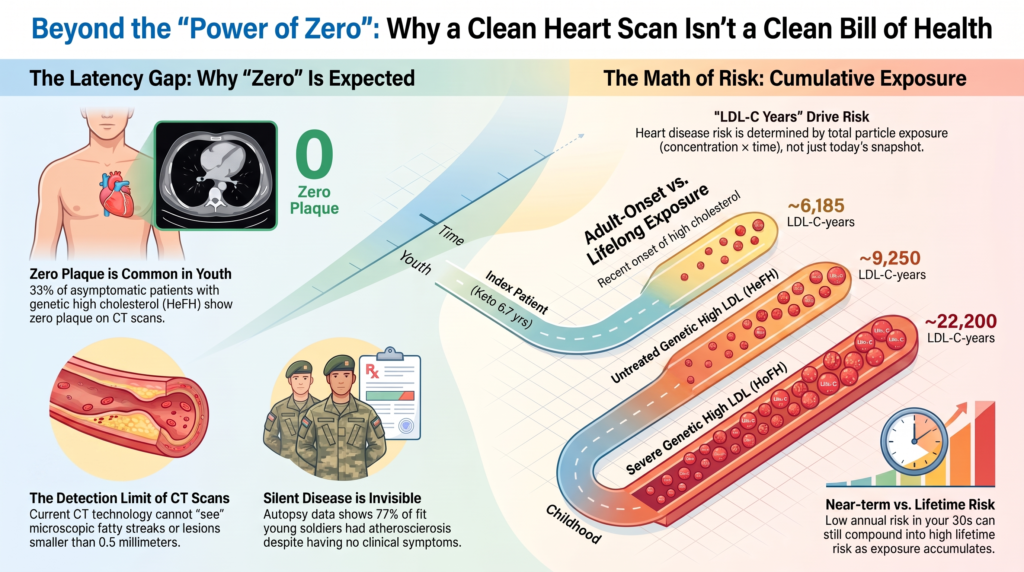
Klinische und mechanistische Bedeutung des Fehlens von Koronarplaques bei einem jungen Erwachsenen mit extremer ernährungsbedingter Hypercholesterinämie: Eine kritische Bewertung des Phänotyps der „Hyper-Responder“ bei der mageren Körpermasse
Highlights
- Eine einzige plaquefreie Koronar-CT-Untersuchung Angiographie nach etwa 6,7 Jahren extremer, im Erwachsenenalter auftretender Hypercholesterinämie zeigt keinen Schutz vor ApoB-vermittelter Atherosklerose.
- Rekonstruiert kumulative Exposition (~6.185 mg/dL-Jahre im Alter von 37 Jahren) liegt deutlich unter dem Wert von unbehandelten heterozygoten Personen gleichen Alters familiäre Hypercholesterinämie und weit unter dem Wert bei homozygoter FH.
- Nicht nachweisbar Plaque kommt häufig bei jungen Menschen mit lebenslanger schwerer LDL Höhe und wird während der biologische Latenzzeit der Atherosklerose.
- Ein Wert von 0 mm³ deutet auf eine Erkrankung unterhalb der Bildgebungs-/Segmentierungsschwelle hin, nicht auf das biologische Fehlen einer Atherosklerose.
- Die begleitenden KETO-CTA Die Studie wurde offiziell zurückgezogen (JACC: Advances, 11. März 2026) und sollte nicht mehr als zuverlässige Evidenz angesehen werden.
Zusammenfassung
Hintergrund. Der Hyper-Responder bei der fettfreien Masse (LMHR)-Phänotyp – deutliche Erhöhungen bei LDL-Cholesterin (LDL-C) und HDL-C bei niedrigem Triglyceride bei schlanken, stoffwechselgesunden Personen mit ketogene Diäten—wurde als Gegenargument zu Modellen der Atherosklerose auf der Grundlage kumulativer Exposition angeführt. In einem Fallbericht aus dem Jahr 2026 wurde ein Mann in den Dreißigern beschrieben, der unter anhaltender extremer Hypercholesterinämie litt (LDL-C-Spitzenwert 574 mg/dl; Apolipoprotein B [ApoB] >300 mg/dL) über einen Zeitraum von etwa sechs Jahren und acht Monaten, die eine Koronarkalk-Score von Null und 0 mm³ quantifizierter Koronarplaque bei der AI-Analyse Koronare CT-Angiographie (CCTA).
Vorgehensweise. Im Rahmen dieser kritischen Bewertung wird jede wesentliche Tatsachenbehauptung unabhängig anhand von begutachteten und offiziellen Quellen überprüft, die kumulative atherogene Exposition des Patienten rekonstruiert, mit Kohorten von Patienten mit familiärer Hypercholesterinämie (FH) verglichen und die bildgebenden Verfahren sowie mechanistischen und evidenzbasierten Grundlagen für die Schlussfolgerung auf eine verminderte Atherogenität der Partikel oder auf Langzeitsicherheit.
Ergebnisse. Das Fehlen makroskopisch nachweisbarer Plaques nach weniger als sieben Jahren Exposition im Erwachsenenalter steht im Einklang mit der bekannten Latenzzeit der Atherosklerose und mit der hohen Prävalenz von Null-Koronarkalk bei jungen FH-Patienten. Die rekonstruierte Exposition (~6.185 mg/dL-Jahre) liegt deutlich unter der von altersgleichen, unbehandelten heterozygoten FH-Patienten. Ein Ergebnis von 0 mm³ deutet eher auf eine Erkrankung unterhalb der Nachweisgrenze hin als auf deren Fehlen. Es gibt keine von Fachkollegen begutachteten Belege aus Studien am Menschen, die eine verringerte arterielle Retention von ketogenem LDL nach Berücksichtigung der ApoB-Konzentration belegen, und die wichtigste Studie, die dies stützte (KETO-CTA), wurde offiziell zurückgezogen.
Schlussfolgerungen. Die vorliegenden Erkenntnisse stützen am stärksten die Interpretation, dass dieser Fall auf eine biologische Latenz und eine geringere kumulative Exposition zurückzuführen ist – und nicht auf eine Resistenz gegenüber ApoB-vermittelten Erkrankungen. Eine Überinterpretation birgt die Gefahr, dass die gemäß den Leitlinien vorgesehene lipidsenkende Therapie verzögert wird.
1. Einleitung und der Indexfall
Die ursächliche Rolle von Apolipoprotein B (ApoB)-haltigen Lipoproteine bei Atherosklerose Herz-Kreislauf-Erkrankung (ASCVD) gehört zu den am häufigsten replizierten Befunden in der Herz-Kreislauf-Medizin. Das Auftreten der magere Masse Hyper-Responder-Phänotyp (LMHR) – deutlich erhöhte LDL-Werte Cholesterin (LDL-C) und HDL-C bei gleichzeitig niedrigen Triglyceridwerten bei schlanken, metabolisch gesunden Personen, die sich ketogen ernähren – wurde als Herausforderung für traditionelle Modelle zur Risikostratifizierung dargestellt. In dieser Bewertung wird untersucht, ob ein viel diskutierter Fallbericht aus dem Jahr 2026 diese Herausforderung untermauert.
Der Indexbericht beschreibt einen sportlichen Mann in den Dreißigern (“Patient N”), der eine ketogene Diät begann (ca. 80% Fett, 18% Protein, 2% Kohlenhydrat) zur Behandlung von durch eine Biopsie nachgewiesenen Colitis ulcerosa, wobei er innerhalb von etwa zwei Wochen eine klinische Remission erreichte. Sein LDL-C stieg von einem Ausgangswert von 95 mg/dl bei gemischter Makronährstoffzufuhr auf einen Höchstwert von 574 mg/dl, wobei Gesamtcholesterin und erreichte 705 mg/dl. Über einen Zeitraum von etwa sechs Jahren und acht Monaten hielt er seinen LDL-C-Wert weitgehend im Bereich von 400–600 mg/dl, seinen HDL-C-Wert bei 124 mg/dl und seine Triglyceridwerte auf einem sehr niedrigen Niveau; der ApoB-Wert lag durchgehend über 300 mg/dl und Lipoprotein(a) [Lp(a)] lag im Bereich von etwa 100 bis 194 nmol/L. Am 3. Februar 2026 ergab eine CCTA mit fachärztlicher Auswertung und einer durch HeartFlow-KI unterstützten Plaque-Analyse einen Koronarer Kalzium-Score Punktzahl 0, CAD-RADS 0 sowie 0 mm³ an quantifizierter Gesamtkoronarplaque, womit er “im untersten Perzentil” für Plaquebelastung [1].
Die Autoren argumentieren, dass dieser Fall die Grenzen einer Extrapolation des kardiovaskulären Risikos allein anhand des LDL-C-Werts verdeutlicht, und weisen auf die Möglichkeit hin, dass die ernährungsbedingte Ätiologie die intrinsische Atherogenität von ApoB-haltige Partikel, wobei anzumerken ist, dass ein einzelner Fall die gängige Praxis nicht neu definieren kann [1]. Ein Fallbericht stellt jedoch die niedrigste Stufe der klinischen Evidenz dar – eine einzelne, selbst ausgewählte Beobachtung ohne Kontrollgruppe oder Randomisierung—und jede weitere Schlussfolgerung muss im Rahmen dieser Einschränkung betrachtet werden.
2. Überlegungen zur ApoB-Berichterstattung
Der Bericht dokumentiert ApoB-Werte über 300 mg/dl und behebt damit eine Einschränkung früherer Diskussionen zur LMHR. Dennoch schränken mehrere Lücken eine eindeutige Interpretation ein: Es wird kein strenger ApoB-Ausgangswert vor der Diät angegeben, der dem LDL-C-Ausgangswert von 95 mg/dL entspricht, und die Serienwerte werden sporadisch und nicht als zeitgewichtete Reihe angegeben; die Standardisierung der Assays anhand von WHO/IFCC-Referenzmaterialien ist nicht dokumentiert, was gerade im extremen Bereich (>300 mg/dL) von größter Bedeutung ist; und direkte LDL-Partikelanzahl, Restpartikel, und VLDL Die Größe wird nicht systematisch angegeben, was eine Beurteilung von Unstimmigkeit zwischen der LDL-C-Konzentration und atherogene Partikelanzahl [1].
3. Kumulative LDL-C- und ApoB-Exposition
Atherosklerose ist ein kumulativer, dosisabhängiger Prozess, der durch die Gesamtzahl der ApoB-haltigen Partikel bestimmt wird, die sich im Laufe der Zeit in der Arterienwand ansammeln; dieser lässt sich am besten quantifizieren als “LDL-C-Jahre” oder “ApoB-Jahre.” Der logarithmisch-lineare, von der Dauer abhängige Zusammenhang mit dem Risiko wird in Konsensstellungnahmen der Europäischen Gesellschaft für Atherosklerose [8,9]. Für den Indexpatienten im Alter von 37 Jahren lässt sich die kumulative Exposition näherungsweise wie folgt berechnen: 95 mg/dl × 30 Jahre + ~500 mg/dl × 6,67 Jahre ≈ 6.185 mg/dl-Jahre. Diese Berechnung ist unter den genannten Annahmen korrekt; die FH-Vergleichswerte in Tabelle 1 sind illustrative Modellergebnisse, die von angenommenen lebenslangen LDL-C-Verläufen abhängen, und keine unabhängig veröffentlichten Konstanten.
Tabelle 1. Beispielhafte kumulative LDL-C-Exposition (mg/dL-Jahre) nach Kohorte und Alter (Szenarien mit mittlerer Schätzung).
| Kohorte und Meilenstein | Niedrig | Mitte | Hoch |
| Indexpatient – Alter 30 (Beginn der Diät) | 2,850 | 2,850 | 2,850 |
| Indexpatient – Alter 37 (Untersuchung) | 5,518 | 6,185 | 6,851 |
| Indexpatient – Alter 50 (voraussichtlich) | 10,850 | 12,850 | 14,850 |
| Unbehandelte HeFH – Alter: 37 Jahre | 7,030 | 9,250 | 12,950 |
| Unbehandelte HoFH – Alter: 37 Jahre | 14,800 | 22,200 | 29,600 |
HeFH, heterozygote familiäre Hypercholesterinämie; HoFH, homozygot familiäre Hypercholesterinämie. FH-Werte sind illustrative Modelle unter den angegebenen Annahmen und keine Messdaten.
Obwohl der aktuelle LDL-C-Wert des Patienten (~574 mg/dl) im HoFH-Bereich liegt, liegt seine kumulative Exposition im Alter von 37 Jahren (~6.185 mg/dL-Jahre) deutlich unter der eines gleichaltrigen, unbehandelten HeFH-Patienten (~9.250) und beträgt etwa ein Drittel der eines unbehandelten HoFH-Patienten (~22.200). Da Atherosklerose Zeit benötigt, um sich von der Partikelretention zu einer makroskopisch sichtbaren Läsion, Ein unauffälliges CCTA-Ergebnis nach nur etwa 6,7 Jahren Exposition im Erwachsenenalter steht biologisch im Einklang mit den vorliegenden Erkenntnissen zur Latenzzeit von Plaques. Die prognostizierte Exposition bis zum 50. Lebensjahr (~12.850 mg/dL-Jahre) würde die eines typischen HeFH-Patienten übersteigen; solche Prognosen veranschaulichen die kumulative Exposition und sagen keine spezifischen Ereignisse oder deren Zeitpunkt voraus (Abbildung 1).
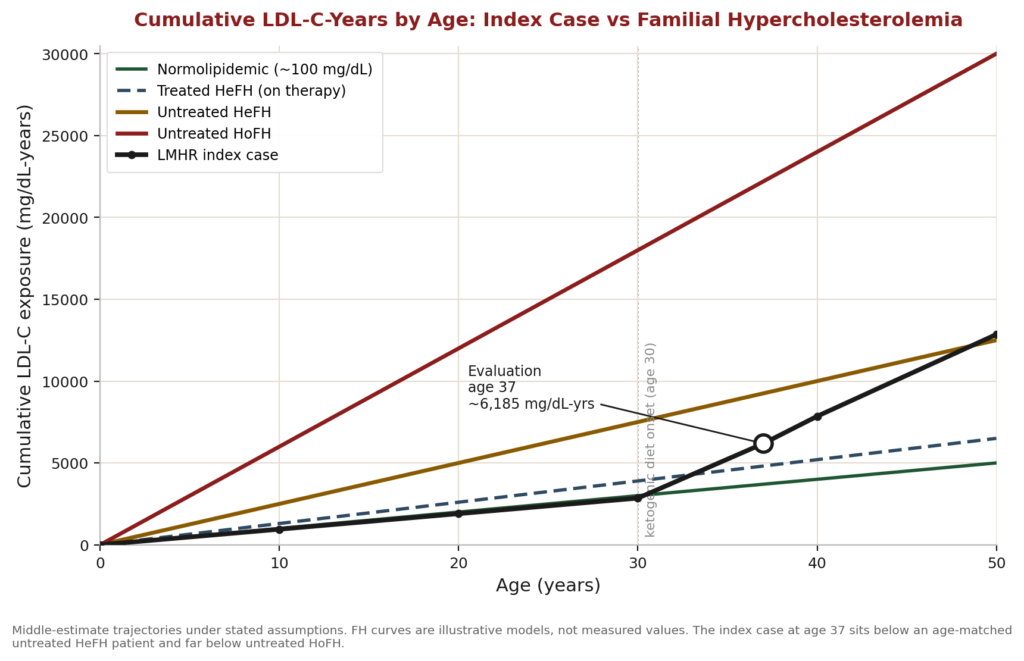
Abbildung 1. Kumulative LDL-C-Jahre nach Alter für den Indexfall im Vergleich zu den Verläufen bei Normolipidämie, behandelter/unbehandelter heterozygoter FH und homozygoter FH. Beim Indexfall steigt die Exposition bis zum Beginn der ketogenen Diät im Alter von 30 Jahren langsam an und steigt dann steil an; zum Zeitpunkt der Auswertung (Alter 37) liegt sie unterhalb der altersentsprechenden Kurve für unbehandelte heterozygote FH und weit unterhalb der Kurve für unbehandelte homozygote FH. Die FH-Kurven sind illustrative Modelle unter den angegebenen Annahmen und keine gemessenen Werte.
4. Familiäre Hypercholesterinämie und die Häufigkeit des Fehlens von Plaques
Die familiäre Hypercholesterinämie (FH) ist eine lebenslange, angeborene Erhöhung des LDL-C-Spiegels. Bestätigt Epidemiologie: Die Prävalenz der heterozygoten FH (HeFH) liegt bei etwa 1 zu 311 (95%-Konfidenzintervall 1:250–1:397) [6]; homozygote FH (HoFH) ~1 von 300.000. Ohne wirksame Behandlung beträgt die kumulative koronare Herzkrankheit Das Risiko bis zum 60. Lebensjahr liegt bei Männern bei mindestens ~50% und bei Frauen bei ~30% [23], und die CDC erklärt Herzanfälle treten bei 30% Frauen mit familiärer Hypercholesterinämie (FH) bis zum 60. Lebensjahr und bei 50% Männern bis zum 50. Lebensjahr auf, wobei eine frühzeitige Behandlung das Koronarrisiko um ~80% senkt [24]. Die beste Schätzung des relativen Risikos ist die Kopenhagener Allgemeinbevölkerungsstudie: ~13-fach erhöhtes KHK-Risiko bei unbehandelter gesicherter/wahrscheinlicher FH (95%, KI 10–17) und ~10-fach erhöhtes Risiko bei behandelter FH [7]. Bei unbehandelter HoFH tritt eine ASCVD im mittleren Alter von ca. 28 Jahren auf, wobei das mittlere Sterbealter bei ca. 32 Jahren liegt.
Entscheidend ist, dass ein unauffälliger Befund bei jungen Menschen mit stark erhöhten LDL-Werten die Regel und nicht die Ausnahme ist. In der multinationalen gepoolten Analyse von Nasir et al. an 1.011 asymptomatischen HeFH-Patienten ohne klinische ASCVD wiesen 41,81 TP9T einen CAC-Wert von 0 auf und 33,11 TP9T zeigten in der CTA keine Plaques; Frauen wiesen häufiger als Männer einen CAC-Wert von 0 auf (48,01 TP9T gegenüber 34,61 TP9T) [4]. Bildgebungsuntersuchungen an der Allgemeinbevölkerung bestätigen dies: In der Multi-Ethnic Study of Atherosclerosis (MESA) Bei der Analyse der Teilnehmer mit einem LDL-C-Wert von ≥190 mg/dL wiesen 37% einen CAC-Wert von 0 auf; sie waren jünger, weiblichen Geschlechts und wiesen keine Diabetes Vorhersage einer Punktzahl von Null [20]. Der gegenteiligen Ansicht zuliebe sei angemerkt, dass diese Analyse auch ergab, dass ein CAC-Wert von 0 selbst bei Personen mit hohem LDL-Spiegel ein geringeres Ereignisrisiko mit sich brachte; die Einschränkung in diesem Fall besteht darin, dass die CAC-Bewertung lediglich verkalkte Läsionen erfasst und frühe Stadien nicht ausschließen kann nicht verkalkte Plaque, und MESA Die Teilnehmer waren im Durchschnitt um Jahrzehnte älter. Der unauffällige Befund des Indexpatienten liegt genau innerhalb des dokumentierten Spektrums der Latenzzeit subklinischer Erkrankungen bei jungen FH-Populationen.
Warum eine lebenslange FH-Exposition nicht einfach “mehr vom Gleichen” ist”
Ein berechtigter Einwand lautet, dass die Exposition gegenüber LMHR erst im Erwachsenenalter beginnt, während die Exposition gegenüber FH angeboren ist – und dieser Unterschied könnte über rein rechnerische Aspekte hinausgehen. Die sich entwickelnde Arterienwand ist nicht identisch mit der ausgereiften: Während der Kindheit und Jugend ist die Intima Umbauvorgänge und Veränderungen des Proteoglykangehalts; daher könnte eine Exposition während dieser prägenden Jahre dazu führen, dass sich die Lipidretention und die Läsionsarchitektur auf einem fortgeschritteneren Verlauf festigen. Dies wirkt sich kurzfristig positiv auf den Patienten aus und unterstreicht zugleich, dass seine geringere kumulative Exposition – und nicht etwa eine besondere Partikelbiologie – die schlichte Erklärung für das unauffällige Scanbild ist. Eine Einschränkung gilt jedoch in umgekehrter Richtung: FH-Kohorten unterscheiden sich von diesem Patienten nicht nur hinsichtlich des Zeitpunkts der Exposition – auch die Verteilungen von Lp(a), Blutdruck, Modifikatorgene und die Ernährung variieren alle – daher schränkt der Vergleich die Plausibilität seines Ergebnisses ein, anstatt eine Äquivalenz zu beweisen.
5. Latenzzeit: Von der Exposition gegenüber Partikeln bis zur nachweisbaren Plaquebildung
Mensch Atherogenese erfolgt über Jahrzehnte hinweg, und seine frühesten Stadien sind in der klinischen Bildgebung nicht erkennbar. Höhere ApoB-Konzentrationen erhöhen die Wahrscheinlichkeit des endothelialen Transports durch konzentrationsabhängige Mechanismen, zu denen der passive Fluss und regulierte Caveolare Transzytose über Rezeptoren wie beispielsweise LDLR, SR-B1, und ALK1 [10]. In der Intima angekommen, binden sich die Partikel an arterielle Proteoglykane, werden chemisch modifiziert und von Makrophagen die zu … werden Schaumzellen—die mikroskopisch kleine Fettstreifen die weder Verkalkung noch Stenose und lassen sich weder mittels CAC-Scan noch mittels CCTA nachweisen.
Obduktionsbefunde bestätigen diese „stille“ Erkrankung. Bei den in Korea gefallenen US-Soldaten (Durchschnittsalter ~22) wiesen 77,31 TP9T trotz ihres jungen Alters und fehlender Symptome eine makroskopisch erkennbare koronare Atherosklerose auf [11]; unter den Kriegsopfern in Vietnam wiesen 45% eine leichte koronare Atherosklerose und 5% eine schwere Erkrankung auf [12]. Das PDAY und die Bogalusa-Heart-Studien zeigten, dass das Ausmaß der Fettstreifen und der erhabenen Läsionen bei 15- bis 39-Jährigen mit dem Nicht-HDL-Cholesterin korrelierte, Bluthochdruck, und Adipositas, und umgekehrt mit dem HDL-C [13,14]. Ein Befund von 0 mm³ bei einer CCTA bei einer Person in den Dreißigern deutet daher nicht auf das biologische Fehlen von Atherosklerose hin, sondern darauf, dass keine Läsionen vorliegen, die so weit fortgeschritten sind, dass sie die Nachweisgrenzen der Technologie überschreiten.
6. CCTA und KI-basierte Plaque-Quantifizierung: Nachweisgrenzen
- Räumliche Auflösung. Die klinische CT-Auflösung in der Ebene beträgt ca. 0,4–0,5 mm bei einer Schichtdicke von ca. 0,5–0,6 mm; neuere ultrahochauflösende Systeme und Photonenzählsysteme erreichen Werte von ca. 0,15–0,2 mm. Frühe Atherom (Intimadicke ~100–300 µm) liegt unterhalb dieser Untergrenze und geht bei der Volumenmittelung verloren.
- Quantifizierungsschwellenwerte. Die SCCT-Standards empfehlen, die quantitative Plaque-Analyse auf Gefäße mit einem Durchmesser von ≥ 2,0 mm zu beschränken [22]; es gibt keinen einheitlichen, allgemein anerkannten nachweisbaren Mindestwert Plaquevolumen. Ein Wert von 0 mm³ bedeutet nicht, dass keine Plaque vorliegt – es bedeutet, dass die Plaque unterhalb des Segmentierungsschwellenwerts der Software liegt.
- Serielle Veränderungen im Bereich von wenigen mm³ reagieren äußerst empfindlich auf Herzfrequenz, Kontrastzeit, Rekonstruktionskern und Schichtdicke; bei schlanken Personen führt eine geringere Menge an epikardialem Fett zu einem schlechteren Signal-Rausch-Verhältnis an der Gefäßwand.
Das verwendete KI-Tool (HeartFlow) wurde in der Plaque-Färbetablette Studie gegen Intravaskulärer Ultraschall (IVUS) bei 237 Patienten, mit einem mittleren IVUS-Gesamtplaquevolumen von 186,0 mm³ und einer Korrelation des Gesamtplaquevolumens von r = 0,91 [5]. Diese Validierung wurde an einer älteren, symptomatischen CAD-Patientengruppe mit höherem Krankheitsgrad durchgeführt; sie belegt zwar eine Korrelation in Arterien mit starker Plaquebildung, belegt jedoch nicht, dass Längsveränderungen von 0–5 mm³ in jungen Arterien mit geringem Krankheitsgrad biologisch aussagekräftig sind. Die KI verbessert die Reproduzierbarkeit und kann Plaques erkennen, die unterhalb der Zuverlässigkeitsgrenze einer menschlichen Befundung liegen, ist jedoch grundsätzlich durch die räumliche Auflösung der CT begrenzt. Auch die Plaquezusammensetzung hat über das Volumen hinaus prognostische Bedeutung: In der SCOT-HEART-Studie, Plaque mit niedriger Dämpfung Die Belastung war der stärkste Prädiktor für Myokardinfarkt, wobei eine Belastung von >4% mit einem etwa fünffach höheren Risiko verbunden ist [21]; da es sich hierbei um eine Population von Patienten mit Brustschmerzen handelt, ist die externe Validität in Bezug auf junge, asymptomatische Personen begrenzt, doch die allgemeine Erkenntnis – dass nicht nur das Volumen, sondern auch die Zusammensetzung eine Rolle spielt – bleibt bestehen.
7. Die zurückgezogene KETO-CTA-Studie
Der Fallbericht aus dem Jahr 2026 stützte sich teilweise auf die KETO-CTA-Studie, um die Behauptung zu untermauern, dass ernährungsbedingte ApoB-Erhöhungen das Fortschreiten von Plaques nicht begünstigen. Diese Arbeit erhielt im Januar 2026 eine „Expression of Concern“ und wurde am 11. März 2026 auf Antrag der Autoren und Herausgeber offiziell aus dem JACC: Advances zurückgezogen, mit der Begründung, dass methodische Bedenken die Zuverlässigkeit der Daten beeinträchtigten und die festgestellten Fehler zu gravierend waren, um sie durch ein Korrigendum zu beheben [2]. Es sollte nicht mehr als zuverlässiger Beweis angesehen werden.
Die festgestellten Probleme waren wesentlicher Natur: Das registrierte primäre Endpunktkriterium (prozentuale Veränderung des Volumens der nicht verkalkten Plaque; NCT05733325) wurde nicht in den Vordergrund gestellt [3]; ein Mitautor war bei dem mit der Analyse beauftragten Anbieter (Cleerly) in einer Funktion tätig, von der die Mitautoren nach eigenen Angaben nichts wussten, und die Analyse erfolgte nicht, wie angenommen, im Doppelblindverfahren; außerdem haben mehrere Autoren erklärt, dass sie vor der Veröffentlichung keinen Zugang zu den Rohdaten hatten [2]. Die einzige in einer Fachzeitschrift veröffentlichte Zahl zur Progression ist ein medianer Anstieg des Volumens nicht-kalzifizierter Plaques um 18,9 mm³ (IQR 9,3–47,0) über ein Jahr, gegenüber einer vorab registrierten konservativen Schätzung von ~7 mm³ [3] sowie die annualisierte prozentuale Veränderung des Atheromvolumens nach PARADIGM von ~0,45% (niedriges Risiko) und ~0,58% (hohes Risiko) [19]. Zahlen aus einer erneuten Analyse nach der Rücknahme, die als “Plaquerückbildung”stammen aus nicht begutachteten Autorenmitteilungen und werden aus der Evidenzgrundlage dieser Bewertung ausgeschlossen.“.
8. Mechanistische Bewertung: Die hypothetische Verringerung der Atherogenität der Partikel
Genauer gesagt stützen die derzeitigen Erkenntnisse nicht die Hypothese, dass ketogene LDL-Partikel eine geringere intrinsische Atherogenität aufweisen. Die mechanistische Begründung besteht aus drei Teilen, von denen derzeit keiner belegt ist.
Erstens: Herkunft ist kein Garant für Sicherheit. Das Lipid-Energie-Modell erklärt plausibel, warum die Sekretion von Leberlipoproteinen bei schlanken Personen unter Kohlenhydratrestriktion ansteigt, doch ein Mechanismus, der erklärt, warum Partikel gebildet werden, sagt nichts darüber aus, ob diese auch im Körper verbleiben. Um die Unbedenklichkeit nachzuweisen, wären direkte kinetische Nachweise beim Menschen erforderlich (z. B. mittels stabiler Isotope ApoB-100 (Umsatz) einer veränderten Verweildauer, die bei ketogenen LMHRs nicht vorliegt.
Zweitens verleiht die Partikelgröße keine Immunität. Sowohl kleine, dichte (~18–20,5 nm) als auch große, schwimmfähige (~20,5–23 nm) LDL-Partikel passieren die Endothelverbindungen. Kleines, dichtes LDL hat jedoch Nachteile auf Partikelebene – längere Verweildauer im Plasma, höhere Anfälligkeit für Oxidation, höhere Proteoglykan-Retention— eine Verschiebung hin zu größeren Partikeln ist also nicht gänzlich neutral; größere Partikel transportieren jedoch mehr Cholesterin pro Partikel, und der Nettoeffekt befreit Phänotypen mit großem LDL bei einer gegebenen ApoB-Partikelzahl nicht von ihrer Atherogenität. Jedes LDL-Partikel trägt genau ein ApoB-100-Molekül, und es gibt keine überzeugenden Belege aus Studien am Menschen, die eine verringerte arteriellen Retention von ketogenem LDL nach Berücksichtigung der ApoB-Konzentration belegen.
Drittens, Stoffwechselgesundheit verringert das Risiko, beseitigt es jedoch nicht. Insulinsensitivität, niedrige Triglyceridwerte, hohe HDL-C-Werte und niedrige hs-CRP-Werte verändern die Steigung der Risikokurve. Der endotheliale Transport wird durch Scherspannung, Permeabilität und die Stickstoffmonoxid-Signalübertragung beeinflusst, Entzündung, Bluthochdruck und Glyokalyx Integrität: Hier gibt es mehrere positive Aspekte; allerdings sind die rezeptorvermittelten Signalwege bereits bei relativ niedrigen Konzentrationen gesättigt, sodass bei anhaltenden ApoB-Werten >300 mg/dL die konzentrationsabhängige Komponente zunehmend dominiert [10]. Mendelsche Randomisierung zeigt durchweg, dass genetisch bedingte ApoB/LDL-Erhöhungen das ASCVD-Risiko logarithmisch-linear und weitgehend unabhängig von Metabolisches Syndrom, Diabetes oder Entzündungen [8,9]. Bei dieser Expositionsstärke gibt es derzeit keine Hinweise darauf, dass positive Stoffwechselmodifikatoren den durch die Konzentration selbst verursachten Retentionsdruck vollständig ausgleichen.
Zwei weitere Faktoren verstärken die Besorgnis: Ein Lp(a)-Wert von 100–194 nmol/L, wobei jedes Partikel ein ApoB-100 sowie prothrombotisches, kalzifikationsförderndes Apo(a) und oxidierte Phospholipide trägt, deren genetisch bedingtes Risiko durch die Stoffwechselgesundheit nicht neutralisiert wird; sowie ein vorzeitiges koronares Ereignis beim Vater, das mit einer vererbten Anfälligkeit über die monogene FH hinaus vereinbar ist, wobei jedoch eine gemeinsame Umwelt nicht ausgeschlossen werden kann.
9. Absolutes Risiko versus relatives Risiko
Ein großer relatives Risiko Bei einem niedrigen Ausgangsrisiko kann dies dennoch zu einer moderaten kurzfristigen absoluten Ereignisrate führen, während sich dasselbe relative Risiko, das über Jahrzehnte hinweg bestehen bleibt, zu einer erheblichen lebenslangen Belastung summiert. Mit etwa 37 Jahren ist die jährliche absolute Wahrscheinlichkeit eines schweren koronaren Ereignisses bei diesem Patienten gering, da das Ausgangsrisiko Ende 30 niedrig ist – genau deshalb sind ein unauffälliger Befund und das Fehlen von Symptomen derzeit nichts Besonderes und bieten wenig Sicherheit für die kommenden Jahrzehnte. Zur Veranschaulichung: Wenn ein extrem anhaltend erhöhter ApoB-Wert die jährliche Wahrscheinlichkeit eines schweren Ereignisses von einem Ausgangswert nahe 0,05% auf etwa 0,4–0,5% erhöhen würde, wäre dies zwar ein großer relativer Anstieg, in einem einzelnen Jahr jedoch immer noch gering; über die verbleibende Lebenszeit integriert, summiert sich derselbe Multiplikator zu einer erheblich erhöhten kumulativen Wahrscheinlichkeit. (Diese Zahlen dienen der Veranschaulichung und sind nicht aus den Daten des Patienten abgeleitet.) Die relevante Größe ist die kumulative Lebenszeitbelastung und die davon bestimmte Lebenszeit-Ereigniskurve, nicht die Ereigniswahrscheinlichkeit des laufenden Jahres.
10. Lipidsenkende Therapie: Die Argumente gegen einen Aufschub
Die Metaanalysen der Cholesterol Treatment Trialists zeigen eine Verringerung der schweren vaskulären Ereignisse um ~22% pro 1,0 mmol/l (38,7 mg/dl) Senkung des LDL-C-Werts [15], und ~23% für schwere koronare Ereignisse [16], proportional zur absoluten Senkung. Was die Sicherheit betrifft, so ist die CTT für den einzelnen Teilnehmer Meta-Analyse gefunden Statine führte im ersten Jahr lediglich zu einem relativen Anstieg der Berichte über Muskelsymptome um ~7% (RR 1,07, 95% KI 1,04–1,10), ohne dass danach ein Anstieg zu verzeichnen war, woraus geschlossen wurde, dass >90% der Berichte über Muskelbeschwerden nicht auf das Statin zurückzuführen waren [17]; die National Lipid Association schätzt die Häufigkeit von medikamentenbedingten Statin-assoziierten Muskelsymptomen auf ~1–2% [18]. Gemäß den Leitlinien von ACC/AHA und ESC ist ein anhaltender, starker Anstieg von ApoB/LDL-C in dieser Größenordnung eine klare Indikation für eine lipidsenkende Therapie, unabhängig von einem einzelnen unauffälligen Befund.
11. Strukturierte Bewertung der zentralen Fragen
Ist es biologisch gesehen überraschend, dass bei einem Mann in den Dreißigern nach etwa 6 Jahren und 8 Monaten extremer Belastung keinerlei Plaque nachweisbar ist?
Bewertung: Nicht unterstützt. Ein unauffälliger Befund nach etwa 6,7 Jahren Exposition im Erwachsenenalter steht biologisch im Einklang mit der Plaque-Latenz – einer offensichtlichen Verzögerung der klinisch nachweisbaren Plaquebildung, nicht jedoch einem Nachweis von Resistenz.
Liegt das Ergebnis außerhalb des bei jungen Menschen mit FH beobachteten Bereichs?
Bewertung: Nicht unterstützt. Multinationale FH-Register und bildgebende Untersuchungen der Allgemeinbevölkerung zeigen, dass ein großer Anteil vergleichbarer Personen einen CAC-Wert von 0 und keine mittels CCTA nachweisbaren Plaques aufweist; dieser Fall reiht sich in dieses Spektrum ein.
Zeigt das Ergebnis, dass LMHR-ApoB-Partikel weniger atherogen sind?
Bewertung: Nicht unterstützt. Es gibt keine biophysikalischen Hinweise auf eine verminderte Proteoglykan-Affinität oder Oxidationsanfälligkeit pro ApoB-Partikel; der einzige Längsschnitt-Datensatz zur LMHR, der inzwischen zurückgezogen wurde, zeigte ein erhebliches Fortschreiten nicht-verkalkter Plaques.
Wird damit festgestellt, dass eine fortgesetzte Exposition unbedenklich ist?
Bewertung: Nicht unterstützt. Eine einmalige Querschnittsuntersuchung in der frühen Latenzphase kann keine Aussage über die Sicherheit in den folgenden Jahrzehnten treffen, da die kumulative Strahlenbelastung zunimmt.
Welche Belege wären erforderlich, bevor man der Öffentlichkeit mitteilen könnte, dass durch eine extreme Diät bedingte ApoB-Werte akzeptabel sein könnten?
Bewertung: Eine hohe Messlatte, die noch nicht erreicht wurde. Prospektive, gut abgestimmte, mehrjährige Kohortenstudien mit hochauflösender Bildgebung und objektiven Endpunkten, die das Ausbleiben einer Progression und eines Ereignisrisikos im Vergleich zu normolipidämischen Kontrollgruppen belegen.
Ist die Interpretation in dem Manuskript angemessen zurückhaltend?
Beurteilung: Dies könnte durchaus irreführend sein. Formulierungen wie “offensichtlicher Widerstand” und das Verweisen auf eine inzwischen zurückgezogene Studie gehen über die Datenlage hinaus und könnten dazu führen, dass die leitliniengerechte Therapie aufgeschoben wird.
12. Schlussfolgerungen und Ausblick
Der Befund „Null-Plaque“ lässt sich am besten als Indikator für eine frühe Latenzphase bei einer jungen, aktiven Person verstehen, bei der sich die kumulative atherogene Exposition, die erforderlich ist, um die Nachweisgrenze der CCTA zu überschreiten, noch nicht angesammelt hat. Günstige Stoffwechselmarker mindern das Risiko; sie heben jedoch die Massenwirkungsmechanismen der subendothelialen ApoB-Retention nicht auf. Eine leitsatzkonforme lipidsenkende Therapie bleibt weiterhin indiziert.
Um zu klären, ob der LMHR-Phänotyp echte Resilienz mit sich bringt, ist eine prospektive, multizentrische, registergestützte Kohortenstudie erforderlich, in der metabolisch gesunde LMHR-Personen mit genetisch bestätigten HeFH-Patienten und normolipidämischen Kontrollpersonen verglichen werden, wobei zu Studienbeginn sowie im 3. und 5. Jahr eine CCTA mittels ultrahochauflösender oder photonenzählender CT durchgeführt wird; eine vollständig verblindete, unabhängige Kernlaboranalyse über mehrere validierte Plattformen hinweg; primäre Endpunkte der absoluten Veränderung des Volumens nicht verkalkter Plaques und der prozentualen Veränderung des Atheromvolumens; sowie sekundäre Endpunkte, darunter Plaques mit geringer Dämpfung, Endothelfunktion, ApoB-Kinetik und Entzündungsprozesse Biomarker. Solange solche Belege nicht vorliegen, sollte ein einzelner Befund ohne Plaque nicht als Nachweis für die Sicherheit gewertet werden.
Erklärungen
Finanzierung.
Für diese Arbeit wurden keine spezifischen Fördermittel von einer Förderinstitution aus dem öffentlichen, kommerziellen oder gemeinnützigen Sektor gewährt. [Vom Autor zu bestätigen oder zu ergänzen.]
Interessenkonflikte.
Der Autor ist Gründer und Betreiber von „Curing Heart Disease, LLC“, einer Plattform zur Aufklärung über Herz-Kreislauf-Gesundheit (curingheartdisease.com), was ein potenzielles nichtfinanzielles Interesse sowie ein Reputationsrisiko in Bezug auf das Thema darstellt. Der Autor erklärt, dass er keine finanziellen Beziehungen zu Pharma- oder Medizinprodukteherstellern unterhält, die für diese Arbeit relevant sind. [Der Autor muss etwaige weitere Interessen bestätigen und offenlegen.]
Verfügbarkeit der Daten.
Es handelt sich hierbei um eine kritische Auswertung bereits veröffentlichter Literatur; es wurden keine neuen Primärdaten erhoben. Alle Quellen sind zitiert und über die genannten Fachzeitschriften und offiziellen Aufzeichnungen öffentlich zugänglich. Die dem Fallbericht zugrunde liegenden Rohbilddaten standen dem Autor nicht zur Verfügung und konnten daher nicht unabhängig neu analysiert werden.
Ethische Genehmigung und Einwilligung.
Diese Auswertung analysiert einen bereits veröffentlichten, anonymisierten Fallbericht sowie weitere veröffentlichte Literatur; sie umfasste weder neue menschliche Teilnehmer noch identifizierbare Patientendaten oder Versuchstiere und erforderte daher keine zusätzliche Genehmigung durch eine Ethikkommission oder eine Einverständniserklärung. [Der Autor muss die Übereinstimmung mit den Richtlinien der Zielzeitschrift bestätigen.]
Einsatz von KI-gestützten Tools.
Es wurden KI-gestützte Tools eingesetzt, um die unabhängige Überprüfung von Sachaussagen anhand von begutachteten und offiziellen Quellen zu unterstützen sowie bei der Ausarbeitung und Formatierung zu helfen. Alle Quellen wurden anhand von primären, begutachteten oder offiziellen Unterlagen überprüft, und der Autor übernimmt die volle Verantwortung für den Inhalt und die Schlussfolgerungen. [Offenlegung gemäß den Richtlinien der Zielzeitschrift.]
Beiträge der Autoren.
P.M. konzipierte die Bewertung, führte die Analyse und Überprüfung durch und verfasste das Manuskript.
Referenzen
Als Quellen gelten ausschließlich begutachtete Zeitschriftenartikel sowie offizielle Unterlagen von Gesundheitsbehörden oder Verlagen. Nicht begutachtete Materialien (Preprints, Blogs, soziale Medien und Nachrichtenkommentare) werden ausgeschlossen.
- Norwitz NG, Feldman D, Soto-Mota A. Seven Years of 700 Cholesterol Without Coronary Atherosclerosis: A Lean Mass Hyper-Responder Case Report. Diseases. 2026;14(5):168. Published 2026 May 11. doi:10.3390/diseases14050168
- Expression of Concern: “Plaque Begets Plaque. ApoB Does Not: Longitudinal Data from The KETO-CTA Trial” [JACC: Advances, Volume 4, Issue 7, July 2025, Article 101686]. JACC Adv. 2026;5(3):102607. doi:10.1016/j.jacadv.2026.102607
- Budoff M, Manubolu VS, Kinninger A, et al. Carbohydrate Restriction-Induced Elevations in LDL-Cholesterol and Atherosclerosis: The KETO Trial. JACC Adv. 2024;3(8):101109. Published 2024 Aug 28. doi:10.1016/j.jacadv.2024.101109
- Nasir K, Mszar R, Cainzos-Achirica M, et al. Age- and sex-based heterogeneity in coronary artery plaque presence and burden in familial hypercholesterolemia: A multi-national study. Am J Prev Cardiol. 2023;17:100611. Published 2023 Nov 23. doi:10.1016/j.ajpc.2023.100611
- Narula J, Stuckey TD, Nakazawa G, et al. Prospective deep learning-based quantitative assessment of coronary plaque by computed tomography angiography compared with intravascular ultrasound: the REVEALPLAQUE study. Eur Heart J Cardiovasc Imaging. 2024;25(9):1287-1295. doi:10.1093/ehjci/jeae115
- Hu P, Dharmayat KI, Stevens CAT, et al. Prevalence of Familial Hypercholesterolemia Among the General Population and Patients With Atherosclerotic Cardiovascular Disease: A Systematic Review and Meta-Analysis. Circulation. 2020;141(22):1742-1759. doi:10.1161/CIRCULATIONAHA.119.044795
- Nordestgaard BG, Chapman MJ, Humphries SE, et al. Familial hypercholesterolaemia is underdiagnosed and undertreated in the general population: guidance for clinicians to prevent coronary heart disease: consensus statement of the European Atherosclerosis Society. Eur Heart J. 2013;34(45):3478-90a. doi:10.1093/eurheartj/eht273
- Ference BA, Ginsberg HN, Graham I, et al. Low-density lipoproteins cause atherosclerotic cardiovascular disease. 1. Evidence from genetic, epidemiologic, and clinical studies. A consensus statement from the European Atherosclerosis Society Consensus Panel. Eur Heart J. 2017;38(32):2459-2472. doi:10.1093/eurheartj/ehx144
- Borén J, Chapman MJ, Krauss RM, et al. Low-density lipoproteins cause atherosclerotic cardiovascular disease: pathophysiological, genetic, and therapeutic insights: a consensus statement from the European Atherosclerosis Society Consensus Panel. Eur Heart J. 2020;41(24):2313-2330. doi:10.1093/eurheartj/ehz962
- Bolanle IO, de Liedekerke Beaufort GC, Weinberg PD. Transcytosis of LDL Across Arterial Endothelium: Mechanisms and Therapeutic Targets. Arterioscler Thromb Vasc Biol. 2025;45(4):468-480. doi:10.1161/ATVBAHA.124.321549
- ENOS WF, HOLMES RH, BEYER J. Coronary disease among United States soldiers killed in action in Korea; preliminary report. J Am Med Assoc. 1953;152(12):1090-1093. doi:10.1001/jama.1953.03690120006002
- McNamara JJ, Molot MA, Stremple JF, Cutting RT. Coronary artery disease in combat casualties in Vietnam. JAMA. 1971;216(7):1185-1187.
- Strong JP, Malcom GT, McMahan CA, et al. Prevalence and extent of atherosclerosis in adolescents and young adults: implications for prevention from the Pathobiological Determinants of Atherosclerosis in Youth Study. JAMA. 1999;281(8):727-735. doi:10.1001/jama.281.8.727
- Berenson GS, Srinivasan SR, Bao W, Newman WP 3rd, Tracy RE, Wattigney WA. Association between multiple cardiovascular risk factors and atherosclerosis in children and young adults. The Bogalusa Heart Study. N Engl J Med. 1998;338(23):1650-1656. doi:10.1056/NEJM199806043382302
- Cholesterol Treatment Trialists’ (CTT) Collaboration, Baigent C, Blackwell L, et al. Efficacy and safety of more intensive lowering of LDL cholesterol: a meta-analysis of data from 170,000 participants in 26 randomised trials. Lancet. 2010;376(9753):1670-1681. doi:10.1016/S0140-6736(10)61350-5
- Baigent C, Keech A, Kearney PM, et al. Efficacy and safety of cholesterol-lowering treatment: prospective meta-analysis of data from 90,056 participants in 14 randomised trials of statins. Lancet. 2005;366(9493):1267-1278. doi:10.1016/S0140-6736(05)67394-1
- Cholesterol Treatment Trialists’ Collaboration. Effect of statin therapy on muscle symptoms: an individual participant data meta-analysis of large-scale, randomised, double-blind trials. Lancet. 2022;400(10355):832-845. doi:10.1016/S0140-6736(22)01545-8
- Cheeley MK, Saseen JJ, Agarwala A, et al. NLA scientific statement on statin intolerance: a new definition and key considerations for ASCVD risk reduction in the statin intolerant patient. J Clin Lipidol. 2022;16(4):361-375. doi:10.1016/j.jacl.2022.05.068
- Won KB, Lee SE, Lee BK, et al. Longitudinal assessment of coronary plaque volume change related to glycemic status using serial coronary computed tomography angiography: A PARADIGM (Progression of AtheRosclerotic PlAque DetermIned by Computed TomoGraphic Angiography Imaging) substudy. J Cardiovasc Comput Tomogr. 2019;13(2):142-147. doi:10.1016/j.jcct.2018.12.002
- Sandesara PB, Mehta A, O’Neal WT, et al. Clinical significance of zero coronary artery calcium in individuals with LDL cholesterol ≥190 mg/dL: The Multi-Ethnic Study of Atherosclerosis. Atherosclerosis. 2020;292:224-229. doi:10.1016/j.atherosclerosis.2019.09.014
- Williams MC, Kwiecinski J, Doris M, et al. Low-Attenuation Noncalcified Plaque on Coronary Computed Tomography Angiography Predicts Myocardial Infarction: Results From the Multicenter SCOT-HEART Trial (Scottish Computed Tomography of the HEART). Circulation. 2020;141(18):1452-1462. doi:10.1161/CIRCULATIONAHA.119.044720
- Nieman K, García-García HM, Hideo-Kajita A, et al. Standards for quantitative assessments by coronary computed tomography angiography (CCTA): An expert consensus document of the society of cardiovascular computed tomography (SCCT). J Cardiovasc Comput Tomogr. 2024;18(5):429-443. doi:10.1016/j.jcct.2024.05.232
- Humphries SE, Cooper JA, Seed M, et al. Coronary heart disease mortality in treated familial hypercholesterolaemia: Update of the UK Simon Broome FH register. Atherosclerosis. 2018;274:41-46. doi:10.1016/j.atherosclerosis.2018.04.040
- Centers for Disease Control and Prevention. About Familial Hypercholesterolemia. Atlanta, GA: CDC (official public-health source).
Dieses Manuskript dient wissenschaftlichen und informativen Zwecken und stellt keine individuelle medizinische Beratung dar. Klinische Entscheidungen sollten in Absprache mit einer qualifizierten Fachkraft getroffen werden.