1. The Hypothesis and How This Review Tests It
The proposition under examination is that a nutritionally adequate, entirely whole-food alimentation à base de plantes, very low in total fat (hereafter VLF-WFPB), offers cardiovascular protection beyond that of other high-quality dietary patterns, for prevention, for treatment of established disease, and for regression. Four separate questions are kept apart throughout: (Q1) Does VLF-WFPB improve outcomes compared with a typical Western diet? (Q2) Does it outperform other high-quality diets, such as DASH, Mediterranean, or Portfolio? (Q3) Are complete exclusion of animal foods, very low total fat, and minimal processing each independently necessary for any advantage? (Q4) Do such diets protect arteries through pathways beyond lowering ApoB-containing lipoprotéines? Q4 is treated as the central question (Section 5), because a benefit that runs entirely through ApoB could in principle be matched by any equally effective means of lowering ApoB.
The positive case rests on convergence. Randomized trials show that plant-based diets lower causal facteurs de risque; intensive lifestyle trials that included very-low-fat régimes végétariens showed functional and angiographic improvement; and populations with lifelong low animal-food intake had low cholestérol and low coronary mortality. Each line is weak alone. Together they make it more credible that sustained dietary lowering of ApoB-containing lipoproteins can slow coronary disease, which bears mainly on Q1. They cannot answer Q2 or Q3, because in every line the diet travels with other exposures—perte de poids, physical activity, co-interventions, drugs—that also change risk. Convergence is therefore used here to judge plausibility, not to enlarge sample sizes or to compute a probability of superiority. Unrelated populations are not pooled.
Narrative reviews by Wang and colleagues, Freeman and colleagues, and Kahleova and colleagues served as background and as routes to original studies; numerical claims are taken from the original reports, and repeated citation of the same cohort is not treated as independent corroboration [1–3].
1.1 Scope and methods
This is a targeted critical review, not a registered revue systématique. Sources were identified through PubMed-indexed records, publisher pages, full-text articles where accessible, guideline repositories, and reference tracing, with a final update search on 12 September 2026. Numerical claims were checked against original reports where accessible; where only an abstract or an official summary could be obtained, that is stated at the relevant passage. No new méta-analyse or patient-level reanalysis was performed.
Interests deserve attention without being disqualifying. Several lifestyle programs were evaluated by the investigators who developed them; the direct vegan–Mediterranean comparison was conducted by an organization that advocates plant-based diets; and the major Mediterranean secondary-prevention trial was funded principally by olive-oil foundations. These are reasons to emphasize allocation, retention, prespecification, blinded outcomes, and independent replication, not reasons to reject results.
1.2 How to read the evidence: five tiers of data
Not all evidence answers the same question. This review sorts studies into five tiers according to how well each design can show cause and effect, not according to whether its results support the hypothesis. Lower tiers still count—evidence is evidence—but they answer different questions and carry different risks of misleading us (Figure 1).
Niveau 1 : essais randomisés avec événements cliniques. Les personnes sont assignées à un régime par tirage au sort, et crises cardiaques, cajoleries, ou les décès sont comptabilisés. L'assignation aléatoire réduit facteur de confusion en espérance, bien que pas nécessairement dans chaque essai individuel, de sorte qu'une différence dans les événements constitue la preuve la plus solide disponible que le régime en est la cause. Les exemples dans cette revue sont PREDIMED, CORDIOPREV, et le Étude de Lyon sur le régime cardioprotecteur.
Niveau 2 : essais randomisés sur des critères de jugement intermédiaires. L'assignation se fait toujours par tirage au sort, mais le résultat est une mesure prédictive d'événements : LDL-C, ApoB, tension artérielle, rétrécissement coronarien, volume de la plaque dentaire, ou flux sanguin myocardique. Ces essais montrent qu'un régime modifie la mesure ; ils ne démontrent pas en eux-mêmes une diminution des événements. Des exemples sont le Essai sur le mode de vie et le cœur, EVADE CAD, et les méta-analyses lipidiques.
Niveau 3 : cohorte prospective études. De grands groupes d'individus rapportent ce qu'ils mangent et sont suivis pendant des années. Ces études capturent des maladies réelles chez des personnes réelles sur des décennies, ce que les essais cliniques peuvent rarement faire, mais elles montrent une association : les personnes qui choisissent un régime diffèrent par de nombreux autres aspects, et l'ajustement statistique ne peut supprimer ces différences que partiellement (Section 9.1). Des exemples sont l'Adventist Health Study-2, EPIC-Oxford, et la cohorte danoise sur les nitrates.
Niveau 4 : comparaisons de populations, études transversales et séries de cas non contrôlées. Des populations entières sont comparées (Chine rurale, Okinawa, les Tsimane), les personnes sont mesurées une seule fois, ou les patients traités sont suivis sans groupe de comparaison (les cohortes d'Esselstyn). Ces données génèrent des hypothèses et montrent ce qui est réalisable, mais de nombreuses explications peuvent correspondre au même profil.
Niveau 5 : études mécanistiques sur des cellules et des animaux. Les expériences peuvent isoler une voie unique dans des conditions contrôlées, ce qui en fait le meilleur moyen de tester comment quelque chose pourrait fonctionner. La question de savoir si la même voie a une importance dans les artères humaines sur plusieurs décennies doit être démontrée séparément.
La conception est un point de départ, pas un verdict : la confiance dépend également du risque de biais, de la précision, de la mesure dans laquelle la comparaison répond directement à la question et de la manière dont les résultats ont été établis. Les niveaux s'appliquent également aux résultats plutôt qu'aux études entières, de sorte qu'un essai peut se situer dans un niveau pour l'imagerie et dans un autre pour les événements cliniques. L'argumentaire en faveur d'une alimentation végétale complète est le plus solide lorsque plusieurs niveaux pointent dans la même direction et le plus faible lorsqu'il repose sur un seul niveau. Les titres de section tout au long de la revue indiquent le principal niveau de preuve discuté.
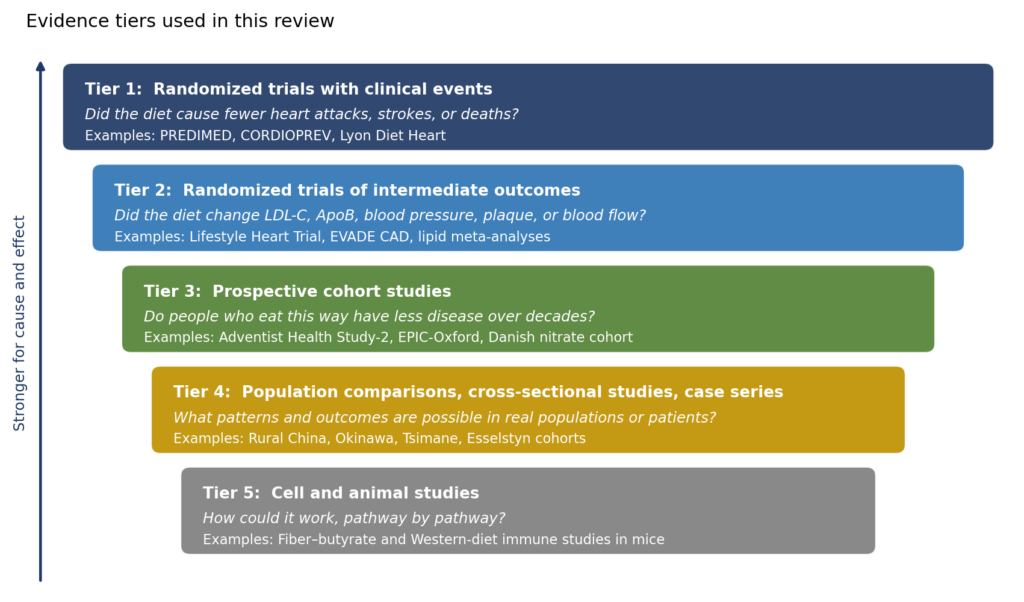
Figure 1. Cinq niveaux de preuve utilisés dans cette revue, la question à laquelle chaque niveau peut répondre et des exemples d'études dans chaque niveau. Les niveaux supérieurs sont plus aptes à démontrer la cause et l'effet ; les niveaux inférieurs ajoutent de l'ampleur, de la durée et des explications biologiques.
2. Définition des régimes alimentaires et des comparaisons
Le régime proposé. L'alimentation VLF-WFPB se compose de légumes, de légumineuses, de céréales complètes intactes, de fruits et d'aliments amylacés peu transformés, sans aliments d'origine animale et avec peu ou pas d'huile ajoutée, soit concrètement environ 10 à 15 % de l'énergie provenant des graisses. Le protocole Esselstyn de 2014 excluait également l'avocat, les noix, l'excès de sel et les aliments sucrés, puis plus tard la caféine et le fructose, et conseillait une multivitamine, de la vitamine B12 et de la farine de lin [4]. La cohorte Esselstyn de 1985 n'était pas végétalienne : les patients éliminaient l'huile, le poisson, la volaille, la viande et les produits laitiers à l'exception du lait écrémé et du yaourt sans matière grasse, visaient 10 % de l'énergie provenant des graisses et recevaient un traitement hypocholestérolémiant individualisé [5]. Le Étude sur le mode de vie et la santé cardiaque d'Ornish était un régime végétarien à base d'aliments complets contenant 10 % de graisses, autorisant les produits laitiers sans matière grasse et les blancs d'œufs [6, 7]; l'apport en graisses atteint était de 6,2 % de l'énergie à un an et de 8,5 % à cinq ans [6].
Régimes apparentés mais différents. Les régimes végétaliens à base d'aliments complets plus riches en graisses incluent des noix, des graines, de l'avocat ou huile d'olive; la phase pauvre en huile de l'essai Recipe for Heart Health de 2024 fournissait encore 32 % de l'énergie provenant des graisses [8], et le bras végétalien de l'essai EVADE CAD s'est terminé à environ 30 % [9]. Generic vegan diets exclude animal foods without constraining food processing or fat. Conventional low-fat diets are omnivorous; the low-fat arm of CORDIOPREV prescribed less than 30% fat with lean meat and low-fat dairy, and achieved 32.1% [10].
Comparators. The DASH combination diet emphasized fruits, vegetables, and low-fat dairy with reduced saturated and total fat [11]. Régimes méditerranéens tested in randomized trials were substantially higher in fat: the PREDIMED arms were supplemented with extra-virgin olive oil or nuts [12]; the CORDIOPREV Mediterranean arm prescribed at least 35% fat and achieved 40.5% [10]; and the Lyon intervention supplied an alpha-linolenic-acid-rich margarine in place of butter and cream, alongside advice to follow a Mediterranean-type pattern [13, 14]. Le Régime portfolio adds nuts, plant protéine, viscous fibre, and plant stérols to a low-saturated-fat background [15]. Table 1 summarizes the patterns as they were actually tested.
Table 1. Dietary patterns as tested.
| Motif | Defining features in the key trials | Fat, % of energy | What the label alone does not establish |
| VLF-WFPB | Legumes, intact grains, vegetables, fruit, starchy foods; no animal foods; little or no oil; Esselstyn 2014 also excluded nuts and avocado [4] | Target ~10–15%; Ornish (vegetarian, not vegan) achieved 6.2–8.5% [6] | Adequate B12, protein, essential fats, or sustained adhésion |
| Higher-unsaturated-fat whole-food vegan | Animal-free, with nuts, seeds, avocado, or olive oil | 32–48% [8]; ~30% in EVADE CAD [9] | Inferiority to an oil-free vegan pattern |
| TIRER | Fruit, vegetables, low-fat dairy; reduced saturated and total fat; sodium reduction in DASH-Sodium [11, 16] | Reduced, not very low | That benefit depends on dairy; event reduction in a trial |
| Méditerranéen | Vegetables, legumes, whole grains, nuts, extra-virgin olive oil, fish [10, 12] | 40.5% achieved in CORDIOPREV [10] | A fixed macronutrient ratio or unlimited energy |
| Portfolio | Nuts, plant protein, viscous fiber, plant sterols added to a low-saturated-fat diet [15] | Varied across trials; includes nuts but not necessarily high in fat | Event reduction; core evidence is hypolipémiant; tested patterns were not restricted to 10–15% fat |
| Conventional low-fat (omnivorous) | Lean meat, low-fat dairy, complex glucide [10] | <30% prescribed; 32.1% achieved [10] | Equivalence to VLF-WFPB |
3. Three Levers: Animal-Food Exclusion, Total Fat, and Food Processing (Tiers 2–3)
VLF-WFPB bundles three changes that can be separated: excluding animal foods, restricting total fat to about 10–15% of energy, and building the diet from whole or minimally processed foods. The Esselstyn and Ornish programs push fat restriction and whole-food eating to their extremes and remove all or nearly all animal foods (their early protocols permitted nonfat dairy, and Ornish’s also egg whites). That makes them the natural test bed for the whole package and, for the same reason, unable on their own to apportion credit among its parts (Figure 2). The label “plant-based” describes only the first lever, and the evidence shows it is not sufficient on its own.
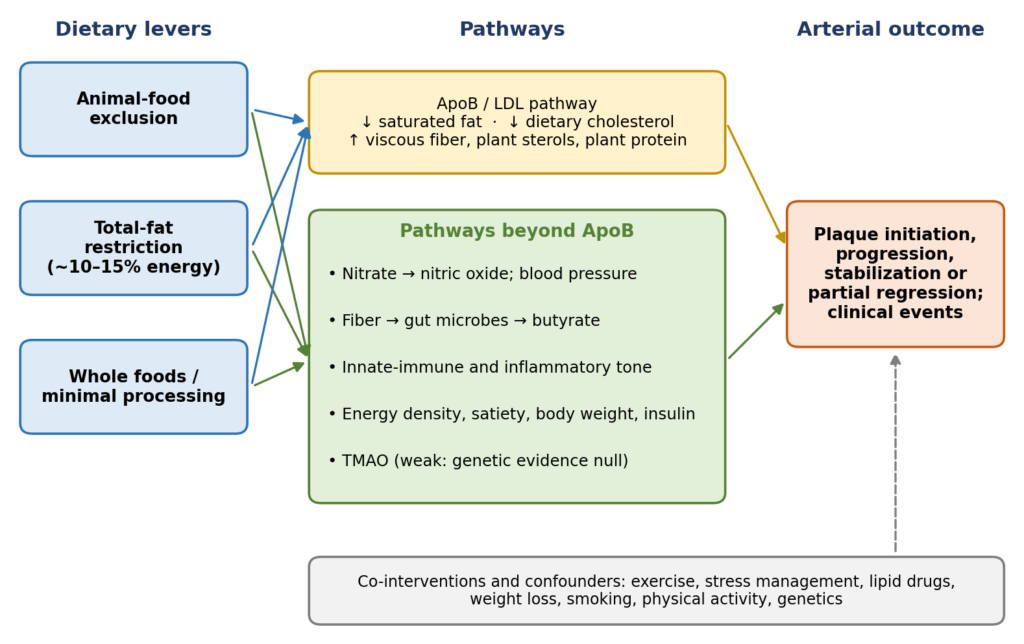
Figure 2. Three separable dietary levers and the pathways by which they could affect coronary athérosclérose. Most intervention programs change all three levers together and add co-interventions, so trials cannot attribute benefit to a single lever.
Diet quality within plant-based eating. In three US cohorts totalling about 209,000 health professionals with 8,631 incident coronary events, an overall plant-based diet index was only weakly associated with lower risk (rapport des cotes for extreme deciles 0.92; 95% CI 0.83 to 1.01). A healthful index that rewarded whole grains, fruits, vegetables, nuts, legumes, oils, tea, and coffee was associated with 25% lower risk (0.75; 0.68 to 0.83), whereas an unhealthful index that rewarded refined grains, potatoes, sweetened beverages, juices, and sweets was associated with 32% higher risk (1.32; 1.20 to 1.46) [17]. Two points follow. Plant-based eating is not protective in itself; quality determines the direction. And the healthful index scored nuts and vegetable oils as beneficial, so this evidence favors a whole-food pattern rather than specifically a very-low-fat one.
Processing within plant foods. In 126,842 UK Biobank participants followed for a median of 9 years, each 10-percentage-point increase in energy from plant-sourced foods that were not ultra-processed was associated with 7% lower maladie cardiovasculaire risk (hazard ratio 0.93; 95% CI 0.91 to 0.95) and 13% lower cardiovascular mortality (0.87; 0.80 to 0.94). Plant-sourced aliments ultra-transformés showed the opposite association (1.05; 1.03 to 1.07 for disease and 1.12; 1.05 to 1.20 for mortality), and total plant-food intake, ignoring processing, showed no association [18].
Randomized evidence on processing. Processing also has randomized evidence, although for energy balance rather than atherosclerosis. In an inpatient crossover trial, 20 weight-stable adults received ultra-processed or unprocessed diets for two weeks each, with meals matched for presented calories, densité énergétique, macronutrients, sugar, sodium, and fiber. On the ultra-processed diet they ate 508 ± 106 kcal/day more and gained 0.9 kg; on the unprocessed diet they lost 0.9 kg [19].
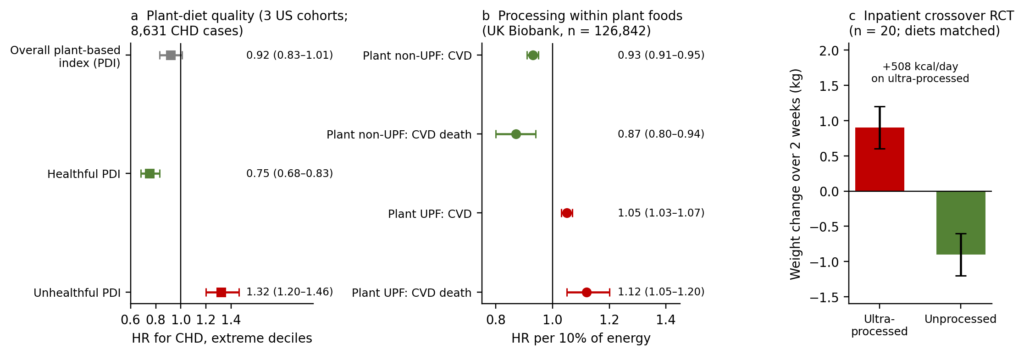
Figure 3. Diet quality and processing. (a) Plant-based diet indices and incident maladie coronarienne, extreme deciles. (b) Plant-sourced foods by processing, per 10% of energy, UK Biobank. (c) Weight change in an inpatient crossover trial of ultra-processed versus unprocessed diets (mean ± SE). Panels come from different designs and are not comparable in magnitude. Sources: Satija 2017; Rauber 2024; Hall 2019.
What this changes. The evidence on processing is consistent in direction: associations for plant foods reverse with processing, and in a randomized feeding trial the ultra-processed pattern increased energy intake and weight relative to the unprocessed pattern, with nutrients matched as far as the design allowed. These findings support attention to food quality and processing; they do not establish the importance of processing relative to animal-food exclusion, a comparison no trial has made. This reframes the Esselstyn and Ornish programs. What they share with each other, and with rural China, Okinawa, and the Tsimane (Sections 6–8), is not zero animal food but a diet built almost entirely from whole, minimally processed foods. That feature, and the question of whether its benefits run only through ApoB (Section 5), are the focus of what follows.
4. The Biological Case: ApoB and the Lipid Pathway (Tiers 1–2)
4.1 Organizing framework: cumulative exposure to ApoB-containing particles
LDL and other ApoB-containing lipoproteins cause atherosclerotic cardiovascular disease, and genetic, epidemiologic, and trial evidence indicate that risk rises with both the magnitude and the duration of exposure [20]. Particles enter the arterial intima in proportion to their concentration and are retained in susceptible sites, so the relevant quantity is exposition cumulative rather than a single measurement. This framework is used here as an organizing principle, not as a validated numerical risk equation.
The framework has two implications for diet. First, a modest reduction sustained from early adulthood could matter more than the same reduction begun after disease is established; this is the logic behind the population evidence in Sections 6 to 8. Second, in established disease the relevant benchmark is the statin-trial slope: about a 22% relative reduction in major vascular events per 1 mmol/L (38.7 mg/dL) of LDL-C lowering over roughly five years [21]. If that slope applied to the pooled dietary LDL-C difference of 0.30 mmol/L reported below, it would predict a relative reduction of about 7% over five years (1 − 0.78^0.30). That figure is an extrapolation, not a measured dietary effect: dietary trials last weeks to months, adherence erodes, and a diet also changes body weight, blood pressure, and other factors that the statine slope does not capture.
4.2 Randomized evidence on lipids and risk factors
The largest meta-analysis of randomized trials comparing vegetarian or vegan diets with omnivorous diets included 30 trials. Plant-based diets lowered cholestérol total by 0.34 mmol/L (95% CI 0.23 to 0.44; about 13 mg/dL) and LDL-C by 0.30 mmol/L (95% CI 0.19 to 0.40; about 11.6 mg/dL). ApoB fell by 12.92 mg/dL (95% CI 3.20 to 22.63), a 14% reduction, but only six trials contributed ApoB data and heterogeneity was substantial (I² = 71.7%); triglycérides did not differ overall [22]. The ApoB figure is the published pooled estimate; because it rests on six trials, its precision depends on those trials being independent randomized comparisons of diet alone, which could not be confirmed from the accessible sources; pooled analyses in this literature also require checking for multiple reports of a single cohort. These results support lipid-mediated plausibility. They do not establish event reduction, régression de la plaque, an individual’s response, or a special benefit from excluding graisses insaturées, because the trial diets and comparators varied widely.
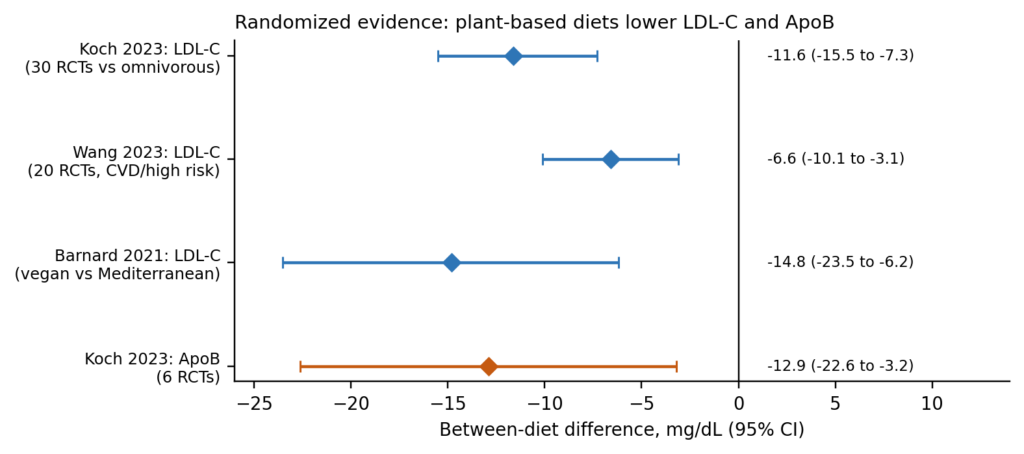
Figure 4. Randomized evidence that plant-based diets lower LDL-C and ApoB. Between-diet differences with 95% confidence intervals; Koch 2023 values converted from mmol/L (× 38.67). Estimates share constituent trials and are not additive. Sources: Koch 2023; Wang 2023; Barnard 2021 (participants without medication changes).
A second meta-analysis restricted to people with, or at high risk of, cardiovascular disease pooled 20 trials (1,878 participants; mean duration 25.4 weeks). Vegetarian diets lowered LDL-C by 6.6 mg/dL (95% CI 3.1 to 10.1), HbA1c by 0.24 percentage points (95% CI 0.07 to 0.40), and body weight by 3.4 kg (95% CI 2.0 to 4.9), with no effect on pression artérielle systolique (−0.1 mm Hg; 95% CI −2.8 to 2.6) [7]. The article’s Key Points box states 6.8 mg/dL and 0.25%; the results section and forest plots give 6.6 mg/dL and 0.24%, which are used here. Two further details matter for Q2. Against usual diets, LDL-C fell 12.9 mg/dL; against active dietary comparators, the LDL-C difference was not statistically significant. And baseline LDL-C explained the between-trial heterogeneity [7]. Only four trials enrolled patients with established cardiovascular disease, three of them Ornish-type programs.
Blood pressure. Earlier meta-analyses, as summarized by Wang and colleagues, reported systolic reductions of about 2.5 mm Hg with vegetarian diets [7]. The null result in higher-risk patients is plausibly explained by background antihypertenseur therapy and by medication reductions during trials, which the authors note could mask diet effects. Blood-pressure benefit is not specific to plant-exclusive eating: the Régime DASH, which includes low-fat dairy, lowered pressure substantially in controlled feeding [11, 16], and in a direct crossover comparison a Mediterranean diet lowered systolic pressure more than a low-fat vegan diet [23]. Blood pressure is therefore not a demonstrated advantage of VLF-WFPB. Estimates from the two lipid meta-analyses are not added together; they share trials.
4.3 Dietary cholesterol
Dietary cholesterol raises serum cholesterol independently of graisse saturée. In a meta-analysis of egg-feeding studies cited by Freeman and colleagues, each additional 100 mg/day raised LDL-C by about 1.9 mg/dL and HDL-C by about 0.3 mg/dL; the response is larger when baseline intake is low and varies between individuals with intestinal absorption capacity [2]. Even people habituated to a very low intake respond: in eight Tarahumara men whose customary diet supplied little cholesterol, a 1,000 mg/day diet raised plasma cholesterol from 113 to 147 mg/dL after a cholesterol-free phase [24]. VLF-WFPB supplies essentially none; in EVADE CAD, dietary cholesterol fell to a median of 0 mg/day in the vegan arm versus 142 mg/day in the AHA arm [9]. The average contribution to LDL-C lowering is modest; the individual contribution can be larger. The AHA’s 2026 dietary guidance states that, for most people, dietary cholesterol is no longer a primary target for cardiovascular risk reduction [25]; eliminating it is therefore a minor, not a defining, part of the case for VLF-WFPB.
4.4 Saturated fat and what replaces it
In the current Cochrane review, reducing saturated fat lowered combined cardiovascular events (risk ratio 0.83; 95% CI 0.70 to 0.98; 12 trials, 53,758 participants), and larger reductions in saturated fat, reflected in larger cholesterol reductions, produced larger benefits. Subgroup analyses did not show a significant difference between replacing saturated fat with graisse polyinsaturée or with carbohydrate [26]. The May 2020 issue of that review reported a risk ratio of 0.79; the corrected version of record is used here. VLF-WFPB drives saturated fat very low (4.5% of energy in the EVADE vegan arm versus 6.6% in the AHA arm [9]), and it replaces it predominantly with starch and fiber from whole foods. Plant protein, viscous fiber, and plant sterols are further plausible LDL-lowering components; current dyslipidémie guidance points patients toward reducing saturated fat and increasing fiber-rich plant foods [27].
The Portfolio evidence shows a different route to the same target. In a meta-analysis of controlled trials (439 participants), adding nuts, plant protein, viscous fiber, and plant sterols to a cholesterol-lowering NCEP Step II diet lowered LDL-C by about 17%, with reductions in ApoB and cholestérol non-HDL as well [15]. Because the Portfolio diet contains nuts, it demonstrates that excluding nuts is not a prerequisite for substantial dietary LDL-C lowering.
5. Beyond ApoB: The Central Question (Tiers 2–5)
If every benefit of VLF-WFPB ran through lower ApoB, the diet would be one of several interchangeable ways to lower ApoB, drugs included, and the case for its particular rules would reduce to how far and how durably it lowers particules athérogènes. The distinctive claim of whole-food plant-based medicine is that it does more: that whole plant foods act on the endothélium, the gut, immune signaling, blood pressure, and energy balance in ways a statin does not. That claim is biologically serious, and it is the central question of this review.
Four kinds of evidence bear on it, in increasing order of strength: (1) a mechanism demonstrated in cells or animals under conditions where lipids are unchanged or controlled; (2) human physiological or biomarqueur effects not explained by LDL-C change; (3) human outcome associations that persist after adjustment for lipids; and (4) randomized comparison of diets at matched ApoB. The subsections below note each candidate pathway against these criteria (Figure 6). No study yet provides the fourth kind.
5.1 Fiber, gut microbes, and butyrate
Viscous fiber lowers LDL-C, but fermentable plant polysaccharides may also act through the microbiote intestinal. Across 83 genetically diverse, atherosclerosis-susceptible mouse strains, the abundance of the butyrate-producing genus Roseburia was inversely related to lésion size and was not correlated with cholesterol. In germ-free apolipoprotéine E–deficient mice colonized with defined bacterial communities, Roseburia intestinalis lowered systemic inflammation and atherosclerosis only when the diet was rich in plant polysaccharides, and intestinal delivery of butyrate itself reduced endotoxemia and atherosclerosis [28]. This is the clearest demonstration in this review of a diet-dependent, cholesterol-independent atheroprotective mechanism. It comes from mouse models, and no human trial has shown that raising butyrate production changes plaque or events.
5.2 Leafy-green nitrate, nitric oxide, and the endothelium
Leafy green vegetables, central to Esselstyn’s protocol, are the main dietary source of inorganic nitrate, which the body can convert to oxyde nitrique through an enterosalivary pathway. In 53,150 Danish adults followed for up to 23 years (14,088 cardiovascular events), a moderate vegetable-nitrate intake (median 59 mg/day, roughly a cup of leafy greens) compared with the lowest quintile (median 23 mg/day) was associated with 15% lower cardiovascular disease risk (hazard ratio 0.85; 95% CI 0.82 to 0.89), and with lower risks of maladie cardiaque ischémique (0.88; 0.82 to 0.94), accident vasculaire cérébral ischémique (0.83; 0.76 to 0.91), and peripheral artery disease (0.74; 0.67 to 0.83). The association plateaued above about 60 mg/day and persisted after adjustment for reported hypercholestérolémie and other dietary factors, which is not the same as controlling measured, cumulative ApoB exposure; a analyse de médiation estimated that baseline systolic blood pressure explained 21.9% of it [29]. The authors note that the largest nitrate trial did not lower blood pressure in older adults with elevated pressure, and that observational data cannot separate nitrate from vegetable intake in general; in this cohort lettuce and potato supplied most vegetable nitrate [29]. The finding supports the leafy-green element of the whole-food lever; it is not specific to a vegan diet.
Fonction endothéliale (acute and short-term human physiology; relevance to events unproven). A single high-fat meal transiently impaired brachial flow-mediated dilation in healthy volunteers [30]. In the same investigators’ ten-person experiment, an olive-oil meal reduced flow-mediated dilation acutely, by 31%, and the reduction was smaller when the meal included antioxydant vitamins or salad with balsamic vinegar [31]. Sustained feeding points the other way: in a meta-analysis of eight trials, olive-oil interventions increased flow-mediated dilation by 0.76 percentage points (95% CI 0.27 to 1.24) [32], and in 805 CORDIOPREV participants a Mediterranean diet improved flow-mediated dilation more than the low-fat diet after one year [33]. Over eight weeks in EVADE CAD, EndoPAT-measured endothelial function did not change in either arm [9]. Neither acute nor short-term vascular-function findings establish effects on events.
5.3 Inflammation and innate-immune memory
Inflammation (human randomized biomarker evidence). EVADE CAD randomized 100 patients with angiographic coronary disease to eight weeks of a vegan or AHA-recommended diet, with groceries, sample menus, and dietitian support for both. At baseline 94–96% took statins and more than half took high-dose statins. The vegan diet produced a 32% lower high-sensitivity Protéine C-réactive (β 0.68; 95% CI 0.49 to 0.94; P = 0.02), consistent after adjustment. LDL-C was 13% lower (adjusted β 0.87; 95% CI 0.78 to 0.97), which the investigators classified as nonsignificant under their Bonferroni threshold (α = 0.0015) for secondary endpoints. Weight, HbA1c, other lipids, leukocyte activation markers, and quality of life did not differ between arms [9]. Crucially, EVADE did not test very-low-fat eating: median reported fat intake at eight weeks was 29.9% of energy in the vegan arm and 30.2% in the AHA arm, both groups were encouraged to use unsaturated oils and olive oil appeared in recipes for both, and the principal dietary contrast was plant versus animal protein, with lower saturated fat and higher fiber in the vegan arm [9]. The hs-CRP result is a biomarker finding; it does not establish fewer events or an ApoB-independent clinical benefit.
Animal work suggests how diet could leave a lasting inflammatory imprint. In LDL-receptor–deficient mice, Western-diet feeding induced systemic inflammation that disappeared from the blood after a return to standard chow, yet myeloid progenitor cells remained reprogrammed, with heightened innate-immune responses; mice also lacking NLRP3 were protected [34]. Because these mice are severely hypercholesterolemic and LDL oxydé was implicated in the human arm of the study [34], this mechanism is not independent of lipoproteins; it suggests instead that the history of dietary exposure, not only current lipid levels, may shape plaque biology. The Tsimane point the other way: about half had hs-CRP above 3 mg/L from infectious burden, yet coronary calcium was the lowest recorded, which the investigators interpret as inflammation possibly not driving atherosclerosis when LDL is low [35].
5.4 Energy density, processing, body weight, and glycemia
Body weight and energy density (human randomized biomarker evidence). Vegetarian diets reduced weight by 3.4 kg in higher-risk patients [7], and a low-fat vegan diet produced greater weight loss than a Mediterranean diet in a crossover trial [23]. In the Lifestyle Heart Trial, the experimental group lost 10.9 kg at one year and remained 5.8 kg below baseline at five years [6]. Weight loss itself lowers LDL-C, blood pressure, and glycemia, so these effects overlap with the lipid pathway and cannot be added to it.
Sensibilité à l'insuline and glycemia (human randomized biomarker evidence). HbA1c fell 0.24 percentage points overall and 0.36 points in people with type 2 diabète [7]. This may add to lipid effects in people with diabetes, but again partly through weight.
The processing trial (Section 3) shows one non-lipid route directly: the same nutrient targets delivered as unprocessed rather than ultra-processed food reduced spontaneous energy intake by about 500 kcal/day [19]. Blood pressure is a further separate, causal pathway. It is not a demonstrated advantage of plant-exclusive eating (Section 4.2), but nitrate-rich vegetables and potassium-rich, low-sodium patterns such as DASH lower it [11, 16, 29].
5.5 Trimethylamine N-oxide
Gut microbiome and trimethylamine N-oxide (human association plus mechanistic hypothesis). Gut microbes convert dietary precursors including choline et carnitine to trimethylamine, which host liver enzymes then oxidize to TMAO [36]; circulating TMAO predicted cardiovascular events in cohort data [37]. Randomisation mendélienne analyses have not found genetically predicted TMAO to be associated with maladie coronarienne, infarctus du myocarde, or stroke [38], which weakens a causal interpretation, and no trial shows that lowering TMAO reduces events. The 2014 Esselstyn report asserts that its participants were unlikely to harbor TMAO-producing flora, but TMAO was not measured in that cohort [4].
5.6 Human signals that ApoB does not fully explain—and those it does
Most measured benefits of plant-based diets can run through ApoB, weight, blood pressure, and glycemia. A diet may have a real total effect even if nothing remains after conditioning on these mediators; the question of an additional effect is separate. Three observations bear on it. First, in the Lifestyle Heart Trial, experimental-group ApoB fell from 1.000 g/L at baseline to 0.769 g/L at one year but was 1.014 g/L at five years, while percent sténose diamétrale continued to improve; LDL-C remained 20% below baseline at five years [6]. Because the program also included exercise, stress management, and group support, and because a year-5 snapshot does not capture the lower cumulative exposure during the preceding years, this cannot be read as diet acting independently of ApoB. Second, within STARS, progression correlated with saturated and total fat intake after adjustment for LDL-C, an observational within-trial analysis [39]. Third, in cohort data roughly one-fifth of the vegetarian–IHD association may be mediated by indice de masse corporelle [40], and in EPIC-Oxford the vegetarian–IHD association weakened substantially after adjustment for self-reported cholesterol, blood pressure, diabetes, and body mass index [41]. No trial has compared dietary patterns at matched ApoB, blood pressure, and weight, which is the design needed to establish an effect beyond the mediators.
Figure 5 displays the Lifestyle Heart Trial data. Although it cannot establish a dietary effect independent of ApoB, it remains the best clinical exhibit for the hypothesis: the experimental group took no lipid drugs, and the change in percent sténose continued from −1.75 points at one year to −3.07 points at five years, after ApoB had returned to 101.4 mg/dL (baseline 100.0), while controls worsened [6]. Two further observations sharpen the picture. First, the Tsimane had mean ApoB of 97 mg/dL at scanning, not especially low, yet almost no coronary calcium; their LDL-C averaged about 71 mg/dL (1.84 mmol/L) from 2004 to 2011 and has risen since, and they spend hours a day in physical activity [35], so lifetime exposure and activity may explain this as well as any dietary factor. Second, the Esselstyn 1995 cohort, often cited for this argument, cannot support it: every patient took cholesterol-lowering drugs and mean LDL-C was 71.6 mg/dL [42], so concomitant lipid lowering is a plausible explanation for part of the improvement, and the uncontrolled design cannot isolate the diet’s contribution or show that any pathway beyond ApoB was involved.
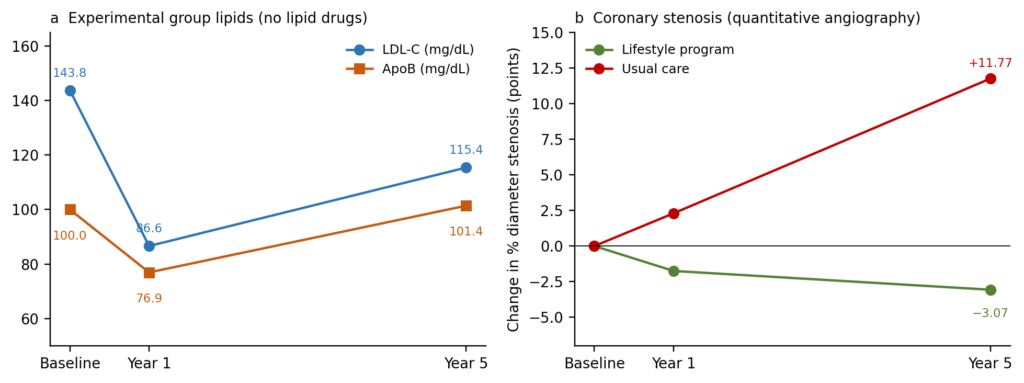
Figure 5. Lifestyle Heart Trial. (a) LDL-C and ApoB in the experimental group, which took no lipid-lowering drugs (ApoB converted from g/L × 100). (b) Change in percent diameter stenosis on quantitative angiography, plotted from the 1998 five-year report for the 35 participants with five-year angiography; the 1990 one-year report covers all 48 participants and gives slightly different baselines, so its values are not plotted here. 60% of controls started lipid drugs between years one and five.
5.7 Weighing the beyond-ApoB case
The additional-benefit hypothesis is therefore conditional: a stricter pattern could outperform another healthy diet if it produces a larger and sustained improvement in ApoB, blood pressure, weight, or santé métabolique without poorer adherence or nutritional disadvantage. “Vegan,” “no oil,” and “10% fat” are not themselves validated critères d'évaluation de substitution. Nor can a short-term dietary lipid change be converted mechanically into an Esselstyn-specific event reduction using drug-trial slopes.
On balance, the beyond-ApoB case is biologically plausible and partly supported. Animal models demonstrate one diet-dependent, cholesterol-independent mechanism (fiber and butyrate) and one mechanism of lasting inflammatory memory; human cohorts link leafy-green nitrate to lower cardiovascular risk after adjustment for hypercholesterolemia, and minimally processed plant foods to lower risk; and a randomized trial shows that processing alone changes energy intake [18, 19, 28, 29, 34]. Against this, the vegetarian–coronary association in EPIC-Oxford weakened substantially after adjustment for conventional risk factors [41], genetic evidence does not support TMAO as causal [38], and no trial has compared diets at matched ApoB. Figure 6 summarizes the evidence by pathway; the proposed trial (Section 17) is designed to supply the missing test.
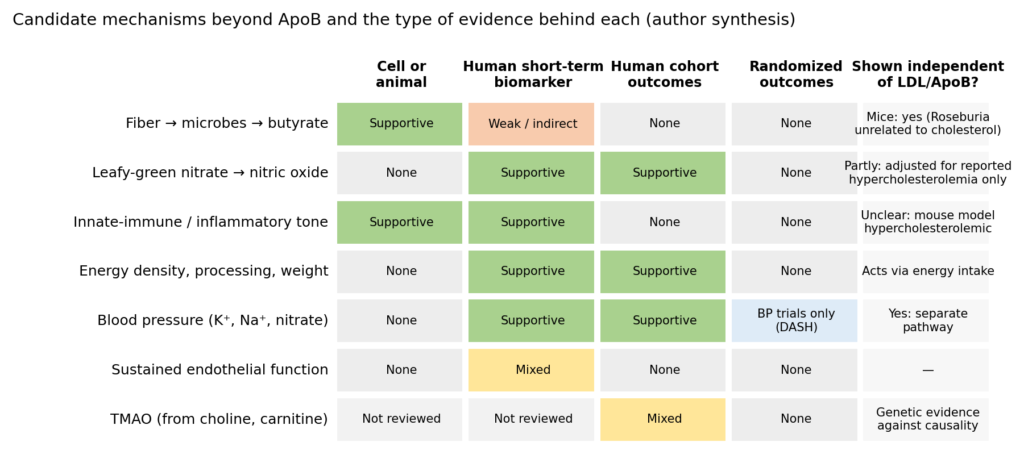
Figure 6. Candidate mechanisms beyond ApoB and the type of evidence for each. Author synthesis of sources cited in Section 5; “supportive” indicates the direction of evidence, not proof of a causal effect on human atherosclerosis.
6. Rural China (Tier 4)
6.1 What was measured
China Study I combined county mortality data with dietary, blood, and urine surveys in 65 rural counties and 130 villages, sampling 50 adults per village; diet and blood were collected in 1983–1984 [43]. The average rural diet supplied 14% of energy from fat, 71% from carbohydrate, 5% from alcool, and 10% from protein, of which about 11% was of animal origin (roughly 1% of total energy); fiber intake was 33 g/day and mean body mass index 20.5 [43]. Mean serum total cholesterol was 127 mg/dL, compared with 203 mg/dL in US adults aged 20–74 [43]. The diet was low in animal food, not vegan; the authors describe rural diets of 1950–1980 as containing 3–6% animal-based foods [43].
6.2 What the coronary figures are
The widely quoted coronary comparison uses mortality, not incidence, recorded in 1973–1975 and truncated at ages 0–64: 4.0 per 100,000 men and 3.4 per 100,000 women in rural China versus 66.8 and 18.9 in the United States, taken from a 1989 WHO statistics annual, giving ratios of 16.7 and 5.6 [43]. Four features limit interpretation. The mortality period precedes the dietary and blood survey by about a decade. Excluding deaths after age 64 removes the ages at which most coronary deaths occur. Death certification and coronary diagnosis in rural China in the 1970s differ from US practice, so under-ascertainment cannot be excluded. And competing mortality from infections and other causes of death, which the authors describe as clustering in the same counties, removes people before coronary disease manifests [43]. No charge athéromateuse was measured.
6.3 What the county correlations show
Across counties, coronary mortality correlated positively with plasma ApoB (r = 0.37) and with an index of salt intake (r = 0.42), and inversely with green-vegetable intake; ApoB in turn correlated with animal protein and meat intake [43]. Coronary mortality also correlated with wheat flour intake (r = 0.67), which the authors attribute partly to co-varying milk, salt, triglycerides, and body weight [43]. The authors themselves note that the county, not the individual, is the unit of analysis, so the data cannot show whether low disease rates reflect uniformly low animal-food intake or fewer individuals eating more [43].
6.4 Confounding and alternative explanations
Energy intake per kilogram was about 30% higher than in the United States with far less obésité, which the authors attribute to greater daily energy expenditure such as cycling to work [43]. Physical activity, body weight, tobacco use, socioeconomic conditions, health care access, and diagnostic ascertainment all differ between these populations and the United States. The coronary paper does not report ischemic or accident vasculaire cérébral hémorragique, and this review makes no claim about stroke subtypes in these counties. This review also did not re-verify post-1990 trend data; claims that China’s later dietary transition proves a causal diet effect should rest on contemporaneous individual-level cohorts.
6.5 Checking the secondary summary
Freeman and colleagues’ 2017 review is a useful route to these data but should not be quoted in place of them [2]. Its table correctly gives the 0–64 age restriction and the 127 mg/dL cholesterol, but lists macronutrients of 14% fat, 71% carbohydrate, and 10% protein, which sum to 95% because the 5% alcohol in the original is omitted [2, 43]. Its Tarahumara entry reports 528 people surveyed and a mean adult cholesterol of 136 mg/dL [2]; the original abstract reports 523 people aged 5 to 70 with a mean of 125 mg/dL overall and 116 mg/dL in children, a diet of 12% fat, 2% saturated fat, 71 mg/day cholesterol, and 75% carbohydrate, and a virtual absence of hypertension, obesity, and the usual age-related rise in cholesterol [44]. The difference in denominators could not be resolved without the full text. The Tarahumara study measured lipids and diet, not coronary outcomes.
6.6 What rural China contributes
The rural Chinese data are consistent with the cumulative-exposure hypothesis: populations with lifelong low animal-food and saturated-fat intake had low cholesterol, and county coronary mortality tracked ApoB. That strengthens plausibility for Q1. It says nothing decisive about Q2 or Q3, because the diet was neither vegan nor compared with a high-quality alternative, and because activity, body size, and competing mortality are inseparable from diet in these data.
7. Traditional Okinawa (Tier 4)
The traditional régime d'Okinawa is known chiefly from a 1949 survey, conducted during post-war scarcity and US administration, as analyzed by the Willcox group. Sweet potato supplied about 69% of energy; total energy intake was about 1,785 kcal/day; fat supplied roughly 6% of energy; and meat intake was a few grams per day, with small amounts of fish, soy, and seaweed [45, 46]. The Willcox group estimates that adults ate about 11% fewer calories than needed to maintain weight until the late 1960s, with a lean average body mass index of 21 [47]. Interpretation is contested: one critic has argued that the Okinawan data reflect severe malnutrition, whereas Gavrilova and Gavrilov, responding, attribute the later loss of longevity advantage to westernization of the diet and note that a low infectious burden may also have contributed [48]. A single post-war survey cannot establish lifelong intake.
Coronary outcomes should be judged directly rather than through longevity. The same group reports that older Okinawans have about 80% less coronary mortality than the US population, based on age-adjusted vital statistics rather than individual dietary linkage [47]. The advantage has not persisted: Okinawans who did not experience the energy-restricted era now have higher body mass index, more type 2 diabetes, and worse cardiovascular risk factors than other Japanese, and the prefecture’s life-expectancy advantage is now confined to older ages [47]. That transition is compatible with a dietary contribution but equally with changes in energy balance, activity, and other exposures.
Okinawa informs the hypothesis in a limited way. It shows that a very-low-fat, high-carbohydrate, plant-predominant diet is compatible with low coronary mortality. It does not show that complete exclusion of animal foods is necessary, because the traditional diet included pork and fish, and it cannot separate low fat from caloric restriction, low body size, physical labor, or génétique. Its shared features with DASH and Mediterranean patterns are high vegetable and legume intake, low saturated fat, and low energy density; its distinctive features are very low total fat, a single dominant starchy staple, and chronic mild energy restriction.
8. Other Traditional Populations: The Tsimane and Kitava (Tier 4)
The Tsimane. The Tsimane, forager-horticulturalists of the Bolivian Amazon, provide the only traditional-population data in this review with direct imagerie coronaire. Of 705 adults aged 40 to 94 scanned in 2014–2015, 596 (85%) had no coronary artère calcium, 89 (13%) had scores of 1–100, and 20 (3%) had scores above 100; among those older than 75, 31 (65%) had none and four (8%) had scores of 100 or more [35]. Mean LDL-C was 91 mg/dL and HDL-C 39.5 mg/dL, and obesity, hypertension, hyperglycémie, and regular tabagisme were rare. Compared with the US MESA cohort, the Tsimane reached a nonzero score calcique about 24 years later and a score of 100 or more about 28 years later [35] (Figure 7).
The Tsimane diet is low in fat and minimally processed but not plant-exclusive: about 14% of energy from protein, 14% from fat, and 72% from carbohydrate, an estimated 38 g of fat per day including 11 g of saturated fat and no trans fat, with rice, plantain, manioc, and corn as staples and meat and fish obtained by hunting and fishing [35]. Men and women average 6–7 and 4–6 hours of physical activity per day. The limits are important: calcium scoring cannot detect plaque non calcifiée, the design is cross-sectional, and outcome data are thin, with one possible myocardial infarction among 50 recent adult deaths ascertained by verbal autopsy. LDL-C has risen by about 0.16 mmol/L per year since 2011 as motorized river travel improved access to market food [35], a natural experiment whose coronary consequences are not yet known.
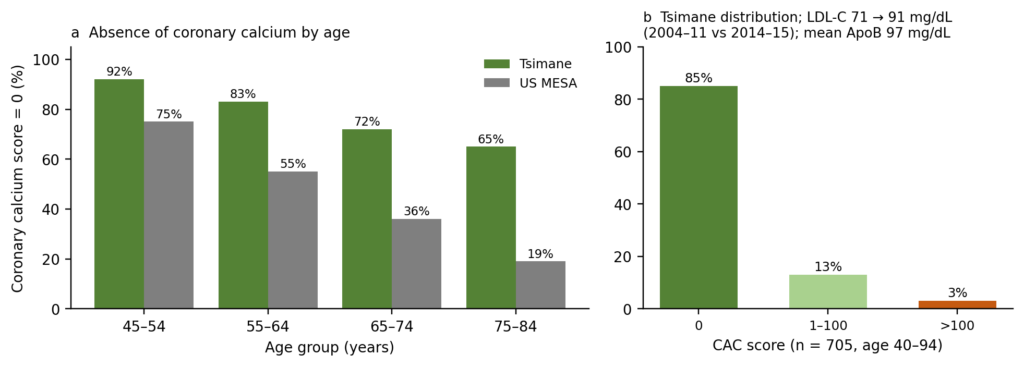
Figure 7. Coronary artery calcium in the Tsimane. (a) Proportion with a calcium score of zero by age group, Tsimane versus US MESA, as labeled in Figure 2 of Kaplan 2017. (b) Distribution of scores among 705 Tsimane adults. Calcium scoring does not detect noncalcified plaque.
Kitava. On Kitava in the Trobriand Islands, where tubers, fruit, fish, and coconut are dietary staples, semi-structured interviews with 213 adults identified no case corresponding to stroke, sudden death, or angine, and resting electrocardiograms showed few abnormalities [49]. Smoking was common: 76% of men and 80% of women over 20 smoked in the risk-factor survey [50]. The evidence rests on interviews and electrocardiograms rather than imaging or death registration.
What these populations add. None was vegan, and their fat intakes were not uniformly low in saturated fat. The Kitavan diet supplied about 21% of energy as fat and 17% as saturated fat, mostly lauric and myristic acid from coconut [51], a clear exception to the pattern. What rural China, traditional Okinawa, the Tsimane, and Kitava share is diets built from whole, minimally processed staples, leanness, and in most cases high physical activity. The pattern supports the cumulative-exposure argument and the whole-food lever; it provides no support for the claim that complete exclusion of animal foods is required. Fat intake ranged from very low in Okinawa to low among the Tsimane, and coconut was a Kitavan staple.
9. Prospective Cohort Evidence (Tier 3)
The most comprehensive cohort meta-analysis included 13 prospective cohorts with 844,175 participants. Compared with non-vegetarians, vegetarians had lower risk of cardiovascular disease (risque relatif 0.85; 95% CI 0.79 to 0.92; 8 cohorts) and ischemic heart disease (0.79; 95% CI 0.71 to 0.88; 8 cohorts), but not of total stroke (0.90; 95% CI 0.77 to 1.05; 12 cohorts). For vegans the ischemic heart disease estimate was 0.82 (95% CI 0.68 to 1.00; 6 studies), and the cardiovascular disease estimate 0.92 (95% CI 0.79 to 1.06). Risk of bias was moderate in eight cohorts and serious in five [40]. Incidence estimates were used in preference to mortality where both were reported. The IHD association was weaker when early follow-up was excluded, about one-fifth of it appeared attributable to body mass index, and the E-value was 1.86 (lower confidence limit 1.49), meaning an unmeasured facteur de confusion would need associations of that strength with both diet and disease to explain it away [40].
The “40% lower coronary risk” figure sometimes attached to vegetarian diets traces to a meta-analysis restricted to Seventh-day Adventist cohorts, which reported a relative risk of 0.60 (95% CI 0.43 to 0.80) for coronary events [2, 52]. That estimate is population-specific and should not be generalized. Several Adventist and Oxford cohorts recur across meta-analyses, so repeated citation is not independent corroboration. Cohort vegetarian and vegan categories are defined by exclusion of animal foods, not by total fat, so none of this evidence tests the very-low-fat component.
Endpoint-specific data matter. In EPIC-Oxford (48,188 participants followed for 18.1 years), vegetarians including vegans had a 22% lower rate of ischemic heart disease than meat eaters (hazard ratio 0.78; 95% CI 0.70 to 0.87), equivalent to about 10 fewer cases per 1,000 people over 10 years; adjustment for self-reported high cholesterol, high blood pressure, diabetes, and body mass index attenuated the estimate to 0.90 (95% CI 0.81 to 1.00). The same group had a 20% higher rate of total stroke (1.20; 95% CI 1.02 to 1.40), about three more cases per 1,000 over 10 years, mostly hemorrhagic, and this association did not attenuate with risk-factor adjustment [41]. Coronary benefit and stroke risk must therefore be reported separately, and the attenuation of the coronary association is consistent with benefit running largely through conventional risk factors.
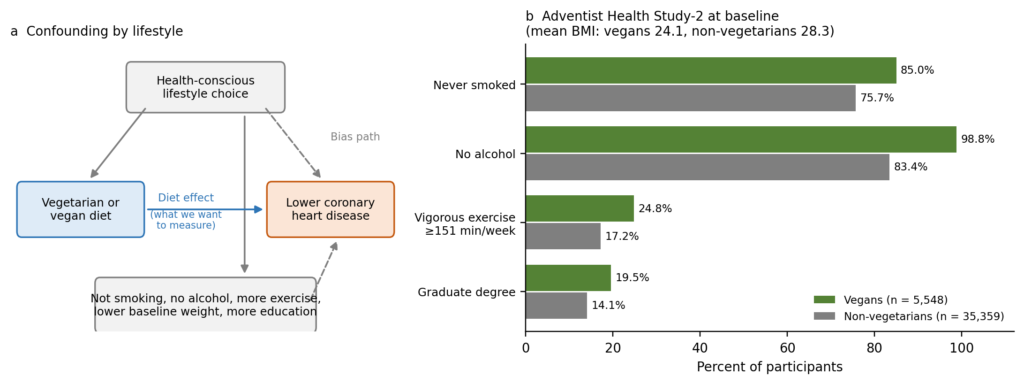
Figure 8. Prospective cohort estimates for vegetarian and vegan diets. The coronary association weakens after adjustment for conventional risk factors (EPIC-Oxford), and stroke risk is not lower. Estimates are shown side by side, not pooled; several cohorts overlap across meta-analyses. Sources: Dybvik 2023; Tong 2019; Orlich 2013; Kwok 2014.
9.1 Healthy-user bias: why associations are hard to read
Cohort studies compare people who chose different diets, and people who choose a vegetarian diet usually choose other healthy habits as well. This is called healthy-user bias, a form of confounding: part or all of an observed difference in disease may come from the other habits rather than from the diet. The Adventist data show the problem clearly. Compared with non-vegetarians in Adventist Health Study-2, vegans were more likely never to have smoked (85.0% versus 75.7%), far more likely to drink no alcohol (98.8% versus 83.4%), more likely to exercise vigorously for at least 151 minutes a week (24.8% versus 17.2%), more likely to hold a graduate degree (19.5% versus 14.1%), and leaner (mean body mass index 24.1 versus 28.3) [53] (Figure 9). The authors note that the conscious lifestyle choice of a vegetarian diet may itself affect the results and that uncontrolled confounding remains possible [53].
Researchers use several tools to reduce this bias, and each has limits. Comparing similar people: in both Adventist Health Study-2 and EPIC-Oxford, the non-vegetarian comparison group is itself relatively health-conscious, and very few Adventists smoke or drink, which narrows the gap without closing it [53]. Statistical adjustment: models adjust for smoking, exercise, education, and similar factors, but only for factors that were measured, and only as accurately as they were measured. Watching what adjustment does: when EPIC-Oxford added cholesterol, blood pressure, diabetes, and body mass index to its model, the vegetarian–ischemic heart disease hazard ratio moved from 0.78 to 0.90 [41]; this suggests much of the benefit runs through those risk factors, which is expected if the diet works, and it also shows how sensitive the estimate is to modeling choices. Quantifying robustness: in the Dybvik meta-analysis, an unmeasured confounder would need a relative risk of 1.86 with both diet and heart disease to explain the association away [40]. Duration and age: in a pooled analysis of five cohorts, lower ischemic heart disease mortality in vegetarians was restricted to people who had followed their diet for more than five years, and it was larger at younger ages (45% lower below age 65, 31% lower at 65–79, and 8% lower, not significant, at 80–89) [54]. A relation with duration of diet is what a causal effect would produce, although long-term vegetarians may also differ in other long-term habits.
Two further observations cut both ways. A meta-analysis found a larger ischemic heart disease association in Adventist cohorts (relative risk 0.60) than in non-Adventist cohorts (0.84; 95% CI 0.74 to 0.96) [52]. That difference could reflect stronger healthy-user effects among Adventists, or it could reflect what Adventist vegetarians actually eat: Adventist vegans reported about 46–47 g of fiber a day, compared with about 26–28 g in EPIC-Oxford vegans [53]. And causalité inverse—people changing diet after early illness—is reduced but not eliminated by excluding people with prior cardiovascular disease at enrollment, as both cohorts did [41, 53].
None of this means cohort evidence should be set aside. It is large, long, consistent across countries, and aligned in direction with randomized lipid trials and with biology. It should be read as Tier 3 evidence: strong for association, supportive but not decisive for cause, and unable on its own to rank one healthy diet against another.
Figure 9. Healthy-user bias. (a) How a lifestyle choice can link a diet to lower heart disease through paths other than the diet itself. (b) Baseline characteristics of vegans and non-vegetarians in Adventist Health Study-2, standardized by age, sex, and race as reported in Orlich 2013.
9.2 Do vegans do better than other vegetarians?
Vegan diets exclude all animal foods; lacto-ovo vegetarian diets include dairy and eggs; pesco-végétarien diets include fish. If complete exclusion of animal foods added protection, vegans should do better than the other groups. The cohort data do not show that (Figure 10).
Adventist Health Study-2. Compared with non-vegetarians, the hazard ratio for ischemic heart disease death was 0.90 (95% CI 0.60 to 1.33) for vegans, 0.82 (0.62 to 1.06) for lacto-ovo vegetarians, and 0.65 (0.43 to 0.97) for pesco-vegetarians, the only statistically significant reduction [53]. Among men, vegans had hazard ratios of 0.45 (0.21 to 0.94) for ischemic heart disease death and 0.58 (0.38 to 0.89) for cardiovascular death; among women the corresponding estimates were 1.39 (0.87 to 2.24) and 1.18 (0.88 to 1.60) [53]. The whole cohort recorded 372 ischemic heart disease deaths over a mean of 5.79 years, so these subgroup estimates are imprecise, and the association of vegetarian diet with cardiovascular mortality differed significantly by sex [53]. In the longer 2024 follow-up of 88,400 participants, vegetarians overall had lower ischemic heart disease mortality, but a vegan diet was not associated with lower mortalité toutes causes confondues in men and women combined; vegan men had lower mortality only at younger ages [55].
EPIC-Oxford and pooled cohorts. Compared with meat eaters, ischemic heart disease incidence in EPIC-Oxford was 0.82 (0.64 to 1.05) in vegans (67 cases), 0.77 (0.69 to 0.86) in lacto-ovo vegetarians, and 0.87 (0.77 to 0.99) in fish eaters [41]. In the pooled analysis of five cohorts, ischemic heart disease mortality was 26% lower in vegans and 34% lower in both lacto-ovo vegetarians and fish eaters than in regular meat eaters [54]. A systematic review of vegan diets found that none of three cohort studies, including at least 7,380 vegans, reported a significantly higher or lower risk of any primary cardiovascular outcome for vegans [56].
What this does and does not show. Vegans are few, so their estimates are wide and inconclusive rather than null. More important for this review, the vegans in these cohorts were not following VLF-WFPB: EPIC-Oxford vegans obtained 28.1% of energy from fat and ate about 26 g of fiber a day [41], neither very low in fat nor especially high in whole foods. These cohorts do not establish that vegans have lower cardiovascular risk than lacto-ovo vegetarians or fish eaters; they also do not establish equivalence or inferiority, since each group is compared with meat eaters rather than with the others, and in EPIC-Oxford the vegan point estimate was numerically lower than the fish eaters’. Within Adventist Health Study-2, protein from nuts and seeds was associated with 40% lower cardiovascular mortality, and protein from meat with 61% higher mortality, comparing highest with lowest quintiles; these associations persisted after adjustment for vegetarian diet type [57]. That pattern favors plant protein and nuts. It does not favor excluding nuts or all animal foods.
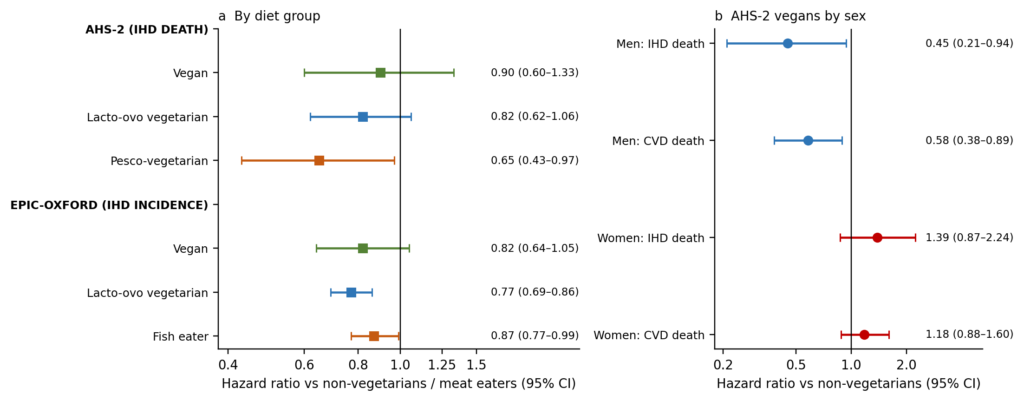
Figure 10. Vegans compared with other vegetarian groups. (a) Ischemic heart disease by diet group in Adventist Health Study-2 (deaths) and EPIC-Oxford (incident cases), each compared with non-vegetarians or meat eaters. (b) Adventist Health Study-2 vegans by sex. Wide intervals reflect small numbers of vegans. Sources: Orlich 2013 (Table 4); Tong 2019 (Supplementary Table 3).
9.3 Chinese and Taiwanese vegetarians
La recherche pour cette revue n'a trouvé aucune étude prospective de Chine continentale comparant les végétaliens aux omnivores pour les résultats liés aux maladies cardiaques. Les preuves disponibles pour la Chine et Taïwan concernent les végétariens, dont la plupart consomment des produits laitiers et souvent des œufs. À Taïwan, deux cohortes bouddhistes Tzu Chi (13 352 participants au total) ont trouvé un risque d'accident vasculaire cérébral plus faible chez les végétariens : dans la première cohorte, le rapport de risque pour l'AVC ischémique était de 0,26 (IC à 95 % 0,08 à 0,88) ; dans la seconde, l'AVC global était de 0,52 (0,33 à 0,82), l'AVC ischémique de 0,41 (0,19 à 0,88) et l'AVC hémorragique de 0,34 (0,12 à 1,00) [58]. Les participants étaient membres d'une fondation bouddhiste, une population ayant son propre profil d'utilisateur en bonne santé, et une analyse exploratoire a suggéré que l'apport en vitamine B12 modifiait l'association [58]. Le résultat concernant l'AVC hémorragique va à l'encontre de celui d'EPIC-Oxford [41], un rappel que les sous-types d'AVC se comportent différemment selon les populations.
Dans une étude transversale de Xiamen, 169 hommes chinois lacto-végétariens en bonne santé présentaient une pression artérielle, un cholestérol LDL, une ApoB, des triglycérides et une glycémie à jeun plus bas glucose, et une paroi carotidienne plus fine épaisseur intima-media, que 126 hommes omnivores [59]. Il s'agit de preuves de niveau 4 sur marqueurs de substitution chez les végétariens consommant des produits laitiers.
Les données de Hong Kong ajoutent une mise en garde. Une carence en vitamine B12 a été signalée chez environ 80 % des végétaliens de Hong Kong, qui utilisaient rarement des aliments enrichis ou des suppléments ; les groupes végétariens carencés en B12 présentaient une altération de la fonction endothéliale artérielle et des parois carotidiennes plus épaisses, et la supplémentation en B12 a amélioré ces mesures vasculaires chez les végétaliens de Hong Kong [60]. Un régime végétalien sans supplémentation peut donc nuire au bénéfice vasculaire qu'il est censé apporter, ce qui renforce les conseils nutritionnels de la section 15.
10. Réévaluation des études d'Esselstyn (Niveau 4)
10.1 La cohorte de la Cleveland Clinic de 1985
Trois rapports décrivent cette cohorte, et leurs dénominateurs diffèrent. Le rapport complet de 1995 décrit 22 patients (21 hommes, 1 femme) souffrant d'une maladie coronarienne grave documentée par angiographie, recrutés entre 1985 et 1988 ; les 11 participants dont les résultats sont rapportés présentaient tous une maladie tritronculaire et étaient des non-fumeurs non diabétiques et non hypertendus [42]. Le régime alimentaire tirait moins de 10 % de l'énergie des graisses et excluait les huiles, la viande, le poisson, la volaille et les produits laitiers, à l'exception du lait écrémé et du yaourt sans matière grasse. Chaque participant recevait également un médicament hypocholestérolémiant individualisé, le plus souvent de la cholestyramine 4 g deux fois par jour avec de la lovastatine 40–60 mg par jour ; un entraînement à la relaxation et à la méditation a été proposé mais abandonné en quelques semaines, et aucun exercice n'a été prescrit [42]. Chez les 11 participants ayant subi une imagerie, le cholestérol total moyen est passé de 246 mg/dL au début de l'étude à 132,4 mg/dL pendant le traitement, avec un cholestérol LDL moyen de 71,6 mg/dL et un cholestérol HDL de 36,3 mg/dL [42].
Sur les 38 lésions présentant une sténose de plus de 20 % chez ces 11 participants, trois traitées par angioplastie et quatre lésions sur vaisseaux natifs proximales à des pontages ont été exclues a priori — ces dernières parce que, comme le notent les auteurs, on s'attendait à ce que ces lésions progressent, ce qu'elles ont fait — et six autres n'ont pas pu être appariées lors du suivi, en laissant 25 [42]. Deux techniciens travaillant en aveugle sur la angiographie séquence ont lu les clichés. En termes de pourcentage de sténose du diamètre, 11 des 25 lésions ont régressé et 14 étaient stables, la sténose moyenne est passée de 53,4 % à 46,2 % (diminution estimée de 7 points de pourcentage ; IC à 95 % 3,3 à 10,7), et 8 des 11 participants ont été classés comme étant en régression. Par le diamètre lumens minimal, la mesure la moins dépendante de la référence, 6 lésions ont régressé, 14 étaient stables et 5 ont progressé, et l'augmentation moyenne était de 0,08 mm (IC à 95 % −0,06 à 0,22 ; non significatif) [42].
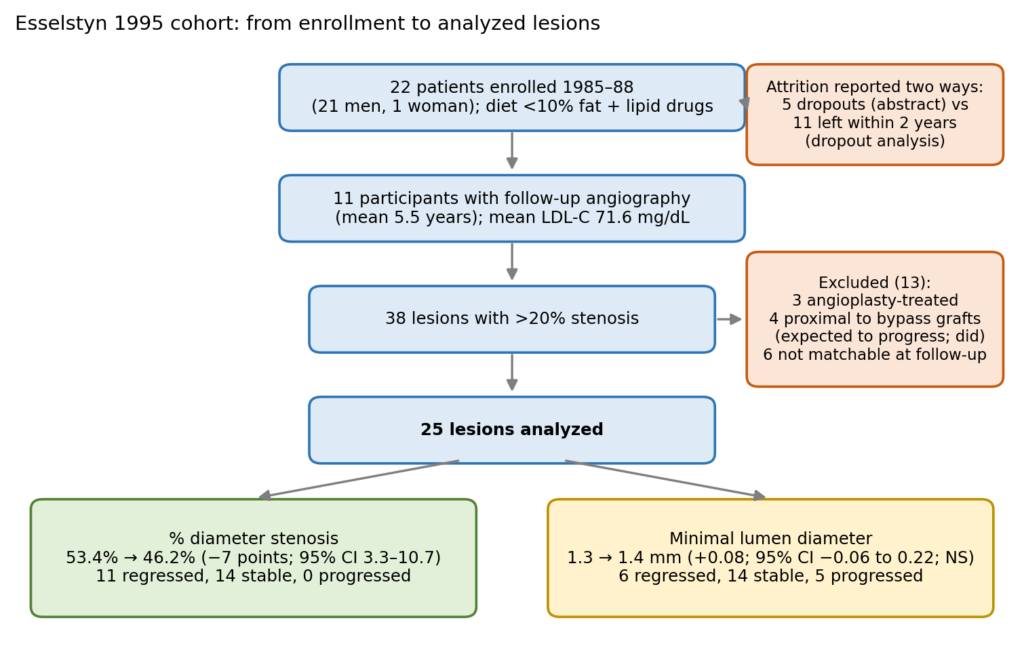
Figure 11. Cohorte Esselstyn 1995 : recrutement, attrition, sélection des lésions et résultats angiographiques selon les deux méthodes rapportées. Source : Esselstyn 1995 (texte intégral).
Le même article rapporte l'attrition de deux manières. Son résumé indique que 5 des 22 participants ont abandonné en moins de deux ans et 17 ont maintenu le régime ; son analyse des abandons indique que 11 sont partis en moins de deux ans (trois ont déménagé, quatre avaient des conflits professionnels, trois n'ont pas pu maintenir le régime et un a choisi pontage) [42]. Les cinq personnes ayant abandonné et repris leur régime alimentaire précédent ont signalé 10 accidents cardiaques. The 11 imaged participants had experienced 37 cardiovascular events in the eight years before enrollment. None had a new infarction during follow-up, although two required coronary procedures during the study (repeat angioplasty in one, bypass surgery in the other) and the patient who had bypass surgery, whose fraction d'éjection was below 20%, later died of an arrhythmia [42].
The 1999 update describes the cohort as 24 patients (23 men, 1 woman). Six nonadherent patients were released within 12–18 months and returned to standard care; 18 adhered for five years, and 11 of them had five-year angiography showing arrest in all 11 and regression in 8 (73%) by percent stenosis. Mean cholesterol fell from 237 to 137 mg/dL over five years and was 145 mg/dL at 12 years. The 18 adherent patients were reported to have had 49 coronary events in the eight years before enrollment and none during follow-up, while the six released patients had 13 new events by 1998 [5]. “No coronary events” reflects the report’s own event classification: the same cohort included a ventricular-arrhythmic death without infarction after five-year angiography [42]. The 2014 report gives yet another summary, stating that 17 of 22 patients were adherent and that inversion was angiographically confirmed in 4 of 12 [4]. Baseline cholesterol (246 versus 237 mg/dL), cohort size (22 versus 24), and prior-event counts (37 events in 11 patients in the 1995 discussion versus 49 in 18 patients in 1999) differ across reports. Two different 73% figures circulate: 8 of 11 imaged patients with regression by percent stenosis, and 16 of 22 original patients still following the diet in 1995 [5, 42].
Comparing events after enrollment with events in the preceding eight years is vulnerable to regression to the mean, because patients typically enter such programs after a cluster of events. The regimen combined diet with drugs, so the diet’s independent contribution cannot be estimated.
10.2 The 2014 cohort of 198 patients
Design and enrollment. Two hundred consecutive self-referred volunteers with cardiovascular disease were counseled; two were lost to follow-up, leaving 198 (91% men; mean age 62.9 years; mean follow-up 44.2 ± 24.1 months). Coronary disease was documented in 195, by angiography or CT angiography in 180; 44 had a prior myocardial infarction. All were nonsmokers; 161 had hyperlipidemia, 60 hypertension, and 23 diabetes. The intervention was a single five-hour seminar with follow-up by telephone or email, and patients continued their usual cardiac medications, which were not recorded. Exercise was encouraged but not required [4].
Adherence and data collection. Patients who avoided all meat, fish, and dairy, and knowingly any added oil, were classified as adherent. Data were collected by telephone in 2011–2012, from relatives for those who had died. No lipid values were reported [4].
Outcomes, with denominators. Of 177 adherent patients, 112 reported angina at baseline, of whom 104 (93% in the text; the table gives 105, 94%) improved. “Reversal” was documented in 39 of 177 (22%) by radiographic or stress testing. Eighteen of 177 (10%) were classified as worse: the investigators judged nine of these events unrelated to the diet (including two coronary bypass operations in asymptomatic patients persuaded by their physicians, stent thrombose after clopidogrel was stopped, and a stroke after warfarin was refused) and four as disease progression (one stroke, two bypass operations, one restenting). There were five non-cardiac deaths and no cardiac deaths. The headline 0.6% event rate counts only the stroke as a progression-related major event; a supplementary table in the same article instead lists a 2.2% event rate for adherent patients [4]. Of 21 nonadherent patients, 13 (62%) had at least one event: two sudden cardiac deaths, one heart transplant, two ischemic strokes, four stenting procedures, three bypass operations, and one endarterectomy [4].
Why the contrast is not causal. Les groupes n'étaient pas randomisés ; les participants se sont auto-sélectionnés dans un programme qu'ils ont activement recherché ; l'observance était auto-déclarée et classifiée après coup ; les investigateurs ont identifié et arbitré les événements par téléphone et ont décidé lesquels étaient liés au régime ; l'imagerie était dictée par la clinique plutôt que par le protocole ; l'utilisation de médicaments n'a pas été enregistrée ; et sept des événements du groupe non observant étaient revascularisation des procédures, qui dépendent des symptômes et des décisions des médecins. Les patients observants et non observants différaient également au départ, par exemple 93 % contre 76 % d'hommes [].4Le contraste brut de 62 % contre 0,6 % peut être divisé, mais le quotient n'est pas un risque relatif causal valide ou nombre nécessaire à traiter: les groupes n'étaient pas randomisés, et les définitions d'événements qui leur sont appliquées ne sont pas comparables. Les participants inscrits après 2007 ont reçu une copie du livre de l'auteur principal dans le cadre du programme [4].
10.3 Ce que les travaux d'Esselstyn peuvent et ne peuvent pas soutenir
Le programme d'Esselstyn mérite d'être mis en avant pour trois raisons. Il constitue l'expression réelle la plus intensive du levier de l'alimentation complète : pas d'huile, pas d'aliments d'origine animale dans la cohorte de 2014, pas d'aliments transformés, et d'abondants légumes verts à feuilles. Il montre que certains patients motivés atteints d'une maladie grave peuvent maintenir un tel régime pendant des années, 16 des 22 patients originaux le suivant toujours en 1995 [42] et un taux d'observance auto-déclaré de 89 % dans la cohorte de 2014 [4]. Et il a généré des hypothèses spécifiques et testables — nitrates des légumes verts à feuilles et oxyde nitrique, protection endothéliale, exclusion de l'huile — que la section 5 évalue par rapport à des preuves indépendantes.
Ce qu'il ne peut pas soutenir, c'est un poids causal pour l'affirmation « au-delà de l'ApoB » ou pour l'affirmation de supériorité. La cohorte de 1995 combinait le régime avec la cholestyramine et la lovastatine et a atteint un LDL-C moyen de 71,6 mg/dL, un niveau auquel le traitement médicamenteux concomitant est une explication plausible d'une partie du résultat angiographique, bien que la conception non contrôlée ne puisse établir que les médicaments seuls en sont responsables ou que ce taux de LDL-C garantisse l'arrêt de la progression [42] ; seuls 11 patients ont fait l'objet d'une imagerie, 13 des 38 lésions ont été exclues, et l'article rapporte l'attrition de deux manières (Figure 11). La cohorte de 2014 n'avait pas de données lipidiques, l'observance était auto-déclarée, et les résultats étaient arbitrés par les investigateurs (Section 10.2). Considérées parallèlement aux essais lipidiques randomisés, deux observations deviennent néanmoins plus plausibles : un taux de LDL-C très bas maintenu, obtenu grâce à un régime d'aliments complets et des médicaments, est compatible avec l'arrêt de la maladie angiographique chez la plupart des patients imagés [20, 21], et l'angine de poitrine s'est améliorée chez la plupart des patients, ce qui est cohérent avec les résultats randomisés d'Ornish et de Heidelberg [6, 61, 62]. Restent non résolus la contribution indépendante du régime, si l'exclusion de l'huile, des noix et de l'avocat apporte quelque chose, le taux d'événements réel dans une population représentative, et comment les résultats se compareraient à un programme méditerranéen ou à un programme d'aliments complets plus riche en graisses bénéficiant d'un soutien égal.
11. Essais randomisés et contrôlés sur le mode de vie (principalement de niveau 2)
11.1 L'essai Lifestyle Heart
Conception. Sur 193 patients potentiellement éligibles, 93 sont restés éligibles après angiographie et ont été randomisés selon un protocole par invitation (53 dans le groupe expérimental, 40 dans le groupe témoin) ; 28 et 20 respectivement ont accepté de participer, constituant les 48 participants à l'essai. Trente-cinq (20 expérimentaux, 15 témoins) ont terminé les cinq ans angio-coronarographie quantitative, lus en aveugle de l'affectation [6]. L'intervention combinait un régime végétarien d'aliments complets à 10 % de graisses avec une activité physique modérée exercice aérobie, une gestion du stress (87 minutes par jour après un an, 49 après cinq ans), l'arrêt du tabac et un soutien psychosocial de groupe. Les patients expérimentaux n'ont pris aucun médicament hypolipémiant ; 9 des 15 patients témoins (60 %) en ont commencé entre la première et la cinquième année [6].
Angiographie : quel rapport, quelle cohorte. Two reports describe this trial and are often quoted interchangeably, which makes them look inconsistent. The 1990 Lancet report covers the first year in all 48 participants, analyzing 195 lesions: mean percent diameter stenosis fell from 40.0% (SD 16.9) to 37.8% (16.5) in the experimental group and rose from 42.7% (15.5) to 46.1% (18.5) in controls; among lesions more than 50% stenosed the change was 61.1% to 55.8% versus 61.7% to 64.4%; and 18 of 22 experimental patients (82%) changed in the direction of regression [63]. The 1998 JAMA report covers the 35 participants who completed five-year angiography, a subset with slightly different baseline values (38.92% experimental, 42.50% control), and reports changes rather than start-and-end values [6]. The figures below are from the 1998 report unless stated; a 1990 value and a 1998 value should never be compared directly, because they describe different patients.
Percent diameter stenosis changed by −3.07 percentage points (95% CI −5.91 to −0.24) in the experimental group and +11.77 points (95% CI 3.40 to 20.14) in controls at five years (P = 0.001), corresponding to a 7.9% relative improvement and a 27.7% relative worsening [6]. These are changes in lumen narrowing, not a 7.9% removal of plaque volume. Minimum lumen diameter was unchanged in the experimental group (+0.001 mm) and fell 0.34 mm in controls (P = 0.05). The reference (“normal”) segment diameter decreased slightly in the experimental group (−0.13 mm) and widened slightly in controls (P = 0.01) [6]. Because percent stenosis is calculated relative to that reference segment, a stable minimum diameter with a narrowing reference segment will register as reduced stenosis; the authors interpreted the reference-segment change as flow streamlining [6]. Within the experimental group, stenosis change tracked adherence tertiles (−6.81, −3.02, and −0.37 points; n = 6, 7, and 6), an observational analysis within a randomized trial [6].
Lipids. LDL-C fell from 143.8 to 86.6 mg/dL (−40%) at one year and was 115.4 mg/dL (−20%) at five years; triglycerides rose (227.8 to 258.2 mg/dL at one year), HDL-C fell (40.1 to 34.8 mg/dL at five years), and ApoB returned to baseline by year five as described in Section 5.6. LDL-C did not differ between groups at five years, largely because most controls took lipid-lowering drugs [6].
Events and angina. Over five years there were 25 cardiac events among 28 experimental patients and 45 among 20 controls (rate ratio for controls 2.47; 95% CI 1.48 to 4.20) [6]. These are recurrent-event counts, not numbers of patients with an event, and they are dominated by procedures and hospitalizations: myocardial infarction 2 versus 4, angioplasty 8 versus 14, bypass surgery 2 versus 5, cardiac hospitalizations (which include those events) 23 versus 44, and deaths 2 versus 1 [6]. Hard events were too few for comparison. Reported angina frequency fell 91% within the experimental group at one year (with a 42% fall in duration and a 28% fall in severity) and 72% at five years [6, 63]; between-group differences were no longer significant at five years because the most symptomatic controls had undergone revascularization [6]. The control-group change in angina frequency at one year is given as a 186% increase in the 1998 paper but as 165% in the 1990 report [6, 63]; the difference has not been reconciled and both are stated here.
Attrition and bias. Seven patients lacked one-year angiograms, and four in each group lacked five-year angiograms; fourteen lesions were unavailable overall—four in the experimental group and ten in controls, including four control lesions excluded after revascularization—which would bias toward the null [6]. A correction notice added an omitted author [6].
Interprétation. Randomisation supports a causal reading of the comparison between the whole lifestyle package and usual care of the time, though post-allocation consent and attrition limit that confidence. The inability to isolate diet is a limitation of attribution, not an absence of randomization. Participation was selected after allocation: 93 patients were randomized by the invitational design and 48 then consented. Similar consent proportions in the two arms do not eliminate selection bias, and small size and attrition are further limitations.
11.2 PET perfusion (Gould 1995)
Gould and colleagues reported that, in the same 20 experimental and 15 control patients, the size and severity of perfusion abnormalities on rest–dipyridamole PET improved with the lifestyle intervention and worsened in controls, who received mainly antianginal therapy [61]. This is a functional outcome in the same patients, not an independent replication, and it is distinct from ventricular function and angiographic anatomy. Freeman and colleagues’ summary of a “400% increase in perfusion myocardique” could not be traced to this report and should not be reused [2].
11.3 The Multicenter Lifestyle Demonstration Project
This nonrandomized project followed 333 patients eligible for revascularization: 194 who chose the lifestyle program and 139 controls who underwent revascularization. At three years, 150 of 194 experimental patients (77%) had avoided revascularization, and rates of myocardial infarction, stroke, and death per patient-year were similar between groups [64]. The 77% describes procedure avoidance among self-selected patients; it is not a randomized 77% reduction in procedures or events. Freeman and colleagues’ statement that demonstration projects produced a “greater than 90% reduction in angina within weeks” cites this project and a 24-site program evaluation [2, 65]; the specific study, outcome, and time point could not be traced, and the verified one-year 91% figure from the Lifestyle Heart Trial cannot support a claim about weeks.
11.4 Lower-fat but non-vegan angiographic trials
In STARS, 90 men with coronary disease were randomized to usual care, a lipid-lowering diet (27% of energy from fat), or the diet plus cholestyramine, with angiography at 39 months. Mean absolute width of coronary segments narrowed 0.201 mm with usual care, was unchanged with diet alone (+0.003 mm), and widened 0.103 mm with diet plus cholestyramine; the proportion with progression was 46%, 15%, and 12% respectively [66]. In the Heidelberg trial, 113 men were randomized to usual care or intensive exercise plus a low-fat, low-cholesterol diet without lipid drugs; at one year, lesions progressed in 23% versus 48% and regressed in 32% versus 17% [62]. At six years, 90 patients were re-evaluated, and lipid differences between groups were no longer significant [67]. Dans DISCO-CT, 92 patients with nonobstructive disease on optimal medical therapy were randomized to added intensive dietary counseling with a DASH-type pattern and activity checks, or to medical therapy alone; after about 67 weeks, noncalcified plaque volume fell more with the intervention (−51.3 versus −21.3 mm³; P = 0.045), although the change in total athérome volume did not differ significantly between groups [68]. At about six years, most of the weight lost during the intervention had been regained in both groups, and one événement cardiovasculaire indésirable majeur had occurred in the DASH group versus four (including one fatal myocardial infarction) among controls—too few events for inference [69]. These trials show that omnivorous or lower-fat regimens well above 10–15% fat also slowed progression.
12. The Strongest Competing Evidence (Tiers 1–2)
12.1 DASH and DASH-Sodium
In controlled feeding of 459 adults for eight weeks, the DASH combination diet lowered systolic and diastolic pressure by 5.5 and 3.0 mm Hg more than a typical American control diet, and by 11.4 and 5.5 mm Hg in the 133 participants with hypertension [11]. Combining DASH with low sodium lowered systolic pressure by 7.1 mm Hg in normotensive participants and 11.5 mm Hg in those with stage 1 hypertension, compared with the high-sodium control diet [16]. These benefits were achieved with low-fat dairy in the diet.
12.2 PREDIMED
The 2013 PREDIMED report was retracted because of randomization irregularities and republished in 2018 with reanalysis. Among 7,447 adults at high cardiovascular risk followed for a median of 4.8 years, major cardiovascular events occurred in 96 of 2,543 participants (3.8%) assigned a Mediterranean diet plus extra-virgin olive oil, 83 of 2,454 (3.4%) assigned a Mediterranean diet plus nuts, and 109 of 2,450 (4.4%) in the control group advised to reduce dietary fat (hazard ratios 0.69, 95% CI 0.53 to 0.91, and 0.72, 95% CI 0.54 to 0.95); results were similar after excluding 1,588 participants with known or suspected protocol departures [12]. The control arm received advice, not a very-low-fat plant-based diet.
12.3 The Lyon Diet Heart Study
In 605 survivors of a first myocardial infarction followed for a mean of 46 months, the Mediterranean-type diet reduced cardiac death plus nonfatal infarction (composite 1: 14 versus 44 events), composite 1 plus angine instable, stroke, insuffisance cardiaque, and embolism (composite 2: 27 versus 90), and composite 2 plus minor events requiring hospitalization (composite 3: 95 versus 180) [70]. The abstract reports adjusted risk ratios ranging from 0.28 to 0.53 across the three composites; the supplementary table of the 2014 Esselstyn article assigns 0.28 (95% CI 0.15 to 0.53) to composite 1 [4, 70]. Summaries of “up to 65%” or “70%” reductions do not match any single endpoint and should be avoided. The comparator was a prudent Western-type diet rather than a healthy active diet [10], and the intervention supplied an alpha-linolenic-acid-rich margarine in place of butter and cream [13]. Lyon shows that a plant-rich but not plant-exclusive diet with substantial unsaturated fat reduced recurrent events.
12.4 CORDIOPREV
CORDIOPREV randomized 1,002 patients with coronary heart disease to a Mediterranean diet (at least 35% fat; 40–60 g/day of extra-virgin olive oil) or a low-fat, high-complex-carbohydrate diet (less than 30% fat, less than 10% saturated fat, lean meat and low-fat dairy permitted), with equally intensive dietitian support and a median seven-year follow-up. Achieved fat was 40.5% of energy in the Mediterranean arm and 32.1% in the low-fat arm. The primary composite occurred in 87 (17.3%) versus 111 (22.2%) patients (unadjusted hazard ratio 0.745; 95% CI 0.563 to 0.986; adjusted models 0.719 to 0.753). Benefit was statistically demonstrable in men (hazard ratio 0.669; 95% CI 0.489 to 0.915), while the estimate in the smaller subgroup of 175 women was inconclusive rather than showing absence of benefit; no single component differed significantly; lipids and glucose did not change differently between diets; and 86.6% took statins at baseline. More low-fat participants abandoned their diet (17.2% versus 9.2%). The trial was funded principally by olive-oil foundations [10].
CORDIOPREV challenges the broad claim that less total fat is always better: within the 30–40% range, among omnivores on statins, the higher-fat Mediterranean diet did better. It does not test a 10–15% fat, animal-free, whole-food diet, which differs from its low-fat arm in fat level, animal-food content, and food processing.
12.5 Direct comparisons of plant-exclusive and Mediterranean diets
Aucun essai n'a comparé ces régimes sur des événements cliniques, et les trois essais sur les facteurs de risque ci-dessous fournissent des comparaisons connexes mais distinctes plutôt qu'une seule comparaison répétée. Dans un essai croisé de 16 semaines portant sur 62 adultes en surpoids (52 ayant terminé l'étude), un régime végétalien pauvre en graisses a réduit le poids corporel de 6,0 kg sans changement avec un régime méditerranéen de style PREDIMED (effet du traitement −6,0 kg ; IC à 95 % −7,5 à −4,5), et a abaissé le LDL-C de 15,3 mg/dL sans changement significatif avec le régime méditerranéen (effet du traitement −14,8 mg/dL ; IC à 95 % −23,5 à −6,2), tandis que le régime méditerranéen a davantage abaissé la pression systolique (effet du traitement +6,0 mm Hg en faveur du régime méditerranéen ; IC à 95 % 1,0 à 10,9) [23]. L'estimation des lipides couvre les 43 participants n'ayant pas modifié leur traitement hypolipidémiant et l'estimation de la pression artérielle les 41 n'ayant pas modifié leur traitement antihypertenseur ; un effet de report significatif pour la pression systolique est apparu dans l'analyse de tous les participants, y compris ceux dont le traitement a changé, mais pas dans le sous-groupe sous traitement stable [23]. L'apport en graisses déclaré à la fin de la phase végétalienne était de 17 % de l'énergie (IC à 95 % 15 à 19), de sorte que l'essai a testé un régime végétalien pauvre en graisses plutôt qu'un régime à 10–15 % de graisses, et l'affectation de la séquence d'un participant a été modifiée après la randomisation pour qu'une mère et sa fille suivent le même régime [23]. L'essai a été mené par une organisation qui préconise les régimes à base de plantes. Dans CARDIVEG, un essai croisé de trois mois chez 107 adultes en surpoids à faible risque, des régimes lacto-ovo-végétariens et méditerranéens à apport énergétique restreint ont produit une perte de poids et de graisse similaire ; le LDL-C a davantage chuté avec le régime végétarien, les triglycérides ont davantage chuté avec le régime méditerranéen, et la vitamine B12 a baissé avec le régime végétarien [71]. EVADE CAD a comparé un régime végétalien au régime de l'AHA avec des apports en graisses similaires (Section 5.3) [9]. Seul Barnard a comparé un régime végétalien à un régime méditerranéen ; CARDIVEG a comparé un régime lacto-ovo végétarien à un régime méditerranéen, et EVADE a comparé un régime végétalien au régime de l'AHA. Lus séparément, chacun a révélé que le bras à base de plantes abaissait le LDL-C au moins autant, le comparateur méditerranéen étant meilleur pour la pression artérielle (Barnard) ou les triglycérides (CARDIVEG) ; il ne s'agit pas de trois réplications d'une comparaison unique.
12.6 La revue Cochrane et le manque de données sur les événements
La revue Cochrane de 2021 sur les régimes végétaliens (recherche jusqu'en février 2020) comprenait 13 essais randomisés avec au moins 12 semaines de suivi ; aucun n'a rapporté de critères d'évaluation cliniques cardiovasculaires. Un seul essai, portant sur 63 participants, portait sur prévention secondaire par rapport à une autre intervention diététique, et n'a montré aucun effet clair sur les lipides ou la pression artérielle (preuves de certitude faible ou très faible) [72]. Ses critères d'éligibilité plus stricts — végétalien uniquement, minimum 12 semaines, comparateurs actifs ou à intervention minimale — expliquent pourquoi ses conclusions sont plus prudentes que celles des méta-analyses de Koch et Wang, qui admettaient des régimes végétariens et des comparateurs différents [7, 22]. Une recherche mise à jour pour cette revue, jusqu'au 10 septembre 2026, n'a trouvé aucun essai randomisé publié sur un régime végétalien très pauvre en graisses ayant pour critère d'évaluation des événements cardiovasculaires. L'absence de preuves sur les événements est une lacune, et non une preuve d'absence de bénéfice. Les analyses groupées doivent également être vérifiées pour le chevauchement des cohortes : les rapports de l'étude Lifestyle Heart Trial d'un an (1990) et de cinq ans (1998) décrivent la même cohorte randomisée, de sorte qu'une analyse qui les intègre comme des essais distincts compte deux fois une même cohorte et gonfle la précision.
Des comparaisons directes sont utilisées chaque fois qu'elles sont disponibles. Les régimes ne sont pas classés en comparant l'ampleur des effets entre des essais non liés, car les populations, le traitement de fond, l'observance et les critères d'évaluation diffèrent.
La figure 12 présente les essais randomisés avec résultats cliniques abordés dans cette section, aux côtés du ratio d'événements récurrents de l'étude Lifestyle Heart Trial.
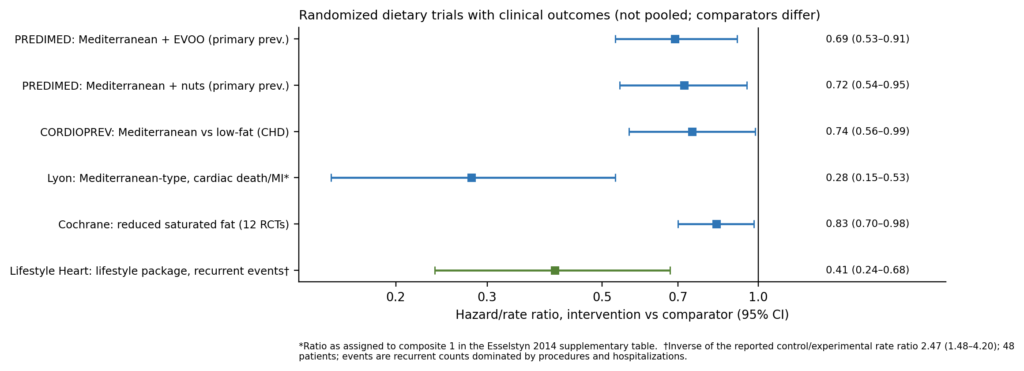
Figure 12. Essais diététiques randomisés avec résultats cliniques. Les estimations sont présentées côte à côte, non regroupées ; les comparateurs, les populations et les critères d'évaluation diffèrent. Aucun essai randomisé sur un régime végétalien très pauvre en graisses n'a rapporté d'événements cliniques.
12.7 Appliquer la même norme aux essais de comparaison
Cette revue a examiné de près les études d'Esselstyn et d'Ornish, et les essais qui favorisent les régimes méditerranéens méritent le même examen. Le tableau 2 pose les mêmes questions à chacun d'eux. L'objectif n'est pas de qualifier un essai de sans valeur, mais de clarifier ce que chacun peut étayer.
PREDIMED. La republication de 2018 documente elle-même les principaux problèmes. Des enveloppes scellées n'ont été utilisées pour dissimuler l'attribution que pendant une partie de la phase pilote ; 425 membres de foyers ont été recrutés sans randomisation et ont suivi le même régime que leur parent ; sur un site, 467 participants ont été affectés par clinique plutôt qu'individuellement ; et des tables de randomisation ont été utilisées de manière incohérente sur un autre site [12]. Les auteurs ont réanalysé l'essai avec un ajustement statistique, et les résultats étaient similaires lorsque les 1 588 participants concernés ont été exclus (rapports de risque de 0,71 et 0,68 chez les 5 859 restants) [12]. Le groupe témoin a reçu un dépliant annuel avec des conseils sur les régimes pauvres en graisses jusqu'en septembre 2006 et seulement après cela la même fréquence de contact que les groupes méditerranéens ; son apport total en graisses a peu changé, de sorte que PREDIMED a comparé un régime méditerranéen supplémenté à un régime habituel bénéficiant de conseils limités, et non à un véritable régime pauvre en graisses [12]. Un bénéfice était également présent chez les participants recrutés après l'augmentation des contacts avec le groupe témoin — rapport de risque 0,49 (IC à 95 % 0,26 à 0,92) contre 0,77 (0,59 à 1,00) avant le changement d'octobre 2006 (P = 0,21 pour l'hétérogénéité) — ce qui plaide contre un soutien inégal comme seule explication, bien qu'une comparaison par période de recrutement ne puisse exclure une certaine contribution de sa part [12]. L'arrêt de l'étude était de 11,3 % dans le groupe témoin contre 4,9 % dans les groupes méditerranéens. L'huile d'olive et les fruits à coque ont été donnés par des producteurs et fournis gratuitement, les participants connaissaient leur affectation et seul le comité des critères d'évaluation était en aveugle [12]. L'essai a été arrêté lors de sa quatrième analyse intermédiaire [12], et les essais arrêtés prématurément pour bénéfice ont tendance à surestimer l'ampleur de l'effet. Enfin, le résultat composite a été principalement déterminé par les accidents vasculaires cérébraux (rapport de risque combiné 0,58 ; IC à 95 % 0,42 à 0,82), alors que l'infarctus du myocarde (0,80 ; 0,53 à 1,21), le décès cardiovasculaire (0,80 ; 0,51 à 1,24) et le décès de toute cause (0,98 ; 0,77 à 1,24) ne différaient pas de manière significative ; les auteurs attribuent cela à une puissance limitée [12] (Figure 13).
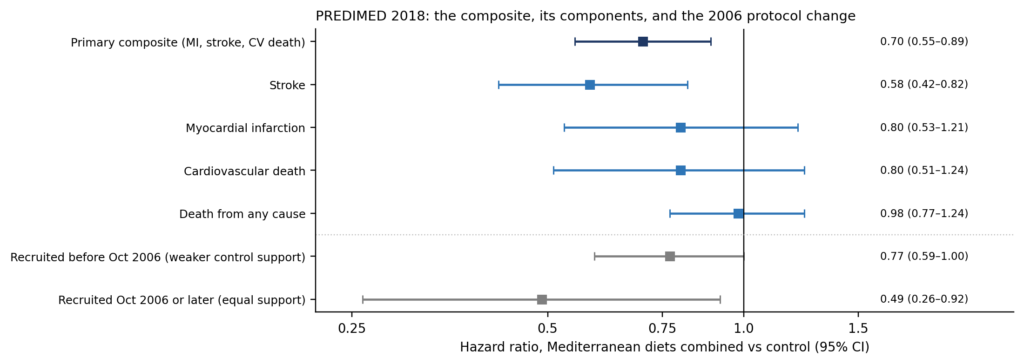
Figure 13. PREDIMED 2018 : le résultat composite et ses composantes (régimes méditerranéens combinés par rapport au témoin), et l'effet avant et après l'augmentation du soutien au groupe témoin en octobre 2006. Source : Estruch 2018, Tableau 3 et texte.
Lyon Diet Heart Study. L'étude de Lyon a randomisé 605 survivants d'un premier infarctus du myocarde selon un plan en simple aveugle et a été arrêtée prématurément pour bénéfice à une moyenne de 27 mois, avec un suivi prolongé ultérieurement à 46 mois [13, 14, 70]. Son comparateur était un régime de type occidental prudent plutôt qu'un régime sain soutenu de manière intensive [70]. La réduction importante des événements s'est produite alors que les lipides sériques, la pression artérielle et l'indice de masse corporelle restaient similaires entre les groupes [14]. C'est un signal authentique qu'un modèle alimentaire peut réduire les événements par d'autres voies que la baisse des lipides (Section 5), mais il provient d'un essai de petite taille, arrêté prématurément, dont l'ampleur de l'effet est probablement gonflée.
CORDIOPREV. CORDIOPREV était un essai monocentrique financé principalement par des fondations de l'huile d'olive ; le bénéfice était statistiquement démontrable uniquement chez les hommes, avec une estimation non concluante dans le sous-groupe féminin plus restreint ; aucune composante individuelle du composite n'était significative ; et son bras pauvre en graisses a atteint 32,1 % de l'énergie provenant des graisses [10]. Il présente la conception la plus solide des trois car les deux bras ont reçu un soutien tout aussi intensif, mais il teste un comparateur omnivore à teneur modérée en graisses, pas un régime végétal très pauvre en graisses.
Problèmes partagés par l'ensemble des sciences de la nutrition. Plusieurs faiblesses s'appliquent à presque chaque étude de cette revue, quel que soit le régime qu'elle privilégie. Le régime alimentaire est généralement mesuré par questionnaire ; dans l'étude Adventist Health Study-2, les corrélations de validité des questionnaires par rapport aux rappels de 24 heures répétés étaient de 0,76 pour viande rouge mais de 0,53 pour le poisson chez les participants blancs [53]. Les participants aux essais diététiques savent ce qu'ils mangent. L'adhésion s'estompe, comme le montrent l'arrêt du groupe témoin dans PREDIMED, l'abandon du régime dans CORDIOPREV et la baisse des scores d'adhésion dans le Lifestyle Heart Trial [6, 10, 12]. Les comparateurs sont souvent faibles : le groupe témoin précoce de PREDIMED, le régime prudent de Lyon et les soins habituels du Lifestyle Heart Trial. Les essais sont souvent de petite taille ou arrêtés prématurément. Et les intérêts divergent dans toutes les directions : les producteurs d'huile d'olive et de noix, les concepteurs de programmes et les organisations de défense ont tous financé ou dirigé les études discutées ici [4, 10, 12, 23].
Ce que la critique change. Ces limitations réduisent la confiance dans l'ampleur du bénéfice méditerranéen et dans toute affirmation selon laquelle le régime méditerranéen est prouvé supérieur. Elles ne rehaussent pas le statut du VLF-WFPB, qui ne dispose d'aucun essai randomisé avec des événements cliniques. Un essai randomisé avec des événements cliniques, même imparfait, répond à la question causale qu'une série de cas non contrôlée ne peut pas traiter, bien que son poids dépende toujours du biais, de la précision et de la mesure dans laquelle il teste directement le régime en question. Appliquer le même scepticisme aux deux parties est ce qui permet de faire confiance aux conclusions de cette revue.
Tableau 2. Application des mêmes questions aux principaux essais de chaque côté du débat.
| Question | PREDIMED | CORDIOPREV | Lyon Diet Heart | Essai sur le mode de vie et le cœur | Cohorte Esselstyn 2014 |
| Niveau de preuve | 1 | 1 | 1 | 2 (faible nombre d'événements) | 4 |
| Randomisé ? | Oui, avec des écarts affectant 1 588 sur 7 447 ; enveloppes utilisées seulement dans une partie de l'étude pilote [12] | Oui [10] | Oui [14] | Oui, sur invitation ; la moitié des personnes éligibles ont décliné [6] | No [4] |
| Qui était en aveugle ? | Comité des critères d'évaluation uniquement [12] | Critère d'évaluation jugement rapporté comme masqué ; participants et diététiciens non en aveugle, comme dans tout essai diététique | Conception en simple aveugle [14] | Conception en simple aveugle [14] | Personne ; les investigateurs ont statué sur les événements [4] |
| Comparateur | Conseil de réduire les graisses ; brochure annuelle jusqu'en 2006, puis contact égal ; le total des graisses a peu changé [12] | Régime pauvre en graisses soutenu de manière égale ; 32,1 % de graisses atteint [10] | Régime de type occidental prudent [70] | Soins habituels ; 60 % ont commencé des médicaments hypolipémiants [6] | Volontaires non adhérents [4] |
| Arrêté prématurément ? | Oui, à la 4ème analyse intermédiaire [12] | Suivi médian de 7 ans [10] | Oui, à 27 mois ; prolongé plus tard à 46 mois [13, 14] | Oui, à 27 mois ; prolongé plus tard à 46 mois [13, 14] | Non applicable |
| Ce qui a motivé le résultat | AVC 0,58 ; IDM 0,80 et décès CV 0,80 non significatifs [12] | Bénéfice démontrable chez les hommes ; estimation chez 175 femmes non concluante ; aucun composant unique significatif [10] | Réductions importantes avec des taux de lipides sériques, une pression artérielle et un IMC similaires [14] | Procédures et hospitalisations (décomptes récurrents) [6] | Revascularisations dans le groupe non adhérent [4] |
| Intérêts | Huile d'olive et noix données par les producteurs [12] | Principalement des fondations d'huile d'olive [10] | Non évalué ici | Non évalué ici | Concepteur du programme ; livre remis aux participants [4] |
| Régime testé vs VLF-WFPB | Méditerranéen supplémenté vs régime habituel avec conseils légers | Méditerranéen 40,5 % de graisses vs pauvre en graisses omnivore 32,1 % | Type méditerranéen riche en ALA | Margarine riche en ALA plus conseils de type méditerranéen | Sans huile, sans produit animal, sans noix ni avocat |
13. Une teneur totale en graisses très faible est-elle meilleure en soi ?
Séparer les graisses. Les graisses saturées augmentent le LDL-C et leur réduction diminue les événements [26] ; les acides gras trans industriels doivent être évités [73] ; les graisses insaturées abaissent le LDL-C lorsqu'elles remplacent les graisses saturées et sont associées à une réduction des événements dans les essais méditerranéens [10, 12]. Le terme « graisses totales » regroupe ces effets opposés.
Ce qui remplace la graisse importe. Dans le VLF-WFPB, le remplacement se fait par des céréales complètes, des légumineuses, des légumes et des fruits ; dans d'autres régimes pauvres en graisses, il peut s'agir d'amidon raffiné ou de sucre. Aucun essai n'a comparé ces remplacements au sein d'un régime exclusivement végétal sur les résultats cliniques.
Le seul test direct au sein d'un régime végétal complet. In a randomized crossover trial, 40 adults with at least 5% estimated cardiovascular risk followed a whole-food plant-based vegan diet with either about four tablespoons or less than one teaspoon of extra-virgin olive oil daily, for four weeks each; fat supplied 48% and 32% of energy respectively. Both phases lowered LDL-C, total cholesterol, ApoB, HDL-C, glucose, and hs-CRP from baseline. There was a sequence interaction: moving from high to low oil lowered LDL-C by 12.7 mg/dL (P = 0.04), and moving from low to high raised it by 15.8 mg/dL (P = 0.02); in the first period, LDL-C fell 25.5 versus 16.7 mg/dL (P = 0.162) [8]. Neither phase approached 10–15% fat, the trial was short, and carryover complicates the crossover analysis. It suggests large oil additions can blunt LDL-C lowering; it does not show that 10–15% fat is better than a nut- and seed-based plant diet at around 30%.
Nuts, seeds, and olive oil. Mediterranean diets rich in extra-virgin olive oil or supplemented with nuts reduced events against comparators [10, 12]. No trial shows that excluding nuts, seeds, or olive oil from an otherwise low-saturated-fat diet improves clinical outcomes. The acute impairment of flow-mediated dilation after a single high-fat meal [30], cited in support of oil exclusion [4], cannot establish that oils cause atherosclerosis.
Triglycerides, HDL, and ApoB–LDL-C discordance. Very-low-fat, high-carbohydrate diets can raise triglycerides and lower HDL-C, as in the Lifestyle Heart Trial’s first year [6]; across plant-based trials overall, triglycerides did not change [22], and Mediterranean diets lowered triglycerides more than a vegetarian diet in CARDIVEG [71]. When triglyceride-rich lipoproteins rise, LDL-C can understate nombre de particules athérogènes. The Lifestyle Heart Trial illustrates this: at five years LDL-C was 20% below baseline while ApoB was not [6]. Future trials should measure ApoB directly.
Attribution. Where VLF-WFPB outperforms a comparator on LDL-C, the advantage may reflect fat quantity, fat quality (almost no saturated fat), food quality (fiber, plant protein), weight loss, or adherence. The Barnard crossover, for example, produced both larger LDL-C reductions and larger weight loss on the vegan diet [23]. No available trial separates these contributions. On current evidence, very low total fat is not established as an independent requirement; very low saturated fat within a whole-food diet is the component with the strongest causal support.
14. Prevention, Treatment, and Reversal
14.1 Outcomes that must not be conflated
Fewer cardiovascular events, slower progression, stabilisation de plaque, improved angina or perfusion, reduced angiographic stenosis, and quantitatively measured regression of plaque volume are different outcomes. Primary and secondary prevention are also different settings.
14.2 What imaging can and cannot show
Quantitative coronary angiography measures lumen, not plaque. Percent stenosis depends on the reference segment and on tonus vasomoteur, and outward (positive) remodeling can hide substantial plaque behind a normal lumen. Myocardial perfusion and stress testing measure function; improvement can occur without anatomic regression, as the Heidelberg investigators noted [62]. Échographie intravasculaire et angioscanner coronaire measure plaque volume and composition; CT additionally characterizes noncalcified and plaque à faible atténuation. Coronary calcium scores can rise when plaque stabilizes, because statins increase calcified and fibrous plaque while reducing fibrofatty and necrotic-core components, so calcium-score change alone indicates neither success nor failure [74]. Plaque can enlarge substantially before angiography detects narrowing [74]; conversely, an apparently wider lumen can reflect changes in vasomotor tone rather than smaller plaque. In a meta-regression summarized by Dawson and colleagues, each 1% reduction in volume d'athérome en pourcentage was associated with about 20% lower odds of major adverse events, but there is no direct evidence that regression itself reduces events [74]. Table 3 summarizes what each finding can and cannot establish.
Table 3. What symptom and imaging findings can and cannot establish.
| Finding | What it establishes | What it does not establish |
| Less angina; better test de résistance or PET perfusion [6, 61, 62] | Better symptoms or myocardial blood supply | A measured loss of plaque |
| Reduced angiographic percent stenosis | A less narrowed lumen relative to a reference segment | The percentage of plaque removed; reference-segment changes can alter the result [6] |
| Change in minimum lumen diameter | Absolute lumen change at the lesion | Plaque volume, which remodelage excentrique can hide [74] |
| CCTA or IVUS plaque volume or composition change | Change in the measured plaque compartment, within acquisition and segmentation limits | Eradication of disease or a guaranteed event reduction |
| Rising coronary calcium score | A higher Score d'Agatston, which reflects calcified area, density, or both | Greater total plaque burden or treatment failure; statins increase plaque calcifiée while reducing fibrofatty and cœur nécrotique [74] |
14.3 The primate and pharmacologic benchmarks
Two bodies of evidence set the standard against which dietary regression claims should be read. Neither is a dietary trial in humans, and both are cited here as benchmarks rather than as support for any diet.
Controlled primate experiments (Tier 5). In rhesus monkeys given an atherogenic diet and then switched to a regression diet, atheromatous artères coronaires lost lipid [75], while arterial fibrous proteins behaved differently from the lipid compartment [76]. The achieved cholesterol level mattered: in animals whose plasma cholesterol was held near 300 mg/dL there was little or no increase in lumen area attributable to regression of intimal plaque, whereas at about 200 mg/dL a considerable share of the lumen gain was attributable to plaque regression, and the contribution depended on both plaque size and time [77]. This is the closest thing in the literature to a controlled demonstration that lowering atherogenic lipoproteins by dietary means depletes the lipid-rich compartment while denser tissue persists. It is also animal evidence, in a different species, with induced rather than spontaneous disease, and it cannot establish what a human diet achieves.
Pharmacologic imaging (Tiers 1–2). Dans GLAGOV, 968 statin-treated patients with angiographic coronary disease were randomized to monthly évocumab ou placebo for 76 weeks, and 846 had evaluable serial intravascular ultrasound. Time-weighted LDL-C was 36.6 mg/dL versus 93.0 mg/dL, percent atheroma volume changed by −0.95% versus +0.05% (difference −1.0 percentage point; P < 0.001), and plaque regression occurred in 64.3% versus 47.3% of patients [78]. Notably, the trial’s virtual-histology substudy did not show a difference in dense calcium volume [78], so GLAGOV demonstrates volumetric regression rather than a compositional shift; trials designed to measure plaque composition are outside the scope of this review and no compositional figures are quoted. Two comparisons follow. No dietary trial has produced coronary regression of this magnitude under this level of rigor, and no dietary trial identified here used serial intravascular ultrasound at all, which is the modality that measures atheroma volume most precisely.
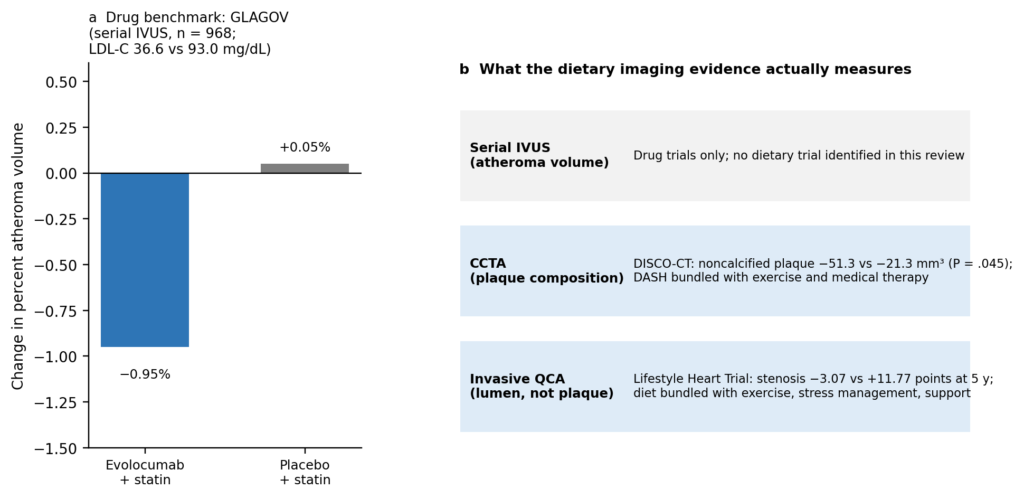
Figure 14. Benchmarks for coronary plaque change. Pharmacologic regression measured by serial intravascular ultrasound (GLAGOV) alongside the dietary imaging evidence available in this review, which uses different modalities and cannot be placed on the same axis. No dietary trial identified here used serial intravascular ultrasound. Sources: Nicholls 2016; Henzel 2021; Ornish 1998.
Exercise as a co-lever. Physical activity belongs alongside the three dietary levers rather than inside them. The populations with the least coronary calcium are also the most active: Tsimane men average six to seven hours and women four to six hours of physical activity a day [35]. In the two randomized imaging trials that showed benefit, exercise was part of the intervention rather than a controlled covariate—the Lifestyle Heart Trial bundled aerobic exercise with the diet [6], et les conseils d'activité groupés DISCO-CT avec DASH [68]—c'est pourquoi aucun des deux ne peut s'attribuer le mérite. Aucune estimation quantitative de la réduction de l'ApoB attribuable à l'entraînement aérobique n'est donnée ici ; l'idée demeure, sur le plan qualitatif, que l'alimentation, l'activité physique et le traitement hypolipémiant agissent sur des voies communes et sont complémentaires plutôt que concurrents.
14.4 Ce que les données probantes soutiennent dans chaque domaine
Prévention primaire. Les données probantes consistent en des associations de cohortes [40], des données de population (sections 6 à 8) et des essais randomisés sur les lipides [22]. Il n'existe aucun essai randomisé sur les événements pour le régime VLF-WFPB.
Prévention secondaire (traitement). L'étude Lifestyle Heart Trial a réduit l'angine de poitrine ainsi que les interventions cardiaques et les hospitalisations grâce à un programme incluant un régime végétarien très pauvre en graisses [6]. Les réductions d'événements randomisées avec le régime seul en prévention secondaire proviennent d'essais de type méditerranéen [10, 70].
Progression ralentie et régression partielle. Des programmes intensifs d'hygiène de vie intégrant des régimes végétariens très pauvres en graisses ont démontré une modeste régression angiographique chez certains patients ; la contribution indépendante de l'alimentation et de la restriction des graisses totales reste incertaine [6, 42]. Des régimes moins gras mais non végétaliens ont également ralenti la progression angiographique [62, 66], et un programme de type DASH ajouté au traitement médical a réduit la plaque non calcifiée au scanner [68]. Une régression partielle semble plus probable lorsque des réductions importantes et durables des lipoprotéines athérogènes sont obtenues, souvent à l'aide de médicaments, et une régression plus importante a été observée à cinq ans qu'à un an dans le programme Ornish [6]. La régression ne signifie pas l'éradication de la maladie ou un risque futur nul.
L'examen Dawson. Comme le résument les points clés publiés par l'ACC, l'examen de l'état de l'art du JACC de 2022 a jugé limité l'effet démontré du régime alimentaire, de l'exercice physique et de l'arrêt du tabac sur le volume et la composition de la plaque coronaire [74]. Les affirmations parfois attribuées à cet examen dans des résumés secondaires, notamment l'assertion selon laquelle la plupart des bras alimentaires traités par statines ont progressé, ne sont pas utilisées ici. Les preuves limitées de régression par le seul régime alimentaire ne signifient pas que le traitement diététique a peu de valeur clinique : stabiliser la plaque, améliorer la perfusion et prévenir la progression peuvent être cliniquement significatifs même lorsque le changement anatomique est faible, bien que les essais alimentaires existants n'établissent pas le mécanisme d'une quelconque réduction d'événements.
15. Faisabilité, adéquation et sécurité
Adhésion. L'adhésion rapportée a été élevée chez des volontaires sélectionnés : 89 % par auto-évaluation dans la cohorte Esselstyn de 2014 [4], et 94 % contre 70 % pour les régimes végétaliens contre les régimes de l'AHA à huit semaines dans l'étude EVADE CAD, dont les participants représentaient 14 % de ceux répondant aux critères initiaux [9]. Dans l'étude Lifestyle Heart Trial, la moitié des patients éligibles invités ont refusé, et le score d'adhésion est passé de 1,29 à un an à 1,06 à cinq ans [6]. Sur sept ans dans l'étude CORDIOPREV, plus de patients ont abandonné un régime pauvre en graisses conventionnel qu'un régime méditerranéen [10].
Nutriments. La supplémentation en vitamine B12 est essentielle ; l'apport médian dans le bras végétalien d'EVADE est tombé à 1,2 µg/jour, et les taux de B12 ont chuté pendant la phase végétarienne de CARDIVEG [9, 71]. Les apports en zinc et en acides gras oméga-3 étaient également plus faibles avec le régime végétalien dans EVADE [9]. Le statut en calcium, vitamine D, iode, fer et oméga-3 à longue chaîne nécessite une planification, et les aliments enrichis ou les compléments sont appropriés lorsque l'apport est insuffisant [79] ; le terme « aliments complets » ne devrait pas devenir une raison de les rejeter. Les aliments végétaux terrestres non enrichis fournissent de l'acide alpha-linolénique mais peu ou pas d'EPA ou de DHA préformés, que les compléments dérivés d'algues et les produits enrichis peuvent fournir dans le cadre d'un régime végétalien [79] ; le protocole d'Esselstyn a ajouté des graines de lin comme source d'acide alpha-linolénique [4]. Une restriction agressive des graisses ne doit pas remplacer l'énergie nécessaire ou les graisses essentielles.
Énergie et protéines. L'apport médian en protéines avec le régime végétalien EVADE était de 50 g/jour (12,9 % de l'énergie) [9]. Les régimes végétariens sans restriction énergétique ont réduit l'apport énergétique d'environ 276 kcal/jour par rapport aux régimes habituels [7], et dans la cohorte Esselstyn de 2014, les 135 patients disposant de données de poids ont perdu en moyenne 18,7 lb [4]. Une faible densité énergétique est un atout pour la perte de poids, mais un risque potentiel pour les personnes âgées ayant un faible appétit ou sarcopénie et pour les personnes physiquement actives ayant des besoins élevés ; l'adéquation en protéines et en énergie doit être planifiée individuellement.
Qualité de vie. Dans EVADE CAD, les scores de qualité de vie se sont améliorés de manière similaire avec les deux régimes [9].
Alimentation et médicaments. Les preuves randomisées groupées situent la réduction de l'ApoB d'origine alimentaire à environ 14 % [22]. Une estimation correspondante de la baisse de l'ApoB sous statine intensive ou PCSK9 thérapie n'est pas présentée ici, donc aucune comparaison numérique n'est établie ; le point clinique repose sur d'autres bases. Dans l'ASCVD établie, l'alimentation est un complément au traitement préconisé par les directives, et non un substitut, et le traitement indiqué ne doit pas être suspendu ou arrêté pour suivre un régime quel qu'il soit.
Cette revue est éducative. Les changements alimentaires doivent être effectués en parallèle, et non à la place, du traitement cardiovasculaire prescrit, et les ajustements médicamenteux relèvent du médecin traitant.
16. Positionnement clinique
La directive AHA/ACC 2023 pour la maladie coronarienne chronique recommande un régime privilégiant les légumes, les fruits, les légumineuses, les fruits à coque, les céréales complètes et les protéines maigres pour réduire les événements cardiovasculaires (classe 1, niveau B-R), et stipule que réduire les graisses saturées à moins de 6 % de l'apport énergétique et les remplacer par des graisses monoinsaturées et polyinsaturées, des glucides complexes et des fibres peut être bénéfique (classe 2a) [73]. Son illustration sur la nutrition énumère acide gras monoinsaturé telles que l'huile d'olive et les graisses polyinsaturées parmi les aliments à privilégier [73]. Le directive 2026 de l'ACC/AHA multisociété sur la dyslipidémie, qui remplace la directive sur le cholestérol de 2018, décrit les modèles alimentaires préférés comme étant principalement à base de plantes — méditerranéen, DASH, et végétalien ou végétarien [27].
Les recommandations alimentaires 2026 de l'AHA listent les caractéristiques d'un modèle sain pour le cœur, notamment le choix de sources de protéines saines, le choix de sources de graisses insaturées à la place des graisses saturées, le choix d'aliments peu transformés, la minimisation sucres ajoutés, et la réduction du sodium [25].
Ces directives soutiennent un traitement diététique riche en végétaux et s'adaptent à un modèle végétalien. Elles n'approuvent pas de protocole de réversion végétalien à très faible teneur en graisses uniquement efficace, et elles incluent explicitement les fruits à coque et les huiles insaturées. Une recommandation professionnelle d'un modèle n'est pas une preuve que chaque composante ou exclusion au sein d'un régime particulier est nécessaire.
17. La prochaine étude décisive
Conception primaire. Un essai randomisé en groupes parallèles avec évaluation des critères de jugement en aveugle chez des adultes traités médicalement présentant une athérosclérose coronarienne documentée par scanner, recrutant délibérément des femmes, des adultes plus âgés et des patients en dehors des programmes spécialisés d'hygiène de vie. Bras : (A) VLF-WFPB, 10 à 15 % de l'énergie provenant des graisses, aucun aliment d'origine animale, aucune huile ajoutée, quantité limitée de fruits à coque et d'avocat ; (B) un régime à base d'aliments complets d'origine végétale à plus forte teneur en graisses insaturées, environ 30 à 40 % de graisses provenant des fruits à coque, des graines, de l'avocat et de l'huile d'olive extra vierge, aucun aliment d'origine animale ; (C) un régime méditerranéen (style PREDIMED/CORDIOPREV) ou DASH. A contre B teste la restriction des graisses totales au sein d'un régime sans produits animaux ; B contre C évalue l'effet de l'exclusion des aliments d'origine animale, bien que les aliments de substitution diffèrent. Tous les bras reçoivent un temps de contact, des instructions de cuisine, un soutien alimentaire et des conseils d'exercice identiques.
Sous-étude mécanistique. Comme la conception à trois bras ne peut pas séparer complètement l'exclusion des aliments d'origine animale des graisses totales, une sous-étude factorielle 2 x 2 à alimentation contrôlée — sans produits animaux contre aliments d'origine animale spécifiés limités, croisée avec environ 10 à 15 % contre 30 à 35 % de l'énergie provenant des graisses, avec les graisses saturées, le sodium, les fibres, les protéines et l'énergie harmonisés aussi étroitement que possible — isolerait chaque facteur à poids stable. Un troisième facteur — aliments végétaux entiers contre ultra-transformés avec des macronutriments équivalents — testerait directement le levier de la transformation, suivant la conception de l'essai de transformation en milieu hospitalier [19]. Les différences inévitables dans les aliments de remplacement doivent être mesurées et rapportées.
Deux estimands. L'effet pragmatique de l'assignation d'un modèle ad libitum, y compris ses effets sur le poids et l'observance, diffère de l'effet biologique de la composition du régime alimentaire à poids stable. Ajuster la perte de poids dans l'analyse primaire supprimerait une partie de l'effet du régime assigné ; la sous-étude sur l'alimentation traite de la composition.
Médicaments. Chaque bras suit le même algorithme de traitement clinique, et le traitement indiqué n'est jamais retenu pour amplifier un contraste alimentaire. Étant donné que la titration vers les objectifs lipidiques compensera en partie les différences alimentaires d'ApoB, l'intensité du traitement hypolipémiant requis devient un critère d'évaluation secondaire spécifié à l'avance, et l'ApoB est analysée conjointement avec l'intensité de la médication. L'essai principal estime l'efficacité comparative sous un algorithme de traitement commun ; il n'égalise pas en soi l'exposition cumulative à l'ApoB, et l'attribution de tout bénéfice résiduel à des voies indépendantes de l'ApoB nécessiterait une mesure longitudinale répétée des médiateurs et des hypothèses causales explicites.
Critères d'évaluation. Critère d'évaluation principal de l'étape 1 : changement à 24 mois du pourcentage de volume d'athérome (ou du volume de plaque non calcifiée) par angiographie coronaire par TDM, lu dans un laboratoire central en aveugle selon un calendrier protocolaire plutôt que selon les symptômes. Critères d'évaluation secondaires : ApoB moyennée dans le temps, cholestérol non-HDL, triglycérides, pression artérielle ambulatoire, poids et composition corporelle, HbA1c, hs-CRP, TMAO, débit sanguin myocardique par TEP, angine de poitrine (Seattle Angina Questionnaire), fonction, qualité de vie, coût, rétention et statut nutritionnel (B12, fer, vitamine D, iode, indice oméga-3). L'observance est mesurée objectivement (profil des acides gras plasmatiques, caroténoïdes, azote et potassium urinaires) ainsi que par des relevés alimentaires répétés. Étape 2 : un essai sur les événements avec un critère composite dur de décès cardiovasculaire, d'infarctus du myocarde et d'accident vasculaire cérébral ischémique ; les procédures sont arbitrées en aveugle et rapportées séparément, avec des analyses du délai jusqu'au premier événement et des événements récurrents.
Analyse. Analyse primaire en intention de traiter avec gestion prédéfinie des données manquantes et des changements de médication ; l'effet causal moyen chez les compliants et les analyses per-protocole sont secondaires ; les analyses d'observance ne traitent pas les personnes observantes comme des groupes nouvellement randomisés ; les analyses de médiation utilisant l'ApoB, le poids et la pression artérielle sont qualifiées d'exploratoires.
Tailles d'échantillon illustratives (hypothèses énoncées). Étape 1 : en supposant un écart-type de 3,0 points de pourcentage pour le changement à 24 mois du pourcentage de volume d'athérome, une différence minimale importante entre les bras de 1,0 point, deux comparaisons primaires par paires (A contre B ; B contre C) testées chacune à un α bilatéral = 0,025, et une puissance de 90 %, environ 224 participants par bras sont requis, soit 280 par bras (840 au total) en prévoyant une attrition de 20 %. Étape 2 : détecter un rapport de risque (hazard ratio) de 0,80 dans chaque comparaison par paires à un α bilatéral = 0,025 et une puissance de 80 % nécessite environ 764 événements par comparaison ; avec un risque supposé de premier événement à quatre ans de 15 % dans le bras de référence, environ 2 800 participants par bras (environ 8 400 au total) seraient nécessaires. Ces chiffres sont illustratifs ; un protocole nécessiterait des hypothèses pour l'observance, le croisement et la titration des médicaments. Ils expliquent également pourquoi les preuves basées sur les événements n'existent pas encore.
18. Conclusions par domaine
Le tableau 4 (après le texte principal) résume la base de données probantes, et le tableau 5 indique si chaque avantage proposé est partagé avec les régimes comparateurs ou s'il existe des preuves de bénéfice supplémentaire.
Étiquettes : Établi— preuves randomisées cohérentes sur le critère d'évaluation énoncé. Soutenu mais incertain— preuves randomisées de faible envergure, à composantes multiples ou sur des critères d'évaluation intermédiaires, ou preuves observationnelles cohérentes. Biologiquement plausible— soutien mécanistique ou indirect sans preuves adéquates sur les critères d'évaluation. Non soutenu— aucune preuve adéquate, ou preuves contraires.
Prévention. Le fait que les régimes à base de plantes abaissent le LDL-C et l'ApoB par rapport aux régimes omnivores est établi (différence de LDL-C combinée d'environ 11,6 mg/dL) [22]. Le fait que le régime VLF-WFPB réduise l'incidence de l'ASCVD par rapport à un régime occidental typique est soutenu mais incertain: les associations de cohortes (risque relatif de cardiopathie ischémique chez les végétariens de 0,79) sont cohérentes avec une plausibilité médiée par les lipides, mais il n'existe aucune preuve d'événements randomisés [40]. Le fait qu'il prévienne mieux l'athérosclérose cardiovasculaire qu'un régime méditerranéen ou DASH est non étayé. Les résultats coronariens et d'AVC devraient être rapportés séparément : dans EPIC-Oxford, les végétariens présentaient moins de cardiopathies ischémiques mais des taux d'AVC hémorragique et totaux plus élevés [41].
Traitement. Le fait qu'un programme de mode de vie intensif comprenant un régime végétarien très pauvre en graisses réduise l'angine de poitrine et les interventions cardiaques ou les hospitalisations par rapport aux soins habituels est soutenu mais incertain, reposant sur un petit essai randomisé de 1986–1992 [6]. Le fait que le régime seul réduise les événements en cas de maladie établie est biologiquement plausible. Le fait qu'il réduise les événements davantage qu'un régime méditerranéen, pour lequel il existe des preuves de prévention secondaire randomisées [10, 70], est non étayé.
Régression. Le fait que les programmes de mode de vie intensifs intégrant des régimes végétariens très pauvre en graisses produisent une régression angiographique modeste chez certains patients est soutenu mais incertain [6]. Le fait que le régime VLF-WFPB seul produise une régression quantitative du volume de la plaque par échographie intravasculaire ou scanner est non étayé car cela n'a pas été testé. Le fait que la régression élimine les risques futurs est non étayé.
Supériorité et nécessité. Le fait qu'un taux très bas de graisses totales soit indépendamment nécessaire au bénéfice est non étayé; les preuves au sein des régimes végétaux sont à court terme et mitigées, et les preuves d'événements randomisés favorisent l'inclusion de graisses insaturées dans les régimes omnivores [8, 10, 12]. Le fait que l'exclusion complète des aliments d'origine animale apporte un bénéfice supplémentaire par rapport à un régime pauvre en graisses saturées est biologiquement plausible (zéro cholestérol alimentaire, graisses saturées très faibles, possiblement moins de TMAO) mais non testé sur les résultats cliniques.
Aliments entiers et transformation. Le fait que les aliments d'origine végétale peu transformés soient associés à un risque cardiovasculaire plus faible, et les aliments d'origine végétale ultra-transformés à un risque plus élevé, est soutenu mais incertain: les grandes cohortes sont cohérentes, et des preuves randomisées existent pour l'apport énergétique mais pas pour l'athérosclérose [17–19]. Le fait que la qualité du régime et la transformation comptent autant que l'exclusion des aliments d'origine animale est non testé: aucune étude n'a comparé directement les deux leviers.
Au-delà de l'ApoB. Le fait que les régimes végétaux à base d'aliments entiers protègent les artères par des voies au-delà de l'ApoB est biologiquement plausible, avec un soutien observationnel partiel : les mécanismes sont démontrés chez l'animal, les nitrates des légumes à feuilles vertes sont associés à un risque moindre dans une grande cohorte après ajustement pour l'hypercholestérolémie, et le Lifestyle Heart Trial a montré une amélioration angiographique continue après le retour de l'ApoB à son niveau de base [6, 28, 29]. Ce n'est pas établi, car aucun essai n'a comparé les régimes à taux d'ApoB équivalents.
Les végétaliens comparés aux autres végétariens. Le fait que les végétaliens aient un risque de maladie cardiaque plus faible que les lacto-ovo- ou les pesco-végétariens est non étayé: à travers les cohortes adventistes, britanniques et regroupées, les estimations pour les végétaliens sont favorables en tendance mais non concluantes, et aucune cohorte ne fournit de comparaison directe entre les sous-groupes végétariens [41, 53, 54, 56]. Le signal chez les hommes végétaliens adventistes permet de générer des hypothèses.
Rôle par rapport au traitement médicamenteux. L'utilisation du régime alimentaire à la place d'un traitement hypolipémiant indiqué ou d'un autre traitement préconisé par les directives dans l'athérosclérose cardiovasculaire établie est non étayé: aucun essai examiné ici n'a testé l'arrêt du traitement indiqué, et chaque essai d'intervention montrant un bénéfice a été réalisé en complément de celui-ci [10, 12, 22].
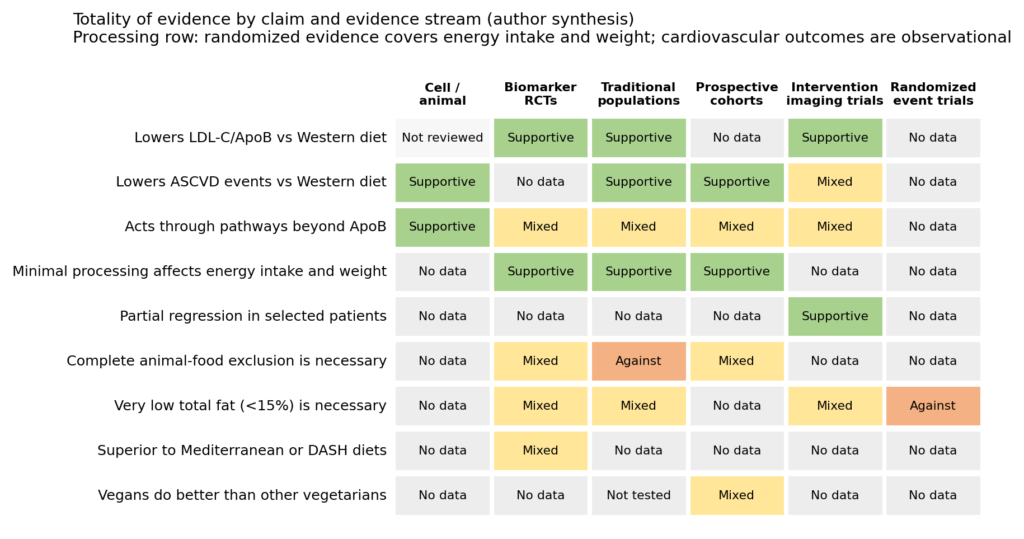
Figure 15. Totalité des preuves par affirmation et flux de preuves. Synthèse de l'auteur des sections 3 à 17 ; « contre » indique les preuves qui contredisent l'affirmation telle qu'énoncée.
19. L'affirmation la plus forte que les preuves justifient aujourd'hui
Un régime à base d'aliments complets d'origine végétale réduit de manière fiable les lipoprotéines athérogènes par rapport aux régimes occidentaux typiques, et les populations ayant une faible consommation d'aliments d'origine animale tout au long de la vie présentaient un taux de cholestérol bas et une mortalité coronarienne enregistrée faible. Des programmes de mode de vie intensifs basés sur des régimes végétariens très pauvres en graisses ont produit une régression angiographique modeste, une meilleure perfusion myocardique, moins d'angine de poitrine et moins de procédures cardiaques que les soins habituels dans de petites études portant sur des patients sélectionnés. Prises ensemble, ces preuves rendent crédible le fait qu'un tel régime puisse aider à prévenir, ralentir et, chez certains patients, inverser partiellement l'athérosclérose coronarienne, principalement grâce à une exposition cumulative plus faible à l'ApoB. Le bénéfice est plus systématiquement associé au caractère d'aliments complets du régime — transformation minimale, teneur élevée en fibres et légumes abondants — plutôt qu'à la seule exclusion des aliments d'origine animale, et des preuves plausibles mais non prouvées suggèrent qu'une partie de ce bénéfice passe par des voies allant au-delà de l'ApoB. Les preuves n'établissent pas que l'exclusion de tous les aliments d'origine animale et de presque toutes les graisses ajoutées protège mieux qu'un régime méditerranéen, DASH ou un régime à base de plantes à plus forte teneur en graisses insaturées bien mis en œuvre.
Une affirmation plus forte nécessiterait une comparaison randomisée de ces régimes à intensité de soutien et traitement médical égaux, avec une mesure de l'ApoB tout au long, une imagerie quantitative des plaques en aveugle et, enfin, des événements cliniques jugés par un comité. En l'absence de telles données, le régime VLF-WFPB est mieux présenté comme une option étayée par des preuves au sein de la famille des régimes sains pour le cœur à prédominance végétale, remarquable pour sa puissance de réduction du LDL-C, plutôt que comme un protocole d'inversion d'une efficacité unique.
Tableau 4. Tableau des preuves. Niveau : 1 = essai randomisé avec événements cliniques ; 2 = essai randomisé sur des critères de jugement intermédiaires ; 3 = cohorte prospective ; 4 = comparaison de populations, étude transversale ou série de cas (Section 1.2). IC = intervalle de confiance à 95 %.
| Étude | Niveau | Conception, n, durée | Régime tel que prescrit / suivi | Traitement de fond | Résultats et estimations de l'effet | Principales limites |
| Méta-analyse Koch 2023 [22] | 2 | 30 ECR ; ApoB provenant de 6 essais | Végétarien ou végétalien vs omnivore ; teneur en matières grasses variable | Variable ; certains sous hypolipémiants | CT −0,34 mmol/L (IC −0,44 à −0,23) ; LDL-C −0,30 mmol/L (−0,40 à −0,19) ≈ −11,6 mg/dL ; ApoB −12,92 mg/dL (−22,63 à −3,20 ; I² = 71,7 %, 6 essais) ; TG non différent | Régimes et comparateurs hétérogènes ; essais courts ; aucun événement ; n'isole pas le taux de graisses ; l'estimation de l'ApoB repose sur 6 essais présentant une hétérogénéité substantielle dont l'indépendance n'a pas pu être confirmée ici |
| Méta-analyse Wang 2023 [7] | 2 | 20 ECR, 1 878 ; moyenne 25,4 sem | Végétarien, incluant Ornish et végétalien pauvre en graisses | La plupart sous médicaments cardiométaboliques | LDL-C −6,6 mg/dL (−10,1 à −3,1) ; HbA1c −0,24 % (−0,40 à −0,07) ; poids −3,4 kg (−4,9 à −2,0) ; PAS −0,1 mmHg (−2,8 à 2,6) | LDL-C NS vs comparateurs actifs ; majorité à haut risque de biais ; le texte des points clés diffère des résultats |
| Rees 2021 Cochrane [72] | 2 | 13 ECR ; ≥ 12 sem ; recherche jusqu'en février 2020 | Végétalien uniquement | — | Aucun essai n'a rapporté d'événements cliniques ; un essai de prévention secondaire (n = 63) : pas d'effet clair sur les lipides ou la PA | Petits essais ; recherche datée ; faible certitude |
| Méta-analyse de cohortes Dybvik 2023 [40] | 3 | 13 cohortes, 844 175 | Végétarien ou végétalien vs non-végétarien (auto-déclaration) | — | RR de cardiopathie ischémique 0,79 (0,71–0,88 ; 8 cohortes) ; MCV 0,85 (0,79–0,92) ; AVC 0,90 (0,77–1,05) ; cardiopathie ischémique chez les végétaliens 0,82 (0,68–1,00 ; 6) | Facteurs de confusion résiduels (Valeur E 1,86) ; ~1/5 médié par l'IMC ; plus faible en excluant le suivi précoce ; graisses non évaluées |
| EPIC-Oxford [41] | 3 | Cohorte ; 48 188 ; 18,1 ans | Végétariens incluant végétaliens vs mangeurs de viande ; végétaliens ~28 % de graisses | — | HR de cardiopathie ischémique 0,78 (0,70–0,87), 0,90 (0,81–1,00) après ajustement des facteurs de risque ; HR d'AVC total 1,20 (1,02–1,40), principalement hémorragique ; cardiopathie ischémique chez les végétaliens 0,82 (0,64–1,05), lacto-ovo 0,77 (0,69–0,86), consommateurs de poisson 0,87 (0,77–0,99) | Observationnel ; régime alimentaire et facteurs de risque auto-déclarés |
| AHS-2 [53] | 3 | Cohorte ; 73 308 Adventistes ; 5,79 ans | Végétalien, lacto-ovo, pesco-, semi-végétarien vs non-végétarien | — | Végétariens : décès par CI 0,81 (0,64–1,02) ; hommes 0,71 (0,51–1,00). Par groupe : végétaliens 0,90 (0,60–1,33), lacto-ovo 0,82 (0,62–1,06), pesco 0,65 (0,43–0,97) ; hommes végétaliens 0,45 (0,21–0,94), femmes végétaliennes 1,39 (0,87–2,24) | Suivi court ; profil d'utilisateur sain (Figure 9) ; peu de décès chez les végétaliens |
| Indices de régime à base de plantes [17] | 3 | 3 cohortes ; ~209 000 ; 8 631 coronaropathies | Indices d'alimentation d'origine végétale sains vs malsains | — | RR de coronaropathie (déciles extrêmes) : PDI 0,92 (0,83–1,01) ; hPDI 0,75 (0,68–0,83) ; uPDI 1,32 (1,20–1,46) | Basé sur des QFA ; professionnels de santé ; l'hPDI favorise les huiles et les fruits à coque |
| Transformation UK Biobank [18] | 3 | Cohorte ; 126 842 ; médiane 9 ans | Aliments d'origine végétale répartis selon l'ultra-transformation | — | Par 10 % d'énergie : aliments d'origine végétale non AUT MCV 0,93 (0,91–0,95), décès par MCV 0,87 (0,80–0,94) ; aliments d'origine végétale AUT MCV 1,05 (1,03–1,07), décès 1,12 (1,05–1,20) | Observationnel ; rappels de 24 h ; classification NOVA |
| Cohorte danoise sur les nitrates [29] | 3 | Cohorte ; 53 150 ; jusqu'à 23 ans ; 14 088 MCV | Quintiles de nitrates végétaux (médiane 23 vs 59 mg/jour) | Ajusté pour l'hypercholestérolémie | RR de MCV 0,85 (0,82–0,89) ; CI 0,88 (0,82–0,94) ; AVC ischémique 0,83 (0,76–0,91) ; MAP 0,74 (0,67–0,83) ; 21,9 % médié par la PAS | Observationnel ; plateau ~60 mg/jour ; nitrates provenant principalement de la laitue et de la pomme de terre |
| Principales cohortes combinées de 1999 [54] | 3 | 5 cohortes ; 76 172 ; moyenne 10,6 ans | Végétaliens, lacto-ovo, consommateurs de poisson, consommateurs occasionnels de viande vs consommateurs réguliers de viande | — | Mortalité par CI : végétariens 0,76 (0,62–0,94) ; végétaliens 26 % plus bas, lacto-ovo et consommateurs de poisson 34 % plus bas ; bénéfice limité au régime alimentaire > 5 ans et plus important aux âges plus jeunes | Mortalité uniquement ; cohortes plus anciennes ; ajusté uniquement pour l'âge, le sexe et le tabagisme |
| AHS-2 2024 [55] | 3 | Cohorte ; 88 400 ; ~11 ans | Cinq groupes de régimes alimentaires | — | Mortalité par CI plus faible chez les végétariens ; le régime végétalien n'est pas associé à la mortalité toutes causes confondues en général ; mortalité plus faible chez les hommes végétaliens aux âges plus jeunes | Les rapports de risque varient selon l'âge ; AVC et démence plus élevés chez les végétariens âgés |
| Protéines AHS-2 [57] | 3 | Cohorte ; 81 337 ; 9,4 ans ; 2 276 décès par MCV | Facteurs liés aux sources de protéines | — | Mortalité par MCV : facteur viande 1,61 (IC 98,75 % 1,12–2,32) ; facteur fruits à coque et graines 0,60 (0,42–0,86) | Analyse factorielle ; QFA ; observationnel |
| Revue des régimes végétaliens [56] | 3 | Revue systématique ; 7 études ; ≥ 7 661 végétaliens | Végétalien vs non-végétalien | — | Aucune cohorte n'a montré de risque cardiovasculaire primaire significativement plus élevé ou plus faible chez les végétaliens | Peu de végétaliens ; faible puissance statistique |
| Cohortes Tzu Chi [58] | 3 | 2 cohortes ; 13 352 ; Taïwan | Végétariens bouddhistes (principalement lacto-ovo) vs non-végétariens | — | AVC ischémique 0,26 (0,08–0,88) et 0,41 (0,19–0,88) ; hémorragique 0,34 (0,12–1,00) | AVC uniquement ; contexte d'utilisateurs sains ; peu d'événements |
| Lacto-végétariens de Xiamen [59] | 4 | Transversal ; 169 vs 126 hommes | Lacto-végétarien chinois vs omnivore | — | Baisse de la PA, du LDL-C, de l'ApoB, des TG, du glucose ; EIM carotidienne plus fine | Mesure unique ; marqueurs de substitution ; consommation de produits laitiers |
| Végétaliens de Hong Kong (revue) [60] | 4 (revue) | Revue d'études transversales et de supplémentation | Végétaliens et végétariens avec une faible teneur en B12 | — | ~80 % de carence en B12 chez les végétaliens de Hong Kong ; altération de la DMF et EIM plus épaisse en cas de carence ; amélioration avec la B12 | Résultats de substitution ; prudence pour les régimes végétaliens sans supplémentation |
| Tsimane [35] | 4 | Transversal ; 705 adultes de 40 à 94 ans ; scanner calcique | 14 % de lipides, 14 % de protéines, 72 % de glucides ; gibier et poisson ; non transformés | Aucun | SCC 0 chez 85 %, 1–100 chez 13 %, > 100 chez 3 % ; > 75 ans : 65 % à zéro ; LDL-C 91 mg/dL ; ApoB 97 mg/dL | Le SCC manque les plaques non calcifiées ; transversal ; 6 à 7 h/jour d'activité (hommes) |
| China Study I [43] | 4 | Écologique ; 65 comtés, 130 villages ; régime 1983–84 ; mortalité 1973–75 | 14 % de lipides ; protéines animales ~1 % de l'énergie ; non végétalien | Aucun | CT moyen 127 vs 203 mg/dL (É-U) ; mortalité par coronaropathie de 0 à 64 ans : 4,0 (hommes) et 3,4 (femmes) vs 66,8 et 18,9 pour 100 000 (É-U) | Écologique ; écart d'une décennie ; âges tronqués ; constatation ; activité et mortalité compétitive |
| Okinawa (Willcox) [45, 47] | 4 | Écologique ; enquête de 1949 ; statistiques de l'état civil | ~1 785 kcal/jour ; patate douce ~69 % de l'énergie ; lipides ~6 % ; un peu de porc et de poisson | Aucun | Les cohortes plus anciennes ont rapporté une mortalité par coronaropathie ~80 % plus faible qu'aux États-Unis | Pénurie d'après-guerre ; restriction énergétique ; taille corporelle ; transition ; pas de lien individuel |
| Esselstyn 1995/1999 [5, 42] | 4 | Série de cas ; 22–24 inscrits ; imagerie pour 11 d'entre eux à ~5 ans | ≤10% fat; skim milk, nonfat yogurt allowed | Cholestyramine + lovastatin most often | TC 246 → 132.4 mg/dL (LDL-C 71.6); % stenosis 53.4 → 46.2% (−7 points, CI 3.3–10.7); MLD +0.08 mm (−0.06 to 0.22), NS; regression in 8/11 patients by % stenosis | No control; 13 of 38 lesions excluded (4 graft-proximal lesions that progressed); attrition reported as 5 and as 11; drugs; regression to the mean |
| Esselstyn 2014 [4] | 4 | Cohort; 198 (177 adherent, 21 nonadherent); mean 44.2 mo | No animal foods, oil, nuts, avocado; fat not measured | Usual medications, not recorded | Adherent: 1 progression-related stroke per investigators (0.6%); 18/177 “worse” (10%); 0 cardiac deaths. Nonadherent: 13/21 (62%) with ≥1 event, 7 of 13 events revascularizations | Self-selected; self-reported adherence; no lipids; investigator adjudication; not randomized; 2.2% in supplementary table |
| Lifestyle Heart Trial [6, 63] | 2 (events: counts) | RCT (invitational), 48; 35 with 5-y QCA; 5 y | 10% fat vegetarian (nonfat dairy, egg white); achieved 6.2% (1 y), 8.5% (5 y); plus exercise, stress management, support | No lipid drugs (exp.); 60% of controls started them | 5-y (1998 report, n = 35): % diameter stenosis −3.07 (−5.91 to −0.24) vs +11.77 (3.40 to 20.14), P = .001; minimum lumen diameter essentially unchanged (+0.001 mm) vs −0.34 mm (P = .05); 1-y (1990 report, n = 48): 40.0% → 37.8% vs 42.7% → 46.1%, 82% of experimental patients toward regression; events 25 vs 45, rate ratio 2.47 (1.48–4.20); angina −91% at 1 y (within group) | Multicomponent; small; half of eligible declined; attrition; events = recurrent counts, mostly procedures; stenosis and lumen diameter are not plaque volume |
| Gould 1995 PET [61] | 2 | Same trial; 20 vs 15 | Comme ci-dessus | Comme ci-dessus | Perfusion abnormalities smaller/less severe vs worsening in controls | Not independent; functional endpoint |
| Multicenter Lifestyle Demonstration [64] | 4 | Nonrandomized; 194 vs 139 revascularized; 3 y | Programme Ornish | Not reported | 150/194 (77%) avoided revascularization; similar MI, stroke, death rates per patient-year | Self-selection; comparator is revascularized patients |
| STARS [66] | 2 | RCT; 90 men; 39 mo | Lipid-lowering diet, 27% fat (not vegan) ± cholestyramine | Cholestyramine in one arm | MAWS −0.201 (usual care), +0.003 (diet), +0.103 mm (diet + resin); progression 46%, 15%, 12% | Small; men only; not plant-exclusive |
| Heidelberg [62] | 2 | RCT; 113 men; 12 mo | Low-fat, low-cholesterol diet + intensive exercise | No lipid drugs | Progression 23% vs 48%; regression 32% vs 17% | Exercise co-intervention; lipid differences gone at 6 y |
| DISCO-CT [68] | 2 | RCT; 92; ~67 wk; CCTA | DASH-based counseling + activity + OMT vs OMT | OMT in both arms | Noncalcified plaque −51.3 vs −21.3 mm³ (P = .045); total atheroma change not significantly different; ~6-y follow-up: MACE 1 vs 4 [69] | Single center; not plant-exclusive; weight largely regained; too few events |
| EVADE CAD [9] | 2 | RCT; 100; 8 wk | Vegan vs AHA diet; median fat 29.9% vs 30.2% of energy at 8 wk; unsaturated oils encouraged and olive oil in recipes for both; groceries provided | 94–96% statins | hs-CRP 32% lower (β 0.68, 0.49–0.94); LDL-C 13% lower (β 0.87, 0.78–0.97; NS at Bonferroni α) | Short; biomarker only; not very-low-fat; 14% of those meeting initial criteria enrolled |
| Barnard 2021 crossover [23] | 2 | Crossover RCT; 62 randomized, 52 completers; 16 wk per diet | Low-fat vegan (17% of energy from fat achieved; 95% CI 15–19) vs PREDIMED-style Mediterranean | Lipid estimate in 43 without lipid-drug changes; BP estimate in 41 without antihypertensive changes | Weight −6.0 kg (−7.5 to −4.5) and LDL-C −14.8 mg/dL (−23.5 to −6.2) favoring vegan; SBP +6.0 mm Hg (+1.0 to +10.9) favoring Mediterranean | Short; diet-induced weight loss may mediate the effects, so the direct effect of dietary composition is not isolated; advocacy sponsor; not a 10–15%-fat diet; significant SBP carryover in the all-participant analysis but not in the stable-medication subgroup; 1 participant reassigned after randomization to match a household member |
| CARDIVEG [71] | 2 | ECR en chassé-croisé ; 107 à faible risque ; 3 mois par régime | Lacto-ovo-végétarien hypocalorique vs méditerranéen hypocalorique | Adultes à faible risque | Perte de poids similaire ; cholestérol LDL plus bas avec le régime végétarien ; TG plus bas avec le régime méditerranéen ; baisse de la B12 avec le régime végétarien | Faible risque ; ni végétalien ni très pauvre en graisses |
| Recette pour la santé cardiaque [8] | 2 | ECR en chassé-croisé ; 40 ; 4 semaines par phase | Végétalien WFPB avec haute teneur en HOVE (48 % de graisses) vs faible teneur en HOVE (32 % de graisses) | Non spécifié | Les deux ont réduit le LDL-C et l'ApoB ; période 1 LDL-C -25,5 vs -16,7 mg/dL (P = ,162) ; interaction de séquence | Court ; effet de rémanence ; aucune phase n'était très pauvre en graisses |
| Méta-analyse Portfolio [15] | 2 | Essais contrôlés ; 439 participants | Noix, protéines végétales, fibres visqueuses, stérols ajoutés au régime NCEP Step II ; la teneur en graisses variait selon les essais | Variée | LDL-C ~17 % plus bas ; ApoB et non-HDL-C également plus bas | Critères d'évaluation lipidiques uniquement ; inclut des noix (pas de régime pauvre en graisses) |
| ECR sur la transformation [19] | 2 | Chassé-croisé en milieu hospitalier ; 20 ; 2 semaines chacun | Ultra-transformés vs non transformés, appariés pour les nutriments présentés | — | +508 ± 106 kcal/jour pour les produits ultra-transformés ; +0,9 vs -0,9 kg | Court ; balance énergétique, pas l'athérosclérose |
| DASH [11] | 2 | ECR d'alimentation contrôlée ; 459 ; 8 semaines | Combinaison DASH incluant des produits laitiers allégés | — | PA -5,5/-3,0 mm Hg ; hypertendus -11,4/-5,5 | Critère d'évaluation PA uniquement |
| DASH-Sodium [16] | 2 | ECR d'alimentation contrôlée | DASH + faible teneur en sodium vs témoin à forte teneur en sodium | — | PAS -7,1 (normotendus), -11,5 mm Hg (hypertension de stade 1) | Critère d'évaluation PA uniquement |
| PREDIMED 2018 [12] | 1 | ECR ; 7 447 à haut risque ; médiane 4,8 ans | Méditerranéen + HOVE ou noix vs conseils pour réduire les graisses | — | 96/2 543 vs 83/2 454 vs 109/2 450 ; HR 0,69 (0,53–0,91) HOVE ; 0,72 (0,54–0,95) noix | Rapport de 2013 rétracté pour irrégularités de randomisation ; témoin basé sur des conseils |
| Lyon Diet Heart [70] | 1 | ECR ; 605 post-IDM ; moyenne 46 mois | Margarine riche en ALA fournie à la place du beurre et de la crème, plus conseils de type méditerranéen, vs régime occidental prudent | — | Décès d'origine cardiaque/IDM 14 vs 44 ; composites plus larges 27 vs 90 et 95 vs 180 ; RR ajusté 0,28–0,53 pour l'ensemble des composites | Comparateur faible ; ère de traitement plus ancienne |
| CORDIOPREV [10] | 1 | ECR ; 1 002 coronaropathies ; médiane 7 ans | Méditerranéen (40,5 % de graisses) vs omnivore faible en graisses (32,1 % de graisses) | Statines 86,6 % | 87 (17,3 %) vs 111 (22,2 %) ; HR 0,745 (0,563–0,986) ; hommes HR 0,669 (0,489–0,915) ; estimation chez 175 femmes non concluante | Centre unique ; financement par une fondation sur l'huile d'olive ; le bras pauvre en graisses n'était pas VLF-WFPB |
| Hooper 2020 Cochrane [26] | 1 | 12 ECR dans l'analyse principale des événements ; 53 758 | Réduction des graisses saturées | — | Événements CV combinés RR 0,83 (0,70–0,98) | Teste les graisses saturées, pas les graisses totales ou le VLF-WFPB |
Tableau 5. Avantages proposés du VLF-WFPB : partagés avec les régimes comparateurs, ou preuves d'un bénéfice supplémentaire ?
| Avantage proposé | Preuve principale | Partagé avec le régime méditerranéen / DASH ? | Preuve d'un bénéfice supplémentaire pour le VLF-WFPB | Verdict |
| LDL-C et ApoB plus bas (très peu de graisses saturées, pas de cholestérol alimentaire, fibres, protéines végétales) | ECR regroupés vs régimes omnivores [22] ; chassé-croisé végétalien vs méditerranéen [23] ; CARDIVEG [71] ; Portfolio [15] | En partie : tous réduisent les graisses saturées ; Portfolio parvient à une baisse du LDL-C d'environ 17 % avec des noix ; le régime méditerranéen a moins abaissé le LDL-C dans les comparaisons directes | Certaines interventions à base de plantes abaissent davantage le LDL-C et l'ApoB que les comparateurs sélectionnés sur des semaines ou des mois ; la supériorité du protocole spécifique à 10–15 % de graisses n'est pas établie | Soutenu (biomarqueur) ; non établi pour le protocole spécifique |
| Perte de poids / faible densité énergétique | Wang [7] ; Barnard [23] ; Ornish [6] | Similaire lorsque les deux régimes sont restreints en calories [71] | Plus important avec une alimentation ad libitum dans les essais courts | Dépendant du contexte |
| Pression artérielle plus basse | Wang (nul) [7] ; DASH [11, 16] ; Barnard [23] | Oui ; DASH et méditerranéen égaux ou meilleurs | Aucun démontré | Aucun bénéfice supplémentaire démontré |
| Mieux contrôle glycémique | Wang, sous-groupe diabète de type 2 [7] | En partie | Par rapport aux régimes diabétiques conventionnels, pas par rapport au régime méditerranéen | Soutenu mais incertain |
| Triglycérides et HDL-C | Ornish [6] ; Koch [22] ; CARDIVEG [71] | Le régime méditerranéen abaisse davantage les TG | Les régimes très pauvres en graisses peuvent augmenter les triglycérides et abaisser le HDL-C ; une baisse du HDL-C seule ne démontre pas de préjudice cardiovasculaire [80], et les triglycérides doivent être interprétés parallèlement à l'ApoB, au non-HDL-C et aux résultats cliniques | Incertain ; désavantage possible |
| Moins d'inflammation (hs-CRP) | EVADE CAD [9] | Mediterranean also lowered inflammatory markers in CARDIVEG [71] | vs AHA diet at ~30% fat; not tested at very low fat | Biologiquement plausible |
| Better endothelial function | Single-meal studies [30, 81]; olive-oil meta-analysis [32]; CORDIOPREV substudy [33]; EVADE EndoPAT [9] | Yes: sustained olive-oil and Mediterranean diets improved FMD | None sustained for VLF-WFPB | Non soutenu |
| Lower stroke risk | EPIC-Oxford [41]; Dybvik [40] | — | No: the higher stroke rate in EPIC-Oxford concerns its vegetarian grouping, not VLF-WFPB, which has not been tested for stroke | Not demonstrated either way |
| Clear food rules that aid adherence | Adherence data [4, 6, 9] | Any structured program | Behavioral hypothesis; strictness may help some and deter others | Hypothesis |
| Whole, minimally processed foods | Indices de régime à base de plantes [17]; UK Biobank [18]; processing RCT [19] | Partly: DASH and Mediterranean are also minimally processed patterns | Strongest non-lipid lever; plant ultra-processed foods associated with higher risk | Soutenu mais incertain |
| Leafy-green nitrate → nitric oxide | Danish cohort [29] | Yes: any vegetable-rich pattern | Association persists after lipid adjustment; not vegan-specific | Plausible, partly supported |
| Fiber → butyrate | Mouse models [28] | Yes: any high-fiber pattern | Cholesterol-independent in mice; no human outcome data | Biologiquement plausible |
| Lower TMAO / favorable microbiome | Cohort association [37]; Mendelian randomization null [38] | Partly (fiber-rich patterns) | No outcome evidence; genetic evidence against a causal TMAO effect | Weak hypothesis |
| Exclusion of added oil | Recette pour la santé cardiaque [8]; PREDIMED [12]; CORDIOPREV [10] | No: EVOO-rich diets reduced events vs comparators | Large oil additions may blunt LDL-C lowering; no event data | Unsupported as necessary |
| Exclusion of nuts and seeds | PREDIMED nut arm [12] | No: nut-supplemented diet reduced events | Aucun | Non soutenu |
| Angiographic slowing or regression | Lifestyle Heart [6]; STARS [66]; Heidelberg [62]; DISCO-CT [68] | Yes: lower-fat non-vegan and DASH-based programs also slowed progression | Package effect only; diet share unknown | Soutenu mais incertain |
| Complete exclusion of animal foods | AHS-2 [53]; EPIC-Oxford [41]; pooled cohorts [54]; vegan review [56]; AHS-2 protein [57] | Non applicable | None: vegans did not do better than lacto-ovo or pesco-vegetarians; nut and seed protein associated with lower CVD mortality | Non soutenu |
Abbreviations: ApoB, apolipoprotein B; BP, blood pressure; CCTA, coronary CT angiography; CHD, coronary heart disease; EVOO, extra-virgin olive oil; IHD, ischemic heart disease; MAWS, mean absolute width of coronary segments; MLD, minimal lumen diameter; NS, not significant; OMT, optimal medical therapy; QCA, quantitative coronary angiography; RCT, essai contrôlé randomisé; TC, total cholesterol; TG, triglycerides; VLF-WFPB, very-low-fat whole-food plant-based.
Références
- Wang T, Masedunskas A, Willett WC, Fontana L. Vegetarian and vegan diets: benefits and drawbacks. Eur Heart J. 2023;44(36):3423–3439. doi:10.1093/eurheartj/ehad436.
- Freeman AM, Morris PB, Barnard N, et al. Trending cardiovascular nutrition controversies. J Am Coll Cardiol. 2017;69(9):1172–1187. doi:10.1016/j.jacc.2016.10.086. PMID 28254181.
- Kahleova H, Levin S, Barnard ND. Vegetarian dietary patterns and cardiovascular disease. Prog Cardiovasc Dis. 2018;61(1):54–61. doi:10.1016/j.pcad.2018.05.002. PMID 29800598.
- Esselstyn CB Jr, Gendy G, Doyle J, Golubic M, Roizen MF. A way to reverse CAD? J Fam Pract. 2014;63(7):356–364b. PMID 25198208.
- Esselstyn CB Jr. Updating a 12-year experience with arrest and reversal therapy for coronary heart disease (an overdue requiem for palliative cardiology). Am J Cardiol. 1999;84(3):339–341, A8. doi:10.1016/S0002-9149(99)00290-8. PMID 10496449.
- Ornish D, Scherwitz LW, Billings JH, et al. Intensive lifestyle changes for reversal of coronary heart disease. JAMA. 1998;280(23):2001–2007. doi:10.1001/jama.280.23.2001. PMID 9863851. Correction (author list): JAMA. 1999;281(15):1380.
- Wang T, Kroeger CM, Cassidy S, et al. Vegetarian dietary patterns and cardiometabolic risk in people with or at high risk of cardiovascular disease: a systematic review and meta-analysis. JAMA Netw Open. 2023;6(7):e2325658. doi:10.1001/jamanetworkopen.2023.25658. PMID 37490288.
- Krenek AM, Mathews A, Guo J, et al. Recipe for Heart Health: a randomized crossover trial on cardiometabolic effects of extra virgin olive oil within a whole-food plant-based vegan diet. J Am Heart Assoc. 2024;13(15):e035034. doi:10.1161/JAHA.124.035034. PMID 39045758.
- Shah B, Newman JD, Woolf K, et al. Anti-inflammatory effects of a vegan diet versus the American Heart Association–recommended diet in coronary artery disease trial. J Am Heart Assoc. 2018;7(23):e011367. doi:10.1161/JAHA.118.011367. PMID 30571591.
- Delgado-Lista J, Alcala-Diaz JF, Torres-Peña JD, et al. Long-term secondary prevention of cardiovascular disease with a Mediterranean diet and a low-fat diet (CORDIOPREV): a randomised controlled trial. Lancet. 2022;399(10338):1876–1885. doi:10.1016/S0140-6736(22)00122-2. PMID 35525255.
- Appel LJ, Moore TJ, Obarzanek E, et al. A clinical trial of the effects of dietary patterns on blood pressure. DASH Collaborative Research Group. N Engl J Med. 1997;336(16):1117–1124. doi:10.1056/NEJM199704173361601. PMID 9099655.
- Estruch R, Ros E, Salas-Salvadó J, et al. Primary prevention of cardiovascular disease with a Mediterranean diet supplemented with extra-virgin olive oil or nuts. N Engl J Med. 2018;378(25):e34. doi:10.1056/NEJMoa1800389. PMID 29897866. (Replaces the retracted 2013 report.)
- Kris-Etherton P, Eckel RH, Howard BV, St Jeor S, Bazzarre TL. AHA science advisory: Lyon Diet Heart Study. Benefits of a Mediterranean-style, National Cholesterol Education Program/American Heart Association Step I dietary pattern on cardiovascular disease. Circulation. 2001;103(13):1823–1825. doi:10.1161/01.CIR.103.13.1823.
- de Lorgeril M, Renaud S, Mamelle N, et al. Mediterranean alpha-linolenic acid-rich diet in secondary prevention of coronary heart disease. Lancet. 1994;343(8911):1454–1459. doi:10.1016/S0140-6736(94)92580-1.
- Chiavaroli L, Nishi SK, Khan TA, et al. Portfolio dietary pattern and cardiovascular disease: a systematic review and meta-analysis of controlled trials. Prog Cardiovasc Dis. 2018;61(1):43–53. doi:10.1016/j.pcad.2018.05.004. PMID 29807048.
- Sacks FM, Svetkey LP, Vollmer WM, et al. Effects on blood pressure of reduced dietary sodium and the Dietary Approaches to Stop Hypertension (DASH) diet. N Engl J Med. 2001;344(1):3–10. doi:10.1056/NEJM200101043440101. PMID 11136953.
- Satija A, Bhupathiraju SN, Spiegelman D, et al. Healthful and unhealthful plant-based diets and the risk of coronary heart disease in U.S. adults. J Am Coll Cardiol. 2017;70(4):411–422. doi:10.1016/j.jacc.2017.05.047. PMID 28728684.
- Rauber F, Louzada MLC, Chang K, et al. Implications of food ultra-processing on cardiovascular risk considering plant origin foods: an analysis of the UK Biobank cohort. Lancet Reg Health Eur. 2024;43:100948. doi:10.1016/j.lanepe.2024.100948. PMID 39210945.
- Hall KD, Ayuketah A, Brychta R, et al. Ultra-processed diets cause excess calorie intake and weight gain: an inpatient randomized controlled trial of ad libitum food intake. Cell Metab. 2019;30(1):67–77.e3. doi:10.1016/j.cmet.2019.05.008.
- Ference BA, Ginsberg HN, Graham I, et al. Low-density lipoproteins cause atherosclerotic cardiovascular disease. 1. Evidence from genetic, epidemiologic, and clinical studies. A consensus statement from the European Atherosclerosis Society Consensus Panel. Eur Heart J. 2017;38(32):2459–2472. doi:10.1093/eurheartj/ehx144. PMID 28444290.
- Cholesterol Treatment Trialists’ (CTT) Collaboration. Efficacy and safety of more intensive lowering of LDL cholesterol: a meta-analysis of data from 170 000 participants in 26 randomised trials. Lancet. 2010;376(9753):1670–1681. doi:10.1016/S0140-6736(10)61350-5. PMID 21067804.
- Koch CA, Kjeldsen EW, Frikke-Schmidt R. Vegetarian or vegan diets and blood lipids: a meta-analysis of randomized trials. Eur Heart J. 2023;44(28):2609–2622. doi:10.1093/eurheartj/ehad211. PMID 37226630.
- Barnard ND, Alwarith J, Rembert E, et al. A Mediterranean diet and low-fat vegan diet to improve body weight and cardiometabolic risk factors: a randomized, cross-over trial. J Am Nutr Assoc. 2022;41(2):127–139. doi:10.1080/07315724.2020.1869625. PMID 33544066.
- McMurry MP, Connor WE, Cerqueira MT. Dietary cholesterol and the plasma lipids and lipoproteins in the Tarahumara Indians: a people habituated to a low cholesterol diet after weaning. Am J Clin Nutr. 1982;35(4):741–744. doi:10.1093/ajcn/35.4.741.
- Lichtenstein AH, Khera A, Anderson CAM, et al. 2026 dietary guidance to improve cardiovascular health: a scientific statement from the American Heart Association. Circulation. Published online 31 March 2026. doi:10.1161/CIR.0000000000001435.
- Hooper L, Martin N, Jimoh OF, Kirk C, Foster E, Abdelhamid AS. Reduction in saturated fat intake for cardiovascular disease. Cochrane Database Syst Rev. 2020;(8):CD011737. doi:10.1002/14651858.CD011737.pub3. (Version of record superseding the May 2020 issue, PMID 32428300.)
- Blumenthal RS, Morris PB, Gaudino M, et al. 2026 ACC/AHA/AACVPR/ABC/ACPM/ADA/AGS/APhA/ASPC/NLA/PCNA guideline on the management of dyslipidemia: a report of the American College of Cardiology/American Heart Association Joint Committee on Clinical Practice Guidelines. Circulation. 2026. doi:10.1161/CIR.0000000000001423. Also J Am Coll Cardiol. doi:10.1016/j.jacc.2025.11.016.
- Kasahara K, Krautkramer KA, Org E, et al. Interactions between Roseburia intestinalis and diet modulate atherogenesis in a murine model. Nat Microbiol. 2018;3(12):1461–1471. doi:10.1038/s41564-018-0272-x.
- Bondonno CP, Dalgaard F, Blekkenhorst LC, et al. Vegetable nitrate intake, blood pressure and incident cardiovascular disease: Danish Diet, Cancer, and Health Study. Eur J Epidemiol. 2021;36(8):813–825. doi:10.1007/s10654-021-00747-3.
- Vogel RA, Corretti MC, Plotnick GD. Effect of a single high-fat meal on endothelial function in healthy subjects. Am J Cardiol. 1997;79(3):350–354. doi:10.1016/S0002-9149(96)00760-6. PMID 9036757.
- Vogel RA, Corretti MC, Plotnick GD. The postprandial effect of components of the Mediterranean diet on endothelial function. J Am Coll Cardiol. 2000;36(5):1455–1460. doi:10.1016/S0735-1097(00)00896-2. PMID 11079642.
- Schwingshackl L, Christoph M, Hoffmann G. Effects of olive oil on markers of inflammation and endothelial function—a systematic review and meta-analysis. Nutrients. 2015;7(9):7651–7675. doi:10.3390/nu7095356. PMID 26378571.
- Yubero-Serrano EM, Fernandez-Gandara C, Garcia-Rios A, et al. Mediterranean diet and endothelial function in patients with coronary heart disease: an analysis of the CORDIOPREV randomized controlled trial. PLoS Med. 2020;17(9):e1003282. doi:10.1371/journal.pmed.1003282. PMID 32903262.
- Christ A, Günther P, Lauterbach MAR, et al. Western diet triggers NLRP3-dependent innate immune reprogramming. Cell. 2018;172(1-2):162–175.e14. doi:10.1016/j.cell.2017.12.013. PMID 29328911.
- Kaplan H, Thompson RC, Trumble BC, et al. Coronary atherosclerosis in indigenous South American Tsimane: a cross-sectional cohort study. Lancet. 2017;389(10080):1730–1739. doi:10.1016/S0140-6736(17)30752-3. PMID 28320601.
- Koeth RA, Wang Z, Levison BS, et al. Intestinal microbiota metabolism of L-carnitine, a nutrient in red meat, promotes atherosclerosis. Nat Med. 2013;19(5):576–585. doi:10.1038/nm.3145. PMID 23563705.
- Tang WHW, Wang Z, Levison BS, et al. Intestinal microbial metabolism of phosphatidylcholine and cardiovascular risk. N Engl J Med. 2013;368(17):1575–1584. doi:10.1056/NEJMoa1109400. PMID 23614584.
- Jia J, Dou P, Gao M, et al. Assessment of causal direction between gut microbiota-dependent metabolites and cardiometabolic health: a bidirectional Mendelian randomization analysis. Diabetes. 2019;68(9):1747–1755. doi:10.2337/db19-0153.
- Watts GF, Jackson P, Mandalia S, et al. Nutrient intake and progression of coronary artery disease. Am J Cardiol. 1994;73(5):328–332. PMID 8109545.
- Dybvik JS, Svendsen M, Aune D. Vegetarian and vegan diets and the risk of cardiovascular disease, ischemic heart disease and stroke: a systematic review and meta-analysis of prospective cohort studies. Eur J Nutr. 2023;62(1):51–69. doi:10.1007/s00394-022-02942-8. PMID 36030329.
- Tong TYN, Appleby PN, Bradbury KE, et al. Risks of ischaemic heart disease and stroke in meat eaters, fish eaters, and vegetarians over 18 years of follow-up: results from the prospective EPIC-Oxford study. BMJ. 2019;366:l4897. doi:10.1136/bmj.l4897. PMID 31484644.
- Esselstyn CB Jr, Ellis SG, Medendorp SV, Crowe TD. A strategy to arrest and reverse coronary artery disease: a 5-year longitudinal study of a single physician’s practice. J Fam Pract. 1995;41(6):560–568. PMID 7500065.
- Campbell TC, Parpia B, Chen J. Diet, lifestyle, and the etiology of coronary artery disease: the Cornell China study. Am J Cardiol. 1998;82(10B):18T–21T. doi:10.1016/S0002-9149(98)00718-8. PMID 9860369.
- Connor WE, Cerqueira MT, Connor RW, Wallace RB, Malinow MR, Casdorph HR. The plasma lipids, lipoproteins, and diet of the Tarahumara Indians of Mexico. Am J Clin Nutr. 1978;31(7):1131–1142. doi:10.1093/ajcn/31.7.1131. PMID 665563.
- Willcox BJ, Willcox DC, Todoriki H, et al. Caloric restriction, the traditional Okinawan diet, and healthy aging: the diet of the world’s longest-lived people and its potential impact on morbidity and life span. Ann N Y Acad Sci. 2007;1114:434–455. doi:10.1196/annals.1396.037. PMID 17986602.
- Willcox DC, Willcox BJ, Todoriki H, Suzuki M. The Okinawan diet: health implications of a low-calorie, nutrient-dense, antioxidant-rich dietary pattern low in glycemic load. J Am Coll Nutr. 2009;28(Suppl):500S–516S. doi:10.1080/07315724.2009.10718117. PMID 20234038.
- Willcox BJ, Willcox DC. Caloric restriction, caloric restriction mimetics, and healthy aging in Okinawa: controversies and clinical implications. Curr Opin Clin Nutr Metab Care. 2014;17(1):51–58. doi:10.1097/MCO.0000000000000019. PMID 24316687.
- Gavrilova NS, Gavrilov LA. Comments on dietary restriction, Okinawa diet and longevity. Gerontology. 2012;58(3):221–223. doi:10.1159/000329894. PMID 21893946.
- Lindeberg S, Lundh B. Apparent absence of stroke and ischaemic heart disease in a traditional Melanesian island: a clinical study in Kitava. J Intern Med. 1993;233(3):269–275. doi:10.1111/j.1365-2796.1993.tb00986.x. PMID 8450295.
- Lindeberg S, Nilsson-Ehle P, Terént A, Vessby B, Scherstén B. Cardiovascular risk factors in a Melanesian population apparently free from stroke and ischaemic heart disease: the Kitava study. J Intern Med. 1994;236(3):331–340.
- Lindeberg S, Nilsson-Ehle P, Vessby B. Lipoprotein composition and serum cholesterol ester fatty acids in nonwesternized Melanesians. Lipids. 1996;31(2):153–158. doi:10.1007/BF02522614. PMID 8835402.
- Kwok CS, Umar S, Myint PK, Mamas MA, Loke YK. Vegetarian diet, Seventh Day Adventists and risk of cardiovascular mortality: a systematic review and meta-analysis. Int J Cardiol. 2014;176(3):680–686. doi:10.1016/j.ijcard.2014.07.080.
- Orlich MJ, Singh PN, Sabaté J, et al. Vegetarian dietary patterns and mortality in Adventist Health Study 2. JAMA Intern Med. 2013;173(13):1230–1238. doi:10.1001/jamainternmed.2013.6473. PMID 23836264.
- Key TJ, Fraser GE, Thorogood M, et al. Mortality in vegetarians and nonvegetarians: detailed findings from a collaborative analysis of 5 prospective studies. Am J Clin Nutr. 1999;70(3 Suppl):516S–524S. doi:10.1093/ajcn/70.3.516s. PMID 10479225.
- Abris GP, Shavlik DJ, Mathew RO, et al. Cause-specific and all-cause mortalities in vegetarian compared with those in nonvegetarian participants from the Adventist Health Study-2 cohort. Am J Clin Nutr. 2024;120(4):907–917. doi:10.1016/j.ajcnut.2024.07.028. PMID 39098708.
- Kaiser J, van Daalen KR, Thayyil A, Cocco MTARR, Caputo D, Oliver-Williams C. A systematic review of the association between vegan diets and risk of cardiovascular disease. J Nutr. 2021;151(6):1539–1552. doi:10.1093/jn/nxab037. PMID 33831953.
- Tharrey M, Mariotti F, Mashchak A, Barbillon P, Delattre M, Fraser GE. Patterns of plant and animal protein intake are strongly associated with cardiovascular mortality: the Adventist Health Study-2 cohort. Int J Epidemiol. 2018;47(5):1603–1612. doi:10.1093/ije/dyy030. PMID 29618018.
- Chiu THT, Chang HR, Wang LY, Chang CC, Lin MN, Lin CL. Vegetarian diet and incidence of total, ischemic, and hemorrhagic stroke in 2 cohorts in Taiwan. Neurology. 2020;94(11):e1112–e1121. doi:10.1212/WNL.0000000000009093. PMID 32102976.
- Yang SY, Li XJ, Zhang W, et al. Chinese lacto-vegetarian diet exerts favorable effects on metabolic parameters, intima-media thickness, and cardiovascular risks in healthy men. Nutr Clin Pract. 2012;27(3):392–398. doi:10.1177/0884533611436173. PMID 22412169.
- Woo KS, Kwok TCY, Celermajer DS. Vegan diet, subnormal vitamin B-12 status and cardiovascular health. Nutrients. 2014;6(8):3259–3273. doi:10.3390/nu6083259. PMID 25195560.
- Gould KL, Ornish D, Scherwitz L, et al. Changes in myocardial perfusion abnormalities by positron emission tomography after long-term, intense risk factor modification. JAMA. 1995;274(11):894–901. doi:10.1001/jama.1995.03530110056036. PMID 7674504.
- Schuler G, Hambrecht R, Schlierf G, et al. Regular physical exercise and low-fat diet: effects on progression of coronary artery disease. Circulation. 1992;86(1):1–11. doi:10.1161/01.cir.86.1.1. PMID 1617762.
- Ornish D, Brown SE, Scherwitz LW, et al. Can lifestyle changes reverse coronary heart disease? The Lifestyle Heart Trial. Lancet. 1990;336(8708):129–133. doi:10.1016/0140-6736(90)91656-U. PMID 1973470.
- Ornish D. Avoiding revascularization with lifestyle changes: the Multicenter Lifestyle Demonstration Project. Am J Cardiol. 1998;82(10B):72T–76T. doi:10.1016/S0002-9149(98)00744-9. PMID 9860380.
- Silberman A, Banthia R, Estay IS, et al. The effectiveness and efficacy of an intensive cardiac rehabilitation program in 24 sites. Am J Health Promot. 2010;24(4):260–266. (Cited only as the second source of an untraced statement in ref. 2.)
- Watts GF, Lewis B, Brunt JN, et al. Effects on coronary artery disease of lipid-lowering diet, or diet plus cholestyramine, in the St Thomas’ Atherosclerosis Regression Study (STARS). Lancet. 1992;339(8793):563–569. doi:10.1016/0140-6736(92)90863-X. PMID 1347091.
- Niebauer J, Hambrecht R, Velich T, et al. Attenuated progression of coronary artery disease after 6 years of multifactorial risk intervention: role of physical exercise. Circulation. 1997;96(8):2534–2541. PMID 9355890.
- Henzel J, Kępka C, Kruk M, et al. High-risk coronary plaque regression after intensive lifestyle intervention in nonobstructive coronary disease: a randomized study. JACC Cardiovasc Imaging. 2021;14(6):1192–1202. doi:10.1016/j.jcmg.2020.10.019. PMID 33341413.
- Makarewicz-Wujec M, Henzel J, Kępka C, et al. Long-term outcomes of the Dietary Approaches to Stop Hypertension (DASH) intervention in nonobstructive coronary artery disease: follow-up of the DISCO-CT study. Nutrients. 2025;17(15):2565. doi:10.3390/nu17152565.
- de Lorgeril M, Salen P, Martin JL, Monjaud I, Delaye J, Mamelle N. Mediterranean diet, traditional risk factors, and the rate of cardiovascular complications after myocardial infarction: final report of the Lyon Diet Heart Study. Circulation. 1999;99(6):779–785. doi:10.1161/01.CIR.99.6.779. PMID 9989963.
- Sofi F, Dinu M, Pagliai G, et al. Low-calorie vegetarian versus Mediterranean diets for reducing body weight and improving cardiovascular risk profile: CARDIVEG Study (Cardiovascular Prevention With Vegetarian Diet). Circulation. 2018;137(11):1103–1113. doi:10.1161/CIRCULATIONAHA.117.030088. PMID 29483085.
- Rees K, Al-Khudairy L, Takeda A, Stranges S. Vegan dietary pattern for the primary and secondary prevention of cardiovascular diseases. Cochrane Database Syst Rev. 2021;2(2):CD013501. doi:10.1002/14651858.CD013501.pub2. PMID 33629376.
- Virani SS, Newby LK, Arnold SV, et al. 2023 AHA/ACC/ACCP/ASPC/NLA/PCNA guideline for the management of patients with chronic coronary disease. Circulation. 2023;148(9):e9–e119. doi:10.1161/CIR.0000000000001168.
- Dawson LP, Lum M, Nerleker N, Nicholls SJ, Layland J. Coronary atherosclerotic plaque regression: JACC state-of-the-art review. J Am Coll Cardiol. 2022;79(1):66–82. doi:10.1016/j.jacc.2021.10.035. PMID 34991791.
- Armstrong ML, Megan MB. Lipid depletion in atheromatous coronary arteries in rhesus monkeys after regression diets. Circ Res. 1972;30(6):675–680. doi:10.1161/01.res.30.6.675.
- Armstrong ML, Megan MB. Arterial fibrous proteins in cynomolgus monkeys after atherogenic and regression diets. Circ Res. 1975;36(2):256–261. doi:10.1161/01.res.36.2.256.
- Clarkson TB, Bond MG, Bullock BC, Marzetta CA. A study of atherosclerosis regression in Macaca mulatta. IV. Changes in coronary arteries from animals with atherosclerosis induced for 19 months and then regressed for 24 or 48 months at plasma cholesterol concentrations of 300 or 200 mg/dl. Exp Mol Pathol. 1981;34(3):345–368. doi:10.1016/0014-4800(81)90052-6.
- Nicholls SJ, Puri R, Anderson T, et al. Effect of evolocumab on progression of coronary disease in statin-treated patients: the GLAGOV randomized clinical trial. JAMA. 2016;316(22):2373–2384. doi:10.1001/jama.2016.16951. PMID 27846344.
- Melina V, Craig W, Levin S. Position of the Academy of Nutrition and Dietetics: vegetarian diets. J Acad Nutr Diet. 2016;116(12):1970–1980. doi:10.1016/j.jand.2016.09.025. PMID 27886704.
- Voight BF, Peloso GM, Orho-Melander M, et al. Plasma HDL cholesterol and risk of myocardial infarction: a Mendelian randomisation study. Lancet. 2012;380(9841):572–580. doi:10.1016/S0140-6736(12)60312-2. PMID 22607825.
- Vogel RA. The Mediterranean diet and endothelial function: why some dietary fats may be healthy. Cleve Clin J Med. 2000;67(4):232–236. (Reports the Vogel group’s postprandial olive-oil, vitamin, and vinegar-salad experiments.)