
हार्ट रोग को उलट देने की आहार संबंधी वास्तुकला:
रोकथाम और नैदानिक प्रतिगमन के लिए इष्टतम वसा सीमा और खाद्य-गुणवत्ता मापदंड
सभी उद्धरण: सहकर्मी-समीक्षित प्राथमिक साहित्य | वैंकूवर/ICMJE प्रारूप
सारांश
पृष्ठभूमि: का नैदानिक प्रबंधन कोरोनरी धमनी रोग (सीएडी) ने ऐतिहासिक रूप से फार्माकोलॉजिकल जोखिम में कमी और हस्तक्षेप पर जोर दिया है पुनर्संवहन. हालाँकि, सहकर्मी-समीक्षा साक्ष्यों का एक बड़ा हिस्सा यह प्रदर्शित करता है कि आहार संबंधी मैक्रोन्यूट्रिएंट संरचना चिकित्सीय रुख को रोग स्थिरीकरण से सक्रिय की ओर ले जा सकती है पट्टिका प्रतिगमन. यह समीक्षा संश्लेषण करती है नैदानिक परीक्षण डेटा, जनसंख्या दीर्घायु अध्ययन, और संवहनी यंत्रवत अनुसंधान, इसके लिए इष्टतम आहार सीमाएं तय करने हेतु प्राथमिक रोकथाम और स्थापित सीएडी (CAD) का द्वितीयक प्रतिगमन।.
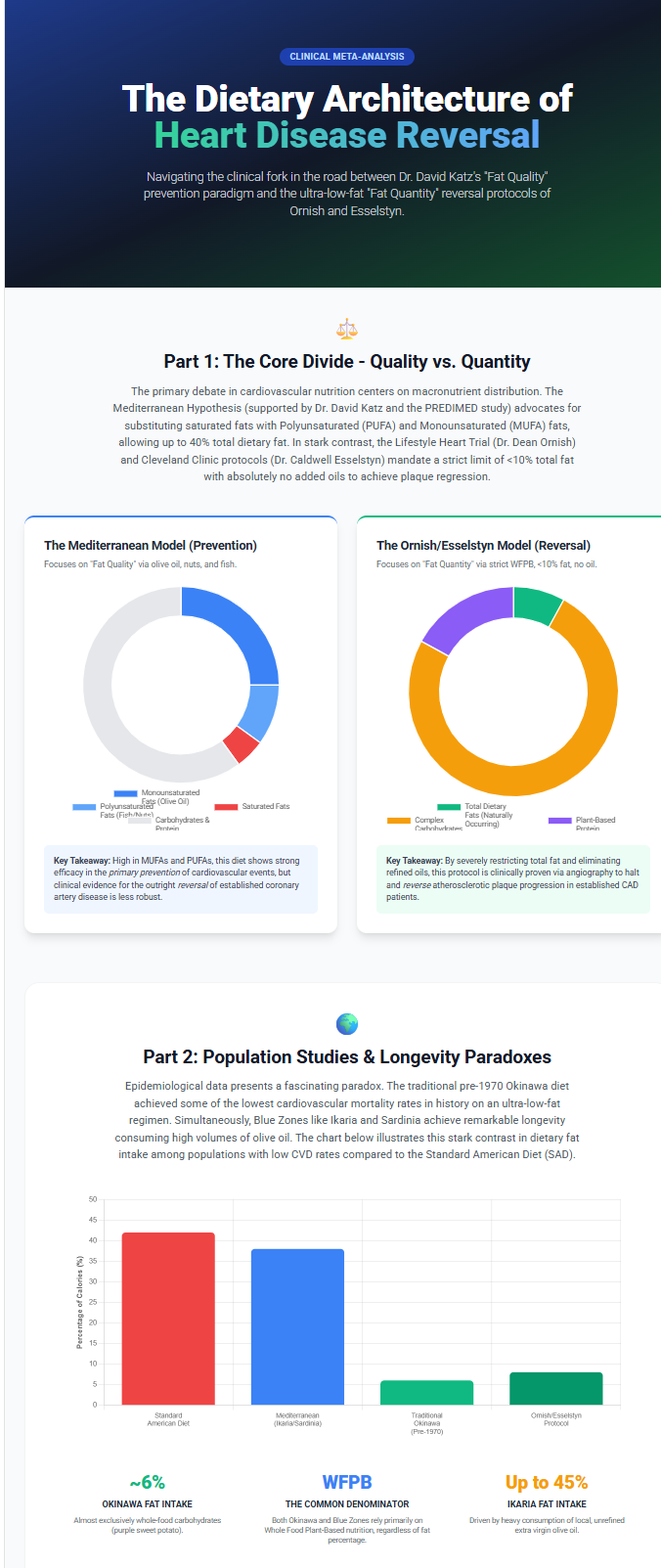
विधियाँ: ए व्यवस्थित समीक्षा पबमेड-अनुक्रमित स्रोतों का उपयोग करके सहकर्मी-समीक्षित प्राथमिक साहित्य का एक सर्वेक्षण किया गया था जिसमें यादृच्छिक नियंत्रित परीक्षण (RCTs), बड़े संभावित समूह अध्ययन, और यंत्रणात्मक जांच। सभी गैर-सहकर्मी-समीक्षित स्रोतों को हटा दिया गया है और प्राथमिक साहित्य से प्रतिस्थापित किया गया है। दो प्रमुख आहार संबंधी प्रतिमानों की जांच की गई है: (1) मात्रात्मक वसा-प्रतिबंध मॉडल (कुल कैलोरी का <10% वसा, संपूर्ण-खाद्य पौधा-आधारित, कोई अतिरिक्त तेल नहीं — ऑर्निश/एसेलस्टीन प्रोटोकॉल); और (2) गुणात्मक वसा-प्रतिस्थापन मॉडल (कुल वसा 30-45%, भूमध्यसागरीय पैटर्न, संतृप्त वसा की जगह असंतृप्त वसा).
परिणाम: अति-निम्न-वसायुक्त संपूर्ण-खाद्य पादप-आधारित (WFPB) आहार एकमात्र ऐसा आहार प्रोटोकॉल है जिसने एंजियोग्राम द्वारा पुष्टि की गई परिणामों को प्रदर्शित किया है पट्टिका समीक्षा किए गए सहकर्मी (पीयर-रिव्यू) RCT डेटा में पाँच वर्षों तक फैला हुआ प्रतिगमन (Ornish et al., JAMA 1998; PMID 9863851)। भूमध्यसागरीय आहार मॉडल मजबूत प्राथमिक रोकथाम लाभ प्रदान करता है लेकिन इसके समकक्ष प्रदर्शन नहीं किया है एंजियोग्राफिक प्रतिगमन. मेडिटेरेनियन मॉडल के लिए प्राथमिक आरसीटी साक्ष्य आधार — PREDIMED परीक्षण — इसमें महत्वपूर्ण पद्धतिगत सीमाएँ हैं, जिनमें शामिल हैं यादृच्छिकीकरण प्रतिभागियों में 21% की विफलताएं, प्रारंभिक परीक्षण समाप्ति इससे प्रभाव के आकार में संभवतः वृद्धि हुई, और एक नियंत्रण समूह जिसने कभी वास्तव में कम वसा वाली स्थिति प्राप्त नहीं की। CORDIOPREV परीक्षण यह एक मध्यम रूप से कम-वसा (~28-30%) वाले तुलनात्मक आहार की तुलना में भूमध्यसागरीय आहार की श्रेष्ठता की पुष्टि करता है, लेकिन <10% सीमा का परीक्षण नहीं करता है।.
निष्कर्ष: साक्ष्य 'क्लिनिकल फोर्क इन द रोड' मॉडल का समर्थन करते हैं: सामान्य आबादी में प्राथमिक रोकथाम के लिए भूमध्यसागरीय आहार पैटर्न उपयुक्त है; हालांकि, स्थापित कोरोनरी धमनी रोग (CAD) वाले और दस्तावेजीकृत प्लाक प्रतिगमन चाहने वाले रोगियों के लिए, <10% वसा वाला WFPB प्रोटोकॉल ही एकमात्र आहार संबंधी हस्तक्षेप है जिसके प्रभावकारिता का एंजियोग्राफिक प्रमाण संभावित नैदानिक डेटा में मौजूद है।.
1. परिचय
का नैदानिक प्रबंधन हृदय रोग पारंपरिक रूप से हृदय रोगों (CVD) का प्रबंधन औषधीय जोखिम प्रबंधन और आक्रामक रूप से लक्षणों को कम करने के दृष्टिकोण के तहत किया जाता रहा है। यह दृष्टिकोण, हालांकि तीव्र स्थितियों में जीवन रक्षक होता है, लेकिन अंतर्निहित एथेरोजेनिक प्रक्रिया को अनसुलझा छोड़ देता है। सहकर्मी-समीक्षित (पीयर-रिव्यू) साक्ष्यों का एक बड़ा हिस्सा यह सुझाव देता है कि आहारीय मैक्रोन्यूट्रिएंट आर्किटेक्चर—वसा का विशिष्ट वितरण, कार्बोहाइड्रेट, और प्रोटीन, डटरी लिपिड के गुणात्मक स्रोत के साथ-साथ — ऐसे शारीरिक状態 (स्थितियों) को उत्पन्न कर सकता है जो न केवल बीमारी को स्थिर करने के लिए बल्कि स्थापित एथेरोस्क्लेरोटिक प्लाक के नैदानिक प्रतिगमन (regression) के लिए अनुकूल हैं।
यह समीक्षा दो प्रतिस्पर्धी पोषण दर्शनों की जांच करती है: (1) 'वसा मात्रा' प्रतिबंध मॉडल, जिसका आरंभ ऑर्निश और एसेलस्टीन ने किया था, जो तेल रहित WFPB प्रोटोकॉल के माध्यम से कुल आहार वसा को <10% कैलोरी तक लक्षित करता है; और (2) 'वसा गुणवत्ता' प्रतिस्थापन मॉडल, जिसे AHA द्वारा समर्थित और भूमध्यसागरीय आहार पैटर्न में समाहित किया गया है, जो संतृप्त और ट्रांस फैट पॉली- और मोनोअनसैचुरेटेड विकल्पों द्वारा प्रतिस्थापित किया जाता है। आरसीटी डेटा, जनसंख्या दीर्घायु अध्ययनों और संवहनी यंत्रवत अनुसंधान को संश्लेषित करके — और प्रत्येक प्रतिमान के प्राथमिक साक्ष्य आधार की पद्धतिगत सीमाओं का कठोरता से मूल्यांकन करके — यह समीक्षा प्राथमिक रोकथाम और माध्यमिक रोग प्रतिगमन दोनों के लिए इष्टतम आहार सीमाओं को परिभाषित करती है।.
एक केंद्रीय निष्कर्ष यह है कि PREDIMED परीक्षण — जो भूमध्यसागरीय प्रतिमान के लिए सबसे अधिक बार उद्धृत किया जाने वाला RCT है — में कई गंभीर पद्धतिगत चिंताएं शामिल हैं जो इसके निष्कर्षों की निश्चितता को काफी कम कर देती हैं। इनकी विस्तार से समीक्षा अनुभाग 5 में की गई है। PREDIMED को वास्तव में कम वसा वाले तुलनित्र की तुलना में भूमध्यसागरीय आहार की श्रेष्ठता के निश्चित प्रमाण के रूप में उद्धृत करने वाले जांचकर्ताओं और चिकित्सकों को इन सीमाओं से अवगत होना चाहिए।.
2. मात्रात्मक वसा प्रतिमान: नैदानिक प्रतिवर्तन के लिए अति-निम्न-वसा WFPB प्रोटोकॉल
यह परिकल्पना कि तीव्र कुल आहार वसा में कमी से स्थापित एथेरोस्क्लेरोटिक पट्टिका (प्लाक) का प्रतिगमन हो सकता है, इस अवलोकन द्वारा समर्थित है कि अत्यंत कम वसा सेवन वाले आबादी में कोरोनरी (हृदय रोग) की लगभग पूरी तरह से अनुपस्थिति प्रदर्शित होती है। धमनी बीमारी। (13,14) ओरनिश और एसेल्स्टीन ने स्वतंत्र रूप से इस महामारी संबंधी अवलोकन को नैदानिक प्रोटोकॉल में अनुवादित किया जो सीएडी (CAD) को एक प्रगतिशील, अपरिवर्तनीय स्थिति के रूप में पारंपरिक दृष्टिकोण को चुनौती देते हैं। (1,2,3,4,5)
2.1 द लाइफस्टाइल हार्ट ट्रायल — एंजियोोग्राफिक रिग्रेशन के लिए यादृच्छिक नियंत्रित साक्ष्य
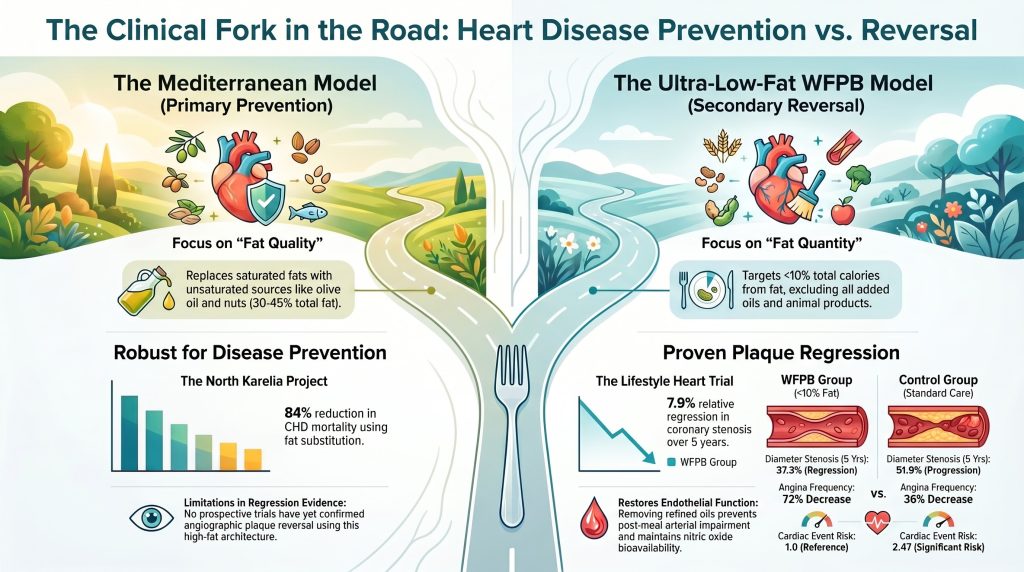
द लाइफ़स्टाइल हार्ट ट्रायल (LHT) वह सहकर्मी-समीक्षित आरसीटी (RCT) है जो सबसे सीधे तौर पर आहार संबंधी उलटफेर कोरोनरी धमनी रोग के। एंजियोग्राफिक रूप से मध्यम से गंभीर CAD के साथ रोगियों को <10% वसा पर केंद्रित एक प्रयोगात्मक कार्यक्रम में यादृच्छिक रूप से आवंटित किया गया था। शाकाहारी आहार, एरोबिक व्यायाम, तनाव प्रबंधन, और धूम्रपान cessation.(1,2) आहार संबंधी घटक ने वसा सीमा बनाए रखने के लिए अंडे की सफेदी और गैर-वसा युक्त डेयरी को छोड़कर सभी पशु उत्पादों पर प्रतिबंध लगाया, और अतिरिक्त तेल, एवोकैडो और मेवों को बाहर रखा।.
एक-वर्षीय परिणामों ने दर्शाया कि औसत प्रतिशत व्यास स्टेनोसिस प्रयोगात्मक समूह में यह 40.7% से घटकर 38.5% हो गया, जबकि नियंत्रण समूह में — मानक देखभाल के बाद — यह 41.3% से बढ़कर 42.3% हो गया (p < 0.001)।(2) ये विशिष्ट आंकड़े JAMA 1998 के पाँच-वर्षीय पेपर (PMID 9863851) से लिए गए हैं, जो पूर्ण एंजियोग्राफिक फॉलो-अप के साथ एक सीमित उप-समूह की रिपोर्ट करता है। मूल 1990 के लैंसेट पेपर (PMID 1973470) में पूरी यादृच्छिक कोहोर्ट के लिए अलग आंकड़े दिए गए हैं: प्रयोगात्मक समूह में 40.0% से 37.8% तक और नियंत्रण समूह में 42.7% से 46.1% तक — दोनों विश्लेषणों में दिशात्मक रूप से सुसंगत और सांख्यिकीय रूप से महत्वपूर्ण।(1)
तालिका 1. लाइफस्टाइल हार्ट ट्रायल के दीर्घकालिक परिणाम (1-वर्ष और 5-वर्ष का डेटा)
| नैदानिक मानदंड | प्रयोगात्मक (<10% फैट WFPB) | नियंत्रण (मानक देखभाल) | सांख्यिकीय महत्व |
| व्यास स्टेनोसिस (संकुचन) — आधार रेखा | 40.7% | 41.3% | लागू नहीं |
| व्यास संकीर्णता — 1 वर्ष | 38.5% | 42.3% | p < 0.001 |
| व्यास संकुचन — 5 वर्ष | 37.3% | 51.9% | p < 0.001 |
| सापेक्ष परिवर्तन | 7.9% प्रतिगमन | 27.71टीपी9टी प्रगति | p = 0.001 |
| एंजाइना आवृत्ति | 72% कमी | 36% कमी | p < 0.05 |
| जोखिम अनुपात — कोई भी हृदय संबंधी घटना | 1.0 (संदर्भ) | 2.47 (95% CI: 1.48-4.20) | महत्वपूर्ण |
स्रोत: ऑर्निश डी और अन्य।. JAMA. 1998;280(23):2001-7 (PMID: 9863851). पूर्ण 5-वर्षीय एंजियोग्राफिक अनुवर्ती के साथ प्रतिबंधित उप-समूह से प्राप्त डेटा। सभी आंकड़े प्रकाशित प्राथमिक स्रोत के विरुद्ध सत्यापित।.
पाँच वर्षों के आंकड़े दिखाते हैं कि नियंत्रण समूह में प्रमुख के लिए जोखिम अनुपात 2.47 (95% विश्वसनीय अंतराल: 1.48-4.20) था। हृदय संबंधी घटनाएं प्रयोगात्मक समूह की तुलना में, यह पुष्टि करते हुए कि मानक-देखभाल ‘मॉडरेशन’ इस उच्च-जोखिम समूह में रोग की प्रगति को रोकने के लिए अपर्याप्त था।(2) एंजाइना की आवृत्ति प्रयोगात्मक समूह में 72% से घटी, जबकि नियंत्रण शाखा में यह 36% थी।(2) ये आंकड़े इस परिकल्पना का समर्थन करते हैं कि <10% वसा की सीमा एक जैविक तल के रूप में कार्य करती है, जिसके नीचे धमनी ऊतक एक ऐसे मरम्मतकारी अवस्था में प्रवेश कर जाता है जो उच्च आहार वसा सेवन पर प्राप्त नहीं की जा सकती।.
2.2 एसेलस्टीन क्लीवलैंड क्लिनिक समूह
एसेलस्टीन का 2014 अवलोकन संबंधी अध्ययन 198 रोगियों में गंभीर कोरोनरी धमनी रोग (J Fam Pract, PMID: 25198208) के साथ, यह उन्नत-रोग आबादी में बिना तेल वाले WFPB प्रोटोकॉल के लिए सबसे बड़ा डेटासेट प्रदान करता है।(5) इस समूह में वे रोगी शामिल थे जो पहले से ही पारंपरिक उपचारों में असफल हो चुके थे, जिनमें कई पुनरुद्धार प्रक्रियाएँ शामिल थीं। प्रोटोकॉल का औसतन 3.7 वर्षों तक पालन करने वाले 177 रोगियों में एक हृदय संबंधी घटना हुई (घटना दर 0.6%)। प्रोटोकॉल का पालन न करने वाले 21 रोगियों में 13 घटनाएँ हुईं (62% घटना दर)।(5) फॉलो-अप एंजियोग्राफी में दस्तावेजीकरण किया गया धमनी काठिन्य 22% में प्रतिभागी लोगों में उलटफेर। (5) बेहतर होने के PET इमेजिंग साक्ष्य मायोकार्डियल पर्फ़्यूजन एक समतुल्य आहार संबंधी प्रोटोकॉल के तहत गूल्ड एट अल. (JAMA 1995, PMID: 7674504) द्वारा प्रदान किया गया था।(29)
एसेलस्टीन समूहों की एक महत्वपूर्ण पद्धतिगत सीमा अधिकांश रोगियों में कोलेस्ट्रॉल-घटाने वाली दवाओं के एक साथ उपयोग है, जिससे देखी गई लिपिड में कमी और घटना-दर के आंकड़ों में आहार संबंधी योगदान को औषधीय योगदान से अलग करना असंभव हो जाता है। हालाँकि, अनुपालन करने वालों और न करने वालों के बीच घटना-दर में जो अंतर है — जबकि दोनों समूहों को समान औषधीय सहायता प्राप्त हुई — वह इस बात का तर्क देता है कि दवाओं से अकेले जो प्रभाव होता, उससे परे एक पर्याप्त स्वतंत्र आहार संबंधी प्रभाव मौजूद है।(5)
3. गुणात्मक वसा प्रतिमान: वसा प्रतिस्थापन और भूमध्यसागरीय मॉडल
एक विपरीत प्रतिमान, जिसे AHA का समर्थन प्राप्त है और जो भूमध्यसागरीय आहार पैटर्न में समाहित है, यह तर्क देता है कि कुल वसा की मात्रा की तुलना में वसा की गुणवत्ता अधिक निर्णायक है। यह ‘प्रतिस्थापन तर्क’ संतृप्त वसा अम्ल (SFA) और ट्रांस-वसा अम्ल (TFA) को बहुअसंतृप्त (PUFA) और एकलअसंतृप्त (MUFA) वसा से प्रतिस्थापित करने पर केंद्रित है, जिससे आमतौर पर कुल वसा से 30–45% कैलोरी की मात्रा प्राप्त होती है।(24,31)
3.1 नॉर्थ कैरेलिया परियोजना — वसा प्रतिस्थापन के लिए जनसंख्या-स्तरीय साक्ष्य
द नॉर्थ कैरेलिया परियोजना प्रतिस्थापन मॉडल का जनसंख्या-स्तर पर सबसे प्रभावशाली प्रदर्शनों में से एक प्रदान करता है। फिनिश आबादी को व्यवस्थित रूप से संतृप्त डेयरी वसा से रेपसीड (कैनोला) तेल की ओर स्थानांतरित करके और सब्जियों का सेवन बढ़ाकर, इस दशकों-लंबे सार्वजनिक स्वास्थ्य हस्तक्षेप ने 40 वर्षों में 35-64 वर्ष की आयु के पुरुषों में सीएचडी (coronary heart disease) मृत्यु दर में लगभग 84% की कमी हासिल की, जैसा कि जौसिलहती एट अल. द्वारा ग्लोबल हार्ट (PMID: 27242088) में रिपोर्ट किया गया है।(11) ब्रेड पर मक्खन के उपयोग में 1972 में आबादी के 90% से घटकर 2012 तक 5% से भी कम हो गया, जैसा कि वार्तियाइनेन एट अल. (PMID: 27242084) द्वारा प्रलेखित है।(12)
तालिका 2. नॉर्थ कैरेलिया परियोजना — वसा प्रतिस्थापन का जनसंख्या-स्तरीय प्रभाव (1972-2012)
| पैरामीटर | 1972 आधाररेखा | 2012 का परिणाम | प्रभाव |
| ब्रेड पर मक्खन का उपयोग | जनसंख्या का 90% | जनसंख्या का <5% | एसएफए में पर्याप्त कमी |
| मुख्य वसा स्रोत | संतृप्त (डेयरी/मक्खन) | असंतृप्त (सरसों/वनस्पति) | प्रतिस्थापन तर्क प्रदर्शित |
| रक्त प्लाज्मा कोलेस्ट्रॉल | स्पष्ट रूप से बढ़ा हुआ | महत्वपूर्ण कमी | सीवीडी मृत्यु दर का सबसे बड़ा चालक |
| सीएचडी मृत्यु दर (पुरुष 35-64) | वैश्विक स्तर पर सर्वोच्च | ~84% कमी | जनसंख्या-स्तर पर उलटफेर |
स्रोत: जौसिलाह्टी पी एट अल. ग्लोब हार्ट. 2016;11(2):207-12 (PMID: 27242088); वार्तियाइनेन ई एट अल. ग्लोब हार्ट. 2016;11(2):179-84 (PMID: 27242084); Puska P et al. Glob Heart. 2016;11(2):173-8 (PMID: 27242083).
3.2 PREDIMED परीक्षण — भूमध्यसागरीय आहार के प्राथमिक यादृच्छिक नियंत्रित परीक्षण (RCT) साक्ष्य का आलोचनात्मक मूल्यांकन
PREDIMED परीक्षण प्राथमिक हृदय-रक्तवाहिनी रोकथाम के लिए भूमध्यसागरीय आहार पैटर्न का समर्थन करने वाला सबसे अधिक उद्धृत यादृच्छिक नियंत्रित परीक्षण (RCT) है। 7,447 उच्च-जोखिम प्रतिभागियों में ‘कम-वसा’ नियंत्रण आहार की तुलना दो भूमध्यसागरीय शाखाओं (EVOO-पूरक और नट-पूरक) से करते हुए, इसने भूमध्यसागरीय समूहों में प्रमुख हृदय संबंधी घटनाओं में लगभग 30% की कमी रिपोर्ट की।(6) हालांकि, जैसा कि इस समीक्षा के अनुभाग 5 में विस्तार से बताया गया है, PREDIMED में कई गंभीर पद्धतिगत सीमाएँ हैं जो इसके निष्कर्षों की निश्चितता को काफी कम कर देती हैं। इन चिंताओं के व्यवस्थित विश्लेषण के लिए पाठक को तालिका 4 देखनी चाहिए।.
इस समीक्षा की केंद्रीय बहस के लिए एक मौलिक सीमा यह है कि PREDIMED नियंत्रण समूह ने कभी भी वास्तव में कम-वसा दर्जा प्राप्त नहीं किया: अध्ययन के अंत तक नियंत्रण समूह में औसत वसा सेवन 37% कैलोरी तक पहुँच गया — जो कम वसा वाले आहार की किसी भी स्वीकृत परिभाषा से कहीं अधिक है और प्लाक-रिवर्सल अनुसंधान में उपयोग की जाने वाली <10% वसा सीमा से पूरी तरह असंगत है।(6,7) PREDIMED इसलिए यह दर्शाता है कि दो उच्च-वसा वाले आहार पैटर्न में, भूमध्यसागरीय आहार श्रेष्ठ है; यह वास्तव में कम-वसा वाले या WFPB तुलना समूह पर भूमध्यसागरीय आहार की श्रेष्ठता को प्रदर्शित नहीं करता है।.
3.3 लायन डाइट हार्ट स्टडी — द्वितीयक रोकथाम के प्रमाण
द ल्योन डाइट हार्ट स्टडी भूमध्यसागरीय प्रतिमान के लिए अधिक पद्धतिगत रूप से ठोस प्रमाण प्रदान करता है। द्वितीयक रोकथाम क्षमता.(8,9) इस RCT ने हृदय संबंधी मृत्यु और गैर-घातक में 73% की कमी प्रदर्शित की। मायोकार्डियल इंफार्क्शन 27 महीनों से अधिक (समायोजित आरआर 0.27, 95% CI 0.12-0.59, p = 0.001) पोस्ट-इन्फार्क्शन रोगियों में ALA-समृद्ध भूमध्यसागरीय आहार बनाम मानक पोस्ट-इन्फार्क्शन आहार के बाद, और देखे गए लाभ की व्यापकता के कारण इसे समय से पहले ही बंद कर दिया गया।(9) PREDIMED के विपरीत, ल्यों परीक्षण उन यादृच्छिककरण और नियंत्रण-समूह संदूषण संबंधी समस्याओं से ग्रस्त नहीं है जिनकी समीक्षा अनुभाग 5 में की गई है, जिससे इसके निष्कर्ष पद्धतिगत रूप से अधिक विश्वसनीय बनते हैं।.
लायन अध्ययन हालांकि केंद्रीय बहस का समाधान नहीं करता: इसने एक की तुलना की भूमध्यसागरीय आहार यह एक मानक पश्चिमी पोस्ट-इन्फार्क्शन आहार के खिलाफ है, न कि WFPB या अल्ट्रा-लो-फैट प्रोटोकॉल के खिलाफ। इसके निष्कर्ष दर्शाते हैं कि भूमध्यसागरीय आहार पैटर्न द्वितीयक रोकथाम के लिए मानक पश्चिमी आहार से काफी बेहतर प्रदर्शन करता है — एक निष्कर्ष जो साक्ष्यों द्वारा अच्छी तरह से समर्थित है। ये निष्कर्ष यह नहीं बताते कि भूमध्यसागरीय आहार पैटर्न प्लाक प्रतिगमन के लिए WFPB प्रोटोकॉल के समकक्ष है या उससे श्रेष्ठ है।.
४. जनसंख्या अध्ययन और दीर्घायु विरोधाभास
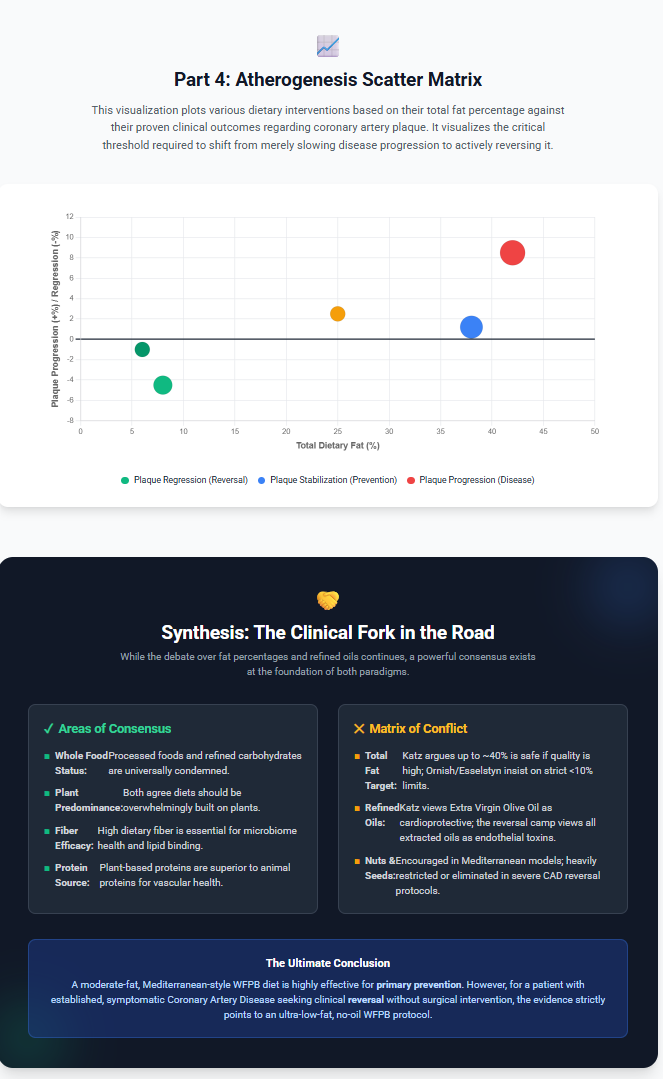
दो विपरीत दीर्घायु वाली आबादी — पारंपरिक ओकिनावावासी और भूमध्यसागरीय ब्लू जोन्स इकारिया और सार्डिनिया — आहार संरचना और हृदय-रक्तवाहिनी दीर्घायु के संबंध में जानकारीपूर्ण प्राकृतिक प्रयोग प्रस्तुत करते हैं।.
तालिका 3. दीर्घायु आबादियों में तुलनात्मक मैक्रोन्यूट्रिएंट वितरण
| पोषक तत्व | पारंपरिक ओकिनावा (1970 से पूर्व) | मध्यधराईय नीले क्षेत्र (इकरिया / सार्डिनिया) | आधुनिक पश्चिमी आहार |
| कुल वसा (% कैलोरी) | 6% | 30-45% | 35-40% |
| संतृप्त वसा (% किलो कैलोरी) | 2% | 8-10% | 12-15% |
| कार्बोहाइड्रेट (% कैलोरी) | 85% | 40-45% | 45-50% |
| मुख्य वसा स्रोत | सोया / समुद्री शैवाल | जैतून का तेल / मेवे | मक्खन / चर्बी / परिष्कृत तेल |
| सीएडी मृत्यु दर (सापेक्ष) | अमेरिकी दर का लगभग 1/8 | बहुत कम | उच्च |
स्रोत: विलकॉक्स डीसी एट अल. जे एम कॉल् न्यूट्र. 2009;28(पूरक):500S-516S (PMID: 20234038); त्रिकोपोलू ए और अन्य।. एन इंग्ल जे मेड. 2003;348(26):2599-608 (PMID: 12826634); पौलेन एम एट अल. एक्सप जेरोंटोल. 2004;39(9):1423-9 (PMID: 15489066).
4.1 ओकिनावा मॉडल — हृदय-रक्तवाहिनी दीर्घायु संरचना के रूप में अति-निम्न-वसा
पारंपरिक 1970-पूर्व ओकिनावा आहार — विलकॉक्स एट अल. (जे एम कोल न्यूट्र 2009, पीएमआईडी: 20234038) द्वारा 6% वसा / 85% कार्बोहाइड्रेट / के रूप में वर्णित 9% प्रोटीन, जिसमें पोषक तत्वों से भरपूर शकरकंद मुख्य कैलोरी स्रोत था — CAD मृत्यु दर समकालीन अमेरिकी दरों के लगभग एक-आठवें हिस्से से जुड़ी थी और यह दुनिया में सबसे अधिक जीवन प्रत्याशा से संबंधित थी।(13,14) जब ओकिनावावासियों ने पश्चिमीकरण वाले आहार अपनाया — जिससे कुल वसा लगभग 27% तक बढ़ गई — तो हृदय संबंधी मृत्यु दर में काफी वृद्धि हुई और उनकी दीर्घायु रैंकिंग गिर गई।(14) यह दीर्घकालिक परिवर्तन एक प्राकृतिक प्रयोग प्रस्तुत करता है जिसमें कुल वसा का बढ़ता सेवन, संतृप्त वसा (SFA) का बढ़ता सेवन, और संपूर्ण-वनस्पति खाद्य घनत्व में गिरावट, बढ़ते हृदय संबंधी जोखिम के साथ एक साथ हुई, जो मात्रात्मक वसा-प्रतिबंध परिकल्पना का समर्थन करती है।.
4.2 भूमध्यसागरीय ब्लू ज़ोन विरोधाभास और इसके निहितार्थ
इकैरिया और सार्डिनिया के ब्लू ज़ोन्स में लोग अक्सर कुल वसा 35% से अधिक वाली आहार लेते हैं, फिर भी ये विश्व-स्तरीय दीर्घायु और हृदय रोगों की कम दर प्रदर्शित करते हैं।(15,17) यह एक स्पष्ट विरोधाभास उत्पन्न करता है: यदि ओकिनावा में अल्ट्रा-लो फैट सेवन ही निर्णायक कारक था, तो कहीं अधिक वसा सेवन वाली भूमध्यसागरीय आबादी समान दीर्घायु कैसे प्राप्त करती है?
इस विरोधाभास का समाधान कुल वसा की मात्रा और वसा की गुणवत्ता के बीच के अंतर में निहित है, साथ ही इस अवलोकन में कि दोनों आबादी में निम्नलिखित संरचनात्मक समानताएँ हैं: उच्च संपूर्ण-वनस्पति खाद्य घनत्व, न्यूनतम संसाधित खाद्य सेवन, न्यूनतम परिष्कृत चीनी की खपत, और न्यूनतम पशु प्रोटीन।(15,16,17) हृदय रोग की तुलना के लिए महत्वपूर्ण अंतर यह है कि प्रत्यक्ष महामारी संबंधी आंकड़े बताते हैं कि पारंपरिक ओकिनावा में CAD मृत्यु दर भूमध्यसागरीय ब्लू ज़ोन्स की तुलना में और भी कम थी — यह सुझाव देते हुए कि, जबकि दोनों संरचनाएं पश्चिमी आहार की तुलना में सीवीडी से बचाती हैं, अल्ट्रा-लो-फैट WFPB पैटर्न मात्रात्मक रूप से बेहतर कोरोनरी धमनी सुरक्षा प्रदान कर सकता है।(13,14)
५. PREDIMED परीक्षण का आलोचनात्मक मूल्यांकन — एक व्यवस्थित पद्धतिगत विश्लेषण
PREDIMED की कार्डियोवैस्कुलर रोकथाम में भूमध्यसागरीय आहार प्रतिमान के लिए प्राथमिक यादृच्छिक नियंत्रित परीक्षण (RCT) साक्ष्य आधार के रूप में मौलिक भूमिका को देखते हुए, इसकी पद्धतिगत विश्वसनीयता का कठोर मूल्यांकन आवश्यक है। निम्नलिखित विश्लेषण आधारित है वापसी सूचना और पुनः प्रकाशित पेपर (Estruch et al., N Engl J Med 2018, PMID: 29897866) और आगरवाल और इओआनिडिज़ द्वारा की गई सहकर्मी-समीक्षित पद्धतिगत आलोचना (BMJ 2019, PMID: 30733217)।(6,7)
तालिका 4. PREDIMED परीक्षण — व्यवस्थित पद्धतिगत चिंताएँ
| पद्धतिगत चिंता | विवरण | साक्ष्य-आधारित मूल्यांकन |
| यादृच्छिकीकरण विफलताएँ | प्रतिभागियों में से 21% (n=1,588) को उचित रूप से व्यक्तिगत रूप से यादृच्छिक नहीं किया गया था: घर आवंटन, क्लिनिक-स्तर पर असाइनमेंट, और कई स्थलों पर बिना दस्तावेजीकृत विचलन। | NEJM 2018 में वापसी और पुनःप्रकाशन की पुष्टि हुई। दिशात्मक परिणाम अपरिवर्तित रहे, लेकिन साक्ष्य की निश्चितता में काफी कमी की गई। |
| परीक्षण समय से पहले रोका गया | अंतरिम लाभ संकेत के बाद नियोजित 6 वर्षों में से 4.8 वर्ष पूरे होने पर रोक लगा दी गई; आहार संबंधी परीक्षणों में समयपूर्व समाप्ति व्यवस्थित रूप से प्रभाव आकारों को बढ़ा देती है। | अगरवाल और इओआननिडिस (बीएमजे 2019, पीएमआईडी 30733217): संशोधित परिणामों को देखते हुए समयपूर्व रोकना अनुचित था।‘ |
| नियंत्रण समूह वास्तव में कम-वसा वाला नहीं था। | कंट्रोल आर्म ने अध्ययन के अंत तक कुल वसा 37% तक पहुँच ली; ‘कम वसा’ निर्देश पहले तीन वर्षों तक केवल पैम्फलेट के रूप में था। वास्तविक कम वसा को <10% कैलोरी के रूप में परिभाषित किया गया है। | Ioannidis: ‘PREDIMED ने 41% बनाम 37% वसा का परीक्षण किया — दो उच्च-वसा आहार पैटर्न की तुलना, न कि भूमध्यसागरीय बनाम वास्तव में कम-वसा’ |
| असंतुलित हस्तक्षेप तीव्रता | मध्यसागरीय समूह को अध्ययन की शुरुआत से ही मुफ्त भोजन (प्रति सप्ताह 1 लीटर एक्स्ट्रा वर्जिन जैतून का तेल या प्रतिदिन 30 ग्राम मेवे) और तीव्र त्रैमासिक परामर्श प्राप्त हुआ; नियंत्रण समूह को पहले तीन वर्षों के लिए केवल पैम्फलेट्स प्राप्त हुए। | भेदभावपूर्ण ध्यान और भोजन प्रदान करना आहार संबंधी आवंटन को जटिल बनाता है; लाभ आंशिक रूप से गैर-आहार संबंधी प्रभावों को प्रतिबिंबित कर सकते हैं। |
| स्ट्रोक-प्रमुख कंपोजिट एंडपॉइंट | प्राथमिक संयुक्त समाप्ति बिंदु की महत्वता निम्नलिखित द्वारा प्रेरित आघात कमी; MI और CVD मृत्यु दर व्यक्तिगत रूप से समूहों के बीच महत्वपूर्ण रूप से भिन्न नहीं थे। | NICE व्यवस्थित समीक्षा: व्यक्तिगत हृदय-रक्तवाहिनी रोग (CVD) परिणामों के लिए PREDIMED में ‘गंभीर’ पक्षपात का जोखिम; मृत्यु दर परिणामों के लिए ‘निम्न या बहुत निम्न गुणवत्ता’ का डेटा |
| द्वितीयक प्रकाशन प्रसार | PREDIMED डेटाबेस का उपयोग करके 267 से अधिक द्वितीयक विश्लेषण प्रकाशित किए गए; कई अविश्वसनीय प्रेक्षणीय दावे रिपोर्ट किए गए (जैसे, नट्स की आवृत्ति का पूर्वानुमान लगाना) सभी कारणों से होने वाली मृत्यु दर) | ‘PREDIMED प्रकाशनों में रिपोर्ट किए गए आंकड़ों के बीच कई विरोधाभास, परीक्षण की गुणवत्ता में एक अधिक सामान्य समस्या का सुझाव देते हैं। (अग्रवाल और इओआनिडिज़, बीएमजे 2019) |
स्रोत: एस्ट्रुच आर और अन्य।. एन इंग्ल जे मेड. 2018;378(25):e34 (PMID: 29897866); अग्रवाल ए, इओआनिडिज जेपीए. BMJ. 2019;364:l341 (PMID: 30733217).
इनमें से प्रत्येक चिंता को अलग-अलग लिया जाए तो एक बड़े, वास्तविक-विश्व आहार RCT के संदर्भ में प्रबंधनीय माना जा सकता है। सामूहिक रूप से लिए जाने पर, ये उस साक्ष्यगत भार को काफी कम कर देते हैं जो PREDIMED को वास्तव में कम वसा वाले तुलना समूह की तुलना में भूमध्यसागरीय आहार की श्रेष्ठता के निर्णायक प्रमाण के रूप में दिया जा सकता है। अग्रवाल और इओआनिडिज़ ने निष्कर्ष निकाला कि ‘PREDIMED प्रकाशनों में रिपोर्ट किए गए डेटा के बीच कई विरोधाभास परीक्षण की गुणवत्ता की एक अधिक सामान्य समस्या का सुझाव देते हैं’ और यह कि ‘पुनः प्रकाशन शेष कई समस्याओं को हल नहीं कर सकता है’।(7)
महत्वपूर्ण रूप से, इन चिंताओं को वापसी के बाद पश्चात में नहीं उठाया गया था: PREDIMED की NICE प्रणालीगत समीक्षा — जो 2018 की वापसी से पहले स्वतंत्र रूप से की गई थी — ने पहले ही व्यक्तिगत सीवीडी परिणामों के लिए परीक्षण को पक्षपात के ‘गंभीर’ जोखिम में रेट किया था, और मृत्यु दर परिणामों के लिए डेटा को ‘निम्न या बहुत निम्न गुणवत्ता’ के रूप में वर्गीकृत किया था।(7) यह पूर्व-वापसी मूल्यांकन अत्यंत महत्वपूर्ण है और यह इस बात की व्याख्या के खिलाफ मजबूती से तर्क देता है कि PREDIMED यह निर्णायक प्रमाण प्रदान करता है कि भूमध्यसागरीय आहार कठोर हृदय संबंधी परिणामों के लिए वास्तव में कम वसा वाले आहार दृष्टिकोण से बेहतर प्रदर्शन करता है।.
लायन डाइट हार्ट स्टडी, जो PREDIMED की यादृच्छिकता और नियंत्रण-समूह संबंधी चिंताओं से मुक्त है और द्वितीयक-रोकथाम आबादी में हृदय संबंधी मृत्यु और गैर-घातक मायोकार्डियल इंफार्क्शन में 73% की कमी प्रदर्शित करती है, समीक्षा-आधारित साहित्य में एकल-परीक्षण आहार संबंधी द्वितीयक-रोकथाम यादृच्छिक नियंत्रित परीक्षण (RCT) का अब तक का सबसे मजबूत परिणाम बनी हुई है।(8,9)
6. नैदानिक तंत्र: एपोबी लिपोप्रोटीन, एंडोथीलियल नाइट्रिक ऑक्साइड, और प्लाक जीवविज्ञान
6.1 एथेरोजेनेसिस और एपोबी-युक्त लिपोप्रोटीन
आधुनिक निवारक हृदयरोग विज्ञान पहचानता है एपोलिपोप्राटीन Bअपोबी) एथेरोजेनिक जोखिम के प्राथमिक कारणीय मार्कर के रूप में। प्रत्येक वीएलडीएल, आईडीएल, और एलडीएल कण में ठीक एक होता है एपोबी-100 अणु, जिसका अर्थ है कि प्लाज्मा एपोबी सांद्रता संभावित रूप से मौजूद कुल संख्या को सीधे मापती है। एथोजेनिक कण प्रचलन में। (21) क्योंकि धमनी पट्टिका प्रारंभिक घटना कण-एंडोथीलियम अंतःक्रिया की संभावना पर निर्भर करती है, ApoB पारंपरिक LDL-C सांद्रता की तुलना में मायोकार्डियल इन्फार्क्शन का अधिक कारणपरक सटीक पूर्वानुमानक है। यह की पुष्टि की गई थी। यूके बायोबैंक Marston et al. (JAMA Cardiol 2022, PMID: 34773460) द्वारा किया गया विश्लेषण, जिसमें 389,529 व्यक्तियों के एक समूह में पूर्ण समायोजन के बाद MI के साथ स्वतंत्र रूप से जुड़े एकमात्र लिपिड पैरामीटर के रूप में ApoB को प्रदर्शित किया गया।(22)
आहार संबंधी संतृप्त वसा अम्ल यकृत संबंधी LDL रिसेप्टर एक तंत्र के माध्यम से अभिव्यक्ति, जो कोशिकीय कोलेस्ट्रॉल के पुनर्वितरण द्वारा होती है, जिससे परिसंचरण से रिसेप्टर-मध्यस्थ ApoB कणों की निकासी बाधित होती है।(23) इसे यांत्रिक रूप से वूलेट, स्पैडी और डिएट्शी (J Lipid Res 1992, PMID: 1552235) द्वारा स्थापित किया गया था और 60-ट्रायल में इसकी पुष्टि की गई मेटा-विश्लेषण मेंसिनक एट अल. (Am J Clin Nutr 2003, PMID: 12716665).(23,24) अल्ट्रा-लो-फैट WFPB मॉडल दो समवर्ती मार्गों के माध्यम से एलडीएल-सी और एपोबी में कमी लाता है: कुल एसएफए इनपुट में उल्लेखनीय कमी, और एपोबी की आंशिक उपापचयी दर में वृद्धि — जब कुल आहार वसा इनपुट न्यूनतम होता है, तो यकृत एथेरोजेनिक कणों को काफी तेजी से साफ करता है।(1,2)
6.2 एचडीएल का कार्य और रिवर्स कोलेस्ट्रॉल परिवहन
Hernaez et al. द्वारा किए गए PREDIMED उप-अध्ययन (Circulation 2017, PMID: 28193797) ने सहकर्मी-समीक्षित साक्ष्य प्रदान किए हैं कि एक EVOO-समृद्ध भूमध्यसागरीय आहार की कार्यात्मक क्षमता में महत्वपूर्ण सुधार करता है। एचडीएल कोलेस्ट्रॉल के बहिर्वाह के लिए, HDL-C सांद्रता से स्वतंत्र रूप से।(25) यह भूमध्यसागरीय मॉडल का एक वास्तविक यांत्रिक लाभ दर्शाता है: HDL कणों की गुणात्मक कार्यक्षमता बढ़ जाती है। अल्ट्रा-लो-फैट मॉडल के समर्थक इस निष्कर्ष को स्वीकार करते हैं, लेकिन तर्क देते हैं कि <10% वसा WFPB आहार पर आने वाले कोलेस्ट्रॉल का पूर्ण भार इतना नाटकीय रूप से कम हो जाता है कि शुद्ध प्लाक कोलेस्ट्रॉल प्रवाह — और इसलिए प्रतिगमन की दर — व्यक्तिगत HDL कणों की कार्यक्षमता में समान वृद्धि के बिना भी बेहतर होती है।(1,2,35) इस विशिष्ट यांत्रिक बहस को किसी भी आमने-सामने परीक्षण द्वारा हल नहीं किया गया है जो दोनों स्थितियों के तहत नेट प्लाक कोलेस्ट्रॉल संतुलन को मापे।.
6.3 परिष्कृत तेल, भोजनोपरांत एंडोथीलियल क्षति, और नाइट्रिक ऑक्साइड जैवउपलब्धता
प्रवाह-मध्यस्थता फैलाव (एफएमडी) ब्राकियल धमनी एंडोथीलियल का मान्य नैदानिक माप है। नाइट्रिक ऑक्साइड उत्पादन क्षमता और हृदय-रक्तवाहिनी संबंधी घटनाओं का संभावित पूर्वानुमानक है। Vogel, Corretti, और Plotnick (J Am Coll Cardiol 2000, PMID: 11079642) ने प्रदर्शित किया कि जैतून का तेल युक्त एकल उच्च-वसा वाला भोजन कम कर देता है। ब्राचियल धमनी एफएमडी लगभग 31% से, एक ऐसी हानि जो उच्च संतृप्त-वसा वाले फास्ट-फूड भोजन से उत्पन्न हानि के बराबर है।(18) फ्यूक्स एट अल. (Am J Clin Nutr 2022, PMID: 35665799) द्वारा 131 आहार परीक्षणों की एक व्यवस्थित समीक्षा और मेटा-विश्लेषण ने पुष्टि की कि उच्च-वसा वाले भोजन लगातार और पुनरुत्पादनीय रूप से पोस्ट-प्रैंडियल को बाधित करते हैं एंडोथेलियल फ़ंक्शन कई प्रकार की चर्बी में।(20)
इसके विपरीत, कोर्टेस एट अल. (J Am Coll Cardiol 2006, PMID: 17045905) ने प्रदर्शित किया कि अखरोट — जिनमें जैतून के तेल वाले भोजन के समान वसा कैलोरी होती हैं — ने भोजनोपरांत FMD को संरक्षित या सुधारित किया, जो कि … के कारण था। आर्जिनिन सामग्री (एक प्रत्यक्ष नाइट्रिक ऑक्साइड अग्रदूत) और ओमेगा-3 फैटी एसिड पूर्ण-खाद्य मैट्रिक्स में मौजूद लेकिन परिष्कृत तेल में अनुपस्थित। (19) रोस एट अल. (Circulation 2004, PMID: 15037535) ने नियमित अखरोट सेवन से एफएमडी में निरंतर सुधार की पुष्टि की। हाइपरकोलेस्ट्रॉलएमीया विषय।(33)
तालिका 5. विभिन्न वसा स्रोतों पर भोजनोपरांत एंडोथीलियल प्रतिक्रिया (प्रवाह-मध्यस्थता विस्तार)
| वसा का स्रोत / भोजन | एफएमडी प्रभाव (भोजन के बाद 3-4 घंटे) | यंत्रणात्मक व्याख्या |
| जैतून का तेल (परिष्कृत) | ब्रैकियल धमनी के फैलाव में ~31% की कमी | भोजनोपरांत लिपिमा; ऑक्सीडेटिव तनाव; कोई दमन नहीं |
| कैनोला तेल | तुच्छ हानि | उच्च एएलए (ओमेगा-3) सामग्री आंशिक रूप से सुरक्षात्मक |
| सैल्मन / मछली का तेल | न्यूनतम से कोई बाधा नहीं | संरक्षणात्मक ईपीए/डीएचए + नाइट्रिक ऑक्साइड सहक्रिया |
| अखरोट (पूरा खाद्य) | एफएमडी का संरक्षण या सुधार | आर्जिनिन (NO अग्रदूत) + ओमेगा-3; परिष्कृत तेल में आर्जिनिन नहीं होता। |
| जैतून का तेल + सलाद / सिरका | महत्वपूर्ण रूप से मद्धिम प्रभाव | पॉलीफेनोल्स और एंटीऑक्सीडेंट्स सब्जियों में भोजनोपरांत वसाजन्य तनाव को निष्प्रभावी बनाता है। |
| उच्च-एसएफए वाला भोजन (मक्खन/सलामी) | गंभीर हानि | प्रत्यक्ष सूजन-प्रेरक एंडोथीलियल क्षति; गंभीर नाइट्रिक ऑक्साइड दमन |
स्रोत: वोगेल आरए और अन्य।. जे एएम कॉल् कार्डियोल. 2000;36(5):1455-60 (PMID: 11079642); कोर्टेस बी एट अल. जे एएम कॉल् कार्डियोल. 2006;48(8):1666-71 (PMID: 17045905); Ros E et al. Circulation. 2004;109(13):1609-14 (PMID: 15037535); Fewkes JJ et al. Am J Clin Nutr. 2022;116(3):699-729 (PMID: 35665799).
इन FMD निष्कर्षों का नैदानिक निहितार्थ सीधा है: एसेलस्टीन प्रोटोकॉल द्वारा सभी परिष्कृत तेलों — जिसमें EVOO भी शामिल है — को समाप्त करने से सभी भोजन अवसरों पर पाचनोत्तर एंडोथीलियल तनावकारी हट जाता है, जिससे एंडोथेलियम लगातार उच्च बनाए रखने के लिए नाइट्रिक ऑक्साइड जैवउपलब्धता दिन भर। भूमध्यसागरीय आहार पर, तेल युक्त भोजन के बाद के पोस्ट-प्रैंडियल समय-खंड में एंडोथीलियल कार्य प्रभावित होता है, भले ही उपवास की स्थिति में एंडोथीलियल माप अनुकूल बने रहें।(5,18,35) वोगेल की व्याख्या थी कि भूमध्यसागरीय आहार का लाभ स्वयं जैतून के तेल में नहीं बल्कि इसके साथ खाई जाने वाली एंटीऑक्सीडेंट-युक्त सब्जियों और सिरके में निहित है, जो आहारोपरांत एंडोथीलियल तनाव को आंशिक रूप से कम करते हैं।(18)
7. साक्ष्य-आधारित संश्लेषण: केवल सिद्ध प्लाक-उलटान रणनीति के रूप में डब्ल्यूएफपीबी प्रोटोकॉल
7.1 एंजियोग्राफिक रिग्रेशन साक्ष्य आधार की विशिष्टता
अति-निम्न-वसा WFPB आहार, इस समीक्षा के अनुसार, बहु-वर्षीय अनुवर्ती अध्ययन वाले सहकर्मी-समीक्षित यादृच्छिक नियंत्रित परीक्षण (RCT) डेटा में एंजियोग्राफिक रूप से पुष्टि की गई प्लाक प्रतिगमन वाला एकमात्र आहार संबंधी प्रोटोकॉल है। ऑर्निश लाइफस्टाइल हार्ट ट्रायल प्रयोगात्मक समूह में पांच वर्षों में कोरोनरी स्टेनोसिस में औसतन 7.9% सापेक्ष प्रतिगमन दर्ज किया गया, जबकि नियंत्रण समूह में 27.7% सापेक्ष प्रगति देखी गई (p < 0.001), और नियंत्रण समूह में हृदय संबंधी घटना दर 2.47 गुना अधिक थी।(2) एक नियंत्रित संभावित परीक्षण में भूमध्यसागरीय आहार पैटर्न के लिए कोई तुलनीय एंजियोग्राफिक कोरोनरी प्रतिगमन डेटा उपलब्ध नहीं है।.
द कार्डियोप्रेव एक परीक्षण (Delgado-Lista et al., Lancet 2022, PMID: 35525255) ने कैरोटिड में प्रगति में महत्वपूर्ण कमी और मामूली प्रतिगमन को प्रलेखित किया। इन्टीमा-मीडिया मोटाई (IMT-CC) भूमध्यसागरीय आहार पर 5–7 वर्षों में कम वसा वाले तुलनात्मक समूह की तुलना में, साथ ही कैरोटिड प्लाक की ऊँचाई में कमी।(26,27) ये सार्थक प्रतिस्थापक निष्कर्ष हैं। हालाँकि, CORDIOPREV में कम-वसा तुलना समूह में लगभग 28–30% वसा का उपयोग किया गया — <10% WFPB सीमा नहीं — और परीक्षण ने प्राथमिक के रूप में कोरोनरी एंजियोग्राफी के बजाय कैरोटिड IMT का उपयोग किया। प्रतिस्थापक अन्तबिंदु, ऑर्निश एंजियोग्राफिक रिग्रेशन डेटा के साथ प्रत्यक्ष तुलना करना पद्धतिगत रूप से अनुचित है।(26)
अमेरिकन कॉलेज ऑफ कार्डियोलॉजी के पूर्व अध्यक्ष की चिकित्सकीय स्थिति यहाँ सीधे प्रासंगिक है: सहकर्मी-समीक्षित टिप्पणी में, विलियम्स ने कहा कि एंजियोग्राफिक रूप से प्रमाणीकृत सीएडी वाले रोगियों में प्लाक प्रतिगमन ‘केवल चार तरीकों में ही स्वीकार्य जोखिम/लाभ अनुपात के साथ दिखाया गया है’ — ऑर्निश आहार, एस्सेलस्टीन आहार, उच्च-खुराक अटोरवास्टेटिन, और उच्च-खुराक रोसुवास्टेटिन. भूमध्यसागरीय आहार पैटर्न चार में से नहीं है।(35)
7.2 भूमध्यसागरीय आहार के साक्ष्य पदानुक्रम का पुनर्मूल्यांकन
भूमध्यसागरीय आहार पैटर्न प्राथमिक हृदय संबंधी रोकथाम के लिए एक ठोस साक्ष्य आधार बनाए हुए है, जिसे ल्यों डाइट हार्ट स्टडी के माध्यमिक रोकथाम में 73% घटनाओं की कमी (PMID: 9989963) का समर्थन प्राप्त है, नॉर्थ करेलिया प्रोजेक्ट द्वारा 40 वर्षों में 84% सीएचडी मृत्यु दर में कमी (PMID: 27242088), और ट्राइकोपोलो एट अल. (NEJM 2003, PMID: 12826634), और डिनू एट अल. द्वारा किए गए 57 मेटा-विश्लेषणों को कवर करने वाले छत्र मेटा-विश्लेषण (Eur J Clin Nutr 2018, PMID: 28488692).(9,11,15,31) साक्ष्यों का यह समग्र आधार पर्याप्त है और यह हृदय संबंधी रोगों की वास्तविक रोकथाम में भूमिका का समर्थन करता है।.
हालांकि, PREDIMED — प्राथमिक रोकथाम के लिए भूमध्यसागरीय प्रतिमान का आधारस्तंभ RCT — को एक पद्धतिगत रूप से निर्णायक परीक्षण नहीं माना जा सकता है, क्योंकि इसमें 21% प्रतिभागियों में यादृच्छिककरण विफलताएं हुईं, समय से पहले रोकने से प्रभाव आकार बढ़ गए, और नियंत्रण समूह कभी भी कम-वसा वाले स्तर को प्राप्त नहीं कर सका, असंतुलित हस्तक्षेप तीव्रता, और NICE द्वारा ‘गंभीर पक्षपात का जोखिम’ के पूर्व-वापसी मूल्यांकन को देखते हुए।(6,7) PREDIMED के डेटा से वास्तव में कम-वसा आहार की तुलना में भूमध्यसागरीय आहार की श्रेष्ठता के बारे में निष्कर्ष निकालना ज्ञानमीमांसीय रूप से उचित नहीं है।.
7.3 अति-कम-वसा साक्ष्य आधार की आलोचनात्मक सीमाएँ
बौद्धिक ईमानदारी के लिए WFPB साक्ष्यों की समान रूप से कड़ी जांच आवश्यक है। लाइफस्टाइल हार्ट ट्रायल में केवल 48 रोगियों को यादृच्छिक रूप से शामिल किया गया, जिनमें से 35 का पांच वर्षीय एंजियोग्राफिक फॉलो-अप पूरा हुआ — यह एक छोटा नमूना है जिसकी सामान्यीकरण क्षमता सीमित है।(1,2) इस कार्यक्रम में आहार के साथ व्यायाम, तनाव प्रबंधन और सामाजिक समर्थन को मिलाया गया था, जिससे केवल RCT डेटा से आहार को अलग करना पद्धतिगत रूप से असंभव हो गया।(2) एस्सेलस्टीन 2014 समूह अवलोकनात्मक है, यादृच्छिक नहीं, और अधिकांश रोगियों ने एक साथ कोलेस्ट्रॉल-घटाने वाली दवाइयाँ लीं, जिससे केवल आहार को कारण मानना सीमित हो जाता है।(5)
ये सीमाएँ निष्कर्षों के नैदानिक महत्व को खारिज नहीं करतीं, बल्कि कारण संबंधी दावों की निश्चितता को उचित रूप से सीमित करती हैं। इस क्षेत्र को तत्काल एक बड़े, पर्याप्त शक्ति-युक्त (प्रत्येक शाखा में n ≥ 400), बहु-शाखा यादृच्छिक नियंत्रित परीक्षण की आवश्यकता है, जो कोरोनरी CTA प्लाक मात्रांकन को प्राथमिक इमेजिंग समाप्ति बिंदु के रूप में उपयोग करते हुए, <10% वसा WFPB प्रोटोकॉल को भूमध्यसागरीय आहार और अनुकूलित चिकित्सा चिकित्सा के विरुद्ध सीधे तुलना करे। डिस्को-सीटी रैंडमाइज़्ड ट्रायल (Henzel et al., JACC Cardiovasc Imaging 2021, PMID: 33341413) कोरोनरी CTA इमेजिंग परिणामों के साथ गहन जीवनशैली हस्तक्षेप के लिए एक आधुनिक पद्धतिगत टेम्पलेट प्रदान करता है।(34)
8. सहमति का मैट्रिक्स और साक्ष्य-आधारित मतभेद के बिंदु
तालिका 6. हृदय-रक्तवाहिनी पोषण में सर्वसम्मति और साक्ष्य-आधारित मतभेद का मैट्रिक्स
| आहार संबंधी कारक | सहमति का क्षेत्र | साक्ष्य-आधारित विचलन का क्षेत्र |
| आहार फाइबर | विश्वव्यापी रूप से LDL-C और ApoB के उन्मूलन के लिए महत्वपूर्ण माना जाता है, के माध्यम से पित्त अम्ल खाद्य पृथक्करण; दोनों गुट उच्च फाइबर सेवन का समर्थन करते हैं | कोई संघर्ष नहीं; दोनों प्रतिमानों द्वारा सार्वभौमिक रूप से अधिक सेवन की वकालत की जाती है। |
| प्रोटीन का स्रोत | दोनों दालें, सोया और पौधे आधारित प्रोटीन पर जोर देते हैं; इस बात पर सहमति है कि संसाधित मांस एथेरोजेनिक होता है। | रिवर्सल कैंप पूरी तरह से मछली को वर्जित करता है; मेडिटेरेनियन कैंप ओमेगा-3 की मात्रा के लिए तैलीय मछली का समर्थन करता है। |
| परिष्कृत कार्बोहाइड्रेट्स | दोनों परिष्कृत अनाज और अतिरिक्त शर्करा स्वतंत्र हृदय-रक्तवाहिनी जोखिम कारक के रूप में | कोई टकराव नहीं; दोनों परिष्कृत स्टार्च और अतिरिक्त शर्करा को सीमित करते हैं। |
| संतृप्त वसा | दोनों सहमत हैं कि SFA यकृत में LDL-रिसेप्टर की डाउन-रेगुलेशन के माध्यम से LDL-C बढ़ाता है और इसकी मात्रा कैलोरी का 7–10% से कम होनी चाहिए। | दिशा समान; रिवर्सल कैंप का लक्ष्य कुल वसा के हिस्से के रूप में <2% SFA; मेडिटेरेनियन कैंप का लक्ष्य <7-8% |
| कुल वसा % | इस बात पर सहमति कि पश्चिमी आहार में औसतन 35–40% कुल वसा एथेरोजेनिक है और इसे कम करने की आवश्यकता है। | रिवर्सल कैंप: प्लाक प्रतिगमन के लिए <10% आवश्यक; भूमध्यसागरीय कैंप: प्राथमिक रोकथाम के लिए 30–45% स्वीकार्य |
| परिष्कृत तेल | दोनों सहमत हैं कि EVOO वसा स्रोत के रूप में मक्खन और ट्रांस फैट की तुलना में कहीं अधिक श्रेष्ठ है; दोनों आंशिक रूप से हाइड्रोजनीकृत तेलों का समर्थन नहीं करते। | रिवर्सल कैंप: शून्य अतिरिक्त परिष्कृत तेल (सभी पोस्ट-प्रैंडियल विंडो में एफएमडी को बाधित करते हैं); मेडिटेरेनियन कैंप: ईवीओओ का उदार समर्थन |
| मेवे और बीज | जनसंख्या समूह डेटा लगातार दिखाते हैं कि संपूर्ण नट्स का सेवन हृदय संबंधी घटनाओं में कमी से जुड़ा हुआ है; दोनों पक्ष इसे स्वीकार करते हैं। | एसेलस्टीन समूह उन्नत कोरोनरी धमनी रोग (CAD) में कुल वसा को 10% से कम रखने के लिए मेवों पर प्रतिबंध लगाता है; ऑर्निश और भूमध्यसागरीय समूह मध्यम मात्रा में मेवों के सेवन की अनुमति देते हैं। |
इनसे संश्लेषित: ऑर्निश डी एट अल. जैमा. 1998;280(23):2001-7; एसेलस्टीन सीबी जूनियर एट अल. J Fam Pract. 2014;63(7):356-364b; Estruch R et al. N Engl J Med. 2018;378(25):e34; Mensink RP et al. Am J Clin Nutr. 2003;77(5):1146-55.
9. साक्ष्य-आधारित निष्कर्ष और नैदानिक सिफारिशें
9.1 प्राथमिक रोकथाम — एक पर्याप्त आहार संरचना के रूप में भूमध्यसागरीय पैटर्न
स्थापित कोरोनरी धमनी रोग से रहित व्यक्तियों के लिए, साबुत फल, सब्जियां, फलियां और साबुत अनाज से भरपूर, तथा मुख्य रूप से साबुत मेवे, बीज और एक्स्ट्रा-वर्जिन जैतून के तेल से प्राप्त वसा वाला भूमध्यसागरीय-शैली का आहार, उपलब्ध सहकर्मी-समीक्षित साहित्य के अनुसार प्राथमिक हृदय-संबंधी रोकथाम के लिए सर्वोत्तम प्रमाणित आहार संबंधी हस्तक्षेप है। कुल वसा 25-35% कैलोरी होनी चाहिए, संतृप्त वसा को सख्ती से <7% तक सीमित किया जाना चाहिए, और परिष्कृत कार्बोहाइड्रेट को न्यूनतम किया जाना चाहिए।(15,24,31) इस अनुशंसा का समर्थन RCT डेटा (लायन डाइट हार्ट स्टडी), संभावित समूह अध्ययनों (ट्रिकोपोलो एट अल.) के एक अभिसारी निकाय द्वारा किया जाता है, जनसंख्या हस्तक्षेप डेटा (नॉर्थ कैरेलिया प्रोजेक्ट), और मेटा-विश्लेषण साक्ष्य (डिनू एट अल.) द्वारा समर्थित है, यह स्वीकार करते हुए कि PREDIMED — जबकि दिशात्मक रूप से सहायक है — को पद्धतिगत रूप से निर्णायक नहीं माना जाना चाहिए।(9,11,15,31)
9.2 द्वितीयक रोकथाम और पट्टिका उलटफेर — एकमात्र सिद्ध संरचना के रूप में डब्ल्यूएफपीबी प्रोटोकॉल
स्थापित कोरोनरी धमनी रोग वाले रोगियों के लिए जो जैविक पट्टिका प्रतिगमन चाहते हैं, वर्तमान सहकर्मी-समीक्षित साक्ष्य आधार बिना मिलाए गए तेलों के अल्ट्रा-लो-फैट (<10% कैलोरी) WFPB आहार का समर्थन करता है, जो बहु-वर्षीय अनुवर्ती कार्रवाई में प्रभावकारिता के एंजियोग्राफिक प्रमाण के साथ एकमात्र आहार संबंधी हस्तक्षेप है।(1,2,5) यह सिफारिश अमेरिकन कॉलेज ऑफ कार्डियोलॉजी के पूर्व अध्यक्ष द्वारा व्यक्त की गई नैदानिक स्थिति के अनुरूप है, जिन्होंने ऑर्निश और एसेलस्टीन प्रोटोकॉल को — उच्च-खुराक एटोरवास्टैटिन और रोसुवास्टैटिन के साथ — केवल चार दृष्टिकोणों में से दो के रूप में पहचाना था, जिनका प्रलेखित एंजियोग्राफिक पट्टिका प्रतिगमन के लिए एक स्वीकार्य जोखिम/लाभ अनुपात है।(35)
दस्तावेजीकृत प्रतिगमन से जुड़े जैव-रासायनिक लक्ष्य — कुल सीरम कोलेस्ट्रॉल 150 मिलीग्राम/डीएल से कम और एलडीएल-सी 70-85 मिलीग्राम/डीएल से कम — को केवल भूमध्यसागरीय पैटर्न पर आहार के माध्यम से, बिना महत्वपूर्ण औषधीय सहायता के, लगातार हासिल करना कठिन है।(1,2,3,4) अल्ट्रा-लो-फैट WFPB प्रोटोकॉल इन लक्ष्यों को एक साथ कई तंत्रों के माध्यम से प्राप्त करता है: आहार में लिपिड की मात्रा में उल्लेखनीय कमी; ApoB के अपचयी दर में वृद्धि; उच्च पौधे-फाइबर सेवन के माध्यम से पित्त में कोलेस्ट्रॉल के उत्सर्जन में वृद्धि; और परिष्कृत तेलों से भोजनोत्तर लिपिड तनाव को समाप्त करके एंडोथीलियल नाइट्रिक ऑक्साइड की जैवउपलब्धता को पुनर्स्थापित करना।(1,2,5,18,21)
महत्वपूर्ण रूप से, इन दो आहार संरचनाओं को रोगी की रोग यात्रा के दौरान परस्पर अपरिहार्य नहीं माना जाना चाहिए। एक भूमध्यसागरीय पैटर्न प्रारंभिक से मध्य वयस्कता में प्राथमिक रोकथाम रणनीति के रूप में उपयुक्त रूप से काम कर सकता है; CAD निदान के समय एक सख्त WFPB तेल-रहित प्रोटोकॉल में संक्रमण चिकित्सकीय रूप से औचित्यसंगत तीव्रता वृद्धि का प्रतिनिधित्व करता है, जो स्थापित रोग भार की प्रतिक्रिया में औषधीय खुराक वृद्धि के समान है।.
9.3 भविष्य के शोध के लिए सिफारिशें
मौजूदा साक्ष्य आधार में एक महत्वपूर्ण अंतराल है: किसी भी पर्याप्त शक्ति-युक्त यादृच्छिक नियंत्रित परीक्षण (RCT) ने कठोर इमेजिंग अंतःबिंदुओं (कोरोनरी CTA प्लाक मात्रांकन या इंट्रावैस्कुलर अल्ट्रासाउंड). ऐसा परीक्षण, जिसे कोरोनरी के साथ कम से कम तीन वर्षों तक संचालित किया गया तख्ती की मात्रा मुख्य परिणाम के रूप में, इस समीक्षा के केंद्रीय नैदानिक प्रश्न को हल करेगा और वह निर्णायक डेटा प्रदान करेगा जो वर्तमान में दोनों प्रतिमानों में कमी है।.
संदर्भ
- Ornish D, Brown SE, Scherwitz LW, et al. Can lifestyle changes reverse coronary heart disease? The Lifestyle Heart Trial. Lancet. 1990;336(8708):129-133. doi:10.1016/0140-6736(90)91656-u
- Ornish D, Scherwitz LW, Billings JH, et al. Intensive lifestyle changes for reversal of coronary heart disease. JAMA. 1998;280(23):2001-2007. doi:10.1001/jama.280.23.2001
- Esselstyn CB Jr, Ellis SG, Medendorp SV, Crowe TD. A strategy to arrest and reverse coronary artery disease: a 5-year longitudinal study of a single physician’s practice. J Fam Pract. 1995;41(6):560-568.
- Esselstyn CB Jr. Updating a 12-year experience with arrest and reversal therapy for coronary heart disease (an overdue requiem for palliative cardiology). Am J Cardiol. 1999;84(3):339-A8. doi:10.1016/s0002-9149(99)00290-8
- Esselstyn CB Jr, Gendy G, Doyle J, Golubic M, Roizen MF. A way to reverse CAD?. J Fam Pract. 2014;63(7):356-364b.
- Estruch R, Ros E, Salas-Salvadó J, et al. Primary Prevention of Cardiovascular Disease with a Mediterranean Diet Supplemented with Extra-Virgin Olive Oil or Nuts. N Engl J Med. 2018;378(25):e34. doi:10.1056/NEJMoa1800389
- Agarwal A, Ioannidis JPA. PREDIMED trial of Mediterranean diet: retracted, republished, still trusted?. BMJ. 2019;364:l341. Published 2019 Feb 7. doi:10.1136/bmj.l341
- de Lorgeril M, Renaud S, Mamelle N, et al. Mediterranean alpha-linolenic acid-rich diet in secondary prevention of coronary heart disease. Lancet. 1994;343(8911):1454-1459. doi:10.1016/s0140-6736(94)92580-1
- de Lorgeril M, Salen P, Martin JL, Monjaud I, Delaye J, Mamelle N. Mediterranean diet, traditional risk factors, and the rate of cardiovascular complications after myocardial infarction: final report of the Lyon Diet Heart Study. Circulation. 1999;99(6):779-785. doi:10.1161/01.cir.99.6.779
- Puska P, Vartiainen E, Nissinen A, Laatikainen T, Jousilahti P. Background, Principles, Implementation, and General Experiences of the North Karelia Project. Glob Heart. 2016;11(2):173-178. doi:10.1016/j.gheart.2016.04.010
- Jousilahti P, Laatikainen T, Salomaa V, Pietilä A, Vartiainen E, Puska P. 40-Year CHD Mortality Trends and the Role of Risk Factors in Mortality Decline: The North Karelia Project Experience. Glob Heart. 2016;11(2):207-212. doi:10.1016/j.gheart.2016.04.004
- Vartiainen E, Laatikainen T, Tapanainen H, Puska P. Changes in Serum Cholesterol and Diet in North Karelia and All Finland. Glob Heart. 2016;11(2):179-184. doi:10.1016/j.gheart.2016.04.006
- Willcox DC, Willcox BJ, Todoriki H, Suzuki M. The Okinawan diet: health implications of a low-calorie, nutrient-dense, antioxidant-rich dietary pattern low in glycemic load. J Am Coll Nutr. 2009;28 Suppl:500S-516S. doi:10.1080/07315724.2009.10718117
- Willcox BJ, Willcox DC, Todoriki H, et al. Caloric restriction, the traditional Okinawan diet, and healthy aging: the diet of the world’s longest-lived people and its potential impact on morbidity and life span. Ann N Y Acad Sci. 2007;1114:434-455. doi:10.1196/annals.1396.037
- Trichopoulou A, Costacou T, Bamia C, Trichopoulos D. Adherence to a Mediterranean diet and survival in a Greek population. N Engl J Med. 2003;348(26):2599-2608. doi:10.1056/NEJMoa025039
- Chrysohoou C, Stefanadis C. Longevity and diet. Myth or pragmatism?. Maturitas. 2013;76(4):303-307. doi:10.1016/j.maturitas.2013.09.014
- Poulain M, Pes GM, Grasland C, et al. Identification of a geographic area characterized by extreme longevity in the Sardinia island: the AKEA study. Exp Gerontol. 2004;39(9):1423-1429. doi:10.1016/j.exger.2004.06.016
- Vogel RA, Corretti MC, Plotnick GD. The postprandial effect of components of the Mediterranean diet on endothelial function. J Am Coll Cardiol. 2000;36(5):1455-1460. doi:10.1016/s0735-1097(00)00896-2
- Cortés B, Núñez I, Cofán M, et al. Acute effects of high-fat meals enriched with walnuts or olive oil on postprandial endothelial function. J Am Coll Cardiol. 2006;48(8):1666-1671. doi:10.1016/j.jacc.2006.06.057
- Fewkes JJ, Kellow NJ, Cowan SF, Williamson G, Dordevic AL. A single, high-fat meal adversely affects postprandial endothelial function: a systematic review and meta-analysis. Am J Clin Nutr. 2022;116(3):699-729. PMID: 35665799.
- Sniderman AD, Thanassoulis G, Glavinovic T, Navar AM, Pencina M, Catapano A, et al. Apolipoprotein B particles and cardiovascular disease: a narrative review. JAMA Cardiol. 2019;4(12):1287-95. PMID: 31642874.
- Marston NA, Giugliano RP, Melloni GEM, Park JG, Morrill V, Blazing MA, et al. Association of apolipoprotein B-containing lipoproteins and risk of myocardial infarction in individuals with and without atherosclerosis. JAMA Cardiol. 2022;7(3):250-6. PMID: 34773460.
- Woollett LA, Spady DK, Dietschy JM. Saturated and unsaturated fatty acids independently regulate low density lipoprotein receptor activity and production rate. J Lipid Res. 1992;33(1):77-88. PMID: 1552235.
- Mensink RP, Zock PL, Kester ADM, Katan MB. Effects of dietary fatty acids and carbohydrates on the ratio of serum total to HDL cholesterol and on serum lipids and apolipoproteins: a meta-analysis of 60 controlled trials. Am J Clin Nutr. 2003;77(5):1146-55. PMID: 12716665.
- Hernaez A, Castaner O, Elosua R, Pinto X, Estruch R, Salas-Salvado J, et al. Mediterranean diet improves high-density lipoprotein function in high-cardiovascular-risk individuals: a randomized controlled trial. Circulation. 2017;135(7):633-43. PMID: 28193797.
- Delgado-Lista J, Alcala-Diaz JF, Torres-Pena JD, Quintana-Navarro GM, Fuentes F, Garcia-Rios A, et al.; CORDIOPREV Investigators. Long-term secondary prevention of cardiovascular disease with a Mediterranean diet and a low-fat diet (CORDIOPREV): a randomized controlled trial. Lancet. 2022;399(10338):1876-85. PMID: 35525255.
- Jimenez-Torres J, Alcala-Diaz JF, Torres-Pena JD, Gutierrez-Mariscal FM, Leon-Acuna A, Gomez-Luna P, et al. Mediterranean diet reduces atherosclerosis progression in coronary heart disease: an analysis of the CORDIOPREV randomised controlled trial. Stroke. 2021;52(8):2440-50. PMID: 34372670.
- Esposito K, Marfella R, Ciotola M, Di Palo C, Giugliano F, Giugliano G, et al. Effect of a Mediterranean-style diet on endothelial dysfunction and markers of vascular inflammation in the metabolic syndrome: a randomized trial. JAMA. 2004;292(12):1440-6. PMID: 15383514.
- Gould KL, Ornish D, Scherwitz L, Brown S, Edens RP, Hess MJ, et al. Changes in myocardial perfusion abnormalities by positron emission tomography after long-term, intense risk factor modification. JAMA. 1995;274(11):894-901. PMID: 7674504.
- Satija A, Bhupathiraju SN, Spiegelman D, Chiuve SE, Manson JE, Willett W, et al. Healthful and unhealthful plant-based diets and the risk of coronary heart disease in U.S. adults. J Am Coll Cardiol. 2017;70(4):411-22. PMID: 28728684.
- Dinu M, Pagliai G, Casini A, Sofi F. Mediterranean diet and multiple health outcomes: an umbrella review of meta-analyses of observational studies and randomised trials. Eur J Clin Nutr. 2018;72(1):30-43. PMID: 28488692.
- Kahleova H, Levin S, Barnard ND. Cardio-metabolic benefits of plant-based diets. Nutrients. 2017;9(8):848. PMID: 28792455.
- Ros E, Nunez I, Perez-Heras A, Serra M, Gilabert R, Casals E, et al. A walnut diet improves endothelial function in hypercholesterolaemic subjects: a randomized crossover trial. Circulation. 2004;109(13):1609-14. PMID: 15037535.
- Henzel J, Kepka C, Kruk M, Wardziak L, Dzielinska Z, Ruzylllo W, et al. High-risk coronary plaque regression after intensive lifestyle intervention in nonobstructive coronary disease: a randomized study (DISCO-CT). JACC Cardiovasc Imaging. 2021;14(6):1192-202. PMID: 33341413.
- Esselstyn CB Jr. Defining an overdue requiem for palliative cardiovascular medicine. Am J Lifestyle Med. 2018;12(1):14-22. PMC6125067.