
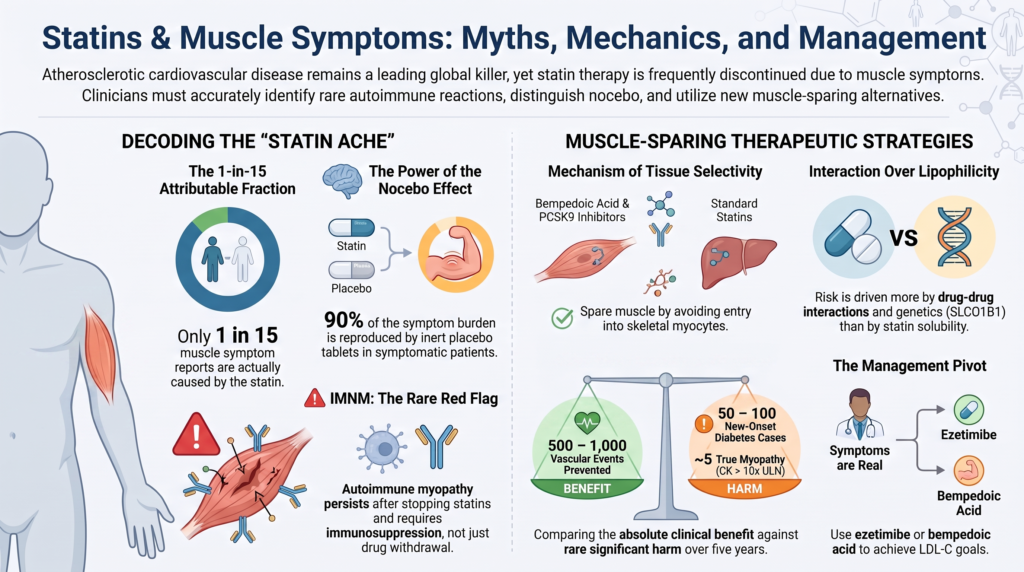
Revisione comparativa delle terapie ipolipemizzanti
Vie biologiche, dinamiche di efficacia, meccanismi cellulari di tossicità muscolare, farmacogenomica e il fenomeno nocebo
Astratto
Aterosclerotico malattia cardiovascolare rimane la principale causa di morte in tutto il mondo, e l'abbassamento della bassa densità lipoproteina colesterolo (LDL-C) è il mezzo farmacologico più solidamente validato per ridurre tale rischio. L'armamentario terapeutico si è ampliato dagli inibitori della 3-idrossi-3-metilglutaril-coenzima A (HMG-CoA) reduttasi agli inibitori dell'ATP-citrato liasi, della Niemann-Pick C1-Like 1, proproteina convertasi subtilisina/kexina di tipo 9 (PCSK9), e angiopoietin-like proteina 3, con estere del colesterolo inibitori della proteina di trasferimento, per via orale Inibitori di PCSK9, e terapie a base di acido nucleico dirette contro la lipoproteina(a) in fase di sviluppo avanzato. Nonostante l'inequivocabile beneficio cardiovascolare, la persistenza terapeutica è compromessa dagli effetti avversi riportati, in modo preponderante sintomi muscolari associati alle statine.
Questa rassegna sintetizza la farmacologia molecolare, l'efficacia comparativa e il profilo di sicurezza muscolare di ogni classe di farmaci ipolipemizzanti attualmente disponibili. Tratta gli effetti muscolari in modo ampio anziché limitarli al solo dolore, affrontando la stanchezza, la ridotta energia e capacità di esercizio come esiti con la propria base di evidenze distinta. Essa distingue quattro entità biologicamente distinte che vengono frequentemente confuse: (i) i sintomi mediati dal nocebo, che rappresentano la grande maggioranza dei disturbi muscolari attribuiti a statine — nei dati individuali dei partecipanti allo studio Cholesterol Treatment Trialists, oltre il 90% delle segnalazioni di sintomi muscolari tra i partecipanti a cui erano state somministrate statine non erano attribuibili al farmaco; (ii) mialgia farmacologica vera e propria, che colpisce una minoranza esigua ma reale; (iii) miopatia vera e propria e rabdomiolisi, che sono rari e dose-dipendenti; e (iv) miopatia necrotizzante immunomediata anti-HMGCR, una rara malattia autoimmune che persiste dopo la sospensione del farmaco e richiede immunosoppressione anziché rassicurazione. Prove dai dati dei singoli partecipanti della Cholesterol Treatment Trialists’ Collaboration meta-analisi, il SAMSON e StatinWISE studi n-di-1, il confronto in doppio cieco versus in aperto dello studio ASCOT-LLA e la nuova esposizione randomizzata dello studio GAUSS-3 sono integrati con indicazioni farmacogenomiche e un pratico algoritmo di gestione. Il messaggio clinico centrale è duplice: i clinici non devono né accettare i sintomi muscolari riferiti come prova di tossicità farmacologica, né scartarli come invariabilmente di origine psicologica.
1. Introduzione
Le malattie cardiovascolari guidate dall'aterosclerosi rimangono la principale causa di mortalità globale1La relazione tra LDL-C e il rischio aterosclerotico è causale, dose-dipendente e cumulativa nel tempo, e il beneficio clinico della riduzione delle LDL-C è proporzionale all'entità assoluta della riduzione ottenuta e alla sua durata, indipendentemente, in larga misura, dal meccanismo con cui viene raggiunta.
Tuttavia, la traduzione di queste prove in un beneficio a livello di popolazione è limitata meno dall'efficacia che dalla persistenza. Una frazione sostanziale dei pazienti a cui sono state prescritte statine le interrompe entro due anni, adducendo più comunemente sintomi muscolari. Il divario risultante tra l'efficacia dimostrata negli studi clinici e il beneficio realizzato nella pratica è una delle maggiori perdite evitabili nella cardiologia preventiva.
La risoluzione di questo problema richiede precisione su ciò che viene effettivamente osservato quando un paziente riferisce dolore muscolare durante l'assunzione di una statina. Le evidenze attuali consentono tale precisione. Questa rassegna ha pertanto tre obiettivi: descrivere la farmacologia molecolare e l'efficacia comparativa di tutti gli agenti ipolipemizzanti disponibili; definire la base biologica della tossicità muscolare e le ragioni per cui alcuni farmaci risparmiano del tutto il muscolo scheletrico; e quantificare quanta parte del carico di sintomi muscolari segnalati sia attribuibile al farmaco piuttosto che all'aspettativa, all'invecchiamento o alla coincidenza.
1.1 Una nota su terminologia e ambito
Questo articolo è un revisione narrativa con sintesi quantitativa dei dati degli studi pubblicati. Non si tratta di una metanalisi *de novo*: gli autori non hanno calcolato stime di effetto cumulate e tutte le cifre cumulate citate sono quelle riportate dai ricercatori originali o da metanalisi pubblicate, identificate come tali. Laddove le stime siano in conflitto tra le fonti, il conflitto viene dichiarato anziché risolto per preferenza.
2. Vie biologiche e meccanismi molecolari d'azione
Terapeutico ipolipemizzante si ottiene alterando la funzionalità epatica sintesi del colesterolo, assorbimento intestinale del colesterolo, epatico Riciclo del recettore delle LDL (LDLR), o al catabolismo delle lipoproteine. Queste differenze farmacodinamiche determinano non solo la potenza ma anche la distribuzione tissutale e, di conseguenza, il profilo degli effetti avversi. La distinzione che conta di più per la sicurezza muscolare è semplice: il farmaco penetra nei miociti scheletrici e, in caso affermativo, interferisce con una via metabolica richiesta dal muscolo?
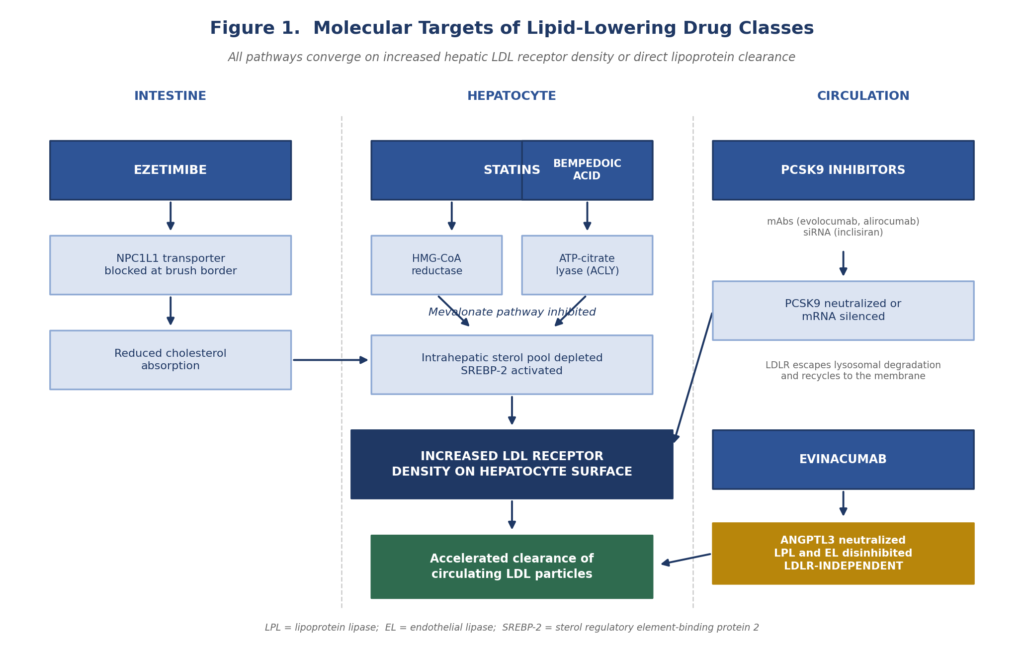
Figura 1. Bersagli molecolari delle classi di farmaci ipolipemizzanti. Statine e acido bempedoico agire su due nodi separati del fegato via del mevalonato; ezetimibe agisce sull'orletto a spazzola dell'enterocita; gli agenti diretti contro la PCSK9 agiscono nella circolazione o all'interno dell'epatocita per preservare Recettore delle LDL riciclaggio. Evinacumab è l'unico agente il cui effetto non dipende da LDL densità dei recettori, motivo per cui mantiene l'attività in quelli privi di recettori ipercolesterolemia familiare omozigote.
2.1 Inibitori della HMG-CoA reduttasi (Statine)
Le statine inibiscono competitivamente Idrossi-metilglutaril-CoA reduttasi, l'enzima limitante che converte l'HMG-CoA in mevalonato nella via biosintetica del colesterolo. La deplezione dell'intraepatico sterolo il pool attiva la proteina legante l'elemento regolatore degli steroli 2 (SREBP-2), che aumenta la trascrizione e l'espressione di superficie di LDLR sulle membrane degli epatociti, accelerando la clearance delle LDL circolanti e delle lipoproteine a bassissima densità (VLDL) particelle residue.
Tutte le statine sono a effetto epatoselettivo, principalmente a causa di un'efficiente captazione epatica di primo passaggio. Esse differiscono tuttavia nel modo in cui tale captazione viene raggiunta e nella facilità con cui raggiungono i tessuti extraepatici:
- Statine lipofile (atorvastatina, simvastatina, lovastatina, fluvastatina, pitavastatina, e il cerivastatina ritirato): possiedono una permeabilità di membrana sufficiente per la diffusione passiva attraverso le membrane cellulari, comprese quelle dei miociti scheletrici. Sono di conseguenza più suscettibili al metabolismo ossidativo da parte del sistema del citocromo P450, con la notevole eccezione della pitavastatina.
- Statine idrofilerosuvastatina, pravastatina): possiedono domini strutturali polari che limitano il passaggio passivo attraverso la membrana. L'ingresso epatico dipende principalmente dal trasporto attivo da parte del polipeptide trasportatore di anioni organici 1B1 (OATP1B1, codificato da SLCO1B1), e nessuno dei due subisce un metabolismo CYP450 sostanziale.
È importante premettere che questa distinzione chimico-fisica, sebbene reale e meccanisticamente plausibile, non si è tradotta in una differenza costantemente dimostrabile nei tassi di sintomi muscolari clinici. Di ciò si tratta direttamente nella Sezione 6.4. La pitavastatina è la dimostrazione più evidente del motivo per cui la semplice euristica lipofilo-uguale-rischioso fallisce: è una molecola lipofila, eppure, poiché non subisce quasi alcun metabolismo mediato dal CYP450, comporta uno dei rischi di miopatia mediata da interazioni più bassi tra tutte le statine.
2.2 L'elenco completo delle statine
Attualmente sono commercializzate sette statine. Un'ottava, la cerivastatina, è stata ritirata volontariamente in tutto il mondo nel 2001 a seguito di un'incidenza inaccettabile di rabdomiolisi fatale, in particolare se associata a gemfibrozil. Poiché gran parte dell'ansia storica che circonda la miotossicità da statine deriva dall'esperienza con la cerivastatina, essa è inclusa qui per contesto.
| Statina | Classe | Solubilità | Metabolismo principale | Note su trasporto / interazione | Dosi disponibili | Posizionamento pratico |
| Atorvastatina | Sintetico | Lipofilo | CYP3A4 (metaboliti attivi) | Substrato di OATP1B1; gli inibitori del CYP3A4 ne aumentano l'esposizione | 10, 20, 40, 80 mg al giorno | Agente da lavoro; permessi a lunga emivita somministrazione a giorni alterni |
| Rosuvastatina | Sintetico | Idrofilo | CYP minimo (tracce di CYP2C9) | Substrato di OATP1B1 e ABCG2 (BCRP); le varianti di ABCG2 aumentano l'esposizione | 5, 10, 20, 40 mg al giorno | Più potente per mg; lunga emivita; buona scelta dopo intolleranza |
| Simvastatina | Di origine fungina | Lipofilo | CYP3A4 (estensivo) | Più forte SLCO1B1 segnale di miopatia; molti limiti di dosaggio con farmaci interagenti | 5, 10, 20, 40 mg al giorno (80 mg limitati) | Il più alto rischio di miopatia mediato da interazioni e genotipo tra le statine in commercio; 80 mg non raccomandati |
| Pravastatina | Di origine fungina | Idrofilo | Non-CYP (solfatazione) | Substrato di OATP1B1; poche interazioni con i CYP | 10, 20, 40, 80 mg al giorno | Bassa potenza ma profilo di interazione favorevole; utile nella politerapia |
| Lovastatina | Di origine fungina | Lipofilo | CYP3A4 (estensivo) | profarmaco lattone; limiti di dose per interazioni multiple | 10, 20, 40 mg (IR); 20–60 mg (ER) | In gran parte superato; assumere con il pasto serale |
| Fluvastatina | Sintetico | Lipofilo | CYP2C9 (principale) | Evita la via del CYP3A4; i metabolizzatori lenti del CYP2C9 accumulano il farmaco | 20, 40 mg; 40 mg BID; 80 mg XL | Utile quando l'interazione del CYP3A4 è il problema; potenza minima |
| Pitavastatina | Sintetico | Lipofilo | CYP minimo; glucuronidazione | Non è un substrato del CYP3A4; ciclosporina controindicata | 1, 2, 4 mg al giorno | Basso carico di interazione; comunemente usato dopo che altre statine non sono tollerate, su basi empiriche anziché da studi comparativi |
| Cerivastatina | Sintetico | Lipofilo | CYP2C8 e CYP3A4 | Ritirato nel 2001; rabdomiolisi fatale, specialmente con gemfibrozil | Ritirato | Solo storico; fonte di molta ansia da miotossicità da statine |
Tabella 1. Caratteristiche farmacologiche di tutte le statine in commercio più la cerivastatina ritirata dal mercato. La classificazione della solubilità segue Schachter (2005) [14]; i dati sul metabolismo e sulle interazioni seguono l'etichetta del prodotto [15-21] e la linea guida CPIC 2022 [22]. IR = rilascio immediato; ER/XL = rilascio prolungato; BID = due volte al giorno.
Classificazione dell'intensità delle statine
I regimi a base di statine sono convenzionalmente classificati in base alla riduzione media di LDL-C ottenuta anziché alla sola dose. Le categorie di intensità alta, moderata e bassa sono state definite nelle linee guida sul colesterolo ACC/AHA del 2013, che hanno introdotto la tabella dell'intensità sostanzialmente nella sua forma attuale [92], e sono stati riportati nelle linee guida multisocietarie AHA/ACC del 2018 [12]; rimangono di uso generale. La linea guida del 2018 stessa è stata superata: la Linea guida ACC/AHA/Multisociety del 2026 sulla gestione di Dislipidemia, pubblicato a marzo 2026, lo ritira e lo sostituisce11], e i cambiamenti al framework che introduce sono riassunti nella Sezione 9.3. La percentuale di riduzione del C-LDL rimane una priorità dichiarata nel documento del 2026, quindi la tabella dell'intensità sottostante mantiene la sua utilità pratica, ma i lettori dovrebbero notare che ora si trova all'interno di un quadro di prescrizione basato sugli obiettivi piuttosto che puramente sull'intensità.
| Alta intensità (riduzione del colesterolo LDL ≥ 50%) | Intensità moderata (riduzione di 30–491 TP9T) | Bassa intensità (riduzione < 30%) |
| Atorvastatina 40–80 mg | Atorvastatina 10–20 mg | Simvastatina 10 mg |
| Rosuvastatina 20–40 mg | Rosuvastatina 5–10 mg | Pravastatina 10–20 mg |
| — | Simvastatina 20–40 mg | Lovastatina 20 mg |
| — | Pravastatina 40–80 mg | Fluvastatina 20–40 mg |
| — | Lovastatina 40–80 mg | Pitavastatina 1 mg |
| — | Fluvastatina 40 mg due volte al giorno o 80 mg a rilascio prolungato | — |
| — | Pitavastatina 2–4 mg | — |
Tabella 2. Classificazione dell'intensità delle statine, adattata dalla classificazione ACC/AHA introdotta nel 2013 [92] e riportato nel 2018 [12Nessuna dose di pravastatina, lovastatina, fluvastatina o pitavastatina raggiunge la classificazione ad alta intensità; solo l'atorvastatina e la rosuvastatina lo fanno. Le linee guida sulla dislipidemia del 2026 che hanno sostituito il documento del 2018 aggiungono obiettivi assoluti di LDL-C e non-HDL-C oltre alla riduzione percentuale; si veda la Sezione 9.3.
2.3 Inibitori dell'ATP-Citrato Liasi (Acido Bempedoico)
L'acido bempedoico è un profarmaco acido dicarbossilico sintetico che inibisce ATP-citrato liasi (ACLY), un enzima che agisce due passaggi a monte della HMG-CoA reduttasi nella via del mevalonato. L'ACLY scinde il citrato di derivazione mitocondriale in acetil-CoA e ossalacetato, fornendo il substrato principale per la sintesi de novo del colesterolo e degli acidi grassi.
L'attività farmacologica richiede l'esterificazione con il coenzima A per formare bempedoyl-CoA, una reazione catalizzata dall'acil-CoA sintetasi 1 a catena molto lunga (ACSVL1, codificata da SLC27A2). Nella caratterizzazione originale della molecola, ACSVL1 era altamente espressa nel fegato, rilevata solo minimamente nel rene e non rilevabile nel muscolo scheletro nelle condizioni sperimentali studiate; di conseguenza, il metaboleta tioestere attivo è stato recuperato dal fegato ma non dal muscolo scheletrico o dal tessuto adiposo [24Questa è la base meccanicistica del profilo di risparmio muscolare del farmaco, e si tratta di una vera e propria argomentazione di selettività tissutale anziché farmacocinetica.
L'acido bempedoico attiva anche la proteina chinasi attivata dall'AMP (AMPK) in sistemi preclinici, con sottoregolazione degli enzimi lipogenici. Ciò non dovrebbe essere presentato come un meccanismo umano consolidato: la revisione integrata della FDA rileva che l'attivazione dell'AMPK potrebbe essere specifica dei roditori, che la sua rilevanza nell'uomo non è chiara e che la riduzione dell'LDL-C può avvenire indipendentemente da essa [93]. Separatamente, l'acido bempedoico riduce l'alta sensibilità Proteina C-reattiva (hsCRP) di circa 19–33% nell’ambito del programma CLEAR [25A livello renale, l'acido bempedoico e il suo metabolita acil-glucuronide inibiscono competitivamente il trasportatore di anioni organici 2 (OAT2) nel tubulo prossimale. Poiché l'OAT2 media la secrezione tubulare sia dell'acido urico che della creatinina, questa inibizione produce aumenti prevedibili e reversibili dell'urato sierico e della creatinina che riflettono la competizione tra i trasportatori piuttosto che un danno parenchimale.
2.4 Inibitori di Niemann-Pick C1-Like 1 (Ezetimibe)
L'ezetimibe si localizza sul bordo a spazzola degli enterociti dell'intestino tenue e si lega al trasportatore di steroli Niemann-Pick C1-Like 1 (NPC1L1), bloccando l'endocitosi della biliare e colesterolo alimentare attraverso l'epitelio intestinale senza alterare in modo significativo l'assorbimento di trigliceridi, acidi biliari, o vitamine liposolubili. Ridotto chilomicrone colesterolo residuo La somministrazione riduce le riserve intraepatiche di steroli e aumenta l’espressione epatica dell’LDLR. L’esposizione sistemica non è trascurabile: l’ezetimibe e il suo glucuronide attivo sono facilmente rilevabili nel plasma, sono legati alle proteine per oltre il 90%, subiscono un ricircolo enteroepatico e hanno un’emivita di circa 22 ore [27Ciò che conta per la sicurezza muscolare non è l'assenza di farmaco in circolo, ma il fatto che il bersaglio farmacologico sia intestinale e che non sia stato identificato alcun bersaglio a livello del muscolo scheletrico.
2.5 Terapie dirette contro PCSK9
PCSK9 è una proteina secreta serina proteasi che si lega al dominio extracellulare dell'LDLR sulla superficie degli epatociti e dirige il recettore verso la degradazione lisosomiale anziché verso il riciclo endosomiale. Poiché ciascuna molecola di LDLR può altrimenti essere riciclata molte volte, prevenirne la degradazione aumenta sostanzialmente la densità dei recettori funzionali.
- Anticorpi monoclonali (evolocumab, alirocumab): anticorpi IgG interamente umani che si legano al PCSK9 libero circolante con elevata affinità, bloccando stericamente l'interazione PCSK9-LDLR. Agiscono prevalentemente in via extracellulare, in linea con il piccolo volume di distribuzione apparente riportato per evolocumab, e non hanno bersagli miocitari intracellulari identificati; l'etichettatura non stabilisce la totale assenza di ingresso nei miociti [29,30].
- Piccolo RNA interferente (inclisiran): un siRNA sintetico a doppio filamento coniugato a un ligando triantennario di N-acetilgalattosamina (GalNAc). Il GalNAc si lega ai recettori dell'asialoglicoproteina espressi quasi esclusivamente sugli epatociti, guidando una rapida endocitosi mediata da recettori. All'interno della cellula, l'siRNA si carica nel complesso di silenziamento indotto da RNA e guida il taglio catalitico dell'RNA messaggero di PCSK9, producendo una soppressione prolungata che consente una somministrazione bisettimanale dopo la dose di carico [31,34,35,59].
- Inibitori peptidici macrociclici orali (enlicitide): peptidi macrociclici biodisponibili per via orale che legano la PCSK9 con un'affinità simile a quella degli anticorpi, bloccando l'interazione PCSK9–LDLR con lo stesso meccanismo degli anticorpi monoclonali ma somministrati sotto forma di comparsa. Enlicitide (Lipfendra) è stato approvato dalla FDA il 16 luglio 2026 come il primo inibitore orale della PCSK9, alla dose di 20 mg una volta al giorno, ed è trattato più in dettaglio nella Sezione 10.2 [36].
2.6 Inibitori della proteina 3 simile all'angiopoietina (Evinacumab)
L'evinacumab è un anticorpo monoclonale totalmente umano diretto contro ANGPTL3, un inibitore endogeno della lipasi endoteliale e lipoproteina lipasi. La neutralizzazione di ANGPTL3 deinibisce entrambe le lipasi, accelerando la clearance degli intermedi di processamento delle VLDL e promuovendo la degradazione intravascolare diretta delle lipoproteine a densità intermedia e delle particelle di LDL. Fondamentalmente, questa via non richiede recettori LDLR funzionali, il che rende l'evinacumab efficace nei casi omozigoti ipercolesterolemia familiare (HoFH), compresi i pazienti con mutazioni null/null del LDLR che rispondono poco o per nulla alle statine e agli inibitori di PCSK9 [13,37]. È più accurato descrivere l'evinacumab come prevalentemente anziché puramente indipendente da LDLR. La dimostrazione di efficacia in pazienti null/null stabilisce che esiste una via indipendente da LDLR ed è sufficiente di per sé; essa non stabilisce che la clearance mediata da LDLR non contribuisca affatto nei pazienti che mantengono una funzione recettoriale parziale, e una certa biologia residua del recettore potrebbe benissimo contribuire alla risposta in quel gruppo più ampio [43].
2.7 Inibizione della proteina di trasferimento degli esteri del colesterolo (Obicetrapib, in fase di sperimentazione)
CETP media il trasferimento di esteri del colesterolo da HDL a apolipoproteina lipoproteine contenenti B in cambio di trigliceridi. L'obicetrapib è un inibitore di CETP orale, a basso dosaggio e di nuova generazione che riduce il colesterolo LDL, l'apolipoproteina B e lipoproteina(a) aumentando al contempo il livello di HDL-C. In precedenza Inibitori della CETP hanno fallito a causa di tossicità fuori bersaglio (torcetrapib) o di efficacia insufficiente (dalcetrapib, evacetrapib), pertanto questa classe di farmaci è oggetto di una giustificata cautela storica in attesa dei dati sugli esiti cardiovascolari [38].
3. Efficacia farmacodinamica nella monoterapia e nei regimi terapeutici combinati
La monoterapia con statine presenta un andamento non lineare dose-risposta curva regolata dalla cosiddetta “regola del sei”: ogni raddoppio della dose comporta solo una riduzione aggiuntiva di circa 6% del colesterolo LDL. Questa attenuazione si verifica perché l’esaurimento intracellulare degli steroli innesca una sovraregolazione compensatoria dell’assorbimento intestinale del colesterolo tramite NPC1L1 e un aumento della PCSK9 circolante. L’implicazione clinica è che l’aumento progressivo della dose rappresenta una strategia inefficiente rispetto alla combinazione di vie metaboliche.
3.1 Strategie di combinazione razionali
- Doppio blocco della sintesi (acido bempedoico più statina): L'inibizione della via del mevalonato in due punti enzimatici impedisce l'accumulo dei precursori a monte e determina riduzioni additive del pool di steroli intraepatici.
- Sintesi più inibizione dell'assorbimento (statina o acido bempedoico più ezetimibe): attenua l'aumento compensatorio dell'assorbimento intestinale del colesterolo indotto dall'inibizione della sintesi. Si tratta della combinazione più conveniente attualmente disponibile.
- Terapia combinata con blocco della clearance (statina più inibitore della PCSK9): statine ad alta intensità aumentano l'espressione del recettore LDL (LDLR), ma provocano anche un aumento della PCSK9 circolante. L'aggiunta di un anticorpo monoclonale anti-PCSK9 o di inclisiran neutralizza questo aumento contro-regolatorio, determinando le riduzioni più significative ottenibili con la terapia attuale.
3.2 Efficacia comparativa
I dati riportati di seguito rappresentano le riduzioni del colesterolo LDL (LDL-C) corrette rispetto al placebo o al valore basale, ricavate dagli studi clinici principali di registrazione. Occorre tenere presenti due avvertenze. Innanzitutto, le percentuali relative alle terapie combinate sono espresse rispetto a un valore basale non trattato e non sono quindi sommabili con quelle relative alle monoterapie. In secondo luogo, la riduzione percentuale è un indicatore surrogato; solo i farmaci per i quali sono stati completati studi sugli esiti cardiovascolari hanno dimostrato una riduzione degli eventi, come indicato esplicitamente nell’ultima colonna.
| Regime terapeutico | Dosaggio standard | Riduzione media del colesterolo LDL | Popolazione primaria | Dati relativi agli esiti |
| Statina con idrofilia bassa/moderata | Pravastatina 20–40 mg al giorno | 20–35% | Prevenzione primaria; politerapia | Sì (WOSCOPS, LIPID, CARE) |
| Statina idrofila ad alta intensità | Rosuvastatina 20–40 mg al giorno | 45–55% | Prevenzione primaria per soggetti ad alto rischio (la Giove popolazione); utilizzato anche in caso di elevato rischio di ASCVD | Sì (JUPITER, uno studio di prevenzione primaria condotto su adulti apparentemente sani) |
| Statina a lipofilia bassa/moderata | Atorvastatina 10–20 mg al giorno | 30–40% | Dislipidemia di base | Sì (ASCOT-LLA, CARDS) |
| Statina lipofila ad alta intensità | Atorvastatina 40–80 mg al giorno | 50–60% | ACS; gestione post-infarto miocardico | Sì (PROVE-IT, TNT) |
| Monoterapia con inibitore di NPC1L1 | Ezetimibe 10 mg al giorno | 15–20% | Agente coadiuvante in caso di intolleranza alle statine | Adgiuntivo (IMPROVE-IT) |
| Statina più ezetimibe | Statina ad alta intensità + ezetimibe 10 mg | ≈ 60–65% | ASCVD in stadio avanzato in cui la sola terapia con statine non è efficace | Sì (IMPROVE-IT) |
| Monoterapia con inibitori dell'ACL | Acido bempedoico 180 mg al giorno | ≈ 18% in trattamento con statine; ≈ 21–25% in monoterapia | Intolleranza alle statine | Sì (Risultati CLEAR, 2023) |
| Inibitore dell'ACL più ezetimibe | Acido bempedoico 180 mg + ezetimibe 10 mg | 38–40% | Intolleranza alle statine che richiede una forte riduzione dei livelli | Prove relative ai componenti |
| Monoterapia con anticorpo monoclonale anti-PCSK9 | Evolocumab 140 mg ogni due settimane oppure 420 mg al mese | 50–60% | Ipercolesterolemia grave; intolleranza alle statine | LDL-C solo in monoterapia. Fourier e Odissea I RISULTATI hanno dimostrato una riduzione degli eventi con l'aggiunta dell'anticorpo alla terapia di base a base di statine o alla terapia con statine alla dose massima tollerata, ma non in monoterapia |
| Anticorpo monoclonale anti-PCSK9 associato a una statina ad alta intensità | Evolocumab + atorvastatina 80 mg | ≈ 70–80% rispetto al valore basale non trattato | ASCVD ad altissimo rischio; HeFH | Sì (FOURIER) |
| siRNA contro la PCSK9 | Inclisiran 284 mg il giorno 0, al terzo mese, poi ogni 6 mesi | 48–52% | Pazienti con aderenza terapeutica limitata | In sospeso (ORION-4, VICTORION-2P) |
| Inibitore dell'ANGPTL3 | Evinacumab 15 mg/kg per via endovenosa una volta al mese | ≈ 47–49% | FH omozigote, compresa la mutazione LDLR-null | Solo per conto terzi |
| Inibitore della CETP (in fase di sperimentazione) | Obicetrapib 10 mg al giorno | ≈ 33–37% in aggiunta alla terapia di base | ASCVD/HeFH: obiettivi non raggiunti | In sospeso (PREVAIL) |
| Inibitore orale della PCSK9 | Enlicitide (Lipfendra) 20 mg una volta al giorno | ≈ 56–591 TP9T, con aggiustamento rispetto al placebo a 24 settimane | Ipercolesterolemia compresa l'HeFH; alternativa orale ai farmaci iniettabili | Solo LDL-C; risultati in attesa di conferma (CORALreef Outcomes) |
Tabella 3. Efficacia comparativa nella riduzione del colesterolo LDL. Q2W = ogni due settimane; Q6M = ogni sei mesi; ACS = sindrome coronarica acuta; HeFH = ipercolesterolemia familiare eterozigote. L’obicetrapib è ancora in fase di sperimentazione e non è approvato per l’uso descritto. L’enlicitide è stato approvato nel luglio 2026 esclusivamente sulla base della sua capacità di abbassare il colesterolo LDL; poiché lo studio sugli esiti cardiovascolari è ancora in corso, la riga relativa a questo farmaco va interpretata come evidenza surrogata, nonostante il farmaco sia già in commercio. Fonti degli studi sugli esiti per l’ultima colonna: JUPITER [39]; IMPROVE-IT [28]; Risultati CLEAR [40]; FOURIER [32]; RISULTATI DI ODYSSEY [33]; il ORION programma [34,35,59]; CORALreef [44-46]; BROADWAY [38]; evinacumab [13,43].
3.3 Dati provenienti dall'imaging dell'aterosclerosi
La riduzione percentuale del colesterolo LDL è un indicatore surrogato di un altro indicatore surrogato. Seriale ecografia intravascolare (IVUS) fornisce un endpoint anatomico intermedio che collega la riduzione dei lipidi al processo patologico stesso, e gli studi di imaging sono utili in questo contesto per un motivo specifico: dimostrano che regressione della placca I percorsi hanno consentito di raggiungere livelli di colesterolo LDL indipendentemente, in larga misura, dal meccanismo utilizzato per ottenerli.
- Saturno (NEJM 2011). 1.385 pazienti affetti da malattia coronarica sono stati randomizzati al trattamento con 40 mg di rosuvastatina o 80 mg di atorvastatina per 104 settimane. Volume percentuale dell'ateroma è sceso a 0,991 TP9T con l’atorvastatina e a 1,221 TP9T con la rosuvastatina (P = 0,17, non significativo); totale ateroma il volume è diminuito in misura maggiore con la rosuvastatina (−6,39 vs −4,42 mm³, P = 0,01). Si è osservata una regressione nella maggior parte dei pazienti in entrambi i bracci (63,2% e 68,5%). Al di là dei dati sull’efficacia, lo studio SATURN rappresenta un confronto diretto tra una statina lipofila e una idrofila alla dose massima ed è citato nuovamente nella Sezione 6.4 [47].
- PRECISE-IVUS (JACC 2015). 246 pazienti giapponesi affetti da malattia coronarica sono stati randomizzati al trattamento con atorvastatina in monoterapia o con atorvastatina più ezetimibe 10 mg, con titolazione del dosaggio fino al raggiungimento di un valore target di LDL-C inferiore a 70 mg/dL; in 202 di essi è stata eseguita una IVUS di controllo a 9–12 mesi. Il valore di LDL-C raggiunto è stato di 73,3 mg/dL con la monoterapia rispetto a 63,2 mg/dL con la terapia combinata (P < 0,001), e la terapia combinata ha prodotto una regressione significativamente maggiore della percentuale di volume ateromatoso con tassi di eventi avversi comparabili. Ciò conferma il principio secondo cui la riduzione del colesterolo LDL ottenuta senza statine produce un beneficio anatomico e non è solo un effetto di laboratorio [10].
- GLAGOV (JAMA 2016). 968 pazienti con malattia coronarica angiografica in terapia con statine, randomizzati al trattamento con evolocumab 420 mg al mese oppure placebo per 76 settimane. Il livello di LDL-C era pari a 36,6 mg/dL nel gruppo trattato con evolocumab rispetto a 93,0 mg/dL nel gruppo trattato con placebo. Il volume percentuale dell’ateroma è diminuito di 1,01% rispetto al placebo (IC 95% da −1,38 a −0,64; P < 0,0001), e si è osservata una regressione nel 64,3% dei pazienti rispetto al 47,3%. In un sottogruppo esplorativo che ha raggiunto un valore medio di LDL-C pari a 24 mg/dL, l’81,2% ha mostrato una regressione. Lo studio GLAGOV costituisce la prova principale del fatto che il beneficio continua ad accumularsi a livelli di LDL-C ben al di sotto degli obiettivi convenzionali, senza che sia stata osservata una soglia al di sotto della quale un’ulteriore riduzione smettesse di essere utile [9].
Occorre tenere presenti due avvertenze. Si tratta di endpoint anatomici surrogati, non di eventi clinici, e nessuno di questi studi era stato progettato per valutare gli esiti clinici. Inoltre, le popolazioni sono state selezionate in modo specifico: si trattava di pazienti sottoposti ad angiografia clinicamente indicata, piuttosto che di coorti di prevenzione primaria. Il loro valore risiede nel dimostrare la coerenza biologica tra la riduzione del colesterolo LDL e la modificazione della malattia attraverso tre diversi meccanismi d’azione farmacologica, non nel dimostrare la riduzione degli eventi, che si basa sugli studi sugli esiti citati nella Tabella 3.
4. Meccanismi cellulari della tossicità muscolare
La tossicità a carico dei muscoli scheletrici causata dalla terapia ipolipemizzante varia da un lieve disagio soggettivo a una degradazione muscolare potenzialmente letale. La suscettibilità dipende dal fatto che il farmaco si accumuli nei miociti e che alteri una via metabolica da cui dipende il muscolo.
4.1 Meccanismi ipotizzati alla base della miotossicità delle statine
Vengono proposti tre meccanismi. Essi sono qui presentati in ordine decrescente di supporto probatorio, e va precisato chiaramente che nessuno di essi è stato definitivamente accertato come causa della mialgia comune nell'uomo.
Esaurimento degli isoprenoidi e compromissione della prenilazione delle proteine
A valle dell’HMG-CoA reduttasi, la via del mevalonato genera gli isoprenoidi non sterolici farnesil pirofosfato (FPP) e geranilgeranil pirofosfato (GGPP). Questi sono necessari per la prenilazione post-traduzionale delle piccole GTPasi, tra cui Ras, Rho e Rac. La perdita della prenilazione compromette l’ancoraggio alla membrana, la trasduzione del segnale e il mantenimento del citoscheletro e può innescare l’apoptosi nei miociti. Questo meccanismo gode del più solido supporto sperimentale, poiché l’integrazione con mevalonato o GGPP inverte la miotossicità indotta dalle statine in coltura cellulare, mentre l’integrazione con colesterolo non lo fa [48,49].
Disfunzione mitocondriale e riduzione dei livelli di coenzima Q10
La via del mevalonato produce anche l'ubichinone (coenzima Q10), un vettore di elettroni nella catena di trasporto degli elettroni mitocondriale. Le statine riducono i livelli circolanti di CoQ10 e si ipotizza che la sua deplezione intramiocellulare comprometta l'attività del complesso I e del complesso IV, riducendo la produzione di ATP e aumentando specie reattive dell'ossigeno produzione.
Questa ipotesi va presentata con esplicita cautela. Sebbene i dati biochimici siano coerenti, le evidenze cliniche relative al fatto che la carenza di CoQ10 causi sintomi, o che la sua integrazione li allevi, sono in diretto contrasto tra loro. Una meta-analisi di dodici studi randomizzati condotti su 575 pazienti ha riportato un miglioramento significativo del dolore muscolare, della debolezza, dei crampi e della stanchezza grazie alla supplementazione [51], mentre una precedente meta-analisi di sei studi clinici condotti su 302 pazienti e un’analisi successiva di otto studi clinici condotti su 472 pazienti non hanno evidenziato alcun beneficio significativo [52]; revisioni sistematiche pubblicati fino al 2025 rimangono contrastanti. Diverse caratteristiche degli studi con esiti positivi ne riducono l’affidabilità: le dimensioni dei campioni sono ridotte, le definizioni dei sintomi muscolari sono eterogenee tra i vari studi e tutti gli endpoint primari sono soggettivi e quindi particolarmente vulnerabili alla risposta al placebo, che, come dimostra la stessa letteratura, è significativa.
Un problema più fondamentale è che la catena causale si interrompe già al primo anello. È vero che i livelli plasmatici di CoQ10 diminuiscono in modo affidabile durante la terapia con statine, ma una parte sostanziale di tale diminuzione è un artefatto dell’effetto previsto del farmaco: la CoQ10 viene trasportata dalle lipoproteine, quindi la riduzione numero di particelle LDL riduce meccanicamente i livelli plasmatici misurati di CoQ10 senza necessariamente esaurirne le riserve nei tessuti. Ciò che conta per il muscolo è la CoQ10 intramuscolare, e in questo caso le misurazioni dirette sono in gran parte rassicuranti. Lo studio LIFESTAT ha prelevato biopsie muscolari da 64 pazienti trattati con simvastatina (25 con mialgia, 39 senza) e da 20 soggetti di controllo non trattati, e ha rilevato che, sebbene la terapia con statine compromettesse la respirazione mitocondriale legata al complesso II, le concentrazioni intramuscolari di CoQ10 rimanevano inalterate e la mialgia non era associata a una riduzione della CoQ10 muscolare [53]. Uno studio randomizzato in doppio cieco, condotto con una dose giornaliera di 400 mg di CoQ10 per otto settimane, ha successivamente rilevato che l’integrazione non ha aumentato i livelli di CoQ10 nei muscoli, non ha migliorato la capacità respiratoria mitocondriale e che le variazioni individuali dei livelli di CoQ10 nei muscoli non erano correlate alle variazioni dell’intensità della mialgia [54]. I risultati non sono uniformi — uno studio clinico condotto con simvastatina 80 mg ha riportato una diminuzione del 34% del CoQ10 muscolare — ma la maggior parte degli studi basati su biopsie non è riuscita a dimostrare una riduzione clinicamente significativa del CoQ10 muscolare, e il peso delle prove tissutali dirette non supporta quindi l’esaurimento come meccanismo consolidato della mialgia da statine comune.
La conclusione pratica è limitata e va formulata con cautela, poiché può essere facilmente fraintesa. In alcuni studi sono state dimostrate alterazioni mitocondriali misurabili nei muscoli esposti alle statine, mentre in altri no; le prove a riguardo sono discusse più approfonditamente nella Sezione 4.3. Ciò che non è stato stabilito è che la deplezione di CoQ10 ne sia la causa, né che la CoQ10 per via orale la corregga. L’integrazione è economica e sicura e può essere ragionevolmente proposta in modo empirico, ma non dovrebbe essere descritta ai pazienti come una terapia consolidata, e la mancata miglioramento di un paziente con il CoQ10 non dovrebbe essere interpretata come prova che i suoi sintomi fossero immaginari. Sono ancora necessari ulteriori studi clinici con adeguata potenza statistica e endpoint oggettivi; la letteratura esistente è dominata da studi di piccole dimensioni con esiti soggettivi, che rappresentano proprio il disegno più vulnerabile alla risposta al placebo.
Perdita di calcio dal reticolo sarcoplasmatico
Le specie reattive dell'ossigeno mitocondriali e l'esaurimento dell'energia cellulare possono destabilizzare i canali del recettore della rianodina di tipo 1 (RyR1) del reticolo sarcoplasmatico. L'efflusso incontrollato di calcio nel citoplasma attiva le calpaine e le caspasi, provocando la degradazione delle miofibrille e infiammazione. Le prove a sostegno di questo meccanismo sono in gran parte di natura preclinica [50].
4.2 Perché i farmaci non a base di statine non danneggiano il muscolo scheletrico
- Acido bempedoico: richiede l’ACSVL1 per l’attivazione del profarmaco. L’ACSVL1 non è rilevabile nel muscolo scheletrico umano secondo gli studi di espressione pubblicati; pertanto, non si prevede la formazione del tioestere attivo nei miociti e si ipotizza che la sintesi del mevalonato muscolare, i pool di isoprenoidi e la funzione mitocondriale rimangano inalterati. Tale previsione si basa sui dati di espressione tissutale e sull’assenza di un segnale clinico a carico del muscolo, piuttosto che su una misurazione diretta di queste vie a valle nel muscolo umano. Questa previsione meccanicistica è stata confermata clinicamente: nello studio CLEAR Outcomes, che ha coinvolto 13.970 pazienti intolleranti alle statine, la mialgia non è risultata aumentata rispetto al placebo [40].
- Anticorpi monoclonali anti-PCSK9 e inclisiran: agiscono a livello extracellulare oppure vengono convogliati verso gli epatociti tramite l’assorbimento da parte del recettore della GalNAc-asialoglicoproteina. Non si prevede che nessuno dei due raggiunga un coinvolgimento intracellulare clinicamente rilevante nei miociti scheletrici né che alteri le vie metaboliche intracellulari in tali cellule. Lo stesso ragionamento vale per l’enlicitide, il cui bersaglio è anch’esso la proteina circolante.
- Ezetimibe: agisce a livello del bordo a spazzola degli enterociti. L’ezetimibe e il suo glucuronide circolano e sono soggetti a ricircolo enteroepatico, quindi la questione non riguarda un’esposizione trascurabile, bensì il fatto che non sia stato identificato alcun bersaglio a livello dei muscoli scheletrici.
- Evinacumab: agisce su una proteina bersaglio circolante all’interno del compartimento vascolare; non è stato identificato alcun bersaglio intracellulare nel muscolo scheletrico.
4.3 Affaticamento, calo di energia e capacità di sforzo
Il dibattito sugli effetti delle statine sui muscoli è dominato dal tema del dolore. Ciò è in parte dovuto al modo in cui sono stati definiti gli esiti: il modello standard SAMS si concentra su mialgia, crampi e dolorabilità, e gli studi che prendono in considerazione i “sintomi muscolari” spesso rilevano bene l’indolenzimento ma male l’affaticamento. Eppure, nella pratica clinica, un numero considerevole di pazienti descrive qualcosa di diverso: non tanto che le gambe facciano male, quanto piuttosto che si sentano privi di energia, che uno sforzo normale richieda uno sforzo maggiore rispetto al passato, o che l’allenamento non produca più la risposta di un tempo. Questi disturbi meritano un trattamento a sé stante, poiché le prove a loro sostegno sono diverse da quelle relative all’indolenzimento e, sotto certi aspetti, più solide.
Dati scientifici provenienti da studi randomizzati su energia e affaticamento
La prova più diretta proviene dallo studio sulle statine dell’UCSD, riportato da Golomb e colleghi nel Archivi di Medicina Interna nel 2012. Si trattava di uno studio randomizzato, in doppio cieco, controllato con placebo, condotto su 1.016 adulti senza malattie cardiovascolari o diabete, con livelli di colesterolo LDL compresi tra 115 e 190 mg/dL, sono stati assegnati a un trattamento con simvastatina 20 mg, pravastatina 40 mg o placebo per sei mesi. I partecipanti hanno valutato la variazione rispetto al basale dei livelli di energia e di affaticamento da sforzo.
Entrambe le statine hanno prodotto effetti avversi significativi sul livello di energia e sull’affaticamento da sforzo rispetto al placebo, e l’effetto è risultato più pronunciato nelle donne rispetto agli uomini. Si è trattato, per quanto a conoscenza dei ricercatori, della prima evidenza randomizzata relativa a un esito che in precedenza si basava esclusivamente sulle segnalazioni dei pazienti e su dati osservazionali. Due caratteristiche rendono questo risultato particolarmente rilevante in questo contesto. In primo luogo, l’effetto è emerso sia con la pravastatina, una statina idrofila, sia con la simvastatina — un’ulteriore prova a sfavore di una semplice gerarchia basata sulla lipofilia. In secondo luogo, le dosi erano moderate piuttosto che elevate, quindi non si tratta esclusivamente di un fenomeno legato all’alta intensità [60].
La discrepanza tra energia soggettiva e prestazione oggettiva
A ciò si contrappone una serie di prove che indicano che le prestazioni muscolari oggettive rimangono in gran parte intatte. Il Studio STOMP ha assegnato in modo casuale 420 adulti sani, che non avevano mai assunto statine, al trattamento con 80 mg di atorvastatina o al placebo per sei mesi, con misurazione formale della forza di presa, della forza del gomito e del ginocchio, della resistenza degli estensori del ginocchio e della forza massima esercizio aerobico capacità. L’atorvastatina ad alto dosaggio non ha determinato una riduzione significativa della forza muscolare media né delle prestazioni fisiche. Ha invece aumentato l’incidenza di mialgia (19 contro 10 soggetti, P = 0,05) e ha determinato un aumento della creatina chinasi media di 20,8 U/L (P < 0,0001), con un aumento della CK rispetto al valore basale nel 64,9% dei soggetti trattati con atorvastatina contro il 40,1% di quelli trattati con placebo. Nessun valore individuale della CK ha superato di dieci volte il valore normale [61,62].
STOMP stabilisce quindi contemporaneamente tre aspetti che possono facilmente essere confusi. Le statine provocano un lieve aumento dei sintomi muscolari. Le statine producono prove biochimiche misurabili di un lieve danno muscolare anche in soggetti asintomatici. E le statine, in media, non rendono le persone sane misurabilmente più deboli o meno capaci di fare esercizio fisico. Un paziente può riferire accuratamente di sentirsi peggio pur mantenendo oggettivamente le stesse prestazioni.
Un’osservazione correlata proviene da uno studio fisiologico condotto su volontari maschi anziani, che ha rilevato che la mialgia da statine non era associata a una riduzione della forza muscolare, della massa muscolare o del ricambio proteico, ma era associata a un rallentamento del tempo necessario per raggiungere la potenza massima. Ciò suggerisce che, laddove la funzionalità risulti compromessa, il deficit possa risiedere nella velocità con cui si sviluppa la potenza piuttosto che nella forza massima — una distinzione che i test di forza convenzionali non riuscirebbero a cogliere e che i pazienti potrebbero percepire come pesantezza o lentezza piuttosto che come debolezza [63].
Adattamento all'allenamento fisico e capacità mitocondriale
Un altro interrogativo è se le statine attenuino la risposta adattativa all’allenamento piuttosto che le prestazioni di base. Mikus e colleghi hanno sottoposto a randomizzazione 37 adulti sedentari in sovrappeso o obesi con sindrome metabolica fattori di rischio a 12 settimane di allenamento aerobico da solo oppure di allenamento aerobico associato a simvastatina 40 mg al giorno. Idoneità cardiorespiratoria è aumentata di 10% con il solo esercizio fisico, ma solo di 1,5% con l'esercizio fisico associato alla simvastatina (P < 0,005 per l'interazione gruppo-tempo). L’attività della citrato sintasi del muscolo scheletrico, un marcatore del contenuto mitocondriale misurato nelle biopsie del vasto laterale, è aumentata di 13% con il solo esercizio fisico, ma è diminuita di 4,5% nel gruppo trattato con statine (P < 0,05 per l’interazione) [55].
Questo risultato va interpretato con cautela. Il campione era di piccole dimensioni, la popolazione era sedentaria e presentava disturbi metabolici piuttosto che essere abitualmente attiva, e il farmaco in esame era la simvastatina. Uno studio successivo sugli adattamenti all’allenamento fisico in pazienti affetti da sindrome metabolica in terapia cronica con statine non ha riprodotto lo stesso grado di compromissione [57]. Il risultato è tuttavia biologicamente coerente con le misurazioni mitocondriali dirette: uno studio del 2024 ha riportato che dosi elevate di atorvastatina hanno progressivamente ridotto la capacità respiratoria mitocondriale del muscolo scheletrico negli esseri umani, ed esistono prove che le forme di lattone delle statine inibiscano il complesso III della catena respiratoria, con una ridotta attività del complesso III osservata nelle biopsie muscolari di pazienti affetti da miopatia indotta da statine [56,64].
Gli studi randomizzati esistenti hanno coinvolto prevalentemente soggetti sedentari o che praticano attività fisica a livello ricreativo, piuttosto che atleti di élite di resistenza. Non è ancora chiaro se anche effetti mitocondriali minimi assumano rilevanza clinica a livelli di prestazione atletica di élite. Questa precisazione merita di essere sottolineata piuttosto che relegata a una nota a piè di pagina: un effetto troppo piccolo per essere rilevato in un test di forza in laboratorio su una coorte sedentaria non è necessariamente troppo piccolo per essere rilevante per chi opera al limite della propria capacità aerobica, dove i margini che determinano la prestazione sono molto più ristretti rispetto a quelli che determinano la significatività statistica. L’assenza di danni dimostrati negli atleti allenati riflette la mancanza di studi con adeguata potenza statistica in quella popolazione, non una prova di assenza.
Non è ancora chiaro se questi risultati siano applicabili anche agli atleti di resistenza allenati, poiché studi successivi hanno riportato un livello di compromissione inferiore e poiché le popolazioni studiate finora erano sedentarie e con problemi metabolici, piuttosto che abitualmente attive. Gli individui allenati presentano valori basali diversi densità mitocondriale, lo stimolo di allenamento e la riserva adattativa; inoltre, nessuno studio con una potenza statistica adeguata ha esaminato gli effetti delle statine sull'adattamento all'allenamento in questo gruppo. Il risultato di Mikus dovrebbe quindi essere citato come un segnale che giustifica ulteriori studi piuttosto che come un effetto consolidato negli atleti.
In sintesi, le prove suggeriscono che le statine abbiano effetti misurabili sulla funzione mitocondriale del muscolo scheletrico, che tali effetti siano stati osservati a livello tissutale e dell’intero organismo in alcuni studi ma non in altri, e che non sembrino essere spiegati dalla deplezione di CoQ10. Per la maggior parte dei pazienti questi cambiamenti sono subclinici. Per una minoranza, e forse in misura sproporzionata per coloro che si allenano ad alta intensità o sono già vicini al proprio limite funzionale, potrebbero essere percepibili.
| Studio | Design | Esito misurato | Scoprimento |
| Golomb et al., Arch Intern Med 2012 | Studio randomizzato controllato (RCT), n = 1.016; simvastatina 20 mg vs pravastatina 40 mg vs placebo, 6 mesi | Autovalutazione dell’energia e della fatica durante lo sforzo fisico | Effetto avverso significativo in entrambi i casi con entrambe le statine; più marcato nelle donne |
| STOMP (Parker et al., Circulation 2013) | Studio randomizzato controllato (RCT), n = 420 soggetti sani che non avevano mai assunto statine; atorvastatina 80 mg vs placebo, 6 mesi | Forza, resistenza, capacità aerobica massima, CK | Nessuna diminuzione della forza o della capacità di esercizio; mialgia 19 contro 10 (P = 0,05); CK media +20,8 U/L (P < 0,0001) |
| Mallinson et al., J Physiol 2015 | Studio fisiologico, volontari maschi anziani | Forza, massa, ricambio proteico, potenza sviluppata | Nessuna riduzione della forza, della massa o del ricambio proteico; rallentamento del tempo necessario per raggiungere la potenza massima |
| Mikus et al., JACC 2013 | RCT, n = 37; 12 settimane di allenamento vs allenamento più simvastatina 40 mg | Capacità cardiorespiratoria; citrato sintasi muscolare | Fitness +10% vs +1,5%; citrato sintasi +13% vs −4,5% (entrambe le interazioni sono significative) |
| LIFESTAT (Dohlmann et al., JCEM 2019) | Studio sulla biopsia muscolare; 64 pazienti in terapia con statine (25 affetti da mialgia), 20 soggetti di controllo | CoQ10 per via intramuscolare; respirazione mitocondriale | Compromissione della respirazione legata al Complesso II; livelli di CoQ10 nei muscoli invariati; mialgia non correlata ai livelli di CoQ10 nei muscoli |
| Kuhlman et al., Antioxidants 2022 | Studio clinico randomizzato in doppio cieco, n = 37; CoQ10 400 mg vs placebo, 8 settimane | CoQ10 muscolare; funzione mitocondriale; mialgia | Nessun aumento dei livelli di CoQ10 nei muscoli; nessun miglioramento della funzione mitocondriale; nessuna correlazione con la mialgia |
| Ryan et al., JCI Insight 2024 | Studio clinico sull'atorvastatina ad alto dosaggio | Capacità respiratoria mitocondriale del muscolo scheletrico | Diminuzione progressiva della capacità respiratoria; si ipotizza un’inibizione del complesso III |
Tabella 4. Dati relativi agli effetti delle statine su energia, affaticamento e capacità di esercizio, da distinguere dal dolore muscolare. Si noti la ricorrente dissociazione: l’energia soggettiva e l’affaticamento risultano influenzati, mentre la forza massima oggettiva rimane in gran parte inalterata e i parametri mitocondriali risultano alterati senza che ciò comporti una riduzione dei livelli di CoQ10.
Implicazioni cliniche
- Chiedete informazioni sull’energia, non solo sul dolore. Un paziente che nega di avvertire indolenzimento muscolare potrebbe comunque risentire degli effetti di un farmaco. Le domande di screening dovrebbero riguardare l’affaticamento da sforzo, la ridotta tolleranza all’esercizio fisico e la mancanza di risposta all’allenamento.
- Non confondere la stanchezza soggettiva con la debolezza oggettiva. Questa distinzione è una questione di sicurezza, non di semantica. Una sensazione soggettiva di bassa energia con potenza e CK normali è un problema di tollerabilità. Una debolezza prossimale oggettiva — difficoltà ad alzarsi da una sedia o a salire le scale — in particolare in presenza di CK marcatamente elevata, è un segnale d’allarme per una miopatia necrotizzante immuno-mediata e deve essere indagata come descritto nella Sezione 5.2.
- Prima di escludere una classe di farmaci, occorre valutare la dose e il principio attivo. Il segnale di affaticamento nei dati randomizzati è emerso a dosi moderate di due diverse statine, pertanto il semplice cambio di farmaco potrebbe non risolvere il problema; la riduzione della dose, la somministrazione intermittente o l’uso di un farmaco non statinico che non provochi effetti collaterali a carico dei muscoli sono tutte opzioni ragionevoli da prendere in considerazione.
- Fornite ai pazienti che intraprendono nuovi programmi di esercizio fisico consigli realistici. I dati relativi all'adattamento all'allenamento sono limitati e in parte contraddittori, e non dovrebbero essere utilizzati per scoraggiare l'attività fisica, che rimane comunque estremamente benefica. Tuttavia, giustificano il fatto di prendere sul serio un paziente che riferisce che l'allenamento ha smesso di produrre risultati.
- Anche in questo caso vale la precauzione relativa all'effetto nocebo. Nessuna delle prove relative all’affaticamento esenta questi sintomi dal problema di attribuzione descritto nella Sezione 7. L’energia e l’affaticamento sono endpoint soggettivi e non sono stati valutati negli studi “n-of-1”; pertanto, la percentuale di affaticamento associato alle statine segnalata come mediata dall’effetto nocebo non è stata quantificata. Si tratta di una vera e propria lacuna nella letteratura.
5. Lo spettro delle patologie muscolari associate alle statine
L’errore clinico di gran lunga più grave in questo campo consiste nel considerare i “sintomi muscolari da statine” come un’unica entità. Si tratta di quattro fenomeni biologicamente distinti, caratterizzati da frequenze diverse, meccanismi diversi e una gestione radicalmente diversa, in cui la miopatia vera e propria e la rabdomiolisi rappresentano due punti su un unico continuum dose-dipendente e sono riportate come righe separate nella Tabella 5. Tre di questi sono benigni o reversibili; uno è una grave malattia autoimmune.
| Entità | Definizione | Frequenza approssimativa | Comportamento in caso di sospensione della statina | Gestione |
| Sintomi mediati dall'effetto nocebo | Sintomi muscolari attribuibili all’aspettativa e all’atto stesso di assumere una compressa, non al farmaco | La grande maggioranza dei sintomi segnalati: oltre il 90% delle segnalazioni di sintomi muscolari associati alle statine non era attribuibile al farmaco (CTT 2022). Il rapporto nocebo di SAMSON, pari a 0,90, è una grandezza diversa — cfr. Sezione 7 | Si risolvono, ma si ripresentano con la stessa frequenza del placebo | Reesposizione alla statina in cieco o strutturata; spiegazione; ripresa della terapia con statine |
| Mialgia farmacologica (SAMS) | Dolore muscolare prossimale simmetrico, rigidità o crampi con CK inferiore a 4 volte il limite superiore della norma (ULN) | Aumento di circa 1% rispetto al placebo nel primo anno | Si risolve nel giro di pochi giorni o settimane; riproducibile in caso di nuova esposizione | Riduzione della dose, cambio di statina, somministrazione a giorni alterni o farmaco non a base di statine |
| Miopatia vera e propria | Dolore o debolezza muscolare con CK superiore a 10 volte il limite superiore della norma (ULN) | ≈ 5 su 10.000 pazienti trattati nell’arco di cinque anni (0,051 TP9T) secondo la stima del CTT; ≈ 5 su 100.000 anni-persona nella farmacoepidemiologia. Cifre più elevate, comprese tra 0,1 e 0,51 TP9T, compaiono in revisioni più datate che utilizzano definizioni di caso più ampie e non sono direttamente comparabili [66] | Delibera sul ritiro | Sospendere la statina; verificare le interazioni; non ripetere il trattamento alla stessa dose |
| Rabdomiolisi | Elevazione massiccia dei livelli di CK con mioglobinuria e danno renale acuto | ≈ 4,4 ogni 100.000 anni-persona in monoterapia con statine [23]; più alto con fibrato combinazioni | Risolvere con cure di supporto | Emergenza; sospendere definitivamente le statine; somministrare fluidi per via endovenosa |
| Miopatia necrotizzante immuno-mediata anti-HMGCR | Miopatia necrotizzante autoimmune con anticorpi anti-HMGCR | ≈ 2–3 per milione di anni-persona (popolazione generale); ≈ 20–25 per milione di utilizzatori di statine all’anno | Persiste o peggiora dopo la sospensione del trattamento | Immunosoppressione; astensione permanente dall'assunzione di statine |
Tabella 5. Le entità comprese nel termine “sintomi muscolari da statine”. Sono riportate cinque righe relative alle quattro categorie utilizzate nell’abstract; la miopatia e la rabdomiolisi sono qui distinte in base alla gravità. CK = creatina chinasi; ULN = limite superiore della norma. La persistenza dei sintomi dopo la sospensione delle statine è il singolo fattore diagnostico più utile al letto del paziente per distinguere la miopatia necrotizzante immuno-mediata.
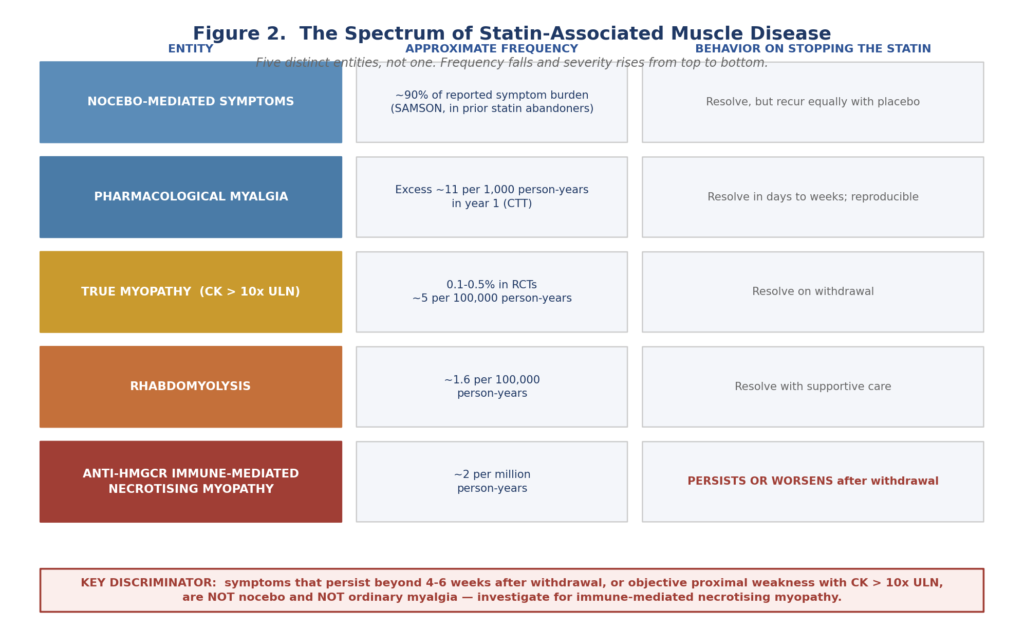
Figura 2. Lo spettro delle patologie muscolari associate alle statine. Queste patologie differiscono per ordini di grandezza in termini di frequenza e presentano differenze fondamentali nella gestione clinica. L’andamento clinico dopo la sospensione delle statine è il singolo fattore discriminante più utile a disposizione al capezzale del paziente.
5.1 Definizioni diagnostiche
SAMS / mialgia: dolore muscolare soggettivo, indolenzimento, rigidità, sensibilità alla palpazione o crampi, tipicamente simmetrici e prossimali, che interessano cosce, glutei e polpacci, senza un aumento significativo della CK [3].
Da quest’ultima affermazione deriva un importante corollario che, nella pratica, viene spesso interpretato in modo errato. La creatina chinasi è un marcatore sensibile della necrosi delle fibre muscolari, ma insensibile ai sintomi muscolari lievi associati alle statine: i pazienti possono riferire sintomi gravi e realmente invalidanti, mentre la CK rimane interamente entro i valori di riferimento. Un valore normale della CK rende quindi molto improbabili la miopatia e la rabdomiolisi definite in base alla CK, ma non esclude la presenza di SAMS (sintomi muscolari lievi associati alle statine) e non costituisce una prova del fatto che i sintomi del paziente siano immaginari o che la statina non ne sia responsabile. La CK è un test per individuare malattie pericolose, non per verificare se un disturbo sia reale. Al contrario, l’aumento asintomatico della CK è comune: nello studio STOMP, la CK è aumentata rispetto al valore basale nel 64,91% dei pazienti trattati con 80 mg di atorvastatina senza che ciò fosse accompagnato da perdita di forza.
Miopatia vera e propria: debolezza muscolare o dolore accompagnati da livelli di CK superiori di dieci volte al limite superiore della norma. La stima del CTT corrisponde a circa 5 casi ogni 10.000 pazienti trattati per cinque anni (0,05%), mentre l’analisi farmacoepidemiologica indica circa 5 casi ogni 100.000 anni-persona. I valori più elevati, compresi tra 0,1 e 0,51 TP9T, citati in revisioni di studi più datati riflettono definizioni di caso più ampie e non sono direttamente comparabili con nessuna delle due stime [66].
Rabdomiolisi: rapida degradazione del muscolo scheletrico con massiccio aumento della CK, iperkaliemia, mioglobinuria e danno renale acuto dovuto all’ostruzione tubulare causata da depositi di mioglobina. Nella più ampia analisi farmacoepidemiologica, la rabdomiolisi con ricovero ospedaliero si è verificata con un’incidenza di circa 0,44 per 10.000 anni-persona, ovvero 4,4 per 100.000, durante la monoterapia con atorvastatina, pravastatina o simvastatina, con tassi sostanzialmente più elevati per la cerivastatina e per le combinazioni di statine e fibrati [23]. Si verifica più frequentemente quando le statine ad alto dosaggio vengono associate a potenti inibitori del CYP3A4, al gemfibrozil o alla ciclosporina.
5.2 Miopatia necrotizzante immuno-mediata anti-HMGCR
La miopatia necrotizzante immuno-mediata associata alle statine (IMNM) merita un’attenzione particolare e specifica, poiché è l’unica malattia muscolare correlata alle statine che sia realmente pericolosa, non sia un effetto nocebo e rischi di passare inosservata se tutti i disturbi muscolari venissero attribuiti al solo effetto delle aspettative.
L’IMNM è caratterizzata dalla presenza di autoanticorpi diretti contro la stessa HMG-CoA reduttasi, bersaglio farmacologico del farmaco. Il meccanismo ipotizzato è che l’esposizione alle statine determini una sovraregolazione HMGCR espressione nel muscolo in fase di rigenerazione fibre, e negli individui geneticamente predisposti ciò determina una risposta autoimmune prolungata che diventa indipendente dalla continua esposizione al farmaco. È stata riconosciuta nelle linee guida multisocietarie AHA/ACC del 2018 come un’entità distinta e rara [12,68]; tale linea guida è stata abrogata e sostituita nel marzo 2026 (Sezione 9.3).
L'incidenza riportata dipende dal denominatore utilizzato, ed entrambe le convenzioni sono presenti in letteratura. Nella coorte multinazionale descritta di seguito, l’incidenza media annua era pari a 2,9 casi per milione di anni-persona nella popolazione adulta generale e da 20,4 (Regno Unito) a 24,1 (Australia) casi per milione di utilizzatori di statine all’anno [67]. Le stime più datate, pari a circa 2 casi per milione di anni-persona, si riferiscono alla popolazione generale; i dati di 2–3 casi ogni 100.000 pazienti in terapia con statine si riferiscono invece a chi assume statine. Il denominatore relativo agli utilizzatori di statine è quello appropriato quando si fornisce consulenza a un paziente che sta assumendo il farmaco, mentre il denominatore relativo alla popolazione generale sottostima il rischio per quel paziente di circa dieci volte.
Una coorte multinazionale di 109 casi positivi all’anti-HMGCR ha riportato un’età mediana di 66 anni, una prevalenza femminile pari al 51%, esposizione alle statine in 101 dei 109 pazienti, di cui circa tre quarti trattati con atorvastatina, una durata mediana della terapia con statine di tre anni prima della diagnosi e un valore mediano di picco della CK pari a 7.020 IU/L, con un intervallo compreso tra 964 e 39.076 IU/L. Circa il 7,5% dei pazienti positivi agli anticorpi anti-HMGCR non aveva mai assunto una statina, a conferma del fatto che l’anticorpo non è indotto esclusivamente dal farmaco [67].
Come distinguere l’IMNM dal SAMS al capezzale del paziente
- La debolezza prevale sul dolore. L’IMNM si manifesta con debolezza oggettiva dei muscoli prossimali (difficoltà ad alzarsi da una sedia, a salire le scale, a sollevare oggetti sopra la testa), mentre la SAMS si manifesta con dolore e rigidità, pur con forza muscolare intatta.
- Il CK è nettamente elevato. I valori tipici vanno da migliaia a decine di migliaia, a differenza della CK normale o minimamente elevata osservata nella SAMS.
- I sintomi persistono o peggiorano dopo la sospensione della statina. Questa è la caratteristica determinante. La SAMS si risolve nel giro di pochi giorni o settimane dalla sospensione del trattamento; l’IMNM no.
- La diagnosi richiede esami sierologici e, spesso, istologici. Il test per gli anticorpi anti-HMGCR è altamente specifico. La risonanza magnetica muscolare evidenzia un edema, mentre la biopsia mostra necrosi e rigenerazione delle fibre muscolari con un infiltrato infiammatorio sparso.
- Il trattamento consiste nell'immunosoppressione, non nel rassicurare il paziente. In genere sono necessari corticosteroidi in associazione con immunoglobuline per via endovenosa e un agente che riduca il fabbisogno di steroidi, come il metotrexato, l’azatioprina o il rituximab. Le statine devono essere evitate in modo permanente.
Il differenziale più ampio: anti-SRP e IMNM sieronegativo
L’anticorpo anti-HMGCR non è l’unico parametro sierologico rilevante in questo contesto, e un risultato negativo non esclude la miopatia necrotizzante. L’IMNM viene convenzionalmente suddivisa in tre gruppi sierologici: anti-HMGCR positivi, anti-particella di riconoscimento del segnale (anti-SRP) positivi e sieronegativi. Circa il 60% dei casi di IMNM presenta anticorpi anti-HMGCR o anti-SRP; i restanti sono sieronegativi e vengono diagnosticati mediante biopsia [69,70].
- IMNM anti-SRP in genere non è associata alle statine e tende a presentare un fenotipo più aggressivo. Rispetto alla malattia anti-HMGCR, causa più spesso grave debolezza agli arti, debolezza del collo, disfagia, insufficienza respiratoria e atrofia muscolare, e coinvolge più frequentemente organi diversi dalla muscolatura, con un maggiore riscontro sia di coinvolgimento cardiaco che di malattia polmonare interstiziale. L’età di esordio è tipicamente più giovane [70].
- Anti-HMGCR IMNM si manifesta più spesso con sola debolezza muscolare e senza coinvolgimento extramuscolare. Circa il 7,5% dei pazienti positivi agli anticorpi anti-HMGCR non ha mai assunto statine, e i casi in cui non si è mai fatto uso di statine differiscono in qualche modo da quelli associati alle statine, presentandosi più spesso in pazienti più giovani e con tassi più elevati di disfagia.
- IMNM sieronegativo La diagnosi viene formulata quando entrambi gli anticorpi risultano assenti, ma la biopsia evidenzia il quadro caratteristico di necrosi diffusa delle fibre muscolari, rigenerazione e infiammazione a predominanza macrofagica e paucilimfocitaria. Questa condizione presenta un’elevata associazione con neoplasie sottostanti; pertanto, un risultato negativo del pannello anticorpale dovrebbe indurre a eseguire una biopsia e uno screening oncologico adeguato all’età, piuttosto che fornire rassicurazioni [71].
Nonostante il trattamento, gli esiti sono spesso incompleti. Nella coorte multinazionale, meno della metà dei pazienti presentava livelli normali di CK (47,6%) o una forza muscolare normale (46,2%) al follow-up, e il 45,7% aveva ricevuto immunoglobuline per via endovenosa [67]. Questo decorso refrattario costituisce l’argomento più evidente a favore di una diagnosi precoce della patologia.
La regola pratica che ne deriva è chiara: qualsiasi paziente che presenti debolezza prossimale, un livello di CK superiore a dieci volte il limite superiore della norma o sintomi muscolari che non si risolvono entro quattro-sei settimane dalla sospensione delle statine dovrebbe essere sottoposto a accertamenti per escludere una miopatia necrotizzante, anziché essere semplicemente rassicurato riguardo alla effetto nocebo. Se il test anti-HMGCR risulta negativo e il sospetto persiste, i passi successivi sono l’esecuzione del test anti-SRP e la biopsia muscolare, non la dimissione.
6. Profilo di tossicità muscolare relativa ed effetti avversi non muscolari
| Classe farmacologica | Tossicità muscolare negli studi clinici controllati | Basi meccanicistiche | Principali effetti indesiderati non muscolari |
| Farmaci a base di PCSK9 (evolocumab, alirocumab, inclisiran, enlicitide) | Non ha mostrato un aumento rispetto al placebo | Neutralizzazione extracellulare o assorbimento da parte degli epatociti mediato dal GalNAc; nessun bersaglio intracellulare identificato nei miociti | Reazioni nel sito di iniezione 2–5%; rinofaringite transitoria; eventi neurocognitivi con incidenza pari a quella del placebo (EBBINGHAUS) [72] |
| Inibitori dell'ACL (acido bempedoico) | Non ha mostrato un aumento rispetto al placebo | L'attivazione del profarmaco richiede la presenza di ACSVL1, che non è rilevabile nel muscolo scheletrico | Iperuricemia e gotta; aumento reversibile della creatinina; colelitiasi; rottura dei tendini; aumento degli enzimi epatici |
| Inibitori di NPC1L1 (ezetimibe) | Non si è osservato un aumento rispetto al placebo. (Nella fase B dello studio GAUSS-3, sono stati segnalati sintomi muscolari dal 28,8% dei pazienti trattati con ezetimibe e il 6,8% ha interrotto il trattamento a causa di tali sintomi; quella fase non prevedeva un braccio placebo e ha arruolato una popolazione selezionata intollerante alle multistatine, e i dati provenienti da studi controllati con placebo non mostrano alcun eccesso.) | Bersaglio intestinale; il farmaco e il glucuronide circolano, ma non è stato identificato alcun bersaglio a livello dei muscoli scheletrici | Lievi disturbi gastrointestinali 1–2%, con incidenza pari a quella del placebo |
| Inibitori dell'ANGPTL3 (evinacumab) | Non ha mostrato un aumento rispetto al placebo | Bersaglio proteico extracellulare; nessun bersaglio intracellulare identificato nei miociti | Reazioni correlate all’infusione e ipersensibilità ≈ 6%; rinofaringite; sintomi simil-influenzali |
| Statine (tutti i principi attivi) | Un eccesso modesto ma statisticamente significativo rispetto al placebo, limitato in gran parte al primo anno | Non vengono risparmiati: nei miociti si verifica un’inibizione intracellulare dell’HMG-CoA reduttasi | Diabete di nuova insorgenza (dose-dipendente); aumento dei livelli delle transaminasi; epatite autoimmune rara; IMNM raro |
Tabella 6. Profilo relativo di tossicità muscolare delle classi di farmaci ipolipemizzanti. Le classi sono presentate come categorie descrittive piuttosto che come una classifica ordinale, poiché gli agenti non statinici non sono distinguibili in modo affidabile tra loro o dal placebo per quanto riguarda gli endpoint muscolari, e una gerarchia numerata implicherebbe una precisione che i dati non supportano. La riga relativa alle statine non è stata volutamente suddivisa in base alla lipofilia; la motivazione è illustrata nella Sezione 6.4. Il rischio muscolare in eccesso associato alle statine come classe è modesto in termini assoluti — circa 11 eventi ogni 1.000 anni-persona nel primo anno — e non dovrebbe essere interpretato come elevato solo perché diverso da zero.
La tabella 6 raggruppa i farmaci per classe. Poiché il confronto clinicamente utile è spesso tra farmaci specifici piuttosto che tra classi, le stesse informazioni sono riportate di seguito a livello di singolo farmaco. Due parametri sono stati volutamente separati, poiché la loro confusione è all’origine della maggior parte dei consigli sulla scelta del farmaco, sicuri ma privi di fondamento scientifico, in questo campo. La prima colonna indica se un farmaco produce più sintomi muscolari rispetto al placebo negli studi in cieco; tra le statine, la risposta è che non sono distinguibili in modo affidabile l’una dall’altra, come hanno rilevato i dati individuali dei partecipanti del CTT. La seconda colonna indica quali pazienti presentano un rischio elevato di miopatia vera e propria, mediata dall’interazione farmacologica o dal genotipo, con un determinato farmaco; in questo caso i farmaci differiscono in modo sostanziale e prevedibile. Un’unica classifica ordinata confonderebbe le due cose.
| Agente | Sintomi muscolari rispetto al placebo negli studi in cieco | Rischio di miopatia mediato dall’interazione e dal genotipo |
| Anticorpi monoclonali anti-PCSK9 (evolocumab, alirocumab) | Non è aumentato | Nessun bersaglio intracellulare identificato nei miociti; non applicabile |
| Inclisiran | Non è aumentato | Assorbimento da parte degli epatociti mediato dal GalNAc; non applicabile |
| Enlicitide | Non è stato aumentato nel programma CORALreef | Proteina bersaglio circolante; non applicabile |
| Ezetimibe | Non è stato osservato un aumento nei dati dei studi controllati con placebo (si veda la nota nella Tabella 6 relativa alla Fase B dello studio GAUSS-3) | Azione a livello degli enterociti; non applicabile |
| Acido bempedoico | Non è aumentato, nemmeno nei risultati CLEAR | ACSVL1 è necessario per l'attivazione e non rilevabile nel muscolo; non applicabile |
| Evinacumab | Non è aumentato | Proteina extracellulare bersaglio; non applicabile |
| Pitavastatina | Non è possibile distinguerla in modo affidabile dalle altre statine | Basso: metabolismo minimo da parte del CYP450; controindicazione alla ciclosporina |
| Pravastatina, fluvastatina | Non è possibile distinguerla in modo affidabile dalle altre statine | Basso: eliminazione non mediata dal CYP3A4; CYP2C9 relativo alla fluvastatina |
| Rosuvastatina | Non è possibile distinguerla in modo affidabile dalle altre statine | Da basso a moderato: ABCG2 le varianti aumentano il rischio di esposizione; limiti di dose nelle persone di origine asiatica |
| Atorvastatina, lovastatina | Non è possibile distinguerla in modo affidabile dalle altre statine | Moderato: interazioni mediate dal CYP3A4; SLCO1B1 intermedio per l'atorvastatina |
| Simvastatina, in particolare alla dose di 80 mg | Non è possibile distinguerla in modo affidabile dalle altre statine | La più alta tra le statine in commercio: la più potente SLCO1B1 segnale più un metabolismo esteso da parte del CYP3A4; la dose di 80 mg non è più raccomandata |
| Cerivastatina | Ritirato nel 2001 | Tasso inaccettabile di rabdomiolisi fatale, in particolare con il gemfibrozil |
Tabella 7. Effetti muscolari a livello di singolo agente, con i sintomi riportati e il rischio di miopatia meccanistica riportati in colonne separate. La prima colonna riflette i dati randomizzati in cieco, in cui nessuna statina è stata distinguibile in modo affidabile dalle altre per quanto riguarda l’incidenza dei sintomi muscolari; le voci ivi riportate non devono essere interpretate come una classifica. La seconda colonna riporta l’esposizione farmacocinetica e farmacogenomica, ambito in cui i farmaci differiscono effettivamente e in cui la scelta del farmaco può essere razionalizzata. I farmaci non statinici si collocano al livello del placebo nella prima colonna e nessuno di essi è distinguibile in modo affidabile dagli altri.
6.1 Acido bempedoico: effetti fuori bersaglio
- Iperuricemia e gotta. L'inibizione competitiva dell'OAT2 renale riduce l'escrezione di urato, determinando un aumento dell'acido urico sierico entro circa quattro settimane dall'inizio della terapia. Nello studio CLEAR Outcomes, la gotta si è manifestata nel 3,1% dei pazienti trattati con acido bempedoico rispetto al 2,1% di quelli trattati con placebo [40]. I pazienti con una storia pregressa di gotta presentano un rischio elevato di recidive e devono sottoporsi a un monitoraggio dei livelli di urato.
- Aumento reversibile della creatinina. L'inibizione dell'OAT2 riduce anche la secrezione tubulare di creatinina, determinando lievi aumenti medi della creatinina sierica e corrispondenti modesti cali della stima filtrazione glomerulare valore. Queste variazioni si stabilizzano rapidamente, si invertono completamente alla sospensione del trattamento e riflettono una competizione a livello dei trasportatori piuttosto che un danno renale strutturale. Non devono essere interpretate erroneamente come nefrotossicità.
- Rottura del tendine. È stata osservata un'incidenza elevata di rotture tendinee, che hanno interessato prevalentemente i tendini di Achille, della cuffia dei rotatori o del bicipite. I tassi erano pari a 0,51 TP9T contro 0,1 TP9T negli studi sull’ipercolesterolemia primaria e a 1,21 TP9T contro 0,91 TP9T nello studio CLEAR Outcomes, pertanto l’incidenza assoluta nei pazienti trattati si attesta a circa 11 TP9T o meno nell’ambito dell’intero programma, e l’eccesso attribuibile al farmaco è ancora più contenuto. Il segnale è reale ma raro, e dovrebbe essere presentato ai pazienti in questi termini piuttosto che come un rischio rilevante. Il meccanismo proposto prevede un’alterazione matrice extracellulare e il ricambio del collagene nei tenociti. I fattori di rischio includono l’età superiore ai 60 anni, la terapia concomitante con corticosteroidi o fluorochinoloni, l’insufficienza renale e una tendinopatia preesistente [26,41].
- Colelitiasi e aumento degli enzimi epatici. Entrambi questi effetti sono risultati più frequenti nello studio CLEAR Outcomes e meritano di essere tenuti in considerazione, sebbene nessuno dei due richieda solitamente l'interruzione del trattamento.
6.2 Diabete di nuova insorgenza associato alle statine
Le statine causano un aumento moderato e dose-dipendente delle nuove diagnosi di diabete. La meta-analisi dei dati individuali dei partecipanti condotta nel 2024 dalla Cholesterol Treatment Trialists’ Collaboration, basata sulla stessa popolazione di studio utilizzata per l’analisi dei sintomi muscolari, ha quantificato questo fenomeno con precisione. L’aumento proporzionale dei casi di diabete di nuova insorgenza è stato di 10% con la terapia con statine a bassa o moderata intensità (1,3% all’anno contro 1,2% all’anno con il placebo) e di 36% con la terapia ad alta intensità (4,8% contro 3,5% all’anno) [73].
Due risultati aiutano a mettere le cose nella giusta prospettiva. Innanzitutto, l’effetto sottostante consiste in un aumento molto lieve della glicemia piuttosto che in un vero e proprio processo diabetogenico: tra i partecipanti senza diabete al basale, la media glucosio è aumentata di 0,04 mmol/L e l’HbA1c media di 0,06% con la terapia a bassa o moderata intensità e di 0,08% con la terapia ad alta intensità. In secondo luogo, e soprattutto ai fini della consulenza, l’eccesso si concentra in modo sproporzionato tra le persone che erano già vicine alla soglia diagnostica. Tra i partecipanti con una misurazione basale della glicemia, circa 62% dei casi di diabete di nuova insorgenza si sono verificati in coloro che si trovavano già nel quarto superiore della distribuzione basale. Si tratta di una netta maggioranza, ma non dell’intero eccesso: circa due nuove diagnosi su cinque sono emerse al di fuori del quartile superiore. L’effetto è quindi meglio descritto come uno spostamento oltre la soglia di persone che si stavano già avvicinando ad essa, piuttosto che come la generazione di diabete in persone metabolicamente sane, pur riconoscendo che una minoranza dei casi si verifica effettivamente a livelli di glicemia basale più bassi.
Un’ulteriore avvertenza limita la valida delle cifre assolute. I ricercatori hanno osservato che l’entità dell’eccesso assoluto dipendeva in modo sostanziale dalla frequenza con cui veniva misurata la glicemia negli studi inclusi, poiché le nuove diagnosi vengono conteggiate solo quando vengono attivamente ricercate. Le stime relative rappresentano la grandezza più facilmente trasferibile; i dati assoluti relativi al diabete per 1.000 individui dovrebbero essere presentati ai pazienti come approssimazioni legate a un particolare regime di accertamento, non come tassi fissi [73].
Le prove genetiche indicano che si tratta di un effetto mirato e non di una tossicità farmacologica idiosincratica. A Randomizzazione mendeliana analisi basata sulle varianti comuni in HMGCR (rs17238484 e rs12916) come indicatori a lungo termine dell’inibizione dell’HMG-CoA reduttasi hanno rilevato che i portatori di alleli che riducono i livelli di LDL presentavano un peso corporeo leggermente superiore, circonferenza vita, glicemia e insulina, e un rischio più elevato di diabete di tipo 2, che rispecchia fedelmente l’effetto osservato negli studi randomizzati sulle statine. Gli autori hanno concluso che l’aumento del rischio di diabete riscontrato con le statine è almeno in parte spiegabile dall’inibizione dell’HMGCR stessa [80].
Un’ulteriore osservazione complica qualsiasi tentativo di inquadrare la questione come una responsabilità specifica delle statine. Le varianti in PCSK9 che livelli più bassi di colesterolo LDL sono associati anche a un modesto aumento del rischio di diabete, così come, più in generale, le varianti che riducono i livelli di LDL [7,8,91]. L’effetto diabetogeno potrebbe quindi essere una proprietà della riduzione delle LDL mediata dal recettore LDLR piuttosto che delle statine in particolare, il che significherebbe che non si evita passando a un farmaco non statinico che agisce attraverso la stessa via recettoriale. Questa rimane un’ipotesi derivante da studi genetici epidemiologia e non è stata confermata da studi clinici di risultato condotti su farmaci non a base di statine, ma ciò dovrebbe smorzare qualsiasi ipotesi secondo cui l’inibizione della PCSK9 rappresenti un’alternativa priva di effetti metabolici.
Tra i partecipanti con diabete preesistente, il rischio relativo di peggioramento controllo glicemico era pari a 1,10 con la terapia a intensità bassa o moderata e a 1,24 con quella ad alta intensità. I ricercatori hanno sottolineato che qualsiasi conseguenza cardiovascolare avversa derivante da tali variazioni glicemiche è già pienamente contemplata nel beneficio cardiovascolare netto osservato negli stessi studi. La risposta appropriata è il monitoraggio glicemico, non la sospensione delle statine.
6.3 Effetti epatici, compresa l’epatite autoimmune, che si manifesta raramente
Un aumento asintomatico dei livelli delle transaminasi si verifica in circa lo 0,5–2% dei pazienti trattati con statine; è solitamente transitorio e non richiede un monitoraggio di routine della funzionalità epatica nei pazienti asintomatici. L’epatotossicità clinicamente significativa da statine è rara.
Un’entità distinta e notevolmente più rara è l’epatite autoimmune indotta da farmaci (DIAIH) causata dalle statine, che ricalca l’epatite autoimmune idiopatica dal punto di vista clinico e istologico. È stata documentata in casi clinici e serie di casi relativi all’atorvastatina, alla rosuvastatina e ad altri agenti; inoltre, un’analisi di farmacovigilanza del Sistema di segnalazione degli eventi avversi della FDA (FDA Adverse Event Reporting System), pubblicata nel 2024, ha individuato segnali positivi di epatite autoimmune in tutte e sette le statine commercializzate [75]. Il quadro clinico può includere ittero, affaticamento, marcato aumento delle transaminasi e presenza di anticorpi antinucleari o anti-muscolo liscio, sebbene si possano verificare anche casi sieronegativi. L’insorgenza varia da due mesi a diversi anni dopo l’inizio [76].
Il parallelo clinico con l’IMNM è istruttivo e merita di essere sottolineato esplicitamente: in entrambe le condizioni, una statina sembra innescare un processo autoimmune che può persistere dopo la sospensione del farmaco e che richiede un trattamento immunosoppressivo piuttosto che la semplice interruzione della terapia. Entrambe sono rare. Nessuna delle due è un effetto nocebo. È necessario sottolineare che non esiste una stima affidabile dell’incidenza della DIAIH indotta dalle statine, poiché la base di evidenze è costituita da casi clinici e segnali di sproporzionalità piuttosto che da dati di coorte, e tali segnali riflettono le modalità di segnalazione piuttosto che la frequenza reale. Nel contesto dell’enorme esposizione globale alle statine, il danno epatico grave clinicamente evidente rimane, secondo la valutazione della monografia LiverTox del NIH, straordinariamente raro [74].
6.4 La lipofilia è un fattore predittivo del rischio muscolare? Una risposta cauta
Si sostiene spesso che le statine lipofile comportino un rischio sostanzialmente maggiore di sintomi muscolari rispetto alle statine idrofile, in quanto la diffusione passiva nei miociti è maggiore. La presente revisione non adotta deliberatamente tale gerarchia, e le ragioni di tale scelta dovrebbero essere esposte in modo trasparente.
La logica biologica è fondata. Gli agenti lipofili raggiungono effettivamente una maggiore penetrazione nei tessuti extraepatici, e questo costituisce un meccanismo plausibile alla base del danno miocitario. Tuttavia, le attuali evidenze provenienti da studi randomizzati non hanno dimostrato in modo coerente differenze clinicamente significative tra statine idrofile e lipofile per quanto riguarda i sintomi muscolari. Una revisione sistematica e una meta-analisi pubblicate nel 2018 hanno rilevato che, nel complesso, le statine aumentavano solo leggermente la SAMS (rischio relativo 1,05, IC 95% 1,014–1,089) e che le statine lipofiliche non avevano un impatto apprezzabile sullo sviluppo del SAMS rispetto alle formulazioni idrofile [77]. Anche una meta-analisi di rete su studi randomizzati in doppio cieco pubblicata nel 2022 non ha riscontrato alcuna differenza statisticamente significativa tra le singole statine in termini di incidenza dei sintomi muscolari [78]. L’analisi dei dati individuali dei partecipanti allo studio CTT del 2022, il set di dati più ampio e rigoroso attualmente disponibile, non ha evidenziato alcuna variazione nel rischio di sintomi muscolari tra le diverse statine [65].
Altre due fonti di prova si riferiscono direttamente a questo aspetto. Il studio SATURN ha assegnato in modo randomizzato 1.385 pazienti affetti da malattia coronarica a un trattamento con rosuvastatina 40 mg (idrofila) o atorvastatina 80 mg (lipofila) per 104 settimane — un confronto diretto tra le due classi alla dose massima — e hanno riscontrato una tollerabilità comparabile senza alcun segno di tossicità muscolare differenziale [47]. A parte ciò, i dati provenienti da studi randomizzati sull’affaticamento, discussi nella Sezione 4.3, hanno evidenziato effetti avversi sul livello di energia e sull’affaticamento da sforzo sia con la pravastatina, un agente idrofilo, sia con la simvastatina.
Tre ulteriori considerazioni contraddicono l’ipotesi di una semplice gerarchia. In primo luogo, la pitavastatina è lipofila, eppure presenta uno dei rischi più bassi di miopatia mediata dall’interazione tra tutte le statine, poiché viene metabolizzata in misura minima dagli enzimi CYP450; la lipofilia e il rischio clinico risultano quindi dissociati. In secondo luogo, il segnale più forte e genuinamente specifico del farmaco non è affatto la lipofilia, bensì il SLCO1B1 interazione farmacogenomica con la simvastatina, discussa nella Sezione 8. In terzo luogo, la dose e l’intensità sono predittori più consistenti rispetto alla classe di solubilità: l’analisi CTT ha rilevato un rischio relativo nel primo anno pari a 1,11 (IC 95% 1,05–1,17) per i regimi più intensivi rispetto al placebo, contro 1,07 (1,04–1,10) per la terapia con statine nel complesso.
Alla base di tutto ciò c’è una distinzione che viene spesso confusa nelle discussioni sull’intolleranza alle statine e che vale la pena sottolineare esplicitamente: una differenza meccanicistica non equivale a un esito clinico. Il fatto che gli agenti lipofili raggiungano una maggiore penetrazione nei tessuti extraepatici è un dato farmacologico accertato. Se tale differenza produca o meno una variazione misurabile nella frequenza con cui i pazienti riferiscono sintomi muscolari è una questione empirica a sé stante, a cui si può rispondere solo tramite confronti controllati, e tali confronti non ne evidenziano alcuna. Un meccanismo plausibile è un generatore di ipotesi, non una prova di efficacia, e il divario tra i due è proprio la fonte da cui ha origine gran parte dei consigli terapeutici in questo campo, formulati con sicurezza ma privi di fondamento.
La formulazione clinicamente sostenibile è quindi la seguente: il passaggio da una statina lipofila a una idrofila è una strategia individuale ragionevole e spesso efficace in un paziente che non ha tollerato un determinato farmaco, ma dovrebbe essere presentata come un processo empirico di tentativi ed errori piuttosto che come una riduzione prevedibile del rischio. Ciò che riduce in modo affidabile il rischio è la riduzione della dose, l’evitare farmaci che interagiscono con la statina e l’evitare dosi elevate di simvastatina.
7. Epidemiologia dei sintomi muscolari segnalati e fenomeno nocebo
Un paradosso persistente caratterizza questo campo. Nei registri osservazionali non in cieco e nella pratica clinica quotidiana, il 10–20% dei pazienti riferisce sintomi muscolari e molti interrompono la terapia. Negli studi randomizzati in doppio cieco, la differenza tra statine e placebo è molto esigua. Quattro serie di evidenze risolvono questo paradosso e, nel loro insieme, costituiscono una delle dimostrazioni più eleganti dell’effetto nocebo nella medicina moderna [81].
Nota sulle due cifre più citate in questo campo: il “90%” di SAMSON e il “uno su quindici” del CTT non corrispondono allo stesso numero. Derivano da popolazioni diverse, da parametri diversi e da disegni di studio diversi, e nessuna delle due conferma la validità dell’altra.
Poiché queste cifre vengono spesso confuse, vale la pena chiarire la distinzione prima di discutere di entrambe. Il rapporto nocebo SAMSON di 0,90 descrive la proporzione dell’aumento dell’intensità dei sintomi causato dall’assunzione di una compressa che è stata riprodotta da una compressa inerte. È stato misurato su 60 pazienti che avevano già interrotto l’assunzione di statine a causa degli effetti collaterali — un fenotipo volutamente estremo — utilizzando una scala continua dei sintomi giornalieri e, cosa fondamentale, una condizione di controllo senza compresse che manca nella maggior parte degli studi clinici. Il dato CTT di uno su quindici descrive la proporzione di eventi sintomatici muscolari segnalati nel primo anno di trattamento attribuibili alla statina piuttosto che a cause di fondo, misurata su 123.940 partecipanti nelle popolazioni generali degli studi clinici confrontando il numero di eventi con quello del placebo.
Da un lato si tratta di un rapporto tra gli incrementi di intensità dei sintomi in pazienti predisposti; dall’altro, di una frazione attribuibile delle segnalazioni di eventi in una popolazione non selezionata. Il fatto che giungano a conclusioni sostanzialmente concordanti — ovvero che la grande maggioranza dei sintomi muscolari segnalati in relazione alle statine non sia causata dal farmaco — è scientificamente significativo proprio perché i disegni di studio differiscono in modo così netto. Ma la vicinanza numerica tra 90% e quattordici quindicesimi è una coincidenza aritmetica, non una replica. Nessuna delle due cifre dovrebbe essere citata come se confermasse l’altra, né dovrebbe essere applicata a una popolazione diversa da quella in cui è stata misurata.
7.1 La meta-analisi della Cholesterol Treatment Trialists’ Collaboration (2022)
Il Collaborazione CTT ha condotto una meta-analisi basata sui dati individuali dei partecipanti relativa a 23 studi clinici randomizzati in doppio cieco su larga scala, comprendenti 19 studi controllati con placebo con 123.940 partecipanti e 4 studi che mettevano a confronto un trattamento più intensivo con uno meno intensivo con 30.724 partecipanti, pubblicati su The Lancet nell'agosto 2022 [65].
Nel corso di un periodo di follow-up mediano ponderato di 4,3 anni, 16.835 partecipanti assegnati al gruppo delle statine (27,1%) hanno riferito dolore o debolezza muscolare rispetto a 16.446 assegnati al gruppo placebo (26,6%), con un rapporto di incidenza pari a 1,03 (IC 95% 1,01–1,06). L’eccesso si è limitato quasi interamente al primo anno di trattamento, durante il quale la terapia con statine ha prodotto un aumento relativo del 7% (rapporto di incidenza 1,07, 95% CI 1,04–1,10), corrispondente a un eccesso assoluto di 11 eventi (95% CI 6–16) per 1.000 anni-persona. Dopo il primo anno non si è osservato alcun eccesso significativo (rapporto di incidenza 0,99, IC 95% 0,96–1,02).
I ricercatori hanno espresso tale implicazione in termini aritmetici: solo uno su quindici dei casi di disturbi muscolari segnalati dai partecipanti assegnati alla terapia con statine era effettivamente attribuibile alla statina. Per i regimi terapeutici più intensivi, il rapporto di incidenza rispetto al placebo era pari a 1,08 (IC 95% 1,04–1,13) su tutti gli anni, salendo a 1,11 (IC 95% 1,05–1,17) nel primo anno; pertanto, la frazione attribuibile sale a circa uno su dieci a intensità elevata. Entrambe queste cifre rappresentano confronti con il placebo; i quattro studi che hanno randomizzato direttamente una terapia più intensiva rispetto a una meno intensiva hanno prodotto un rapporto di rate pari a 1,05 (IC 95% 0,99–1,11), e i due confronti non devono essere confusi. I crampi muscolari, una causa molto comune di interruzione del trattamento nella pratica clinica, hanno mostrato solo una differenza assoluta di 0,2% e non sono significativamente correlati alle statine. In particolare, non vi erano prove che il rischio variasse tra le singole statine.
7.2 Lo studio SAMSON (2020)
SAMSON (Metodo di autovalutazione degli effetti collaterali delle statine o del nocebo), pubblicato su New England Journal of Medicine nel novembre 2020 con i dati completi nel Journal of the American College of Cardiology Nel 2021 sono stati arruolati 60 pazienti provenienti da 17 centri di riferimento del Regno Unito e tramite auto-segnalazione, tutti i quali avevano precedentemente interrotto l’assunzione di statine a causa di effetti collaterali insorti entro due settimane dall’inizio del trattamento. Si tratta, di proposito, della popolazione più soggetta a sintomi che si possa individuare [5,6].
Design
SAMSON ha utilizzato un disegno di studio randomizzato in doppio cieco “n-of-1” della durata di 12 mesi consecutivi. Ciascun partecipante ha ricevuto 12 flaconi di farmaco mensili in sequenza randomizzata: quattro contenenti 20 mg di atorvastatina al giorno, quattro contenenti un placebo corrispondente e quattro vuoti. I mesi con i flaconi vuoti rappresentano l’innovazione metodologica, poiché consentono di stabilire il livello di base dei sintomi di ciascun paziente in assenza totale di compresse. I partecipanti hanno registrato l’intensità giornaliera dei sintomi su un’applicazione per smartphone utilizzando una scala continua da 0 (assenza di sintomi) a 100 (il peggiore immaginabile) e potevano interrompere l’assunzione delle compresse di quel mese se i sintomi diventavano intollerabili.
Risultati
Sessanta partecipanti sono stati randomizzati e 49 hanno completato l’intero protocollo di 12 mesi. L’intensità media dei sintomi è stata di 8,0 nei mesi senza assunzione di compresse (IC 95% 4,7–11,3), di 15,4 nei mesi con placebo (IC 95% 12,1–18,7; P < 0,001 rispetto ai mesi senza compresse) e pari a 16,3 durante i mesi di trattamento con statine (IC 95% 13,0–19,6; P < 0,001 rispetto ai mesi senza compresse). La differenza tra i mesi di trattamento con statine e quelli con placebo non era significativa (P = 0,388).
Il rapporto nocebo, definito come l’intensità dei sintomi con il placebo meno l’intensità dei sintomi in assenza di compresse, diviso per l’intensità dei sintomi con la statina meno l’intensità dei sintomi in assenza di compresse, era pari a 0,90. Il 90% del carico sintomatico indotto dall’assunzione di una compressa di statina è stato riprodotto dall’assunzione di una compressa di placebo.
Per completezza, è opportuno segnalare una precisazione metodologica. L’analisi primaria originariamente specificata ha prodotto un rapporto nocebo pari a 2,2 con un 95% intervallo di confidenza da −62,3 a 66,7, una stima instabile dovuta al fatto che in alcuni soggetti il denominatore “statina meno nessun farmaco” era molto piccolo o negativo. Uno statistico indipendente ha raccomandato di raggruppare i dati individuali dei partecipanti prima di calcolare il rapporto, ottenendo così il valore riportato di 0,90. Si tratta di una decisione analitica legittima e riportata in modo trasparente, ma i lettori devono comprendere che il dato riportato nel titolo deriva dall’analisi rivista e non da quella originale.
L’interruzione della terapia a causa di sintomi intollerabili si è verificata 71 volte: 31 durante i mesi di trattamento con placebo e 40 durante i mesi di trattamento con statine, una differenza non significativa. Le compresse di placebo sono state quindi interrotte con una frequenza quasi pari a quella del farmaco attivo. Al follow-up di sei mesi, dopo che ai partecipanti erano stati mostrati grafici personalizzati dei propri punteggi dei sintomi nelle tre condizioni, 30 dei 60 partecipanti avevano ripreso con successo la terapia con statine.
7.3 Lo studio StatinWISE (2021)
StatinWISE, pubblicato su BMJ nel febbraio 2021, ha replicato in modo indipendente lo studio SAMSON su scala più ampia nell’ambito dell’assistenza primaria. Lo studio comprendeva una serie di 200 studi randomizzati in doppio cieco di tipo “n-of-1” condotti su pazienti che stavano valutando l’interruzione della terapia a causa di sintomi muscolari, in cui sono stati somministrati 20 mg di atorvastatina rispetto al placebo nell’arco di sei periodi di due mesi ciascuno [82].
Dei 200 partecipanti, 151 (75,5%) hanno contribuito all’analisi primaria. Non è stata riscontrata alcuna differenza nei punteggi dei sintomi muscolari tra i periodi di trattamento con statine e quelli con placebo (differenza media −0,11, IC al 95% da −0,36 a 0,14; P = 0,40). L’interruzione dello studio a causa di sintomi muscolari intollerabili si è verificata in 9% durante i periodi di trattamento con statine e in 7% durante i periodi di trattamento con placebo. Due terzi dei partecipanti che hanno completato lo studio hanno scelto di riprendere la terapia con statine. La convergenza di due programmi n-of-1 condotti in modo indipendente verso la stessa conclusione rafforza in modo sostanziale l’inferenza.
7.4 ASCOT-LLA: studio in cieco contro studio in aperto (2017)
Le prove più convincenti a livello di popolazione provengono da un esperimento naturale condotto nell’ambito di un unico studio clinico. Lo studio ASCOT-LLA ha assegnato in modo randomizzato i pazienti al trattamento con 10 mg di atorvastatina o al placebo in una fase in cieco, per poi proseguire con una fase di estensione in aperto in cui sia i pazienti che i medici sapevano chi stesse assumendo una statina.
Durante la fase randomizzata in cieco non è stato osservato un aumento significativo degli eventi avversi di natura muscolare con l’atorvastatina. Durante l’estensione in aperto, gli eventi avversi di natura muscolare sono risultati significativamente più frequenti tra i soggetti che assumevano statine (161 eventi, 1,26% all’anno) rispetto ai non utilizzatori (124 eventi, 1,00% all’anno), con un rischio relativo pari a 1,41 (IC al 95% 1,10–1,79; P = 0,006). Il farmaco non è cambiato. È cambiata solo la consapevolezza di assumerlo [83].
7.5 GAUSS-3: quantificazione dell’intolleranza effettiva (2016)
GAUSS-3, pubblicato su JAMA pubblicato nell’aprile 2016, rappresenta il necessario contrappeso alla letteratura sul nocebo, poiché dimostra che anche l’intolleranza farmacologica vera e propria è reale. Lo studio ha coinvolto 511 pazienti con una storia documentata di intolleranza a due o più statine e un valore medio di LDL-C all’inizio dello studio pari a circa 212 mg/dL [42].
Fase A: riesposizione in cieco
491 pazienti sono stati sottoposti a uno studio in doppio cieco, crossover, di riesposizione alla durata di 24 settimane con atorvastatina 20 mg rispetto al placebo, per 10 settimane ciascuno, separati da un periodo di washout. I risultati suddividono questa popolazione fortemente preselezionata in quattro gruppi: 209 su 491 (42,6%) hanno sviluppato sintomi muscolari intollerabili con l’atorvastatina ma non con il placebo; il 26,5% ha sviluppato sintomi con il placebo ma non con l’atorvastatina; circa il 10% ha sviluppato sintomi con entrambi; e il resto non ha sviluppato sintomi con nessuno dei due. Durante il secondo periodo di crossover il hazard ratio per i sintomi muscolari nel gruppo trattato con atorvastatina rispetto al placebo era pari a 1,96 (IC 95% 1,44–2,66; P < 0,001).
Ne derivano due conclusioni, entrambe rilevanti. Esiste un’intolleranza alle statine autentica, riproducibile e mediata farmacologicamente, che ha colpito circa 43% di questa popolazione con fenotipo estremo. Allo stesso modo, più di un quarto di questi stessi pazienti ha manifestato dolori muscolari intollerabili causati interamente da una compressa inerte. Visto da un’altra prospettiva, circa 60% di pazienti che avevano già manifestato un fallimento terapeutico con almeno due statine non hanno mostrato un’intolleranza riproducibile in seguito a una nuova somministrazione in cieco.
Fase B: terapia comparativa senza statine
218 pazienti con intolleranza confermata, comprendenti quelli identificati nella Fase A più 19 che avevano saltato la Fase A a causa di un precedente aumento documentato della CK superiore a dieci volte il limite superiore della norma, sono stati randomizzati in rapporto 2:1 al trattamento con evolocumab 420 mg al mese (n = 145) o ezetimibe 10 mg al giorno (n = 73) per 24 settimane.
Sono stati riportati due endpoint primari congiunti. Dal basale alla settimana 24, il colesterolo LDL è diminuito di 52,8% con evolocumab rispetto a 16,7% con ezetimibe. Per la media delle settimane 22 e 24, il colesterolo LDL è diminuito di 54,5% (IC 95% da −57,2 a −51,8; riduzione assoluta 103,6 mg/dL) con evolocumab rispetto a 16,7% (IC 95% da −20,5 a −12,9) con ezetimibe, con una differenza tra i gruppi pari a −37,8% (IC 95% da −42,3 a −33,3; P < 0,001). Sono stati segnalati sintomi muscolari dal 20,7% dei pazienti trattati con evolocumab e dal 28,8% di quelli trattati con ezetimibe. L’interruzione del trattamento a causa di sintomi muscolari intollerabili si è verificata in 1 su 145 pazienti (0,7%) trattati con evolocumab rispetto a 5 su 73 (6,8%) trattati con ezetimibe. Nessuno dei due bracci aveva un comparatore con placebo, pertanto questi tassi quantificano il carico sintomatico residuo in una popolazione selezionata piuttosto che il rischio attribuibile al farmaco [42].
Genomica esplorativa
Un’analisi esplorativa su scala genomica condotta nell’ambito del progetto GAUSS-3 ha individuato associazioni tra i sintomi muscolari correlati alle statine e loci situati in MGAT5 e KCNJ2/SOX9, mentre le varianti che influenzano l'esposizione sistemica alle statine, quali SLCO1B1 non sono risultati significativamente associati alla ricomparsa dei sintomi in questa coorte. Questi risultati hanno solo valenza ipotetica: la coorte comprendeva circa 500 pazienti, un numero decisamente insufficiente per una scoperta a livello genomico, e i loci non sono stati replicati in modo robusto. Non dovrebbero essere presentati ai pazienti come clinicamente utilizzabili.
| Processo | Progettazione e popolazione | Risultato principale |
| Collaborazione CTT (2022) | 19 studi clinici randomizzati controllati in doppio cieco con placebo; 123.940 partecipanti; mediana di 4,3 anni | 27,11 TP9T vs 26,61 TP9T: sintomi muscolari segnalati (RR 1,03); RR a un anno 1,07, eccesso di 11 casi ogni 1.000 anni-persona; solo 1 segnalazione su 15 attribuibile alle statine |
| SAMSON (2020) | Studio in doppio cieco n-of-1; 60 pazienti che avevano interrotto l’assunzione di statine; 4 mesi con statine, 4 mesi con placebo, 4 mesi senza trattamento | Punteggi dei sintomi: 8,0 / 15,4 / 16,3 (senza compresse / placebo / statina); statina vs placebo P = 0,388; rapporto nocebo 0,90; 30 su 60 hanno ripreso il trattamento |
| StatinWISE (2021) | 200 studi in doppio cieco di tipo "n-of-1" nell'ambito dell'assistenza primaria; atorvastatina 20 mg rispetto al placebo | Nessuna differenza nel punteggio dei sintomi (differenza media −0,11, IC 95% da −0,36 a 0,14); due terzi dei partecipanti che hanno portato a termine lo studio hanno ripreso l’assunzione di statine |
| ASCOT-LLA (2017) | Fase randomizzata in cieco rispetto alla fase di estensione non in cieco dello stesso studio | Nessun evento di ipertonia muscolare in condizioni di cieco; RR 1,41 (IC 95% 1,10–1,79) in condizioni di non cieco |
| GAUSS-3 (2016) | 511 pazienti con intolleranza alle multistatine; reintroduzione in cieco dell’atorvastatina, seguita da trattamento con evolocumab rispetto all’ezetimibe | 42,61 TP9T nei pazienti trattati solo con statine; 26,51 TP9T nei pazienti trattati solo con placebo; evolocumab −54,51 TP9T rispetto a ezetimibe −16,71 TP9T per il colesterolo LDL (LDL-C) |
Tabella 8. Studi di riferimento che definiscono il confine tra i sintomi muscolari da statine di origine farmacologica e quelli mediati dall’effetto nocebo. RR = rapporto di incidenza o rischio relativo, secondo quanto riportato dagli autori dello studio originale.
7.6 Valutare i benefici e i danni con lo stesso metro di misura
I rischi relativi e i rapporti di incidenza sono il linguaggio naturale utilizzato nei resoconti clinici, ma costituiscono una base inadeguata per un colloquio con un paziente, che deve prendere una decisione riguardante una singola persona piuttosto che una coorte. I valori che contano ai fini di tale decisione sono assoluti, e la CTT Collaboration li ha pubblicati per un regime terapeutico standard.
Ridurre il colesterolo LDL di 2 mmol/L (77 mg/dL) con un regime terapeutico efficace, come l’atorvastatina da 40 mg al giorno, per cinque anni in 10.000 pazienti, consentirebbe in genere di prevenire uno o più eventi vascolari maggiori in circa 1.000 pazienti conmalattia vascolare occlusiva preesistente, con un beneficio assoluto pari a 10%, e in circa 500 pazienti ad alto rischio che non hanno ancora manifestato un evento, con un beneficio assoluto pari a 5%. D’altra parte, lo stesso trattamento negli stessi 10.000 pazienti nello stesso periodo causerebbe in genere circa 5 casi di miopatia, di cui uno potrebbe progredire in rabdomiolisi se la statina non venisse sospesa, da 50 a 100 nuovi casi di diabete e da 5 a 10 ictus emorragici, oltre a eventi avversi sintomatici quali dolori muscolari riscontrati in un numero compreso tra 50 e 100 pazienti, con un danno assoluto compreso tra 0,5% e 1,0% [2].
| Risultati su un periodo di 5 anni | Ogni 10.000 persone trattate | Ogni 1.000 persone trattate | Tasso assoluto |
| Prevenzione degli eventi vascolari gravi, prevenzione secondaria | ≈ 1.000 | ≈ 100 | Vantaggi del modello 10% |
| Prevenzione degli eventi vascolari gravi, prevenzione primaria | ≈ 500 | ≈ 50 | Vantaggio 5% |
| Diabete di nuova insorgenza causato da | 50–100 | 5–10 | 0,5–1,01 TP9T danno |
| Eventi avversi muscolari sintomatici causati da | 50–100 | 5–10 | 0,5–1,01 TP9T danno |
| Emorragico ictus causato | 5–10 | 0.5–1 | 0,05–0,11 TP9T danno |
| Miopatia causata da (CK > 10× ULN) | ≈ 5 | ≈ 0,5 | 0,051 TP9T danno |
| Rabdomiolisi causata da | ≈ 1 | ≈ 0,1 | 0,011 TP9T danno |
Tabella 9. Benefici e rischi assoluti derivanti da cinque anni di trattamento efficace con statine che riduce il colesterolo LDL di 2 mmol/L, secondo le stime della CTT Collaboration. I dati per 1.000 sono stati ricavati per divisione e sono riportati per facilità di consultazione; le stime pubblicate si riferiscono a 10.000. I benefici variano in base ai valori basali rischio assoluto e in base all’entità e alla durata della riduzione del colesterolo LDL, pertanto questi dati descrivono un paziente tipico piuttosto che un singolo individuo. Due righe richiedono alcune precisazioni. La riga relativa al diabete di nuova insorgenza deriva dalla stessa proiezione quinquennale precedente e va interpretata come una stima dell’ordine di grandezza: l’analisi dei dati individuali dei partecipanti del 2024 ha rilevato che l’eccesso assoluto variava in modo sostanziale a seconda dell’intensità del monitoraggio glicemico nei vari studi, pertanto non esiste una singola cifra assoluta fissa ben supportata (Sezione 6.2). Anche la riga relativa agli eventi avversi muscolari sintomatici deriva dalla precedente proiezione quinquennale del gruppo CTT. L’analisi dei dati individuali dei partecipanti del 2022 ha riportato un eccesso assoluto di 11 eventi per 1.000 anni-persona limitato al primo anno, equivalente a circa 110 per 10.000 nel solo primo anno, e sostituisce la precedente proiezione per questo endpoint. Le due stime utilizzano definizioni e basi temporali diverse e non devono essere sommate, mediate o interpretate come un calcolo incoerente dei benefici.
Tre aspetti di questo confronto meritano di essere sottolineati. I benefici e gli effetti negativi non hanno lo stesso peso anche quando i numeri sono simili: la miopatia e i sintomi muscolari regrediscono con la sospensione del farmaco, mentre infarto miocardico mentre l’ictus spesso non lo fa. Qualsiasi conseguenza cardiovascolare avversa derivante dall’eccesso di diabete e dall’ictus emorragico è già inclusa nelle cifre relative al beneficio netto, poiché entrambi sono emersi negli stessi studi da cui è stato misurato il beneficio; pertanto, le colonne non dovrebbero essere sottratte l’una dall’altra. Inoltre, il beneficio si accumula per ogni anno di trattamento, quindi il periodo di cinque anni sottostima i risultati ottenibili con una terapia per tutta la vita.
Il controargomento da tenere in considerazione è che queste stime provengono dal gruppo CTT, i cui metodi e l’accesso ai dati individuali dei partecipanti sono stati contestati da una minoranza di ricercatori, e che descrivono popolazioni piuttosto che singoli individui. Un paziente con un rischio cardiovascolare assoluto molto basso ne trae un beneficio proporzionalmente minore e, per quel paziente, il rapporto tra rischi e benefici è effettivamente più equilibrato di quanto suggerisca la tabella.
8. Farmacogenomica della miopatia da statine
Se la domanda è: quale paziente ha maggiori probabilità di subire una lesione muscolare vera e propria durante il trattamento con statine?, la risposta più attendibile è di natura genetica piuttosto che fisico-chimica.
8.1 SLCO1B1
La scoperta determinante è stata uno studio di associazione genomica condotto nell’ambito dello studio SEARCH, pubblicato su New England Journal of Medicine nel 2008, che ha individuato il SLCO1B1 variante c.521T>C (rs4149056) come determinante genetico dominante della miopatia associata alla simvastatina 80 mg [79]. SLCO1B1 codifica per l'OATP1B1, il trasportatore responsabile dell'assorbimento epatico. Le varianti con funzionalità ridotta compromettono l'estrazione epatica, aumentando l'esposizione sistemica all'acido statinico e quella a livello dei muscoli scheletrici.
Le linee guida sono fornite dal Consorzio per l'implementazione della farmacogenetica clinica (CPIC), le cui linee guida del 2022 trattano SLCO1B1, ABCG2, e CYP2C9 genotipi e sintomi muscoloscheletrici associati alle statine, che sostituisce la precedente linea guida relativa alla sola simvastatina [22]. Le prove che collegano il polimorfismo rs4149056 alla miopatia sono classificate come di alta qualità per la simvastatina. Il CPIC raccomanda di limitare il dosaggio o di scegliere una statina alternativa nei fenotipi con funzionalità ridotta o scarsa. Le attribuzioni relative alla funzione degli alleli sono state ulteriormente aggiornate nell’ottobre 2025 per migliorare l’accuratezza nelle popolazioni sottorappresentate [84].
L'associazione è fortemente specifica per ciascun farmaco, il che risulta clinicamente utile. È più marcata per la simvastatina, intermedia e meno consistente per l'atorvastatina, mentre è minima per la pravastatina, la rosuvastatina, la fluvastatina e la pitavastatina, poiché l'OATP1B1 contribuisce in misura diversa all'assorbimento epatico di ciascun agente.
8.2 ABCG2, CYP2C9 e altri loci
- ABCG2: codifica il trasportatore di efflusso BCRP. La variante c.421C>A aumenta notevolmente l'esposizione alla rosuvastatina, e il CPIC 2022 include raccomandazioni sul dosaggio della rosuvastatina da parte di ABCG2 fenotipo [22].
- CYP2C9: l'enzima principale responsabile del metabolismo della fluvastatina; nei soggetti con metabolismo lento si verifica un accumulo del farmaco, il che richiede una limitazione della dose.
- CYP3A4*22: Allele a funzionalità ridotta che influisce sulla clearance della simvastatina, della lovastatina e dell’atorvastatina. Le evidenze sono indicative, ma non ancora sufficienti per giustificare l’adozione di linee guida.
- COQ2, GATM, e i loci GAUSS-3 (MGAT5, KCNJ2/SOX9): associazioni candidate con risultati non replicabili. Si tratta di risultati di ricerca che non devono essere utilizzati in ambito clinico.
| Gene | Variante | Le statine hanno influito principalmente su | Implicazioni pratiche |
| SLCO1B1 | c.521T>C (rs4149056) | Simvastatina (forte); atorvastatina (moderata) | Evitare dosi elevate di simvastatina in caso di funzionalità ridotta o compromessa; privilegiare rosuvastatina, pravastatina, fluvastatina o pitavastatina |
| ABCG2 | c.421C>A | Rosuvastatina | Limitare la dose di rosuvastatina nei fenotipi con funzionalità ridotta |
| CYP2C9 | *2, *3 alleli a funzionalità ridotta | Fluvastatina | Limitare la dose di fluvastatina nei soggetti con metabolismo lento |
| CYP3A4 | *22 | Simvastatina, lovastatina, atorvastatina | Solo a titolo indicativo; al momento non costituisce una linea guida applicabile |
| MGAT5, KCNJ2/SOX9, COQ2, GATM | Varie | Non specifico per un agente | Di natura esplorativa; non clinicamente applicabile |
Tabella 10. Loci farmacogenomici rilevanti per la miopatia da statine, con raccomandazioni in linea con le linee guida CPIC 2022 (aggiornate a ottobre 2025). Attualmente solo SLCO1B1, ABCG2 e CYP2C9 sono oggetto di raccomandazioni CPIC applicabili.
8.3 Interazioni farmacologiche
La miopatia mediata dall’interazione è più comune, più prevedibile e più prevenibile rispetto alla miopatia idiosincratica. Il meccanismo è semplice: qualsiasi fattore che aumenti la concentrazione sistemica di statine aumenta l’esposizione muscolare.
| Agente interattivo | Meccanismo | Influenza delle statine | Gestione |
| Gemfibrozil | Inibisce la glucuronidazione e il trasporto mediato dall'OATP1B1 | Tutte le statine | Evitare l'associazione; se è necessario un fibrato, ricorrere invece al fenofibrato |
| Claritromicina, eritromicina, itraconazolo, ketoconazolo, ritonavir | Potente inibizione del CYP3A4 | Simvastatina, lovastatina, atorvastatina | Sospendere la statina durante i cicli di trattamento brevi oppure passare alla pravastatina, alla rosuvastatina o alla pitavastatina |
| Ciclosporina | OATP1B1 e inibizione dei trasportatori multipli | Tutti; controindicato in caso di trattamento con pitavastatina | Limiti massimi rigorosi per le dosi; supervisione da parte di uno specialista |
| Amiodarone, verapamil, diltiazem | Inibizione moderata del CYP3A4 | Simvastatina, lovastatina | Rispettare i limiti di dose indicati nell'etichetta; prendere in considerazione una statina non inibitrice del CYP3A4 |
| Colchicina | Miotossicità indipendente; rischio additivo | Tutte le statine | Monitorare i livelli di CK in caso di uso concomitante, soprattutto in presenza di insufficienza renale |
| Succo di pompelmo (in grandi quantità) | Inibizione del CYP3A4 a livello intestinale | Simvastatina, lovastatina, atorvastatina | Si raccomanda moderazione; clinicamente rilevante soprattutto in caso di assunzione elevata |
Tabella 11. Interazioni farmacologiche clinicamente rilevanti che aumentano il rischio di miopatia da statine. Si noti che la pravastatina, la rosuvastatina e la pitavastatina presentano il vantaggio di un metabolismo minimo da parte del CYP450, il che costituisce una base più affidabile per la scelta delle statine in caso di politerapia rispetto alla lipofilia.
8.4 Fattori reversibili non genetici
Prima di concludere che un paziente sia intollerante alle statine, è necessario escludere diversi fattori reversibili, poiché ciascuno di essi, indipendentemente dagli altri, provoca o aggrava la mialgia: ipotiroidismo (controllare il TSH), carenza di vitamina D, insufficienza renale, recente attività fisica intensa a cui non si è abituati ed eccesso alcol assunzione [58]. È opportuno sottolineare un aspetto: sebbene in questo contesto la carenza di vitamina D venga comunemente corretta, uno studio randomizzato che ha confrontato la vitamina D con un placebo in soggetti che iniziavano a assumere statine non ha riscontrato alcuna riduzione dei sintomi muscolari associati alle statine; pertanto, la reintegrazione della vitamina D dovrebbe essere considerata una misura di cura generale ragionevole piuttosto che un rimedio comprovato per i SAMS [85]. Anche l’età avanzata, la massa corporea ridotta, il sesso femminile e l’origine asiatica (particolarmente rilevante per il dosaggio della rosuvastatina) aumentano la suscettibilità.
9. Gestione clinica: un algoritmo basato sull’evidenza
La sequenza che segue sintetizza le evidenze esaminate in precedenza. Il principio guida è che i sintomi del paziente debbano essere sempre presi sul serio, senza tuttavia dare per scontata un’attribuzione causale al farmaco [58,81].
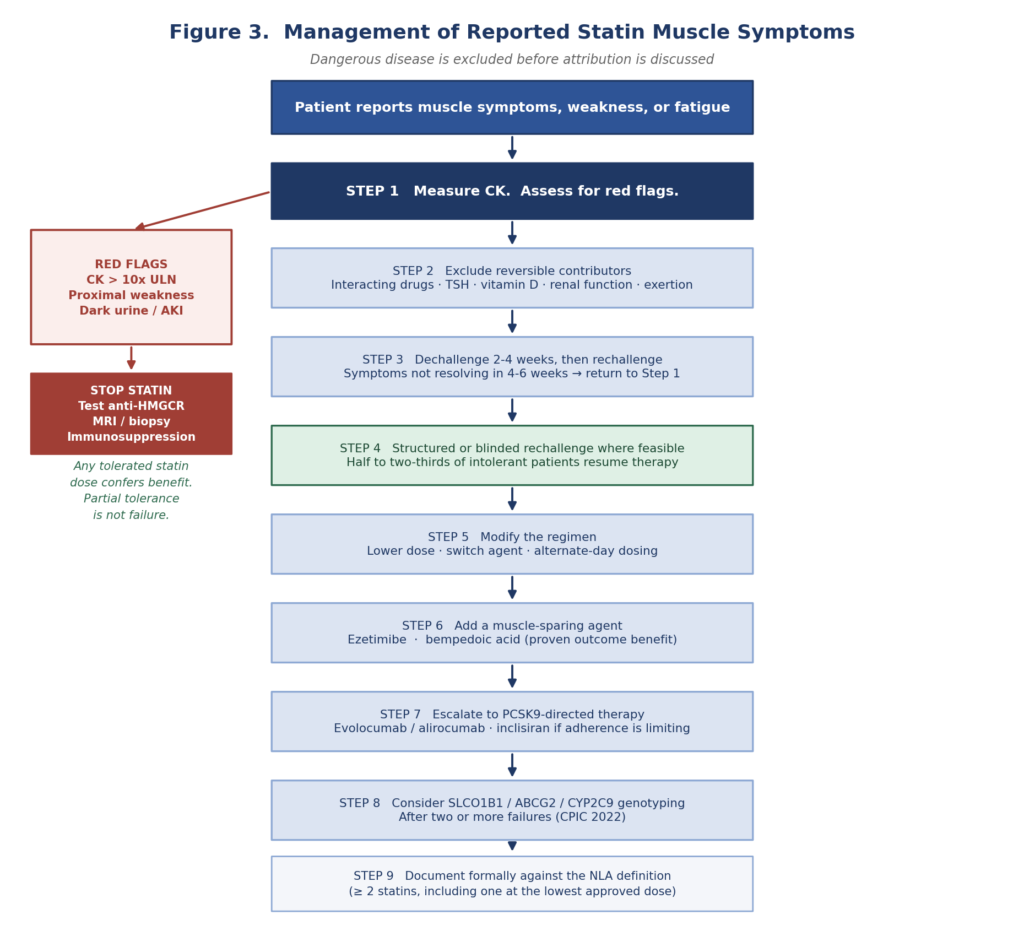
Figura 3. Algoritmo di gestione dei sintomi muscolari attribuiti alle statine. La sequenza è voluta: si esclude la presenza di una patologia grave prima di discutere l’attribuzione dei sintomi, poiché un paziente affetto da miopatia necrotizzante immuno-mediata, se rassicurato riguardo all’effetto nocebo, potrebbe subire un peggioramento delle condizioni.
- Escludere innanzitutto una miopatia pericolosa. Misurare la CK. Se la CK supera di dieci volte il limite superiore della norma, o se è presente una debolezza prossimale oggettiva, oppure se si riscontrano urine scure o insufficienza renale, interrompere immediatamente la somministrazione della statina e indagare sulla presenza di una vera miopatia, rabdomiolisi o miopatia necrotizzante immuno-mediata. Non procedere a rassicurare il paziente riguardo all’effetto nocebo fino a quando questa fase non sia stata completata.
- Individuare i fattori reversibili. Verificare la presenza di interazioni farmacologiche, ipotiroidismo, carenza di vitamina D, insufficienza renale e recente sforzo fisico insolito. Correggere ciò che è correggibile.
- Sospendere il trattamento e riprenderlo. Sospendere la statina per un periodo compreso tra due e quattro settimane. L’assenza di miglioramento riduce la probabilità di una SAMS farmacologica ordinaria e dovrebbe indurre a rivalutare cause alternative o la presenza di una miopatia persistente, piuttosto che presumere che la statina non fosse responsabile; se i sintomi persistono oltre le quattro-sei settimane, in particolare in presenza di CK elevata o debolezza oggettiva, indagare sulla possibilità di IMNM. Se i sintomi si risolvono, ripetere la somministrazione con una statina diversa a basso dosaggio.
- Ove possibile, ricorrere a una riprova strutturata o in cieco. Gli studi SAMSON e StatinWISE dimostrano che i dati oggettivi e personalizzati relativi al quadro sintomatico specifico di ciascun paziente costituiscono un intervento efficace per ripristinare adesione — quello con il supporto randomizzato più diretto — che ha consentito a circa la metà o ai due terzi dei pazienti partecipanti di riprendere la terapia. Nessuno dei due studi ha confrontato questo approccio con altre strategie di aderenza alla terapia, pertanto non dovrebbe essere descritto come superiore a tutte le alternative [5,6,82].
- Modificare il regime terapeutico prima di interrompere il trattamento con questa classe di farmaci. Ridurre la dose; cambiare farmaco, in particolare evitando la simvastatina ad alto dosaggio; oppure somministrare a giorni alterni o due volte alla settimana una statina a lunga emivita, come la rosuvastatina o l’atorvastatina. Qualsiasi dose di statina tollerata apporta benefici; una tolleranza parziale non costituisce un fallimento terapeutico.
- Aggiungere un agente che preservi la massa muscolare a una dose ridotta di statine. L'ezetimibe è economico, ben tollerato e aggiunge 15–20%. L'acido bempedoico aggiunge circa 18% ed è l'unico agente orale non statinico con comprovati benefici cardiovascolari nei pazienti intolleranti alle statine.
- Passare a una terapia mirata al PCSK9 in caso di intolleranza confermata con significativa rischio residuo. Lo studio GAUSS-3 ha convalidato l’uso di evolocumab proprio in questa popolazione, mentre inclisiran prevede una somministrazione semestrale nei casi in cui l’aderenza terapeutica rappresenti il fattore limitante.
- Si raccomanda di effettuare la genotipizzazione nei casi di intolleranza ricorrente. SLCO1B1, ABCG2, e CYP2C9 La genotipizzazione secondo il CPIC 2022 può aiutare a razionalizzare la scelta del farmaco dopo due o più fallimenti terapeutici.
- Documentare in modo formale. L’intolleranza alle statine dovrebbe essere documentata secondo la definizione della National Lipid Association, che richiede la sperimentazione di almeno due statine, di cui una alla dose minima approvata, anziché essere registrata sulla base di un unico tentativo fallito [4].
9.1 Comunicazione dei rischi ai pazienti
I risultati dello studio SAMSON indicano che mostrare ai pazienti i propri dati personali è più persuasivo che citare statistiche relative alla popolazione. Laddove non siano disponibili dati personalizzati «n-of-1», le seguenti interpretazioni risultano accurate e utili: i dolori muscolari sono comuni negli adulti indipendentemente dal trattamento farmacologico, e circa un quarto delle persone li riferisce sia che assuma una statina sia che assuma un placebo; su ogni quindici persone che riferiscono sintomi muscolari durante l’assunzione di una statina, circa quattordici li avrebbero avuti comunque [65]; la maggior parte dei sintomi effettivamente causati da una statina compare entro il primo anno e si risolve entro poche settimane dall’interruzione del trattamento, sebbene in alcuni casi si verifichino insorgenze più tardive; inoltre, una maggioranza consistente di persone che interrompono l’assunzione di una statina a causa dei sintomi e sono disposte a riprovare riesce a riprendere il trattamento con successo. Quest’ultimo dato si riferisce ai pazienti che si sono offerti volontariamente per una nuova somministrazione e non dovrebbe essere citato come percentuale applicabile a tutti coloro che hanno interrotto il trattamento.
Altrettanto importante è ciò che non va detto. I sintomi non devono mai essere descritti come immaginari. L’effetto nocebo produce sintomi reali e misurabili; i partecipanti allo studio SAMSON hanno smesso di assumere le compresse di placebo con una frequenza quasi pari a quella con cui hanno interrotto l’assunzione del farmaco attivo. Il messaggio è che i sintomi sono reali, ma la loro causa di solito non è il farmaco, e che questa distinzione apre una via per tornare al trattamento anziché precluderla.
9.2 Diagnostica oggettiva
- Non è raccomandato il monitoraggio di routine nei pazienti asintomatici. È necessario stabilire un valore di riferimento nei pazienti ad alto rischio ed effettuare la misurazione in qualsiasi paziente sintomatico. Un livello di CK superiore a dieci volte il limite superiore della norma indica una miopatia e richiede l’interruzione del trattamento. Si noti l’asimmetria nelle informazioni fornite dal risultato: un valore elevato di CK è indicativo, ma un valore normale non garantisce che i sintomi siano assenti o immaginari. La CK è insensibile alle SAMS lievi e i pazienti con sintomi invalidanti presentano spesso valori del tutto normali.
- Anticorpi anti-HMGCR. Effettuare il test quando si manifesta una debolezza marcata, la CK è notevolmente elevata o i sintomi persistono oltre le quattro-sei settimane successive alla sospensione del trattamento.
- Risonanza magnetica muscolare e biopsia. Da riservare ai casi in cui si sospetti una miopatia infiammatoria o necrotizzante, in genere a seguito di risultati sierologici positivi o equivoci.
- TSH, vitamina D, funzionalità renale. Da eseguire in tutti i pazienti che presentano sintomi muscolari durante il trattamento con statine.
- Indice clinico SAMS. Uno strumento standardizzato per la valutazione della causalità che assegna un punteggio alla sede dei sintomi, al momento di insorgenza dopo l’inizio del trattamento e al momento di risoluzione dopo la sospensione, utile per una documentazione coerente [86].
9.3 Contesto delle linee guida: le linee guida sulla dislipidemia del 2026
Il quadro di riferimento relativo alle decisioni sopra citate è cambiato nel marzo 2026. Le Linee guida ACC/AHA/Multisociety del 2026 sulla gestione della dislipidemia sostituiscono le Linee guida del 2018 sulla gestione del colesterolo ematico e sono state rinominate per riflettere l’attenzione rivolta alle lipoproteine aterogene oltre alle particelle LDL, inclusi i residui ricchi di trigliceridi e le lipoproteine(a) [11]. Cinque modifiche riguardano la presente revisione.
- Stima del rischio. Le equazioni PREVENT-ASCVD dell'AHA sostituiscono le Equazioni di coorte raggruppate per orientare la terapia ipolipemizzante nella prevenzione primaria negli adulti di età compresa tra i 30 e i 79 anni, fornendo proiezioni del rischio sia a 10 che a 30 anni.
- Ritorno agli obiettivi terapeutici. Gli obiettivi relativi al colesterolo LDL (LDL-C) e al colesterolo non-HDL (non-HDL-C) vengono ripristinati insieme alla riduzione percentuale. La linea guida fissa un obiettivo di LDL-C inferiore a 100 mg/dL in caso di rischio borderline o intermedio, inferiore a 70 mg/dL in caso di rischio elevato e inferiore a 55 mg/dL per i pazienti con ASCVD clinica a rischio molto elevato. Si tratta di un cambiamento sostanziale rispetto al quadro normativo del 2018, che dava priorità all’intensità della terapia con statine rispetto agli obiettivi assoluti, e rafforza le ragioni a favore della terapia combinata nei pazienti che non raggiungono l’obiettivo con la sola statina.
- ApoB e Lp(a). L'esame dell'ApoB è considerato utile una volta raggiunti gli obiettivi relativi al colesterolo LDL (LDL-C) e al colesterolo non-HDL (non-HDL-C), in particolare in presenza di trigliceridi superiori a 200 mg/dL, diabete o colesterolo LDL (LDL-C) inferiore a 70 mg/dL. L'Lp(a) dovrebbe essere misurata almeno una volta negli adulti nell'ambito della valutazione del rischio.
- Sequenziamento non basato sulle statine. Laddove la terapia con statine da sola non consenta di raggiungere l’obiettivo, si raccomanda di aggiungere ezetimibe, acido bempedoico e anticorpi monoclonali anti-PCSK9. Le raccomandazioni relative all’inclisiran sono state sospese in attesa dei risultati degli studi clinici, in linea con la distinzione operata nella Sezione 11.
- Intolleranza alle statine. La linea guida include un algoritmo pratico per l’intolleranza alle statine; è proprio in questo contesto che va letta la sequenza gestionale descritta nella Sezione 9.
Da questa revisione emergono due considerazioni interpretative. La classificazione in base all’intensità riportata nella Tabella 2 rimane utile e la riduzione percentuale del colesterolo LDL rimane una priorità dichiarata, pertanto nulla di quanto esposto nella Sezione 3 viene invalidato. Tuttavia, la struttura basata sugli obiettivi modifica il peso pratico del problema dei sintomi muscolari: quando un paziente deve raggiungere un obiettivo assoluto di LDL-C anziché limitarsi a tollerare una statina di una determinata intensità, distinguere correttamente l’intolleranza mediata dall’effetto nocebo da quella farmacologica diventa più rilevante, non meno, poiché l’interruzione non necessaria del trattamento ora preclude il raggiungimento di un obiettivo terapeutico definito piuttosto che di una categoria di intensità.
10. Terapie emergenti
LO STATUS NORMATIVO DEVE ESSERE VERIFICATO IMMEDIATAMENTE PRIMA DELL'USO CLINICO O DELLA PUBBLICAZIONE. Lo stato di approvazione, i risultati delle sperimentazioni cliniche e le informazioni riportate nelle avvertenze in questo settore cambiano nell’arco di pochi mesi. Lo stato riportato di seguito riflette le informazioni verificate al 9 agosto 2026. L’obicetrapib e i farmaci mirati alla lipoproteina (a) rimangono in fase di sperimentazione per le indicazioni descritte. Enlicitide non è più in fase di sperimentazione — è stato approvato nel luglio 2026 — ma i dati relativi agli esiti cardiovascolari sono ancora in attesa di valutazione, e tale distinzione viene mantenuta in tutta questa sezione.
Tutte le cifre riportate in questa sezione sono endpoint surrogato Dati. Nessuno di questi farmaci, approvati o meno, ha completato uno studio sugli esiti cardiovascolari per l’uso descritto, e la riduzione del colesterolo LDL o della lipoproteina (a) non deve essere presentata ai pazienti come una riduzione dimostrata degli eventi. L’approvazione normativa basata su un endpoint lipidico non equivale a una riduzione dimostrata degli eventi, e i due aspetti devono essere tenuti distinti nelle conversazioni con i pazienti.
10.1 Obicetrapib (inibitore orale della CETP)
I risultati degli studi di fase 3 BROADWAY e TANDEM sono stati pubblicati nel 2025 e presentati al Congresso della Società Europea di Aterosclerosi. Aggiunto alla terapia di base alla dose massima tollerata, obicetrapib 10 mg ha ridotto il colesterolo LDL (LDL-C) di circa il 33–37% rispetto al placebo, mentre una combinazione a dose fissa con ezetimibe ha raggiunto una riduzione di circa il 50%. Il farmaco riduce anche la lipoproteina (a) e l’apolipoproteina B, e la sicurezza è risultata paragonabile a quella del placebo in tutto il programma. Lo studio PREVAIL sugli esiti cardiovascolari ha randomizzato oltre 9.500 pazienti e ha completato l’arruolamento nell’aprile 2024; i risultati sono attesi per la fine del 2026. Il 23 luglio 2026 il Comitato per i medicinali per uso umano dell’EMA ha adottato pareri positivi raccomandando l’autorizzazione all’immissione in commercio per la monoterapia con obicetrapib (Ubeslo) e per la combinazione a dose fissa di obicetrapib ed ezetimibe (Evlarco) nell’ipercolesterolemia primaria e nella dislipidemia mista; la decisione della Commissione europea è ancora in sospeso [87,88]. Un parere positivo rappresenta un passo avanti dal punto di vista normativo, non una prova di efficacia, e PREVAIL rimane lo studio clinico che determinerà se la riduzione del colesterolo LDL ottenuta tramite l’inibizione della CETP riduca il numero di eventi. È opportuno mantenere una certa cautela nei confronti della classe dei farmaci CETP, alla luce dei fallimenti di torcetrapib, dalcetrapib ed evacetrapib [38].
10.2 Enlicitide (inibitore orale della PCSK9) — approvato nel luglio 2026
L’enlicitide è un peptide macrociclico biodisponibile per via orale che si lega alla PCSK9 e ne blocca l’interazione con il recettore delle LDL. È stato approvato dalla FDA il 16 luglio 2026, commercializzato con il nome di Lipfendra, come coadiuvante della dieta e dell’attività fisica per ridurre il colesterolo LDL negli adulti affetti da ipercolesterolemia, compresa l’ipercolesterolemia familiare eterozigote. È il primo inibitore orale della PCSK9 ad arrivare sul mercato [36]. La dose consiste in una compressa da 20 mg una volta al giorno, da assumere a stomaco vuoto, rispettando un intervallo prestabilito prima dei pasti.
L'approvazione si è basata su due studi di fase 3 condotti nell'ambito del programma CORALreef. CORALreef Lipids ha randomizzato 2.904 adulti in terapia stabile con statine a intensità moderata o elevata che necessitavano di un’ulteriore riduzione del colesterolo LDL, mentre CORALreef HeFH ha applicato lo stesso disegno a 303 pazienti con ipercolesterolemia familiare eterozigote. A 24 settimane, le riduzioni del colesterolo LDL rispetto al placebo sono state rispettivamente di circa 56% e 59%. Gli eventi avversi sono risultati sostanzialmente comparabili a quelli del placebo nello studio CORALreef Lipids; nello studio HeFH, di dimensioni più ridotte, sono stati segnalati casi di diarrea e vertigini con maggiore frequenza rispetto al placebo [44,45].
Ci sono due aspetti da tenere presenti quando si parla di questo farmaco con i pazienti. Innanzitutto, l’approvazione è stata concessa sulla base di un endpoint relativo al colesterolo LDL; lo studio cardiovascolare CORALreef Outcomes è ancora in corso e i risultati non sono attesi prima del 2029 circa [46], pertanto, sulla base di considerazioni meccanicistiche, si prevede una riduzione degli eventi, ma ciò non è ancora stato dimostrato per questo farmaco. La distinzione operata nella Sezione 11 tra farmaci con e senza evidenze sugli esiti si applica quindi all’enlicitide così come all’inclisiran. In secondo luogo, la rilevanza per questa revisione è specifica: un agente orale in grado di ottenere una riduzione del colesterolo LDL pari a quella degli anticorpi monoclonali elimina sia la barriera rappresentata dall’iniezione sia qualsiasi possibile via di esposizione attraverso il muscolo scheletrico, il che lo rende un’aggiunta sostanziale alle opzioni disponibili in caso di intolleranza confermata alle statine. La caratterizzazione della tollerabilità post-commercializzazione rimane in una fase iniziale.
10.3 Terapie mirate alla lipoproteina (a)
La lipoproteina (a) è un fattore di rischio cardiovascolare causale, determinato geneticamente, che non risente in modo significativo dell’uso di statine, ezetimibe o di modifiche dello stile di vita. Diverse terapie a base di acidi nucleici consentono di ottenere una riduzione significativa: pelacarsen (oligonucleotide antisenso, studio Lp(a) HORIZON), olpasiran (siRNA, riduzione superiore al 95% nella fase 2, studio OCEAN(a)-Outcomes ancora in corso) [89], lepodisiran (siRNA, una riduzione media nel tempo, corretta rispetto al placebo, pari a 93,91 TP9T nei giorni compresi tra il 60° e il 180° dopo una singola dose da 400 mg nello studio di fase 2 ALPACA pubblicato nel 2025) [90], lo zerlasiran e la muvalaplin, una piccola molecola per via orale. Nessuno di questi farmaci ha ancora dimostrato una riduzione degli eventi clinici, e i risultati degli studi clinici sono attesi a partire dal 2026. Questi agenti sono inclusi in questa sede per completezza del panorama terapeutico ipolipemizzante, piuttosto che come terapia attuale.
11. Sintesi
La gestione dei disturbi lipidici richiede un equilibrio tra una riduzione aggressiva del colesterolo LDL e la tossicità farmacologica, sia percepita che effettiva. Dall’analisi delle prove scientifiche esaminate emergono otto conclusioni.
- I sintomi muscolari segnalati di solito non sono causati dalla statina. Due linee di evidenza indipendenti convergono su questo punto. Nei pazienti che avevano già interrotto l’assunzione delle statine, circa il 90% del carico sintomatico indotto dall’assunzione di una compressa è stato riprodotto da una compressa inerte (SAMSON). In popolazioni di studio non selezionate, solo circa un caso su quindici di sintomi muscolari segnalati nel primo anno era attribuibile al farmaco, senza alcun aumento in seguito (CTT). Come illustrato nella Sezione 7, si tratta di misure diverse in popolazioni diverse e dovrebbero essere citate come convergenti piuttosto che identiche.
- Esiste tuttavia una vera e propria intolleranza farmacologica. Lo studio GAUSS-3 ha evidenziato sintomi muscolari riproducibili, in cieco e specifici del farmaco nel 42,6% di una popolazione con fenotipo estremo, e l’analisi CTT conferma un eccesso modesto ma statisticamente significativo.
- Non bisogna mai trascurare una miopatia autoimmune rara. La miopatia necrotizzante immuno-mediata anti-HMGCR si manifesta con una frequenza di circa 20-25 casi all’anno ogni milione di utilizzatori di statine (circa 2-3 casi ogni milione di anni-persona nella popolazione generale); si manifesta con debolezza e un marcato aumento della CK, persiste dopo la sospensione del farmaco e richiede un trattamento immunosoppressivo.
- Gli effetti sui muscoli vanno oltre il semplice indolenzimento. Dati provenienti da studi randomizzati evidenziano effetti negativi sul livello di energia e sull’affaticamento da sforzo a dosi moderate sia di una statina lipofila che di una idrofila; inoltre, le statine influenzano in modo misurabile la funzione mitocondriale del muscolo scheletrico. La forza massima oggettiva e la capacità di esercizio rimangono tuttavia ampiamente preservate, e nessuno di questi effetti è attribuibile a una riduzione dei livelli di coenzima Q10.
- Esistono alternative che preservano la massa muscolare e sono giustificate dal punto di vista meccanicistico. L’acido bempedoico, gli inibitori della PCSK9, l’inclisiran e l’ezetimibe evitano tutti l’esposizione dei miociti attraverso meccanismi distinti. I dati relativi agli esiti, tuttavia, differiscono nettamente e non devono essere confusi: gli anticorpi monoclonali anti-PCSK9 e l’acido bempedoico hanno dimostrato una riduzione degli eventi cardiovascolari, l’ezetimibe lo ha fatto come terapia aggiuntiva, mentre l’inclisiran ha dimostrato solo una riduzione del colesterolo LDL. I suoi studi clinici sugli esiti cardiovascolari, ORION-4 e VICTORION-2P, sono ancora in corso, e l’inclisiran dovrebbe essere descritto ai pazienti come un agente con comprovata efficacia lipidica ma con una riduzione degli eventi ancora da dimostrare. Lo stesso vale per l’enlicitide, approvato nel luglio 2026 sulla base di un endpoint relativo al colesterolo LDL, mentre lo studio CORALreef Outcomes è ancora in corso.
- La scelta delle statine dovrebbe basarsi sul profilo di interazione e sulla farmacogenomica piuttosto che sulla lipofilia. Il segnale più forte su cui agire è SLCO1B1 con la simvastatina; la misura pratica più affidabile consiste nell’evitare le interazioni mediate dal CYP3A4.
- I benefici cardiovascolari della terapia con statine superano di gran lunga il rischio di diabete ad essa associato. L’aumento delle nuove diagnosi è modesto, dose-dipendente, concentrato nelle persone già vicine alla soglia diagnostica e riflette una variazione glicemica di circa 0,06–0,08% nell’HbA1c. Qualsiasi conseguenza cardiovascolare avversa derivante da tale variazione è già pienamente contemplata nel beneficio netto osservato negli stessi studi. Il monitoraggio glicemico è la risposta appropriata; sospendere le statine non lo è.
- La maggior parte dei pazienti che presentano intolleranza ma sono disposti a riprovare può essere sottoposta a un nuovo trattamento. La metà dei partecipanti allo studio SAMSON e i due terzi dei partecipanti che hanno portato a termine lo studio StatinWISE hanno ripreso la terapia con statine dopo aver preso visione dei propri dati relativi ai sintomi. Entrambe le cifre si riferiscono a pazienti che si sono offerti volontariamente per una nuova somministrazione, e nessuna delle due dovrebbe essere generalizzata a tutti i pazienti che hanno interrotto l’assunzione di statine.
12. Limitazioni
- Si tratta di una revisione narrativa, non di una revisione sistematica né di una meta-analisi de novo. Gli studi sono stati selezionati in base alla loro rilevanza piuttosto che secondo un protocollo di ricerca prestabilito, e non sono state calcolate in modo indipendente stime aggregate.
- Gli studi sul nocebo presentano un limite strutturale che i critici hanno giustamente sottolineato. Gli studi SAMSON e StatinWISE hanno reclutato pazienti disposti a sottoporsi a una nuova somministrazione, il che potrebbe comportare una sottorappresentazione dei soggetti più gravemente colpiti. Anche gli studi in cieco con periodi di run-in potrebbero escludere i pazienti più sensibili prima che randomizzazione. La letteratura sul nocebo dovrebbe quindi essere interpretata nel senso che la maggior parte dei sintomi segnalati non è causata dai farmaci, e non nel senso che l’intolleranza farmacologica sia rara in ogni individuo.
- Le percentuali di efficacia derivano da studi clinici caratterizzati da condizioni di partenza, terapie di base e popolazioni diverse e non sono direttamente comparabili tra le diverse righe della Tabella 3.
- Non esistono stime affidabili sull'incidenza dell'epatite autoimmune indotta dalle statine; le prove disponibili si basano su casi clinici e su segnali di sproporzionalità emersi dalla farmacovigilanza, che riflettono il comportamento di segnalazione piuttosto che la frequenza effettiva.
- Le stime dell’incidenza dell’IMNM anti-HMGCR variano di un ordine di grandezza a seconda che il denominatore sia la popolazione generale o quella esposta alle statine, e l’accertamento dei casi dipende dalla disponibilità locale di test sierologici anti-HMGCR; i dati riportati nella Sezione 5.2 vanno quindi interpretati tenendo conto di tale avvertenza.
- I dati relativi agli agenti sperimentali provengono in parte da presentazioni tenute in occasione di congressi e da comunicazioni degli sponsor, piuttosto che da pubblicazioni sottoposte a revisione tra pari, e la situazione normativa e lo stato delle sperimentazioni cliniche sono soggetti a rapidi cambiamenti. Lo stato normativo e delle linee guida riportato nella presente revisione è aggiornato al 9 agosto 2026 e dovrebbe essere verificato nuovamente prima della pubblicazione.
- I dati relativi al rischio assoluto di diabete associato alle statine dipendono dall’intensità con cui è stata monitorata la glicemia negli studi che hanno contribuito alla revisione; le stime relative rappresentano il dato più facilmente trasferibile, e le righe relative al rischio assoluto della Tabella 9 dovrebbero essere interpretate di conseguenza.
- La letteratura sul CoQ10 non fornisce una risposta definitiva sulla questione dei benefici sintomatici derivanti dall’integrazione, e la presente revisione non si pronuncia in merito. La questione più circoscritta, ovvero se vi sia effettivamente un esaurimento del CoQ10 nei muscoli, è supportata da prove dirette più chiare e viene trattata di conseguenza.
- Gli endpoint relativi alla stanchezza e all’energia non sono stati esaminati in studi di tipo “n-of-1” o in studi con disegno “in cieco contro non in cieco”; pertanto, la percentuale di stanchezza associata alle statine attribuibile all’effetto nocebo non è stata quantificata. Le evidenze relative alla stanchezza e quelle relative all’effetto nocebo si basano quindi su disegni di studio non sovrapponibili e non possono essere direttamente conciliate.
Riferimenti
- World Health Organization. Global Health Estimates 2021: Deaths by Cause, Age, Sex, by Country and by Region, 2000-2021. Geneva: World Health Organization; 2024. Accessed 8 August 2026.
- Collins R, Reith C, Emberson J, et al. Interpretation of the evidence for the efficacy and safety of statin therapy. Lancet. 2016;388(10059):2532-2561. Published online 8 September 2016.
- Stroes ES, Thompson PD, Corsini A, et al. Statin-associated muscle symptoms: impact on statin therapy—European Atherosclerosis Society Consensus Panel Statement. Eur Heart J. 2015;36(17):1012-1022.
- Cheeley MK, Saseen JJ, Agarwala A, et al. NLA scientific statement on statin intolerance: a new definition and key considerations for ASCVD risk reduction in the statin intolerant patient. J Clin Lipidol. 2022;16(4):361-375.
- Wood FA, Howard JP, Finegold JA, et al. N-of-1 Trial of a Statin, Placebo, or No Treatment to Assess Side Effects. N Engl J Med. 2020;383(22):2182-2184. Published 15 November 2020.
- Howard JP, Wood FA, Finegold JA, et al. Side Effect Patterns in a Crossover Trial of Statin, Placebo, and No Treatment (SAMSON). J Am Coll Cardiol. 2021;78(12):1210-1222. Published 13 September 2021.
- Ference BA, Robinson JG, Brook RD, et al. Variation in PCSK9 and HMGCR and Risk of Cardiovascular Disease and Diabetes. N Engl J Med. 2016;375(22):2144-2153.
- Lotta LA, Sharp SJ, Burgess S, et al. Association Between Low-Density Lipoprotein Cholesterol-Lowering Genetic Variants and Risk of Type 2 Diabetes: A Meta-analysis. JAMA. 2016;316(13):1383-1391.
- Nicholls SJ, Puri R, Anderson T, et al. Effect of Evolocumab on Progression of Coronary Disease in Statin-Treated Patients: The GLAGOV Randomized Clinical Trial. JAMA. 2016;316(22):2373-2384.
- Tsujita K, Sugiyama S, Sumida H, et al. Impact of Dual Lipid-Lowering Strategy With Ezetimibe and Atorvastatin on Coronary Plaque Regression (PRECISE-IVUS). J Am Coll Cardiol. 2015;66(5):495-507.
- Blumenthal RS, Morris PB, Gaudino M, et al. 2026 ACC/AHA/AACVPR/ABC/ACPM/ADA/AGS/APhA/ASPC/NLA/PCNA Guideline on the Management of Dyslipidemia: a report of the American College of Cardiology/American Heart Association Joint Committee on Clinical Practice Guidelines. J Am Coll Cardiol. 2026;87(19):2624-2757. doi:10.1016/j.jacc.2025.11.016. PMID 41824590.
- Grundy SM, Stone NJ, Bailey AL, et al. 2018 AHA/ACC/AACVPR/AAPA/ABC/ACPM/ADA/AGS/APhA/ASPC/NLA/PCNA Guideline on the Management of Blood Cholesterol. Circulation. 2019;139(25):e1082-e1143.
- Raal FJ, Rosenson RS, Reeskamp LF, et al. Evinacumab for Homozygous Familial Hypercholesterolemia (ELIPSE HoFH). N Engl J Med. 2020;383(8):711-720. Published 20 August 2020.
- Schachter M. Chemical, pharmacokinetic and pharmacodynamic properties of statins: an update. Fundam Clin Pharmacol. 2005;19(1):117-125. PMID 15660968.
- Lipitor (atorvastatin calcium) tablets. Full prescribing information. Silver Spring (MD): US Food and Drug Administration; Drugs@FDA label repository. Label revision as posted at access. Accessed 8 August 2026.
- Crestor (rosuvastatin calcium) tablets. Full prescribing information. Silver Spring (MD): US Food and Drug Administration; Drugs@FDA label repository. Label revision as posted at access. Accessed 8 August 2026.
- Zocor (simvastatin) tablets. Full prescribing information. Silver Spring (MD): US Food and Drug Administration; Drugs@FDA label repository. Label revision as posted at access. Accessed 8 August 2026.
- Pravachol (pravastatin sodium) tablets. Full prescribing information. Silver Spring (MD): US Food and Drug Administration; Drugs@FDA label repository. Label revision as posted at access. Accessed 8 August 2026.
- Altoprev / Mevacor (lovastatin) tablets. Full prescribing information. Silver Spring (MD): US Food and Drug Administration; Drugs@FDA label repository. Label revision as posted at access. Accessed 8 August 2026.
- Lescol XL (fluvastatin sodium) tablets. Full prescribing information. Silver Spring (MD): US Food and Drug Administration; Drugs@FDA label repository. Label revision as posted at access. Accessed 8 August 2026.
- Livalo (pitavastatin) tablets. Full prescribing information. Silver Spring (MD): US Food and Drug Administration; Drugs@FDA label repository. Label revision as posted at access. Accessed 8 August 2026.
- Cooper-DeHoff RM, Niemi M, Ramsey LB, et al. The Clinical Pharmacogenetics Implementation Consortium Guideline for SLCO1B1, ABCG2, and CYP2C9 Genotypes and Statin-Associated Musculoskeletal Symptoms. Clin Pharmacol Ther. 2022;111(5):1007-1021. doi:10.1002/cpt.2557.
- Graham DJ, Staffa JA, Shatin D, et al. Incidence of hospitalized rhabdomyolysis in patients treated with lipid-lowering drugs. JAMA. 2004;292(21):2585-2590.
- Pinkosky SL, Newton RS, Day EA, et al. Liver-specific ATP-citrate lyase inhibition by bempedoic acid decreases LDL-C and attenuates atherosclerosis. Nat Commun. 2016;7:13457. Published 28 November 2016.
- Cicero AFG, Fogacci F, Hernandez AV, et al. Efficacy and safety of bempedoic acid: pooled analysis of the CLEAR program. Curr Atheroscler Rep. 2022;24:791-801. Published 28 July 2022.
- Ballantyne CM, Bays H, Catapano AL, et al. Role of Bempedoic Acid in Clinical Practice: pooled CLEAR Harmony and CLEAR Wisdom safety analyses. Cardiovasc Drugs Ther. 2021;35(4):853-864.
- Zetia (ezetimibe) tablets. Full prescribing information. Silver Spring (MD): US Food and Drug Administration; Drugs@FDA label repository. Label revision as posted at access. Accessed 8 August 2026.
- Cannon CP, Blazing MA, Giugliano RP, et al. Ezetimibe Added to Statin Therapy after Acute Coronary Syndromes (IMPROVE-IT). N Engl J Med. 2015;372(25):2387-2397.
- Repatha (evolocumab) injection. Full prescribing information. Silver Spring (MD): US Food and Drug Administration; Drugs@FDA label repository. Label revision as posted at access. Accessed 8 August 2026.
- Praluent (alirocumab) injection. Full prescribing information. Silver Spring (MD): US Food and Drug Administration; Drugs@FDA label repository. Label revision as posted at access. Accessed 8 August 2026.
- Leqvio (inclisiran) injection. Full prescribing information. Silver Spring (MD): US Food and Drug Administration; Drugs@FDA label repository. Label revision as posted at access. Accessed 8 August 2026.
- Sabatine MS, Giugliano RP, Keech AC, et al. Evolocumab and Clinical Outcomes in Patients with Cardiovascular Disease (FOURIER). N Engl J Med. 2017;376(18):1713-1722.
- Schwartz GG, Steg PG, Szarek M, et al. Alirocumab and Cardiovascular Outcomes after Acute Coronary Syndrome (ODYSSEY OUTCOMES). N Engl J Med. 2018;379(22):2097-2107.
- Ray KK, Wright RS, Kallend D, et al. Two Phase 3 Trials of Inclisiran in Patients with Elevated LDL Cholesterol (ORION-10 and ORION-11). N Engl J Med. 2020;382(16):1507-1519. Published 16 April 2020.
- Raal FJ, Kallend D, Ray KK, et al. Inclisiran for the Treatment of Heterozygous Familial Hypercholesterolemia (ORION-9). N Engl J Med. 2020;382(16):1520-1530.
- US Food and Drug Administration. FDA approves first oral PCSK9 inhibitor to lower LDL cholesterol in adults with high cholesterol (enlicitide; Lipfendra). FDA news release, 16 July 2026. Accessed 8 August 2026.
- Evkeeza (evinacumab-dgnb) injection. Full prescribing information. Silver Spring (MD): US Food and Drug Administration; Drugs@FDA label repository. Label revision as posted at access. Accessed 8 August 2026.
- Nicholls SJ, Nelson AJ, Ditmarsch M, et al. Safety and Efficacy of Obicetrapib in Patients at High Cardiovascular Risk (BROADWAY). N Engl J Med. 2025;393(1):51-61. doi:10.1056/NEJMoa2415820.
- Ridker PM, Danielson E, Fonseca FAH, et al. Rosuvastatin to Prevent Vascular Events in Men and Women with Elevated C-Reactive Protein (JUPITER). N Engl J Med. 2008;359(21):2195-2207. doi:10.1056/NEJMoa0807646.
- Nissen SE, Lincoff AM, Brennan D, et al. Bempedoic Acid and Cardiovascular Outcomes in Statin-Intolerant Patients (CLEAR Outcomes). N Engl J Med. 2023;388(15):1353-1364. Published 4 March 2023.
- Nexletol / Nexlizet (bempedoic acid; bempedoic acid and ezetimibe) tablets. Full prescribing information. Silver Spring (MD): US Food and Drug Administration; Drugs@FDA label repository. Label revision as posted at access. Accessed 8 August 2026.
- Nissen SE, Stroes E, Dent-Acosta RE, et al. Efficacy and Tolerability of Evolocumab vs Ezetimibe in Patients With Muscle-Related Statin Intolerance: The GAUSS-3 Randomized Clinical Trial. JAMA. 2016;315(15):1580-1590. Published online 3 April 2016.
- Raal FJ, Rosenson RS, Reeskamp LF, et al. The Long-Term Efficacy and Safety of Evinacumab in Patients With Homozygous Familial Hypercholesterolemia. JACC Adv. 2023;2(9):100648. doi:10.1016/j.jacadv.2023.100648. PMCID PMC11198175.
- Navar AM, Mikhailova E, Catapano AL, Banka P, Blom DJ, Cadena A, Kourpanidis S, Lepor NE, Tsukamoto K, Mendizabal G, Nunez J, Zhang W, Zhu P, Zhuo M, Ballantyne CM; CORALreef Lipids Investigators. A Placebo-Controlled Trial of the Oral PCSK9 Inhibitor Enlicitide. N Engl J Med. 2026;394(6):529-539. doi:10.1056/NEJMoa2511002. PMID 41879224.
- Ballantyne CM, Gellis L, Tardif JC, Banka P, Navar AM, Asprusten EA, Scott R, Stroes ESG, Froman S, Mendizabal G, Wang F, Catapano AL. Efficacy and Safety of Oral PCSK9 Inhibitor Enlicitide in Adults With Heterozygous Familial Hypercholesterolemia: A Randomized Clinical Trial. JAMA. 2026;335(2):129-139. doi:10.1001/jama.2025.20620. PMID 41206969.
- gov. Enlicitide Decanoate (MK-0616) Cardiovascular Outcomes Study (CORALreef Outcomes). NCT06008756. Status: active, not recruiting; estimated primary completion 2029. Accessed 8 August 2026.
- Nicholls SJ, Ballantyne CM, Barter PJ, et al. Effect of Two Intensive Statin Regimens on Progression of Coronary Disease (SATURN). N Engl J Med. 2011;365(22):2078-2087. doi:10.1056/NEJMoa1110874.
- Johnson TE, Zhang X, Bleicher KB, Dysart G, Loughlin AF, Schaefer WH, Umbenhauer DR. Statins induce apoptosis in rat and human myotube cultures by inhibiting protein geranylgeranylation but not ubiquinone. Toxicol Appl Pharmacol. 2004;200(3):237-250. doi:10.1016/j.taap.2004.04.010. PMID 15504460.
- Jaśkiewicz A, Pająk B, Litwiniuk A, Urbańska K, Orzechowski A. Geranylgeraniol Prevents Statin-Dependent Myotoxicity in C2C12 Muscle Cells through RAP1 GTPase Prenylation and Cytoprotective Autophagy. Oxid Med Cell Longev. 2018;2018:6463807. doi:10.1155/2018/6463807.
- Epelde F. Statin-Associated Muscle Symptoms and Myotoxicity: A Clinically Oriented Narrative Review with a Practical Prevention, Evaluation, and Management Algorithm. Medicina (Kaunas). 2026;62(6):1134.
- Qu H, Guo M, Chai H, et al. Effects of Coenzyme Q10 on Statin-Induced Myopathy: An Updated Meta-Analysis of Randomized Controlled Trials. J Am Heart Assoc. 2018;7(19):e009835.
- Banach M, Serban C, Sahebkar A, et al. Effects of coenzyme Q10 on statin-induced myopathy: a meta-analysis of randomized controlled trials. Mayo Clin Proc. 2015;90(1):24-34.
- Dohlmann TL, Morville T, Kuhlman AB, et al. Statin Treatment Decreases Mitochondrial Respiration But Muscle Coenzyme Q10 Levels Are Unaltered: The LIFESTAT Study. J Clin Endocrinol Metab. 2019;104(7):2501-2508. doi:10.1210/jc.2018-01185.
- Kuhlman AB, Morville T, Dohlmann TL, et al. Coenzyme Q10 Supplementation in Statin Treated Patients: A Double-Blinded Randomized Placebo-Controlled Trial. Antioxidants (Basel). 2022;11(9):1698. Published 29 August 2022.
- Mikus CR, Boyle LJ, Borengasser SJ, et al. Simvastatin impairs exercise training adaptations. J Am Coll Cardiol. 2013;62(8):709-714. doi:10.1016/j.jacc.2013.02.074.
- Ryan TE, Torres MJ, Lin C-T, et al. High-dose atorvastatin therapy progressively decreases skeletal muscle mitochondrial respiratory capacity in humans. JCI Insight. 2024;9(4):e174125. doi:10.1172/jci.insight.174125.
- Morales-Palomo F, Ramirez-Jimenez M, Ortega JF, et al. Exercise Training Adaptations in Metabolic Syndrome Individuals on Chronic Statin Treatment. J Clin Endocrinol Metab. 2020;105(4):e1695-e1704.
- Warden BA, Guyton JR, Kovacs AC, et al. Assessment and management of statin-associated muscle symptoms (SAMS): A clinical perspective from the National Lipid Association. J Clin Lipidol. 2023;17(1):19-39. Published online 11 September 2022.
- Wright RS, Koenig W, Landmesser U, et al. Safety and Efficacy of Inclisiran: Pooled and Extension Analyses of the ORION Program. J Am Coll Cardiol. 2021;77(9):1182-1193.
- Golomb BA, Evans MA, Dimsdale JE, White HL. Effects of Statins on Energy and Fatigue With Exertion: Results From a Randomized Controlled Trial. Arch Intern Med. 2012;172(15):1180-1182. Published online 11 June 2012. doi:10.1001/archinternmed.2012.2171.
- Parker BA, Capizzi JA, Grimaldi AS, et al. Effect of Statins on Skeletal Muscle Function (STOMP). Circulation. 2013;127(1):96-103. doi:10.1161/CIRCULATIONAHA.112.136101.
- Ballard KD, Parker BA, Capizzi JA, et al. Increases in creatine kinase with atorvastatin treatment are not associated with decreases in muscular performance. Atherosclerosis. 2013;230(1):121-124.
- Mallinson JE, Marimuthu K, Murton A, et al. Statin myalgia is not associated with reduced muscle strength, mass or protein turnover in older male volunteers, but is allied with a slowing of time to peak power output, insulin resistance and differential muscle mRNA expression. J Physiol. 2015;593(5):1239-1257.
- Thompson PD, Parker B. Statins, exercise, and exercise training [editorial]. J Am Coll Cardiol. 2013;62(8):715-716.
- Cholesterol Treatment Trialists’ Collaboration. Effect of statin therapy on muscle symptoms: an individual participant data meta-analysis of large-scale, randomized, double-blind trials. Lancet. 2022;400(10355):832-845. Published online 29 August 2022.
- Fernandez G, Spatz ES, Jablecki C, Phillips PS. Statin myopathy: a common dilemma not reflected in clinical trials. Cleve Clin J Med. 2011;78(6):393-403. doi:10.3949/ccjm.78a.10073.
- Khoo T, Tan E, Limaye V, Gunawardena H, Sadler R, Lamb JA, Lyu X, Brusch A, Needham M, Austin K, Bahadori A, Buch MH, Tomaszewski M, Lilleker JB, Chinoy H. The incidence of anti-HMGCR immune-mediated necrotizing myopathy: an Australian and UK retrospective multi-site cohort study. Rheumatology (Oxford). 2025;64(9):4995-5003. doi:10.1093/rheumatology/keaf238. PMID 40347460.
- Mammen AL. Statin-Associated Autoimmune Myopathy. N Engl J Med. 2016;374(7):664-669.
- Allenbach Y, Mammen AL, Benveniste O, Stenzel W. 224th ENMC International Workshop: Clinico-sero-pathological classification of immune-mediated necrotizing myopathies. Neuromuscul Disord. 2018;28(1):87-99.
- Pinal-Fernandez I, Casal-Dominguez M, Mammen AL. Immune-Mediated Necrotizing Myopathy. Curr Rheumatol Rep. 2018;20(4):21.
- Lim J, Rietveld A, De Bleecker JL, et al. Seronegative patients form a distinctive subgroup of immune-mediated necrotizing myopathy. Neurol Neuroimmunol Neuroinflamm. 2019;6(1):e513.
- Giugliano RP, Mach F, Zavitz K, et al. Cognitive Function in a Randomized Trial of Evolocumab (EBBINGHAUS). N Engl J Med. 2017;377(7):633-643.
- Cholesterol Treatment Trialists’ Collaboration. Effects of statin therapy on diagnoses of new-onset diabetes and worsening glycemia in large-scale randomized blinded statin trials: an individual participant data meta-analysis. Lancet Diabetes Endocrinol. 2024;12(5):306-319. Published online 27 March 2024.
- LiverTox: Clinical and Research Information on Drug-Induced Liver Injury. Statins (class overview). Bethesda (MD): National Institute of Diabetes and Digestive and Kidney Diseases. Continuously updated resource; version as posted at access. Accessed 8 August 2026.
- Wang B, Huang S, Li S, et al. Hepatotoxicity of statins: a real-world study based on the US Food and Drug Administration Adverse Event Reporting System database. Front Pharmacol. 2024;15:1502791. doi:10.3389/fphar.2024.1502791. Published online 7 January 2025.
- Serrano-Pérez NH, Rodríguez-Martínez JS, Feria-Agudelo SM, et al. Drug-induced autoimmune hepatitis due to atorvastatin: a complex clinical case and literature review. Gastroenterol Rep. 2026;14:goag022.
- Irwin JC, Khalesi S, Fenning AS, Vella RK. The effect of lipophilicity and dose on the frequency of statin-associated muscle symptoms: A systematic review and meta-analysis. Pharmacol Res. 2018;128:264-273. PMID 28943224.
- Hou Q, Chen Y, Zhang Y, Pang C. Comparative Muscle Tolerability of Different Types and Intensities of Statins: A Network Meta-Analysis of Double-Blind Randomized Controlled Trials. Cardiovasc Drugs Ther. 2024;38(3):459-469. doi:10.1007/s10557-022-07405-0. Epub 2022 Nov 29. PMID 36447018.
- SEARCH Collaborative Group. SLCO1B1 variants and statin-induced myopathy—a genomewide study. N Engl J Med. 2008;359(8):789-799.
- Swerdlow DI, Preiss D, Kuchenbaecker KB, et al. HMG-coenzyme A reductase inhibition, type 2 diabetes, and bodyweight: evidence from genetic analysis and randomized trials. Lancet. 2015;385(9965):351-361.
- Penson PE, Bruckert E, Marais D, et al. Step-by-step diagnosis and management of the nocebo/drucebo effect in statin-associated muscle symptoms: an International Lipid Expert Panel position paper. J Cachexia Sarcopenia Muscle. 2022;13(3):1596-1622.
- Herrett E, Williamson E, Brack K, et al. Statin treatment and muscle symptoms: series of randomized, placebo controlled n-of-1 trials (StatinWISE). BMJ. 2021;372:n135. Published 24 February 2021.
- Gupta A, Thompson D, Whitehouse A, et al. Adverse events associated with unblinded, but not with blinded, statin therapy in the Anglo-Scandinavian Cardiac Outcomes Trial—Lipid-Lowering Arm (ASCOT-LLA). Lancet. 2017;389(10088):2473-2481. Published 2 May 2017.
- Clinical Pharmacogenetics Implementation Consortium. SLCO1B1, ABCG2 and CYP2C9 allele definition, allele functionality and frequency tables. Online resource at cpicpgx.org, versioned separately from the 2022 guideline; allele function assignment version of October 2025. Accessed 8 August 2026.
- Hlatky MA, Gonzalez PE, Manson JE, et al. Statin-Associated Muscle Symptoms Among New Statin Users Randomly Assigned to Vitamin D or Placebo. JAMA Cardiol. 2023;8(1):74-80. doi:10.1001/jamacardio.2022.4250. PMID 36416841.
- Rosenson RS, Miller K, Bayliss M, et al. The Statin-Associated Muscle Symptom Clinical Index (SAMS-CI): revision for clinical use, content validation, and inter-rater reliability. Cardiovasc Drugs Ther. 2017;31(2):179-186.
- European Medicines Agency. Evlarco (obicetrapib/ezetimibe): summary of opinion. Committee for Medicinal Products for Human Use positive opinion adopted 23 July 2026; European Commission decision pending. Available from the EMA medicines register. Accessed 8 August 2026.
- European Medicines Agency. Ubeslo (obicetrapib): summary of opinion. Committee for Medicinal Products for Human Use positive opinion adopted 23 July 2026; European Commission decision pending. Accessed 8 August 2026.
- O’Donoghue ML, Rosenson RS, Gencer B, et al. Small Interfering RNA to Reduce Lipoprotein(a) in Cardiovascular Disease (OCEAN(a)-DOSE). N Engl J Med. 2022;387(20):1855-1864.
- Nissen SE, Wolski K, Watts GF, et al. Lepodisiran — A Long-Duration Small Interfering RNA Targeting Lipoprotein(a). N Engl J Med. 2025;392(17):1673-1683. doi:10.1056/NEJMoa2415818. PMID 40162643.
- Stone NJ, Robinson JG, Lichtenstein AH, et al. 2013 ACC/AHA Guideline on the Treatment of Blood Cholesterol to Reduce Atherosclerotic Cardiovascular Risk in Adults: a report of the American College of Cardiology/American Heart Association Task Force on Practice Guidelines. Circulation. 2014;129(25 Suppl 2):S1-S45.
- US Food and Drug Administration, Center for Drug Evaluation and Research. Integrated review, NDA 211616 (bempedoic acid). Silver Spring (MD): FDA; 2020. Accessed 9 August 2026.
- Brandts J, Müller-Wieland D. Debate: Lipid-lowering Therapies and Diabetes Development. Curr Atheroscler Rep. 2025;27(1):24. doi:10.1007/s11883-024-01270-y.
Note on this reference list. The 91 entries are carried over in full from the master manuscript, and the body text is now numerically keyed to them: every claim resting on an external source carries a bracketed citation, and all 91 entries are cited at least once. Numbering follows the master list unchanged, so any existing cross-references to it remain valid. Two corrections were made on transfer. The date in entry 36 was corrected from 17 to 16 July 2026, the date carried by both the FDA press announcement and the Merck release. Entries 87 and 88 were verified against the EMA record: the CHMP adopted positive opinions for Ubeslo and Evlarco on 23 July 2026, announced 24 July, with the European Commission decision pending.
È opportuno sottolineare due convenzioni per il redattore. Le citazioni vanno inserite alla fine della frase o della proposizione di cui sostengono l’affermazione, e una singola citazione si riferisce all’affermazione precedente piuttosto che all’intero paragrafo. Quando un’affermazione si basa su più fonti, queste vengono indicate come un insieme (ad esempio [34,35,59] per il programma ORION). Le didascalie delle tabelle riportano i riferimenti bibliografici relativi alle figure presenti nelle rispettive righe, pertanto le tabelle stesse non sono annotate singolarmente.

