Os Fatos
Are cardiac stentsA stent is a small metal mesh tube expanded inside a narrowed artery to hold it open. necessary? The short answer: Yes, and no. Although this is a complicated question and the answer can be even more complicated, the most accurate and most straightforward solution is this:
Yes if you are having a ataque cardíacoUm ataque cardíaco ocorre quando o fluxo sanguíneo para uma parte do músculo cardíaco é interrompido e esse músculo começa a morrer. and No, for anything else.
A few facts:
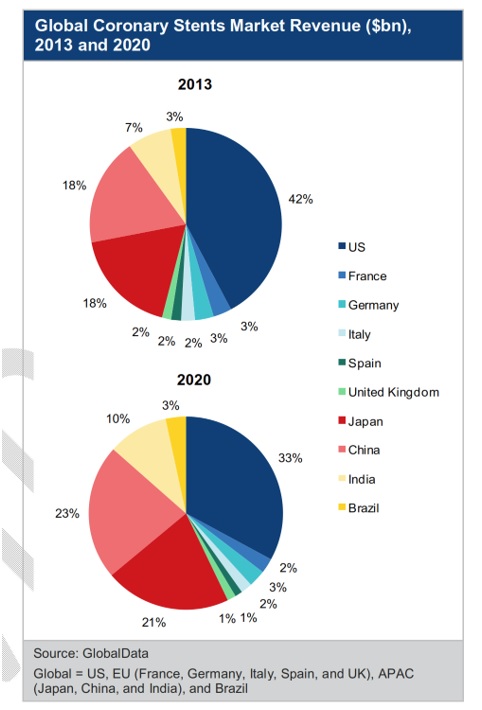
There is a lot of money to be made with cardiac stents by hospitals, cardiologists, drug companies, and of course, medical device manufacturers. (Figure 1) The first stents não farmacológicosAn uncoated metal mesh tube implanted inside a coronary artery to hold it open; unlike drug-eluting stents, it carries no medication and has a higher tendency to become re-blocked by overgrowth of arterial tissue (neointimal hyperplasia). were invented in 1986 and FDA approved in 1992 while in 2003 the first drug-eluting stent was approved.[1, 2] According to iData Research, approximately 1,000,000 stents a year are inserted into artérias coronáriasAs artérias coronárias são os pequenos vasos que envolvem a parte externa do seu coração e alimentam o próprio músculo cardíaco. in the United States alone.[3](Figure 2) Stents are a $5 billion industry annually, according to GlobalData.[4](Figure 3) Between 2000 and 2006, a world record, as reported by the Guinness Book of World Records, was set with 34 cardiac stents placed in Emil Lohan’s heart. [5][/vc_column_text][vc_column_text]


[/vc_column_text][vc_column_text]
Understanding Cardiac Stents
What are stents anyway?
Stents are tiny metal scaffoldings that are used to force open narrow atherosclerotic arteries. (Figure 4) Many improvements in stent technology have been made over the years. As of 2018, we are on our fourth generation of stents. The metal scaffolding mesh has gotten narrower, which promotes the growth of a monolayer of endotélioO endotélio é o revestimento ultrafino e escorregadio no interior de cada vaso sanguíneo. Ele tem a espessura de apenas uma célula. (endothelializationThe process by which a single layer of endothelial cells grows to cover the inner surface of a stent, restoring a natural lining to the artery wall and reducing the risk of clot formation on the exposed metal.) or the ability for the arterial tissue to cover up the metal stent. This is necessary for healthy blood flow in the artériaUma artéria é um vaso sanguíneo que transporta o sangue do coração para o resto do corpo. and for preventing coágulos sanguíneosUm coágulo sanguíneo é um aglomerado de células sanguíneas e proteínas que se forma para parar o sangramento. forming in the stent, also called in-stent thrombosisThe formation of a blood clot inside a coronary stent, a potentially fatal complication that is more common with drug-eluting stents because the drug delays full coverage of the metal by endothelial cells..[6](Figure 5) These new stents are also more flexible to bend into tiny arteries, thereby facilitating placement. The most essential function of the drug is to prevent the stent from becoming clogged with the rapid overgrowth of arterial tissue, also known as neointimal hyperplasiaThe rapid overgrowth of smooth muscle and endothelial tissue inside an artery after stent placement, which can progressively narrow or completely re-block the vessel; it is the principal problem that drug-eluting stents were designed to prevent.; however, as seen in Figure 5, there is a significant trade-off for this protection with the increase of potentially deadly in-stent tromboseTrombose é um coágulo sanguíneo que se forma dentro de um vaso sanguíneo..[6] This is what happened to my younger brother, who died. Clots can also form in the stent due to incomplete appositionA condition in which a stent fails to make full contact with the artery wall after deployment, leaving gaps where blood can flow behind the stent struts and clots may form on surfaces that never become covered by endothelial cells. (the stent does not fully deploy or open) leaving a gap that may never endothelialize.


In the mid-80s, physicians used balloon angioplastyA catheter-based procedure in which a small balloon is inflated inside a narrowed coronary artery to compress the plaque and widen the vessel; widely used before stents were developed but limited by a high rate of the artery re-narrowing (restenosis) after the procedure. to expand the artery without using a stent. A tiny balloon at the end of a catheter was inflated to simply push the placaPlaca é o acúmulo de colesterol, células imunológicas, tecido cicatricial e cálcio dentro da parede de uma artéria. out of the way making the artery wider. This technique was less effective, and most arteries soon returned to their previous diameter or worse; therefore stents are now used. Stents cannot be removed.[7] The newest technologies are bioabsorbable (the stent material is eventually degraded and absorbed by the body disappearing over time) and drug impregnated balloon angioplastiaA angioplastia é um procedimento no qual um pequeno balão é inflado dentro de uma artéria estreitada para desobstruir o bloqueio. Geralmente, um stent é deixado no local para mantê-la aberta.. The results of these techniques are approaching that of modern stents but have not yet proved superior.[7] However, their advantage is that no permanent structure is left in the artery. They coat the inside of the artery with an agent similar to the drug-eluting stents. The drug sticks to the artery wall facilitating the patency (openness) of the artery.
Years before the development of drug-eluting stents, bare-metal stents were the only type on the market. The older bare-metal stents had a tendency for generating overgrowth of arterial tissue endothelium (neointimal hyperplasia) around them clogging the artery. [6][7] This occurs most often in smaller arteries and with diabetic patients- which is what happened to my father. The newest drug-eluting stents use much narrower scaffolding and have a polymer coating the metal. The polymer is impregnated with a chemical (usually a chemotherapy agent like paclitaxel or everolimus) that prevent overgrowth of tissue around the stent that can sometimes block the artery. The drug elution usually lasts only a few weeks.
Newest Generation Stents
The newest stents on the market have a dissolvable polymer, so after a few months, the drug goes away, and the polymers coating then resorbs to allow bare- metal underneath the tissue. This is advantageous because the polymer coating on earlier models tended to cause dysfunction in the endothelial tissue surrounding the stent and may cause blood clots to form. It seems that the metal itself does not have the effect of disrupting the função endotelialA capacidade do revestimento interno dos vasos sanguíneos de regular o tônus vascular, a inflamação e a coagulação; células endoteliais saudáveis liberam óxido nítrico para manter as artérias relaxadas e resistentes à formação de placas. once the tissue has fully endothelialized. The newest 4th generation stents with dissolvable polymers have a much lower rate of in-stent thrombosis or clotting.
An unforeseen side effect of the drug-eluting stents is that they still have a higher probability of having a clot form in and around the stent.[6](Figure 5) Even though the side-effect of tissue overgrowth has been virtually eliminated, the prospect of in-stent thrombosis is an incessant danger-so, there is some trade-off. Unfortunately, anybody that has a stent must be on terapia antiplaquetária for life, usually in the form of aspirinaA aspirina torna as plaquetas sanguíneas menos pegajosas, de modo que é menos provável que se formem coágulos., but dual antiplatelet therapy, which is typically a combination of Clopidogrel and aspirin, is needed to stop clots from forming especially when the stent is new. The most recent guidelines are for about 6 months for dual antiplatelet therapy, but there is increased risk of dangerous bleeding with this therapy (including aspirin monotherapy), so there is some long-term concern for stents from the perspective of anticoagulation therapy.
The Consensus
Evidence has mounted over the years, and the consensus is that there is no advantage for having a stent if a person is currently having an síndrome coronariana agudaSíndrome coronariana aguda (SCA) é o termo guarda-chuva para qualquer queda repentina no fluxo sanguíneo para o coração — desde a angina instável até um ataque cardíaco completo — causada pela ruptura ou erosão súbita de uma placa., otherwise known as a heart attack. In 2009 the Estudo COURAGEThe Clinical Outcomes Utilizing Revascularization and Aggressive Drug Evaluation trial randomized 2,287 patients with stable coronary artery disease to PCI plus optimal medical therapy or medical therapy alone, finding no significant difference in death or heart attack rates over up to 15 years of follow-up. determined that there was no advantage to stents vs. optimal medical therapy (using best class drugs). [8]
Following up in 2017, the ORBITA trialA randomized, sham-controlled clinical trial completed in 2017 that compared coronary stenting with a placebo procedure in patients with stable angina and found no significant difference in exercise tolerance or symptom relief between the two groups. was completed, which should have been the nail in the coffin for most stent procedures. ORBITA clearly demonstrated when patients were given a stent or a procedure mimicking stent (sham procedure), there was no evidence of a difference for exercise tolerance or symptoms like chest pain. ORBITA the first placebo-controlled trial ever done! The overarching message is that unless you are having a heart attack, stents show no improvement over medical therapy.
A 2015 update in JAMA (Journal of the American Medical Association) concluded that nearly 80% of all cardiac stents procedures were initially unwarranted according to the current guidelines. [9] Here is a quote from the study authors:
“This systematic review reaffirms the absence of scientific evidence for an initial strategy of PCI[ percutaneous intervention- aka stent] in stable CAD [coronary artery disease]. Despite the evidence, PCI is still commonly used as initial treatment of patients with stable CAD who are asymptomatic or have stable angina and are not on optimal medical therapy. The continued use of PCI for the initial treatment of an obstructive epicardial stenosis reflects persistent adherence to the belief that the epicardial obstruction is the proximate cause of death, myocardial infarction, and angina in stable CAD. However, when the data does not support the existing paradigm, a new paradigm Clinical Review & Education must be formulated to reflect the scientific data and inform practice.”
What Does It All Mean?
Essentially they are saying the medical community is lagging behind the science and physicians just keep stenting patients unnecessarily – AND this is before the ORBITA study came out showing that most of the benefit for stents is from the placeboUm placebo é um tratamento falso — uma pílula de açúcar ou uma injeção de solução salina — administrado para que os pesquisadores possam determinar o que um medicamento real realmente faz. effect…bottom line, not enough reason to have this dangerous invasive procedure before all other avenues are explored.
Interestingly, no study, to date, has looked at both the combination of dieta baseada em vegetais inteirosA whole food plant-based diet is built from vegetables, fruit, beans, whole grains, nuts, and seeds, with animal products and processed foods largely removed. combined with optimal medical therapy. Dean Ornish, Satish Gupta, and Caldwell Esselstyn have all revealed remarkable cardiac benefits of low-fat whole food plant based diet alone or in combination with other lifestyle changes lowered anginaAngina is chest discomfort that happens when the heart muscle isn't getting enough oxygen. People describe it as pressure, tightness, squeezing, or burning, and it can spread to the arm, neck, or jaw. or chest pain in over 90% of patients, decreased plaque in arteries and reducing heart attacks. [10-12] Work needs to be done on combing these interventions with drug therapy.
This is precisely what I’ve done – combining the best of both worlds – showing a rapid reversãoO estudo REVERSAL comparou a terapia com estatinas moderada e intensiva, utilizando ultrassom intravascular para medir o que aconteceu com a placa coronariana. de doença arterial coronarianaA doença arterial coronariana é o acúmulo de placas nas artérias que irrigam o músculo cardíaco. and a substantial increase in exercise performance.
- Sigwart, U., et al., Intravascular stents to prevent oclusãoOcclusion is the partial or complete blockage of a blood vessel, preventing normal blood flow; a coronary occlusion reduces or cuts off oxygen delivery to the heart muscle supplied by that artery. and restenosis after transluminal angioplasty. N Engl J Med, 1987. 316(12): p. 701-6.
- Serruys, P.W., M.J. Kutryk, and A.T. Ong, Coronary-artery stents. N Engl J Med, 2006. 354(5): p. 483-95.
- https://idataresearch.com/over-1-8-million-stents-implanted-per-year-in-the-u-s/.
- https://www.marketresearch.com/product/sample-8538829.pdf.
- http://www.guinnessworldrecords.com/world-records/most-coronary-stent-implants.
- Jakabcin, J., et al., The lack of endothelization after drug-eluting stent implantation as a cause of fatal late stent thrombosis. J Thromb ThrombolysisThrombolysis is the use of clot-dissolving drugs — sometimes called 'clot busters' — to break up the coronary artery blockage causing a heart attack, restoring blood flow to the heart muscle. It was one of the key rescue therapies that reduced heart-attack mortality in the latter decades of the twentieth century., 2008. 26(2): p. 154-8.
- Buccheri, D., et al., Understanding and managing in-stent restenosis: a review of clinical data, from pathogenesis to treatment. J Thorac Dis, 2016. 8(10): p. E1150-E1162.
- Maron, D.J., et al., Impact of an initial strategy of medical therapy without percutaneous coronary intervention in high-risk patients from the Clinical Outcomes Utilizing RevascularizaçãoRevascularization is a medical or surgical procedure—such as coronary artery bypass grafting or percutaneous coronary intervention—performed to restore blood flow through a blocked or narrowed coronary artery, addressing the physical obstruction rather than the underlying atherogenic process. and Aggressive DruG Evaluation (COURAGE) trial. Am J Cardiol, 2009. 104(8): p. 1055-62.
- Mitchell, J.D. and D.L. Brown, Update on Percutaneous Coronary Intervention in Stable Coronary Artery Disease. JAMA Intern Med, 2016. 176(12): p. 1855-1856.
- Gupta, S.K., et al., Regression of coronary ateroscleroseA aterosclerose é a doença por trás da maioria dos ataques cardíacos e de muitos acidentes vasculares cerebrais. Partículas de colesterol ficam presas na parede de uma artéria, o corpo envia células imunológicas para limpar e, ao longo dos anos, essa bagunça endurece, transformando-se em placa. through healthy lifestyle in coronary artery disease patients–Mount Abu Open Heart Trial. Indian Heart J, 2011. 63(5): p. 461-9.
- Esselstyn, C.B., Jr., Updating a 12-year experience with arrest and reversal therapy for doença cardíaca coronarianaA doença arterial coronariana é o estreitamento ou bloqueio das artérias que fornecem sangue para o músculo cardíaco, causado pelo acúmulo de placa aterosclerótica; é a principal causa de ataque cardíaco e morte cardíaca em todo o mundo. (an overdue requiem for palliative cardiology). Am J Cardiol, 1999. 84(3): p. 339-41, A8.
- Ornish, D., et al., Intensive lifestyle changes for reversal of coronary heart disease. JAMA, 1998. 280(23): p. 2001-7.