
Resultados Clínicos, Fisiológicos e Fisiopatológicos Comparativos das Modalidades de Revascularização e da Medicina de Estilo de Vida Intensiva na Doença Arterial Coronariana Aterosclerótica
Resumo
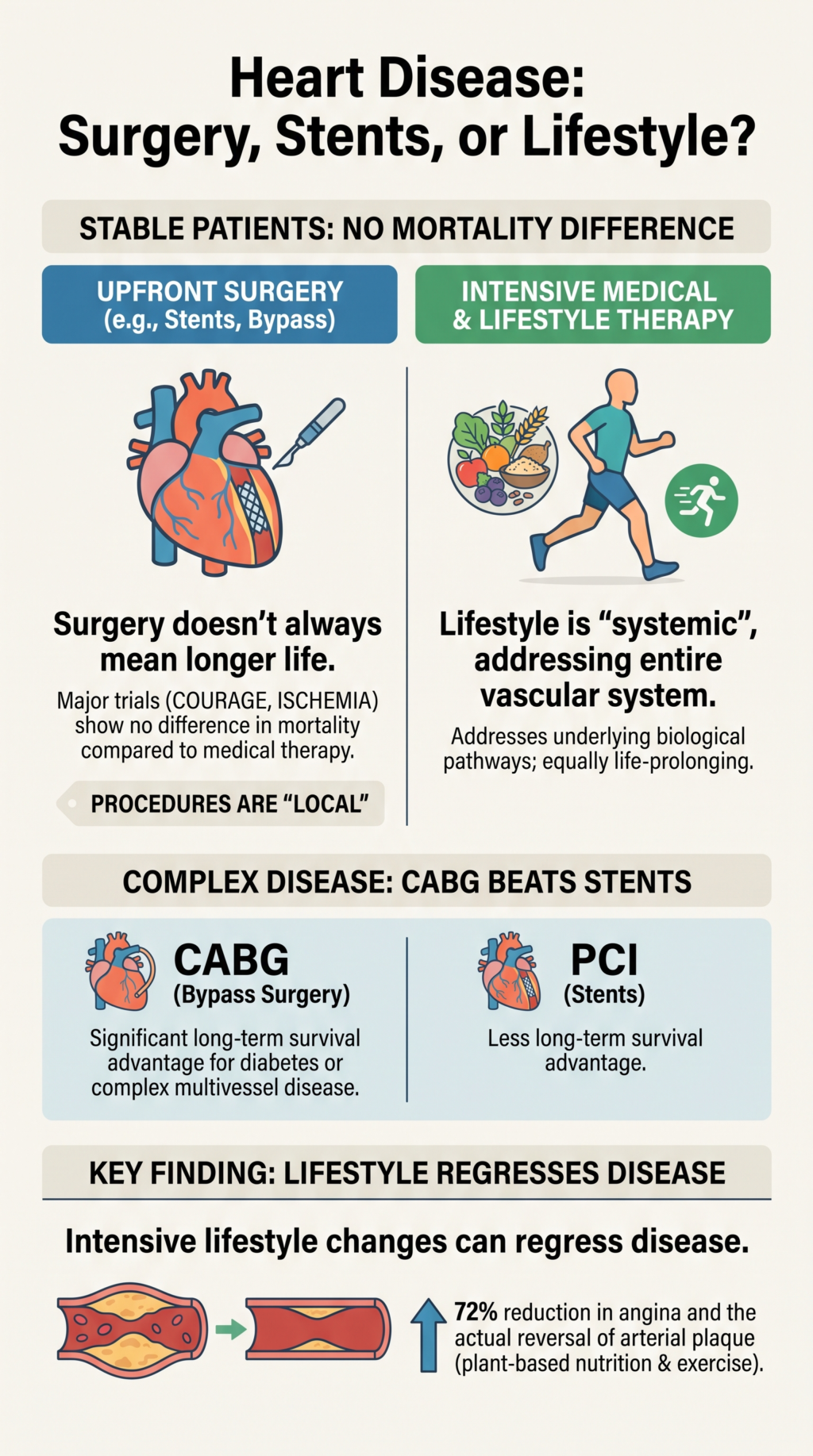
Nas últimas duas décadas, evidências de ensaios clínicos randomizados reformulou o manejo das síndromes coronarianas estáveis (crônicas), passando de um paradigma reflexivamente intervencionista para um em que a terapia clínica direcionada por diretrizes e a modificação intensiva do estilo de vida são reconhecidas como estratégias centrais de manejo em muitos pacientes com doença estável. Esta revisão sintetiza as evidências comparativas de longo prazo em três domínios terapêuticos: (1) inicial revascularização versus terapia médica para pacientes estáveis doença arterial coronariana; (2) comparações diretas de intervenção coronária percutânea (ICP) e cirurgia de revascularização miocárdica (CRM); e (3) terapia intensiva de estilo de vida, incluindo nutrição baseada em vegetais integrais, como tratamento primário e adjuvante. Em COURAGE, Isquemia, FAME 2 e MASS II, a revascularização de rotina na doença estável não reduz mortalidade por todas as causas em relação à terapia médica ideal, embora melhore angina e reduz a revascularização urgente. Em doença multiarterial anatomicamente complexa e diabética, a cirurgia de revascularização miocárdica (CRM) confere uma vantagem de sobrevivência a longo prazo sobre a ICP. Intervenções intensivas no estilo de vida demonstram reduções na angina, marcadores inflamatórios e, em coortes selecionadas, regressão angiográfica de doença. Alegações de reduções específicas do estilo de vida na restenose intra-stent ou stent trombose não são apoiadas por dados primários revisados por pares e são explicitamente identificadas como tal. As recomendações são mapeadas para as diretrizes da ACC/AHA e da ESC citadas nesta revisão.
1. Resultados Clínicos Comparativos de Longo Prazo de Estratégias de Tratamento Primário
O manejo da doença coronariana crônica estável mudou substancialmente nas últimas duas décadas. Historicamente, uma lesão epicárdica limitadora de fluxo estenose foi vista como uma indicação para revascularização mecânica para prevenir infarto do miocárdio e prolongar a vida. Dados de ensaios clínicos randomizados modernos, em vez disso, estabeleceram amplo equilíbrio clínico entre a revascularização inicial e o manejo conservativo com terapia médica guiada por diretrizes para a maioria dos pacientes com doença estável.
1.1 CORAGEM
O estudo clínico COURAGE (Clinical Outcomes Utilizing Revascularization and Aggressive Drug Evaluation) randomizou 2.287 pacientes com doença coronariana estável artéria doença (DAC) e evidência objetiva de isquemia miocárdica para intervenção coronária percutânea (ICP) mais tratamento médico ideal ou apenas ao TMO. Em um seguimento mediano de 4,6 anos, não houve diferença estatisticamente significativa no desfecho primário endpoint composto de mortalidade por todas as causas ou infarto do miocárdio (IM) não fatal.1] A inclusão ocorreu de 1999 a 2004 usando predominantemente stents não farmacológicos e sem rotina reserva de fluxo fracionado (FFR) orientação, limitações frequentemente citadas por críticos; a doença coronariana multivascular esteve presente em aproximadamente dois terços dos participantes.1]
O acompanhamento prolongado da sobrevida da coorte COURAGE, realizado em um subconjunto de 1.211 pacientes (aproximadamente 53%, provenientes em grande parte do sistema do Departamento de Assuntos dos Veteranos dos EUA) ao longo de uma mediana de 11,9 anos e se estendendo até 15 anos, confirmou a persistência desse equilíbrio. Não houve diferença estatisticamente significativa na mortalidade por todas as causas, com um valor ajustado razão de riscos (HR) para morte de 1,03 (IC 95% 0,83–1,21). [2As curvas de sobreposição permaneceram essencialmente superpostas ao longo do seguimento.
1.2 ISQUEMIA
O estudo International Study of Comparative Health Effectiveness with Medical and Invasive Approaches (ISCHEMIA) abordou as críticas tecnológicas do COURAGE ao exigir a prática contemporânea. O ISCHEMIA randomizou 5.179 pacientes com DAC estável e isquemia moderada a grave em testes estresse não invasivos para uma estratégia invasiva inicial (angiografia seguida de ICP com stents farmacológicos [DES] ou CRM, mais OMT) ou uma estratégia conservadora inicial de OMT isolada. [3Durante um seguimento mediano de 3,2 anos, o desfecho primário de cinco componentes (morte cardiovascular, IAM ou hospitalização por angina instável, insuficiência cardíaca, ou ressuscitado parada cardíaca) não diferiram significativamente entre os grupos. [3]
1.3 ISCHEMIA-EXTEND
A extensão observacional, ISCHEMIA-EXTEND, acompanhou os participantes sobreviventes por uma mediana de 5,7 anos (e até 7 anos), registrando 557 óbitos — quase o dobro do número observado na fase inicial. A mortalidade cumulativa por todas as causas em sete anos foi de 12,7% no braço invasivo e de 13,4% no braço conservador (HR ajustado 1,00; IC 95% 0,85–1,18). [4]
Observou-se uma divergência entre os componentes da mortalidade. A estratégia invasiva foi associada a uma redução relativa estatisticamente significativa da mortalidade cardiovascular em 7 anos (6,4% vs. 8,6%; HR ajustado 0,78; IC 95% 0,63–0,96), correspondendo a uma diferença absoluta de 2,2 pontos percentuais na mortalidade cardiovascular em 7 anos. Esse benefício foi compensado por um aumento estatisticamente significativo na mortalidade não cardiovascular no grupo invasivo (5,6% vs. 4,4%; HR ajustado 1,44; IC 95% 1,08–1,91), e o efeito líquido sobre a sobrevida global foi neutro. [4]
Duas ressalvas se aplicam. Esses achados de mortalidade específica por causa foram obtidos durante um acompanhamento prolongado observacional coletado após o término da fase randomizada, portanto, eles geram hipóteses, em vez de serem comparações randomizadas. Além disso, a base biológica para o sinal de mortalidade não cardiovascular permanece inexplicada e não adjudicada.4]
1.4 FAME 2
O estudo Fractional Flow Reserve Versus Angiography for Multivessel Evaluation 2 (FAME 2) comparou a ICP guiada por FFR mais OMT com OMT isolada em pacientes com DAC estável e estenoses fisiologicamente significativas (FFR ≤ 0,80); 1.220 pacientes foram incluídos e 888 com pelo menos uma significativa lesão foram randomizados.5] Ao fim de 5 anos, o desfecho composto primário, que incluiu morte, infarto do miocárdio ou revascularização urgente, foi significativamente menor com a ICP guiada por FFR (13,9% vs. 27,0%; HR 0,46; IC 95% 0,34–0,63; P < 0,001), uma diferença impulsionada predominantemente pela revascularização urgente, sem diferença estatisticamente significativa na mortalidade ou no infarto do miocárdio, individualmente. [6]
Posteriormente, foi relatado um acompanhamento de dez anos (mediana de 11,2 anos), que foi analisado utilizando um modelo de razão de ganho. O desfecho primário composto favoreceu a estratégia de ICP (índice de vantagem de 1,25; IC 95% 1,01–1,56; P = 0,043), mais uma vez impulsionado de forma esmagadora pelas reduções na revascularização urgente (índice de vantagem do componente 4,57; IC 95% 2,53–8,24), enquanto o componente de mortalidade não favoreceu a ICP. [7Portanto, o sinal durável do FAME 2 é uma redução na revascularização urgente subsequente, em vez de uma redução estatisticamente significativa na mortalidade ou no infarto do miocárdio espontâneo.
1.5 MISSA II
O Segundo Médico, Angioplastia, ou Surgery Study (MASS II) randomizou 611 pacientes com DAC multiarterial estável e preservada fração de ejeção do ventrículo esquerdo em comparação com a cirurgia de revascularização do miocárdio (CRM), a intervenção coronária percutânea (ICP) ou apenas a terapia médica. Após 10 anos, a sobrevida por todas as causas foi estatisticamente semelhante entre os grupos: 74,9% com CABG, 75,1% com ICP e 69,0% com terapia médica (P = 0,089). [8] A terapia médica foi associada a uma maior incidência cumulativa de infarto do miocárdio em 10 anos (20,7% vs. 10,3% com cirurgia de revascularização do miocárdio e 13,3% com ICP; P < 0,010). A revascularização adicional durante o acompanhamento foi menor após a cirurgia de revascularização do miocárdio (7,41 TP9T) e elevada tanto após a ICP (41,91 TP9T) quanto após a terapia médica (39,41 TP9T; P < 0,001), refletindo a vantagem da revascularização cirúrgica em termos de durabilidade, no que diz respeito à ausência de procedimentos repetidos. [8]
Tabela 1. Ensaios clínicos de estratégia de tratamento primário: revascularização versus terapia clínica na DAC estável.
| Avaliação | Coorte / comparação | Acompanhamento | Principais descobertas |
| CORAGEM | N = 2.287; DAC estável com isquemia; ICP + TMO vs. TMO | 4,6 a; subconjunto para 15 a | Nenhuma diferença significativa em morte/infarto do miocárdio em 4,6 anos.
Estendido (mediana 11,9 anos): HR ajustado para morte 1,03 (0,83–1,21). |
| Isquemia | N = 5.179; isquemia moderada a grave; invasivo vs. conservador | 3,2 a | Nenhuma diferença significativa no desfecho primário de 5 componentes. |
| ISCHEMIA-EXTEND | Mesma coorte; extensão observacional | 5,7 a (7 anos) | Mortalidade por todas as causas em 7 anos: 12,71 TP9T vs. 13,41 TP9T (HR ajustado 1,00; ARD 0,7 pp).
Morte cardiovascular: 6,41 TP9T vs. 8,61 TP9T (HR 0,78; ARD 2,2 pp); mortalidade não cardiovascular 5,6% vs. 4,4% (HR 1,44); resultado líquido neutro (observacional). |
| FAME 2 | N = 1.220; FFR ≤ 0,80; ICP guiada por FFR vs. OMT | 5 a; 10 a (mediana 11,2 a) | Índice composto em 5 anos: 13,91 TP9T vs. 27,01 TP9T (HR 0,46; ARD 13,1 pp), impulsionado pela revascularização de urgência.
taxa de vitória em 10 anos de 1,25; nenhuma redução significativa na mortalidade ou IAM. |
| MISSA II | N = 611; multiarterial, FE preservada; CRM vs. ICP vs. MT | 10 a | Sobrevivência em 10 anos: 74,91 TP9T / 75,11 TP9T / 69,01 TP9T (P = 0,089).
O MI foi menor na cirurgia de revascularização do miocárdio (10,31 TP9T) em comparação com a ICP (13,31 TP9T) e com o tratamento médico (20,71 TP9T). |
TMO, tratamento médico ideal; TM, tratamento médico; FE, fração de ejeção; HR, razão de risco (IC 95% entre parênteses); ARD, risco absoluto diferença entre os braços comparados (pontos percentuais).
2. Modalidades de Revascularização: Análises Comparativas Diretas
Para pacientes com doença arterial coronariana (DAC) anatomicamente complexa ou multivascular, a escolha da modalidade de revascularização é consequente. Vários grandes ensaios clínicos randomizados e seus seguimentos prolongados compararam diretamente a ICP com o uso de stents farmacológicos contemporâneos com a CRM.
2.1 SINTAXE / SINTAXES
O estudo SYNTAX (The Synergy Between PCI with TAXUS and Cardiac Surgery) randomizou 1.800 pacientes com doença coronariana triarterial de novo (3VD) ou doença de tronco da artéria coronária esquerda (LMCAD) para ICP com stents farmacológicos de paclitaxel de primeira geração ou para cirurgia de revascularização miocárdica (CRM). [9] No estudo SYNTAX Extended Survival (SYNTAXES), com duração de 10 anos, a mortalidade global por todas as causas não apresentou diferença significativa entre os grupos (27% com ICP vs. 24% com CRM; P = 0,092), mas observou-se uma interação significativa entre o tratamento e a anatomia. Na coorte 3VD, a cirurgia de revascularização do miocárdio (CRM) conferiu uma vantagem de sobrevivência (mortalidade de 28% com ICP versus 21% com CRM), enquanto na coorte LMCAD não houve diferença estatisticamente significativa (26% com ICP vs. 28% com CRM; P para interação = 0,019). [10]
A completeza da revascularização foi um determinante da sobrevivência a longo prazo: a revascularização incompleta foi mais comum após ICP do que após cirurgia de revascularização miocárdica (CRM), e os pacientes submetidos à ICP com revascularização incompleta apresentaram maior mortalidade em 10 anos do que aqueles submetidos à CRM com revascularização completa. [10]
2.2 LIBERDADE
The Future Revascularization Evaluation in Patients with Diabetes O estudo FREEDOM randomizou 1.900 pacientes com diabetes e DAC multiarterial para ICP com stent farmacológico de primeira geração ou para cirurgia de revascularização miocárdica (CRM), tendo como base a terapia médica otimizada (TMO). Em 5 anos, o desfecho primário composto de morte, IAM ou acidente vascular cerebral foi significativamente menor com a cirurgia de revascularização do miocárdio (CABG) (18,7% vs. 26,6%; P = 0,005), impulsionado por reduções na mortalidade por todas as causas (10,9% vs. 16,3%) e no infarto do miocárdio (6,0% vs. 13,9%; P < 0,001). O AVC foi mais frequente no grupo da CABG (5,2% vs. 2,4%; P = 0,03). [11]
No estudo FREEDOM Follow-On, um subgrupo de 943 pacientes foi acompanhado por uma mediana de 7,5 anos (até 13,2 anos). A cirurgia de revascularização do miocárdio (CABG) manteve uma vantagem em termos de sobrevida, com mortalidade por todas as causas de 18,3% contra 24,3% com a ICP (HR 1,36; IC 95% 1,07–1,74; P = 0,01). [12]
2.3 Doença do Tronco da Coronária Esquerda: PRECOMBAT, EXCEL e NOBLE
O estudo PRECOMBAT, com duração de 10 anos, randomizou 600 pacientes com LMCAD para ICP com stents liberadores de sirolimus ou para CRM. Não houve diferenças estatisticamente significativas no desfecho primário composto por eventos adversos cardíacos ou cerebrovasculares graves (MACCE; 29,8% com ICP vs. 24,7% com CABG; HR 1,25; IC 95% 0,93–1,69), na mortalidade por todas as causas (14,5% vs. 13,8%; HR 1,13; IC 95% 0,75–1,70) ou no desfecho composto “hard” de morte, infarto do miocárdio ou acidente vascular cerebral (18,2% vs. 17,5%). A revascularização do vaso-alvo motivada por isquemia foi aproximadamente duas vezes maior após a ICP (16,1% vs. 8,0%; HR 1,98; IC 95% 1,21–3,21). [13]
O estudo “Avaliação do XIENCE versus CABG quanto à eficácia da revascularização do tronco principal esquerdo (EXCEL)” randomizou 1.905 pacientes com LMCAD de complexidade anatômica baixa ou intermediária para ICP com stents liberadores de everolimus ou para CABG. Após 5 anos, o desfecho primário composto por morte, acidente vascular cerebral ou infarto do miocárdio não apresentou diferença significativa (22,0% com ICP vs. 19,2% com CRM; P = 0,13). A mortalidade por todas as causas foi maior no grupo de ICP (13,0% versus 9,9%; razão de chances 1,38; IC 95% 1,03–1,85), um achado que foi contestado, pois a mortalidade cardiovascular não apresentou diferença significativa (5,0% vs. 4,5%). [14]
Os resultados do estudo EXCEL geraram polêmica substancial. Grande parte da divergência centrou-se na definição de infarto do miocárdio utilizada para adjudicar os eventos: a definição do protocolo do estudo enfatizava o período pós-procedimento biomarcador limiares, enquanto os críticos argumentavam que a aplicação da Terceira Definição Universal de IAM teria alterado a contagem relativa de IAM entre os braços e, com ela, a interpretação do desfecho primário composto. A ponderação entre IAM periprocedimento versus espontâneo, e como esses eventos se refletem no prognóstico a longo prazo, continuaram sendo o cerne da disputa.14], [15]
O Estudo Nórdico-Báltico-Britânico de Revascularização da Artéria Principal Esquerda (NOBLE) randomizou 1.201 pacientes com LMCAD para ICP com stents liberadores de biolimus ou para CRM. Na análise atualizada, a ICP foi associada a piores resultados de MACCE em 5 anos do que a CABG (28,41 TP9T vs. 19,01 TP9T; HR 1,58; IC 95% 1,24–2,01; P = 0,0002), impulsionado por taxas mais elevadas de infarto do miocárdio não relacionado ao procedimento (7,6% vs. 2,7%) e revascularização repetida (17,1% vs. 10,2%). A mortalidade por todas as causas não apresentou diferença significativa entre os grupos. [16], [17]
2.4 MELHOR
A Comparação Aleatória de Cirurgia de ponte de safena O estudo Versus Everolimus-Eluting Stent Implantation for Multivessel Coronary Artery Disease (BEST) randomizou 880 pacientes para ICP com stents eluidores de everolimus ou para cirurgia de revascularização do miocárdio (CRM). Em um acompanhamento mediano prolongado de 11,8 anos, o desfecho primário — morte, infarto do miocárdio ou revascularização do vaso-alvo — ocorreu em 34,5% do grupo de ICP e em 30,3% do grupo de CRM (HR 1,18; IC 95% 0,88–1,56; P = 0,26). A mortalidade por todas as causas (20,5% vs. 19,9%) e o acidente vascular cerebral (5,3% vs. 5,7%) foram semelhantes, mas a revascularização repetida permaneceu mais elevada após a ICP (22,6% vs. 12,7%; HR 1,92; P < 0,001), e o infarto do miocárdio espontâneo foi mais frequente após a ICP. [18], [19]
2.5 FAME 3
O estudo FAME 3 randomizou 1.500 pacientes com DAC triarterial para ICP guiada por FFR com stents elutores de zotarolimus ou para CRM. Ele não atingiu sua margem pré-especificada de não inferioridade em 1 ano para o desfecho composto de morte, IAM, AVC ou nova revascularização. [20] Ao terceiro ano, o desfecho composto por morte, infarto do miocárdio ou acidente vascular cerebral não apresentou diferença significativa (12,0% com ICP vs. 9,2% com CRM; HR 1,30; IC 95% 0,98–1,83; P = 0,07), embora o infarto do miocárdio (7,0% vs. 4,2%) e a revascularização repetida (11,1% vs. 5,9%) tenham sido maiores após a ICP, enquanto a mortalidade por todas as causas foi semelhante. [21]
Tabela 2. Estudos comparativos diretos de ICP versus RM (seguimento prolongado, quando disponível).
| Avaliação | Foco | Mortalidade (ICP vs. CRM) | Durabilidade / segurança |
| SINTAXES | 3VD ou LMCAD (1.800) | 10 anos: 27% vs. 24% (P = 0,092; ARD 3 pp).
3VD: 28% x 21% (ARD 7 pp). LMCAD: 26% x 28% (NS). |
A revascularização incompleta é mais comum após a ICP; está associada a uma maior taxa de mortalidade em 10 anos. |
| LIBERDADE | Diabetes + doença arterial coronariana multivascular (1.900) | 7,5 anos: 24,31 TP9T vs. 18,31 TP9T (HR 1,36; 1,07–1,74; ARD 6,0 pp). | MI em 5 anos: 13,91 TP9T vs. 6,01 TP9T; incidência de AVC mais elevada com a cirurgia de revascularização do miocárdio (5,21 TP9T vs. 2,41 TP9T). |
| PRÉ-COMBATE | LMCAD (600) | 10 anos: 14,51 TP9T contra 13,81 TP9T (HR 1,13; 0,75–1,70; ARD 0,7 pp). | TVR induzida por isquemia 16,1% vs. 8,0% (HR 1,98). |
| EXCEL | LMCAD, complexidade baixa/intermediária (1.905) | 5 anos: 13,01 TP9T vs. 9,91 TP9T (OR 1,38; 1,03–1,85; ARD 3,1 pp). | Índice composto 22,0% vs. 19,2% (P = 0,13); revascularização 16,9% vs. 10,0%. |
| NOBLE | LMCAD (1.201) | A mortalidade por todas as causas não apresentou diferença significativa. | MACCE em 5 anos: 28,4% vs. 19,0% (HR 1,58; P = 0,0002; ARD 9,4 pp); IM não relacionado a procedimentos: 7,6% vs. 2,7%. |
| MELHOR | Multivascular (880) | 11,8 anos: 20,51 TP9T vs. 19,91 TP9T (P = 0,86; ARD 0,6 pp). | Compósito primário: 34,51 TP9T vs. 30,31 TP9T (HR 1,18; P = 0,26); revascularização repetida: 22,61 TP9T vs. 12,71 TP9T. |
| FAME 3 | 3VD (1.500) | A mortalidade por todas as causas em 3 anos foi semelhante. | Morte/infarto do miocárdio/acidente vascular cerebral em 3 anos: 12,01 TP9T vs. 9,21 TP9T (HR 1,30; P = 0,07; ARD 2,8 pp); infarto do miocárdio: 7,01 TP9T vs. 4,21 TP9T. |
TVR, revascularização do vaso-alvo; OR, razão de chances; MACCE, eventos cardíacos ou cerebrovasculares adversos graves; NS, não significativo; ARD, diferença de risco absoluto entre os grupos comparados (pontos percentuais).
3. Evidências clínicas sobre a nutrição à base de alimentos integrais de origem vegetal e a terapia intensiva de estilo de vida
Considerando que a revascularização e a farmacoterapia tratam lesões obstrutivas e fatores modificáveis fatores de risco, a terapia intensiva de estilo de vida modifica favoravelmente várias vias biológicas envolvidas em aterosclerose. Um conjunto limitado, mas influente, de evidências de estudos randomizados e observacionais corrobora seu papel na redução dos sintomas, na melhora dos biomarcadores e, em coortes selecionadas, na estabilização ou regressão angiográfica.
3.1 O Estudo Lifestyle Heart Trial
Ornish e seus colegas realizaram o Lifestyle Heart Trial, um pequeno ensaio clínico randomizado e controlado (48 pacientes; 28 no grupo experimental e 20 no grupo controle) que avaliou um programa abrangente composto por uma dieta de 10% de alimentos integrais dieta vegetariana, moderado exercício aeróbico, controle do estresse (incluindo ioga e meditação), tabagismo cessação do tabagismo e apoio psicossocial em grupo, sem o uso de medicamentos hipolipemiantes. [22]
Angiografia coronariana quantitativa de 195 lesões mostrou que, após 1 ano, a porcentagem média estenose diametral no grupo experimental, houve uma regressão de 40,01 TP9T para 37,81 TP9T, enquanto no grupo controle houve um avanço de 42,71 TP9T para 46,11 TP9T; grupo experimental Colesterol LDL caiu em cerca de 37%. [22] Após 5 anos, a divergência aumentou: a estenose no grupo experimental mediu 37,3% (a partir de um valor basal de 40,7% nessa análise) contra 51,9% nos controles (P = 0,001 entre os grupos), e uma relação direta entre adesão e o grau de regressão foi observado tanto ao longo de 1 quanto de 5 anos. [23] A frequência de crises de angina relatada diminuiu em 72% no grupo experimental, e a taxa de 5 anos risco relativo O risco de qualquer evento cardíaco foi 2,47 vezes maior no grupo controle (IC 95% 1,48–4,20). Tomografia por emissão de pósitrons após 5 anos, apresentou melhora perfusão miocárdica no grupo experimental e piora da perfusão no grupo de controle. [23]
3.2 As coortes de Esselstyn
Esselstyn investigou uma dieta rigorosa à base de alimentos integrais com 10–15% de gordura dieta à base de plantas (WFPBD), que exclui todos os produtos de origem animal e óleos adicionados, combinada com terapia hipolipemiante em baixa dosagem. Em um estudo inicial estudo longitudinal de pacientes com DAC em estado grave que, no total, sofreram 49 eventos cardíacos nos 8 anos anteriores à inclusão no estudo, os pacientes que aderiram ao tratamento alcançaram uma média de colesterol total redução de aproximadamente 246 mg/dL para 137 mg/dL, e nenhum deles apresentou um evento cardíaco recorrente ao longo dos 12 anos de acompanhamento; a angiografia serial realizada no subgrupo submetido ao exame demonstrou regressão em vários pacientes. [24], [25]
Um estudo subsequente não controlado estudo observacional acompanhou 198 voluntários consecutivos com diagnóstico confirmado de doença cardiovascular que receberam orientação para adotar uma dieta baseada em alimentos integrais (WFPBD); como os participantes se auto-selecionaram efetivamente em grupos aderentes e não aderentes, esse desenho de estudo não permite estabelecer causalidade. Ao longo de um acompanhamento médio de 3,7 anos, 177 dos 198 (89%) aderiram à dieta. Um evento cardiovascular grave recorrente ocorreu em 0,6% dos participantes aderentes (1 de 177, um único acidente vascular cerebral isquêmico), em comparação com 62% de participantes que não aderiram ao programa (13 de 21). [26] Considerando o pequeno subgrupo de pacientes não aderentes e a ausência de randomização, esses resultados servem mais para gerar hipóteses do que para fornecer conclusões definitivas.
3.3 EVADE CAD
Para avaliar os efeitos anti-inflamatórios e lipídicos de curto prazo em condições randomizadas, o estudo “Efeitos de uma Dieta Vegana em Comparação com a Dieta Recomendada pela AHA na Doença Arterial Coronariana” (EVADE CAD) randomizou 100 pacientes com doença arterial coronariana (DAC) definida por angiografia, em terapia médica orientada pelas diretrizes, para 8 semanas de uma dieta vegana à base de alimentos integrais de origem vegetal ou uma dieta recomendada pela AHA. O desfecho primário, proteína C-reativa de alta sensibilidade (PCR-us), foi 32% menor com a dieta vegana (IC 95% para a razão 0,47–0,94; P = 0,02). [27] Diferenças em LDL colesterol, marcadores glicêmicos e índice de massa corporal A diferença entre as dietas não atingiu significância estatística nesse curto intervalo. [27]
3.4 Reabilitação cardíaca intensiva
Tratamento intensivo ambulatorial reabilitação cardíaca programas que combinam exercícios estruturados com educação intensiva sobre nutrição e estilo de vida têm sido associados a melhorias na capacidade funcional, nos parâmetros antropométricos, perfis lipídicos, e a qualidade de vida relacionada à saúde nas coortes incluídas no estudo. Os efeitos comparativos sobre desfechos concretos, como mortalidade e readmissão hospitalar, estão menos claramente estabelecidos na literatura revisada por pares; as reduções relatadas nesses desfechos devem ser interpretadas com cautela até que haja dados de estudos controlados, e os números de marketing específicos dos programas não são considerados como evidência nesta revisão.
Tabela 3. Biomarcadores representativos e alterações fisiológicas observadas com a terapia intensiva de estilo de vida.
| Parâmetro | Linha de base | Pós-intervenção | Fonte / mecanismo |
| hs-CRP (inflamação) | 1,66 mg/L (grupo da dieta da AHA) | 1,13 mg/L (grupo vegano) | EVADE CAD [27]. Diferença randomizada entre os grupos às 8 semanas (≈32% a menos com a dieta vegana), e não uma variação intragrupo da linha de base até o pós-teste. |
| Colesterol total | ~246 mg/dL | ~137 mg/dL | Coortes de Esselstyn [24,25]. Reduzido colesterol dietético/gordura saturada; aumento da expressão do receptor de LDL no fígado. |
| Colesterol LDL | Linha de base | Redução de ~37% ao fim de 1 ano | Ornish 1 ano [22]. Redução da ingestão de gordura saturada. |
| Estenose do diâmetro (QCA) | 40.7% | 37,31 TP9T aos 5 anos | Ornish 5 anos [23]. Estabilização da placa/regressão. |
| Perfusão miocárdica | Déficits regionais | Melhoria aos 5 anos | PET de Ornish/Gould [23]. Melhoria da vasodilatação dependente do endotélio. |
| Frequência da angina | Alto | Redução do 72% aos 5 anos | Ornish 5 anos [23]. Melhoria da reatividade vascular e da perfusão. |
QCA, angiografia coronária quantitativa; PET, tomografia por emissão de pósitrons. Os valores foram extraídos dos estudos primários citados e diferem quanto à população e ao desenho.
4. Regressão da aterosclerose: evidências de que a doença coronariana pode ser revertida
Uma premissa central da abordagem conservadora e não intervencionista é que a aterosclerose não é uma doença inexoravelmente progressiva. Um conjunto consistente de evidências angiográficas e de imagens intravasculares demonstra que a aterosclerose coronariana pode ser retardada, interrompida e — em um grau mensurável — revertida com tratamento intensivo hipolipemiante e na modificação do estilo de vida. A magnitude da regressão é, em geral, modesta em termos absolutos, e seu principal valor clínico reside em placa na estabilização e na redução de eventos, em vez de na restauração em grande escala da lúmen; no entanto, a comprovação de que a doença é modificável é o que justifica a oferta de um tratamento adequado, envolvendo terapia médica e mudanças no estilo de vida, antes da realização de procedimentos invasivos eletivos em casos de doença estável. [1], [3]
4.1 Regressão pré-clínica e farmacológica
A possibilidade de regressão foi demonstrada pela primeira vez em modelos experimentais. Em primatas não humanos, a retirada do colesterol da dieta e outras intervenções para redução dos níveis de lipídios produziram uma redução mensurável das placas ateroscleróticas já formadas, comprovando que as lesões não são estruturas permanentes. [28] Estudos posteriores com primatas confirmaram que as lesões coronárias e carotídeas induzidas pela dieta podem regredir até atingirem o estado normal, embora levem mais tempo para isso do que as lesões em outros segmentos arteriais [29], e análises abrangentes da literatura sobre estudos com animais concluíram que regressão de placa é um fenômeno reproduzível em várias espécies. [30]
Os primeiros estudos angiográficos em humanos demonstraram, então, que a terapia hipolipemiante pode provocar regressão. No Estudo sobre a Redução do Colesterol e a Aterosclerose (CLAS), a terapia combinada com colestipol e niacina reduziu a progressão e aumentou a regressão das lesões coronárias nativas e das pontes de safena venosas em comparação com placebo. [31] Em pacientes com hipercolesterolemia familiar, os esquemas terapêuticos combinados que reduziram significativamente o colesterol LDL produziram regressão angiográfica das lesões coronárias. [32] Com o advento de estatinas de alta intensidade, o Estudo ASTEROID número de série usado ultrassom intravascular para demonstrar que a intensidade é muito alta rossuvastatina—alcançando um nível médio de colesterol LDL próximo a 60 mg/dL—regressão da doença coronariana ateroma, reduzindo volume percentual de ateroma ao longo dos segmentos medidos. [33] A angiografia quantitativa serial em estudos de hipolipemiantes também documentou uma regressão mensurável das lesões coronárias. [34] Uma síntese do Estudo sobre a Redução do Colesterol e a Aterosclerose (Cholesterol Lowering Atherosclerosis Study) e do Estudo sobre a Regressão Monitorada da Aterosclerose (MARS) concluiu que a redução dos níveis lipídicos pode interromper a progressão da doença e produzir regressão detectável por angiografia, ao mesmo tempo em que enfatizou que as variações absolutas no diâmetro do lúmen são pequenas em relação à redução concomitante dos eventos clínicos. [35]
O momento em que ocorre a regressão farmacológica foi sintetizado de forma sistemática. A revisão sistemática sobre a evolução temporal da regressão da placa revelou que, em estudos que documentaram a regressão com estatina Na terapia, observou-se uma regressão mensurável após uma média de aproximadamente 19,7 meses de tratamento, o que é consistente com um processo gradual de redução dos lipídios da placa e estabilização, em vez de um processo rápido reversão. [36] Como a regressão mensurável geralmente leva de muitos meses a cerca de dois anos, é necessário um período de tratamento adequado — e não breve — antes de se concluir que a terapia médica não conseguiu alterar o quadro da doença.
4.2 Regressão baseada no estilo de vida
Programas intensivos de mudança de estilo de vida também têm sido associados à regressão angiográfica. Conforme descrito na Seção 3, o estudo Lifestyle Heart Trial documentou uma regressão líquida da porcentagem de estenose do diâmetro no grupo de intervenção aos 1 e 5 anos, com progressão no grupo controle [22], [23], e as coortes de Esselstyn relataram regressão nos pacientes submetidos a exames de imagem que adotaram uma dieta baseada em alimentos vegetais integrais. [24], [26]
Uma série de estudos prospectivos realizados na Índia, que combinaram dieta, exercícios físicos e técnicas de controle do estresse baseadas na ioga, reforçou essas evidências. Um estudo randomizado conduzido por Manchanda e colegas constatou que uma intervenção baseada no estilo de vida da ioga, com duração de um ano, retardou a aterosclerose coronariana e reduziu os episódios de angina em pacientes com doença arterial coronariana (DAC) comprovada por angiografia. [37] O estudo prospectivo e controlado “Caring Heart Project” relatou regressão das lesões coronárias e melhora na perfusão miocárdica com um programa de estilo de vida baseado em ioga. [38] O Estudo Mount Abu Open Heart, um estudo aberto sobre uma dieta vegetariana abrangente com baixo teor de gordura, exercícios moderados e meditação Rajyoga, relatou que os pacientes mais aderentes ao protocolo apresentaram uma redução na estenose do diâmetro de aproximadamente 18 pontos percentuais absolutos e tiveram menos eventos cardíacos do que os menos aderentes. [39] Esses estudos são limitados pelo pequeno tamanho das amostras e, na maioria dos casos, por desenhos abertos ou não randomizados, e o benefício dependia fortemente da adesão; é melhor interpretá-los como dados de apoio e geradores de hipóteses, e não como conclusões definitivas.
4.3 Magnitude e interpretação clínica
Dois pontos relativizam e esclarecem essas evidências. Primeiro, a magnitude absoluta da regressão é modesta: estudos de imagem geralmente mostram pequenas reduções na porcentagem do volume de ateroma ou da estenose, e não uma reabertura total dos vasos ocluídos. Segundo, o benefício prognóstico da redução dos níveis lipídicos e da mudança no estilo de vida decorre menos do ganho luminal do que da estabilização da composição da placa — redução dos lipídios, diminuição da inflamação e uma estrutura mais robusta cápula fibrosa—o que reduz o risco de ruptura de placa e eventos clínicos. [36] No nível celular, a regressão reflete uma menor retenção de apolipoproteína Contendo B– lipoproteínas na parede arterial, a liberação de colesterol da placa e a remoção de resíduos necróticos por macrófagos—processos que dependem de uma melhora robusta e duradoura do perfil lipoproteico. [40] Entendida dessa forma, a regressão é um indicador de que a doença está sendo modificada; o objetivo clínico de uma estratégia inicial de tratamento médico e de estilo de vida em casos de doença estável é a redução de eventos e o controle dos sintomas, tendo a regressão e a estabilização como mecanismo subjacente. Revisões abrangentes da literatura sobre regressão chegam à mesma conclusão: com redução lipídica suficiente e sustentada, a aterosclerose pode ser interrompida e regredir parcialmente, embora o benefício clínico seja dominado pela estabilização da placa, em vez de um grande ganho luminal. [41]
Observação: Alguns relatos amplamente divulgados sobre uma “reversão” dramática não são considerados neste trabalho. O Estudo Indo-Mediterrâneo sobre Dieta e Coração, por exemplo, é objeto de uma declaração formal de preocupação publicada a respeito da confiabilidade de seus dados e, portanto, foi excluído desta síntese.
4.4 Terapia combinada dietética e farmacológica: estratégia complementar ou autônoma
As evidências de regressão se dividem em duas vertentes que, quando combinadas, se revelam mais eficazes. Programas intensivos de alimentação e estilo de vida e a farmacoterapia hipolipemiante reduzem, cada um à sua maneira, a carga aterogênica, mas por vias complementares; as maiores reduções nas lipoproteínas contendo apolipoproteína B — o principal fator impulsionador do crescimento da placa — são alcançadas quando a nutrição intensiva é combinada com terapia medicamentosa agressiva. O Estudo Lifestyle Heart Trial alcançou regressão apenas com mudança intensiva no estilo de vida, sem o uso de medicamentos hipolipemiantes [22], [23], enquanto o programa de Esselstyn combinava explicitamente uma dieta à base de alimentos vegetais integrais com medicamentos hipolipemiantes, tendo como meta um colesterol total inferior a 150 mg/dL e relatando a interrupção e a regressão seletiva da doença [24], [26], [42]. Os estudos de regressão farmacológica mostram qual é a contribuição da terapia medicamentosa por si só [31], [32], [33].
Seguem-se duas observações práticas. Primeiro, a abordagem combinada — alimentação à base de alimentos integrais de origem vegetal, juntamente com terapia hipolipemiante orientada por diretrizes (uma estatina de alta intensidade, com ezetimiba, ácido bempedoico, ou um Inibidor da PCSK9 (adicionada conforme necessário para atingir as metas de apolipoproteína B) — é a estratégia não intervencionista mais robusta para modificar o curso da doença e é valiosa como tratamento adjuvante após a revascularização. Em segundo lugar, na doença estável, essa mesma combinação pode servir como estratégia inicial autônoma, em substituição a um procedimento eletivo, reservando-se a revascularização para as indicações indicadas abaixo. A dieta não é apresentada aqui como uma alternativa à medicação, nem a medicação como uma alternativa à dieta; as evidências para interromper e reverter a doença são mais fortes quando ambas são utilizadas em conjunto.
4.5 Implicações: uma tentativa terapêutica inicial como primeira opção legítima na doença estável
Em conjunto com os estudos de desfecho das Seções 1 e 2, essas evidências redefinem o manejo inicial da doença coronariana estável. Como a revascularização de rotina não reduz a mortalidade nem o infarto do miocárdio na doença estável, e como a terapia médica intensiva e a modificação do estilo de vida podem interromper a progressão, estabilizar a placa, e fazer com que a doença regreda modestamente, um período adequado de terapia médica orientada pelas diretrizes, combinado com modificação intensiva do estilo de vida, é uma opção legítima de primeira linha em pacientes adequadamente selecionados — e não apenas um complemento adicionado a um procedimento. [1], [3]
Enquadrar isso como uma verdadeira primeira opção tem implicações diretas para tomada de decisão compartilhada. A um paciente com doença estável pode ser oferecido — e ele pode, com razão, optar por — um período definido de terapia intensiva com monitoramento objetivo — sintomas, alcance das metas de colesterol LDL e apolipoproteína B e capacidade funcional —, sendo considerada a revascularização eletiva caso os sintomas continuem refratários apesar da terapia ideal ou caso os marcadores objetivos não apresentem melhora. Essa sequência não se aplica a síndromes coronarianas agudas, em casos de anatomia significativa do tronco principal esquerdo ou outra anatomia de alto risco, em casos de diabetes com doença multiarterial ou em casos de função ventricular esquerda significativamente reduzida, nos quais a revascularização melhora os resultados e não deve ser adiada. O objetivo não é adiar um procedimento necessário, mas garantir que pacientes com doença estável não sejam encaminhados para uma intervenção eletiva antes de terem tido uma oportunidade real de controlar a doença subjacente.
5. Terapia de estilo de vida e prevenção secundária farmacológica após revascularização
A PCI e a cirurgia de revascularização do miocárdio (CABG) são tratamentos localizados aplicados a uma doença vascular sistêmica e progressiva. A implantação de um stent ou a realização de uma cirurgia de revascularização não interrompe o processo aterosclerótico subjacente, razão pela qual prevenção secundária é fundamental para os resultados a longo prazo após a revascularização.
5.1 Os limites das evidências atuais
Uma observação sobre alegações de resultados diretos. Às vezes, circulam números específicos — por exemplo, que uma dieta à base de alimentos vegetais integrais reduz a reestenose intra-stent para 2–3% (em comparação com 10–20% em onívoros) ou elimina a trombose precoce do stent — são não respaldado por dados primários submetidos a revisão por pares. A afirmação parece derivar de um relatório não indexado que descreve observações não publicadas, realizadas em um único centro; como essa fonte não fornece dados comparativos controlados, ela não deve ser considerada como evidência. Assim, esta revisão não afirma uma taxa específica de reestenose ou trombose de stent associada à dieta. O que se pode afirmar é de natureza mecanicista e indireta: mudanças na dieta e no estilo de vida provavelmente contribuem para a saúde vascular pós-procedimento por meio de vias estabelecidas, e a redução agressiva dos lipídios após a revascularização apresenta benefícios comprovados quanto à permeabilidade do enxerto e aos eventos clínicos.
5.2 Mecanismos plausíveis com respaldo de artigos revisados por pares
Vários mecanismos pelos quais uma nutrição predominantemente à base de vegetais pode influenciar favoravelmente o leito vascular pós-revascularização têm fundamentação biológica, embora sua influência nos resultados do procedimento ainda não tenha sido demonstrada em ensaios controlados:
- Óxido nítrico sinalização. Dietas ricas em vegetais fornecem nitrato alimentar e arginina substrato para a produção de óxido nítrico. O óxido nítrico inibe a adesão de leucócitos e plaquetas, limita a proliferação das células musculares lisas vasculares e promove a integridade endotelial — processos relevantes para hiperplasia neointimal e na cicatrização endotelial; ainda não foi estabelecida, em ensaios clínicos controlados, uma relação direta com os resultados relativos à reestenose.
- Inflamação sistêmica. Os padrões alimentares à base de vegetais estão associados a níveis mais baixos de hs-CRP, conforme demonstrado no estudo EVADE CAD; os efeitos sobre a interleucina-6 e o fator de necrose tumoral-α são mais variáveis. [27]
- Óxido de trimetilamina (TMAO) via. Alimentar carnitina, colina, e a fosfatidilcolina é metabolizada pela microbiota intestinal em trimetilamina, que é oxidada no fígado, formando TMAO. O TMAO tem sido associado, em estudos experimentais, à comprometimento da transporte reverso de colesterol, a formação de células espumosas nos macrófagos e a hiperreatividade plaquetária; uma mudança para uma alimentação à base de vegetais rica em fibras altera o microbioma e reduz os níveis de TMAO, embora os efeitos causais em humanos ainda sejam objeto de debate. [43], [44], [45]
As alegações de que mudanças no estilo de vida preservam o comprimento dos telômeros ou protegem a função mitocondrial derivam de pequenos estudos-piloto não randomizados realizados em homens com câncer de próstata de baixo risco, e não em pacientes coronarianos, e não devem ser extrapoladas para desfechos cardiovasculares. [46], [47]
5.3 Permeabilidade do enxerto e redução dos níveis lipídicos após a cirurgia de revascularização do miocárdio (CRM)
Os resultados a longo prazo após a cirurgia de revascularização do miocárdio (CRM) dependem fortemente da permeabilidade do enxerto. A anastomose entre a artéria mamária interna esquerda e a artéria descendente anterior esquerda é duradoura, com permeabilidade em 10 anos superior a 90%, enquanto os enxertos de veia safena são mais vulneráveis: aproximadamente 10–20% falham no primeiro ano pós-operatório e 40–50% estão ocluídos aos 10 anos. [48]
O estudo NHLBI Post Coronary Artery Bypass Graft (Pós-CABG) demonstrou que a redução agressiva do LDL (com meta de aproximadamente 60–85 mg/dL com lovastatina, e colestiramina conforme necessário) reduziu a progressão angiográfica nos enxertos de veia safena em comparação com a redução moderada: 27% de enxertos apresentaram progressão no braço de tratamento agressivo, contra 39% no braço de tratamento moderado (P < 0,001), o que representa uma redução relativa de aproximadamente 31%. [49] O acompanhamento clínico de longo prazo associou a estratégia agressiva à redução da revascularização e dos eventos clínicos compostos. [50]
5.4 Prevenção secundária farmacológica atual
Além das estatinas, vários medicamentos com benefícios cardiovasculares comprovados têm sido cada vez mais utilizados após a revascularização, complementando, e não substituindo, a terapia de estilo de vida. Convertase de proproteína subtilisina/kexina tipo 9 (PCSK9) Os anticorpos monoclonais proporcionam uma redução adicional substancial do colesterol LDL e diminuem a incidência de eventos recorrentes: evolocumabe reduziu os eventos cardiovasculares graves em pacientes com doença aterosclerótica comprovada em tratamento com estatinas [51], e alirocumabe redução do número de eventos após síndrome coronariana aguda. [52] Inclisiran, um RNA pequeno interferente que inibe a síntese hepática de PCSK9, produz reduções duradouras do colesterol LDL com administração duas vezes por ano. [53] O ácido bempedóico, um inibidor da ATP-citrato-liase, reduziu eventos cardiovasculares adversos maiores em pacientes com intolerância às estatinas. [54] Entre os agonistas do receptor do peptídeo semelhante ao glucagon tipo 1, semaglutida reduziu os eventos cardiovasculares adversos graves em aproximadamente 20% em pacientes com doença cardiovascular comprovada e sobrepeso ou obesidade mas sem diabetes. [55]
Essas terapias atuam nas vias lipídicas e cardiometabólicas, nas quais a modificação intensiva do estilo de vida também exerce influência. A redução da ingestão de gorduras saturadas contribui para o alcance de metas rigorosas de colesterol LDL e apolipoproteína B, enquanto a prática de exercícios, o controle de peso e a cessação do tabagismo atuam sobre o substrato sistêmico da doença, tanto nos vasos enxertados quanto nos nativos. A prevenção secundária contemporânea, portanto, integra a farmacoterapia à intervenção alimentar e comportamental, em vez de tratar uma como substituto da outra.
6. Análise de subgrupos e estratificação de risco no nível do paciente
O valor relativo da revascularização em comparação com a terapia médica intensiva e a mudança no estilo de vida depende da anatomia e das características clínicas específicas de cada paciente. A estratificação ajuda a identificar o caminho ideal.
6.1 Diabetes
No estudo FREEDOM, os pacientes com diabetes tipo 2 e doença multiarterial randomizados para a cirurgia de revascularização do miocárdio (CABG) apresentaram taxas significativamente menores de morte, infarto do miocárdio e acidente vascular cerebral em 5 anos do que aqueles submetidos à intervenção coronária percutânea (PCI) (18,7% vs. 26,6%; P = 0,005), resultado consistente nos subgrupos de pacientes insulino-dependentes e não insulino-dependentes. [11] No estudo BARI 2D, a vantagem da revascularização imediata em relação à terapia médica concentrou-se no grupo selecionado para cirurgia de revascularização do miocárdio (CRM), no qual se observou redução dos eventos cardiovasculares graves; no grupo selecionado para ICP, a revascularização imediata não apresentou diferença significativa em relação à terapia médica. [56] O sinal consistente é, portanto, a superioridade da cirurgia de revascularização do miocárdio (CRM) em relação à intervenção coronária percutânea (ICP) na doença multivascular diabética, e não uma superioridade geral de qualquer tipo de revascularização em relação à terapia médica ideal. Programas intensivos de estilo de vida e controle de peso podem induzir a remissão do diabetes tipo 2 — como demonstrado, por exemplo, pelo estudo DiRECT, que utilizou um programa estruturado de baixa caloria em vez de uma dieta especificamente à base de vegetais —, fornecendo uma justificativa para combinar a otimização metabólica com a revascularização em pacientes diabéticos. [57]
6.2 Doença renal crônica
O estudo ISCHEMIA-CKD randomizou 777 pacientes com doença renal crônica (eGFR < 30 mL/min/1,73 m² ou diálise) e isquemia moderada a grave em relação a uma estratégia inicial invasiva ou conservadora. Ao longo de um acompanhamento mediano de 2,2 anos, o desfecho primário de morte ou infarto do miocárdio não fatal não apresentou diferença significativa entre os grupos. [58] Dado o elevado risco de lesão renal associada ao contraste e de complicações do procedimento nessa população, uma estratégia conservadora inicial com terapia médica intensiva pode ser razoável em muitos desses pacientes, reservando-se o tratamento invasivo para sintomas refratários.
6.3 Função ventricular esquerda
Pacientes com fração de ejeção preservada e doença arterial coronariana estável não obtêm benefício em termos de sobrevida com a revascularização de rotina em comparação com o tratamento médico ótimo. Em contrapartida, para pacientes isquêmicos cardiomiopatia em pacientes com função sistólica gravemente reduzida (FEVE ≤ 35%), o programa STICH/STICHES demonstrou um benefício em termos de mortalidade a longo prazo com a cirurgia de revascularização do miocárdio (CRM) ao longo de 10 anos, embora o resultado da análise por intenção de tratar aos 5 anos tenha sido neutro. [59], [60]
6.4 Doença estável versus síndromes coronarianas agudas
Nas síndromes coronarianas agudas (STEMI e NSTE-ACS de alto risco), a revascularização urgente é recomendada pelas diretrizes e, em contextos adequados, salva vidas; a terapia intensiva de estilo de vida não tem papel como tratamento agudo primário. Em síndromes coronarianas crônicas estáveis, por outro lado, a revascularização de rotina não melhora a sobrevida nem reduz o infarto do miocárdio espontâneo em comparação com a terapia médica intensiva e a terapia de estilo de vida, tornando o manejo conservador uma estratégia razoável para muitos pacientes.
6.5 Complexidade anatômica e completude da revascularização
Pacientes com baixa complexidade anatômica (baixa pontuação no SYNTAX) geralmente apresentam resultados igualmente bons com a ICP ou a CRM, enquanto aqueles com complexidade moderada ou alta obtêm uma vantagem de sobrevivência a longo prazo com a CRM. Uma análise combinada de 10 anos com dados individuais de pacientes provenientes de estudos envolvendo múltiplas artérias e a artéria principal esquerda constatou maior mortalidade a longo prazo com a ICP do que com a CABG entre pacientes com maior complexidade anatômica. [61] No caso da doença coronariana complexa de três vasos, o estudo SYNTAXES confirmou um benefício em termos de sobrevida em 10 anos com a cirurgia de revascularização do miocárdio (CRM). [10] A completude da revascularização está intimamente ligada a essa diferença; quando não é possível alcançar uma revascularização completa ou quase completa por via percutânea, a cirurgia de revascularização do miocárdio (CRM) é a opção preferida.
6.6 Escolha do conduto na cirurgia de revascularização do miocárdio (CABG)
A estratégia de escolha do enxerto influencia a durabilidade. O uso de um enxerto de artéria radial em vez de um enxerto de veia safena melhorou os resultados clínicos em uma análise combinada de ensaios clínicos randomizados. [62] Em contrapartida, o Estudo de Revascularização Arterial não demonstrou uma vantagem estatisticamente significativa na sobrevida, na análise por intenção de tratar, para a enxertia bilateral em relação à enxertia unilateral da artéria torácica interna aos 10 anos, o que moderou as expectativas anteriores em relação à enxertia mamária bilateral de rotina. [63]
7. Recomendações das diretrizes
Os itens a seguir resumem como as evidências acima se relacionam com as diretrizes da ACC/AHA e da ESC citadas nesta revisão. As designações de classe e nível de evidência (LOE) são apresentadas conforme publicadas; nos casos em que os documentos dos EUA e da Europa divergem, ambos são mencionados.
7.1 Classe I (Recomendada)
- Padrões alimentares saudáveis, com ênfase em vegetais, frutas, leguminosas, nozes, grãos integrais e peixes, para reduzir o risco de doenças cardiovasculares ateroscleróticas (ACC/AHA Prevenção Primária: Classe I, LOE B-R). [64]
- Reabilitação cardíaca baseada em exercícios para prevenção secundária após infarto do miocárdio (IM), cirurgia de revascularização do miocárdio (CRM), intervencionismo coronariano percutâneo (ICP) ou em casos de angina estável, com o objetivo de reduzir a morbidade cardiovascular (diretriz de prevenção secundária; Classe I). [65]
- Cirurgia de revascularização do miocárdio (CABG) em vez de intervenção coronária percutânea (PCI) para pacientes com diabetes e doença arterial coronariana (DAC) multivascular de complexidade anatômica intermediária a alta, a fim de melhorar a sobrevida (Revascularização ACC/AHA: Classe 1, Nível de Evidência A). [65]
- Terapia com estatinas de alta intensidade, com adição de agentes não estatínicos conforme necessário, após cirurgia de revascularização do miocárdio (CRM) ou intervenção coronária percutânea (ICP). A meta da ESC/EAS para pacientes de risco muito elevado é colesterol LDL < 55 mg/dL (Classe I, Nível de Evidência A); o quadro de referência da AHA/ACC de 2018 intensifica a terapia a partir de um limite de LDL ≥ 70 mg/dL, em vez de especificar uma meta < 55 mg/dL. [66], [67]
7.2 Classe IIa (razoável)
- Exames funcionais invasivos (FFR ou índice de ausência de onda instantânea) para avaliar estenoses de gravidade intermediária antes da revascularização em síndromes coronarianas crônicas. [65]
- A PCI como alternativa à cirurgia de revascularização do miocárdio (CABG) em pacientes selecionados com doença do tronco principal esquerdo de complexidade anatômica baixa a média, nos quais seja possível obter revascularização equivalente, a fim de melhorar a sobrevida (ACC/AHA Revascularização: Classe 2a, Nível de Evidência B-NR). [65]
7.3 Classe IIb / Classe III (benefício limitado ou ausente)
- Para a doença arterial coronariana (DAC) multivascular estável com função ventricular esquerda normal, a diretriz da ACC/AHA/SCAI de 2021 distingue os dois modos quando o objetivo é melhorar a sobrevida: A cirurgia de revascularização do miocárdio (CABG) pode ser uma opção razoável para melhorar a sobrevida (Classe 2b), enquanto a utilidade da intervenção coronária percutânea (PCI) para melhorar a sobrevida é incerta (Classe 2b). Ambos refletem a atenuação de qualquer vantagem em termos de sobrevida na era do estudo ISCHEMIA. [65]
- Não é recomendada a realização de uma cirurgia de revascularização do miocárdio (CRM) com o único objetivo de melhorar a sobrevida em pacientes com doença coronariana estável, função ventricular esquerda normal e sem indicação anatômica de tronco principal esquerdo ou outra indicação de alto risco (Classe III). [65]
Observação: Recomendação para substituir a planta proteína A recomendação relativa à proteína animal com base na hs-CRP não faz parte das diretrizes da ACC/AHA ou da ESC aqui citadas e não é defendida nesta revisão. A hs-CRP aparece nessas diretrizes como um fator que aumenta o risco, e não como uma meta de tratamento alimentar.
7.4 Diretrizes europeias atuais (Síndromes Coronarianas Crônicas – ESC 2024)
As Diretrizes da ESC de 2024 para o manejo de síndromes coronarianas crônicas, endossadas pela Associação Europeia de Cirurgia Cardio-Torácica, constituem o padrão europeu atual para a doença estável e estão em consonância com o quadro acima. Elas reservam a revascularização coronariana para sintomas refratários à terapia médica ou para anatomias de alto risco (artéria principal esquerda, descendente anterior esquerda proximal ou doença multiarterial) e estabelecem como base do tratamento a otimização do estilo de vida e a modificação dos fatores de risco, juntamente com a terapia médica modificadora da doença. Para doença significativa do tronco principal esquerdo com baixo risco cirúrgico, a cirurgia de revascularização do miocárdio (CRM) é recomendada em vez da terapia médica para melhorar a sobrevida e como modalidade preferencial em relação à intervenção coronária percutânea (ICP); para função ventricular esquerda gravemente reduzida, a escolha entre revascularização e terapia médica é individualizada pela Equipe Cardíaca. A diretriz também amplia o conceito de síndromes coronarianas crônicas para abranger angina ou isquemia com lesões não obstrutivas artérias coronárias. [68]
8. Áreas de incerteza clínica
- O sinal de mortalidade não cardiovascular do estudo ISCHEMIA-EXTEND. O mecanismo por trás do aumento das mortes não cardiovasculares no braço invasivo (5,61 TP9T vs. 4,41 TP9T; HR ajustado 1,44) não foi explicado nem avaliado, e o achado surgiu durante o acompanhamento observacional, o que impede uma interpretação definitiva em termos de segurança. [4]
- Ausência de estudos clínicos em larga escala sobre a regressão induzida pela dieta. Embora pequenos ensaios clínicos randomizados e registros prospectivos relatem estabilização ou regressão angiográfica e baixas taxas de eventos, faltam ensaios multicêntricos com poder estatístico adequado que avaliem uma dieta à base de alimentos vegetais integrais como terapia primária isolada para a DAC estável. [22], [23], [26]
- Condutos vasculares produzidos por engenharia de tecidos. Estruturas vegetais descelularizadas (por exemplo, celulose de folhas de espinafre) demonstraram a viabilidade da perfusão como prova de conceito e endotelização em estudos pré-clínicos, mas sua durabilidade mecânica sob pressões arteriais humanas ainda não foi testada clinicamente; essa continua sendo uma linha de pesquisa experimental e pré-clínica. [69]
9. Síntese de decisões estratégicas
9.1 Quando a PCI é a melhor terapia primária?
Para a síndrome coronariana aguda com elevação do segmento ST e muitas síndromes coronarianas agudas sem elevação do segmento ST de alto risco, a revascularização urgente — na maioria das vezes, a ICP — é um tratamento primário, baseado em evidências, que limita a necrose miocárdica e reduz a mortalidade. Na doença estável, a ICP é a opção preferencial para angina refratária, mesmo após terapia médica e mudanças no estilo de vida em dosagem máxima, quando a anatomia é de baixa complexidade e é possível alcançar revascularização completa ou quase completa com poucos stents; além disso, é uma alternativa menos invasiva à cirurgia de revascularização do miocárdio (CRM) em casos selecionados de doença do tronco principal esquerdo de baixa a média complexidade, particularmente em pacientes com alto risco cirúrgico ou idade avançada.
9.2 Quando a cirurgia de revascularização do miocárdio (CRM) é a melhor terapia primária?
A cirurgia de revascularização do miocárdio (CRM) continua sendo o tratamento padrão para a doença coronariana multivascular complexa (pontuação SYNTAX mais elevada) nos casos em que a revascularização percutânea completa não é viável; para diabetes associada a DAC multivascular; para cardiomiopatia isquêmica com FEVE ≤ 35%; e para doença multivascular complexa do tronco principal esquerdo ou da artéria descendente anterior esquerda proximal, em que a durabilidade do enxerto da artéria mamária interna para a artéria descendente anterior esquerda contribui para resultados superiores a longo prazo. [10], [11], [60]
9.3 Quando a adoção de um estilo de vida intensivo, aliada à terapia médica, é a melhor estratégia primária?
A terapia intensiva de estilo de vida, combinada com terapia médica ideal, é uma estratégia de primeira linha adequada para síndromes coronarianas crônicas estáveis sem doença do tronco principal esquerdo ou FEVE gravemente reduzida, nas quais a revascularização imediata não reduz a mortalidade ou o infarto do miocárdio; para doença de vaso único ou de baixa complexidade; para doença crônica avançada doença renal, nos casos em que a revascularização não melhora a sobrevida, mas apresenta alto risco procedural; e para pacientes com doença difusa ou não passível de ponte de safena, que não são candidatos à revascularização mecânica. [3], [4], [58]
9.4 O que a terapia de estilo de vida traz de mais após a revascularização?
Após a revascularização, a terapia intensiva de estilo de vida deve ser entendida como uma prevenção secundária abrangente. Suas contribuições comprovadas incluem a redução de marcadores inflamatórios (por exemplo, hs-CRP), o apoio para atingir metas rigorosas de colesterol LDL e apolipoproteína B em conjunto com a farmacoterapia, e a melhora da angina e da capacidade funcional. [27], [49] Não deve ser apresentado como capaz de produzir reduções específicas na reestenose intra-stent ou na trombose de stent, pois não há evidências de estudos controlados a esse respeito.
10. Conclusão
Para pacientes com doença coronariana estável (crônica), as evidências analisadas neste artigo apoiam um princípio de sequenciamento claro: uma tentativa adequada de terapia médica orientada pelas diretrizes e modificação intensiva do estilo de vida deve, em geral, preceder a revascularização invasiva eletiva em pacientes estáveis devidamente selecionados, sem anatomia de alto risco. Três achados convergem para essa conclusão. Primeiro, na doença estável, a revascularização de rotina associada à terapia médica não reduz a mortalidade nem o infarto do miocárdio em comparação com a terapia médica isolada. [1], [3], [4] Em segundo lugar, a aterosclerose é uma condição modificável: o tratamento intensivo para redução dos níveis lipídicos e a mudança no estilo de vida podem interromper a progressão da doença, estabilizar a placa e produzir uma regressão mensurável. [33], [39] Em terceiro lugar, como a regressão e a estabilização costumam ocorrer ao longo de muitos meses até cerca de dois anos, o período de tratamento deve ter duração e intensidade adequadas antes que se considere que a terapia médica tenha falhado. [36]
Essa sequência está sujeita a exceções importantes. Ela não se aplica às síndromes coronarianas agudas, nas quais a revascularização urgente é recomendada pelas diretrizes e, frequentemente, salva vidas; nem deve atrasar a revascularização em pacientes com sintomas refratários, apesar do tratamento ideal, com doença significativa do tronco principal esquerdo ou doença multiarterial complexa, diabetes associada a doença multiarterial ou função ventricular esquerda significativamente reduzida, para os quais a revascularização — frequentemente por cirurgia de revascularização do miocárdio (CRM) — melhora os resultados. [11], [60]
Dentro desses limites, as implicações para a prática clínica e a tomada de decisão compartilhada são claras. Pacientes com doença coronariana estável merecem uma oportunidade genuína de controlar sua doença por meio de medicamentos e mudanças no estilo de vida — uma abordagem que, em ensaios randomizados, não se associou a taxas mais elevadas de morte ou infarto do miocárdio, não apresenta risco procedural e aborda a biologia sistêmica da aterosclerose — antes que procedimentos eletivos sejam realizados. A revascularização continua sendo uma ferramenta essencial, a ser utilizada quando os sintomas ou a anatomia assim o justifiquem, e não como uma primeira resposta automática a uma estenose estável.
Financiamento e Divulgações
Esta revisão foi elaborada pela Curing Heart Disease, LLC, uma plataforma independente de educação em saúde cardiovascular, e não recebeu nenhum financiamento comercial externo nem subsídios. O autor é o fundador e administrador da Curing Heart Disease, LLC, que produz conteúdo educacional, ferramentas e serviços relacionados à área de prevenção de doenças cardiovasculares; os leitores devem levar em consideração essa afiliação ao interpretar a revisão. O conteúdo reflete a literatura revisada por pares aqui citada e é fornecido exclusivamente para fins educacionais. Não se trata de orientação médica; para diagnóstico ou tratamento, consulte um profissional de saúde qualificado.
Referências
- Boden WE, O’Rourke RA, Teo KK, et al. Optimal medical therapy with or without PCI for stable coronary disease. N Engl J Med. 2007;356(15):1503-1516. doi:10.1056/NEJMoa070829
- Sedlis SP, Hartigan PM, Teo KK, et al. Effect of PCI on Long-Term Survival in Patients with Stable Ischemic Heart Disease. N Engl J Med. 2015;373(20):1937-1946. doi:10.1056/NEJMoa1505532
- Maron DJ, Hochman JS, Reynolds HR, et al. Initial Invasive or Conservative Strategy for Stable Coronary Disease. N Engl J Med. 2020;382(15):1395-1407. doi:10.1056/NEJMoa1915922
- Hochman JS, Anthopolos R, Reynolds HR, et al. Survival After Invasive or Conservative Management of Stable Coronary Disease. Circulation. 2023;147(1):8-19. doi:10.1161/CIRCULATIONAHA.122.062714
- De Bruyne B, Pijls NH, Kalesan B, et al. Fractional flow reserve-guided PCI versus medical therapy in stable coronary disease. N Engl J Med. 2012;367(11):991-1001. doi:10.1056/NEJMoa1205361
- Xaplanteris P, Fournier S, Pijls NHJ, et al. Five-Year Outcomes with PCI Guided by Fractional Flow Reserve. N Engl J Med. 2018;379(3):250-259. doi:10.1056/NEJMoa1803538
- Collet C, Mahendiran T, Fearon WF, et al. Fractional flow reserve-guided percutaneous coronary intervention versus medical therapy for stable coronary artery disease: long-term results of the FAME 2 trial. Nat Med. 2026;32(1):318-324. doi:10.1038/s41591-025-04132-5
- Hueb W, Lopes N, Gersh BJ, et al. Ten-year follow-up survival of the Medicine, Angioplasty, or Surgery Study (MASS II): a randomized controlled clinical trial of 3 therapeutic strategies for multivessel coronary artery disease. Circulation. 2010;122(10):949-957. doi:10.1161/CIRCULATIONAHA.109.911669
- Mohr FW, Morice MC, Kappetein AP, et al. Coronary artery bypass graft surgery versus percutaneous coronary intervention in patients with three-vessel disease and left main coronary disease: 5-year follow-up of the randomised, clinical SYNTAX trial. Lancet. 2013;381(9867):629-638. doi:10.1016/S0140-6736(13)60141-5
- Thuijs DJFM, Kappetein AP, Serruys PW, et al. Percutaneous coronary intervention versus coronary artery bypass grafting in patients with three-vessel or left main coronary artery disease: 10-year follow-up of the multicentre randomised controlled SYNTAX trial. Lancet. 2019;394(10206):1325-1334. doi:10.1016/S0140-6736(19)31997-X
- Farkouh ME, Domanski M, Sleeper LA, et al. Strategies for multivessel revascularization in patients with diabetes. N Engl J Med. 2012;367(25):2375-2384. doi:10.1056/NEJMoa1211585
- Farkouh ME, Domanski M, Dangas GD, et al. Long-Term Survival Following Multivessel Revascularization in Patients With Diabetes: The FREEDOM Follow-On Study. J Am Coll Cardiol. 2019;73(6):629-638. doi:10.1016/j.jacc.2018.11.001
- Park DW, Ahn JM, Park H, et al. Ten-Year Outcomes After Drug-Eluting Stents Versus Coronary Artery Bypass Grafting for Left Main Coronary Disease: Extended Follow-Up of the PRECOMBAT Trial. Circulation. 2020;141(18):1437-1446. doi:10.1161/CIRCULATIONAHA.120.046039
- Stone GW, Kappetein AP, Sabik JF, et al. Five-Year Outcomes after PCI or CABG for Left Main Coronary Disease. N Engl J Med. 2019;381(19):1820-1830. doi:10.1056/NEJMoa1909406
- Gregson J, Stone GW, Ben-Yehuda O, et al. Implications of Alternative Definitions of Peri-Procedural Myocardial Infarction After Coronary Revascularization. J Am Coll Cardiol. 2020;76(14):1609-1621. doi:10.1016/j.jacc.2020.08.016
- Holm NR, Mäkikallio T, Lindsay MM, et al. Percutaneous coronary angioplasty versus coronary artery bypass grafting in the treatment of unprotected left main stenosis: updated 5-year outcomes from the randomised, non-inferiority NOBLE trial. Lancet. 2020;395(10219):191-199. doi:10.1016/S0140-6736(19)32972-1
- Mäkikallio T, Holm NR, Lindsay M, et al. Percutaneous coronary angioplasty versus coronary artery bypass grafting in treatment of unprotected left main stenosis (NOBLE): a prospective, randomised, open-label, non-inferiority trial. Lancet. 2016;388(10061):2743-2752. doi:10.1016/S0140-6736(16)32052-9
- Park SJ, Ahn JM, Kim YH, et al. Trial of everolimus-eluting stents or bypass surgery for coronary disease. N Engl J Med. 2015;372(13):1204-1212. doi:10.1056/NEJMoa1415447
- Kim H, Kang DY, Ahn JM, et al. Everolimus-Eluting Stents or Bypass Surgery for Multivessel Disease in Diabetics: The BEST Extended Follow-Up Study. JACC Cardiovasc Interv. 2023;16(19):2412-2422. doi:10.1016/j.jcin.2023.07.028
- Fearon WF, Zimmermann FM, De Bruyne B, et al. Fractional Flow Reserve-Guided PCI as Compared with Coronary Bypass Surgery. N Engl J Med. 2022;386(2):128-137. doi:10.1056/NEJMoa2112299
- Zimmermann FM, Ding VY, Pijls NHJ, et al. Fractional Flow Reserve-Guided PCI or Coronary Bypass Surgery for 3-Vessel Coronary Artery Disease: 3-Year Follow-Up of the FAME 3 Trial. Circulation. 2023;148(12):950-958. doi:10.1161/CIRCULATIONAHA.123.065770
- Ornish D, Brown SE, Scherwitz LW, et al. Can lifestyle changes reverse coronary heart disease? The Lifestyle Heart Trial. Lancet. 1990;336(8708):129-133. doi:10.1016/0140-6736(90)91656-u
- Ornish D, Scherwitz LW, Billings JH, et al. Intensive lifestyle changes for reversal of coronary heart disease. JAMA. 1998;280(23):2001-2007. doi:10.1001/jama.280.23.2001
- Esselstyn CB Jr, Ellis SG, Medendorp SV, Crowe TD. A strategy to arrest and reverse coronary artery disease: a 5-year longitudinal study of a single physician’s practice. J Fam Pract. 1995;41(6):560-568.
- Esselstyn CB Jr. Updating a 12-year experience with arrest and reversal therapy for coronary heart disease (an overdue requiem for palliative cardiology). Am J Cardiol. 1999;84(3):339-A8. doi:10.1016/s0002-9149(99)00290-8
- Esselstyn CB Jr, Gendy G, Doyle J, Golubic M, Roizen MF. A way to reverse CAD?. J Fam Pract. 2014;63(7):356-364b.
- Shah B, Newman JD, Woolf K, et al. Anti-Inflammatory Effects of a Vegan Diet Versus the American Heart Association-Recommended Diet in Coronary Artery Disease Trial. J Am Heart Assoc. 2018;7(23):e011367. doi:10.1161/JAHA.118.011367
- Malinow MR. Atherosclerosis. Regression in nonhuman primates. Circ Res. 1980;46(3):311-320. doi:10.1161/01.res.46.3.311
- Strong JP, Bhattacharyya AK, Eggen DA, et al. Long-term induction and regression of diet-induced atherosclerotic lesions in rhesus monkeys. II. Morphometric evaluation of lesions by light microscopy in coronary and carotid arteries. Arterioscler Thromb. 1994;14(12):2007-2016. doi:10.1161/01.atv.14.12.2007
- Wissler RW, Vesselinovitch D. Can atherosclerotic plaques regress? Anatomic and biochemical evidence from nonhuman animal models. Am J Cardiol. 1990;65(12):33F-40F. doi:10.1016/0002-9149(90)91253-3
- Blankenhorn DH, Nessim SA, Johnson RL, Sanmarco ME, Azen SP, Cashin-Hemphill L. Beneficial effects of combined colestipol-niacin therapy on coronary atherosclerosis and coronary venous bypass grafts. JAMA. 1987;257(23):3233-3240.
- Kane JP, Malloy MJ, Ports TA, Phillips NR, Diehl JC, Havel RJ. Regression of coronary atherosclerosis during treatment of familial hypercholesterolemia with combined drug regimens. JAMA. 1990;264(23):3007-3012.
- Nissen SE, Nicholls SJ, Sipahi I, et al. Effect of very high-intensity statin therapy on regression of coronary atherosclerosis: the ASTEROID trial. JAMA. 2006;295(13):1556-1565. doi:10.1001/jama.295.13.jpc60002
- Blankenhorn DH. Angiographic assessment of atherosclerosis during lipid-lowering therapy. Cardiology. 1989;76 Suppl 1:75-82. doi:10.1159/000174549
- Hodis HN. Reversibility of atherosclerosis–evolving perspectives from two arterial imaging clinical trials: the cholesterol lowering atherosclerosis regression study and the monitored atherosclerosis regression study. J Cardiovasc Pharmacol. 1995;25 Suppl 4:S25-S31.
- Noyes AM, Thompson PD. A systematic review of the time course of atherosclerotic plaque regression. Atherosclerosis. 2014;234(1):75-84. doi:10.1016/j.atherosclerosis.2014.02.007
- Manchanda SC, Narang R, Reddy KS, et al. Retardation of coronary atherosclerosis with yoga lifestyle intervention. J Assoc Physicians India. 2000;48(7):687-694.
- Yogendra J, Yogendra HJ, Ambardekar S, et al. Beneficial effects of yoga lifestyle on reversibility of ischaemic heart disease: caring heart project of International Board of Yoga. J Assoc Physicians India. 2004;52:283-289.
- Gupta SK, Sawhney RC, Rai L, et al. Regression of coronary atherosclerosis through healthy lifestyle in coronary artery disease patients–Mount Abu Open Heart Trial. Indian Heart J. 2011;63(5):461-469.
- Feig JE. Regression of atherosclerosis: insights from animal and clinical studies. Ann Glob Health. 2014;80(1):13-23. doi:10.1016/j.aogh.2013.12.001
- Schell WD, Myers JN. Regression of atherosclerosis: a review. Prog Cardiovasc Dis. 1997;39(5):483-496. doi:10.1016/s0033-0620(97)80041-2
- Esselstyn CB Jr. Resolving the Coronary Artery Disease Epidemic Through Plant-Based Nutrition. Prev Cardiol. 2001;4(4):171-177. doi:10.1111/j.1520-037x.2001.00538.x
- Wang Z, Klipfell E, Bennett BJ, et al. Gut flora metabolism of phosphatidylcholine promotes cardiovascular disease. Nature. 2011;472(7341):57-63. doi:10.1038/nature09922
- Koeth RA, Wang Z, Levison BS, et al. Intestinal microbiota metabolism of L-carnitine, a nutrient in red meat, promotes atherosclerosis. Nat Med. 2013;19(5):576-585. doi:10.1038/nm.3145
- Zhu W, Gregory JC, Org E, et al. Gut Microbial Metabolite TMAO Enhances Platelet Hyperreactivity and Thrombosis Risk. Cell. 2016;165(1):111-124. doi:10.1016/j.cell.2016.02.011
- Ornish D, Lin J, Daubenmier J, et al. Increased telomerase activity and comprehensive lifestyle changes: a pilot study. Lancet Oncol. 2008;9(11):1048-1057. doi:10.1016/S1470-2045(08)70234-1
- Ornish D, Lin J, Daubenmier J, et al. Increased telomerase activity and comprehensive lifestyle changes: a pilot study. Lancet Oncol. 2008;9(11):1048-1057. doi:10.1016/S1470-2045(08)70234-1
- Fitzgibbon GM, Kafka HP, Leach AJ, Keon WJ, Hooper GD, Burton JR. Coronary bypass graft fate and patient outcome: angiographic follow-up of 5,065 grafts related to survival and reoperation in 1,388 patients during 25 years. J Am Coll Cardiol. 1996;28(3):616-626. doi:10.1016/0735-1097(96)00206-9
- Post Coronary Artery Bypass Graft Trial Investigators. The effect of aggressive lowering of low-density lipoprotein cholesterol levels and low-dose anticoagulation on obstructive changes in saphenous-vein coronary-artery bypass grafts. N Engl J Med. 1997;336(3):153-162. doi:10.1056/NEJM199701163360301
- Knatterud GL, Rosenberg Y, Campeau L, et al. Long-term effects on clinical outcomes of aggressive lowering of low-density lipoprotein cholesterol levels and low-dose anticoagulation in the post coronary artery bypass graft trial. Post CABG Investigators. Circulation. 2000;102(2):157-165. doi:10.1161/01.cir.102.2.157
- Sabatine MS, Giugliano RP, Keech AC, et al. Evolocumab and Clinical Outcomes in Patients with Cardiovascular Disease. N Engl J Med. 2017;376(18):1713-1722. doi:10.1056/NEJMoa1615664
- Schwartz GG, Steg PG, Szarek M, et al. Alirocumab and Cardiovascular Outcomes after Acute Coronary Syndrome. N Engl J Med. 2018;379(22):2097-2107. doi:10.1056/NEJMoa1801174
- Ray KK, Wright RS, Kallend D, et al. Two Phase 3 Trials of Inclisiran in Patients with Elevated LDL Cholesterol. N Engl J Med. 2020;382(16):1507-1519. doi:10.1056/NEJMoa1912387
- Nissen SE, Lincoff AM, Brennan D, et al. Bempedoic Acid and Cardiovascular Outcomes in Statin-Intolerant Patients. N Engl J Med. 2023;388(15):1353-1364. doi:10.1056/NEJMoa2215024
- Lincoff AM, Brown-Frandsen K, Colhoun HM, et al. Semaglutide and Cardiovascular Outcomes in Obesity without Diabetes. N Engl J Med. 2023;389(24):2221-2232. doi:10.1056/NEJMoa2307563
- BARI 2D Study Group, Frye RL, August P, et al. A randomized trial of therapies for type 2 diabetes and coronary artery disease. N Engl J Med. 2009;360(24):2503-2515. doi:10.1056/NEJMoa0805796
- Lean ME, Leslie WS, Barnes AC, et al. Primary care-led weight management for remission of type 2 diabetes (DiRECT): an open-label, cluster-randomised trial. Lancet. 2018;391(10120):541-551. doi:10.1016/S0140-6736(17)33102-1
- Bangalore S, Maron DJ, O’Brien SM, et al. Management of Coronary Disease in Patients with Advanced Kidney Disease. N Engl J Med. 2020;382(17):1608-1618. doi:10.1056/NEJMoa1915925
- Velazquez EJ, Lee KL, Deja MA, et al. Coronary-artery bypass surgery in patients with left ventricular dysfunction. N Engl J Med. 2011;364(17):1607-1616. doi:10.1056/NEJMoa1100356
- Velazquez EJ, Lee KL, Jones RH, et al. Coronary-Artery Bypass Surgery in Patients with Ischemic Cardiomyopathy. N Engl J Med. 2016;374(16):1511-1520. doi:10.1056/NEJMoa1602001
- Head SJ, Milojevic M, Daemen J, et al. Mortality after coronary artery bypass grafting versus percutaneous coronary intervention with stenting for coronary artery disease: a pooled analysis of individual patient data. Lancet. 2018;391(10124):939-948. doi:10.1016/S0140-6736(18)30423-9
- Gaudino M, Benedetto U, Fremes S, et al. Radial-Artery or Saphenous-Vein Grafts in Coronary-Artery Bypass Surgery. N Engl J Med. 2018;378(22):2069-2077. doi:10.1056/NEJMoa1716026
- Taggart DP, Benedetto U, Gerry S, et al. Bilateral versus Single Internal-Thoracic-Artery Grafts at 10 Years. N Engl J Med. 2019;380(5):437-446. doi:10.1056/NEJMoa1808783
- Arnett DK, Blumenthal RS, Albert MA, et al. 2019 ACC/AHA Guideline on the Primary Prevention of Cardiovascular Disease: A Report of the American College of Cardiology/American Heart Association Task Force on Clinical Practice Guidelines. Circulation. 2019;140(11):e596-e646. doi:10.1161/CIR.0000000000000678
- Lawton JS, Tamis-Holland JE, Bangalore S, et al. 2021 ACC/AHA/SCAI Guideline for Coronary Artery Revascularization: A Report of the American College of Cardiology/American Heart Association Joint Committee on Clinical Practice Guidelines. Circulation. 2022;145(3):e18-e114. doi:10.1161/CIR.0000000000001038
- Mach F, Baigent C, Catapano AL, et al. 2019 ESC/EAS Guidelines for the management of dyslipidaemias: lipid modification to reduce cardiovascular risk. Eur Heart J. 2020;41(1):111-188. doi:10.1093/eurheartj/ehz455
- Grundy SM, Stone NJ, Bailey AL, et al. 2018 AHA/ACC/AACVPR/AAPA/ABC/ACPM/ADA/AGS/APhA/ASPC/NLA/PCNA Guideline on the Management of Blood Cholesterol: A Report of the American College of Cardiology/American Heart Association Task Force on Clinical Practice Guidelines. Circulation. 2019;139(25):e1082-e1143. doi:10.1161/CIR.0000000000000625
- Vrints C, Andreotti F, Koskinas KC, et al. 2024 ESC Guidelines for the management of chronic coronary syndromes. Eur Heart J. 2024;45(36):3415-3537. doi:10.1093/eurheartj/ehae177
- Gershlak JR, Hernandez S, Fontana G, et al. Crossing kingdoms: Using decellularized plants as perfusable tissue engineering scaffolds. Biomaterials. 2017;125:13-22. doi:10.1016/j.biomaterials.2017.02.011