Les Faits
Sont-ils cardiaques ? stents Est-ce nécessaire ? La réponse courte : oui et non. Bien que ce soit une question complexe et que la réponse puisse l'être encore davantage, la solution la plus précise et la plus simple est la suivante :
Oui, si vous avez un crise cardiaque et « Non » pour tout le reste.
Quelques faits :
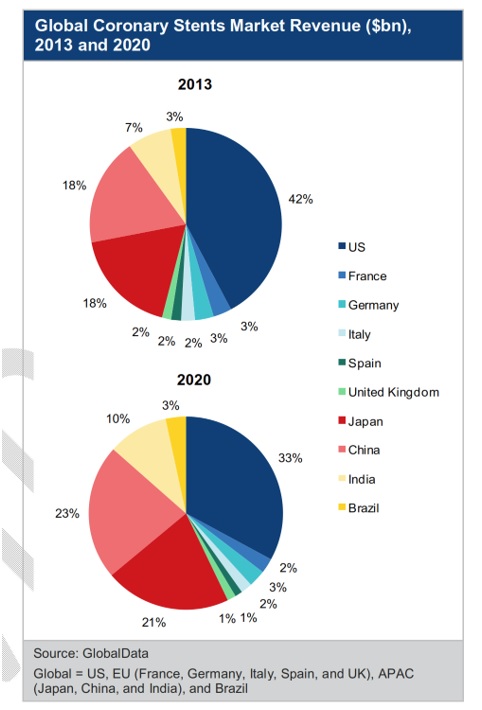
Les stents cardiaques représentent une source de revenus considérable pour les hôpitaux, les cardiologues, les laboratoires pharmaceutiques et, bien sûr, les fabricants de dispositifs médicaux. (Figure 1) Le premier stents nus ont été inventés en 1986 et approuvés par la FDA en 1992, tandis qu'en 2003, le premier stent à élution médicamenteuse a été autorisé.[1, 2] Selon iData Research, environ 1 000 000 de stents sont posés chaque année dans artères coronaires rien qu'aux États-Unis.[3] (Figure 2) Selon GlobalData, le marché des stents représente un chiffre d'affaires annuel de $5 milliards.[4] (Figure 3) Entre 2000 et 2006, un record mondial a été établi, comme l'indique le Livre Guinness des records, was set with 34 cardiac stents placed in Emil Lohan’s heart. [5][/vc_column_text][vc_column_text]


[/vc_column_text][vc_column_text]
Tout savoir sur les stents cardiaques
Au fond, qu'est-ce qu'un stent ?
Les stents sont de minuscules structures métalliques utilisées pour maintenir ouvertes les artères rétrécies par l'athérosclérose. (Figure 4) La technologie des stents a connu de nombreuses améliorations au fil des ans. En 2018, nous en sommes à la quatrième génération de stents. La maillage de l'armature métallique est devenu plus fin, ce qui favorise la croissance d'une monocouche de endothélium (endothélialisation) ou la capacité du tissu artériel à recouvrir le stent métallique. Cela est indispensable pour assurer une bonne circulation sanguine dans la artère et pour prévenir caillots sanguins se formant dans le stent, également appelé thrombose intra-stent.[6](Figure 5) Ces nouveaux stents sont également plus souples, ce qui permet de les faire passer dans des artères très fines et facilite ainsi leur mise en place. La fonction principale du médicament est d’empêcher l’obstruction du stent due à la prolifération rapide du tissu artériel, également appelée hyperplasie néointimale; toutefois, comme le montre la figure 5, cette protection s'accompagne d'un compromis important lié à l'augmentation du risque d'événements potentiellement mortels au sein du stent thrombose.[6] C'est ce qui est arrivé à mon petit frère, qui est décédé. Des caillots peuvent également se former dans le stent en raison de apposition incomplète (le stent ne se déploie pas complètement ou ne s'ouvre pas entièrement), ce qui laisse un espace qui risque de ne jamais se recouvrir d'endothélium.


Au milieu des années 80, les médecins utilisaient angioplastie par ballonnet pour dilater l'artère sans recourir à un stent. Un minuscule ballonnet situé à l'extrémité d'un cathéter a été gonflé afin de simplement pousser le plaque pour dégager le passage et élargir l’artère. Cette technique s’est avérée moins efficace, et la plupart des artères retrouvaient rapidement leur diamètre initial, voire pire ; c’est pourquoi on utilise désormais des stents. Les stents ne peuvent pas être retirés.[7] Les technologies les plus récentes sont les stents bioabsorbables (le matériau du stent finit par se dégrader et être absorbé par l’organisme, disparaissant ainsi au fil du temps) et les ballons imprégnés de médicaments angioplastie. Les résultats obtenus avec ces techniques se rapprochent de ceux des stents modernes, mais leur supériorité n'a pas encore été démontrée.[7] Elles présentent toutefois l'avantage de ne laisser aucune structure permanente dans l'artère. Elles consistent à recouvrir la paroi interne de l'artère d'un agent similaire à celui utilisé pour les stents à élution médicamenteuse. Le médicament adhère à la paroi artérielle, ce qui favorise la perméabilité (ouverture) de l’artère.
Bien avant l'apparition des stents à élution médicamenteuse, les stents métalliques nus étaient les seuls disponibles sur le marché. Les anciens stents métalliques nus avaient tendance à provoquer une prolifération excessive de l'endothélium artériel (hyperplasie néointimale) autour d'eux, ce qui obstruait l'artère. [6][7] Ce phénomène se produit le plus souvent dans les petites artères et chez les patients diabétiques – ce qui a été le cas de mon père. Les stents à élution médicamenteuse les plus récents utilisent une armature beaucoup plus fine et sont recouverts d’un polymère. Le polymère est imprégné d’un produit chimique (généralement un agent chimiothérapeutique comme le paclitaxel ou l’évérolimus) qui empêche la prolifération excessive de tissu autour du stent, susceptible parfois d’obstruer l’artère. La libération du médicament ne dure généralement que quelques semaines.
Stents de dernière génération
Les stents les plus récents disponibles sur le marché sont recouverts d'un polymère soluble ; ainsi, au bout de quelques mois, le médicament disparaît et le revêtement polymère se résorbe pour laisser apparaître le métal nu sous le tissu. Cela présente un avantage, car le revêtement polymère des modèles antérieurs avait tendance à perturber le fonctionnement du tissu endothélial entourant le stent et pouvait entraîner la formation de caillots sanguins. Il semble que le métal lui-même n'ait pas pour effet de perturber le fonction endothéliale une fois que le tissu s'est entièrement endothélialisé. Les stents de 4e génération, les plus récents, dotés de polymères solubles, présentent un taux nettement plus faible de thrombose intra-stent ou de formation de caillots.
Un effet secondaire imprévu des stents à élution médicamenteuse est qu'ils présentent toujours un risque plus élevé de formation d'un caillot à l'intérieur et autour du stent.[6] (Figure 5) Même si l'effet secondaire lié à la prolifération tissulaire a été pratiquement éliminé, le risque de thrombose intra-stent reste une menace constante ; il y a donc un compromis à faire. Malheureusement, toute personne porteuse d'un stent doit suivre un traitement traitement antiplaquettaire à vie, généralement sous la forme de aspirine, mais un traitement antiplaquettaire double, qui consiste généralement en une association de clopidogrel et d’aspirine, est nécessaire pour empêcher la formation de caillots, en particulier lorsque le stent est récent. Les recommandations les plus récentes préconisent une double thérapie antiplaquettaire pendant environ 6 mois, mais ce traitement (y compris la monothérapie à l’aspirine) comporte un risque accru d’hémorragies graves ; il existe donc certaines préoccupations à long terme concernant les stents du point de vue du traitement anticoagulant.
Le consensus
Les données se sont accumulées au fil des ans, et le consensus est qu’il n’y a aucun avantage à poser un stent si une personne souffre actuellement d’une syndrome coronarien aigu, également appelé crise cardiaque. En 2009, le essai CLINICAL a conclu que les stents ne présentaient aucun avantage par rapport à un traitement médical optimal (utilisant les meilleurs médicaments de leur catégorie). [8]
Dans la continuité de 2017, le Essai ORBITA a été mené à bien, ce qui aurait dû sonner le glas de la plupart des interventions par stent. L'étude ORBITA a clairement démontré que, selon que les patients recevaient un stent ou subissaient une intervention simulant la pose d'un stent (intervention fictive), il n'y avait aucune différence observable en termes de tolérance à l'effort ou de symptômes tels que les douleurs thoraciques. ORBITA est le tout premier essai contrôlé par placebo jamais réalisé ! Le message principal est le suivant : à moins de subir une crise cardiaque, les stents n’apportent aucune amélioration par rapport au traitement médical.
Une mise à jour publiée en 2015 dans le JAMA (Journal of the American Medical Association) a conclu que près de 80% de toutes les interventions de pose de stents cardiaques étaient initialement injustifiées au regard des recommandations en vigueur. [9] Voici une citation des auteurs de l'étude :
“Cette revue systématique réaffirme l'absence de preuves scientifiques pour une stratégie initiale de PCI [intervention percutanée, également appelée pose de stent] en cas de coronaropathie stable [maladie coronarienne]. Malgré ces données, l'ICP reste couramment utilisée comme traitement de première intention chez les patients atteints de coronaropathie stable qui sont asymptomatiques ou souffrent d’angine stable et ne suivent pas un traitement optimal traitement médicamenteux. Le recours continu à l'ICP pour le traitement initial d'une sténose épicardique obstructive témoigne d'une adhérence persistante à l'idée selon laquelle l'obstruction épicardique est la cause immédiate cause de décès, infarctus du myocarde et angine de poitrine dans le cadre d'une coronaropathie stable. Cependant, lorsque les données ne corroborent pas le paradigme existant, un Il convient d'élaborer un nouveau paradigme en matière de revue clinique et de formation. afin de refléter les données scientifiques et d'orienter la pratique.”
Qu'est-ce que tout cela signifie ?
En substance, ils affirment que la communauté médicale est à la traîne par rapport aux avancées scientifiques et que les médecins continuent de poser des stents à des patients sans que cela soit nécessaire – ET cela avant même la publication de l’étude ORBITA, qui a démontré que la majeure partie des bénéfices liés aux stents provient de la placebo En résumé… il n’y a pas de raison suffisante pour recourir à cette intervention invasive et dangereuse avant d’avoir exploré toutes les autres possibilités.
Il est intéressant de noter qu'à ce jour, aucune étude n'a examiné à la fois la combinaison de alimentation végétale à base d'aliments complets associé à un traitement médical optimal. Dean Ornish, Satish Gupta et Caldwell Esselstyn ont tous mis en évidence les bienfaits cardiaques remarquables d’un régime alimentaire à base d’aliments végétaux non transformés et pauvres en graisses, seul ou associé à d’autres changements de mode de vie, qui ont permis de réduire angine ou des douleurs thoraciques chez plus de 90% de patients, une diminution des plaques dans les artères et une réduction des crises cardiaques. [10-12] Des travaux doivent encore être menés pour associer ces interventions à un traitement médicamenteux.
C'est exactement ce que j'ai fait : j'ai réuni le meilleur des deux mondes, en montrant une évolution rapide inversion de maladie coronarienne et une amélioration significative des performances physiques.
- Sigwart, U., et al., Stents intravasculaires destinés à prévenir occlusion et la resténose après une angioplastie transluminale. N Engl J Med, 1987. 316(12) : p. 701-706.
- Serruys, P.W., M.J. Kutryk et A.T. Ong, Stents coronariens. N Engl J Med, 2006. 354(5) : p. 483-495.
- https://idataresearch.com/over-1-8-million-stents-implanted-per-year-in-the-u-s/.
- https://www.marketresearch.com/product/sample-8538829.pdf.
- http://www.guinnessworldrecords.com/world-records/most-coronary-stent-implants.
- Jakabcin, J., et al., L'absence d'endothélialisation après la pose d'un stent à élution médicamenteuse comme cause de thrombose tardive mortelle du stent. J Thromb Thrombolyse, 2008. 26(2) : p. 154-158.
- Buccheri, D., et al., Comprendre et prendre en charge la resténose intra-stent : une revue des données cliniques, de la pathogenèse au traitement. J Thorac Dis, 2016. 8(10) : p. E1150-E1162.
- Maron, D.J., et al., Impact d'une stratégie initiale de traitement médical sans intervention coronarienne percutanée chez les patients à haut risque, d'après l'étude « Clinical Outcomes Utilizing » Revascularisation et l'essai « Aggressive Drug Evaluation » (COURAGE). Am J Cardiol, 2009. 104(8) : p. 1055-1062.
- Mitchell, J.D. et D.L. Brown, Le point sur l'intervention coronarienne percutanée dans le cadre d'une coronaropathie stable. JAMA Intern Med, 2016. 176(12) : p. 1855-1856.
- Gupta, S.K., et al., Régression coronarienne athérosclérose grâce à un mode de vie sain chez les patients atteints de maladie coronarienne – Étude « Mount Abu Open Heart Trial ». Indian Heart J, 2011. 63(5) : p. 461-469.
- Esselstyn, C.B., Jr., Bilan de 12 ans d'expérience en matière de traitement par arrestation et inversion pour maladie coronarienne (un requiem attendu depuis longtemps pour la cardiologie palliative). Am J Cardiol, 1999. 84(3) : p. 339-341, A8.
- Ornish, D., et al., Changements de mode de vie radicaux visant à inverser l'évolution de la maladie coronarienne. JAMA, 1998. 280(23) : p. 2001-7.