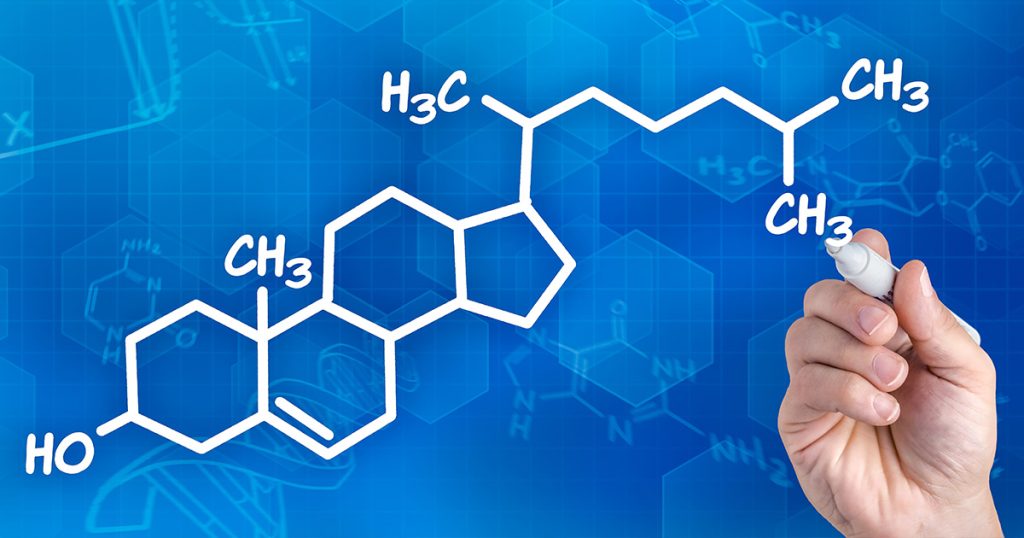
L'économie métabolique du cholestérol humain
Analyse de Synthèse de novo, Lipoprotéine Flux et prélèvement de tissu périphérique
1. Résumé
La régulation physiologique de cholestérol dans le corps humain est l'un des exemples les plus sophistiqués d'homéostasie métabolique de la biologie des mammifères. Le cholestérol, tétracyclique stérol, est indispensable à la vie eucaryote, servant de clé de voûte architecturale des membranes cellulaires, de substrat pour l'hormone stéroïde et acide biliaire synthèse et d'échafaudage pour les plateformes de signalisation transmembranaire. Les tissus périphériques ne peuvent pas cliver le noyau stérol du choléstérol ; la conversion hépatique en acides biliaires constitue donc la seule voie d'élimination des acides biliaires, tandis que l'élimination des stérols neutres comprend également des voies d'excrétion biliaire et transintestinale.
Chaque cellule pourvue d'un noyau possède la machinerie enzymatique nécessaire pour synthétiser le cholestérol de novo à partir de l'acétyl-CoA via une voie d'environ 30 étapes. Le coût énergétique élevé de cette synthèse favorise une captation préférentielle médiée par des récepteurs LDL captation par la plupart des tissus lorsque le cholestérol circulant est disponible. Ce rapport examine la distribution quantitative du cholestérol dans les tissus humains, caractérise l'utilisation de la voie biosynthétique spécifique aux tissus à la lumière de données d'analyse de flux définitives, et contextualise l'architecture régulatrice qui maintient l'homéostasie des stérols.
2. Introduction
Le cholestérol occupe une position singulière dans la biochimie des mammifères. Contrairement à la plupart des métabolites qui sont soit oxydés pour fournir de l'énergie, soit polymérisés en assemblages macromoléculaires, le cholestérol est géré comme un actif structurel durable. Le système cyclique du stérol est extraordinairement stable ; aucune voie enzymatique dans les cellules humaines ne peut le cliver pour récupérer les atomes de carbone sous forme de combustible oxydable. L'élimination est donc un processus hépatique indirect impliquant la conversion en acides biliaires (via CYP7A1 et voies accessoires) ou excrétion directe dans la bile [11].
L'importance clinique du cholestérol est bien établie. Des concentrations élevées de cholestérol LDL (LDL-C), et plus précisément des concentrations élevées Nombre de particules de LDL tel que quantifié par le plasma apolipoprotéine BApoB), sont causalement associés à l'athérosclérose maladie cardiovasculaire (MCV) sur une large base de Randomisation mendélienne, épidémiologique et interventionnelle [20]. Une compréhension précise de l'économie sous-jacente du cholestérol a des implications thérapeutiques directes : elle explique pourquoi hyper-synthétiseurs répondre vigoureusement à HMG-CoA réductase inhibiteurs (statines) mais mal aux restrictions alimentaires, tandis que hyper-absorbants montrer le motif inverse et bénéficier de l'intestinal NPC1L1 bloquage avec ézétimibe [28, 29]. Cela explique également pourquoi PCSK9 inhibition par prévention de la phase post-traductionnelle Récepteur des LDL (LDLR) la dégradation amplifie la clairance hépatique des LDL indépendamment du voie du mévalonate [21].
3. Le cadre quantitatif du cholestérol total de l'organisme
Chez un être humain adulte en bonne santé, le cholestérol corporel total est d'environ 2 100 mg par kilogramme de poids corporel [6]. Pour une personne de 70 kg, cela correspond à une réserve d’environ 147 grammes. Plus de 90% de cette réserve se trouve dans les membranes cellulaires, où le cholestérol module la fluidité de la bicouche et organise des microdomaines enrichis en cholestérol (‘radeaux lipidiques’) qui servent de plateformes aux récepteurs tyrosine-kinases et aux récepteurs couplés aux protéines G [19].
Le bilan quotidien net du cholestérol tient compte de la synthèse endogène, de l'apport alimentaire, de la réabsorption du cholestérol biliaire et de la perte fécale de stérols neutres et acides ; il ne doit pas être réduit à une simple dichotomie entre synthèse et absorption alimentaire. Le renouvellement du cholestérol dans l'organisme humain est d'environ 0,71 TP9T par jour, ce qui équivaut à environ 0,8 à 1,2 gramme par jour chez un adulte de 70 kg [5, 6]. En revanche, les souris éliminent quotidiennement environ 7 à 91 TP9T de leur cholestérol total [5] – une différence ayant des implications importantes quant à la possibilité de transposer les résultats des études sur la réduction des taux de lipides menées chez les rongeurs à l'être humain.
Tableau 1. Bilan quotidien du cholestérol chez un adulte en bonne santé suivant un régime alimentaire occidental typique.
Remarque : ce tableau présente les flux établis au sein du métabolisme du cholestérol chez l'être humain. L'absorption alimentaire n'est pas simplement le ‘ revers ’ de la synthèse de novo ; elle reflète un processus intestinal en plusieurs étapes impliquant la sécrétion biliaire, le mélange luminal, l'absorption médiée par la protéine NPC1L1 et la recirculation biliaire partielle.
| Paramètre | Valeur typique / Plage | Note d'interprétation | Référence clé |
| Cholestérol total | environ 2 100 mg/kg de poids corporel ; environ 147 g chez un adulte de 70 kg | La grande majorité (>90%) se trouve dans les membranes ; le reste, dans les lipoprotéines circulantes | Goodman et al., 1973 [6] |
| Renouvellement quotidien de l'organisme tout entier | ~0,71 TP9T/jour (~0,8–1,2 g/jour chez un adulte de 70 kg) | Nettement inférieur à celui des rongeurs (~7–91 TP9T/jour) ; ce qui suggère une gestion très économe des stérols chez l'homme | Dietschy & Turley 2002 [5]; Goodman et al., 1973 [6] |
| Synthèse de novo | 700 à 900 mg/jour chez les adultes en bonne santé (variabilité interindividuelle importante) | Il ne s'agit pas simplement d'un contrepoids à l'absorption alimentaire ; cela reflète la synthèse de l'organisme tout entier, dans l'ensemble des tissus. | Grundy 1983 [3] |
| – Contribution hépatique | ~10–25% de synthèse totale | La majorité provient de tissus extra-hépatiques ; la proportion exacte varie en fonction du phénotype et de la méthode utilisée. | Dietschy et al., 1993 [4]; Dietschy & Turley 2002 [5] |
| Cholestérol alimentaire admission | Généralement environ 200 à 500 mg/jour (en fonction de la population et de l'époque) | La moyenne de la population varie considérablement ; elle ne constitue pas un facteur déterminant du taux de LDL-C plasmatique chez la plupart des individus en raison de la suppression compensatoire du SREBP2. | Wang 2007 [9] |
| Le cholestérol intestinal a été présenté à lumens | environ 1 400 à 1 700 mg/jour (alimentation + bile + cellules épithéliales excrétées) | La contribution biliaire est prépondérante ; la fraction alimentaire ne représente qu'une minorité de la charge luminale | Wang 2007 [9]; Russell 2003 [11] |
| Absorption intestinale fractionnée | Très variable : 29,0–81,11 TP9T, moyenne de 56,21 TP9T chez les sujets sains | Les variations interindividuelles sont importantes ; le génotype du gène NPC1L1 est un facteur déterminant majeur | Bosner et al., 1999 [10] |
| Sécrétion biliaire de cholestérol | environ 800 à 1 200 mg/jour | Principale source de cholestérol luminal ; la majeure partie est réabsorbée ; la fraction non réabsorbée est excrétée sous forme de stérol neutre | Russell 2003 [11] |
| Synthèse des acides biliaires | ~400 mg/jour (estimation classique approximative) | Seule voie d'élimination des acides biliaires ; les voies biliaire ET transintestinale contribuent à l'élimination globale des stérols neutres | Russell 2003 [11] |
| Perte totale de stérols fécaux | ~0,7 à 1,0 g/jour (fourchette large) | Il convient de distinguer les stérols neutres des stérols acides ; excrétion transintestinale du cholestérol (TICE) s'ajoute à la perte biliaire | Russell 2003 [11] |
| Synthèse des hormones stéroïdes | environ 50 mg/jour (estimation approximative historique) | Sources peu fiables ; données fournies à titre d'approximation d'ordre de grandeur uniquement | Miller & Auchus 2011 [12] |
Toutes les valeurs correspondent à des intervalles physiologiques dans des conditions métaboliques normales. Ces valeurs varient considérablement en cas de dyslipidémie, de maladie hépatique ou d'intervention pharmacologique. La part exacte de la synthèse hépatique dépend de la méthode utilisée ; l'intervalle 10–25% reflète les données obtenues à partir de traceurs chez l'homme.
4. L'impératif énergétique : la synthèse de novo, un atout coûteux
La voie complète allant de l'acétyl-CoA au cholestérol comprend environ 30 étapes enzymatiques [1]. Il se divise en deux phases principales :
- La phase pré-lanostérol (environ 11 étapes) : elle englobe la voie du mévalonate proprement dite (6 étapes enzymatiques spécifiques allant de l'acétyl-CoA à l'isopentényl pyrophosphate [IPP]), ainsi que la synthèse du squalène et la cyclisation oxydative menant au lanostérol [1].
- La phase post-lanostérol (~19 étapes) : la conversion du lanostérol en cholestérol via des voies biosynthétiques divergentes décrites par Bloch (1965) [1] et Kandutsch & Russell (1960) [17].
4.1 Coût bioénergétique : une analyse nuancée
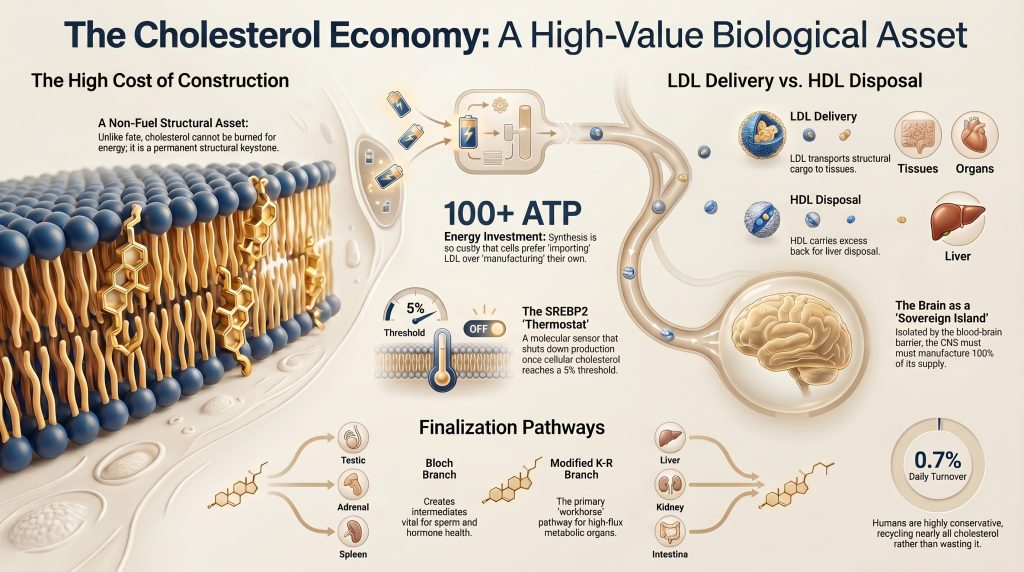
La biosynthèse du cholestérol est un processus très coûteux sur le plan énergétique. Selon les estimations couramment citées, elle nécessite environ 18 molécules d’ATP et 16 molécules de NADPH par molécule à partir de l’acétyl-CoA, ce qui ne tient compte que des cofacteurs de la voie principale (étapes de la mévalonate kinase et de l’HMG-CoA réductase). Ce sont là les valeurs reconnues dans la plupart des manuels de biochimie [1]. Des conventions de calcul plus larges — qui incluent en outre le NADPH consommé après le lanostérol au cours des trois étapes de déméthylation oxydative et des réductions cycliques du lanostérol en cholestérol — donnent des valeurs plus élevées (environ 26 NADPH au total sur l'ensemble de la voie [2]) il n'existe pas de réponse unique faisant l'unanimité [2]. Lorsque le coût d’opportunité de 18 molécules d’acétyl-CoA (énergie perdue lors de la β-oxydation) et de tous les équivalents réducteurs est converti en unités équivalentes à l’ATP, l’investissement total par molécule de cholestérol dépasse largement les 100 équivalents d’ATP. Cela explique pourquoi les cellules préfèrent nettement l’absorption du LDL par voie réceptrice à la synthèse de novo lorsque du cholestérol circulant est disponible [13].
4.2 La PCSK9 et le cycle du récepteur des LDL
Le LDLR intervient dans l'endocytose médiée par récepteur des particules de LDL contenant de l'ApoB-100. Après avoir transféré sa charge lipidique vers les lysosomes, le récepteur est recyclé vers la surface de l'hépatocyte afin de pouvoir se lier à nouveau à d'autres particules de LDL. Convertase des proprotéines La subtilisine/kexine de type 9 (PCSK9) perturbe ce processus de recyclage en se liant au récepteur LDL (LDLR) au sein de l'endosome et en le dirigeant vers la dégradation lysosomale plutôt que vers son retour à la surface [21].
Les variants de perte de fonction du gène PCSK9 sont associés à un taux de LDL-C plus faible tout au long de la vie et à une réduction significative du risque coronarien, mais l'ampleur de cette protection varie selon le type de variant et la population [21]. Anticorps monoclonaux inhibiteurs de la PCSK9 (évocumab, alirocumab) réduisent le LDL-C de 50 à 65% en complément d'un traitement par statines et réduisent de manière significative événements cardiovasculaires indésirables majeurs chez les patients à haut risque [22, 23]. Ce mécanisme s'ajoute à l'inhibition de l'HMG-CoA réductase induite par les statines et ne dépend pas de la voie du mévalonate.
5. Variantes des voies métaboliques : les branches de Bloch et de Kandutsch-Russell
La biosynthèse du cholestérol post-lanostérol est mieux décrite comme un spectre de flux spécifiques à chaque tissu, passant par les branches de Bloch (dominantes) et de Kandutsch-Russell (modifiées), plutôt que comme un choix binaire strict entre les voies canoniques de Bloch et de K-R.
La distribution tissulaire de ces voies a été caractérisée de manière définitive par Mitsche, McDonald, Hobbs et Cohen [16] à l'aide d'une analyse des flux d'isotopes stables dans 15 tissus murins in vivo. Leur principale conclusion est que la voie K-R canonique n'a été observée comme voie intacte dominante dans aucun tissu ; ils ont plutôt décrit un modèle K-R modifié dans lequel le foie et les reins présentaient principalement un flux K-R modifié, tandis que les testicules et les glandes surrénales étaient dominés par la voie de Bloch. Tout résumé présentant le foie, les reins et l’intestin comme des sites de prédominance de la voie K-R canonique, au titre d’une règle établie chez les mammifères, dénature à la fois les conclusions des auteurs et certaines attributions tissulaires spécifiques.
5.1 Voie de Bloch (via le desmostérol)
Le Voie de Bloch se fait par l'intermédiaire du desmostérole (lanostérol → … → desmostérole → cholestérol via la DHCR24). Ce processus prédomine dans les tissus où l'intermédiaire qu'est le desmostérole remplit lui-même une fonction biologique. Les testicules en sont l’exemple le plus frappant : le desmosterol s’accumule dans les têtes des spermatozoïdes matures, où ses propriétés biophysiques distinctes par rapport au cholestérol facilitent le remodelage membranaire nécessaire à la capacité de fécondation [16, 18].
Tissus à prédominance de cellules de type Bloch selon l'analyse de Mitsche et al. : testicules, glandes surrénales et rate. Par ailleurs, des études spécifiques à certains types cellulaires menées dans le cerveau démontrent que astrocytes et les neurones en développement recourent de préférence à la synthèse du Bloch/desmosterol. Cependant, dans la même analyse de Mitsche et al., le tissu cérébral adulte dans son ensemble correspondait principalement au flux K-R modifié. Il ne faut pas confondre ces deux résultats : les données relatives au cerveau adulte dans son ensemble et celles concernant des types cellulaires neuronaux spécifiques doivent être présentées séparément.
5.2 Voie de Kandutsch-Russell modifiée (via le 7-DHC / le lathostérol)
La voie K-R modifiée passe par le 7-déhydrocholestérol (7-DHC) et le lathostérol (lanostérol → … → 7-DHC → cholestérol via la DHCR7). L'analyse de Mitsche et al. a montré que le foie de souris adultes présentait principalement un flux K-R modifié. Ceci revêt une importance clinique : une déficience en DHCR7 entraîne Syndrome de Smith-Lemli-Opitz, dans lequel l'accumulation toxique de 7-DHC affecte tous les tissus modifiés à dominance K-R [18]. Dans la peau, le 7-DHC est le précurseur immédiat de la vitamine D₃ sous l'effet du rayonnement UVB, ce qui confère à la branche K-R modifiée un rôle photobiologique particulier [18].
La DHCR24 et la DHCR7 sont les réductases terminales qui déterminent des voies métaboliques importantes, mais le flux tissulaire est plus flexible et ramifié que ne le laisse supposer un schéma de voie métabolique strictement binaire [16].
Tableau 2. Répartition de la voie de biosynthèse post-lanostérol par tissu (données corrigées d'après Mitsche et al., 2015 [16]).
| Branche « Pathway » | Tissus dans lesquels cette branche prédomine (d'après Mitsche et al. 2015 [16]) | Fondements biologiques et mises en garde |
| Bloch (via le desmosterol) | Testicules, glandes surrénales, rate ; astrocytes et neurones en développement (études sur les types cellulaires) | Le desmostérol (l'avant-dernier intermédiaire de la voie de Bloch) possède des propriétés biophysiques distinctes qui jouent un rôle important dans la spermatogenèse. Des études menées sur les astrocytes et les neurones en développement indiquent un flux préférentiel de Bloch/desmostérol. Le tissu cérébral adulte, en revanche, a été principalement associé à un flux K-R modifié dans l'analyse réalisée par Mitsche et al. sur des souris. |
| Voie de Kandutsch-Russell modifiée (via le 7-DHC/lathostérol) | Foie, rein, glande préputiale, intestin ; tissu cérébral entier d'adulte (d'après Mitsche et al.) | Dominante dans les organes à haut flux métabolique. Mitsche et al. ont décrit ce phénomène comme une voie ‘ K-R modifiée ’ : la voie K-R canonique n’a été observée comme voie intacte dominante dans aucun tissu. Le foie utilise principalement le flux K-R modifié, et non la voie de Bloch. Le déficit en DHCR7 (syndrome de Smith–Lemli–Opitz) démontre l’importance clinique de cette branche. |
| Variable / dépend du contexte | Peau, muscles squelettiques, cœur, poumons | Ce rapport varie en fonction du stade de développement, de l'oxygénation et du contexte hormonal. Au niveau de la peau, le 7-DHC intermédiaire de la voie K-R est le précurseur photochimique direct de la vitamine D₃. Le flux tissulaire s'apparente davantage à un spectre variable qu'à un choix binaire strict. |
Les données proviennent d'une analyse des flux d'isotopes stables dans 15 tissus murins [16]. La distribution dans les tissus humains est déduite à partir de l'homologie enzymatique ; l'expression ‘ K-R modifié ’ renvoie à la terminologie propre à Mitsche et al. — la voie K-R canonique n'a été observée comme voie intacte prédominante dans aucun tissu.
6. Dynamique des lipoprotéines : le système logistique systémique
Étant donné que les cellules sont capables de synthétiser leur propre cholestérol, les lipoprotéines circulantes remplissent trois fonctions principales : (1) la redistribution des ressources des tissus présentant un excès de synthèse vers ceux présentant un déficit de synthèse ; (2) la régulation métabolique afin d’économiser l’ATP et le NADPH cellulaires lors de périodes de forte demande énergétique ; et (3) le transport inverse et l’élimination des stérols périphériques en excès, empêchant ainsi leur accumulation dans macrophages et athérogenèse [25]. Le cholestérol est hautement lipophile et insoluble dans le plasma aqueux ; il doit être encapsulé dans des particules de lipoprotéines amphipathiques, aux côtés de phospholipides et d’apolipoprotéines qui lui confèrent une spécificité de liaison aux récepteurs [30].
6.1 La cascade VLDL-IDL-LDL
VLDL Ces particules sont synthétisées dans les hépatocytes puis sécrétées dans la circulation veineuse hépatique (systémique), où lipoprotéine lipase (LPL), fixée aux surfaces endothéliales, hydrolyse progressivement le noyau triglycéridique, ce qui entraîne le remodelage des VLDL en lipoprotéines de densité intermédiaire (IDL) jusqu’à ce qu’il ne reste plus que la particule de LDL appauvrie en triglycérides et enrichie en esters de cholestérol [30]. Chaque particule de LDL transporte un seul ApoB-100 molécule ; par conséquent, la concentration plasmatique d’ApoB constitue un indicateur plus précis de particule athérogène charge que la masse de cholestérol LDL, qui ne tient pas compte de l'hétérogénéité de la taille des particules [20]. Environ 60 à 70% de la masse de cholestérol circulant se trouve dans la fraction LDL [30].
6.2 HDL et transport inverse du cholestérol
Les particules de lipoprotéines de haute densité facilitent le retour de l'excès de cholestérol périphérique vers le foie par le biais de transport inverse du cholestérol (ECR). ABCA1 joue un rôle dans le transfert initial du cholestérol cellulaire et des phospholipides vers l'apoA-I pauvre en lipides, formant ainsi des particules discoïdales naissantes HDL particules. L'ABCG1 favorise la poursuite de l'efflux du cholestérol, principalement vers des particules HDL plus matures et riches en lipides ; il s'agit là de pools récepteurs initiaux distincts dont les rôles fonctionnels ne se chevauchent pas [26]. La lécithine-cholestérol acyltransférase (LCAT), activée par l'ApoA-I, procède alors à l'estérification du cholestérol acquis, ce qui entraîne thermodynamiquement un efflux net et transforme les disques naissants en HDL sphériques matures [26].
Le cholestérol est renvoyé vers le foie soit par une absorption sélective médiée par le SR-BI, soit par un échange médié par la CETP vers particules contenant de l'ApoB puis éliminé par le LDLR. Le foie transforme le cholestérol renvoyé en acides biliaires (primaires : acide cholique, acide chénodésoxycholique) par l'intermédiaire du CYP7A1, ou l'excrète directement dans la bile pour l'élimination des stérols neutres [11]. L'excrétion transintestinale du cholestérol (TICE) constitue une voie supplémentaire d'élimination fécale qui ne dépend pas de la sécrétion biliaire.
6.3 SR-BI et absorption sélective dans les tissus stéroïdogènes
Le SR-BI (récepteur scavenger de classe B, type I) intervient dans l'absorption sélective de esters de cholestérol à la fois à partir des HDL et des LDL, sans dégradation concomitante de la particule lipoprotéique. La SR-BI est fortement exprimée dans le cortex surrénal et les gonades ; elle est régulée à la hausse par l'ACTH au niveau surrénal, créant ainsi un mécanisme d'action positive qui relie la demande hormonale à l'apport en stérols circulants [24]. Cependant, le rôle prédominant du SR-BI en tant que voie d’absorption stéroïdogène est mieux établi dans les glandes surrénales des rongeurs que dans celles de l’être humain ; chez l’être humain, l’absorption des LDL médiée par le LDLR reste particulièrement importante et la voie HDL–SR-BI semble moins dominante que chez les rongeurs. Ces deux voies contribuent au processus, et il convient d’éviter toute généralisation excessive des données relatives au SR-BI chez les rongeurs à l’être humain.
7. Profils d'acquisition du cholestérol spécifiques à chaque tissu
La mesure dans laquelle un tissu dépend du cholestérol circulant par rapport à sa synthèse interne reflète son rôle métabolique, son accès vasculaire et sa capacité biosynthétique. Le tableau 3 ci-dessous présente des profils tissulaires qualitatifs ; les pourcentages spécifiques d'apport par rapport à la synthèse pour la plupart des tissus périphériques (musculaire, adipeux, cutané) ne sont pas établis par des données directes issues de marqueurs chez l'humain et ne doivent pas être considérés comme des chiffres définitifs.
Tableau 3. Profils qualitatifs d'absorption du cholestérol par les tissus.
| Tissu | Profil d'acquisition du cholestérol et rôle fonctionnel |
| Cerveau (SNC) | Essentiellement autosuffisant en cholestérol dans des conditions normales chez l'adulte ; l'apport plasmatique en cholestérol lié aux lipoprotéines à travers la barrière hémato-encéphalique est négligeable. Tout le cholestérol est synthétisé localement, principalement par les astrocytes, puis distribué aux neurones par le biais de lipoprotéines du LCR contenant de l'ApoE. La répartition précise entre synthèse et absorption ne peut pas être quantifiée de manière fiable à partir des pourcentages de fractions tissulaires chez l'être humain. |
| Cortex surrénal | Forte dépendance vis-à-vis du cholestérol issu des lipoprotéines plasmatiques ; chez l’homme, l’absorption des LDL médiée par le récepteur LDLR (LDLR) est particulièrement importante, le SR-BI jouant également un rôle (mais la prédominance du SR-BI est mieux établie dans les glandes surrénales des rongeurs que dans celles de l’homme). Sous stimulation aiguë par l’ACTH, plus de 80% du cholestérol précurseur des stéroïdes provient des lipoprotéines circulantes. Les réserves intracellulaires d’esters de cholestérol (régulées par l’ACAT/HSL) constituent un tampon. |
| Foie | Centre névralgique : assure l’absorption des LDL par voie réceptrice, la synthèse de novo, la sécrétion des VLDL, la synthèse des acides biliaires et l’excrétion biliaire. La contribution fractionnelle exacte à la synthèse de novo de l'organisme varie selon la source et la méthode (~10–25% dans les données humaines à l'état d'équilibre). Utilise principalement le flux biosynthétique K-R modifié. Les pourcentages précis d'importation par rapport à la synthèse dépendent de la méthode utilisée. |
| Intestin | Organe principal impliqué à la fois dans l'absorption du cholestérol (médiée par la protéine NPC1L1 à partir de la lumière intestinale) et dans sa synthèse de novo. Il participe également à l'excrétion du cholestérol par la voie transintestinale (TICE), qui contribue à la perte de stérols dans les selles indépendamment de la sécrétion biliaire. Modifie principalement le flux biosynthétique K-R. |
| Gonades | On utilise un mélange issu de la synthèse de novo, des réserves intracellulaires d’esters de cholestérol (mobilisées par l’HSL) et des lipoprotéines plasmatiques (via les voies LDLR et SR-BI). Les pourcentages exacts dépendent du contexte et sont régulés de manière aiguë par les gonadotrophines (LH/FSH). La voie de Bloch prédomine dans les testicules. |
| Muscle squelettique, tissu adipeux, peau | Bien qu’il joue un rôle important dans l’équilibre cholestérolique de l’organisme en raison de sa masse, les rapports précis entre l’apport et la synthèse chez l’être humain ne sont pas établis sans données directes issues d’études avec traceurs. Des estimations générales suggèrent un recours prédominant à la synthèse locale dans des conditions normales, mais il ne faut pas leur attribuer de pourcentages précis sans citer l’étude primaire avec traceurs qui les étaye chez l’être humain. |
Les descriptions qualitatives reflètent le consensus issu d'études menées chez l'homme et chez l'animal. Aucun pourcentage précis n'a été établi pour les tissus périphériques (muscle squelettique, tissu adipeux, peau) à partir de données directes issues de l'utilisation de traceurs chez l'homme ; voir Dietschy et al. 1993 [4] et Goodman et al., 1973 [6] pour les données cinétiques primaires disponibles. Le flux tissulaire varie considérablement en fonction de inflammation, les maladies métaboliques, l'hypoxie et les interventions pharmacologiques.
7.1 Cerveau : autonomie
Le SNC contient environ 20 à 251 TP9T de cholestérol total, alors qu'il ne représente qu'environ 21 TP9T de la masse corporelle [7]. La barrière hémato-encéphalique (BHE), formée par des jonctions serrées entre les cellules cérébrales cellules endothéliales exclut le cholestérol lié aux lipoprotéines de la circulation systémique ; l'apport net de cholestérol plasmatique à travers la barrière hémato-encéphalique chez l'adulte est négligeable [7, 8]. Le cerveau doit donc synthétiser lui-même la totalité de son cholestérol, une tâche assurée principalement par les astrocytes, qui transfèrent le cholestérol aux neurones par le biais de lipoprotéines contenant de l'ApoE présentes dans le liquide céphalo-rachidien [8].
Le cholestérol présent dans le cerveau est éliminé principalement par conversion en oxystérols, en particulier le 24(S)-hydroxycholestérol, par l'intermédiaire de l'enzyme neuronale CYP46A1 (cholestérol 24-hydroxylase). Des mesures directes de la différence artérioveineuse au niveau de la veine jugulaire suggèrent une exportation cérébrale d’environ 2 à 3 mg/jour ; des estimations indirectes plus anciennes suggéraient 4 à 7 mg/jour. Il s’agit d’une fourchette d’estimation dépendant de la méthode utilisée, et non d’une valeur unique fixe [8]. Les gaines de myéline constituent les assemblages membranaires les plus riches en cholestérol chez les mammifères ; le cholestérol représente environ 25 à 40% des lipides totaux de la myéline (la proportion exacte dépend de l'espèce, de la région et de la méthode de mesure) [7].
7.2 Tissus stéroïdogènes : consommateurs à haut débit dépendants des apports externes
Le cortex surrénal et les gonades ont besoin de cholestérol comme substrat exclusif pour la synthèse des hormones stéroïdes, via la voie d'importation mitochondriale médiée par la protéine StAR [12]. Sous stimulation aiguë par l'ACTH, plus de 80% du cholestérol utilisé dans la stéroïdogenèse provient des lipoprotéines circulantes [24]. Les réserves intracellulaires d'esters de cholestérol (estérification médiée par l'ACAT, mobilisation médiée par la HSL) constituent une réserve rapidement accessible.
7.3 Muscles squelettiques, tissu adipeux et peau
Ces tissus représentent collectivement la plus grande masse de l'organisme et, par conséquent, une part absolue importante du pool de cholestérol ; pourtant, leur renouvellement quotidien est faible et la majeure partie du cholestérol y est synthétisée localement. Des estimations générales issues d’études de marqueurs chez l’animal suggèrent une forte dépendance à la synthèse de novo dans des conditions normales, mais les pourcentages in vivo d’importation par rapport à la synthèse pour ces tissus chez l’homme ne sont pas établis avec la précision qu’implique un tableau de chiffres spécifiques. Leur contribution au métabolisme lipidique systémique est également indirecte : une masse musculaire squelettique plus importante est épidémiologiquement associée à un taux de LDL-C circulant plus faible, potentiellement par le biais d’une activité accrue de la LPL et d’une amélioration sensibilité à l'insuline (qui entraîne une augmentation de l'expression hépatique du récepteur LDL), ou les effets médiés par les myokines sur le métabolisme hépatique des lipoprotéines [33, 34].
8. Le paradoxe fonctionnel : pourquoi le cholestérol n'est pas un carburant
Une distinction conceptuelle essentielle dans le métabolisme des lipides réside dans le fait que, d'une part, triglycérides constituent la principale réserve énergétique lipidique et sont catabolisés par β-oxydation pour produire de l'ATP, tandis que le cholestérol n'est en aucun cas une source d'énergie. Le système cyclique tétracyclique des stérols est extrêmement stable et ne comporte pas les liaisons C–H à haute énergie que l'on trouve dans les chaînes acyles des acides gras. Les cellules humaines ne possèdent aucune voie enzymatique permettant la scission du cycle stérol ; les atomes de carbone du cholestérol ne peuvent pas être récupérés sous forme d’unités d’acétyl-CoA pour le cycle de Krebs [1].
Les lipoprotéines circulantes remplissent donc trois fonctions non caloriques :
- Maintenance structurelle : la membrane plasmique est la principale destination du cholestérol en circulation. Le cholestérol s'intercale entre les chaînes acyles des phospholipides, ce qui provoque une condensation de la bicouche et l'organisation de microdomaines à ordre liquide (Lo) (‘ radeaux lipidiques ’) qui servent de plateformes aux récepteurs de signalisation [19]. Cette fonction dépend de la densité membranaire et ne peut pas être assurée par les triglycérides.
- Distribution des précurseurs : le LDL circulant fournit le substrat stéroïdien immédiat nécessaire à la stéroïdogenèse corticosurrénale. En maintenant un réservoir systémique de LDL, l'organisme garantit que la production de cortisol et d'aldostérone puisse être déclenchée en quelques minutes après une stimulation par l'ACTH, sans avoir à attendre une synthèse de novo [12, 24].
- Régulation homéostatique : en cas de lésion tissulaire ou de prolifération rapide, les cellules peuvent mobiliser le cholestérol circulant pour assurer la biogenèse membranaire d'urgence, ce qui permet d'économiser l'ATP et le NADPH à un moment où la demande métabolique est maximale [13].
8.1 Accumulation de cholestérol dans les mitochondries : conséquences pathologiques
Si le cholestérol est indispensable à la membrane plasmique, son accumulation dans la membrane mitochondriale interne (MMI) à des concentrations supérieures aux valeurs physiologiques est pathologique. La MMI est normalement la membrane la plus pauvre en cholestérol de la cellule, condition nécessaire au maintien de la fluidité et de la teneur en cardiolipine indispensables au fonctionnement optimal de la chaîne respiratoire [27]. Un excès de cholestérol IMM altère l'activité des complexes I et III, réduit le potentiel membranaire mitochondrial et diminue l'importation de glutathion dans les mitochondries, ce qui accroît la vulnérabilité à espèces réactives de l'oxygène générée par l'activité partiellement couplée de la chaîne respiratoire [27]. Ce mécanisme a été mis en cause dans la transition de la stéatohépatite vers la cirrhose chez les patients atteints de stéatohépatite non alcoolique stéatose hépatique la maladie et dans la vulnérabilité de cellules spumeuses dans l'athérosclerose plaques [27].
Deux réserves concernant la précision : (a) le seuil pathologique exact de l’accumulation de cholestérol dans l’IMM n’est pas établi avec suffisamment de clarté pour permettre une affirmation chiffrée définitive chez l’homme ; une description qualitative est plus défendable que de citer des seuils mol% spécifiques comme des faits avérés ; et (b) l’identité du transporteur mitochondrial du glutathion impliqué fait l’objet d’un débat — une étude de reconstitution directe a remis en cause le transport du GSH médié par l’OGC/DIC — et cela reste à ce jour incertain.
9. Boucle de régulation : le centre SREBP2
La détection du cholestérol au niveau cellulaire repose sur la liaison à l'élément régulateur des stérols (SRE-B) Protéine 2 (SREBP2), un facteur de transcription membranaire présent dans le réticulum endoplasmique (RE) [14]. Dans des conditions normales, le taux de cholestérol dans le réticulum endoplasmique est maintenu à un niveau faible par rapport à celui de la membrane plasmique ; SREBP-2 le traitement chute brusquement lorsque la concentration en cholestérol de l'ER avoisine environ 5 mol% de lipides membranaires de l'ER [15].
Lorsque le taux de cholestérol dans l'ER passe en dessous de ce seuil, le complexe SCAPse dissocie des protéines de rétention INSIG-1/INSIG-2, permettant ainsi à la SCAP d'escorter la SREBP2 jusqu'au Golgi, où les protéases de site 1 et de site 2 clivent séquentiellement la SREBP2, libérant ainsi le domaine N-terminal du facteur de transcription en vue de son importation dans le noyau [14]. Dans le noyau, le SREBP2 induit une régulation à la hausse coordonnée de :
- HMGCR (HMG-CoA réductase, l'enzyme limitante de la voie du mévalonate) : pour augmenter la synthèse interne.
- LDLR (récepteur des LDL) : pour augmenter la prise en charge des LDL par les récepteurs dans le sang.
- PCSK9 : régulé à la hausse de manière paradoxale par SREBP2 en tant que facteur de régulation par rétroaction négative du recyclage du récepteur LDLR — le mécanisme à l'origine de Inhibiteur de PCSK9 pharmacologie [21].
Lorsque le taux de cholestérol ER atteint environ 5 mol% — un seuil de basculement établi par Radhakrishnan et al. [15] D'après une étude de biochimie membranaire quantitative (SCAP), la protéine est retenue dans le réticulum endoplasmique (RE) par l'INSIG, le SREBP2 reste inactif et l'HMG-CoA réductase est ciblée pour une dégradation protéasomale via le recrutement, médié par l'INSIG, de la ligase d'ubiquitine E3 gp78 [14, 15]. Ce mécanisme bistable garantit que les cellules n'utilisent le pool circulant qu'en cas de nécessité.
10. Variabilité interindividuelle et implications cliniques
10.1 Les « hyper-synthétiseurs » face aux « hyper-absorbeurs »
La contribution relative de la synthèse et de l'absorption au pool de cholestérol circulant varie considérablement d'un individu à l'autre — une distinction qui a des implications cliniques [28]. Les ‘ hyper-synthétiseurs ’ présentent des taux plasmatiques élevés de lathostérol (un marqueur de synthèse) et des taux réduits de campestérol et de sitostérol (marqueurs d’absorption) par rapport aux médianes de la population. Les statines entraînent une forte réduction du LDL-C chez ces patients. À l’inverse, les ‘ hyper-absorbeurs ’ présentent un profil plasmatique des stérols opposé ; leur transporteur intestinal NPC1L1 capte une fraction disproportionnée du cholestérol alimentaire et biliaire. Chez les hyper-absorbeurs, les statines peuvent entraîner des réductions atténuées du LDL-C, car une régulation à la hausse compensatoire du gène NPC1L1 contrebalance partiellement l’inhibition de la synthèse ; un traitement combiné à base d’ézétimibe rétablit une réponse plus complète [28, 29].
Le mécanisme d'« hyper-synthèse/hyper-absorption » présente un intérêt biologique et est soutenu par un stérol non cholestérolique. biomarqueur ces données, mais il ne s'agit pas encore d'une taxonomie clinique universellement normalisée et imposée par les recommandations : des marqueurs d'absorption plus élevés ne permettent pas toujours de prédire des réponses différentielles du LDL-C, en particulier dans les cohortes de patients atteints d'hypercholestérolémie familiale (HF). Ce cadre doit être présenté comme utile, mais non déterministe.
10.2 L'hypercholestérolémie familiale et la voie du récepteur LDL (LDLR)
Hypercholestérolémie familiale (FH) est la maladie monogénique grave la plus fréquente chez l'être humain ; sa prévalence est d'environ 1 cas sur 250 à 300 (une estimation consensuelle récente de la NLA situe la prévalence mondiale à environ 1 cas sur 311, en fonction de la population et de la définition diagnostique) [21]. L'hypercholestérolémie familiale (HF) résulte de mutations avec perte de fonction du gène LDLR, de mutations avec gain de fonction du gène PCSK9, ou variants pathogènes dans l'APOB, qui entravent tous l'élimination du LDL par les récepteurs [21]. En raison de la diminution de l'absorption hépatique des LDL, le SREBP2 reste constitutivement actif, ce qui entraîne une régulation à la hausse de l'HMGCR et, paradoxalement, une augmentation de la synthèse hépatique dans un contexte d'absorption exogène altérée [14] – un cercle vicieux qui, s'il n'est pas traité, conduit à une ASCVD prématurée.
11. Les oxystérols : le niveau de régulation au sein du système métabolique du cholestérol
Les oxystérols sont des dérivés oxydés du cholestérol présents dans les tissus et le plasma à des concentrations inférieures de 3 à 4 ordres de grandeur à celles du cholestérol lui-même ; ils exercent pourtant une influence régulatrice disproportionnée sur l'homéostasie des stérols et la fonction immunitaire [31, 32].
Plusieurs oxystérols agissent en tant que ligands endogènes de l'INSIG et en tant qu'activateurs des récepteurs X hépatiques (LXRs), des récepteurs nucléaires qui régulent à la hausse, au niveau transcriptionnel, l'expression des gènes ABCA1, ABCG1 et ApoE — les mécanismes responsables du transport inverse du cholestérol [31, 32]. L'activation du LXR par les oxystérols (notamment le 24(S),25-époxycholestérol et le 27-hydroxycholestérol) crée ainsi un couplage de type « feedforward » entre l'excès de stérols cellulaires et leur élimination. Dans le cerveau, le 24(S)-hydroxycholestérol produit par le CYP46A1 neuronal remplit non seulement la fonction d’exportation du cholestérol décrite à la section 7.1, mais agit également comme un modulateur allostérique positif des récepteurs du glutamate de type NMDA, établissant ainsi un lien entre le renouvellement du cholestérol et la plasticité synaptique [8].
12. Limitations
Plusieurs questions fondamentales concernant le métabolisme du cholestérol chez l'être humain restent encore partiellement sans réponse, et il convient d'interpréter les données en gardant cela à l'esprit.
- La fraction hépatique exacte de la synthèse de novo totale dans l'organisme synthèse du cholestérol. Les données disponibles issues de traceurs humains suggèrent une valeur comprise entre environ 10 et 251 TP9T, mais celle-ci dépend du phénotype et est techniquement difficile à mesurer in vivo.
- Rapport spécifique à chaque tissu entre le flux de Bloch et le flux K-R modifié chez l'être humain tout au long de la vie. L'étude de Mitsche et al. (2015) a été menée chez la souris ; les données directes chez l'être humain sont limitées.
- L'identité exacte du transporteur mitochondrial du glutathion impliqué dans les processus liés au cholestérol stress oxydatif; les données actuelles font l'objet de controverses.
- Le seuil pathologique de cholestérol IMM chez l'être humain ; les seuils précis de mol% établis dans des systèmes modèles ne sont pas nécessairement transposables directement au contexte clinique.
- Le mécanisme reliant la masse musculaire squelettique au LDL-C circulant – que ce soit par le biais de l'activité de la LPL, de la signalisation des myokines ou insuline surdulation du LDLR induite par la sensibilité [33, 34].
- L'excrétion transintestinale du cholestérol (TICE) constitue une voie d'élimination des stérols fécaux quantitativement importante ; sa contribution par rapport à l'excrétion biliaire dans diverses conditions physiologiques et pharmacologiques doit faire l'objet d'études plus approfondies chez l'homme.
13. Conclusion
Le métabolisme du cholestérol chez l'être humain est un système double, caractérisé à la fois par une autosuffisance locale et une interdépendance systémique. La plupart des cellules synthétisent le cholestérol de novo via une voie en environ 30 étapes, ce qui représente un coût métabolique substantiel (~18 ATP et ~16 NADPH selon le calcul basé sur les cofacteurs essentiels ; ce coût est plus élevé selon des conventions de calcul plus larges). Ce coût favorise l'absorption préférentielle des LDL par les récepteurs dans la plupart des tissus périphériques lorsque du cholestérol circulant est disponible.
Les lipoprotéines circulantes ne transportent pas le cholestérol comme source d'énergie. Les LDL agissent comme un réservoir mobile de précurseurs structurels et stéroïdogènes ; les HDL facilitent le retour obligatoire des stérols périphériques vers le foie par le biais du transport inverse du cholestérol — seule voie par laquelle le noyau stéroïdien peut finalement être éliminé de l'organisme.
La biosynthèse post-lanostérol est décrite avec plus de précision comme un spectre de flux spécifique à chaque tissu plutôt que comme une opposition binaire stricte entre les modèles de Bloch et de K-R. Le foie utilise principalement un flux de type Kandutsch–Russell modifié ; les testicules et les glandes surrénales utilisent principalement un flux de type Bloch ; le cerveau adulte dans son ensemble correspond principalement à un flux de type K-R modifié dans l’analyse des flux, tandis que les astrocytes et les neurones en développement présentent des signatures de type Bloch/desmosterol plus marquées, qui ne doivent pas être confondues avec le tableau global de l’organe. Les pourcentages numériques précis des rapports importation/synthèse tissulaires chez l’être humain ne sont pas encore pleinement compris pour la plupart des tissus périphériques.
Une compréhension cliniquement exploitable de ce mécanisme — englobant le commutateur SREBP2, le spectre « hyper-synthétiseur/hyper-absorbeur », l’axe PCSK9/LDLR et la couche de régulation des oxystérols — sous-tend le choix rationnel entre les statines, l’ézétimibe, des inhibiteurs de la PCSK9 et des agents émergents ciblant la synthèse de novo et le transport inverse.
Références
- Bloch K. The biological synthesis of cholesterol. Science. 1965;150(3692):19-28. doi:10.1126/science.150.3692.19
- Gaylor JL. Membrane-bound enzymes of cholesterol synthesis from lanosterol. Biochem Biophys Res Commun. 2002;292(5):1139-1146. doi:10.1006/bbrc.2001.2008
- Grundy SM. Absorption and metabolism of dietary cholesterol. Annu Rev Nutr. 1983;3:71-96. doi:10.1146/annurev.nu.03.070183.000443
- Dietschy JM, Turley SD, Spady DK. Role of liver in the maintenance of cholesterol and low density lipoprotein homeostasis in different animal species, including humans. J Lipid Res. 1993;34(10):1637-1659.
- Dietschy JM, Turley SD. Control of cholesterol turnover in the mouse. J Biol Chem. 2002;277(6):3801-3804. doi:10.1074/jbc.R100057200
- Goodman DS, Noble RP, Dell RB. The effects of colestipol resin and of colestipol plus clofibrate on the turnover of plasma cholesterol in man. J Clin Invest. 1973;52(10):2646-2655. doi:10.1172/JCI107457
- Dietschy JM, Turley SD. Thematic review series: brain Lipids. Cholesterol metabolism in the central nervous system during early development and in the mature animal. J Lipid Res. 2004;45(8):1375-1397. doi:10.1194/jlr.R400004-JLR200
- Björkhem I, Meaney S. Brain cholesterol: long secret life behind a barrier. Arterioscler Thromb Vasc Biol. 2004;24(5):806-815. doi:10.1161/01.ATV.0000120374.59826.1b
- Wang DQ. Regulation of intestinal cholesterol absorption. Annu Rev Physiol. 2007;69:221-248. doi:10.1146/annurev.physiol.69.031905.160725
- Bosner MS, Lange LG, Stenson WF, Ostlund RE Jr. Percent cholesterol absorption in normal women and men quantified with dual stable isotopic tracers and negative ion mass spectrometry. J Lipid Res. 1999;40(2):302-308.
- Russell DW. The enzymes, regulation, and genetics of bile acid synthesis. Annu Rev Biochem. 2003;72:137-174. doi:10.1146/annurev.biochem.72.121801.161712
- Miller WL, Auchus RJ. The molecular biology, biochemistry, and physiology of human steroidogenesis and its disorders. Endocr Rev. 2011;32(1):81-151. doi:10.1210/er.2010-0013
- Brown MS, Goldstein JL. A receptor-mediated pathway for cholesterol homeostasis. Science. 1986;232(4746):34-47. doi:10.1126/science.3513311
- Brown MS, Goldstein JL. The SREBP pathway: regulation of cholesterol metabolism by proteolysis of a membrane-bound transcription factor. Cell. 1997;89(3):331-340. doi:10.1016/s0092-8674(00)80213-5
- Radhakrishnan A, Goldstein JL, McDonald JG, Brown MS. Switch-like control of SREBP-2 transport triggered by small changes in ER cholesterol: a delicate balance. Cell Metab. 2008;8(6):512-521. doi:10.1016/j.cmet.2008.10.008
- Mitsche MA, McDonald JG, Hobbs HH, Cohen JC. Flux analysis of cholesterol biosynthesis in vivo reveals multiple tissue and cell-type specific pathways. Elife. 2015;4:e07999. Published 2015 Jun 26. doi:10.7554/eLife.07999
- KANDUTSCH AA, RUSSELL AE. Preputial gland tumor sterols. 3. A metabolic pathway from lanosterol to cholesterol. J Biol Chem. 1960;235:2256-2261.
- Porter FD, Herman GE. Malformation syndromes caused by disorders of cholesterol synthesis. J Lipid Res. 2011;52(1):6-34. doi:10.1194/jlr.R009548
- Simons K, Vaz WL. Model systems, lipid rafts, and cell membranes. Annu Rev Biophys Biomol Struct. 2004;33:269-295. doi:10.1146/annurev.biophys.32.110601.141803
- Ference BA, Ginsberg HN, Graham I, et al. Low-density lipoproteins cause atherosclerotic cardiovascular disease. 1. Evidence from genetic, epidemiologic, and clinical studies. A consensus statement from the European Atherosclerosis Society Consensus Panel. Eur Heart J. 2017;38(32):2459-2472. doi:10.1093/eurheartj/ehx144
- Abifadel M, Varret M, Rabès JP, et al. Mutations in PCSK9 cause autosomal dominant hypercholesterolemia. Nat Genet. 2003;34(2):154-156. doi:10.1038/ng1161
- Sabatine MS, Giugliano RP, Keech AC, et al. Evolocumab and Clinical Outcomes in Patients with Cardiovascular Disease. N Engl J Med. 2017;376(18):1713-1722. doi:10.1056/NEJMoa1615664
- Schwartz GG, Steg PG, Szarek M, et al. Alirocumab and Cardiovascular Outcomes after Acute Coronary Syndrome. N Engl J Med. 2018;379(22):2097-2107. doi:10.1056/NEJMoa1801174
- Glass C, Pittman RC, Weinstein DB, Steinberg D. Dissociation of tissue uptake of cholesterol ester from that of apoprotein A-I of rat plasma high density lipoprotein: selective delivery of cholesterol ester to liver, adrenal, and gonad. Proc Natl Acad Sci U S A. 1983;80(17):5435-5439. doi:10.1073/pnas.80.17.5435
- Tall AR. Cholesterol efflux pathways and other potential mechanisms involved in the athero-protective effect of high density lipoproteins. J Intern Med. 2008;263(3):256-273. doi:10.1111/j.1365-2796.2007.01898.x
- Rye KA, Barter PJ. Formation and metabolism of prebeta-migrating, lipid-poor apolipoprotein A-I. Arterioscler Thromb Vasc Biol. 2004;24(3):421-428. doi:10.1161/01.ATV.0000104029.74961.f5
- Garcia-Ruiz C, Mari M, Colell A, et al. Mitochondrial cholesterol in health and disease. Histol Histopathol. 2009;24(1):117-132. doi:10.14670/HH-24.117
- Miettinen TA, Gylling H. Cholesterol absorption efficiency and sterol metabolism in obesity. Atherosclerosis. 2000;153(1):241-248. doi:10.1016/s0021-9150(00)00404-4
- Sudhop T, Lütjohann D, Kodal A, et al. Inhibition of intestinal cholesterol absorption by ezetimibe in humans. Circulation. 2002;106(15):1943-1948. doi:10.1161/01.cir.0000034044.95911.dc
- Goldstein JL, Brown MS. A century of cholesterol and coronaries: from plaques to genes to statins. Cell. 2015;161(1):161-172. doi:10.1016/j.cell.2015.01.036
- Janowski BA, Willy PJ, Devi TR, Falck JR, Mangelsdorf DJ. An oxysterol signalling pathway mediated by the nuclear receptor LXR alpha. Nature. 1996;383(6602):728-731. doi:10.1038/383728a0
- Kalaany NY, Mangelsdorf DJ. LXRS and FXR: the yin and yang of cholesterol and fat metabolism. Annu Rev Physiol. 2006;68:159-191. doi:10.1146/annurev.physiol.68.033104.152158
- Vella CA, Nelson MC, Unkart JT, Miljkovic I, Allison MA. Skeletal muscle area and density are associated with lipid and lipoprotein cholesterol levels: The Multi-Ethnic Study of Atherosclerosis. J Clin Lipidol. 2020;14(1):143-153. doi:10.1016/j.jacl.2020.01.002
- Hong S, Chang Y, Jung HS, Yun KE, Shin H, Ryu S. Relative muscle mass and the risk of incident type 2 diabetes: A cohort study. PLoS One. 2017;12(11):e0188650. Published 2017 Nov 30. doi:10.1371/journal.pone.0188650