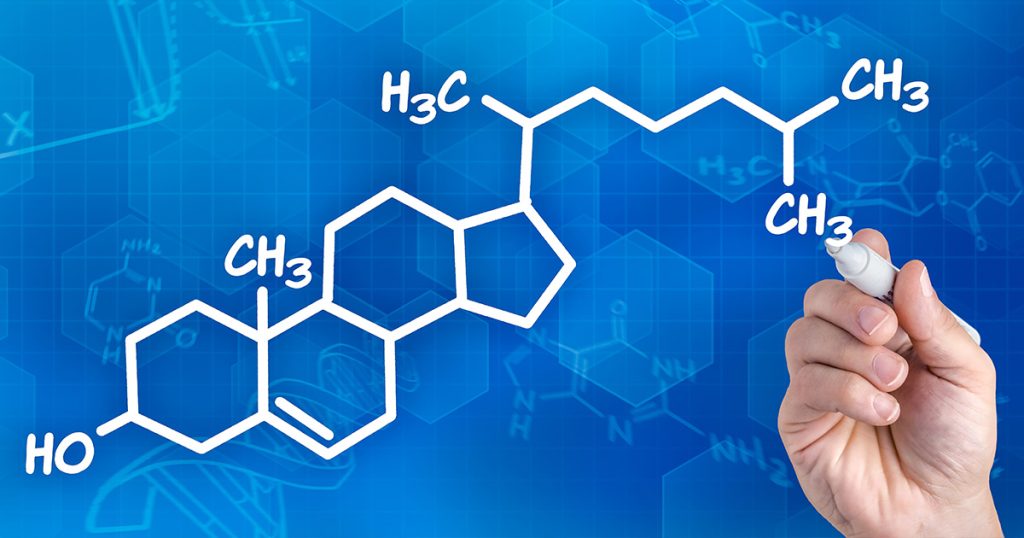
De metabole economie van menselijk cholesterol
Analyse van De Novo Synthese, Lipoproteïne Flux en perifere weefselacquisitie
1. Samenvatting
De fysiologische regulatie van cholesterol in het menselijk lichaam behoort tot de meest geavanceerde voorbeelden van metabole homeostase in de zoogdierbiologie. Cholesterol, een tetracyclisch sterol, is onmisbaar voor eukaryotisch leven en dient als een architectonische sluitsteen van celmembranen, een substraat voor steroïdhormonen en galzuur synthese, en een steiger voor transmembrane signaalplatforms. Perifere weefsels kunnen de sterolkern van cholesterol niet klieven; hepatische omzetting in galzuren is daarom de enige galzuurverwijderingsroute, terwijl de eliminatie van neutrale sterolen ook biliaire en transintestinale excretieroutes omvat.
Elke cel met een kern bezit het enzymatische mechanisme om cholesterol de novo te synthetiseren uit acetyl-CoA via een traject van ongeveer 30 stappen. De hoge energetische kosten van deze synthese stimuleren de preferentiële receptor-gemedieerde LDL opname in de meeste weeën wanneer circulerend cholesterol beschikbaar is. Dit rapport onderzoekt de kwantitatieve verdeling van cholesterol over menselijke weeën, karakteriseert het gebruik van weefsel specifieke biosynthetische routes in het licht van definitieve fluxanalysedata, en contextualiseert de regulerende architectuur die sterolhomeostase handhaaft.
2. Inleiding
Cholesterol neemt een unieke plaats in binnen de zoogdierbiochemie. In tegenstelling tot de meeste metabolieten die ofwel worden geoxideerd voor energie ofwel worden gepolymeriseerd tot macromoleculaire structuren, wordt cholesterol beheerd als een duurzaam structureel bezit. Het sterolringsysteem is buitengewoon stabiel; geen enkele enzymatische route in menselijke cellen kan het splitsen om de koolstofatomen terug te winnen als oxideerbare brandstof. Verwijdering is daarom een indirect, hepatisch proces dat conversie naar galzuren omvat (via CYP7A1 en secundaire routes) of directe uitscheiding in de gal [11].
De klinische betekenis van cholesterol is welbekend. Verhoogde concentraties LDL-cholesterol (LDL-C), en meer in het bijzonder verhoogde LDL-deeltjesaantal zoals gekwantificeerd door plasma apolipoproteïne B (ApoB), causaal geassocieerd zijn met atherosclerotische hart- en vaatziekten (ASCVD) over een brede basis van Mendeliana randomisatie, epidemiologische en interventionele bewijzen [20]. Een nauwkeurig begrip van de onderliggende cholesteroleconomie heeft directe therapeutische implicaties: het verklaart waarom hyper-synthesizers krachtig reageren op HMG-CoA-reductase remmers (statines) maar slecht op dieetbeperking, terwijl superabsorberende materialen toon het omgekeerde patroon en profiteer van de darm NPC1L1 blokkade met ezetimib [28, 29]. Het legt ook uit waarom PCSK9 remming door het voorkomen van posttranslationele LDL-receptor (LDLR)-degradatie versterkt de hepatische LDL-klaring onafhankelijk van de mevalonaatroute [21].
3. Het kwantitatieve raamwerk van totaal lichaamscholesterol
Bij een gezonde volwassen mens bedraagt het totale lichaamscholesterol ongeveer 2.100 mg per kilogram lichaamsgewicht [6]. Voor iemand van 70 kg komt dit neer op een totale hoeveelheid van ongeveer 147 gram. Ruim 90% van deze totale hoeveelheid bevindt zich in celmembranen, waar cholesterol de vloeibaarheid van de dubbellaag reguleert en met cholesterol verrijkte microdomeinen vormt (‘lipidenvlotten’) die dienen als platformen voor receptortyrosinekinases en G-proteïne-gekoppelde receptoren [19].
De dagelijkse nettocholesterolbalans weerspiegelt de endogene synthese, de opname via de voeding, de reabsorptie van galcholesterol en het verlies van neutrale en zure sterolen via de ontlasting; deze balans mag niet worden gereduceerd tot een eenvoudige tweedeling tussen synthese en opname via de voeding. De cholesterolomzet in het gehele menselijke lichaam bedraagt ongeveer 0,71 TP9T per dag – wat overeenkomt met ongeveer 0,8–1,2 gram per dag bij een volwassene van 70 kg [5, 6]. Muizen daarentegen vernieuwen dagelijks ongeveer 7–9% van hun totale lichaamscholesterol [5]-een verschil met belangrijke implicaties voor de vertaalbaarheid van knaagdier-lipidennarderende studies naar menselijke uitkomsten.
Tabel 1. Dagelijkse cholesterolbalans bij een gezonde volwassene onder typische westerse dieetomstandigheden.
Opmerking: Deze tabel geeft gevestigde stromen in de menselijke cholesterolhuishouding weer. Dieetabsorptie is niet simpelweg de ‘andere kant’ van de novo-synthese; het weerspiegelt een darmproces in meerdere stappen, waaronder biliaire secretie, luminale menging, NPC1L1-gemedieerde opname en gedeeltelijke biliaire recirculatie.
| Parameter | Typische Waarde / Bereik | Interpretatieve Notitie | Belangrijke referentie |
| Totaal lichaamscholesterol | ~2.100 mg/kg lichaamsgewicht; ~147 g bij een volwassene van 70 kg | Overgrote meerderheid (>90%) in membranen; de rest in circulerende lipoproteïnen | Goodman et al. 1973 [6] |
| Lichamelijke dagelijkse omzet | ~0,71 TP9T/dag (~0,8–1,2 g/dag bij een volwassene van 70 kg) | Aanzienlijk lager dan bij knaagdieren (~7–9%/dag); dit duidt op een zeer zuinig sterolgebruik bij de mens | Dietschy & Turley 2002 [5]; Goodman et al. 1973 [6] |
| de novo-synthese | 700–900 mg/dag bij gezonde volwassenen (aanzienlijke interindividuele variabiliteit) | Geen simpel tegenwicht voor dieetabsorptie; weerspiegelt de synthese in het hele lichaam over alle weefsels heen | Grundy 1983 [3] |
| – Leverbijdrage | ~10–25% van de totale synthese | De meerderheid is afkomstig van extrahepatische weeën; de exacte fractie varieert per fenotype en methode | Dietschy et al. 1993 [4]; Dietschy & Turley 2002 [5] |
| Voedingscholesterol intake | Meestal ~200–500 mg/dag (afhankelijk van populatie en tijdperk) | Populatiegemiddeldes variëren sterk; bij de meeste individuen is dit geen primaire bepalende factor voor LDL-C in het plasma als gevolg van compensatoire SREBP2-suppressie | Wang 2007 [9] |
| Intestinale cholesterol gepresenteerd aan lumen | ~1.400–1.700 mg/dag (voeding + gal + afgeschilferde epitheelcellen) | Galbijdraag is dominant; dieetfractie is minderheid van luminale belasting | Wang 2007 [9]; Russell 2003 [11] |
| Fractionctionele darmabsorptie | Zeer variabel: 29,0–81,11 TP9T, gemiddelde 56,21 TP9T bij gezonde proefpersonen | Inter-individuele variatie is groot; het NPC1L1-genotype is een belangrijke bepalende factor | Bosner et al. 1999 [10] |
| Biliaire cholesterolsecretie | ~800–1.200 mg/dag | Primaire luminale cholesterolbron; het meeste wordt heropgenomen; de fractie die niet wordt heropgenomen wordt uitgescheiden als neutraal sterol | Russell 2003 [11] |
| Galzuursynthese | ~400 mg/dag (benaderde klassieke schatting) | Alleen galzuur-uitscheidingsroute; galwegen- en transintestinale routes dragen bij aan de totale neutrale steroleliminatie | Russell 2003 [11] |
| Totale verlies van fecale sterolen | ~0,7–1,0 g/dag (breed bereik) | Neutrale sterolen en zure sterolen moeten worden onderscheiden; transintestinale cholesterol-excretie draagt bij als aanvulling op galverlies | Russell 2003 [11] |
| Steroïdhormoonsynthese | ~50 mg/dag (ruwe historische schatting) | Zwak onderbouwd; alleen gerapporteerd als orde-van-grootte-benadering | Miller & Auchus 2011 [12] |
Alle waarden geven de fysiologische bereiken weer onder normale metabolische omstandigheden. Deze waarden verschuiven aanzienlijk bij dyslipidemie, leverziekte of farmacologische interventie. Het exacte aandeel van de synthese in de lever is afhankelijk van de gebruikte methode; het bereik 10–25% is gebaseerd op tracergegevens bij mensen.
4. Het Energetische Imperatief: De Novo Synthese als een Kostbaar Bezit
De volledige route van acetyl-CoA naar cholesterol omvat ongeveer 30 enzymatische stappen [1]. Het is opgesplitst in twee belangrijke fasen:
- De pre-lanosterol fase (~11 stappen): omvat de mevalonaatroute zelf (6 toegewijde enzymatische stappen van acetyl-CoA tot isopentenylpyrofosfaat [IPP]) via squaleensynthese en oxidatieve cyclisatie tot lanosterol [1].
- De post-lanosterol-fase (~19 stappen): de omzetting van lanosterol in cholesterol via divergente biosynthetische takken gekarakteriseerd door Bloch (1965) [1] en Kandutsch & Russell (1960) [17].
4.1 Bio-energetische Kosten: Een Nuancevereiste Boekhouding
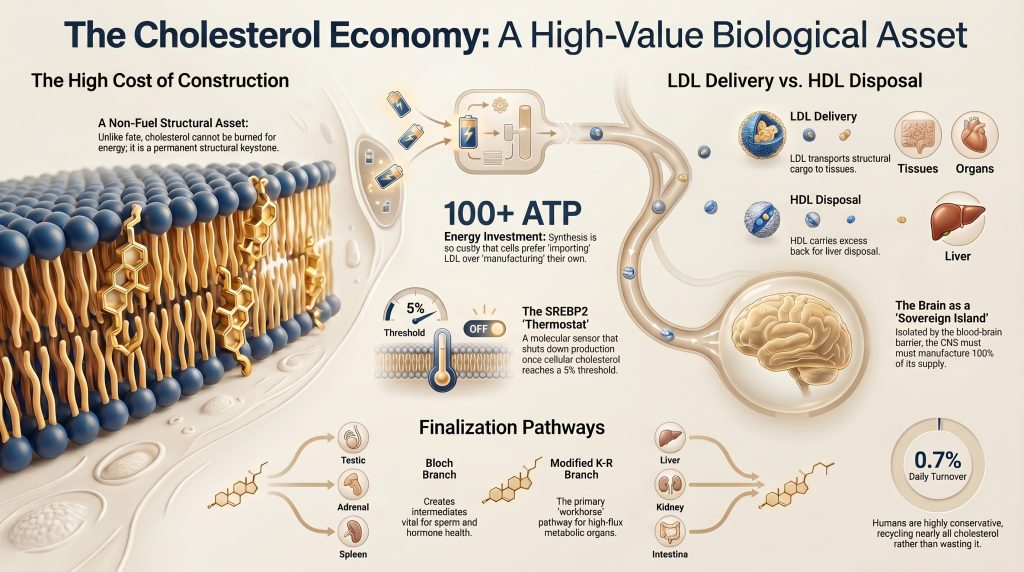
Cholesterol-biosynthese is energetisch duur. Vaak aangehaalde schattingen zijn ongeveer 18 ATP en 16 NADPH per molecuul vanaf acetyl-CoA, waarbij alleen rekening wordt gehouden met de cofactoren van de kernroute (stappen van mevalonaatkinase en HMG-CoA-reductase). Dit zijn de waarden die in de meeste biochemiehandboeken worden erkend [1]. Bredere boekhoudkundige conventies – die bovendien de na lanosterol verbruikte NADPH omvatten tijdens de drie oxidatieve demethyleringsstappen en ringreducties van lanosterol tot cholesterol – leveren hogere waarden op (ongeveer 26 NADPH in totaal voor de volledige route [2]) is er geen universeel geaccepteerd enkel antwoord [2Wanneer de opportuniteitskosten van 18 acetyl-CoA-moleculen (verloren energie door β-oxidatie) en alle reducerende equivalenten worden omgezet in ATP-equivalente eenheden, overschrijdt de totale investering per cholesterolmolecuul aanzienlijk de 100 ATP-equivalenten. Dit verklaart waarom cellen de voorkeur geven aan receptorgemedieerde LDL-opname boven de novo synthese wanneer circulerend cholesterol beschikbaar is13].
4.2 PCSK9 en de LDL-receptorcyclus
De LDLR mediërend receptor-gemedieerde endocytose van ApoB-100-bevattende LDL-partikels. Na het afleveren van zijn lipidenlading aan lysosomen, wordt de receptor gerecycled naar het oppervlak van de hepatocyt voor volgende rondes van LDL-binding. proproteïneconvertase subtilisine/kexine type 9 (PCSK9) verstoort deze recycling door in het endosoom te binden aan de LDLR en deze te dirigeren naar lysosomale afbraak in plaats van terugkeer naar het celoppervlak21].
Loss-of-function-varianten in PCSK9 zijn geassocieerd met een levenslang lager LDL-C en aanzienlijke reducties in coronair risico, maar de mate van bescherming variëert per varianttype en populatie21Monoklonaal-antilichaamremmers van PCSK9 (evolocumab, alirocumab) verlagen het LDL-cholesterol met 50–65% als aanvulling op een behandeling met statines en zorgen voor een aanzienlijke daling van ernstige ongewenste cardiovasculaire gebeurtenissen bij patiënten met een hoog risico [22, 23]. Dit mechanisme is een aanvulling op de door statines gemedieerde remming van HMG-CoA-reductase en is niet afhankelijk van de mevalonaatroute.
5. Routevariaties: Bloch- en Kandutsch-Russell-takken
Post-lanosterol cholesterol biosynthese kan beter worden omschreven als een spectrum van weefselspecifieke fluxen via Bloch-dominante en gemodificeerde Kandutsch-Russell-takken, in plaats van als een strikte binaire keuze tussen de canonieke Bloch- en canonieke K-R-routes.
De weefseldistributie van deze routes is definitief gekarakteriseerd door Mitsche, McDonald, Hobbs en Cohen [16] met behulp van stabiele-isotoop fluxanalyse in 15 weefsels van muizen in vivo. Hun belangrijkste bevinding is dat de canonieke K-R niet werd waargenomen als de dominante intacte route in enig weefsel; in plaats daarvan beschreven zij een gemodificeerd K-R-model waarin lever en nier voornamelijk een gemodificeerde K-R-flux lieten zien, terwijl de testes en bijnieren Bloch-zwaar waren. Elke samenvatting die lever/nier/darm presenteert als locaties waar de canonieke K-R domineert als een vastgestelde zoogdierregel, verdraait zowel de conclusies van de auteurs als enkele specifieke weefseltoewijzingen.
5.1 Bloch-route (via Desmosterol)
De Bloch-route wordt voortgezet via desmosterol (lanosterol → … → desmosterol → cholesterol via DHCR24). Het komt hoofdzakelijk voor in weefsels waar het desmosterol-tussenproduct zelf een biologische functie vervult. De testes zijn het duidelijkste voorbeeld: desmosterol hoopt zich op in de koppen van mature spermatozoën, waar de unieke biofysische eigenschappen ervan ten opzichte van cholesterol membraanremodellering vergemakkelijken die vereist is voor de bevruchtingsbekwaamheid [16, 18].
Bloch-dominante weefsels in de analyse van Mitsche et al.: testes, bijnieren en milt. Celtype-specifieke onderzoeken in de hersenen tonen daarentegen aan dat astrocyten en zich ontwikkelende neuronen gebruiken bij voorkeur de synthese van Bloch/desmosterol. Volwassen weefsel van de gehele hersenen in dezelfde analyse van Mitsche et al. vertoonde echter voornamelijk een mapping naar de gemodificeerde K-R-flux. Deze twee bevindingen mogen niet met elkaar worden verward: bewijs met betrekking tot volwassen gehele hersenen en specifieke neurale celtypen moet apart worden vermeld.
5.2 Gewijzigde Kandutsch-Russell-route (via 7-DHC / Lathosterol)
De gemodificeerde K-R-route verloopt via 7-dehydrocholesterol (7-DHC) en lathosterol (lanosterol → … → 7-DHC → cholesterol via DHCR7). Volwassen muizenlever in de analyse van Mitsche et al. vertoonde overwegend gemodificeerde K-R-flux. Dit is klinisch belangrijk: DHCR7-deficiëntie veroorzaakt Smith-Lemli-Opitz-syndroom, waarin de ophoping van toxisch 7-DHC alle gemodificeerde K-R-dominante weefsels aantast [18]. In de huid is 7-DHC de directe voorloper van vitamine D₃ na UVB-bestraling, wat de gemodificeerde K-R-tak een onderscheidende fotobiologische rol geeft [18].
DHCR24 en DHCR7 zijn de terminale reductasen die belangrijke takchemie bepalen, maar weefselflux is plastischer en vertakter dan een strikt binair route-diagram suggereert [16].
Tabel 2. Distributie van de biosynthetische route na lanosterol per weefsel (gecorrigeerd volgens Mitsche et al. 2015 [16]).
| Pad Tak | Weefsels waarin deze tak domineert (in Mitsche et al. 2015 [16]) | Biologische achtergrond en kanttekeningen |
| Bloch (via desmosterol) | Teelbal, bijnieren, milt; astrocyten en ontwikkelende neuronen (celtypestudies) | Desmosterol (het voorlaatste intermediair van Bloch) heeft uitgesproken biofysische eigenschappen die belangrijk zijn bij de spermatogenese. Astrocyt-specifieke en ontwikkelende-neuronestudies duiden op een preferentiële Bloch/desmosterol-flux. Volwassen hersenweefsel als geheel daarentegen correleerde voornamelijk met een gewijzigde K-R-flux in de muizenanalyse van Mitsche et al. |
| Gewijzigde Kandutsch-Russell (via 7-DHC/lathosterol) | Lever, nier, voorhuidklier, darm; volwassen hersenweefsel in zijn geheel (in Mitsche et al.) | Dominant in organen met een hoge metabole flux. Mitsche et al. beschreven dit als een ‘gewijzigde K-R’-route - de canonieke K-R werd in geen enkel weefsel waargenomen als de dominante intacte route. De lever gebruikt voornamelijk een gewijzigde K-R-flux, geen Bloch. DHCR7-deficiëntie (Smith-Lemli-Opitz-syndroom) toont het klinische belang van deze tak aan. |
| Gemengd / contextafhankelijk | Huid, skeletspier, hart, long | Verhoudingen verschuiven met ontwikkelingsstadium, oxygenatie en hormonale context. In de huid is K-R intermediair 7-DHC de directe fotochemische precursor van vitamine D₃. Weefselflux wordt beter omschreven als een plastisch spectrum dan als een strikte binaire keuze. |
Gegevens zijn afkomstig van stabiele-isotoop-fluxanalyse in 15 muizenweefsels16]. De verspreiding in menselijk weefsel wordt afgeleid uit enzymhomologie; ‘gemodificeerde K-R’ verwijst naar de eigen terminologie van Mitsche et al. - de canonieke K-R werd in geen enkel weefsel waargenomen als de voornamelijk intacte route.
6. Lipoproteïnedynamica: Het Systemische Logistieke Systeem
Aangezien cellen hun eigen cholesterol kunnen synthetiseren, vervullen circulerende lipoproteïnen drie primaire functies: (1) herverdeling van hulpbronnen van weefsels met een synthesesurplus naar weefsels met een synthesetekort; (2) metabole buffering om moleculair ATP en NADPH te besparen tijdens toestanden met een hoge energiebehoefte; en (3) omgekeerd transport en afvoer van overtollige perifere sterolen, ter voorkoming van ophoping in macrofagen en atherogenese [25]. Cholesterol is sterk lipofiel en onoplosbaar in waterrijk plasma; het moet worden verpakt in amfifatische lipoproteïnedeeltjes samen met fosfolipiden en apolipoproteïnen die receptorbindende specificiteit verlenen [30].
6.1 De VLDL-IDL-LDL-cascade
VLDL deeltjes worden samengesteld in hepatocyten en uitgescheiden in de leverveneuze (systemische) circulatie, waar lipoproteïnelipase (LPL) verankerd aan endotheeloppervlakken hydrolyseert progressief de triglyceridenkern, waardoor VLDL wordt hermodelleerd via intermodale-dichtheid lipoproteïne (IDL) restanten totdat het triglyceride-verarmde, cholesterylester-verrijkte LDL-deeltje overblijft [30]. Elk LDL-deeltje vervoert één enkel ApoB-100 molecuul; daarom is de plasmaconcentratie van ApoB een nauwkeurigere index van atherogeen deeltje belasting dan LDL-cholesterolmassa, wat de heterogeniteit in de deeltjesgrootte samenvoegt [20]. Ongeveer 60–70% van de hoeveelheid cholesterol in de bloedbaan wordt door de LDL-fractie getransporteerd [30].
6.2 HDL en omgekeerd cholesteroltransport
Lipoproteïnedeltjes met hoge dichtheid vergemakkelijken de terugkeer van overtollig perifeer cholesterol naar de lever via omgekeerd cholesteroltransport (RCT). ABCA1 bemiddelt de initiële overdracht van cellulair cholesterol en fosfolipide naar lipide-arme apoA-I, waarbij ontluikende discoïdale HDL deeltjes. ABCG1 bevordert verdere cholesterolefflux voornamelijk naar rijpere, lipidenrijke HDL-deeltjes; dit zijn afzonderlijke initiële acceptorpools met niet-overlappende functionele rollen [26]. Lecithine-cholesterol-acyltransferase (LCAT), geactiveerd door ApoA-I, verestert vervolgens opgenomen cholesterol, waardoor de netto efflux thermodynamisch wordt aangedreven en onrijpe schijfjes worden omgezet in mature sferische HDL [26].
Cholesterol wordt via SR-BI-gemiddelde selectieve opname of via CETP-gemiddelde uitwisseling teruggevoerd naar de lever in ApoB-bevattende deeltjes vervolgens geklaard door LDLR. De lever zet teruggebracht cholesterol om in galzuren (primair: cholzuur, chenodeoxycholzuur) via CYP7A1, of scheidt het direct uit in de gal voor neutrale steroleliminatie [11]. Transintestinale cholesterol-excretie (TICE) biedt een extra fecale uitscheidingsroute die niet afhankelijk is van biliaire secretie.
6.3 SR-BI en selectieve opname in steroïdogene weefsels
SR-BI (scavenger receptor class B type I) bemiddelt de selectieve opname van cholesterylesters van zowel HDL als LDL zonder gelijktijdige afbraak van het lipoproteïnedeeltje. SR-BI komt tot hoge expressie in de bijnierschors en gonaden en wordt geüp upregulated door ACTH in de bijnier, waardoor een feedforward-mechanisme ontstaat dat de hormonale vraag koppelt aan het circulerende sterolaanbod [24De dominantie van SR-BI als de steroïdogene opnameroute is echter beter aangetoond in de bijnier van knaagdieren dan in de menselijke bijnier; bij de mens blijft LDLR-gemiddelde LDL-opname bijzonder belangrijk en lijkt de HDL-SR-BI-route minder dominant dan bij knaagdieren. Beide routes dragen bij, en overgeneralisatie van SR-BI-data van knaagdieren naar mensen moet worden vermeden.
7. Weefselspecifieke Cholesterolacquisitieprofielen
De mate waarin een weefsel afhankelijk is van circulerend cholesterol versus interne synthese weerspiegelt zijn metabolologische rol, vasculaire toegang en biosynthetische capaciteit. Tabel 3 hieronder geeft kwalitatieve weefselprofielen; specifieke import-versus-synthese percentages voor de meeste perifeer weefsel (spier, vet, huid) zijn niet vastgesteld door direct humaan tracerbewijs en mogen niet worden vermeld als vaststaande cijfers.
Tabel 3. Kwalitatieve weefselcholesterol-acquisitieprofielen.
| Zakdoek | Cholesterol-acquisitieprofiel en functionele rol |
| Hersenen (CZS) | In essentie zelfvoorzienend voor cholesterol onder normale volwassen omstandigheden; influx van plasmalipoproteïne-cholesterol over de bloed-hersenbarrière is te verwaarlozen. Al het cholesterol wordt lokaal gesynthetiseerd, voornamelijk door astrocyten, en via ApoE-bevattende liquorlipoproteïnen aan neuronen gedistribueerd. De exacte verdeling tussen synthese en opname kan bij mensen niet betrouwbaar worden gekwantificeerd aan de hand van weefselfractiepercentages. |
| Bijnierschors | Grote afhankelijkheid van cholesterol afkomstig uit plasma-lipoproteïnen; bij mensen is de door LDLR gemedieerde opname van LDL bijzonder belangrijk, waarbij ook SR-BI een rol speelt (hoewel de dominante rol van SR-BI beter is aangetoond in de bijnier van knaagdieren dan in die van mensen). Bij acute ACTH-stimulatie is >80% van het steroïdeprecursor-cholesterol afkomstig uit circulerende lipoproteïnen. Intracellulaire cholesterolesterreserves (gereguleerd door ACAT/HSL) fungeren als buffer. |
| Lever | Centraal knooppunt: zorgt voor de receptorgemedieerde opname van LDL, de novo-synthese, de afscheiding van VLDL, de synthese van galzuren en de uitscheiding via de gal. De exacte fractionele bijdrage aan de de novo-synthese in het gehele lichaam varieert per bron en methode (~10–25% in gegevens bij mensen in steady state). Maakt voornamelijk gebruik van de gemodificeerde K-R-biosynthetische flux. De precieze percentages van import versus synthese zijn afhankelijk van de methode. |
| Darm | Belangrijk orgaan voor zowel cholesterolabsorptie (NPC1L1-gemedieerd vanuit het lumen) als de novo-synthese. Neemt tevens deel aan cholesterol-excretie via transintestinale cholesterol-excretie (TICE), wat bijdraagt aan faecaal sterolverlies onafhankelijk van biliaire secretie. Voornamelijk gemodificeerde K-R biosynthetische flux. |
| Geslachtsklieren | Gebruik een mix van de novo-synthese, intracellulaire cholesterylesterreserves (gemobiliseerd door HSL) en plasmalipoproteïnen (zowel LDLR- als SR-BI-routes). Exacte percentages zijn contextafhankelijk en worden acuut gereguleerd door gonadotrofinen (LH/FSH). De Bloch-route domineert in de teelbal. |
| Skeletspier, vetweefsel, huid | Belangrijk voor de cholesterolhuishouding van het hele lichaam vanwege de pure massa, maar precieze menselijke import-versus-syntheseverhoudingen zijn niet vastgesteld zonder direct tracerbewijs. Brede schattingen suggereren een overwegende afhankelijkheid van lokale synthese onder normale omstandigheden, maar hieraan mogen geen specifieke percentages worden toegekend zonder vermelding van de primaire tracerstudie die dit bij de mens ondersteunt. |
Kwalitatieve beschrijvingen weerspiegelen de consensus uit humane en dierlijke studies. Nauwkeurige percentages voor perifeer weefsel (skeletspier, vetweefsel, huid) zijn niet vastgesteld door direct humaan traceronderzoek; zie Dietschy et al. 1993 [4] en Goodman et al. 1973 [6] voor beschikbare primaire kinetische gegevens. De weefselflux varieert aanzienlijk onder ontsteking, stofwisselingsziekte, hypoxie en farmacologische interventie.
7.1 Brein: Zelfvoorziening
Het centrale zenuwstelsel bevat ongeveer 20–25% van het totale lichaamscholesterol, hoewel het slechts ~2% van de lichaamsmassa uitmaakt [7]. De bloed-hersenbarrière (BBB) gevormd door tight junctions tussen cerebrale endotheelcellen sluit lipoproteïne-gebonden cholesterol uit van de systemische circulatie; de netto instroom van plasmacholesterol over de volwassen BBB is te verwaarlozen7, 8]. De hersenen moeten daarom al hun eigen cholesterol synthetiseren, een taak die voornamelijk wordt uitgevoerd door astrocyten, die cholesterol overdragen aan neuronen via ApoE-bevattende lipoproteïnen in het hersenvocht [8].
Hersencholesterol wordt voornamelijk geëlimineerd door omzetting in oxysterolen, in het bijzonder 24(S)-hydroxycholesterol, via neuronale CYP46A1 (cholesterol 24-hydroxylase). Directe arterioveneuze verschilmetingen in de jugularis suggereren een hersenexport van ongeveer 2–3 mg/dag; oudere indirecte schattingen suggereren 4–7 mg/dag. Dit is een schattingsbereik dat afhankelijk is van de methode - geen vaste enkele waarde [8]. Myelinescheden zijn de membraanstructuren met het hoogste cholesterolgehalte in de biologie van zoogdieren; cholesterol maakt ongeveer 25–40% van de totale lipiden in myeline uit (het exacte percentage is afhankelijk van de soort, de regio en de meetmethode) [7].
7.2 Steroidogene Weefsels: Import-Afhankelijke Consumenten met een Hoge Doorstroming
De bijnierschors en gonaden hebben cholesterol nodig als exclusief substraat voor de synthese van steroïdhormonen via de door het StAR-eiwit gemedieerde mitochondriale importroute12]. Bij acute ACTH-stimulatie is meer dan 80% van het cholesterol dat bij de steroïdogenese wordt verbruikt, afkomstig uit circulerende lipoproteïnen [24]. Intracellular cholesterolesterreserves (ACAT-gemedieerde verestering, HSL-gemedieerde mobilisatie) zorgen voor een snel toegankelijke buffer.
7.3 Skeletspier, vetweefsel en huid
Deze weefsels vormen gezamenlijk de grootste massa in het lichaam en daarom een grote absolute fractie van de cholesterolpool, maar hun dagelijkse fractionele turnover is laag en het meeste cholesterol wordt lokaal gesynthetiseerd. Ruwe schattingen uit dierlijke tracerstudies suggereren een grote afhankelijkheid van de novo synthese onder normale omstandigheden, maar humane in-vivo import-vs-synthese percentages voor deze weefsels zijn niet vastgesteld met de precisie die een tabel met specifieke getallen suggereert. Hun bijdrage aan het systemische lipidenmetabolisme is bovendien indirect: een grotere skeletspiercermassa is epidemiologisch geassocieerd met een lager circulerend LDL-C, mogelijk via verhoogde LPL-activiteit, verbeterde insulinegevoeligheid (dat de hepatische LDLR-expressie opreguleert), of myokine-gemedieerde effecten op het hepatische lipoproteïnemetabolisme [33, 34].
8. De functionele paradox: Waarom cholesterol geen brandstof is
Een cruciaal conceptueel onderscheid in het lipidenmetabolisme is dat hoewel triglyceriden zijn de primaire lipidenenergiereserve en worden gekataboliseerd via β-oxidatie voor ATP-generatie, cholesterol is categoriek geen brandstof. Het tetracyclische sterolringsysteem is buitengewoon stabiel en ontbeert de energierijke C–H-bindingen van vetzuurketens. Menselijke cellen bezitten geen enzymatische route voor de splitsing van de sterolring; de koolstofatomen van cholesterol kunnen niet worden terug gewonnen als acetyl-CoA-eenheden voor de TCA-cyclus [1].
Circulerende lipoproteïnen vervullen daarom drie niet-calorische functies:
- Structureel onderhoud: De primaire bestemming voor circulerend cholesterol is het plasmamembraan. Cholesterol intercaleert tussen de vetzuurketens van fosfolipiden, condenseert de dubbellaag en organiseert vloeistof-gerangschikte (Lo) microdomeinen (‘lipid rafts’) die dienen als platformen voor signaalreceptoren [19]. Deze functie is membraandichtheidafhankelijk en kan niet door triglyceriden worden uitgevoerd.
- Precursorverdeling: Circulerend LDL levert het directe sterolsubstraat voor bijnierschorssteroïdogenese. Door een systemische LDL-pool te handhaven, zorgt het lichaam ervoor dat de productie van cortisol en aldosteron binnen enkele minuten na ACTH-stimulatie kan worden gestart, zonder te wachten op de novo synthese12, 24].
- Homeostatische buffering: Tijdens weefselbeschadiging of snelle proliferatie kunnen cellen circulerend cholesterol rekruteren voor noodmembraanbiogenese, waarbij ATP en NADPH worden bespaard op een moment van maximale metabole vraag13].
8.1 Mitochondriale cholesterolstapeling: Pathologische gevolgen
Hoewel cholesterol onmisbaar is in het plasmabembraan, is de ophoping ervan in het binnenste mitochondriale membraan (IMM) boven de fysiologische concentraties pathologisch. Het IMM is normaal gesproken het meest cholesterolarme membraan in de cel — een toestand die vereist is om de the vloeibaarheid en het cardiolipinegehalte te handhaven die nodig zijn voor een optimale werking van de ademhalingsketen [27]. Overtollig IMM-cholesterol schaadt de activiteit van complex I en complex III, verlaagt de mitochondriale membraanpotentie en vermindert de mitochondriale glutathionopname, waardoor de kwetsbaarheid toeneemt voor reactieve zuurstofcomponenten gegenereerd door gedeeltelijk gekoppelde ademhalingsketenactiviteit27]. Dit mechanisme is betrokken bij de overgang van steatohepatitis naar cirrose bij niet-alcoholische leververvetting ziekte en in de kwetsbaarheid van schuimcellen bij atherosclerotische plaques [27].
Twee kanttekeningen met betrekking tot de nauwkeurigheid: (a) de exacte pathologische drempelwaarde voor de ophoping van IMM-cholesterol is niet duidelijk genoeg vastgesteld om een definitieve numerieke uitspraak voor de mens te kunnen doen – een kwalitatieve beschrijving is beter te verdedigen dan het aanhalen van specifieke mol%-drempelwaarden als vaststaand feit; en (b) er bestaat onenigheid over de identiteit van de betrokken mitochondriale glutathiontransporter – een direct reconstitutieonderzoek heeft het door OGC/DIC gemedieerde GSH-transport in twijfel getrokken – en dit is tot op heden onzeker.
9. Regelgevende feedback: De SREBP2-hub
Cellulaire cholesterol-detectie is gecentreerd rond Sterol Regulatory Element-Binding Eiwit 2 (SREBP2), een membraangebonden transcriptiefactor in het endoplasmatisch reticulum (ER) [14]. ER-cholesterol wordt onder normale omstandigheden op lage niveaus gehandhaafd in vergelijking met het plasmamembraan; SREBP-2 de verwerking neemt abrupt af wanneer het ER-cholesterol ongeveer 5 mol% van de ER-membraanlipiden benadert [15].
Wanneer het ER-cholesterol onder deze drempelwaarde daalt, dissocieert het SCAP-SREBP2-complex van INSIG-1/INSIG-2-retentieproteïnen, waardoor SCAP SREBP2 naar het Golgi escorteert, waar site-1- en site-2-proteases SREBP2 opeenvolgend knippen, waardoor het N-terminale transcriptiefactordomein vrijkomt voor nucleaire import [14]. In de celkern stimuleert SREBP2 een gecoördineerde opregulatie van:
- HMGCR (HMG-CoA-reductase, het snelheidsbeperkende enzym van de mevalonaatroute): om de interne synthese te verhogen.
- LDLR (LDL-receptor): om de receptor-gemiddelde LDL-opname uit het bloed te verhogen.
- PCSK9: paradoxaal opgereguleerd door SREBP2 als negatieve feedback-begrenzer op de LDLR-recycling - de mechanistische basis voor PCSK9-remmer farmacologie21].
Wanneer het ER-cholesterol stijgt tot ongeveer 5 mol% – een schakelaarachtige drempelwaarde die door Radhakrishnan et al. is vastgesteld [15] met behulp van kwantitatieve membraanbiochemie wordt SCAP in het ER vastgehouden door INSIG, blijft SREBP2 inactief en wordt HMG-CoA-reductase gedegradeerd via het proteasoom door INSIG-gemedieerde recrutering van het gp78 E3-ubiquitine-ligase [14, 15]. Deze bistabiele schakelaar zorgt ervoor dat cellen de circulerende pool alleen benutten wanneer dat nodig is.
10. Interindividuele variabiliteit en klinische implicaties
10.1 Hypersynthesizers versus hyperabsorbers
Individuen verschillen aanzienlijk in de relatieve bijdrage van synthese versus absorptie aan hun circulerende cholesterolpool - een klinisch bruikbaar onderscheid28]. ‘Hyper-synthesizers’ vertonen verhoogde plasmalathosterolwaarden (een synthesemerker) en verlaagde campesterol-/sitosterolwaarden (absorptiemerken) ten opzichte van de populatiemediaan. Statines veroorzaken sterke LDL-C-verlagingen bij deze patiënten. ‘Hyper-absorbers’ daarentegen vertonen het omgekeerde plasmasterolprofiel; hun darm-NPC1L1-transporter legt een onevenredig groot deel van zowel dieet- als galcholesterol vast. Bij hyper-absorbers kunnen statines een verminderde LDL-C-verlaging teweegbrengen omdat compensatoire NPC1L1-upregulatie de syntheseremming gedeeltelijk tenietdoet; combinatietherapie met ezetimibe herstelt een volledigere respons [28, 29].
Het hyper-synthesizer/hyper-absorber framework is biologisch nuttig en wordt ondersteund door niet-cholesterol sterolen biomarker gegevens, maar het is nog geen universeel gestandaardiseerde, door richtlijnen voorgeschreven klinische taxonomie: hogere absorptiemarkers voorspellen niet altijd differentiële LDL-C-responsen, met name in FH-cohorten. Het kader moet worden gepresenteerd als behulpzaam, maar niet deterministisch.
10.2 Familiaire Hypercholesterolemie en de LDLR-route
Familiaire hypercholesterolemie (FH) is de meest voorkomende ernstige monogene aandoening bij mensen; de prevalentie is ongeveer 1 op 250–300 (een recente schatting op basis van een NLA-consensus plaatst de wereldwijde prevalentie rond 1 op 311, afhankelijk van de populatie en de diagnostische definitie) [21]. FH ontstaat door verlies-van-functiemutaties in LDLR, winst-van-functiemutaties in PCSK9, of pathogene varianten in APOB, die allemaal de receptor-gegemedieerde LDL-klaring belemmeren [21Omdat de hepatische LDL-opname is verminderd, blijft SREBP2 constitutief actief, wat leidt tot opregulatie van HMGCR en paradoxaal genoeg de hepatische synthese verhoogt in de context van een verminderde exogene opname14]-een vicieu cirkel die, indien onbehandeld, leidt tot voortijdige ASCVD.
11. Oxysterolen: De regulerende laag binnen de cholesteroleconomie
Oxysterolen zijn geoxideerde cholesterolderivaten die in weefsels en plasma aanwezig zijn in concentraties die 3 tot 4 orden van grootte lager zijn dan die van cholesterol zelf, maar ze oefenen een onevenredig grote regulerende invloed uit op de sterolhomeostase en de immuunfunctie [31, 32].
Verschillende oxysterolen fungeren als endogene INSIG-liganden en als activatoren van lever-X-receptoren (LXR's), nucleaire receptoren die transcriptioneel ABCA1, ABCG1 en ApoE opreguleren - de machinerie van het omgekeerde cholesteroltransport [31, 32]. LXR-activatie door oxysterolen (waaronder 24(S),25-epoxycholesterol en 27-hydroxycholesterol) creëert dus een feedforward-koppeling tussen cellulair steroloverschot en de verwijdering daarvan. In de hersenen dient 24(S)-hydroxycholesterol, geproduceerd door neuronale CYP46A1, niet alleen voor de cholesterol-exportfunctie beschreven in Sectie 7.1, maar fungerend ook als een allosterische modulator van NMDA-type glutamaatreceptoren, wat de cholesterolomzet koppelt aan synaptische plasticiteit [8].
12. Beperkingen
Verschillende fundamentele vragen over het menselijk cholesterolmetabolisme zijn nog niet volledig opgehelderd en men moet voorzichtig zijn bij het interpreteren van de gegevens met dit in gedachten.
- De exacte leverfractie van de totale lichaamseigen de novo cholesterolsynthese. Uit beschikbare gegevens over tracers bij mensen blijkt een waarde van ~10–25%, maar dit is afhankelijk van het fenotype en technisch moeilijk in vivo te meten.
- De weefselspecifieke ratio van Bloch- tot gemodificeerde-K-R-flux bij mensen gedurende de levenscyclus. De studie van Mitsche et al. 2015 werd uitgevoerd bij muizen; directe humane gegevens zijn beperkt.
- De exacte identiteit van de mitochondriale glutathiontransporter die betrokken is bij cholesterolgerelateerde oxidatieve stress; het huidige bewijs is betwist.
- De pathologische IMM-cholesterolgrenswaarde bij mensen; de precieze mol%-grenswaarden die in modelsystemen zijn vastgesteld, zijn mogelijk niet rechtstreeks toepasbaar in de klinische praktijk.
- Het mechanisme dat de skeletspiermassa koppelt aan circulerend LDL-C—hetzij via LPL-activiteit, myokinensignalering, of insuline gevoeligheidsgemedieerde LDLR-upregulatie33, 34].
- Transintestinale cholesterol-excretie (TICE) als een kwantitatief significante fecale sterolverwijderingsroute; de bijdrage hiervan ten opzichte van biliaire excretie onder verschillende fysiologische en farmacologische omstandigheden vereist nadere karakterisering bij de mens.
13. Conclusie
De menselijke cholesterol-economie is een duaal systeem van lokale zelfvoorziening en systemische onderlinge afhankelijkheid. De meeste cellen synthetiseren cholesterol de novo via een route van ongeveer 30 stappen tegen aanzienlijke metabolische kosten (~18 ATP en ~16 NADPH volgens de kernboekhouding van cofactoren; hoger onder bredere boekhoudkundige conventies). Deze kosten drijven preferentiële receptor-gemedieerde LDL-opname in de meeste perifeer weefsel wanneer circulerend cholesterol beschikbaar is.
Circulerende lipoproteïnen vervoeren geen cholesterol als brandstof. LDL fungeert als een mobiel reservoir van structureel en steroidogeen precursor materiaal; HDL vergemakkelijkt de verplichte terugkeer van perifeer sterol naar de lever via omgekeerd cholesteroltransport - de enige route waarlangs de sterolkern uiteindelijk uit het lichaam kan worden verwijderd.
Post-lanosterol biosynthese kan nauwkeuriger worden omschreven als een weefselspecifiek fluxspectrum dan als een strikte Bloch-versus-K-R-binaire verdeling. De lever gebruikt hoofdzakelijk gemodificeerde Kandutsch–Russell-flux; de testis en bijnier gebruiken hoofdzakelijk Bloch-flux; de volwassen hersenen als geheel mappen voornamelijk naar gemodificeerd K-R in fluxanalyse, terwijl astrocyten en ontwikkelende neuronen sterkere Bloch/desmosterol-signaturen vertonen die niet mogen worden verward met het beeld van het hele orgaan. Precieze numerieke percentages voor de verhoudingen tussen opname en synthese in weefsels bij mensen zijn voor de meeste perifeer weefsels nog niet volledig begrepen.
Een klinisch bruikbaar begrip van deze economie - met inbegrip van de SREBP2-schakelaar, het hyper-synthesizer/hyper-absorber-spectrum, de PCSK9/LDLR-as en de oxysterol-regulatielaag - vormt de basis voor een rationele keuze tussen statines, ezetimibe, PCSK9-remmers en opkomende middelen die gericht zijn op de novo synthese en omgekeerd transport.
Referenties
- Bloch K. The biological synthesis of cholesterol. Science. 1965;150(3692):19-28. doi:10.1126/science.150.3692.19
- Gaylor JL. Membrane-bound enzymes of cholesterol synthesis from lanosterol. Biochem Biophys Res Commun. 2002;292(5):1139-1146. doi:10.1006/bbrc.2001.2008
- Grundy SM. Absorption and metabolism of dietary cholesterol. Annu Rev Nutr. 1983;3:71-96. doi:10.1146/annurev.nu.03.070183.000443
- Dietschy JM, Turley SD, Spady DK. Role of liver in the maintenance of cholesterol and low density lipoprotein homeostasis in different animal species, including humans. J Lipid Res. 1993;34(10):1637-1659.
- Dietschy JM, Turley SD. Control of cholesterol turnover in the mouse. J Biol Chem. 2002;277(6):3801-3804. doi:10.1074/jbc.R100057200
- Goodman DS, Noble RP, Dell RB. The effects of colestipol resin and of colestipol plus clofibrate on the turnover of plasma cholesterol in man. J Clin Invest. 1973;52(10):2646-2655. doi:10.1172/JCI107457
- Dietschy JM, Turley SD. Thematic review series: brain Lipids. Cholesterol metabolism in the central nervous system during early development and in the mature animal. J Lipid Res. 2004;45(8):1375-1397. doi:10.1194/jlr.R400004-JLR200
- Björkhem I, Meaney S. Brain cholesterol: long secret life behind a barrier. Arterioscler Thromb Vasc Biol. 2004;24(5):806-815. doi:10.1161/01.ATV.0000120374.59826.1b
- Wang DQ. Regulation of intestinal cholesterol absorption. Annu Rev Physiol. 2007;69:221-248. doi:10.1146/annurev.physiol.69.031905.160725
- Bosner MS, Lange LG, Stenson WF, Ostlund RE Jr. Percent cholesterol absorption in normal women and men quantified with dual stable isotopic tracers and negative ion mass spectrometry. J Lipid Res. 1999;40(2):302-308.
- Russell DW. The enzymes, regulation, and genetics of bile acid synthesis. Annu Rev Biochem. 2003;72:137-174. doi:10.1146/annurev.biochem.72.121801.161712
- Miller WL, Auchus RJ. The molecular biology, biochemistry, and physiology of human steroidogenesis and its disorders. Endocr Rev. 2011;32(1):81-151. doi:10.1210/er.2010-0013
- Brown MS, Goldstein JL. A receptor-mediated pathway for cholesterol homeostasis. Science. 1986;232(4746):34-47. doi:10.1126/science.3513311
- Brown MS, Goldstein JL. The SREBP pathway: regulation of cholesterol metabolism by proteolysis of a membrane-bound transcription factor. Cell. 1997;89(3):331-340. doi:10.1016/s0092-8674(00)80213-5
- Radhakrishnan A, Goldstein JL, McDonald JG, Brown MS. Switch-like control of SREBP-2 transport triggered by small changes in ER cholesterol: a delicate balance. Cell Metab. 2008;8(6):512-521. doi:10.1016/j.cmet.2008.10.008
- Mitsche MA, McDonald JG, Hobbs HH, Cohen JC. Flux analysis of cholesterol biosynthesis in vivo reveals multiple tissue and cell-type specific pathways. Elife. 2015;4:e07999. Published 2015 Jun 26. doi:10.7554/eLife.07999
- KANDUTSCH AA, RUSSELL AE. Preputial gland tumor sterols. 3. A metabolic pathway from lanosterol to cholesterol. J Biol Chem. 1960;235:2256-2261.
- Porter FD, Herman GE. Malformation syndromes caused by disorders of cholesterol synthesis. J Lipid Res. 2011;52(1):6-34. doi:10.1194/jlr.R009548
- Simons K, Vaz WL. Model systems, lipid rafts, and cell membranes. Annu Rev Biophys Biomol Struct. 2004;33:269-295. doi:10.1146/annurev.biophys.32.110601.141803
- Ference BA, Ginsberg HN, Graham I, et al. Low-density lipoproteins cause atherosclerotic cardiovascular disease. 1. Evidence from genetic, epidemiologic, and clinical studies. A consensus statement from the European Atherosclerosis Society Consensus Panel. Eur Heart J. 2017;38(32):2459-2472. doi:10.1093/eurheartj/ehx144
- Abifadel M, Varret M, Rabès JP, et al. Mutations in PCSK9 cause autosomal dominant hypercholesterolemia. Nat Genet. 2003;34(2):154-156. doi:10.1038/ng1161
- Sabatine MS, Giugliano RP, Keech AC, et al. Evolocumab and Clinical Outcomes in Patients with Cardiovascular Disease. N Engl J Med. 2017;376(18):1713-1722. doi:10.1056/NEJMoa1615664
- Schwartz GG, Steg PG, Szarek M, et al. Alirocumab and Cardiovascular Outcomes after Acute Coronary Syndrome. N Engl J Med. 2018;379(22):2097-2107. doi:10.1056/NEJMoa1801174
- Glass C, Pittman RC, Weinstein DB, Steinberg D. Dissociation of tissue uptake of cholesterol ester from that of apoprotein A-I of rat plasma high density lipoprotein: selective delivery of cholesterol ester to liver, adrenal, and gonad. Proc Natl Acad Sci U S A. 1983;80(17):5435-5439. doi:10.1073/pnas.80.17.5435
- Tall AR. Cholesterol efflux pathways and other potential mechanisms involved in the athero-protective effect of high density lipoproteins. J Intern Med. 2008;263(3):256-273. doi:10.1111/j.1365-2796.2007.01898.x
- Rye KA, Barter PJ. Formation and metabolism of prebeta-migrating, lipid-poor apolipoprotein A-I. Arterioscler Thromb Vasc Biol. 2004;24(3):421-428. doi:10.1161/01.ATV.0000104029.74961.f5
- Garcia-Ruiz C, Mari M, Colell A, et al. Mitochondrial cholesterol in health and disease. Histol Histopathol. 2009;24(1):117-132. doi:10.14670/HH-24.117
- Miettinen TA, Gylling H. Cholesterol absorption efficiency and sterol metabolism in obesity. Atherosclerosis. 2000;153(1):241-248. doi:10.1016/s0021-9150(00)00404-4
- Sudhop T, Lütjohann D, Kodal A, et al. Inhibition of intestinal cholesterol absorption by ezetimibe in humans. Circulation. 2002;106(15):1943-1948. doi:10.1161/01.cir.0000034044.95911.dc
- Goldstein JL, Brown MS. A century of cholesterol and coronaries: from plaques to genes to statins. Cell. 2015;161(1):161-172. doi:10.1016/j.cell.2015.01.036
- Janowski BA, Willy PJ, Devi TR, Falck JR, Mangelsdorf DJ. An oxysterol signalling pathway mediated by the nuclear receptor LXR alpha. Nature. 1996;383(6602):728-731. doi:10.1038/383728a0
- Kalaany NY, Mangelsdorf DJ. LXRS and FXR: the yin and yang of cholesterol and fat metabolism. Annu Rev Physiol. 2006;68:159-191. doi:10.1146/annurev.physiol.68.033104.152158
- Vella CA, Nelson MC, Unkart JT, Miljkovic I, Allison MA. Skeletal muscle area and density are associated with lipid and lipoprotein cholesterol levels: The Multi-Ethnic Study of Atherosclerosis. J Clin Lipidol. 2020;14(1):143-153. doi:10.1016/j.jacl.2020.01.002
- Hong S, Chang Y, Jung HS, Yun KE, Shin H, Ryu S. Relative muscle mass and the risk of incident type 2 diabetes: A cohort study. PLoS One. 2017;12(11):e0188650. Published 2017 Nov 30. doi:10.1371/journal.pone.0188650