Cholesterolstructuur, -transport en biologische behoefte
Een mechanistische analyse van compartimentscheiding, lipoproteïne structurele vereisten en het door het model geschatte minimum voor het circulerende transportsysteem
Abstract
Achtergrond. Hele lichaam cholesterol distributie, structurele vereisten voor lipoproteïnen en weefselafhankelijkheid van circulerend cholesterol worden in klinische en educatieve bronnen vaak op één lijn gesteld, wat leidt tot overdrijvingen over hoeveel circulerend cholesterol het lichaam “nodig heeft”.”
Methoden. Deze analyse (i) definieert een strikt op compartimenten gebaseerd vocabulaire dat een onderscheid maakt tussen totaal lichaamscholesterol, weefselcholesterol, intracellulair cholesterol en circulerend (plasma/serum) cholesterol, en (ii) bouwt een transparante transportmodelsschatting voor de minimale circulerende cholesterolconcentratie die nodig is om de structurele integriteit van lipoproteïnen te handhaven en te voldoen aan de exogene weefselvraag, met vermelde aannames, expliciet omgerekende parameters en gevoeligheidsgrenzen. Vergelijkingen en parameterbereiken worden gegeven in de Methodappendix (Sectie 11).
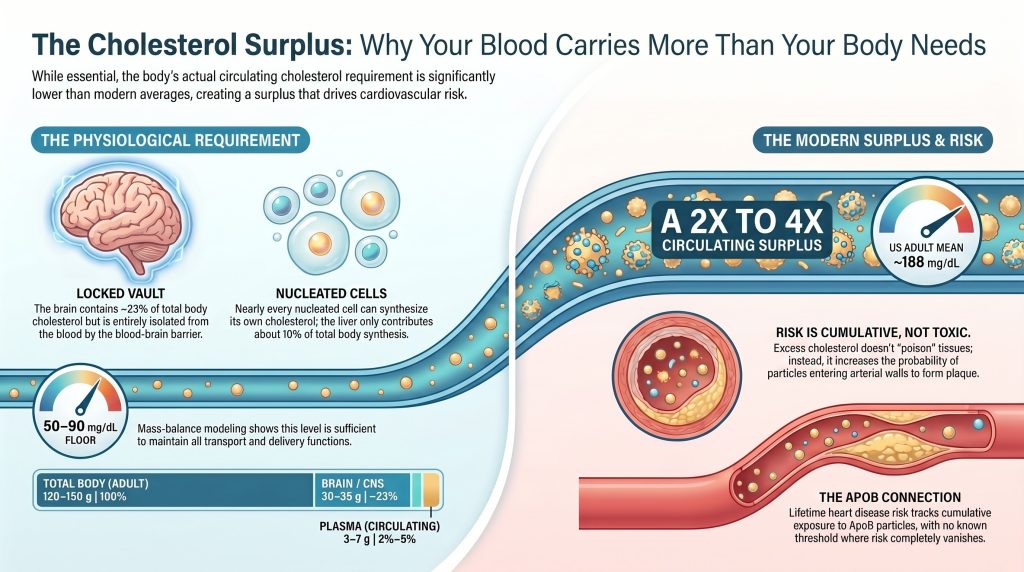
Bevindingen. (1) Het totale lichaamscholesterol bij een volwassene bedraagt ongeveer 120–150 g; de snel uitwisselbare plasmapoel van 3–7 g (afhankelijk van het plasmavolume en gemeten totaal cholesterol concentratie) vertegenwoordigt 2–5% van de totale hoeveelheid in het lichaam. (2) Alleen al de hersenen bevatten ~30–35 g, geïsoleerd uit plasma door de bloed-hersenbarrière. (3) Het plasma-cholesterol bestaat voor ongeveer 70% uit veresterde vorm en voor ongeveer 30% uit vrije vorm. (4) Een representatief 22-nm-model LDL Een deeltje (Hevonoja-reconstructie) bevat ongeveer 2.200 cholesterolmoleculen, waarvan ongeveer 18% aan vrij cholesterol aan het oppervlak; LDL is heterogeen en deze cijfers mogen niet klakkeloos op alle LDL-deeltjes worden toegepast. (5) Onder de genoemde aannames van het transportmodel en met gebruikmaking van NMR-consistente deeltjesaantallen (LDL-P in nmol/L → ~10¹⁶–10¹⁷ deeltjes/dL; HDL-P in µmol/L → ~10¹⁸ deeltjes/dL), bedraagt het door het model geschatte minimale totale cholesterolgehalte in het plasma dat tegelijkertijd het lipoproteïnesysteem stabiliseert en voorziet in ~50 mg/dag aan netto exogene behoefte bij een niet-zwangere volwassene ongeveer 50–90 mg/dL (gevoeligheid 40–110 mg/dL). Dit is een berekend scenario, geen aangetoond fysiologisch minimum.
Conclusies. Het gemiddelde plasmacholesterolniveau van volwassen Amerikanen van circa 188 mg/dL (NHANES 2017–2018) overschrijdt de door een model geschatte transportondergrens met een factor die gevoelig is voor aannames, maar consistent groter is dan 2. Dit overschot wordt metabolisch getolereerd, is causaal gekoppeld aan het risico op ASCVD op basis van het aantal apoB-deeltjes, en is niet vereist voor enige bekende fysiologische functie. Klinische richtlijnen die LDL-C-verlaging aanbevelen ter preventie van ASCVD opereren in een ander epistemisch register (gebeurtenisreductie in onderzoeken) dan dit artikel (massabalansmodellering); de twee vullen elkaar aan, ze zijn niet in strijd.
1. Compartimentsgebaseerde woordenschat
Elke cholesterolbewering in dit artikel specificeert (i) het compartiment, (ii) de chemische vorm en (iii) de eenheden. Het verwarren van klinische lipidenpaneelconcentraties met weefsel- of thet hele lichaamscholesterolmassa is de bron van de meeste kwantitatieve fouten in de leken- en educatieve literatuur. De volgende terminologie wordt overal gebruikt. [1]
| Termijn | Betekenis | Typische eenheden |
| Plasma TC / serum TC | Totaalcholesterolconcentratie in de corresponderende bloedfractie (berekend of direct gemeten op een routine lipidenprofiel) | mg/dL of mmol/L |
| Plasma LDL-C / HDL-C / VLDL-C | Cholesterol getransporteerd door de genoemde lipoproteïneklasse in plasma | mg/dL of mmol/L |
| LDL-P / HDL-P | Getalsconcentratie van LDL of HDL deeltjes (doorgaans gemeten via NMR-spectroscopie) | LDL-P in nmol/L; HDL-P in µmol/L (let op verschillende grootteordes) |
| Plasma Vrij Cholesterol / Plasma cholesterylester | Chemische verdeling van plasma-cholesterol tussen niet-veresterde en veresterde vormen (doorgaans ~30% / ~70%) | mg/dL, mmol/L of % plasma-TC |
| Plasmacholesterolmassa | Plasmacholesterol × plasmavolume; de absolute cholesterolmassa die op een bepaald moment in het plasma circuleert | g (= mg/dL × dL_plasma / 1000) |
| circulerende cholesterolmassa | Plasmacholesterolmassa + cholesterol in erytrocytenmembranen (wisselt snel uit met plasma) | g |
| Weefselcholesterolconcentratie | Cholesterol per massa-eenheid weefsel (bijv. hersenen bij ~23 mg/g nat gewicht) | mg/g nat of droog gewicht |
| Cellulair / subcellulair cholesterol | Cholesterol in een specifiek celtype, organelmembraan of pool | mol% van membraanlipiden; µg/mg eiwit |
| Totaal lichaamscholesterol | Totale lichaamscholesterolmassa over alle weefsels en vloeistoffen | g |
| Model-geschatte transportvloer | Berekende minimale plasmacholesterolconcentratie die voldoet aan de structurele en afleveringsfuncties van het circulerende lipoproteïnesysteem onder de opgegeven aannames | mg/dL |
| ■ Lipoproteïnedeeltjeseenheden zijn NMR-conventies
NMR-lipoproteïne-subfractie-analyse (LipoProfile en vergelijkbare tests) rapporteert LDL-P in nanomol per liter (nmol/l), wat het bereik van ongeveer 10¹⁵–10¹⁸ deeltjes/l weerspiegelt dat typisch is voor volwassenen. HDL-P wordt conventioneel gerapporteerd in micromol per liter (µmol/l) omdat HDL overvloediger aanwezig is op basis van het aantal deeltjes. Dit artikel hanteert overal de NMR-conventies en rekent dit om naar deeltjes per deciliter met behulp van expliciete berekeningen. |
| ■ Plasma versus serum
Routinematige klinische lipidenprofielen worden uitgevoerd op serum of plasma; het verschil in de gemeten cholesterolwaarde is klein (doorgaans < 3%). Tenzij anders aangegeven, hebben alle concentraties van circulerend cholesterol zowel betrekking op plasma als op serum. |
2. Systemische distributie en massabalans
2.1 Totaal lichaamscholesterol
Het totale lichaamscholesterol bij een volwassene bedraagt ongeveer 120–150 g, met lichaamsgewichtschaling. Het bereik weerspiegelt de variabiliteit tussen proefpersonen en tussen methoden in weefseldistributiestudies. [2][3] Oudere leerboekcitaten van ~35 g vertegenwoordigen in het kinetische tracer-model alleen Goodman's snel uitwisselende Pool A (lever + plasma + erythrocyten + deel van de ingewanden), en niet het totaal van het hele lichaam. Directe kwantitatieve weefselanalyse (Sabine, 1977, herhaald in moderne overzichten) plaatst het totale lichaamscholesterol van een volwassen mens op het hogere cijfer, waarbij de hersenen, bindweefsel inclusief vetweefsel, en skeletspieren elk ongeveer 25–35 g bijdragen. [2][3]
Het driepooletracerodel van Goodman definieert een snel uitwisselende Poel A (lever, plasma, erythrocyten, splanchnicus) van 15–30 g, een langzaam uitwisselende Poel B (skeletspier, vetweefsel, dens bindweefsel) van 35–60 g, en een kinetisch geïsoleerde CZS-poel van ca. 30–35 g.4][5Alleen het plasmacompartiment bevat 3–7 g van cholesterol, afhankelijk van het plasmavolume en de gemeten totale plasmacholesterolconcentratie.
2.2 Weefseldistributie
Verdeling onder de aanname van ~140 g totaal lichaamscholesterol (representatief middenpunt). Alle vermeldingen zijn weefselcholesterolmassa. [2][3]
| Compartiment | Cholesterol (g) | % van het totale gewicht | Dominante chemische vorm |
| Hersenen / CZS (myeline + neurale membranen) | 30–35 | ~22–25% | >99,51 TP9T vrij (niet-veresterd) |
| Skeletspier | ~25–30 | ~18–22% | Vrij (plasmamembraan) |
| Bindweefsel, vetweefsel, lichaamsvloeistoffen | ~25–32 | ~18–23% | Gemengd; CE accumuleert met de leeftijd in pees/dura |
| Huid | ~12–18 | ~9–13% | Gratis |
| Andere ingewanden (long, nier, darm, etc.) | ~12–18 | ~9–13% | Voornamelijk gratis |
| Lever | ~4–6 | ~3–4% | Gemengd FC + CE |
| PlasMAP / circulerende pool | 3–7 | ~2–5% | ~70% CE / ~30% FC |
| Hart, milt, bijnieren (per orgaan) | <1 elk | <1% | Hoge dichtheid per gram (bijnieren ≥ 25 mg/g) |
Het centrale zenuwstelsel bevat ongeveer 22–251 TP9T lichaamscholesterol bij de hoogste weefselconcentratie (ongeveer 23 mg/g natgewicht). [5][6] De bloed-hersenbarrière is ondoordringbaar voor lipoproteïnecholesterol; de totale CZS-pool wordt lokaal gesynthetiseerd. Corticale neuronale cholesterol heeft een omzetsnelheid met een halfwaardetijd van 6 maanden tot 5 jaar; myelinecholesterol heeft een omzetsnelheid van de orde van decennia. Netto-efflux uit het CZS vindt voornamelijk plaats als 24S-hydroxycholesterol, dat de bloed-hersenbarrière passeert en in het plasma wordt geklaard. [5][6][7]
2.3 Plasmacholesterolmassa bij verschillende plasmatotalecholesterolconcentraties
Plasmacolesterolmassa is het product van plasmavolume en de totale plasmacolesterolconcentratie. Bij een representatief plasmavolume van 3,0 L:
| Plasma TC (mg/dL) | Plasmacolesterolmassa (g, 3,0 L plasma) | Klinische context |
| 50 | 1.5 | Onder het typische neonatale bereik; zeldzame LOF-mutaties |
| 80 | 2.4 | Gerapporteerd PCSK9 LOF homozygote range |
| 100 | 3.0 | PCSK9-remmer behandeldoelstellingen |
| 150 | 4.5 | Therapeutisch doel bij intensieve lipidenverlaging |
| 188 | 5.6 | Gemiddelde voor Amerikaanse volwassenen (NHANES 2017–2018) [8] |
| 220 | 6.6 | Grensverhoogd |
| 280 | 8.4 | Heterozygote FH-range |
| ■ Plasmavolume varieert met lichaamsgrootte
Het plasmavolume bij volwassenen is ongeveer 40–45 mL/kg lichaamsgewicht (~2,8–3,2 L voor een volwassene van 70 kg, ~3,5–4,0 L voor een volwassene van 90 kg). Alle berekeningen van de plasmassa in dit artikel gebruiken een representatieve 3,0 L tenzij anders vermeld. |
2.4 Subcellulaire distributie en de ER-cholesterolsensor
In de meeste niet-neurale cellen bevat het plasmamembraan 60–90% cellulair cholesterol op 30–40 mol% PM-lipiden, terwijl het endoplasmatisch reticulum slechts 3–6 mol% bevat. [9][10] De gradiënt wordt geregeld door SREBP2 in combinatie met SCAP en Insig: wanneer het cholesterolgehalte in het ER ~5 mol% overschrijdt, houdt SCAP SREBP2 in het ER vast en wordt de synthese onderdrukt. [11] Das et al. (eLife 2014) hebben het cholesterol in de plasmamembraan (PM) onderverdeeld in drie functionele pools met behulp van een Perfringolysin O (PFO*) probe: een in sfingomyeline opgeslagen pool (~15 mol% aan PM-lipiden), een “essentiële” pool die nodig is voor de levensvatbaarheid van de cel, en een “toegankelijke” pool die naar het ER stroomt om de synthese te reguleren. [11][12De toegankelijke pool – niet de totale PM-cholesterol – is het regulerende signaal.
| ▲ PFO*-bindingsdrempel is van toepassing op plasmamembraanbilagen, niet op lipoproteïnemonolagen.
De 35 mol% PFO*-toegankelijkheidsdrempel in plasmamembranen weerspiegelt de architectuur van de dubbellaag en de voor het plasmamembraan specifieke complexvorming tussen sfingomyeline en cholesterol. [11][12LDL- en HDL-oppervlakken zijn fosfolipidenmonolagen die worden gestabiliseerd door apolipoproteïnen; ze hebben een andere lipidesamenstelling, bladhelftasymmetrie en pakkingsbeperkingen. De drempelwaarde mag niet zonder verdere analyse direct op lipoproteïne-oppervlakken worden toegepast. |
2,5 Dagelijkse omzet
Gehele lichaam de novo cholesterolsynthese bij volwassenen is ongeveer 10 mg/kg/dag (~700 mg/dag bij een volwassene van 70 kg, ~880 mg/dag bij een volwassene van 88 kg). De lever draagt slechts ~10% bij aan de totale synthese bij de mens; het grootste deel vindt buiten de lever plaats. [13Drie-pool-tracerstudies van plasmacolesterol-turnover geven een totale productiesnelheid (synthese plus dieetabsorptie) van ~1,0–1,2 g/dag bij normolipidemische proefpersonen.4] De opname via de voeding (~300–500 mg/dag bij een westers dieet, ~30–50% wordt opgenomen) wordt gecompenseerd door een afremming van de endogene synthese. [14]
3. Lipoproteïnearchitectuur en Cholesterolpartitionering
3.1 Representatieve samenstelling van een 22-nm LDL-partikel
De reconstructie hieronder is afkomstig van Hevonoja et al. (BBA 2000) voor een representatief LDL-deeltje met een diameter van 22 nm.15][16][17]
| Onderdeel | Moleculen / deeltje | Massafactie (%) | Locatie |
| Cholesterylesters (CE) | ~1,600 | 40–45% | Kern |
| Onveresterd cholesterol (FC) | ~600 | 8–10% | ~400 oppervlak, ~200 kern |
| Triglyceriden (TG) | ~170 | 5–9% | Kern |
| Fosfatidylcholine | ~450 | } 19–21% gecombineerd | Oppervlaktemonolaag |
| Sfingomyeline | ~185 | (totaal fosfolipide) | Oppervlaktemonolaag |
| ApoB-100 (één exemplaar) | 1 | 20–25% | Bedekt het oppervlak |
Het totale cholesterolgehalte per representatief LDL-deeltje bedraagt ~2.200 moleculen; het FC aan het oppervlak maakt ~18% uit van LDL-cholesterol. Sommige algemene literatuurverwijzingen noemen ~1.500 cholesterolmoleculen per gemiddeld LDL-deeltje, wat verschillende middelingstechnieken over de LDL-grootteverdeling weerspiegelt; beide getallen zijn beschrijvingen van de centrale tendens van een inherent heterogene populatie.16]
| ▲ LDL is heterogeen.
In-vivo LDL varieert van ~22–27,5 nm met aanzienlijke compositionele variatie; kleine dense LDL draagt minder cholesterol per deeltje en is verrijkt in TG, terwijl grote, drijvende LDL meer draagt. De Hevonoja-reconstructie is een representatief centraal-tendensdeeltje en mag niet ukritisch op alle LDL-soorten worden toegepast. |
3.2 Verhouding vrij tot geësterificeerd plasmacholesterol
Uit directe enzymatische en chromatografische metingen in serum van gezonde mensen blijkt dat het vrije cholesterol in het plasma ongeveer 25–30% van het totale plasma-cholesterol uitmaakt, terwijl de veresterde fractie ongeveer 70–75% bedraagt. [18][19Een verhoogde FC/CE-ratio is geassocieerd met LCAT-dysfunctie, familiaire chylomicronemie en in sommige studies met een onafhankelijk atherogeen signaal.20]
3.3 Vrij oppervlakte-cholesterol: structurele rol
Vrij cholesterol op het lipoproteïneoppervlak intercaleert tussen fosfolipide-acylketens, waarbij de 3β-hydroxylgroep uitsteekt in het waterige grensvlak en zijn stijve sterol ring is uitgelijnd met de lipidenstaarten. Deze “condensatie” vermindert het vrije volume in de monolaag, verlaagt de permeabiliteit voor water en verhoogt de mechanische stabiliteit van het deeltje.21][22] Een FC van ongeveer 25 mol% aan oppervlakte-lipiden komt overeen met een vloeibare, geordende en dicht opeengepakte monolaag; deze configuratie bevordert de stabiliteit van de deeltjes en de laterale mobiliteit voor enzymatische verwerking. [23]
3.4 Vrije cholesterol-uitwisseling
Vrij cholesterol op lipoproteïne-oppervlakken is in spontane evenwichtstoestand met celmembranen en andere lipoproteïnedeeltjes via passieve, waterige diffusie. De uitwisselingshalveringstijd schchaalt omgekeerd evenredig met de oppervltekromming: ~5 min voor nascent HDL, ~45 min voor LDL.21][23Dit kinetische systeem handhaaft een nagenoeg uniforme thermodynamische activiteit van cholesterol over alle extracellulaire lipidenoppervlakken.22][23]
4. Cholesterylesters: Transportlading
Cholesterylesters zijn volledig hydrofoob en bevinden zich in de lipoproteïnekern in de vorm van een vloeibare of vloeibaar-kristallijne druppel. CE in LDL vertegenwoordigt 40–45% van de deeltjesmassa en levert het grootste deel van het cholesterol dat via receptorgemedieerde endocytose aan cellen wordt afgegeven, waar lysosomaal zuurlipase vrij cholesterol vrijmaakt voor gebruik. [17]
CETP transporteert CE van HDL naar apoB-bevattende lipoproteïnen in ruil voor triglyceriden, waardoor apoB deeltjes met cholesterol als lading. Een aanzienlijk deel van de apoB-deeltjeskern-CE weerspiegelt derhalve cholesterol dat heeft gecirculeerd via perifeer weefsel, plasma en HDL voordat het werd overgedragen op LDL, bovenop de hepatische cholesterolpools die worden uitgescheiden als VLDL. [24]
5. HDL-rijping
Ontluikend HDL wordt uitgescheiden als lipide-arm apoA-I dat fosfolipide en vrij cholesterol opneemt van perifeere cellen via ABCA1, waarbij een discoïdaal deeltje van twee apoA-I-moleculen in een “dubbele-riem”-conformatie wordt gevormd. [25LCAT, geactiveerd door apoA-I, draagt een acylgroep over van de sn-2-positie van fosfatidylcholine naar oppervlakte-FC, waarbij CE wordt gevormd dat naar de hydrofobe kern migreert.23][25]
Naarmate CE zich ophoopt, wordt de schijfvormige dubbellaag sferisch. Volwassen HDL2 bereikt een diameter van ~10–12 nm en draagt ~30–60 cholesterolmoleculen per deeltje (voornamelijk CE), met ~5–15 oppervlakte-FC.23] De CE keert óf direct terug naar de lever via SR-B1 of wordt overgedragen op apoB-partikels via CETP voor hepatische klaring via LDLR. [23][24]
6. Weefselvereisten: De Novo Synthese en Exogene Opname
6.1 De meeste weefsels met een kern kunnen cholesterol *de novo* synthetiseren
Elke cel met een kern in het menselijk lichaam brengt de volledige mevalonaat-cholesterol-biosyntheseroute tot expressie.13][26Onder normale omstandigheden zijn de meeste weeën niet absoluut afhankelijk van een continue exogene cholesterolaanvoer vanuit het plasma; de kwantitatieve balans tussen lokale synthese en uit lipoproteïnen afkomstige opname varieert per weefsel, leeftijd en fysiologische toestand.
| Zakdoek | Primaire cholesterolbron | Notities |
| Hersenen / CZS | Lokale syntheseastrocyten → neuronen via apoE) | BBB sluit lipoproteïnecholesterol uit; netto efflux via 24S-OH-cholesterol [7] |
| Skeletspier | Overwegend lokale synthese | Lage vraag naar nieuwe sterol |
| Huid | ~90% lokale synthese | Ondersteunt de barrièrefunctie |
| Bijnierschors | Gemengd: LDLR > SR-B1 bij mensen; omgekeerd bij knaagdieren27][28] | Opgeslagen CE-buffers voorzien in acute steroïdogene behoefte |
| Geslachtsklieren (teelballen, eierstokken) | Gemengd: LDLR + SR-B1; reproductieve-toestand-afhankelijk | Zwangerschap en borstvoeding verhogen de behoefte |
| Moederkoek | Maternale LDL en HDL; alleen zwangerschap | Buiten de scope van de analyse van niet-zwangere volwassenen |
| Lever | Synthese + dieet + omgekeerd transport | Hoofdregulator; scheidt VLDL af |
In de humane bijnierschors- en gonadenfysiologie draagt LDLR-gemedieerde endocytose kwantitatief meer bij aan de cholesteroltoevoer dan SR-B1 — in tegenstelling tot het knaagdierpatroon waarin SR-B1 domineert. SR-B1 blijft desondanks tot expressie komen en biologisch actief in humane steroïdogene weeën, en functieverlies van SR-B1 bij mensen leidt tot subtiele maar reële afwijkingen in de door ACTH gestimuleerde cortisolrespons. Het gemengde-routeskarakter van de humane steroïdogene cholesterolvoorziening moet in elke mechanistische bespreking behouden blijven.27][28]
6.2 LDL-receptor-kinetiek: in-vitro en in-vivo zijn niet uitwisselbaar
In-vitro: in gekweekte humane fibroblasten verzadigt de high-affinity binding van LDL apoB-100 bij LDL-proteïneconcentraties onder 50 µg/mL (Brown & Goldstein).29][30] Catapano en collega’s (2024) omschrijven dit als een halve verzadiging die overeenkomt met een LDL-C-plasma-equivalent van ~2,5 mg/dL, en combineren dit met de observatie dat LDL-C in interstitiële vloeistof ~20% van het LDL-C-gehalte in plasma bedraagt, om te stellen dat een LDL-C-gehalte in plasma van ~12,5 mg/dL de LDLR’s in het weefsel zou verzadigen. [31Dit argument is afhankelijk van intermediaire aannames over de massaverhouding tussen LDL-eiwit en cholesterol, de samenstelling van de interstitiële vloeistof en de uniformiteit van het LDLR-gedrag van fibroblasten; dit artikel citeert het argument zonder het goed te keuren als een gemeten menselijke drempelwaarde.
In vivo orgaan-specifieke LDL-klaring bij rat en hamster (Spady & Dietschy) geeft Km ≈ 90 mg/dL — ongeveer 30 keer hoger, wat een weerspiegeling is van ongeroerde grenslagen, capillaire permeabiliteit en receptordichtheid in plaats van intrinsieke affiniteit.32Dit knaagdier in-vivo getal is niet direct overdraagbaar op cholesterolleveringsdrempels op menselijk weefselniveau.
| ▲ Receptorenverzadigingskinetiek is geen duidelijke drempelwaarde voor toediening aan mensen.
De keten (in-vitro fibroblast Km → plasmacuivalent LDL-C → interstitieel-vocht LDLR-verzadiging in bijnier-/gonadencellen) is afhankelijk van aannames die niet onafhankelijk zijn gevalideerd bij de mens, en hepatocyten worden blootgesteld aan sinusvormig bloed in plaats van aan gewone interstitiële vloeistof. De inhoudelijk verdedigbare claim is empirisch: mensen met een zeer lage plasma-LDL-C, door genetica of therapie, hebben geen klinische tekenen van cholesterol-afgifte-insufficiëntie vertoond in de gerapporteerde populaties. |
6.3 Empirische waarnemingen: zeer lage LDL-C bij mensen
Dragers van homozygote PCSK9-functieverliesmutaties maken deel uit van een kleine gerapporteerde steekproef. De oorspronkelijk beschreven Afro-Amerikaanse homozygoten uit de Dallas Heart Study hadden gedurende hun hele leven een plasma-LDL-C van 14–29 mg/dL (totaal cholesterol typisch 50–80 mg/dL) zonder duidelijke klinische afwijkingen in de beperkte gepubliceerde beschrijvingen.33][34] Het totaal gerapporteerde wereldwijde aantal van dergelijke homozygoten blijft klein, dus dit bewijs ondersteunt de afwezigheid van schadelijkheid met een groot effect, maar bewijst geen universeel fysiologisch minimum.
Groότερα bewijzen zijn afkomstig van gerandomiseerde onderzoeken met PCSK9-remmers. Fourier (n = 27.564) had een mediane gerandomiseerde follow-up van 2,2 jaar, met een mediane LDL-C tijdens de behandeling van 30 mg/dL en geen tekenen van bijnierinsufficiëntie, hypogonadisme, cognitieve achteruitgang, hersentumor, of spierziekte. [35] Odyssee UITKOMSTEN (n = 18.924) hadden een mediane follow-up van 2,8 jaar met vergelijkbare veiligheidsbevindingen.36] De FOURIER Open-Label Extension (FOURIER-OLE, n = 6.635 van de oorspronkelijke 27.564) voegde een mediaan toe 5,0 jaar of evolocumab blootstelling, brengen cumulatieve blootstelling in die subgroep tot ~8,4 jaar, zonder nieuw veiligheidssignaal.37Dit zijn omvangrijke, prospectieve veiligheidsgegevens; zij zijn geen directe meting van de drempelwaarden voor cholesterolaanvoer bij de mens, maar zij begrenzen het empirisch aangetoonde veilige bereik van LDL-C in het plasma van bovenaf.
In onderzoeken naar perifere lymfe bij mensen wordt gemeld dat de LDL-concentratie in het interstitiële vocht ongeveer 10–20% bedraagt ten opzichte van de LDL-concentratie in het plasma. [38][39Deze gegevens zijn beschrijvend en stellen geen gemeten weefselverzadigingsdrempel voor de mens vast.
7. Een transportmodel-schatting van het minimum circulerende cholesterol
| ■ Wat deze sectie wel en niet is.
Dit gedeelte presenteert een transportmodellenschatting van de minimale plasmaconcentratie van cholesterol die tegelijkertijd (i) de structurele integriteit van het circulerende lipoproteïnesysteem in stand houdt en (ii) onder normale omstandigheden voorziet in de netto dagelijkse exogene cholesterolbehoefte van een niet-zwangere volwassene. De schatting is een berekening, geen meting. Vergelijkingen en parameterwaarden staan in Sectie 11. |
7.1 Structurele integriteit
Alle circulerende lipoproteïnedeeltjes hebben vrij cholesterol op het oppervlak nodig om hun fosfolipidenmonolagen te stabiliseren. Met behulp van NMR-consistente deeltjesaantallen (LDL-P in nmol/L; HDL-P in µmol/L) en expliciete eenheidsomzetting: [15][17]
| Deeltjesklasse | Specialisatie (klinisch) | Deeltjes per dL | Oppervlakte-FC per deeltje | Bijdrage van Surface FC (mg/dL) |
| LDL | LDL-C 100 mg/dL; LDL-P ~1.200 nmol/L | ~7,1 × 10¹⁶ | ~400 | ~18 |
| HDL | HDL-C 50 mg/dL; HDL-P ~30 µmol/L | ~1,8 × 10¹⁸ | ~10 | ~12 |
| VLDL / IDL | TG-gestuurd; deeltjestellingen ~10¹⁵–10¹⁶ /dL | — | ~variabele | ~2–3 |
| Totale oppervlakte FC (model, referentiewaarde TC ~190) | — | — | — | ~30–33 |
| Totaal gemeten FC in plasma (~28% van TC bij TC 190) | — | — | — | ~50–55 (inclusief kern-FC en overige) |
De uit het model afgeleide FC aan het oppervlak van ~30–33 mg/dL bij typische klinische lipidenwaarden, plus de FC in de kern van ~10–15 mg/dL (LDL heeft ~200 kern-FC per deeltje, HDL levert een kleinere bijdrage aan de kern-FC), en een kleine bijdrage van chylomicronresten en Lp(a), komt in totaal uit op ongeveer 45–55 mg/dL FC in plasma. Dit komt overeen met de rechtstreeks gemeten FC-fractie in het plasma van ~25–30% van het totale cholesterol bij een totaal cholesterolgehalte van ~190 mg/dL. [18][19]
7.2 Netto dagelijkse aanvoer van exogeen cholesterol naar perifere weefsels
Omgekeerd cholesteroltransport Uit traceronderzoeken bij gezonde volwassenen (Turner et al., 2012) blijkt dat de efflux van FC uit alle lichaamsweefsels 3,79 ± 0,88 mg/kg/u bedraagt, wat in het oorspronkelijke artikel wordt weergegeven als ≈8 g/dag; dit komt overeen met ~6,4 g/dag bij 70 kg of ~8 g/dag bij 88 kg (het gemiddelde geschatte lichaamsgewicht in de studie). [40] Dit betreft een bidirectionele uitwisselingsstroom, niet de netto-opnamebehoefte. De geschatte netto exogene opname door weefsels waarvan de lokale synthese onder basisomstandigheden onvoldoende is, bij een niet-zwangere volwassene, bedraagt ongeveer:
| Weefsel / functie | Geschatte dagelijkse inname van cholesterol | Leverancier |
| Steroïdogenese in de bijnieren (uitgangswaarde) | ~30–60 mg/dag | Voornamelijk via LDLR; bijdrage van SR-B1 |
| Steroïdogenese in de geslachtsklieren (volwassen vrouw, niet-zwanger, uitgangswaarde) | < 10 mg/dag | Bij mensen voornamelijk via de LDLR |
| Galzuur synthese | ~400 mg/dag | Leverpool; geen perifere vraag |
| Extrahepatische membraanomzet (totaal) | ~600–700 mg/dag | Vervaardigd via lokale synthese |
| Netto-exogene vraag (volwassen vrouw die niet zwanger is, uitgangssituatie) | In de orde van grootte van tientallen mg/dag (~50 mg/dag als gemiddelde schatting) | Geconstateerd bij een zeer laag LDL-C-gehalte in het plasma |
| ▲ Volwassen, niet-zwanger, alleen bij aanvang.
Tijdens de zwangerschap verdubbelt het cholesterolgehalte in het plasma van de moeder ongeveer; de behoefte van de placenta ligt in een heel andere orde van grootte en wordt hier niet meegenomen. Ook acute ziekte, ernstige stress en snelle weefselregeneratie verhogen de behoefte. |
7.3 Op basis van het gecombineerde model geschatte transportdrempel
Modelresultaten voor een reeks plasma-TC-waarden:
| Plasma TC-scenario | LDL-oppervlakte-FC (mg/dL) | HDL-oppervlakte FC (mg/dL) | Totaal FC in plasma (mg/dL) | Notities |
| TC 188 (gemiddelde in de VS) | ~18 | ~12 | ~50–55 | Nulpunt |
| TC 100 (PCSK9-Rx-doelwit) | ~10 | ~10 | ~30 | Voldoende; ruim boven elk constructievloerniveau |
| TC 70 (homozygoot voor PCSK9-LOF) | ~4 | ~9 | ~17 | Op of nabij de modelvloer; empirisch aanvaardbaar |
| TC 50 (extreem genetisch) | ~2 | ~8 | ~13 | Onder elke goed onderbouwde empirische casus |
Kortom: het transportmodel voorspelt dat een niet-zwangere volwassene onder basisomstandigheden een functioneel lipoproteïnesysteem in de bloedsomloop kan handhaven en kan voorzien in een exogene weefselbehoefte van ongeveer 50 mg/dag bij een totaal cholesterolgehalte in het plasma in de orde van grootte van 50–90 mg/dL (gevoeligheidsbereik 40–110 mg/dL). De chemische samenstelling blijft binnen dit bereik grofweg 70% veresterd en 30% onveresterd. De schatting op basis van het model komt numeriek overeen met het plasma-TC dat wordt waargenomen bij PCSK9 LOF-homozygoten (~50–80 mg/dL), wat een onafhankelijke bevestiging biedt van klinische en genetische waarnemingen. Het gemiddelde plasma-TC bij volwassenen in de VS bedraagt momenteel ~188 mg/dL [8] overschrijdt de door het model geschatte ondergrens met ongeveer 2 tot 4 keer, afhankelijk van welk gevoeligheidsscenario wordt gebruikt.
7.4 Gevoeligheidsgrenzen
| Aanname varieerde | Bereik getest | Gevolgen voor de raming van de transportkosten |
| Plasmavolume | 2,5–4,0 l | Omgekeerde schaalverdeling; primair effect op de absolute massa, secundair effect op mg/dL |
| LDL-P bij een bepaald LDL-C-gehalte | ± 50% van een representatief exemplaar | Heeft een evenredige invloed op de FC-component |
| Oppervlakte-FC per LDL-deeltje | 300–500 | ± 15% op FC-component |
| FC per HDL-deeltje | 5–15 | ± 25% op de HDL FC-component |
| Netto vraag naar randapparatuur | 20–150 mg/dag | Voegt een marge van 5–30 mg/dL toe |
| Zwangerschap / acute ziekte | — | Model niet van toepassing; de vraag kan 2–10 keer toenemen |
| Gecombineerd aannemelijk bereik (volwassen vrouw die niet zwanger is, uitgangssituatie) | — | ~40–110 mg/dL plasma-TC |
8. Causaal verband tussen ApoB en het risico op ASCVD
Of perifere weefsels cholesterol uit de bloedbaan nodig hebben, is een andere vraag dan of apoB-bevattende lipoproteïnen in de bloedbaan daadwerkelijk atherogeen zijn. Mendeliana randomisatie in meer dan 50 genetische instrumenten (LDLR, PCSK9, HMGCR, NPC1L1, APOB, ANGPTL3, LPL, CETP) heeft aangetoond dat het levenslange risico op ASCVD eerder samenhangt met de cumulatieve blootstelling aan apoB-deeltjes dan met de absolute LDL-C-concentratie alleen, waarbij een log-lineair verband tussen apoB en het risico op een voorval bij een LDL-C-waarde van minder dan 20 mg/dL. [41][42]
Het atherogene risico dat een bepaalde hoeveelheid circulerend cholesterol met zich meebrengt, wordt bepaald door het aantal deeltjes (apoB-telling) en de verblijftijd, en niet door de vraag of het cholesterol nodig is voor de toevoer naar de weefsels. Deze twee aspecten staan fysiologisch gezien los van elkaar.
9. Evolutionaire en mechanistische context
Voor de cholesterolbiosynthese zijn 11 moleculen O₂ en ongeveer 100 ATP-equivalenten per cholesterolmolecuul nodig, en daarbij komen giftige tussenproducten vrij. [43][44] Deze uitgave strookt met het feit dat cholesterol is ontstaan toen eukaryoten zich aanpasten aan een stijgende zuurstofspanning in de atmosfeer; cholesterol verbruikt tijdens de synthese O₂ en vermindert tegelijkertijd de O₂-doorlaatbaarheid van het membraan, waardoor het gedeeltelijk als een O₂-opslagplaats fungeert. [44]
Vanuit het in paragraaf 7 ontwikkelde modelleringsperspectief kan het lipoproteïnetransportsysteem het best worden geïnterpreteerd als (i) een middel voor de distributie van triglyceriden — LDL is een kinetisch bijproduct van het VLDL-katabolisme — en (ii) een kinetische chemische-potentiaalbuffer die zorgt voor een uniforme sterolactiviteit op alle extracellulaire lipidenoppervlakken. [22][23] Volgens deze interpretatie wordt de cholesterolconcentratie in het bloed van de moderne bevolking voornamelijk bepaald door de klaringscapaciteit van de lever (LDLR-dichtheid, PCSK9-activiteit, IDOL-activiteit) en niet zozeer door de vraag vanuit de perifere weefsels.
10. Conclusies
- Het totale cholesterolgehalte in het lichaam van een volwassene bedraagt ongeveer 120–150 g; het plasmagedeelte van 3–7 g vertegenwoordigt 2–5%, en niet 10–30%, van de totale hoeveelheid in het lichaam.
- De hersenen bevatten ongeveer 30–35 g (22–25% van het totale cholesterolgehalte in het lichaam), dat volledig ter plaatse wordt aangemaakt en door de bloed-hersenbarrière uit het plasma wordt afgeschermd.
- Een representatief LDL-deeltje van 22 nm bevat ongeveer 2.200 cholesterolmoleculen (ongeveer 1.600 CE + ongeveer 600 FC, waarvan ongeveer 400 FC zich aan het oppervlak bevinden). LDL is heterogeen; deze cijfers geven een representatieve reconstructie weer.
- Het cholesterol in het plasma bestaat voor ongeveer 70% uit veresterde vorm en voor ongeveer 30% uit vrije vorm.
- Bij mensen speelt LDLR-gemedieerde endocytose een grotere rol dan SR-B1 bij de opname van cholesterol door de bijnieren en geslachtsklieren, maar SR-B1 blijft biologisch actief.
- Op basis van NMR-consistente lipoproteïnedeeltjestellingen (LDL-P in nmol/L, HDL-P in µmol/L) bedraagt het door het model geschatte minimale totale plasmacholesterolgehalte voor een niet-zwangere volwassene onder basislijnomstandigheden ongeveer 50–90 mg/dL (gevoeligheid 40–110 mg/dL). Dit is een berekend scenario, geen direct gemeten fysiologisch minimum bij de mens.
- De netto dagelijkse aanvoer van exogeen cholesterol naar perifere weefsels bij een niet-zwangere volwassene onder basisomstandigheden ligt in de orde van grootte van tientallen mg/dag; hieraan wordt ruimschoots voldaan bij een plasma-LDL-C-gehalte in het bereik van 15–30 mg/dL, zoals waargenomen bij PCSK9 LOF-dragers en bij proefpersonen in onderzoeken met PCSK9-remmers (mediaan FOURIER 2,2 jaar, mediaan FOURIER-OLE-subgroep 5,0 extra jaren), bij wie geen aanwijzingen voor een tekort aan cholesteroltoevoer zijn gemeld.
- Het gemiddelde totale cholesterolgehalte in het plasma bij volwassenen in de VS van ~188 mg/dL (NHANES 2017–2018) overschrijdt de door het model geschatte transportdrempel met ongeveer 2–4 keer, afhankelijk van welk gevoeligheidsscenario wordt gebruikt. Dit overschot wordt metabolisch verdragen, houdt op per-apoB-basis een causaal verband in met het ASCVD-risico en is onder basislijnomstandigheden niet vereist voor enige bekende fysiologische functie bij een niet-zwangere volwassene.
11. Bijlage: Methoden
11.1 Toepassingsgebied
In deze bijlage worden de vergelijkingen, parameterwaarden en aannames gespecificeerd die zijn gebruikt bij de schatting op basis van het transportmodel in paragraaf 7.
11.2 Vergelijkingen
Plasmacholesterolmassa:
M_plasma = TC × V_plasma / 1000 (g)
waarbij TC wordt uitgedrukt in mg/dL en V_plasma in dL.
Omrekening van de NMR-deeltjesconcentratie naar deeltjes per dL:
N_deeltjes_per_dL = [klasse-P] × 10⁻⁹ × N_A / 10 (LDL: [LDL-P] in nmol/L)
N_deeltjes_per_dL = [klasse-P] × 10⁻⁶ × N_A / 10 (HDL: [HDL-P] in µmol/L)
waarbij N_A = 6,022 × 10²³ /mol. De /10 zet L om in dL.
Rekenvoorbeeld, LDL-P = 1.200 nmol/L:
1.200 × 10⁻⁹ × 6,022 × 10²³ / 10 = 7,23 × 10¹⁶ deeltjes/dL
Voorbeeldberekening, HDL-P = 30 µmol/L:
30 × 10⁻⁶ × 6,022 × 10²³ / 10 = 1,81 × 10¹⁸ deeltjes/dL
Bijdrage van Surface FC uit één lipoproteïneklasse:
[FC]_klasse (mg/dL) = N_deeltjes_per_dL × n_FC,klasse × MW_chol × 1000 / N_A
Rekenvoorbeeld: LDL bij LDL-C 100 (N = 7,23 × 10¹⁶/dL), 400 FC’s per deeltje, MW_chol = 386,7 g/mol:
7,23 × 10¹⁶ × 400 × 386,7 × 1000 / 6,022 × 10²³ = ~18,2 mg/dL
Totale, op basis van het model geschatte transportbodem:
TC_vloer ≈ Σ [FC]_klasse,oppervlak + Σ [FC]_klasse,kern + CE_kern,constructief + CE_leveringsreserve
11.3 Gebruikte parameterwaarden
| Parameter | Middenwaarde | Bron / basis | Gevoeligheidsbereik |
| Plasmavolume | 3,0 L (= 30 dL) | ~42 ml/kg × 70 kg | 2,5–4,0 l |
| LDL-P bij een LDL-C-waarde van 100 mg/dL | ~1.200 nmol/L (= 7,1 × 10¹⁶ /dL) | NMR LipoProfile-gegevens; MESA, Jupiter | 600–1.800 nmol/L |
| HDL-P bij een HDL-C-waarde van 50 mg/dL | ~30 µmol/L (= 1,8 × 10¹⁸ /dL) | NMR-gegevens | 20–40 µmol/L |
| Oppervlakte-FC per LDL-deeltje | 400 | Reconstructie van Hevonoja 2000 [15] | 300–500 |
| FC per HDL-deeltje (totaal) | ~10 | Overzichten van de samenstelling van HDL2/3; berekend op basis van HDL-C / HDL-P bij centrale waarden | 5–15 |
| Netto dagelijkse perifere exogene behoefte (volwassen vrouw, niet zwanger) | ~50 mg/dag | Samenstelling van schattingen voor de bijnieren, geslachtsklieren en membranen [26][27] | 20–150 mg/dag |
| MW-cholesterol | 386,7 g/mol | Opgelost | n.v.t. |
| Het getal van Avogadro | 6,022 × 10²³ /mol | Opgelost | n.v.t. |
11.4 Aannames
De berekening van de transportvloer is afhankelijk van de aannames die hier expliciet worden vermeld:
- De niet-zwangere volwassene bevindt zich onder basisomstandigheden (geen zwangerschap, geen acute ziekte, geen snelle weefselregeneratie) in een metabolische evenwichtstoestand.
- Het plasmavolume wordt weergegeven als één representatieve waarde in plaats van per persoon.
- Het aantal deeltjes neemt binnen het gemodelleerde bereik ongeveer lineair toe met de cholesterolconcentratie in de betreffende klasse; deze benadering gaat niet meer op bij extreme waarden.
- De oppervlakte-FC per LDL is ontleend aan de Hevonoja-reconstructie; de samenstelling van het oppervlak varieert enigszins naargelang de deeltjesgrootte en de toestand van de hermodellering.
- De FC per HDL-deeltje weerspiegelt de samenstelling van volgroeide, bolvormige HDL2/3-deeltjes; ontluikende, schijfvormige HDL-deeltjes hebben een ander FC-gehalte per deeltje.
- De netto perifere vraag wordt geschat op enkele tientallen mg/dag; hierbij worden waarden op weefselniveau samengevoegd die onder verschillende endocriene toestanden een grote onzekerheid vertonen.
- Lp(a), chylomicronen, en chylomicronresten worden niet afzonderlijk gemodelleerd; als we ze zouden meerekenen, zou de FC-bijdrage iets omhoog gaan.
- Het model is een stationair model en houdt geen rekening met dagelijkse, postprandiaal, en seizoensgebonden schommelingen.
11.5 Wat in deze bijlage niet wordt vastgesteld
Deze bijlage stelt geen gemeten fysiologisch minimum voor totaal cholesterol bij mensen vast. Het biedt een transparante, reproduceerbare schatting op basis van een transportmodel. Direct empirisch bewijs voor de veiligheid van een zeer laag LDL-C-gehalte in het plasma bij mensen (dragers van een PCSK9-LOF; deelnemers aan onderzoeken met PCSK9-remmers) wordt afzonderlijk gepresenteerd in paragraaf 6.3 en blijft het sterkste bewijs dat de door het model voorspelde ondergrens fysiologisch aannemelijk is. De twee bewijslijnen zijn onafhankelijk van elkaar: een transportmodel en een klinische/genetische waarneming. Ze zijn numeriek consistent — beide geven aan dat het totale cholesterolgehalte in het plasma kan dalen tot ~50–80 mg/dL zonder dat er bij een niet-zwangere volwassene klinische gevolgen zijn vastgesteld — maar geen van beide is op zichzelf doorslaggevend.
Referenties
- Mach F, Baigent C, Catapano AL, et al. 2019 ESC/EAS Guidelines for the management of dyslipidaemias: lipid modification to reduce cardiovascular risk. Eur Heart J. 2020;41(1):111-188. doi:10.1093/eurheartj/ehz455
- Pikuleva IA, Curcio CA. Cholesterol in the retina: the best is yet to come. Prog Retin Eye Res. 2014;41:64-89. doi:10.1016/j.preteyeres.2014.03.002
- Mc Auley MT, Wilkinson DJ, Jones JJ, Kirkwood TB. A whole-body mathematical model of cholesterol metabolism and its age-associated dysregulation. BMC Syst Biol. 2012;6:130. Published 2012 Oct 10. doi:10.1186/1752-0509-6-130
- Goodman DS, Noble RP, Dell RB. Three-pool model of the long-term turnover of plasma cholesterol in man. J Lipid Res. 1973;14(2):178-188.
- Dietschy JM, Turley SD. Thematic review series: brain Lipids. Cholesterol metabolism in the central nervous system during early development and in the mature animal. J Lipid Res. 2004;45(8):1375-1397. doi:10.1194/jlr.R400004-JLR200
- Björkhem I, Meaney S. Brain cholesterol: long secret life behind a barrier. Arterioscler Thromb Vasc Biol. 2004;24(5):806-815. doi:10.1161/01.ATV.0000120374.59826.1b
- Lütjohann D, Breuer O, Ahlborg G, et al. Cholesterol homeostasis in human brain: evidence for an age-dependent flux of 24S-hydroxycholesterol from the brain into the circulation. Proc Natl Acad Sci U S A. 1996;93(18):9799-9804. doi:10.1073/pnas.93.18.9799
- Gao Y, Shah LM, Ding J, Martin SS. US Trends in Cholesterol Screening, Lipid Levels, and Lipid-Lowering Medication Use in US Adults, 1999 to 2018. J Am Heart Assoc. 2023;12(3):e028205. doi:10.1161/JAHA.122.028205
- Canfrán-Duque A, Rotllan N, Zhang X, et al. Macrophage-Derived 25-Hydroxycholesterol Promotes Vascular Inflammation, Atherogenesis, and Lesion Remodeling. Circulation. 2023;147(5):388-408. doi:10.1161/CIRCULATIONAHA.122.059062
- van Meer G, Voelker DR, Feigenson GW. Membrane lipids: where they are and how they behave. Nat Rev Mol Cell Biol. 2008;9(2):112-124. doi:10.1038/nrm2330
- Das A, Brown MS, Anderson DD, Goldstein JL, Radhakrishnan A. Three pools of plasma membrane cholesterol and their relation to cholesterol homeostasis. Elife. 2014;3:e02882. Published 2014 Jun 11. doi:10.7554/eLife.02882
- Schoop V, Martello A, Eden ER, Höglinger D. Cellular cholesterol and how to find it. Biochim Biophys Acta Mol Cell Biol Lipids. 2021;1866(9):158989. doi:10.1016/j.bbalip.2021.158989
- Dietschy JM, Turley SD, Spady DK. Role of liver in the maintenance of cholesterol and low density lipoprotein homeostasis in different animal species, including humans. J Lipid Res. 1993;34(10):1637-1659.
- Jones PJ, Pappu AS, Hatcher L, Li ZC, Illingworth DR, Connor WE. Dietary cholesterol feeding suppresses human cholesterol synthesis measured by deuterium incorporation and urinary mevalonic acid levels. Arterioscler Thromb Vasc Biol. 1996;16(10):1222-1228. doi:10.1161/01.atv.16.10.1222
- Hevonoja T, Pentikäinen MO, Hyvönen MT, Kovanen PT, Ala-Korpela M. Structure of low density lipoprotein (LDL) particles: basis for understanding molecular changes in modified LDL. Biochim Biophys Acta. 2000;1488(3):189-210. doi:10.1016/s1388-1981(00)00123-2
- Kumar V, Butcher SJ, Öörni K, et al. Three-dimensional cryoEM reconstruction of native LDL particles to 16Å resolution at physiological body temperature. PLoS One. 2011;6(5):e18841. Published 2011 May 9. doi:10.1371/journal.pone.0018841
- Feingold KR. Introduction to Lipids and Lipoproteins. In: Feingold KR, Adler RA, Ahmed SF, et al., eds. Endotext. South Dartmouth (MA): MDText.com, Inc.; January 14, 2024.
- Leonard PJ, Shaper AG, Jones KW. Relationship between free and total cholesterol values in human serum. Am J Clin Nutr. 1965;17(6):377-380. doi:10.1093/ajcn/17.6.377
- Saier EL, Nordstrand E, Juves MW, Hartsock RJ. The ratio of free to esterified cholesterol in serum. A new discriminant in correlating lipid metabolism with disease state. Am J Clin Pathol. 1979;71(1):83-87. doi:10.1093/ajcp/71.1.83
- Bagheri B, Alikhani A, Mokhtari H, Rasouli M. The Ratio of Unesterified/esterified Cholesterol is the Major Determinant of Atherogenicity of Lipoprotein Fractions. Med Arch. 2018;72(2):103-107. doi:10.5455/medarh.2018.72.103-107
- Lange Y, Steck TL. Cholesterol homeostasis and the escape tendency (activity) of plasma membrane cholesterol. Prog Lipid Res. 2008;47(5):319-332. doi:10.1016/j.plipres.2008.03.001
- Maxfield FR, Tabas I. Role of cholesterol and lipid organization in disease. Nature. 2005;438(7068):612-621. doi:10.1038/nature04399
- Rothblat GH, Phillips MC. High-density lipoprotein heterogeneity and function in reverse cholesterol transport. Curr Opin Lipidol. 2010;21(3):229-238. doi:10.1097/mol.0b013e328338472d
- Barter PJ, Brewer HB Jr, Chapman MJ, Hennekens CH, Rader DJ, Tall AR. Cholesteryl ester transfer protein: a novel target for raising HDL and inhibiting atherosclerosis. Arterioscler Thromb Vasc Biol. 2003;23(2):160-167. doi:10.1161/01.atv.0000054658.91146.64
- Shih AY, Sligar SG, Schulten K. Maturation of high-density lipoproteins. J R Soc Interface. 2009;6(39):863-871. doi:10.1098/rsif.2009.0173
- Cerqueira NM, Oliveira EF, Gesto DS, et al. Cholesterol Biosynthesis: A Mechanistic Overview. Biochemistry. 2016;55(39):5483-5506. doi:10.1021/acs.biochem.6b00342
- Azhar S, Reaven E. Scavenger receptor class BI and selective cholesteryl ester uptake: partners in the regulation of steroidogenesis. Mol Cell Endocrinol. 2002;195(1-2):1-26. doi:10.1016/s0303-7207(02)00222-8
- Gomez-Sanchez CE, Gomez-Sanchez EP. Cholesterol Availability and Adrenal Steroidogenesis. Endocrinology. 2024;165(4):bqae032. doi:10.1210/endocr/bqae032
- Brown MS, Goldstein JL. A receptor-mediated pathway for cholesterol homeostasis. Science. 1986;232(4746):34-47. doi:10.1126/science.3513311
- Goldstein JL, Brown MS. Familial hypercholesterolemia: identification of a defect in the regulation of 3-hydroxy-3-methylglutaryl coenzyme A reductase activity associated with overproduction of cholesterol. Proc Natl Acad Sci U S A. 1973;70(10):2804-2808. doi:10.1073/pnas.70.10.2804
- Borghi C, Bragagni A. There are those who would like zero LDL cholesterol. Eur Heart J Suppl. 2024;26(Suppl 1):i19-i22. Published 2024 Apr 17. doi:10.1093/eurheartjsupp/suae012
- Spady DK, Bilheimer DW, Dietschy JM. Rates of receptor-dependent and -independent low density lipoprotein uptake in the hamster. Proc Natl Acad Sci U S A. 1983;80(11):3499-3503. doi:10.1073/pnas.80.11.3499
- Cohen JC, Boerwinkle E, Mosley TH Jr, Hobbs HH. Sequence variations in PCSK9, low LDL, and protection against coronary heart disease. N Engl J Med. 2006;354(12):1264-1272. doi:10.1056/NEJMoa054013
- Zhao Z, Tuakli-Wosornu Y, Lagace TA, et al. Molecular characterization of loss-of-function mutations in PCSK9 and identification of a compound heterozygote. Am J Hum Genet. 2006;79(3):514-523. doi:10.1086/507488
- Sabatine MS, Giugliano RP, Keech AC, et al. Evolocumab and Clinical Outcomes in Patients with Cardiovascular Disease. N Engl J Med. 2017;376(18):1713-1722. doi:10.1056/NEJMoa1615664
- Schwartz GG, Steg PG, Szarek M, et al. Alirocumab and Cardiovascular Outcomes after Acute Coronary Syndrome. N Engl J Med. 2018;379(22):2097-2107. doi:10.1056/NEJMoa1801174
- O’Donoghue ML, Giugliano RP, Wiviott SD, et al. Long-Term Evolocumab in Patients With Established Atherosclerotic Cardiovascular Disease. Circulation. 2022;146(15):1109-1119. doi:10.1161/CIRCULATIONAHA.122.061620
- Sloop CH, Dory L, Roheim PS. Interstitial fluid lipoproteins. J Lipid Res. 1987;28(3):225-237.
- Reichl D, Simons LA, Myant NB, Pflug JJ, Mills GL. The lipids and lipoproteins of human peripheral lymph, with observations on the transport of cholesterol from plasma and tissues into lymph. Clin Sci Mol Med. 1973;45(3):313-329. doi:10.1042/cs0450313
- Turner S, Voogt J, Davidson M, et al. Measurement of reverse cholesterol transport pathways in humans: in vivo rates of free cholesterol efflux, esterification, and excretion. J Am Heart Assoc. 2012;1(4):e001826. doi:10.1161/JAHA.112.001826
- Ference BA, Ginsberg HN, Graham I, et al. Low-density lipoproteins cause atherosclerotic cardiovascular disease. 1. Evidence from genetic, epidemiologic, and clinical studies. A consensus statement from the European Atherosclerosis Society Consensus Panel. Eur Heart J. 2017;38(32):2459-2472. doi:10.1093/eurheartj/ehx144
- Sniderman AD, Thanassoulis G, Glavinovic T, et al. Apolipoprotein B Particles and Cardiovascular Disease: A Narrative Review. JAMA Cardiol. 2019;4(12):1287-1295. doi:10.1001/jamacardio.2019.3780
- Summons RE, Bradley AS, Jahnke LL, Waldbauer JR. Steroids, triterpenoids and molecular oxygen. Philos Trans R Soc Lond B Biol Sci. 2006;361(1470):951-968. doi:10.1098/rstb.2006.1837
- Brown AJ, Galea AM. Cholesterol as an evolutionary response to living with oxygen. Evolution. 2010;64(7):2179-2183. doi:10.1111/j.1558-5646.2010.01011.x