
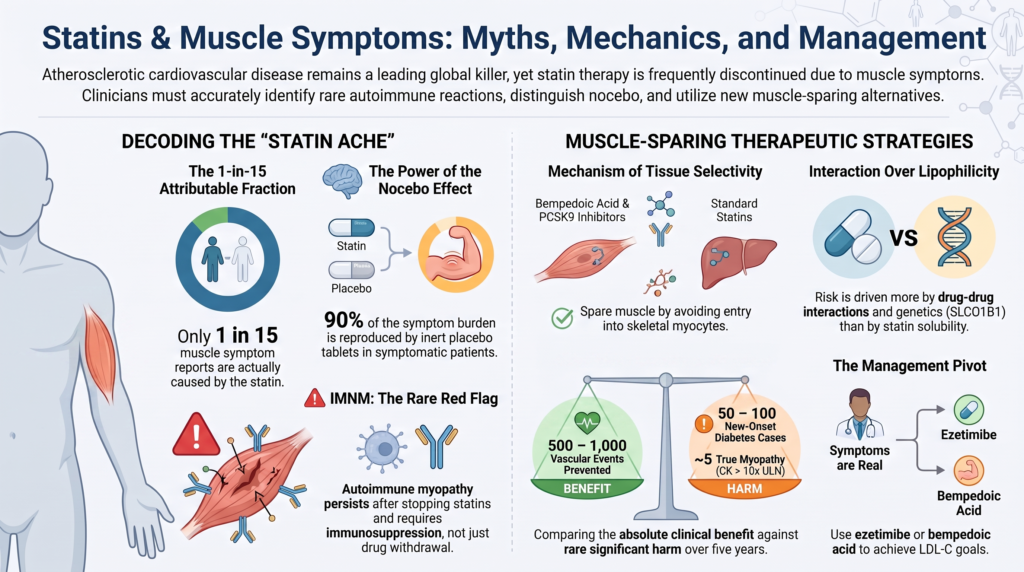
Comparative Review of Lipid-Lowering Therapeutics
Biological Pathways, Efficacy Dynamics, Cellular Mechanisms of Muscle Toxicity, Pharmacogenomics, and the Nocebo Phenomenon
Abstract
Atherosclerotic cardiovascular disease (ASCVD) remains the leading cause of death worldwide, and lowering low-density lipoprotein cholesterol (LDL-C) is the most robustly validated pharmacological means of reducing that risk. The therapeutic armamentarium has expanded from 3-hydroxy-3-methylglutaryl-coenzyme A (HMG-CoA) reductase inhibitors to inhibitors of ATP-citrate lyase, Niemann-Pick C1-Like 1, proprotein convertase subtilisin/kexin type 9 (PCSK9), and angiopoietin-like protein 3, with cholesteryl ester transfer protein inhibitors, oral PCSK9 inhibitors, and lipoprotein(a)-directed nucleic acid therapies in late-stage development. Despite unambiguous cardiovascular benefit, therapeutic persistence is undermined by reported adverse effects, overwhelmingly statin-associated muscle symptoms (SAMS).
This review synthesizes the molecular pharmacology, comparative efficacy, and muscle safety profile of every currently available LDL-lowering drug class. It treats muscle effects broadly rather than as soreness alone, addressing fatigue, reduced energy, and exercise capacity as outcomes with their own distinct evidence base. It distinguishes four biologically distinct entities that are frequently conflated: (i) nocebo-mediated symptoms, which account for the large majority of muscle complaints attributed to statins — in the Cholesterol Treatment Trialists’ individual participant data, more than 90% of muscle symptom reports among participants allocated statin were not attributable to the drug; (ii) genuine pharmacological myalgia, affecting a small but real minority; (iii) true myopathy and rhabdomyolysis, which are rare and dose-dependent; and (iv) anti-HMGCR immune-mediated necrotizing myopathy, a rare autoimmune disease that persists after drug withdrawal and requires immunosuppression rather than reassurance. Evidence from the Cholesterol Treatment Trialists’ Collaboration individual participant data meta-analysis, the SAMSON and StatinWISE n-of-1 trials, the ASCOT-LLA blinded-versus-unblinded comparison, and the GAUSS-3 randomized rechallenge is integrated with pharmacogenomic guidance and a practical management algorithm. The central clinical message is dual: clinicians should neither accept reported muscle symptoms as proof of pharmacological toxicity, nor dismiss them as invariably psychological.
1. Introduction
Cardiovascular disease driven by ASCVD remains the leading cause of global mortality [1]. The relationship between LDL-C and atherosclerotic risk is causal, dose-dependent, and cumulative over time, and the clinical benefit of LDL-C reduction is proportional to the absolute magnitude of reduction achieved and its duration, largely irrespective of the mechanism by which it is achieved.
Yet the translation of this evidence into population-level benefit is limited less by efficacy than by persistence. A substantial fraction of patients prescribed statins discontinue them within two years, most commonly citing muscle symptoms. The resulting gap between demonstrated efficacy in trials and realized benefit in practice is one of the largest avoidable losses in preventive cardiology.
Resolving this problem requires precision about what is actually being observed when a patient reports muscle pain on a statin. The evidence now permits that precision. This review therefore has three aims: to describe the molecular pharmacology and comparative efficacy of all available LDL-lowering agents; to define the biological basis of muscle toxicity and the reasons certain agents spare skeletal muscle entirely; and to quantify how much of the reported muscle symptom burden is attributable to the drug rather than to expectation, aging, or coincidence.
1.1 A note on terminology and scope
This article is a narrative review with quantitative synthesis of published trial data. It is not a de novo meta-analysis: no pooled effect estimates were calculated by the authors, and all pooled figures cited are those reported by the original investigators or by published meta-analyses, which are identified as such. Where estimates conflict between sources, the conflict is stated rather than resolved by preference.
2. Biological Pathways and Molecular Mechanisms of Action
Therapeutic lipid lowering is achieved by disrupting hepatic cholesterol synthesis, intestinal cholesterol absorption, hepatic LDL receptor (LDLR) recycling, or lipoprotein catabolism. These pharmacodynamic differences determine not only potency but also tissue distribution, and therefore adverse effect profile. The distinction that matters most for muscle safety is simple: does the drug enter skeletal myocytes, and if it does, does it interfere with a metabolic pathway that muscle requires?
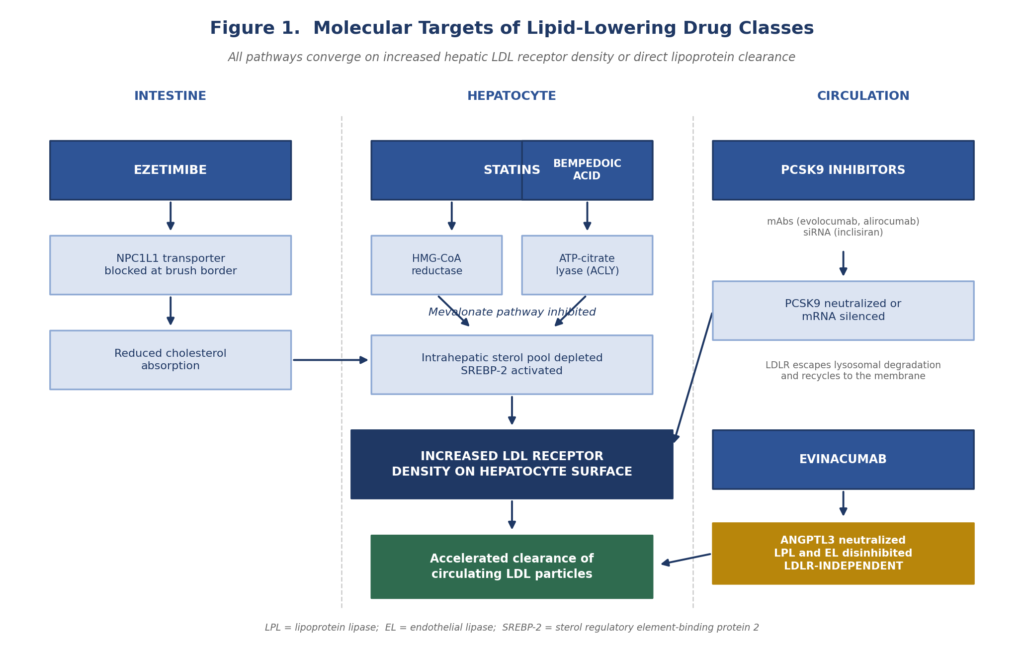
Figure 1. Molecular targets of the lipid-lowering drug classes. Statins and bempedoic acid act at two separate nodes of the hepatic mevalonate pathway; ezetimibe acts at the enterocyte brush border; PCSK9-directed agents act in the circulation or within the hepatocyte to preserve LDL receptor recycling. Evinacumab is the only agent whose effect does not depend on LDL receptor density, which is why it retains activity in receptor-null homozygous familial hypercholesterolemia.
2.1 HMG-CoA Reductase Inhibitors (Statins)
Statins competitively inhibit HMG-CoA reductase, the rate-limiting enzyme converting HMG-CoA to mevalonate in the cholesterol biosynthetic pathway. Depletion of the intrahepatic sterol pool activates sterol regulatory element-binding protein 2 (SREBP-2), which increases transcription and surface expression of LDLR on hepatocyte membranes, accelerating clearance of circulating LDL and very-low-density lipoprotein (VLDL) remnant particles.
All statins are hepatoselective in effect, principally because of efficient first-pass hepatic uptake. They differ, however, in how that uptake is achieved and in how readily they reach extrahepatic tissue:
- Lipophilic statins (atorvastatin, simvastatin, lovastatin, fluvastatin, pitavastatin, and the withdrawn cerivastatin): possess sufficient membrane permeability for passive diffusion across cell membranes, including those of skeletal myocytes. They are correspondingly more susceptible to oxidative metabolism by the cytochrome P450 system, with the notable exception of pitavastatin.
- Hydrophilic statins (rosuvastatin, pravastatin): possess polar structural domains that restrict passive membrane passage. Hepatic entry depends primarily on active transport by organic anion transporting polypeptide 1B1 (OATP1B1, encoded by SLCO1B1), and neither undergoes substantial CYP450 metabolism.
It is important to state at the outset that this physicochemical distinction, although real and mechanistically plausible, has not translated into a consistently demonstrable difference in clinical muscle symptom rates. This is addressed directly in Section 6.4. Pitavastatin is the clearest illustration of why the simple lipophilic-equals-risky heuristic fails: it is a lipophilic molecule, yet because it undergoes almost no CYP450 metabolism it carries one of the lowest interaction-mediated myopathy risks of any statin.
2.2 The Complete Statin Roster
Seven statins are currently marketed. An eighth, cerivastatin, was voluntarily withdrawn worldwide in 2001 after an unacceptable incidence of fatal rhabdomyolysis, particularly in combination with gemfibrozil. Because much of the historical anxiety surrounding statin myotoxicity derives from the cerivastatin experience, it is included here for context.
| Statin | Class | Solubility | Principal metabolism | Transport / interaction notes | Available doses | Practical positioning |
| Atorvastatin | Synthetic | Lipophilic | CYP3A4 (active metabolites) | OATP1B1 substrate; CYP3A4 inhibitors raise exposure | 10, 20, 40, 80 mg daily | Workhorse agent; long half-life permits alternate-day dosing |
| Rosuvastatin | Synthetic | Hydrophilic | Minimal CYP (CYP2C9 trace) | OATP1B1 and ABCG2 (BCRP) substrate; ABCG2 variants raise exposure | 5, 10, 20, 40 mg daily | Most potent per mg; long half-life; good choice after intolerance |
| Simvastatin | Fungal-derived | Lipophilic | CYP3A4 (extensive) | Strongest SLCO1B1 myopathy signal; many dose caps with interacting drugs | 5, 10, 20, 40 mg daily (80 mg restricted) | Highest interaction- and genotype-mediated myopathy risk among marketed statins; 80 mg not recommended |
| Pravastatin | Fungal-derived | Hydrophilic | Non-CYP (sulfation) | OATP1B1 substrate; few CYP interactions | 10, 20, 40, 80 mg daily | Low potency but favorable interaction profile; useful in polypharmacy |
| Lovastatin | Fungal-derived | Lipophilic | CYP3A4 (extensive) | Prodrug lactone; multiple interaction dose caps | 10, 20, 40 mg (IR); 20–60 mg (ER) | Largely superseded; take with evening meal |
| Fluvastatin | Synthetic | Lipophilic | CYP2C9 (principal) | Avoids CYP3A4 pathway; CYP2C9 poor metabolisers accumulate drug | 20, 40 mg; 40 mg BID; 80 mg XL | Useful when CYP3A4 interaction is the problem; lowest potency |
| Pitavastatin | Synthetic | Lipophilic | Minimal CYP; glucuronidation | Not a CYP3A4 substrate; ciclosporin contraindicated | 1, 2, 4 mg daily | Very low interaction burden; commonly used after other statins are not tolerated, on empirical rather than comparative-trial grounds |
| Cerivastatin | Synthetic | Lipophilic | CYP2C8 and CYP3A4 | Withdrawn 2001; fatal rhabdomyolysis, especially with gemfibrozil | Withdrawn | Historical only; source of much statin myotoxicity anxiety |
Table 1. Pharmacological characteristics of all marketed statins plus the withdrawn cerivastatin. Solubility classification follows Schachter (2005) [14]; metabolism and interaction data follow product labeling [15-21] and the CPIC 2022 guideline [22]. IR = immediate release; ER/XL = extended release; BID = twice daily.
Statin intensity classification
Statin regimens are conventionally classified by the average LDL-C reduction achieved rather than by dose alone. The high-, moderate-, and low-intensity categories were defined in the 2013 ACC/AHA cholesterol guideline, which introduced the intensity table in essentially its present form [92], and were carried forward in the 2018 AHA/ACC Multisociety guideline [12]; they remain in general use. The 2018 guideline itself has been superseded: the 2026 ACC/AHA/Multisociety Guideline on the Management of Dyslipidemia, published in March 2026, retires and replaces it [11], and the framework changes it introduces are summarised in Section 9.3. Percentage LDL-C reduction remains a stated priority in the 2026 document, so the intensity table below retains its practical utility, but readers should note that it now sits inside a goal-based rather than a purely intensity-based prescribing framework.
| High intensity (≥ 50% LDL-C reduction) | Moderate intensity (30–49% reduction) | Low intensity (< 30% reduction) |
| Atorvastatin 40–80 mg | Atorvastatin 10–20 mg | Simvastatin 10 mg |
| Rosuvastatin 20–40 mg | Rosuvastatin 5–10 mg | Pravastatin 10–20 mg |
| — | Simvastatin 20–40 mg | Lovastatin 20 mg |
| — | Pravastatin 40–80 mg | Fluvastatin 20–40 mg |
| — | Lovastatin 40–80 mg | Pitavastatin 1 mg |
| — | Fluvastatin 40 mg BID or 80 mg XL | — |
| — | Pitavastatin 2–4 mg | — |
Table 2. Statin intensity classification, adapted from the ACC/AHA classification introduced in 2013 [92] and carried forward in 2018 [12]. No dose of pravastatin, lovastatin, fluvastatin, or pitavastatin reaches high-intensity classification; only atorvastatin and rosuvastatin do. The 2026 dyslipidemia guideline that replaced the 2018 document adds absolute LDL-C and non-HDL-C goals alongside percentage reduction; see Section 9.3.
2.3 ATP-Citrate Lyase Inhibitors (Bempedoic Acid)
Bempedoic acid is a synthetic dicarboxylic acid prodrug that inhibits ATP-citrate lyase (ACLY), an enzyme acting two steps upstream of HMG-CoA reductase in the mevalonate pathway. ACLY cleaves mitochondrially derived citrate into acetyl-CoA and oxaloacetate, supplying the principal substrate for de novo cholesterol and fatty acid synthesis.
Pharmacological activity requires esterification with coenzyme A to form bempedoyl-CoA, a reaction catalyzed by very-long-chain acyl-CoA synthetase 1 (ACSVL1, encoded by SLC27A2). In the original characterization of the molecule, ACSVL1 was highly expressed in liver, only minimally detected in kidney, and undetectable in skeletal muscle under the experimental conditions studied; correspondingly, the active thioester metabolite was recovered from liver but not from skeletal muscle or adipose tissue [24]. This is the mechanistic basis of the drug’s muscle-sparing profile, and it is a genuine tissue-selectivity argument rather than a pharmacokinetic one.
Bempedoic acid also activates 5’-AMP-activated protein kinase (AMPK) in preclinical systems, with downregulation of lipogenic enzymes. This should not be presented as an established human mechanism: the FDA integrated review notes that AMPK activation may be rodent-specific, that its relevance in humans is unclear, and that LDL-C lowering can occur independently of it [93]. Separately, bempedoic acid reduces high-sensitivity C-reactive protein (hsCRP) by approximately 19–33% across the CLEAR program [25]. At the renal level, bempedoic acid and its acyl-glucuronide metabolite competitively inhibit organic anion transporter 2 (OAT2) in the proximal tubule. Because OAT2 mediates tubular secretion of both uric acid and creatinine, this inhibition produces predictable, reversible elevations in serum urate and creatinine that reflect transporter competition rather than parenchymal injury.
2.4 Niemann-Pick C1-Like 1 Inhibitors (Ezetimibe)
Ezetimibe localizes to the brush border of small intestinal enterocytes and binds the sterol transporter Niemann-Pick C1-Like 1 (NPC1L1), blocking endocytosis of biliary and dietary cholesterol across the intestinal epithelium without meaningfully affecting absorption of triglycerides, bile acids, or fat-soluble vitamins. Reduced chylomicron remnant cholesterol delivery depletes intrahepatic sterol stores and upregulates hepatic LDLR expression. Systemic exposure is not negligible: ezetimibe and its active glucuronide are readily detectable in plasma, are more than 90% protein bound, undergo enterohepatic recirculation, and have half-lives of approximately 22 hours [27]. What matters for muscle safety is not the absence of circulating drug but that the pharmacological target is intestinal and that no skeletal-muscle target has been identified.
2.5 PCSK9-Directed Therapeutics
PCSK9 is a secreted serine protease that binds the extracellular domain of the LDLR on hepatocyte surfaces and directs the receptor to lysosomal degradation rather than endosomal recycling. Because each LDLR molecule can otherwise recycle many times, preventing its degradation substantially increases functional receptor density.
- Monoclonal antibodies (evolocumab, alirocumab): fully human IgG antibodies that bind free circulating PCSK9 with high affinity, sterically blocking the PCSK9–LDLR interaction. They act predominantly extracellularly, consistent with the small apparent volume of distribution reported for evolocumab, and have no identified intracellular myocyte target; the labeling does not establish literal absence of myocyte entry [29,30].
- Small interfering RNA (inclisiran): a synthetic double-stranded siRNA conjugated to a triantennary N-acetylgalactosamine (GalNAc) ligand. GalNAc binds asialoglycoprotein receptors expressed almost exclusively on hepatocytes, driving rapid receptor-mediated endocytosis. Intracellularly the siRNA loads into the RNA-induced silencing complex and directs catalytic cleavage of PCSK9 messenger RNA, producing sustained suppression that permits twice-yearly dosing after loading [31,34,35,59].
- Oral macrocyclic peptide inhibitors (enlicitide): orally bioavailable macrocyclic peptides that bind PCSK9 with antibody-like affinity, blocking the PCSK9–LDLR interaction by the same mechanism as the monoclonal antibodies but delivered as a tablet. Enlicitide (Lipfendra) was approved by the FDA on 16 July 2026 as the first oral PCSK9 inhibitor, at 20 mg once daily, and is discussed further in Section 10.2 [36].
2.6 Angiopoietin-Like 3 Inhibitors (Evinacumab)
Evinacumab is a fully human monoclonal antibody directed against ANGPTL3, an endogenous inhibitor of endothelial lipase and lipoprotein lipase. Neutralizing ANGPTL3 disinhibits both lipases, accelerating clearance of VLDL processing intermediates and promoting direct intravascular degradation of intermediate-density lipoprotein and LDL particles. Critically, this pathway does not require functional LDLRs, which makes evinacumab effective in homozygous familial hypercholesterolemia (HoFH), including patients with null/null LDLR mutations who respond poorly or not at all to statins and PCSK9 inhibitors [13,37]. It is more accurate to describe evinacumab as largely rather than purely LDLR-independent. The demonstration of efficacy in null/null patients establishes that an LDLR-independent route exists and is sufficient on its own; it does not establish that LDLR-mediated clearance contributes nothing in patients who retain partial receptor function, and some residual receptor biology may well contribute to the response in that larger group [43].
2.7 Cholesteryl Ester Transfer Protein Inhibition (Obicetrapib, investigational)
CETP mediates transfer of cholesteryl esters from HDL to apolipoprotein B-containing lipoproteins in exchange for triglycerides. Obicetrapib is an oral, low-dose, next-generation CETP inhibitor that lowers LDL-C, apolipoprotein B, and lipoprotein(a) while raising HDL-C. Earlier CETP inhibitors failed for reasons of off-target toxicity (torcetrapib) or insufficient efficacy (dalcetrapib, evacetrapib), so the class carries appropriate historical caution pending cardiovascular outcome data [38].
3. Pharmacodynamic Efficacy Across Monotherapy and Combination Regimens
Statin monotherapy exhibits a non-linear dose-response curve governed by the so-called rule of six: each doubling of dose yields only about a 6% additional reduction in LDL-C. This attenuation occurs because intracellular sterol depletion triggers compensatory upregulation of intestinal cholesterol absorption via NPC1L1 and an increase in circulating PCSK9. The clinical implication is that dose escalation is an inefficient strategy compared with pathway combination.
3.1 Rational combination strategies
- Dual synthesis blockade (bempedoic acid plus statin): inhibiting the mevalonate pathway at two enzymatic nodes prevents upstream precursor accumulation and produces additive reductions in the intrahepatic sterol pool.
- Synthesis plus absorption blockade (statin or bempedoic acid plus ezetimibe): blunts the compensatory rise in intestinal cholesterol absorption induced by synthesis inhibition. This is the most cost-effective combination available.
- Synthesis plus clearance blockade (statin plus PCSK9 inhibitor): high-intensity statins upregulate LDLR but also raise circulating PCSK9. Adding a PCSK9 monoclonal antibody or inclisiran neutralizes this counter-regulatory rise, producing the largest reductions achievable with current therapy.
3.2 Comparative efficacy
The figures below are placebo-corrected or baseline-corrected LDL-C reductions from the principal registration trials. Two cautions apply. First, combination percentages are expressed relative to an untreated baseline and are therefore not additive with the monotherapy rows. Second, percentage reduction is a surrogate; only agents with completed cardiovascular outcome trials have demonstrated event reduction, and this is indicated explicitly in the final column.
| Regimen | Standard dosing | Mean LDL-C reduction | Primary population | Outcome evidence |
| Low/moderate hydrophilic statin | Pravastatin 20–40 mg daily | 20–35% | Primary prevention; polypharmacy | Yes (WOSCOPS, LIPID, CARE) |
| High-intensity hydrophilic statin | Rosuvastatin 20–40 mg daily | 45–55% | Elevated-risk primary prevention (the JUPITER population); also used at high ASCVD risk | Yes (JUPITER, a primary-prevention trial in apparently healthy adults) |
| Low/moderate lipophilic statin | Atorvastatin 10–20 mg daily | 30–40% | Baseline dyslipidemia | Yes (ASCOT-LLA, CARDS) |
| High-intensity lipophilic statin | Atorvastatin 40–80 mg daily | 50–60% | ACS; post-MI management | Yes (PROVE-IT, TNT) |
| NPC1L1 inhibitor monotherapy | Ezetimibe 10 mg daily | 15–20% | Statin-intolerant adjunct | Adjunctive (IMPROVE-IT) |
| Statin plus ezetimibe | High-intensity statin + ezetimibe 10 mg | ≈ 60–65% | Advanced ASCVD failing statin alone | Yes (IMPROVE-IT) |
| ACL inhibitor monotherapy | Bempedoic acid 180 mg daily | ≈ 18% on statin; ≈ 21–25% as monotherapy | Statin intolerance | Yes (CLEAR Outcomes, 2023) |
| ACL inhibitor plus ezetimibe | Bempedoic acid 180 mg + ezetimibe 10 mg | 38–40% | Statin intolerance needing robust lowering | Component evidence |
| PCSK9 mAb monotherapy | Evolocumab 140 mg Q2W or 420 mg monthly | 50–60% | Severe hypercholesterolemia; statin intolerance | LDL-C only in monotherapy use. FOURIER and ODYSSEY OUTCOMES demonstrated event reduction with the antibody added to background statin or maximally tolerated statin therapy, not as monotherapy |
| PCSK9 mAb plus high-intensity statin | Evolocumab + atorvastatin 80 mg | ≈ 70–80% from untreated baseline | Very high-risk ASCVD; HeFH | Yes (FOURIER) |
| PCSK9 siRNA | Inclisiran 284 mg day 0, month 3, then Q6M | 48–52% | Adherence-limited patients | Pending (ORION-4, VICTORION-2P) |
| ANGPTL3 inhibitor | Evinacumab 15 mg/kg IV monthly | ≈ 47–49% | Homozygous FH, including LDLR-null | Surrogate only |
| CETP inhibitor (investigational) | Obicetrapib 10 mg daily | ≈ 33–37% added to background therapy | ASCVD/HeFH not at goal | Pending (PREVAIL) |
| Oral PCSK9 inhibitor | Enlicitide (Lipfendra) 20 mg once daily | ≈ 56–59% placebo-adjusted at 24 weeks | Hypercholesterolemia including HeFH; oral alternative to injectables | LDL-C only; outcomes pending (CORALreef Outcomes) |
Table 3. Comparative LDL-C lowering efficacy. Q2W = every two weeks; Q6M = every six months; ACS = acute coronary syndrome; HeFH = heterozygous familial hypercholesterolemia. Obicetrapib remains investigational and is not approved for the use described. Enlicitide was approved in July 2026 on the basis of LDL-C lowering alone; its cardiovascular outcome trial is ongoing, so its row should be read as surrogate evidence despite the agent being marketed. Outcome trial sources for the final column: JUPITER [39]; IMPROVE-IT [28]; CLEAR Outcomes [40]; FOURIER [32]; ODYSSEY OUTCOMES [33]; the ORION program [34,35,59]; CORALreef [44-46]; BROADWAY [38]; evinacumab [13,43].
3.3 Evidence from Atherosclerosis Imaging
Percentage LDL-C reduction is a surrogate for a surrogate. Serial intravascular ultrasound (IVUS) provides an intermediate anatomical endpoint that links lipid lowering to the disease process itself, and the imaging trials are useful here for a specific reason: they demonstrate that plaque regression tracks achieved LDL-C largely irrespective of the mechanism used to achieve it.
- SATURN (NEJM 2011). 1,385 patients with coronary disease randomized to rosuvastatin 40 mg or atorvastatin 80 mg for 104 weeks. Percent atheroma volume fell 0.99% with atorvastatin and 1.22% with rosuvastatin (P = 0.17, not significant); total atheroma volume fell more with rosuvastatin (−6.39 vs −4.42 mm³, P = 0.01). Regression occurred in the majority of patients in both arms (63.2% and 68.5%). Beyond its efficacy message, SATURN is a head-to-head comparison of a lipophilic and a hydrophilic statin at maximal dose and is referenced again in Section 6.4 [47].
- PRECISE-IVUS (JACC 2015). 246 Japanese patients with coronary disease randomized to atorvastatin alone or atorvastatin plus ezetimibe 10 mg, titrated to an LDL-C target below 70 mg/dL, with paired IVUS at 9–12 months in 202. Achieved LDL-C was 73.3 mg/dL on monotherapy versus 63.2 mg/dL on combination (P < 0.001), and the combination produced significantly greater regression of percent atheroma volume with comparable adverse event rates. This supports the principle that non-statin LDL lowering produces anatomical benefit and is not merely a laboratory effect [10].
- GLAGOV (JAMA 2016). 968 patients with angiographic coronary disease on statin therapy randomized to evolocumab 420 mg monthly or placebo for 76 weeks. LDL-C was 36.6 mg/dL on evolocumab versus 93.0 mg/dL on placebo. Percent atheroma volume fell by 1.01% relative to placebo (95% CI −1.38 to −0.64; P < 0.0001), and regression occurred in 64.3% versus 47.3% of patients. In an exploratory subgroup achieving a mean LDL-C of 24 mg/dL, 81.2% showed regression. GLAGOV is the principal evidence that benefit continues to accrue at LDL-C levels far below conventional targets, with no observed threshold below which further lowering ceased to help [9].
Two caveats apply. These are surrogate anatomical endpoints, not clinical events, and none of these trials was powered for outcomes. The populations were also selected — patients undergoing clinically indicated angiography rather than primary prevention cohorts. Their value lies in demonstrating biological coherence between LDL-C reduction and disease modification across three different drug mechanisms, not in establishing event reduction, which rests on the outcome trials cited in Table 3.
4. Cellular Mechanisms of Muscle Toxicity
Skeletal muscle toxicity from lipid-lowering therapy ranges from mild subjective discomfort to life-threatening muscle breakdown. Susceptibility is determined by whether the drug accumulates in myocytes and whether it perturbs a pathway on which muscle depends.
4.1 Proposed mechanisms of statin myotoxicity
Three mechanisms are proposed. They are presented here in descending order of evidential support, and it should be stated plainly that none has been definitively established as the cause of common myalgia in humans.
Isoprenoid depletion and impaired protein prenylation
Downstream of HMG-CoA reductase, the mevalonate pathway generates the non-sterol isoprenoids farnesyl pyrophosphate (FPP) and geranylgeranyl pyrophosphate (GGPP). These are required for post-translational prenylation of small GTPases including Ras, Rho, and Rac. Loss of prenylation disrupts membrane anchoring, signal transduction, and cytoskeletal maintenance, and can trigger apoptosis in myocytes. This mechanism has the strongest experimental support, since supplementation with mevalonate or GGPP reverses statin-induced myotoxicity in cell culture, whereas cholesterol supplementation does not [48,49].
Mitochondrial dysfunction and coenzyme Q10 depletion
The mevalonate pathway also produces ubiquinone (coenzyme Q10), an electron carrier in the mitochondrial electron transport chain. Statins reduce circulating CoQ10, and it is hypothesized that intramyocellular depletion impairs complex I and complex IV activity, lowering ATP generation and increasing reactive oxygen species production.
This hypothesis should be presented with explicit caution. Although the biochemistry is coherent, the clinical evidence that CoQ10 depletion causes symptoms, or that repleting CoQ10 relieves them, is directly conflicting. One meta-analysis of twelve randomized trials in 575 patients reported significant improvement in muscle pain, weakness, cramping, and tiredness with supplementation [51], whereas an earlier meta-analysis of six trials in 302 patients and a later analysis of eight trials in 472 patients found no significant benefit [52]; systematic reviews published through 2025 remain split. Several features of the positive studies reduce confidence in them: sample sizes are small, definitions of muscle symptoms are heterogeneous between trials, and all primary endpoints are subjective and therefore particularly vulnerable to the placebo response that this same literature demonstrates is large.
A more fundamental problem is that the causal chain breaks at its first link. Plasma CoQ10 does fall reliably during statin therapy, but a substantial part of that fall is an artefact of the drug’s intended effect: CoQ10 is transported on lipoproteins, so lowering LDL particle number mechanically lowers measured plasma CoQ10 without necessarily depleting any tissue. What matters for muscle is intramuscular CoQ10, and here the direct measurements are largely reassuring. The LIFESTAT study obtained muscle biopsies from 64 simvastatin-treated patients (25 with myalgia, 39 without) and 20 untreated controls, and found that although statin therapy did impair complex II-linked mitochondrial respiration, intramuscular CoQ10 concentrations were unaltered and myalgia was not coupled to reduced muscle CoQ10 [53]. A double-blind randomized trial of 400 mg daily CoQ10 for eight weeks subsequently found that supplementation did not raise muscle CoQ10 levels, did not improve mitochondrial respiratory capacity, and that individual changes in muscle CoQ10 did not correlate with changes in myalgia intensity [54]. Findings are not uniform — one trial using simvastatin 80 mg reported a 34% fall in muscle CoQ10 — but most biopsy studies have failed to demonstrate clinically meaningful depletion of muscle CoQ10, and the weight of direct tissue evidence therefore does not support depletion as the established mechanism of ordinary statin myalgia.
The practical conclusion is a narrow one, and it should be stated carefully because it is easily misread. Measurable mitochondrial alterations have been demonstrated in statin-exposed muscle in some studies and not in others, and the evidence is discussed further in Section 4.3. What is not established is that CoQ10 depletion causes it, or that oral CoQ10 corrects it. Supplementation is inexpensive and safe and may reasonably be offered empirically, but it should not be described to patients as established therapy, and a patient’s failure to improve on CoQ10 should not be taken as evidence that their symptoms were imaginary. Further adequately powered trials with objective endpoints remain warranted; the existing literature is dominated by small trials with subjective outcomes, which is precisely the design most vulnerable to the placebo response.
Sarcoplasmic reticulum calcium leak
Mitochondrial reactive oxygen species and cellular energy depletion may destabilize sarcoplasmic reticulum ryanodine receptor type 1 (RyR1) channels. Uncontrolled calcium efflux into the cytoplasm activates calpains and caspases, producing myofibrillar degradation and inflammation. Evidence for this mechanism is largely preclinical [50].
4.2 Why non-statin agents spare skeletal muscle
- Bempedoic acid: requires ACSVL1 for prodrug activation. ACSVL1 is undetectable in human skeletal muscle in the published expression work, so the active thioester is not expected to form in myocytes, and muscle mevalonate synthesis, isoprenoid pools, and mitochondrial function are predicted to be spared. That prediction rests on tissue expression data and on the absence of a clinical muscle signal rather than on direct measurement of these downstream pathways in human muscle. This mechanistic prediction has been confirmed clinically: in CLEAR Outcomes, involving 13,970 statin-intolerant patients, myalgia was not increased versus placebo [40].
- PCSK9 monoclonal antibodies and inclisiran: act extracellularly or are targeted to hepatocytes by GalNAc–asialoglycoprotein receptor uptake. Neither is expected to achieve clinically relevant intracellular target engagement in skeletal myocytes or to alter intracellular metabolic pathways there. The same reasoning applies to enlicitide, whose target is likewise the circulating protein.
- Ezetimibe: acts at the enterocyte brush border. Ezetimibe and its glucuronide do circulate and undergo enterohepatic recirculation, so the argument is not one of negligible exposure; it is that no skeletal-muscle target has been identified.
- Evinacumab: acts on a circulating protein target within the vascular compartment; no intracellular skeletal-muscle target has been identified.
4.3 Fatigue, Reduced Energy, and Exercise Capacity
Discussion of statin muscle effects is dominated by pain. This is partly an artefact of how outcomes have been defined: the standard SAMS construct centers on myalgia, cramp, and tenderness, and trials that count “muscle symptoms” often capture soreness well and fatigue poorly. Yet in clinical practice a substantial number of patients describe something different — not that their legs hurt, but that they feel flat, that ordinary exertion costs more than it used to, or that training no longer produces the response it once did. These complaints deserve separate treatment, because the evidence bearing on them is different from the evidence on soreness, and in some respects stronger.
Randomized evidence on energy and fatigue
The most direct evidence comes from the UCSD Statin Study, reported by Golomb and colleagues in the Archives of Internal Medicine in 2012. This was a randomized, double-blind, placebo-controlled trial of 1,016 adults without cardiovascular disease or diabetes, with screening LDL-C between 115 and 190 mg/dL, allocated to simvastatin 20 mg, pravastatin 40 mg, or placebo for six months. Participants rated change from baseline in energy and in fatigue with exertion.
Both statins produced significant adverse effects on energy and on exertional fatigue relative to placebo, and the effect was more pronounced in women than in men. This was, to the investigators’ knowledge, the first randomized evidence for an outcome that had previously rested on patient report and observational data. Two features make it particularly relevant here. First, the effect appeared with pravastatin, a hydrophilic statin, as well as with simvastatin — further evidence against a simple lipophilicity hierarchy. Second, the doses were moderate rather than high, so this is not solely a high-intensity phenomenon [60].
The dissociation between subjective energy and objective performance
Against this sits a body of evidence that objective muscle performance is largely preserved. The STOMP trial randomized 420 healthy, statin-naive adults to atorvastatin 80 mg or placebo for six months, with formal measurement of handgrip, elbow and knee strength, knee extensor endurance, and maximal aerobic exercise capacity. High-dose atorvastatin produced no significant decrease in average muscle strength or exercise performance. It did increase myalgia (19 versus 10 subjects, P = 0.05), and it increased average creatine kinase by 20.8 U/L (P < 0.0001), with CK rising from baseline in 64.9% of atorvastatin subjects versus 40.1% on placebo. No individual CK value exceeded ten times normal [61,62].
STOMP therefore establishes three things simultaneously that are easily confused. Statins produce a small excess of muscle symptoms. Statins produce measurable biochemical evidence of mild muscle injury even in asymptomatic people. And statins do not, on average, make healthy people measurably weaker or less able to exercise. A patient can accurately report feeling worse while performing objectively the same.
A related observation comes from a physiological study of older male volunteers, which found that statin myalgia was not associated with reduced muscle strength, muscle mass, or protein turnover, but was associated with a slowing of time to peak power output. This suggests that where function is affected, the deficit may lie in the rate at which power can be developed rather than in maximal force — a distinction that conventional strength testing would miss and that patients might experience as heaviness or sluggishness rather than weakness [63].
Exercise training adaptation and mitochondrial capacity
A separate question is whether statins blunt the adaptive response to training rather than baseline performance. Mikus and colleagues randomized 37 sedentary overweight or obese adults with metabolic syndrome risk factors to 12 weeks of aerobic exercise training alone or exercise plus simvastatin 40 mg daily. Cardiorespiratory fitness rose 10% with exercise alone but only 1.5% with exercise plus simvastatin (P < 0.005 for the group-by-time interaction). Skeletal muscle citrate synthase activity, a marker of mitochondrial content measured in vastus lateralis biopsies, rose 13% with exercise alone but fell 4.5% in the statin group (P < 0.05 for interaction) [55].
This finding should be handled with proportion. The sample was small, the population was sedentary and metabolically unwell rather than habitually active, and the agent was simvastatin. A subsequent study of exercise training adaptations in metabolic syndrome patients on chronic statin therapy did not reproduce the same degree of impairment [57]. The finding is nonetheless biologically coherent with direct mitochondrial measurements: a 2024 study reported that high-dose atorvastatin progressively decreased skeletal muscle mitochondrial respiratory capacity in humans, and there is evidence that statin lactone forms inhibit respiratory chain complex III, with reduced complex III activity observed in muscle biopsies from patients with statin-induced myopathy [56,64].
Existing randomized trials largely enrolled sedentary or recreational individuals rather than elite endurance athletes. Whether even small mitochondrial effects become clinically important at elite athletic performance levels remains uncertain. This qualification deserves emphasis rather than a footnote: an effect too small to register on a laboratory strength test in a sedentary cohort is not necessarily too small to matter to someone operating at the limit of their aerobic capacity, where the margins that decide performance are far narrower than the margins that decide statistical significance. The absence of demonstrated harm in trained athletes reflects the absence of adequately powered studies in that population, not evidence of absence.
Whether these findings extend to trained endurance athletes remains uncertain, because subsequent investigations have reported less impairment, and because the populations studied to date have been sedentary and metabolically unwell rather than habitually active. Trained individuals differ in baseline mitochondrial density, training stimulus, and adaptive reserve, and no adequately powered trial has examined statin effects on training adaptation in this group. The Mikus finding should therefore be cited as a signal warranting further study rather than as an established effect in athletes.
The honest summary is that the evidence suggests statins have measurable effects on skeletal muscle mitochondrial function, that these effects have been observed at the tissue and whole-body level in some studies but not others, and that they do not appear to be explained by CoQ10 depletion. For most patients these changes are subclinical. For a minority, and possibly disproportionately for those training at high intensity or already close to their functional ceiling, they may be perceptible.
| Study | Design | Outcome measured | Finding |
| Golomb et al., Arch Intern Med 2012 | RCT, n = 1,016; simvastatin 20 mg vs pravastatin 40 mg vs placebo, 6 months | Self-rated energy and fatigue with exertion | Significant adverse effect on both with both statins; greater in women |
| STOMP (Parker et al., Circulation 2013) | RCT, n = 420 healthy statin-naive; atorvastatin 80 mg vs placebo, 6 months | Strength, endurance, maximal aerobic capacity, CK | No decrease in strength or exercise capacity; myalgia 19 vs 10 (P = 0.05); mean CK +20.8 U/L (P < 0.0001) |
| Mallinson et al., J Physiol 2015 | Physiological study, older male volunteers | Strength, mass, protein turnover, power output | No reduction in strength, mass, or protein turnover; slowing of time to peak power output |
| Mikus et al., JACC 2013 | RCT, n = 37; 12 weeks training vs training plus simvastatin 40 mg | Cardiorespiratory fitness; muscle citrate synthase | Fitness +10% vs +1.5%; citrate synthase +13% vs −4.5% (both interactions significant) |
| LIFESTAT (Dohlmann et al., JCEM 2019) | Muscle biopsy study; 64 statin-treated (25 myalgic), 20 controls | Intramuscular CoQ10; mitochondrial respiration | Complex II-linked respiration impaired; muscle CoQ10 unaltered; myalgia not coupled to muscle CoQ10 |
| Kuhlman et al., Antioxidants 2022 | Double-blind RCT, n = 37; CoQ10 400 mg vs placebo, 8 weeks | Muscle CoQ10; mitochondrial function; myalgia | No increase in muscle CoQ10; no improvement in mitochondrial function; no correlation with myalgia |
| Ryan et al., JCI Insight 2024 | Human study of high-dose atorvastatin | Skeletal muscle mitochondrial respiratory capacity | Progressive decrease in respiratory capacity; complex III inhibition implicated |
Table 4. Evidence on statin effects on energy, fatigue, and exercise capacity, as distinct from muscle soreness. Note the recurring dissociation: subjective energy and fatigue are affected, objective maximal strength largely is not, and mitochondrial measures are affected without accompanying CoQ10 depletion.
Clinical implications
- Ask about energy, not only pain. A patient who denies muscle soreness may still be experiencing a drug effect. Screening questions should include exertional fatigue, reduced exercise tolerance, and loss of training response.
- Do not equate subjective fatigue with objective weakness. This distinction is a safety matter, not a semantic one. Subjective low energy with normal power and normal CK is a tolerability issue. Objective proximal weakness — difficulty rising from a chair or climbing stairs — particularly with markedly elevated CK, is a red flag for immune-mediated necrotizing myopathy and must be investigated as described in Section 5.2.
- Consider dose and agent before abandoning the class. The fatigue signal in the randomized data appeared at moderate doses of two different statins, so switching alone may not resolve it; dose reduction, intermittent dosing, or a muscle-sparing non-statin agent are all reasonable next steps.
- Counsel patients undertaking new exercise programs realistically. The training-adaptation data are limited and partly conflicting, and should not be used to discourage exercise, which remains strongly beneficial. They do justify taking seriously a patient who reports that training has stopped producing results.
- The nocebo caution applies here too. None of the fatigue evidence exempts these symptoms from the attribution problem described in Section 7. Energy and fatigue are subjective endpoints and were not assessed in the n-of-1 designs, so the proportion of reported statin-associated fatigue that is nocebo-mediated has not been quantified. This is a genuine gap in the literature.
5. The Spectrum of Statin-Associated Muscle Disease
The single most consequential clinical error in this field is treating “statin muscle symptoms” as one entity. There are four biologically distinct phenomena with different frequencies, different mechanisms, and radically different management, with true myopathy and rhabdomyolysis representing two points on a single dose-dependent continuum and shown as separate rows in Table 5. Three are benign or reversible; one is a serious autoimmune disease.
| Entity | Definition | Approximate frequency | Behavior on stopping the statin | Management |
| Nocebo-mediated symptoms | Muscle symptoms attributable to expectation and the act of taking a tablet, not the drug | The large majority of reported symptoms: > 90% of muscle symptom reports on statin were not attributable to the drug (CTT 2022). SAMSON’s nocebo ratio of 0.90 is a different quantity — see Section 7 | Resolve, but recur equally with placebo | Blinded or structured rechallenge; explanation; resume statin |
| Pharmacological myalgia (SAMS) | Symmetrical proximal muscle ache, stiffness, or cramp with CK below 4× ULN | Excess of ≈ 1% over placebo in year 1 | Resolve within days to weeks; reproducible on rechallenge | Dose reduction, statin switch, alternate-day dosing, or non-statin agent |
| True myopathy | Muscle pain or weakness with CK above 10× ULN | ≈ 5 per 10,000 treated over five years (0.05%) in the CTT estimate; ≈ 5 per 100,000 person-years in pharmacoepidemiology. Higher figures of 0.1–0.5% appear in older reviews using broader case definitions and are not directly comparable [66] | Resolve on withdrawal | Stop statin; investigate interactions; do not rechallenge at same dose |
| Rhabdomyolysis | Massive CK elevation with myoglobinuria and acute kidney injury | ≈ 4.4 per 100,000 person-years on statin monotherapy [23]; higher with fibrate combinations | Resolve with supportive care | Emergency; stop statin permanently; IV fluids |
| Anti-HMGCR immune-mediated necrotizing myopathy | Autoimmune necrotizing myopathy with anti-HMGCR antibodies | ≈ 2–3 per million person-years (general population); ≈ 20–25 per million statin users per year | Persists or worsens after withdrawal | Immunosuppression; permanent statin avoidance |
Table 5. The entities encompassed by the term “statin muscle symptoms.” Five rows are shown across the four categories used in the abstract, myopathy and rhabdomyolysis being separated here by severity. CK = creatine kinase; ULN = upper limit of normal. The persistence of symptoms after statin withdrawal is the single most useful bedside discriminator for immune-mediated necrotizing myopathy.
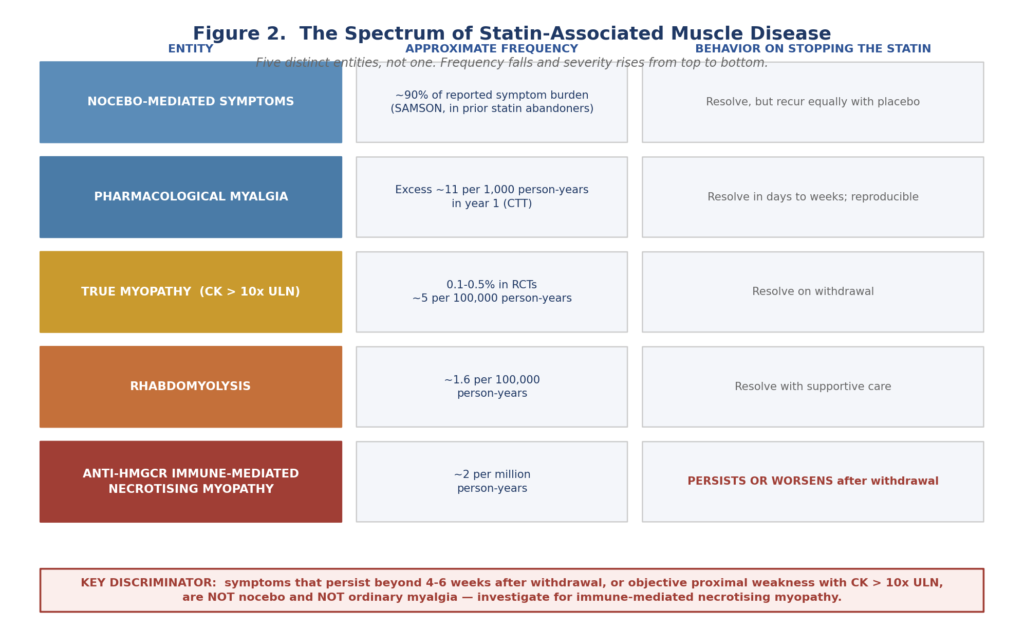
Figure 2. The spectrum of statin-associated muscle disease. The entities differ by orders of magnitude in frequency and differ fundamentally in management. Behavior after statin withdrawal is the most useful single discriminator available at the bedside.
5.1 Diagnostic definitions
SAMS / myalgia: subjective muscle pain, aching, stiffness, tenderness, or cramp, typically symmetrical and proximal, affecting thighs, buttocks, and calves, without significant CK elevation [3].
An important corollary follows from that last clause and is frequently misapplied in practice. Creatine kinase is a sensitive marker for myofiber necrosis but an insensitive marker for mild statin-associated muscle symptoms: patients may report severe, genuinely disabling symptoms while CK remains entirely within the reference range. A normal CK therefore makes CK-defined myopathy and rhabdomyolysis very unlikely but does not exclude SAMS, and it is not evidence that the patient’s symptoms are imagined or that the statin is not responsible. CK is a test for dangerous disease, not a test for whether a complaint is real. Conversely, asymptomatic CK elevation is common: in STOMP, CK rose from baseline in 64.9% of patients on atorvastatin 80 mg without accompanying loss of strength.
True myopathy: muscle weakness or pain accompanied by CK exceeding ten times the upper limit of normal. The CTT estimate corresponds to approximately 5 cases per 10,000 patients treated for five years (0.05%), and pharmacoepidemiological analysis gives approximately 5 per 100,000 person-years. Higher figures of 0.1–0.5% cited in older trial reviews reflect broader case definitions and are not directly comparable with either estimate [66].
Rhabdomyolysis: rapid skeletal muscle breakdown with massive CK elevation, hyperkalemia, myoglobinuria, and acute kidney injury from tubular myoglobin cast obstruction. In the largest pharmacoepidemiological analysis, hospitalized rhabdomyolysis occurred at approximately 0.44 per 10,000 person-years, or 4.4 per 100,000, during monotherapy with atorvastatin, pravastatin, or simvastatin, with substantially higher rates for cerivastatin and for statin–fibrate combinations [23]. It occurs most often when high-dose statins are combined with potent CYP3A4 inhibitors, gemfibrozil, or ciclosporin.
5.2 Anti-HMGCR immune-mediated necrotizing myopathy
Statin-associated immune-mediated necrotizing myopathy (IMNM) deserves separate and emphatic treatment, because it is the one statin muscle disease that is genuinely dangerous, is not nocebo, and will be missed if all muscle complaints are attributed to expectation.
IMNM is defined by autoantibodies directed against HMG-CoA reductase itself, the pharmacological target of the drug. The proposed mechanism is that statin exposure upregulates HMGCR expression in regenerating muscle fibers, and in genetically susceptible individuals this drives a sustained autoimmune response that becomes independent of continued drug exposure. It was recognized in the 2018 AHA/ACC Multisociety guideline as a distinct, rare entity [12,68]; that guideline was retired and replaced in March 2026 (Section 9.3).
Reported incidence depends on the denominator used, and both conventions appear in the literature. In the multinational cohort described below, the mean annual incidence was 2.9 cases per million person-years in the general adult population, and 20.4 (UK) to 24.1 (Australia) cases per million statin users per year [67]. Older estimates of approximately 2 per million person-years refer to the general population; figures of 2–3 per 100,000 statin-treated patients refer to statin users. The statin-user denominator is the appropriate one when counseling a patient who is taking the drug, and the general-population denominator understates the risk to that patient roughly tenfold.
A multinational cohort of 109 anti-HMGCR-positive cases reported a median age of 66 years, female predominance of 51%, statin exposure in 101 of 109 patients with atorvastatin accounting for approximately three-quarters, a median statin duration of three years before diagnosis, and a median peak CK of 7,020 IU/L with a range from 964 to 39,076 IU/L. Approximately 7.5% of anti-HMGCR-positive patients had never taken a statin, confirming that the antibody is not exclusively drug-induced [67].
Distinguishing IMNM from SAMS at the bedside
- Weakness dominates over pain. IMNM presents with objective proximal weakness (difficulty rising from a chair, climbing stairs, lifting overhead), whereas SAMS presents with ache and stiffness with preserved power.
- CK is markedly elevated. Typical values are in the thousands to tens of thousands, in contrast to the normal or minimally elevated CK of SAMS.
- Symptoms persist or progress after the statin is stopped. This is the decisive feature. SAMS resolves within days to weeks of withdrawal; IMNM does not.
- Diagnosis requires serology and often histology. Anti-HMGCR antibody testing is highly specific. Muscle MRI demonstrates edema, and biopsy shows myofiber necrosis and regeneration with sparse inflammatory infiltrate.
- Treatment is immunosuppression, not reassurance. Corticosteroids with intravenous immunoglobulin and a steroid-sparing agent such as methotrexate, azathioprine, or rituximab are typically required. Statins must be permanently avoided.
The wider differential: anti-SRP and seronegative IMNM
Anti-HMGCR antibody is not the only serology relevant here, and a negative result does not exclude necrotizing myopathy. IMNM is conventionally divided into three serological groups: anti-HMGCR positive, anti-signal recognition particle (anti-SRP) positive, and seronegative. Approximately 60% of IMNM cases carry either anti-HMGCR or anti-SRP antibodies; the remainder are seronegative and are diagnosed on biopsy [69,70].
- Anti-SRP IMNM is generally not statin-associated and tends to be the more aggressive phenotype. Compared with anti-HMGCR disease it more often produces severe limb weakness, neck weakness, dysphagia, respiratory insufficiency, and muscle atrophy, and it more often involves organs outside muscle, with cardiac involvement and interstitial lung disease both more frequent. Age at onset is typically younger [70].
- Anti-HMGCR IMNM more often presents with muscle weakness alone and without extramuscular involvement. Roughly 7.5% of anti-HMGCR-positive patients are statin-naive, and statin-naive cases differ somewhat from statin-associated ones, occurring more often in younger patients and with higher rates of dysphagia.
- Seronegative IMNM is diagnosed when both antibodies are absent but biopsy shows the characteristic pattern of scattered myofiber necrosis, regeneration, and macrophage-predominant, pauci-lymphocytic inflammation. It carries an elevated association with underlying malignancy, so a negative antibody panel should prompt biopsy and age-appropriate cancer screening rather than reassurance [71].
Outcomes are frequently incomplete despite treatment. In the multinational cohort, fewer than half of patients had a normal CK (47.6%) or normal muscle power (46.2%) at follow-up, and 45.7% had received intravenous immunoglobulin [67]. This refractory course is the clearest argument for recognizing the condition early.
The practical rule that follows is straightforward: any patient with proximal weakness, a CK above ten times the upper limit of normal, or muscle symptoms that fail to resolve within four to six weeks of statin withdrawal should be investigated for necrotizing myopathy rather than reassured about the nocebo effect. If anti-HMGCR is negative and suspicion persists, anti-SRP testing and muscle biopsy are the next steps, not discharge.
6. Relative Muscle Toxicity Profile and Non-Muscle Adverse Effects
| Drug class | Muscle toxicity in controlled trials | Mechanistic basis | Principal non-muscle adverse effects |
| PCSK9 therapeutics (evolocumab, alirocumab, inclisiran, enlicitide) | Not increased above placebo | Extracellular neutralization or GalNAc-directed hepatocyte uptake; no identified intracellular myocyte target | Injection site reactions 2–5%; transient nasopharyngitis; neurocognitive events at placebo rate (EBBINGHAUS) [72] |
| ACL inhibitors (bempedoic acid) | Not increased above placebo | Prodrug activation requires ACSVL1, undetectable in skeletal muscle | Hyperuricemia and gout; reversible creatinine rise; cholelithiasis; tendon rupture; hepatic enzyme elevation |
| NPC1L1 inhibitors (ezetimibe) | Not increased above placebo. (In GAUSS-3 Phase B, muscle symptoms were reported by 28.8% of ezetimibe recipients and 6.8% discontinued for them; that phase had no placebo arm and enrolled a selected multi-statin-intolerant population, and the placebo-controlled evidence shows no excess.) | Intestinal target; drug and glucuronide do circulate, but no identified skeletal-muscle target | Mild gastrointestinal upset 1–2%, at placebo-level rates |
| ANGPTL3 inhibitors (evinacumab) | Not increased above placebo | Extracellular protein target; no identified intracellular myocyte target | Infusion-related reactions and hypersensitivity ≈ 6%; nasopharyngitis; influenza-like symptoms |
| Statins (all agents) | Small but statistically real excess over placebo, confined largely to year 1 | Not spared: intracellular HMG-CoA reductase inhibition occurs in myocytes | New-onset diabetes (dose-dependent); transaminase elevation; rare autoimmune hepatitis; rare IMNM |
Table 6. Relative muscle toxicity profile of the lipid-lowering drug classes. The classes are presented as descriptive categories rather than as an ordinal ranking, because the non-statin agents are not reliably distinguishable from one another or from placebo on muscle endpoints, and a numbered hierarchy would imply a precision the data do not support. The statin row is deliberately not subdivided by lipophilicity; the rationale is given in Section 6.4. The excess muscle risk attached to statins as a class is small in absolute terms — roughly 11 events per 1,000 person-years in the first year — and should not be read as large merely because it is non-zero.
Table 6 groups agents by class. Because the clinically useful comparison is often between specific agents rather than between classes, the same information is set out below at agent level. Two quantities are separated deliberately, because conflating them is the source of most of the confident but unsupported agent-selection advice in this field. The first column asks whether an agent produces more muscle symptoms than placebo in blinded trials; among the statins, the answer is that they are not reliably distinguishable from one another, which is what the CTT individual participant data found. The second column asks which patients are at elevated risk of genuine, interaction- or genotype-mediated myopathy on a given agent; here the agents differ substantially and predictably. A single ordered ranking would blur the two.
| Agent | Muscle symptoms vs placebo in blinded trials | Interaction- and genotype-mediated myopathy risk |
| PCSK9 monoclonal antibodies (evolocumab, alirocumab) | Not increased | No identified intracellular myocyte target; not applicable |
| Inclisiran | Not increased | GalNAc-directed hepatocyte uptake; not applicable |
| Enlicitide | Not increased in the CORALreef program | Circulating protein target; not applicable |
| Ezetimibe | Not increased in placebo-controlled data (see the qualifier in Table 6 regarding GAUSS-3 Phase B) | Enterocyte-local action; not applicable |
| Bempedoic acid | Not increased, including in CLEAR Outcomes | ACSVL1 required for activation and undetectable in muscle; not applicable |
| Evinacumab | Not increased | Extracellular protein target; not applicable |
| Pitavastatin | Not reliably distinguishable from other statins | Low: minimal CYP450 metabolism; ciclosporin contraindicated |
| Pravastatin, fluvastatin | Not reliably distinguishable from other statins | Low: non-CYP3A4 disposition; CYP2C9 relevant to fluvastatin |
| Rosuvastatin | Not reliably distinguishable from other statins | Low to moderate: ABCG2 variants raise exposure; dose caps in Asian ancestry |
| Atorvastatin, lovastatin | Not reliably distinguishable from other statins | Moderate: CYP3A4-mediated interactions; SLCO1B1 intermediate for atorvastatin |
| Simvastatin, particularly at 80 mg | Not reliably distinguishable from other statins | Highest among marketed statins: strongest SLCO1B1 signal plus extensive CYP3A4 metabolism; 80 mg no longer recommended |
| Cerivastatin | Withdrawn 2001 | Unacceptable rate of fatal rhabdomyolysis, particularly with gemfibrozil |
Table 7. Muscle effects at agent level, with reported symptoms and mechanistic myopathy risk kept in separate columns. The first column reflects blinded randomized data, in which no statin has been reliably distinguished from another on muscle symptom incidence; the entries there should not be read as a ranking. The second column reflects pharmacokinetic and pharmacogenomic exposure, where the agents genuinely differ and where agent selection can be rationalized. The non-statin agents sit at placebo level in the first column and none is reliably distinguishable from the others.
6.1 Bempedoic acid: off-target effects
- Hyperuricemia and gout. Competitive inhibition of renal OAT2 reduces urate excretion, elevating serum uric acid within about four weeks of starting therapy. In CLEAR Outcomes, gout occurred in 3.1% of bempedoic acid recipients versus 2.1% on placebo [40]. Patients with a prior history of gout are at elevated risk of recurrent flares and warrant urate monitoring.
- Reversible creatinine elevation. OAT2 inhibition also reduces tubular creatinine secretion, producing small average rises in serum creatinine and corresponding modest declines in estimated glomerular filtration rate. These changes stabilize early, reverse completely on discontinuation, and reflect transporter competition rather than structural renal injury. They should not be misinterpreted as nephrotoxicity.
- Tendon rupture. An excess of tendon rupture has been observed, involving predominantly the Achilles, rotator cuff, or biceps tendons. Rates were 0.5% versus 0% in the primary hypercholesterolemia trials and 1.2% versus 0.9% in CLEAR Outcomes, so the absolute incidence in treated patients sits at roughly 1% or below across the program, and the excess attributable to the drug is smaller still. The signal is real but uncommon, and it should be presented to patients in those terms rather than as a prominent risk. The proposed mechanism involves altered extracellular matrix and collagen turnover in tenocytes. Risk factors include age above 60 years, concomitant corticosteroid or fluoroquinolone therapy, renal impairment, and pre-existing tendinopathy [26,41].
- Cholelithiasis and hepatic enzyme elevation. Both were increased in CLEAR Outcomes and warrant awareness, though neither commonly requires discontinuation.
6.2 Statin-associated new-onset diabetes
Statins cause a moderate, dose-dependent increase in new diagnoses of diabetes. The 2024 Cholesterol Treatment Trialists’ Collaboration individual participant data meta-analysis, drawing on the same trial population as the muscle symptom analysis, quantified this precisely. The proportional increase in new-onset diabetes was 10% with low- or moderate-intensity statin therapy (1.3% per year versus 1.2% per year on placebo) and 36% with high-intensity therapy (4.8% versus 3.5% per year) [73].
Two findings put this in proportion. First, the underlying effect is a very small upward shift in glycemia rather than a distinct diabetogenic process: among participants without baseline diabetes, mean glucose rose by 0.04 mmol/L and mean HbA1c by 0.06% with low- or moderate-intensity therapy and 0.08% with high-intensity therapy. Second, and most importantly for counseling, the excess is concentrated disproportionately among people who were already close to the diagnostic threshold. Among participants with a baseline measure of glycemia, approximately 62% of new-onset diabetes cases occurred in those already in the top quarter of the baseline distribution. That is a clear majority but not the whole of the excess: roughly two in five new diagnoses arose outside the top quarter. The effect is therefore better described as shifting people who were already approaching the threshold across it than as generating diabetes in metabolically healthy people, while acknowledging that a minority of cases do occur at lower baseline glycemia.
One further caveat limits how far the absolute figures travel. The investigators noted that the size of the absolute excess depended substantially on how frequently glycemia was measured in the contributing trials, since new diagnoses are only counted when someone looks for them. The relative estimates are the more transportable quantity; absolute per-1,000 figures for diabetes should be presented to patients as approximations tied to a particular ascertainment regime, not as fixed rates [73].
Genetic evidence indicates this effect is on-target rather than an idiosyncratic drug toxicity. A Mendelian randomization analysis using common variants in HMGCR (rs17238484 and rs12916) as lifelong proxies for HMG-CoA reductase inhibition found that carriers of LDL-lowering alleles had modestly higher bodyweight, waist circumference, plasma glucose and insulin, and a higher risk of type 2 diabetes, closely mirroring the effect observed in the randomized statin trials. The authors concluded that the increased diabetes risk seen with statins is at least partially explained by HMGCR inhibition itself [80].
A further observation complicates any attempt to frame this as a statin-specific liability. Variants in PCSK9 that lower LDL-C are also associated with modestly increased diabetes risk, as are LDL-lowering variants more generally [7,8,91]. The diabetogenic effect may therefore be a property of LDLR-mediated LDL lowering rather than of statins in particular, which would mean it is not avoided by switching to a non-statin agent that works through the same receptor pathway. This remains an inference from genetic epidemiology and has not been confirmed by outcome trials of the non-statin agents, but it should temper any suggestion that PCSK9 inhibition offers a metabolically free alternative.
Among participants with pre-existing diabetes, the relative risk of worsening glycemic control was 1.10 with low- or moderate-intensity therapy and 1.24 with high-intensity therapy. The investigators emphasized that any adverse cardiovascular consequence of these glycemic changes is already fully captured within the net cardiovascular benefit observed in the same trials. The appropriate response is glycemic monitoring, not statin withholding.
6.3 Hepatic effects, including rare autoimmune hepatitis
Asymptomatic transaminase elevation occurs in roughly 0.5–2% of statin recipients, is usually transient, and does not warrant routine liver function monitoring in asymptomatic patients. Clinically significant statin hepatotoxicity is rare.
A distinct and considerably rarer entity is statin-induced drug-induced autoimmune hepatitis (DIAIH), which mirrors idiopathic autoimmune hepatitis clinically and histologically. It has been documented in case reports and case series for atorvastatin, rosuvastatin, and other agents, and pharmacovigilance analysis of the FDA Adverse Event Reporting System published in 2024 identified positive autoimmune hepatitis signals across all seven marketed statins [75]. Presentation may include jaundice, fatigue, marked transaminase elevation, and positive antinuclear or anti-smooth-muscle antibodies, although seronegative cases occur. Onset ranges from two months to several years after initiation [76].
The clinical parallel with IMNM is instructive and worth stating explicitly: in both conditions, a statin appears to trigger an autoimmune process that can persist after the drug is withdrawn and that requires immunosuppression rather than simple discontinuation. Both are rare. Neither is nocebo. It must be stressed that no reliable incidence estimate exists for statin-induced DIAIH, because the evidence base consists of case reports and disproportionality signals rather than cohort data, and disproportionality signals reflect reporting patterns rather than true frequency. In the context of the enormous global exposure to statins, clinically apparent severe liver injury remains, in the assessment of the NIH LiverTox monograph, extraordinarily rare [74].
6.4 Does lipophilicity predict muscle risk? A qualified answer
It is frequently asserted that lipophilic statins carry a materially higher risk of muscle symptoms than hydrophilic statins, on the reasoning that passive diffusion into myocytes is greater. This review deliberately does not adopt that hierarchy, and the reasons should be set out transparently.
The biological rationale is genuine. Lipophilic agents do achieve greater extrahepatic tissue penetration, and this is a plausible substrate for myocyte injury. However, current randomized evidence has not consistently demonstrated clinically meaningful differences between hydrophilic and lipophilic statins with respect to muscle symptoms. A systematic review and meta-analysis published in 2018 found that statins increased SAMS only slightly overall (relative risk 1.05, 95% CI 1.014–1.089) and that lipophilic statins had no appreciable impact on SAMS development compared with hydrophilic formulations [77]. A network meta-analysis of double-blind randomized trials published in 2022 likewise found no statistically significant difference between individual statins in muscle symptom incidence [78]. The 2022 CTT individual participant data analysis, the largest and most rigorous dataset available, reported no evidence that muscle symptom risk varied among the different statins [65].
Two further sources of evidence bear directly on this. The SATURN trial randomized 1,385 patients with coronary disease to rosuvastatin 40 mg (hydrophilic) or atorvastatin 80 mg (lipophilic) for 104 weeks — a head-to-head comparison of the two classes at maximal dose — and found comparable tolerability with no signal of differential muscle toxicity [47]. Separately, the randomized evidence on fatigue discussed in Section 4.3 found adverse effects on energy and exertional fatigue with pravastatin, a hydrophilic agent, as well as with simvastatin.
Three further considerations argue against a simple hierarchy. First, pitavastatin is lipophilic yet has among the lowest interaction-mediated myopathy risk of any statin, because it is barely metabolized by CYP450 enzymes; lipophilicity and clinical risk therefore dissociate. Second, the strongest genuine drug-specific signal is not lipophilicity at all but the SLCO1B1 pharmacogenomic interaction with simvastatin, discussed in Section 8. Third, dose and intensity are more consistent predictors than solubility class: the CTT analysis found a year-one relative risk of 1.11 (95% CI 1.05–1.17) for more intensive regimens compared with placebo, against 1.07 (1.04–1.10) for statin therapy overall.
Underlying all of this is a distinction that is regularly collapsed in discussions of statin intolerance, and which is worth stating explicitly: a mechanistic difference is not a clinical outcome. That lipophilic agents achieve greater extrahepatic tissue penetration is an established pharmacological fact. Whether that difference produces a measurable difference in the rate at which patients report muscle symptoms is a separate empirical question, answerable only by controlled comparison, and the controlled comparisons do not show one. Plausible mechanism is a hypothesis generator, not evidence of effect, and the gap between the two is precisely where a great deal of confident but unsupported prescribing advice in this field originates.
The clinically defensible formulation is therefore this: switching from a lipophilic to a hydrophilic statin is a reasonable and commonly successful individual strategy in a patient who has not tolerated a particular agent, but it should be presented as empirical trial-and-error rather than as a predictable reduction in risk. What does reliably reduce risk is lowering the dose, avoiding interacting drugs, and avoiding high-dose simvastatin.
7. Epidemiology of Reported Muscle Symptoms and the Nocebo Phenomenon
A persistent paradox defines this field. In unblinded observational registries and routine practice, 10–20% of patients report muscle symptoms and many discontinue therapy. In double-blind randomized trials, the difference between statin and placebo is very small. Four bodies of evidence resolve this paradox, and together they constitute one of the more elegant demonstrations of the nocebo effect in modern medicine [81].
Note on the two most-quoted figures in this field: SAMSON’s “90%” and the CTT’s “one in fifteen” are not the same number. They derive from different populations, different metrics, and different study designs, and neither validates the other.
Because these figures are so often conflated, the distinction is worth setting out before either is discussed. The SAMSON nocebo ratio of 0.90 describes the proportion of the increment in symptom intensity caused by taking a tablet that was reproduced by an inert tablet. It was measured in 60 patients who had already abandoned statins because of side effects — a deliberately extreme phenotype — using a continuous daily symptom scale and, critically, a no-tablet control condition that most trials lack. The CTT figure of one in fifteen describes the proportion of reported muscle symptom events in the first year of treatment attributable to the statin rather than to background causes, measured across 123,940 participants in general trial populations by comparing event counts against placebo.
One is a ratio of symptom intensity increments in symptom-prone patients; the other is an attributable fraction of event reports in an unselected population. That they arrive at broadly concordant conclusions — that the large majority of reported statin muscle symptoms are not caused by the drug — is scientifically meaningful precisely because the designs differ so completely. But the numerical closeness of 90% and fourteen-fifteenths is a coincidence of arithmetic, not a replication. Neither figure should be quoted as though it confirmed the other, and neither should be applied to a population unlike the one in which it was measured.
7.1 The Cholesterol Treatment Trialists’ Collaboration meta-analysis (2022)
The CTT Collaboration conducted an individual participant data meta-analysis of 23 large-scale double-blind randomized trials, comprising 19 placebo-controlled trials with 123,940 participants and 4 more-intensive-versus-less-intensive trials with 30,724 participants, published in The Lancet in August 2022 [65].
Over a weighted average median follow-up of 4.3 years, muscle pain or weakness was reported by 16,835 participants allocated to statin (27.1%) versus 16,446 allocated to placebo (26.6%), a rate ratio of 1.03 (95% CI 1.01–1.06). The excess was confined almost entirely to the first year of treatment, during which statin therapy produced a 7% relative increase (rate ratio 1.07, 95% CI 1.04–1.10), corresponding to an absolute excess of 11 events (95% CI 6–16) per 1,000 person-years. After the first year there was no significant excess (rate ratio 0.99, 95% CI 0.96–1.02).
The investigators expressed the implication arithmetically: only one in fifteen of the muscle-related reports among participants allocated to statin therapy was actually attributable to the statin. For more intensive regimens the rate ratio against placebo was 1.08 (95% CI 1.04–1.13) across all years, rising to 1.11 (95% CI 1.05–1.17) in year one, so the attributable fraction rises to roughly one in ten at high intensity. Both of these figures are comparisons against placebo; the four trials that directly randomized more intensive against less intensive therapy yielded a rate ratio of 1.05 (95% CI 0.99–1.11), and the two comparisons should not be conflated. Muscle cramps, a very common reason for discontinuation in practice, showed only a 0.2% absolute difference and are not meaningfully statin-related. Notably, there was no evidence that risk varied between individual statins.
7.2 The SAMSON trial (2020)
SAMSON (Self-Assessment Method for Statin Side-effects Or Nocebo), published in the New England Journal of Medicine in November 2020 with full data in the Journal of the American College of Cardiology in 2021, enrolled 60 patients recruited from 17 UK referral centres and by self-referral, all of whom had previously abandoned statins because of side effects that developed within two weeks of initiation. This is deliberately the most symptom-prone population obtainable [5,6].
Design
SAMSON used a double-blind randomized n-of-1 design spanning 12 consecutive months. Each participant received 12 monthly medication bottles in randomized sequence: four containing atorvastatin 20 mg daily, four containing matching placebo, and four empty. The empty-bottle months are the methodological innovation, since they establish each patient’s background symptom level in the absence of any tablet at all. Participants recorded daily symptom intensity on a smartphone application using a continuous scale from 0 (symptom-free) to 100 (worst imaginable), and could stop that month’s tablets if symptoms became intolerable.
Results
Sixty participants were randomized and 49 completed the full 12-month protocol. Mean symptom intensity was 8.0 during no-tablet months (95% CI 4.7–11.3), 15.4 during placebo months (95% CI 12.1–18.7; P < 0.001 versus no-tablet months), and 16.3 during statin months (95% CI 13.0–19.6; P < 0.001 versus no-tablet months). The difference between statin and placebo months was not significant (P = 0.388).
The nocebo ratio, defined as symptom intensity on placebo minus symptom intensity on no tablet, divided by symptom intensity on statin minus symptom intensity on no tablet, was 0.90. Ninety per cent of the symptom burden induced by taking a statin tablet was reproduced by taking a placebo tablet.
One methodological caveat should be recorded for completeness. The originally specified primary analysis produced a nocebo ratio of 2.2 with a 95% confidence interval from −62.3 to 66.7, an unstable estimate arising because in some individuals the statin-minus-no-tablet denominator was very small or negative. An independent statistician recommended pooling individual participant data before calculating the ratio, which yielded the reported value of 0.90. This is a legitimate and transparently reported analytical decision, but readers should understand that the headline figure derives from the revised rather than the original analysis.
Tablet stoppages for intolerable symptoms occurred 71 times: 31 during placebo months and 40 during statin months, a non-significant difference. Placebo tablets were therefore abandoned nearly as often as active drug. At six-month follow-up, after participants were shown individualized charts of their own symptom scores across the three conditions, 30 of the 60 participants had successfully restarted statin therapy.
7.3 The StatinWISE trial (2021)
StatinWISE, published in the BMJ in February 2021, independently replicated SAMSON at larger scale in primary care. It comprised a series of 200 randomized double-blind n-of-1 trials in patients considering discontinuation because of muscle symptoms, using atorvastatin 20 mg versus placebo across six two-month periods [82].
Of 200 participants, 151 (75.5%) contributed to the primary analysis. There was no difference in muscle symptom scores between statin and placebo periods (mean difference −0.11, 95% CI −0.36 to 0.14; P = 0.40). Withdrawal for intolerable muscle symptoms occurred in 9% during statin periods and 7% during placebo periods. Two-thirds of participants who completed the trial elected to resume statin therapy. The convergence of two independently conducted n-of-1 programs on the same conclusion materially strengthens the inference.
7.4 ASCOT-LLA: blinded versus unblinded (2017)
The most compelling population-level evidence comes from a natural experiment within a single trial. ASCOT-LLA randomized patients to atorvastatin 10 mg or placebo in a blinded phase, then continued them in a non-blinded extension in which patients and physicians knew who was taking a statin.
During the blinded randomized phase there was no significant excess of muscle-related adverse events on atorvastatin. During the non-blinded extension, muscle-related adverse events were significantly more frequent among statin users (161 events, 1.26% per year) than non-users (124 events, 1.00% per year), a relative risk of 1.41 (95% CI 1.10–1.79; P = 0.006). The drug did not change. Only the knowledge of taking it changed [83].
7.5 GAUSS-3: quantifying genuine intolerance (2016)
GAUSS-3, published in JAMA in April 2016, is the necessary counterweight to the nocebo literature, because it demonstrates that genuine pharmacological intolerance is also real. It enrolled 511 patients with a documented history of intolerance to two or more statins and entry mean LDL-C of approximately 212 mg/dL [42].
Phase A: blinded rechallenge
491 patients underwent a 24-week double-blind crossover rechallenge with atorvastatin 20 mg versus placebo, 10 weeks each, separated by washout. The results partition this heavily preselected population into four groups: 209 of 491 (42.6%) developed intolerable muscle symptoms on atorvastatin but not placebo; 26.5% developed symptoms on placebo but not atorvastatin; approximately 10% developed symptoms on both; and the remainder on neither. During the second crossover period the hazard ratio for muscle symptoms on atorvastatin versus placebo was 1.96 (95% CI 1.44–2.66; P < 0.001).
Two conclusions follow, and both matter. Genuine, reproducible, pharmacologically mediated statin intolerance exists and affected roughly 43% of this extreme-phenotype population. Equally, more than a quarter of these same patients experienced intolerable muscle pain caused entirely by an inert tablet. Framed the other way, approximately 60% of patients who had already failed at least two statins did not demonstrate reproducible intolerance on blinded rechallenge.
Phase B: comparative non-statin therapy
218 patients with confirmed intolerance, comprising those identified in Phase A plus 19 who bypassed Phase A because of documented prior CK elevation above ten times the upper limit of normal, were randomized 2:1 to evolocumab 420 mg monthly (n = 145) or ezetimibe 10 mg daily (n = 73) for 24 weeks.
Two co-primary endpoints were reported. From baseline to week 24, LDL-C fell 52.8% with evolocumab versus 16.7% with ezetimibe. For the mean of weeks 22 and 24, LDL-C fell 54.5% (95% CI −57.2 to −51.8; absolute reduction 103.6 mg/dL) with evolocumab versus 16.7% (95% CI −20.5 to −12.9) with ezetimibe, a between-group difference of −37.8% (95% CI −42.3 to −33.3; P < 0.001). Muscle symptoms were reported by 20.7% of evolocumab recipients and 28.8% of ezetimibe recipients. Discontinuation for intolerable muscle symptoms occurred in 1 of 145 patients (0.7%) on evolocumab versus 5 of 73 (6.8%) on ezetimibe. Neither arm had a placebo comparator, so these rates quantify residual symptom burden in a selected population rather than drug-attributable risk [42].
Exploratory genomics
Exploratory genome-wide analysis within GAUSS-3 identified associations between statin-associated muscle symptoms and loci at MGAT5 and KCNJ2/SOX9, while variants influencing systemic statin exposure such as SLCO1B1 were not significantly associated with symptom recurrence in this cohort. These findings are hypothesis-generating only: the cohort comprised roughly 500 patients, which is severely underpowered for genome-wide discovery, and the loci have not been robustly replicated. They should not be presented to patients as clinically actionable.
| Trial | Design and population | Principal finding |
| CTT Collaboration (2022) | 19 placebo-controlled double-blind RCTs; 123,940 participants; median 4.3 years | 27.1% vs 26.6% reported muscle symptoms (RR 1.03); year-1 RR 1.07, excess 11 per 1,000 person-years; only 1 in 15 reports attributable to statin |
| SAMSON (2020) | Double-blind n-of-1; 60 patients who had abandoned statins; 4 statin, 4 placebo, 4 empty months | Symptom scores 8.0 / 15.4 / 16.3 (no tablet / placebo / statin); statin vs placebo P = 0.388; nocebo ratio 0.90; 30 of 60 restarted |
| StatinWISE (2021) | 200 double-blind n-of-1 trials in primary care; atorvastatin 20 mg vs placebo | No difference in symptom score (mean difference −0.11, 95% CI −0.36 to 0.14); two-thirds of completers resumed statins |
| ASCOT-LLA (2017) | Blinded randomized phase vs non-blinded extension of the same trial | No excess muscle events when blinded; RR 1.41 (95% CI 1.10–1.79) when unblinded |
| GAUSS-3 (2016) | 511 multi-statin-intolerant patients; blinded atorvastatin rechallenge then evolocumab vs ezetimibe | 42.6% symptoms on statin only; 26.5% on placebo only; evolocumab −54.5% vs ezetimibe −16.7% LDL-C |
Table 8. Landmark trials defining the boundary between pharmacological and nocebo-mediated statin muscle symptoms. RR = rate ratio or relative risk as reported by the original investigators.
7.6 Putting Benefit and Harm on the Same Scale
Relative risks and rate ratios are the natural language of trial reporting but a poor basis for a conversation with a patient, who is deciding about one person rather than a cohort. The quantities that matter to that decision are absolute, and the CTT Collaboration has published them for a standard regimen.
Lowering LDL-C by 2 mmol/L (77 mg/dL) with an effective regimen such as atorvastatin 40 mg daily, for five years in 10,000 patients, would typically prevent one or more major vascular events in about 1,000 patients with pre-existing occlusive vascular disease, an absolute benefit of 10%, and in about 500 patients at elevated risk who have not yet had an event, an absolute benefit of 5%. Against this, the same treatment in the same 10,000 patients over the same period would typically cause about 5 cases of myopathy, of which one might progress to rhabdomyolysis if the statin were not stopped, 50 to 100 new cases of diabetes, and 5 to 10 hemorrhagic strokes, alongside symptomatic adverse events such as muscle pain in up to 50 to 100 patients, an absolute harm of 0.5% to 1.0% [2].
| Outcome over 5 years | Per 10,000 treated | Per 1,000 treated | Absolute rate |
| Major vascular events prevented, secondary prevention | ≈ 1,000 | ≈ 100 | 10% benefit |
| Major vascular events prevented, primary prevention | ≈ 500 | ≈ 50 | 5% benefit |
| New-onset diabetes caused | 50–100 | 5–10 | 0.5–1.0% harm |
| Symptomatic muscle adverse events caused | 50–100 | 5–10 | 0.5–1.0% harm |
| Hemorrhagic strokes caused | 5–10 | 0.5–1 | 0.05–0.1% harm |
| Myopathy caused (CK > 10× ULN) | ≈ 5 | ≈ 0.5 | 0.05% harm |
| Rhabdomyolysis caused | ≈ 1 | ≈ 0.1 | 0.01% harm |
Table 9. Absolute benefit and harm from five years of an effective statin regimen lowering LDL-C by 2 mmol/L, per CTT Collaboration estimates. Per-1,000 figures are derived by division and are given for accessibility; the published estimates are per 10,000. Benefits scale with baseline absolute risk and with the magnitude and duration of LDL-C reduction, so these figures describe a typical patient rather than any individual one. Two rows require qualification. The new-onset diabetes row derives from the same earlier five-year projection and should be read as an order-of-magnitude estimate: the 2024 individual participant data analysis found that the absolute excess varied substantially with the intensity of glycemic ascertainment across trials, so no single fixed absolute figure is well supported (Section 6.2). The symptomatic muscle adverse event row likewise derives from the CTT group’s earlier five-year projection. The 2022 individual participant data analysis reported an absolute excess of 11 events per 1,000 person-years confined to the first year, equivalent to approximately 110 per 10,000 in year one alone, and supersedes the earlier projection for this endpoint. The two estimates use different definitions and time bases and should not be added, averaged, or read as inconsistent benefit accounting.
Three features of this comparison deserve emphasis. The benefits and harms are not of equal weight even where the numbers are similar: myopathy and muscle symptoms reverse on stopping the drug, whereas myocardial infarction and stroke frequently do not. Any adverse cardiovascular consequence of the excess diabetes and hemorrhagic stroke is already contained within the net benefit figures, because both arose in the same trials from which the benefit was measured, so the columns should not be subtracted from one another. And the benefit accrues for each year treatment continues, so five years understates what lifelong therapy achieves.
The honest counterweight is that these estimates come from the CTT group, whose methods and access to individual participant data have been contested by a minority of investigators, and that they describe populations rather than persons. A patient at very low absolute cardiovascular risk gains proportionally less, and for that patient the balance is genuinely closer than the table suggests.
8. Pharmacogenomics of Statin Myopathy
If the question is which patient is most likely to sustain genuine muscle injury on a statin, the most robust answer available is genetic rather than physicochemical.
8.1 SLCO1B1
The defining discovery was a genome-wide association study within the SEARCH trial, published in the New England Journal of Medicine in 2008, which identified the SLCO1B1 c.521T>C variant (rs4149056) as the dominant genetic determinant of myopathy with simvastatin 80 mg [79]. SLCO1B1 encodes OATP1B1, the hepatic uptake transporter. Reduced-function variants impair hepatic extraction, raising systemic exposure to statin acid and increasing skeletal muscle exposure.
Guidance is provided by the Clinical Pharmacogenetics Implementation Consortium (CPIC), whose 2022 guideline covers SLCO1B1, ABCG2, and CYP2C9 genotypes and statin-associated musculoskeletal symptoms, superseding the earlier simvastatin-only guideline [22]. The evidence linking rs4149056 to myopathy is graded as high quality for simvastatin. CPIC recommends dose limitation or selection of an alternative statin in decreased- and poor-function phenotypes. Allele function assignments were further updated in October 2025 to improve accuracy in under-represented populations [84].
The association is strongly drug-specific, which is clinically useful. It is strongest for simvastatin, intermediate and less consistent for atorvastatin, and minimal for pravastatin, rosuvastatin, fluvastatin, and pitavastatin, because OATP1B1 contributes a different proportion of hepatic uptake for each agent.
8.2 ABCG2, CYP2C9, and other loci
- ABCG2: encodes the efflux transporter BCRP. The c.421C>A variant markedly increases rosuvastatin exposure, and CPIC 2022 includes rosuvastatin dosing recommendations by ABCG2 phenotype [22].
- CYP2C9: the principal metabolizing enzyme for fluvastatin; poor metabolisers accumulate drug and warrant dose limitation.
- CYP3A4*22: reduced-function allele affecting simvastatin, lovastatin, and atorvastatin clearance. Evidence is suggestive but not yet guideline-actionable.
- COQ2, GATM, and the GAUSS-3 loci (MGAT5, KCNJ2/SOX9): candidate associations with inconsistent replication. These remain research findings and should not be used clinically.
| Gene | Variant | Statins principally affected | Practical implication |
| SLCO1B1 | c.521T>C (rs4149056) | Simvastatin (strong); atorvastatin (moderate) | Avoid high-dose simvastatin in decreased/poor function; prefer rosuvastatin, pravastatin, fluvastatin, or pitavastatin |
| ABCG2 | c.421C>A | Rosuvastatin | Limit rosuvastatin dose in poor-function phenotypes |
| CYP2C9 | *2, *3 reduced-function alleles | Fluvastatin | Limit fluvastatin dose in poor metabolisers |
| CYP3A4 | *22 | Simvastatin, lovastatin, atorvastatin | Suggestive only; not currently guideline-actionable |
| MGAT5, KCNJ2/SOX9, COQ2, GATM | Various | Not agent-specific | Exploratory; not clinically actionable |
Table 10. Pharmacogenomic loci relevant to statin myopathy, with recommendations following the CPIC 2022 guideline (updated October 2025). Only SLCO1B1, ABCG2, and CYP2C9 currently carry actionable CPIC recommendations.
8.3 Drug-drug interactions
Interaction-mediated myopathy is more common, more predictable, and more preventable than idiosyncratic myopathy. The mechanism is straightforward: anything that raises systemic statin concentration raises muscle exposure.
| Interacting agent | Mechanism | Statins affected | Management |
| Gemfibrozil | Inhibits glucuronidation and OATP1B1 transport | All statins | Avoid combination; use fenofibrate instead if a fibrate is required |
| Clarithromycin, erythromycin, itraconazole, ketoconazole, ritonavir | Potent CYP3A4 inhibition | Simvastatin, lovastatin, atorvastatin | Suspend statin during short courses, or switch to pravastatin, rosuvastatin, or pitavastatin |
| Ciclosporin | OATP1B1 and multi-transporter inhibition | All; contraindicated with pitavastatin | Strict dose caps; specialist supervision |
| Amiodarone, verapamil, diltiazem | Moderate CYP3A4 inhibition | Simvastatin, lovastatin | Dose caps per labeling; consider a non-CYP3A4 statin |
| Colchicine | Independent myotoxicity; additive risk | All statins | Monitor CK if used together, especially in renal impairment |
| Grapefruit juice (large quantities) | Intestinal CYP3A4 inhibition | Simvastatin, lovastatin, atorvastatin | Advise moderation; clinically relevant mainly at high intake |
Table 11. Clinically important drug interactions increasing statin myopathy risk. Note that pravastatin, rosuvastatin, and pitavastatin share the advantage of minimal CYP450 metabolism, which is a more reliable basis for statin selection in polypharmacy than lipophilicity.
8.4 Reversible non-genetic contributors
Before concluding that a patient is statin-intolerant, several reversible contributors should be excluded, since each independently produces or amplifies myalgia: hypothyroidism (check TSH), vitamin D deficiency, renal impairment, recent unaccustomed vigorous exercise, and excess alcohol intake [58]. One qualification is worth recording: although vitamin D deficiency is commonly corrected in this setting, a randomized comparison of vitamin D against placebo in new statin users found no reduction in statin-associated muscle symptoms, so repletion should be regarded as reasonable general care rather than as a demonstrated remedy for SAMS [85]. Advanced age, low body mass, female sex, and Asian ancestry (particularly relevant to rosuvastatin dosing) also increase susceptibility.
9. Clinical Management: An Evidence-Based Algorithm
The following sequence integrates the evidence reviewed above. Its guiding principle is that the patient’s symptoms should always be taken seriously, while causal attribution to the drug should not be assumed [58,81].
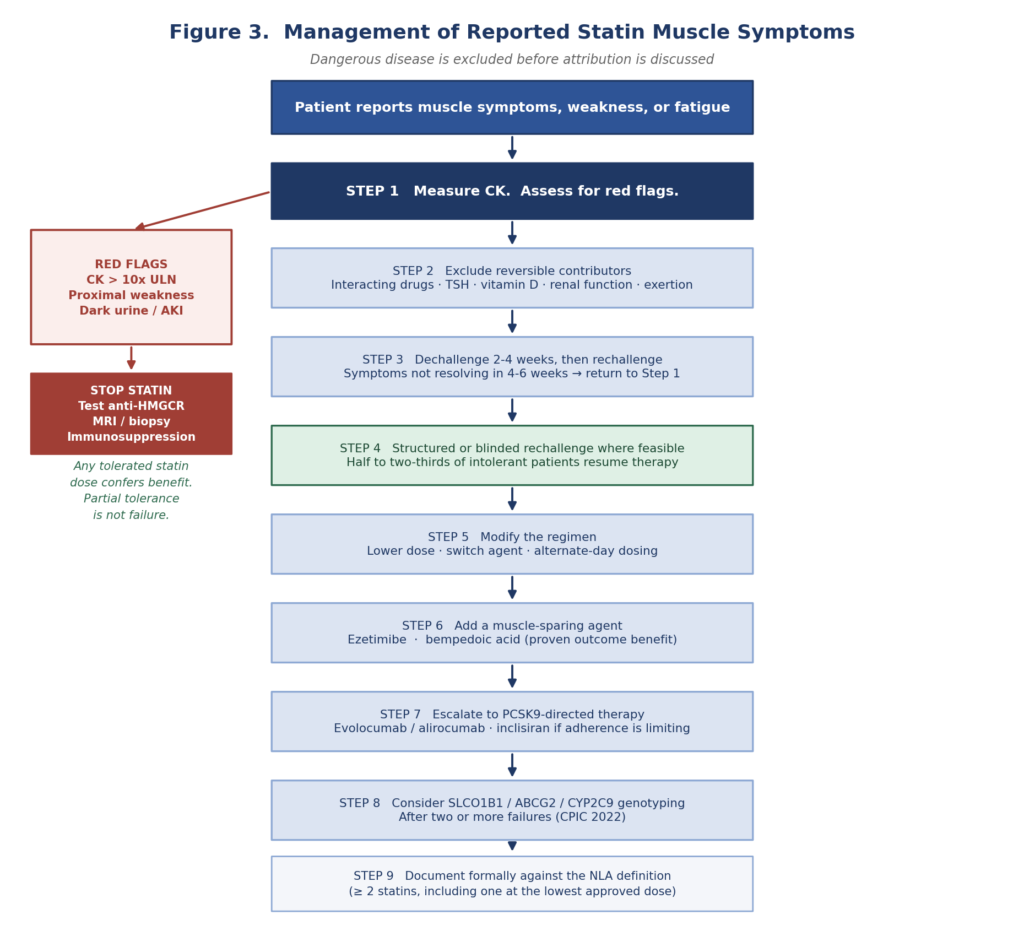
Figure 3. Management algorithm for reported statin muscle symptoms. The sequence is deliberate: dangerous disease is excluded before attribution is discussed, because a patient with immune-mediated necrotizing myopathy who is reassured about the nocebo effect may deteriorate.
- Exclude dangerous myopathy first. Measure CK. If CK exceeds ten times the upper limit of normal, or if there is objective proximal weakness, or if there is dark urine or renal impairment, stop the statin immediately and investigate for true myopathy, rhabdomyolysis, or immune-mediated necrotizing myopathy. Do not proceed to reassurance about nocebo until this step is complete.
- Identify reversible contributors. Review for interacting drugs, hypothyroidism, vitamin D deficiency, renal impairment, and recent unaccustomed exertion. Correct what is correctable.
- Dechallenge and rechallenge. Withdraw the statin for two to four weeks. Failure to improve lowers the likelihood of ordinary pharmacological SAMS and should prompt reassessment for alternative causes or for a persistent myopathy, rather than a presumption that the statin was blameless; if symptoms persist beyond four to six weeks, particularly with elevated CK or objective weakness, investigate for IMNM. If symptoms do resolve, rechallenge with a different statin at a low dose.
- Use structured or blinded rechallenge where feasible. SAMSON and StatinWISE demonstrate that objective, individualized data on a patient’s own symptom pattern is an effective intervention for restoring adherence — the one with the most direct randomized support — enabling roughly half to two-thirds of participating patients to resume therapy. Neither trial compared this approach against other adherence strategies, so it should not be described as superior to all alternatives [5,6,82].
- Modify the regimen before abandoning the class. Reduce the dose; switch agent, particularly away from high-dose simvastatin; or use alternate-day or twice-weekly dosing of a long-half-life statin such as rosuvastatin or atorvastatin. Any tolerated statin dose confers benefit; partial tolerance is not failure.
- Add a muscle-sparing agent to a reduced statin dose. Ezetimibe is inexpensive, well tolerated, and adds 15–20%. Bempedoic acid adds approximately 18% and is the only non-statin oral agent with proven cardiovascular outcome benefit in statin-intolerant patients.
- Escalate to PCSK9-directed therapy for confirmed intolerance with substantial residual risk. GAUSS-3 validated evolocumab in this exact population, and inclisiran offers twice-yearly dosing where adherence is the limiting factor.
- Consider genotyping in recurrent intolerance. SLCO1B1, ABCG2, and CYP2C9 genotyping per CPIC 2022 can rationalize agent selection after two or more failures.
- Document formally. Statin intolerance should be documented against the National Lipid Association definition, which requires trial of at least two statins including one at the lowest approved dose, rather than recorded on the basis of a single failed trial [4].
9.1 Communicating risk to patients
Evidence from SAMSON indicates that showing patients their own data is more persuasive than citing population statistics. Where individualized n-of-1 data are unavailable, the following framings are accurate and useful: muscle aches are common in adults regardless of medication, and roughly a quarter of people report them whether taking a statin or a placebo; of every fifteen people who report muscle symptoms on a statin, about fourteen would have had them anyway [65]; most symptoms genuinely caused by a statin appear within the first year and resolve within weeks of stopping, although later onset does occur in individuals; and a substantial majority of people who stop a statin because of symptoms and are willing to try again can successfully restart one. That last figure comes from patients who volunteered for rechallenge and should not be quoted as a rate for all discontinuers.
Equally important is what should not be said. Symptoms should never be described as imaginary. The nocebo effect produces real, measurable symptoms; SAMSON participants abandoned placebo tablets nearly as often as active drug. The message is that the symptoms are real but their cause is usually not the drug, and that this distinction opens a path back to treatment rather than closing one.
9.2 Objective diagnostics
- Routine monitoring in asymptomatic patients is not recommended. Obtain a baseline in patients at elevated risk, and measure in any symptomatic patient. CK above ten times the upper limit of normal defines myopathy and mandates discontinuation. Note the asymmetry in what the result tells you: an elevated CK is informative, but a normal CK is not reassurance that symptoms are absent or imagined. CK is insensitive for mild SAMS, and patients with disabling symptoms frequently have entirely normal values.
- Anti-HMGCR antibodies. Test when weakness is prominent, CK is markedly elevated, or symptoms persist beyond four to six weeks after withdrawal.
- Muscle MRI and biopsy. Reserve for suspected inflammatory or necrotizing myopathy, typically after positive or equivocal serology.
- TSH, vitamin D, renal function. Obtain in all patients presenting with muscle symptoms on a statin.
- SAMS Clinical Index. A standardized causality instrument that scores symptom location, timing of onset after initiation, and timing of resolution after withdrawal, useful for consistent documentation [86].
9.3 Guideline context: the 2026 dyslipidemia guideline
The framework surrounding the decisions above changed in March 2026. The 2026 ACC/AHA/Multisociety Guideline on the Management of Dyslipidemia retires and replaces the 2018 Guideline on the Management of Blood Cholesterol, and is retitled to reflect attention to atherogenic lipoproteins beyond LDL particles, including triglyceride-rich remnants and lipoprotein(a) [11]. Five changes bear on this review.
- Risk estimation. The AHA PREVENT-ASCVD equations replace the Pooled Cohort Equations for guiding lipid-lowering therapy in primary prevention in adults aged 30 to 79, providing both 10-year and 30-year risk projections.
- Treatment goals return. LDL-C and non-HDL-C goals are restored alongside percentage reduction. The guideline sets an LDL-C goal below 100 mg/dL at borderline or intermediate risk, below 70 mg/dL at high risk, and below 55 mg/dL for patients with clinical ASCVD at very high risk. This is a material change from the 2018 framework, which prioritized statin intensity over absolute targets, and it strengthens the case for combination therapy in patients who do not reach goal on a statin alone.
- ApoB and Lp(a). ApoB testing is described as useful once LDL-C and non-HDL-C goals are met, particularly with triglycerides above 200 mg/dL, diabetes, or achieved LDL-C below 70 mg/dL. Lp(a) should be measured at least once in adults as part of risk assessment.
- Non-statin sequencing. Where statin therapy alone does not achieve goal, ezetimibe, bempedoic acid, and PCSK9 monoclonal antibodies are the recommended additions. Inclisiran recommendations were held pending its outcome trials, which is consistent with the distinction drawn in Section 11.
- Statin intolerance. The guideline includes a practical algorithm for statin intolerance, which is the context in which the management sequence in Section 9 should be read.
Two points of interpretation follow for this review. The intensity classification in Table 2 remains useful and percentage LDL-C reduction remains a stated priority, so nothing in Section 3 is invalidated. But the goal-based structure changes the practical weight of the muscle symptom problem: when a patient must reach an absolute LDL-C target rather than simply tolerate a statin of a given intensity, correctly distinguishing nocebo-mediated from pharmacological intolerance becomes more consequential, not less, because unnecessary discontinuation now forecloses a defined therapeutic goal rather than an intensity category.
10. Emerging Therapeutics
REGULATORY STATUS MUST BE VERIFIED IMMEDIATELY BEFORE CLINICAL USE OR PUBLICATION. Approval status, trial readouts, and labeling in this field change on a timescale of months. Status below reflects information verified to 9 August 2026. Obicetrapib and the lipoprotein(a)-directed agents remain investigational for the indications described. Enlicitide is no longer investigational — it was approved in July 2026 — but its cardiovascular outcome data are still pending, and that distinction is maintained throughout this section.
All figures in this section are surrogate endpoint data. None of these agents, approved or not, has completed a cardiovascular outcomes trial for the use described, and LDL-C or lipoprotein(a) reduction must not be presented to patients as demonstrated event reduction. Regulatory approval on a lipid endpoint is not the same thing as demonstrated event reduction, and the two should be kept apart in patient conversations.
10.1 Obicetrapib (oral CETP inhibitor)
Phase 3 BROADWAY and TANDEM results were published in 2025 and presented at the European Atherosclerosis Society Congress. Added to maximally tolerated background therapy, obicetrapib 10 mg reduced LDL-C by approximately 33–37% versus placebo, with a fixed-dose combination with ezetimibe achieving approximately 50%. The agent also lowers lipoprotein(a) and apolipoprotein B, and safety was comparable to placebo across the program. The PREVAIL cardiovascular outcomes trial randomized more than 9,500 patients and completed enrollment in April 2024, with results anticipated in late 2026. On 23 July 2026 the EMA Committee for Medicinal Products for Human Use adopted positive opinions recommending marketing authorization for obicetrapib monotherapy (Ubeslo) and the obicetrapib–ezetimibe fixed-dose combination (Evlarco) in primary hypercholesterolemia and mixed dyslipidemia; the European Commission decision remains pending [87,88]. A positive opinion is a regulatory step, not outcome evidence, and PREVAIL remains the trial that will determine whether LDL-C lowering by CETP inhibition reduces events. Historical caution is warranted for the CETP class given the failures of torcetrapib, dalcetrapib, and evacetrapib [38].
10.2 Enlicitide (oral PCSK9 inhibitor) — approved July 2026
Enlicitide is an orally bioavailable macrocyclic peptide that binds PCSK9 and blocks its interaction with the LDL receptor. It was approved by the FDA on 16 July 2026, marketed as Lipfendra, as an adjunct to diet and exercise to reduce LDL-C in adults with hypercholesterolemia including heterozygous familial hypercholesterolemia. It is the first oral PCSK9 inhibitor to reach the market [36]. The dose is a 20 mg tablet once daily, taken on an empty stomach, with a required interval before food.
Approval rested on two phase 3 trials in the CORALreef program. CORALreef Lipids randomized 2,904 adults on stable moderate- or high-intensity statin therapy who required further LDL-C reduction, and CORALreef HeFH applied the same design in 303 patients with heterozygous familial hypercholesterolemia. At 24 weeks, placebo-adjusted LDL-C reductions were approximately 56% and 59% respectively. Adverse events were broadly comparable with placebo in CORALreef Lipids; in the smaller HeFH trial, diarrhea and dizziness were reported more often than with placebo [44,45].
Two qualifications matter for how this agent is discussed with patients. First, approval was granted on an LDL-C endpoint; the CORALreef Outcomes cardiovascular trial is ongoing, with results not expected until around 2029 [46], so event reduction is anticipated on mechanistic grounds but not yet demonstrated for this agent. The distinction drawn in Section 11 between agents with and without outcome evidence therefore applies to enlicitide as it does to inclisiran. Second, the relevance to this review is specific: an oral agent achieving monoclonal-antibody-magnitude LDL-C reduction removes both the injection barrier and any plausible route of skeletal muscle exposure, which makes it a substantive addition to the options available in confirmed statin intolerance. Post-marketing tolerability characterization remains at an early stage.
10.3 Lipoprotein(a)-directed therapies
Lipoprotein(a) is a genetically determined, causal cardiovascular risk factor essentially unaffected by statins, ezetimibe, or lifestyle modification. Several nucleic acid therapies achieve profound reduction: pelacarsen (antisense oligonucleotide, Lp(a) HORIZON outcomes trial), olpasiran (siRNA, greater than 95% reduction in phase 2, OCEAN(a)-Outcomes ongoing) [89], lepodisiran (siRNA, a placebo-adjusted time-averaged reduction of 93.9% across days 60 to 180 after a single 400 mg dose in the ALPACA phase 2 trial published in 2025) [90], zerlasiran, and the oral small molecule muvalaplin. None has yet demonstrated event reduction, and outcome trial readouts are anticipated from 2026 onward. These agents are included here for completeness of the lipid-lowering landscape rather than as current therapy.
11. Synthesis
Managing lipid disorders requires balancing aggressive LDL-C lowering against perceived and genuine drug toxicity. Eight conclusions follow from the evidence reviewed.
- Reported muscle symptoms are usually not caused by the statin. Two independent lines of evidence converge on this. In patients who had already abandoned statins, roughly 90% of the symptom burden induced by taking a tablet was reproduced by an inert tablet (SAMSON). In unselected trial populations, only about one in fifteen reported muscle symptom events in the first year was attributable to the drug, with no excess thereafter (CTT). As set out in Section 7, these are different measures in different populations and should be cited as convergent rather than identical.
- Genuine pharmacological intolerance nonetheless exists. GAUSS-3 demonstrated reproducible, blinded, drug-specific muscle symptoms in 42.6% of an extreme-phenotype population, and the CTT analysis confirms a small but statistically real excess.
- A rare autoimmune myopathy must never be missed. Anti-HMGCR immune-mediated necrotizing myopathy occurs at roughly 20 to 25 cases per million statin users per year (about 2–3 per million person-years in the general population), presents with weakness and marked CK elevation, persists after drug withdrawal, and requires immunosuppression.
- Muscle effects extend beyond soreness. Randomized data show adverse effects on energy and exertional fatigue at moderate doses of both a lipophilic and a hydrophilic statin, and statins measurably affect skeletal muscle mitochondrial function. Objective maximal strength and exercise capacity are nonetheless largely preserved, and none of these effects is explained by coenzyme Q10 depletion.
- Muscle-sparing alternatives exist and are mechanistically justified. Bempedoic acid, PCSK9 inhibitors, inclisiran, and ezetimibe all avoid myocyte exposure by distinct routes. Their outcome evidence differs sharply, however, and should not be blurred: the PCSK9 monoclonal antibodies and bempedoic acid have demonstrated cardiovascular event reduction, ezetimibe has done so as add-on therapy, whereas inclisiran has demonstrated LDL-C reduction only. Its cardiovascular outcome trials, ORION-4 and VICTORION-2P, remain ongoing, and inclisiran should be described to patients as an agent of proven lipid effect and as yet unproven event reduction. The same applies to enlicitide, approved in July 2026 on an LDL-C endpoint with CORALreef Outcomes still running.
- Statin selection should be driven by interaction profile and pharmacogenomics rather than by lipophilicity. The strongest actionable signal is SLCO1B1 with simvastatin; the most reliable practical lever is avoiding CYP3A4-mediated interactions.
- The cardiovascular benefit of statin therapy substantially exceeds its diabetes risk. The excess in new diagnoses is modest, dose-dependent, concentrated in people already near the diagnostic threshold, and reflects a glycemic shift of roughly 0.06–0.08% in HbA1c. Any adverse cardiovascular consequence of that shift is already fully captured within the net benefit observed in the same trials. Glycemic monitoring is the appropriate response; withholding statins is not.
- Most intolerant patients who are willing to try again can be re-treated. Half of SAMSON participants and two-thirds of StatinWISE completers resumed statin therapy after seeing their own symptom data. Both figures come from patients who volunteered for rechallenge, and neither should be generalized to all patients who have discontinued a statin.
12. Limitations
- This is a narrative review, not a systematic review or a de novo meta-analysis. Studies were selected for relevance rather than by a prespecified search protocol, and no pooled estimates were independently calculated.
- Nocebo trials have a structural limitation that critics have fairly raised. SAMSON and StatinWISE recruited patients willing to undertake a rechallenge, which may under-represent the most severely affected. Blinded trials with run-in periods may also exclude susceptible patients before randomization. The nocebo literature should therefore be read as establishing that most reported symptoms are not drug-caused, not as establishing that pharmacological intolerance is rare in every individual.
- Efficacy percentages are drawn from trials with differing baselines, background therapy, and populations, and are not directly comparable across rows of Table 3.
- No reliable incidence estimate exists for statin-induced autoimmune hepatitis; the evidence base is case reports and pharmacovigilance disproportionality signals, which reflect reporting behavior rather than true frequency.
- Incidence estimates for anti-HMGCR IMNM vary by an order of magnitude depending on whether the denominator is the general population or the statin-exposed population, and case ascertainment depends on local availability of anti-HMGCR serology; the figures given in Section 5.2 should be read with that caveat.
- Investigational agent data derive partly from conference presentations and sponsor communications rather than peer-reviewed publication, and regulatory and trial status changes rapidly. Regulatory and guideline status in this review is current to 9 August 2026 and should be re-verified before publication.
- Absolute risk figures for statin-associated diabetes are sensitive to how intensively glycemia was ascertained in the contributing trials; relative estimates are the more transportable quantity, and the absolute rows of Table 9 should be read accordingly.
- The CoQ10 literature is genuinely unresolved on the question of symptomatic benefit from supplementation, and this review does not adjudicate it. The narrower question of whether muscle CoQ10 is depleted at all has clearer direct evidence and is treated accordingly.
- Fatigue and energy endpoints have not been examined in n-of-1 or blinded-versus-unblinded designs, so the proportion of statin-associated fatigue attributable to nocebo has not been quantified. The fatigue evidence and the nocebo evidence therefore rest on non-overlapping study designs and cannot be directly reconciled.
References
- World Health Organization. Global Health Estimates 2021: Deaths by Cause, Age, Sex, by Country and by Region, 2000-2021. Geneva: World Health Organization; 2024. Accessed 8 August 2026.
- Collins R, Reith C, Emberson J, et al. Interpretation of the evidence for the efficacy and safety of statin therapy. Lancet. 2016;388(10059):2532-2561. Published online 8 September 2016.
- Stroes ES, Thompson PD, Corsini A, et al. Statin-associated muscle symptoms: impact on statin therapy—European Atherosclerosis Society Consensus Panel Statement. Eur Heart J. 2015;36(17):1012-1022.
- Cheeley MK, Saseen JJ, Agarwala A, et al. NLA scientific statement on statin intolerance: a new definition and key considerations for ASCVD risk reduction in the statin intolerant patient. J Clin Lipidol. 2022;16(4):361-375.
- Wood FA, Howard JP, Finegold JA, et al. N-of-1 Trial of a Statin, Placebo, or No Treatment to Assess Side Effects. N Engl J Med. 2020;383(22):2182-2184. Published 15 November 2020.
- Howard JP, Wood FA, Finegold JA, et al. Side Effect Patterns in a Crossover Trial of Statin, Placebo, and No Treatment (SAMSON). J Am Coll Cardiol. 2021;78(12):1210-1222. Published 13 September 2021.
- Ference BA, Robinson JG, Brook RD, et al. Variation in PCSK9 and HMGCR and Risk of Cardiovascular Disease and Diabetes. N Engl J Med. 2016;375(22):2144-2153.
- Lotta LA, Sharp SJ, Burgess S, et al. Association Between Low-Density Lipoprotein Cholesterol-Lowering Genetic Variants and Risk of Type 2 Diabetes: A Meta-analysis. JAMA. 2016;316(13):1383-1391.
- Nicholls SJ, Puri R, Anderson T, et al. Effect of Evolocumab on Progression of Coronary Disease in Statin-Treated Patients: The GLAGOV Randomized Clinical Trial. JAMA. 2016;316(22):2373-2384.
- Tsujita K, Sugiyama S, Sumida H, et al. Impact of Dual Lipid-Lowering Strategy With Ezetimibe and Atorvastatin on Coronary Plaque Regression (PRECISE-IVUS). J Am Coll Cardiol. 2015;66(5):495-507.
- Blumenthal RS, Morris PB, Gaudino M, et al. 2026 ACC/AHA/AACVPR/ABC/ACPM/ADA/AGS/APhA/ASPC/NLA/PCNA Guideline on the Management of Dyslipidemia: a report of the American College of Cardiology/American Heart Association Joint Committee on Clinical Practice Guidelines. J Am Coll Cardiol. 2026;87(19):2624-2757. doi:10.1016/j.jacc.2025.11.016. PMID 41824590.
- Grundy SM, Stone NJ, Bailey AL, et al. 2018 AHA/ACC/AACVPR/AAPA/ABC/ACPM/ADA/AGS/APhA/ASPC/NLA/PCNA Guideline on the Management of Blood Cholesterol. Circulation. 2019;139(25):e1082-e1143.
- Raal FJ, Rosenson RS, Reeskamp LF, et al. Evinacumab for Homozygous Familial Hypercholesterolemia (ELIPSE HoFH). N Engl J Med. 2020;383(8):711-720. Published 20 August 2020.
- Schachter M. Chemical, pharmacokinetic and pharmacodynamic properties of statins: an update. Fundam Clin Pharmacol. 2005;19(1):117-125. PMID 15660968.
- Lipitor (atorvastatin calcium) tablets. Full prescribing information. Silver Spring (MD): US Food and Drug Administration; Drugs@FDA label repository. Label revision as posted at access. Accessed 8 August 2026.
- Crestor (rosuvastatin calcium) tablets. Full prescribing information. Silver Spring (MD): US Food and Drug Administration; Drugs@FDA label repository. Label revision as posted at access. Accessed 8 August 2026.
- Zocor (simvastatin) tablets. Full prescribing information. Silver Spring (MD): US Food and Drug Administration; Drugs@FDA label repository. Label revision as posted at access. Accessed 8 August 2026.
- Pravachol (pravastatin sodium) tablets. Full prescribing information. Silver Spring (MD): US Food and Drug Administration; Drugs@FDA label repository. Label revision as posted at access. Accessed 8 August 2026.
- Altoprev / Mevacor (lovastatin) tablets. Full prescribing information. Silver Spring (MD): US Food and Drug Administration; Drugs@FDA label repository. Label revision as posted at access. Accessed 8 August 2026.
- Lescol XL (fluvastatin sodium) tablets. Full prescribing information. Silver Spring (MD): US Food and Drug Administration; Drugs@FDA label repository. Label revision as posted at access. Accessed 8 August 2026.
- Livalo (pitavastatin) tablets. Full prescribing information. Silver Spring (MD): US Food and Drug Administration; Drugs@FDA label repository. Label revision as posted at access. Accessed 8 August 2026.
- Cooper-DeHoff RM, Niemi M, Ramsey LB, et al. The Clinical Pharmacogenetics Implementation Consortium Guideline for SLCO1B1, ABCG2, and CYP2C9 Genotypes and Statin-Associated Musculoskeletal Symptoms. Clin Pharmacol Ther. 2022;111(5):1007-1021. doi:10.1002/cpt.2557.
- Graham DJ, Staffa JA, Shatin D, et al. Incidence of hospitalized rhabdomyolysis in patients treated with lipid-lowering drugs. JAMA. 2004;292(21):2585-2590.
- Pinkosky SL, Newton RS, Day EA, et al. Liver-specific ATP-citrate lyase inhibition by bempedoic acid decreases LDL-C and attenuates atherosclerosis. Nat Commun. 2016;7:13457. Published 28 November 2016.
- Cicero AFG, Fogacci F, Hernandez AV, et al. Efficacy and safety of bempedoic acid: pooled analysis of the CLEAR program. Curr Atheroscler Rep. 2022;24:791-801. Published 28 July 2022.
- Ballantyne CM, Bays H, Catapano AL, et al. Role of Bempedoic Acid in Clinical Practice: pooled CLEAR Harmony and CLEAR Wisdom safety analyses. Cardiovasc Drugs Ther. 2021;35(4):853-864.
- Zetia (ezetimibe) tablets. Full prescribing information. Silver Spring (MD): US Food and Drug Administration; Drugs@FDA label repository. Label revision as posted at access. Accessed 8 August 2026.
- Cannon CP, Blazing MA, Giugliano RP, et al. Ezetimibe Added to Statin Therapy after Acute Coronary Syndromes (IMPROVE-IT). N Engl J Med. 2015;372(25):2387-2397.
- Repatha (evolocumab) injection. Full prescribing information. Silver Spring (MD): US Food and Drug Administration; Drugs@FDA label repository. Label revision as posted at access. Accessed 8 August 2026.
- Praluent (alirocumab) injection. Full prescribing information. Silver Spring (MD): US Food and Drug Administration; Drugs@FDA label repository. Label revision as posted at access. Accessed 8 August 2026.
- Leqvio (inclisiran) injection. Full prescribing information. Silver Spring (MD): US Food and Drug Administration; Drugs@FDA label repository. Label revision as posted at access. Accessed 8 August 2026.
- Sabatine MS, Giugliano RP, Keech AC, et al. Evolocumab and Clinical Outcomes in Patients with Cardiovascular Disease (FOURIER). N Engl J Med. 2017;376(18):1713-1722.
- Schwartz GG, Steg PG, Szarek M, et al. Alirocumab and Cardiovascular Outcomes after Acute Coronary Syndrome (ODYSSEY OUTCOMES). N Engl J Med. 2018;379(22):2097-2107.
- Ray KK, Wright RS, Kallend D, et al. Two Phase 3 Trials of Inclisiran in Patients with Elevated LDL Cholesterol (ORION-10 and ORION-11). N Engl J Med. 2020;382(16):1507-1519. Published 16 April 2020.
- Raal FJ, Kallend D, Ray KK, et al. Inclisiran for the Treatment of Heterozygous Familial Hypercholesterolemia (ORION-9). N Engl J Med. 2020;382(16):1520-1530.
- US Food and Drug Administration. FDA approves first oral PCSK9 inhibitor to lower LDL cholesterol in adults with high cholesterol (enlicitide; Lipfendra). FDA news release, 16 July 2026. Accessed 8 August 2026.
- Evkeeza (evinacumab-dgnb) injection. Full prescribing information. Silver Spring (MD): US Food and Drug Administration; Drugs@FDA label repository. Label revision as posted at access. Accessed 8 August 2026.
- Nicholls SJ, Nelson AJ, Ditmarsch M, et al. Safety and Efficacy of Obicetrapib in Patients at High Cardiovascular Risk (BROADWAY). N Engl J Med. 2025;393(1):51-61. doi:10.1056/NEJMoa2415820.
- Ridker PM, Danielson E, Fonseca FAH, et al. Rosuvastatin to Prevent Vascular Events in Men and Women with Elevated C-Reactive Protein (JUPITER). N Engl J Med. 2008;359(21):2195-2207. doi:10.1056/NEJMoa0807646.
- Nissen SE, Lincoff AM, Brennan D, et al. Bempedoic Acid and Cardiovascular Outcomes in Statin-Intolerant Patients (CLEAR Outcomes). N Engl J Med. 2023;388(15):1353-1364. Published 4 March 2023.
- Nexletol / Nexlizet (bempedoic acid; bempedoic acid and ezetimibe) tablets. Full prescribing information. Silver Spring (MD): US Food and Drug Administration; Drugs@FDA label repository. Label revision as posted at access. Accessed 8 August 2026.
- Nissen SE, Stroes E, Dent-Acosta RE, et al. Efficacy and Tolerability of Evolocumab vs Ezetimibe in Patients With Muscle-Related Statin Intolerance: The GAUSS-3 Randomized Clinical Trial. JAMA. 2016;315(15):1580-1590. Published online 3 April 2016.
- Raal FJ, Rosenson RS, Reeskamp LF, et al. The Long-Term Efficacy and Safety of Evinacumab in Patients With Homozygous Familial Hypercholesterolemia. JACC Adv. 2023;2(9):100648. doi:10.1016/j.jacadv.2023.100648. PMCID PMC11198175.
- Navar AM, Mikhailova E, Catapano AL, Banka P, Blom DJ, Cadena A, Kourpanidis S, Lepor NE, Tsukamoto K, Mendizabal G, Nunez J, Zhang W, Zhu P, Zhuo M, Ballantyne CM; CORALreef Lipids Investigators. A Placebo-Controlled Trial of the Oral PCSK9 Inhibitor Enlicitide. N Engl J Med. 2026;394(6):529-539. doi:10.1056/NEJMoa2511002. PMID 41879224.
- Ballantyne CM, Gellis L, Tardif JC, Banka P, Navar AM, Asprusten EA, Scott R, Stroes ESG, Froman S, Mendizabal G, Wang F, Catapano AL. Efficacy and Safety of Oral PCSK9 Inhibitor Enlicitide in Adults With Heterozygous Familial Hypercholesterolemia: A Randomized Clinical Trial. JAMA. 2026;335(2):129-139. doi:10.1001/jama.2025.20620. PMID 41206969.
- gov. Enlicitide Decanoate (MK-0616) Cardiovascular Outcomes Study (CORALreef Outcomes). NCT06008756. Status: active, not recruiting; estimated primary completion 2029. Accessed 8 August 2026.
- Nicholls SJ, Ballantyne CM, Barter PJ, et al. Effect of Two Intensive Statin Regimens on Progression of Coronary Disease (SATURN). N Engl J Med. 2011;365(22):2078-2087. doi:10.1056/NEJMoa1110874.
- Johnson TE, Zhang X, Bleicher KB, Dysart G, Loughlin AF, Schaefer WH, Umbenhauer DR. Statins induce apoptosis in rat and human myotube cultures by inhibiting protein geranylgeranylation but not ubiquinone. Toxicol Appl Pharmacol. 2004;200(3):237-250. doi:10.1016/j.taap.2004.04.010. PMID 15504460.
- Jaśkiewicz A, Pająk B, Litwiniuk A, Urbańska K, Orzechowski A. Geranylgeraniol Prevents Statin-Dependent Myotoxicity in C2C12 Muscle Cells through RAP1 GTPase Prenylation and Cytoprotective Autophagy. Oxid Med Cell Longev. 2018;2018:6463807. doi:10.1155/2018/6463807.
- Epelde F. Statin-Associated Muscle Symptoms and Myotoxicity: A Clinically Oriented Narrative Review with a Practical Prevention, Evaluation, and Management Algorithm. Medicina (Kaunas). 2026;62(6):1134.
- Qu H, Guo M, Chai H, et al. Effects of Coenzyme Q10 on Statin-Induced Myopathy: An Updated Meta-Analysis of Randomized Controlled Trials. J Am Heart Assoc. 2018;7(19):e009835.
- Banach M, Serban C, Sahebkar A, et al. Effects of coenzyme Q10 on statin-induced myopathy: a meta-analysis of randomized controlled trials. Mayo Clin Proc. 2015;90(1):24-34.
- Dohlmann TL, Morville T, Kuhlman AB, et al. Statin Treatment Decreases Mitochondrial Respiration But Muscle Coenzyme Q10 Levels Are Unaltered: The LIFESTAT Study. J Clin Endocrinol Metab. 2019;104(7):2501-2508. doi:10.1210/jc.2018-01185.
- Kuhlman AB, Morville T, Dohlmann TL, et al. Coenzyme Q10 Supplementation in Statin Treated Patients: A Double-Blinded Randomized Placebo-Controlled Trial. Antioxidants (Basel). 2022;11(9):1698. Published 29 August 2022.
- Mikus CR, Boyle LJ, Borengasser SJ, et al. Simvastatin impairs exercise training adaptations. J Am Coll Cardiol. 2013;62(8):709-714. doi:10.1016/j.jacc.2013.02.074.
- Ryan TE, Torres MJ, Lin C-T, et al. High-dose atorvastatin therapy progressively decreases skeletal muscle mitochondrial respiratory capacity in humans. JCI Insight. 2024;9(4):e174125. doi:10.1172/jci.insight.174125.
- Morales-Palomo F, Ramirez-Jimenez M, Ortega JF, et al. Exercise Training Adaptations in Metabolic Syndrome Individuals on Chronic Statin Treatment. J Clin Endocrinol Metab. 2020;105(4):e1695-e1704.
- Warden BA, Guyton JR, Kovacs AC, et al. Assessment and management of statin-associated muscle symptoms (SAMS): A clinical perspective from the National Lipid Association. J Clin Lipidol. 2023;17(1):19-39. Published online 11 September 2022.
- Wright RS, Koenig W, Landmesser U, et al. Safety and Efficacy of Inclisiran: Pooled and Extension Analyses of the ORION Program. J Am Coll Cardiol. 2021;77(9):1182-1193.
- Golomb BA, Evans MA, Dimsdale JE, White HL. Effects of Statins on Energy and Fatigue With Exertion: Results From a Randomized Controlled Trial. Arch Intern Med. 2012;172(15):1180-1182. Published online 11 June 2012. doi:10.1001/archinternmed.2012.2171.
- Parker BA, Capizzi JA, Grimaldi AS, et al. Effect of Statins on Skeletal Muscle Function (STOMP). Circulation. 2013;127(1):96-103. doi:10.1161/CIRCULATIONAHA.112.136101.
- Ballard KD, Parker BA, Capizzi JA, et al. Increases in creatine kinase with atorvastatin treatment are not associated with decreases in muscular performance. Atherosclerosis. 2013;230(1):121-124.
- Mallinson JE, Marimuthu K, Murton A, et al. Statin myalgia is not associated with reduced muscle strength, mass or protein turnover in older male volunteers, but is allied with a slowing of time to peak power output, insulin resistance and differential muscle mRNA expression. J Physiol. 2015;593(5):1239-1257.
- Thompson PD, Parker B. Statins, exercise, and exercise training [editorial]. J Am Coll Cardiol. 2013;62(8):715-716.
- Cholesterol Treatment Trialists’ Collaboration. Effect of statin therapy on muscle symptoms: an individual participant data meta-analysis of large-scale, randomized, double-blind trials. Lancet. 2022;400(10355):832-845. Published online 29 August 2022.
- Fernandez G, Spatz ES, Jablecki C, Phillips PS. Statin myopathy: a common dilemma not reflected in clinical trials. Cleve Clin J Med. 2011;78(6):393-403. doi:10.3949/ccjm.78a.10073.
- Khoo T, Tan E, Limaye V, Gunawardena H, Sadler R, Lamb JA, Lyu X, Brusch A, Needham M, Austin K, Bahadori A, Buch MH, Tomaszewski M, Lilleker JB, Chinoy H. The incidence of anti-HMGCR immune-mediated necrotizing myopathy: an Australian and UK retrospective multi-site cohort study. Rheumatology (Oxford). 2025;64(9):4995-5003. doi:10.1093/rheumatology/keaf238. PMID 40347460.
- Mammen AL. Statin-Associated Autoimmune Myopathy. N Engl J Med. 2016;374(7):664-669.
- Allenbach Y, Mammen AL, Benveniste O, Stenzel W. 224th ENMC International Workshop: Clinico-sero-pathological classification of immune-mediated necrotizing myopathies. Neuromuscul Disord. 2018;28(1):87-99.
- Pinal-Fernandez I, Casal-Dominguez M, Mammen AL. Immune-Mediated Necrotizing Myopathy. Curr Rheumatol Rep. 2018;20(4):21.
- Lim J, Rietveld A, De Bleecker JL, et al. Seronegative patients form a distinctive subgroup of immune-mediated necrotizing myopathy. Neurol Neuroimmunol Neuroinflamm. 2019;6(1):e513.
- Giugliano RP, Mach F, Zavitz K, et al. Cognitive Function in a Randomized Trial of Evolocumab (EBBINGHAUS). N Engl J Med. 2017;377(7):633-643.
- Cholesterol Treatment Trialists’ Collaboration. Effects of statin therapy on diagnoses of new-onset diabetes and worsening glycemia in large-scale randomized blinded statin trials: an individual participant data meta-analysis. Lancet Diabetes Endocrinol. 2024;12(5):306-319. Published online 27 March 2024.
- LiverTox: Clinical and Research Information on Drug-Induced Liver Injury. Statins (class overview). Bethesda (MD): National Institute of Diabetes and Digestive and Kidney Diseases. Continuously updated resource; version as posted at access. Accessed 8 August 2026.
- Wang B, Huang S, Li S, et al. Hepatotoxicity of statins: a real-world study based on the US Food and Drug Administration Adverse Event Reporting System database. Front Pharmacol. 2024;15:1502791. doi:10.3389/fphar.2024.1502791. Published online 7 January 2025.
- Serrano-Pérez NH, Rodríguez-Martínez JS, Feria-Agudelo SM, et al. Drug-induced autoimmune hepatitis due to atorvastatin: a complex clinical case and literature review. Gastroenterol Rep. 2026;14:goag022.
- Irwin JC, Khalesi S, Fenning AS, Vella RK. The effect of lipophilicity and dose on the frequency of statin-associated muscle symptoms: A systematic review and meta-analysis. Pharmacol Res. 2018;128:264-273. PMID 28943224.
- Hou Q, Chen Y, Zhang Y, Pang C. Comparative Muscle Tolerability of Different Types and Intensities of Statins: A Network Meta-Analysis of Double-Blind Randomized Controlled Trials. Cardiovasc Drugs Ther. 2024;38(3):459-469. doi:10.1007/s10557-022-07405-0. Epub 2022 Nov 29. PMID 36447018.
- SEARCH Collaborative Group. SLCO1B1 variants and statin-induced myopathy—a genomewide study. N Engl J Med. 2008;359(8):789-799.
- Swerdlow DI, Preiss D, Kuchenbaecker KB, et al. HMG-coenzyme A reductase inhibition, type 2 diabetes, and bodyweight: evidence from genetic analysis and randomized trials. Lancet. 2015;385(9965):351-361.
- Penson PE, Bruckert E, Marais D, et al. Step-by-step diagnosis and management of the nocebo/drucebo effect in statin-associated muscle symptoms: an International Lipid Expert Panel position paper. J Cachexia Sarcopenia Muscle. 2022;13(3):1596-1622.
- Herrett E, Williamson E, Brack K, et al. Statin treatment and muscle symptoms: series of randomized, placebo controlled n-of-1 trials (StatinWISE). BMJ. 2021;372:n135. Published 24 February 2021.
- Gupta A, Thompson D, Whitehouse A, et al. Adverse events associated with unblinded, but not with blinded, statin therapy in the Anglo-Scandinavian Cardiac Outcomes Trial—Lipid-Lowering Arm (ASCOT-LLA). Lancet. 2017;389(10088):2473-2481. Published 2 May 2017.
- Clinical Pharmacogenetics Implementation Consortium. SLCO1B1, ABCG2 and CYP2C9 allele definition, allele functionality and frequency tables. Online resource at cpicpgx.org, versioned separately from the 2022 guideline; allele function assignment version of October 2025. Accessed 8 August 2026.
- Hlatky MA, Gonzalez PE, Manson JE, et al. Statin-Associated Muscle Symptoms Among New Statin Users Randomly Assigned to Vitamin D or Placebo. JAMA Cardiol. 2023;8(1):74-80. doi:10.1001/jamacardio.2022.4250. PMID 36416841.
- Rosenson RS, Miller K, Bayliss M, et al. The Statin-Associated Muscle Symptom Clinical Index (SAMS-CI): revision for clinical use, content validation, and inter-rater reliability. Cardiovasc Drugs Ther. 2017;31(2):179-186.
- European Medicines Agency. Evlarco (obicetrapib/ezetimibe): summary of opinion. Committee for Medicinal Products for Human Use positive opinion adopted 23 July 2026; European Commission decision pending. Available from the EMA medicines register. Accessed 8 August 2026.
- European Medicines Agency. Ubeslo (obicetrapib): summary of opinion. Committee for Medicinal Products for Human Use positive opinion adopted 23 July 2026; European Commission decision pending. Accessed 8 August 2026.
- O’Donoghue ML, Rosenson RS, Gencer B, et al. Small Interfering RNA to Reduce Lipoprotein(a) in Cardiovascular Disease (OCEAN(a)-DOSE). N Engl J Med. 2022;387(20):1855-1864.
- Nissen SE, Wolski K, Watts GF, et al. Lepodisiran — A Long-Duration Small Interfering RNA Targeting Lipoprotein(a). N Engl J Med. 2025;392(17):1673-1683. doi:10.1056/NEJMoa2415818. PMID 40162643.
- Stone NJ, Robinson JG, Lichtenstein AH, et al. 2013 ACC/AHA Guideline on the Treatment of Blood Cholesterol to Reduce Atherosclerotic Cardiovascular Risk in Adults: a report of the American College of Cardiology/American Heart Association Task Force on Practice Guidelines. Circulation. 2014;129(25 Suppl 2):S1-S45.
- US Food and Drug Administration, Center for Drug Evaluation and Research. Integrated review, NDA 211616 (bempedoic acid). Silver Spring (MD): FDA; 2020. Accessed 9 August 2026.
- Brandts J, Müller-Wieland D. Debate: Lipid-lowering Therapies and Diabetes Development. Curr Atheroscler Rep. 2025;27(1):24. doi:10.1007/s11883-024-01270-y.
Note on this reference list. The 91 entries are carried over in full from the master manuscript, and the body text is now numerically keyed to them: every claim resting on an external source carries a bracketed citation, and all 91 entries are cited at least once. Numbering follows the master list unchanged, so any existing cross-references to it remain valid. Two corrections were made on transfer. The date in entry 36 was corrected from 17 to 16 July 2026, the date carried by both the FDA press announcement and the Merck release. Entries 87 and 88 were verified against the EMA record: the CHMP adopted positive opinions for Ubeslo and Evlarco on 23 July 2026, announced 24 July, with the European Commission decision pending.
Two conventions are worth stating for the copy editor. Citations are placed at the end of the sentence or clause whose claim they support, and a single citation covers the preceding claim rather than the whole paragraph. Where a claim rests on several sources, they appear as a set (for example [34,35,59] for the ORION program). Table captions carry the citations for figures given in their rows, so the tables themselves are not individually annotated.