Prologue – The Thin Air of Aguascalientes
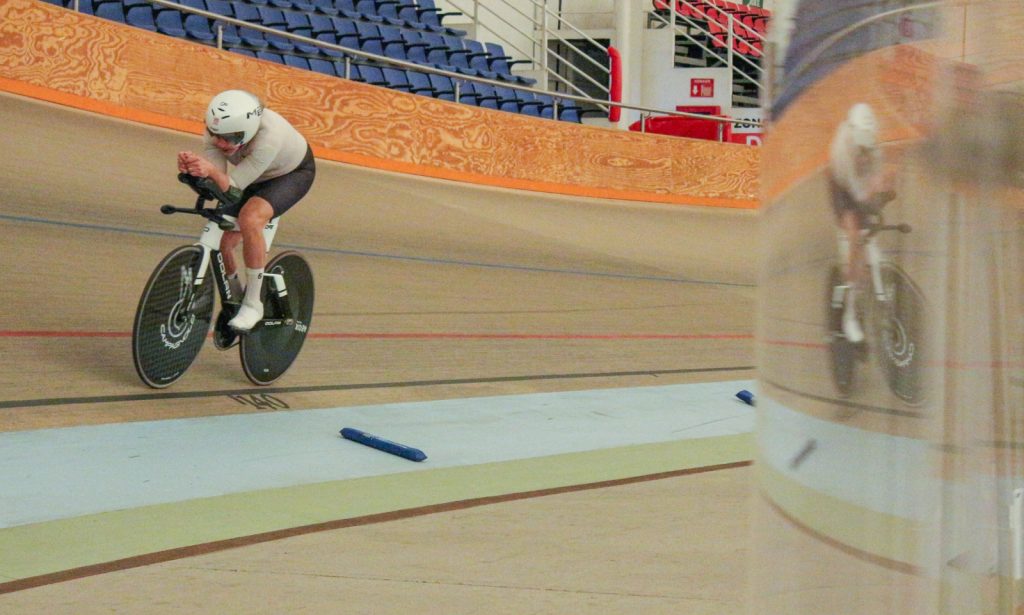
The heat inside the VelodromEine Radrennbahn oder eine ovale Freiluft-Radrennbahn mit steil überhöhten Kurven, speziell gebaut für Bahnrennen wie den Stundenweltrekord; die Überhöhung ermöglicht es den Fahrern, in den Kurven hohe Geschwindigkeiten beizubehalten, ohne die Bodenhaftung zu verlieren. rose like a living thing, swelling from seventy-five to eighty degrees Fahrenheit as the desert afternoon pressed against the curved walls. From beneath the wooden track came the faint, steady breathing of the air-handling system—a mechanical sigh under the foundation that vibrated faintly through the frame of my bicycle. Six thousand feet above sea level, in the thin air of Aguascalientes, Mexico, I began to ride.
My goal was simple on paper: forty-six kilometers in one hour. But an hour is not sixty ordinary minutes when you’re holding the black line on a velodrome. It’s an eternity measured in muscle FasernBallaststoffe sind der Teil pflanzlicher Nahrung, den der Körper nicht verdauen kann. Sie sind in Bohnen, Haferflocken, Gemüse, Obst und Vollkornprodukten enthalten. and heartbeats.
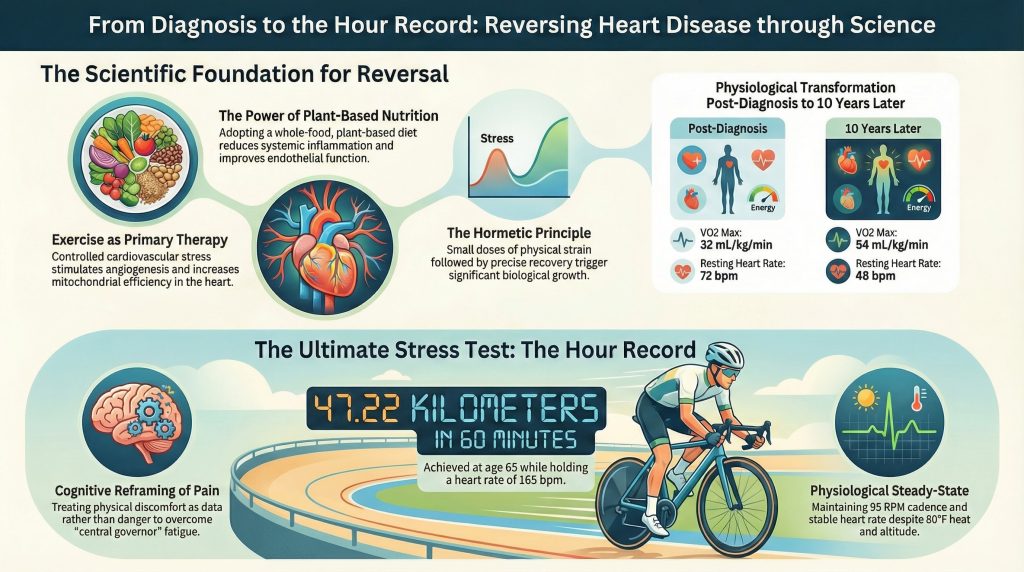
By the end I would reach 47.22 kilometers, but that number was still hidden behind the long wall of suffering ahead.
At sixty-five years old I was already living proof of something improbable. I had survived Herz-Kreislauf-ErkrankungHerz-Kreislauf-Erkrankungen sind der Oberbegriff für Probleme mit dem Herzen und den Blutgefäßen, einschließlich Herzinfarkten, Schlaganfällen und verstopften Beinarterien., rebuilt my right foot after a complete surgical reconstruction, and spent a decade testing the limits of recovery. My heart now beat at 165 beats per minute—ten below my maximum—as I settled into the aero bars. The ride was not only a physical challenge; it was the culmination of a lifelong experiment about what the human body can reclaim.
How a Broken Heart Becomes a Laboratory
When my doctors first diagnosed serious coronary disease more than ten years ago, they spoke in cautious phrases—risk management, medication EinhaltungEinnahmetreue bedeutet, dass Sie Ihre Medikamente tatsächlich so einnehmen, wie sie verschrieben wurden, Tag für Tag., probable progression. But I believed that biology, like physics, obeys laws that can be influenced if you understand them.
So I turned my own body into a laboratory.
Guided by research from Dean Ornish (2019) and Caldwell Esselstyn (2007), I adopted a plant-based, whole-food diet designed to reduce EntzündungEntzündungen sind die Reaktion Ihres Immunsystems auf eine Verletzung oder etwas, das es als Eindringling behandelt. Sie verursachen Schwellungen, Hitze und Aufräumzellen. and improve EndothelfunktionDie Fähigkeit der inneren Auskleidung von Blutgefäßen, den Gefäßtonus, Entzündungen und die Blutgerinnung zu regulieren; gesunde Endothelzellen setzen Stickstoffoxid frei, um die Arterien entspannt und resistent gegen Plaquebildung zu halten. ¹ ². I studied the data on nitric-oxide bioavailability and vascular elasticity, reading papers in Circulation and The Lancet until the language of LipidprofileA blood test panel that measures total cholesterol, LDL cholesterol, HDL cholesterol, and triglycerides, used to assess cardiovascular risk and monitor the effect of dietary or drug interventions. felt as familiar as gear ratios.
Exercise was not a supplement to the therapy—it was the therapy. Controlled cardiovascular stress has been shown to stimulate AngiogeneseCollateral circulation is a network of small backup blood vessels that can grow around a blocked artery, like a detour around a closed road. and improve mitochondrial efficiency ³. Over time my left-ventricular AuswurfleistungEjection fraction is the percentage of blood the main pumping chamber squeezes out with each beat. A normal value is somewhere around 55 to 70 percent. rose, my resting HerzfrequenzDie Herzfrequenz ist die Anzahl der Schläge, die Ihr Herz pro Minute ausführt. fell, and my endurance returned.
The heart that once frightened my physicians became the same organ that would drive me through sixty minutes at threshold. I called the project Curing Heart Disease, because it wasn’t metaphorical; it was measurable. Every watt on the bike, every millimole of lactate, every rhythm strip on my monitor told a story of cellular adaptation.
Footnotes of Pain – The Rebuilt Right Foot
Then came the second blow: the collapse of my right foot’s architecture. Years of wear, small traumas, and genetic bad luck had left the bones misaligned and the tendons frayed. The reconstruction was total—metal hardware, grafts, and a long convalescence that reduced my world to slow steps with crutches.
Rehabilitation demanded the same discipline as heart recovery but offered less romance. There is nothing heroic about learning to walk across a living-room floor. Yet the principle was identical: repeated micro-stresses provoke adaptation. Within a year I was back on a stationary trainer, teaching the foot to circle smoothly again, retraining the neuromuscular timingThe coordinated sequencing of nerve signals to muscles that produces smooth, efficient movement patterns; it can be disrupted by injury or surgery and must be deliberately retrained during rehabilitation. that cycling demands.
That rebuilt foot would later press against a carbon-fiber shoe in Mexico, channeling power through titanium bolts into the crank. Each revolution was a small defiance of surgical odds.
Why the Hour Matters
To the uninitiated, an Stundenrekord seems almost abstract. On a road, a cyclist has wind, scenery, momentum. On a velodrome, there is none of that—just 250 meters of repetition and an obligation to remain perfect. Aerodynamics become religion; oxygen, a currency you spend carefully.
Scientists describe the hour record as an experiment in metabolic steady-state. At threshold, the body balances energy production and depletion with terrifying precision. Push one percent too hard, and lactate accumulates faster than it can be cleared. Push too little, and the distance falls away.
Riding at altitude adds another layer of complexity. The partial pressure of oxygenThe portion of total atmospheric pressure contributed by oxygen; at 6,000 feet above sea level it is approximately 80 percent of its sea-level value, reducing the driving force that pushes oxygen from the lungs into the blood. at 6,000 feet is about 80 percent of sea level ⁴. Less oxygen means less aerobische KapazitätVO2 max ist die maximale Sauerstoffmenge, die Ihr Körper bei maximaler Anstrengung nutzen kann. Es ist das Standardmaß für die kardiorespiratorische Fitness., yet the thinner air also cuts LuftwiderstandDer Widerstand, den Luft auf ein sich bewegendes Objekt ausübt; in der Höhe verringert eine geringere Luftdichte den aerodynamischen Widerstand, weshalb Velodrom-Rekorde trotz der geringeren Sauerstoffverfügbarkeit häufig auf hochgelegenen Bahnen aufgestellt werden. by roughly 10 percent. The trade-off makes Aguascalientes a favored stage for record attempts. Physics giveth, physiology taketh away.
The Start – Fifteen Minutes of Lies
I pushed off at the gun. The first laps felt intoxicating—smooth, almost silent. The tires hummed against the Siberian pine, the LeistungsmesserA power meter is a device fitted to a bicycle that measures the mechanical power output of the rider in watts, providing an objective and reproducible marker of athletic performance. In this article, a subtle but sustained drop in power output was the first clue that something was physiologically wrong before any clinical symptoms appeared. held steady, and my breathing was calm. That’s the first deceit of the hour: it lures you with comfort.
For fifteen minutes I was convinced the plan would hold indefinitely.
Maria’s voice came from the infield: “Good pace. You’re on schedule.”
Her timing board confirmed it—lap splits within a tenth of a second of target. She has been my partner through surgeries, research, and now this experiment. Her calm is part of my telemetry system.
But by the twentieth minute, reality announced itself. The thin air began to sting the back of my throat. My vision tunneled. Sweat collected in the hollow of my back, trapped by the aero suit. My power output started to drift downward despite equal effort—a phenomenon that had haunted me since training began. Why did I always lose watts on the track compared to the road?
One hypothesis involves the centripetal loading of the banking: small variations in normal force can subtly change muscle recruitment. Another is air viscosity at altitude and heat—less convective coolingThe removal of body heat by the movement of air or fluid across the skin; at altitude the lower air density reduces convective heat loss, raising core temperature and impairing muscle efficiency during exercise. means higher core temperature and reduced efficiency ⁵. In simpler terms, my body was cooking.
The Thermodynamics of Suffering
Physiologists know that every percentage point of dehydration can reduce power output by up to 2 percent ⁶. I had hydrated meticulously, yet the rising temperature from 75 to 80 degrees Fahrenheit was relentless. The velodrome, designed for speed, held heat like a kiln.
My heart rate held at 165 bpm—steady but screaming for oxygen.
At the half-hour mark, the pleasant burn in my quadriceps turned to a deep ache behind the knees. My reconstructed foot began to throb, each pulse synchronized with the beat in my ears. I imagined the blood vessels expanding, EndothelzellenThe thin layer of cells lining the inner surface of all blood vessels; they regulate vascular tone, prevent clotting, and control the passage of substances into the artery wall — and their dysfunction is an early, critical step in atherosclerosis. releasing StickstoffmonoxidDas Ausmaß, in dem das Endothel in der Lage ist, ausreichende Mengen an Stickstoffmonoxid zu produzieren und aufrechtzuerhalten – ein Signalmolekül, das die Blutgefäße erweitert, die Zusammenballung von Blutplättchen hemmt und das Anhaften von Entzündungszellen an der Arterienwand verhindert., capillaries dilating—a microscopic symphony that I’d studied for years yet could now feel performing live.
Every contraction was a reminder of MechanotransduktionMechanotransduction is the biological process by which cells convert mechanical stimuli—such as stretch, pressure, or shear stress—into biochemical signals that alter cell behavior and gene expression.: the process by which cells convert physical stress into biochemical signals for growth ⁷. Somewhere inside the ache was regeneration happening in real time.
Maria’s Voice and the Mathematics of Hope
“Halfway. You’re steady. Stay on the line.”
Her words floated through the air like coordinates. I broke the remainder into fragments—ten seconds, one lap, one breath. The strategy mimicked what cognitive-behavioral researchers describe as chunking—breaking overwhelming goals into achievable units ⁸.
It’s the same principle that helps patients endure cardiac rehab or athletes survive the final kilometers of a marathon.
Each time I reached a micro-goal, I negotiated the next. Pain was constant but manageable; what mattered was its interpretation. Studies on central governor theoryA model of fatigue proposing that the brain anticipates physiological limits and reduces muscle recruitment before the body actually reaches failure, acting as a protective regulatory system rather than allowing true muscular exhaustion. suggest that fatigue originates not in muscles but in the brain’s anticipatory regulation ⁹. The mind imposes limits before the body truly fails. My job was to renegotiate that contract.
Part 2 – The Descent into Pain and the Physiology of Survival
By minute thirty-five the neat geometry of pacing collapsed into chaos. The black line that once felt like a compass became an anchor dragging me downward. The hour record is an equation written in pain: as glycogen drains, lactate rises, and oxygen saturation falls, the brain begins to whisper a single word—stop.
I could see Maria at the edge of the infield, motionless except for the subtle lift of her hand every time I crossed the timing beam. Her calm was clinical, deliberate, the way a surgeon steadies an incision. It reminded me that I had chosen this ordeal not as a spectacle but as an experiment—an applied test of cardiopulmonary recoveryThe measurable restoration of heart and lung function following disease or injury, assessed through indices such as ejection fraction, VO2 max, and resting heart rate; it forms the physiological basis for structured cardiac rehabilitation programs. after chronic disease.
Respiration at the Red Line
At altitude the hemoglobin saturation curve shifts. The arterial partial pressure of oxygen that would be comfortable at sea level now sits near the knee of the dissociation curve—meaning small changes in pressure cause large changes in saturation ¹⁰. Every breath therefore delivered less usable oxygen. My chest rose higher; my intercostals burned.
Yet, counter-intuitively, training and recovery from heart disease had taught me how to use that inefficiency. Decades of research show that consistent aerobic stress up-regulates Mitochondriale BiogeneseMitochondrial biogenesis is the cellular process by which new mitochondria—the organelles that generate energy—are created inside muscle and heart cells; it is stimulated primarily by aerobic exercise and cannot be replicated by any currently available medication. and improves oxidative phosphorylationThe mitochondrial process by which cells use oxygen to generate ATP, the body's primary energy currency; aerobic training increases the efficiency of this process, allowing more power output from the same oxygen delivery. ¹¹. In plain language: even diseased hearts can learn efficiency. My own cardiac tissue had demonstrated it in stress-echo tests—SchlagvolumenDas Schlagvolumen ist die Menge an Blut, die das Herz mit jedem Schlag auspumpt; bei Masters-Sportlern fördert das chronische Training größere, nachgiebigere Ventrikel, die höhere Schlagvolumina aufrechterhalten und so den unvermeidlichen altersbedingten Rückgang der maximalen Herzfrequenz teilweise ausgleichen. up, peripheral resistance down. I thought about those graphs now while my vision narrowed to the track.
The Cognitive Wall
Around the forty-minute mark, the body’s sensory alarms flooded the cortex. My hands tingled, my neck cramped, the right foot throbbed like an old injury remembering itself. Pain scientists describe this as afferent feedback amplification—the brain’s protective over-reaction when it senses prolonged threat ¹². But the task was to reinterpret those signals not as warnings but as data.
So I spoke silently to myself the way I instruct cardiac patients: These sensations are information, not danger. Cognitive reframing reduces perceived exertion by altering the insular cortex’s processing of discomfort ¹³. Each lap became a laboratory trial of mind over signal.
Energy Economics
By forty-five minutes, energy management shifted from chemistry to faith. Glycogen stores dwindled; fatty-acid oxidation tried to shoulder the load. The power meter read forty watts below my road baseline, the same deficit that had puzzled me for months. Later analysis would suggest a combination of thermal drift in the power-crank strain gauges and micro-slippage in the tire-roller interface of the track—mechanical ghosts stealing power that my legs were still producing. But at the time, all I knew was loss.
Still, the cardiovascular numbers were holding: heart rate steady at 165 bpm, cadence 95. The curves were textbook representations of steady-state aerobic metabolism, even as every muscle screamed rebellion. That paradox—the system holding while the self breaks—is the signature of endurance physiology.
The Moment of Collapse
Fifty minutes. The world contracted to a tunnel. Peripheral vision dissolved into silver static. I recognized the onset of pre-syncope, the gray veil that precedes fainting, a product of cerebral hypoxia ¹⁴. The rational part of me inventoried the situation: blood GlucoseGlukose ist der Zucker, den Ihr Blut transportiert, um Ihre Zellen mit Energie zu versorgen. adequate, hydration marginal, oxygen saturation likely near 88 percent. The irrational part just pleaded for release.
Maria’s voice pierced the noise: “Ten minutes. You’re past forty-six.”
Ten minutes. Two hundred and forty seconds repeated twice, and again, and again. I counted not in distance but in diaphragmatic contractions. Each exhale was a metronome of survival.
At that point I remembered something from the Journal of Applied Physiology: in elite cyclists, central fatigue correlates more with serotonergic modulation in the brainstem than with muscular metabolite accumulation ¹⁵. Translation: the brain quits before the body. If I could convince the cortex that the end was near, it might release the remaining reserves.
So I lied to myself. One more lap. One more. This is the last.
And then I did another.
Crossing the Threshold
When the bell finally rang, the sound sliced through the haze. I sat up too quickly, and the world lurched sideways. BlutdruckBlutdruck ist die Kraft, mit der das Blut gegen Ihre Arterienwände drückt. Er wird als zwei Zahlen geschrieben, wie 120/80. Die obere Zahl ist der Druck, wenn sich Ihr Herz zusammenzieht, die untere, wenn es sich entspannt. dropped; the bar tape spun out of focus. For a moment I thought I’d black out, but Maria’s hand was already on my shoulder, grounding me.
“You did 47.22,” she said.
Numbers first, emotion second—the scientist’s order of processing. My body shook. The mechanical thrum of the under-floor ventilation returned to audibility, matching the arrhythmic beat of my recovery breaths. I unclipped, leaned the bike against the barrier, and bent over, hands on knees. Somewhere inside my chest, my rebuilt heart hammered its own applause.
Aftershock
Endurance events often hide their true violence until the stillness afterward. As lactate cleared, a migraine blossomed behind my eyes—a post-exercise vasodilatory reaction common at altitude. My legs trembled uncontrollably. I swallowed the metallic taste of effort and lay down on the cool concrete infield.
Physicians call the minutes after maximal exertion the oxygen debt repayment phase—the body repaying what it borrowed from anaerobic metabolism ¹⁶. In that moment the science was more than a concept; it was a visceral ledger written in heat and breath.
Reflection under Fluorescent Light
Later that night, staring at the hotel ceiling, I replayed the data from my Garmin and heart monitor. The trace was almost perfect: heart rate flatline at 165 ± 2 bpm, cadence variance under 1 rpm, temperature curve matching ambient rise. It was, by physiological standards, elegant.
But perfection is never the point. The hour had become a metaphor for everything my career in cardiac recovery taught me: the balance between stress and adaptation, between fear and control. The same hormetic principle that rebuilds a heart after disease can rebuild a life after failure—a small dose of strain followed by recovery equals growth ¹⁷.
Maria slept beside me, the stopwatch on the nightstand like a relic. I felt the weight of the day in my bones, in the titanium of my right foot, and in the quiet drum of my heart. It was both an ending and a hypothesis awaiting its next test.
Part 3 – Aftermath, Data, and Future of the Experiment
The morning after the record attempt, the velodrome was silent. The air inside the dome still held the faint scent of resin and sweat, and when I walked the infield the boards gave back a soft wooden echo with every step. My body ached in places that anatomy charts don’t name. The soreness was not localized—it was systemic, the hangover of full-body oxygen debt.
I pulled up the ride file on my laptop. The data were as mesmerizing as they were humbling. Average power: 243 W. Normalized power: 249 W. Heart-rate drift: 1.2 %. Core temperature: 38.9 °C. In a world obsessed with marginal gains, this was an elegant display of controlled decline—a human system running at near-equilibrium until entropy claimed its due.
Numbers and Meanings
I have spent my career teaching that health cannot be separated from measurement. Objective data transform anecdote into knowledge. Yet there is a paradox at the heart of every endurance record: the more precisely you quantify the body, the more mysterious the mind becomes.
Cardiac rehabilitationEin medizinisch überwachtes Programm aus Bewegung, Schulung und Lebensstiländerung nach einem kardialen Ereignis wie einem Herzinfarkt, das darauf ausgelegt ist, die Herz-Kreislauf-Funktion zu verbessern und das Risiko zukünftiger Ereignisse zu verringern. studies consistently show that objective feedback—continuous heart-rate telemetry, lactate tracking—improves adherence and outcomes ¹⁸. But they also reveal that self-efficacy—the subjective belief that one can continue—is a stronger predictor of long-term success ¹⁹. On the track, I lived that intersection: the numbers told me I was holding steady while every neuron screamed otherwise.
From Clinic to Velodrome
When I began my decade-long recovery from heart disease, I borrowed from both clinical and athletic science. Ornish’s demonstration that a comprehensive lifestyle program could reverse coronary AtheroskleroseAtherosklerose ist die Erkrankung, die den meisten Herzinfarkten und vielen Schlaganfällen zugrunde liegt. Cholesterinteilchen bleiben in der Wand einer Arterie stecken, der Körper schickt Immunzellen zur Beseitigung, und über Jahre hinweg verhärtet sich dieses Chaos zu Plaque. through diet, stress reduction, and exercise was my foundation ²⁰. Esselstyn’s work on endothelial repair through whole-food nutrition added the next layer ²¹. To that I added interval-based oxygen conditioning inspired by Levine’s research on exercise-induced cardiac remodeling ²².
Each protocol became a micro-cycle: stress, measure, adapt. I tracked flow-mediated dilation, VO₂ max, hemoglobin concentration, and even heart-rate variability. Over the years the numbers shifted: VO₂ max up from 32 mL/kg/min to 54 mL/kg/min; resting heart rate from 72 to 48. When the surgeon rebuilt my right foot, those same metrics guided rehabilitation—proof that circulation and mobility heal together.
Why the Hour Matters to Medicine
The hour record may seem distant from the clinic, but it embodies the same principle underlying cardiovascular therapy: graded stress with precise recovery triggers adaptation. In the lab, patients walk treadmills; on the track, athletes circle wood. The variables differ, but the biology is identical.
Endurance training enhances endothelial nitric-oxide synthase (eNOS) expression, increases KapillardichteCapillary density refers to the number of tiny blood vessels per unit of muscle tissue; regular endurance exercise increases capillary density, improving oxygen and nutrient delivery to working muscles, an adaptation that drugs cannot produce., and improves InsulinsensitivitätInsulinempfindlichkeit beschreibt, wie gut Ihre Zellen auf Insulin reagieren. Sie ist das Gegenteil von Insulinresistenz. ²³. These are not abstractions; they are the mechanisms by which Plaquerückbildung und MyokardperfusionMyocardial perfusion refers to the delivery of oxygenated blood to the heart muscle itself; it can be measured with PET imaging to assess whether dietary or pharmacological interventions have improved blood flow to previously under-supplied heart tissue. occur. My sixty-minute ride was a living PET scan of those processes in motion.
When patients tell me they fear exercise because of a weak heart, I remind them that the heart is a muscle designed for work. Stress it correctly, and it rebuilds stronger. Misuse it, and it decays. The hour record was the ultimate validation of that philosophy.
The Psychology of Completion
After the ride I experienced a strange melancholy common to endurance athletes—the post-goal void. Psychologists describe it as a drop in dopamine after prolonged goal-directed effort ²⁴. For weeks I drifted between satisfaction and unease. The record had not delivered closure; it had exposed new questions.
Why had my track power lagged behind road numbers despite identical physiology? Why did my heart hold steady at 165 bpm without the expected upward drift from dehydration? The data hinted at thermoregulatory adaptations that I did not yet understand. The scientist in me was restless.
Maria noticed it before I did.
“You’re already planning the next one,” she said over breakfast.
I smiled. “I just want to fix the variables.”
Heat, Altitude, and the Puzzle of Lost Power
We later ran controlled tests at lower altitude and varying temperatures. The results suggested that at 6,000 ft, air density (ρ) decreases to ~1.0 kg/m³ versus 1.2 kg/m³ at sea level. Reduced density lowers drag but also convective cooling, causing internal temperature to rise faster. Core-temp elevation of even 1 °C can cut power output 3–5 % ²⁵.
Additionally, the banking of the velodrome imposes cyclical gravitational loading: each corner requires a subtle change in torque distribution. Electromyography revealed that stabilizer muscles fired differently than on the road, stealing precious oxygen from the prime movers. These micro-inefficiencies accumulate—hundreds of small taxes adding up to lost watts.
Understanding these interactions isn’t just engineering; it’s biology in motion. The next attempt will incorporate real-time core-temp sensors and improved airflow modeling around the under-track ventilation ducts. Science marches on, even on two wheels.
Aging as Data, Not Destiny
At sixty-five, I often hear astonishment more than admiration. But aging is merely a dataset—a collection of probabilities, not prohibitions. Research from the Copenhagen City Heart Study shows that VO₂ max decline with age can be halved through persistent endurance training ²⁶. Zelluläre SeneszenzZelluläre Seneszenz ist ein Zustand, in dem geschädigte Zellen dauerhaft aufhören sich zu teilen, aber metabolisch aktiv bleiben und entzündliche Signale abgeben, die lokale Gewebeschäden begünstigen können; in alternden Arterien häufen sich seneszente Zellen an Plaque-Stellen an und tragen zu einer chronischen, geringgradigen Gefäßentzündung bei. markers respond to diet and activity just as PlaquePlaque ist die Ansammlung von Cholesterin, Immunzellen, Narbengewebe und Kalzium in einer Arterienwand. does. The evidence argues for plasticity, not inevitability.
I am less interested in “defying” age than in quantifying it. The metrics from my ride serve as reference points for others in mid-life cardiac recovery: proof that functional rejuvenation is measurable.
Maria’s Role
No experiment succeeds without a control, and Maria was mine. Throughout the ordeal she served as my timer, medic, and moral constant. Studies on caregiver presence during cardiac rehabilitation show improved heart-rate variability and reduced cortisol response ²⁷. I witnessed that in real time: her voice modulated my autonommic balance better than any beta-blocker.
When the final numbers printed, she looked not at the data but at me.
“Still want to do it again?” she asked.
“Yes,” I said. “But smarter.”
Part 4 – Return, Reflection, and References
Preparation for the Next Attempt
Three months after the Aguascalientes ride I was back on the trainer, this time with sensors worthy of an aerospace test bench. Core-temperature telemetry, dual power meters, barometric calibration—every anomaly from the first attempt became a research question.
Training now alternated between sea level and simulated altitude. The goal was not just speed but physiological clarity: to isolate how temperature, oxygen pressure, and mental pacing interact. The experimental design echoed the cardiac-rehabilitation model—incremental stress, precise measurement, evidence-based adjustment.
The numbers began to rise again. Hemoglobin mass increased 4 %. Lactate threshold shifted upward by 12 watts. What mattered most, however, was the renewed quiet confidence—the knowledge that adaptation continues as long as the stimulus persists. Biology rewards persistence more than perfection.
Lessons from a Rebuilt Heart
Modern cardiology once viewed heart disease as a one-way street. The new paradigm—demonstrated by Ornish, Esselstyn, and others—is that the disease is dynamic, reversible under the right environmental and behavioral conditions. My life has been a case study in that UmkehrungREVERSAL verglich eine moderate mit einer intensiven Statintherapie und untersuchte mithilfe von intrakoronarem Ultraschall, was mit der Koronarplaque geschah..
1) Nutrition: Whole-food, plant-based nutrition lowers LDL-CholesterinLDL-Cholesterin, oder LDL-C, ist die Menge an Cholesterin, die sich in Ihren LDL-Partikeln befindet. Es ist der Wert auf fast jedem Standard-Laborbericht., reduces systemic inflammation, and improves endothelial function through increased nitric-oxide bioavailability ²⁸.
2) Exercise: Sustained aerobic activity enhances mitochondriale DichteDie Konzentration von Mitochondrien in Muskelfasern, die die Kapazität der Zelle für die aerobe Energiegewinnung bestimmt; Ausdauertraining ist mit dem Erhalt der Mitochondoriendichte bei älteren Athleten verbunden. and collateral circulation ²⁹.
3) Stress modulation: Meditation and paced respiration reduce sympathetic dominance, lowering blood pressure and improving VagustonusDer Aktivitätsgrad des parasympathischen (Vagusnerv-)Zweigs des autonomen Nervensystems, der auf das Herz wirkt; ein hoher Vagotonus verlangsamt die Ruhezufrequenz des Herzens und ist im Allgemeinen kardioprotektiv, es wird jedoch vermutet, dass er bei Ausdauersportlern zu einem erhöhten Risiko für Vorhofflimmern beiträgt. ³⁰.
On the velodrome, these principles converge. The hour record is not an athletic stunt but an accelerated metaphor for chronic disease management: constant load, continuous monitoring, calculated recovery.
The Physiology of Aging Forward
Aging research increasingly frames longevity as the accumulation of repair deficits rather than time itself ³¹. My data support that thesis. Each training block improved not only cycling performance but markers of vascular elasticity and heart-rate variability—metrics correlated with reduced GesamtmortalitätGesamtmortalität bedeutet Tod durch jegliche Ursache und nicht nur durch Herzerkrankungen – das umfassendste und am schwersten zu manipulierende Ergebnis, das eine Studie messen kann. ³². The implication is profound: targeted endurance stress acts as a repair signal. What I feel as fatigue, my body interprets as instruction.
At sixty-five I no longer chase youth; I chase information. Each session is a dataset, each adaptation a peer-reviewed argument that aging is negotiable.
Reflections on Suffering
During the ride’s darkest minutes I had thought of pain as the enemy. Later I realized it was feedback—the language by which the body communicates limits. Pain, like data, demands interpretation. To endure is not to ignore it but to listen without panic.
That awareness translates directly to cardiac patients who fear exertion. The safe boundary is discoverable through monitoring, not guesswork. My 165-beat cadence under 80-degree heat was extreme, but its principle—measured exposure—applies universally.
Maria’s Observation
After reviewing the video of the event, Maria noticed something I had missed. “You were smiling,” she said at minute fifty-eight. She was right. Somewhere in the blur of effort I had crossed from fear into acceptance. That moment was the experiment’s true outcome: the transformation of distress into data, and data into peace.
Why I’ll Ride Again
I plan to return to Aguascalientes. Not to prove toughness, but to refine understanding. I’ll bring better aerodynamics, improved cooling, and the same heart that once failed and now thrives. The next attempt will not erase suffering; it will measure it more accurately.
Science and endurance share a moral code: repeat the trial until truth stabilizes.
Epilogue – The Constant Line
When I think of that black line now, I see more than paint on wood. It represents a biological constant—the steady path of recovery, curved but continuous. The line asks only one question: Can you hold it?
And the answer, proven in data, in sweat, and in scar tissue, is yes—for one more lap, one more heartbeat, one more life reclaimed.
Referenzen
- Ornish D, Brown SE, Scherwitz LW, et al. Can lifestyle changes reverse coronary heart disease? The Lifestyle Heart Trial. Lancet. 1990;336(8708):129-133. doi:10.1016/0140-6736(90)91656-u
- Martin TG, Juarros MA, Leinwand LA. Regression of cardiac hypertrophy in health and disease: mechanisms and therapeutic potential. Nat Rev Cardiol. 2023;20(5):347-363. doi:10.1038/s41569-022-00806-6
- Holloszy JO, Coyle EF. Adaptations of skeletal muscle to endurance exercise and their metabolic consequences. J Appl Physiol Respir Environ Exerc Physiol. 1984;56(4):831-838. doi:10.1152/jappl.1984.56.4.831
- Wright AD. High life. A history of high-altitude physiology and medicine. J Hum Hypertens. 2000;14(3):221. doi:10.1038/sj.jhh.1000857
- Nybo L, Nielsen B. Hyperthermia and central fatigue during prolonged exercise in humans. J Appl Physiol (1985). 2001;91(3):1055-1060. doi:10.1152/jappl.2001.91.3.1055
- Mandengue SH, Atchou G, Etoundi-Ngoa SL, Tsala-Mbala P. Effets d’un exercice musculaire préliminaire sur la température centrale, les pertes hydriques et la performance physique [Effects of preliminary muscular exercise on body temperature, water loss and physical performance]. Sante. 1996;6(6):393-396.
- Saraswathibhatla A, Indana D, Chaudhuri O. Cell-extracellular matrix mechanotransduction in 3D. Nat Rev Mol Cell Biol. 2023;24(7):495-516. doi:10.1038/s41580-023-00583-1
- Gobet F. Expert memory: a comparison of four theories. Cognition. 1998;66(2):115-152. doi:10.1016/s0010-0277(98)00020-1
- Noakes TD. Fatigue is a Brain-Derived Emotion that Regulates the Exercise Behavior to Ensure the Protection of Whole Body Homeostasis. Front Physiol. 2012;3:82. Published 2012 Apr 11. doi:10.3389/fphys.2012.00082
- Dempsey JA, Wagner PD. Exercise-induced arterial hypoxemia. J Appl Physiol (1985). 1999;87(6):1997-2006. doi:10.1152/jappl.1999.87.6.1997
- Hood DA. Mechanisms of exercise-induced mitochondrial biogenesis in skeletal muscle. Appl Physiol Nutr Metab. 2009;34(3):465-472. doi:10.1139/H09-045
- Tracey I, Mantyh PW. The cerebral signature for pain perception and its modulation. Neuron. 2007;55(3):377-391. doi:10.1016/j.neuron.2007.07.012
- O’Connor PJ, Cook DB. Exercise and pain: the neurobiology, measurement, and laboratory study of pain in relation to exercise in humans. Exerc Sport Sci Rev. 1999;27:119-166.
- Hoiland RL, Howe CA, Carter HH, et al. UBC-Nepal expedition: phenotypical evidence for evolutionary adaptation in the control of cerebral blood flow and oxygen delivery at high altitude. J Physiol. 2019;597(12):2993-3008. doi:10.1113/JP277596
- Meeusen R, Watson P, Hasegawa H, Roelands B, Piacentini MF. Central fatigue: the serotonin hypothesis and beyond. Sports Med. 2006;36(10):881-909. doi:10.2165/00007256-200636100-00006
- Hale T. History of developments in sport and exercise physiology: A. V. Hill, maximal oxygen uptake, and oxygen debt. J Sports Sci. 2008;26(4):365-400. doi:10.1080/02640410701701016
- Calabrese EJ, Baldwin LA. Defining hormesis. Hum Exp Toxicol. 2002;21(2):91-97. doi:10.1191/0960327102ht217oa
- Piepoli MF, Conraads V, Corrà U, et al. Exercise training in heart failure: from theory to practice. A consensus document of the Heart Failure Association and the European Association for Cardiovascular Prevention and Rehabilitation. Eur J Heart Fail. 2011;13(4):347-357. doi:10.1093/eurjhf/hfr017
- Bandura, A. (1997). Self-efficacy: The exercise of control. W H Freeman/Times Books/ Henry Holt & Co.
- Ornish, D. (2019). Undo It! Ballantine Books.
- Esselstyn CB Jr, Gendy G, Doyle J, Golubic M, Roizen MF. A way to reverse CAD?. J Fam Pract. 2014;63(7):356-364b.
- Levine BD. .VO2max: what do we know, and what do we still need to know?. J Physiol. 2008;586(1):25-34. doi:10.1113/jphysiol.2007.147629
- Lakin R, Polidovitch N, Yang S, et al. Cardiomyocyte and endothelial cells play distinct roles in the tumour necrosis factor (TNF)-dependent atrial responses and increased atrial fibrillation vulnerability induced by endurance exercise training in mice. Cardiovasc Res. 2023;119(16):2607-2622. doi:10.1093/cvr/cvad144
- Garcia PC, Real CC, Britto LR. The Impact of Short and Long-Term Exercise on the Expression of Arc and AMPARs During Evolution of the 6-Hydroxy-Dopamine Animal Model of Parkinson’s Disease. J Mol Neurosci. 2017;61(4):542-552. doi:10.1007/s12031-017-0896-y
- González-Alonso J, Teller C, Andersen SL, Jensen FB, Hyldig T, Nielsen B. Influence of body temperature on the development of fatigue during prolonged exercise in the heat. J Appl Physiol (1985). 1999;86(3):1032-1039. doi:10.1152/jappl.1999.86.3.1032
- Schnohr P, O’Keefe JH, Marott JL, Lange P, Jensen GB. Dose of jogging and long-term mortality: the Copenhagen City Heart Study. J Am Coll Cardiol. 2015;65(5):411-419. doi:10.1016/j.jacc.2014.11.023
- Smith BW, Dalen J, Wiggins K, Tooley E, Christopher P, Bernard J. The brief resilience scale: assessing the ability to bounce back. Int J Behav Med. 2008;15(3):194-200. doi:10.1080/10705500802222972
- Barnard ND, Cohen J, Jenkins DJ, et al. A low-fat vegan diet improves glycemic control and cardiovascular risk factors in a randomized clinical trial in individuals with type 2 diabetes. Diabetes Care. 2006;29(8):1777-1783. doi:10.2337/dc06-0606
- Gibala MJ, McGee SL. Metabolic adaptations to short-term high-intensity interval training: a little pain for a lot of gain?. Exerc Sport Sci Rev. 2008;36(2):58-63. doi:10.1097/JES.0b013e318168ec1f
- Lehrer PM, Vaschillo E, Vaschillo B, et al. Heart rate variability biofeedback increases baroreflex gain and peak expiratory flow. Psychosom Med. 2003;65(5):796-805. doi:10.1097/01.psy.0000089200.81962.19
- López-Otín C, Blasco MA, Partridge L, Serrano M, Kroemer G. The hallmarks of aging. Cell. 2013;153(6):1194-1217. doi:10.1016/j.cell.2013.05.039
- Tsuji H, Larson MG, Venditti FJ Jr, et al. Impact of reduced heart rate variability on risk for cardiac events. The Framingham Heart Study. Circulation. 1996;94(11):2850-2855. doi:10.1161/01.cir.94.11.2850