
冠動脈疾患の100年の後退
何が実際に起こったのか、現代の心臓病学がどれほど貢献したのか、そして次に何が起こるべきなのか
物語的および系統的エビデンスレビュー、1925〜2026年頃
Peter Megdal, PhD 2026年8月24日
目次
何が実際に起こったのか、現代の心臓病学がどれほど貢献したのか、そして次に何が起こるべきなのか 3
数えられるようになる前に発見されなければならなかった流行(1900〜1949年頃). 7
モデルの仕組みと、それらが伝えられること、伝えられないこと.. 15
生物学的タイムラグ:なぜアトリビューションウィンドウが重要なのか. 16
図3 — 具体的分解(米国、1980年〜2000年). 20
第4部:予防:ランダム化証拠が実際に証明していること. 23
第VI部:血行再建術:1つの名称を持つ3つの異なる手術. 32
現代の人口がもし昔の医療ケア――あるいは昔の危険因子を持っていたらどうなるだろうか?. 35
パートX. その次に来るもの:現在よりもうまくやるために. 41
- 中年期の閾値ではなく、累積的な生涯ばく露を扱う. 41
- リポタンパク質(a)の治療がついに実現. 42
- 脂質低下療法の選択肢を拡充し、アドヒアランスの問題を解決する. 42
- 心代謝ドライバーを直接治療する. 42
- 残余炎症リスクに対処する. 43
- イベント前にリスクのある人々を見つける. 43
- 人口政策は依然として異例ほど大きな影響力保持している. 43
そして何よりも重要なのは、実装のギャップを埋めることです. 44
平易な言葉で書かれたエグゼクティブサマリー
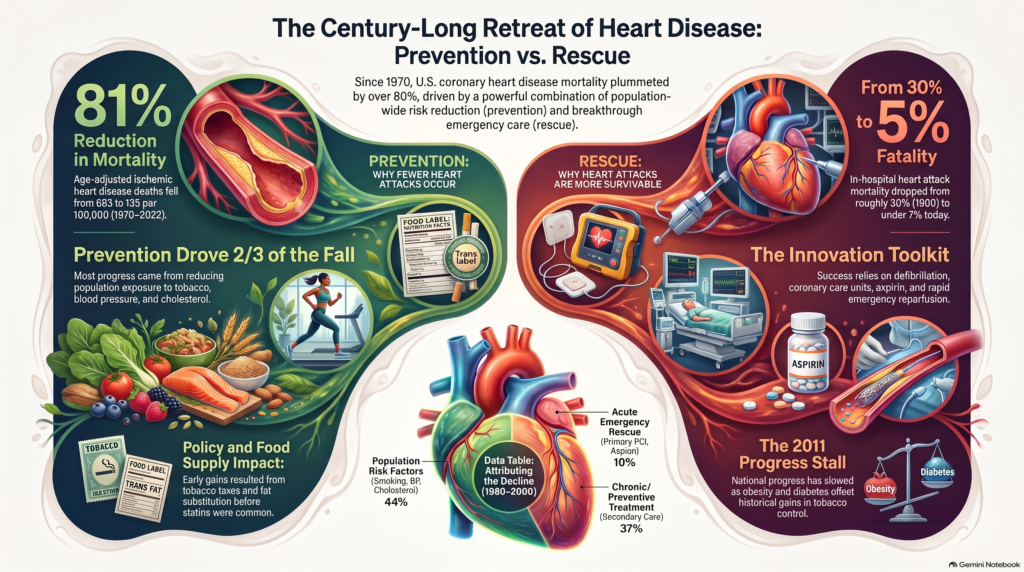
医学の歴史の大部分において、誰も以下が原因で死亡したと診断されなかった。 心臓発作 —なぜなら 心筋梗塞 起こらなかったのではなく、まだ臨床症候群として認識されていなかったからである。. 冠動脈血栓症 生きた患者において臨床的症候群として記述されたのは1912年になってからである。140年も経たないうちに、それは工業化社会における最大の死因となった。さらに40年後には、それは急速に後退していた。これは最も特筆すべき 逆転 医学の歴史において、そしてそれは決まって下手くそに説明される。.
循環器科が作り上げた一般的な説 — スタチン そして ステント それによって心臓病を克服したというのは、年代の観点からだけでも間違っている。米国の冠動脈疾患による死亡率は1968年頃にピークを迎えており、最初のスタチンが承認される前には、すでに約3分の1減少していた。その前は ACE阻害薬, 、プライマリーの前に 経皮的冠動脈形成術, そして誰も無作為化試験を実施する前に アスピリン 急性心筋梗塞において。その逆のバージョン、すなわちその減少は単に人々の問題であったというものは 喫煙 より少なく食べ、より健康的な食事を心がけ、それに医薬品が寄り添うという見方も、同様に間違っている。現代の治療法は、死亡率低下の非常に大きな割合を占めており、国や時代によってはその半分に迫るほどである。.
正確なバージョンは、全く異なる2つのことが同時に起きたのであり、それらは決して混同されるべきではないということです。
まず、心臓発作を起こす人が減少しました。. 集団は、支配的な変更可能な要因のうちの3つに対する生涯の曝露を減らした 動脈硬化:タバコ煙、高値 血圧, 、および動脈硬化性の コレステロール. これらが唯一の因果的寄与要因というわけではない—— 糖尿病, 、肥満、そして代謝異常も重要であり、それらの傾向は望ましくない方向に進んでいる。その一部は個人の行動に起因し、多くは政策や食品供給に起因し、そして時間の経過とともにその割合が増加しているのが薬物によるものである—— 降圧薬 1970年代から、スタチンは1990年中頃から。.
第二に、心臓発作を起こした人々が、それによって亡くなることがなくなった。. 1960年当時、急性心筋梗塞で入院した場合、退院できない確率はおよそ3分の1から5分の1程度であった。 高所得国の医療システムにおけるST上昇型心筋梗塞の現在の院内死亡率は、多くの場合4~7%程度であるが、この数値は症例構成によって大きく異なり、すべての急性心筋梗塞(AMI)に普遍的に当てはまる値ではない。冠動脈集中治療室、除細動、心肺蘇生法、救急医療システム、アスピリン、, 血栓溶解療法, そして、緊急経皮的冠動脈介入術がこれを行った。これらの急性救命介入は、初回の心筋梗塞を予防するというよりも、発作後の生存率を主に改善させるものである。.
どちらの成果も冠動脈疾患による死亡率を低下させるため、死亡率だけではどちらが原因であるかを判断することはできない。最良の国際データによると、冠動脈死亡率が著しく低下した数十年の間、その低下のおよそ3分の2は冠動脈イベントの発生減少によるものであり、残りのおよそ3分の2はそれらを生き延びたことによるものである。.
そして、教科書にはまだ書かれていない物語の部分もある。. 下落は一服した。. 米国と英国では、2011年頃から進展が急激に鈍化し、55歳未満の成人においては、一部の急性期の転帰が悪い方向に動き始めている。. 肥満 そして2型糖尿病は30年間にわたり台帳から差し引かれ続け、国民の血圧管理は悪化し、たばこ対策による容易な成果は概ね蓄積されてきた。今後100年の進歩は、過去100年の繰り返しからは生まれない。それは、中高年のリスク閾値ではなく、生涯にわたるアテローム原性曝露の蓄積に対処することにますます依存する可能性が高い。 リポ蛋白(a) もしアウトカム試験でベネフィットが確認されれば、現在進行中の心血管代謝革命について インクレチン 療法について 残存炎症リスク, そして何よりも、わかっていることと患者が現実に受けている医療との間にある、膨大な実施のギャップを埋めることにあります。.
回答は1段落でお願いします。
冠動脈疾患 20世紀前半にかけて増加し、ほとんどの高所得国では1960年代にピークに達した後、主要な死因として記録された中で最大かつ持続的な死亡率の低下の一つを経験しました。米国では、年齢調整された 虚血性心疾患 死亡率は〜から低下した 1970年から2022年にかけて、10万人あたり693人から135人へと減少した――81%の減少 — 一方で、急性心筋梗塞に特異的にコードされた死亡率は減少した一方で、 10万人あたり354から40へ、89%の減少 [2]。利用可能な中で最良の帰属モデルによれば、その成果を「医学」単独、あるいは「生活習慣」単独のおかげとすることはできない。主要な減少期における全米および数カ国のヨーロッパ諸国において、およそ 秋に確認された44–73%は、人口レベルのリスク要因に好ましい変化が見られたことに起因するとされた, 、一方で 23–47%は、内科的および外科的治療に起因するものとされた; 急性冠動脈治療自体は通常、約 総死亡率の減少のうち、4–12%が占める割合 IMPACT型モデルにおいて[3,4,5,6,7,8]。これと並行して、WHO MONICAのデータは、およそ 1980年代から1990年代にかけての冠動脈疾患死亡率の低下の3分の2は冠動脈イベントの減少によるものであり、残り3分の1はイベント発生後の生存率の向上によるものである。, 、集団間に大きな違いがあり、9].
実用的な結論として、冠動脈イベントの発生率が歴史的に低下してきた要因の多くは、一般人口におけるアテローム性動脈硬化のリスク要因(特に喫煙、 血圧、コレステロールといった動脈硬化リスクに対する曝露状況の変化によるものと思われる。一方で、現代の循環器医学は、これらのリスクを医学的に低減し、再発を予防し、心筋梗塞を、かつては短期死亡率がおよそ20~30%であった疾患から、現代の高所得国の医療制度下でははるかに生存率の高い疾患へと変貌させることで、非常に大きな追加的貢献を果たした。.
中心的定量的結論
| 質問 | 最も防御可能な統合 | 自信 |
| 米国の冠動脈性心疾患/虚血性心疾患の死亡率はどれくらい低下しましたか? | 年齢調整虚血性心疾患死亡率が低下した 1970年~2022年の81%; 急性心筋梗塞コードの死亡率が低下した 89%. 最も詳細に記録された単一の期間において、年齢調整冠動脈性心疾患死亡率は約 1980年から2000年までの50%. 以前の歴史的シリーズでは、心臓病による死亡率が世紀半ばのピークに向かって上昇し、その後持続的な減少を示している。. | 高 |
| 心筋梗塞の発症率はどのくらい減少しましたか? | 有効な通世紀の数値は存在しない。フラミンガム心電図定義による初発心筋梗塞は、およそ 1960年~1999年の50%; アイスランドにおける心筋梗塞の発症率が低下した 1981年~2006年の66%; ARIC 約年間減少を示した 3–4% 1987年から2008年の間、ほとんどの性別・人種グループにおいて、日本は発症率が全く低下する必要がないことを示している。宮城では増加し 人口10万人あたり7.4〜27.0 1979年から2008年の間に. | 中程度 |
| 心筋梗塞(MI)の症例致命率はどのくらい低下しましたか? | フラミンガム研究の年齢および性別で調整した30日、1年、および5年の症例致死率は、それぞれ約 1960年~1999年の60%; 宮城県の院内死亡率は次から低下した: 20.0% から 7.8% へ 1979年から2008年にかけて。冠疾患集中治療室(CCU)導入前の病院死亡率は約 30% 現代の院内STEMI死亡率(およそ)と比較して 4–7%. | 高 指示のために; 中程度 時代横断的な規模感のために |
| 集団リスク要因寄与度 | 一般的に ~45–70%, 、個別のIMPACT推計の範囲は 44%(米国) へ 73%(アイスランド). | 中程度 |
| すべての医療・外科治療費の貢献 | 一般的に ~25–45%, 、およそ〜に及ぶ 23–47% 主要なIMPACT分析において。. | 中程度 |
| 救急医療への貢献 | 通常 CHD(冠動脈疾患)総死亡率低下の約5~10% 帰属モデルにおいて(国によって約4~12%)。しかし、致死率の改善(これには急性期ケアシステムの改善が大きく寄与している)は、冠動脈疾患死亡率低下の約 3分の1 を、MONICA型の分解分析において占めている。 | 中程度 |
| その他/診断/保健システムの寄与 | 独立して特定することはできない。IMPACTの残差は一般的に 約5~10%であるが、この残差は ではない 救急医療(EMS)、診断、または保健システムの改善と同等に見なさなければならない。なぜなら、そのような効果の多くは、すでに治療の推定値の中に組み込まれているからである。 | 低い |
| 進歩は続いているか? | いいえ。 米国と英国では2011年頃から低下が著しく鈍化し、若年成人では停滞しており、最近のエビデンスでは、18–54歳の成人における初回STEMI後の院内死亡率の悪化が示されている。肥満、糖尿病、および 高血圧 管理状況は、集団レベルで重要な対抗要因であり続けている。 | 中~高 |
重要な用語上の注意点が、以下のすべてを規定している。 「リスク因子」というカテゴリーは、個人のライフスタイルの選択と同義ではない。 喫煙率の低下は、課税、禁煙法、広告制限、医師によるカウンセリング、および個人の決定を反映している。集団におけるコレステロール値の低下は、食品供給の再編、食事の変化、およびスタチンを反映している。血圧の低下は、長期的な集団の変化と降圧剤の処方の両方を反映している。最も強力な分析では、これらを二重にカウントするのではなく、これらの経路を明示的に分けている。例えば、スウェーデンのIMPACT研究では、0.64 mmol/Lの集団コレステロール低下を、約 食事の変化によって予防または延期された5,210人の死亡と、スタチンによる810人の死亡に分解しており、一方で2.6 mmHgの収縮期血圧の低下は、約 長期的な変化による900人の死亡と、降圧治療による575人の死亡に分けられた。 [10].
パートI. 物語:ある病の盛衰
数えられるようになる前に発見されなければならなかった流行(1900〜1949年頃)
心筋梗塞の100年史を書く上での最初の困難は、その最初の4分の1の間、診断がほとんど存在しなかったことである。ジェームズ・ヘリックによる1912年の冠動脈 血栓症 の生存患者における記述(10年間はほぼ無視されていた)によって、閉塞した冠動脈 動脈 は生存可能であり、したがって単なる死後の所見ではなく診断可能であることが確立された。[1] 心電計によって、ベッドサイドでの特定が可能になった。そこからようやく、集計を始めることができたのである。
確信を持って言えるのは、心疾患が米国における主要な死因となったのは 1921, and that coronary mortality continued to rise through the 1930s, 1940s, and 1950s. What we cannot say is how much of that apparent rise was a genuine increase in atherosclerotic events and how much was improved recognition, better death certification, and the simple fact that populations were surviving long enough — past infectious disease, past tuberculosis, past childbirth — to develop coronary disease at all. Almost certainly it was both, with mass cigarette adoption, adverse blood-pressure trends, and a changing food supply likely contributing substantially — though the causal partition for this early period is intrinsically uncertain.
Effective evidence-based coronary therapy was extremely limited. The standard treatment for acute infarction was six weeks of strict bed rest, on the theory that the damaged 心筋 needed to be spared work. There was no monitoring, no way to treat the arrhythmia that killed a substantial share of patients in the first hours, no way to reopen the artery, and no validated modern risk-factor framework for coronary prevention — diet, exercise, tobacco, and blood pressure had all been discussed, but prospective risk-factor science did not yet exist. A patient who reached hospital alive had perhaps a two-in-three to four-in-five chance of leaving it.
ピークと転換(1950–1969)
Two things had to happen before the epidemic could be reversed, and both happened in this era.
その 危険因子 were discovered. その フラミンガム心臓研究, begun in 1948, gave the world the very concept of a “risk factor” and identified blood pressure, cholesterol, and smoking as the principal modifiable ones. Ancel Keys’s Seven Countries Study linked population dietary patterns to serum cholesterol to coronary incidence.[11] The 1964 U.S. Surgeon General’s report made tobacco’s causal role official policy rather than academic opinion. None of this treated a single patient. All of it made everything downstream possible.
Rescue was invented. The coronary care unit — Desmond Julian’s proposal, realized in units in Kansas City, Toronto, Philadelphia, and Sydney in the early 1960s — was one of the most consequential innovations in the acute treatment of myocardial infarction, and it involved no drug at all. Its insight was simple: a large fraction of early MI deaths were caused by 心室細動へと変えるトリガーとモジュレーターを供給します。, ventricular fibrillation is instantly reversible if you are standing there with a defibrillator, and therefore patients should be watched continuously by people trained to shock them. Closed-chest cardiac massage was described in 1960; external defibrillation had been demonstrated in the preceding decade. Historical series suggest hospital mortality for acute MI fell from roughly 30% toward 15% with the arrival of coronary care.[12]
The evidence base for this is weaker than its importance would suggest — most of it is before-and-after observational work, and a famous strand of British research argued that home care was no worse for selected patients. A prospective randomized comparison of coronary care unit versus general ward admission found overall mortality of 15.3% (17/111) versus 29.3% (27/92), with the risk of dying on the general ward relative to the unit of 2.3 (95% CI 1.1–4.8), and sudden death more frequent on the general ward.[13] That trial is small, single-centre, and drawn from a care context unlike today’s, and the wider evidence base is largely observational;[14] but the temporal signal across many institutions is consistent and large.
Meanwhile, effective antihypertensive therapy arrived. The Veterans Administration Cooperative Studies (1967, 1970) demonstrated that treating severe and then moderate hypertension prevented 脳卒中, 心不全, and death — landmark randomized evidence that pharmacologically modifying a cardiovascular risk factor changed clinical outcomes.[15]
U.S. coronary mortality peaked around 1968 and began to fall.
急激な衰退(1970–1989年)
This is the era that most decisively refutes the “modern cardiology did it” narrative, because for most of it modern cardiology did not yet exist. There were no statins until 1987 and no statin outcome trial until 1994. There was no ACE inhibitor trial in heart failure until 1987 or post-infarction until 1992. Balloon angioplasty was performed for the first time in 1977 and remained a niche procedure for a decade. Aspirin was not proven in acute MI until 1988.
The decline was noticed before it was explained. The 1978 Bethesda Conference, convened by the National Heart, Lung, and Blood Institute, was called specifically to document and account for an unexpected downturn in U.S. coronary and stroke mortality that nobody had predicted and nobody could yet attribute. That conference is the origin point of the entire attribution literature reviewed below.[16]
And yet U.S. age-adjusted ischemic heart disease mortality, 693 per 100,000 in 1970, fell steeply and continuously throughout the period. What changed instead was exposure. Male smoking prevalence fell substantially in the wake of the Surgeon General’s report and the subsequent advertising restrictions. Serum cholesterol fell as the food supply shifted. The National High Blood Pressure Education Program (1972) drove detection and treatment of hypertension into routine primary care. And in North Karelia, Finland — then recording among the highest coronary mortality rates documented anywhere, particularly among working-age men — an explicitly community-based prevention program began in 1972 and demonstrated that a population’s risk-factor profile could be deliberately changed.
Toward the end of the era the therapeutic revolution finally arrived, and it arrived in the emergency department. GISSI (1986)[17] and then ISIS-2 (1988)[18] established that streptokinase and aspirin each independently reduced death in acute myocardial infarction and that together they reduced it dramatically. The randomized trials of coronary artery bypass grafting conducted between 1972 and 1984 established that survival benefit was concentrated in left main and extensive multivessel disease, with little demonstrable survival benefit in less extensive disease — though benefit also varied with left ventricular function and anatomy.[19]
薬理学的定着期(1990–2009年)
If the 1970s and 1980s belonged to population prevention and acute rescue, this era belonged to chronic pharmacotherapy and to systems of care.
The 4S trial (1994) showed that simvastatin reduced mortality in patients with coronary disease, and within a decade statins had become among the most prescribed drugs on earth.[20] ACE inhibitors moved from heart failure into post-infarction care. Beta-blockers, aspirin, and 脂質低下 consolidated into a standard secondary-prevention bundle. Coronary stents reduced acute recoil and abrupt closure and substantially reduced restenosis compared with balloon angioplasty — though restenosis was reduced, not eliminated, and drug-eluting stents later reduced it further. Dual 抗血小板療法院 substantially reduced thrombotic complications and helped make routine stenting practical. Primary PCI progressively displaced thrombolysis for ST-elevation infarction[21], and organized STEMI networks — prehospital ECG, catheterization laboratory activation from the ambulance, measured door-to-balloon times — made timely reperfusion increasingly a systems-and-logistics challenge that health systems could optimize.
Both incidence and case fatality fell measurably during this period, and this is the era in which quantitative attribution is strongest, because treatment uptake was documented, trial efficacy was known, and risk-factor surveillance was systematic. It is also the era in which the counterweights became visible: obesity and type 2 diabetes began subtracting from the ledger, and many major attribution models from this period recorded them as negative contributions.
停滞期(2010年〜2026年)
死亡率は依然として歴史的なピークを大きく下回っており、米国の虚血性心疾患の死亡率は以下に達した 2022年には10万人あたり135人 — しかし、その軌跡は性質を変えている。米国と英国では、低下率は2011年頃から顕著に鈍化した。55歳未満の成人、特に女性において、長期的な低下は鈍化または停滞しており、一部の研究では特定の冠動脈転帰における悪影響の傾向が報告されている。[22] 絶対的な負担は依然として膨大である。米国では以下の数字が記録された: 2023年の心血管疾患による死亡者数 915,973人、年齢調整後のCVD(心血管疾患)死亡率は 10万人あたり218.3人[23]、そして世界的にはGBD 2023により以下の推計が出されている: 心血管疾患による死亡者数 1,920万人[24] 個人の年齢調整リスクが低下していても、人口増加と高齢化によって絶対的な死亡者数が増加する可能性があるためである。
停滞の原因として考えられる説明は芳しくなく、その多くは非技術的なものである。前世代が直面したことのないレベルの肥満と糖尿病、喫煙がすでに一般的ではなくなった集団における安易なタバコ対策の成果の枯渇、そして米国では、以下の数値が示す高血圧管理の悪化が記録されている: 53.8% (2013–2014) から 43.7% (2017–2018) へ[25] その後、COVID-19パンデミックが急激な逆転をもたらした。米国の25歳以上の成人における年齢調整CVD死亡率は、2019年に330.8、2020年に346.0、2021年に359.6(いずれも10万人あたり)となり、2年間で数年分の進歩が帳消しになった。 この一連のデータは25歳以上の成人を対象としており、前述の全成人を対象とした異なる標準化率(10万人あたり218.3人)と直接比較することはできない。これら2つを単一の傾向として読み取ってはならない。
表1 — 100年のタイムライン
| 時代 | CHD/MI 流行病学 | 人口およびリスク因子の動向 | 医療および救急の進展 | 証拠の解釈 |
| 1925–1949 | CHDが上昇。比較可能な人口MI発症率の監視データはほとんど存在しない。心疾患は1921年までに米国の死因の第1位となった。 | 喫煙量やその他の冠動脈への悪影響を及ぼす要因が急増。リスク因子理論はまだ存在していなかった。 | 心電図(ECG)が臨床で広く使用されるようになる。MIの治療は安静と対症療法であった。 | ティア 3/5 死亡データは概ね信頼できるが、因果関係の特定は1950年以降よりもはるかに弱い。 |
| 1950–1969 | CHD死亡率は高止まりし、1968年頃に米国でのピークに達した。 | フラミンガム研究やセブンカントリー研究が、喫煙、血圧、コレステロールを修正可能なリスクとして特定。1964年の公衆衛生局長官報告。 | 体外除細動、CPR、冠動脈疾患集中治療室(CCU)、効果的な高血圧治療、初の冠動脈バイパス術(CABG)。CCUにより、院内MI死亡率は約30%から約15%に低下した。 | ティア 2–5 初期の生存率の変化は説得力があるが、主に観察研究によるものである。 |
| 1970–1989 | 持続的で急激な低下が始まる。米国の年齢調整IHD死亡率は以下の通りであった: 1970年に10万人あたり693人. | 喫煙率が大幅に低下。国民の血圧とコレステロール値が改善。ノースカレリアが強力な地域予防活動を開始。 | 高血圧治療の普及、CABG、PTCA(1977年)、ベータ遮断薬、アスピリン、 心臓リハビリテーション、血栓溶解療法。この時代の終盤に最初のスタチンが登場。ISIS-2試験がアスピリンとストレプトキナーゼの有効性を確立。 | ティア 1–4 人口レベルの予防と根拠に基づく循環器学が同時に寄与し始める。 |
| 1990–2009 | ARIC研究やフラミンガム研究において、MIの発症率と致死率の両方の大幅な低下が測定可能となる。 | 喫煙、コレステロール、血圧のさらなる改善が、肥満や糖尿病によって次第に相殺される。 | スタチン、ACE阻害薬、ステント、抗血小板薬2剤併用療法、現代的な救急医療(EMS)、プライマリPCIが主流に。ランダム化比較試験の統合解析で、プライマリPCIが血栓溶解療法を上回る。 | ティア 1–4 定量的寄与の特定において最も強力な時代。 |
| 2010–2026 | 死亡率はピークを大きく下回っているが、 低下が停滞。若年成人における停滞が見られ、近年では18〜54歳の初回STEMI入院死亡率が悪化している。。米国のIHD死亡率は 2022年に10万人あたり135人. | 高所得国ではタバコの使用が引き続き減少。肥満、糖尿病、代謝リスクが成果を打ち消す。米国の高血圧管理が悪化。 | 強力なスタチン、 エゼチミブ, PCSK9 阻害、最適化されたACSシステム、橈骨動脈アプローチのPCI、高感度 トロポニン, GLP-1受容体作動薬, コルヒチン. | ティア 1–3 個別の治療の有効性に関する強力な証拠。エビデンスの分割についてははるかに弱い証拠 最近の 国家的な動向。 |
図1 — 米国の年齢調整冠動脈疾患死亡率の推移
観測された国の死亡データ。年齢基準と疾患コーディングが変更されたため、過去と現代のシリーズは意図的に数値的に統合されていない。
パネルA — 主要な観測データポイント
| シリーズ | 年 | 10万人あたりの年齢調整率 | 変化 |
| 心疾患(1940年基準) | 1950 | 307.4 | — |
| 心疾患(1940年基準) | 1996 | 134.6 | −56% |
| 虚血性心疾患(現代のシリーズ) | 1970 | 693 | — |
| 虚血性心疾患(現代のシリーズ) | 2022 | 135 | −81% |
| 急性心筋梗塞 | 1970 | 354 | — |
| 急性心筋梗塞 | 2022 | 40 | −89% |
| すべての心血管疾患、25歳以上の成人 | 2019 | 330.8 | — |
| すべての心血管疾患、25歳以上の成人 | 2020 | 346.0 | +4.6% |
| すべての心血管疾患、25歳以上の成人 | 2021 | 359.6 | 2019年比+8.7% |
パネルB — 推移の形状
心疾患が米国の主要な死因となる ………. 1921年
死亡率が上昇 ……………………………. 1930年代〜1960年代
ピーク(冠動脈性心疾患) ………………………. 1968年頃
急激かつ持続的な減少 ……………………………. 1968〜2010年
若年成人において減少が鈍化・停滞。
特定の急性転帰が悪化 …………………….. 2011年以降
パンデミックによる中断 ……………………………… 2020〜2021年
虚血性心疾患、年齢調整済み、10万人あたり:
1970 693 ####################################
2022 135 #######
急性心筋梗塞、年齢調整済み、10万人あたり:
1970 354 ##################
2022 40 ##
出典:米国の過去の国家死亡分析(CDC/NCHS)[26]、King et al. 2025 [2](1970〜2022年のIHDおよびAMIシリーズ)
図2 ツールが到着したとき
おおよその臨床採用のタイムライン。日付は、単一の普遍的な開始日ではなく、出現または主要なエビデンスの到達を示す。
| 期間 | 予防および慢性期治療 | 急性救護およびシステム |
| 1950年代 | 効果的な降圧薬の登場 | 体外除細動 |
| 1960年代初頭 | リスク因子の概念の確立(フラミンガム) | 心肺蘇生法(CPR)、冠疾患集中治療室および持続的な心拍モニタリング |
| 1960年代後半 | 1964年 公衆衛生局長官による喫煙に関する報告 | CABGが臨床導入される |
| 1970年代 | ベータ遮断薬、全米高血圧教育プログラム、ノースカレリア | バルーン冠動脈形成術(1977年)、組織化された救急医療サービス(EMS)の拡大 |
| 1980年代 | スタチンの導入(1987年)、心臓リハビリテーションの形式化 | 急性心筋梗塞におけるアスピリンと血栓溶解療法の確立(GISSI 1986、ISIS-2 1988) |
| 1990年代 | スタチン・アウトカム試験(4S 1994)、ACE阻害薬ベース 二次予防 | 冠動脈ステント、一次的PCIが血栓溶解療法に代わって普及 |
| 2000年代 | 強力なスタチン療法、ポリピルの概念 | AEDのパブリックアクセスプログラム、現代的なSTEMIネットワーク、病院前心電図 |
| 2010年代 | エゼチミブ・アウトカム(2015年) PCSK9阻害薬 (2017–18); SGLT2阻害薬 | 高感度トロポニンの普及、橈骨動脈アプローチの標準化 |
| 2020年代 | 超低LDL二次予防、コルヒチン、GLP-1受容体作動薬(SELECT 2023) インクリシラン; ベムペド酸 | 成熟した統合ACS/EMSシステム、アウトカム試験におけるLp(a)低下薬 |
第2部:衰退の適切な測定
この主題に関するほとんどすべての通俗的な誤解は、4つの異なる数値を混同することから生じている。それらは関連しているが、独立して、かつ異なる理由で変動する。
冠動脈イベント発生率 は、人々がどの程度の頻度で心臓発作を起こすかを示す。 致命率 は、発症した人のうち、死亡した人の割合を示す。 CHD死亡率 は、おおよそ上記の2つの積に、再発イベントと院外突然死を加えたものである。 総心血管死亡率 は、さらに脳卒中、心不全、その他の血管死を含んでおり、そのため、より広範で特異性の低い指標である。致命率を半減させる治療法と発生率を半減させる政策は、CHD死亡率において同じ低下をもたらすが、その成果の内容は全く異なる。
全体を通して、4つの方法論的な注意点がある。
年齢調整が必須である。 高齢化人口における粗死亡率は、個人のリスクが急激に低下している間でも上昇することがある。本レビューにおけるすべての傾向に関する記述は、明示的に別段の記載がない限り、年齢調整済みまたは年齢特異的である。これはまた、年齢調整後の死亡率が低下している一方で、世界全体の心血管死の絶対数が増え続けている理由でもある。
診断基準は繰り返し変更されており、これは些細なことではない。 心筋梗塞は、連続した バイオマーカー eras: AST, LDH and total CK in the 1970s; CK-MB mass and activity assays in the 1980s and 1990s; conventional cardiac troponin I and T in the early 2000s; and high-sensitivity troponin assays from the 2010s — layered on top of the successive Universal Definitions of MI (2000, 2007, 2012, 2018).[27] As the analytical limit of detection fell from micrograms to sub-nanograms per litre, troponin elevations became detectable in patients who previously met no biomarker criterion. These categories must be kept distinct. Myocardial injury — any troponin elevation above the 99th percentile — is not itself myocardial infarction; it becomes infarction only when accompanied by clinical evidence of acute myocardial 虚血. Type 1 MI reflects atherothrombosis; type 2 MI requires an acute rise and/or fall in troponin plus clinical evidence of ischemia arising from supply–demand mismatch; and non-ischemic myocardial injury (sepsis, 心筋炎, renal disease, heart failure) remains injury and is not MI at all. What the assay transition did was enlarge the population in whom troponin is measurable and abnormal, increasing recorded NSTEMI diagnoses while also increasing recognition of injury that is not infarction. This is sometimes called troponin-induced diagnostic 再分類, and it has two opposing effects: it artifactually 引き上げる recorded NSTEMI incidence in administrative databases, and it lowers apparent aggregate case fatality by enlarging the denominator with lower-risk patients. When standardized historical algorithms are applied longitudinally — strict Q-wave ECG criteria and constant biomarker thresholds, as in MONICA — the decline in standardized ECG-defined infarction appears steeper than raw administrative coding suggests. Framingham demonstrated the magnitude directly: between 1960 and 1999, ECG-defined MI incidence fell roughly 50% while infarctions detected predominantly through increasingly sensitive biomarkers approximately doubled.[28] Surveillance that standardizes on ECG criteria or explicitly adjusts for biomarker era — Framingham, ARIC, MONICA — therefore deserves far more weight than unadjusted hospital discharge coding.
Competing risks matter. As cancer, stroke, and other causes of death shift, the population at risk of a coronary death changes. Falling coronary mortality partly redistributes deaths to other causes and to later ages rather than eliminating them; “deaths prevented or postponed” is the scientifically honest phrase.
A century-long MI incidence series does not exist and should not be manufactured. The honest statement is that reliable national incidence surveillance begins in the 1960s–1980s depending on the country, and that everything before that is mortality data plus inference.
監視カメラの映像が実際に示しているもの
United States, mortality. Age-adjusted ischemic heart disease mortality fell from 693 to 135 per 100,000 between 1970 and 2022 (−81%), and AMI-coded mortality from 354 to 40 (−89%) [2]. Within that span, the best-documented single interval is 1980–2000, over which age-adjusted CHD death rates fell from 542.9 to 266.8 per 100,000 in men and from 263.3 to 134.4 in women [3]. Using the older 1940 age standard, “diseases of the heart” mortality fell from 307.4 per 100,000 in 1950 to 134.6 in 1996; these values must not be numerically spliced onto modern 2000-standard series.[26]
United States, incidence and case fatality. Framingham, following 9,824 participants over 212,539 person-years, found ECG-defined first-MI incidence fell approximately 1960年~1999年の50%, while crude 30-day case fatality moved from 20% to 14%, one-year from 24% to 21%, and five-year from 45% to 41%; after age and sex adjustment, case fatality at all three horizons fell by about 60% [28]. ARIC, surveilling four U.S. communities from 1987–2008 with explicit biomarker adjustment for the enzyme-to-troponin transition, found incident hospitalized MI declining annually by about 4.3% in White men, 3.8% in White women, 3.4% in Black women — but only 1.5% in Black men, with 28-day case fatality declining approximately 2.6–3.6% per year by group [29]. ARIC also documented that infarctions themselves became smaller and less severe over time.[30]
Contemporary burden. Despite the decline, the United States recorded 2023年の心血管疾患による死亡者数 915,973人, with an age-adjusted CVD death rate of 10万人あたり218.3人 versus 224.3 in 2022.[23] Globally, GBD estimated approximately 9.0 million ischemic heart disease deaths in 2021 with an age-standardized IHD mortality rate of about 108.7 per 100,000, representing a roughly 32% decline in age-standardized rate since 1990 — and 19.2 million total cardiovascular deaths in 2023.[24] Age-standardized risk is falling; absolute burden is not.
第3部:なぜそれが起きたのか:要因帰属に関する文献
モデルの仕組みと、それらが伝えられること、伝えられないこと
The strongest direct answer to “how much was medicine and how much was prevention” comes from IMPACT-type models, developed by Capewell and colleagues from 1996 and applied in more than twenty countries[3,4]. The method takes observed changes in population risk factors, observed treatment uptake, trial-derived efficacy estimates, patient numbers, and case fatality, and asks how many “deaths prevented or postponed” relative to a baseline year can be assigned to each component. The models have been shown to account for most of the observed mortality change in England, Scotland, Ireland, New Zealand, Finland, Sweden, and the United States, in the sense that the sum of modeled components typically reproduces 85–100% of the observed change. This is calibration and internal accounting, not independent validation of the causal attribution itself: a model can reproduce an aggregate total while misallocating it among components.
These are Tier 4 attribution models incorporating externally estimated causal effect sizes, not randomized experiments, and the percentages they produce are model-dependent. Their value is that the same broad finding recurs in populations with very different histories: risk-factor change usually explains somewhat more of the mortality decline than treatment does, but both are large.
二重計上の問題とその処理方法
This is the single most important methodological issue in the field, and it is where most casual analyses fail. A fall in population mean blood pressure is partly caused by antihypertensive drugs[10], partly by diet and sodium intake, partly by body weight, and partly by other secular influences. A fall in population cholesterol is partly statins, partly dietary change, partly trans-fat removal from the food supply. If you credit “medicine” with the drug effect and separately credit “lifestyle” with the entire observed risk-factor change, you have counted the same biological improvement twice.
Well-implemented IMPACT models handle this in three ways. First, in well-specified implementations such as the Swedish analysis, individuals receiving a relevant treatment are removed from the population risk-factor calculation, so a statin-treated patient’s cholesterol fall is credited to statins, not to “diet.” This handling is implementation-specific and is not applied identically across all IMPACT models. Second, benefits from concurrent therapies are combined multiplicatively rather than added, using the Mant–Hicks approach, so that a patient on aspirin plus a beta-blocker plus a statin is not credited with the arithmetic sum of three 相対リスク reductions. Third, overlapping treatment populations are explicitly enumerated and adjusted.
The Swedish analysis is the most transparent worked example. Between 1986 and 2002, 総コレステロール fell 0.64 mmol/L in the Swedish population. The model attributed approximately 5,210 deaths prevented or postponed to dietary change and 810 to statins. Smoking reduction accounted for about 1,195 deaths. A 2.6 mmHg fall in systolic pressure was divided into roughly 長期的な変化による900人の死亡と、降圧治療による575人の死亡に分けられた。. About three-quarters of the mortality reduction attributed to the three major risk factors occurred among people without diagnosed coronary disease — that is, in 一次予防.[10]
Models also apply compliance discounts to reflect real-world persistence rather than trial 固守 — conventionally assuming 100% compliance during acute hospitalization, approximately 70% in symptomatic outpatients, and approximately 50% in asymptomatic primary-prevention populations. This matters: applying trial efficacy to prescription data without discounting systematically overstates the treatment share.
Residual double-counting remains possible even in good implementations, and this is a stated limitation rather than a solved problem.
生物学的タイムラグ:なぜアトリビューションウィンドウが重要なのか
A further complication rarely handled explicitly is that different interventions act on different timescales, so the same calendar window can flatter or penalize a given intervention depending on when it was adopted.
Weeks to months. Smoking cessation and antiplatelet therapy reduce coronary risk rapidly — before major anatomical 歯垢 change would be expected.
One to two years. Pharmacological lipid lowering produces separating event curves in randomized trials within roughly 12–18 months[31], which is earlier than large changes in luminal geometry would be expected — the mechanism is generally attributed to プラーク安定化 rather than anatomical regression, though the trial evidence establishes the outcome effect rather than the mechanism.
Decades. 累積 アポリポ蛋白B exposure[32] and long-term blood-pressure burden operate over decades to influence atherosclerotic development and vascular injury. This is the timescale on which the population-level cholesterol decline of the 1970s and 1980s was operating — and it is why a model comparing 1980 with 2000 may capture the mortality consequence of dietary change that began two decades earlier, while assigning it to the wrong window.
表2 — 主な原因帰属研究
| Study / population | 期間 | Observed CHD mortality decline | Risk-factor contribution | Treatment contribution | その他/不明 | Access, tier, identifier |
| Ford et al., United States | 1980–2000 | Men 542.9→266.8/100k; women 263.3→134.4; 341,745 fewer deaths in 2000 | 44% | 47% | ~9% | Full text reviewed; Tier 4. NEJM 2007; DOI 10.1056/NEJMsa053935; PMID 17554120[3] |
| Unal et al., England & Wales | 1981–2000 | −62% men, −45% women; 68,230 fewer deaths | 58% | 42% | Model approximately complete after adverse trends | Abstract reviewed; Tier 4. 循環 2004; PMID 14993137[4] |
| Laatikainen et al., Finland | 1982–1997 | −63% | 53–72% | 23% | Remainder/model uncertainty | Abstract reviewed; Tier 4. Am J Epidemiol 2005; DOI 10.1093/aje/kwi274; PMID 16150890[5] |
| Björck et al., Sweden | 1986–2002 | −53.4% men, −52.0% women; 13,180 fewer deaths | 55% | 36% | ~9% | Abstract + open follow-up full text; Tier 4. DOI 10.1093/eurheartj/ehn554; PMID 19141562[6] |
| Aspelund et al., Iceland | 1981–2006 | −80%; MI incidence −66% | 73% (sensitivity 54–93%) | 25% (8–40%) | ~2% | Abstract/results reviewed, open full text; Tier 4. DOI 10.1371/journal.pone.0013957; PMID 21103050[7] |
| Ireland IMPACT | 1985–2000 | −47% | 48.1% | 43.6% | ~8.3% | Abstract reviewed; Tier 4. PMID 16537349[8] |
| Bandosz et al., Poland | 1991–2005 | −54%; 26,200 fewer deaths in 2005 | 54% (cholesterol/dietary fat 39%, physical activity 10%, smoking in men 15%) | 37% | Remainder | Abstract reviewed; Tier 4. BMJ 2012 |
| Koopman et al., Netherlands | 1997–2007 | −48% (269→141/100,000); ~11,200 fewer deaths | ~36% (SBP 30%, cholesterol 10%, smoking 5%) | ~37% | ~27% (model explained ~72%) | Abstract reviewed; Tier 4. PLoS One 2016 |
| North Karelia (within-community) | 1972–1986 | Substantial early IHD incidence decline | Observed changes in the three major risk factors predicted the great majority of the early incidence decline, far exceeding the reference area (exact percentage attribution requires primary-source verification) | Not separately assigned | — | Tier 2/4 natural experiment. Int J Epidemiol 1989; DOI 10.1093/ije/18.3.595[35] |
These percentages must not be averaged into a universal constant. They differ because baseline smoking, cholesterol, and hypertension prevalence differed; because treatment uptake differed; because countries were studied during different phases of technological diffusion; because age ranges differed; and because the models include somewhat different components. England and Wales looks smoking-dominated because the British smoking epidemic was unusually severe and its reversal unusually rapid. The United States shows the largest treatment share partly because it was studied during precisely the decades in which American treatment uptake expanded fastest.
防御可能な統合
For high-income countries during the principal 1970s–2000s decline:
- Population risk-factor change: approximately 45–70%
- Preventive and chronic treatment (including secondary prevention, heart failure care, hypertension and lipid treatment, 血行再建術 for chronic 狭心症): roughly 15–40%
- Direct acute MI/ACS treatment: roughly 5–10%, occasionally up to ~12%
- Explicit model residual: a few percent to ~10%
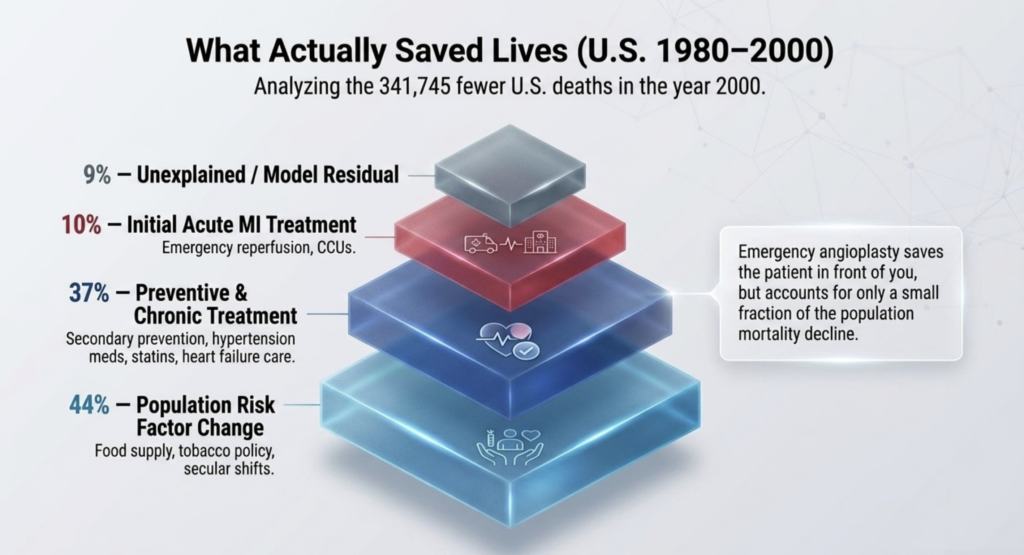
The A-versus-total-treatment comparison is far more robust than the B/C subdivision, which is not standardized across studies. For the United States specifically, the published 47% total treatment share included 10% for the initial treatment of AMI and 不安定狭心症, permitting a U.S.-specific — not universal — reclassification of approximately 44% A, 37% B, 10% C, 9% D. The 37% figure is an author reclassification derived by subtraction from Ford et al., not a published category from that paper.
図3 — 具体的分解(米国、1980年〜2000年)
Model estimate, not a randomized decomposition, and not a universal hundred-year pie chart.
A Population risk-factor change 44% ######################
B Preventive / chronic treatment* 37% ###################
C Initial acute MI / unstable angina 10% #####
D Unexplained / model residual 9% ####
* AUTHOR RECLASSIFICATION, not a published category.
B = published 47% total treatment minus the published 10%
acute-MI / unstable-angina component. It therefore includes
secondary prevention, heart-failure care, hypertension
treatment, and chronic-angina revascularization — not only
drugs that prevent a first MI.
Within the acute category, Ford and colleagues separately calculated that initial AMI treatments alone accounted for about 21,570 deaths prevented or postponed, or 6.3% of the total decline, with sensitivity bounds of 2.6–11.0%.[3] This is the single most useful corrective to the intuition that emergency angioplasty explains the population-level fall in coronary mortality. At the population level, it plainly does not — however dramatic its effect on the individual patient in front of you.
どのリスク要因が最も重要でしたか?
The same three exposures recur — cholesterol, smoking, blood pressure — but their ranking varies dramatically with local history. In the U.S. 1980–2000 model, lower total cholesterol accounted for 24% of the decline, lower 収縮期血圧 20%, lower smoking prevalence 12%, and reduced physical inactivity 5%; rising BMI and diabetes offset gains equivalent to 8% and 10% respectively. In Iceland, cholesterol, smoking, and blood pressure contributed 32%, 22%, and 22%. In England and Wales, smoking alone accounted for 48%.[4]
表 3 — 個別リスク要因の寄与
| リスク因子 | Approximate population mean shift (see note) | Approximate share of observed CHD mortality decline across major IMPACT analyses | 解釈 | 自信 |
| Population total-cholesterol reduction (reflecting, in part, lower atherogenic-lipoprotein exposure) | Substantial secular decline across U.S. and other high-income series | に関しては、 10–45%: U.S. 24%, Iceland 32%, Ireland 30.2%, Poland 39%; dominant in Sweden | One of the largest cumulative contributors, though the ranking varies by country. The share due to food environment versus medication changes markedly by era — predominantly non-statin and likely substantially related to dietary and food-supply change before the mid-1990s, increasingly pharmacological thereafter. | 中~高 |
| Smoking reduction | U.S. adult prevalence fell from roughly 42% in 1965 to roughly 12% in recent years | Roughly 9–48%: U.S. 12%, Iceland 22%, Ireland 25.6%, England/Wales 48% | Enormous heterogeneity reflecting different starting epidemics and pace of tobacco control. Causally the most secure of all the risk factors. | 高 for causality; 中程度 for exact attribution |
| Blood-pressure reduction | Mean systolic pressure declined materially in many high-income populations | Approximately 6–22%: U.S. 20%, Iceland 22%, England/Wales 9.5%, Ireland 6% | Includes secular population decline unless drug effects have been separately partitioned, as in Sweden. | 高 for causality; 中程度 for historical share |
| Physical activity / inactivity | Modest reported decline in inactivity prevalence | Typically 1–10% where modeled; U.S. 5%, Poland 10% | Self-report and secular surveillance are substantially weaker than for smoking, BP, or cholesterol. | 低~中程度 |
| Diet independent of cholesterol and BP | Not separately quantified | Not safely additive to the cholesterol and BP contributions | The Swedish decomposition assigned most of the cholesterol-mediated benefit to diet. Counting “diet” plus the cholesterol decline it caused double-counts one biological pathway. | 中程度 |
| 肥満 | Mean BMI rose substantially; U.S. adult obesity exceeded 42% by 2020 | Negative: −1.5% to −8% across models; U.S. rising BMI added burden equivalent to 8% of the decline that would otherwise have occurred | Obesity blunted the decline; it did not produce it. | 中程度 |
| 糖尿病 | U.S. diagnosed prevalence rose several-fold, exceeding 11% | Negative: −2% to −10% across models; U.S. offset equivalent to 10% | Rising diabetes prevented coronary mortality from falling considerably further. | 中~高 |
Note on the second column: these are order-of-magnitude summaries of secular change drawn from differing national series, age ranges, and periods (predominantly US and other high-income data). They are intended to convey direction and approximate scale, not to serve as pooled measurements from a single sourced dataset, and they should not be quoted as precise population values.
One observation deserves emphasis because it is decisive for the whole argument: substantial population cholesterol lowering predated widespread statin use — statins reached the market only in 1987 and were not widely used in primary prevention until the late 1990s. An important contributor appears to have been changing dietary fat composition and the food supply — the substitution of polyunsaturated and 一価不飽和脂肪酸 for saturated animal fats, and later the regulatory elimination of industrial トランス脂肪酸, beginning with Denmark in 2003 and followed by EU regulation and the U.S. FDA’s revocation of GRAS status[36]. In IMPACT models, population cholesterol reductions accounted for roughly 24–39% of the total decline across several countries; where explicitly decomposed, much of the pre-statin contribution was attributed to non-pharmacological change, while statins contributed only a few percent of the population cholesterol change up to 2000.
Similarly, a substantial share of the population-wide fall in blood pressure occurred in people not taking antihypertensive drugs. The mechanisms behind that non-pharmacological component are not securely partitioned in the literature and should not be attributed confidently to any single dietary or environmental cause.
The distinction the brief insists upon is worth restating: these are population exposures, not moral categories. Tobacco taxation, smoke-free legislation, industrial trans-fat elimination, sodium reformulation in processed food, and broader changes in food availability and composition are not “lifestyle choices.” They are policy and supply-chain interventions that changed the distribution of risk in entire populations, and they belong in the risk-factor column alongside individual behavior change.
第4部:予防:ランダム化証拠が実際に証明していること
Historical attribution asks what した happen in a population. Randomized trials answer the complementary question of what a treatment 缶 cause in the patients who receive it. These are different questions and must never be conflated. A drug can be enormously effective for the individual patient and still explain almost none of a historical mortality decline, simply because it was not yet available when the decline occurred.
血圧降下
The Blood Pressure Lowering Treatment Trialists’ Collaboration pooled individual participant data from 344,716 participants in 48 randomized trials. For every 5 mmHg reduction in systolic pressure, major cardiovascular events fell by about 10%: ハザード比 0.91 (95% CI 0.89–0.94) in participants without prior 心血管疾患 そして 0.89 (0.86–0.92) in those with previous disease. Benefit was present across baseline blood-pressure strata, including in people whose pressure was not conventionally “hypertensive” [37] (ティア1). Component estimates from this and related BPLTTC work indicate reductions of roughly 13% for stroke, 7% for ischemic heart disease, 14% for heart failure, and 5% for cardiovascular death per 5 mmHg.
This gives causal interpretation to the historical association. Some of the mortality gain assigned to “blood-pressure change” in attribution models genuinely was medicine; some was secular population shift. Sweden is valuable precisely because it attempted to separate the two.
LDLおよびアポリポ蛋白Bの低下
The Scandinavian Simvastatin Survival Study (4S, 1994) opened the era, reducing 全因死亡率 by 30% and coronary mortality by 42% in patients with established coronary disease[20] — a landmark demonstration that statin-mediated cholesterol lowering prolonged life rather than merely altering a laboratory value.
The Cholesterol Treatment Trialists’ Collaboration then made the relationship quantitative. Across 26 trials and approximately 170,000 participants, each 1.0 mmol/L (38.7 mg/dL) reduction in LDL-C produced a 22% reduction in major vascular events (RR 0.78, 95% CI 0.76–0.80), 、 20% reduction in coronary mortality (RR 0.80, 99% CI 0.74–0.87), and a 10% reduction in all-cause mortality (RR 0.90, 95% CI 0.87–0.93) — the last driven entirely by vascular deaths, with no excess of cancer or non-vascular mortality.[31] In the individual-participant メタ分析 の 27 randomized trials focused on lower-risk participants, the rate ratio for major vascular events was 0.79 (95% CI 0.77–0.81) per 1.0 mmol/L; among participants without previous vascular disease, vascular mortality fell with RR 0.85 (0.77–0.95) and all-cause mortality with RR 0.91 (0.85–0.97) per 1 mmol/L [38] (ティア1). Proportional benefit is remarkably consistent across baseline risk, age, and sex, and no lower threshold for benefit has been demonstrated within the ranges tested in randomized trials.
Non-statin trials confirm that the benefit tracks the magnitude of LDL lowering rather than representing an idiosyncratic statin property. In IMPROVE-IT, adding ezetimibe after 急性冠症候群 lowered the seven-year composite event rate from 34.7% to 32.7%, HR 0.936 (95% CI 0.89–0.99) [39]. In フーリエ, エボロクマブ lowered the primary composite from 11.3% to 9.8%, HR 0.85 (0.79–0.92), and cardiovascular death/MI/stroke from 7.4% to 5.9%, HR 0.80 (0.73–0.88) [40]. In オデッセイ OUTCOMES, アリロクマブ after ACS reduced 主要心血管イベント からの 11.1% to 9.5%, HR 0.85 (0.78–0.93) [41]. All are ティア1.
This is where the chronology matters most. These therapies are among the most important tools in contemporary practice, and they cannot retrospectively receive credit for a decline that began decades before they existed. The Icelandic model, covering 1981–2006, assigned only 0.5% of the historical mortality decline to statin treatment while assigning 32% to falling cholesterol overall[7] — because during most of that window the population cholesterol decline was largely non-pharmacological and plausibly substantially related to dietary and food-supply change. The correct reading is not that statins are unimportant; it is that statins are important 今, and were largely absent then. Any analysis that credits statins with the twentieth-century decline has the arrow of time pointing the wrong way.
抗血小板療法と二次予防バンドル
ISIS-2 remains one of the cleanest results in cardiovascular medicine. Among 17,187 patients with suspected acute MI, streptokinase alone reduced five-week vascular mortality from 12.0% to 9.2%; aspirin alone from 11.8% to 9.4%; and the combination from approximately 13.2% to 8.0%, an odds reduction of about 42% [18] (ティア1). That a drug costing pennies produced a mortality benefit of that magnitude remains a useful check on therapeutic enthusiasm for expensive alternatives.
For chronic use, the Antithrombotic Trialists’ Collaboration drew the decisive distinction between prevention settings. In 二次予防, aspirin reduced serious vascular events by 19% (6.7% versus 8.2% per year), with absolute benefit substantially exceeding bleeding risk. In 一次予防, the reduction was only 12% in major vascular events (0.51% versus 0.57% per year), driven entirely by non-fatal MI, with no significant effect on vascular mortality and offset by roughly a 42% increase in major gastrointestinal and extracranial bleeding[42]. This is why contemporary guidelines have retreated from routine primary-prevention aspirin — a rare example of the evidence base narrowing rather than expanding an indication.
Combined guideline-directed secondary prevention — antiplatelet agent, statin, ACE inhibitor or ARB, and beta-blocker — is estimated in attribution models to produce a substantial cumulative relative risk reduction when components are combined multiplicatively rather than additively. Published composite figures should be treated as modeled estimates that pool heterogeneous endpoints and trial eras rather than as a measured quantity. Real-world adherence to multi-drug regimens declines materially over the years after discharge, which is the rationale for the polypill.
At the population level, the secondary-prevention bundle made a substantial contribution. In the United States, therapies given after MI or revascularization accounted for approximately 11% of the entire 1980–2000 fall in CHD deaths — more than initial acute-MI treatment alone. Modern trials of fixed-dose combination therapy confirm the bundle’s value and demonstrate the importance of adherence as a major modifiable constraint: the SECURE trial of a post-MI polypill (aspirin, ramipril, アトルバスタチン) reduced the primary composite by 24% (HR 0.76, 95% CI 0.60–0.96) and cardiovascular death by 33% (HR 0.67, 0.47–0.97) [43]
表4 — 主な医学の進歩
| 介入 | Adoption / evidence era | Effect on MI incidence | Effect on MI mortality | Evidence and identifier |
| Antihypertensive therapy | Effective from 1960s; widespread from 1970s | Strong prevention: ~9–11% lower major CV-event risk per 5 mmHg SBP reduction | Reduces fatal and non-fatal vascular events; substantial historical population contribution | ティア1 RCT meta-analysis. DOI 10.1016/S0140-6736(21)00590-0; PMID 33933205[37] |
| スタチン | Introduced 1987; outcome evidence 1994; mass adoption late 1990s–2000s | Strong prevention: RR 0.79 (0.77–0.81) major vascular events per 1 mmol/L LDL reduction; ~22% per mmol/L across the full programme | Vascular and all-cause mortality benefit in appropriate populations | ティア1 IPD meta-analysis. DOI 10.1016/S0140-6736(12)60367-5; PMID 22607822[38] |
| エゼチミブ | Outcome evidence 2015 | Incremental prevention after ACS: 34.7%→32.7% composite at 7 years | Composite benefit; not primarily a mortality result | ティア1. DOI 10.1056/NEJMoa1410489; PMID 26039521[39] |
| PCSK9 inhibition | Outcome evidence 2017–2018 | FOURIER HR 0.85; ODYSSEY HR 0.85 after ACS | Strong event prevention; mortality effect depends on population and follow-up duration | ティア1. PMID 28304224; DOI 10.1056/NEJMoa1801174[40] |
| Aspirin (acute and secondary prevention) | Definitive 1988 | Reduces recurrent ischemic events; broad primary prevention limited by bleeding | ISIS-2: aspirin reduced acute vascular death odds ~23%; with streptokinase ~42% | ティア1. PMID 2899772[18] |
| Aspirin (primary prevention) | Reassessed 2009–2019 | Only 12% reduction in major vascular events, driven by non-fatal MI | No significant vascular mortality effect; offset by ~42% more major bleeds | ティア1, Antithrombotic Trialists’ Collaboration, ランセット 2009[42] |
| Beta-blockers, ACE inhibitors / ARBs | 1980s / 1990s | Modest effect on incidence | Historical post-MI and HFrEF mortality benefit established in randomized trials and meta-analysis; contemporary long-term post-MI indications depend on LV function and other indications | ティア1[44,45,46] |
| 血栓溶解療法 | 1986–1990s | なし — reopens an artery after the event has begun | ~30 fewer deaths per 1,000 treated within 0–6 h; ~20 per 1,000 at 7–12 h in eligible ST-elevation/BBB patients | ティア1, Fibrinolytic Therapy Trialists; PMID 7905143[47] |
| Primary PCI for STEMI | 1990s onward | なし on first events; reduces reinfarction versus lysis | 23-trial synthesis: short-term death 7% vs 9%; reinfarction 3% vs 7%; stroke 1% vs 2% | ティア1. DOI 10.1016/S0140-6736(03)12113-7; PMID 12517460[21] |
| CCU / telemetry / defibrillation | Early 1960s onward | なし | Historical hospital mortality 30%→15%; one randomized comparison 15.3% vs 29.3% (RR for general ward 2.3, 95% CI 1.1–4.8)[13] | ティア2 (single small RCT)[13] plus Tier 5 historical series[14] |
| Public-access AED | 1990s–2000s | なし | PAD trial: 30 survivors of 128 definite arrests with CPR+AED versus 15 of 107 with CPR alone | ティア1. DOI 10.1056/NEJMoa040566[48] |
| CABG | 1968 onward; trials 1972–1984 | Reduces spontaneous MI in selected anatomy | Survival benefit concentrated in left main and three-vessel disease; little or none in one- to two-vessel disease | ティア1, Yusuf et al.[19] ランセット 1994[19] |
| PCI for stable coronary disease | 1980s onward | No general population preventive role | 虚血: no reduction in ischemic events or all-cause death over median 3.2 years; death HR 1.05 (0.83–1.32) | ティア1. DOI 10.1056/NEJMoa1915922; PMID 32227755[49] |
| GLP-1受容体作動薬 | Outcome evidence 2016–2023 | Prevention in obesity なし diabetes (SELECT): MACE 6.5% vs 8.0%, HR 0.80 (0.72–0.90); separate CV outcome evidence exists in type 2 diabetes | Reduces MACE; SELECT did ではない establish a statistically significant reduction in cardiovascular death alone (2.5% vs 3.0%, HR 0.85, 95% CI 0.71–1.01) | ティア1. NEJM 2023; DOI 10.1056/NEJMoa2307563[50] |
| コルヒチン | Outcome evidence 2019–2020 | Reduces recurrent events in established disease | COLCOT reduced its primary composite by ~23% (HR 0.77, 95% CI 0.61–0.96)[51]; LoDoCo2 by ~31% (HR 0.69)[52] | ティア1, but CLEAR SYNERGY/OASIS-9 was neutral (HR 0.99, 95% CI 0.85–1.16)[53] |
第5部 救出:心臓発作が死刑宣告でなくなった理由
予防と救助を分かつ方程式
At population level:
CHD mortality ≈ coronary-event incidence × case fatality
with additional contributions from recurrent events, out-of-hospital sudden death, competing risks, and coding. This is the equation that makes the central question answerable. If mortality falls and incidence is flat, the gain came from rescue. If mortality falls and case fatality is flat, the gain came from prevention. Usually both moved.
その WHO MONICAプロジェクト exploited exactly this across 37 populations in 21 countries over approximately 1983–1993, with standardized coronary-event ascertainment — an extraordinary logistical achievement that has never been repeated at that scale. The central finding was that, in populations where mortality declined, approximately two-thirds of the fall was attributable to declining coronary-event rates and about one-third to improving case fatality, with substantial variation by country and sex [9] (ティア3). A companion analysis linked improvements in coronary care and secondary prevention directly to falling case fatality: for a common 20-point change in treatment score, case fatality fell about 19% in men and 16% in women, event rates about 25% and 23%, and coronary mortality about 42% and 34%.[54]
Because the MONICA age range was principally 25–64, these proportions should not be projected mechanically onto contemporary older populations, in whom the balance may differ.
表5 — 時代別の急性心筋梗塞生存率
ILLUSTRATIVE HISTORICAL RANGES — NOT DIRECTLY COMPARABLE. This table is a schematic historical synthesis, not a single sourced dataset. これらの層は、70年にわたる不均一なコホート、診断基準、および人口から構成されており、そのため各年代の数値は、直接比較可能な測定値というよりも指標としての意味合いが強いものです。時代を超えた比較は慎重に解釈されなければなりません。なぜなら、現代の高感度トロポニンは、以前の時代なら決してカウントされなかったであろう小さな梗塞を捉えるためであり、それ自体が測定される致死率を低下させるからです。下のパネルにある個々のソース別コホートが証拠としての重みを持ち、年代別の層は読者の目安となるものです。
| 時代 | 院内致死率 | 28日/30日致死率 | 早期死亡の主な様式 | 治療環境 |
| CCU以前、1950–1961年 | ~30% | ~40% | 突然の原発性心室細動 | 厳格な安静、モルヒネ、酸素 |
| 初期のCCU、1962–1975年 | ~15% | ~25% | 心原性ショック、進行性ポンプ不全 | 持続的テレメトリー、DC除細動、リドカイン |
| 早期再灌流、1976–1989年 | ~10% | ~15–20% | 心原性ショック、遊離壁破裂 | 静注血栓溶解療法、急性期経口アスピリン、ベータ遮断薬 |
| プライマリPCIおよびステント、1990–2009年 | ~5–7% | ~10% | 心原性ショック、多臓器不全 | プライマリPCI(Door-to-Balloon時間 <90分)、DAPT、ACE阻害 |
| 現代のネットワーク、2010–2026年 | ~4–6% | ~7–9% | 非心臓性の併存疾患、難治性ショック | 橈骨動脈アプローチ優先のPPCI、選択的な補助循環、強力なP2Y12阻害薬、ガイドラインに基づいた二次予防 |
地域および集団データの裏付け
| ソース | 所見 |
| ウスター心臓発作研究、1975–2005年 | 初回AMI後の院内生存率は改善した 81% (1975) から 91% (2005) へ — すなわち、特定の施設ではなく地域全体で、院内死亡が約19%から9%に減少した[55]。年齢調整後の院内致死率は、同じ地域においてすでに 22.2% (1975) から 15.1% (1984) へ 低下していた[56] |
| フレイミングハム研究、1960年代→1990年代 | 30日粗致死率は 20%→14%、30日・1年・5年それぞれの年齢・性別調整後の致死率は約60% 低下 |
| ARIC研究、1987–2008年 | 28日致死率は、2.6–3.6% per year 性別/人種グループに応じて~低下 |
| 宮城(日本)、1979→2008年 | 年齢調整後の院内死亡率 20.0%→7.8% — 一方で発生率は バラ |
| CCUのランダム化比較[13] | 15.3% (17/111、CCU) vs 29.3% (27/92、一般病棟); 一般病棟での死亡の相対リスク 2.3 (95% CI 1.1–4.8) |
さらに大きな進歩は SHOCK試験,[57] によってもたらされた。これは、初期の内科的安定化と比較して、早期の血行再建による長期的な生存利益を示したものであるが、その主要な30日死亡率の比較では統計的有意性に達しなかった。この試験は、冠動脈疾患集中治療室(CCU)が不整脈の問題をほぼ解決した後、院内死亡の主な原因として心室細動に代わって現れた失敗モード(病態)に対処したものである。
因果的視点における介入
冠動脈疾患集中治療室 (CCU) は、発症後数時間で人々を死に至らしめていた病態、すなわち心室細動を攻撃した。それは薬物を必要とせず、継続的な観察と室内への除細動器の設置のみを必要とした。そのエビデンスベースは妥当性の高さに比べれば弱いが、経時的な変化を示すシグナルは大きく、一貫している。
CPR(心肺蘇生)と公衆アクセス除細動(PAD) は、病院外で同様の病態を攻撃する。そこではほとんどの 心臓突然死 が発生する。ランダム化公衆アクセス除細動試験(Public Access Defibrillation Trial)では、CPRのみの地域の 確定した128例のうち30例の院内生存者 心停止 が CPR と AED 訓練を割り当てられた地域で見られたのに対し、 107 例中 15 例 であった [48] (ティア1)。これは病院の統計には現れない種類の利益である。なぜなら、関係する患者は以前なら病院に到着する前に死亡していたはずだからである。そして、これは基礎となる動脈硬化性事象の発生率を減らすことなく、冠動脈疾患による死亡率を低下させる。
線維素溶解 は、真の死亡率のブレイクスルーであった。約58,600名のランダム化された患者を対象としたFibrinolytic Therapy Trialistsの概要では、 1,000人あたり30人少ない死亡 という絶対的な利益が、発症後6時間以内の治療開始で見られ、7~12時間では 1,000人あたり20人 であった。これはST上昇または脚ブロックがある患者においてであり、それらがない患者では利益はなく、むしろ害がある可能性があった [47]。35日死亡率の相対的な減少は約18%であった。
Primary PCI then improved on fibrinolysis. Keeley and colleagues’ meta-analysis of 23 trials and 7,739 patients found short-term mortality of 7% with primary angioplasty versus 9% with thrombolysis, reinfarction 3% versus 7%, stroke 1% versus 2%, and the composite of death, reinfarction, or stroke 8% versus 14% [21]
Emergency medical systems, prehospital ECG, and STEMI networks are not treatments but the delivery mechanism that determines whether the treatments arrive in time. Their contribution is real and largely invisible to attribution models, because it is embedded in the observed case-fatality improvement rather than appearing as a separate line item.
日本:決定的な反例
Any claim that falling coronary mortality necessarily means fewer heart attacks is refuted by Japan. In the MIYAGI-AMI registry of 22,551 patients, age-adjusted acute MI incidence rose from 7.4 to 27.0 per 100,000 between 1979 and 2008, while age-adjusted in-hospital mortality fell from 20.0% to 7.8% as ambulance use and primary PCI expanded [58]. The registry also reported markedly higher 2008 mortality in women than men — 12.2% versus 6.3% — a sex disparity also reported in other populations, including contemporary U.S. data in young adults.[59]
The Akita–Osaka study[60] similarly found heterogeneous long-term Japanese trends, with age-adjusted MI incidence in urban men rising from 45 per 100,000 in 1964–1971 to 90 per 100,000 in 1996–2003, alongside worsening cholesterol and BMI but declining smoking. Western trajectories are not universal, and a country can achieve dramatic survival gains while losing ground on prevention.
第VI部:血行再建術:1つの名称を持つ3つの異なる手術
“Revascularization” is not a single causal category, and treating it as one is among the most common analytic errors in this literature.
Primary PCI for ST-elevation infarction is emergency reperfusion of an occluded artery in a patient who is currently infarcting. It saves lives, as above.
CABG in selected anatomy prolongs life. Two distinct evidence bases should not be merged. On coronary anatomy, CASS and the Veterans Administration Cooperative Study supported survival benefit in left main 狭窄 and three-vessel disease with proximal LAD involvement. On ischemic 心筋症 with severe left ventricular dysfunction — a different population defined by ventricular function rather than anatomy — STICH and its extended follow-up demonstrated a long-term survival benefit from surgical revascularization added to medical therapy.[61] FREEDOM subsequently showed that in diabetic multivessel disease, CABG reduced death and MI compared with stenting.[62] Yusuf’s meta-analysis of seven randomized trials and 2,649 patients from 1972–1984 found the survival benefit concentrated in left main disease (five-year odds ratio 0.32) そして three-vessel disease (OR 0.58), with little or no benefit in one- to two-vessel disease, and an overall absolute survival advantage of roughly 4% at ten years.[19]
Elective PCI for stable coronary disease is predominantly a symptom-relief procedure. COURAGE (2007) found no reduction in death or MI versus optimal medical therapy.[63] ORBITA, using a sham-controlled design, found a far smaller symptomatic effect than expected.[64] 虚血 — the largest and most definitive trial — randomized patients with moderate or severe ischemia and found five-year primary-outcome estimates of 16.4% versus 18.2% for invasive versus conservative strategies, a difference of −1.8 percentage points (95% CI −4.7 to 1.0), with all-cause death HR 1.05 (0.83–1.32) [49] ISCHEMIA-EXTEND, at a median 5.7 years, showed no all-cause mortality difference, with a modest reduction in cardiovascular death offset by an increase in non-cardiovascular death.[65]
Across IMPACT models, CABG in chronic and post-MI cohorts accounted for roughly 3–5% of the total CHD mortality decline, while elective PCI in stable disease contributed on the order of 1–2%.
This explains an otherwise puzzling finding: despite an enormous growth in procedure volume, revascularization for chronic angina accounted for only about 5% of the U.S. 1980–2000 CHD mortality decline in the IMPACT model. Much of the growth in procedure volume occurred in settings where a population survival benefit was not established.
表6 — 予防対レスキュー
| 介入 | Prevents first MI? | Prevents recurrent MI? | Reduces death during/after MI? | Primary historical role |
| Tobacco control and smoking cessation | はい | はい | Indirectly | Population prevention |
| Lower population LDL/ApoB via food supply and diet | はい | はい | Indirectly | Population prevention |
| Salt reduction / salt substitution | はい (via BP) | はい | Indirectly | Population prevention |
| Statins and intensive LDL lowering | はい in appropriate primary prevention | Yes, strongly | Yes, via fewer events | Preventive / chronic medicine |
| Antihypertensive therapy | はい | はい | Yes, via fewer vascular events | Preventive / chronic medicine |
| GLP-1受容体作動薬 | Reduces MACE in selected high-risk obesity/T2D populations | はい | Indirectly | Preventive / cardiometabolic |
| アスピリン | Limited by bleeding; not universally indicated | はい | Yes in acute MI | Secondary prevention plus acute therapy |
| Cardiac rehabilitation and comprehensive secondary prevention | No effect on an event already occurring | はい | Improves subsequent prognosis | 二次予防 |
| CCU and telemetry | いいえ | Not directly | はい | Acute rescue |
| CPR, AED, defibrillation | いいえ | いいえ | Yes, dramatically in shockable arrest | Emergency rescue |
| EMS, prehospital ECG, STEMI networks | いいえ | Not directly | Yes, by reducing treatment delay | Health system / acute rescue |
| 血栓溶解療法 | いいえ | Reduces acute reinfarction consequences | はい | Reperfusion rescue |
| Primary PCI for STEMI | いいえ | 血栓溶解療法と比較して再梗塞を減少させる | はい | 急性期再灌流 |
| 安定冠動脈疾患に対する待機的PCI | 集団レベルでの役割は証明されていない | 強力な医学的予防の代わりにはならない | 良好な薬物療法と比較して明らかな生存率の優位性はない | 症状の緩和;特定の解剖学的特徴 |
| CABG | 集団における初回心筋梗塞の予防ではない | 特定の高リスクな解剖学的特徴において予後を改善する | 特定の疾患において有用;症状緩和も | 慢性疾患の血行再建術 |
| トロポニンと診断の向上 | 生物学的な予防効果はない | 治療の標的化を可能にする | 間接的にケアを改善する可能性がある | 診断;また 測定される変化 発症率と致死率 |
第7部:反実仮想と救われた命
現代の人口がもし昔の医療ケア――あるいは昔の危険因子を持っていたらどうなるだろうか?
いずれの問いもランダム化されたことはなく、正確に答えることもできない。最も妥当な計算は、絶対数を独自に報告している米国IMPACTモデルによるものである。以下に示すのは、 その帰属モデルから導き出された算術的な反事実的シミュレーションであり、 — モデル化された予防または延期された死亡数を、観察された死亡数に加算したものである。これは例示的な再構成であり、介入を中止した場合に何が起こるかについての検証済みのシミュレーションではない。
現代の危険因子、1980年代当時の治療。 2000年にモデル化された年齢層で観察された冠動脈疾患による死亡数は約337,658人であった。1980年以降の治療改善による推定利益を除外すると、およそ 159,330人の死亡が加わり、約 496,988 — 約 観察された数値より47%多くなる一方、モデル化された危険因子の改善は維持される。
現代の治療、1980年代当時の危険因子。 2000年の治療は維持しつつ、1980年から2000年にかけてモデル化された危険因子の改善を逆転させると、約 149,635人の死亡が加わり、およそ 487,293 — 約 観察された数値より44%多くなる。.
2つの注意点がある。第一に、これらは 1980年の医療と1980年のリスクに基づいた反事実的シミュレーションであり、1950年代のものではない。20世紀半ばの医療には、冠疾患集中治療室、現代の除細動システム、血栓溶解療法、PCI、スタチン、そして事実上すべてのエビデンスに基づく二次予防が欠けていたため、真の1950年代の反事実的シミュレーションはかなり悪い結果になるだろう。しかし、特定の数値を裏付ける検証済みのモデルは存在せず、過去に遡って外挿することは捏造に近いものとなる。同様に、1950年代の実際の喫煙、コレステロール、血圧の分布を復元すれば、1980年から2000年の変化のみを逆転させるよりも大きな影響が出るだろう。
第二に、そしてより興味深いことに、 2つの反事実的シミュレーションはほぼ対称的である。1980年から2000年の米国において、現代の治療による利益または良好な危険因子の改善による利益のいずれかを除外したとしても、進歩のかなりの部分が失われていただろう。この対称性は、「医療かライフスタイルか」という枠組み全体に対する強力な反論となる。双方が同等に大きな貢献をしており、歴史を 「医療か」 「医療」 または 「危険因子の変化」のどちらか一方として提示することは誤解を招く。どちらか一方の経路だけでは失敗していたということを意味するものではない。それぞれ単独でも大幅な死亡率減少をもたらしたであろう。
何人の命が救われましたか?
科学的に正当化できる用語は、 「予防または延期された死亡」である。なぜなら、ある年に冠動脈疾患による死亡を回避した人が、具体的に何年の余命を得たかを確定できるモデルは存在しないからである。
米国の3つの時点における反事実的シミュレーションがその規模を示している。
- もし1980年の年齢別冠動脈疾患死亡率が2000年の人口構成においても持続していたとしたら、その単年だけでさらに 341,745人の冠動脈疾患死亡者がその年に出ていたはずである。これらのうち、約 159,330 が治療に起因し、 149,635 が危険因子の変化に起因するとされた。モデルは観察された差異の約90%を説明した。
- もし 1963米国の冠動脈疾患死亡率のピークが持続していたとしたら、およそ 1994年の死亡者数は約482,000人ではなく107万6,000人になっていたであろう — 約 その年だけで594,000人の死亡が回避または延期されたことになる.
- CDCの歴史的分析でも同様に、約 1996年の冠動脈疾患死亡者数が、 1963年のピーク時の率が持続していた場合よりも621,000人少なかったと推定されている。
The decline in cardiovascular mortality also contributed materially to gains in adult longevity: cardiovascular disease was the dominant cause of adult death, and its retreat is among the largest contributors to twentieth-century adult survival gains in high-income countries. This review does not estimate a global cumulative number of deaths prevented, nor a specific number of life-years gained, because it cites no dedicated demographic decomposition capable of supporting such a figure. The aggregate global “deaths prevented” figure is far softer, depends entirely on the counterfactual baseline chosen, and should not be quoted as a precise number without independent verification.
These figures must not simply be summed across years to produce a cumulative count of unique people saved. The same individual can have death postponed across many counterfactual years; the population’s age structure changes; competing non-coronary mortality changes; and the baseline rate is itself a counterfactual. A rigorous century-long cumulative “lives saved” total is therefore unspecified rather than falsely precise. What can be said is that single-year estimates against the 1963 peak-rate counterfactual are of the order of half a million to six hundred thousand deaths prevented or postponed in the mid-1990s — a scale of benefit with few parallels in the history of medicine. No verified continuous annual series exists across the following three decades, and none is asserted here.
第8部 国際的な自然実験
Attribution models are inference. Natural experiments — where a population’s risk factors changed sharply and mortality followed — provide stronger triangulating evidence, although they remain non-randomized and potentially confounded by concurrent secular change.
フィンランドと北カレリア
The Finnish experience is one of the most informative population-level natural experiments in the field, because the risk-factor changes were deliberately engineered, documented prospectively, and preceded the mortality change.
In the early 1970s, North Karelia recorded among the highest coronary mortality rates then documented anywhere, particularly among middle-aged working-age men in eastern Finland. A community-based program launched in 1972 — working through village organizations, schools, food producers, dairy cooperatives, and eventually national legislation — systematically reduced smoking, 飽和脂肪酸 intake, and blood pressure. Working-age male coronary mortality in eastern Finland fell from 643 to 118 per 100,000 between the early 1970s and 2012 (−82%), and female mortality from 114 to 17 (−84%).[66]
The within-community analyses estimated that observed reductions in the three classical risk factors predicted the great majority of the first-period decline in ischemic heart disease incidence in North Karelia — far more than in the reference area[35] — evidence about incidence, not merely mortality, and therefore evidence about prevention rather than rescue.[67] Even in the later decades of follow-up, the three classical risk factors continued to explain a substantial share of the ongoing decline. The national Finnish IMPACT analysis nevertheless assigned treatment a meaningful 23% share for 1982–1997[5], demonstrating once again that this is not an either/or.
アイスランド
Iceland offers the cleanest quantitative demonstration that fewer events, not merely better survival, drove the mortality fall: coronary mortality fell 80% and MI incidence fell 66% between 1981 and 2006. The model attributed 73% of the mortality decline to risk-factor change and 25% to treatment, with cholesterol contributing 32%, smoking 22%, and systolic blood pressure 22%.[7] Within the treatment share: secondary prevention 8%, heart-failure treatment 6%, acute coronary syndrome treatment 5%, revascularization 3%, hypertension treatment 2%, and statins 0.5%.
スウェーデン
Coronary mortality fell approximately 53% in men and 52% in women from 1986–2002, with 55% attributed to risk-factor reduction and 36% to treatment.[6] The detailed follow-up analysis provides the field’s best worked example of separating diet from pharmacology within a single risk factor, and established that roughly three-quarters of the risk-factor-attributable benefit occurred in people なし diagnosed coronary disease.
イングランドおよびウェールズ
The 1981–2000 decline was 62% in men and 45% in women aged 25–84, with treatment explaining 42% and risk-factor change 58%.[4] The distinguishing feature is that smoking reduction alone accounted for 48% of the modeled decline — a reminder that where a population’s dominant exposure is unusually severe, its reversal dominates everything else. Acute MI treatment contributed about 8%.
アメリカ合衆国
The most complete accounting, and the one with absolute numbers, as described above: 44% risk factors, 47% treatment, ~9% unexplained, 341,745 deaths prevented or postponed in the year 2000 alone.
ポーランド:食料供給における偶発的な国家的実験
Poland provides a particularly informative natural experiment bearing on the dietary hypothesis, because the change was economic rather than medical and was not primarily initiated as a cardiovascular health-service intervention. It was emphatically not a controlled test: the post-communist transition changed incomes, employment, healthcare, and much else simultaneously. After the 1991 economic transition, consumer subsidies on butter and lard were removed while trade liberalization made imported rapeseed and soybean oils cheap and available. Within roughly three years, animal fat consumption fell about 20%, vegetable oil consumption doubled, and fruit and vegetable intake rose.
Between 1991 and 2005, age-adjusted coronary mortality in Poland fell 54%, corresponding to approximately 26,200 deaths avoided in 2005. The Polish IMPACT model attributed roughly 54% of the decline to dietary fat substitution and increased physical activity, and 37% to medical therapy [33] Poland matters because the change in exposure was abrupt, externally imposed, not designed as a health-service intervention, and followed by a mortality change of the predicted direction and magnitude.
ロシアとポスト・ソ連の急増:逆回転した実験
The dissolution of the Soviet Union produced the mirror image. Economic collapse, social disruption, hazardous binge consumption of high-proof spirits, and the breakdown of routine chronic disease care were followed by a very large increase in cardiovascular mortality during the 1990s in the Russian Federation, with reported increases of roughly 35–45%.[68] Comparable directional deterioration occurred in several neighboring post-Soviet states, though the precise magnitude there requires country-specific sources.
This provides especially compelling evidence that the century’s gains are not automatic, irreversible, or purely technological. A population with essentially unchanged medical knowledge lost decades of cardiovascular progress in under ten years because its social and behavioral conditions deteriorated. Any account that treats the coronary decline as a ratchet driven by accumulating medical capability cannot explain Russia.
オランダ
Coronary mortality fell 48% between 1997 and 2007 (269 to 141 per 100,000), with approximately 37% attributed to treatment and 36% to risk-factor change — notable for systolic blood pressure dominating the risk-factor share at about 30%. The model explained roughly 72% of the observed decline, leaving an unusually large residual.[34]
日本
Discussed above: rising incidence, sharply falling case fatality. Japan also illustrates the limits of extrapolating Western attribution percentages to populations with different baseline diets, lipid distributions, and stroke-versus-coronary disease balance.
グローバルな乖離
The high-income experience is not the world’s experience. While high-income countries recorded large declines in age-standardized cardiovascular mortality in recent decades, the picture elsewhere is heterogeneous by GBD region rather than a simple high-income/low-income binary. Many countries have seen rising absolute 年齢標準化率は低下したものの、人口増加と高齢化により心血管疾患の負担が増加した。一部の地域では、都市化、タバコ、加工食品の普及、予防および急性期治療へのアクセスの制限により、年齢標準化率も停滞または上昇している。[24] 世界的な冠動脈疾患の流行は一律に終息しているわけではなく、世界の多くの地域において、絶対数で見れば依然として増加傾向にある。
表 7 — 心血管疫学における自然実験
| 地域 / 背景 | 期間 | 構造的要因 | 死亡率の動向 | 特定された主な要因 |
| 北カレリアおよびフィンランド | 1972–2012 | 計画的な地域介入、乳脂肪から植物油への置き換え、減塩 | >80%の低下 (現役世代のCHD死亡率において) | コレステロール低下が支配的、禁煙、血圧管理 |
| ポーランド | 1991–2005 | 動物性脂肪への補助金撤廃、輸入植物油 | −54% | 飽和脂肪から多価不飽和脂肪酸(PUFA)への置き換え、身体活動の増加 |
| アイスランド | 1981–2006 | 近代化、国民皆保険、タバコおよび食事政策 | −80%;発症率 −66% | コレステロール -32%、喫煙 -22%、収縮期血圧(SBP) -22%、治療 25% |
| ロシア連邦 | 1990–1998 | 社会経済的崩壊、慢性期治療の混乱 | +35%から+45%の増加 | 有害な アルコール 使用、社会経済的混乱、保健システムの悪化 |
| 日本(宮城) | 1979–2008 | 急速に近代化する急性期治療と、欧米化するリスクプロファイル | 発症率 +265%;院内死亡率 -61% | 救急救命は改善したが、予防は悪化した |
| 世界的な地域格差 | 1990–2026 | リスク転換と保健システム能力の乖離 | 高所得地域では年齢標準化率が大幅に低下、その他の地域では不均一であり、ほとんどの地域で絶対的な負担が増加している | 予防およびガイドラインに基づいた治療の普及 vs 都市化、タバコ、加工食品。GBD地域別推計を参照してください[24] |
第9部:失速と、取り残された者たち
正直な説明には、3つの不都合な見解が含まれる。
進歩は鈍化しており、場所によっては逆行している。 米国および英国における冠動脈疾患死亡率の低下速度は、おおよそ2011年以降、顕著に鈍化した。55歳未満の成人(特に女性)では、横ばいまたは上昇が見られる。Wilmotらは、2011年までの若年成人における停滞を記録している。[22] また、18歳から54歳の米国の成人における初回急性心筋梗塞による入院945,977件を対象とした2026年の分析では、調整後の 院内 初回STEMI後の死亡率が、 バラ 2011年から2022年の間に絶対値で1.2パーセントポイント増加した。一方で、初回NSTEMIの死亡率は実質的に変化がなかった。[59] 若年女性は若年男性よりも予後が悪く(STEMI 3.1% vs 2.6%、NSTEMI 1.0% vs 0.8%)、非伝統的なリスク要因(低所得、 腎臓病、タバコ以外の薬物使用など)は、伝統的な要因よりも死亡とより強く関連していた。これは入院患者の致死率を測定したものであり、人口全体の死亡率ではないことに注意されたい。 この院内STEMI死亡率の悪化の原因は確定していない。研究自体では、伝統的な要因よりも非伝統的な要因の方が死亡との関連が強いことが判明した。人口レベルでは、肥満と2型糖尿病が依然として長期的な冠動脈疾患の進展に対する大きな阻害要因となっており、多くの主要な帰属モデルは1990年代以降、これらを負の寄与として指摘しているが、これらが若年成人の院内STEMI死亡率の特異な上昇を説明すると決めつけるべきではない。
米国では高血圧の管理が悪化している。 従来の <140/90 mmHg という閾値を用いると、米国の高血圧成人の管理率は2013年から2014年頃にピークに達し、約 53.8% であったが、その後 2017年から2018年までに43.7%に低下した.[25] より厳格な2017年ACC/AHAの定義(<130/80 mmHg)では、わずか 20.7% の米国の高血圧成人のみが2021年8月から2023年8月の間に管理されており、2017年から2020年3月までと比較して有意な変化はなかった。[69] 閾値と分母は常に明記されなければならない。なぜなら、これらの数値は互換性がないからである。これは、世界で最も大きな人口寄与心血管リスクの一つにおいて、数十年にわたる改善が逆転したことを意味している。[24] これは実質的に、効果的な治療法の欠如というよりも、実施および保健システムの失敗であり、社会経済的、測定、および生物学的要因も寄与しているものの、回復可能である。
The gains have not been shared equally. ARIC found incident MI declining at only 1.5% per year in Black men versus 3.4–4.3% in other groups over 1987–2008.[29] The Miyagi registry found in-hospital mortality of 12.2% in women versus 6.3% in men in 2008.[58] Socioeconomic and geographic gradients in coronary mortality persist and in several countries have widened, even as national averages improved. A national average that improves while a subgroup stagnates is a partial success being reported as a complete one.
Globally, GBD identifies high systolic blood pressure, dietary risk, high LDLコレステロール, and air pollution among the largest contributors to cardiovascular burden, while high BMI and 高血糖 have worsened.[24] In much of the world, the coronary epidemic is not in retreat at all — it is in its ascending phase, in countries with far less capacity to deploy either prevention or rescue.
パートX. その次に来るもの:現在よりもうまくやるために
The last hundred years were won with tobacco control, the food supply, blood pressure, cholesterol, and the emergency reperfusion of occluded arteries. Future progress cannot rely solely on repeating those strategies — though substantial gains remain available from implementing them better, particularly outside high-income countries.
One structural fact should govern planning. The marginal population gains available from further reducing already-low in-hospital STEMI mortality are likely smaller than those available from prevention. With in-hospital STEMI case fatality compressed to roughly 4–7%, even halving it again would move population coronary mortality only modestly. This does not mean acute care is finished: substantial opportunity remains in out-of-hospital cardiac arrest survival, cardiogenic shock, reperfusion delay, systems of care, and the disparities documented above — and the 2026 young-adult data show acute outcomes can deteriorate. But a larger share of future gains will probably need to come from preventing events rather than surviving them.
Seven directions have the strongest claim.
1. Treat cumulative lifetime exposure, not middle-aged thresholds
This is an important conceptual shift, and it requires no new drug. メンデルランダム化 studies indicate that genetically mediated lifelong lower LDL confers a risk reduction several-fold greater per unit of LDL than the same reduction achieved for five years in a middle-aged trial population — the difference between roughly 22% per mmol/L over a trial[31] and a far larger effect over a lifetime.[32] Atherosclerotic risk depends strongly on cumulative atherogenic-particle exposure over time — along with blood pressure, smoking, glycemia, 炎症, and genetic factors — rather than on a cholesterol value measured on a given morning at age 55.
The practical implications are substantial: consider アポリポ蛋白 B in addition to LDL-C — particularly where LDL-C and ApoB are discordant, or in metabolically high-risk patients — since ApoB counts 動脈硬化惹起性粒子 directly;[32] initiate treatment earlier in people with clearly elevated lifetime exposure rather than relying solely on a ten-year risk threshold that is strongly age-dependent and can understate lifetime risk in younger patients; and use short-term risk scores alongside an assessment of cumulative lifetime exposure, rather than allowing the score alone to determine treatment.
2. Finally treat lipoprotein(a)
Roughly one in five people carries an elevated Lp(a) depending on the threshold used, it is almost entirely genetically determined, it is causally associated with atherosclerotic disease and 大動脈弁狭窄症, and neither statins nor ezetimibe lower it meaningfully. It is a major common causal risk factor for which outcome-proven targeted therapy remains unavailable, and it remains substantially undermeasured in routine practice — despite requiring, in most people, only a single lifetime test.
RNA-targeted therapeutics now lower it dramatically: ペラカルセン (antisense) by roughly 80%, オルパシラン and lepodisiran (siRNA) by approximately 90–94%, with oral small-molecule approaches such as muvalaplin in earlier development.[70,71,72,73,74] Phase 3 cardiovascular outcome trials are ongoing; as of August 2026, definitive cardiovascular outcome results have not been reported, and the field should not pre-commit to a result. One-time measurement in adulthood is already endorsed by major contemporary society and consensus statements;[75] the outcome trials are needed principally to establish whether targeted treatment improves outcomes. Positive results would strongly reinforce systematic one-time measurement and could make Lp(a) lowering a major addition to preventive cardiology.
3. Extend the lipid-lowering toolkit and solve adherence
Inclisiran offers siRNA-based LDL lowering with twice-yearly maintenance dosing after initial and three-month doses, converting adherence from a daily behavioral problem into a scheduled clinical event; a direct cardiovascular outcome benefit has not yet been established, with ORION-4 ongoing. Bempedoic acid provides a non-statin option with demonstrated outcome benefit for the statin-intolerant.[76] Obicetrapib and other agents remain investigational, with cardiovascular outcome data still pending.
Fixed-dose combination therapy addresses the same problem from the other direction. SECURE (post-MI polypill) reduced the primary composite by 24%;[43] PolyIran reduced major cardiovascular events with HR 0.66 in a primary-prevention population;[77] TIPS-3 showed HR 0.69 for polypill plus aspirin.[78] The consistent finding is that adherence is one of the major limiting factors in secondary prevention — alongside 残留リスク, undertreatment, clinical inertia, and access.
4. Treat the cardiometabolic driver directly
Obesity and diabetes have been major counterweights to progress for thirty years, and until recently there was no pharmacotherapy producing 体重減少 of this magnitude while also improving cardiometabolic risk and cardiovascular outcomes. SELECT changed that: in 17,604 patients with obesity and cardiovascular disease but without diabetes, セマグルチド reduced major adverse cardiovascular events from 8.0% to 6.5%, HR 0.80 (95% CI 0.72–0.90).[50] Cardiovascular death alone was not significantly reduced (2.5% vs 3.0%; HR 0.85, 95% CI 0.71–1.01), so the benefit is established for the composite rather than for cardiovascular mortality specifically. SGLT2 inhibitors reduce heart failure events and cardiovascular death in heart-failure and 慢性腎臓病 populations, including people without diabetes; they are not established as generic primary prevention in all non-diabetic adults. Dual and triple incretin agonists are in outcome trials.
If these agents can be deployed at population scale — which is at present a pricing, supply, and health-system question far more than a scientific one — they address the specific factor that has been subtracting from the ledger since 1990. That is one plausible route to helping restart the stalled decline.
5. Address residual inflammatory risk
カントス provided randomized evidence supporting the inflammatory hypothesis: カナキヌマブ reduced recurrent events by roughly 15% with no lipid change, though without an all-cause mortality benefit and without ever being approved for this indication.[79] Colchicine at 0.5 mg daily reduced the primary composite by about 23% in COLCOT (HR 0.77, 95% CI 0.61–0.96)[51] and about 31% in LoDoCo2 (HR 0.69)[52]. The subsequent CLEAR SYNERGY (OASIS-9) trial in 7,062 patients after acute MI was neutral (9.1% vs 9.3%; HR 0.99, 95% CI 0.85–1.16),[53] introducing genuine uncertainty about which patients benefit. ジルチベキマブ, targeting interleukin-6, is in outcome trials. Residual inflammatory risk is real; the optimal agent and the right patient are not yet settled.
6. Find the people at risk before the event
Coronary artery calcium scoring can refine risk classification when conventional ten-year estimates leave treatment decisions uncertain, and a score of zero is a powerful negative predictor.[80] ポリジェニック・リスク・スコア add independent information, particularly in the young, though their clinical utility across ancestries remains uneven.
More consequentially: 家族性高コレステロール血症 affects roughly one in 250 people, causes premature coronary death, is readily screenable with a lipid panel, is highly treatable, and remains largely undiagnosed.[81] Diagnosis requires clinical, family, and often genetic context plus exclusion of secondary causes, but screening itself is simple. Universal lipid screening in childhood with cascade screening of families is recommended by several professional societies, though guideline consensus and implementation both remain incomplete.
7. Population policy retains exceptionally large leverage
Population policies shift exposure across entire distributions rather than acting only on the motivated minority who attend clinics, and therefore carry unusually large potential leverage. The evidence base is not uniform across them: industrial trans-fat elimination, sodium reduction, and tobacco control have the strongest support for hard cardiovascular outcomes, whereas sugar taxation and some dietary reformulation policies currently rest on more indirect evidence.
その SSaSS trial demonstrated this with randomized evidence: in 20,995 participants followed a mean 4.74 years, replacing salt with a 75% sodium chloride / 25% potassium chloride substitute reduced stroke (rate ratio 0.86, 95% CI 0.77–0.96, P=0.006), major cardiovascular events by 13%, and all-cause death by 12%.[82] In this high-risk rural population, a low-cost dietary substitution produced clinically important outcome benefits; generalizability to lower-risk settings is less certain.
そして何よりも重要なのは、実装のギャップを埋めることです
One of the largest potentially available gains today is not a new molecule. It is the distance between what the evidence supports and what patients actually receive. Fewer than half of American adults with hypertension are controlled to conventional targets.[25] European registry surveillance of coronary patients has repeatedly documented large shortfalls in risk-factor control and low uptake of cardiac rehabilitation after an acute event.[83] Many high-risk patients leave hospital after an infarction without guideline-recommended intensive lipid lowering; Lp(a) remains undermeasured in routine practice; and familial 高コレステロール血症 commonly goes undiagnosed for decades.[81]
The awareness–treatment–control cascade for hypertension and lipids leaks at every stage, and many of these gaps are amenable to established policy and delivery interventions. Closing those gaps with drugs that came off 特許 years ago would plausibly yield a very large mortality benefit. No model is cited here comparing that benefit against the expected yield of the next decade of pharmaceutical innovation, and the comparison should be read as an unquantified judgment rather than an estimate.
表8 — 今後の課題
| Lever | メカニズム | Current evidence status | Plausible scale of benefit |
| Lifetime ApoB/LDL exposure reduction, earlier initiation | Reduces cumulative atherogenic particle-years | メンデルの ランダム化 plus trial extrapolation; no long-horizon RCT | Potentially very large; hardest to prove |
| Lp(a) lowering | Targets a major common causal lipid risk not addressed by conventional LDL-lowering therapy | Potent lowering proven; phase 3 outcome trials ongoing, definitive results not reported as of August 2026 | Large if positive; unknown until then |
| GLP-1 and incretin therapies | Addresses the obesity/diabetes counterweight | ティア1 (SELECT); more trials reading out | Large; constrained by cost and access |
| Polypill and adherence engineering | Converts proven efficacy into realized benefit | ティア1 (SECURE, PolyIran, TIPS-3) | Moderate–large, especially in secondary prevention |
| Anti-inflammatory therapy | Addresses residual inflammatory risk | ティア1 but heterogeneous; patient selection unresolved | 中程度 |
| Salt substitution and sodium policy | Population-wide BP reduction | ティア1 (SSaSS) | Large at population scale, very low cost |
| Tobacco endgame policy | Reduces residual smoking burden | Strong policy evidence | Moderate in high-income, very large globally |
| CAC, ポリジェニックスコア, FH cascade screening | Finds high-risk individuals before events | Good evidence; poor implementation | Moderate; concentrated in the young |
| Closing the control cascade | Delivers existing therapy to existing patients | Strong; implementation is a major limiting factor | Potentially very large near-term gain |
エビデンスの階層とエビデンス台帳
Tier 1 — randomized trials and meta-analyses establish that lowering LDL, lowering blood pressure, giving aspirin and reperfusion in acute MI, and providing primary PCI promptly rather than fibrinolysis in appropriate STEMI patients, causally reduce events or death. They do ではない tell us how much of a country’s forty-year mortality decline came from each intervention, because that additionally requires population uptake data.
Tier 2 — cohorts and natural experiments (Framingham, North Karelia) reveal long-term changes in incidence, risk factors, and survival, and strengthen causal interpretation of population prevention.
Tier 3 — surveillance (CDC/NCHS, ARIC, MONICA, national registries) provides the strongest evidence that population event and mortality rates actually changed.
Tier 4 — IMPACT attribution models, which incorporate externally estimated causal effect sizes rather than independently identifying causal effects, are the only practical way to partition an observed national decline among dozens of treatments and risk factors simultaneously. Their percentages are model-dependent and must never be presented as though they came from randomized experiments.
Tier 5 — historical inference is unavoidable for the early CCU era and for 1925–1950, when modern event definitions and surveillance did not exist.
証拠台帳
| 勉強 | Main quantitative finding used here | Access status | 階層 | Identifier |
| Ford et al., NEJM 2007 | U.S. 1980–2000: 47% treatment, 44% risk factors; 341,745 fewer deaths | Full text reviewed | 4 | DOI 10.1056/NEJMsa053935; PMID 17554120 |
| Unal et al., 循環 2004 | England/Wales: 42% treatment, 58% risk factors; smoking 48% | Abstract reviewed | 4 | PMID 14993137 |
| Laatikainen et al., Am J Epidemiol 2005 | Finland: treatment 23%, risk factors 53–72% | Abstract reviewed | 4 | DOI 10.1093/aje/kwi274; PMID 16150890 |
| Björck et al., 欧州心臓病学会誌 2009 | Sweden: 36% treatment, 55% risk factors | Abstract reviewed | 4 | DOI 10.1093/eurheartj/ehn554; PMID 19141562[6] |
| Björck et al., PLoS One 2015 | Swedish diet/statin/BP partition; double-counting method | Full text reviewed | 4 | DOI 10.1371/journal.pone.0124769; PMID 25942424[10] |
| Aspelund et al., PLoS One 2010 | Iceland: mortality −80%, incidence −66%; risk factors 73%, treatment 25%, statins 0.5% | Full text openly available | 4 | DOI 10.1371/journal.pone.0013957; PMID 21103050[7] |
| Tunstall-Pedoe et al., ランセット 1999 | MONICA: ~two-thirds event rates, ~one-third case fatality | Abstract/reference record reviewed | 3 | DOI 10.1016/S0140-6736(99)04021-0; PMID 10334252 |
| Parikh et al., 循環 2009 | Framingham: ECG-MI incidence −50%; adjusted case fatality −60% | Full PMC text reviewed | 2 | DOI 10.1161/CIRCULATIONAHA.108.825364; PMID 19237656[28] |
| Rosamond et al., 循環 2012 | ARIC incidence and 28-day case-fatality declines; Black men 1.5%/yr | Open full text | 3 | DOI 10.1161/CIRCULATIONAHA.111.047480; PMID 22420957[29] |
| King et al., J Am Heart Assoc 2025 | U.S. 1970–2022: IHD −81%, AMI mortality −89% | Full/open article record reviewed | 3 | DOI 10.1161/JAHA.124.038644; PMID 40557798[2] |
| BPLTTC, ランセット 2021 | ~10% MACE reduction per 5 mmHg SBP; 344,716 participants | Detailed record; free PMCID | 1 | DOI 10.1016/S0140-6736(21)00590-0; PMID 33933205[37] |
| CTTコラボレーション, ランセット 2012 | MVE RR 0.79 per 1 mmol/L LDL reduction | Abstract/full-text metadata reviewed | 1 | DOI 10.1016/S0140-6736(12)60367-5; PMID 22607822[38] |
| ISIS-2, ランセット 1988 | Aspirin and streptokinase acute-MI mortality effects | Abstract/results reviewed | 1 | PMID 2899772 |
| Fibrinolytic Therapy Trialists, ランセット 1994 | ~30 fewer deaths/1,000 treated within 6 h | Abstract reviewed | 1 | PMID 7905143 |
| Keeley et al., ランセット 2003 | Primary PCI vs thrombolysis: death 7% vs 9% | Complete abstract reviewed | 1 | DOI 10.1016/S0140-6736(03)12113-7; PMID 12517460[21] |
| PAD Trial, NEJM 2004 | CPR+AED roughly doubled survivor count vs CPR-only | Publisher abstract/methods reviewed | 1 | DOI 10.1056/NEJMoa040566 |
| Maron et al. (ISCHEMIA), NEJM 2020 | No death/ischemic-event advantage from routine invasive strategy | Full text reviewed | 1 | DOI 10.1056/NEJMoa1915922; PMID 32227755[49] |
| Yusuf et al., ランセット 1994 | CABG survival benefit in left main and three-vessel disease | Abstract reviewed | 1 | CABG Trialists Collaboration |
| Cannon et al. (IMPROVE-IT), NEJM 2015 | Ezetimibe + statin 32.7% vs 34.7% at 7 years | Complete abstract reviewed | 1 | DOI 10.1056/NEJMoa1410489; PMID 26039521[39] |
| Sabatine et al. (FOURIER), NEJM 2017 | Evolocumab HR 0.85 primary endpoint | Complete abstract reviewed | 1 | PMID 28304224 |
| Schwartz et al. (ODYSSEY OUTCOMES), NEJM 2018 | Alirocumab HR 0.85 MACE after ACS | Complete abstract reviewed | 1 | DOI 10.1056/NEJMoa1801174; PMID 30403574 |
| Lincoff et al. (SELECT), NEJM 2023 | Semaglutide MACE 6.5% vs 8.0%, HR 0.80 | Complete abstract reviewed | 1 | DOI 10.1056/NEJMoa2307563[50] |
| Neal et al. (SSaSS), NEJM 2021 | Salt substitute: stroke RR 0.86; all-cause death −12% | Complete abstract reviewed | 1 | DOI 10.1056/NEJMoa2105675[82] |
| Castellano et al. (SECURE), NEJM 2022 | Polypill post-MI: composite HR 0.76; CV death HR 0.67 | Complete abstract reviewed | 1 | DOI 10.1056/NEJMoa2208275[43] |
| Takii et al. (MIYAGI-AMI), Circ J 2010 | Incidence 7.4→27.0/100k; hospital death 20.0→7.8% | Complete abstract reviewed | 3 | DOI 10.1253/circj.CJ-09-0619; PMID 19942783[58] |
| Antithrombotic Trialists’ Collaboration, ランセット 2009[42] | Aspirin: secondary 19% event reduction; primary 12%, offset by bleeding | Abstract reviewed | 1 | ATT Collaboration |
| Bandosz et al., BMJ 2012 | [33] Poland 1991–2005: −54%; 54% risk factors, 37% treatment | Abstract reviewed | 4 | BMJ 2012;344:d8136 |
| Worcester Heart Attack Study | Hospital survival after initial AMI 81% (1975) → 91% (2005); age-adjusted in-hospital case fatality 22.2% (1975) → 15.1% (1984) | Abstract level | 3 | Floyd et al.[55]; Goldberg et al.[56] |
| Leon et al., ランセット 1997 and GBD | Post-Soviet CVD mortality surge of ~35–45% in the 1990s | Secondary/abstract level | 3 | PMID 9269215 |
| GBD 2023 CVD Collaborators, JACC 2025 | 19.2 million CVD deaths in 2023; risk-factor burden | Publisher record reviewed | 3 | DOI 10.1016/j.jacc.2025.08.015[24] |
抽象レベルのエビデンスが使用された構造化要約
England and Wales IMPACT — Unal, Critchley & Capewell. The IMPACT mortality model was applied to national treatment uptake, clinical effectiveness data, and population risk-factor trends from 1981–2000. CHD mortality declined 62% in men and 45% in women aged 25–84, corresponding to 68,230 fewer deaths in 2000. Treatment was assigned 42% and population risk-factor reduction 58%; smoking alone contributed 48%, with blood pressure and cholesterol about 9.5% each, and obesity, diabetes, and inactivity offsetting some gains. Abstract-level evidence; no numerical detail beyond the reported abstract was inferred.
Finland IMPACT — Laatikainen et al. Finnish national death, hospital, and social-insurance records were combined with random-sample risk-factor surveys and IMPACT treatment-effect estimates for 1982–1997. CHD mortality declined 63%. Treatment explained approximately 23%; risk-factor changes approximately 53–72%. Abstract-level evidence.
MONICA — Tunstall-Pedoe et al. The project standardized coronary-event ascertainment across 37 populations and assessed how changes in event rates and survival related to falling CHD mortality over approximately a decade. The central result, as summarized in the subsequent peer-reviewed literature, is that roughly two-thirds of the mortality decline arose through reduced coronary-event rates and one-third through improved case fatality, with substantial population and sex heterogeneity. Bibliographic/abstract record plus later peer-reviewed summary; no unsupported subgroup extraction was made.
MIYAGI-AMI Registry. Among 22,551 acute MI patients registered from 1979–2008, age-adjusted incidence increased from 7.4 to 27.0 per 100,000 while age-adjusted hospital mortality declined from 20.0% to 7.8%; ambulance use and primary PCI increased over the period. The abstract also reports 2008 mortality of 12.2% in women versus 6.3% in men. Complete abstract reviewed.
エビデンスの空白と残された不確実性
No valid single decomposition exists for the entire period 1925–2026. IMPACT analyses typically compare two years 15–25 years apart and are concentrated in high-income countries after 1980. Extrapolating their percentages backward through the pre-CCU era, or forward into the PCSK9 and high-sensitivity troponin era, is unjustified.
Diagnostic drift is a first-order problem, not a footnote. 現代の高感度トロポニン測定は、数十年前なら完全に見逃されていたであろう心筋梗塞を検出し、一見した発生率を押し上げると同時に、一見した致死率を押し下げている。フラミンガム研究はこの効果を直接的に実証した。したがって、バイオマーカーで調整された、あるいは心電図で標準化された監視は、未調整の退院時コーディングよりも大幅に大きな重み付けに値する。
カテゴリー間の境界は、因果関係において曖昧である。 スタチンは集団のコレステロール測定値を下げ、降圧薬の処方は集団の平均血圧を下げ、医師のカウンセリングは喫煙行動を変え、EMSは早期のアスピリン服用とPCIを可能にする。トロポニンは診断と治療適格性の両方を変える。優れたIMPACTモデルの実施では既知の重複を調整するが、残存する二重計上の可能性は依然として残る。
「説明不能な」残差は、医療システムの貢献分ではない。 より優れた救急車ネットワーク、カテーテル室の利用可能性、看護、治療開始までの時間、予防クリニック、診断上の認識などは、観察された治療の普及や致死率の変化に部分的に組み込まれている。そのカテゴリーに対する誠実な記述は、 「現在の帰属文献からは個別に定量化できない」ということである。
平均値は格差を隠蔽する。 黒人男性における減少の遅れ、女性における高い致死率、持続的で場所によっては拡大している社会経済的・地理的な勾配。
性別固有のエビデンスは、あるべき姿よりも弱い。 女性は1980年代から1990年代の基礎的な治験において過小評価されていた。脂質低下や血圧低下の相対的な利益は性別によって一貫しているように見えるが、女性における臨床像、診断、急性期管理に関するデータは依然として不完全であり、アウトカムの格差は解消されていない。
この流行は終わっていない。 多くの主要な帰属モデルにおいて、肥満と糖尿病の増加が、喫煙、コレステロール、血圧の減少による利益を繰り返し打ち消している。世界的に見れば、心血管疾患は世界の多くの地域で依然として増加傾向にある。
このバージョンでは、図表を意図的に削除または制限した。 検証不可能な複数のコホートを統合した帰属推定値は、但し書きを付けて残すのではなく削除された。世界的な累積「回避された死亡」数は、数値ではなく言葉で述べられている。55歳未満の成人における心臓麻痺死亡率の上昇という主張は、2026年の院内STEMIに関する具体的な知見に置き換えられた。[59] 2つの数値には依然としてフラグが立てられている。表3の集団平均リスク因子の推移は、単一の出典に基づいた一連の数値ではなく、異なる集団や期間にわたる桁単位の要約であり、表5の時代区分は単一のデータセットではなく概略的な統合である。
真に不明なままである主要な数値: 極めて早期からの生涯にわたる脂質低下の効果量、Lp(a)の低下がイベント減少につながるかどうか、どの患者が抗炎症療法から利益を得るか、そしてインクレチン療法を、心代謝系の反対重力を大幅に軽減できるほどの規模で展開できるかどうか。
主な結論に対する確信度評価
確信度:高。 冠動脈疾患および急性心筋梗塞の死亡率は驚異的に低下し(20世紀後半の米国の基準レベルから約80〜90%低下)、 両方 イベント発生率の低下と致死率の低下がそれに寄与した。
確信度:高。 LDL/ApoBの低下、血圧の低下、禁煙、適切な急性期および二次予防における抗血小板療法、ならびに適時の再灌流は、因果関係として冠動脈イベントおよび/または死亡を減少させる。
確信度:中。 1970年代から2000年代の主な減少期間中に最もよく研究された高所得層において、 およそ2分の1から3分の2 の冠動脈疾患死亡率の改善は集団のリスク因子の変化に起因し、 およそ4分の1から5分の2 は治療に起因していたが、国ごとにかなりの差があった。
確信度:中。 急性期治療それ自体が説明するのは、通常、 歴史的なCHD死亡率の総減少量の約5〜10% に過ぎないと帰属モデルでは示されている。たとえ、実際に心筋梗塞を起こした患者における生存率向上において、急性期医療がはるかに大きな割合を占めているとしてもである。
Moderate–high confidence. The direction of the international evidence is stable across the country-specific IMPACT analyses: risk factors somewhat ahead of treatment, with both large. No verified pooled point estimate is relied upon here.
Moderate–high confidence. Natural experiments in both directions — North Karelia and Poland downward, post-Soviet Russia upward — support a causal rather than merely associational reading of the population risk-factor contribution.
Moderate–high confidence. Progress has stalled since approximately 2011 in the U.S. and U.K., with stagnation in younger adults and recent evidence of worsening in-hospital mortality after first STEMI among adults aged 18–54,[59] and deteriorating hypertension control is a plausible contributor.
Low confidence. Any precise 1925–2026 partition into risk factors versus treatment; any exact cumulative century-long or global “lives saved” figure; any specific mortality estimate for a hypothetical modern population treated with literal 1950s medicine.
中心合成分離
- How much has CHD mortality declined? U.S. age-adjusted ischemic heart disease mortality fell 81% between 1970 and 2022, and AMI-coded mortality 89%; age-adjusted CHD mortality fell roughly 1980年から2000年までの50% alone. Comparable declines of 47–84% are documented across high-income countries. Globally, age-standardized IHD mortality fell approximately 32% between 1990 and 2021 while absolute deaths rose.
- How much has MI incidence declined? Substantially, but with no valid universal figure and with major measurement caveats. Framingham ECG-defined first MI fell ~50% (1960–1999); Icelandic incidence fell 66% (1981–2006); ARIC found ~3–4% annual declines in most groups (1987–2008). Japan is the counterexample where incidence rose. Falling incidence was nonetheless the larger contributor during the classic MONICA era, averaging roughly two-thirds of the mortality decline.
- How much has MI case fatality declined? Dramatically. Pre-CCU hospital mortality of roughly 30% compares with contemporary in-hospital figures of ~3–7%. Framingham found age- and sex-adjusted case fatality at 30 days, one year, and five years each about 60% 低下 across 1960–1999.
- Of the fall in CHD mortality, what fraction is explained by each source? Approximately 45–70% population risk-factor improvement; approximately 15–40% preventive and chronic medical treatment; approximately 5–10% (up to ~12%) direct acute and emergency cardiac care; and a few percent to ~10% unexplained residual, which should not be interpreted as the health-system contribution. For the United States 1980–2000 specifically: 44% / 37% / 10% / 9%.
- Within risk-factor improvement, what were the contributions? Population total cholesterol approximately 10–45% (U.S. 24%) — historical models measured serum total cholesterol rather than ApoB; smoking approximately 9–48% (U.S. 12%, England/Wales 48%); blood pressure approximately 6–22% (U.S. 20%); physical activity and diet approximately 5–10% where separately modeled and not double-counted against cholesterol and blood pressure. Obesity and diabetes contributed negatively, offsetting the equivalent of roughly 8% and 10% of the U.S. decline respectively.
- The five advances that have probably prevented or postponed the most coronary (CHD) deaths. Note that the underlying attribution literature concerns coronary mortality specifically, not all cardiovascular mortality. This is inference from repeated attribution studies rather than a measured league table, and the ranking is order-of-magnitude rather than precise.
| Rank | Advance | 根拠 | 自信 |
| 1 | Reduced serum cholesterol exposure — food supply and diet first, lipid-lowering pharmacotherapy later | 24% of the U.S. decline, 32% Iceland, ~30% Ireland, dominant in Sweden; randomized LDL lowering causally reduces major vascular events ~20% per mmol/L | 高 |
| 2 | Smoking reduction and tobacco control | 12% (U.S.) to 48% (England/Wales); acts directly on first-event incidence | 高 |
| 3 | Blood-pressure reduction, from both population change and medication | 6–22% across models; ~10% fewer major CV events per 5 mmHg in randomized evidence | 高 |
| 4 | Comprehensive secondary prevention — antiplatelet therapy, lipid lowering, BP treatment, ACE inhibition, rehabilitation | 8–11% of entire national mortality declines despite applying only to those with established disease | 中~高 |
| 5 | The acute coronary rescue system — CCU and defibrillation, aspirin and reperfusion, EMS and primary PCI | Smaller effect on incidence, transformative effect on case fatality; ~5–10% of total mortality decline, but a major reason short-term MI survival improved dramatically | 中~高 |
Ranks 1 and 2 could reasonably be reversed in a population such as England and Wales where smoking dominated. The acute rescue system would rank first if the outcome of interest were survival after a heart attack rather than population coronary mortality.
要点
People today are dramatically less likely to die of coronary heart disease than their grandparents for two fundamentally different reasons, and the failure to distinguish them is the source of nearly every misconception about this history.
First, they became less likely to have a heart attack at all. Smoking fell. Average blood pressure fell. Atherogenic cholesterol exposure fell. Food environments changed, tobacco policy changed, and, increasingly from the 1970s and 1990s, antihypertensive and lipid-lowering medicines pushed those biological risks lower still. In the international attribution literature, these changes generally explain more of the historical decline than acute cardiology does.
Second, when a heart attack does occur, medicine is vastly better at preventing it from being fatal. Coronary care units and defibrillation attacked malignant arrhythmia. Aspirin and antithrombotic therapy limited thrombosis. Thrombolysis and then primary PCI restored coronary flow. Emergency medical systems shortened delay. Secondary prevention lowered the probability of the next event.
The proposed summary — that the decline arose from fewer cardiovascular insults across the population, plus increasingly effective preventive medications, plus dramatic improvements in survival when heart attacks occurred — is therefore supported by the evidence, with three amendments:
- そうです not a timeless 50/50 law. The balance shifts by country and, decisively, by era. Risk-factor change probably accounted for a larger share before 1980, because most modern therapy did not yet exist — but coronary care units, hypertension treatment, and CABG were already contributing, and a precise partition for that period is unavailable.
- Acute rescue deserves both more and less credit than it usually receives — more, because it is a major reason heart attacks are now far more survivable; less, because it explains only around 5–10% of the population-level mortality decline.
- The story does not end in triumph, and it is not a ratchet. The decline has stalled, and in adults under 55 in-hospital mortality after a first STEMI rose between 2011 and 2022.[59] Post-Soviet Russia demonstrated that a population can lose decades of cardiovascular progress in under ten years without losing any medical knowledge at all. Progress is contingent on social and behavioral conditions, not guaranteed by accumulated technology.
The fairest quantitative summary is this:
During the best-studied decades of the coronary mortality decline, favorable population risk-factor changes commonly explain about 45–70% of the fall, while medical and surgical treatment explains about 25–45%. Within the treatment contribution, direct acute-MI rescue commonly represents only around 5–10% of the total population mortality decline; the remainder comes largely from chronic treatment, secondary prevention, and management of established cardiovascular disease. Approximately two-thirds of the decline in coronary mortality during the classic MONICA era reflected fewer coronary events, and about one-third better survival after them.
In other words: 現代の循環器学は膨大な数の死を防いできたが、今世紀の循環器系における功績は循環器学だけにとどまるものではない。集団予防が冠動脈疾患の発生頻度を減少させ、現代医学はその後の経過を一変させたのである。
そして、その帰結は歴史以上に重要である。20世紀の成果の大部分は、急性期治療の変革とともに、喫煙、高血圧、動脈硬化性コレステロールへの集団の曝露を減少させたことによってもたらされた。今後の成果は、中年期の閾値ではなく生涯にわたる累積的な曝露の治療、および以下への対処にますます依存するようになるだろう。 リポタンパク質(a) および残留炎症リスク、30年にわたり進歩を蝕んできた肥満や糖尿病という重荷への対抗、そして何よりも、数十年前に効果が証明された治療法を実際に患者に届けるという地味な活動である。
参考文献
本文に最初に登場した順に番号が付けられています。
- Herrick JB. Clinical features of sudden obstruction of the coronary arteries. 1912;59:2015–2020.
- King SJ, Wangdak Yuthok TY, Bacong AM, Khandelwal A, Kazi DS, Mussolino ME, Wong SS, Martin SS, Lewis EF, Rodriguez F, Palaniappan LP. Heart disease mortality in the United States, 1970 to 2022. J Am Heart Assoc. 2025;14(13):e038644. DOI 10.1161/JAHA.124.038644. PMID 40557798. (Adults aged 25 and older; National Vital Statistics System/CDC WONDER.)
- Ford ES, Ajani UA, Croft JB, et al. Explaining the decrease in U.S. deaths from coronary disease, 1980–2000. N Engl J Med. 2007;356:2388–2398. DOI 10.1056/NEJMsa053935. PMID 17554120.
- Unal B, Critchley JA, Capewell S. Explaining the decline in coronary heart disease mortality in England and Wales between 1981 and 2000. 2004;109:1101–1107. PMID 14993137.
- Laatikainen T, Critchley J, Vartiainen E, Salomaa V, Ketonen M, Capewell S. Explaining the decline in coronary heart disease mortality in Finland between 1982 and 1997. Am J Epidemiol. 2005;162:764–773. DOI 10.1093/aje/kwi274. PMID 16150890.
- Björck L, Rosengren A, Bennett K, Lappas G, Capewell S. Modelling the decreasing coronary heart disease mortality in Sweden between 1986 and 2002. Eur Heart J. 2009;30:1046–1056. DOI 10.1093/eurheartj/ehn554. PMID 19141562.
- Aspelund T, Gudnason V, Magnusdottir BT, et al. Analysing the large decline in coronary heart disease mortality in the Icelandic population aged 25–74 between 1981 and 2006. PLoS One. 2010;5:e13957. DOI 10.1371/journal.pone.0013957. PMID 21103050.
- Bennett K, Kabir Z, Unal B, et al. Explaining the recent decrease in coronary heart disease mortality rates in Ireland, 1985–2000. J Epidemiol Community Health. 2006;60:322–327. PMID 16537349.
- Tunstall-Pedoe H, Kuulasmaa K, Mähönen M, Tolonen H, Ruokokoski E, Amouyel P. Contribution of trends in survival and coronary-event rates to changes in coronary heart disease mortality: 10-year results from 37 WHO MONICA Project populations. 1999;353:1547–1557. DOI 10.1016/S0140-6736(99)04021-0. PMID 10334252.
- Björck L, Capewell S, O’Flaherty M, et al. Decline in coronary mortality in Sweden between 1986 and 2002: comparing contributions from primary and secondary prevention. PLoS One. 2015;10:e0124769. DOI 10.1371/journal.pone.0124769. PMID 25942424.
- Dawber TR, Meadors GF, Moore FE. Epidemiological approaches to heart disease: the Framingham Study. Am J Public Health. 1951;41:279–281. Keys A. Seven Countries: A Multivariate Analysis of Death and Coronary Heart Disease. Cambridge, MA: Harvard University Press; 1980.
- Julian DG. The history of coronary care units. Br Heart J. 1987;57:497–502; and Kouwenhoven WB, Jude JR, Knickerbocker GG. Closed-chest cardiac massage. 1960;173:1064–1067.
- Hu JS. The impact of coronary care unit on mortality from acute myocardial infarction in Hong Kong. A prospective randomized controlled study. Chin Med J (Engl). 1990;103(2):101–106. PMID 2118025.
- Killip T, Kimball JT. Treatment of myocardial infarction in a coronary care unit: a two year experience with 250 patients. Am J Cardiol. 1967;20:457–464. Mather HG, Pearson NG, Read KL, et al. Acute myocardial infarction: home and hospital treatment. Br Med J. 1971;3:334–338. Hill JD, Hampton JR, Mitchell JR. A randomised trial of home-versus-hospital management for patients with suspected myocardial infarction. 1978;1:837–841.
- Veterans Administration Cooperative Study Group on Antihypertensive Agents. Effects of treatment on morbidity in hypertension. 1967;202:1028–1034; and 1970;213:1143–1152.
- Havlik RJ, Feinleib M, eds. Proceedings of the Conference on the Decline in Coronary Heart Disease Mortality. NIH Publication No. 79-1610. Bethesda, MD: National Heart, Lung, and Blood Institute; 1979.
- Gruppo Italiano per lo Studio della Streptochinasi nell’Infarto Miocardico (GISSI). Effectiveness of intravenous thrombolytic treatment in acute myocardial infarction. 1986;1:397–402.
- ISIS-2 (Second International Study of Infarct Survival) Collaborative Group. Randomised trial of intravenous streptokinase, oral aspirin, both, or neither among 17,187 cases of suspected acute myocardial infarction. 1988;2:349–360. PMID 2899772.
- Yusuf S, Zucker D, Peduzzi P, et al. Effect of coronary artery bypass graft surgery on survival: overview of 10-year results from randomised trials by the Coronary Artery Bypass Graft Surgery Trialists Collaboration. 1994;344:563–570.
- Scandinavian Simvastatin Survival Study Group. Randomised trial of cholesterol lowering in 4444 patients with coronary heart disease (4S). 1994;344:1383–1389.
- Keeley EC, Boura JA, Grines CL. Primary angioplasty versus intravenous thrombolytic therapy for acute myocardial infarction: a quantitative review of 23 randomised trials. 2003;361:13–20. DOI 10.1016/S0140-6736(03)12113-7. PMID 12517460.
- Wilmot KA, O’Flaherty M, Capewell S, Ford ES, Vaccarino V. Coronary heart disease mortality declines in the United States from 1979 through 2011: evidence for stagnation in young adults, especially women. 2015;132:997–1002. PMID 26302759.
- American Heart Association. Heart Disease and Stroke Statistics — 2025 Update: A Report from the American Heart Association. 2025.
- GBD 2023 Cardiovascular Diseases Collaborators. Global, regional, and national burden of cardiovascular diseases and risk factors, 1990–2023. J Am Coll Cardiol. DOI 10.1016/j.jacc.2025.08.015.
- Muntner P, Hardy ST, Fine LJ, et al. Trends in blood pressure control among US adults with hypertension, 1999–2000 to 2017–2018. 2020;324:1190–1200.
- National Center for Health Statistics / Centers for Disease Control and Prevention. Decline in deaths from heart disease and stroke — United States, 1900–1999. MMWR Morb Mortal Wkly Rep. 1999;48:649–656.
- Thygesen K, Alpert JS, Jaffe AS, et al. Fourth Universal Definition of Myocardial Infarction (2018). 2018;138:e618–e651.
- Parikh NI, Gona P, Larson MG, et al. Long-term trends in myocardial infarction incidence and case fatality in the National Heart, Lung, and Blood Institute’s Framingham Heart Study. 2009;119:1203–1210. DOI 10.1161/CIRCULATIONAHA.108.825364. PMID 19237656.
- Rosamond WD, Chambless LE, Heiss G, et al. Twenty-two-year trends in incidence of myocardial infarction, coronary heart disease mortality, and case fatality in four US communities, 1987–2008. 2012;125:1848–1857. DOI 10.1161/CIRCULATIONAHA.111.047480. PMID 22420957.
- Myerson M, Coady S, Taylor H, Rosamond WD, Goff DC. Declining severity of myocardial infarction from 1987 to 2002: the Atherosclerosis Risk in Communities (ARIC) study. 2009;119:503–514.
- Cholesterol Treatment Trialists’ (CTT) Collaboration. Efficacy and safety of more intensive lowering of LDL cholesterol: a meta-analysis of data from 170,000 participants in 26 randomised trials. 2010;376:1670–1681.
- Ference BA, Ginsberg HN, Graham I, et al. Low-density lipoproteins cause atherosclerotic cardiovascular disease: evidence from genetic, epidemiologic, and clinical studies. A consensus statement from the European Atherosclerosis Society Consensus Panel. Eur Heart J. 2017;38:2459–2472.
- Bandosz P, O’Flaherty M, Drygas W, et al. Decline in mortality from coronary heart disease in Poland after socioeconomic transformation: modelling study. 2012;344:d8136. PMID 22279114.
- Koopman C, Vaartjes I, van Dis I, et al. Explaining the decline in coronary heart disease mortality in the Netherlands between 1997 and 2007. PLoS One. 2016;11:e0166139.
- Salonen JT, Puska P, Kottke TE, Tuomilehto J, Nissinen A. Decline in mortality from coronary heart disease in Finland from 1969 to 1979. Int J Epidemiol. 1989;18:595–601. DOI 10.1093/ije/18.3.595.
- Restrepo BJ, Rieger M. Denmark’s policy on artificial trans fat and cardiovascular disease. Am J Prev Med. 2016;50:69–76.
- Blood Pressure Lowering Treatment Trialists’ Collaboration. Pharmacological blood pressure lowering for primary and secondary prevention of cardiovascular disease across different levels of blood pressure: an individual participant-level data meta-analysis. 2021;397:1625–1636. DOI 10.1016/S0140-6736(21)00590-0. PMID 33933205.
- Cholesterol Treatment Trialists’ (CTT) Collaborators. The effects of lowering LDL cholesterol with statin therapy in people at low risk of vascular disease: meta-analysis of individual data from 27 randomised trials. 2012;380:581–590. DOI 10.1016/S0140-6736(12)60367-5. PMID 22607822.
- Cannon CP, Blazing MA, Giugliano RP, et al. Ezetimibe added to statin therapy after acute coronary syndromes (IMPROVE-IT). N Engl J Med. 2015;372:2387–2397. DOI 10.1056/NEJMoa1410489. PMID 26039521.
- Sabatine MS, Giugliano RP, Keech AC, et al. Evolocumab and clinical outcomes in patients with cardiovascular disease (FOURIER). N Engl J Med. 2017;376:1713–1722. PMID 28304224.
- Schwartz GG, Steg PG, Szarek M, et al. Alirocumab and cardiovascular outcomes after acute coronary syndrome (ODYSSEY OUTCOMES). N Engl J Med. 2018;379:2097–2107. DOI 10.1056/NEJMoa1801174. PMID 30403574.
- Antithrombotic Trialists’ (ATT) Collaboration. Aspirin in the primary and secondary prevention of vascular disease: collaborative meta-analysis of individual participant data from randomised trials. 2009;373:1849–1860.
- Castellano JM, Pocock SJ, Bhatt DL, et al. Polypill strategy in secondary cardiovascular prevention (SECURE). N Engl J Med. 2022;387:967–977. DOI 10.1056/NEJMoa2208275.
- Freemantle N, Cleland J, Young P, Mason J, Harrison J. Beta blockade after myocardial infarction: systematic review and meta regression analysis. 1999;318:1730–1737.
- Pfeffer MA, Braunwald E, Moyé LA, et al. Effect of captopril on mortality and morbidity in patients with left ventricular dysfunction after myocardial infarction (SAVE). N Engl J Med. 1992;327:669–677.
- SOLVD Investigators. Effect of enalapril on survival in patients with reduced left ventricular ejection fractions and congestive heart failure. N Engl J Med. 1991;325:293–302.
- Fibrinolytic Therapy Trialists’ (FTT) Collaborative Group. Indications for fibrinolytic therapy in suspected acute myocardial infarction: collaborative overview of early mortality and major morbidity results from all randomised trials of more than 1000 patients. 1994;343:311–322. PMID 7905143.
- Hallstrom AP, Ornato JP, Weisfeldt M, et al. Public-access defibrillation and survival after out-of-hospital cardiac arrest (PAD Trial). N Engl J Med. 2004;351:637–646. DOI 10.1056/NEJMoa040566.
- Maron DJ, Hochman JS, Reynolds HR, et al. Initial invasive or conservative strategy for stable coronary disease (ISCHEMIA). N Engl J Med. 2020;382:1395–1407. DOI 10.1056/NEJMoa1915922. PMID 32227755.
- Lincoff AM, Brown-Frandsen K, Colhoun HM, et al. Semaglutide and cardiovascular outcomes in obesity without diabetes (SELECT). N Engl J Med. 2023;389:2221–2232. DOI 10.1056/NEJMoa2307563.
- Tardif JC, Kouz S, Waters DD, et al. Efficacy and safety of low-dose colchicine after myocardial infarction (COLCOT). N Engl J Med. 2019;381:2497–2505.
- Nidorf SM, Fiolet ATL, Mosterd A, et al. Colchicine in patients with chronic coronary disease (LoDoCo2). N Engl J Med. 2020;383:1838–1847.
- Jolly SS, d’Entremont MA, Lee SF, et al. Colchicine in acute myocardial infarction (CLEAR SYNERGY / OASIS-9). N Engl J Med. 2025;392:633–642. DOI 10.1056/NEJMoa2405922.
- Tunstall-Pedoe H, Vanuzzo D, Hobbs M, et al. Estimation of contribution of changes in coronary care to improving survival, event rates, and coronary heart disease mortality across the WHO MONICA Project populations. 2000;355:688–700. PMID 10703800.
- Floyd KC, Yarzebski J, Spencer FA, Lessard D, Dalen JE, Alpert JS, Gore JM, Goldberg RJ. A 30-year perspective (1975–2005) into the changing landscape of patients hospitalized with initial acute myocardial infarction: Worcester Heart Attack Study. Circ Cardiovasc Qual Outcomes. 2009;2:88–95. DOI 10.1161/CIRCOUTCOMES.108.811828. PMID 20031820.
- Goldberg RJ, Gore JM, Alpert JS, Dalen JE. Incidence and case fatality rates of acute myocardial infarction (1975–1984): the Worcester Heart Attack Study. Am Heart J. 1988;115:761–767.
- Hochman JS, Sleeper LA, Webb JG, et al. Early revascularization in acute myocardial infarction complicated by cardiogenic shock (SHOCK). N Engl J Med. 1999;341:625–634.
- Takii T, Yasuda S, Takahashi J, et al. Trends in acute myocardial infarction incidence and mortality over 30 years in Japan: report from the MIYAGI-AMI Registry Study. Circ J. 2010;74:93–100. DOI 10.1253/circj.CJ-09-0619. PMID 19942783.
- Satish M, Walters RW, Wenzl FA, Safford M, Kini V. Sex differences in outcomes of young adults hospitalized with first myocardial infarction from 2011 to 2022. J Am Heart Assoc. 2026;15(5):e046517. DOI 10.1161/JAHA.125.046517. PMID 41744115. (National Inpatient Sample; 945,977 weighted first-AMI hospitalizations, ages 18–54.)
- Kitamura A, Sato S, Kiyama M, et al. Trends in the incidence of coronary heart disease and stroke in Japan: the Akita–Osaka study. J Am Coll Cardiol. 2008;52:71–79.
- Velazquez EJ, Lee KL, Jones RH, et al. Coronary-artery bypass surgery in patients with ischemic cardiomyopathy (STICH Extension Study). N Engl J Med. 2016;374:1511–1520.
- Farkouh ME, Domanski M, Sleeper LA, et al. Strategies for multivessel revascularization in patients with diabetes (FREEDOM). N Engl J Med. 2012;367:2375–2384.
- Boden WE, O’Rourke RA, Teo KK, et al. Optimal medical therapy with or without PCI for stable coronary disease (COURAGE). N Engl J Med. 2007;356:1503–1516.
- Al-Lamee R, Thompson D, Dehbi HM, et al. Percutaneous coronary intervention in stable angina (ORBITA): a double-blind, randomised controlled trial. 2018;391:31–40.
- Hochman JS, Anthopolos R, Reynolds HR, et al. Survival after invasive or conservative management of stable coronary disease (ISCHEMIA-EXTEND). 2023;147:8–19.
- Vartiainen E. The North Karelia Project: cardiovascular disease prevention in Finland. Glob Cardiol Sci Pract. 2018;2018(2):13. Vartiainen E, Laatikainen T, Peltonen M, et al. Thirty-five-year trends in cardiovascular risk factors in Finland. Int J Epidemiol. 2010;39:504–518.
- Salonen JT, Puska P, Mustaniemi H. Changes in morbidity and mortality during a comprehensive community programme to control cardiovascular diseases during 1972–77 in North Karelia. Br Med J. 1979;2:1178–1183. DOI 10.1136/bmj.2.6199.1178.
- Leon DA, Chenet L, Shkolnikov VM, et al. Huge variation in Russian mortality rates 1984–94: artefact, alcohol, or what? 1997;350:383–388. PMID 9269215.
- Fryar CD, Kit B, Carroll MD, Afful J. Hypertension prevalence, awareness, treatment, and control among adults age 18 and older: United States, August 2021–August 2023. NCHS Data Brief511. Hyattsville, MD: National Center for Health Statistics; October 2024.
- Tsimikas S, Karwatowska-Prokopczuk E, Gouni-Berthold I, et al. Lipoprotein(a) reduction in persons with cardiovascular disease (pelacarsen, phase 2). N Engl J Med. 2020;382:244–255.
- O’Donoghue ML, Rosenson RS, Gencer B, et al. Small interfering RNA to reduce lipoprotein(a) in cardiovascular disease (OCEAN[a]-DOSE, olpasiran). N Engl J Med. 2022;387:1855–1864.
- Nissen SE, Linnebjerg H, Shen X, et al. Lepodisiran, an extended-duration short interfering RNA targeting lipoprotein(a). 2023;330:2075–2083.
- Nicholls SJ, Nissen SE, Fleming C, et al. Muvalaplin, an oral small molecule inhibitor of lipoprotein(a) formation. 2023;330:1042–1053.
- Phase 3 cardiovascular outcome trials of Lp(a)-lowering therapy — Lp(a)HORIZON (NCT04023552), OCEAN(a)-Outcomes (NCT05581303), and ACCLAIM-Lp(a) (NCT06292013) — were registered as ongoing without reported outcome results as of August 2026.
- Kronenberg F, Mora S, Stroes ESG, et al. Lipoprotein(a) in atherosclerotic cardiovascular disease and aortic stenosis: a European Atherosclerosis Society consensus statement. Eur Heart J. 2022;43(39):3925–3946.
- Nissen SE, Lincoff AM, Brennan D, et al. Bempedoic acid and cardiovascular outcomes in statin-intolerant patients (CLEAR Outcomes). N Engl J Med. 2023;388:1353–1364.
- Roshandel G, Khoshnia M, Poustchi H, et al. Effectiveness of polypill for primary prevention of cardiovascular diseases (PolyIran): a pragmatic cluster-randomised trial. 2019;394:672–683.
- Yusuf S, Joseph P, Dans A, et al. Polypill with or without aspirin in persons without cardiovascular disease (TIPS-3). N Engl J Med. 2021;384:216–228.
- Ridker PM, Everett BM, Thuren T, et al. Antiinflammatory therapy with canakinumab for atherosclerotic disease (CANTOS). N Engl J Med. 2017;377:1119–1131.
- Greenland P, Blaha MJ, Budoff MJ, Erbel R, Watson KE. Coronary calcium score and cardiovascular risk. J Am Coll Cardiol. 2018;72:434–447.
- Nordestgaard BG, Chapman MJ, Humphries SE, et al. Familial hypercholesterolaemia is underdiagnosed and undertreated in the general population: consensus statement of the European Atherosclerosis Society. Eur Heart J. 2013;34:3478–3490.
- Neal B, Wu Y, Feng X, et al. Effect of salt substitution on cardiovascular events and death (SSaSS). N Engl J Med. 2021;385:1067–1077. DOI 10.1056/NEJMoa2105675.
- Kotseva K, De Backer G, De Bacquer D, et al. Lifestyle and impact on cardiovascular risk factor control in coronary patients across 27 countries: results from the European Society of Cardiology ESC-EORP EUROASPIRE V registry. Eur J Prev Cardiol. 2019;26(8):824–835.