1. The Hypothesis and How This Review Tests It
The proposition under examination is that a nutritionally adequate, entirely whole-food dieta a base vegetale, very low in total fat (hereafter VLF-WFPB), offers cardiovascular protection beyond that of other high-quality dietary patterns, for prevention, for treatment of established disease, and for regression. Four separate questions are kept apart throughout: (Q1) Does VLF-WFPB improve outcomes compared with a typical Western diet? (Q2) Does it outperform other high-quality diets, such as DASH, Mediterranean, or Portfolio? (Q3) Are complete exclusion of animal foods, very low total fat, and minimal processing each independently necessary for any advantage? (Q4) Do such diets protect arteries through pathways beyond lowering ApoB-containing lipoproteine? Q4 is treated as the central question (Section 5), because a benefit that runs entirely through ApoB could in principle be matched by any equally effective means of lowering ApoB.
The positive case rests on convergence. Randomized trials show that plant-based diets lower causal fattori di rischio; intensive lifestyle trials that included very-low-fat diete vegetariane showed functional and angiographic improvement; and populations with lifelong low animal-food intake had low colesterolo and low coronary mortality. Each line is weak alone. Together they make it more credible that sustained dietary lowering of ApoB-containing lipoproteins can slow coronary disease, which bears mainly on Q1. They cannot answer Q2 or Q3, because in every line the diet travels with other exposures—perdita di peso, physical activity, co-interventions, drugs—that also change risk. Convergence is therefore used here to judge plausibility, not to enlarge sample sizes or to compute a probability of superiority. Unrelated populations are not pooled.
Narrative reviews by Wang and colleagues, Freeman and colleagues, and Kahleova and colleagues served as background and as routes to original studies; numerical claims are taken from the original reports, and repeated citation of the same cohort is not treated as independent corroboration [1–3].
1.1 Scope and methods
This is a targeted critical review, not a registered revisione sistematica. Sources were identified through PubMed-indexed records, publisher pages, full-text articles where accessible, guideline repositories, and reference tracing, with a final update search on 12 September 2026. Numerical claims were checked against original reports where accessible; where only an abstract or an official summary could be obtained, that is stated at the relevant passage. No new meta-analisi or patient-level reanalysis was performed.
Interests deserve attention without being disqualifying. Several lifestyle programs were evaluated by the investigators who developed them; the direct vegan–Mediterranean comparison was conducted by an organization that advocates plant-based diets; and the major Mediterranean secondary-prevention trial was funded principally by olive-oil foundations. These are reasons to emphasize allocation, retention, prespecification, blinded outcomes, and independent replication, not reasons to reject results.
1.2 How to read the evidence: five tiers of data
Not all evidence answers the same question. This review sorts studies into five tiers according to how well each design can show cause and effect, not according to whether its results support the hypothesis. Lower tiers still count—evidence is evidence—but they answer different questions and carry different risks of misleading us (Figure 1).
Tier 1: randomized trials with clinical events. People are assigned to a diet by chance, and infarti, ictus, or deaths are counted. Chance assignment reduces confondente in expectation, though not necessarily in any single trial, so a difference in events is the strongest available evidence that the diet caused it. Examples in this review are PREDIMED, CORDIOPREV, e il Studio di Lione sulla dieta cardioprotettiva.
Tier 2: randomized trials of intermediate outcomes. Assignment is still by chance, but the outcome is a measurement that predicts events: LDL-C, ApoB, pressione sanguigna, coronary narrowing, volume della placca, or myocardial blood flow. These trials show that a diet changes the measurement; they do not by themselves show fewer events. Examples are the Lifestyle Heart Trial, EVADE CAD, and the lipid meta-analyses.
Tier 3: coorte prospettica studies. Large groups of individuals report what they eat and are followed for years. These studies capture real disease in real people over decades, which trials rarely can, but they show association: people who choose a diet differ in many other ways, and statistical adjustment can only partly remove those differences (Section 9.1). Examples are Adventist Health Study-2, EPIC-Oxford, and the Danish nitrate cohort.
Tier 4: population comparisons, cross-sectional studies, and uncontrolled case series. Whole populations are compared (rural China, Okinawa, the Tsimane), people are measured once, or treated patients are followed without a comparison group (the Esselstyn cohorts). These data generate hypotheses and show what is achievable, but many explanations can fit the same pattern.
Tier 5: mechanistic studies in cells and animals. Experiments can isolate a single pathway under controlled conditions, which makes them the best way to test how something might work. Whether the same pathway matters in human arteries over decades has to be shown separately.
Design is a starting point, not a verdict: confidence also depends on risk of bias, precision, how directly the comparison addresses the question, and how outcomes were ascertained. Tiers also apply to outcomes rather than to whole studies, so a trial can sit in one tier for imaging and another for clinical events. The case for a whole-food plant-based diet is strongest where several tiers point the same way and weakest where it rests on one tier alone. Section headings throughout the review note the main tier of evidence discussed.
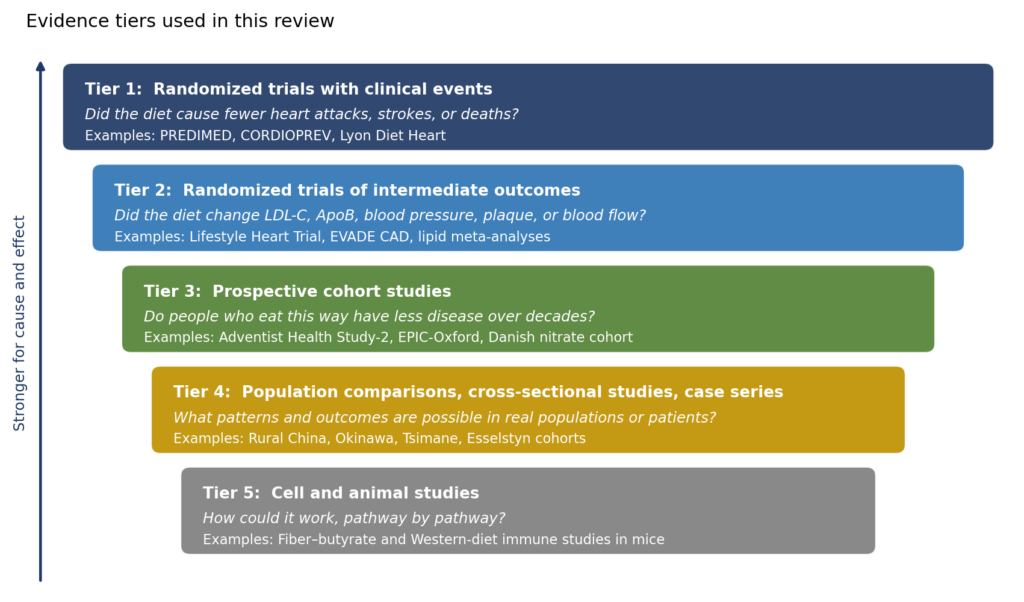
Figure 1. Five tiers of evidence used in this review, the question each tier can answer, and examples of studies in each tier. Higher tiers are better at showing cause and effect; lower tiers add breadth, duration, and biological explanation.
2. Defining the Diets and the Comparisons
The proposed diet. VLF-WFPB consists of vegetables, legumes, intact whole grains, fruit, and minimally processed starchy foods, with no animal foods and little or no added oil, operationally about 10–15% of energy from fat. The 2014 Esselstyn protocol also excluded avocado, nuts, excess salt, and sugary foods, later also caffeine and fructose, and advised a multivitamin, vitamin B12, and flaxseed meal [4]. The earlier 1985 Esselstyn cohort was not vegan: patients eliminated oil, fish, fowl, meat, and dairy products except skim milk and nonfat yogurt, targeted 10% of energy from fat, and received individualized cholesterol-lowering medication [5]. Il Ornish Lifestyle Heart Trial diet was a 10%-fat whole-foods vegetarian diet that permitted nonfat dairy and egg whites [6, 7]; achieved fat intake was 6.2% of energy at one year and 8.5% at five years [6].
Related but different diets. Higher-fat whole-food vegan diets include nuts, seeds, avocado, or olio d'oliva; the low-oil phase of the 2024 Recipe for Heart Health trial still provided 32% of energy from fat [8], and the vegan arm of the EVADE CAD trial ended at about 30% [9]. Generic vegan diets exclude animal foods without constraining food processing or fat. Conventional low-fat diets are omnivorous; the low-fat arm of CORDIOPREV prescribed less than 30% fat with lean meat and low-fat dairy, and achieved 32.1% [10].
Comparators. The DASH combination diet emphasized fruits, vegetables, and low-fat dairy with reduced saturated and total fat [11]. Dieta mediterranea tested in randomized trials were substantially higher in fat: the PREDIMED arms were supplemented with extra-virgin olive oil or nuts [12]; the CORDIOPREV Mediterranean arm prescribed at least 35% fat and achieved 40.5% [10]; and the Lyon intervention supplied an alpha-linolenic-acid-rich margarine in place of butter and cream, alongside advice to follow a Mediterranean-type pattern [13, 14]. Il Dieta personalizzata adds nuts, plant proteina, viscous fibra, and plant steroli to a low-saturated-fat background [15]. Table 1 summarizes the patterns as they were actually tested.
Table 1. Dietary patterns as tested.
| Modello | Defining features in the key trials | Fat, % of energy | What the label alone does not establish |
| VLF-WFPB | Legumes, intact grains, vegetables, fruit, starchy foods; no animal foods; little or no oil; Esselstyn 2014 also excluded nuts and avocado [4] | Target ~10–15%; Ornish (vegetarian, not vegan) achieved 6.2–8.5% [6] | Adequate B12, protein, essential fats, or sustained adesione |
| Higher-unsaturated-fat whole-food vegan | Animal-free, with nuts, seeds, avocado, or olive oil | 32–48% [8]; ~30% in EVADE CAD [9] | Inferiority to an oil-free vegan pattern |
| TRATTO | Fruit, vegetables, low-fat dairy; reduced saturated and total fat; sodium reduction in DASH-Sodium [11, 16] | Reduced, not very low | That benefit depends on dairy; event reduction in a trial |
| Mediterranea | Vegetables, legumes, whole grains, nuts, extra-virgin olive oil, fish [10, 12] | 40.5% achieved in CORDIOPREV [10] | A fixed macronutrient ratio or unlimited energy |
| Portfolio | Nuts, plant protein, viscous fiber, plant sterols added to a low-saturated-fat diet [15] | Varied across trials; includes nuts but not necessarily high in fat | Event reduction; core evidence is ipolipemizzante; tested patterns were not restricted to 10–15% fat |
| Conventional low-fat (omnivorous) | Lean meat, low-fat dairy, complex carboidrato [10] | <30% prescribed; 32.1% achieved [10] | Equivalence to VLF-WFPB |
3. Three Levers: Animal-Food Exclusion, Total Fat, and Food Processing (Tiers 2–3)
VLF-WFPB bundles three changes that can be separated: excluding animal foods, restricting total fat to about 10–15% of energy, and building the diet from whole or minimally processed foods. The Esselstyn and Ornish programs push fat restriction and whole-food eating to their extremes and remove all or nearly all animal foods (their early protocols permitted nonfat dairy, and Ornish’s also egg whites). That makes them the natural test bed for the whole package and, for the same reason, unable on their own to apportion credit among its parts (Figure 2). The label “plant-based” describes only the first lever, and the evidence shows it is not sufficient on its own.
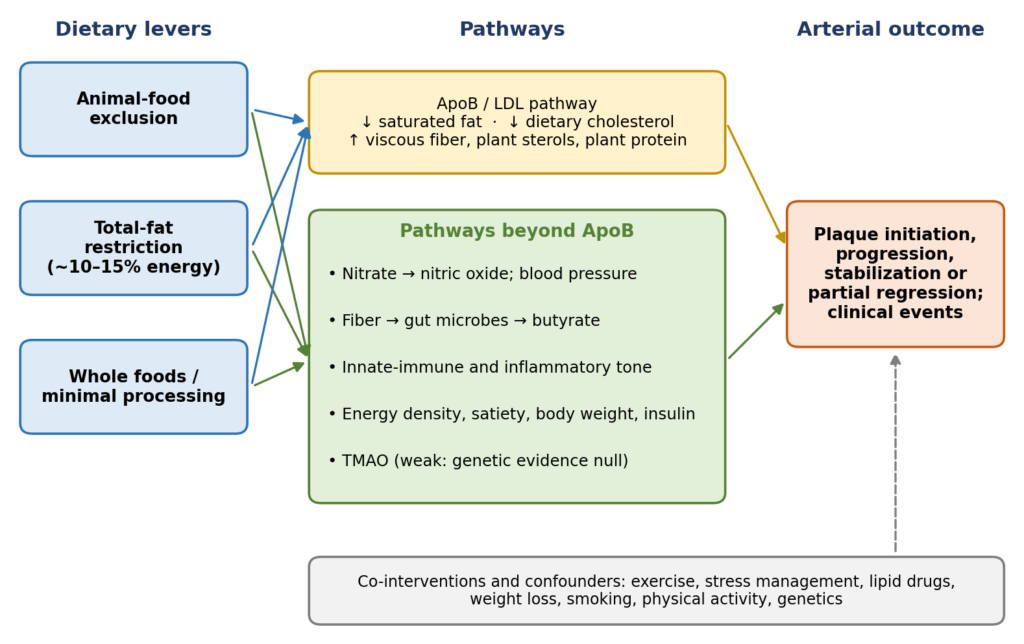
Figure 2. Three separable dietary levers and the pathways by which they could affect coronary aterosclerosi. Most intervention programs change all three levers together and add co-interventions, so trials cannot attribute benefit to a single lever.
Diet quality within plant-based eating. In three US cohorts totalling about 209,000 health professionals with 8,631 incident coronary events, an overall plant-based diet index was only weakly associated with lower risk (hazard ratio for extreme deciles 0.92; 95% CI 0.83 to 1.01). A healthful index that rewarded whole grains, fruits, vegetables, nuts, legumes, oils, tea, and coffee was associated with 25% lower risk (0.75; 0.68 to 0.83), whereas an unhealthful index that rewarded refined grains, potatoes, sweetened beverages, juices, and sweets was associated with 32% higher risk (1.32; 1.20 to 1.46) [17]. Two points follow. Plant-based eating is not protective in itself; quality determines the direction. And the healthful index scored nuts and vegetable oils as beneficial, so this evidence favors a whole-food pattern rather than specifically a very-low-fat one.
Processing within plant foods. In 126,842 UK Biobank participants followed for a median of 9 years, each 10-percentage-point increase in energy from plant-sourced foods that were not ultra-processed was associated with 7% lower malattia cardiovascolare risk (hazard ratio 0.93; 95% CI 0.91 to 0.95) and 13% lower cardiovascular mortality (0.87; 0.80 to 0.94). Plant-sourced alimenti ultra-processati showed the opposite association (1.05; 1.03 to 1.07 for disease and 1.12; 1.05 to 1.20 for mortality), and total plant-food intake, ignoring processing, showed no association [18].
Randomized evidence on processing. Processing also has randomized evidence, although for energy balance rather than atherosclerosis. In an inpatient crossover trial, 20 weight-stable adults received ultra-processed or unprocessed diets for two weeks each, with meals matched for presented calories, energy density, macronutrients, sugar, sodium, and fiber. On the ultra-processed diet they ate 508 ± 106 kcal/day more and gained 0.9 kg; on the unprocessed diet they lost 0.9 kg [19].
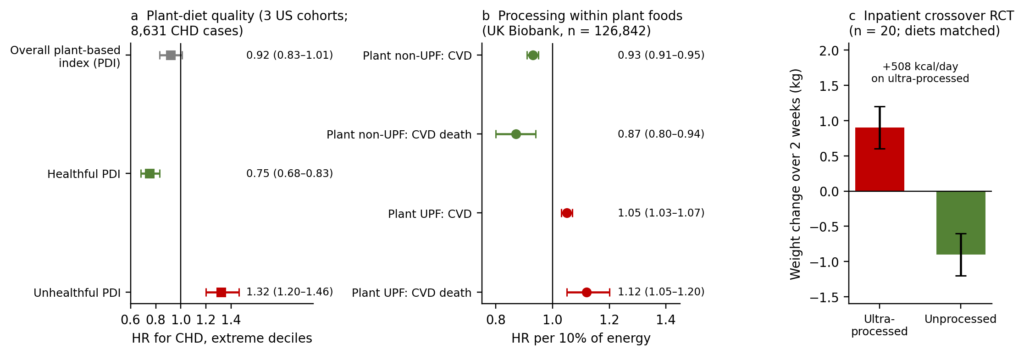
Figure 3. Diet quality and processing. (a) Plant-based diet indices and incident malattia coronarica, extreme deciles. (b) Plant-sourced foods by processing, per 10% of energy, UK Biobank. (c) Weight change in an inpatient crossover trial of ultra-processed versus unprocessed diets (mean ± SE). Panels come from different designs and are not comparable in magnitude. Sources: Satija 2017; Rauber 2024; Hall 2019.
What this changes. The evidence on processing is consistent in direction: associations for plant foods reverse with processing, and in a randomized feeding trial the ultra-processed pattern increased energy intake and weight relative to the unprocessed pattern, with nutrients matched as far as the design allowed. These findings support attention to food quality and processing; they do not establish the importance of processing relative to animal-food exclusion, a comparison no trial has made. This reframes the Esselstyn and Ornish programs. What they share with each other, and with rural China, Okinawa, and the Tsimane (Sections 6–8), is not zero animal food but a diet built almost entirely from whole, minimally processed foods. That feature, and the question of whether its benefits run only through ApoB (Section 5), are the focus of what follows.
4. The Biological Case: ApoB and the Lipid Pathway (Tiers 1–2)
4.1 Organizing framework: cumulative exposure to ApoB-containing particles
LDL and other ApoB-containing lipoproteins cause atherosclerotic cardiovascular disease, and genetic, epidemiologic, and trial evidence indicate that risk rises with both the magnitude and the duration of exposure [20]. Particles enter the arterial intima in proportion to their concentration and are retained in susceptible sites, so the relevant quantity is esposizione cumulativa rather than a single measurement. This framework is used here as an organizing principle, not as a validated numerical risk equation.
The framework has two implications for diet. First, a modest reduction sustained from early adulthood could matter more than the same reduction begun after disease is established; this is the logic behind the population evidence in Sections 6 to 8. Second, in established disease the relevant benchmark is the statin-trial slope: about a 22% relative reduction in major vascular events per 1 mmol/L (38.7 mg/dL) of LDL-C lowering over roughly five years [21]. If that slope applied to the pooled dietary LDL-C difference of 0.30 mmol/L reported below, it would predict a relative reduction of about 7% over five years (1 − 0.78^0.30). That figure is an extrapolation, not a measured dietary effect: dietary trials last weeks to months, adherence erodes, and a diet also changes body weight, blood pressure, and other factors that the statina slope does not capture.
4.2 Randomized evidence on lipids and risk factors
The largest meta-analysis of randomized trials comparing vegetarian or vegan diets with omnivorous diets included 30 trials. Plant-based diets lowered colesterolo totale by 0.34 mmol/L (95% CI 0.23 to 0.44; about 13 mg/dL) and LDL-C by 0.30 mmol/L (95% CI 0.19 to 0.40; about 11.6 mg/dL). ApoB fell by 12.92 mg/dL (95% CI 3.20 to 22.63), a 14% reduction, but only six trials contributed ApoB data and heterogeneity was substantial (I² = 71.7%); trigliceridi did not differ overall [22]. The ApoB figure is the published pooled estimate; because it rests on six trials, its precision depends on those trials being independent randomized comparisons of diet alone, which could not be confirmed from the accessible sources; pooled analyses in this literature also require checking for multiple reports of a single cohort. These results support lipid-mediated plausibility. They do not establish event reduction, regressione della placca, an individual’s response, or a special benefit from excluding grassi insaturi, because the trial diets and comparators varied widely.
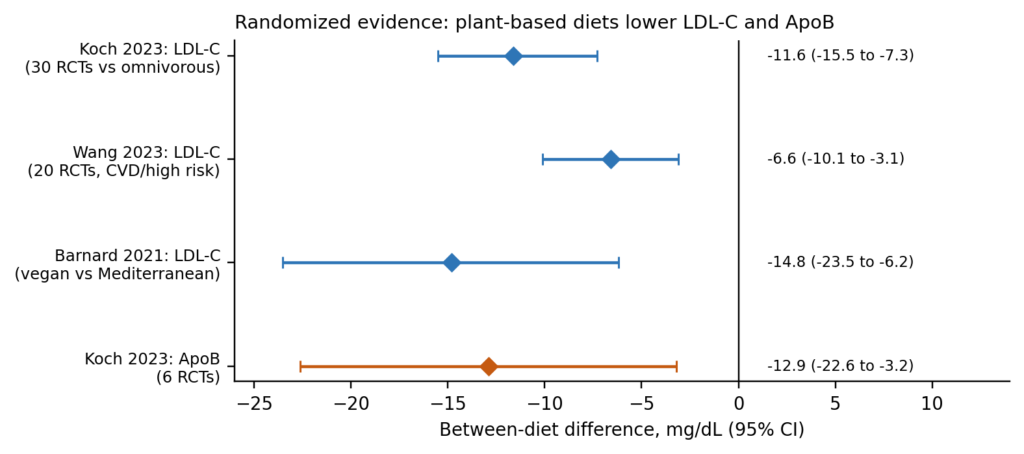
Figure 4. Randomized evidence that plant-based diets lower LDL-C and ApoB. Between-diet differences with 95% intervalli di confidenza; Koch 2023 values converted from mmol/L (× 38.67). Estimates share constituent trials and are not additive. Sources: Koch 2023; Wang 2023; Barnard 2021 (participants without medication changes).
A second meta-analysis restricted to people with, or at high risk of, cardiovascular disease pooled 20 trials (1,878 participants; mean duration 25.4 weeks). Vegetarian diets lowered LDL-C by 6.6 mg/dL (95% CI 3.1 to 10.1), HbA1c by 0.24 percentage points (95% CI 0.07 to 0.40), and body weight by 3.4 kg (95% CI 2.0 to 4.9), with no effect on pressione arteriosa sistolica (−0.1 mm Hg; 95% CI −2.8 to 2.6) [7]. The article’s Key Points box states 6.8 mg/dL and 0.25%; the results section and forest plots give 6.6 mg/dL and 0.24%, which are used here. Two further details matter for Q2. Against usual diets, LDL-C fell 12.9 mg/dL; against active dietary comparators, the LDL-C difference was not statistically significant. And baseline LDL-C explained the between-trial heterogeneity [7]. Only four trials enrolled patients with established cardiovascular disease, three of them Ornish-type programs.
Blood pressure. Earlier meta-analyses, as summarized by Wang and colleagues, reported systolic reductions of about 2.5 mm Hg with vegetarian diets [7]. The null result in higher-risk patients is plausibly explained by background antim ipertensivo therapy and by medication reductions during trials, which the authors note could mask diet effects. Blood-pressure benefit is not specific to plant-exclusive eating: the Dieta DASH, which includes low-fat dairy, lowered pressure substantially in controlled feeding [11, 16], and in a direct crossover comparison a Mediterranean diet lowered systolic pressure more than a low-fat vegan diet [23]. Blood pressure is therefore not a demonstrated advantage of VLF-WFPB. Estimates from the two lipid meta-analyses are not added together; they share trials.
4.3 Dietary cholesterol
Colesterolo alimentare raises serum cholesterol independently of grassi saturi. In a meta-analysis of egg-feeding studies cited by Freeman and colleagues, each additional 100 mg/day raised LDL-C by about 1.9 mg/dL and HDL-C by about 0.3 mg/dL; the response is larger when baseline intake is low and varies between individuals with intestinal absorption capacity [2]. Even people habituated to a very low intake respond: in eight Tarahumara men whose customary diet supplied little cholesterol, a 1,000 mg/day diet raised plasma cholesterol from 113 to 147 mg/dL after a cholesterol-free phase [24]. VLF-WFPB supplies essentially none; in EVADE CAD, dietary cholesterol fell to a median of 0 mg/day in the vegan arm versus 142 mg/day in the AHA arm [9]. The average contribution to LDL-C lowering is modest; the individual contribution can be larger. The AHA’s 2026 dietary guidance states that, for most people, dietary cholesterol is no longer a primary target for cardiovascular risk reduction [25]; eliminating it is therefore a minor, not a defining, part of the case for VLF-WFPB.
4.4 Saturated fat and what replaces it
In the current Cochrane review, reducing saturated fat lowered combined cardiovascular events (risk ratio 0.83; 95% CI 0.70 to 0.98; 12 trials, 53,758 participants), and larger reductions in saturated fat, reflected in larger cholesterol reductions, produced larger benefits. Subgroup analyses did not show a significant difference between replacing saturated fat with grasso polinsaturo or with carbohydrate [26]. The May 2020 issue of that review reported a risk ratio of 0.79; the corrected version of record is used here. VLF-WFPB drives saturated fat very low (4.5% of energy in the EVADE vegan arm versus 6.6% in the AHA arm [9]), and it replaces it predominantly with starch and fiber from whole foods. Plant protein, viscous fiber, and plant sterols are further plausible LDL-lowering components; current dislipidemia guidance points patients toward reducing saturated fat and increasing fiber-rich plant foods [27].
The Portfolio evidence shows a different route to the same target. In a meta-analysis of controlled trials (439 participants), adding nuts, plant protein, viscous fiber, and plant sterols to a cholesterol-lowering NCEP Step II diet lowered LDL-C by about 17%, with reductions in ApoB and colesterolo non-HDL as well [15]. Because the Portfolio diet contains nuts, it demonstrates that excluding nuts is not a prerequisite for substantial dietary LDL-C lowering.
5. Beyond ApoB: The Central Question (Tiers 2–5)
If every benefit of VLF-WFPB ran through lower ApoB, the diet would be one of several interchangeable ways to lower ApoB, drugs included, and the case for its particular rules would reduce to how far and how durably it lowers particelle aterogene. The distinctive claim of whole-food plant-based medicine is that it does more: that whole plant foods act on the endotelio, the gut, immune signaling, blood pressure, and energy balance in ways a statin does not. That claim is biologically serious, and it is the central question of this review.
Four kinds of evidence bear on it, in increasing order of strength: (1) a mechanism demonstrated in cells or animals under conditions where lipids are unchanged or controlled; (2) human physiological or biomarcatore effects not explained by LDL-C change; (3) human outcome associations that persist after adjustment for lipids; and (4) randomized comparison of diets at matched ApoB. The subsections below voto each candidate pathway against these criteria (Figure 6). No study yet provides the fourth kind.
5.1 Fiber, gut microbes, and butyrate
Viscous fiber lowers LDL-C, but fermentable plant polysaccharides may also act through the microbiota intestinale. Across 83 genetically diverse, atherosclerosis-susceptible mouse strains, the abundance of the butyrate-producing genus Roseburia was inversely related to lesione size and was not correlated with cholesterol. In germ-free apolipoproteina E–deficient mice colonized with defined bacterial communities, Roseburia intestinalis lowered systemic infiammazione and atherosclerosis only when the diet was rich in plant polysaccharides, and intestinal delivery of butirrato itself reduced endotoxemia and atherosclerosis [28]. This is the clearest demonstration in this review of a diet-dependent, cholesterol-independent atheroprotective mechanism. It comes from mouse models, and no human trial has shown that raising butyrate production changes placca or events.
5.2 Leafy-green nitrate, nitric oxide, and the endothelium
Leafy green vegetables, central to Esselstyn’s protocol, are the main dietary source of inorganic nitrate, which the body can convert to ossido nitrico attraverso un percorso enterosalivare. In 53.150 adulti danesi seguiti per un massimo di 23 anni (14.088 eventi cardiovascolari), un'assunzione moderata di nitrati di origine vegetale (mediana 59 mg/giorno, circa una tazza di verdure a foglia verde) rispetto al quintile più basso (mediana 23 mg/giorno) è stata associata a un rischio di malattie cardiovascolari inferiore del 15% (hazard ratio 0,85; IC al 95% da 0,82 a 0,89) e a rischi inferiori di cardiopatia ischemica (0,88; da 0,82 a 0,94), ictus ischemico (0,83; da 0,76 a 0,91) e arteriopatia periferica (0,74; da 0,67 a 0,83). L'associazione ha raggiunto un plateau sopra i 60 mg/giorno circa ed è persistita dopo l'aggiustamento per le segnalazioni di ipercolesterolemia e altri fattori dietetici, il che non equivale a controllare l'esposizione cumulativa misurata ad ApoB; una analisi di mediazione ha stimato che la pressione arteriosa sistolica basale ne spiegasse il 21,9% [29]. Gli autori osservano che il più ampio studio sui nitrati non ha ridotto la pressione arteriosa negli anziani con pressione elevata, e che i dati osservazionali non possono separare l'assunzione di nitrati da quella di verdure in generale; in questa coorte la lattuga e le patate fornivano la maggior parte dei nitrati vegetali [29]. Il risultato supporta l'elemento delle verdure a foglia verde della leva dei cibi integrali; non è specifico per una dieta vegana.
Funzione endoteliale (fisiologia umana acuta e a breve termine; rilevanza per gli eventi non provata). Un singolo pasto ricco di grassi ha compromesso transitoriamente la dilatazione flusso-mediata dell'arteria brachiale in volontari sani [30]. Nell'esperimento condotto dagli stessi ricercatori su dieci persone, un pasto a base di olio d'oliva ha ridotto acutamente la dilatazione flusso-mediata del 31%, e la riduzione è stata minore quando il pasto includeva antiossidante vitamine o insalata con aceto balsamico [31]. L'alimentazione sostenuta indica il contrario: in una meta-analisi di otto studi, gli interventi con olio d'oliva hanno aumentato la dilatazione flusso-mediata di 0,76 punti percentuali (IC 95% da 0,27 a 1,24) [32], e in 805 partecipanti al CORDIOPREV una dieta mediterranea ha migliorato la dilatazione flusso-mediata più della dieta a basso contenuto di grassi dopo un anno [33]. Nell'arco di otto settimane in EVADE CAD, la funzione endoteliale misurata tramite EndoPAT non è cambiata in nessuno dei due bracci [9]. Né i risultati sulla funzione vascolare acuta né quelli a breve termine stabiliscono effetti sugli eventi.
5.3 Infiammazione e memoria immunitaria innata
Infiammazione (evidenza di biomarcatori randomizzati sull'uomo). EVADE CAD ha randomizzato 100 pazienti con malattia coronarica angiografica a otto settimane di una dieta vegana o raccomandata dall'AHA, con spesa, menu di esempio e supporto di un dietista per entrambi. Al basale, il 94-96% assumeva statine e più della metà assumeva statine ad alto dosaggio. La dieta vegana ha prodotto una Proteina C-reattiva ad alta sensibilità inferiore del 32% (β 0,68; IC al 95% da 0,49 a 0,94; P = 0,02), coerente dopo l'aggiustamento. L'LDL-C era inferiore del 13% (β aggiustato 0,87; IC 95% da 0,78 a 0,97), che i ricercatori hanno classificato come non significativo secondo la loro soglia di Bonferroni (α = 0,0015) per gli endpoint secondari. Peso, HbA1c, altri lipidi, marcatori di attivazione leucocitaria e qualità della vita non differivano tra i bracci [9]. Fondamentalmente, EVADE non ha testato un'alimentazione a bassissimo contenuto di grassi: l'apporto mediano di grassi riportato a otto settimane era il 29,9% dell'energia nel braccio vegano e il 30,2% nel braccio AHA, entrambi i gruppi sono stati incoraggiati a usare oli insaturi e l'olio d'oliva appariva nelle ricette per entrambi, e il principale contrasto dietetico era tra proteine vegetali e animali, con grassi saturi inferiori e fibre più elevate nel braccio vegano [9]. Il risultato della hs-CRP è una scoperta di biomarcatori; non stabilisce un numero inferiore di eventi o un beneficio clinico indipendente da ApoB.
Il lavoro sugli animali suggerisce come la dieta potrebbe lasciare un'impronta infiammatoria duratura. In topi con deficit del recettore LDL, l'alimentazione con dieta occidentale ha indotto un'infiammazione sistemica che è scomparsa dal sangue dopo il ritorno al cibo standard, tuttavia le cellule progenitrici mieloidi sono rimaste riprogrammate, con risposte immunitarie innate potenziate; i topi privi anche di NLRP3 erano protetti [34]. Poiché questi topi sono gravemente ipercolesterolemici e LDL ossidata è stato implicato nel braccio umano dello studio [34], this mechanism is not independent of lipoproteins; it suggests instead that the history of dietary exposure, not only current lipid levels, may shape plaque biology. The Tsimane point the other way: about half had hs-CRP above 3 mg/L from infectious burden, yet coronary calcium was the lowest recorded, which the investigators interpret as inflammation possibly not driving atherosclerosis when LDL is low [35].
5.4 Energy density, processing, body weight, and glycemia
Body weight and energy density (human randomized biomarker evidence). Vegetarian diets reduced weight by 3.4 kg in higher-risk patients [7], and a low-fat vegan diet produced greater weight loss than a Mediterranean diet in a crossover trial [23]. In the Lifestyle Heart Trial, the experimental group lost 10.9 kg at one year and remained 5.8 kg below baseline at five years [6]. Weight loss itself lowers LDL-C, blood pressure, and glycemia, so these effects overlap with the lipid pathway and cannot be added to it.
La sensibilità all'insulina and glycemia (human randomized biomarker evidence). HbA1c fell 0.24 percentage points overall and 0.36 points in people with type 2 diabete [7]. This may add to lipid effects in people with diabetes, but again partly through weight.
The processing trial (Section 3) shows one non-lipid route directly: the same nutrient targets delivered as unprocessed rather than ultra-processed food reduced spontaneous energy intake by about 500 kcal/day [19]. Blood pressure is a further separate, causal pathway. It is not a demonstrated advantage of plant-exclusive eating (Section 4.2), but nitrate-rich vegetables and potassium-rich, low-sodium patterns such as DASH lower it [11, 16, 29].
5.5 Trimethylamine N-oxide
Gut microbiome and trimethylamine N-oxide (human association plus mechanistic hypothesis). Gut microbes convert dietary precursors including colina e carnitina to trimethylamine, which host liver enzymes then oxidize to TMAO [36]; circulating TMAO predicted cardiovascular events in cohort data [37]. Randomizzazione mendeliana analyses have not found genetically predicted TMAO to be associated with malattia coronarica, infarto miocardico, or stroke [38], which weakens a causal interpretation, and no trial shows that lowering TMAO reduces events. The 2014 Esselstyn report asserts that its participants were unlikely to harbor TMAO-producing flora, but TMAO was not measured in that cohort [4].
5.6 Human signals that ApoB does not fully explain—and those it does
Most measured benefits of plant-based diets can run through ApoB, weight, blood pressure, and glycemia. A diet may have a real total effect even if nothing remains after conditioning on these mediators; the question of an additional effect is separate. Three observations bear on it. First, in the Lifestyle Heart Trial, experimental-group ApoB fell from 1.000 g/L at baseline to 0.769 g/L at one year but was 1.014 g/L at five years, while percent stenosi diametricale continued to improve; LDL-C remained 20% below baseline at five years [6]. Because the program also included exercise, stress management, and group support, and because a year-5 snapshot does not capture the lower cumulative exposure during the preceding years, this cannot be read as diet acting independently of ApoB. Second, within STARS, progression correlated with saturated and total fat intake after adjustment for LDL-C, an observational within-trial analysis [39]. Third, in cohort data roughly one-fifth of the vegetarian–IHD association may be mediated by indice di massa corporea [40], and in EPIC-Oxford the vegetarian–IHD association weakened substantially after adjustment for self-reported cholesterol, blood pressure, diabetes, and body mass index [41]. No trial has compared dietary patterns at matched ApoB, blood pressure, and weight, which is the design needed to establish an effect beyond the mediators.
Figure 5 displays the Lifestyle Heart Trial data. Although it cannot establish a dietary effect independent of ApoB, it remains the best clinical exhibit for the hypothesis: the experimental group took no lipid drugs, and the change in percent stenosi è continuata da −1,75 punti a un anno a −3,07 punti a cinque anni, dopo che l'ApoB era tornata a 101,4 mg/dL (livello basale 100,0), mentre i controlli sono peggiorati [6]. Due ulteriori osservazioni definiscono meglio il quadro. In primo luogo, i Tsimane avevano un'ApoB media di 97 mg/dL alla scansione, non particolarmente bassa, eppure quasi nessun calcio coronarico; il loro LDL-C ha avuto una media di circa 71 mg/dL (1,84 mmol/L) dal 2004 al 2011 ed è aumentato da allora, e trascorrono ore al giorno in attività fisica [35], quindi l'esposizione e l'attività nel corso della vita possono spiegare questo fatto così come qualsiasi fattore dietetico. In secondo luogo, la coorte di Esselstyn del 1995, spesso citata a favore di questo argomento, non può sostenerlo: ogni paziente assumeva farmaci ipocolesterolemizzanti e l'LDL-C medio era di 71,6 mg/dL [42], quindi la concomitante riduzione dei lipidi è una spiegazione plausibile per parte del miglioramento, e il design non controllato non può isolare il contributo della dieta o dimostrare che fosse coinvolto un percorso oltre l'ApoB.
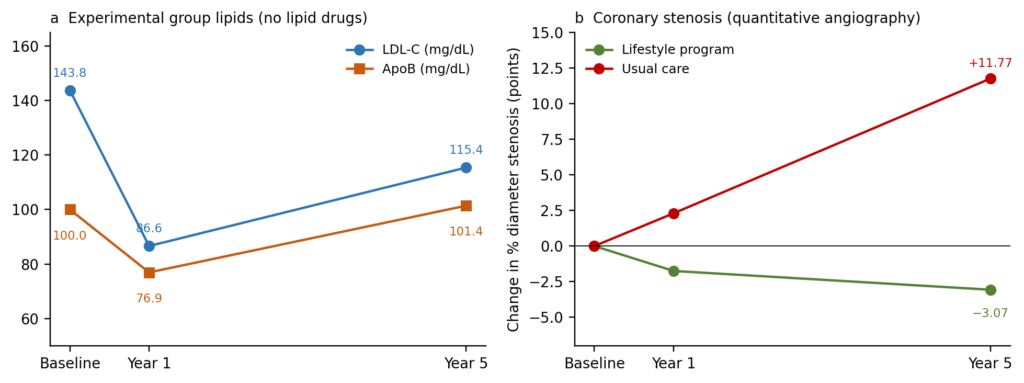
Figura 5. Lifestyle Heart Trial. (a) LDL-C e ApoB nel gruppo sperimentale, che non ha assunto farmaci ipolipemizzanti (ApoB convertita da g/L × 100). (b) Variazione della percentuale di stenosi del diametro all'angiografia quantitativa, tracciata dal rapporto a cinque anni del 1998 per i 35 partecipanti con angiografia a cinque anni; il rapporto a un anno del 1990 copre tutti i 48 partecipanti e fornisce valori basali leggermente diversi, quindi i suoi valori non sono tracciati qui. Il 60% dei controlli ha iniziato i farmaci lipidici tra il primo e il quinto anno.
5.7 Valutazione del caso oltre l'ApoB
L'ipotesi del beneficio aggiuntivo è quindi condizionale: un modello più rigoroso potrebbe superare un'altra dieta sana se produce un miglioramento maggiore e duraturo dell'ApoB, della pressione sanguigna, del peso o salute metabolica senza una minore aderenza o svantaggi nutrizionali. “Vegano”, “senza olio” e “10% di grassi” non sono di per sé validati endpoint surrogati. Né un cambiamento lipidico dietetico a breve termine può essere convertito meccanicamente in una riduzione degli eventi specifica per Esselstyn utilizzando le pendenze dei trial farmacologici.
Tutto sommato, il caso oltre l'ApoB è biologicamente plausibile e parzialmente supportato. I modelli animali dimostrano un meccanismo dipendente dalla dieta e indipendente dal colesterolo (fibre e butirrato) e un meccanismo di memoria infiammatoria duratura; le coorti umane collegano i nitrati delle verdure a foglia verde a un minor rischio cardiovascolare dopo l'aggiustamento per l'ipercolesterolemia, e gli alimenti vegetali minimamente processati a un minor rischio; e un trial randomizzato mostra che la sola lavorazione cambia l'apporto energetico [18, 19, 28, 29, 34]. Di contro, l'associazione vegetariano-coronarica nell'EPIC-Oxford si è indebolita sostanzialmente dopo l'aggiustamento per i fattori di rischio convenzionali [41], l'evidenza genetica non supporta il TMAO come causale [38], e nessun trial ha confrontato diete con ApoB abbinata. La Figura 6 riassume le prove per percorso; il trial proposto (Sezione 17) è progettato per fornire il test mancante.
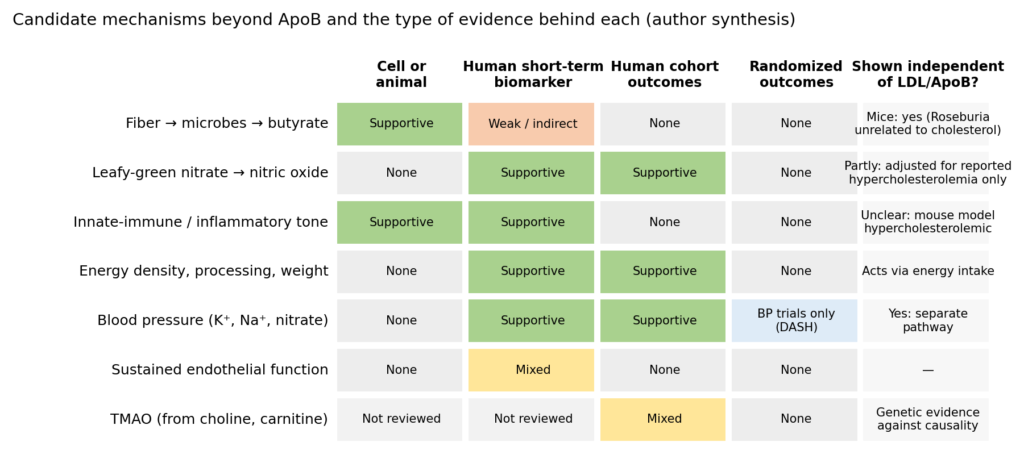
Figura 6. Meccanismi candidati oltre l'ApoB e tipo di evidenza per ciascuno. Sintesi dell'autore delle fonti citate nella Sezione 5; “supportivo” indica la direzione dell'evidenza, non la prova di un effetto causale sull'aterosclerosi umana.
6. Cina rurale (Livello 4)
6.1 Cosa è stato misurato
Il China Study I ha combinato i dati sulla mortalità per contea con indagini dietetiche, del sangue e delle urine in 65 contee rurali e 130 villaggi, campionando 50 adulti per villaggio; dieta e sangue sono stati raccolti nel 1983-1984 [43]. La dieta rurale media forniva il 14% dell'energia dai grassi, il 71% dai carboidrati, il 5% da alcol, e il 10% dalle proteine, di cui circa l'11% era di origine animale (circa l'1% dell'energia totale); l'apporto di fibre era di 33 g/giorno e l'indice di massa corporea medio era di 20,5 [43]. Il colesterolo totale sierico medio era di 127 mg/dL, rispetto ai 203 mg/dL negli adulti statunitensi di età compresa tra 20 e 74 anni [43]. La dieta era a basso contenuto di alimenti animali, non vegana; gli autori descrivono le diete rurali del 1950-1980 come contenenti il 3-6% di alimenti di origine animale [43].
6.2 Quali sono le cifre coronariche
The widely quoted coronary comparison uses mortality, not incidence, recorded in 1973–1975 and truncated at ages 0–64: 4.0 per 100,000 men and 3.4 per 100,000 women in rural China versus 66.8 and 18.9 in the United States, taken from a 1989 WHO statistics annual, giving ratios of 16.7 and 5.6 [43]. Four features limit interpretation. The mortality period precedes the dietary and blood survey by about a decade. Excluding deaths after age 64 removes the ages at which most coronary deaths occur. Death certification and coronary diagnosis in rural China in the 1970s differ from US practice, so under-ascertainment cannot be excluded. And competing mortality from infections and other causes of death, which the authors describe as clustering in the same counties, removes people before coronary disease manifests [43]. No carico di placca was measured.
6.3 What the county correlations show
Across counties, coronary mortality correlated positively with plasma ApoB (r = 0.37) and with an index of salt intake (r = 0.42), and inversely with green-vegetable intake; ApoB in turn correlated with animal protein and meat intake [43]. Coronary mortality also correlated with wheat flour intake (r = 0.67), which the authors attribute partly to co-varying milk, salt, triglycerides, and body weight [43]. The authors themselves note that the county, not the individual, is the unit of analysis, so the data cannot show whether low disease rates reflect uniformly low animal-food intake or fewer individuals eating more [43].
6.4 Confounding and alternative explanations
Energy intake per kilogram was about 30% higher than in the United States with far less obesità, which the authors attribute to greater daily energy expenditure such as cycling to work [43]. Physical activity, body weight, tobacco use, socioeconomic conditions, health care access, and diagnostic ascertainment all differ between these populations and the United States. The coronary paper does not report ischemic or ictus emorragico, and this review makes no claim about stroke subtypes in these counties. This review also did not re-verify post-1990 trend data; claims that China’s later dietary transition proves a causal diet effect should rest on contemporaneous individual-level cohorts.
6.5 Checking the secondary summary
Freeman and colleagues’ 2017 review is a useful route to these data but should not be quoted in place of them [2]. Its table correctly gives the 0–64 age restriction and the 127 mg/dL cholesterol, but lists macronutrients of 14% fat, 71% carbohydrate, and 10% protein, which sum to 95% because the 5% alcohol in the original is omitted [2, 43]. Its Tarahumara entry reports 528 people surveyed and a mean adult cholesterol of 136 mg/dL [2]; the original abstract reports 523 people aged 5 to 70 with a mean of 125 mg/dL overall and 116 mg/dL in children, a diet of 12% fat, 2% saturated fat, 71 mg/day cholesterol, and 75% carbohydrate, and a virtual absence of ipertensione, obesity, and the usual age-related rise in cholesterol [44]. The difference in denominators could not be resolved without the full text. The Tarahumara study measured lipids and diet, not coronary outcomes.
6.6 What rural China contributes
The rural Chinese data are consistent with the cumulative-exposure hypothesis: populations with lifelong low animal-food and saturated-fat intake had low cholesterol, and county coronary mortality tracked ApoB. That strengthens plausibility for Q1. It says nothing decisive about Q2 or Q3, because the diet was neither vegan nor compared with a high-quality alternative, and because activity, body size, and competing mortality are inseparable from diet in these data.
7. Traditional Okinawa (Tier 4)
The traditional dieta di Okinawa is known chiefly from a 1949 survey, conducted during post-war scarcity and US administration, as analyzed by the Willcox group. Sweet potato supplied about 69% of energy; total energy intake was about 1,785 kcal/day; fat supplied roughly 6% of energy; and meat intake was a few grams per day, with small amounts of fish, soy, and seaweed [45, 46]. The Willcox group estimates that adults ate about 11% fewer calories than needed to maintain weight until the late 1960s, with a lean average body mass index of 21 [47]. Interpretation is contested: one critic has argued that the Okinawan data reflect severe malnutrition, whereas Gavrilova and Gavrilov, responding, attribute the later loss of longevity advantage to westernization of the diet and note that a low infectious burden may also have contributed [48]. A single post-war survey cannot establish lifelong intake.
Coronary outcomes should be judged directly rather than through longevity. The same group reports that older Okinawans have about 80% less coronary mortality than the US population, based on age-adjusted vital statistics rather than individual dietary linkage [47]. The advantage has not persisted: Okinawans who did not experience the energy-restricted era now have higher body mass index, more type 2 diabetes, and worse cardiovascular risk factors than other Japanese, and the prefecture’s life-expectancy advantage is now confined to older ages [47]. That transition is compatible with a dietary contribution but equally with changes in energy balance, activity, and other exposures.
Okinawa informs the hypothesis in a limited way. It shows that a very-low-fat, high-carbohydrate, plant-predominant diet is compatible with low coronary mortality. It does not show that complete exclusion of animal foods is necessary, because the traditional diet included pork and fish, and it cannot separate low fat from caloric restriction, low body size, physical labor, or genetica. Its shared features with DASH and Mediterranean patterns are high vegetable and legume intake, low saturated fat, and low energy density; its distinctive features are very low total fat, a single dominant starchy staple, and chronic mild energy restriction.
8. Other Traditional Populations: The Tsimane and Kitava (Tier 4)
The Tsimane. The Tsimane, forager-horticulturalists of the Bolivian Amazon, provide the only traditional-population data in this review with direct imaging coronarico. Of 705 adults aged 40 to 94 scanned in 2014–2015, 596 (85%) had no coronary arteria calcium, 89 (13%) had scores of 1–100, and 20 (3%) had scores above 100; among those older than 75, 31 (65%) had none and four (8%) had scores of 100 or more [35]. Mean LDL-C was 91 mg/dL and HDL-C 39.5 mg/dL, and obesity, hypertension, iperglicemia, and regular fumo were rare. Compared with the US MESA cohort, the Tsimane reached a nonzero punteggio di calcio about 24 years later and a score of 100 or more about 28 years later [35] (Figure 7).
The Tsimane diet is low in fat and minimally processed but not plant-exclusive: about 14% of energy from protein, 14% from fat, and 72% from carbohydrate, an estimated 38 g of fat per day including 11 g of saturated fat and no grassi trans, with rice, plantain, manioc, and corn as staples and meat and fish obtained by hunting and fishing [35]. Men and women average 6–7 and 4–6 hours of physical activity per day. The limits are important: calcium scoring cannot detect placca non calcifica, the design is cross-sectional, and outcome data are thin, with one possible myocardial infarction among 50 recent adult deaths ascertained by verbal autopsy. LDL-C has risen by about 0.16 mmol/L per year since 2011 as motorized river travel improved access to market food [35], a natural experiment whose coronary consequences are not yet known.
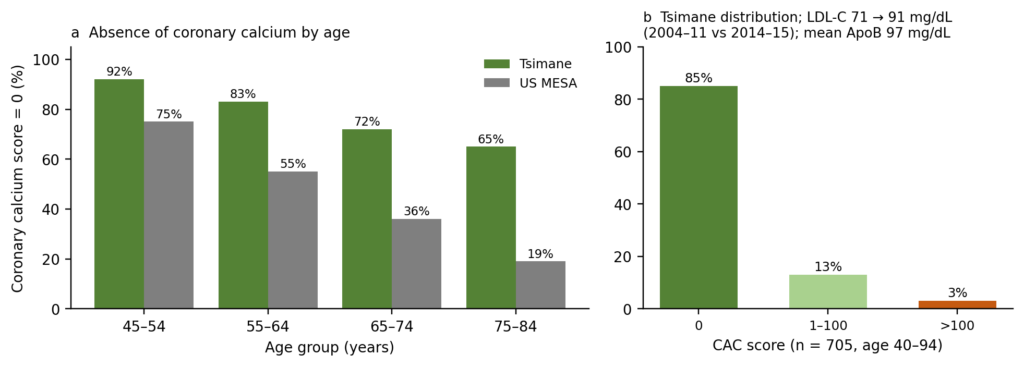
Figure 7. Coronary artery calcium in the Tsimane. (a) Proportion with a calcium score of zero by age group, Tsimane versus US MESA, as labeled in Figure 2 of Kaplan 2017. (b) Distribution of scores among 705 Tsimane adults. Calcium scoring does not detect noncalcified plaque.
Kitava. On Kitava in the Trobriand Islands, where tubers, fruit, fish, and coconut are dietary staples, semi-structured interviews with 213 adults identified no case corresponding to stroke, sudden death, or angina, and resting electrocardiograms showed few abnormalities [49]. Smoking was common: 76% of men and 80% of women over 20 smoked in the risk-factor survey [50]. The evidence rests on interviews and electrocardiograms rather than imaging or death registration.
What these populations add. None was vegan, and their fat intakes were not uniformly low in saturated fat. The Kitavan diet supplied about 21% of energy as fat and 17% as saturated fat, mostly lauric and myristic acid from coconut [51], a clear exception to the pattern. What rural China, traditional Okinawa, the Tsimane, and Kitava share is diets built from whole, minimally processed staples, leanness, and in most cases high physical activity. The pattern supports the cumulative-exposure argument and the whole-food lever; it provides no support for the claim that complete exclusion of animal foods is required. Fat intake ranged from very low in Okinawa to low among the Tsimane, and coconut was a Kitavan staple.
9. Prospective Cohort Evidence (Tier 3)
The most comprehensive cohort meta-analysis included 13 prospective cohorts with 844,175 participants. Compared with non-vegetarians, vegetarians had lower risk of cardiovascular disease (rischio relativo 0.85; 95% CI 0.79 to 0.92; 8 cohorts) and ischemic heart disease (0.79; 95% CI 0.71 to 0.88; 8 cohorts), but not of total stroke (0.90; 95% CI 0.77 to 1.05; 12 cohorts). For vegans the ischemic heart disease estimate was 0.82 (95% CI 0.68 to 1.00; 6 studies), and the cardiovascular disease estimate 0.92 (95% CI 0.79 to 1.06). Risk of bias was moderate in eight cohorts and serious in five [40]. Incidence estimates were used in preference to mortality where both were reported. The IHD association was weaker when early follow-up was excluded, about one-fifth of it appeared attributable to body mass index, and the E-value was 1.86 (lower confidence limit 1.49), meaning an unmeasured fattore di confusione would need associations of that strength with both diet and disease to explain it away [40].
The “40% lower coronary risk” figure sometimes attached to vegetarian diets traces to a meta-analysis restricted to Seventh-day Adventist cohorts, which reported a relative risk of 0.60 (95% CI 0.43 to 0.80) for coronary events [2, 52]. That estimate is population-specific and should not be generalized. Several Adventist and Oxford cohorts recur across meta-analyses, so repeated citation is not independent corroboration. Cohort vegetarian and vegan categories are defined by exclusion of animal foods, not by total fat, so none of this evidence tests the very-low-fat component.
Endpoint-specific data matter. In EPIC-Oxford (48,188 participants followed for 18.1 years), vegetarians including vegans had a 22% lower rate of ischemic heart disease than meat eaters (hazard ratio 0.78; 95% CI 0.70 to 0.87), equivalent to about 10 fewer cases per 1,000 people over 10 years; adjustment for self-reported high cholesterol, high blood pressure, diabetes, and body mass index attenuated the estimate to 0.90 (95% CI 0.81 to 1.00). The same group had a 20% higher rate of total stroke (1.20; 95% CI 1.02 to 1.40), about three more cases per 1,000 over 10 years, mostly hemorrhagic, and this association did not attenuate with risk-factor adjustment [41]. Coronary benefit and stroke risk must therefore be reported separately, and the attenuation of the coronary association is consistent with benefit running largely through conventional risk factors.
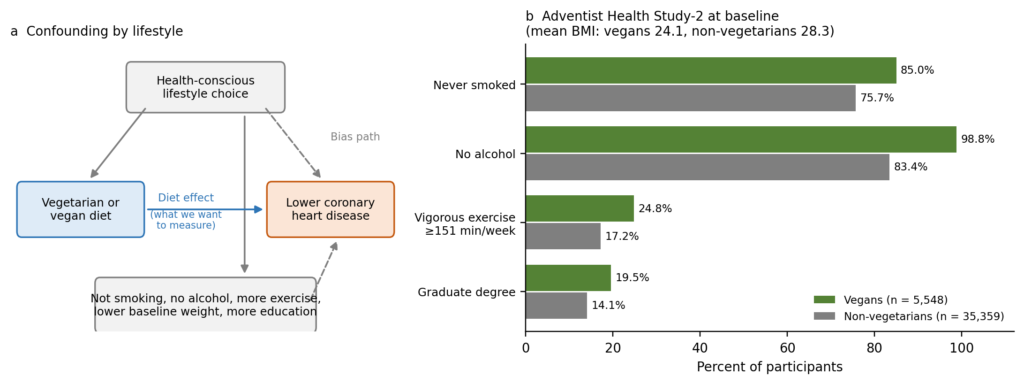
Figure 8. Prospective cohort estimates for vegetarian and vegan diets. The coronary association weakens after adjustment for conventional risk factors (EPIC-Oxford), and stroke risk is not lower. Estimates are shown side by side, not pooled; several cohorts overlap across meta-analyses. Sources: Dybvik 2023; Tong 2019; Orlich 2013; Kwok 2014.
9.1 Healthy-user bias: why associations are hard to read
Cohort studies compare people who chose different diets, and people who choose a vegetarian diet usually choose other healthy habits as well. This is called healthy-user bias, a form of confounding: part or all of an observed difference in disease may come from the other habits rather than from the diet. The Adventist data show the problem clearly. Compared with non-vegetarians in Adventist Health Study-2, vegans were more likely never to have smoked (85.0% versus 75.7%), far more likely to drink no alcohol (98.8% versus 83.4%), more likely to exercise vigorously for at least 151 minutes a week (24.8% versus 17.2%), more likely to hold a graduate degree (19.5% versus 14.1%), and leaner (mean body mass index 24.1 versus 28.3) [53] (Figure 9). The authors note that the conscious lifestyle choice of a vegetarian diet may itself affect the results and that uncontrolled confounding remains possible [53].
Researchers use several tools to reduce this bias, and each has limits. Comparing similar people: in both Adventist Health Study-2 and EPIC-Oxford, the non-vegetarian comparison group is itself relatively health-conscious, and very few Adventists smoke or drink, which narrows the gap without closing it [53]. Statistical adjustment: models adjust for smoking, exercise, education, and similar factors, but only for factors that were measured, and only as accurately as they were measured. Watching what adjustment does: when EPIC-Oxford added cholesterol, blood pressure, diabetes, and body mass index to its model, the vegetarian–ischemic heart disease hazard ratio moved from 0.78 to 0.90 [41]; this suggests much of the benefit runs through those risk factors, which is expected if the diet works, and it also shows how sensitive the estimate is to modeling choices. Quantifying robustness: in the Dybvik meta-analysis, an unmeasured confounder would need a relative risk of 1.86 with both diet and heart disease to explain the association away [40]. Duration and age: in a pooled analysis of five cohorts, lower ischemic heart disease mortality in vegetarians was restricted to people who had followed their diet for more than five years, and it was larger at younger ages (45% lower below age 65, 31% lower at 65–79, and 8% lower, not significant, at 80–89) [54]. A relation with duration of diet is what a causal effect would produce, although long-term vegetarians may also differ in other long-term habits.
Two further observations cut both ways. A meta-analysis found a larger ischemic heart disease association in Adventist cohorts (relative risk 0.60) than in non-Adventist cohorts (0.84; 95% CI 0.74 to 0.96) [52]. That difference could reflect stronger healthy-user effects among Adventists, or it could reflect what Adventist vegetarians actually eat: Adventist vegans reported about 46–47 g of fiber a day, compared with about 26–28 g in EPIC-Oxford vegans [53]. And causalità inversa—people changing diet after early illness—is reduced but not eliminated by excluding people with prior cardiovascular disease at enrollment, as both cohorts did [41, 53].
None of this means cohort evidence should be set aside. It is large, long, consistent across countries, and aligned in direction with randomized lipid trials and with biology. It should be read as Tier 3 evidence: strong for association, supportive but not decisive for cause, and unable on its own to rank one healthy diet against another.
Figure 9. Healthy-user bias. (a) How a lifestyle choice can link a diet to lower heart disease through paths other than the diet itself. (b) Baseline characteristics of vegans and non-vegetarians in Adventist Health Study-2, standardized by age, sex, and race as reported in Orlich 2013.
9.2 Do vegans do better than other vegetarians?
Vegan diets exclude all animal foods; lacto-ovo vegetarian diets include dairy and eggs; pesco-vegetariano diets include fish. If complete exclusion of animal foods added protection, vegans should do better than the other groups. The cohort data do not show that (Figure 10).
Adventist Health Study-2. Compared with non-vegetarians, the hazard ratio for ischemic heart disease death was 0.90 (95% CI 0.60 to 1.33) for vegans, 0.82 (0.62 to 1.06) for lacto-ovo vegetarians, and 0.65 (0.43 to 0.97) for pesco-vegetarians, the only statistically significant reduction [53]. Among men, vegans had hazard ratios of 0.45 (0.21 to 0.94) for ischemic heart disease death and 0.58 (0.38 to 0.89) for cardiovascular death; among women the corresponding estimates were 1.39 (0.87 to 2.24) and 1.18 (0.88 to 1.60) [53]. The whole cohort recorded 372 ischemic heart disease deaths over a mean of 5.79 years, so these subgroup estimates are imprecise, and the association of vegetarian diet with cardiovascular mortality differed significantly by sex [53]. In the longer 2024 follow-up of 88,400 participants, vegetarians overall had lower ischemic heart disease mortality, but a vegan diet was not associated with lower mortalità per tutte le cause in men and women combined; vegan men had lower mortality only at younger ages [55].
EPIC-Oxford and pooled cohorts. Compared with meat eaters, ischemic heart disease incidence in EPIC-Oxford was 0.82 (0.64 to 1.05) in vegans (67 cases), 0.77 (0.69 to 0.86) in lacto-ovo vegetarians, and 0.87 (0.77 to 0.99) in fish eaters [41]. In the pooled analysis of five cohorts, ischemic heart disease mortality was 26% lower in vegans and 34% lower in both lacto-ovo vegetarians and fish eaters than in regular meat eaters [54]. A systematic review of vegan diets found that none of three cohort studies, including at least 7,380 vegans, reported a significantly higher or lower risk of any primary cardiovascular outcome for vegans [56].
What this does and does not show. Vegans are few, so their estimates are wide and inconclusive rather than null. More important for this review, the vegans in these cohorts were not following VLF-WFPB: EPIC-Oxford vegans obtained 28.1% of energy from fat and ate about 26 g of fiber a day [41], neither very low in fat nor especially high in whole foods. These cohorts do not establish that vegans have lower cardiovascular risk than lacto-ovo vegetarians or fish eaters; they also do not establish equivalence or inferiority, since each group is compared with meat eaters rather than with the others, and in EPIC-Oxford the vegan point estimate was numerically lower than the fish eaters’. Within Adventist Health Study-2, protein from nuts and seeds was associated with 40% lower cardiovascular mortality, and protein from meat with 61% higher mortality, comparing highest with lowest quintiles; these associations persisted after adjustment for vegetarian diet type [57]. That pattern favors plant protein and nuts. It does not favor excluding nuts or all animal foods.
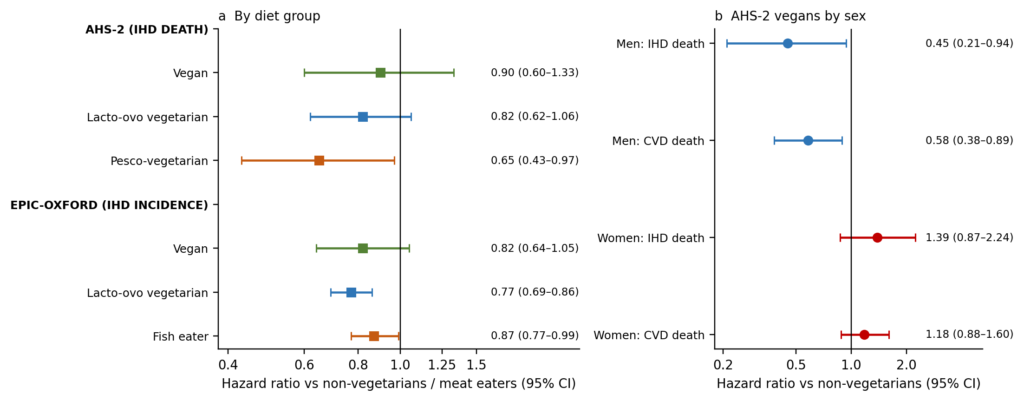
Figure 10. Vegans compared with other vegetarian groups. (a) Ischemic heart disease by diet group in Adventist Health Study-2 (deaths) and EPIC-Oxford (incident cases), each compared with non-vegetarians or meat eaters. (b) Adventist Health Study-2 vegans by sex. Wide intervals reflect small numbers of vegans. Sources: Orlich 2013 (Table 4); Tong 2019 (Supplementary Table 3).
9.3 Chinese and Taiwanese vegetarians
The search for this review found no prospective study from mainland China comparing vegans with omnivores for heart disease outcomes. The available Chinese and Taiwanese evidence concerns vegetarians, most of whom eat dairy and often eggs. In Taiwan, two Buddhist Tzu Chi cohorts (13,352 participants in total) found lower stroke risk among vegetarians: in the first cohort, the hazard ratio for ischemic stroke was 0.26 (95% CI 0.08 to 0.88); in the second, overall stroke 0.52 (0.33 to 0.82), ischemic stroke 0.41 (0.19 to 0.88), and hemorrhagic stroke 0.34 (0.12 to 1.00) [58]. Participants were members of a Buddhist foundation, a population with its own healthy-user profile, and an exploratory analysis suggested that vitamin B12 intake modified the association [58]. The hemorrhagic stroke result runs opposite to EPIC-Oxford’s [41], a reminder that stroke subtypes behave differently across populations.
In a studio trasversale from Xiamen, 169 healthy Chinese lacto-vegetarian men had lower blood pressure, LDL-C, ApoB, triglycerides, and fasting glucosio, and thinner carotid spessore intima-media, than 126 omnivorous men [59]. This is Tier 4 evidence on marcatori surrogati in dairy-eating vegetarians.
Hong Kong data add a caution. Vitamin B12 deficiency was reported in about 80% of Hong Kong vegans, who rarely used fortified foods or supplements; B12-deficient vegetarian groups showed impaired arterial endothelial function and thicker carotid walls, and B12 supplementation improved these vascular measures in Hong Kong vegans [60]. An unsupplemented vegan diet can therefore undermine the vascular benefit it is meant to provide, which reinforces the nutrient guidance in Section 15.
10. Esselstyn’s Studies Reassessed (Tier 4)
10.1 The 1985 Cleveland Clinic cohort
Three reports describe this cohort, and their denominators differ. The full 1995 report describes 22 patients (21 men, 1 woman) with severe, angiographically documented coronary disease enrolled between 1985 and 1988; the 11 participants whose results are reported all had triple-vessel disease and were nondiabetic, nonhypertensive nonsmokers [42]. The diet derived less than 10% of energy from fat and excluded oils, meat, fish, fowl, and dairy except skim milk and nonfat yogurt. Every participant also received an individualized cholesterol-lowering drug, most often cholestyramine 4 g twice daily with lovastatin 40–60 mg daily; relaxation and meditation training was offered but abandoned within weeks, and exercise was not prescribed [42]. In the 11 imaged participants, mean total cholesterol fell from 246 mg/dL at baseline to 132.4 mg/dL during treatment, with mean LDL-C 71.6 mg/dL and HDL-C 36.3 mg/dL [42].
Of 38 lesions with more than 20% stenosis in those 11 participants, three treated by angioplastica and four native-vessel lesions proximal to bypass grafts were excluded a priori—the latter because, as the authors note, such lesions were expected to progress, and they did—and six more could not be matched at follow-up, leaving 25 [42]. Two technicians masked to angiografia sequence read the films. By percent diameter stenosis, 11 of 25 lesions regressed and 14 were stable, mean stenosis fell from 53.4% to 46.2% (estimated decrease 7 percentage points; 95% CI 3.3 to 10.7), and 8 of 11 participants were classified as regressing. By minimal lumen diameter, the less reference-dependent measure, 6 lesions regressed, 14 were stable, and 5 progressed, and the mean increase was 0.08 mm (95% CI −0.06 to 0.22; not significant) [42].
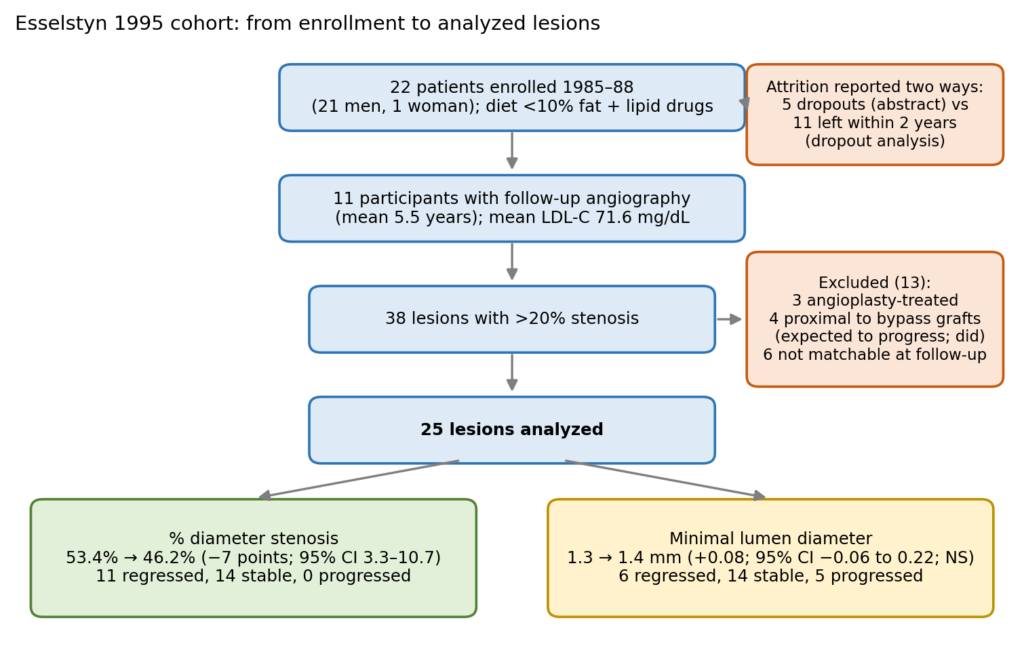
Figure 11. Esselstyn 1995 cohort: enrollment, attrition, lesion selection, and angiographic results by the two methods reported. Source: Esselstyn 1995 (full text).
The same paper reports attrition two ways. Its abstract states that 5 of 22 participants dropped out within two years and 17 maintained the diet; its dropout analysis states that 11 left within two years (three moved, four had work conflicts, three could not maintain the diet, and one chose chirurgia di bypass) [42]. The five dropouts who resumed their previous diet reported 10 eventi cardiaci. The 11 imaged participants had experienced 37 cardiovascular events in the eight years before enrollment. None had a new infarction during follow-up, although two required coronary procedures during the study (repeat angioplasty in one, bypass surgery in the other) and the patient who had bypass surgery, whose frazione di eiezione was below 20%, later died of an arrhythmia [42].
L'aggiornamento del 1999 descrive la coorte come composta da 24 pazienti (23 uomini, 1 donna). Sei pazienti non aderenti sono stati dimessi entro 12-18 mesi e sono tornati alle cure standard; 18 hanno aderito per cinque anni, e 11 di loro hanno effettuato un'angiografia a cinque anni che ha mostrato un arresto della malattia in tutti gli 11 e una regressione in 8 (73%) in base alla percentuale di stenosi. Il colesterolo medio è sceso da 237 a 137 mg/dL nell'arco di cinque anni ed era di 145 mg/dL a 12 anni. È stato riferito che i 18 pazienti aderenti avevano avuto 49 eventi coronarici negli otto anni precedenti l'arruolamento e nessuno durante il follow-up, mentre i sei pazienti dimessi avevano avuto 13 nuovi eventi entro il 1998 [5]. «Nessun evento coronarico» riflette la classificazione degli eventi del rapporto stesso: la stessa coorte includeva un decesso per aritmia ventricolare senza infarto dopo l'angiografia a cinque anni [42]. Il rapporto del 2014 fornisce un ulteriore riepilogo, affermando che 17 pazienti su 22 erano aderenti e che inversione è stata confermata angiograficamente in 4 su 12 [4]. Il colesterolo basale (246 contro 237 mg/dL), la dimensione della coorte (22 contro 24) e il conteggio degli eventi precedenti (37 eventi in 11 pazienti nella discussione del 1995 contro 49 in 18 pazienti nel 1999) differiscono tra i vari rapporti. Circolano due diverse cifre del 73%: 8 su 11 pazienti sottoposti a diagnostica per immagini con regressione per percentuale di stenosi, e 16 dei 22 pazienti originali che seguivano ancora la dieta nel 1995 [5, 42].
Il confronto tra gli eventi successivi all'arruolamento e gli eventi degli otto anni precedenti è vulnerabile alla regressione verso la media, poiché i pazienti solitamente entrano in tali programmi dopo una serie di eventi. Il regime combinava la dieta con i farmaci, quindi il contributo indipendente della dieta non può essere stimato.
10.2 La coorte del 2014 di 198 pazienti
Progettazione e arruolamento. Sono stati seguiti duecento volontari consecutivi auto-riferiti con malattie cardiovascolari; due sono stati persi al follow-up, lasciandone 198 (91% uomini; età media 62,9 anni; follow-up medio 44,2 ± 24,1 mesi). La malattia coronarica è stata documentata in 195 pazienti, tramite angiografia o angio-TC in 180; 44 avevano avuto un precedente infarto miocardico. Tutti erano non fumatori; 161 soffrivano di iperlipidemia, 60 di ipertensione e 23 di diabete. L'intervento consisteva in un singolo seminario di cinque ore con follow-up telefonico o via e-mail, e i pazienti continuavano i loro consueti farmaci cardiaci, che non sono stati registrati. L'attività fisica era incoraggiata ma non richiesta [4].
Aderenza e raccolta dei dati. I pazienti che evitavano carne, pesce e latticini, e consapevolmente qualsiasi olio aggiunto, sono stati classificati come aderenti. I dati sono stati raccolti telefonicamente nel 2011-2012, dai parenti per coloro che erano deceduti. Non sono stati riportati valori lipidici [4].
Risultati, con denominatori. Su 177 pazienti aderenti, 112 hanno riferito angina al basale, di cui 104 (93% nel testo; la tabella indica 105, 94%) sono migliorati. L'«inversione» è stata documentata in 39 su 177 (22%) tramite test radiografici o da sforzo. Diciotto su 177 (10%) sono stati classificati come peggiorati: i ricercatori hanno giudicato nove di questi eventi come non correlati alla dieta (inclusi due interventi di bypass coronarico in pazienti asintomatici persuasi dai loro medici, stent trombosi dopo la sospensione del clopidogrel, e un ictus dopo il rifiuto del warfarin) e quattro come progressione della malattia (un ictus, due interventi di bypass, un re-stenting). Ci sono stati cinque decessi non cardiaci e nessun decesso cardiaco. Il tasso di eventi principale dello 0,6% conta solo l'ictus come evento maggiore correlato alla progressione; una tabella supplementare nello stesso articolo elenca invece un tasso di eventi del 2,2% per i pazienti aderenti [4]. Su 21 pazienti non aderenti, 13 (62%) hanno avuto almeno un evento: due morti cardiache improvvise, un trapianto di cuore, due ictus ischemici, quattro procedure di stenting, tre interventi di bypass e una endoarterectomia [4].
Perché il contrasto non è causale. I gruppi non erano randomizzati; i partecipanti si sono auto-selezionati in un programma che avevano cercato; l'aderenza è stata auto-riferita e classificata a posteriori; i ricercatori hanno accertato e valutato gli eventi per telefono e deciso quali fossero correlati alla dieta; l'imaging è stato guidato da criteri clinici piuttosto che dal protocollo; l'uso di farmaci non è stato registrato; e sette degli eventi del gruppo non aderente erano rivascolarizzazione procedure, che dipendono dai sintomi e dalle decisioni del medico. I pazienti aderenti e non aderenti differivano anche al basale, per esempio il 93% contro il 76% di uomini [4]. Il contrasto grezzo del 62% rispetto allo 0,6% può essere diviso, ma il quoziente non è un rischio relativo causale valido o numero di pazienti da trattare: i gruppi non erano randomizzati e le definizioni degli eventi applicate non sono comparabili. I partecipanti iscritti dopo il 2007 hanno ricevuto una copia del libro dell'autore principale come parte del programma [4].
10.3 Cosa può e cosa non può sostenere il lavoro di Esselstyn
Il programma di Esselstyn merita rilievo per tre ragioni. È l'espressione reale più intensiva della leva dei cibi integrali: niente olio, niente alimenti di origine animale nella coorte del 2014, niente alimenti trasformati e abbondanti verdure a foglia verde. Dimostra che alcuni pazienti motivati con malattie gravi possono sostenere una tale dieta per anni, con 16 dei 22 pazienti originali che la seguivano ancora nel 1995 [42] e un'aderenza auto-riferita dell'89% nella coorte del 2014 [4]. E ha generato ipotesi specifiche e verificabili — nitrati dalle verdure a foglia e ossido nitrico, protezione endoteliale, esclusione dell'olio — che la Sezione 5 valuta rispetto a prove indipendenti.
Ciò che non può sostenere è un peso causale per l'affermazione oltre l'ApoB o per l'affermazione di superiorità. La coorte del 1995 ha combinato la dieta con colestiramina e lovastatina e ha raggiunto un LDL-C medio di 71,6 mg/dL, un livello al quale la terapia farmacologica concomitante è una spiegazione plausibile per parte del risultato angiografico, sebbene il disegno non controllato non possa stabilire che i farmaci da soli ne siano responsabili o che questo LDL-C garantisca l'arresto della progressione [42]; solo 11 pazienti sono stati sottoposti a imaging, 13 su 38 lesioni sono state escluse e l'articolo riporta il logoramento in due modi (Figura 11). La coorte del 2014 non aveva dati lipidici, aderenza auto-riferita ed esiti valutati dai ricercatori (Sezione 10.2). Considerate insieme agli studi lipidici randomizzati, due osservazioni diventano comunque più plausibili: un LDL-C molto basso e sostenuto ottenuto con una dieta a base di cibi integrali più farmaci è compatibile con l'arresto della malattia angiografica nella maggior parte dei pazienti sottoposti a imaging [20, 21], e l'angina è migliorata nella maggior parte dei pazienti, coerentemente con i risultati randomizzati di Ornish e Heidelberg [6, 61, 62]. Rimangono irrisolti il contributo indipendente della dieta, se l'esclusione di olio, noci e avocado aggiunga qualcosa, il vero tasso di eventi in una popolazione rappresentativa e come i risultati si confronterebbero con un programma mediterraneo o a base di cibi integrali a più alto contenuto di grassi ugualmente supportato.
11. Studi clinici sullo stile di vita randomizzati e controllati (principalmente di Livello 2)
11.1 Il Lifestyle Heart Trial
Design. Su 193 pazienti potenzialmente idonei, 93 sono rimasti idonei dopo l'angiografia e sono stati randomizzati con un disegno a invito (53 sperimentali, 40 di controllo); rispettivamente 28 e 20 hanno accettato di partecipare, per un totale di 48 partecipanti allo studio. Trentacinque (20 sperimentali, 15 di controllo) hanno completato i cinque anni di angiografia coronarica quantitativa, letta in cieco rispetto all'allocazione [6]. L'intervento combinava una dieta vegetariana a base di cibi integrali con il 10% di grassi con una moderata esercizio aerobico, gestione dello stress (87 minuti al giorno a un anno, 49 a cinque anni), cessazione del fumo e supporto psicosociale di gruppo. I pazienti sperimentali non hanno assunto farmaci ipolipemizzanti; 9 su 15 pazienti di controllo (60%) li hanno iniziati tra il primo e il quinto anno [6].
Angiografia: quale rapporto, quale coorte. Two reports describe this trial and are often quoted interchangeably, which makes them look inconsistent. The 1990 Lancet report covers the first year in all 48 participants, analyzing 195 lesions: mean percent diameter stenosis fell from 40.0% (SD 16.9) to 37.8% (16.5) in the experimental group and rose from 42.7% (15.5) to 46.1% (18.5) in controls; among lesions more than 50% stenosed the change was 61.1% to 55.8% versus 61.7% to 64.4%; and 18 of 22 experimental patients (82%) changed in the direction of regression [63]. The 1998 JAMA report covers the 35 participants who completed five-year angiography, a subset with slightly different baseline values (38.92% experimental, 42.50% control), and reports changes rather than start-and-end values [6]. The figures below are from the 1998 report unless stated; a 1990 value and a 1998 value should never be compared directly, because they describe different patients.
Percent diameter stenosis changed by −3.07 percentage points (95% CI −5.91 to −0.24) in the experimental group and +11.77 points (95% CI 3.40 to 20.14) in controls at five years (P = 0.001), corresponding to a 7.9% relative improvement and a 27.7% relative worsening [6]. These are changes in lumen narrowing, not a 7.9% removal of plaque volume. Minimum lumen diameter was unchanged in the experimental group (+0.001 mm) and fell 0.34 mm in controls (P = 0.05). The reference (“normal”) segment diameter decreased slightly in the experimental group (−0.13 mm) and widened slightly in controls (P = 0.01) [6]. Because percent stenosis is calculated relative to that reference segment, a stable minimum diameter with a narrowing reference segment will register as reduced stenosis; the authors interpreted the reference-segment change as flow streamlining [6]. Within the experimental group, stenosis change tracked adherence tertiles (−6.81, −3.02, and −0.37 points; n = 6, 7, and 6), an observational analysis within a randomized trial [6].
Lipids. LDL-C fell from 143.8 to 86.6 mg/dL (−40%) at one year and was 115.4 mg/dL (−20%) at five years; triglycerides rose (227.8 to 258.2 mg/dL at one year), HDL-C fell (40.1 to 34.8 mg/dL at five years), and ApoB returned to baseline by year five as described in Section 5.6. LDL-C did not differ between groups at five years, largely because most controls took lipid-lowering drugs [6].
Events and angina. Over five years there were 25 cardiac events among 28 experimental patients and 45 among 20 controls (rate ratio for controls 2.47; 95% CI 1.48 to 4.20) [6]. These are recurrent-event counts, not numbers of patients with an event, and they are dominated by procedures and hospitalizations: myocardial infarction 2 versus 4, angioplasty 8 versus 14, bypass surgery 2 versus 5, cardiac hospitalizations (which include those events) 23 versus 44, and deaths 2 versus 1 [6]. Hard events were too few for comparison. Reported angina frequency fell 91% within the experimental group at one year (with a 42% fall in duration and a 28% fall in severity) and 72% at five years [6, 63]; between-group differences were no longer significant at five years because the most symptomatic controls had undergone revascularization [6]. The control-group change in angina frequency at one year is given as a 186% increase in the 1998 paper but as 165% in the 1990 report [6, 63]; the difference has not been reconciled and both are stated here.
Attrition and bias. Seven patients lacked one-year angiograms, and four in each group lacked five-year angiograms; fourteen lesions were unavailable overall—four in the experimental group and ten in controls, including four control lesions excluded after revascularization—which would bias toward the null [6]. A correction notice added an omitted author [6].
Interpretazione. Randomizzazione supports a causal reading of the comparison between the whole lifestyle package and usual care of the time, though post-allocation consent and attrition limit that confidence. The inability to isolate diet is a limitation of attribution, not an absence of randomization. Participation was selected after allocation: 93 patients were randomized by the invitational design and 48 then consented. Similar consent proportions in the two arms do not eliminate selection bias, and small size and attrition are further limitations.
11.2 PET perfusion (Gould 1995)
Gould and colleagues reported that, in the same 20 experimental and 15 control patients, the size and severity of perfusion abnormalities on rest–dipyridamole PET improved with the lifestyle intervention and worsened in controls, who received mainly antianginal therapy [61]. This is a functional outcome in the same patients, not an independent replication, and it is distinct from ventricular function and angiographic anatomy. Freeman and colleagues’ summary of a “400% increase in perfusione miocardica” could not be traced to this report and should not be reused [2].
11.3 The Multicenter Lifestyle Demonstration Project
This nonrandomized project followed 333 patients eligible for revascularization: 194 who chose the lifestyle program and 139 controls who underwent revascularization. At three years, 150 of 194 experimental patients (77%) had avoided revascularization, and rates of myocardial infarction, stroke, and death per patient-year were similar between groups [64]. The 77% describes procedure avoidance among self-selected patients; it is not a randomized 77% reduction in procedures or events. Freeman and colleagues’ statement that demonstration projects produced a “greater than 90% reduction in angina within weeks” cites this project and a 24-site program evaluation [2, 65]; the specific study, outcome, and time point could not be traced, and the verified one-year 91% figure from the Lifestyle Heart Trial cannot support a claim about weeks.
11.4 Lower-fat but non-vegan angiographic trials
In STARS, 90 men with coronary disease were randomized to usual care, a lipid-lowering diet (27% of energy from fat), or the diet plus cholestyramine, with angiography at 39 months. Mean absolute width of coronary segments narrowed 0.201 mm with usual care, was unchanged with diet alone (+0.003 mm), and widened 0.103 mm with diet plus cholestyramine; the proportion with progression was 46%, 15%, and 12% respectively [66]. In the Heidelberg trial, 113 men were randomized to usual care or intensive exercise plus a low-fat, low-cholesterol diet without lipid drugs; at one year, lesions progressed in 23% versus 48% and regressed in 32% versus 17% [62]. At six years, 90 patients were re-evaluated, and lipid differences between groups were no longer significant [67]. In TC-DISCO, 92 patients with nonobstructive disease on optimal medical therapy were randomized to added intensive dietary counseling with a DASH-type pattern and activity checks, or to medical therapy alone; after about 67 weeks, noncalcified plaque volume fell more with the intervention (−51.3 versus −21.3 mm³; P = 0.045), although the change in total ateroma volume did not differ significantly between groups [68]. At about six years, most of the weight lost during the intervention had been regained in both groups, and one evento cardiovascolare avverso maggiore had occurred in the DASH group versus four (including one fatal myocardial infarction) among controls—too few events for inference [69]. These trials show that omnivorous or lower-fat regimens well above 10–15% fat also slowed progression.
12. The Strongest Competing Evidence (Tiers 1–2)
12.1 DASH and DASH-Sodium
In controlled feeding of 459 adults for eight weeks, the DASH combination diet lowered systolic and diastolic pressure by 5.5 and 3.0 mm Hg more than a typical American control diet, and by 11.4 and 5.5 mm Hg in the 133 participants with hypertension [11]. Combinare la dieta DASH con un basso apporto di sodio ha ridotto la pressione sistolica di 7,1 mm Hg nei partecipanti normotesi e di 11,5 mm Hg in quelli con ipertensione di stadio 1, rispetto alla dieta di controllo ad alto contenuto di sodio [16]. Questi benefici sono stati ottenuti includendo latticini a basso contenuto di grassi nella dieta.
12.2 PREDIMED
Il rapporto PREDIMED del 2013 è stato ritirato a causa di irregolarità nella randomizzazione e ripubblicato nel 2018 con una nuova analisi. Tra 7.447 adulti ad alto rischio cardiovascolare seguiti per una mediana di 4,8 anni, si sono verificati eventi cardiovascolari maggiori in 96 su 2.543 partecipanti (3,8%) assegnati a una dieta mediterranea con aggiunta di olio extravergine di oliva, in 83 su 2.454 (3,4%) assegnati a una dieta mediterranea con aggiunta di frutta a guscio e in 109 su 2.450 (4,4%) nel gruppo di controllo a cui era stato consigliato di ridurre i grassi alimentari (hazard ratio 0,69, IC 95% da 0,53 a 0,91 e 0,72, IC 95% da 0,54 a 0,95); i risultati sono stati simili dopo aver escluso 1.588 partecipanti con deviazioni note o sospette dal protocollo [12]. Il braccio di controllo ha ricevuto consigli, non una dieta a base vegetale a bassissimo contenuto di grassi.
12.3 Lo studio Lyon Diet Heart
In 605 sopravvissuti a un primo infarto miocardico seguiti per una media di 46 mesi, la dieta di tipo mediterraneo ha ridotto la morte cardiaca più l'infarto non fatale (composito 1: 14 contro 44 eventi), il composito 1 più angina instabile, colpo apoplettico, insufficienza cardiaca, e l'embolia (composito 2: 27 contro 90), e il composito 2 più eventi minori che richiedono l'ospedalizzazione (composito 3: 95 contro 180) [70]. L'abstract riporta rapporti di rischio aggiustati che vanno da 0,28 a 0,53 tra i tre compositi; la tabella supplementare dell'articolo di Esselstyn del 2014 assegna 0,28 (IC 95% da 0,15 a 0,53) al composito 1 [4, 70]. Le sintesi di riduzioni "fino al 65%" o "70%" non corrispondono a nessun singolo endpoint e dovrebbero essere evitate. Il comparatore era una dieta prudente di tipo occidentale piuttosto che una dieta sana e attiva [10], e l'intervento prevedeva la fornitura di una margarina ricca di acido alfa-linolenico in sostituzione di burro e panna [13]. Lo studio di Lione dimostra che una dieta ricca di vegetali ma non esclusivamente vegetale con una quantità sostanziale di grassi insaturi riduce gli eventi ricorrenti.
12.4 CORDIOPREV
Lo studio CORDIOPREV ha randomizzato 1.002 pazienti con malattia coronarica a una dieta mediterranea (almeno il 35% di grassi; 40-60 g/giorno di olio extravergine di oliva) o a una dieta a basso contenuto di grassi e ad alto contenuto di carboidrati complessi (meno del 30% di grassi, meno del 10% di grassi saturi, carne magra e latticini a basso contenuto di grassi consentiti), con un supporto dietetico ugualmente intensivo e un follow-up mediano di sette anni. I grassi raggiunti sono stati il 40,5% dell'energia nel braccio mediterraneo e il 32,1% nel braccio a basso contenuto di grassi. Il composito primario si è verificato in 87 (17,3%) contro 111 (22,2%) pazienti (hazard ratio non aggiustato 0,745; IC 95% da 0,563 a 0,986; modelli aggiustati da 0,719 a 0,753). Il beneficio è stato statisticamente dimostrabile negli uomini (hazard ratio 0,669; IC 95% da 0,489 a 0,915), mentre la stima nel sottogruppo più piccolo di 175 donne è stata inconcludente piuttosto che mostrare assenza di beneficio; nessun singolo componente differiva significativamente; i lipidi e il glucosio non sono cambiati in modo diverso tra le diete; e l'86,6% assumeva statine al basale. Un numero maggiore di partecipanti al gruppo a basso contenuto di grassi ha abbandonato la dieta (17,2% contro 9,2%). Lo studio è stato finanziato principalmente da fondazioni per l'olio d'oliva [10].
CORDIOPREV mette in discussione l'affermazione generale secondo cui meno grassi totali siano sempre preferibili: nell'intervallo 30-40%, tra gli onnivori che assumono statine, la dieta mediterranea a più alto contenuto di grassi ha dato risultati migliori. Lo studio non testa una dieta composta da alimenti integrali, priva di prodotti animali, con il 10-15% di grassi, che differisce dal suo braccio a basso contenuto di grassi per livello lipidico, contenuto di alimenti di origine animale e grado di lavorazione degli alimenti.
12.5 Confronti diretti tra diete esclusivamente vegetali e diete mediterranee
No trial has compared these diets on clinical events, and the three risk-factor trials below provide related but distinct comparisons rather than one comparison repeated. In a 16-week crossover trial in 62 overweight adults (52 completers), a low-fat vegan diet reduced body weight by 6.0 kg with no change on a PREDIMED-style Mediterranean diet (treatment effect −6.0 kg; 95% CI −7.5 to −4.5), and lowered LDL-C by 15.3 mg/dL with no significant change on the Mediterranean diet (treatment effect −14.8 mg/dL; 95% CI −23.5 to −6.2), whereas the Mediterranean diet lowered systolic pressure more (treatment effect +6.0 mm Hg favoring Mediterranean; 95% CI 1.0 to 10.9) [23]. The lipid estimate covers the 43 participants with no change in lipid-lowering medication and the blood-pressure estimate the 41 with no change in antihypertensive medication; a significant carryover effect for systolic pressure appeared in the analysis of all participants, including those whose medication changed, but not in the stable-medication subgroup [23]. Reported fat intake at the end of the vegan phase was 17% of energy (95% CI 15 to 19), so the trial tested a low-fat vegan diet rather than a 10–15%-fat one, and one participant’s sequence assignment was changed after randomization so that a mother and daughter followed the same diet [23]. The trial was conducted by an organization that advocates plant-based diets. In CARDIVEG, a three-month crossover in 107 low-risk overweight adults, energy-restricted lacto-ovo-vegetarian and Mediterranean diets produced similar weight and fat loss; LDL-C fell more on the vegetarian diet, triglycerides fell more on the Mediterranean diet, and vitamin B12 fell on the vegetarian diet [71]. EVADE CAD compared a vegan diet with the AHA diet at similar fat intakes (Section 5.3) [9]. Only Barnard compared a vegan with a Mediterranean diet; CARDIVEG compared a lacto-ovo vegetarian diet with a Mediterranean one, and EVADE compared a vegan diet with the AHA diet. Read separately, each found the plant-based arm lowering LDL-C at least as much, with the Mediterranean comparator better on blood pressure (Barnard) or triglycerides (CARDIVEG); these are not three replications of a single comparison.
12.6 The Cochrane review and the event gap
The 2021 Cochrane review of vegan diets (search to February 2020) included 13 randomized trials with at least 12 weeks of follow-up; none reported cardiovascular clinical endpoints. Only one trial, of 63 participants, addressed prevenzione secondaria against another dietary intervention, and showed no clear effect on lipids or blood pressure (low- or very-low-certainty evidence) [72]. Its stricter eligibility—vegan only, minimum 12 weeks, active or minimal-intervention comparators—explains why its conclusions are more cautious than those of the Koch and Wang meta-analyses, which admitted vegetarian diets and different comparators [7, 22]. An updated search for this review, through 10 September 2026, found no published randomized trial of a very-low-fat vegan diet with cardiovascular events as an outcome. The absence of event evidence is a gap, not evidence of no benefit. Pooled analyses also need checking for cohort overlap: the 1990 one-year and 1998 five-year Lifestyle Heart Trial reports describe the same randomized cohort, so an analysis that enters them as separate trials double-counts one cohort and inflates precision.
Direct comparisons are used wherever available. Diets are not ranked by comparing effect sizes across unrelated trials, because populations, background therapy, adherence, and endpoints differ.
Figure 12 displays the randomized trials with clinical outcomes discussed in this section alongside the Lifestyle Heart Trial’s recurrent-event ratio.
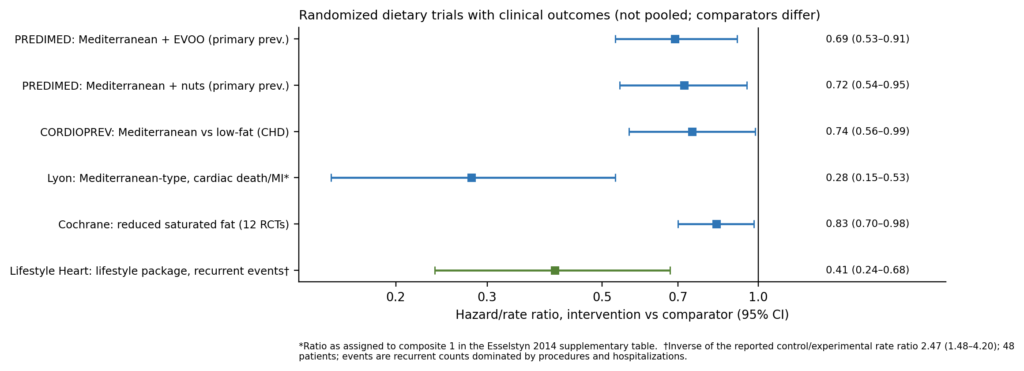
Figure 12. Randomized dietary trials with clinical outcomes. Estimates are shown side by side, not pooled; comparators, populations, and endpoints differ. No randomized trial of a very-low-fat vegan diet has reported clinical events.
12.7 Applying the same standard to the comparator trials
This review has examined the Esselstyn and Ornish studies closely, and the trials that favor Mediterranean diets deserve the same scrutiny. Table 2 asks the same questions of each. The aim is not to label any trial worthless but to be clear about what each can support.
PREDIMED. The 2018 republication documents the main problems itself. Sealed envelopes were used to conceal allocation only during part of the pilot phase; 425 household members were enrolled without randomization and given the same diet as their relative; at one site, 467 participants were assigned by clinic rather than individually; and randomization tables were used inconsistently at another site [12]. The authors reanalyzed the trial with statistical adjustment, and the results were similar when the 1,588 affected participants were excluded (hazard ratios 0.71 and 0.68 in the remaining 5,859) [12]. The control group received a yearly leaflet with low-fat advice until September 2006 and only afterward the same frequency of contact as the Mediterranean groups; its total fat intake changed little, so PREDIMED compared a supplemented Mediterranean diet with a lightly advised usual diet, not with a true low-fat diet [12]. Benefit was also present among participants recruited after control-group contact was increased—hazard ratio 0.49 (95% CI 0.26 to 0.92) versus 0.77 (0.59 to 1.00) before the October 2006 change (P = 0.21 for heterogeneity)—which argues against unequal support as the sole explanation, though a recruitment-period comparison cannot exclude some contribution from it [12]. Study discontinuation was 11.3% in the control group versus 4.9% in the Mediterranean groups. The olive oil and nuts were donated by producers and supplied free, participants knew their assignment, and only the endpoint committee was blinded [12]. The trial was stopped at its fourth interim analysis [12], and trials stopped early for benefit tend to overestimate effect size. Finally, the composite result was driven mainly by stroke (combined hazard ratio 0.58; 95% CI 0.42 to 0.82), whereas myocardial infarction (0.80; 0.53 to 1.21), cardiovascular death (0.80; 0.51 to 1.24), and death from any cause (0.98; 0.77 to 1.24) did not differ significantly; the authors attribute this to limited power [12] (Figure 13).
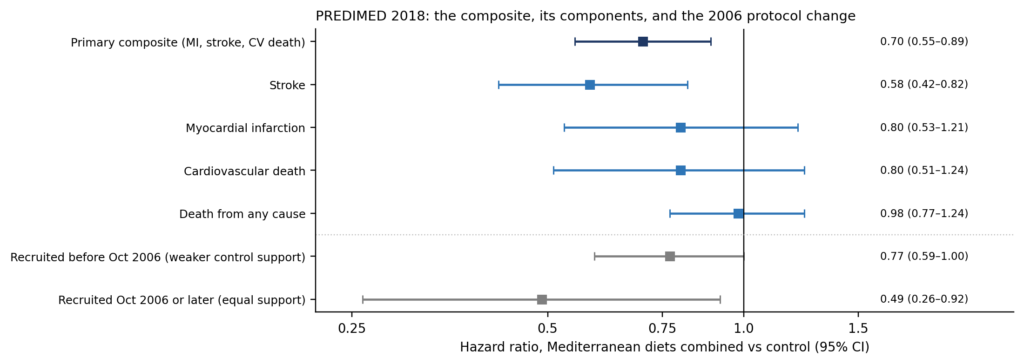
Figure 13. PREDIMED 2018: the composite result and its components (Mediterranean diets combined versus control), and the effect before and after the October 2006 increase in control-group support. Source: Estruch 2018, Table 3 and text.
Lyon Diet Heart Study. Lyon randomized 605 survivors of a first myocardial infarction in a single-blind design and was stopped early for benefit at a mean of 27 months, with follow-up later extended to 46 months [13, 14, 70]. Its comparator was a prudent Western-type diet rather than an intensively supported healthy diet [70]. The large reduction in events occurred while serum lipids, blood pressure, and body mass index remained similar between groups [14]. That is a genuine signal that a dietary pattern can reduce events through pathways other than lipid lowering (Section 5), but it comes from a small, early-stopped trial whose effect size is likely inflated.
CORDIOPREV. CORDIOPREV was a single-center trial funded principally by olive-oil foundations; benefit was statistically demonstrable only in men, with an inconclusive estimate in the smaller female subgroup; no single component of the composite was significant; and its low-fat arm reached 32.1% of energy from fat [10]. It has the strongest design of the three because both arms received equally intensive support, but it tests a moderate-fat omnivorous comparator, not a very-low-fat plant diet.
Problems shared across nutrition science. Diverse debolezze si applicano a quasi ogni studio in questa revisione, qualunque sia la dieta favorita. La dieta viene solitamente misurata tramite questionario; nell'Adventist Health Study-2, le correlazioni di validità del questionario rispetto ai richiami ripetuti delle 24 ore erano 0,76 per carne rossa ma 0,53 per il pesce nei partecipanti bianchi [53]. I partecipanti agli studi sulle diete sanno cosa stanno mangiando. L'aderenza svanisce, come dimostrato dall'interruzione del gruppo di controllo in PREDIMED, dall'abbandono della dieta in CORDIOPREV e dal calo dei punteggi di aderenza nel Lifestyle Heart Trial [6, 10, 12]. I comparatori sono spesso deboli: il gruppo di controllo iniziale di PREDIMED, la dieta prudente di Lione e le cure abituali del Lifestyle Heart Trial. Gli studi sono spesso piccoli o interrotti precocemente. E gli interessi corrono in ogni direzione: produttori di olio d'oliva e frutta a guscio, sviluppatori di programmi e organizzazioni di patrocinio hanno tutti finanziato o guidato gli studi qui discussi [4, 10, 12, 23].
Cosa cambia la critica. Queste limitazioni riducono la fiducia nell'entità del beneficio mediterraneo e in qualsiasi affermazione secondo cui la dieta mediterranea sia provata come superiore. Esse non elevano la posizione della VLF-WFPB, che non ha alcuno studio randomizzato con eventi clinici. Uno studio randomizzato con eventi clinici, anche se imperfetto, affronta la questione causale che una serie di casi non controllati non può affrontare, sebbene il suo peso dipenda ancora da bias, precisione e da quanto direttamente testi la dieta in questione. Applicare lo stesso scetticismo a entrambe le parti è ciò che consente di dare fiducia alle conclusioni di questa revisione.
Tabella 2. Applicazione delle stesse domande ai principali studi su ciascun lato del dibattito.
| Domanda | PREDIMED | CORDIOPREV | Lyon Diet Heart | Lifestyle Heart Trial | Coorte Esselstyn 2014 |
| Livello di evidenza | 1 | 1 | 1 | 2 (conteggio ridotto degli eventi) | 4 |
| Randomizzato? | Sì, con deviazioni che hanno interessato 1.588 su 7.447; buste utilizzate solo in parte del progetto pilota [12] | Sì [10] | Sì [14] | Sì, su invito; la metà degli aventi diritto ha rifiutato [6] | No [4] |
| Chi era in cieco? | Solo il comitato per gli endpoint [12] | Endpoint aggiudicazione riportato come mascherato; partecipanti e dietisti non in cieco, come in qualsiasi studio dietetico | Design in singolo cieco [14] | Design in singolo cieco [14] | Nessuno; i ricercatori hanno aggiudicato gli eventi [4] |
| Comparatore | Consiglio di ridurre i grassi; opuscolo annuale fino al 2006, poi contatti paritari; il grasso totale è cambiato poco [12] | Dieta a basso contenuto di grassi ugualmente supportata; raggiunto il 32,1% di grassi [10] | Dieta prudente di tipo occidentale [70] | Cure abituali; il 60% ha iniziato farmaci ipolipemizzanti [6] | Volontari non aderenti [4] |
| Interrotto precocemente? | Sì, alla 4ª analisi ad interim [12] | Follow-up mediano di 7 anni [10] | Sì, a 27 mesi; successivamente esteso a 46 mesi [13, 14] | Sì, a 27 mesi; successivamente esteso a 46 mesi [13, 14] | Non applicabile |
| Cosa ha guidato il risultato | Ictus 0,58; IMA 0,80 e morte CV 0,80 non significativi [12] | Beneficio dimostrabile negli uomini; stima su 175 donne inconcludente; nessun singolo componente significativo [10] | Grandi riduzioni con lipidi sierici, PA e BMI simili [14] | Procedure e ospedalizzazioni (conteggi ricorrenti) [6] | Rivascolarizzazioni nel gruppo non aderente [4] |
| Interessi | Olio d'oliva e frutta a guscio donati dai produttori [12] | Principalmente fondazioni per l'olio d'oliva [10] | Non valutato qui | Non valutato qui | Sviluppatore del programma; libro consegnato ai partecipanti [4] |
| Dieta testata vs VLF-WFPB | Mediterranea integrata vs dieta abituale con consigli leggeri | Mediterranea 40,5% di grassi vs onnivora a basso contenuto di grassi 32,1% | Di tipo mediterraneo ricca di ALA | Margarina ricca di ALA più consigli di tipo mediterraneo | Senza olio, senza derivati animali, senza frutta a guscio o avocado |
13. Il grasso totale molto basso è di per sé migliore?
Separare i grassi. I grassi saturi aumentano l'LDL-C e la loro riduzione abbassa gli eventi [26]; i grassi trans industriali dovrebbero essere evitati [73]; i grassi insaturi abbassano l'LDL-C quando sostituiscono i grassi saturi e sono associati alla riduzione degli eventi negli studi sulla dieta mediterranea [10, 12]. Il “grasso totale” raggruppa questi effetti opposti.
Ciò che sostituisce il grasso conta. Nella VLF-WFPB la sostituzione avviene con cereali integrali, legumi, verdura e frutta; in altre diete a basso contenuto di grassi può trattarsi di amido raffinato o zucchero. Nessuno studio ha messo a confronto queste sostituzioni all'interno di una dieta esclusivamente vegetale sugli esiti clinici.
L'unico test diretto all'interno di una dieta vegetale a base di alimenti integrali. In uno studio crossover randomizzato, 40 adulti con un rischio cardiovascolare stimato di almeno il 5% hanno seguito una dieta vegana a base di alimenti vegetali integrali con circa quattro cucchiai o meno di un cucchiaino di olio extravergine di oliva al giorno, per quattro settimane ciascuna; i grassi fornivano rispettivamente il 48% e il 32% dell'energia. Entrambe le fasi hanno ridotto l'LDL-C, il colesterolo totale, l'ApoB, l'HDL-C, il glucosio e la hs-CRP rispetto al valore basale. È stata osservata un'interazione di sequenza: il passaggio da un alto a un basso contenuto di olio ha ridotto l'LDL-C di 12,7 mg/dL (P = 0,04), mentre il passaggio da un basso a un alto contenuto lo ha aumentato di 15,8 mg/dL (P = 0,02); nel primo periodo, l'LDL-C è sceso di 25,5 contro 16,7 mg/dL (P = 0,162) [8]. Nessuna delle due fasi si è avvicinata al 10–15% di grassi, lo studio è stato breve e l'effetto carryover complica l'analisi crossover. Suggerisce che grandi aggiunte di olio possono attenuare la riduzione dell'LDL-C; non dimostra che il 10–15% di grassi sia migliore di una dieta vegetale a base di frutta a guscio e semi intorno al 30%.
Frutta a guscio, semi e olio d'oliva. Le diete mediterranee ricche di olio extravergine d'oliva o integrate con frutta a guscio hanno ridotto gli eventi rispetto ai comparatori [10, 12]. Nessuno studio dimostra che l'esclusione di frutta a guscio, semi o olio d'oliva da una dieta altrimenti povera di grassi saturi migliori gli esiti clinici. La compromissione acuta della dilatazione flusso-mediata dopo un singolo pasto ad alto contenuto di grassi [30], citata a sostegno dell'esclusione dell'olio [4], non può stabilire che gli oli causino l'aterosclerosi.
Trigliceridi, HDL, e ApoB–LDL-C discordanza. Le diete a bassissimo contenuto di grassi e ad alto contenuto di carboidrati possono aumentare i trigliceridi e abbassare l'HDL-C, come nel primo anno del Lifestyle Heart Trial [6]; complessivamente negli studi basati su alimenti vegetali, i trigliceridi non sono cambiati [22], e le diete mediterranee hanno ridotto i trigliceridi più di una dieta vegetariana nel CARDIVEG [71]. Quando le lipoproteine ricche di trigliceridi aumentano, l'LDL-C può sottostimare numero di particelle aterogeniche. Il Lifestyle Heart Trial illustra questo punto: a cinque anni l'LDL-C era inferiore del 20% rispetto al valore basale, mentre l'ApoB no [6]. Gli studi futuri dovrebbero misurare direttamente l'ApoB.
Attribuzione. Laddove la VLF-WFPB supera un comparatore sull'LDL-C, il vantaggio può riflettere la quantità di grassi, la qualità dei grassi (quasi assenza di grassi saturi), la qualità del cibo (fibre, proteine vegetali), la perdita di peso o l'aderenza. Il crossover di Barnard, ad esempio, ha prodotto sia maggiori riduzioni di LDL-C che una maggiore perdita di peso con la dieta vegana [23]. Nessuno studio disponibile separa questi contributi. In base alle prove attuali, un contenuto di grassi totali molto basso non è stabilito come un requisito indipendente; un contenuto di grassi saturi molto basso all'interno di una dieta a base di alimenti integrali è il componente con il supporto causale più forte.
14. Prevenzione, trattamento e inversione
14.1 Risultati che non devono essere confusi
Minor numero di eventi cardiovascolari, progressione più lenta, stabilizzazione della placca, miglioramento dell'angina o della perfusione, riduzione della stenosi angiografica e regressione del volume della placca misurata quantitativamente sono esiti diversi. Anche la prevenzione primaria e secondaria sono contesti diversi.
14.2 Cosa può e cosa non può mostrare l'imaging
L'angiografia coronarica quantitativa misura il lume, non la placca. La percentuale di stenosi dipende dal segmento di riferimento e dal tono vasomotorio, e il rimodellamento esterno (positivo) può nascondere una placca sostanziale dietro un lume normale. La perfusione miocardica e i test da sforzo misurano la funzione; il miglioramento può verificarsi senza regressione anatomica, come notato dai ricercatori di Heidelberg [62]. Ecografia intravascolare e angio-TAC coronarica misurano il volume e la composizione della placca; la TC caratterizza inoltre le placche non calcificate e placca a bassa attenuazione. Il punteggio del calcio coronarico può aumentare quando la placca si stabilizza, perché le statine aumentano la placca calcificata e fibrosa riducendo al contempo le componenti fibroadipose e del nucleo necrotico, quindi la variazione del punteggio del calcio da sola non indica né successo né fallimento [74]. La placca può ingrandirsi sostanzialmente prima che l'angiografia rilevi un restringimento [74]; viceversa, un lume apparentemente più ampio può riflettere cambiamenti nel tono vasomotorio piuttosto che una placca più piccola. In una meta-regressione riassunta da Dawson e colleghi, ogni riduzione dell'1% del volume percentuale di ateroma era associata a una probabilità inferiore di circa il 20% di eventi avversi maggiori, ma non ci sono prove dirette che la regressione stessa riduca gli eventi [74]. La Tabella 3 riassume ciò che ogni reperto può e non può stabilire.
Tabella 3. Cosa possono e cosa non possono stabilire i sintomi e i risultati della diagnostica per immagini.
| Scoprimento | Cosa stabilisce | Cosa non stabilisce |
| Meno angina; migliore stress test o perfusione PET [6, 61, 62] | Migliori sintomi o apporto di sangue miocardico | Una perdita misurata di placca |
| Ridotta percentuale di stenosi angiografica | Un lume meno ristretto rispetto a un segmento di riferimento | La percentuale di placca rimossa; i cambiamenti nel segmento di riferimento possono alterare il risultato [6] |
| Cambiamento nel diametro minimo del lume | Cambiamento assoluto del lume in corrispondenza della lesione | Volume della placca, che rimodellamento esterno può nascondere [74] |
| Cambiamento nel volume o nella composizione della placca tramite CCTA o IVUS | Cambiamento nel compartimento della placca misurato, entro i limiti di acquisizione e segmentazione | Eradicazione della malattia o una riduzione garantita degli eventi |
| Aumento del punteggio del calcio coronarico | Un più alto Punteggio di Agatston, che riflette l'area calcificata, la densità o entrambe | Maggiore carico totale di placca o fallimento del trattamento; le statine aumentano placca calcifica mentre riducono quella fibroadiposa e centro necrotico [74] |
14.3 I parametri di riferimento sui primati e farmacologici
Due gruppi di prove stabiliscono lo standard rispetto al quale dovrebbero essere interpretate le affermazioni sulla regressione dietetica. Nessuno dei due è uno studio dietetico sugli esseri umani, ed entrambi sono citati qui come parametri di riferimento piuttosto che come supporto per una qualsiasi dieta.
Esperimenti controllati sui primati (Livello 5). Nelle scimmie rhesus sottoposte a una dieta aterogena e poi passate a una dieta di regressione, le lesioni ateromatose arterie coronarie hanno perso lipidi [75], mentre le proteine fibrose arteriose si sono comportate diversamente dal compartimento lipidico [76]. Il livello di colesterolo raggiunto era importante: negli animali il cui colesterolo plasmatico era mantenuto intorno a 300 mg/dL c'era un aumento minimo o nullo dell'area del lume attribuibile alla regressione della placca intimale, mentre a circa 200 mg/dL una quota considerevole del guadagno del lume era attribuibile alla regressione della placca, e il contributo dipendeva sia dalle dimensioni della placca che dal tempo [77]. Questa è la cosa più vicina in letteratura a una dimostrazione controllata che la riduzione delle lipoproteine aterogene attraverso mezzi dietetici riduce il compartimento ricco di lipidi mentre il tessuto più denso persiste. Si tratta inoltre di prove su animali, in una specie diversa, con una malattia indotta piuttosto che spontanea, e non può stabilire ciò che una dieta umana ottiene.
Diagnostica per immagini farmacologica (Livelli 1–2). In GLAGOV, 968 pazienti trattati con statine con coronaropatia angiografica sono stati randomizzati a ricevere mensilmente evolocumab o placebo per 76 settimane, e 846 hanno avuto un'ecografia intravascolare seriale valutabile. Il colesterolo LDL ponderato nel tempo era di 36,6 mg/dL rispetto a 93,0 mg/dL, il volume percentuale dell'ateroma è cambiato del -0,95% rispetto allo +0,05% (differenza -1,0 punti percentuali; P < 0.001) e la regressione della placca si è verificata nel 64,3% rispetto al 47,3% dei pazienti [78]. In particolare, il sottostudio di istologia virtuale del trial non ha mostrato una differenza nel volume del calcio denso [78], quindi GLAGOV dimostra una regressione volumetrica piuttosto che un cambiamento di composizione; gli studi progettati per misurare la composizione della placca esulano dallo scopo di questa revisione e non vengono riportati dati sulla composizione. Seguono due confronti. Nessuno studio dietetico ha prodotto una regressione coronarica di tale entità sotto questo livello di rigore, e nessuno studio dietetico qui identificato ha utilizzato affatto l'ecografia intravascolare seriale, che è la modalità che misura il volume dell'ateroma in modo più preciso.
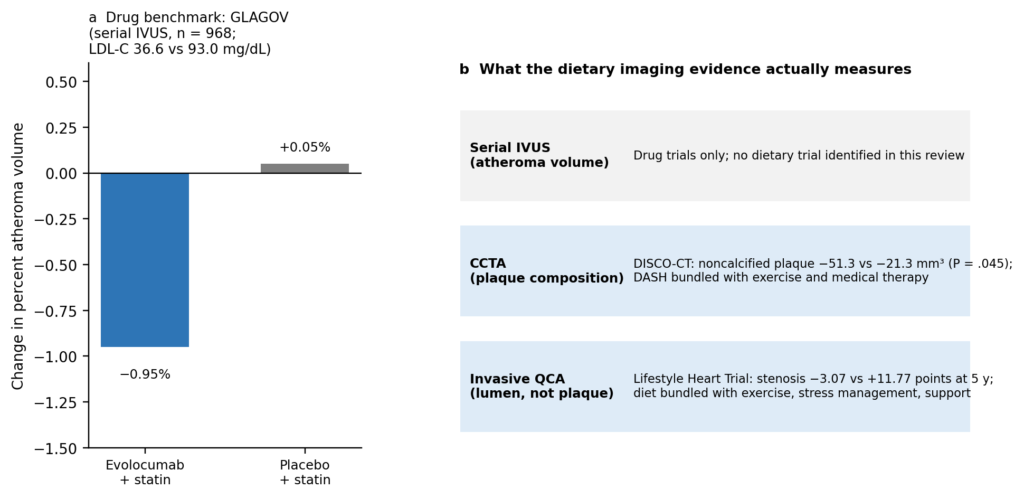
Figura 14. Parametri di riferimento per il cambiamento della placca coronarica. Regressione farmacologica misurata tramite ecografia intravascolare seriale (GLAGOV) insieme alle prove di imaging dietetico disponibili in questa revisione, che utilizza modalità diverse e non può essere collocata sullo stesso asse. Nessuno studio dietetico qui identificato ha utilizzato l'ecografia intravascolare seriale. Fonti: Nicholls 2016; Henzel 2021; Ornish 1998.
L'esercizio fisico come leva aggiuntiva. L'attività fisica si colloca accanto alle tre leve dietetiche piuttosto che al loro interno. Le popolazioni con il minor livello di calcio coronarico sono anche le più attive: gli uomini Tsimane svolgono in media dalle sei alle sette ore e le donne dalle quattro alle sei ore di attività fisica al giorno [35Nei due studi di imaging randomizzati che hanno mostrato benefici, l'esercizio fisico faceva parte dell'intervento piuttosto che essere una covariata controllata: il Lifestyle Heart Trial abbinava l'esercizio aerobico alla dieta [6], e la consulenza sull'attività fisica combinata DISCO-CT con DASH [68]—ed è per questo che nessuno dei due può attribuirne il merito. Non viene fornita qui alcuna stima quantitativa della riduzione di ApoB attribuibile all'allenamento aerobico; il punto resta, a livello qualitativo, che la dieta, l'attività e la terapia ipolipemizzante agiscono su percorsi sovrapposti e sono complementari piuttosto che concorrenti.
14.4 Cosa supportano le evidenze in ciascun ambito
Prevenzione primaria. Le evidenze consistono in associazioni di coorte [40], dati sulla popolazione (Sezioni 6–8) e studi lipidici randomizzati [22]. Non esiste alcuno studio clinico randomizzato sugli eventi per la VLF-WFPB.
Prevenzione secondaria (trattamento). Il Lifestyle Heart Trial ha ridotto l'angina, le procedure cardiache e i ricoveri ospedalieri grazie a un pacchetto che includeva una dieta vegetariana a bassissimo contenuto di grassi [6]. Le riduzioni degli eventi randomizzate con la sola dieta nella prevenzione secondaria provengono da studi di tipo mediterraneo [10, 70].
Progressione rallentata e regressione parziale. Programmi intensivi sullo stile di vita che incorporano diete vegetariane a bassissimo contenuto di grassi hanno dimostrato un modesto regressione angiografica in pazienti selezionati; il contributo indipendente della dieta e della restrizione dei grassi totali rimane incerto [6, 42]. Anche le diete a basso contenuto di grassi ma non vegane hanno rallentato la progressione angiografica [62, 66], e un programma di tipo DASH aggiunto alla terapia medica ha ridotto la placca non calcificata alla TC [68]. La regressione parziale appare più probabile quando si ottengono ampie e sostenute riduzioni delle lipoproteine aterogene, spesso con farmaci, e nel programma Ornish è stata osservata una maggiore regressione a cinque anni rispetto a un anno [6]. Regressione non significa eradicazione della malattia o rischio futuro nullo.
La revisione Dawson. Come riassunto nei punti chiave pubblicati dall'ACC, la revisione dello stato dell'arte del JACC del 2022 ha giudicato limitato l'effetto dimostrato di dieta, esercizio fisico e cessazione del fumo sul volume e sulla composizione della placca coronarica [74]. Le affermazioni talvolta attribuite a quella revisione in sintesi secondarie, inclusa l'asserzione che la maggior parte dei bracci dietetici trattati con statine sia progredita, non vengono utilizzate qui. Le limitate evidenze di regressione dovute alla sola dieta non significano che il trattamento dietetico abbia scarso valore clinico: stabilizzare la placca, migliorare la perfusione e prevenire la progressione può essere clinicamente significativo anche quando il cambiamento anatomico è piccolo, sebbene gli studi dietetici esistenti non stabiliscano il meccanismo di alcuna riduzione degli eventi.
15. Fattibilità, adeguatezza e sicurezza
Aderenza. L'aderenza riportata è stata elevata in volontari selezionati: 89% secondo l'auto-segnalazione nella coorte Esselstyn del 2014 [4], e 94% contro 70% per la dieta vegana rispetto a quella AHA a otto settimane nello studio EVADE CAD, i cui partecipanti rappresentavano il 14% di coloro che soddisfacevano i criteri iniziali [9]. Nel Lifestyle Heart Trial, la metà dei pazienti idonei invitati ha rifiutato e il punteggio di aderenza è sceso da 1,29 a un anno a 1,06 a cinque anni [6]. Nel corso di sette anni nel CORDIOPREV, un numero maggiore di pazienti ha abbandonato una dieta convenzionale a basso contenuto di grassi rispetto a una dieta mediterranea [10].
Nutrienti. L'integrazione di vitamina B12 è essenziale; l'apporto mediano nel braccio vegano EVADE è sceso a 1,2 µg/giorno e i livelli di B12 sono diminuiti durante la fase vegetariana di CARDIVEG [9, 71]. Anche gli apporti di zinco e di acidi grassi omega-3 sono stati inferiori con la dieta vegana in EVADE [9]. Lo stato di calcio, vitamina D, iodio, ferro e omega-3 a catena lunga richiede pianificazione, e cibi fortificati o integratori sono appropriati laddove l'apporto è inadeguato [79]; il concetto di “cibo integrale” non dovrebbe diventare un motivo per rifiutarli. Gli alimenti vegetali terrestri non fortificati forniscono acido alfa-linolenico ma poco o nessun EPA o DHA preformato, che gli integratori derivati dalle alghe e i prodotti fortificati possono fornire all'interno di una dieta vegana [79]; il protocollo di Esselstyn ha aggiunto i semi di lino come fonte di acido alfa-linolenico [4]. Una restrizione aggressiva dei grassi non dovrebbe sostituire l'energia necessaria o i grassi essenziali.
Energia e proteine. L'apporto proteico mediano nella dieta vegana EVADE è stato di 50 g/giorno (12,9% dell'energia) [9]. Le diete vegetariane senza restrizioni energetiche hanno ridotto l'apporto energetico di circa 276 kcal/giorno rispetto alle diete abituali [7], e nella coorte Esselstyn del 2014 i 135 pazienti con dati sul peso hanno perso in media 18,7 libbre [4]. La bassa densità energetica è un vantaggio per la perdita di peso, ma un potenziale rischio per gli adulti più anziani con scarso appetito o sarcopenia e per le persone fisicamente attive con elevati fabbisogni; l'adeguatezza proteica ed energetica dovrebbe essere pianificata individualmente.
Qualità della vita. In EVADE CAD, i punteggi della qualità della vita sono migliorati in modo simile in entrambe le diete [9].
Dieta e farmaci. Le prove randomizzate aggregate indicano che la riduzione dietetica dell'ApoB è di circa il 14% [22]. Una stima comparabile della riduzione dell'ApoB sotto statina intensiva o PCSK9 terapia non è presentata qui, pertanto non viene effettuato alcun confronto numerico; il punto clinico si basa su altri presupposti. Nelle ASCVD accertate, la dieta è un complemento alla terapia guidata dalle linee guida, non un sostituto, e la terapia indicata non deve essere sospesa o interrotta per seguire una qualsiasi dieta.
Questa revisione ha scopo didattico. I cambiamenti dietetici dovrebbero essere apportati parallelamente, e non in sostituzione, alla terapia cardiovascolare prescritta, e gli aggiustamenti dei farmaci spettano al medico curante.
16. Posizionamento clinico
Le linee guida AHA/ACC 2023 per la malattia coronarica cronica raccomandano una dieta che privilegi verdura, frutta, legumi, frutta a guscio, cereali integrali e proteine magre per ridurre gli eventi cardiovascolari (classe 1, livello B-R), e affermano che la riduzione dei grassi saturi a meno del 6% dell'energia e la loro sostituzione con grassi monoinsaturi e polinsaturi, carboidrati complessi e fibre può essere benefica (classe 2a) [73]. La sua illustrazione nutrizionale elenca grasso monoinsaturo come l'olio d'oliva e i grassi polinsaturi tra gli alimenti da scegliere [73]. Il linea guida multisocietaria sulla dislipidemia ACC/AHA 2026, che sostituisce le linee guida sul colesterolo del 2018, descrive i modelli dietetici preferiti come prevalentemente a base vegetale: mediterraneo, DASH, e vegano o vegetariano [27].
Le indicazioni dietetiche dell'AHA per il 2026 elencano le caratteristiche di un modello salutare per il cuore che includono la scelta di fonti sane di proteine, la scelta di fonti di grassi insaturi al posto di grassi saturi, la scelta di alimenti minimamente trasformati, riducendo al minimo zuccheri aggiunti, e riducendo il sodio [25].
Queste linee guida supportano il trattamento dietetico ricco di vegetali e accolgono un modello vegano. Non avallano un protocollo di inversione vegano a bassissimo contenuto di grassi come l'unico efficace, e includono esplicitamente la frutta a guscio e gli oli insaturi. Una raccomandazione professionale di un modello non è la prova che ogni componente o esclusione all'interno di una particolare dieta sia necessaria.
17. Il prossimo studio decisivo
Design primario. Uno studio randomizzato a gruppi paralleli con valutazione dell'endpoint in cieco in adulti trattati medicalmente con aterosclerosi coronarica documentata tramite TC, reclutando deliberatamente donne, adulti più anziani e pazienti al di fuori di programmi specialistici sullo stile di vita. Bracci: (A) VLF-WFPB, 10–15% dell'energia dai grassi, nessun alimento di origine animale, nessun olio aggiunto, frutta a guscio e avocado limitati; (B) una dieta a base vegetale integrale a più alto contenuto di grassi insaturi, circa il 30–40% di grassi da frutta a guscio, semi, avocado e olio extravergine di oliva, nessun alimento di origine animale; (C) una dieta mediterranea (stile PREDIMED/CORDIOPREV) o DASH. Il confronto tra A e B testa la restrizione dei grassi totali all'interno di una dieta priva di prodotti animali; B rispetto a C approssima l'effetto dell'esclusione degli alimenti di origine animale, sebbene gli alimenti sostitutivi differiscano. Tutti i bracci ricevono identico tempo di contatto, istruzioni per la cucina, supporto alimentare e consigli sull'attività fisica.
Sottostudio meccanicistico. Poiché il design a tre bracci non può separare completamente l'esclusione degli alimenti di origine animale dai grassi totali, un sottostudio fattoriale 2 x 2 ad alimentazione controllata — privo di prodotti animali rispetto a limitati alimenti di origine animale specificati, incrociato con circa il 10-15% rispetto al 30-35% dell'energia dai grassi, con grassi saturi, sodio, fibre, proteine ed energia abbinati il più fedelmente possibile — isolerebbe ogni fattore a peso stabile. Un terzo fattore — alimenti vegetali integrali rispetto a quelli ultra-processati con macronutrienti abbinati — testerebbe direttamente la leva della lavorazione, seguendo il design dello studio sulla lavorazione dei pazienti ospedalizzati [19]. Le differenze inevitabili negli alimenti sostitutivi devono essere misurate e riportate.
Due estimandi. L'effetto pragmatico dell'assegnazione di un modello ad libitum, inclusi i suoi effetti sul peso e sull'aderenza, differisce dall'effetto biologico della composizione dietetica a peso costante. Eliminare la perdita di peso tramite aggiustamento nell'analisi primaria rimuoverebbe parte dell'effetto della dieta assegnata; il sottostudio sull'alimentazione affronta la composizione.
Farmaci. Ogni braccio segue lo stesso algoritmo di trattamento clinico e la terapia indicata non viene mai sospesa per amplificare un contrasto dietetico. Poiché la titolazione verso i target lipidici compenserà in parte le differenze dietetiche nell'ApoB, l'intensità della terapia ipolipemizzante richiesta diventa un outcome secondario prestabilito e l'ApoB viene analizzato insieme all'intensità del trattamento farmacologico. Lo studio principale stima l'efficacia comparativa nell'ambito di un algoritmo di trattamento comune; non eguaglia di per sé l'esposizione cumulativa all'ApoB, e attribuire qualsiasi beneficio residuo a percorsi indipendenti dall'ApoB richiederebbe misurazioni longitudinali ripetute dei mediatori e ipotesi causali esplicite.
Outcome. Outcome primario della Fase 1: variazione a 24 mesi della percentuale di volume dell'ateroma (o volume della placca non calcificata) all'angio-TC coronarica, letta in un laboratorio centrale in cieco secondo un programma di protocollo piuttosto che in base ai sintomi. Outcome secondari: ApoB mediata nel tempo, colesterolo non-HDL, trigliceridi, pressione arteriosa ambulatoriale, peso e composizione corporea, HbA1c, hs-CRP, TMAO, flusso sanguigno miocardico PET, angina (Seattle Angina Questionnaire), funzionalità, qualità della vita, costi, ritenzione e stato nutrizionale (B12, ferro, vitamina D, iodio, indice omega-3). L'aderenza è misurata oggettivamente (profilo degli acidi grassi plasmatici, carotenoidi, azoto e potassio urinari) e tramite diari alimentari ripetuti. Fase 2: uno studio sugli eventi con un composito rigido di morte cardiovascolare, infarto del miocardio e ictus ischemico; le procedure sono aggiudicate in cieco e riportate separatamente, con analisi sia del tempo al primo evento che degli eventi ricorrenti.
Analisi. Analisi primaria intention-to-treat con gestione prestabilita dei dati mancanti e dei cambiamenti di terapia; analisi complier-average causal effect e per-protocol come secondarie; le analisi di aderenza non trattano chi aderisce come gruppi appena randomizzati; le analisi di mediazione che utilizzano ApoB, peso e pressione arteriosa sono etichettate come esplorative.
Dimensioni illustrative del campione (ipotesi dichiarate). Fase 1: assumendo una deviazione standard di 3,0 punti percentuali per la variazione a 24 mesi della percentuale di volume dell'ateroma, una differenza minima importante tra i bracci di 1,0 punto, due confronti primari a coppie (A contro B; B contro C) ciascuno testato a α bidirezionale = 0,025 e una potenza del 90%, sono necessari circa 224 partecipanti per braccio, ovvero 280 per braccio (840 in totale) considerando un logorio del 20%. Fase 2: per rilevare un hazard ratio di 0,80 in ciascun confronto a coppie a α bidirezionale = 0,025 e una potenza dell'80% sono necessari circa 764 eventi per confronto; con un rischio ipotizzato di primo evento a quattro anni del 15% nel braccio di riferimento, sarebbero necessari circa 2.800 partecipanti per braccio (circa 8.400 in totale). Queste cifre sono illustrative; un protocollo necessiterebbe di ipotesi per l'aderenza, il crossover e la titolazione dei farmaci. Spiegano anche perché non esistono ancora prove sugli eventi.
18. Conclusioni per Ambito
La Tabella 4 (dopo il testo principale) riassume la base di evidenze e la Tabella 5 mostra se ogni vantaggio proposto è condiviso con le diete di confronto o se presenta prove di benefici aggiuntivi.
Etichette: Consolidato—prove randomizzate coerenti sull'outcome dichiarato. Supportato ma incerto—prove randomizzate limitate, multicomponente o su outcome intermedi, o prove osservazionali coerenti. Biologicamente plausibile—supporto meccanicistico o indiretto senza adeguate prove di outcome. Non supportato—nessuna prova adeguata o prove contrarie.
Prevenzione. Il fatto che le diete a base vegetale riducano il colesterolo LDL e l'ApoB rispetto alle diete onnivore è consolidato (differenza di LDL-C aggregata di circa 11,6 mg/dL) [22]. Che la VLF-WFPB riduca l'incidenza di ASCVD rispetto a una tipica dieta occidentale è supportato ma incerto: le associazioni di coorte (rischio relativo di IHD per i vegetariani 0,79) sono coerenti con la plausibilità mediata dai lipidi, ma non esistono prove di eventi randomizzati [40]. Che prevenga l'ASCVD meglio di una dieta mediterranea o DASH è non supportato. Gli esiti coronarici e di ictus dovrebbero essere riportati separatamente: nell'EPIC-Oxford, i vegetariani avevano una minore IHD ma tassi di ictus emorragico e totale più elevati [41].
Trattamento. Che un pacchetto intensivo di stile di vita comprendente una dieta vegetariana a bassissimo contenuto di grassi riduca l'angina e le procedure cardiache o le ospedalizzazioni rispetto alle cure abituali è supportato ma incerto, basandosi su un piccolo studio randomizzato del 1986–1992 [6]. Che la sola dieta riduca gli eventi nelle malattie accertate è biologicamente plausibile. Che riduca gli eventi più di una dieta mediterranea, che ha prove randomizzate di prevenzione secondaria [10, 70], è non supportato.
Regressione. Che programmi intensivi di stile di vita che incorporano diete vegetariane a bassissimo contenuto di grassi producano una modesta regressione angiografica in pazienti selezionati è supportato ma incerto [6]. Che la sola VLF-WFPB produca una regressione quantitativa del volume della placca mediante ecografia intravascolare o TC è non supportato perché non è stata testata. Che la regressione elimini il rischio futuro è non supportato.
Superiorità e necessità. Che un contenuto totale di grassi molto basso sia indipendentemente necessario per trarre beneficio è non supportato; le prove all'interno delle diete vegetali sono a breve termine e contrastanti, e le prove di eventi randomizzati favoriscono l'inclusione di grassi insaturi nelle diete onnivore [8, 10, 12]. Che l'esclusione completa dei cibi di origine animale aggiunga benefici oltre una dieta a basso contenuto di grassi saturi è biologicamente plausibile (zero colesterolo alimentare, grassi saturi molto bassi, possibilmente TMAO inferiore) ma non testato sugli esiti.
Alimenti integrali e lavorazione. Che gli alimenti vegetali minimamente lavorati siano associati a un minor rischio cardiovascolare, e gli alimenti vegetali ultra-processati a un rischio maggiore, è supportato ma incerto: le grandi coorti sono coerenti, ed esistono prove randomizzate per l'apporto energetico ma non per l'aterosclerosi [17–19]. Che la qualità della dieta e la lavorazione contino quanto l'esclusione di cibi animali è non testato: nessuno studio ha confrontato direttamente le due leve.
Oltre l'ApoB. Che le diete a base di alimenti integrali vegetali proteggano le arterie attraverso percorsi che vanno oltre l'ApoB è biologicamente plausibile, con un parziale supporto osservazionale: i meccanismi sono dimostrati negli animali, il nitrato delle verdure a foglia verde è associato a un rischio inferiore in una vasta coorte dopo l'aggiustamento per l'ipercolesterolemia, e il Lifestyle Heart Trial ha mostrato un continuo miglioramento angiografico dopo che l'ApoB era tornata al valore basale [6, 28, 29]. Non è stabilito, perché nessuno studio ha confrontato le diete a parità di ApoB.
Vegani rispetto ad altri vegetariani. Che i vegani abbiano un rischio di malattie cardiache inferiore rispetto ai latto-ovo o ai pesco-vegetariani è non supportato: tra le coorti degli Avventisti, britanniche e aggregate, le stime sui vegani sono favorevoli nella direzione ma inconcludenti, e nessuna coorte fornisce un confronto diretto tra i sottogruppi vegetariani [41, 53, 54, 56]. Il segnale tra gli uomini vegani avventisti è generatore di ipotesi.
Ruolo rispetto alla terapia farmacologica. L'uso della dieta al posto della terapia ipolipemizzante indicata o di altra terapia guidata dalle linee guida nella ASCVD accertata è non supportato: nessuno studio qui esaminato ha testato la sospensione della terapia indicata, e ogni studio di intervento che ha mostrato benefici è stato condotto in parallelo ad essa [10, 12, 22].
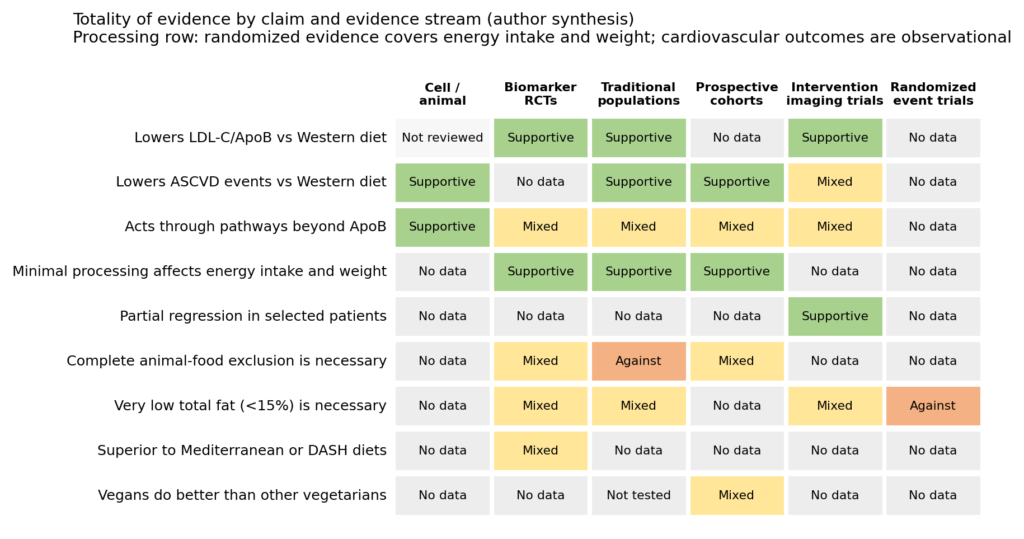
Figura 15. Totalità delle prove per affermazione e flusso di prove. Sintesi dell'autore delle sezioni 3–17; “contro” contrassegna le prove che contraddicono l'affermazione come dichiarata.
19. La più forte affermazione giustificata dalle prove oggi
Una dieta a base di alimenti integrali di origine vegetale riduce in modo affidabile le lipoproteine aterogene rispetto alle tipiche diete occidentali, e le popolazioni con un apporto di alimenti di origine animale basso per tutta la vita hanno mostrato bassi livelli di colesterolo e una bassa mortalità coronarica registrata. Programmi intensivi di stile di vita basati su diete vegetariane a bassissimo contenuto di grassi hanno prodotto una modesta regressione angiografica, una migliore perfusione miocardica, meno angina e meno procedure cardiache rispetto alle cure abituali in piccoli studi su pazienti selezionati. Nel complesso, queste prove rendono credibile che una tale dieta possa aiutare a prevenire, rallentare e in alcuni pazienti invertire parzialmente l'aterosclerosi coronarica, principalmente attraverso una minore esposizione cumulativa all'ApoB. Il beneficio è associato in modo più coerente al carattere integrale della dieta — lavorazione minima, alto contenuto di fibre e abbondanti verdure — piuttosto che alla sola esclusione di alimenti di origine animale, e prove plausibili ma non provate suggeriscono che parte di esso agisca attraverso percorsi che vanno oltre l'ApoB. Le prove non stabiliscono che l'esclusione di tutti gli alimenti di origine animale e di quasi tutti i grassi aggiunti protegga meglio di una dieta mediterranea, DASH o a base vegetale con più grassi insaturi ben attuata.
Un'affermazione più forte richiederebbe un confronto randomizzato di tali diete a parità di intensità di supporto e di terapia medica, con l'ApoB misurato regolarmente, imaging quantitativo della placca in cieco e, infine, eventi clinici giudicati. Fino a quando tali dati non esisteranno, la dieta VLF-WFPB è meglio presentata come un'opzione supportata da prove all'interno della famiglia delle diete salutari per il cuore prevalentemente a base vegetale, nota per la sua efficacia nel ridurre il colesterolo LDL, piuttosto che come un protocollo di inversione univocamente efficace.
Tabella 4. Tabella delle prove. Livello: 1 = studio randomizzato con eventi clinici; 2 = studio randomizzato di esiti intermedi; 3 = coorte prospettica; 4 = confronto di popolazione, studio trasversale o serie di casi (Sezione 1.2). IC = intervallo di confidenza al 95%.
| Studio | Livello | Disegno, n, durata | Dieta somministrata / ottenuta | Terapia di base | Esiti e stime degli effetti | Principali limitazioni |
| Meta-analisi Koch 2023 [22] | 2 | 30 RCT; ApoB da 6 studi | Vegetariana o vegana vs onnivora; contenuto di grassi variabile | Variabile; alcuni in terapia ipolipemizzante | CT −0,34 mmol/L (IC −0,44 a −0,23); C-LDL −0,30 mmol/L (−0,40 a −0,19) ≈ −11,6 mg/dL; ApoB −12,92 mg/dL (−22,63 a −3,20; I² = 71,7%, 6 studi); TG nessuna differenza | Diete e comparatori eterogenei; studi brevi; nessun evento; non isola il livello di grassi; la stima dell'ApoB si basa su 6 studi con sostanziale eterogeneità la cui indipendenza non ha potuto essere confermata in questa sede |
| Meta-analisi Wang 2023 [7] | 2 | 20 RCT, 1.878; media 25,4 sett | Vegetariana, incluse Ornish e vegana a basso contenuto di grassi | La maggior parte in terapia con farmaci cardiometabolici | C-LDL −6,6 mg/dL (−10,1 a −3,1); HbA1c −0,24% (−0,40 a −0,07); peso −3,4 kg (−4,9 a −2,0); PAS −0,1 mm Hg (−2,8 a 2,6) | C-LDL NS vs comparatori attivi; maggioranza ad alto rischio di bias; il testo dei Punti Chiave differisce dai risultati |
| Cochrane Rees 2021 [72] | 2 | 13 RCT; ≥12 sett; ricerca fino a feb 2020 | Solo vegana | — | Nessuno studio ha riportato eventi clinici; uno studio di prevenzione secondaria (n = 63): nessun chiaro effetto su lipidi o PA | Studi piccoli; ricerca datata; bassa certezza |
| Meta-analisi di coorte Dybvik 2023 [40] | 3 | 13 coorti, 844.175 | Vegetariana o vegana vs non vegetariana (auto-riferita) | — | IHD RR 0,79 (0,71–0,88; 8 coorti); CVD 0,85 (0,79–0,92); ictus 0,90 (0,77–1,05); IHD vegani 0,82 (0,68–1,00; 6) | Il confondimento residuo (E-value 1,86); ~1/5 mediato dal BMI; più debole escludendo il follow-up precoce; grassi non valutati |
| EPIC-Oxford [41] | 3 | Coorte; 48.188; 18,1 anni | Vegetariani inclusi vegani vs consumatori di carne; vegani ~28% di grassi | — | IHD HR 0,78 (0,70–0,87), 0,90 (0,81–1,00) dopo aggiustamento per i fattori di rischio; ictus totale HR 1,20 (1,02–1,40), principalmente emorragico; IHD vegani 0,82 (0,64–1,05), latto-ovo 0,77 (0,69–0,86), consumatori di pesce 0,87 (0,77–0,99) | Osservazionale; dieta e fattori di rischio auto-riferiti |
| AHS-2 [53] | 3 | Coorte; 73.308 Avventisti; 5,79 anni | Vegana, latto-ovo, pesco-, semi-vegetariana vs non vegetariana | — | Vegetariani: decesso per IHD 0,81 (0,64–1,02); uomini 0,71 (0,51–1,00). Per gruppo: vegani 0,90 (0,60–1,33), latto-ovo 0,82 (0,62–1,06), pescetariani 0,65 (0,43–0,97); uomini vegani 0,45 (0,21–0,94), donne vegane 1,39 (0,87–2,24) | Follow-up breve; profilo dell'utente sano (Figura 9); pochi decessi tra i vegani |
| Indici della dieta vegetale [17] | 3 | 3 coorti; ~209.000; 8.631 CHD | Indici di origine vegetale sani rispetto a quelli non sani | — | HR per CHD (decili estremi): PDI 0,92 (0,83–1,01); hPDI 0,75 (0,68–0,83); uPDI 1,32 (1,20–1,46) | Basato su FFQ; professionisti sanitari; l'hPDI premia oli e frutta a guscio |
| Elaborazione UK Biobank [18] | 3 | Coorte; 126.842; mediana 9 anni | Alimenti di origine vegetale suddivisi per ultra-trasformazione | — | Per 10% di energia: vegetali non UPF CVD 0,93 (0,91–0,95), decesso per CVD 0,87 (0,80–0,94); vegetali UPF CVD 1,05 (1,03–1,07), decesso 1,12 (1,05–1,20) | Osservazionale; richiami delle 24 ore; classificazione NOVA |
| Coorte danese sui nitrati [29] | 3 | Coorte; 53.150; fino a 23 anni; 14.088 CVD | Quintili di nitrati vegetali (mediana 23 vs 59 mg/giorno) | Aggiustato per l'ipercolesterolemia | HR per CVD 0,85 (0,82–0,89); IHD 0,88 (0,82–0,94); ictus ischemico 0,83 (0,76–0,91); PAD 0,74 (0,67–0,83); 21,9% mediato dalla PAS | Osservazionale; plateau ~60 mg/giorno; nitrati principalmente da lattuga e patate |
| Principali coorti aggregate del 1999 [54] | 3 | 5 coorti; 76.172; media 10,6 anni | Vegani, latto-ovo-vegetariani, consumatori di pesce, consumatori occasionali di carne rispetto ai consumatori regolari di carne | — | Mortalità per IHD: vegetariani 0,76 (0,62–0,94); vegani inferiore del 26%, latto-ovo e consumatori di pesce inferiore del 34%; beneficio limitato alla dieta >5 anni e maggiore in età più giovane | Solo mortalità; coorti più vecchie; aggiustato solo per età, sesso, fumo |
| AHS-2 2024 [55] | 3 | Coorte; 88.400; ~11 anni | Cinque gruppi dietetici | — | Vegetariani con minore mortalità per IHD; dieta vegana non associata alla mortalità per tutte le cause in generale; uomini vegani con minore mortalità in età più giovane | Gli hazard ratio variano con l'età; ictus e demenza più elevati nei vegetariani anziani |
| Proteine AHS-2 [57] | 3 | Coorte; 81.337; 9,4 anni; 2.276 decessi per CVD | Fattori legati alla fonte proteica | — | Mortalità per CVD: fattore carne 1,61 (IC 98,75% 1,12–2,32); fattore frutta a guscio e semi 0,60 (0,42–0,86) | Analisi fattoriale; FFQ; osservazionale |
| Revisione delle diete vegane [56] | 3 | Revisione sistematica; 7 studi; ≥7.661 vegani | Vegani vs non vegani | — | Nessuna coorte ha mostrato un rischio primario di CVD significativamente più alto o più basso nei vegani | Pochi vegani; bassa potenza statistica |
| Coorti Tzu Chi [58] | 3 | 2 coorti; 13.352; Taiwan | Vegetariani buddisti (principalmente latto-ovo) vs non vegetariani | — | Ictus ischemico 0,26 (0,08–0,88) e 0,41 (0,19–0,88); emorragico 0,34 (0,12–1,00) | Solo ictus; contesto dell'utente sano; pochi eventi |
| Latto-vegetariani di Xiamen [59] | 4 | Trasversale; 169 vs 126 uomini | Latto-vegetariani cinesi vs onnivori | — | Minore pressione sanguigna, LDL-C, ApoB, TG, glucosio; IMT carotideo più sottile | Misurazione singola; marcatori surrogati; consumo di latticini |
| Vegani di Hong Kong (revisione) [60] | 4 (revisione) | Revisione di studi trasversali e di integrazione | Vegani e vegetariani con bassi livelli di B12 | — | ~80% di carenza di B12 nei vegani di Hong Kong; compromissione della FMD e IMT più spesso con la carenza; miglioramento con la B12 | Esiti surrogati; cautela per le diete vegane senza integrazione |
| Tsimane [35] | 4 | Trasversale; 705 adulti 40–94; calcio tramite TC | 14% grassi, 14% proteine, 72% carboidrati; selvaggina e pesce; non trasformati | Nessuna | CAC 0 nell'85%, 1–100 nel 13%, >100 nel 3%; >75 anni: 65% zero; LDL-C 91 mg/dL; ApoB 97 mg/dL | La CAC non rileva la placca non calcificata; trasversale; 6–7 ore/giorno di attività (uomini) |
| The China Study I [43] | 4 | Ecologico; 65 contee, 130 villaggi; dieta 1983–84; mortalità 1973–75 | 14% grassi; proteine animali ~1% dell'energia; non vegano | Nessuna | TC media 127 vs 203 mg/dL (USA); mortalità per CAD età 0–64: 4,0 (uomini) e 3,4 (donne) vs 66,8 e 18,9 per 100.000 (USA) | Ecologico; divario di un decennio; età troncate; accertamento; attività e mortalità concorrente |
| Okinawa (Willcox) [45, 47] | 4 | Ecologico; sondaggio del 1949; statistiche vitali | ~1.785 kcal/giorno; patata dolce ~69% dell'energia; grassi ~6%; un po' di maiale e pesce | Nessuna | Le coorti più vecchie riportavano una mortalità per CHD inferiore di circa l'80% rispetto agli USA | Scarsità post-bellica; restrizione energetica; dimensioni corporee; transizione; nessun collegamento individuale |
| Esselstyn 1995/1999 [5, 42] | 4 | Serie di casi; 22–24 arruolati; 11 sottoposti a imaging a ~5 anni | ≤10% fat; skim milk, nonfat yogurt allowed | Cholestyramine + lovastatin most often | TC 246 → 132.4 mg/dL (LDL-C 71.6); % stenosis 53.4 → 46.2% (−7 points, CI 3.3–10.7); MLD +0.08 mm (−0.06 to 0.22), NS; regression in 8/11 patients by % stenosis | No control; 13 of 38 lesions excluded (4 graft-proximal lesions that progressed); attrition reported as 5 and as 11; drugs; regression to the mean |
| Esselstyn 2014 [4] | 4 | Cohort; 198 (177 adherent, 21 nonadherent); mean 44.2 mo | No animal foods, oil, nuts, avocado; fat not measured | Usual medications, not recorded | Adherent: 1 progression-related stroke per investigators (0.6%); 18/177 “worse” (10%); 0 cardiac deaths. Nonadherent: 13/21 (62%) with ≥1 event, 7 of 13 events revascularizations | Self-selected; self-reported adherence; no lipids; investigator adjudication; not randomized; 2.2% in supplementary table |
| Lifestyle Heart Trial [6, 63] | 2 (events: counts) | RCT (invitational), 48; 35 with 5-y QCA; 5 y | 10% fat vegetarian (nonfat dairy, egg white); achieved 6.2% (1 y), 8.5% (5 y); plus exercise, stress management, support | No lipid drugs (exp.); 60% of controls started them | 5-y (1998 report, n = 35): % diameter stenosis −3.07 (−5.91 to −0.24) vs +11.77 (3.40 to 20.14), P = .001; minimum lumen diameter essentially unchanged (+0.001 mm) vs −0.34 mm (P = .05); 1-y (1990 report, n = 48): 40.0% → 37.8% vs 42.7% → 46.1%, 82% of experimental patients toward regression; events 25 vs 45, rate ratio 2.47 (1.48–4.20); angina −91% at 1 y (within group) | Multicomponent; small; half of eligible declined; attrition; events = recurrent counts, mostly procedures; stenosis and lumen diameter are not plaque volume |
| Gould 1995 PET [61] | 2 | Same trial; 20 vs 15 | Come sopra | Come sopra | Perfusion abnormalities smaller/less severe vs worsening in controls | Not independent; functional endpoint |
| Multicenter Lifestyle Demonstration [64] | 4 | Nonrandomized; 194 vs 139 revascularized; 3 y | Programma Ornish | Not reported | 150/194 (77%) avoided revascularization; similar MI, stroke, death rates per patient-year | Self-selection; comparator is revascularized patients |
| STARS [66] | 2 | RCT; 90 men; 39 mo | Lipid-lowering diet, 27% fat (not vegan) ± cholestyramine | Cholestyramine in one arm | MAWS −0.201 (usual care), +0.003 (diet), +0.103 mm (diet + resin); progression 46%, 15%, 12% | Small; men only; not plant-exclusive |
| Heidelberg [62] | 2 | RCT; 113 men; 12 mo | Low-fat, low-cholesterol diet + intensive exercise | No lipid drugs | Progression 23% vs 48%; regression 32% vs 17% | Exercise co-intervention; lipid differences gone at 6 y |
| DISCO-CT [68] | 2 | RCT; 92; ~67 wk; CCTA | DASH-based counseling + activity + OMT vs OMT | OMT in both arms | Noncalcified plaque −51.3 vs −21.3 mm³ (P = .045); total atheroma change not significantly different; ~6-y follow-up: MACE 1 vs 4 [69] | Single center; not plant-exclusive; weight largely regained; too few events |
| EVADE CAD [9] | 2 | RCT; 100; 8 wk | Vegan vs AHA diet; median fat 29.9% vs 30.2% of energy at 8 wk; unsaturated oils encouraged and olive oil in recipes for both; groceries provided | 94–96% statins | hs-CRP 32% lower (β 0.68, 0.49–0.94); LDL-C 13% lower (β 0.87, 0.78–0.97; NS at Bonferroni α) | Short; biomarker only; not very-low-fat; 14% of those meeting initial criteria enrolled |
| Barnard 2021 crossover [23] | 2 | Crossover RCT; 62 randomized, 52 completers; 16 wk per diet | Low-fat vegan (17% of energy from fat achieved; 95% CI 15–19) vs PREDIMED-style Mediterranean | Lipid estimate in 43 without lipid-drug changes; BP estimate in 41 without antihypertensive changes | Weight −6.0 kg (−7.5 to −4.5) and LDL-C −14.8 mg/dL (−23.5 to −6.2) favoring vegan; SBP +6.0 mm Hg (+1.0 to +10.9) favoring Mediterranean | Short; diet-induced weight loss may mediate the effects, so the direct effect of dietary composition is not isolated; advocacy sponsor; not a 10–15%-fat diet; significant SBP carryover in the all-participant analysis but not in the stable-medication subgroup; 1 participant reassigned after randomization to match a household member |
| CARDIVEG [71] | 2 | Crossover RCT; 107 low-risk; 3 mo per diet | Low-calorie lacto-ovo vegetarian vs low-calorie Mediterranean | Low-risk adults | Similar weight loss; LDL-C lower on vegetarian; TG lower on Mediterranean; B12 fell on vegetarian | Low risk; not vegan or very-low-fat |
| Recipe for Heart Health [8] | 2 | Crossover RCT; 40; 4 wk per phase | WFPB vegan with high EVOO (48% fat) vs low EVOO (32% fat) | Not specified | Both lowered LDL-C and ApoB; period 1 LDL-C −25.5 vs −16.7 mg/dL (P = .162); sequence interaction | Short; carryover; neither phase very-low-fat |
| Portfolio meta-analysis [15] | 2 | Controlled trials; 439 participants | Nuts, plant protein, viscous fiber, sterols added to NCEP Step II diet; fat content varied across trials | Varied | LDL-C ~17% lower; ApoB and non-HDL-C also lower | Lipid endpoints only; includes nuts (not low fat) |
| Processing RCT [19] | 2 | Inpatient crossover; 20; 2 wk each | Ultra-processed vs unprocessed, matched for presented nutrients | — | +508 ± 106 kcal/day on ultra-processed; +0.9 vs −0.9 kg | Short; energy balance, not atherosclerosis |
| DASH [11] | 2 | Feeding RCT; 459; 8 wk | DASH combination including low-fat dairy | — | BP −5.5/−3.0 mm Hg; hypertensive −11.4/−5.5 | BP endpoint only |
| DASH-Sodium [16] | 2 | Feeding RCT | DASH + low sodium vs high-sodium control | — | SBP −7.1 (normotensive), −11.5 mm Hg (stage 1 hypertension) | BP endpoint only |
| PREDIMED 2018 [12] | 1 | RCT; 7,447 high risk; median 4.8 y | Mediterranean + EVOO or nuts vs advice to reduce fat | — | 96/2,543 vs 83/2,454 vs 109/2,450; HR 0.69 (0.53–0.91) EVOO; 0.72 (0.54–0.95) nuts | 2013 report retracted for randomization irregularities; control advice-based |
| Lyon Diet Heart [70] | 1 | RCT; 605 post-MI; mean 46 mo | ALA-rich margarine supplied in place of butter and cream, plus Mediterranean-type advice, vs prudent Western diet | — | Cardiac death/MI 14 vs 44; broader composites 27 vs 90 and 95 vs 180; adjusted RR 0.28–0.53 across composites | Weak comparator; older treatment era |
| CORDIOPREV [10] | 1 | RCT; 1,002 CHD; median 7 y | Mediterranean (40.5% fat) vs low-fat omnivorous (32.1% fat) | Statins 86.6% | 87 (17.3%) vs 111 (22.2%); HR 0.745 (0.563–0.986); men HR 0.669 (0.489–0.915); estimate in 175 women inconclusive | Single center; olive-oil-foundation funding; low-fat arm not VLF-WFPB |
| Hooper 2020 Cochrane [26] | 1 | 12 RCTs in main event analysis; 53,758 | Reduced saturated fat | — | Combined CV events RR 0.83 (0.70–0.98) | Tests saturated fat, not total fat or VLF-WFPB |
Table 5. Proposed advantages of VLF-WFPB: shared with comparator diets, or evidence of additional benefit?
| Proposed advantage | Principal evidence | Shared with Mediterranean / DASH? | Evidence of additional benefit for VLF-WFPB | Verdict |
| Lower LDL-C and ApoB (very low saturated fat, no dietary cholesterol, fiber, plant protein) | Pooled RCTs vs omnivorous diets [22]; vegan vs Mediterranean crossover [23]; CARDIVEG [71]; Portfolio [15] | Partly: all lower saturated fat; Portfolio achieves ~17% LDL-C lowering with nuts; Mediterranean lowered LDL-C less in direct comparisons | Some plant-based interventions lower LDL-C and ApoB more than selected comparators over weeks to months; superiority of the specific 10–15%-fat protocol is unestablished | Supported (biomarker); unestablished for the specific protocol |
| Weight loss / low energy density | Wang [7]; Barnard [23]; Ornish [6] | Similar when both diets are energy-restricted [71] | Greater with ad libitum eating in short trials | Context-dependent |
| Lower blood pressure | Wang (null) [7]; DASH [11, 16]; Barnard [23] | Yes; DASH and Mediterranean equal or better | None shown | No additional benefit shown |
| Better controllo glicemico | Wang, type 2 diabetes subgroup [7] | Partly | Versus conventional diabetic diets, not versus Mediterranean | Supportato ma incerto |
| Triglycerides and HDL-C | Ornish [6]; Koch [22]; CARDIVEG [71] | Mediterranean lowers TG more | Very-low-fat diets may raise triglycerides and lower HDL-C; an HDL-C decrease alone does not demonstrate cardiovascular harm [80], and triglycerides should be read alongside ApoB, non-HDL-C, and outcomes | Uncertain; possible disadvantage |
| Less inflammation (hs-CRP) | EVADE CAD [9] | La dieta mediterranea ha anche ridotto i marcatori infiammatori nello studio CARDIVEG [71] | rispetto alla dieta AHA con circa il 30% di grassi; non testata con un contenuto di grassi molto basso | Biologicamente plausibile |
| Migliore funzione endoteliale | Studi su singolo pasto [30, 81]; meta-analisi sull'olio d'oliva [32]; sottostudio CORDIOPREV [33]; EVADE EndoPAT [9] | Sì: l'olio d'oliva costante e le diete mediterranee hanno migliorato la FMD | Nessuna evidenza costante per la dieta VLF-WFPB | Non supportato |
| Minor rischio di ictus | EPIC-Oxford [41]; Dybvik [40] | — | No: il tasso di ictus più elevato nello studio EPIC-Oxford riguarda il gruppo vegetariano, non la dieta VLF-WFPB, che non è stata testata per l'ictus | Non dimostrato in un senso o nell'altro |
| Regole alimentari chiare che favoriscono l'aderenza | Dati sull'aderenza [4, 6, 9] | Qualsiasi programma strutturato | Ipotesi comportamentale; la rigidità può aiutare alcuni e scoraggiare altri | Ipotesi |
| Alimenti integrali e minimamente trasformati | Indici della dieta vegetale [17]; UK Biobank [18]; RCT sulla trasformazione [19] | In parte: le diete DASH e mediterranea sono anch'esse modelli minimamente trasformati | La leva non lipidica più forte; gli alimenti vegetali ultra-trasformati sono associati a un rischio maggiore | Supportato ma incerto |
| Nitrati delle verdure a foglia verde → ossido nitrico | Coorte danese [29] | Sì: qualsiasi modello ricco di verdure | L'associazione persiste dopo l'aggiustamento per i lipidi; non specifica per i vegani | Plausibile, parzialmente supportata |
| Fibre → butirrato | Modelli murini [28] | Sì: qualsiasi modello ad alto contenuto di fibre | Indipendente dal colesterolo nei topi; mancano dati sugli esiti nell'uomo | Biologicamente plausibile |
| TMAO più basso / microbioma favorevole | Associazione di coorte [37]; randomizzazione mendeliana nulla [38] | In parte (modelli ricchi di fibre) | Nessuna evidenza sugli esiti; evidenza genetica contro un effetto causale del TMAO | Ipotesi debole |
| Esclusione dell'olio aggiunto | Recipe for Heart Health [8]; PREDIMED [12]; CORDIOPREV [10] | No: le diete ricche di EVOO hanno ridotto gli eventi rispetto ai comparatori | Grandi aggiunte di olio possono attenuare la riduzione del colesterolo LDL; mancano dati sugli eventi | Non supportato come necessario |
| Esclusione di noci e semi | Braccio PREDIMED con frutta a guscio [12] | No: la dieta integrata con frutta a guscio ha ridotto gli eventi | Nessuna | Non supportato |
| Rallentamento o regressione angiografica | Lifestyle Heart [6]; STARS [66]; Heidelberg [62]; DISCO-CT [68] | Sì: anche i programmi non vegani a basso contenuto di grassi e basati sulla dieta DASH hanno rallentato la progressione | Solo effetto del pacchetto completo; quota relativa alla dieta sconosciuta | Supportato ma incerto |
| Esclusione completa di alimenti di origine animale | AHS-2 [53]; EPIC-Oxford [41]; coorti raggruppate [54]; revisione vegana [56]; proteine AHS-2 [57] | Non applicabile | Nessuna: i vegani non hanno ottenuto risultati migliori dei latto-ovo-vegetariani o pesco-vegetariani; le proteine di noci e semi sono associate a una minore mortalità cardiovascolare | Non supportato |
Abbreviazioni: ApoB, apolipoproteina B; BP, pressione sanguigna; CCTA, angio-TC coronarica; CHD, cardiopatia coronarica; EVOO, olio extravergine d'oliva; IHD, cardiopatia ischemica; MAWS, larghezza media assoluta dei segmenti coronarici; MLD, diametro minimo del lume; NS, non significativo; OMT, terapia medica ottimale; QCA, angiografia coronarica quantitativa; RCT, studio randomizzato controllato; TC, colesterolo totale; TG, trigliceridi; VLF-WFPB, alimentazione vegetale integrale a bassissimo contenuto di grassi.
Riferimenti
- Wang T, Masedunskas A, Willett WC, Fontana L. Vegetarian and vegan diets: benefits and drawbacks. Eur Heart J. 2023;44(36):3423–3439. doi:10.1093/eurheartj/ehad436.
- Freeman AM, Morris PB, Barnard N, et al. Trending cardiovascular nutrition controversies. J Am Coll Cardiol. 2017;69(9):1172–1187. doi:10.1016/j.jacc.2016.10.086. PMID 28254181.
- Kahleova H, Levin S, Barnard ND. Vegetarian dietary patterns and cardiovascular disease. Prog Cardiovasc Dis. 2018;61(1):54–61. doi:10.1016/j.pcad.2018.05.002. PMID 29800598.
- Esselstyn CB Jr, Gendy G, Doyle J, Golubic M, Roizen MF. A way to reverse CAD? J Fam Pract. 2014;63(7):356–364b. PMID 25198208.
- Esselstyn CB Jr. Updating a 12-year experience with arrest and reversal therapy for coronary heart disease (an overdue requiem for palliative cardiology). Am J Cardiol. 1999;84(3):339–341, A8. doi:10.1016/S0002-9149(99)00290-8. PMID 10496449.
- Ornish D, Scherwitz LW, Billings JH, et al. Intensive lifestyle changes for reversal of coronary heart disease. JAMA. 1998;280(23):2001–2007. doi:10.1001/jama.280.23.2001. PMID 9863851. Correction (author list): JAMA. 1999;281(15):1380.
- Wang T, Kroeger CM, Cassidy S, et al. Vegetarian dietary patterns and cardiometabolic risk in people with or at high risk of cardiovascular disease: a systematic review and meta-analysis. JAMA Netw Open. 2023;6(7):e2325658. doi:10.1001/jamanetworkopen.2023.25658. PMID 37490288.
- Krenek AM, Mathews A, Guo J, et al. Recipe for Heart Health: a randomized crossover trial on cardiometabolic effects of extra virgin olive oil within a whole-food plant-based vegan diet. J Am Heart Assoc. 2024;13(15):e035034. doi:10.1161/JAHA.124.035034. PMID 39045758.
- Shah B, Newman JD, Woolf K, et al. Anti-inflammatory effects of a vegan diet versus the American Heart Association–recommended diet in coronary artery disease trial. J Am Heart Assoc. 2018;7(23):e011367. doi:10.1161/JAHA.118.011367. PMID 30571591.
- Delgado-Lista J, Alcala-Diaz JF, Torres-Peña JD, et al. Long-term secondary prevention of cardiovascular disease with a Mediterranean diet and a low-fat diet (CORDIOPREV): a randomised controlled trial. Lancet. 2022;399(10338):1876–1885. doi:10.1016/S0140-6736(22)00122-2. PMID 35525255.
- Appel LJ, Moore TJ, Obarzanek E, et al. A clinical trial of the effects of dietary patterns on blood pressure. DASH Collaborative Research Group. N Engl J Med. 1997;336(16):1117–1124. doi:10.1056/NEJM199704173361601. PMID 9099655.
- Estruch R, Ros E, Salas-Salvadó J, et al. Primary prevention of cardiovascular disease with a Mediterranean diet supplemented with extra-virgin olive oil or nuts. N Engl J Med. 2018;378(25):e34. doi:10.1056/NEJMoa1800389. PMID 29897866. (Replaces the retracted 2013 report.)
- Kris-Etherton P, Eckel RH, Howard BV, St Jeor S, Bazzarre TL. AHA science advisory: Lyon Diet Heart Study. Benefits of a Mediterranean-style, National Cholesterol Education Program/American Heart Association Step I dietary pattern on cardiovascular disease. Circulation. 2001;103(13):1823–1825. doi:10.1161/01.CIR.103.13.1823.
- de Lorgeril M, Renaud S, Mamelle N, et al. Mediterranean alpha-linolenic acid-rich diet in secondary prevention of coronary heart disease. Lancet. 1994;343(8911):1454–1459. doi:10.1016/S0140-6736(94)92580-1.
- Chiavaroli L, Nishi SK, Khan TA, et al. Portfolio dietary pattern and cardiovascular disease: a systematic review and meta-analysis of controlled trials. Prog Cardiovasc Dis. 2018;61(1):43–53. doi:10.1016/j.pcad.2018.05.004. PMID 29807048.
- Sacks FM, Svetkey LP, Vollmer WM, et al. Effects on blood pressure of reduced dietary sodium and the Dietary Approaches to Stop Hypertension (DASH) diet. N Engl J Med. 2001;344(1):3–10. doi:10.1056/NEJM200101043440101. PMID 11136953.
- Satija A, Bhupathiraju SN, Spiegelman D, et al. Healthful and unhealthful plant-based diets and the risk of coronary heart disease in U.S. adults. J Am Coll Cardiol. 2017;70(4):411–422. doi:10.1016/j.jacc.2017.05.047. PMID 28728684.
- Rauber F, Louzada MLC, Chang K, et al. Implications of food ultra-processing on cardiovascular risk considering plant origin foods: an analysis of the UK Biobank cohort. Lancet Reg Health Eur. 2024;43:100948. doi:10.1016/j.lanepe.2024.100948. PMID 39210945.
- Hall KD, Ayuketah A, Brychta R, et al. Ultra-processed diets cause excess calorie intake and weight gain: an inpatient randomized controlled trial of ad libitum food intake. Cell Metab. 2019;30(1):67–77.e3. doi:10.1016/j.cmet.2019.05.008.
- Ference BA, Ginsberg HN, Graham I, et al. Low-density lipoproteins cause atherosclerotic cardiovascular disease. 1. Evidence from genetic, epidemiologic, and clinical studies. A consensus statement from the European Atherosclerosis Society Consensus Panel. Eur Heart J. 2017;38(32):2459–2472. doi:10.1093/eurheartj/ehx144. PMID 28444290.
- Cholesterol Treatment Trialists’ (CTT) Collaboration. Efficacy and safety of more intensive lowering of LDL cholesterol: a meta-analysis of data from 170 000 participants in 26 randomised trials. Lancet. 2010;376(9753):1670–1681. doi:10.1016/S0140-6736(10)61350-5. PMID 21067804.
- Koch CA, Kjeldsen EW, Frikke-Schmidt R. Vegetarian or vegan diets and blood lipids: a meta-analysis of randomized trials. Eur Heart J. 2023;44(28):2609–2622. doi:10.1093/eurheartj/ehad211. PMID 37226630.
- Barnard ND, Alwarith J, Rembert E, et al. A Mediterranean diet and low-fat vegan diet to improve body weight and cardiometabolic risk factors: a randomized, cross-over trial. J Am Nutr Assoc. 2022;41(2):127–139. doi:10.1080/07315724.2020.1869625. PMID 33544066.
- McMurry MP, Connor WE, Cerqueira MT. Dietary cholesterol and the plasma lipids and lipoproteins in the Tarahumara Indians: a people habituated to a low cholesterol diet after weaning. Am J Clin Nutr. 1982;35(4):741–744. doi:10.1093/ajcn/35.4.741.
- Lichtenstein AH, Khera A, Anderson CAM, et al. 2026 dietary guidance to improve cardiovascular health: a scientific statement from the American Heart Association. Circulation. Published online 31 March 2026. doi:10.1161/CIR.0000000000001435.
- Hooper L, Martin N, Jimoh OF, Kirk C, Foster E, Abdelhamid AS. Reduction in saturated fat intake for cardiovascular disease. Cochrane Database Syst Rev. 2020;(8):CD011737. doi:10.1002/14651858.CD011737.pub3. (Version of record superseding the May 2020 issue, PMID 32428300.)
- Blumenthal RS, Morris PB, Gaudino M, et al. 2026 ACC/AHA/AACVPR/ABC/ACPM/ADA/AGS/APhA/ASPC/NLA/PCNA guideline on the management of dyslipidemia: a report of the American College of Cardiology/American Heart Association Joint Committee on Clinical Practice Guidelines. Circulation. 2026. doi:10.1161/CIR.0000000000001423. Also J Am Coll Cardiol. doi:10.1016/j.jacc.2025.11.016.
- Kasahara K, Krautkramer KA, Org E, et al. Interactions between Roseburia intestinalis and diet modulate atherogenesis in a murine model. Nat Microbiol. 2018;3(12):1461–1471. doi:10.1038/s41564-018-0272-x.
- Bondonno CP, Dalgaard F, Blekkenhorst LC, et al. Vegetable nitrate intake, blood pressure and incident cardiovascular disease: Danish Diet, Cancer, and Health Study. Eur J Epidemiol. 2021;36(8):813–825. doi:10.1007/s10654-021-00747-3.
- Vogel RA, Corretti MC, Plotnick GD. Effect of a single high-fat meal on endothelial function in healthy subjects. Am J Cardiol. 1997;79(3):350–354. doi:10.1016/S0002-9149(96)00760-6. PMID 9036757.
- Vogel RA, Corretti MC, Plotnick GD. The postprandial effect of components of the Mediterranean diet on endothelial function. J Am Coll Cardiol. 2000;36(5):1455–1460. doi:10.1016/S0735-1097(00)00896-2. PMID 11079642.
- Schwingshackl L, Christoph M, Hoffmann G. Effects of olive oil on markers of inflammation and endothelial function—a systematic review and meta-analysis. Nutrients. 2015;7(9):7651–7675. doi:10.3390/nu7095356. PMID 26378571.
- Yubero-Serrano EM, Fernandez-Gandara C, Garcia-Rios A, et al. Mediterranean diet and endothelial function in patients with coronary heart disease: an analysis of the CORDIOPREV randomized controlled trial. PLoS Med. 2020;17(9):e1003282. doi:10.1371/journal.pmed.1003282. PMID 32903262.
- Christ A, Günther P, Lauterbach MAR, et al. Western diet triggers NLRP3-dependent innate immune reprogramming. Cell. 2018;172(1-2):162–175.e14. doi:10.1016/j.cell.2017.12.013. PMID 29328911.
- Kaplan H, Thompson RC, Trumble BC, et al. Coronary atherosclerosis in indigenous South American Tsimane: a cross-sectional cohort study. Lancet. 2017;389(10080):1730–1739. doi:10.1016/S0140-6736(17)30752-3. PMID 28320601.
- Koeth RA, Wang Z, Levison BS, et al. Intestinal microbiota metabolism of L-carnitine, a nutrient in red meat, promotes atherosclerosis. Nat Med. 2013;19(5):576–585. doi:10.1038/nm.3145. PMID 23563705.
- Tang WHW, Wang Z, Levison BS, et al. Intestinal microbial metabolism of phosphatidylcholine and cardiovascular risk. N Engl J Med. 2013;368(17):1575–1584. doi:10.1056/NEJMoa1109400. PMID 23614584.
- Jia J, Dou P, Gao M, et al. Assessment of causal direction between gut microbiota-dependent metabolites and cardiometabolic health: a bidirectional Mendelian randomization analysis. Diabetes. 2019;68(9):1747–1755. doi:10.2337/db19-0153.
- Watts GF, Jackson P, Mandalia S, et al. Nutrient intake and progression of coronary artery disease. Am J Cardiol. 1994;73(5):328–332. PMID 8109545.
- Dybvik JS, Svendsen M, Aune D. Vegetarian and vegan diets and the risk of cardiovascular disease, ischemic heart disease and stroke: a systematic review and meta-analysis of prospective cohort studies. Eur J Nutr. 2023;62(1):51–69. doi:10.1007/s00394-022-02942-8. PMID 36030329.
- Tong TYN, Appleby PN, Bradbury KE, et al. Risks of ischaemic heart disease and stroke in meat eaters, fish eaters, and vegetarians over 18 years of follow-up: results from the prospective EPIC-Oxford study. BMJ. 2019;366:l4897. doi:10.1136/bmj.l4897. PMID 31484644.
- Esselstyn CB Jr, Ellis SG, Medendorp SV, Crowe TD. A strategy to arrest and reverse coronary artery disease: a 5-year longitudinal study of a single physician’s practice. J Fam Pract. 1995;41(6):560–568. PMID 7500065.
- Campbell TC, Parpia B, Chen J. Diet, lifestyle, and the etiology of coronary artery disease: the Cornell China study. Am J Cardiol. 1998;82(10B):18T–21T. doi:10.1016/S0002-9149(98)00718-8. PMID 9860369.
- Connor WE, Cerqueira MT, Connor RW, Wallace RB, Malinow MR, Casdorph HR. The plasma lipids, lipoproteins, and diet of the Tarahumara Indians of Mexico. Am J Clin Nutr. 1978;31(7):1131–1142. doi:10.1093/ajcn/31.7.1131. PMID 665563.
- Willcox BJ, Willcox DC, Todoriki H, et al. Caloric restriction, the traditional Okinawan diet, and healthy aging: the diet of the world’s longest-lived people and its potential impact on morbidity and life span. Ann N Y Acad Sci. 2007;1114:434–455. doi:10.1196/annals.1396.037. PMID 17986602.
- Willcox DC, Willcox BJ, Todoriki H, Suzuki M. The Okinawan diet: health implications of a low-calorie, nutrient-dense, antioxidant-rich dietary pattern low in glycemic load. J Am Coll Nutr. 2009;28(Suppl):500S–516S. doi:10.1080/07315724.2009.10718117. PMID 20234038.
- Willcox BJ, Willcox DC. Caloric restriction, caloric restriction mimetics, and healthy aging in Okinawa: controversies and clinical implications. Curr Opin Clin Nutr Metab Care. 2014;17(1):51–58. doi:10.1097/MCO.0000000000000019. PMID 24316687.
- Gavrilova NS, Gavrilov LA. Comments on dietary restriction, Okinawa diet and longevity. Gerontology. 2012;58(3):221–223. doi:10.1159/000329894. PMID 21893946.
- Lindeberg S, Lundh B. Apparent absence of stroke and ischaemic heart disease in a traditional Melanesian island: a clinical study in Kitava. J Intern Med. 1993;233(3):269–275. doi:10.1111/j.1365-2796.1993.tb00986.x. PMID 8450295.
- Lindeberg S, Nilsson-Ehle P, Terént A, Vessby B, Scherstén B. Cardiovascular risk factors in a Melanesian population apparently free from stroke and ischaemic heart disease: the Kitava study. J Intern Med. 1994;236(3):331–340.
- Lindeberg S, Nilsson-Ehle P, Vessby B. Lipoprotein composition and serum cholesterol ester fatty acids in nonwesternized Melanesians. Lipids. 1996;31(2):153–158. doi:10.1007/BF02522614. PMID 8835402.
- Kwok CS, Umar S, Myint PK, Mamas MA, Loke YK. Vegetarian diet, Seventh Day Adventists and risk of cardiovascular mortality: a systematic review and meta-analysis. Int J Cardiol. 2014;176(3):680–686. doi:10.1016/j.ijcard.2014.07.080.
- Orlich MJ, Singh PN, Sabaté J, et al. Vegetarian dietary patterns and mortality in Adventist Health Study 2. JAMA Intern Med. 2013;173(13):1230–1238. doi:10.1001/jamainternmed.2013.6473. PMID 23836264.
- Key TJ, Fraser GE, Thorogood M, et al. Mortality in vegetarians and nonvegetarians: detailed findings from a collaborative analysis of 5 prospective studies. Am J Clin Nutr. 1999;70(3 Suppl):516S–524S. doi:10.1093/ajcn/70.3.516s. PMID 10479225.
- Abris GP, Shavlik DJ, Mathew RO, et al. Cause-specific and all-cause mortalities in vegetarian compared with those in nonvegetarian participants from the Adventist Health Study-2 cohort. Am J Clin Nutr. 2024;120(4):907–917. doi:10.1016/j.ajcnut.2024.07.028. PMID 39098708.
- Kaiser J, van Daalen KR, Thayyil A, Cocco MTARR, Caputo D, Oliver-Williams C. A systematic review of the association between vegan diets and risk of cardiovascular disease. J Nutr. 2021;151(6):1539–1552. doi:10.1093/jn/nxab037. PMID 33831953.
- Tharrey M, Mariotti F, Mashchak A, Barbillon P, Delattre M, Fraser GE. Patterns of plant and animal protein intake are strongly associated with cardiovascular mortality: the Adventist Health Study-2 cohort. Int J Epidemiol. 2018;47(5):1603–1612. doi:10.1093/ije/dyy030. PMID 29618018.
- Chiu THT, Chang HR, Wang LY, Chang CC, Lin MN, Lin CL. Vegetarian diet and incidence of total, ischemic, and hemorrhagic stroke in 2 cohorts in Taiwan. Neurology. 2020;94(11):e1112–e1121. doi:10.1212/WNL.0000000000009093. PMID 32102976.
- Yang SY, Li XJ, Zhang W, et al. Chinese lacto-vegetarian diet exerts favorable effects on metabolic parameters, intima-media thickness, and cardiovascular risks in healthy men. Nutr Clin Pract. 2012;27(3):392–398. doi:10.1177/0884533611436173. PMID 22412169.
- Woo KS, Kwok TCY, Celermajer DS. Vegan diet, subnormal vitamin B-12 status and cardiovascular health. Nutrients. 2014;6(8):3259–3273. doi:10.3390/nu6083259. PMID 25195560.
- Gould KL, Ornish D, Scherwitz L, et al. Changes in myocardial perfusion abnormalities by positron emission tomography after long-term, intense risk factor modification. JAMA. 1995;274(11):894–901. doi:10.1001/jama.1995.03530110056036. PMID 7674504.
- Schuler G, Hambrecht R, Schlierf G, et al. Regular physical exercise and low-fat diet: effects on progression of coronary artery disease. Circulation. 1992;86(1):1–11. doi:10.1161/01.cir.86.1.1. PMID 1617762.
- Ornish D, Brown SE, Scherwitz LW, et al. Can lifestyle changes reverse coronary heart disease? The Lifestyle Heart Trial. Lancet. 1990;336(8708):129–133. doi:10.1016/0140-6736(90)91656-U. PMID 1973470.
- Ornish D. Avoiding revascularization with lifestyle changes: the Multicenter Lifestyle Demonstration Project. Am J Cardiol. 1998;82(10B):72T–76T. doi:10.1016/S0002-9149(98)00744-9. PMID 9860380.
- Silberman A, Banthia R, Estay IS, et al. The effectiveness and efficacy of an intensive cardiac rehabilitation program in 24 sites. Am J Health Promot. 2010;24(4):260–266. (Cited only as the second source of an untraced statement in ref. 2.)
- Watts GF, Lewis B, Brunt JN, et al. Effects on coronary artery disease of lipid-lowering diet, or diet plus cholestyramine, in the St Thomas’ Atherosclerosis Regression Study (STARS). Lancet. 1992;339(8793):563–569. doi:10.1016/0140-6736(92)90863-X. PMID 1347091.
- Niebauer J, Hambrecht R, Velich T, et al. Attenuated progression of coronary artery disease after 6 years of multifactorial risk intervention: role of physical exercise. Circulation. 1997;96(8):2534–2541. PMID 9355890.
- Henzel J, Kępka C, Kruk M, et al. High-risk coronary plaque regression after intensive lifestyle intervention in nonobstructive coronary disease: a randomized study. JACC Cardiovasc Imaging. 2021;14(6):1192–1202. doi:10.1016/j.jcmg.2020.10.019. PMID 33341413.
- Makarewicz-Wujec M, Henzel J, Kępka C, et al. Long-term outcomes of the Dietary Approaches to Stop Hypertension (DASH) intervention in nonobstructive coronary artery disease: follow-up of the DISCO-CT study. Nutrients. 2025;17(15):2565. doi:10.3390/nu17152565.
- de Lorgeril M, Salen P, Martin JL, Monjaud I, Delaye J, Mamelle N. Mediterranean diet, traditional risk factors, and the rate of cardiovascular complications after myocardial infarction: final report of the Lyon Diet Heart Study. Circulation. 1999;99(6):779–785. doi:10.1161/01.CIR.99.6.779. PMID 9989963.
- Sofi F, Dinu M, Pagliai G, et al. Low-calorie vegetarian versus Mediterranean diets for reducing body weight and improving cardiovascular risk profile: CARDIVEG Study (Cardiovascular Prevention With Vegetarian Diet). Circulation. 2018;137(11):1103–1113. doi:10.1161/CIRCULATIONAHA.117.030088. PMID 29483085.
- Rees K, Al-Khudairy L, Takeda A, Stranges S. Vegan dietary pattern for the primary and secondary prevention of cardiovascular diseases. Cochrane Database Syst Rev. 2021;2(2):CD013501. doi:10.1002/14651858.CD013501.pub2. PMID 33629376.
- Virani SS, Newby LK, Arnold SV, et al. 2023 AHA/ACC/ACCP/ASPC/NLA/PCNA guideline for the management of patients with chronic coronary disease. Circulation. 2023;148(9):e9–e119. doi:10.1161/CIR.0000000000001168.
- Dawson LP, Lum M, Nerleker N, Nicholls SJ, Layland J. Coronary atherosclerotic plaque regression: JACC state-of-the-art review. J Am Coll Cardiol. 2022;79(1):66–82. doi:10.1016/j.jacc.2021.10.035. PMID 34991791.
- Armstrong ML, Megan MB. Lipid depletion in atheromatous coronary arteries in rhesus monkeys after regression diets. Circ Res. 1972;30(6):675–680. doi:10.1161/01.res.30.6.675.
- Armstrong ML, Megan MB. Arterial fibrous proteins in cynomolgus monkeys after atherogenic and regression diets. Circ Res. 1975;36(2):256–261. doi:10.1161/01.res.36.2.256.
- Clarkson TB, Bond MG, Bullock BC, Marzetta CA. A study of atherosclerosis regression in Macaca mulatta. IV. Changes in coronary arteries from animals with atherosclerosis induced for 19 months and then regressed for 24 or 48 months at plasma cholesterol concentrations of 300 or 200 mg/dl. Exp Mol Pathol. 1981;34(3):345–368. doi:10.1016/0014-4800(81)90052-6.
- Nicholls SJ, Puri R, Anderson T, et al. Effect of evolocumab on progression of coronary disease in statin-treated patients: the GLAGOV randomized clinical trial. JAMA. 2016;316(22):2373–2384. doi:10.1001/jama.2016.16951. PMID 27846344.
- Melina V, Craig W, Levin S. Position of the Academy of Nutrition and Dietetics: vegetarian diets. J Acad Nutr Diet. 2016;116(12):1970–1980. doi:10.1016/j.jand.2016.09.025. PMID 27886704.
- Voight BF, Peloso GM, Orho-Melander M, et al. Plasma HDL cholesterol and risk of myocardial infarction: a Mendelian randomisation study. Lancet. 2012;380(9841):572–580. doi:10.1016/S0140-6736(12)60312-2. PMID 22607825.
- Vogel RA. The Mediterranean diet and endothelial function: why some dietary fats may be healthy. Cleve Clin J Med. 2000;67(4):232–236. (Reports the Vogel group’s postprandial olive-oil, vitamin, and vinegar-salad experiments.)