In un mondo in cui “biohacking” e le tendenze legate alla rapida perdita di peso, due paradigmi alimentari spesso si scontrano: la dieta a basso contenuto di grassi e basata su alimenti integrali di origine vegetale (WFPB) e la dieta paleo ad alto contenuto proteico e ad alto contenuto di grassi/Diete chetogeniche. Sebbene entrambe sostengano di migliorare la salute, la letteratura scientifica — in particolare quella a lungo termine studi clinici e gli studi sui centenari — evidenziano una netta distinzione tra i cambiamenti metabolici a breve termine e le malattie a lungo termine inversione.
Questa sintesi affronta le questioni fondamentali avvalendosi di prove concrete e di riferimenti bibliografici sottoposti a revisione tra pari.
Una dieta a basso contenuto di grassi e basata su alimenti integrali di origine vegetale (WFPB) può davvero invertire il decorso delle malattie cardiache?
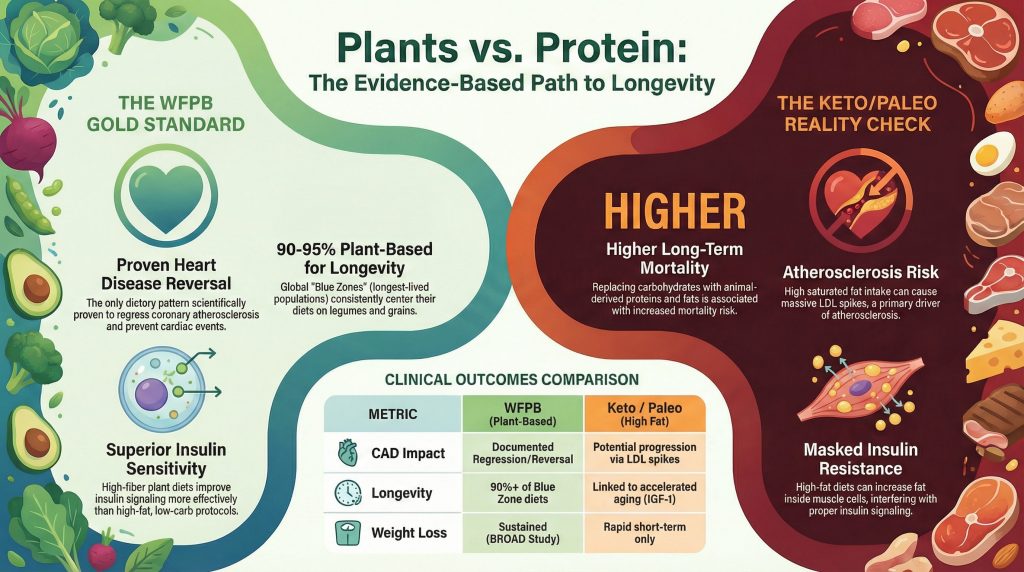
Sì. La dieta WFPB è l'unico regime alimentare scientificamente dimostrato non solo di prevenire, ma anche di invertire effettivamente malattia coronarica (CAD).
- Le prove: il dottor Dean Ornish ha dimostrato nel Lifestyle Heart Trial che i pazienti che seguono una dieta a basso contenuto di grassi (10% grassi) dieta vegetariana, insieme a cambiamenti nello stile di vita, ha mostrato una regressione dell’aterosclerosi coronarica dopo un anno, con un ulteriore miglioramento dopo cinque anni. Al contrario, il gruppo di controllo che ha seguito cambiamenti alimentari “moderati” ha registrato una progressione della malattia (Ornish et al., 1998).
- Il meccanismo: una dieta a base di alimenti vegetali (WFPB) migliora la funzione endoteliale — ovvero la capacità dei vasi sanguigni di dilatarsi — e riduce Colesterolo LDL a livelli “a prova di infarto” (in genere <70 mg/dL). Lo studio della durata di 12 anni condotto dal dottor Caldwell Esselstyn ha dimostrato che il 99,41% dei pazienti che hanno seguito una dieta WFPB ha evitato ulteriori gravi eventi cardiaci (Esselstyn et al., 2014).
Come si colloca la “rapida perdita di peso” delle diete chetogenica e paleo rispetto alla sensibilità all’insulina a lungo termine della dieta WFPB?
Mentre la dieta chetogenica e Diete paleo sono apprezzati per la rapidità perdita di peso e un calo immediato dei livelli ematici glucosio, si tratta spesso di “effetti a breve termine” che possono nascondere problemi di fondo.
- Sensibilità all'insulina: Le diete ricche di grassi possono in realtà aumentare lipidi intramioscelulari (grasso all’interno delle cellule muscolari), che interferisce con insulina segnalazione. Mentre glicemia potrebbe rimanere basso perché il paziente sta evitando carboidrati, il sottostante insulino-resistenza spesso persiste o peggiora.
- I vantaggi della dieta WFPB: le ricerche dimostrano che una dieta WFPB ricca di carboidrati e fibre migliora la sensibilità all’insulina in modo più efficace nel corso del tempo. Il Studi sulla salute degli avventisti ha rilevato che i vegani presentavano un rischio inferiore del 62% di sviluppare il diabete di tipo 2 diabete rispetto ai non vegetariani, anche dopo aver tenuto conto del peso corporeo (Tonstad et al., 2009).
- Dimagrimento: Nel Studio BROAD, un periodo di 6 mesi studio randomizzato controllato, il gruppo WFPB ha ottenuto una maggiore perdita di peso a sei e a dodici mesi rispetto a qualsiasi altro studio che non prevedesse l'esercizio fisico regolare o la restrizione calorica (Wright et al., 2017).
Cosa ci dicono le popolazioni più longeve del mondo (le “Blue Zones”)?
Se l'obiettivo è la longevità, dobbiamo considerare il “Zone Blu”—regioni in cui la popolazione vive molto più a lungo rispetto alla media mondiale (Okinawa, Sardegna, Loma Linda, Nicoya e Ikaria).
- Il filo conduttore: nessuna delle popolazioni più longeve segue una dieta chetogenica o una dieta paleo ad alto contenuto proteico. La loro alimentazione è costantemente a base vegetale al 90-95%, incentrata su legumi (fagioli, piselli, lenticchie), cereali integrali e tuberi.
- Okinawa: Storicamente, il La dieta di Okinawa era costituita da patate dolci 69% e presentava un contenuto molto basso di prodotti di origine animale (Willcox et al., 2007).
- Animale Proteina e l'invecchiamento: un elevato apporto di proteine animali è associato a livelli più elevati di IGF-1 (fattore di crescita insulino-simile 1), un ormone che favorisce la crescita cellulare ma è associato all'invecchiamento precoce e al cancro (Levine et al., 2014).
Esistono rischi legati alle diete chetogeniche e paleo a lungo termine in termini di longevità?
Sebbene le diete chetogeniche e paleo possano rivelarsi efficaci per la regolazione dell'insulina a breve termine in alcuni casi, i dati epidemiologici a lungo termine indicano l'esistenza di alcuni rischi.
- Rischio di mortalità: uno studio su larga scala meta-analisi pubblicato in The Lancet Public Health ha rilevato che sia le diete a basso contenuto di carboidrati (70% di energia) erano associate a un aumento della mortalità. Tuttavia, il rischio era più elevato quando i carboidrati venivano sostituiti da proteine e grassi di origine animale, mentre la mortalità diminuito quando i carboidrati sono stati sostituiti da proteine e grassi di origine vegetale (Seidelmann et al., 2018).
- Aterosclerosi Rischio: un elevato apporto di grassi saturi, tipico di molte diete chetogeniche e paleo, aumenta significativamente LDL colesterolo. Il fenotipo “Lean Mass Hyper-Responder”, riscontrato in alcuni seguaci della dieta chetogenica, comporta picchi massicci di LDL, che rappresentano uno dei principali fattori che favoriscono l’aterosclerosi (Nylander et al., 2023).
Conclusione: la scelta basata sull’evidenza
Se l'obiettivo è invertire il processo di aterosclerosi e massimizzare la durata della vita, le prove scientifiche indicano chiaramente una dieta a basso contenuto di grassi, dieta a base vegetale di cibi integrali. Sebbene le diete Paleo e Keto possano apportare miglioramenti metabolici temporanei grazie alla perdita di peso e alla restrizione dei carboidrati, non hanno dimostrato di poter contrastare la nostra principale causa di morte — le malattie cardiache — e sono in contrasto con le abitudini alimentari riscontrate in tutte le popolazioni longeve del pianeta.
Riferimenti
- Esselstyn CB Jr, Gendy G, Doyle J, Golubic M, Roizen MF. A way to reverse CAD?. J Fam Pract. 2014;63(7):356-364b.
- Levine ME, Suarez JA, Brandhorst S, et al. Low protein intake is associated with a major reduction in IGF-1, cancer, and overall mortality in the 65 and younger but not older population. Cell Metab. 2014;19(3):407-417. doi:10.1016/j.cmet.2014.02.006
- Ornish D, Scherwitz LW, Billings JH, et al. Intensive lifestyle changes for reversal of coronary heart disease. JAMA. 1998;280(23):2001-2007. doi:10.1001/jama.280.23.2001
- Seidelmann SB, Claggett B, Cheng S, et al. Dietary carbohydrate intake and mortality: a prospective cohort study and meta-analysis. Lancet Public Health. 2018;3(9):e419-e428. doi:10.1016/S2468-2667(18)30135-X
- Tonstad S, Butler T, Yan R, Fraser GE. Type of vegetarian diet, body weight, and prevalence of type 2 diabetes. Diabetes Care. 2009;32(5):791-796. doi:10.2337/dc08-1886
- Willcox DC, Willcox BJ, Todoriki H, Suzuki M. The Okinawan diet: health implications of a low-calorie, nutrient-dense, antioxidant-rich dietary pattern low in glycemic load. J Am Coll Nutr. 2009;28 Suppl:500S-516S. doi:10.1080/07315724.2009.10718117
- Wright N, Wilson L, Smith M, Duncan B, McHugh P. The BROAD study: A randomised controlled trial using a whole food plant-based diet in the community for obesity, ischaemic heart disease or diabetes. Nutr Diabetes. 2017;7(3):e256. Published 2017 Mar 20. doi:10.1038/nutd.2017.3