Heart Disease and The Fish-Oil Confusion, the Vascepa Controversy, and What the Evidence Actually Shows
Per decenni, la medicina cardiovascolare è stata dominata da una narrazione unica e spesso fraintesa: “L'olio di pesce fa bene al cuore”. Questa convinzione è diventata così radicata nella cultura da confondere il confine tra cardiologia basata sulle prove e benessere commerciale, spingendo milioni di persone ad assumere integratori di omega-3 ogni giorno nella speranza di ridurre il rischio cardiovascolare.
For many years, the data supporting this practice were inconsistent. Randomized trials of broadly defined omega-3 supplements frequently failed to show meaningful reductions in infarto miocardicoVedi Infarto miocardico per la voce completa., ictusUn ictus si verifica quando il flusso sanguigno verso una parte del cervello si interrompe, a causa di un'ostruzione o di un'emorragia., or cardiovascular death, while observational studies and smaller trials occasionally suggested benefit. The resulting cycle of enthusiasm, disappointment, and equivocation confused not only the public but clinicians as well. A core problem was conceptual: the term “fish oil” was treated as a single exposure, despite encompassing multiple fatty acids, doses, formulations, and manufacturing qualities.
The modern era has forced a more precise question: Which molecule, at what dose, in which population, compared against what, and with what trade-offs?
That reframing explains why icosapent etileIcosapent ethyl is a purified, high-dose form of the omega-3 fat EPA, sold as Vascepa. (IPE; Vascepa) has become one of the most debated therapies in preventive cardiology. Icosapent ethyl is not generic fish oil. It is a prescription-grade, highly purified ethyl ester of eicosapentaenoic acid (EPA) administered at 4 g/day, and in a large randomized outcomes trial it behaved like a cardiovascular drug rather than a dietary supplement.
At the same time, Vascepa sits at the intersection of multiple sources of skepticism: decades of disappointing omega-3 trials, an unexpectedly large clinical effect from a single outcomes study, unresolved mechanistic questions, and controversy surrounding placeboUn placebo è un trattamento fittizio — una pillola di zucchero o un'iniezione di soluzione fisiologica — somministrato affinché i ricercatori possano capire cosa fa realmente un farmaco vero. choice.
Plaque Rupture, Not Luminal Narrowing, Drives Most Events
Most acute coronary events do not arise from slowly progressive luminal narrowing but from sudden rottura di placcaLa rottura della placca si verifica quando il cappuccio protettivo sopra una placca si lacera, riversando il suo contenuto nel flusso sanguigno.. LDLL'LDL, o lipoproteina a bassa densità, è la principale particella che trasporta il colesterolo nel sangue ed è la principale a bloccarsi nelle pareti delle arterie. particles penetrate the arterial wall, undergo oxidative modification, and initiate a chronic inflammatory response. MacrofagoUn macrofago è una grande cellula immunitaria che inghiotte detriti e invasori. Il nome significa letteralmente "grande mangiatore"." infiltration, foam-cell death, and formation of a necrotic nucleo lipidicoIl nucleo lipidico è il centro molle e grasso di una placca, costituito da colesterolo e dai detriti di cellule immunitarie morte. beneath a thin cappuccio fibrosoIl cappuccio fibroso è il robusto strato di tessuto che riveste una placca, separandone il nucleo lipidico dal flusso sanguigno. create targheLa placca è l'accumulo di colesterolo, cellule immunitarie, tessuto cicatriziale e calcio all'interno della parete di un'arteria. that are biologically unstable. Rupture of these plaques precipitates abrupt trombosiLa trombosi è un coagulo di sangue che si forma all'interno di un vaso sanguigno. and vessel occlusioneL'occlusione è il blocco parziale o completo di un vaso sanguigno, che impedisce il normale flusso sanguigno; un'occlusione coronarica riduce o interrompe l'apporto di ossigeno al muscolo cardiaco irrorato da quell'arteria..
StatineUna statina rallenta l'enzima che il fegato usa per produrre il colesterolo. Il fegato risponde prelevando più colesterolo dal sangue, ed è qui che risiede il beneficio reale. substantially reduce LDL-C and vascular infiammazioneL'infiammazione è la risposta del sistema immunitario a una lesione o a qualcosa che esso tratta come un aggressore. Porta gonfiore, calore e cellule di pulizia., ma rischio residuoIl rischio residuo è il rischio che rimane dopo aver fatto le cose ovvie: colesterolo trattato, pressione controllata, assenza di fumo. remains even with optimal LDL control. This residual risk is driven in part by triglyceride-rich lipoproteineUna lipoproteina è una piccola struttura che trasporta grassi e colesterolo attraverso il flusso sanguigno. Poiché i grassi non si dissolvono in acqua, hanno bisogno di un rivestimento proteico per viaggiare., colesterolo residuoIl colesterolo residuo è il colesterolo trasportato dai resti delle particelle ricche di trigliceridi, dopo che queste hanno rilasciato la maggior parte dei loro grassi., and persistent inflammatory
signaling. Icosapent ethyl was tested specifically as an adjunct therapy in this residual-risk context.
Mechanistic Rationale: Why EPA Is Not Just “Fish Oil”
Triglyceride lowering alone is insufficient
In REDUCE-IT, patients with trigliceridiI trigliceridi sono la principale forma di grasso nel sangue e nelle riserve dell'organismo. 135–499 mg/dL experienced large reductions in ischemic events, but the magnitude of benefit exceeded what would be predicted from triglyceride lowering alone, suggesting additional mechanisms beyond simple lipid concentration changes (5).
Membrane biophysics and oxidative biology
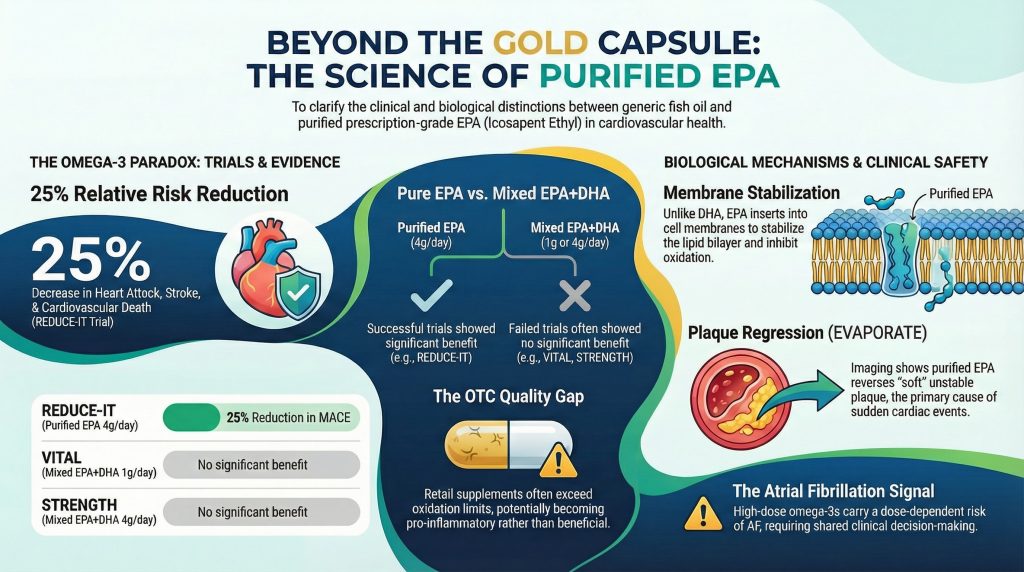
EPA and docosahexaenoic acid (DHA) differ structurally and biophysically. DHA, with six double bonds, increases membrane fluidity and disorder, whereas EPA adopts a more extended conformation within phospholipid bilayers. Mason and colleagues demonstrated that EPA—but not DHA—inhibits oxidation of ApoB-containing lipoprotein particles across a range of particle sizes in vitro, providing a plausible mechanism for reducing downstream inflammatory signaling and plaque vulnerability (1).
Lipoprotein remodeling beyond triglycerides
Human lipidomic studies support triglyceride-independent effects. In normolipidemic individuals, Äikäs and colleagues showed that icosapent ethyl supplementation was associated with broad remodeling of the lipidomaThe lipidome is the complete set of lipids present in a biological system, such as a cell, tissue, or organism; the brain has a particularly large and complex lipidome because lipids are essential to the structure and function of neuronal membranes., including reductions in remnant colesteroloIl colesterolo è una sostanza cerosa di cui il corpo ha bisogno. Entra nelle pareti cellulari, negli ormoni, nella vitamina D e nella bile che digerisce il cibo. Moriresti senza di esso. and ApoB-related markers, indicating a shift toward a less atherogenic circulating profilo lipidicoUn pannello di esami del sangue che misura il colesterolo totale, il colesterolo LDL, il colesterolo HDL e i trigliceridi, utilizzato per valutare il rischio cardiovascolare e monitorare l'effetto di interventi dietetici o farmacologici. (2).
Immune modulation
Inflammation plays a central role in aterosclerosiL'aterosclerosi è la malattia responsabile della maggior parte degli attacchi cardiaci e di molti ictus. Le particelle di colesterolo rimangono intrappolate nella parete di un'arteria, il corpo invia cellule immunitarie per ripulire e, nel corso degli anni, questo accumulo si indurisce trasformandosi in placca.. Reilly and colleagues demonstrated that EPA exposure induces a distinct anti-inflammatory transcriptomic profile in human CD4+ T cells in vitro, implicating immune modulation as a potential triglyceride-independent pathway of benefit (3).
Imaging Evidence: Changing the Disease Substrate
Mechanistic hypotheses gain credibility when supported by human anatomic data. The Studio EVAPORATEA clinical trial that used serial CCTA to track coronary plaque composition over time in patients receiving icosapent ethyl (a purified omega-3 fatty acid); it demonstrated that the drug produced regression of low-attenuation plaque, establishing CCTA as a tool for monitoring plaque response to therapy. seriale usato angio-TAC coronaricaL'angio-TC coronarica, o CCTA, è una tomografia computerizzata eseguita con mezzo di contrasto nelle vene che produce immagini dettagliate delle arterie del cuore. in statin-treated patients with triglycerides 200–499 mg/dL randomized to icosapent ethyl or placebo. Over 18 months, patients receiving IPE demonstrated regression of placca a bassa attenuazioneLa placca a bassa attenuazione è la placca più scura e grassa in assoluto su una scansione TC: abbastanza morbida da permettere ai raggi X di attraversarla facilmente., a marker associated with centro necroticoIl nucleo necrotico è il centro morto e poltaceo di una placca avanzata, costituito da cellule immunitarie che hanno ingerito colesterolo intrappolato e sono poi morte sul posto. and plaque instability, while placebo-treated
patients showed plaque progression (4). Although imaging trials do not replace outcomes trials, EVAPORATE strengthens biological plausibility by demonstrating favorable changes in fenotipo della placcaIl fenotipo della placca si riferisce alle caratteristiche biologiche e strutturali di una lesione aterosclerotica — tra cui le dimensioni del suo nucleo necrotico ricco di lipidi, lo spessore del cappuccio fibroso, il grado di calcificazione e il contenuto di cellule infiammatorie — che insieme determinano se una placca è stabile o ad alto rischio di rottura..
Clinical Outcomes: What Was Proven—and What Was Not
REDUCE-IT
REDUCE-IT randomized 8,179 high-risk, statin-treated patients to icosapent ethyl 4 g/day or mineral oil placeboThe inert-appearing substance used in the placebo arm of REDUCE-IT; its use has been contested because the placebo group experienced modest increases in LDL-C and hs-CRP, raising the possibility that mineral oil was not fully biologically inert and may have modestly inflated the apparent benefit of icosapent ethyl.. The trial demonstrated a 25% rischio relativoIl rischio relativo confronta due gruppi: questo gruppo ha avuto il 30 percento in meno di attacchi cardiaci rispetto a quell'altro gruppo. reduction in the primary endpoint compositoUn endpoint composito raggruppa diversi esiti differenti e conteggia quello che si verifica per primo. of cardiovascular death, myocardial infarction, stroke, coronary rivascolarizzazioneRevascularization is a medical or surgical procedure—such as coronary artery bypass grafting or percutaneous coronary intervention—performed to restore blood flow through a blocked or narrowed coronary artery, addressing the physical obstruction rather than the underlying atherogenic process., oppure angina instabileUnstable angina is chest discomfort that appears at rest, comes on with less effort than before, or is suddenly getting worse. (HR 0.75; 95% CI 0.68–0.83; p<0.001), with a numero di pazienti da trattareIl numero necessario da trattare, o NNT, indica quante persone devono sottoporsi a un trattamento affinché una di esse ne tragga beneficio. of 21 over a median of 4.9 years (5).
Mortality signal
In a prespecified analysis of U.S. participants (REDUCE-IT USA), icosapent ethyl was associated with a statistically significant reduction in mortalità per tutte le causeLa mortalità per tutte le cause indica il decesso dovuto a qualsiasi causa, e non solo a malattie cardiache: l'esito più ampio e difficile da manipolare che uno studio possa misurare. (HR 0.70; 95% CI 0.50–0.99). While supportive, subgroup analyses are best interpreted as complementary to the global trial rather than definitive on their own (6).
Why “Fish Oil” Trials Failed to Reproduce These Results
Dose
Low-dose supplementation appears insufficient. The VITAL trialA large randomized trial testing 1 g/day of combined EPA and DHA in a predominantly healthy population; it found no significant reduction in major cardiovascular events, illustrating that low-dose omega-3 supplementation is insufficient for cardiovascular protection. tested 1 g/day of EPA+DHA in a largely healthy population and showed no significant reduction in major cardiovascular events (7).
Molecule
STRENGTH tested 4 g/day of a mixed EPA/DHA formulation versus corn oil in high-risk patients and found no reduction in eventi avversi cardiovascolari maggioriUn evento cardiovascolare avverso maggiore, o MACE, è un insieme di esiti negativi considerati insieme in uno studio, tipicamente morte cardiovascolare, infarto e ictus. (8). Secondary analyses confirmed no benefit despite high achieved omega-3 levels (9). These findings suggest that EPA-only and EPA+DHA formulations are not interchangeable interventions, although the precise causal explanation for this divergence remains unresolved.
Population risk
REDUCE-IT enrolled patients with established malattia cardiovascolareLe malattie cardiovascolari sono il termine generico per indicare i problemi al cuore e ai vasi sanguigni, tra cui infarti, ictus e ostruzione delle arterie delle gambe. o diabeteIl diabete è una condizione in cui la glicemia rimane troppo alta, o perché il corpo produce troppa poca insulina o perché smette di rispondere all'insulina che produce. plus additional fattori di rischioUn fattore di rischio è qualcosa che aumenta la probabilità di sviluppare una malattia: particelle di colesterolo alto, pressione alta, fumo, diabete, storia familiare., whereas many supplement trials targeted lower-risk populations less likely to benefit.
The Placebo Debate
Mineral oil placebo use in REDUCE-IT remains the most serious critique. The placebo group experienced modest increases in LDL-C and hs-CRP, raising concerns that mineral oil may not have been biologically inert. Regulatory and independent analyses concluded that while these changes could account for a small fraction of the observed benefit, they are insufficient to explain the magnitude of risk reduction seen in REDUCE-IT (10). Consistency with plaque imaging data and prior EPA-only trials such as JELIS further supports a genuine treatment effect (11).
Safety: Atrial Fibrillation and Bleeding
High-dose omega-3 therapy is consistently associated with an increased risk of fibrillazione atrialeAtrial fibrillation, often shortened to AFib, is a fast and irregular heartbeat that starts in the upper chambers of the heart.. In REDUCE-IT, hospitalization for atrial fibrillation or flutter occurred more frequently with icosapent ethyl than placebo (5). Meta-analyses of cardiovascular outcome trials confirm a dose-dependent increase in atrial fibrillation risk (13). Bleeding events were numerically higher with EPA therapy, consistent with mild antiplatelet effects, though fatal bleeding was not significantly increased.
Beyond Cardiovascular Disease
Icosapent ethyl is approved for cardiovascular risk reduction and severe hypertriglyceridemia, with the MARINE trialA randomized trial that established the efficacy of icosapent ethyl for lowering triglycerides in patients with very high triglyceride levels, providing the foundational evidence for its approval in severe hypertriglyceridemia. providing foundational evidence for triglyceride lowering in patients with very high triglyceride levels (14). Anti-inflammatory effects of marine acidi grassi omega-3Gli omega-3 sono grassi presenti principalmente nel pesce azzurro, nelle noci e nei semi di lino. have been demonstrated in artrite reumatoideL'artrite reumatoide è una malattia autoimmune in cui il sistema immunitario attacca le articolazioni. (15), and EPA-dominant formulations show modest benefit in depressive disorders, though these remain non-labeled indications (16).
Conclusione
The era of treating “fish oil” as a single therapeutic idea is ending. The evidence supports a more precise framework:
- Over-the-counter omega-3 supplements are not equivalent to prescription icosapent ethyl.
- REDUCE-IT provides strong randomized evidence for reduction in major ischemic events.
- Imaging and mechanistic studies support biological plausibility.
- Atrial fibrillation risk is real, dose-dependent, and must be incorporated into processo decisionale condivisoIl processo decisionale condiviso è un approccio clinico in cui il medico e il paziente valutano insieme le prove disponibili — inclusi i risultati di imaging, i fattori di rischio e gli obiettivi personali — per giungere a un piano di gestione che rifletta sia la migliore pratica medica sia i valori dell'individuo; le linee guida AHA/ACC del 2025 lo invocano specificamente per gli atleti in cui si riscontrano punteggi di calcio coronarico elevati..
Vascepa is neither a miracle nor a myth. It is a rare example of a nutrient-derived molecule that, when purified, appropriately dosed, and rigorously tested, functions as a true cardiovascular therapy.
Riferimenti
- Mason RP, Sherratt SC, Jacob RF. Eicosapentaenoic Acid Inhibits Oxidation of ApoB-containing Lipoprotein Particles of Different Size In Vitro When Administered Alone or in Combination With Atorvastatin Active Metabolite Compared With Other Triglyceride-lowering Agents. J Cardiovasc Pharmacol. 2016;68(1):33-40. doi:10.1097/FJC.0000000000000379
- Äikäs L, Kovanen PT, Lorey MB, et al. Icosapent ethyl-induced lipoprotein remodeling and its impact on cardiovascular disease risk markers in normolipidemic individuals. JCI Insight. 2025;10(19):e193637. Published 2025 Oct 8. doi:10.1172/jci.insight.193637
- Reilly NA, Dekkers KF, Molenaar J, et al. EPA Induces an Anti-Inflammatory Transcriptome in T Cells, Implicating a Triglyceride-Independent Pathway in Cardiovascular Risk Reduction. JACC Basic Transl Sci. 2025;10(3):383-395. doi:10.1016/j.jacbts.2024.09.002
- Budoff MJ, Bhatt DL, Kinninger A, et al. Effect of icosapent ethyl on progression of coronary atherosclerosis in patients with elevated triglycerides on statin therapy: final results of the EVAPORATE trial. Eur Heart J. 2020;41(40):3925-3932. doi:10.1093/eurheartj/ehaa652
- Bhatt DL, Steg PG, Miller M, et al. Cardiovascular Risk Reduction with Icosapent Ethyl for Hypertriglyceridemia. N Engl J Med. 2019;380(1):11-22. doi:10.1056/NEJMoa1812792
- Bhatt DL, Miller M, Brinton EA, et al. REDUCE-IT USA: Results From the 3146 Patients Randomized in the United States. Circulation. 2020;141(5):367-375. doi:10.1161/CIRCULATIONAHA.119.044440
- Manson JE, Cook NR, Lee IM, et al. Marine n-3 Fatty Acids and Prevention of Cardiovascular Disease and Cancer. N Engl J Med. 2019;380(1):23-32. doi:10.1056/NEJMoa1811403
- Nicholls SJ, Lincoff AM, Garcia M, et al. Effect of High-Dose Omega-3 Fatty Acids vs Corn Oil on Major Adverse Cardiovascular Events in Patients at High Cardiovascular Risk: The STRENGTH Randomized Clinical Trial. JAMA. 2020;324(22):2268-2280. doi:10.1001/jama.2020.22258
- Nissen SE, Lincoff AM, Wolski K, et al. Association Between Achieved ω-3 Fatty Acid Levels and Major Adverse Cardiovascular Outcomes in Patients With High Cardiovascular Risk: A Secondary Analysis of the STRENGTH Trial. JAMA Cardiol. 2021;6(8):910-917. doi:10.1001/jamacardio.2021.1157
- Olshansky B, Chung MK, Budoff MJ, et al. Mineral oil: safety and use as placebo in REDUCE-IT and other clinical studies. Eur Heart J Suppl. 2020;22(Suppl J):J34-J48. Published 2020 Oct 6. doi:10.1093/eurheartj/suaa117
- Tanaka K, Ishikawa Y, Yokoyama M, et al. Reduction in the recurrence of stroke by eicosapentaenoic acid for hypercholesterolemic patients: subanalysis of the JELIS trial. Stroke. 2008;39(7):2052-2058. doi:10.1161/STROKEAHA.107.509455
- Albert BB, Cameron-Smith D, Hofman PL, Cutfield WS. Oxidation of marine omega-3 supplements and human health. Biomed Res Int. 2013;2013:464921. doi:10.1155/2013/464921
- Gencer B, Djousse L, Al-Ramady OT, Cook NR, Manson JE, Albert CM. Effect of Long-Term Marine ɷ-3 Fatty Acids Supplementation on the Risk of Atrial Fibrillation in Randomized Controlled Trials of Cardiovascular Outcomes: A Systematic Review and Meta-Analysis. Circulation. 2021;144(25):1981-1990. doi:10.1161/CIRCULATIONAHA.121.055654
- Bays HE, Ballantyne CM, Kastelein JJ, Isaacsohn JL, Braeckman RA, Soni PN. Eicosapentaenoic acid ethyl ester (AMR101) therapy in patients with very high triglyceride levels (from the Multi-center, plAcebo-controlled, Randomized, double-blINd, 12-week study with an open-label Extension [MARINE] trial). Am J Cardiol. 2011;108(5):682-690. doi:10.1016/j.amjcard.2011.04.015
- Miles EA, Calder PC. Influence of marine n-3 polyunsaturated fatty acids on immune function and a systematic review of their effects on clinical outcomes in rheumatoid arthritis. Br J Nutr. 2012;107 Suppl 2:S171-S184. doi:10.1017/S0007114512001560
- Mocking RJ, Harmsen I, Assies J, Koeter MW, Ruhé HG, Schene AH. Meta-analysis and meta-regression of omega-3 polyunsaturated fatty acid supplementation for major depressive disorder. Transl Psychiatry. 2016;6(3):e756. Published 2016 Mar 15. doi:10.1038/tp.2016.29