
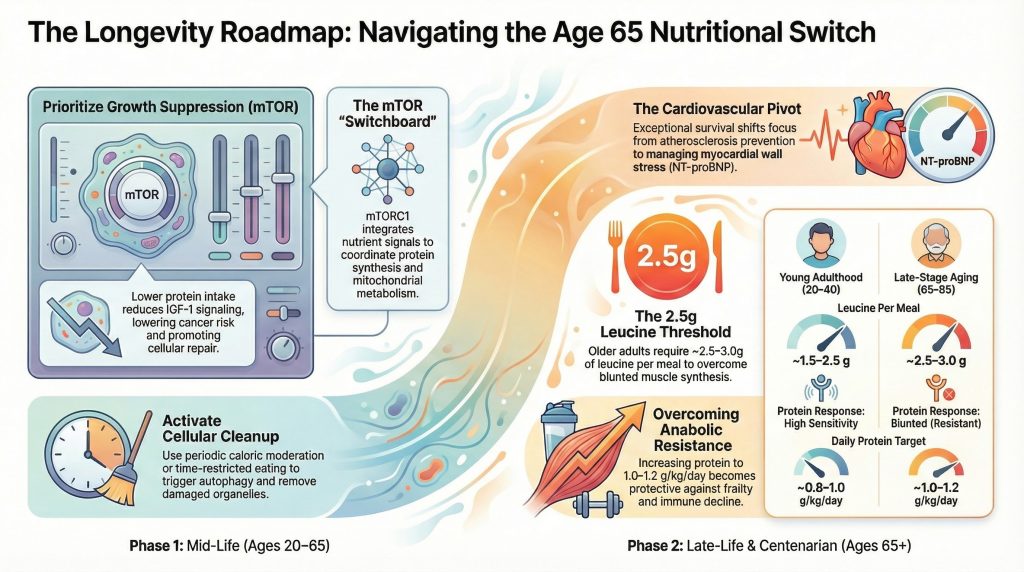
La via mTOR: un centro di regolazione fondamentale nell’invecchiamento e nella durata della vita
L'mTOR funge da “centrale di controllo” metabolica conservata che integra lo stato energetico cellulare, i fattori di crescita e la disponibilità di aminoacidi per coordinare proteina sintesi, autofagia, il metabolismo mitocondriale e le risposte allo stress [1,2]. In diversi organismi modello — tra cui lieviti, mosche e topi — l’aumento della segnalazione anabolica e la ridotta clearance autofagica associati all’invecchiamento sono ripetutamente collegati al declino funzionale e alla riduzione della durata della vita, il che suggerisce che l’eccessiva attività di mTORC1 contribuisca alla biologia dell’invecchiamento piuttosto che costituirne un semplice correlato neutro [1–3].
Architettura molecolare dei complessi mTOR
L'mTOR è presente in due complessi funzionalmente e strutturalmente distinti: mTORC1 e mTORC2. Sebbene entrambi condividano la subunità catalitica mTOR, sono le loro strutture portanti a determinare la specificità del substrato e gli effetti biologici. L’mTORC1 è il complesso sensibile ai nutrienti, caratterizzato dalla presenza di RAPTOR, e regola la traduzione attraverso bersagli quali S6K1 e 4E-BP1 [2,3]. Il complesso mTORC2 è caratterizzato dalla presenza di RICTOR e svolge un ruolo fondamentale nell’organizzazione del citoscheletro e nella segnalazione di sopravvivenza mediata da Akt [2].
L’iperattivazione di mTORC1 nella mezza età e nella terza età è collegata, dal punto di vista meccanicistico, alle patologie associate all’invecchiamento, tra cui i segnali di crescita che favoriscono il cancro e la compromissione di proteostasi, disfunzioni metaboliche e malattie vascolari [2–4]. Promuovendo la traduzione continua e inibendo al contempo l'autofagia (compresa mitofagia), un’eccessiva attività di mTORC1 può accelerare l’accumulo di organelli danneggiati e proteine mal ripiegate, “intasando” di fatto i sistemi di manutenzione cellulare e amplificando i fenotipi associati alla senescenza [2,4].
Tabella 1. Componenti strutturali e funzioni regolatorie di mTORC1
| Componente | Funzione | Ruolo nella segnalazione dell'invecchiamento |
| mTOR | Chinasi catalitica Ser/Thr | Maestro nell’integrazione dei segnali nutrizionali ed energetici [2] |
| RAPTOR | Struttura di supporto per il reclutamento del substrato | Consente la fosforilazione di S6K1 e 4E-BP1 [2,3] |
| mLST8 | Stabilizzatore del dominio chinasi | Favorisce l'integrità strutturale e la trasmissione dei segnali [2] |
| DEPTOR | Inibitore endogeno | Una ridotta espressione/attività può disinibire la segnalazione mTOR [2] |
| PRAS40 | Inibitore regolato da Akt | Link insulina/Segnalazione Akt che porta all'attivazione di mTORC1 [2] |
| Tti1/Tel2 | Fattori di assemblaggio/stabilità | Necessario per la corretta formazione del complesso [2] |
Interventi mirati a mTOR. Inibizione farmacologica di mTORC1 con rapamicina e interventi nutrizionali quali restrizione calorica (CR) sono tra le strategie più riproducibili per prolungare la durata della vita e il periodo di buona salute nei vari sistemi modello [1–3]. Nei topi, la rapamicina è in grado di prolungare la durata della vita anche se somministrata in età avanzata, a conferma dell’ipotesi secondo cui l’mTOR rimane modificabile durante tutto il processo di invecchiamento [1]. La restrizione calorica (CR) riduce costantemente la segnalazione della crescita, potenzia l’autofagia e preserva l’efficienza metabolica. È più corretto descrivere l’inibizione di mTOR/CR come uno degli interventi più costanti a favore della longevità tra i vari taxa piuttosto che come l’unico intervento di questo tipo, poiché anche molteplici manipolazioni (ad esempio, modifiche genetiche alla segnalazione dell’insulina/IGF) prolungano la durata della vita in organismi specifici [1–3].
Il continuum di resistenza anabolica e la segnalazione della leucina
Man mano che le persone passano dalla giovane età adulta alla fase avanzata dell’invecchiamento (spesso definita come ≥65 anni), il muscolo scheletrico mostra progressivamente resistenza anabolica—una stimolazione attenuata di sintesi proteica muscolare (MPS) in risposta alle proteine alimentari e all'esercizio di resistenza [5,6]. Nei soggetti più giovani, dosi moderate di proteine di alta qualità possono innescare un’intensa sintesi proteica muscolare (MPS). Negli anziani, la “soglia anabolica” aumenta; una maggiore disponibilità di aminoacidi essenziali (EAA) — in particolare leucina—è necessario per attivare l’inizio della traduzione e ottenere risposte MPS comparabili [5–7]. Tra i meccanismi coinvolti figurano una compromissione della perfusione e dell'apporto di aminoacidi, una riduzione sensibilità all'insulina, alterazioni nella segnalazione intracellulare muscolare e infiammazione cronica di basso grado infiammazione [5,6].
Il meccanismo del sensore Sestrin2-leucina
La leucina si distingue dagli altri aminoacidi a catena ramificata in quanto funge sia da substrato che da segnale per l'attivazione di mTORC1. Sestrina2 agisce come sensore citosolico della leucina che regola mTORC1 attraverso il Complesso GATOR2 e le GTPasi Rag [8,9]. In condizioni di bassa concentrazione di leucina, Sestrin2 inibisce GATOR2, sopprimendo l’attivazione di Rag e limitando il reclutamento di mTORC1 nei lisosomi [8,9]. Quando la leucina è presente in quantità abbondanti, si lega a una tasca idrofobica conservata sulla Sestrin2, innescando un cambiamento conformazionale che interrompe l’interazione tra Sestrin2 e GATOR2 e consente l’attivazione a valle di mTORC1 [8,9]. Gli studi strutturali evidenziano i fattori di specificità che favoriscono la leucina rispetto alla valina e all’isoleucina, tra cui la complementarità idrofobica e il riconoscimento coordinato dei gruppi amminico e carbossilico della leucina [8,9].
Soglie per superare la resistenza anabolica
Dal punto di vista della geronutrizione pratica, la questione fondamentale non è se la leucina attivi l’mTORC1, ma quale sia il livello di leucina necessario per superare la resistenza anabolica. Analisi osservazionali basate su valori di soglia condotte su anziani hanno individuato un plateau nell’assunzione giornaliera di leucina associato alla massa e alla forza muscolare degli arti inferiori a circa 7,6–8,0 g/giorno, equivalenti a circa 110–115 mg/kg/giorno in coorti tipiche di anziani [10]. Parallelamente, sia le linee guida sull’alimentazione controllata che il consenso degli esperti sottolineano comunemente che gli anziani necessitano spesso di circa 2,5–3,0 g di leucina per pasto (di solito apportati da circa 25–40 g di proteine di alta qualità) per stimolare in modo significativo la sintesi proteica muscolare [6,7]. I metodi di ossidazione degli aminoacidi indicatori suggeriscono inoltre che il fabbisogno di leucina negli anziani possa superare le attuali raccomandazioni, a conferma dell’idea che la leucina possa diventare un fattore limitante quando la qualità delle proteine o l’apporto totale sono bassi [11].
Tabella 2. Valori di riferimento comparativi relativi alle proteine e alla leucina lungo lo spettro dell’invecchiamento
| Metrico | Età adulta giovane (20–40) | Fase avanzata dell'invecchiamento (65–85) | CentENNI (100+) |
| Fabbisogno giornaliero raccomandato (RDA) di proteine (minimo) | 0,8 g/kg/giorno | 0,8 g/kg/giorno (spesso insufficiente) | 0,8 g/kg/giorno (spesso insufficiente) |
| Obiettivo proteico pratico per la giornata | ~0,8–1,0 g/kg/giorno | ~1,0–1,2 g/kg/giorno (dosaggio più elevato in caso di fragilità) [6] | personalizzato; spesso ≥1,0 g/kg/giorno, se tollerato e sicuro [6] |
| Proteine per pasto | circa 20–30 g | ~25–40 g (distribuiti in modo uniforme) [6,7] | densità simile o superiore per pasto, se l’appetito è ridotto |
| Leucina per pasto | ~1,5–2,5 g | ~2,5–3,0 g (ad alto contenuto di leucina) [6,7] | spesso è richiesta un’alta densità; i vincoli legati all’appetito sono determinanti |
| Risposta anabolica | alta sensibilità | smussato (resistente) [5] | probabile forte resistenza; distribuzione critica |
| Stato dell'autofagia | relativamente efficiente | spesso compromesso | eterogene; possono essere conservate in modo selettivo in fenotipi resilienti |
L'implicazione clinica è che attenersi rigorosamente alla dose giornaliera raccomandata (RDA) standard di proteine potrebbe rivelarsi insufficiente per preservare la mobilità e l'autonomia in molti anziani, in particolare quando l'appetito diminuisce e l'apporto energetico cala [6]. La qualità delle proteine, la densità di leucina e la loro distribuzione nei vari pasti assumono un ruolo sempre più centrale nel mantenimento della riserva funzionale.
Transizioni cardiovascolari: Da Aterosclerosi a Insufficienza cardiaca e la demenza
Nel contesto della longevità, il sistema cardiovascolare segue un percorso ben definito di adattamento e declino. Aterosclerosi subclinica è comune negli anni ’70 e ’80, ma tra gli anziani più anziani le cause principali di disabilità e morte tendono spesso a spostarsi verso l’insufficienza cardiaca, la fragilità e la demenza, riflettendo il rimodellamento miocardico cumulativo, l’irrigidimento arterioso e disfunzione microvascolare [12–14]. Ciò non significa che la malattia coronarica scompaia; piuttosto, la manifestazione clinica di invecchiamento vascolare coinvolge sempre più spesso fenotipi di insufficienza cerebrale e cardiaca.
Aterosclerosi subclinica e rischio cognitivo
Coronarica arteria calcificazione (CAC) è un indicatore affidabile del carico aterosclerotico cumulativo. Numerosi studi associano valori più elevati di CAC a un peggioramento della struttura e della funzione cerebrale, nonché a un aumento del rischio di deterioramento cognitivo e demenza negli anziani [12,13]. Studi recenti suggeriscono inoltre che la progressione del CAC possa comportare segnali di un rischio crescente di demenza in coorti prospettiche [14]. Il meccanismo di collegamento potrebbe essere l’invecchiamento vascolare: disfunzione endoteliale, compromissione della perfusione cerebrale, carico di microinfarti e segnalazione proinfiammatoria che accelera la vulnerabilità neurodegenerativa [15].
La rigidità vascolare come fattore determinante della senescenza endoteliale
Un concetto fondamentale nell'invecchiamento cardiovascolare è che la rigidità vascolare non è semplicemente la conseguenza di placca accumulo, ma può fungere da fattore meccanobiologico alla base della disfunzione endoteliale. L’irrigidimento indotto da elastina la degradazione, il rimodellamento del collagene e la reticolazione aumentano lo stress endoteliale e alterano meccanotrasduzione percorsi. La letteratura sperimentale e integrativa sull’invecchiamento vascolare conferma che l’aumento della rigidità e l’alterazione del flusso favoriscono programmi di segnalazione pro-senescenza e la produzione di mediatori infiammatori, in linea con i fenotipi dell’invecchiamento endoteliale [16,17]. Ciò contribuisce a creare un circolo vizioso in cui la rigidità amplifica l’infiammazione e il rimodellamento, e l’infiammazione accelera ulteriormente matrice extracellulare disfunzione [16,17].
Tabella 3. Cardiovascolare Biomarcatori e il contesto di rischio in caso di longevità eccezionale
| Biomarcatore / caratteristica | Invecchiamento standard (anni ’80) | CentENNI (100+) | Implicazioni per la sopravvivenza |
| NT-proBNP | spesso aumenta con l'età | relativamente più bassa nei sottogruppi che sono sopravvissuti in modo eccezionale | livelli più bassi di NT-proBNP associati a un vantaggio in termini di sopravvivenza nelle fasce d’età più avanzate [18] |
| onere CAC | comunemente presente | variabile; un carico minore favorisce il funzionamento del cervello/resilienza vascolare | Un CAC più elevato è associato a esiti cerebrali più sfavorevoli e a un maggiore rischio di demenza [12–14] |
| Rigidità vascolare | spesso aumentato | elasticità preservata nei fenotipi resilienti | riduce lo stress endoteliale e favorisce la salute microvascolare [16,17] |
| Albumina | diminuisce con l'età/l'infiammazione | valori più elevati di albumina indicano una migliore riserva | bassi livelli di albumina sono associati a una maggiore mortalità in tutte le fasce d’età [18] |
Un marcatore particolarmente significativo e riproducibile negli studi sui “centenari” è l’NT-proBNP. Nelle coorti longitudinali aggregate che includono centenari e (semi-)supercentenari, la relazione tra NT-proBNP e mortalità rimane solida anche dopo aver tenuto conto dei tradizionali fattori di rischio e indicatori della riserva d'organo [18]. Questi risultati avvalorano l’ipotesi secondo cui la resistenza allo stress della parete miocardica e la fisiologia dell’insufficienza cardiaca subclinica costituiscano una componente fondamentale di una sopravvivenza eccezionale.
Il “cambiamento” nutrizionale: la soglia critica intorno ai 65 anni
Una delle intuizioni traslazionali più importanti nella ricerca sulla longevità è che la strategia nutrizionale ottimale non rimane immutata nel corso della vita. Intorno ai 65 anni circa si verifica un importante “cambiamento metabolico”, in cui il rapporto rischi-benefici associato all’assunzione di proteine e ai segnali di crescita subisce cambiamenti significativi.
I benefici di una dieta a basso contenuto proteico in età matura
Durante la mezza età, in alcune coorti un apporto proteico più basso è stato associato a una minore segnalazione dell’IGF-1 e a un rischio ridotto di cancro, in linea con l’idea che una segnalazione cronica della crescita possa risultare dannosa quando i meccanismi di riparazione e sorveglianza iniziano a deteriorarsi [19]. In questa fase, l’obiettivo nutrizionale pone spesso l’accento sulla sensibilità all’insulina, salute metabolica, e l’attivazione periodica di vie di mantenimento quali l’autofagia — ottenuta attraverso modelli quali un moderato apporto proteico, l’alimentazione a orario limitato o la moderazione calorica [2,19].
Il fabbisogno proteico nella terza età
Dopo i ~65 anni, il profilo di rischio si inverte. Un basso apporto proteico risulta strettamente correlato a esiti negativi determinati da sarcopenia, fragilità, cadute e ridotta funzionalità immunitaria [6,19]. Un maggiore apporto proteico favorisce il mantenimento della massa muscolare, della riserva funzionale e della risposta immunitaria — sistemi che diventano sempre più vulnerabili con l’avanzare dell’età [6]. Negli anziani, la distribuzione delle proteine e la densità di leucina assumono particolare importanza man mano che l’appetito diminuisce e il fabbisogno energetico si riduce, rendendo determinante la densità nutrizionale (e non solo le calorie).
In linea con quanto sopra, uno studio prospettico condotto su adulti giapponesi di età compresa tra gli 85 e gli 89 anni senza disabilità al basale (Kawasaki Aging and Wellbeing Project) ha riportato valori inferiori mortalità per tutte le cause rischio nei gruppi con l’apporto proteico più elevato rispetto a quelli con l’apporto più basso, dopo aver tenuto conto delle covariate cliniche, a conferma dell’idea che un maggiore apporto proteico possa avere un effetto protettivo in età molto avanzata, quando si mantiene l’indipendenza funzionale [20]. È importante sottolineare che la fonte proteica e il contesto alimentare continuano ad avere rilevanza; dati provenienti da coorti più ampie suggeriscono che la sostituzione di alcune fonti proteiche di origine animale — in particolare la carne rossa e quella lavorata — con proteine vegetali possa migliorare gli esiti a lungo termine nella popolazione generale [21].
Marcatori proteomici e genetici della resilienza dei centenari
I centenari non “sfuggono” all’invecchiamento; spesso ritardano l’insorgenza delle malattie e riducono la morbilità. L’analisi dei profili a livello di sistema conferma sempre più l’esistenza di costellazioni di biomarcatori protettivi nelle coorti di estrema longevità. Studi su larga scala sui biomarcatori condotti tra gli anziani più anziani identificano profili compatibili con una riserva d’organo preservata e una minore incidenza di insufficienza cardiaca tra coloro che raggiungono le età più avanzate, con l’NT-proBNP che emerge come un marcatore particolarmente informativo [18]. Allo stesso tempo, i profili proteomici nei gruppi caratterizzati da una longevità eccezionale riflettono spesso un’alterazione del tono infiammatorio e dell’efficienza metabolica, piuttosto che una sovraregolazione uniforme delle classiche proteine di “difesa”.
Il “paradosso” del redox e degli antiossidanti”
Un errore interpretativo ricorrente consiste nell’equiparare una minore abbondanza di determinate proteine associate agli antiossidanti a difese più deboli. Nei fenotipi di invecchiamento resiliente, una minore espressione di alcune proteine di risposta allo stress può riflettere un minore carico ossidativo a monte, determinato da mitocondri più efficienti e da una ridotta segnalazione infiammatoria cronica. In altre parole, l’omeostasi redox può essere raggiunta attraverso una ridotta produzione di specie reattive piuttosto che attraverso un livello massimo costante antiossidante implementazione. Questa interpretazione è in linea con la letteratura meccanicistica ed epidemiologica che collega stress ossidativo percorsi verso gli esiti cognitivi ed eterogeneità nelle traiettorie di invecchiamento cerebrale [13].
Varianti genetiche e ritardo nella comparsa della malattia
I contributi genetici alla longevità eccezionale sembrano agire principalmente ritardando l’insorgenza delle malattie piuttosto che prevenendo l’invecchiamento in sé. Tra i loci ripetutamente indicati nelle popolazioni longeve vi sono APOE (in particolare l’arricchimento di APOE2), le varianti di FOXO3A associate alla risposta allo stress e alla regolazione della segnalazione dell’insulina, nonché le vie metaboliche legate ai lipidi, compresi i tratti associati alla CETP [22]. Queste varianti sembrano favorire la resilienza vascolare e metabolica, riducendo la probabilità che i danni legati all’età superino le soglie cliniche.
Tabella 4. Meccanismi molecolari chiave e loro influenza sulla longevità
| Meccanismo | Impatto fisiologico | Ruolo nella longevità |
| Mitofagia | controllo selettivo della qualità mitocondriale | limita la produzione di ROS da parte dei mitocondri disfunzionali; favorisce la resilienza energetica [23] |
| Proteostasi | sintesi, ripiegamento e degradazione equilibrati | riduce l'accumulo di proteine aggregate e la disfunzione degli organelli [2,4] |
| Flessibilità metabolica | passaggio da una fonte di combustibile all'altra | favorisce un basso livello basale di insulina e una risposta adattativa allo stress [2,3] |
| Stabilità epigenetica | mantenimento della regolazione genica | potrebbe ridurre l'attivazione disadattiva dei programmi di crescita/senescenza [3] |
| Compliance vascolare | elasticità arteriosa preservata | riduce lo stress vascolare e favorisce la funzione microvascolare del cervello e del cuore [15–17] |
Geronutrizione di precisione e geroterapie emergenti
Con l'evolversi della geroscienza, l'integrazione delle strategie nutrizionali con gli interventi farmacologici mirati ai segni distintivi dell'invecchiamento è diventata una delle principali frontiere di ricerca.
Interventi farmacologici mirati (basati sull'evidenza)
- Rapamicina/rapaloghi: Tra gli interventi più efficaci per prolungare la durata della vita nei modelli animali [1–3]. Negli esseri umani, i primi studi clinici suggeriscono che l’inibizione di mTOR possa migliorare alcuni parametri immunitari negli anziani, a conferma della rilevanza di questa ricerca nel campo della geroscienza, sebbene il prolungamento della durata della vita rimanga da dimostrare [24].
- agonisti dei recettori del GLP-1: Dimostrare significativi benefici in termini di esiti cardiometabolici e cardiovascolari in studi randomizzati su diabete, con un’importanza secondaria per la biologia dell’invecchiamento grazie alla riduzione dell’adiposità, dell’infiammazione e del rischio cardiometabolico [25].
- Inibitori di SGLT2: Hanno dimostrato una significativa riduzione dei ricoveri per insufficienza cardiaca e della mortalità cardiovascolare in studi randomizzati sugli esiti, suggerendo una preservazione della resilienza cardiovascolare; i collegamenti meccanicistici con l'energia mitocondriale e l'infiammazione sono plausibili, ma le affermazioni relative all'allungamento dei telomeri o alla geroprotezione definitiva dovrebbero essere considerate come in fase di studio [26].
- Urolitina A: A microbiota intestinale– un postbiotico derivato che attiva le vie della mitofagia; i risultati di uno studio randomizzato indicano miglioramenti nelle prestazioni muscolari e nei profili dei biomarcatori mitocondriali negli adulti di mezza età, a conferma di un ruolo plausibile nel controllo della qualità mitocondriale [27].
Il ruolo della restrizione calorica nella salute del cervello
Con l’avanzare dell’età, il cervello presenta vulnerabilità ben definite, tra cui il deterioramento dell’integrità della sostanza bianca e della mielina, alterazioni infiammatorie a carico della microglia e una ridotta resilienza metabolica. Studi di mappatura ad alta risoluzione condotti su modelli di invecchiamento indicano che la restrizione calorica può preservare programmi genici specifici per regione legati al mantenimento della mielina, ridurre l’espressione delle vie infiammatorie associate all’invecchiamento e favorire stati cellulari associati alla neuroprotezione [28]. Sebbene non sia semplice applicare all’uomo una restrizione calorica protratta per decenni, questi risultati avvalorano l’idea che una moderazione metabolica prolungata possa preservare la biologia neurovascolare e della sostanza bianca, rilevanti per la resilienza cognitiva.
Analisi regionali e impatto delle politiche sulla longevità
I risultati in termini di longevità non sono determinati esclusivamente da fattori biologici; i contesti alimentari e le strutture politiche influenzano l’esposizione a alimenti ultra-processati, la qualità dell’alimentazione e l’alfabetizzazione nutrizionale. Gli strumenti di sanità pubblica che riducono le resistenze decisionali potrebbero quindi avere effetti di portata eccezionale sull’invecchiamento cardiometabolico a livello di popolazione.
Etichettatura sulla parte anteriore della confezione e alfabetizzazione alimentare
Dati provenienti da studi randomizzati indicano che i sistemi di etichettatura sulla parte anteriore delle confezioni — compresi i modelli di etichetta simili al concetto di “Nutrition Info” proposto dalla FDA — possono migliorare la comprensione da parte dei consumatori e favorire scelte più salutari in scenari di acquisto simulati [29,30]. Gli effetti possono variare in base al livello di alfabetizzazione alimentare e a fattori sociodemografici; le etichette graduate, basate su uno spettro, potrebbero ridurre le disparità di comprensione fornendo indicazioni comparative più chiare tra i vari prodotti [29,30]. Questi risultati sono rilevanti per la longevità, poiché piccoli miglioramenti costanti nella qualità dell’alimentazione possono sommarsi nel corso dei decenni.
La vulnerabilità allo stress ossidativo come bersaglio terapeutico di precisione
La vulnerabilità individuale allo stress ossidativo e alla segnalazione infiammatoria varia. Studi genetici e di inferenza causale confermano l’esistenza di una relazione tra le vie dello stress ossidativo e gli esiti cognitivi, suggerendo che la biologia redox possa contribuire all’eterogeneità delle traiettorie di invecchiamento cerebrale [13]. Ciò rafforza una prospettiva di nutrizione di precisione: alcuni individui potrebbero trarre benefici sproporzionatamente maggiori dall’ottimizzazione precoce del rischio cardiometabolico, della qualità della dieta e dagli interventi volti a ridurre l’infiammazione cronica e il carico ossidativo.
Conclusione: una guida per una vita all’insegna della longevità nutrizionale
Per raggiungere una longevità eccezionale è necessaria una transizione strategica nelle priorità nutrizionali, in linea con le realtà biologiche dell’invecchiamento. La sopravvivenza fino all’undicesimo decennio sembra essere favorita dal mantenimento del controllo della qualità mitocondriale, dal mantenimento della compliance vascolare e da un’adeguatezza nutrizionale sufficiente a superare la resistenza anabolica, nonostante il calo dell’appetito e della riserva fisiologica.
Protocollo nutrizionale raccomandato per le fasi di transizione verso la longevità
- Età precoce e media (20–65): Porre l’accento sulla salute metabolica e su periodici rallentamenti dei segnali di crescita (ad esempio, moderazione calorica o alimentazione a orario limitato). Mantenere un apporto proteico moderato e privilegiare modelli alimentari che favoriscano la salute cardiometabolica e riducano l’infiammazione cronica.
- Transizione nella terza età (65–80): Aumentare l’apporto proteico fino a circa 1,0–1,2 g/kg/giorno, compatibilmente con la tolleranza del paziente e secondo le indicazioni cliniche, prestando attenzione alla distribuzione tra i pasti. Privilegiare porzioni di proteine ad alto contenuto di leucina, con l’obiettivo di raggiungere circa 2,5–3,0 g di leucina per pasto, al fine di favorire la segnalazione della sintesi proteica muscolare (MPS) in caso di resistenza anabolica [6,7].
- Età molto avanzata (80–100+): Concentrarsi sulla densità nutrizionale e su una distribuzione equilibrata dei nutrienti tra i pasti; l’appetito e le difficoltà di masticazione e deglutizione sono i fattori predominanti. Monitorare i marcatori di stress cardiovascolare (ad es. NT-proBNP) e preservare la salute vascolare attraverso pressione sanguigna controllo, attività fisica, ove possibile, e abitudini alimentari che favoriscano funzione endoteliale.
Ridurre il rischio di malattie cardiovascolari e demenza
Mantenere la salute vascolare durante la mezza età rimane fondamentale per ridurre il rischio di insufficienza cardiaca e di vulnerabilità cognitiva in età avanzata. Il carico di CAC e rigidezza arteriosa riflettere esposizione cumulativa e il rischio, nonché le loro conseguenze a lungo termine, sono sempre più legate all’invecchiamento cerebrale man mano che l’aspettativa di vita aumenta [12–17]. Il mantenimento di un ambiente meccanico fisiologico — elasticità arteriosa e integrità microvascolare — può ridurre la disfunzione endoteliale e l’amplificazione dell’infiammazione, favorendo la longevità sia cardiaca che cognitiva.
In sintesi, la transizione verso la longevità non consiste nel ripetere “all’infinito” gli stessi interventi; si tratta piuttosto di un cambiamento strategico, ben ponderato, che porta dal contenimento della crescita e dalla priorità data al mantenimento nella mezza età alla conservazione strutturale e al supporto anabolico nella terza età. Comprendendo il meccanismo di rilevamento dei nutrienti (in particolare le soglie della leucina e le dinamiche dell’mTOR) e la meccanobiologia dell’invecchiamento vascolare, individui e medici possono superare più efficacemente gli ostacoli biologici che separano l’invecchiamento geriatrico standard dai percorsi resilienti dei centenari.
Riferimenti
- Johnson SC, Rabinovitch PS, Kaeberlein M. mTOR is a key modulator of ageing and age-related disease. Nature. 2013;493(7432):338-345. doi:10.1038/nature11861
- Kennedy BK, Lamming DW. The Mechanistic Target of Rapamycin: The Grand ConducTOR of Metabolism and Aging. Cell Metab. 2016;23(6):990-1003. doi:10.1016/j.cmet.2016.05.009
- Papadopoli D, Boulay K, Kazak L, et al. mTOR as a central regulator of lifespan and aging. F1000Res. 2019;8:F1000 Faculty Rev-998. Published 2019 Jul 2. doi:10.12688/f1000research.17196.1
- Zarzycka W, Kobak KA, King CJ, Peelor FF 3rd, Miller BF, Chiao YA. Hyperactive mTORC1/4EBP1 signaling dysregulates proteostasis and accelerates cardiac aging. Geroscience. 2025;47(2):1823-1836. doi:10.1007/s11357-024-01368-w
- Breen L, Phillips SM. Skeletal muscle protein metabolism in the elderly: Interventions to counteract the ‘anabolic resistance’ of ageing. Nutr Metab (Lond). 2011;8:68. Published 2011 Oct 5. doi:10.1186/1743-7075-8-68
- Bauer J, Biolo G, Cederholm T, et al. Evidence-based recommendations for optimal dietary protein intake in older people: a position paper from the PROT-AGE Study Group. J Am Med Dir Assoc. 2013;14(8):542-559. doi:10.1016/j.jamda.2013.05.021
- Moore DR, Churchward-Venne TA, Witard O, et al. Protein ingestion to stimulate myofibrillar protein synthesis requires greater relative protein intakes in healthy older versus younger men. J Gerontol A Biol Sci Med Sci. 2015;70(1):57-62. doi:10.1093/gerona/glu103
- Wolfson RL, Chantranupong L, Saxton RA, et al. Sestrin2 is a leucine sensor for the mTORC1 pathway. Science. 2016;351(6268):43-48. doi:10.1126/science.aab2674
- Saxton RA, Knockenhauer KE, Wolfson RL, et al. Structural basis for leucine sensing by the Sestrin2-mTORC1 pathway. Science. 2016;351(6268):53-58. doi:10.1126/science.aad2087
- Lixandrão ME, Longobardi I, Leitão AE, et al. Daily Leucine Intake Is Positively Associated with Lower Limb Skeletal Muscle Mass and Strength in the Elderly. Nutrients. 2021;13(10):3536. Published 2021 Oct 9. doi:10.3390/nu13103536
- Szwiega S, Pencharz PB, Rafii M, et al. Dietary leucine requirement of older men and women is higher than current recommendations. Am J Clin Nutr. 2021;113(2):410-419. doi:10.1093/ajcn/nqaa323
- Bos D, Vernooij MW, Elias-Smale SE, et al. Atherosclerotic calcification relates to cognitive function and to brain changes on magnetic resonance imaging. Alzheimers Dement. 2012;8(5 Suppl):S104-S111. doi:10.1016/j.jalz.2012.01.008
- Fan Z, Yang C, Qu X, et al. Association of Oxidative Stress on Cognitive Function: A Bidirectional Mendelian Randomisation Study. Mol Neurobiol. 2024;61(12):10551-10560. doi:10.1007/s12035-024-04231-3
- Huang GS, Hansen SL, McClelland RL, et al. Relation of Progression of Coronary Artery Calcium to Dementia (from the Multi-Ethnic Study of Atherosclerosis). Am J Cardiol. 2022;171:69-74. doi:10.1016/j.amjcard.2022.01.061
- Iadecola C. The pathobiology of vascular dementia. Neuron. 2013;80(4):844-866. doi:10.1016/j.neuron.2013.10.008
- Li Q, Qian Z, Huang Y, et al. Mechanisms of endothelial senescence and vascular aging. Biogerontology. 2025;26(4):128. Published 2025 Jun 25. doi:10.1007/s10522-025-10279-y
- Lai A, Zhou Y, Chheang C, et al. Decoding vascular aging: Substrate stiffness and shear stress orchestrate endothelial inflammation and remodelling via mechanosensitive pathways. Biomaterials. 2026;329:123932. doi:10.1016/j.biomaterials.2025.123932
- Hirata T, Arai Y, Yuasa S, et al. Associations of cardiovascular biomarkers and plasma albumin with exceptional survival to the highest ages. Nat Commun. 2020;11(1):3820. Published 2020 Jul 30. doi:10.1038/s41467-020-17636-0
- Levine ME, Suarez JA, Brandhorst S, et al. Low protein intake is associated with a major reduction in IGF-1, cancer, and overall mortality in the 65 and younger but not older population. Cell Metab. 2014;19(3):407-417. doi:10.1016/j.cmet.2014.02.006
- Kurata H, Meguro S, Abe Y, et al. Dietary protein intake and all-cause mortality: results from The Kawasaki Aging and Wellbeing Project. BMC Geriatr. 2023;23(1):479. Published 2023 Aug 9. doi:10.1186/s12877-023-04173-w
- Budhathoki S, Sawada N, Iwasaki M, et al. Association of Animal and Plant Protein Intake With All-Cause and Cause-Specific Mortality in a Japanese Cohort. JAMA Intern Med. 2019;179(11):1509-1518. doi:10.1001/jamainternmed.2019.2806
- Brooks-Wilson AR. Genetics of healthy aging and longevity. Hum Genet. 2013;132(12):1323-1338. doi:10.1007/s00439-013-1342-z
- Shirakabe A, Ikeda Y, Sciarretta S, Zablocki DK, Sadoshima J. Aging and Autophagy in the Heart. Circ Res. 2016;118(10):1563-1576. doi:10.1161/CIRCRESAHA.116.307474
- Mannick JB, Del Giudice G, Lattanzi M, et al. mTOR inhibition improves immune function in the elderly. Sci Transl Med. 2014;6(268):268ra179. doi:10.1126/scitranslmed.3009892
- Marso SP, Daniels GH, Brown-Frandsen K, et al. Liraglutide and Cardiovascular Outcomes in Type 2 Diabetes. N Engl J Med. 2016;375(4):311-322. doi:10.1056/NEJMoa1603827
- Zinman B, Wanner C, Lachin JM, et al. Empagliflozin, Cardiovascular Outcomes, and Mortality in Type 2 Diabetes. N Engl J Med. 2015;373(22):2117-2128. doi:10.1056/NEJMoa1504720
- Singh A, D’Amico D, Andreux PA, et al. Urolithin A improves muscle strength, exercise performance, and biomarkers of mitochondrial health in a randomized trial in middle-aged adults. Cell Rep Med. 2022;3(5):100633. doi:10.1016/j.xcrm.2022.100633
- Zhang Z, Epstein A, Schaefer C, et al. Spatiotemporal profiling reveals the impact of caloric restriction in the aging mammalian brain. Cell Rep. 2025;44(9):116165. doi:10.1016/j.celrep.2025.116165
- Grummon AH, O’Sullivan K, Petimar J, et al. Nutrition Info and Other Front-of-Package Labels and Simulated Food and Beverage Purchases: A Randomized Clinical Trial. JAMA Netw Open. 2025;8(10):e2537389. Published 2025 Oct 1. doi:10.1001/jamanetworkopen.2025.37389
- Huang Y, O’Sullivan K, Block JP, Petimar J, Lee CJY, Grummon AH. Impact of the Food and Drug Administration’s Proposed Front-of-Package Label and Alternative Designs on Consumer Understanding: A Randomized Experiment. Am J Prev Med. Published online December 13, 2025. doi:10.1016/j.amepre.2025.108222