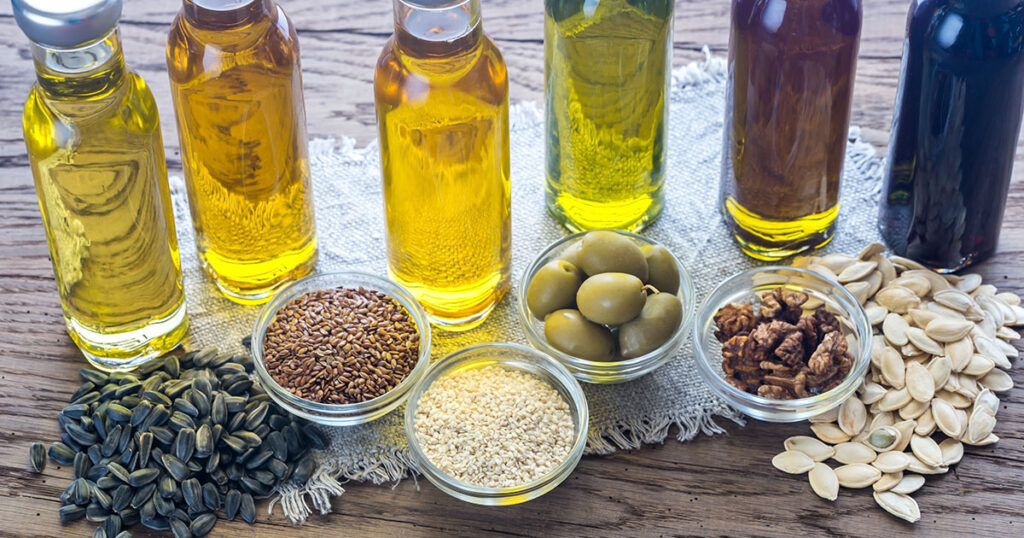
シードオイル(種子油)は健康に良いのでしょうか?○か×か
科学的批判的レビュー 種子油 バーサス オリーブオイル, 飽和脂肪酸, 、およびホールフードの脂質源
抄録
食事性脂肪に関する議論は、低脂肪というパラダイムから、脂質の種類に注目するものへと進展してきた。歴史的に、ガイドラインでは血中コレステロールを下げるため、飽和脂肪酸を多価不飽和脂肪酸に置き換えることが推奨されていた。 コレステロール そして防ぐ 冠動脈疾患. 過去10年間、このガイダンスは、オメガ6を豊富に含む工業用種子油に関する仮説によって異議を唱えられてきた リノール酸 組織的変革を推進する 炎症 そして 脂質過酸化, 、さらにエキストラバージンオリーブオイルやホールフードの脂肪マトリックスがもたらす心血管系の健康上の利点に対する関心の高まりとともに。本総説では、生理学的、メカニズム的、および 治験 証拠、治療 アポリポ蛋白 Bアポリポ蛋白B)-を含む リポタンパク質 の因果的ドライバーとして 動脈硬化. 全体を通して、機械論的なものと 代わりのマーカー, 血流依存性血管拡張反応や炎症などの バイオマーカー, 、および次のようなハードな臨床エンドポイント 心筋梗塞, 脳卒中, 、および心血管死。定量的主張は査読済みの一次研究および体系的エビデンス統合から導き出されており、公開された情報源と照らし合わせて検証できなかった主張は削除されている。.
1. はじめに
食事性脂肪に関する栄養学的な議論は、単純な低脂肪モデルから、脂質の種類に特化した複雑な分析へとシフトしている。公衆衛生上のガイドラインは歴史的に、〜に置き換えることを推奨してきた 飽和脂肪酸 ~と一緒に 多価不飽和脂肪酸 血清を減らすため 総コレステロール (TC)を低下させ、冠動脈疾患(CHD)を予防します。過去10年間にわたり、このガイダンスは、オメガ6系リノール酸(LA、18:2n-6)を豊富に含む工業用種子油が慢性的な全身性炎症や過酸化脂質を促進するという仮説によって異議を唱えられてきました。同時に、心血管系に対するベネフィットを示す証拠が蓄積されてきました エキストラバージンオリーブオイル そしてホールフード由来の脂質マトリックス。1]
このレビューでは、未精製および精製の種子油についてバランスの取れた評価を行い、それらをEVOO、精製オリーブオイル、SFA(飽和脂肪酸)、およびホールフードの脂肪源と比較対照している。分析の中心となるのは、動脈硬化の因果的推進因子としてのApoB含有リポタンパク質の役割であり、同時に 食後の 抽出された脂肪の血管に対する影響は、血中脂質を介した影響とは独立してリスクに寄与している。[2], [3]
2. 種子油は特別に有害なのか?
リノール酸を様々な割合で含有する種子油(大豆油、コーン油、ひまわり油、サフラワー油、キャノーラ油、綿実油、グレープシード油、米ぬか油)が、他の精製脂質とは異なる特有の悪影響を及ぼすという仮説については、現在も研究が続けられている。キャノーラ油は便宜上ここに分類されているが、主に一価不飽和脂肪酸であり、アルファリノレン酸も供給するため、高リノール酸油と同一視して扱ってはならない。懸念の根拠はその化学構造にある。多価不飽和脂肪酸(PUFA)には、複数の二重結合が隔てられて存在する ビスアリル位メチレン基, 、水素引き抜きや脂質過酸化を受けやすくなる [6]
現代の食生活において、これらの油は主に加工食品や超加工食品の成分として摂取されており、精製された種子油の影響を精製されたものから切り離すことが困難であるため、観察研究において結果を複雑にしている。 炭水化物, 、高ナトリウム、および低 ファイバー.
管理された試験において単一の食事成分として評価した場合、種子油は、そのクラスに特有の有害な心血管代謝的悪影響を示していない。むしろ、それらは脂肪酸プロファイルに基づいた予測可能な脂質調節効果を示す。バターやその他の飽和脂肪酸(SFA)が豊富な油脂と比較して、不飽和植物油は一貫して低密度リポ蛋白コレステロール(LDL-C)を低下させ、高オレイン酸油への置換試験でもアポリポ蛋白B(ApoB)の緩やかな減少が示されている。4], [5]
2.1 脂肪酸組成と酸化安定性
主要な添加油脂の脂肪酸組成と相対的な酸化安定性を表1にまとめる。感受性 自動酸化 二重結合の数とともに増加するため、飽和および 一価不飽和脂肪酸 多価不飽和の種子油よりも酸化に対してはるかに安定しています。従来の高リノール酸種子油とその高オレイン酸品種は化学的に異なっています。高オレイン酸のひまわり油、サフラワー油、大豆油は一価不飽和のオレイン酸が大部分を占め、それに対応して従来の高リノール酸のものよりも安定しています。6]
| 脂肪・油分 | プライマリクラス | 主要脂肪酸 | 二重結合 | 酸化感受性 |
| ココナッツオイル | 飽和した | ラウリン酸 (12:0)、ミリスチン酸 (14:0) | 0 | 非常に低い |
| バター | 飽和した | パルミチン酸 (16:0)、ステアリン酸 (18:0) | 0 | 非常に低い |
| エキストラバージンオリーブオイル | 一価不飽和 | オレイン酸 (18:1n-9) | 1 | 低(保護されています ポリフェノール) |
| キャノーラ油 | MUFA / PUFA | オレイン酸(18:1n-9)、リノール酸(18:2n-6)、α-リノレン酸(18:3n-3) | 1から3 | 中程度 |
| 大豆油 | 多価不飽和 | リノール酸 (18:2n-6) | 2 | 高 |
| コーン油 | 多価不飽和 | リノール酸 (18:2n-6) | 2 | 高 |
| ベニバナ油(高リノール酸) | 多価不飽和 | リノール酸 (18:2n-6) | 2 | 非常に高い |
| ベニバナ油(ハイオレイック) | 一価不飽和 | オレイン酸 (18:1n-9) | 1 | 低い |
表1. 主要な添加脂肪の脂肪酸組成と相対的な酸化安定性。組成データは標準的な脂質化学の文献を反映している。酸化されやすさの順位は定性的かつ相対的なものであり、同等の保存および加熱条件に適用されるものであり、測定された普遍的な数値ではない。実際の酸化安定性は、精製度、トコフェロール、および 抗酸化物質 含有量、温度、酸素曝露、脂肪酸組成。.
2.2 業界からの資金提供と解釈
食事性脂肪に関する文献の評価は、産業界からの資金提供を受けた栄養学研究が広く行われているため、複雑化している。飲料に関する研究の方法論的分析によると、産業界からの資金提供は、資金提供者に有利な結論と強く関連していることが判明した。 介入研究において、業界からの資金提供がある場合とない場合を比較した際、好意的な結論と好意的でない結論のオッズ比は7.61(95%信頼区間 1.27~45.73)であり、業界からの資金提供が全額行われた16件の介入研究のいずれも、好意的でない結論を報告していなかった。 [7]
その分析は食事性脂肪ではなく飲料に関するものであり、そこから脂肪特異的なオッズ比を導き出すことはできない。ここで引用されているのは、資金提供バイアスの一般的な傾向を示すためだけである。一貫性を保つためには、この精査が脂肪に関する議論の両陣営に等しく当てはまることを認める必要がある。すなわち、種子油の研究においてもオリーブ油の研究においても、商品生産者からの資金提供は双方で行われているのである。商業的なスポンサーシップが存在するということ自体だけで研究が無効になるわけではないが、議論の双方における、商業的資金に依存しない独立した研究による再現性の重要性が強調される。7]
3. 主な問題はシードオイルではなく添加油なのか?
別の仮説では、食後血管機能障害の主たる決定要因は、種子油の特定の脂肪酸プロファイルではなく、オリーブ油を含むあらゆる種類の抽出・精製された油の摂取であると主張されている。このモデルの下では、機械的または化学的抽出により、脂質から保護的な細胞構造、繊維、微量栄養素マトリックスが剥ぎ取られ、脂質が生物学的利用能が高くカロリーの密集した液体に変換される。3]
抽出された油脂は、無傷の食品マトリックスと比較して、上部消化管においてより迅速に生体利用可能となり、循環血液中における食後の急速な上昇を引き起こす カイロミクロン およびトリグリセリドを豊富に含むリポ蛋白。これにより一過性が引き起こされる可能性がある 酸化ストレス そして 内皮機能障害. 完全なホールフードの基質内で脂肪を摂取すると、食事性繊維や無傷の植物細胞壁がリパーゼのアクセスを遅らせる物理的バリアとして働くため、より緩やかでコントロールされた吸収プロファイルが得られる。これはアーモンドにおいて直接実証されており、54gの脂肪量に調整した食事を比較した20人の男性を対象としたランダム化クロスオーバー試験では、脱脂アーモンド粉末を加えたアーモンドオイルよりも、ホールアーモンドの粒の方が食後のトリグリセリド反応が大幅に小さいことが分かった。セクション2.2の対称性の原則と一致するように、その試験はカリフォルニア・アーモンド協会からの資金提供を受けて行われたものであり、アーモンドの食品基質に関する文献一般もアーモンド業界からの支援を受けている。オリーブ、大豆、アボカドについては、同等の対照比較実験が行われていないため、ナッツ類以外への拡張は推論にとどまる。25], [26]
3.1 追加された脂質が血管生理学に与える機構的影響
抽出された油が血管の健康に影響を与える可能性のある、いくつかの相互に関連する経路が提案されている。これらは決定的なアウトカム試験ではなく食後生理学によって裏付けられた機序的な提案であり、そのように提示されている。3]
- 一酸化窒素 そして 血管内皮機能: 食後の大きな脂質の上昇は、スーパーオキシド産生を増加させ、減少させると提案されている 一酸化窒素の生体利用能, 、これにより一過性の血管収縮機能障害を引き起こした。ある対照ヒト試験では、抗酸化ビタミンであるビタミンCおよびEが、71%による食後の機能障害を軽減し、この反応に酸化ストレスが関与していることが示唆された。[8]
- リポ蛋白の侵入と滞留: 食後内皮障害は、アポB含有リポタンパク質の、内皮下マトリックスへの侵入を促進すると仮定されており、これは以下における最初のステップである アテローム発生, 、食後の文献自体は動脈壁への浸透を示していないものの、[2], [3]
得られたメカニズムの証拠は、脂肪酸の組成に関わらず、抽出された油が一過性の食後血管内皮機能障害の一因となる可能性があることを示している。繰り返される食後血管内皮機能障害は、さらなる調査に値する生物学的に妥当なメカニズムを表している。生物学的に妥当ではあるが、繰り返される一過性のFMD障害が独立して加速することをヒトの試験で証明したものはまだない。 歯垢 ApoB曝露で調整した後の進行であり、ヒトにおいてこの経路がプラークへと進行することを直接示した試験はない。3]
4. 血流依存性血管拡張反応と内皮機能
血流依存性血管拡張反応 上腕の 動脈 一酸化窒素依存性内皮機能を評価する確立された非侵襲的指標であり、心血管イベントと前向きに関連している。 メタ分析 5,547人の参加者を含む14件の観察研究において、上腕動脈FMDの障害は将来の心血管イベントと有意に関連しており、プールされた 相対リスク FMDの1%絶対増加あたり0.87の27それはFMDの検証というよりも、むしろ予後的な関連性である。 代用エンドポイント 治療効果に関して。FMDは臨床的エンドポイントではなく代理マーカーであることを明確に述べることが重要である。すなわち、血管の生理学的特性を測定するものであり、FMDの変化それ自体が構成するものではない 心臓発作, 、脳卒中、あるいは死亡が回避されることにある。その価値は機序的な洞察にあり、臨床的ベネフィットを定量化することではない。27]
4.1 脂質に対する食後の内皮反応
A システマティックレビュー 単回の高脂肪食が内皮機能に及ぼす急性効果に関するメタ分析(131件の研究、うち90件を定量的統合に採用)では、食後の統計的に有意な低下が認められた 上腕動脈血流依存性血管拡張反応. [3]
- 2時間後:FMDは1.02パーセントポイント低下した(95%信頼区間 -1.34~-0.70;P < 0.01)。[3]
- 3時間後:FMDは1.04パーセントポイント低下した(95%信頼区間 -1.48~-0.59;P < 0.001)。[3]
- 4時間後:FMDは1.19パーセントポイント低下した(95%信頼区間 -1.53~-0.84、P < 0.01)。[3]
脂肪からのエネルギーの割合は、3時間後のFMDの変化と逆相関し(P < 0.01)、これは用量依存的な食後効果と一致していた。トリグリセリドを豊富に含むリポ血症および酸化ストレスは、実証されたものというよりは、むしろ候補となるメカニズムである。[3](図1)
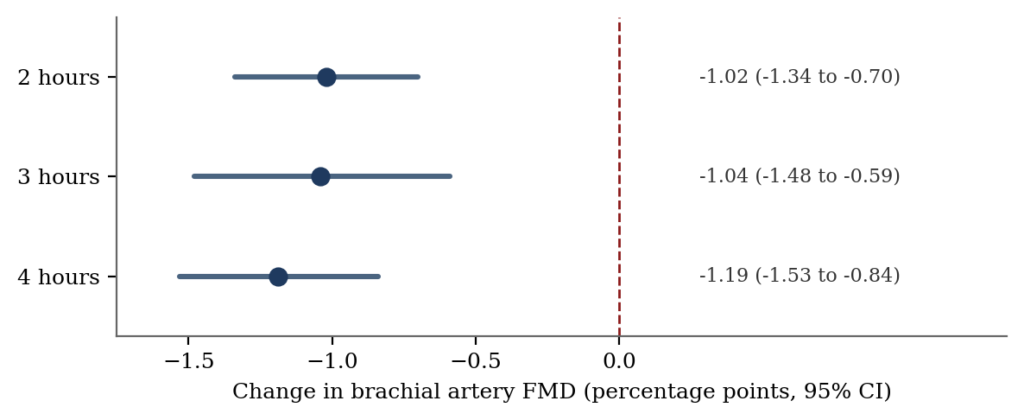
図1. 単回の高脂肪食摂取後の上腕動脈の血流依存性拡張の変化(各試験のデータを統合)。値はパーセントポイントでの平均差であり、95% 信頼区間. FMDは臨床のエンドポイントではなく、血管内皮機能の代替マーカーである。参照文献[3].
4.2 オリーブオイルFMDパラドックス
血管生物学における重要な知見は、Vogelらによって記述されたオリーブオイルFMDパラドックスである。健康な脂質代謝異常のない10人の被験者が、異なる由来の脂肪50gを含む900kcalの食事を摂取した。8]
オリーブオイルの食事は、食後のFMDを31%低下させ、14.3%から9.9%へと減少させた(P = 0.008)。一方、キャノーラ油およびサーモンの食事では、有意な低下は見られなかった。 食後の血清中の変化には逆相関が認められた。 中性脂肪 およびFMDの変化(r = -0.47; P < 0.05)が見られた。 オリーブオイルを含む食事に、抗酸化物質が豊富な食品やビタミンCおよびEを併用した場合、その低下は大幅に抑制された(それぞれ65%および71%)。この実験は、これらの条件下では、エクストラバージンオリーブオイルを多量に含む食事であっても、食後のFMDの低下を防ぐことはできなかったことを示している。 これは10名を対象とした急性高脂肪負荷試験である。実験用食事には約50 gの脂肪が含まれており、多くの人にとって通常の1食あたりの脂肪摂取量を大幅に上回るため、反応の大きさや油の順位を、日常的な摂取状況に直接当てはめるべきではない。[8]
エキストラバージンオリーブオイルによる血管内皮機能の保護は、ヒドロキシチロソールやオレウロペインをはじめとする、その親水性セコイリドイド系フェノール化合物に起因することが多い。, オレオカンタール, 、およびオレアセインは、in vitro(試験管内)でフリーラジカル消去剤として作用します。この作用については慎重に扱うべきであり、本レビューでは確証されたものとしては提示しません。この文献における資金提供の状況はさまざまであり、一括してではなく、個別の事例ごとに記述する必要があります。食後高血糖に関する肯定的な試験、すなわち20人の2型糖尿病リスクのある成人を対象としたランダム化クロスオーバー試験では、 糖尿病, 、ポリフェノールを豊富に含むエキストラバージンオリーブオイルの50mLの単回摂取が、精製オリーブオイルと比較して血管内皮機能を改善したと報告しており、同試験はオリーブオイル生産者から資金提供を受け、試験用オイルも提供されたほか、米国疾病予防管理センター(CDC)からも追加支援を受けていた。28最大のフェノール類臨床試験であるEUROLIVEは、欧州委員会から助成金QLK1-CT-2001-00287の支援を受け、著者らは経済的な利益相反がないことを宣言している。17フェノール富含有口中エキストラバージンオリーブオイルとフェノール乏含有オリーブオイルを比較した46名の健康なボランティアを対象とした3週間のクロスオーバー試験では、以下の抵抗性に対する効果は認められなかった。 LDL または HDL 酸化に対して;その試験は国際オリーブ油評議会および栄養・健康研究財団の支援を受け、1人の著者がユニリーバ健康研究所に所属していた。29正確な要約は、この文献には製薬(生産者)資金による陽性試験、独立資金による陽性試験、およびオリーブ産業資金による中立(非有意)試験が含まれており、その結果の方向性は混在しており、これらの研究はすべてサロゲート(指標)を測定しているということである。したがって、スポンサーシップは研究結果と必ずしも綺麗に一致しておらず、入手可能な証拠に基づくと、オリーブオイルのポリフェノールがヒトの内皮機能を独立して改善するという主張は確立されていない。.
| 脂肪・油分 | 脂肪酸骨格 | 副構成部品 | 食後FMD効果 |
| バター | 飽和脂肪酸(16:0、18:0) | 飽和脂肪酸(SFA)が豊富な乳脂肪マトリックス;コレステロールが存在する | 急性的な高脂肪食は通常FMDを低下させるが、バター特異的な影響は文献[3] |
| 精製種子油 | 多価不飽和脂肪酸(18:2n-6) | トコフェロール(可変) | 変数でありコンテキスト(文脈)に依存するが、急性高脂肪食は頻繁にFMDを低下させる |
| 精製オリーブオイル | MUFA(18:1n-9) | ポリフェノール含有量が非常に少ない | 一部の急性期の比較において減少が報告されている;文脈に依存する |
| エキストラバージンオリーブオイル | MUFA(18:1n-9) | セコイリドイドポリフェノール | 文脈により異なる |
| キャノーラ油 | MUFA(18:1n-9) | ファイトステロール, 、ALA (18:3n-3) | 引用された単一の急性実験における有意な削減なし、一般化可能性は不確実 |
表2. 主要な脂肪源が食後の血流依存性血管拡張反応(FMD)に及ぼす報告された効果。方向性の効果は引用された対照試験を反映しており、大きさは食事の組成によって異なる。FMDはサロゲートマーカーである。.
5. オメガ6脂肪酸の生物学と代謝
種子油が全身性の炎症を促進するという仮説を評価するためには、リノール酸(18:2n-6)の代謝運命を調べなければならない。LAは、不飽和化酵素と鎖長延長酵素の共通のカスケードを介して酵素的変換を受け、最終的に アラキドン酸 (AA, 20:4n-6)は、シクロオキシゲナーゼ、リポキシゲナーゼ、およびシトクロムP450経路を介したエイコサノイド合成の基質である。9]
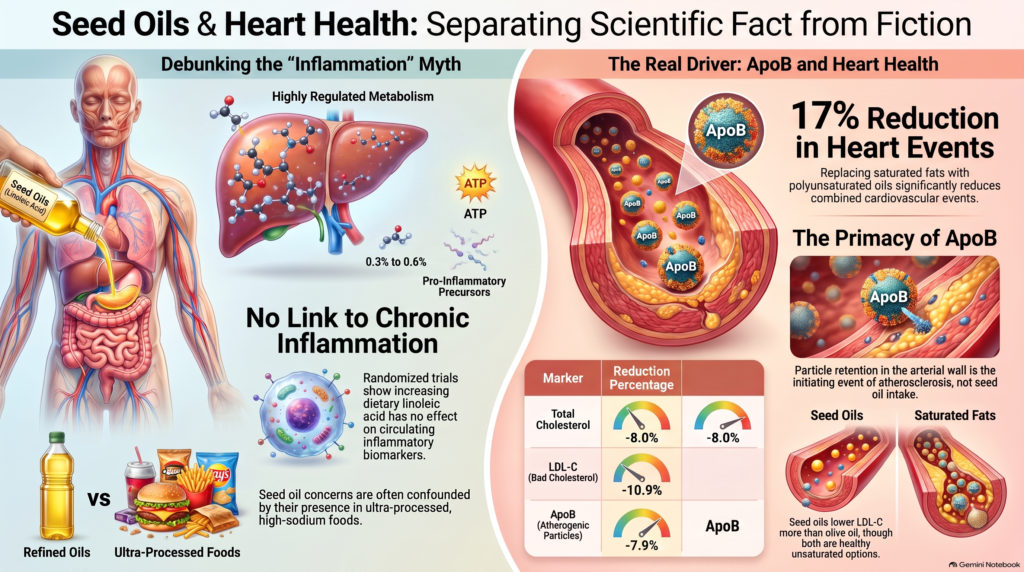
オメガ6仮説では、食事中のLAを多く摂取すると、細胞膜中のAA濃度が上昇し、その結果、炎症誘発性メディエーターが過剰に産生されると提唱されている。 ヒトを対象とした安定同位体トレーサー研究によると、通常の西洋型食事摂取量では、このモデルは支持されないことが示されている。食事由来のLAからAAへの変換率はわずか0.3%~0.6%と推定されており、これは成人ヒト組織において律速酵素であるδ-6-デサチュラーゼの活性が低いことを反映している。[9], [10]
ヒトを対象とした介入研究のシステマティック・レビューによると、食事中のLAを最大90%まで減らしても、血漿または血清リン脂質中のAA含有量とは有意な相関が見られなかった(P = 0.39)。また、食事中のLAを数倍に増やしても、AAとは同様に相関が見られなかった(P = 0.72)。 食事由来のLAの過剰分は、主にエネルギーとしてβ酸化されるか、脂肪組織に蓄積され、AAに変換されることはない。[9]
アラキドン酸代謝も本質的にバランスが取れている。確立されたエイコサノイド生化学によれば、アラキドン酸は炎症誘発性メディエーターだけでなく、血管拡張薬および血小板活性化抑制薬であるプロスタサイクリンや、炎症を積極的に抑制する専門的収束促進メディエーターであるリポキシンンの前駆体でもある。したがって、食事からのリノール酸の増加が一様に炎症の増加をもたらすという単純なモデルは、根底にある生化学と矛盾している。31]
6. オメガ6脂肪酸は慢性炎症を増加させるか?
の系統的レビュー ランダム化比較試験 健康な非乳児集団における食事性LAと慢性炎症の検討では、害の証拠は認められなかった。試験全体において、食事性LAの増加は、血中循環における C反応性タンパク質 (CRP)、フィブリノーゲン、, プラスミノーゲン アクチベーター阻害剤-1, インターロイキン-6 (IL-6), 、腫瘍壊死因子-アルファ(TNF-α)、または可溶性接着分子。11]
したがって、臨床的証拠は、食事からのオメガ6脂肪酸の多量摂取がヒトの全身性炎症を促進するという仮説を支持しない。この結論は、エイコサノイド経路からの機序的外挿に基づくのではなく、客観的バイオマーカーのエンドポイントを用いた管理されたヒト臨床試験に基づいている。11]
透明性の確保およびセクション2の資金提供に関する配慮に従い、リノール酸と炎症に関するレビューは業界技術委員会からの制限のない助成金によって支援され、以下で議論する高オレイン酸油のレビューはコモディティ・ボードによって資金提供されました。これらの開示は透明性のために行われたものであり、これによって研究結果が無効になるわけでもなく、脂質や臨床的転帰に関する無関係のエビデンスによって相殺されるものでもありません。これらはリノール酸が炎症性バイオマーカーを上昇させるか否かとは無関係です。11]
7. 種子油対飽和脂肪
7.1 代謝および脂質への影響
飽和脂肪を多価不飽和の種子油に置き換えることで、アテローム形成性脂質が大幅に低下する。54件の無作為化試験を対象としたネットワークメタ解析では、血中脂質への影響に基づいて油類および固形脂肪がランク付けされた。 LDL-C(SUCRA 82%)および総コレステロール(SUCRA 90%)を低下させる確率が最も高かったのはベニバナ油であり、次いで菜種油(カノーラ油)(LDL-C:SUCRA 76%、 総コレステロールについてはSUCRA 85%)がこれに続いた。不飽和油脂は、バターと比較してLDL-Cを約0.23~0.42 mmol/L低下させた。[4この効果のために一般的に引き合いに出されるメカニズムは、肝臓のアップレギュレーションです。 LDL受容体, 、これにより循環因子のクリアランスが促進され アポB含有リポ蛋白; そのメカニズムは、ネットワークメタアナリシス自体によって示されたというよりも、リポ蛋白に関する文献において確立されているものである。21]
高オレイン酸植物油への置き換えに関するシステマティックレビューでは、アポBへの影響が直接定量化されました。飽和脂肪酸を置き換えることで 高オレイン酸油 総コレステロールを8.0%、LDL-Cを10.9%、ApoBを7.9%それぞれ低下させた(いずれもP < 0.05)。関連する介入は、制限のない追加ではなく置換である。エビデンスは、以下の置換を支持している。 不飽和脂肪酸 飽和脂肪酸が総エネルギー摂取量の約5〜10パーセントの範囲内にある場合であり、既存の食生活に油が無制限に追加されることではありません。[5](図2)
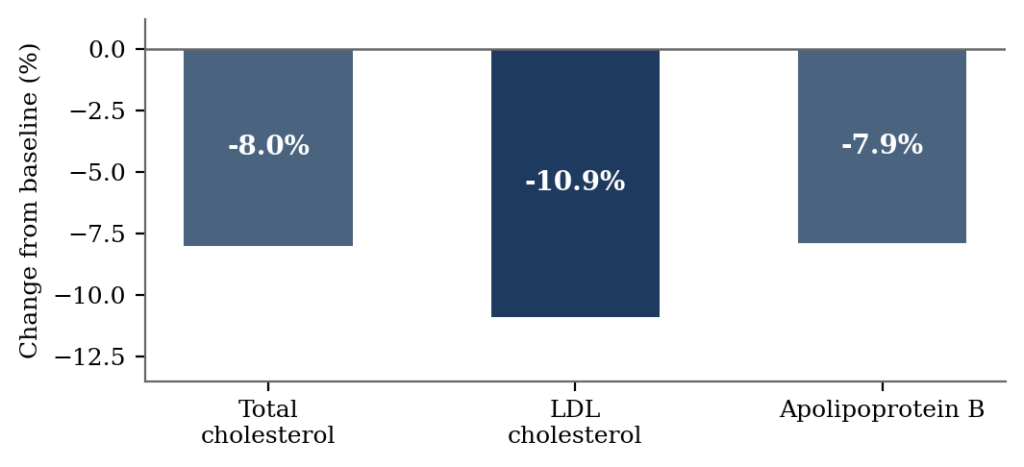
図2. 飽和脂肪酸を高オレイン酸植物油に置き換えた場合の動脈硬化性脂質尺度の変化。すべての変化は P < 0.05。関連する介入は等カロリーの置き換えであり、既存の食餌への油の追加ではない。データ出典:参考文献[5].
7.2 臨床的心血管系アウトカム
飽和脂肪酸摂取量の削減に関する最新のコクラン・システマティックレビューでは、少なくとも2年間飽和脂肪酸の摂取量を減らした56,675名の参加者を対象とした15件のランダム化比較試験を統合した。 飽和脂肪酸の摂取量を減らすことで、心血管イベントの合計において統計学的に有意な減少(17%)が認められた(リスク比 0.83;95% 信頼区間 0.70~0.98;I² 67%)。[18]
サブグループ解析とメタ回帰により、このベネフィットは飽和脂肪酸を 多価不飽和脂肪酸 または高品質な炭水化物であり、コレステロールの低下が大きいほど、より高い保護効果が予測される。 治療必要数 56インチだった 一次予防 および53インチ 二次予防. [18]
合わせたイベントの減少にもかかわらず、飽和脂肪の削減は、ほとんどあるいは全く影響を与えなかった 全因死亡率 (55,858人の参加者、11件の試験)または心血管死(53,421人の参加者、10件の試験)のいずれにおいても認められず、どちらのエビデンスも中等度の質であった。イベント減少と死亡率との間のこの乖離自体が重要であり、セクション12でさらに議論される。18]
7.3 歴史的論争の批判的再評価
食事・心臓仮説の批判者は、ラムズデンらによって再分析された2つの歴史的試験からの復元されたデータを頻繁に引用する。.
- ミネソタ冠動脈実験 施設入所者9,423名を対象とした二重盲検無作為化試験で、飽和脂肪酸をコーン油に置き換えた食事群と、飽和脂肪酸を摂取する対照群を比較した。 コーン油介入群では血清コレステロール値が13.8%低下したのに対し、対照群では1.0%の低下にとどまった(P < 0.001)が、生存率の改善は認められなかった。 共変量を調整したモデルでは、血清コレステロール値が30 mg/dL低下するごとに、死亡リスクが22%高まることが示された(ハザード比 1.22;95% CI 1.14~1.32;P < 0.001)。[13]
- シドニー・ダイエット・ハート・スタディ 最近冠動脈イベントを発症した男性458名を対象とした無作為化試験では、飽和脂肪酸をベニバナ油に置き換えた場合、全死因死亡率が上昇することが明らかになった(17.6% 対 11.8%;ハザード比 1.62; 95% 信頼区間 1.00~2.64)、心血管死(ハザード比 1.70;95% 信頼区間 1.03~2.80)、および冠動脈性死亡(ハザード比 1.74; 95% CI 1.04~2.92)の増加が認められた。[14]
どちらの試験にも、現代の推奨に対する妥当性を制限する重要な限界がある。介入ではn-3系多価不飽和脂肪酸の摂取量を増やすことなくリノール酸を選択的に増加させており、シドニー試験では トランス脂肪酸 研究対象となったマーガリンの成分は記録されておらず、当時の一般的なマーガリンやショートニング自体にトランス脂肪酸が含まれていたという背景を踏まえると、当時のトランス脂肪酸摂取量は不明確なままである。また、これらの歴史的な試験には、食事介入期間、追跡調査、および参加者の継続率の点で重要な限界があった。[13], [14]
8. 種子油とオリーブオイルの比較
8.1 脂質調節の直接的な作用
多価不飽和脂肪酸の含有量が高いため、リノール酸を豊富に含む種子油は、一価不飽和脂肪酸を豊富に含むオリーブオイルよりも、総コレステロールおよびLDL-Cを多少多く低下させる。 27件の無作為化プラセボ対照試験(参加者1,089名)を対象としたメタ分析によると、オリーブオイルによるLDL-Cの低下効果は他の植物油に比べて小さく、加重平均差は4.2 mg/dL(95%信頼区間 1.4~7.01; P = 0.003)であり、総コレステロールの低下幅も6.27 mg/dL(95%信頼区間 2.8~10.6)と、他の植物油に比べて小さかった。 統計的に有意ではあるものの、オリーブオイルに対するこのLDL-Cの差の大きさは控えめであり、読者はこれを両者間の大きな臨床的差異として解釈すべきではない。[15]
一方、オリーブオイルは他の植物油よりも高密度リポタンパク質コレステロール(HDL-C)を上昇させ、27件の試験すべてを対象とした統合加重平均差は1.37 mg/dL(95%信頼区間 0.40~2.36)であった。 この効果は小さく、臨床的意義は不明確である。[15]
8.2 オリーブオイルの等級
「オリーブオイル」という用語には、読者がしばしば混同しがちないくつかの異なる製品が含まれています。バージンオリーブオイルは、化学的処理を行わず、機械的な方法によって製造されます。エクストラバージンオリーブオイルは、最高級の 等級, 、より厳しい官能評価基準および遊離酸度基準を満たし、天然のフェノール化合物を大幅に多く保持している。精製オリーブオイルは、欠陥を除去するために化学的または物理的な精製処理が施されたバージンオイルであり、この工程ではオレイン酸の骨格はそのまま残しつつ、ポリフェノールの大部分が除去されてしまう。 オリーブ搾りかす油は、残留ペーストから溶剤を用いて抽出され、その後精製される。オレイン酸含有量ではなくフェノール類含有量に関連する代替効果がいくつか報告されているため、これらの等級を互換性があるものとして扱うべきではなく、ポリフェノール含有量の高いエクストラバージンオイルで得られた知見が、精製油や搾りかす油の等級にも当てはまるとは限らない。[17]
8.3 血管、内皮、および炎症のプロファイル
オリーブオイルは、血管の炎症や内皮機能の点で精製種子油よりも優れていると言われることがありますが、その主張は代替エンドポイントに基づいているものであり、本稿では臨床的結論を導く根拠としては用いていません。参加者3,106名を対象とした30件のランダム化比較試験のメタ分析によると、オリーブオイルの摂取は以下の低下と関連していることが報告されています。 IL-6 (平均差 -0.29 pg/mL;95% 信頼区間 -0.57~-0.02)、可溶性E-セレクチンの値が低く(平均差 -3.16; 95% 信頼区間 -4.07~-2.25)、およびFMDの上昇(平均差 0.76%;95% 信頼区間 0.27~1.24)が認められた。これらは臨床事象ではなく、代替マーカーである。 このメタ解析は、デザイン、期間、スポンサーが異質な試験を統合したものであり、それ自体では資金提供に関する分析を報告していないため、基礎となる文献のスポンサー構成について結論を導き出すことはできない。 これらの結果は臨床的意義が不確かな代替指標による改善であるため、イベントの減少へと外挿すべきではなく、また、オリーブオイルが他の不飽和油よりも内皮機能において優れているという結論をこれらから導き出すことはできない。[16]
8.4 ポリフェノールの寄与の特定
EVOOの健康効果が、そのオレイン酸を主成分とする構造に由来するのか、それとも微量に含まれる生物活性化合物に由来するのかを明らかにするため、EUROLIVE研究では、無作為化クロスオーバーデザインを用いて、200名の健康な男性を対象に、ポリフェノール含有量が低(2.7 mg/kg)、 中程度(164 mg/kg)、高濃度(366 mg/kg)のポリフェノールを含むオリーブオイルを1日25 mLずつ摂取させた。 HDL-Cはポリフェノール含有量に比例して線形に上昇し(最高用量で+0.045 mmol/Lの変化;95%信頼区間 0.02~0.06)、 酸化LDL 線形に減少した(最高用量での変化量は-3.21 U/L、95% 信頼区間 -5.1~-0.8)一方、ポリフェノール含有量の少ない油は酸化LDLを増加させた。[17]
これらの用量依存的な知見は、オリーブオイルのポリフェノールに関する欧州連合(EU)が承認した健康強調表示の根拠となっており、この表示は、オイル20 gあたり少なくとも5 mgのヒドロキシチロソールおよびその誘導体を含むオイルにのみ適用される。[30] EUROLIVEは、欧州委員会による助成金QLK1-CT-2001-00287の支援を受けて実施されたものであり、著者らは金銭的な利益相反がないことを表明しているため、本試験は独立した資金提供を受けた試験として適切に解釈される。[17] その主な限界は、資金提供ではなくエンドポイントにある。HDL-Cおよび酸化LDLは代替マーカーに過ぎず、オリーブオイルのポリフェノール摂取量を増やすことで心筋梗塞、脳卒中、あるいは心血管死が減少することを示した臨床試験は存在しない。 46名の健康なボランティアを対象とした3週間のクロスオーバー試験では、フェノール含有量の多い油は、フェノール含有量の少ない対照群と比較して、LDLやHDLの酸化に対する耐性を高めないことが判明した。この試験は国際オリーブオイル評議会(IOOC)の支援を受けており、食品業界の企業も関与していたため、独立した試験とは言えない。[29] したがって、ポリフェノールの作用機序は、方向性や資金提供元がまちまちな代替エンドポイントの証拠によって裏付けられているに過ぎず、それだけでは、心血管系アウトカムの観点から、他の不飽和脂肪酸よりもオリーブオイルを推奨する根拠とはならない。 さらに、一般化にあたっては注意が必要である。EUROLIVE試験では、フェノール類の濃度は異なるものの、それ以外は類似したオリーブオイルを比較対象としたため、同試験で比較対象として用いられたフェノール類濃度の低いオリーブオイルを、市販のあらゆる精製オリーブオイルと同等とみなすべきではない。.
| マーカー | エクストラバージンオリーブオイル | 精製オリーブオイル | 精製種子油 |
| LDL-Cの低下 | 中程度 | 中程度 | 変動する。一般的に、多価不飽和脂肪酸(PUFA)を豊富に含む油ほどその値は高くなる。 |
| HDL-Cの効果 | オリーブオイル全体では小幅な増加が報告された | 学年ごとに個別に設定されていない | 変数 |
| 酸化LDL | ポリフェノール含有量の高いオリーブオイルで減少が報告されている | EUROLIVE研究において、ポリフェノール含有量の低いオリーブオイルで増加が報告された | 変動的/一貫して改善されていない |
| 全身性炎症(IL-6) | 一部の臨床試験やメタ分析では、わずかな改善が報告されている | 学年別のエビデンスが不十分 | 概して、慢性炎症のバイオマーカーに上昇は見られない |
| 食後性FMD | 文脈により異なる | 文脈に依存する一過性の減少 | 文脈に依存する一過性の減少 |
| 酸化安定性 | 比較的高め | 中程度から比較的高い | 変動要因:高オレイン酸配合では高く、多価不飽和脂肪酸(PUFA)を豊富に含む配合では低くなる |
表3. 引用された試験に基づく、エクストラバージンオリーブオイル、精製オリーブオイル、および精製種子油の脂質、酸化、血管に関するプロファイルの比較。.
9. ホールフードと抽出油の比較
抽出された油と、それに対応する未加工の食品を比較すると、生体利用率、食後の動態、および 満腹感. 抽出処理により、細胞構造と食物繊維が除去される。これが直接測定されたアーモンドの場合、無傷の細胞壁が脂質の生体利用能を制限するため、脂肪の一部は吸収されずに下部消化管へと通過し、測定された代謝可能エネルギーはアトウォーターの予測値を下回る。 オリーブ、アボカド、およびほとんどの種子については、同等の管理された測定データが存在しないため、このメカニズムを食品全体の脂質に一般化することは、依然としてナッツ類に特化した文献からの推論にとどまっている。[25], [26]
また、未加工の食品形態には、測定可能な脂質面での利点もある。系統的レビュー、メタ分析、および 用量反応 61件の対照試験(参加者2,582名)の分析によると、木の実の摂取は総コレステロールおよびLDL-Cを非線形的に低下させ、1日あたり約60 gを超えるとその効果がより強まり、またApoBおよびトリグリセリドを線形の用量反応関係に従って低下させることが明らかになった。 これは、本総説のApoBを中心とした枠組みと一致している。なぜなら、ナッツの実そのものは 動脈硬化惹起性粒子 直接負担する。[24]
抽出油は、食事の中で最もカロリー密度の高い食品の一つであり、1gあたり約9kcal、大さじ1杯あたりおよそ120kcalを供給しますが、食物繊維はごく微量しか含まれておらず、 タンパク質. エネルギー密度 この程度の運動は、正のエネルギーバランスを促進する可能性があります。これは、過剰な脂肪蓄積自体が心血管疾患の 危険因子. オリーブオイル、種子油、バターはいずれも高カロリーであるため、脂肪酸の質とは関係なく、これらを過剰に摂取すると体重増加につながる可能性があります。.
対照試験によるヒトデータは、自然食品とその油との間に機能的な違いがあることを裏付けている。すなわち、ある患者群において、クルミはオリーブオイルと比較して食後の内皮機能を維持した。 高コレステロール血症, 、これは、脂肪酸、抗酸化物質、およびL-アルギニンの含有量が相まって生じる効果であると言われている。[22]
無作為化試験では、木の実が血中ApoBを直接低下させることが示されており、アーモンドを用いた食品マトリックス研究では、抽出油と比較して脂質の生体利用率が低下し、食後のトリグリセリド反応も小さくなることが実証されている。 すべての自然食品由来の脂質源が、単離された油脂と比較して、カロリー当たりの満腹感、食後代謝、またはApoBを改善するという証拠は確立されておらず、そう断定すべきではない。 同様に、不飽和油を含む質の高い食事パターンと比較して、自然食品由来の脂質源が心血管イベントの減少において優れていることを、無作為化試験で立証できていない。これは、油を含まない自然食品中心の食事と油を含む食事を直接比較した長期試験がほとんどないためである。 したがって、自然食品の有効性を裏付ける根拠は、実証されたイベント減少ではなく、一致する中間的な証拠と生物学的妥当性に基づいている。メカニズムを推奨事項に落とし込む際には、この区別を念頭に置くべきである。[24], [25], [26]
10. 加工、保存、調理過程における脂質の酸化
脂質の自動酸化速度は、脂肪酸鎖に含まれる二重結合の数に比例するため、多価不飽和脂肪酸(PUFA)はフリーラジカルの攻撃を受けやすい。精製された多価不飽和脂肪酸を多く含む種子油を長時間加熱すると、特に商業的な揚げ調理が繰り返される条件下では、熱酸化、加水分解、および重合が生じる。 また、酸化は、フライヤーの繰り返し使用、空気や光への曝露、長期保存によって促進され、暗色のガラス容器での保存、低温保存、不活性ガスの充填によって遅延される。[6], [12]
この分解により、一次脂質ヒドロペルオキシドが生成され、それがマロンジアルデヒドや4-ヒドロキシノネナールなどのアルデヒド、および9-HODEや13-HODEなどの酸化リノール酸代謝物といった反応性の高い二次生成物へと分解される。 ヒトにおいて、食事中のリノール酸を減少させると、血中を循環する生物活性のある酸化リノール酸代謝物が顕著に減少することが確認されており、これは食事に反応する経路が存在することを裏付けている。この文献全体を通じて解釈上の注意が必要である。すなわち、血中を循環する酸化LDLおよび酸化代謝物の測定値は、体内で生じる酸化と相関関係にあるものの、それを直接的に証明するものではない。 動脈プラーク それ自体であり、この2つを同一視してはならない。[6], [23]
対照的に、一価不飽和脂肪酸や飽和脂肪酸は二重結合がはるかに少なく、酸化されやすいビスアリル炭素も持たないため、熱による分解に対してより耐性があります。これらの酸化生成物のメカニズムは、内皮細胞やミトコンドリアへのストレス要因として生物学的に妥当な説明が可能ですが、循環するApoBと比較した際の臨床的寄与の程度については、確立された経路というよりはあくまで仮説の段階にとどまっています。 一般の議論でしばしば混同されがちな重要な区別として、こうした懸念は繰り返し加熱され、熱的に分解された油に当てはまるものであり、加熱されていない新鮮な種子油には当てはまらないという点がある。乱用された揚げ油の酸化生成物は、新鮮な油そのものの性質ではないのである。[6], [12]
11. 内皮細胞の損傷、アテローム性動脈硬化症、およびApoBの重要性
血管機能不全仮説では、抽出油による食後の反復的な内皮ストレスが、数十年にわたり内皮透過性の増加、リポタンパク質の侵入、および血管炎症に寄与すると提唱されている。 繰り返される一過性の内皮機能障害は、長期的な血管損傷に寄与し得る生物学的に妥当なメカニズムであると考えられるが、ヒトにおいてこの経路を実証する直接的な臨床的証拠は依然として限られている。これは、確立された発症原因ではなく、一因となる仮説として捉えるのが適切である。[3]
血管生物学の知見によれば、アテローム性プラークの形成には、アポB含有リポタンパク質が動脈壁に侵入し、そこに滞留することが必要であることが明らかになっています。欧州アテローム性動脈硬化学会のコンセンサスでは、コレステロールを豊富に含むアポB含有リポタンパク質が動脈内に滞留・蓄積することが、 内膜 はアテローム発生の引き金となる事象であり、そのリスクは用量依存的に高まる。ApoBは一般的に、血中濃度のより直接的な指標である。 動脈硬化誘発性粒子数 よりも LDLコレステロール, 、というのも、各アテロゲン性粒子には1つのApoB分子が結合しているからです。血中ApoBを低下させるような食事の変更は、 粒子負荷 動脈壁に浸透し、そこに留まることができる。このメカニズムは、前述のような食後のFMD所見が一過性であるにもかかわらず、飽和脂肪酸を不飽和脂肪酸に置き換えた際に観察される長期的な臨床的利益と整合している。ただし、その比較を直接検証した臨床試験は存在しない。. メンデルランダム化 一連の研究はこの枠組みを裏付けており、遺伝的にLDLやApoBの値が低いことは、その低下メカニズムにかかわらず、心血管リスクを低減させることが示されている。[2], [21]
12. 臨床転帰および対象集団のサブグループ
長期にわたる無作為化試験の知見によると、飽和脂肪酸の摂取量を減らすと心血管イベントの合計が減少することが示されており、飽和脂肪酸を多価不飽和脂肪酸に置き換えた場合、その効果はより大きくなり、コレステロール低下幅と保護効果の大きさは相関関係にある。これは、血中ApoBの減少が主なメカニズムであることを裏付けている。 脳卒中および全死亡率に対する効果は、統合された無作為化データではそれほど顕著ではない。[18], [21]
12.1 オリーブオイルと地中海型食生活
確立された冠動脈疾患については、 CORDIOPREV試験 1,002名の患者を無作為に 地中海式ダイエット 7年間にわたり、エキストラバージンオリーブオイルを豊富に摂取する食事または低脂肪食を続けた。主な 複合エンドポイント 発生率は1,000人年あたり28.1件対37.7件であり、各モデルにおける多変量調整後のハザード比は0.719 (95% 信頼区間 0.541~0.957)から 0.753(95% 信頼区間 0.568~0.998)の範囲にあり、地中海式食事法に有利な結果となった。 解釈上の留意点が2つある。低脂肪対照群では、総脂肪摂取量をカロリーの約32%までしか削減しておらず、厳格な低脂肪目標には達していなかったこと、また、この試験は、オリーブオイル関連団体に加え、スペイン政府や欧州連合(EU)からの資金提供も受けた混合資金によるものであったことである。 一般化可能性を解釈する際には、実際に実施された対照群の食事内容と、この混合資金源の両方を考慮すべきである。[20]
画期的な一次予防試験は PREDIMED, 。この研究では、7,447人の高リスク参加者を、エクストラバージンオリーブオイルを補足した地中海式食事群、ナッツを補足した同様の食事群、あるいは低脂肪の対照群に無作為に割り付けた。再発表された意図治療解析において、主要な心血管イベントに対する調整済みハザード比は、オリーブオイル群で0.69 (95% 信頼区間 0.53~0.91)、ナッツ群では0.72(95% 信頼区間 0.54~0.95)であり、相対的なリスク低減率はおよそ30%であった。 ここで3つの注意点がある。第一に、2013年の当初の報告は、ベースラインデータの監査の結果、以下のことが判明したため、撤回され、2018年に再発表された。 ランダム化 7,447名の参加者のうち約1,588名(約21%)において、一斉に割り当てられた世帯員や、単位として無作為化された診療所を含め、割り当てに不備があった。 本研究は、割り当て手順において重要なプロトコル逸脱が見られる無作為化試験として最も適切に説明され、この点は2018年の再解析で取り上げられており、同解析では、影響を受けた割り当てを除外した後も結果は同様であったと報告されている。第二に、介入内容はオリーブオイル単独ではなく地中海式食事パターン全体であったため、その有益性はオリーブオイルのみに帰属させることはできない。 第三に、資金調達に関して言えば、介入用食品はオリーブオイルやナッツの生産者および商品団体から寄贈されたものである一方、試験自体には多額の公的研究資金が投入されており、研究者らは、スポンサーが研究デザイン、分析、報告において一切関与していないと報告している。[19]
12.2 絶対リスク低減と代替マーカーの限界
食事性脂肪に関する議論で繰り返し見られる問題点は、代替マーカーから臨床的利益への飛躍的な推論である。LDL-C、HDL-C、酸化LDL、FMD、およびIL-6の改善はメカニズムの観点からは有意義であるが、読者が最終的に関心を寄せるのは心筋梗塞や死亡の予防であり、この2つは必ずしも比例して変化するわけではない。 最も明確な絶対値は、コクランの飽和脂肪酸に関するレビューから得られており、試験期間中に心血管イベントを1件予防するために必要な治療人数(NNT)は、一次予防で56、二次予防で53であった一方、全死因死亡率および心血管死率は有意に低下しなかった。[18] 食用油に関する文献の全体的な信頼性は、その量から想像されるほど高くはない。ある 統合レビュー 206件のメタ分析を含む48件のシステマティック・レビューのうち、関連性の確実性について「非常に低い」と評価されたものは67.5%、「低い」は21.8%、「中程度」は9.7%であり、「高い」と評価されたのはわずか1%であった。 AMSTAR-2評価尺度では、48件のレビューのうち、信頼性が「高い」と評価されたのは1件のみであり、14.6%が「中程度」、62.5%が「低い」、20.8%が「極めて低い」と評価された。[32](図3)

図3. 食用油に関するエビデンスの確実性と方法論的信頼性。左:206件のメタアナリシスにおけるGRADEの確実性。右:それらを含む48件のシステマティック・レビューにおけるAMSTAR-2の信頼性。四捨五入のため、パーセンテージの合計が100にならない場合があります。データ出典:[32].
特にオリーブオイルに関しては、オリーブオイル単体を対照群と比較し、重篤な心血管エンドポイントについて検証した無作為化試験は存在しない。オリーブオイルに起因するとされるイベント減少の根拠は、PREDIMEDなどの地中海式食事の全体的なパターンを対象とした試験から得られている。 コディオプレブ, 、そこではオリーブオイルは数ある成分の一つに過ぎなかった。したがって、正確な 絶対リスク オリーブオイルのみを単独の介入として行った場合に、どの程度のリスク低減が期待できるかは不明である。したがって、オリーブオイル単独で心筋梗塞を特定の割合だけ減少させるという推定は、現時点では無作為化試験によるエビデンスによって裏付けられない。 オリーブオイルを対照群と比較してハードエンドポイントについてメタ解析を行った場合、統合推定値は有意差を示さない:心血管イベント(RR 0.97;95% CI 0.67~1.39)、心血管死(RR 1.07; 95% CI 0.77~1.48)、あるいは全死因死亡(RR 0.99;95% CI 0.85~1.15)に対して有意な効果は認められなかった。[32] これは、根本にある食事指導の弱点というよりは、あくまで率直な限界である。[19], [20](図4)
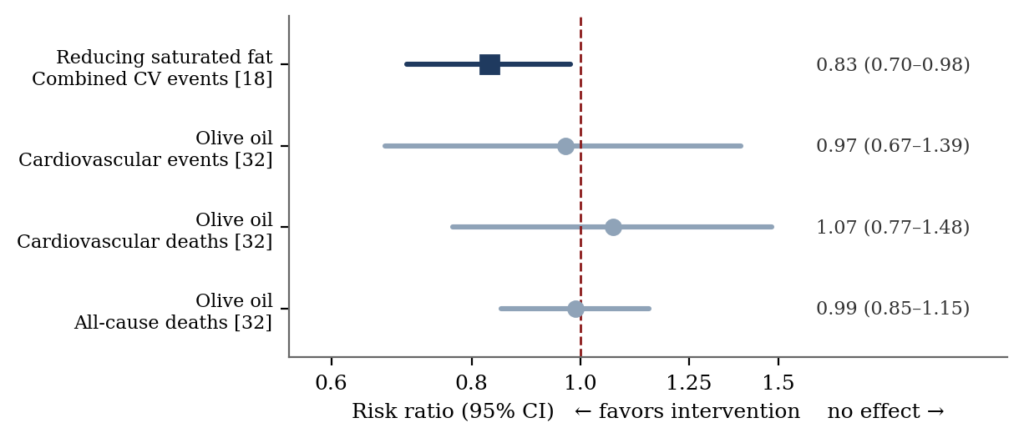
図4. 主要臨床エンドポイントに関する無作為化試験および統合解析によるエビデンス。飽和脂肪酸の摂取量を減らすと、心血管イベントの複合発生率が低下する。オリーブオイルと対照群を比較した統合解析の推定値は、イベントおよび死亡率のいずれについても有意差が認められなかった。四角印は、統計的に有意な推定値を示す。 なお、2つの行は直接比較ではないことに留意されたい。介入、対照群、および試験対象集団が異なるためである。参考文献[18] および [32].
12.3 人口のサブグループ
以下の症状のある患者には 家族性高コレステロール血症, 、遺伝的にLDL受容体の機能が低下しており、生涯にわたるアポBへの曝露量が多い患者においては、食事中の飽和脂肪酸を制限し、不飽和植物油に置き換えることが薬物療法を補完し得るが、LDLを薬物で低下させることは依然として治療の中心である。あらゆるサブグループにおいて、共通する原則は、生涯にわたるアポBへの曝露量の低減である。[2], [21]
13. 総括と核心的な問いへの回答
- 種子油は、他の添加油と比べて特に有害なのでしょうか?
いいえ。一般的に摂取されている種子油が、他の食事性脂肪と同カロリーで置き換えられた場合に、特有の心代謝毒性を示すという説得力のあるヒトを対象とした証拠はありません。対照試験によるヒトのデータでは、慢性炎症のバイオマーカーの上昇は認められておらず、飽和脂肪酸の代替として使用された場合、脂質への影響は概して良好です。これらが頻繁に 超加工食品 は重要な観察研究である 交絡因子. [4], [11]
- オメガ6脂肪酸は、ヒトの慢性炎症を悪化させるのでしょうか?
いいえ。無作為化比較試験によると、食事由来のリノール酸は血中炎症バイオマーカーを増加させないことが示されています。 リノール酸からアラキドン酸への変換率はわずか0.3%から0.6%であり、厳密に制御されている。また、アラキドン酸は、炎症促進性および炎症解消性の両方のメディエーターを生成する。[9], [11]
- 種子油は、オリーブオイルとは異なる形で内皮機能を損なうのでしょうか?
信頼できる差は確認されていない。食後のFMDの変化は食事の量や構成の影響を受け、一部の研究では食後のトリグリセリド反応の大きさと関連している。ここで引用した急性実験では、キャノーラ油を用いた食事では有意な低下は見られなかったが、エクストラバージンオリーブオイルを用いた食事では有意な低下が認められた。[8] 高ポリフェノール含有オリーブオイルと精製オリーブオイルを比較した臨床試験では、資金提供元の背景が様々であるため、結果もまちまちとなっている。具体的には、試験用オイルを供給した生産者の資金提供を受けた試験では、食後における良好な結果が報告されている [28], 国際オリーブオイル評議会が資金提供した3週間のクロスオーバー試験では、フェノール含有量がLDLの酸化抵抗性に影響を与えないことが明らかになった [29]、および欧州委員会から資金提供を受け、利益相反の申告がないEUROLIVE研究では、HDL-Cおよび酸化LDLに用量依存的な変化が報告された [17]. オレイン酸を主成分とする脂肪酸組成だけでは、食後FMDの低下を予防できることは示されておらず、いずれにせよFMDはあくまで代替マーカーに過ぎない。.
- 主な懸念事項は、脂肪酸組成にかかわらず、抽出された油脂そのものにあるのでしょうか?
「全食品」と「油」を直接比較した証拠(アーモンドに関するものが最も有力)は、脂質の生体利用能が著しく高いことを示しており、 食後高脂血症 抽出油は、未処理の種子よりもポリフェノール含有量が高い。この知見をすべての食品マトリックスに一般化することは妥当であると考えられるが、検証は不十分である。また、抽出油は高カロリーである。これらの特性のいずれかが、ApoBの低下とは独立した長期的なリスクにつながるかどうかは、依然として不明である。 ポリフェノールを豊富に含むエキストラバージンオリーブオイル(EVOO)は、その抗酸化成分が脂質に起因する内皮ストレスを相殺するという根拠から、部分的な例外として提唱されることがあるが、その主張を裏付ける臨床試験は少なく、結果もまちまちであり、代替エンドポイントのみを測定している。[3], [8], [25], [28], [29]
- 飽和脂肪酸を種子油に置き換えることで、主にLDL-CおよびApoBを通じて治療成績が改善されるのでしょうか?
はい。その効果は、LDLおよびApoB含有リポタンパク質の曝露量の減少によって、かなり大きく媒介されていると考えられます。飽和脂肪酸は肝臓のLDL受容体の発現を低下させますが、これを不飽和脂肪酸に置き換えると、受容体の活性が上昇し、食事の変更が維持されている限り、血中ApoBを持続的に低下させることができます。[5], [21]
- 自然食品由来の脂質源は、心血管系の健康面においてより優れた効果をもたらすのか?
無作為化試験では、木の実がApoBを直接低下させることが示されており、アーモンドを用いた食品マトリックス研究では、抽出油と比較して脂質の生体利用率が低下することが示されている。この利点がすべての自然食品由来の脂質源に当てはまるかどうかは、まだ明らかになっていない。ハードエンドポイントに関しては、油を含まない食事と油を含む食事を比較した長期の無作為化試験がほとんどないため、エビデンスは限られている。[24], [25], [26]
- 食後の急性FMD機能障害は、長期的なアテローム性動脈硬化にどのような役割を果たしているのか?
これは一過性の血管ストレスの再現性のあるマーカーであるが、アポBの滞留に次ぐ二次的な要因にとどまる。アテローム性プラークの形成には、アポBを含むリポタンパク質が動脈壁に侵入し、滞留することが必要である。 長期的な転帰に関するエビデンスは、現在、一過性のFMDの変化に対する懸念よりも、持続的なApoB低下の臨床的重要性を支持しているが、これら2つが臨床試験で直接比較されたことは一度もない。[2], [21]
13.1 エビデンスに基づく推奨事項
証拠の全体像からは、特にアポB値が高い人、家族性高コレステロール血症の人、あるいは既往の冠動脈疾患がある人については、飽和脂肪酸を植物由来の不飽和脂肪酸に置き換えることを優先する食事パターンが支持される。 オリーブオイルやその他の植物性不飽和油については、ポリフェノールの利点や内皮機能への効果が実証されているわけではないため、LDLおよびApoBへの影響に基づいて、動物性脂肪の妥当な代替品として扱う。というのも、ポリフェノールに関する証拠は完全に代替エンドポイントに基づいており、臨床事象との対比試験は一度も行われていないからである;ナッツ、種子、 アボカド、オリーブといった、最小限の加工しか施されていない天然食品由来の脂質源を推奨する。この中で、木の実類はLDL-CおよびApoBを適度に低下させるという点で最も強力な無作為化試験によるエビデンスを有しているが、そのリストに含まれるすべての食品について同等のApoBに関するエビデンスが存在するわけではないことに留意している;また、熱劣化したもの、繰り返し加熱されたもの、あるいは揚げ油の使用を最小限に抑える。 代替マーカーが改善する場合、率直に言えば、これらはメカニズムの観点から好ましい変化であり、それが臨床事象の減少につながることは、単一の油を単独で見た場合よりも、食事パターン全体として捉えた場合に最も明確に裏付けられている。[18], [24], [25], [26], [6]
参考文献
- Sacks FM, Lichtenstein AH, Wu JHY, et al. Dietary Fats and Cardiovascular Disease: A Presidential Advisory From the American Heart Association. Circulation. 2017;136(3):e1-e23. doi:10.1161/CIR.0000000000000510
- Ference BA, Ginsberg HN, Graham I, et al. Low-density lipoproteins cause atherosclerotic cardiovascular disease. 1. Evidence from genetic, epidemiologic, and clinical studies. A consensus statement from the European Atherosclerosis Society Consensus Panel. Eur Heart J. 2017;38(32):2459-2472. doi:10.1093/eurheartj/ehx144
- Fewkes JJ, Kellow NJ, Cowan SF, Williamson G, Dordevic AL. A single, high-fat meal adversely affects postprandial endothelial function: a systematic review and meta-analysis. Am J Clin Nutr. 2022;116(3):699-729. doi:10.1093/ajcn/nqac153
- Schwingshackl L, Bogensberger B, Benčič A, Knüppel S, Boeing H, Hoffmann G. Effects of oils and solid fats on blood lipids: a systematic review and network meta-analysis. J Lipid Res. 2018;59(9):1771-1782. doi:10.1194/jlr.P085522
- Huth PJ, Fulgoni VL 3rd, Larson BT. A systematic review of high-oleic vegetable oil substitutions for other fats and oils on cardiovascular disease risk factors: implications for novel high-oleic soybean oils. Adv Nutr. 2015;6(6):674-693. Published 2015 Nov 13. doi:10.3945/an.115.008979
- Grootveld M. Evidence-Based Challenges to the Continued Recommendation and Use of Peroxidatively-Susceptible Polyunsaturated Fatty Acid-Rich Culinary Oils for High-Temperature Frying Practises: Experimental Revelations Focused on Toxic Aldehydic Lipid Oxidation Products. Front Nutr. 2022;8:711640. Published 2022 Jan 5. doi:10.3389/fnut.2021.711640
- Lesser LI, Ebbeling CB, Goozner M, Wypij D, Ludwig DS. Relationship between funding source and conclusion among nutrition-related scientific articles. PLoS Med. 2007;4(1):e5. doi:10.1371/journal.pmed.0040005
- Vogel RA, Corretti MC, Plotnick GD. The postprandial effect of components of the Mediterranean diet on endothelial function. J Am Coll Cardiol. 2000;36(5):1455-1460. doi:10.1016/s0735-1097(00)00896-2
- Rett BS, Whelan J. Increasing dietary linoleic acid does not increase tissue arachidonic acid content in adults consuming Western-type diets: a systematic review. Nutr Metab (Lond). 2011;8:36. Published 2011 Jun 10. doi:10.1186/1743-7075-8-36
- Demmelmair H, Iser B, Rauh-Pfeiffer A, Koletzko B. Comparison of bolus versus fractionated oral applications of [13C]-linoleic acid in humans. Eur J Clin Invest. 1999;29(7):603-609. doi:10.1046/j.1365-2362.1999.00477.x
- Johnson GH, Fritsche K. Effect of dietary linoleic acid on markers of inflammation in healthy persons: a systematic review of randomized controlled trials. J Acad Nutr Diet. 2012;112(7):1029-1041.e10415. doi:10.1016/j.jand.2012.03.029
- Bazina N, Ahmed T, Almdaaf M, Abu Hallalah HMO, Jibia S. Chemical Changes in Deep-Fat Frying: Reaction Mechanisms, Oil Degradation, and Health Implications. Food Sci Nutr. 2025;13(10):e70969. Published 2025 Oct 13. doi:10.1002/fsn3.70969
- Ramsden CE, Zamora D, Majchrzak-Hong S, et al. Re-evaluation of the traditional diet-heart hypothesis: analysis of recovered data from Minnesota Coronary Experiment (1968-73). BMJ. 2016;353:i1246. Published 2016 Apr 12. doi:10.1136/bmj.i1246
- Ramsden CE, Zamora D, Leelarthaepin B, et al. Use of dietary linoleic acid for secondary prevention of coronary heart disease and death: evaluation of recovered data from the Sydney Diet Heart Study and updated meta-analysis. BMJ. 2013;346:e8707. Published 2013 Feb 4. doi:10.1136/bmj.e8707
- Ghobadi S, Hassanzadeh-Rostami Z, Mohammadian F, et al. Comparison of blood lipid-lowering effects of olive oil and other plant oils: A systematic review and meta-analysis of 27 randomized placebo-controlled clinical trials. Crit Rev Food Sci Nutr. 2019;59(13):2110-2124. doi:10.1080/10408398.2018.1438349
- Schwingshackl L, Christoph M, Hoffmann G. Effects of Olive Oil on Markers of Inflammation and Endothelial Function-A Systematic Review and Meta-Analysis. Nutrients. 2015;7(9):7651-7675. Published 2015 Sep 11. doi:10.3390/nu7095356
- Covas MI, Nyyssönen K, Poulsen HE, et al. The effect of polyphenols in olive oil on heart disease risk factors: a randomized trial. Ann Intern Med. 2006;145(5):333-341. doi:10.7326/0003-4819-145-5-200609050-00006
- Hooper L, Martin N, Jimoh OF, Kirk C, Foster E, Abdelhamid AS. Reduction in saturated fat intake for cardiovascular disease. Cochrane Database Syst Rev. 2020;8(8):CD011737. Published 2020 Aug 21. doi:10.1002/14651858.CD011737.pub3
- Estruch R, Ros E, Salas-Salvadó J, et al. Primary Prevention of Cardiovascular Disease with a Mediterranean Diet Supplemented with Extra-Virgin Olive Oil or Nuts. N Engl J Med. 2018;378(25):e34. doi:10.1056/NEJMoa1800389
- Delgado-Lista J, Alcala-Diaz JF, Torres-Peña JD, et al. Long-term secondary prevention of cardiovascular disease with a Mediterranean diet and a low-fat diet (CORDIOPREV): a randomised controlled trial. Lancet. 2022;399(10338):1876-1885. doi:10.1016/S0140-6736(22)00122-2
- Borén J, Chapman MJ, Krauss RM, et al. Low-density lipoproteins cause atherosclerotic cardiovascular disease: pathophysiological, genetic, and therapeutic insights: a consensus statement from the European Atherosclerosis Society Consensus Panel. Eur Heart J. 2020;41(24):2313-2330. doi:10.1093/eurheartj/ehz962
- Cortés B, Núñez I, Cofán M, et al. Acute effects of high-fat meals enriched with walnuts or olive oil on postprandial endothelial function. J Am Coll Cardiol. 2006;48(8):1666-1671. doi:10.1016/j.jacc.2006.06.057
- Ramsden CE, Ringel A, Feldstein AE, et al. Lowering dietary linoleic acid reduces bioactive oxidized linoleic acid metabolites in humans. Prostaglandins Leukot Essent Fatty Acids. 2012;87(4-5):135-141. doi:10.1016/j.plefa.2012.08.004
- Del Gobbo LC, Falk MC, Feldman R, Lewis K, Mozaffarian D. Effects of tree nuts on blood lipids, apolipoproteins, and blood pressure: systematic review, meta-analysis, and dose-response of 61 controlled intervention trials. Am J Clin Nutr. 2015;102(6):1347-1356. doi:10.3945/ajcn.115.110965
- Berry SE, Tydeman EA, Lewis HB, et al. Manipulation of lipid bioaccessibility of almond seeds influences postprandial lipemia in healthy human subjects. Am J Clin Nutr. 2008;88(4):922-929. doi:10.1093/ajcn/88.4.922
- Novotny JA, Gebauer SK, Baer DJ. Discrepancy between the Atwater factor predicted and empirically measured energy values of almonds in human diets. Am J Clin Nutr. 2012;96(2):296-301. doi:10.3945/ajcn.112.035782
- Inaba Y, Chen JA, Bergmann SR. Prediction of future cardiovascular outcomes by flow-mediated vasodilatation of brachial artery: a meta-analysis. Int J Cardiovasc Imaging. 2010;26(6):631-640. doi:10.1007/s10554-010-9616-1
- Njike VY, Ayettey R, Treu JA, Doughty KN, Katz DL. Post-prandial effects of high-polyphenolic extra virgin olive oil on endothelial function in adults at risk for type 2 diabetes: a randomized controlled crossover trial. Int J Cardiol. 2021;330:171-176. doi:10.1016/j.ijcard.2021.01.062
- Vissers MN, Zock PL, Wiseman SA, Meyboom S, Katan MB. Effect of phenol-rich extra virgin olive oil on markers of oxidation in healthy volunteers. Eur J Clin Nutr. 2001;55(5):334-341. doi:10.1038/sj.ejcn.1601161
- EFSA Panel on Dietetic Products, Nutrition and Allergies (NDA). Scientific opinion on the substantiation of health claims related to polyphenols in olive and protection of LDL particles from oxidative damage, pursuant to Article 13(1) of Regulation (EC) No 1924/2006. EFSA Journal. 2011;9(4):2033. doi:10.2903/j.efsa.2011.2033. Authorized wording established by Commission Regulation (EU) No 432/2012 of 16 May 2012.
- Serhan CN. Pro-resolving lipid mediators are leads for resolution physiology. Nature. 2014;510(7503):92-101. doi:10.1038/nature13479
- Voon PT, Ng CM, Ng YT, et al. Health effects of various edible vegetable oil: an umbrella review. Adv Nutr. 2024;15(9):100276. doi:10.1016/j.advnut.2024.100276. Several authors are affiliated with the Malaysian Palm Oil Board; the authors declared no conflicts of interest and no funding.