Waar of niet waar
Een kritisch wetenschappelijk overzicht van Zaadoliën Tegen Olijfolie, Verzadigd vet, en onbewerkte bronnen van vet
Abstract
Het debat over dieetvet is geëvolueerd van een vetarme paradigma naar een lipidespecifiek paradigma. Historisch gezien adviseerden richtlijnen om verzadigde vetzuren te vervangen door meervoudig onverzadigde vetzuren om het serum cholesterol en voorkomen kransslagaderziekte. In het afgelopen decennium is dit advies betwist door de hypothese dat industriële zaadoliën rijk aan omega-6 linolzuur bevorder systemisch ontsteking en lipidenperoxidatie, naast de groeiende belangstelling voor de cardiovasculaire voordelen van extra olijfolie van de eerste persing en vetmatrices uit onbewerkte voeding. Dit overzicht evalueert de fysiologische, mechanistische en klinische studie bewijs, behandeling apolipoproteïne B (ApoB)-houdend lipoproteïnen als de causale drijfveer van aderverkalking. Overal wordt een welbewust onderscheid gemaakt tussen mechanistisch en surrogaatmerkers, zoals flow-gemedieerde dilatatie en inflammatoire biomarkers, en harde klinische eindpunten zoals myocardinfarct, beroerte, en cardiovasculaire sterfte. Kwantitatieve claims zijn ontleend aan door vakgenoten getoetste primaire studies en systematische bewijssyntheses; claims die niet konden worden geverifieerd aan de hand van een gepubliceerde bron zijn verwijderd.
1. Inleiding
Het voedingskundige debat rondom voedingsvet is verschoven van een simpel vetarm model naar een complexe, lipidespecifieke analyse. Richtlijnen voor de volksgezondheid adviseerden historisch gezien om te vervangen verzadigde vetzuren (VZV's) met meervoudig onverzadigde vetzuren om het serum te verlagen totaal cholesterol (TC) en coronaire hartziekte (CHD) voorkomen. Het afgelopen decennium is deze richtlijn ter discussie gesteld door de hypothese dat industriële zaadoliën die rijk zijn aan omega-6 linolzuur (LA, 18:2n-6) chronische systemische ontstekingen en lipidenperoxidatie bevorderen. Tegelijkertijd is er bewijs verzameld voor de cardiovasculaire voordelen van extra vierge olijfolie en lipidenmatrices afkomstig uit onbewerkte voeding.1]
Deze recensie biedt een evenwichtige evaluatie van ongeraffineerde en geraffineerde zaadoliën en contrasteert deze met extra olijfolie van de eerste persing, geraffineerde olijfolie, verzadigde vetzuren en volwaardige vetbronnen. Centraal in de analyse staat de rol van ApoB-bevattende lipoproteïnen als de causale drijfveren van atherosclerose, terwijl wordt onderzocht of de postprandiaal en vasculaire effecten van geëxtraheerde vetten dragen onafhankelijk van hun effecten op circulerende lipiden bij aan het risico.2], [3]
2. Zijn zaadoliën uniek schadelijk?
De hypothese dat zaadoliën die uiteenlopende hoeveelheden linolzuur bevatten (soja-, maïs-, zonnebloem-, saffloer-, canola-, katoenzaad-, druivenpit- en rijstolie) unieke nadelige effecten bezitten die verder gaan dan die van andere geraffineerde lipiden, blijft onderwerp van actief onderzoek. Canola-olie wordt hier uit conventie gegroepeerd, maar bestaat hoofdzakelijk uit enkelvoudig onverzadigde vetzuren en levert tevens alfa-linoleenzuur, en mag daarom niet als uitwisselbaar worden beschouwd met oliën met een hoog linolzuurgehalte. De zorg is geworteld in de chemische structuur: PUFA's bevatten meerdere dubbele bindingen gescheiden door bis-allylische methyleengroepen, waardoor ze vatbaar zijn voor waterstofabstractie en lipideperoxidatie. [6]
In moderne diëten worden deze oliën grotendeels geconsumeerd als ingrediënten in bewerkte en ultra-bewerkte voedingsmiddelen, wat observationele studies vertroebelt omdat de effecten van geraffineerde zaadoliën moeilijk te isoleren zijn van die van geraffineerde koolhydraat, hoog natrium en laag vezel.
Wanneer zaadoliën in gecontroleerde studies als geïsoleerde dieetcomponenten worden geëvalueerd, hebben ze geen unieke ongunstige cardiometabole effecten vertoond die eraan als klasse kunnen worden toegeschreven. In plaats daarvan vertonen ze voorspelbare lipidenmodulerende effecten op basis van hun vetzuurprofielen. In vergelijking met boter en andere vetten die rijk zijn aan verzadigde vetzuren (SFA), verlagen onverzadigde plantaardige oliën consequent het LDL-cholesterol (LDL-C); studies met substitutie door olie met een hoog oleïnezuurgehalte tonen eveneens bescheiden reducties van ApoB aan. [4], [5]
2.1 Vetzuurprofielen en oxidatieve stabiliteit
De vetzuurprofielen en relatieve oxidatieve stabiliteiten van de belangrijkste toegevoegde vetten zijn samengevat in Tabel 1. Gevoeligheid voor autoxidatie stijgt met het aantal dubbele bindingen, dus verzadigd en enkelvoudig onverzadigde vetten zijn vele malen stabieler tegen oxidatie dan meervoudig onverzadigde zaadoliën. Conventionele zaadoliën met een hoog linolzuurgehalte en hun varianten met een hoog oliezuurgehalte zijn chemisch gezien verschillend: zonnebloem-, saffloer- en sojaolie met een hoog oliezuurgehalte worden gedomineerd door enkelvoudig onverzadigd oliezuur en zijn dienovereenkomstig stabieler dan hun conventionele tegenhangers met een hoog linolzuurgehalte. [6]
| Vet / Olie | Primaire klasse | Dominante vetzuur/vetzuren | Dubbele bindingen | Oxidatiegevoeligheid |
| Kokosolie | Verzadigd | Laurinezuur (12:0), myristinezuur (14:0) | 0 | Zeer laag |
| Boter | Verzadigd | Palmitinezuur (16:0), stearinezuur (18:0) | 0 | Zeer laag |
| Extra vergine olijfolie | Enkelvoudig onverzadigd | Oleinzuur (18:1n-9) | 1 | Laag (beschermd door polyfenolen) |
| koolzaadolie | EVZV / MVZV | Oliezuur (18:1n-9), linolzuur (18:2n-6), alfa-linoleenzuur (18:3n-3) | 1 tot 3 | Gematigd |
| Sojaolie | Meervoudig onverzadigd | Linolzuur (18:2n-6) | 2 | Hoog |
| Maïsolie | Meervoudig onverzadigd | Linolzuur (18:2n-6) | 2 | Hoog |
| Saffloer (hoog-linolzuur) | Meervoudig onverzadigd | Linolzuur (18:2n-6) | 2 | Zeer hoog |
| Saffloer (hoog-oleïsch) | Enkelvoudig onverzadigd | Oleinzuur (18:1n-9) | 1 | Laag |
Tabel 1. Vetzuurzuursamenstelling en relatieve oxidatieve stabiliteit van de belangrijkste toegevoegde vetten. De samenstellingsgegevens weerspiegelen standaard referentielaboratoriumwaarden voor lipidenchemie. Rangschikkingen van de gevoeligheid voor oxidatie zijn kwalitatief en relatief, en zijn van toepassing op vergelijkbare opslag- en verwarmingsomstandigheden; het zijn geen gemeten universele waarden, en de feitelijke oxidatieve stabiliteit varieert met raffinage, tocoferol en antioxidant gehalte, temperatuur, zuurstofblootstelling en de samenstelling van vetzuren.
2.2 Industrie-financiering en interpretatie
De evaluatie van de literatuur over voedingsvetten wordt bemoeilijkt door het grote aantal door de industrie gefinancierde voedingsonderzoeken. Uit een methodologische analyse van onderzoeken naar dranken bleek dat sponsoring door de industrie sterk verband hield met conclusies die gunstig waren voor de sponsor; bij interventiestudies bedroeg de oddsratio voor een gunstige versus ongunstige conclusie, bij vergelijking van volledige financiering door de industrie met geen financiering door de industrie, 7,61 (95% BI 1,27 tot 45,73), en geen van de zestien interventiestudies die volledig door de industrie werden gefinancierd, rapporteerde een ongunstige conclusie. [7]
Die analyse had betrekking op dranken in plaats van voedingsvetten, en er kan geen specifieke oddsratio voor vet uit worden afgeleid. Het wordt hier alleen aangehaald om de algemene richting van financieringsbias te illustreren. Consistentie vereist dat wordt erkend dat deze kritiek symmetrisch opgaat binnen het vetdebat: financiering door grondstoffenproducenten en producenten komt aan beide kanten voor, zowel bij onderzoek naar zaadolie als bij onderzoek naar olijfolie. Commerciële sponsering maakt een studie op zich niet ongeldig, maar het onderstreept de waarde van replicatie door onafhankelijk, niet-commercieel gefinancierd onderzoek aan alle kanten van het debat.7]
3. Is het belangrijkste probleem toegevoegde oliën in plaats van zaadoliën?
Een alternatieve hypothese stelt dat de primaire determinant van postprandiale vasculaire disfunctie de consumptie is van geëxtraheerde, gezuiverde oliën van welke aard dan ook, met inbegrip van olijfolie, in plaats van het specifieke vetzuurprofiel van zaadoliën. Onder dit model ontnemen mechanische of chemische extractie lipiden van hun beschermende cellulaire structuren, vezels en micronutriëntenmatrices, en zetten deze om in sterk biologisch beschikbare, calorie-dichte vloeistoffen. [3]
Geëxtraheerde oliën kunnen in het upper gastrointestinal tract sneller bio-accessibel zijn dan intacte voedingsmatrices, wat leidt tot een snellere postprandiale stijging in circulerend chylomicronen en triglyceriderijke lipoproteïnen. Dit kan tijdelijk triggeren oxidatieve stress en endotheeldisfunctie. Het consumeren van vetten binnen intacte, onbewerkte voedselmatrices leidt tot een langzamer, meer gecontroleerd absorptieprofiel, omdat voedingsvezels en intacte plantencelwanden fungeren als een fysieke barrière die de toegang van lipase vertraagt. Dit is direct aangetoond bij amandelen, waar een gerandomiseerde cross-overstudie bij 20 mannen waarin maaltijden met dezelfde hoeveelheid van 54 g vet werden vergeleken, een aanzienlijk kleinere postprandiale triglyceridenrespons aantrof op hele amandeldeeltjes dan op amandelolie met ontvet amandelmeel. In overeenstemming met het symmetrieprincipe uit Sectie 2.2, werd die studie ondersteund door een subsidie van de Almond Board of California, en de literatuur over de amandelvoedselmatrix in bredere zin heeft steun ontvangen van de amandelindustrie. Vergelijkbare gecontroleerde vergelijkingen zijn niet uitgevoerd voor olijven, sojabonen of avocado's, dus extrapolatie buiten noten blijft een deductie.25], [26]
3.1 Mechanistische invloed van toegevoegde lipiden op de vaatfysiologie
Er zijn verschillende onderling samenhangende trajecten voorgesteld waarlangs geëxtraheerde oliën de vaatgezondheid kunnen beïnvloeden. Dit zijn mechanistische hypothesen die worden ondersteund door postprandiale fysiologie in plaats van door onderzoeken naar harde eindpunten, en ze worden als zodanig gepresenteerd.3]
- Stikstofoxide en endotheelfunctie: Er wordt gesuggereerd dat grote postprandiale lipidenpieken de productie van superoxide verhogen en verminderen stikstofoxidebeschikbaarheid, wat leidde tot een tijdelijke verstoring van de vasoconstrictie. In een gecontroleerd onderzoek bij mensen zorgden de antioxidanten vitamine C en E ervoor dat de verstoring na de maaltijd door 71% werd afgezwakt, wat erop wijst dat oxidatieve stress een rol speelt bij deze reactie. [8]
- Lipoproteïne-opname en -retentie: Er is gepostuleerd dat postprandiale endotheliale perturbatie de toetreding van ApoB-bevattende lipoproteïnen tot de subendotheliale matrix vergemakkelijkt, de initiërende stap bij atherogenese, hoewel de postprandiale literatuur zelf geen penetratie van de slagaderwand aantoont.2], [3]
Het beschikbare mechanistische bewijs wekt de mogelijkheid dat geëxtraheerde oliën, ongeacht de vetzuursamenstelling, kunnen bijdragen aan voorbijgaande postprandiale endotheeldisfunctie. Herhaalde postprandiale endotheeldisfunctie vertegenwoordigt een biologisch plausibel mechanisme dat nader onderzoek verdient. Hoewel biologisch plausibel, heeft geen enkele humane studie aangetoond dat herhaalde voorbijgaande FMD-beperking onafhankelijk versnelt tandplak progressie na correctie voor ApoB-blootstelling, en geen enkele trial heeft direct aangetoond dat dit traject bij de mens tot plaque leidt. [3]
4. Flow-Mediated Dilatatie en Endotheelfunctie
Flow-gemedieerde dilatatie van de armslagader slagader is een gevestigde niet-invasieve maat voor stikstofoxide-afhankelijke endotheelfunctie en is prospectief geassocieerd met cardiovasculaire events. In een meta-analyse van 14 observationele studies met 5.547 deelnemers was een verminderde brachiale FMD significant geassocieerd met toekomstige cardiovasculaire events, met een samengevoegde relatief risico of 0,87 per één procent absolute toename in FMD. [27Dat is eerder een prognostische associatie dan een validatie van FMD als een surrogaateindpunt voor behandelingseffecten. Het is belangrijk om duidelijk te stellen dat FMD een surrogaatmaat is, geen klinisch eindpunt: het meet een fysiologische eigenschap van de bloedvaten, en een verandering in FMD vormt op zich geen hartinfarct, beroerte of overlijden worden voorkomen. De waarde ervan ligt in mechanistisch inzicht, niet in het kwantificeren van het klinisch voordeel. [27]
4.1 Postprandiale endotheliale reacties op lipiden
A systematische literatuurstudie een meta-analyse van de acute effecten van een enkele maaltijd met veel vet op de endotheliale functie (131 onderzoeken, 90 in de kwantitatieve synthese) vond statistisch significante postprandiale verlagingen in brachiale arterie FMD. [3]
- Na 2 uur: de FMD was met 1,02 procentpunt gedaald (95%-betrouwbaarheidsinterval -1,34 tot -0,70; P < 0,01). [3]
- Na 3 uur: de FMD was met 1,04 procentpunt gedaald (95%-betrouwbaarheidsinterval -1,48 tot -0,59; P < 0,001). [3]
- Na 4 uur: de FMD was met 1,19 procentpunt gedaald (95% TP9T-betrouwbaarheidsinterval -1,53 tot -0,84; P < 0,01). [3]
Het percentage energie afkomstig van vet was omgekeerd evenredig met de verandering in FMD na 3 uur (P < 0,01), in overeenstemming met een dosis-gerelateerd postprandiaal effect; triglyceridenrijke lipemie en oxidatieve stress zijn kandidaat-mechanismen in plaats van aangetoonde.3] (Figuur 1)
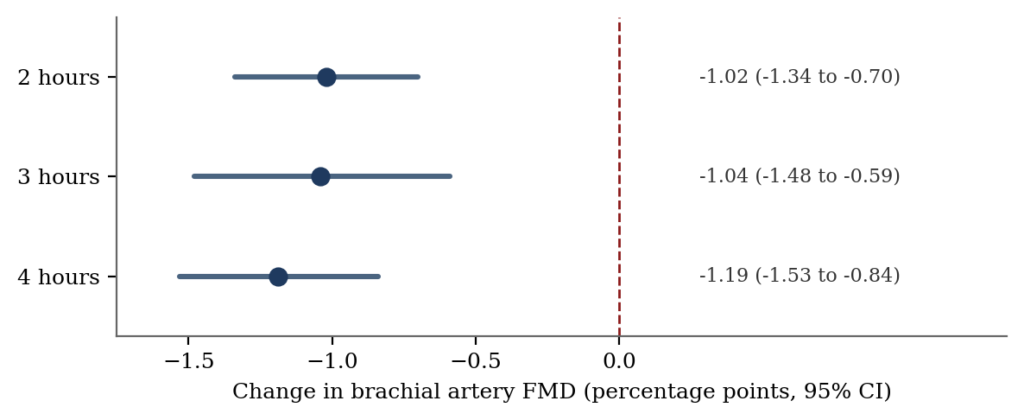
Figuur 1. Verandering in de door bloedstroom gemedieerde dilatatie van de armslagader na één vette maaltijd, samengevat over alle onderzoeken. De waarden zijn gemiddelde verschillen in procentpunten met 95% betrouwbaarheidsintervallen. FMD is een surrogaatmaatstaf voor endotheelfunctie, geen klinisch eindpunt. Gegevens uit referentie [3].
4.2 De Olijfolie-FMD-paradox
Een belangrijke constatering in de vasculaire biologie is de olijfolie-FMD-paradox, beschreven door Vogel en collega's. Tien gezonde, normolipidemische proefpersonen nuttigden maaltijden van 900 kcal met daarin 50 g vet uit verschillende bronnen. [8]
De olijfolie-maaltijd verlaagde de postprandiale FMD met 31%, van 14,3% naar 9,9% (P = 0,008), terwijl de maaltijden met koolzaadolie en zalm geen significante daling teweegbrachten. Er werd een omgekeerde correlatie waargenomen tussen de verandering in serum na de maaltijd triglyceriden en de verandering in FMD (r = -0,47; P < 0,05). Wanneer de maaltijd met olijfolie vergezeld ging van voedingsmiddelen die rijk zijn aan antioxidanten of van vitamine C en E, werd de afname aanzienlijk voorkomen (met respectievelijk 65% en 71%). Dit experiment toont aan dat een maaltijd met veel extra vierge olijfolie onder deze omstandigheden de postprandiale verslechtering van de FMD niet voorkwam. Het betreft een acute vetbelasting bij tien personen: de experimentele maaltijd bevatte ongeveer 50 g vet, aanzienlijk meer dan de gebruikelijke vetinname per maaltijd voor veel mensen, dus noch de omvang van de reactie, noch de rangorde van de oliën mag rechtstreeks worden geëxtrapoleerd naar de gebruikelijke consumptie. [8]
Het behoud van de endotheliale functie door extra olijfolie wordt vaak toegeschreven aan de hydrofiele secoiridoïde fenolen, waaronder hydroxytyrosol, oleuropeïne, oleocanthal, en oleaceïne, die in vitro fungeren als vrije-radicaalvangers. Deze toeschrijving moet met voorzichtigheid worden behandeld, en dit overzicht presenteert deze niet als vaststaand. De financiering in deze literatuur is wisselend en moet per geval worden beschreven in plaats van geaggregeerd. Een positieve postprandiale trial, een gerandomiseerde gecontroleerde cross-overstudie bij 20 volwassenen met een risico op type 2 diabetes, meldde dat een enkele dosis van 50 ml extra olijfolie van eerste persing met een hoog gehalte aan polyfenolen de endotheelfunctie verbeterde in vergelijking met geraffineerde olijfolie; die studie werd gefinancierd door een olijfolieproducent die tevens de onderzoeksoliën leverde, met aanvullende steun van de Centers for Disease Control and Prevention. [28De grootste fenolische studie, EUROLIVE, werd ondersteund door de Europese Commissie in het kader van subsidie QLK1-CT-2001-00287 en de auteurs ervan verklaarden geen financiële belangenconflicten te hebben.17Een driewekek Durende cross-overstudie bij 46 gezonde vrijwilligers waarin fenolrijke en fenolarme extra vergine olijfolie met elkaar werden vergeleken, vond geen effect op de weerstand van LDL of HDL aan oxidatie; die studie werd ondersteund door de Internationale Olijfolieraad en de Stichting voor Voeding en Gezondheidsonderzoek, en één auteur was verbonden aan het Unilever Health Institute. [29De juiste samenvatting is dat deze literatuur door de producent gefinancierde positieve trials, een onafhankelijk gefinancierde positieve trial en een door de olijf-industrie gefinancierde nultrial bevat, dat de resultaten qua richting gemengd zijn, en dat elk van deze studies een surrogaatmeetlat gebruikt. Sponsoring komt daarom niet netjes overeen met de uitkomst van de studie, en op basis van het beschikbare bewijs is de bewering dat olijfoliepolyphenolen de humane endotheelfunctie onafhankelijk verbeteren niet vastgesteld.
| Vet / Olie | vetzuurskelet | Secundaire componenten | Postprandiaal FMD-effect |
| Boter | verzadigde vetzuren (16:0, 18:0) | rijk aan verzadigd vetzuur-zuivelmatrix; cholesterol aanwezig | Acute maaltijden met een hoog vetgehalte verminderen doorgaans de FMD; boterspecifieke conclusie niet vastgesteld door ref. [3] |
| Geraffineerde zaadoliën | PUFA (18:2n-6) | Tocoferolen (variabel) | Variabel en contextafhankelijk; acute maaltijden met een hoog vetgehalte verminderen FMD vaak |
| Geraffineerde olijfolie | EVZV (18:1n-9) | Zeer lage polyfenolen | In sommige directe vergelijkingen werd een afname gemeld; afhankelijk van de context |
| Extra vergine olijfolie | EVZV (18:1n-9) | Secoiridoïde polyfenolen | Gemengd; afhankelijk van de context |
| koolzaadolie | EVZV (18:1n-9) | Fytosterolen, ALA (18:3n-3) | Geen significante afname in het aangehaalde afzonderlijke acute experiment; het is onzeker of de resultaten algemeen geldig zijn |
Tabel 2. Gerapporteerde effecten van de door bloedstroom gemedieerde dilatatie (FMD) na de maaltijd bij de belangrijkste vetbronnen. De richting van de effecten komt overeen met de aangehaalde gecontroleerde studies; de omvang varieert afhankelijk van de samenstelling van de maaltijd. FMD is een surrogaatmarker.
5. Biologie en metabolisme van omega-6-vetzuren
Om de hypothese te toetsen dat zaadoliën systemische ontstekingen bevorderen, moet het metabolisme van linolzuur (18:2n-6) worden onderzocht. Linolzuur ondergaat een enzymatische omzetting via een gemeenschappelijke cascade van desaturatie- en elongatie-enzymen, wat uiteindelijk leidt tot arachidonzuur (AA, 20:4n-6), het substraat voor de synthese van eicosanoïden via de cyclo-oxygenase-, lipoxygenase- en cytochroom P450-routes. [9]
Volgens de omega-6-hypothese zorgt een hoog gehalte aan LA in de voeding ervoor dat membranen worden verrijkt met AA, waardoor er een overproductie van pro-inflammatoire mediatoren ontstaat. Studies met stabiele-isotooptracers bij mensen tonen aan dat dit model niet wordt ondersteund bij de gebruikelijke westerse voedingsinname. De fractionele omzetting van LA uit de voeding naar AA wordt geschat op slechts 0,3% tot 0,6%, wat wijst op een lage activiteit van het snelheidsbeperkende delta-6-desaturase in volwassen menselijk weefsel. [9], [10]
Uit een systematische review van interventies bij mensen bleek dat een vermindering van het LA-gehalte in de voeding met maximaal 90% geen significante correlatie vertoonde met het AA-gehalte in plasma- of serumfosfolipiden (P = 0,39), en dat een veelvoudige verhoging van het LA-gehalte in de voeding eveneens geen correlatie vertoonde met AA (P = 0,72). Een teveel aan LA in de voeding wordt voornamelijk via bèta-oxidatie omgezet in energie of opgeslagen in vetweefsel, in plaats van omgezet te worden in AA. [9]
Het metabolisme van arachidonzuur is eveneens intrinsiek in evenwicht. Uit de gevestigde biochemie van eicosanoïden blijkt dat AA niet alleen de voorloper is van pro-inflammatoire mediatoren, maar ook van prostacycline, een vaatverwijder en remmer van bloedplaatjesactivatie, en van lipoxines, gespecialiseerde pro-resolving-mediatoren die ontstekingen actief onderdrukken. Een eenvoudig model waarin meer linolzuur (LA) in de voeding uniform meer ontsteking veroorzaakt, is daarom in strijd met de onderliggende biochemie. [31]
6. Verhoogt omega-6 chronische ontstekingen?
Een systematische review van gerandomiseerde gecontroleerde onderzoeken Uit onderzoek naar het gehalte aan LA in de voeding en chronische ontstekingen bij gezonde personen (met uitzondering van zuigelingen) bleek dat er geen aanwijzingen waren voor schadelijke effecten. In alle onderzoeken had een toename van het LA-gehalte in de voeding geen significant effect op de concentratie in het bloed van C-reactieve proteïne (CRP), fibrinogeen, plasminogeen activatorremmer-1, interleukine-6 (IL-6), tumornecrosefactor-alfa (TNF-alfa) of oplosbare adhesiemoleculen. [11]
Het klinische bewijs ondersteunt derhalve niet de hypothese dat een hoge inname van omega-6 via de voeding systemische ontstekingen bij mensen bevordert. Deze conclusie is gebaseerd op gecontroleerde studies bij mensen met objectieve biomarker-eindpunten, en niet op mechanistische extrapolatie vanuit eicosanoïde-routes. [11]
Omwille van de transparantie, en in overeenstemming met de overwegingen inzake financiering in paragraaf 2, werd het onderzoek naar ontstekingen en linolzuur ondersteund door een onvoorwaardelijke subsidie van een technische commissie uit de industrie, en werd het hieronder besproken onderzoek naar olie met een hoog oliezuurgehalte gefinancierd door een productraad. Deze mededelingen worden gedaan ter wille van de transparantie; ze doen geen afbreuk aan de bevindingen en worden evenmin tenietgedaan door niet-gerelateerd bewijs over lipiden en klinische uitkomsten, dat geen invloed heeft op de vraag of linolzuur ontstekingsbiomarkers verhoogt. [11]
7. Zaadoliën versus verzadigde vetten
7.1 Effecten op de stofwisseling en de lipidenhuishouding
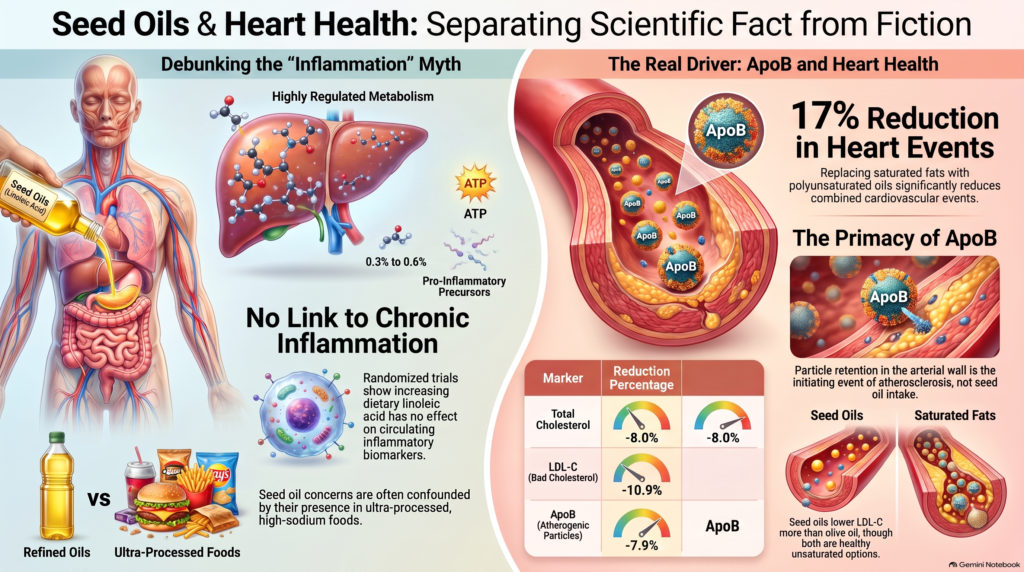
Het vervangen van verzadigde vetten door meervoudig onverzadigde zaadoliën leidt tot een aanzienlijke daling van atherogene lipiden. In een netwerkmeta-analyse van 54 gerandomiseerde studies werden oliën en vaste vetten gerangschikt op basis van hun effecten op de bloedlipiden. Saffloerolie had de grootste kans op een verlaging van LDL-C (SUCRA 82%) en totaal cholesterol (SUCRA 90%), gevolgd door koolzaadolie (canola) (SUCRA 76% voor LDL-C, 85% voor totaal cholesterol). Onverzadigde oliën verlaagden het LDL-C met ongeveer 0,23 tot 0,42 mmol/L in vergelijking met boter. [4] Het mechanisme dat doorgaans voor dit effect wordt aangevoerd, is de opregulatie van lever- LDL-receptoren, waardoor de klaring van circulerende ApoB-bevattende deeltjes; dat mechanisme is vastgesteld in de literatuur over lipoproteïnen en wordt niet aangetoond door de netwerkmeta-analyse zelf. [21]
In een systematische review naar de vervanging van plantaardige oliën met een hoog oliezuurgehalte werd het effect op ApoB rechtstreeks gekwantificeerd: het vervangen van verzadigde vetten door oliën met een hoog oliezuurgehalte het totale cholesterol met 8,0%, het LDL-C met 10,9% en het ApoB met 7,9% verlaagd (allemaal P < 0,05). De relevante interventie is vervanging in plaats van onbeperkte toevoeging: het bewijs pleit voor het vervangen van onverzadigd vet voor verzadigd vet binnen een bereik van ongeveer 5 tot 10 procent van de totale energie-inname, en niet het onbeperkt toevoegen van oliën aan een bestaand dieet. [5] (Figuur 2)
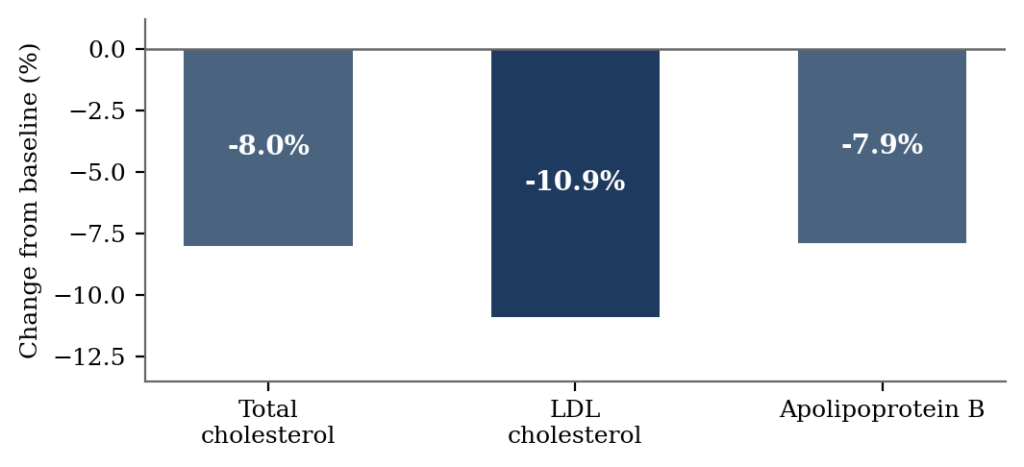
Figuur 2. Verandering in atherogene lipidenwaarden wanneer verzadigd vet wordt vervangen door plantaardige oliën met een hoog oliezuurgehalte. Alle veranderingen: P < 0,05. De betreffende interventie betreft een isocalorische vervanging, niet het toevoegen van olie aan een bestaand dieet. Gegevens uit referentie [5].
7.2 Klinische cardiovasculaire uitkomsten
In een geactualiseerde systematische Cochrane-review over het verminderen van de inname van verzadigd vet werden 15 gerandomiseerde gecontroleerde studies samengevoegd, waaraan in totaal 56.675 deelnemers hadden deelgenomen die gedurende ten minste twee jaar hun inname van verzadigd vet hadden verminderd. Het verminderen van verzadigd vet leidde tot een statistisch significante afname van 17% in het gecombineerde aantal cardiovasculaire voorvallen (risicoverhouding 0,83; 95% BI 0,70 tot 0,98; I-kwadraat 67%). [18]
Uit subgroepanalyses en metaregressie bleek dat het voordeel te danken was aan de vervanging van verzadigd vet door meervoudig onverzadigd vet of hoogwaardige koolhydraten, waarbij een sterkere daling van het cholesterolgehalte een grotere bescherming voorspelt. De number needed to treat translates to: benodigd aantal te behandelen patiënten was 56 in primaire preventie en 53 in secundaire preventie. [18]
Ondanks de afname van het aantal gecombineerde voorvallen had het verminderen van verzadigd vet weinig of geen effect op sterfte door alle oorzaken (55.858 deelnemers, 11 onderzoeken) of cardiovasculaire mortaliteit (53.421 deelnemers, 10 onderzoeken), beide met bewijs van matige kwaliteit. Deze discrepantie tussen de afname van het aantal voorvallen en de mortaliteit is op zich al belangrijk en wordt nader besproken in paragraaf 12. [18]
7.3 Kritische heroverweging van historische controverses
Critici van de ‘dieet-hart’-hypothese verwijzen vaak naar gegevens uit twee historische onderzoeken die door Ramsden en collega’s opnieuw zijn geanalyseerd.
- Het Minnesota-coronaire experiment: Een dubbelblind, gerandomiseerd onderzoek onder 9.423 deelnemers in verzorgingsinstellingen, waarin een dieet waarbij verzadigd vet was vervangen door maïsolie werd vergeleken met een controlegroep die verzadigd vet bleef gebruiken. De maïsolie-interventie verlaagde het serumcholesterol met 13,8% tegenover 1,0% bij de controlegroep (P < 0,001), maar leverde geen voordeel op wat betreft de overleving. In modellen gecorrigeerd voor covariabelen ging een verlaging van het serumcholesterol met 30 mg/dL gepaard met een 22% hoger risico op overlijden (hazardratio 1,22; 95% CI 1,14 tot 1,32; P < 0,001). [13]
- Sydney Diet Heart Study: Uit een gerandomiseerde studie onder 458 mannen met een recent coronair incident bleek dat het vervangen van verzadigd vet door saffloerolie de sterfte door alle oorzaken deed toenemen (17,6% versus 11,8%; hazardratio 1,62; 95%-betrouwbaarheidsinterval 1,00 tot 2,64), de cardiovasculaire sterfte (hazardratio 1,70; 95%-betrouwbaarheidsinterval 1,03 tot 2,80) en de coronaire sterfte (hazardratio 1,74; 95%-betrouwbaarheidsinterval 1,04 tot 2,92). [14]
Beide onderzoeken hebben belangrijke beperkingen die hun relevantie voor hedendaagse aanbevelingen beperken. De interventies zorgden voor een selectieve verhoging van het linolzuurgehalte zonder dat de inname van n-3-PUFA’s toenam, en in het onderzoek in Sydney werd de transvet De samenstelling van de margarine die in het onderzoek werd gebruikt, werd niet vastgelegd, waardoor onzekerheid bestaat over de blootstelling aan transvetten in die tijd, tegen de achtergrond dat gangbare margarines en bakvetten uit die periode zelf transvetten bevatten. De historische onderzoeken kenden bovendien belangrijke beperkingen wat betreft de duur van de gecontroleerde blootstelling via de voeding, de follow-up en het behoud van deelnemers. [13], [14]
8. Zaadoliën versus olijfolie
8.1 Directe lipidenmodulerende effecten
Vanwege hun hogere gehalte aan meervoudig onverzadigde vetzuren verlagen zaadoliën die rijk zijn aan linolzuur het totale cholesterol en het LDL-C iets meer dan olijfolie, die rijk is aan enkelvoudig onverzadigde vetzuren. Uit een meta-analyse van 27 gerandomiseerde, placebogecontroleerde studies (1.089 deelnemers) bleek dat olijfolie het LDL-C minder verlaagde dan andere plantaardige oliën, met een gewogen gemiddeld verschil van 4,2 mg/dL (95% BI 1,4 tot 7,01; P = 0,003) en het totale cholesterol minder verlaagde, namelijk met 6,27 mg/dL (95% BI 2,8 tot 10,6). Hoewel dit verschil statistisch significant is, is de omvang ervan ten opzichte van olijfolie bescheiden, en lezers moeten dit niet interpreteren als een groot klinisch verschil tussen beide. [15]
Daarentegen verhoogde olijfolie het HDL-cholesterol (HDL-C) meer dan andere plantaardige oliën, met een samengevoegd gewogen gemiddeld verschil over alle 27 onderzoeken van 1,37 mg/dL (95%-betrouwbaarheidsinterval 0,40 tot 2,36). Het effect is klein en de klinische betekenis ervan is onzeker. [15]
8.2 Kwaliteitsklassen van olijfolie
De term ‘olijfolie’ omvat verschillende producten die lezers vaak door elkaar halen. Virgin olijfolie wordt op mechanische wijze geproduceerd zonder chemische behandeling; extra virgin olijfolie is de hoogste cijfer, die voldoet aan strengere criteria op het gebied van sensorische eigenschappen en vrije zuurgraad en die aanzienlijk meer natuurlijke fenolverbindingen behoudt. Geraffineerde olijfolie is olijfolie van eerste persing die chemisch of fysisch is geraffineerd om onvolkomenheden te verwijderen; een proces waarbij het overgrote deel van de polyfenolen wordt verwijderd, terwijl de oleïnezuurstructuur intact blijft. Olijfolie uit afvallen wordt met behulp van oplosmiddelen uit de resterende pasta gewonnen en vervolgens geraffineerd. Sommige vervangende effecten zijn in verband gebracht met het gehalte aan fenolverbindingen in plaats van met het gehalte aan oliezuur; daarom mogen deze kwaliteiten niet als onderling uitwisselbaar worden beschouwd, en mag niet worden aangenomen dat bevindingen die zijn verkregen met extra vierge olijfolie met een hoog gehalte aan fenolverbindingen, ook van toepassing zijn op geraffineerde of afvalkwaliteiten. [17]
8.3 Vasculaire, endotheliale en ontstekingsprofielen
Er wordt wel eens beweerd dat olijfolie beter presteert dan geraffineerde zaadoliën wat betreft vasculaire ontsteking en endotheelfunctie, maar die bewering is gebaseerd op surrogaat-eindpunten en wordt hier niet als basis gebruikt voor klinische conclusies. Uit een meta-analyse van 30 gerandomiseerde gecontroleerde studies onder 3.106 deelnemers bleek dat de consumptie van olijfolie geassocieerd was met een lagere IL-6 (gemiddeld verschil -0,29 pg/mL; 95%-betrouwbaarheidsinterval -0,57 tot -0,02), lagere concentraties oplosbare E-selectine (gemiddeld verschil -3,16; 95%-betrouwbaarheidsinterval -4,07 tot -2,25) en een hogere FMD (gemiddeld verschil 0,76%; 95%-betrouwbaarheidsinterval 0,27 tot 1,24). Dit zijn surrogaatmarkers, geen klinische gebeurtenissen. De meta-analyse bundelt onderzoeken met een heterogeen ontwerp, een heterogene duur en heterogene financiering, en rapporteert zelf geen financieringsanalyse; er kan dus geen conclusie uit worden getrokken over het financieringsprofiel van de onderliggende literatuur. Aangezien de resultaten surrogaatverbeteringen zijn met onzekere klinische betekenis, mogen ze niet worden geëxtrapoleerd naar een vermindering van voorvallen, en kan hieruit geen conclusie worden getrokken over de endotheliale superioriteit van olijfolie ten opzichte van andere onverzadigde oliën. [16]
8.4 Het isoleren van de bijdrage van polyfenolen
Om vast te stellen of de voordelen van EVOO voortkomen uit de oleïnezuurbasis of uit de in kleinere hoeveelheden aanwezige bioactieve stoffen, kregen 200 gezonde mannen in het kader van het EUROLIVE-onderzoek dagelijks 25 ml olijfolie met een laag (2,7 mg/kg), gemiddeld (164 mg/kg) of hoog (366 mg/kg) polyfenolgehalte kregen toegediend in een gerandomiseerd cross-overonderzoek. Het HDL-cholesterol steeg lineair met het polyfenolgehalte (verandering van +0,045 mmol/l bij de hoogste dosis; 95% betrouwbaarheidsinterval 0,02 tot 0,06), en geoxideerd LDL daalde lineair (verandering van -3,21 U/L bij de hoogste dosis; 95%-betrouwbaarheidsinterval -5,1 tot -0,8), terwijl de olie met een laag polyfenolgehalte het geoxideerde LDL deed stijgen. [17]
Deze dosisafhankelijke bevindingen vormen de basis voor de door de Europese Unie goedgekeurde gezondheidsclaim voor polyfenolen in olijfolie, die alleen mag worden gebruikt voor oliën die ten minste 5 mg hydroxytyrosol en derivaten daarvan per 20 g olie bevatten. [30] EUROLIVE werd gefinancierd door de Europese Commissie in het kader van subsidie QLK1-CT-2001-00287 en de auteurs hebben verklaard dat er geen financiële belangenconflicten bestaan; het onderzoek kan dan ook terecht worden beschouwd als een onafhankelijk gefinancierd onderzoek. [17] De belangrijkste beperking ligt niet bij de financiering, maar bij het eindpunt. HDL-C en geoxideerd LDL zijn surrogaatmarkers, en geen enkel onderzoek heeft aangetoond dat een verhoogde inname van polyfenolen uit olijfolie het risico op een hartinfarct, een beroerte of cardiovasculaire sterfte vermindert. Uit een drie weken durende cross-overstudie bij 46 gezonde vrijwilligers bleek dat fenolrijke olie de weerstand van LDL of HDL tegen oxidatie niet verhoogde ten opzichte van een fenolarme controlegroep; die studie werd ondersteund door de Internationale Olijfolieraad en er was ook een commerciële band met de voedingsindustrie bij betrokken, dus het is evenmin een onafhankelijke test. [29] Het polyfenolmechanisme wordt dus ondersteund door bewijs op basis van surrogaat-eindpunten met gemengde resultaten en gemengde financiering, en vormt op zichzelf geen rechtvaardiging om olijfolie boven andere onverzadigde vetten aan te bevelen met het oog op cardiovasculaire uitkomsten. Een verdere kanttekening geldt voor generalisatie: EUROLIVE vergeleek olijfoliën die verschilden in fenolconcentratie maar verder vergelijkbaar waren, dus de vergelijkingsgroep met een laag fenolgehalte mag niet worden beschouwd als gelijkwaardig aan elke commercieel geraffineerde olijfolie.
| Markeerder | Extra vierge olijfolie | Geraffineerde olijfolie | Geraffineerde zaadoliën |
| Verlaging van het LDL-cholesterolgehalte | Gematigd | Gematigd | Variabel; over het algemeen hoger bij oliën die rijk zijn aan meervoudig onverzadigde vetzuren |
| Effect op HDL-cholesterol | Over het geheel genomen wordt een lichte stijging van de olijfolieprijzen gemeld | Niet apart per leerjaar vastgesteld | Variabele |
| Geoxideerd LDL | Er is een afname gemeld bij olijfolie met een hoog polyfenolgehalte | In het EUROLIVE-onderzoek werd een toename waargenomen bij olijfolie met een laag polyfenolgehalte | Variabel / niet consistent verbeterd |
| Systemische ontsteking (IL-6) | In sommige onderzoeken en meta-analyses wordt melding gemaakt van een bescheiden verbetering | Onvoldoende bewijs per leerjaar | Over het algemeen geen toename van biomarkers voor chronische ontstekingen |
| FMD na de maaltijd | Gemengd; afhankelijk van de context | Contextgebonden tijdelijke vermindering | Contextgebonden tijdelijke vermindering |
| Oxidatieve stabiliteit | Relatief hoog | Matig tot relatief hoog | Variabele: hoger bij formuleringen met een hoog oliezuurgehalte, lager bij formuleringen die rijk zijn aan meervoudig onverzadigde vetzuren (PUFA) |
Tabel 3. Vergelijkende profielen van lipiden, oxidatieve parameters en vasculaire parameters van extra vierge olijfolie, geraffineerde olijfolie en geraffineerde zaadoliën, op basis van de aangehaalde onderzoeken.
9. Volle voedingsmiddelen versus geëxtraheerde oliën
Uit een vergelijking van geëxtraheerde oliën met hun tegenhangers in de vorm van onbewerkte voedingsmiddelen blijken verschillen in biologische beschikbaarheid, kinetiek na de maaltijd en verzadiging. Door extractie worden de celstructuur en voedingsvezels verwijderd. Bij amandelen, waar dit rechtstreeks is gemeten, beperken intacte celwanden de biologische beschikbaarheid van lipiden, waardoor een deel van het vet onopgenomen in het lagere maag-darmkanaal terechtkomt en de gemeten metaboliseerbare energie onder de voorspelling van Atwater uitkomt. Er zijn geen vergelijkbare gecontroleerde metingen beschikbaar voor olijven, avocado’s en de meeste zaden, zodat de uitbreiding van dit mechanisme naar vetten in onbewerkte voedingsmiddelen in het algemeen een gevolgtrekking blijft op basis van literatuur die specifiek betrekking heeft op noten. [25], [26]
De vorm als onbewerkt voedingsmiddel biedt ook aantoonbare voordelen voor de vetstofhuishouding. Een systematische review, meta-analyse en dosis-effectrelatie Uit een analyse van 61 gecontroleerde onderzoeken (2.582 deelnemers) bleek dat de consumptie van noten het totale cholesterol en het LDL-C op een niet-lineaire manier verlaagde, met sterkere effecten bij een inname van meer dan ongeveer 60 g per dag, en dat het ApoB en de triglyceriden op een lineaire dosis-responsmanier verlaagde. Dit komt overeen met het op ApoB gerichte kader van dit overzicht, aangezien hele noten het atherogeen deeltje last direct. [24]
Geëxtraheerde oliën behoren tot de voedingsmiddelen met de hoogste caloriedichtheid in het dieet; ze leveren ongeveer 9 kcal/g, oftewel zo’n 120 kcal per eetlepel, en bevatten verwaarloosbare hoeveelheden vezels of eiwit. Energiedichtheid van deze omvang kan een positieve energiebalans bevorderen, wat belangrijk is omdat overmatig lichaamsvet op zichzelf al een cardiovasculaire risicofactor. Olijfolie, zaadolie en boter bevatten allemaal veel calorieën, dus als je er te veel van eet, kan elk van deze producten bijdragen aan gewichtstoename, ongeacht de kwaliteit van de vetzuren.
Uit gecontroleerde gegevens bij mensen blijkt dat er een functioneel verschil bestaat tussen onbewerkte voedingsmiddelen en de daaruit gewonnen oliën: walnoten zorgden bij patiënten met […] voor een betere behoud van de endotheelfunctie na de maaltijd in vergelijking met olijfolie. hypercholesterolemie, een effect dat wordt toegeschreven aan de combinatie van vetzuren, antioxidanten en L-arginine in deze producten. [22]
In gerandomiseerde onderzoeken verlagen noten het gehalte aan ApoB in het bloed direct, en uit onderzoeken naar amandelen in voedingsmatrices blijkt dat de biologische beschikbaarheid van lipiden lager is en dat de triglyceridenrespons na de maaltijd kleiner is in vergelijking met geëxtraheerde olie. Er is geen bewijs dat alle vetbronnen uit onbewerkte voedingsmiddelen de verzadiging per calorie, het postprandiale metabolisme of ApoB verbeteren in vergelijking met geïsoleerde oliën, en dit mag dan ook niet worden beweerd. Gerandomiseerde studies hebben evenmin aangetoond dat vetbronnen uit onbewerkte voedingsmiddelen leiden tot een grotere vermindering van cardiovasculaire voorvallen in vergelijking met hoogwaardige voedingspatronen die onverzadigde oliën bevatten, omdat er maar weinig langetermijnstudies zijn waarin olievrije diëten op basis van onbewerkte voedingsmiddelen rechtstreeks worden vergeleken met diëten die olie bevatten. De argumentatie voor onbewerkte voedingsmiddelen berust daarom op convergent tussentijds bewijs en biologische aannemelijkheid, niet op bewezen vermindering van voorvallen, en dit onderscheid moet in het oog worden gehouden bij het vertalen van het mechanisme naar een aanbeveling. [24], [25], [26]
10. Lipideoxidatie tijdens verwerking, opslag en bereiding
De snelheid van de auto-oxidatie van lipiden is evenredig met het aantal dubbele bindingen in de vetzuurketen, waardoor PUFA’s zeer gevoelig zijn voor aantasting door vrije radicalen. Wanneer geraffineerde zaadoliën met een hoog PUFA-gehalte gedurende langere tijd worden verwarmd, met name onder herhaalde commerciële frituuromstandigheden, ondergaan ze thermische oxidatie, hydrolyse en polymerisatie. Oxidatie wordt ook versneld door herhaaldelijk hergebruik van de friteuse, blootstelling aan lucht en licht, en langdurige opslag, en wordt vertraagd door donker glas, koele opslag en spoeling met inert gas. [6], [12]
Deze afbraak leidt tot de vorming van primaire lipidehydroperoxiden die uiteenvallen in reactieve secundaire producten, waaronder aldehyden zoals malondialdehyde en 4-hydroxynonenal, en geoxideerde linolzuurmetabolieten zoals 9-HODE en 13-HODE. Bij mensen leidt het verlagen van het linolzuur in de voeding tot een meetbare afname van de bioactieve geoxideerde linolzuurmetabolieten in de bloedbaan, wat een op de voeding reagerende route bevestigt. Bij de interpretatie van deze literatuur is de nodige voorzichtigheid geboden: metingen van geoxideerd LDL en geoxideerde metabolieten in de bloedbaan correleren weliswaar met, maar tonen niet direct aan dat er oxidatie plaatsvindt binnen de slagaderlijke plaque op zich, en die twee mogen niet op één lijn worden gesteld. [6], [23]
Daarentegen bevatten enkelvoudig onverzadigde en verzadigde vetten veel minder dubbele bindingen en missen ze kwetsbare bis-allyl-koolstofatomen, waardoor ze beter bestand zijn tegen thermische afbraak. Deze mechanismen van oxidatieproducten zijn biologisch aannemelijke factoren die bijdragen aan endotheliale en mitochondriale stress, maar de omvang van hun klinische bijdrage ten opzichte van circulerend ApoB blijft een verondersteld in plaats van een bewezen mechanisme. Een cruciaal onderscheid, dat in de publieke discussie vaak over het hoofd wordt gezien, is dat deze bezwaren betrekking hebben op herhaaldelijk verhitte en thermisch afgebroken oliën, en niet op verse, onverhitte zaadoliën; de oxidatieproducten van misbruikte frituurolie zijn geen eigenschap van de verse olie zelf. [6], [12]
11. Endotheelbeschadiging, atherosclerose en de centrale rol van ApoB
De hypothese van vasculair falen stelt dat herhaalde endotheliale stress na de maaltijd, veroorzaakt door geëxtraheerde oliën, gedurende decennia bijdraagt aan een verhoogde endotheliale permeabiliteit, het binnendringen van lipoproteïnen en vasculaire ontsteking. Herhaalde voorbijgaande endotheeldisfunctie vormt een biologisch aannemelijk mechanisme dat zou kunnen bijdragen aan vasculaire schade op de lange termijn, hoewel direct klinisch bewijs dat dit proces bij mensen aantoont nog steeds beperkt is. Deze hypothese kan het best worden beschouwd als een bijdragende factor, niet als een vaststaande primaire oorzaak. [3]
Uit de vasculaire biologie blijkt dat voor de vorming van atherosclerotische plaques het binnendringen en achterblijven van ApoB-bevattende lipoproteïnen in de slagaderwand noodzakelijk is. De consensus van de European Atherosclerosis Society concludeert dat het achterblijven en de ophoping van cholesterolrijke ApoB-bevattende lipoproteïnen in de slagader intima is de uitlokkende factor van atherogenese, waarbij het risico op een dosisafhankelijke manier toeneemt. ApoB is over het algemeen een directere maatstaf voor de concentratie in het bloed atherogeen deeltjesaantal dan LDL-cholesterol, omdat elk atherogeen deeltje één enkel ApoB-molecuul bevat. Elke verandering in het voedingspatroon die het ApoB-gehalte in het bloed verlaagt, vermindert de deeltjesbelasting die in de arteriële wand kunnen doordringen en daar kunnen worden vastgehouden. Dit raamwerk komt overeen met het op lange termijn waargenomen klinische voordeel wanneer verzadigd vet wordt vervangen door onverzadigd vet, ondanks de hierboven beschreven tijdelijke FMD-bevindingen na de maaltijd; er is geen enkel onderzoek waarin die vergelijking rechtstreeks is getest. Mendeliana randomisatie Onderzoeken ondersteunen dit raamwerk en tonen aan dat een genetisch lagere LDL- en ApoB-spiegel het cardiovasculaire risico verlagen, ongeacht het mechanisme waardoor deze waarden dalen. [2], [21]
12. Klinische resultaten en subgroepen van de populatie
Uit langdurig gerandomiseerd onderzoek blijkt dat het verminderen van verzadigde vetten het aantal gecombineerde cardiovasculaire voorvallen verlaagt, waarbij het voordeel groter lijkt te zijn wanneer verzadigde vetten worden vervangen door meervoudig onverzadigde vetten, en waarbij de mate van cholesterolverlaging correleert met de mate van bescherming. Dit ondersteunt de hypothese dat de verlaging van het ApoB-gehalte in het bloed het belangrijkste mechanisme is. Het effect op beroertes en op de totale mortaliteit is minder uitgesproken in de samengevoegde gerandomiseerde gegevens. [18], [21]
12.1 Olijfolie en het mediterrane voedingspatroon
Bij vastgestelde coronaire hartziekte is de CORDIOPREV-studie 1.002 patiënten willekeurig ingedeeld in een mediterraan dieet een dieet met veel extra vierge olijfolie of een vetarm dieet gedurende zeven jaar. De primaire samengesteld eindpunt kwam voor bij 28,1 tegenover 37,7 voorvallen per 1.000 persoonsjaren, en de voor meerdere variabelen gecorrigeerde hazard ratio’s varieerden in de verschillende modellen van 0,719 (95%-betrouwbaarheidsinterval 0,541 tot 0,957) tot 0,753 (95%-betrouwbaarheidsinterval 0,568 tot 0,998) in het voordeel van het mediterrane dieet. Er zijn twee interpretatieve opmerkingen van toepassing: het vetarme vergelijkingsdieet verminderde het totale vetgehalte slechts tot ongeveer 32 procent van de calorieën, wat achterblijft bij een strikte vetarme doelstelling, en de studie werd gemengd gefinancierd, onder meer door de Spaanse overheid en de Europese Unie, naast olijfolieorganisaties. Zowel het gevolgde vergelijkingsdieet als de gemengde financiering moeten in aanmerking worden genomen bij het interpreteren van de generaliseerbaarheid. [20]
Het baanbrekende onderzoek naar primaire preventie is PREDIMED, waarbij 7.447 deelnemers met een hoog risico willekeurig werden ingedeeld in een groep met een mediterraan dieet aangevuld met extra vierge olijfolie, een groep met hetzelfde dieet aangevuld met noten, of een controlegroep met een vetarm dieet. In de opnieuw gepubliceerde intention-to-treat-analyse bedroeg de gecorrigeerde hazardratio voor ernstige cardiovasculaire voorvallen 0,69 (95% CI 0,53 tot 0,91) voor de olijfoliegroep en 0,72 (95% CI 0,54 tot 0,95) voor de notengroep, wat neerkomt op een relatieve afname van ongeveer 30%. Er zijn drie belangrijke kanttekeningen. Ten eerste werd het oorspronkelijke rapport uit 2013 ingetrokken en in 2018 opnieuw gepubliceerd nadat uit een controle van de basisgegevens bleek dat randomisatie bij ongeveer 1.588 van de 7.447 deelnemers (ongeveer 21 procent) was er sprake van een afwijking, waaronder gezinsleden die en bloc waren ingedeeld en een kliniek die als eenheid was gerandomiseerd; het kan het best worden omschreven als een gerandomiseerde studie met belangrijke afwijkingen van het protocol in de toewijzingsprocedures, die aan de orde kwamen in de heranalyse van 2018, waarin werd gemeld dat de resultaten vergelijkbaar bleven na uitsluiting van de betreffende toewijzingen. Ten tweede betrof de interventie een volledig mediterraan voedingspatroon, en niet alleen olijfolie, zodat het voordeel niet uitsluitend aan olijfolie kan worden toegeschreven. Ten derde, wat de financiering betreft: de voedingsmiddelen voor de interventie werden geschonken door olijfolie- en notenproducenten en grondstoffenorganisaties, terwijl de studie zelf uitgebreide publieke onderzoeksfinanciering ontving, en de onderzoekers meldden dat de sponsors geen rol speelden in het onderzoeksontwerp, de analyse of de rapportage. [19]
12.2 Absolute risicoreductie en de beperkingen van surrogaatmarkers
Een terugkerende leemte in discussies over voedingsvet is de sprong van surrogaatmarkers naar een geïmpliceerd klinisch voordeel. Verbeteringen in LDL-C, HDL-C, geoxideerd LDL, FMD en IL-6 zijn vanuit mechanistisch oogpunt veelzeggend, maar lezers zijn uiteindelijk geïnteresseerd in het aantal voorkomen hartaanvallen en sterfgevallen, en die twee lopen niet altijd evenredig met elkaar mee. De duidelijkste absolute cijfers komen uit de Cochrane-review over verzadigd vet, waarin het aantal patiënten dat behandeld moest worden om één cardiovasculair voorval te voorkomen gedurende de onderzoeksperiode 56 bedroeg bij primaire preventie en 53 bij secundaire preventie, terwijl de totale sterfte en de cardiovasculaire sterfte niet significant waren afgenomen. [18] De algehele betrouwbaarheid van de literatuur over eetbare oliën is ook lager dan de omvang ervan doet vermoeden. Een parapluoverzicht van de 48 systematische reviews met in totaal 206 meta-analyses werd 67,5 procent van de verbanden beoordeeld als zeer onzeker, 21,8 procent als onzeker en 9,7 procent als matig, terwijl slechts 1 procent als zeer zeker werd beoordeeld; op de AMSTAR-2-schaal behaalde slechts één van de 48 reviews een hoge betrouwbaarheid en 14,6 procent een matige, terwijl 62,5 procent laag en 20,8 procent kritiek laag scoorde. [32] (Figuur 3)

Figuur 3. Zekerheid en methodologische betrouwbaarheid van het bewijsmateriaal inzake eetbare oliën. Links: GRADE-zekerheid op basis van 206 meta-analyses. Rechts: AMSTAR-2-betrouwbaarheid op basis van de 48 systematische reviews waarin deze zijn opgenomen. Door afronding is het mogelijk dat de percentages samen niet 100 bedragen. Gegevens uit referentie [32].
Specifiek voor olijfolie is er geen gerandomiseerde studie uitgevoerd waarin olijfolie op zichzelf is vergeleken met een controlegroep wat betreft ernstige cardiovasculaire uitkomsten. Het bewijs dat olijfolie het aantal voorvallen vermindert, is afkomstig uit studies naar het mediterrane dieet in zijn geheel, zoals PREDIMED en CORDIOPREV, waarin olijfolie slechts één van de vele ingrediënten was. Bijgevolg is de precieze absoluut risico Het is niet bekend in hoeverre de afname toe te schrijven is aan olijfolie als afzonderlijke interventie. Daarom kunnen schattingen dat olijfolie op zichzelf het aantal hartinfarcten met een bepaald percentage vermindert, momenteel niet worden onderbouwd met gerandomiseerd bewijs. Wanneer olijfolie in vergelijking met andere behandelingen is geëvalueerd voor harde eindpunten, zijn de samengevatte schattingen nul: geen significant effect op cardiovasculaire voorvallen (RR 0,97; 95% BI 0,67 tot 1,39), cardiovasculaire sterfgevallen (RR 1,07; 95% CI 0,77 tot 1,48) of sterfte door alle oorzaken (RR 0,99; 95% CI 0,85 tot 1,15). [32] Dit is eerder een reële beperking dan een zwak punt van het onderliggende voedingsadvies. [19], [20] (Figuur 4)
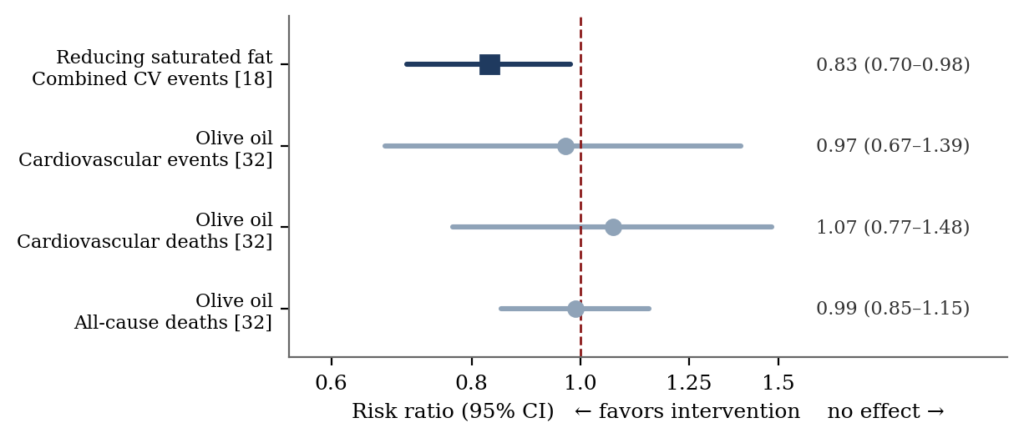
Figuur 4. Gerandomiseerde en samengevoegde bewijskracht voor harde klinische eindpunten. Het verminderen van verzadigd vet leidt tot een daling van het aantal gecombineerde cardiovasculaire voorvallen; de samengevoegde schattingen voor olijfolie ten opzichte van vergelijkingsgroepen zijn niet significant voor zowel voorvallen als sterfte. Een vierkantje duidt op een statistisch significante schatting. Let op: de twee rijen vormen geen rechtstreekse vergelijking: de interventies, vergelijkingsgroepen en onderzoeksgroepen verschillen. Gegevens uit referenties [18] en [32].
12.3 Bevolkingssubgroepen
Voor patiënten met familiaire hypercholesterolemie, bij wie de LDL-receptorfunctie genetisch is aangetast en die gedurende hun hele leven aan hoge ApoB-blootstelling zijn blootgesteld, kan een dieet met beperkte inname van verzadigde vetten en vervanging door onverzadigde plantaardige oliën een aanvulling vormen op de medicamenteuze behandeling, hoewel het medicamenteus verlagen van het LDL-gehalte centraal blijft staan in de behandeling. Voor alle subgroepen geldt dat het verminderen van de ApoB-blootstelling gedurende het hele leven het leidende principe blijft. [2], [21]
13. Samenvatting en antwoorden op de kernvragen
- Zijn zaadoliën bijzonder schadelijk in vergelijking met andere toegevoegde oliën?
Nee. Er is geen overtuigend bewijs bij mensen dat veelgebruikte zaadoliën een specifieke cardiometabole toxiciteit vertonen wanneer ze, bij gelijke calorie-inname, andere voedingsvetten vervangen. Uit gecontroleerd onderzoek bij mensen blijkt geen toename van biomarkers voor chronische ontstekingen, en de effecten op de lipidenwaarden zijn over het algemeen gunstig wanneer deze oliën verzadigd vet vervangen. Hun veelvuldige voorkomen in ultrabewerkte voeding is een belangrijk observationeel verstorende variabele. [4], [11]
- Versterken omega-6-vetzuren chronische ontstekingen bij mensen?
Nee. Uit gerandomiseerde gecontroleerde studies blijkt dat linolzuur uit de voeding de concentraties van ontstekingsbiomarkers in het bloed niet verhoogt. De omzetting van linolzuur in arachidonzuur bedraagt slechts 0,3% tot 0,6% en wordt streng gereguleerd; bovendien leidt arachidonzuur tot zowel pro-inflammatoire als pro-resolving mediatoren. [9], [11]
- Hebben zaadoliën een andere invloed op de endotheelfunctie dan olijfolie?
Er is geen betrouwbaar verschil vastgesteld. Veranderingen in de FMD na de maaltijd worden beïnvloed door de omvang en samenstelling van de maaltijd en worden in sommige onderzoeken in verband gebracht met de omvang van de triglyceridenrespons na de maaltijd; in het hier aangehaalde acute experiment leidde een maaltijd met koolzaadolie niet tot een significante daling, terwijl dat bij een maaltijd met extra vierge olijfolie wel het geval was. [8] De onderzoeken waarin olijfolie met een hoog polyfenolgehalte wordt vergeleken met geraffineerde olijfolie, laten gemengde resultaten zien en zijn op verschillende manieren gefinancierd: een positief onderzoek naar de effecten na de maaltijd werd gefinancierd door een producent die de onderzoeksolie leverde [28], een door de Internationale Olijfolie-raad gefinancierd crossover-onderzoek van drie weken, waaruit bleek dat het fenolgehalte geen invloed had op de oxidatiebestendigheid van LDL [29], en EUROLIVE, gefinancierd door de Europese Commissie zonder gemelde belangenconflicten, waarin dosisafhankelijke veranderingen in HDL-C en geoxideerd LDL werden gemeld [17]. Er is niet aangetoond dat een vetzuurprofiel dat voornamelijk uit oliezuur bestaat, op zichzelf een verslechtering van de FMD na de maaltijd voorkomt, en FMD is sowieso slechts een surrogaatmarker.
- Gaat het in de eerste plaats om geëxtraheerde oliën, ongeacht de vetzuursamenstelling?
Direct bewijs op basis van vergelijkingen tussen onbewerkte voedingsmiddelen en olie – het sterkst voor amandelen – toont aan dat de biologische beschikbaarheid van vetten aanzienlijk groter is en postprandiale lipemie uit geëxtraheerde olie dan uit het intacte zaad; een veralgemening naar alle voedingsmatrices blijft aannemelijk, maar is nog niet volledig getest. Geëxtraheerde oliën bevatten bovendien veel calorieën. Of een van beide eigenschappen zich vertaalt in een risico op lange termijn, los van de verlaging van ApoB, blijft onzeker. EVOO met een hoog polyfenolgehalte wordt soms aangemerkt als een gedeeltelijke uitzondering, op grond van het feit dat de antioxidantfractie ervan door lipiden veroorzaakte endotheelstress tegengaat, maar de onderzoeken die deze stelling ondersteunen zijn schaars, leveren gemengde resultaten op en meten uitsluitend surrogaateindpunten. [3], [8], [25], [28], [29]
- Leidt het vervangen van verzadigd vet door zaadoliën vooral tot betere resultaten via LDL-C en ApoB?
Ja. Het gunstige effect wordt waarschijnlijk grotendeels veroorzaakt door een afname van de blootstelling aan LDL en ApoB-bevattende lipoproteïnen. Verzadigde vetten remmen de LDL-receptoren in de lever, terwijl vervanging door onverzadigde oliën de receptoractiviteit stimuleert en het gehalte aan ApoB in het bloed duurzaam verlaagt, zolang de verandering in het voedingspatroon wordt volgehouden. [5], [21]
- Leveren vetbronnen uit onbewerkte voedingsmiddelen betere resultaten op het gebied van hart- en vaatgezondheid op?
In gerandomiseerde studies verlagen noten het ApoB-gehalte rechtstreeks, en uit onderzoeken naar amandelen in voedingsmatrix blijkt dat de biologische beschikbaarheid van lipiden lager is dan bij geëxtraheerde olie. Of dit voordeel ook geldt voor alle vetbronnen in onbewerkte voedingsmiddelen, is nog niet vastgesteld. Voor harde klinische eindpunten is het bewijs beperkt, omdat er maar weinig gerandomiseerde langetermijnstudies zijn waarin olievrije diëten worden vergeleken met diëten die olie bevatten. [24], [25], [26]
- Welke rol speelt een acute postprandiale verslechtering van de FMD bij atherosclerose op de lange termijn?
Het is een reproduceerbare indicator van voorbijgaande vasculaire stress, maar blijft ondergeschikt aan de retentie van ApoB. Voor de vorming van atherosclerotische plaques is het binnendringen en de retentie van ApoB-bevattende lipoproteïnen in de slagaderwand vereist. Bewijs uit langetermijnonderzoek wijst momenteel op het klinische belang van een aanhoudende verlaging van ApoB boven de bezorgdheid over tijdelijke FMD-veranderingen, hoewel deze twee nooit rechtstreeks in een onderzoek met elkaar zijn vergeleken. [2], [21]
13.1 Op bewijs gebaseerde aanbevelingen
Het totale bewijsmateriaal pleit voor een voedingspatroon waarbij de nadruk ligt op het vervangen van verzadigde vetten door onverzadigde vetten van plantaardige oorsprong, met name voor mensen met verhoogde ApoB-waarden, familiale hypercholesterolemie of vastgestelde coronaire hartziekte; olijfolie en andere onverzadigde plantaardige oliën beschouwt als redelijke vervangingen voor dierlijk vet op basis van hun effecten op LDL en ApoB, in plaats van op enig aangetoond voordeel voor het endotheel of door polyfenolen, aangezien het bewijs voor polyfenolen volledig berust op surrogaat-eindpunten en nooit is getoetst aan de hand van klinische voorvallen; de voorkeur geeft aan minimaal bewerkte vetbronnen uit onbewerkte voedingsmiddelen, zoals noten, zaden, avocado’s en olijven, waarbij noten het sterkste gerandomiseerde bewijs leveren voor een bescheiden verlaging van LDL-C en ApoB, terwijl wordt opgemerkt dat er niet voor elk voedingsmiddel in die lijst vergelijkbaar bewijs voor ApoB bestaat; en beperkt het gebruik van thermisch afgebroken, herhaaldelijk verwarmde of gefrituurde oliën tot een minimum. Wanneer surrogaatmarkers verbeteren, is de eerlijke benadering dat dit mechanistisch gunstige veranderingen zijn, waarvan de vertaling naar een vermindering van voorvallen het best wordt aangetoond voor volledige voedingspatronen in plaats van voor een afzonderlijke olie op zichzelf. [18], [24], [25], [26], [6]
Referenties
- Sacks FM, Lichtenstein AH, Wu JHY, et al. Dietary Fats and Cardiovascular Disease: A Presidential Advisory From the American Heart Association. Circulation. 2017;136(3):e1-e23. doi:10.1161/CIR.0000000000000510
- Ference BA, Ginsberg HN, Graham I, et al. Low-density lipoproteins cause atherosclerotic cardiovascular disease. 1. Evidence from genetic, epidemiologic, and clinical studies. A consensus statement from the European Atherosclerosis Society Consensus Panel. Eur Heart J. 2017;38(32):2459-2472. doi:10.1093/eurheartj/ehx144
- Fewkes JJ, Kellow NJ, Cowan SF, Williamson G, Dordevic AL. A single, high-fat meal adversely affects postprandial endothelial function: a systematic review and meta-analysis. Am J Clin Nutr. 2022;116(3):699-729. doi:10.1093/ajcn/nqac153
- Schwingshackl L, Bogensberger B, Benčič A, Knüppel S, Boeing H, Hoffmann G. Effects of oils and solid fats on blood lipids: a systematic review and network meta-analysis. J Lipid Res. 2018;59(9):1771-1782. doi:10.1194/jlr.P085522
- Huth PJ, Fulgoni VL 3rd, Larson BT. A systematic review of high-oleic vegetable oil substitutions for other fats and oils on cardiovascular disease risk factors: implications for novel high-oleic soybean oils. Adv Nutr. 2015;6(6):674-693. Published 2015 Nov 13. doi:10.3945/an.115.008979
- Grootveld M. Evidence-Based Challenges to the Continued Recommendation and Use of Peroxidatively-Susceptible Polyunsaturated Fatty Acid-Rich Culinary Oils for High-Temperature Frying Practises: Experimental Revelations Focused on Toxic Aldehydic Lipid Oxidation Products. Front Nutr. 2022;8:711640. Published 2022 Jan 5. doi:10.3389/fnut.2021.711640
- Lesser LI, Ebbeling CB, Goozner M, Wypij D, Ludwig DS. Relationship between funding source and conclusion among nutrition-related scientific articles. PLoS Med. 2007;4(1):e5. doi:10.1371/journal.pmed.0040005
- Vogel RA, Corretti MC, Plotnick GD. The postprandial effect of components of the Mediterranean diet on endothelial function. J Am Coll Cardiol. 2000;36(5):1455-1460. doi:10.1016/s0735-1097(00)00896-2
- Rett BS, Whelan J. Increasing dietary linoleic acid does not increase tissue arachidonic acid content in adults consuming Western-type diets: a systematic review. Nutr Metab (Lond). 2011;8:36. Published 2011 Jun 10. doi:10.1186/1743-7075-8-36
- Demmelmair H, Iser B, Rauh-Pfeiffer A, Koletzko B. Comparison of bolus versus fractionated oral applications of [13C]-linoleic acid in humans. Eur J Clin Invest. 1999;29(7):603-609. doi:10.1046/j.1365-2362.1999.00477.x
- Johnson GH, Fritsche K. Effect of dietary linoleic acid on markers of inflammation in healthy persons: a systematic review of randomized controlled trials. J Acad Nutr Diet. 2012;112(7):1029-1041.e10415. doi:10.1016/j.jand.2012.03.029
- Bazina N, Ahmed T, Almdaaf M, Abu Hallalah HMO, Jibia S. Chemical Changes in Deep-Fat Frying: Reaction Mechanisms, Oil Degradation, and Health Implications. Food Sci Nutr. 2025;13(10):e70969. Published 2025 Oct 13. doi:10.1002/fsn3.70969
- Ramsden CE, Zamora D, Majchrzak-Hong S, et al. Re-evaluation of the traditional diet-heart hypothesis: analysis of recovered data from Minnesota Coronary Experiment (1968-73). BMJ. 2016;353:i1246. Published 2016 Apr 12. doi:10.1136/bmj.i1246
- Ramsden CE, Zamora D, Leelarthaepin B, et al. Use of dietary linoleic acid for secondary prevention of coronary heart disease and death: evaluation of recovered data from the Sydney Diet Heart Study and updated meta-analysis. BMJ. 2013;346:e8707. Published 2013 Feb 4. doi:10.1136/bmj.e8707
- Ghobadi S, Hassanzadeh-Rostami Z, Mohammadian F, et al. Comparison of blood lipid-lowering effects of olive oil and other plant oils: A systematic review and meta-analysis of 27 randomized placebo-controlled clinical trials. Crit Rev Food Sci Nutr. 2019;59(13):2110-2124. doi:10.1080/10408398.2018.1438349
- Schwingshackl L, Christoph M, Hoffmann G. Effects of Olive Oil on Markers of Inflammation and Endothelial Function-A Systematic Review and Meta-Analysis. Nutrients. 2015;7(9):7651-7675. Published 2015 Sep 11. doi:10.3390/nu7095356
- Covas MI, Nyyssönen K, Poulsen HE, et al. The effect of polyphenols in olive oil on heart disease risk factors: a randomized trial. Ann Intern Med. 2006;145(5):333-341. doi:10.7326/0003-4819-145-5-200609050-00006
- Hooper L, Martin N, Jimoh OF, Kirk C, Foster E, Abdelhamid AS. Reduction in saturated fat intake for cardiovascular disease. Cochrane Database Syst Rev. 2020;8(8):CD011737. Published 2020 Aug 21. doi:10.1002/14651858.CD011737.pub3
- Estruch R, Ros E, Salas-Salvadó J, et al. Primary Prevention of Cardiovascular Disease with a Mediterranean Diet Supplemented with Extra-Virgin Olive Oil or Nuts. N Engl J Med. 2018;378(25):e34. doi:10.1056/NEJMoa1800389
- Delgado-Lista J, Alcala-Diaz JF, Torres-Peña JD, et al. Long-term secondary prevention of cardiovascular disease with a Mediterranean diet and a low-fat diet (CORDIOPREV): a randomised controlled trial. Lancet. 2022;399(10338):1876-1885. doi:10.1016/S0140-6736(22)00122-2
- Borén J, Chapman MJ, Krauss RM, et al. Low-density lipoproteins cause atherosclerotic cardiovascular disease: pathophysiological, genetic, and therapeutic insights: a consensus statement from the European Atherosclerosis Society Consensus Panel. Eur Heart J. 2020;41(24):2313-2330. doi:10.1093/eurheartj/ehz962
- Cortés B, Núñez I, Cofán M, et al. Acute effects of high-fat meals enriched with walnuts or olive oil on postprandial endothelial function. J Am Coll Cardiol. 2006;48(8):1666-1671. doi:10.1016/j.jacc.2006.06.057
- Ramsden CE, Ringel A, Feldstein AE, et al. Lowering dietary linoleic acid reduces bioactive oxidized linoleic acid metabolites in humans. Prostaglandins Leukot Essent Fatty Acids. 2012;87(4-5):135-141. doi:10.1016/j.plefa.2012.08.004
- Del Gobbo LC, Falk MC, Feldman R, Lewis K, Mozaffarian D. Effects of tree nuts on blood lipids, apolipoproteins, and blood pressure: systematic review, meta-analysis, and dose-response of 61 controlled intervention trials. Am J Clin Nutr. 2015;102(6):1347-1356. doi:10.3945/ajcn.115.110965
- Berry SE, Tydeman EA, Lewis HB, et al. Manipulation of lipid bioaccessibility of almond seeds influences postprandial lipemia in healthy human subjects. Am J Clin Nutr. 2008;88(4):922-929. doi:10.1093/ajcn/88.4.922
- Novotny JA, Gebauer SK, Baer DJ. Discrepancy between the Atwater factor predicted and empirically measured energy values of almonds in human diets. Am J Clin Nutr. 2012;96(2):296-301. doi:10.3945/ajcn.112.035782
- Inaba Y, Chen JA, Bergmann SR. Prediction of future cardiovascular outcomes by flow-mediated vasodilatation of brachial artery: a meta-analysis. Int J Cardiovasc Imaging. 2010;26(6):631-640. doi:10.1007/s10554-010-9616-1
- Njike VY, Ayettey R, Treu JA, Doughty KN, Katz DL. Post-prandial effects of high-polyphenolic extra virgin olive oil on endothelial function in adults at risk for type 2 diabetes: a randomized controlled crossover trial. Int J Cardiol. 2021;330:171-176. doi:10.1016/j.ijcard.2021.01.062
- Vissers MN, Zock PL, Wiseman SA, Meyboom S, Katan MB. Effect of phenol-rich extra virgin olive oil on markers of oxidation in healthy volunteers. Eur J Clin Nutr. 2001;55(5):334-341. doi:10.1038/sj.ejcn.1601161
- EFSA Panel on Dietetic Products, Nutrition and Allergies (NDA). Scientific opinion on the substantiation of health claims related to polyphenols in olive and protection of LDL particles from oxidative damage, pursuant to Article 13(1) of Regulation (EC) No 1924/2006. EFSA Journal. 2011;9(4):2033. doi:10.2903/j.efsa.2011.2033. Authorized wording established by Commission Regulation (EU) No 432/2012 of 16 May 2012.
- Serhan CN. Pro-resolving lipid mediators are leads for resolution physiology. Nature. 2014;510(7503):92-101. doi:10.1038/nature13479
- Voon PT, Ng CM, Ng YT, et al. Health effects of various edible vegetable oil: an umbrella review. Adv Nutr. 2024;15(9):100276. doi:10.1016/j.advnut.2024.100276. Several authors are affiliated with the Malaysian Palm Oil Board; the authors declared no conflicts of interest and no funding.