
Aspirin zur kardiovaskulären Prävention
Eine evidenzbasierte Übersicht über Wirksamkeit, Sicherheit, Dosis-Wirkungs-Beziehung und patientenspezifische Stratifizierung bei primären und Sekundärprävention
| Verlag | Curing Heart Disease, LLC — curingheartdisease.com |
| Autor | Peter Megdal, PhD |
| Dokumenttyp | Überblick über die wissenschaftliche Evidenz im Bildungsbereich (für Kliniker und informierte Leser) |
| Version | 2.2 – endgültige Fassung (veröffentlichungsreif) |
| Erscheinungsdatum | 23. Juni 2026 |
| Vorgeschlagener Termin für die Überprüfung | Juni 2028 oder bei einer Überarbeitung der USPSTF-/ACC-AHA-Leitlinien Aspirin Leitfaden |
| Evidenzgrundlage | Primäre, von Fachkollegen begutachtete Studien, Metaanalysen auf Basis einzelner Teilnehmer sowie Leitlinienaussagen, die in von Fachkollegen begutachteten Fachzeitschriften (JAMA, Lancet, NEJM, Circulation) veröffentlicht wurden. Leitliniengrundlagen: USPSTF 2022; ACC/AHA Primärprävention 2019; AHA/ACC: Chronische koronare Herzkrankheit 2023; ACC/AHA Akute Koronarsyndrome 2025. |
| Offenlegungen | Keine kommerzielle Förderung. Nein Industriefinanzierung. Der Autor gibt an, dass keine relevanten finanziellen Interessenkonflikte bestehen. |
| Wichtige Sicherheitshinweise – bitte zuerst lesen
• Die Nutzen-Risiko-Verhältnis Die Anwendung von Aspirin unterscheidet sich grundlegend zwischen der Sekundärprävention (Personen, bei denen bereits eine Herz-Kreislauf-Erkrankung) und Primärprävention (Personen, bei denen dies nicht der Fall ist). Die Schlussfolgerungen aus dem einen Bereich lassen sich nicht auf den anderen übertragen. • Zur Primärprävention empfiehlt die aktuelle Leitlinie der U.S. Preventive Services Task Force eine individuelle Entscheidung nur für Erwachsene im Alter von 40 bis 59 Jahren mit einem kardiovaskuläres 10-Jahres-Risiko mit einem 10%-Wert von 101 oder höher, bei denen kein erhöhtes Blutungsrisiko besteht, und rät von der Einleitung einer Aspirintherapie bei Erwachsenen ab 60 Jahren ab. • “Nicht zur Primärprävention einsetzen” ist nicht dasselbe wie “Aspirin absetzen” oder “Aspirin niemals einnehmen”. Personen, die Aspirin aufgrund einer bestehenden Erkrankung einnehmen, sollten die Einnahme nicht aufgrund von Daten zur Primärprävention beenden. • Dieses Dokument dient zu Informationszwecken und stellt keine individuelle medizinische Beratung dar. Jede Entscheidung über die Einleitung, Änderung oder das Absetzen einer Aspirin-Therapie sollte gemeinsam mit einem qualifizierten Arzt getroffen werden, der das individuelle Risiko für ischämische Ereignisse und Blutungen abwägen kann. |
Inhalt
- Einleitung und das Paradigma der Primär- und Sekundärprävention…………………………………………. 3
- Pharmakologie und Wirkmechanismus……………………………………………………………………….. 3
- Dosis-Wirkungs-Beziehung und Dosierungshäufigkeit………………………………………………………………………….. 4
- Dosierung auf Basis des Körpergewichts und der Körpermasse……………………………………………………………………………. 5
- Patientenspezifische Überlegungen……………………………………………………………………………………… 6
- Erweiterte Risikostratifizierung: koronar Arterie Kalzium………………………………………………………. 7
- Familiengeschichte vorzeitige koronare Herzkrankheit………………………………………………………………… 7
- Komplementäre und alternative Präventionsstrategien…………………………………………………….. 8
- Quantitative Vorteile und Nachteile………………………………………………………………………………………. 8
- Zusammenfassung der Empfehlungen nach Bevölkerungsgruppen………………………………………………………………. 9
- Zusammenfassung: Zentrale Fragen………………………………………………………………………………………….. 10
- Zusammenfassung in einfacher Sprache………………………………………………………………………………………….. 11
- Einschränkungen und Qualität der Evidenz……………………………………………………………………………….. 11
- Haftungsausschluss………………………………………………………………………………………………………………. 12
Literaturverzeichnis…………………………………………………………………………………………………………………… 13
1. Einleitung und das Paradigma der Primär- und Sekundärprävention
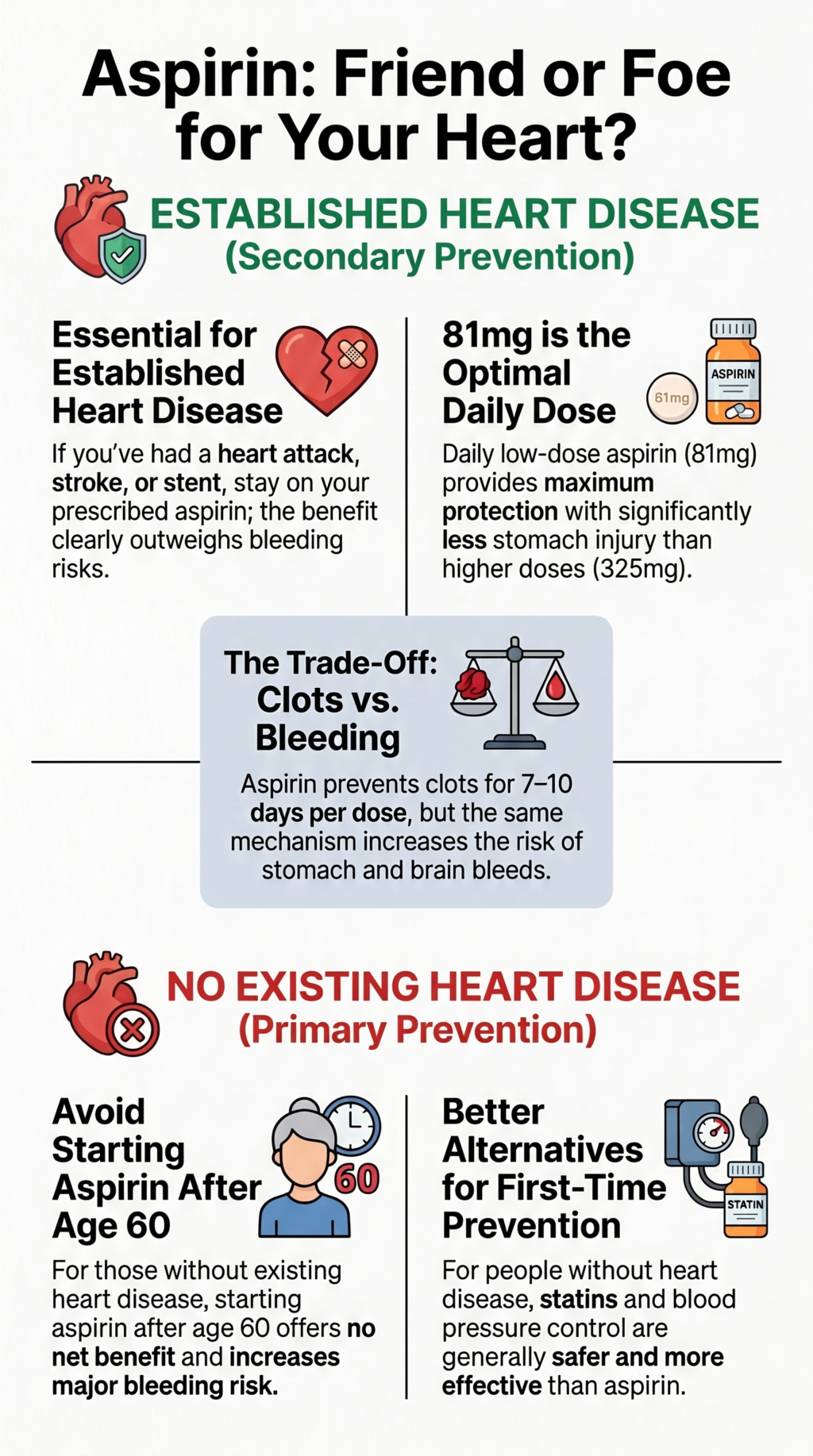
Die Rolle von Acetylsalicylsäure (Aspirin) in der Herz-Kreislauf-Medizin hat sich in den letzten zwei Jahrzehnten erheblich eingeschränkt. Früher wurde Aspirin allgemein als tägliche Prophylaxe für Erwachsene empfohlen, die Herz-Kreislauf-Erkrankungen vorbeugen wollten; heute weiß man, dass es einen engen therapeutischen Spielraum hat, der stark vom individuellen Ausgangsrisiko für Ischämie und Blutungen abhängt. Da Aspirin arterielle Verschlussereignisse durch denselben thrombozytenhemmenden Mechanismus verhindert, der auch die normale Hämostase beeinträchtigt, steigt und sinkt sein Netto-Nutzen mit dem absolutes Risiko der Ereignisse, die dadurch verhindert werden sollen.[1,2]
Der wichtigste Unterschied bei der Interpretation der Aspirin-Studien besteht in der Unterscheidung zwischen zwei Bevölkerungsgruppen. Sekundärprävention gilt für Personen mit nachgewiesener Herz-Kreislauf-Erkrankung – zuvor Myokardinfarkt, ischämischer Schlaganfall oder transitorische ischämische Attacke, stabil oder instabile Angina pectoris, periphere arterielle Verschlusskrankheit oder frühere Revaskularisation (perkutane Koronarintervention oder Koronararterien-Bypass-Operation). Bei diesen Patienten besteht ein hohes absolutes Risiko für erneute thrombotische Ereignisse, sodass selbst ein mäßiges relatives Risiko Diese Reduzierung bringt einen großen absoluten Nutzen mit sich, der das Blutungsrisiko eindeutig überwiegt. [2]
Primärprävention Dies gilt für Personen ohne klinisch nachweisbare Herz-Kreislauf-Erkrankung. Da ihre absolute jährliche Ereignisrate niedrig ist, ist die absolute Zahl der verhinderten ischämischen Ereignisse gering und wird weitgehend durch einen parallelen absoluten Anstieg schwerer Blutungen ausgeglichen, vor allem Blutung im Magen-Darm-Trakt und intrakranielle Blutungen. Diese Asymmetrie – ähnliche relative Auswirkungen, aber sehr unterschiedliche absolute Auswirkungen – ist der zentrale Grund dafür, dass die aktuellen Leitlinien vom routinemäßigen Einsatz zur Primärprävention abgerückt sind. [2,1]
In der bahnbrechenden Studie mit einzelnen Teilnehmern Meta-Analyse Nach Angaben der ’Antithrombotic Trialists’ (ATT) Collaboration“ war die prozentuale Verringerung schwerwiegender vaskulärer Ereignisse in beiden Settings weitgehend ähnlich, doch die absoluten Effekte wiesen deutliche Unterschiede auf: eine absolute Verringerung von etwa 0,061 TP9T pro Jahr in der Primärprävention gegenüber einer absoluten Verringerung, die in der Sekundärprävention um etwa eine Größenordnung höher ausfiel. [2]
Drei moderne Studien zur Primärprävention, über die 2018 berichtet wurde, untermauerten dieses Bild in der heutigen Behandlungsära. ANKUNFT 12.546 Patienten, bei denen ein mäßiges kardiovaskuläres Risiko festgestellt wurde (und die keine Diabetes oder bei hohem Blutungsrisiko) auf 100 mg Aspirin oder Placebo; es zeigte sich keine signifikante Verringerung des primären kardiovaskulären Kompositendpunkts, wobei mehr gastrointestinale Blutungen (meist leicht bis mittelschwer) auftraten und kein Unterschied bei den tödlichen Ereignissen festzustellen war. Bemerkenswerterweise lag die beobachtete Ereignisrate weit unter den Prognosen (etwa 9% gegenüber erwarteten 17%), sodass sich die Kohorte praktisch wie eine Population mit geringerem Risiko verhielt – was zum Teil darauf zurückzuführen war, dass viele Teilnehmer bereits Statine und Antihypertensiva. [16]
Die Begleitstudien von ARRIVE vervollständigten das aktuelle Trio: ASCEND untersuchte die Wirkung von Aspirin bei Diabetes und ASPREE bei älteren Erwachsenen (beide werden in Abschnitt 5 ausführlich beschrieben). Zusammen bilden diese Studien die empirische Grundlage für die Abkehr von der routinemäßigen Aspirin-Primärprävention. [8,5]
2. Pharmakologie und Wirkmechanismus
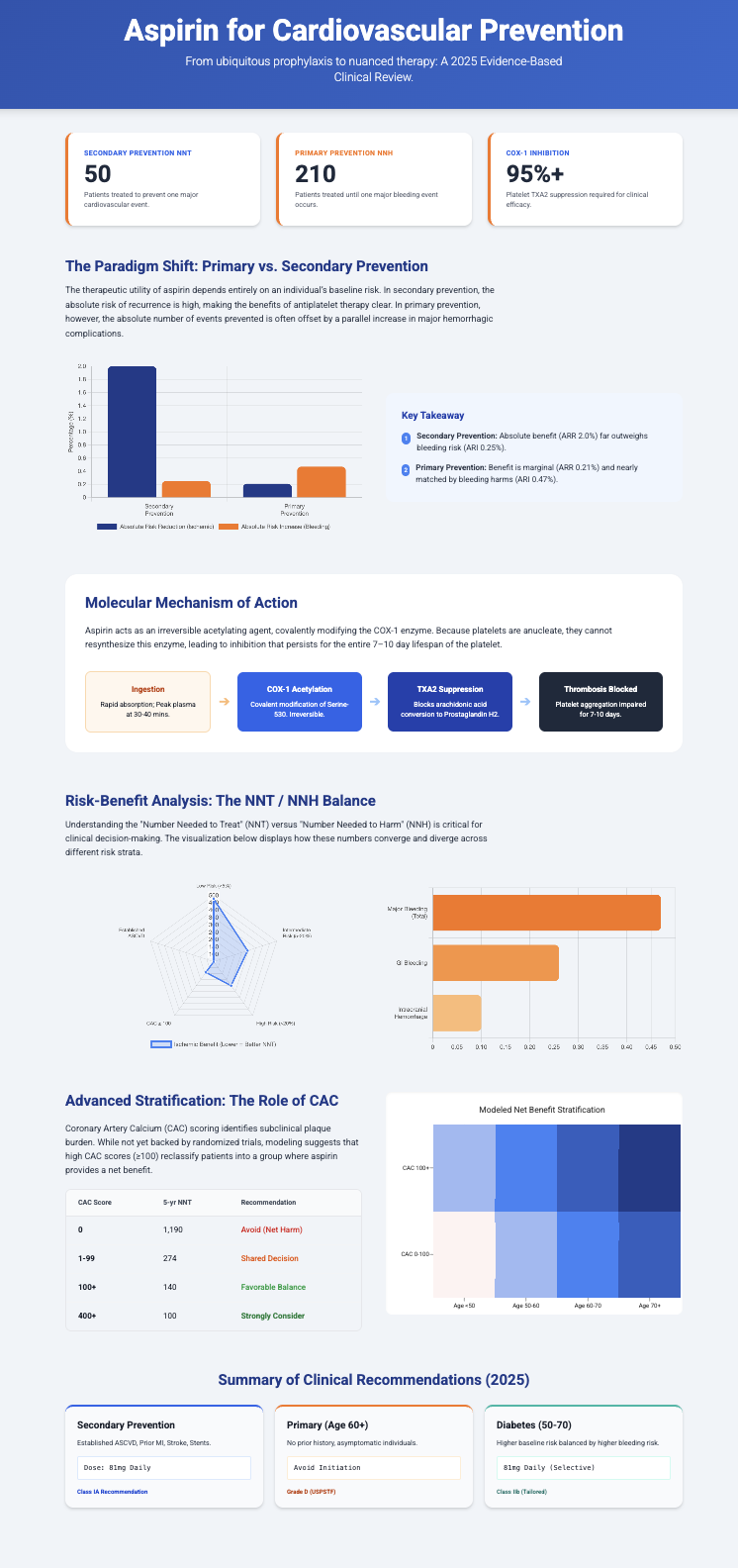
Die antithrombotische Wirkung von Aspirin beruht auf der irreversiblen Hemmung der Cyclooxygenase-1 (COX-1) in den Thrombozyten. Aspirin acetyliert einen Serinrest (Ser-530) im katalytischen Kanal der COX-1 und blockiert dadurch sterisch Arachidonsäure damit es nicht zum aktiven Zentrum gelangt und die Synthese des nachgeschalteten Prostanoids dauerhaft stoppt Thromboxan A₂ (TxA₂), ein starker Auslöser der Thrombozytenaktivierung, -aggregation und Gefäßverengung. [3,4]
Weil Thrombozyten sind kernlos und können keine neuen Protein, Die COX-1-Hemmung hält über die gesamte Lebensdauer der Thrombozyten von etwa 7–10 Tagen an. Diese anhaltende thrombozytenhemmende Wirkung steht im Gegensatz zur kurzen pharmakokinetischen Exposition von Aspirin: Die maximale Plasmakonzentration wird innerhalb von etwa 30–40 Minuten erreicht, und die Plasmahalbwertszeit beträgt aufgrund der schnellen Hydrolyse durch Esterase zu Salicylat nur etwa 15–20 Minuten. Selbst eine vorübergehende Exposition im Pfortaderkreislauf und im systemischen Kreislauf reicht aus, um den zirkulierenden Thrombozytenpool zu inaktivieren. [3,4]
Gefäß Endothelzellen, im Gegensatz dazu, sind kernhaltig und können Cyclooxygenase erneut synthetisieren. Sie produzieren Prostacyclin (PGI₂), ein Vasodilatator und Thrombozytenhemmer, der physiologisch dem TxA₂ entgegenwirkt. Niedrige Tagesdosen (etwa 75–100 mg) bewirken eine nahezu vollständige Hemmung der COX-1 in den Thrombozyten, während das endotheliale Prostacyclin relativ geschont wird – zum Teil, weil die Thrombozyten im Pfortaderkreislauf bereits vor dem First-Pass-Metabolismus in der Leber dem Aspirin ausgesetzt sind. Höhere Tagesdosen unterdrücken zunehmend auch das endotheliale Prostacyclin, wodurch diese Selektivität untergraben wird, ohne dass ein zusätzlicher antithrombotischer Nutzen entsteht. [3,4]
Dieser doppelte Einfluss bestimmt das Nutzen-Risiko-Profil von Aspirin. Die Hemmung der Thrombozytenaggregation verringert die scherinduzierte arterielle Thrombose an Standorten von Plaque-Ruptur, doch dieselbe Beeinträchtigung der Hämostase erhöht das Risiko für Schleimhaut-, Magen-Darm- und intrakranielle Blutungen. [2,3]
3. Dosis-Wirkungs-Beziehung und Dosierungshäufigkeit
Pharmakodynamische Studien zeigen, dass die TxA₂-Synthese in den Thrombozyten durch tägliche Dosen im Bereich von 75–100 mg nahezu vollständig unterdrückt wird und dass die thrombozytenaggregationshemmende Wirksamkeit oberhalb dieses Bereichs ein Plateau erreicht. Höhere Erhaltungsdosen (zum Beispiel 162–325 mg) haben bei der Langzeitprophylaxe keinen zusätzlichen antithrombotischen Nutzen gezeigt und sind in pharmakologischen und historischen Studien mit stärkeren dosisabhängigen Schädigungen der Magen-Darm-Schleimhaut verbunden – obwohl, wie unten angemerkt, die randomisierte ADAPTABLE-Studie selbst keinen statistisch signifikanten Unterschied bei schweren Blutungen feststellte. Einmalige Initialdosen mit sofortiger Freisetzung von 162–325 mg werden bei akuten Koronarsyndromen und akuter ischämischer Schlaganfall um eine schnelle Hemmung der Thrombozytenfunktion zu erreichen; dies ist eine eigenständige, akute Indikation. [3,4,23]
Die eindeutigsten aktuellen Erkenntnisse zur Erhaltungsdosis stammen aus der pragmatischen ADAPTABLE-Studie, in der 15.076 Patienten mit nachgewiesener atherosklerotischer Herz-Kreislauf-Erkrankung randomisiert entweder 81 mg oder 325 mg Aspirin täglich erhielten. Über einen Medianzeitraum von 26,2 Monaten unterschied sich der primäre Wirksamkeitsendpunkt (ein Komposit aus Tod jeglicher Ursache, Krankenhausaufenthalt wegen Myokardinfarkt oder Krankenhausaufenthalt wegen Schlaganfall) nicht signifikant (geschätzte Ereignisraten 7,28% für 81 mg gegenüber 7,51% für 325 mg; Hazard-Ratio 1,02, 95%-KI 0,91–1,14), ebenso wenig wie Krankenhausaufenthalte aufgrund schwerer Blutungen (HR 1,18, 95%-KI 0,79–1,77). [9]
Diese Ergebnisse sollten so interpretiert werden, dass “kein signifikanter Unterschied festgestellt wurde”, und nicht als Beweis für eine exakte Gleichwertigkeit. Die ADAPTABLE-Studie war offen angelegt und wies einen erheblichen Crossover auf: Etwa 41% der Patienten, die der 325-mg-Gruppe zugewiesen waren, wechselten zu 81 mg, während nur etwa 7% in die andere Richtung wechselten. Ein solcher asymmetrischer Wechsel verzerrt den Vergleich in Richtung der Nullhypothese und schränkt ein, inwieweit ein tatsächlicher Dosisunterschied ausgeschlossen werden kann. Unter dieser Einschränkung spricht die Studie auf der Grundlage vergleichbarer gemessener Endpunkte sowie einer besseren Verträglichkeit und Einhaltung. Die aktuellen Leitlinien stimmen darin überein: Die AHA/ACC-Leitlinie zur chronischen koronaren Herzkrankheit aus dem Jahr 2023 empfiehlt niedrig dosiertes Aspirin (75–100 mg, üblicherweise 81 mg) als Thrombozytenaggregationshemmer der Klasse 1 (Evidenzgrad A) für Patienten mit chronischer koronarer Herzkrankheit, die keine orale Antikoagulation erhalten. [9,21]
In Übereinstimmung damit ergab die CURRENT-OASIS-7-Studie zu akuten Koronarsyndromen, dass die fortgesetzte Gabe einer höheren Aspirin-Dosis (300–325 mg) hinsichtlich schwerer ischämischer Endpunkte keiner niedrigeren Dosis (75–100 mg) Aspirin hinsichtlich schwerwiegender ischämischer Endpunkte nicht überlegen war und mit mehr leichten sowie gastrointestinalen Blutungen einherging – eine Argumentation, die auch in den ACC/AHA-Leitlinien für akute Koronarsyndrome aus dem Jahr 2025 aufgegriffen wird, in denen eine Dosis von 75–100 mg für die Erhaltungstherapie empfohlen wird. [10,22]
3.1 Dosierungshäufigkeit und Thrombozytenumsatz
Das Dosierungsintervall wird durch den Thrombozytenumsatz bestimmt. Das Knochenmark gibt täglich einen Teil neuer, nicht gehemmter Thrombozyten in den Blutkreislauf ab, sodass eine einmal tägliche Dosierung erforderlich ist, um eine Hemmung im Steady State aufrechtzuerhalten. Immer-anderthalb-Tage-Dosierung führt zu “Ruhetagen”, an denen neu gebildete Thrombozyten ihre Thromboxan-Kapazität wiederherstellen. In der Women’s Health Study führte die Einnahme von 100 mg Aspirin jeden zweiten Tag über einen Zeitraum von etwa 10 Jahren bei ursprünglich gesunden Frauen zu keiner signifikanten Verringerung des primären Endpunkts schwerer kardiovaskulärer Ereignisse, obwohl sie das Risiko für ischämische Schlaganfälle senkte. [15]
Pharmakodynamische Untersuchungen tragen zur Erklärung dieses Ergebnisses bei: Die Einnahme von 100 mg jeden zweiten Tag führt zu einer geringeren und schwankenderen Hemmung der Thrombozytenfunktion als die tägliche Einnahme von 81 mg, was darauf hindeutet, dass die Teilnehmer bei der Einnahme jeden zweiten Tag an den „freien“ Tagen möglicherweise eine zu geringe Dosis erhalten haben. Diese verminderte Thrombozytenhemmung könnte die Ergebnisse der Women’s Health Study teilweise erklären, obwohl alternative Erklärungen – niedriger als erwartete Ereignisraten, begrenzte statistische Power, und Unterschiede im Studiendesign könnten ebenfalls eine Rolle spielen. Nach derselben Logik wird eine weitere Verlängerung des Intervalls (auf jeden dritten Tag) nicht durch klinische Endpunkte gestützt und daher nicht empfohlen. [18,19,23]
Umgekehrt kann bei Erkrankungen mit beschleunigtem Thrombozytenumsatz – wie beispielsweise bei der essenziellen Thrombozythämie und bei einigen Patienten mit Typ-2-Diabetes – eine einmal tägliche Dosierung dazu führen, dass die Hemmung vor der nächsten Dosis unvollständig ist. Pharmakodynamische Studien deuten darauf hin, dass eine zweimal tägliche Gabe von niedrig dosiertem Aspirin in diesen Fällen eine konsistentere Unterdrückung der Thromboxanbildung bewirken kann als eine bloße Erhöhung der einmal täglichen Dosis; dies ist jedoch nach wie vor eher eine spezialisierte Strategie als gängige Praxis. [4]
4. Dosierung auf Basis des Körpergewichts und der Körpermasse
Ob eine feste Niedrigdosis für alle Körpergrößen geeignet ist, ist noch nicht geklärt. In einer gepoolten Analyse auf Einzelteilnehmer-Ebene mit mehr als 100.000 Teilnehmern aus Studien zur Primär- und Sekundärprävention berichteten Rothwell und Kollegen über eine Wechselwirkung zwischen Dosis und Körpergewicht: Niedrigdosiertes Aspirin (75–100 mg) reduzierte kardiovaskuläre Ereignisse vor allem bei Menschen mit einem Körpergewicht unter etwa 70 kg, während bei einem höheren Körpergewicht kaum ein Nutzen zu verzeichnen war; höhere Dosen (≥325 mg) zeigten hingegen vor allem bei höherem Körpergewicht eine Wirksamkeit. Die Analyse wies zudem auf mögliche Risiken an den Extremen hin – eine höhere Letalität bei einem ersten kardiovaskulären Ereignis bei schwereren Personen, die niedrigdosiertes Aspirin einnahmen, sowie ein erhöhtes Gesamtmortalität bei Personen mit einem Gewicht unter 50 kg (Hazard Ratio 1,52, 95 %-Konfidenzintervall 1,04–2,21). [11]
Diese Ergebnisse dienen der Hypothesenbildung, nicht der Festlegung von Behandlungsrichtlinien, und wurden nicht prospektiv bestätigt. In einer vorab festgelegten Analyse der ASPREE-Studie bei älteren Erwachsenen hatte das Körpergewicht keinen Einfluss auf die kardiovaskuläre Wirkung von Aspirin, und das Blutungsrisiko war bei schwereren Personen nicht geringer. Pharmakodynamische Studien bei Erwachsenen ohne Diabetes haben ebenfalls gezeigt, dass die Thrombozytenhemmung durch 81 mg oder 325 mg weitgehend unabhängig vom Körpergewicht ist. Nachfolgende Analysen konnten die Wechselwirkung mit dem Körpergewicht nicht durchgängig bestätigen, und derzeit empfiehlt keine der wichtigsten Leitlinien eine gewichtsangepasste Aspirin-Dosierung; die derzeit sinnvollste Interpretation lautet, dass eine gewichtsangepasste Dosierung zwar interessant ist, aber keine klinische Umsetzung findet. [5,11]
5. Patientenspezifische Überlegungen
5.1 Alter
Das Blutungsrisiko steigt mit zunehmendem Alter stark an, während der absolute ischämische Nutzen von Aspirin zur Primärprävention weiterhin gering ist. Die ASPREE-Studie 19.114 zu Hause lebende Erwachsene (größtenteils im Alter von 70 Jahren und älter) wurden randomisiert einer täglichen Dosis von 100 mg oder einem Placebo zugewiesen. Aspirin verlängerte das behinderungsfreie Überleben nicht (HR 1,01, 95%-KI 0,92–1,11) und reduzierte Herz-Kreislauf-Erkrankungen nicht signifikant (10,7 gegenüber 11,3 Ereignissen pro 1.000 Personenjahre; HR 0,95, 95 %-KI 0,83–1,08), führte jedoch zu einem signifikanten Anstieg schwerer Blutungen (8,6 gegenüber 6,2 Ereignissen pro 1.000 Personenjahre; HR 1,38, 95%-KI 1,18–1,62) und ging mit einer höheren Gesamtmortalität einher (HR 1,14, 95 %-Konfidenzintervall 1,01–1,29), die größtenteils krebsbedingt war und von den Forschern mit Vorsicht interpretiert wurde. [5,6,7]
Diese Daten untermauern die aktuellen Leitlinien: In der Primärprävention ist eine individuelle Entscheidung nur für Erwachsene im Alter von 40 bis 59 Jahren mit ausreichend hohem kardiovaskulärem Risiko und geringem Blutungsrisiko sinnvoll, und eine Einleitung der Therapie wird ab dem 60. Lebensjahr nicht empfohlen. Die USPSTF empfiehlt darüber hinaus, im Alter von etwa 75 Jahren einen Abbruch der Aspirin-Einnahme zur Primärprävention in Betracht zu ziehen. All dies gilt nicht für die Sekundärprävention. [1]
5.2 Biologisches Geschlecht
Frühere geschlechtsspezifische Analysen deuteten darauf hin, dass der Nutzen von Aspirin in der Primärprävention bei Frauen vor allem auf die Verringerung des Schlaganfallrisikos und bei Männern auf die Verringerung des Myokardinfarktrisikos zurückzuführen war. Spätere Untersuchungen deuten darauf hin, dass ein Großteil dieses offensichtlichen Unterschieds eher auf die Körpergröße und pharmakokinetische Faktoren zurückzuführen ist als auf geschlechtsspezifische biologische Unterschiede, und aktuelle Leitlinien empfehlen in der Primärprävention keine geschlechtsspezifisch unterschiedlichen Aspirin-Strategien. [2,11]
5.3 Diabetes mellitus
Menschen mit Diabetes haben ein erhöhtes kardiovaskuläres Risiko, neigen aber auch zu stärkeren Blutungen. In der ASCEND-Studie wurden 15.480 Erwachsene mit Diabetes und ohne bekannte Herz-Kreislauf-Erkrankung randomisiert entweder einer täglichen Dosis von 100 mg oder einem Placebo zugewiesen. Über einen Zeitraum von durchschnittlich 7,4 Jahren reduzierte Aspirin schwerwiegende vaskuläre Ereignisse (8,5% gegenüber 9,6%; Ratenverhältnis 0,88, 95%-KI 0,79–0,97), erhöhte jedoch das Risiko für schwere Blutungen (4,11 TP9T gegenüber 3,21 TP9T; Ratenverhältnis 1,29, 95%-KI 1,09–1,52). Der absolute Nutzen (etwa 1,11 TP9T) wurde durch den absoluten Anstieg der Blutungsereignisse (etwa 0,91 TP9T) nahezu ausgeglichen, was in etwa 91 behandelten Patienten entspricht, um ein schwerwiegendes vaskuläres Ereignis zu verhindern, und etwa 112 behandelten Patienten, um eine schwere Blutung auszulösen; in keiner Untergruppe überstieg der Nutzen den Schaden deutlich. Die Aspirin-Gabe bei Diabetes erfordert daher eine individuelle, partizipative Entscheidungsfindung anstatt einer routinemäßigen Anwendung. [8]
5.4 Begleitende Risikofaktoren
Aktiv Rauchen und unkontrolliert Bluthochdruck erhöhen sowohl das Risiko für Arteriosklerose als auch das Blutungsrisiko (einschließlich intrakranieller Blutungen). Da Risikofaktoren Da sich die Risikofaktoren für ischämische Ereignisse stark mit denen für Blutungen überschneiden, führt eine Erhöhung des kardiovaskulären Ausgangsrisikos nicht automatisch zu einem Netto-Nutzen. Eine aggressive Kontrolle von Blutdruck Und der Verzicht auf Tabak ist sowohl eine sicherere als auch eine wirksamere erste Maßnahme als die Einnahme von Aspirin. [2,17]
6. Erweiterte Risikostratifizierung: Koronarkalk
Da sich anhand von Bevölkerungsrisikogleichungen nur unvollständig ermitteln lässt, wer tatsächlich davon profitiert, Koronarkalk-Messung (CAC-Score) wurde als Instrument untersucht, um Aspirin zur Primärprävention denjenigen zuzuweisen, die am ehesten davon profitieren. In Analysen der Multi-Ethnic Study of Atherosclerosis (MESA), beschränkt auf Aspirin-naive Erwachsene unter 70 Jahren ohne erhöhtes Blutungsrisiko, verschob sich das Verhältnis zwischen der 5-Jahres-Behandlungszahl (NNT₅) und der Schadenszahl (NNH₅) mit steigendem CAC in positiver Richtung. Insgesamt lag der NNT₅ (476) über dem NNH₅ (355); bei einem CAC ≥ 100 fiel der NNT₅ (140) unter den NNH₅ (518), was auf einen modellierten Nettonutzen hindeutete; und bei einem CAC = 0 lag der NNT₅ (1.190) weit über dem NNH₅ (567), was auf einen modellierten Nettoschaden hindeutete. [12,13]
Es handelt sich hierbei um modellierte Schätzungen, die aus Beobachtungsdaten abgeleitet wurden, und nicht um Ergebnisse einer randomisierten Zuordnung von Aspirin anhand des CAC. Die ACC/AHA-Leitlinie zur Primärprävention aus dem Jahr 2019 betrachtet den CAC als ein Instrument zur Risikoverfeinerung und nicht als validierten Test zur Auswahl einer Aspirintherapie; bisher hat keine randomisierte Studie gezeigt, dass die Verschreibung von Aspirin anhand des CAC die Ergebnisse verbessert. Die nachstehenden Schätzwerte sollten daher als Grundlage für die gemeinsame Entscheidungsfindung dienen, diese jedoch nicht ersetzen. [17,12]
Tabelle 1. Anhand des CAC-Werts abgeleitete Modellschätzungen zum Nutzen und Schaden von Aspirin in der Primärprävention (MESA; Aspirin-naive Erwachsene unter 70 Jahren ohne erhöhtes Blutungsrisiko). Die Modellierung ging von einer relativen Verringerung der kardiovaskulären Ereignisse um 12% und einem relativen Anstieg schwerer Blutungen um 42% aus; bei den Zahlen handelt es sich um Schätzungen aus Beobachtungsstudien, nicht um randomisierte Daten. NNT₅/NNH₅ = 5 Jahre Number Needed to Treat / Schaden zuzufügen.
| CAC-Schicht | 5-Jahres-NNT₅ (zur Verhinderung eines kardiovaskulären Ereignisses) | 5-Jahres-NNH₅ (Ursache für 1 schwere Blutung) | Modellierter Nettoeffekt |
| Gesamtkohorte | 476 | 355 | Modellierter Schaden ≥ Nutzen |
| CAC = 0 | 1,190 | 567 | Modellierter Nettoschaden — vermeiden |
| CAC ≥ 100 | 140 | 518 | Modellierter Nettonutzen (ohne RCT) |
CAC bietet daher eine individuellere Grundlage für die Präzisierung des Risikos als Scores allein: Ein Score von null kennzeichnet Personen, bei denen wahrscheinlich das Blutungsrisiko überwiegt, während ein hoher Score subklinische Fälle kennzeichnet Plaquebelastung in denen die Gabe von Aspirin aus biologischer Sicht gerechtfertigt sein könnte, sofern das Blutungsrisiko gering ist. Hierbei handelt es sich weiterhin um modellbasierte Schlussfolgerungen, die noch einer Bestätigung durch randomisierte Studien bedürfen. Eine ultraschallgestützte Karotis- Plaque Der Score wurde zu demselben Zweck untersucht, wobei das Vorliegen einer Karotisplaque bei einem höheren geschätzten ASCVD-Risiko ein günstigeres Verhältnis anzeigt. [20]
7. Vorzeitige koronare Herzkrankheit in der Familienanamnese
Eine familiäre Vorbelastung mit vorzeitige koronare Herzkrankheit (ein männlicher Verwandter ersten Grades, der vor dem 55. Lebensjahr erkrankt ist, oder eine weibliche Verwandte vor dem 65. Lebensjahr) wird in den ACC/AHA-Leitlinien zur Primärprävention aus dem Jahr 2019 als risikosteigernder Faktor anerkannt, der die Risikobewertung verfeinern kann. Sie kann das geschätzte Risiko einer Person deutlich nach oben korrigieren, und eine ausgeprägte Familienanamnese kann zu Recht Anlass für weitere Untersuchungen – wie beispielsweise eine CAC-Untersuchung – geben, um zu klären, ob eine Intensivierung der Präventionsmaßnahmen gerechtfertigt ist. Sie stellt jedoch keine etablierte eigenständige Indikation für die primärpräventive Aspirin-Einnahme dar und verringert auch nicht das Blutungsrisiko durch Aspirin. Die angemessene Reaktion auf eine ausgeprägte Familienanamnese ist eine intensivierte, leitsatzgerechte Prävention – Lipidmanagement, Blutdruckkontrolle und Maßnahmen zur Lebensstiländerung – und nicht die reflexartige Einleitung einer Aspirintherapie. [17,1]
8. Ergänzende und alternative Präventionsstrategien
Im Zeitalter der modernen Primärprävention bieten mehrere Maßnahmen ein günstigeres Nutzen-Risiko-Profil als Aspirin. Eine Statintherapie senkt die Häufigkeit schwerer kardiovaskulärer Ereignisse erheblich, ohne das Risiko schwerer Blutungen zu erhöhen, und schwerwiegende Nebenwirkungen wie Rhabdomyolyse sind selten. Eine strenge Blutdruckkontrolle senkt das Risiko für Schlaganfälle und Herzinfarkte, ohne das Blutungsrisiko zu erhöhen – und verringert direkt das Risiko für Hämorrhagischer Schlaganfall. Der Verzicht auf das Rauchen führt zu einer starken und raschen Senkung des kardiovaskulären Risikos. [17]
Diese Alternativen werfen auch ein neues Licht auf die Rolle von Aspirin selbst. Da die Einnahme von Statinen und die Kontrolle von Risikofaktoren das verbleibende ischämische Risiko senken, schwindet der zusätzliche absolute Nutzen einer Aspirin-Zugabe in der Primärprävention, während das Blutungsrisiko bestehen bleibt. Für die meisten Menschen ohne nachgewiesene Erkrankung, die bereits eine leitliniengerechte Therapie erhalten, bietet die Zugabe von Aspirin kaum einen Nettovorteil. [2,17]
9. Quantifizierbare Vorteile und Nachteile
Die folgenden Tabellen fassen die Wirkungsschätzungen aus den wichtigsten begutachteten Quellen zusammen. Die relativen Wirkungen sind über alle Kontexte hinweg weitgehend ähnlich; der entscheidende Unterschied liegt in der absoluten Wirkung, die vom Ausgangsrisiko abhängt. Alle Zahlen stammen direkt aus den zitierten Studien und Metaanalysen.
Tabelle 2. Auswirkungen von Aspirin nach Präventionskontext und Bevölkerungsgruppe, basierend auf primären, von Fachkollegen begutachteten Quellen. RR = relatives Risiko; HR = Hazard Ratio; KI = Vertrauensbereich.
| Umfeld / Bevölkerung | Wirkung (95% CI) | Ergebnis und absoluter Effekt | Quelle |
| Primärprävention – schwerwiegende vaskuläre Ereignisse | RR 0,88 (0,82–0,94) | 0,511 TP9T gegenüber 0,571 TP9T pro Jahr; proportionale Reduzierung um ≈121 TP9T | ATT-Metaanalyse |
| Primärprävention – schwere koronare Ereignisse | RR 0,82 (0,75–0,90) | ≈18% proportionale Reduzierung | ATT-Metaanalyse |
| Primärprävention – Schlaganfall (insgesamt) | RR 0,95 (0,85–1,06) | Kein signifikanter Effekt | ATT-Metaanalyse |
| Primärprävention – schwere extrakranielle Blutungen | RR 1,54 (1,30–1,82) | 0,101 TP9T gegenüber 0,071 TP9T pro Jahr; deutlicher Anstieg | ATT-Metaanalyse |
| Primärprävention bei Diabetes – schwerwiegende vaskuläre Ereignisse | RR 0,88 (0,79–0,97) | 8,51 TP9T gegenüber 9,61 TP9T; ARR ≈ 1,11 TP9T; NNT ≈ 91 | ASCEND |
| Primärprävention bei Diabetes – schwere Blutungen | RR 1,29 (1,09–1,52) | 4,11 TP9T gegenüber 3,21 TP9T; ARI ≈ 0,91 TP9T; NNH ≈ 112 | ASCEND |
| Primärprävention bei älteren Erwachsenen – Herz-Kreislauf-Erkrankungen | HR 0,95 (0,83–1,08) | 10,7 gegenüber 11,3 pro 1.000 Einwohner; nicht signifikant | ASPREE |
| Primärprävention bei älteren Menschen – schwere Blutungen | HR 1,38 (1,18–1,62) | 8,6 gegenüber 6,2 / 1.000 Einwohner; deutlicher Anstieg | ASPREE |
| Sekundärprävention – schwerwiegende vaskuläre Ereignisse | ≈proportionale Reduzierung um ein Fünftel | ≈6,71 TP9T gegenüber 8,21 TP9T pro Jahr; großer absoluter Nutzen | ATT-Metaanalyse |
Tabelle 3. Vergleich der Erhaltungsdosen (81 mg gegenüber 325 mg täglich) in der Sekundärprävention.
| Ergebnis | 81 mg | 325 mg | Wirkung (95% CI) |
| Zusammengesetzter Endpunkt: Krankenhausaufenthalt aufgrund von Tod, Myokardinfarkt oder Schlaganfall | 7.28% | 7.51% | HR 1,02 (0,91–1,14) |
| Krankenhausaufenthalt wegen schwerer Blutungen | — | — | HR 1,18 (0,79–1,77) |
| Wechsel zur anderen Dosis (Crossover) | ≈7% | ≈41% | Asymmetrisch – Tendenz zur Nullhypothese |
Quelle: ADAPTABLE. Der ausgeprägte asymmetrische Crossover-Effekt stellt die wesentliche Einschränkung dar und ist der Grund dafür, dass die Studie 81 mg als bevorzugte Dosis empfiehlt, ohne jedoch eine exakte Dosisäquivalenz nachzuweisen. [9]
10. Zusammenfassung der Empfehlungen nach Bevölkerungsgruppen
Die nachstehende Tabelle gibt für jede Bevölkerungsgruppe die Maßnahme (einleiten, fortsetzen oder vermeiden) zusammen mit dem jeweiligen Kontext und den dazugehörigen Leitlinien an. In jeder Zeile wird die Unterscheidung zwischen primären und sekundären Maßnahmen beibehalten.
| Bevölkerung | Aktion | Begründung | Leitfaden |
| Etablierte ASCVD / nach Myokardinfarkt / nach Schlaganfall / nach PCI oder CABG (Sekundärprävention) | Weiter (81 mg täglich) | Hohes Risiko für ein erneutes Auftreten; der absolute Nutzen übersteigt das Blutungsrisiko bei weitem | 2023 AHA/ACC CCD (Klasse 1, LOE A); ATT; ANPASSBAR |
| Primärprävention, Alter 40–59, 10-Jahres-Risiko für Herz-Kreislauf-Erkrankungen ≥ 10%, geringes Blutungsrisiko | Individuell anpassen | Geringer Nettovorteil; hängt vom persönlichen Risiko und den persönlichen Präferenzen ab | USPSTF Note C |
| Primärprävention, Alter ≥ 60 | Nicht starten | Kein Nettovorteil; das Blutungsrisiko überwiegt | USPSTF-Bewertung D |
| Primärprävention bei erhöhtem Blutungsrisiko (jedes Alter) | Nicht starten | Das Blutungsrisiko überwiegt den möglichen ischämischen Nutzen | USPSTF; ACC/AHA |
| Primärprävention, CAC = 0 | Vermeiden | Modellierter Netto-Schaden; sehr geringes ischämisches Risiko (Schätzung aus Beobachtungsdaten) | MESA-Modellierung |
| Primärprävention, CAC ≥ 100, geringes Blutungsrisiko | Betrachten | Modellierter Nettonutzen (NNT₅ < NNH₅); keine Bestätigung durch randomisierte Studie | MESA-Modellierung |
| Primärprävention bei Diabetes, ohne ASCVD | Individuell anpassen | Der Nutzen und die übermäßige Blutung lagen nahezu gleichauf | ASCEND; ADA/Richtlinien |
11. Zusammenfassung: Leitfragen
Wer profitiert am meisten davon?
Patienten mit nachgewiesener Herz-Kreislauf-Erkrankung (Sekundärprävention). Aufgrund ihres hohen Risikos für erneute Ereignisse überwiegt der absolute Nutzen einer niedrig dosierten Aspirin-Therapie eindeutig das Blutungsrisiko. Niedrigdosiertes Aspirin (81 mg täglich) ist die Standard-Langzeittherapie für die meisten Patienten in der Sekundärprävention, sofern keine Kontraindikationen vorliegen oder eine alternative antithrombotische Strategie Vorrang hat – beispielsweise eine orale Antikoagulation aufgrund einer anderen Indikation oder eine definierte duale Thrombozytenaggregationshemmung nach einer kürzlich erfolgten Stentimplantation oder einem akuten Koronarsyndrom. [2,9,21]
Wer profitiert am wenigsten davon?
Erwachsene ohne Herz-Kreislauf-Erkrankungen, die bereits eine leitliniengerechte Prävention erhalten (wirksame Statintherapie, Blutdruckkontrolle, Nichtrauchen). Ihr verbleibendes ischämisches Risiko ist gering, sodass die zusätzliche Einnahme von Aspirin nur einen geringen zusätzlichen Nutzen bietet, während das Blutungsrisiko bestehen bleibt. [2,17]
Welche Bevölkerungsgruppen sollten generell auf die Einnahme von Aspirin zur Primärprävention verzichten?
Erwachsene ab 60 Jahren; Erwachsene jeden Alters mit erhöhtem Blutungsrisiko; Personen mit einem CAC-Wert von Null; sowie – nach aktuellem Wissensstand – Personen am unteren Ende des Körpergewichtsspektrums, bei denen Warnsignale für mögliche Schäden festgestellt wurden. [1,12,11]
Wie hoch ist die niedrigste wirksame Erhaltungsdosis?
Eine Tagesdosis von etwa 75–81 mg bewirkt eine nahezu maximale Thrombozytenhemmung und bietet einen vergleichbaren klinischen Schutz wie höhere Dosen, jedoch mit geringeren gastrointestinalen Nebenwirkungen und einem geringeren Blutungsrisiko. [3,9]
Ist eine tägliche Einnahme besser als eine Einnahme jeden zweiten Tag?
Ja. Die tägliche Einnahme einer niedrigen Aspirin-Dosis führt zu einer gleichmäßigeren Hemmung der Thrombozytenfunktion als die Einnahme jeden zweiten Tag, da neu gebildete Thrombozyten die Thromboxan-Kapazität in den Tagen zwischen den Einnahmen wiederherstellen. [15,18]
Bringen Dosierungen über ~100 mg einen zusätzlichen kardiovaskulären Nutzen?
Es liegen keine einheitlichen Belege dafür vor, dass routinemäßige Erhaltungsdosen von über etwa 100 mg zu besseren kardiovaskulären Ergebnissen führen, während höhere Dosen mit einer stärkeren gastrointestinalen Toxizität verbunden sind. Höhere Einzeldosen sind weiterhin nur für die akute Initialdosierung bei akuten Koronarsyndromen oder akutem Schlaganfall geeignet. [9,10,22]
Wie sieht der allgemeine Konsens für den Zeitraum ab 2025 aus?
In der Sekundärprävention bleibt niedrig dosiertes Aspirin ein Eckpfeiler: Die AHA/ACC-Leitlinie zur chronischen koronaren Herzkrankheit aus dem Jahr 2023 stuft niedrig dosiertes Aspirin (75–100 mg) als Thrombozytenaggregationshemmer der Klasse 1 bei Patienten, die keine Antikoagulation erhalten, und die ACC/AHA-Leitlinie zu akuten Koronarsyndromen aus dem Jahr 2025 befürwortet ebenfalls eine Erhaltungsdosis von 75–100 mg. In der Primärprävention wurde die routinemäßige Anwendung aufgegeben; jede Entscheidung sollte individuell getroffen werden und im Allgemeinen auf Erwachsene im Alter von 40–59 Jahren mit einem 10-Jahres-Risiko von ≥10% bei geringem Blutungsrisiko beschränkt sein; sie lässt sich gut durch bildgebungsbasierte Risikomarker wie CAC verfeinern. [1,21,22]
12. Zusammenfassung in einfacher Sprache
Aspirin verringert die Fähigkeit der Blutplättchen – jener Blutzellen, die Blutgerinnsel bilden –, miteinander zu verklumpen, wodurch das Risiko sinkt, dass ein Gerinnsel eine Arterie verstopft und einen Herzinfarkt oder einen Schlaganfall. Da sich Blutplättchen nicht selbst regenerieren können, wirkt eine niedrige Dosis etwa 7 bis 10 Tage lang. Aufgrund desselben Wirkmechanismus lassen sich Blutungen schwerer stillen, weshalb Aspirin zu Blutungen im Magen, im Darm oder im Gehirn führen kann.
Der Kerngedanke ist, dass der Nutzen von Aspirin davon abhängt, ob Sie bereits an einer Herz- oder Gefäßerkrankung leiden:
- Wenn Sie bereits einen Herzinfarkt oder einen Schlaganfall hatten, Stent, oder Bypass (Sekundärprävention), ist das Risiko eines erneuten Ereignisses hoch, und die tägliche Einnahme einer niedrigen Aspirin-Dosis bringt eindeutig mehr Nutzen als Schaden. Setzen Sie die Einnahme nicht eigenmächtig ab.
- Wenn Sie keine Herz- oder Gefäßerkrankungen in der Vorgeschichte haben (Primärprävention), ist der Nutzen deutlich geringer und wird durch das Blutungsrisiko weitgehend aufgehoben. Die Leitlinien raten davon ab, ab dem 60. Lebensjahr mit der Einnahme von Aspirin zu beginnen, und empfehlen bei Erwachsenen im Alter von 40 bis 59 Jahren mit erhöhtem Risiko lediglich eine individuelle Abwägung.
Verfahren wie der Koronarkalk-Scan können dabei helfen, festzustellen, wer in der Primärpräventionsgruppe noch davon profitieren könnte. Zur Vorbeugung eines ersten Herzinfarkts oder Schlaganfalls bieten Statine und eine Blutdruckkontrolle im Allgemeinen einen besseren und sichereren Schutz als Aspirin.
Tabelle 4. Zusammenfassung in einfacher Sprache: Wer profitiert davon und wer sollte vorsichtig sein?.
| Aspirin hilft in der Regel | Von der Einnahme von Aspirin wird (zur Vorbeugung) in der Regel abgeraten. |
| Früherer Herzinfarkt | Mit der Einnahme von Aspirin im Alter von 60 Jahren oder später beginnen |
| Vorheriger ischämischer Schlaganfall oder TIA | Erhöhtes Blutungsrisiko (Geschwüre, Antikoagulanzien, usw.) |
| Koronarstent oder Bypass-Operation | Keine Herzerkrankung und eine Koronarerkrankung Kalkscore von Null |
| Hohe Plaque-Belastung (CAC ≥ 100) bei geringem Blutungsrisiko | Bereits gut geschützt durch Statine, Blutdruckkontrolle und Nichtrauchen |
Empfohlene Erhaltungsdosis, wenn Aspirin indiziert ist: 81 mg einmal täglich.
13. Einschränkungen und Qualität der Evidenz
Die Schätzungen zur Primärprävention stützen sich auf Studien, die in verschiedenen Zeiträumen und mit unterschiedlichen Risikoprofilen durchgeführt wurden; die heutige Hintergrundtherapie (Statine, bessere Blutdruckkontrolle) führt tendenziell dazu, dass der verbleibende Nutzen von Aspirin im Vergleich zu älteren Studien geringer ausfällt. Die Evidenz zum Dosenvergleich (ADAPTABLE) stammt aus einer offenen Studie mit erheblichem Crossover, sodass sie die Dosenäquivalenz eher einschränkt als belegt. Die gewichtsbasierte Dosierung und Strategien mit zweimal täglicher Einnahme stützen sich hauptsächlich auf pharmakodynamische und Post-hoc-Daten und wurden nicht in speziellen Ergebnisstudien validiert. Die CAC-basierte Zuordnung beruht eher auf Beobachtungsmodellen als auf einer randomisierten Zuordnung. Diese Einschränkungen sprechen für individualisierte, vom behandelnden Arzt geleitete Entscheidungen statt pauschaler Regeln. [9,11,12]
14. Haftungsausschluss
Dieses Dokument dient ausschließlich zu Bildungs- und Informationszwecken und stellt weder eine medizinische Beratung, Diagnose noch eine Behandlung dar; ebenso wenig begründet es eine Arzt-Patienten-Beziehung. Die individuellen Risiken für ischämische Ereignisse und Blutungen, die Einnahme von Medikamenten sowie Begleiterkrankungen variieren stark. Jede Entscheidung über den Beginn, die Fortsetzung, die Änderung oder das Absetzen der Aspirin-Einnahme sollte gemeinsam mit einer qualifizierten medizinischen Fachkraft getroffen werden.
Referenzen
- US Preventive Services Task Force, Davidson KW, Barry MJ, et al. Aspirin Use to Prevent Cardiovascular Disease: US Preventive Services Task Force Recommendation Statement. JAMA. 2022;327(16):1577-1584. doi:10.1001/jama.2022.4983
- Antithrombotic Trialists’ (ATT) Collaboration, Baigent C, Blackwell L, et al. Aspirin in the primary and secondary prevention of vascular disease: collaborative meta-analysis of individual participant data from randomised trials. Lancet. 2009;373(9678):1849-1860. doi:10.1016/S0140-6736(09)60503-1
- Awtry EH, Loscalzo J. Aspirin. Circulation. 2000;101(10):1206-1218. doi:10.1161/01.cir.101.10.1206
- Patrono C, García Rodríguez LA, Landolfi R, Baigent C. Low-dose aspirin for the prevention of atherothrombosis. N Engl J Med. 2005;353(22):2373-2383. doi:10.1056/NEJMra052717
- McNeil JJ, Wolfe R, Woods RL, et al. Effect of Aspirin on Cardiovascular Events and Bleeding in the Healthy Elderly. N Engl J Med. 2018;379(16):1509-1518. doi:10.1056/NEJMoa1805819
- McNeil JJ, Woods RL, Nelson MR, et al. Effect of Aspirin on Disability-free Survival in the Healthy Elderly. N Engl J Med. 2018;379(16):1499-1508. doi:10.1056/NEJMoa1800722
- McNeil JJ, Nelson MR, Woods RL, et al. Effect of Aspirin on All-Cause Mortality in the Healthy Elderly. N Engl J Med. 2018;379(16):1519-1528. doi:10.1056/NEJMoa1803955
- ASCEND Study Collaborative Group, Bowman L, Mafham M, et al. Effects of Aspirin for Primary Prevention in Persons with Diabetes Mellitus. N Engl J Med. 2018;379(16):1529-1539. doi:10.1056/NEJMoa1804988
- Jones WS, Mulder H, Wruck LM, et al. Comparative Effectiveness of Aspirin Dosing in Cardiovascular Disease. N Engl J Med. 2021;384(21):1981-1990. doi:10.1056/NEJMoa2102137
- CURRENT-OASIS 7 Investigators, Mehta SR, Bassand JP, et al. Dose comparisons of clopidogrel and aspirin in acute coronary syndromes. N Engl J Med. 2010;363(10):930-942. doi:10.1056/NEJMoa0909475
- Rothwell PM, Cook NR, Gaziano JM, et al. Effects of aspirin on risks of vascular events and cancer according to bodyweight and dose: analysis of individual patient data from randomised trials. Lancet. 2018;392(10145):387-399. doi:10.1016/S0140-6736(18)31133-4
- Cainzos-Achirica M, Miedema MD, McEvoy JW, et al. Coronary Artery Calcium for Personalized Allocation of Aspirin in Primary Prevention of Cardiovascular Disease in 2019: The MESA Study (Multi-Ethnic Study of Atherosclerosis). Circulation. 2020;141(19):1541-1553. doi:10.1161/CIRCULATIONAHA.119.045010
- Miedema MD, Duprez DA, Misialek JR, et al. Use of coronary artery calcium testing to guide aspirin utilization for primary prevention: estimates from the multi-ethnic study of atherosclerosis. Circ Cardiovasc Qual Outcomes. 2014;7(3):453-460. doi:10.1161/CIRCOUTCOMES.113.000690
- Steering Committee of the Physicians’ Health Study Research Group. Final report on the aspirin component of the ongoing Physicians’ Health Study. N Engl J Med. 1989;321(3):129-135. doi:10.1056/NEJM198907203210301
- Ridker PM, Cook NR, Lee IM, et al. A randomized trial of low-dose aspirin in the primary prevention of cardiovascular disease in women. N Engl J Med. 2005;352(13):1293-1304. doi:10.1056/NEJMoa050613
- Gaziano JM, Brotons C, Coppolecchia R, et al. Use of aspirin to reduce risk of initial vascular events in patients at moderate risk of cardiovascular disease (ARRIVE): a randomised, double-blind, placebo-controlled trial. Lancet. 2018;392(10152):1036-1046. doi:10.1016/S0140-6736(18)31924-X
- Arnett DK, Blumenthal RS, Albert MA, et al. 2019 ACC/AHA Guideline on the Primary Prevention of Cardiovascular Disease: A Report of the American College of Cardiology/American Heart Association Task Force on Clinical Practice Guidelines. Circulation. 2019;140(11):e596-e646. doi:10.1161/CIR.0000000000000678
- Swaim L, Hillman RS. Aspirin administered to women at 100 mg every other day produces less platelet inhibition than aspirin administered at 81 mg per day: implications for interpreting the women’s health study. J Thromb Thrombolysis. 2009;28(1):94-100. doi:10.1007/s11239-008-0262-6
- Feldman M, Cryer B, Rushin K, Betancourt J. A comparison of every-third-day versus daily low-dose aspirin therapy on serum thromboxane concentrations in healthy men and women. Clin Appl Thromb Hemost. 2001;7(1):53-57. doi:10.1177/107602960100700111
- Dzaye O, Razavi AC, Dardari ZA, et al. Carotid Ultrasound-Based Plaque Score for the Allocation of Aspirin for the Primary Prevention of Cardiovascular Disease Events: The Multi-Ethnic Study of Atherosclerosis and the Atherosclerosis Risk in Communities Study. J Am Heart Assoc. 2024;13(12):e034718. doi:10.1161/JAHA.123.034718
- Virani SS, Newby LK, Arnold SV, et al. 2023 AHA/ACC/ACCP/ASPC/NLA/PCNA Guideline for the Management of Patients With Chronic Coronary Disease: A Report of the American Heart Association/American College of Cardiology Joint Committee on Clinical Practice Guidelines. Circulation. 2023;148(9):e9-e119. doi:10.1161/CIR.0000000000001168
- Rao SV, O’Donoghue ML, Ruel M, et al. 2025 ACC/AHA/ACEP/NAEMSP/SCAI Guideline for the Management of Patients With Acute Coronary Syndromes: A Report of the American College of Cardiology/American Heart Association Joint Committee on Clinical Practice Guidelines. Circulation. 2025;151(13):e771-e862. doi:10.1161/CIR.0000000000001309
- Patrono C. The Multifaceted Clinical Readouts of Platelet Inhibition by Low-Dose Aspirin. J Am Coll Cardiol. 2015;66(1):74-85. doi:10.1016/j.jacc.2015.05.012

