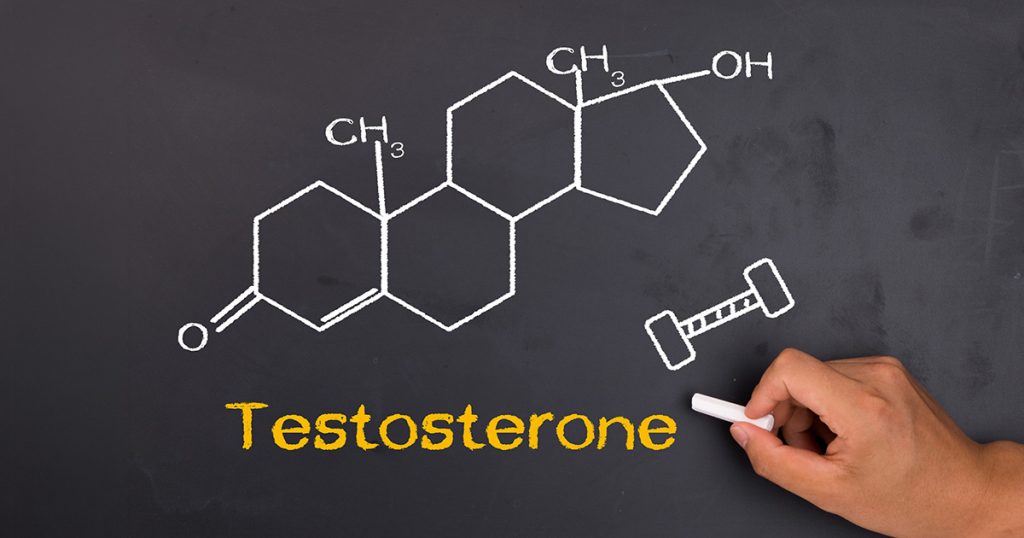
男性生物利用睾酮:病理生理学、性欲的临床重要性、心血管影响以及使用睾酮和hCG的恢复疗法
基于证据的预防实践临床综述
摘要
男性雄激素状态的临床评估早已超越了单纯的血清总测量值。 睾酮. 总浓度通常具有误导性,因为大部分循环中的睾酮都与血浆结合 蛋白质 具有广泛不同的亲和力,其中性激素结合球蛋白(SHBG)作为决定输送至组织的激素实际数量的主要调节因子。本综述总结了对 生物利用 testosterone, 涵盖区室化的生物化学、与年龄相关的衰退机制、SHBG的调节(包括在临床升高时将其降低的实用策略)、产生可靠测量结果的分析方法,以及性欲减退作为真实雄激素缺乏的最具特异性的临床信号的临床重要性。详细探讨了低生物利用度睾酮对心血管的影响,包括以下研究结果 TRAVERSE 试验 以及2025年FDA说明书更新。治疗部分探讨了睾酮替代疗法以及人绒毛膜促性腺激素(hCG)的适当使用,后者可维持睾丸内睾酮的产生和精子发生。其目的是建立一个连贯的、当代的临床框架,供临床医生在实践中应用于男性患者,而不会将生化波动与疾病混为一谈。.
1. 引言
越来越多的证据重新塑造了临床医生对睾酮的认识。这种激素对组织的作用并不与其在血液中的总浓度成正比,而是与游离部分成正比,再加上在毛细血管通过期间从白蛋白释放的松散结合部分。紧密结合球蛋白的那部分在实际应用中具有生物惰性。这就是所谓的 游离激素假说, ,尽管自最初提出以来经过了不断完善,但其核心观点依然成立:生物可用睾酮(游离和白蛋白结合部分的综合)是更具生物学意义的变量。.1-4
临床后果是,如果两个男性的 SHBG 浓度不同,即使他们的总睾酮浓度相同,其雄激素生理状态也可能截然不同。SHBG 本身受肝脏过程的调节,这些过程对……作出反应 胰岛素, ,甲状腺激素、性类固醇、炎性细胞因子、营养状况和衰老。因此,诸如 肥胖, ,2型 糖尿病, ,甲状腺功能亢进、肝功能障碍以及衰老过程会使总睾酮与该激素在组织中的实际活性脱节。.5-7
本综述围绕临床医生在实践中需要解答的问题展开:为什么睾酮水平随年龄下降,为什么SHBG会上升,症状方面什么最重要(其中性欲是最具诊断价值的指标),实验室应如何检测这些分析物,心血管文献现在对内源性睾酮和替代疗法有何见解,以及应如何使用睾酮和hCG来安全地恢复生理机能。.
2. 循环睾酮的分隔
2.1 结合分数及其生物学后果
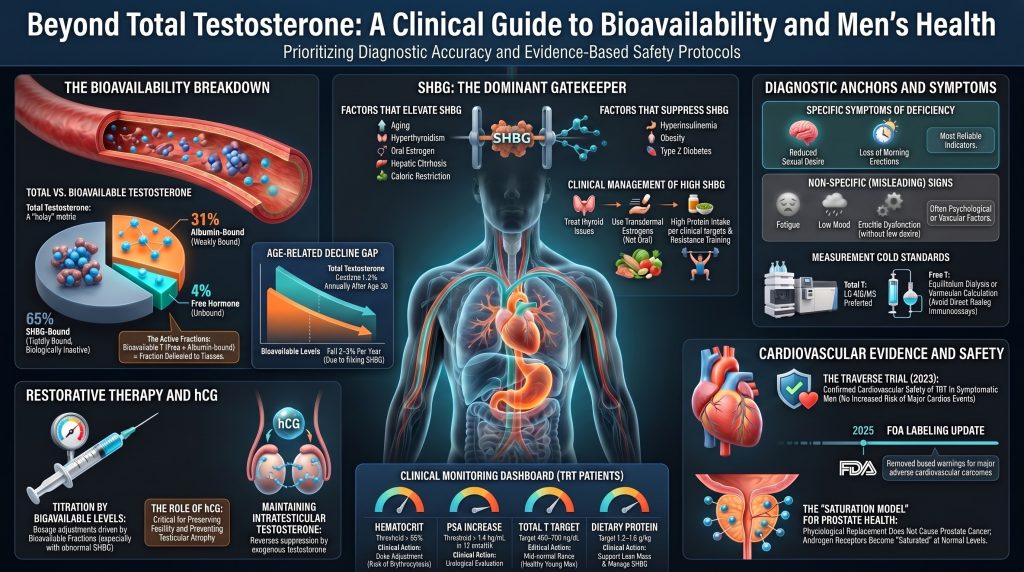
在一个健康的性腺功能正常的男性中,大约 44% 至 65% 的总睾酮与 SHBG 结合,30% 至 50% 与白蛋白疏松结合,1% 至 4% 以游离激素形式循环。.1,2,3 SHBG是一种大约95 kDa的糖蛋白同源二聚体,主要由肝脏产生。它对睾酮的缔合常数约为每摩尔1 × 10⁹,足以使SHBG结合的部分在毛细血管床的短暂穿梭过程中实际上无法被利用。.1 相比之下,白蛋白含量丰富,但与睾酮的结合亲和力要低得多,约为每摩尔 3 × 10⁴。.2,3 白蛋白结合的解离速度足够快,以至于白蛋白结合部分在转运过程中可以释放到组织中,这就是为什么游离部分和白蛋白结合部分的加和被称为生物利用睾酮。.2,4
游离激素假说认为,只有未结合的分子才能扩散穿过细胞膜并作用于细胞内雄激素受体。.4 最近使用高灵敏度检测方法的体内数据完善了这一认知,表明 SHBG 和白蛋白的解离动力学使得游离库之外的某些生物利用度成为可能,特别是在毛细血管转运缓慢的组织中。.2 实际结论没有改变:单凭总睾酮可能会产生误导,而临床上有意义的暴露量更接近生物利用部分。.
表1. 成年男性血浆睾酮组分
| 分数 | 结合伴侣 | 亲和力 (Ka, M⁻¹) | 占总 T 的份额 | 临床相关性 |
| 免费 | 无 | 不适用 | 1–4% | 自由扩散通过细胞膜;活性分数 |
| 白蛋白结合 | 白蛋白 | 约 3 × 10⁴ | 30–50% | 疏松结合;在毛细血管通过期间释放并促进向组织的递送 |
| 结合SHBG的 | 性激素结合球蛋白 | ~1 × 10⁹ | 44–65% | 结合紧密;在正常条件下具有生物惰性 |
| 生物利用度的 | 游离 + 白蛋白结合 | 混合 | ~30–54% | 组织水平雄激素暴露的最佳指标 |
2.2 为什么总睾酮是不够的
由于结合球蛋白(SHBG)结合部分和白蛋白结合部分受质量作用平衡的控制,SHBG浓度的变化会改变结合态与游离态之间的分配 游离睾酮 即使睾丸的产生量没有变化。SHBG(性激素结合球蛋白)的加倍——这在从青年期过渡到古稀之年的过程中并不少见——可以使总睾丸激素恢复正常,而生物利用的睾丸激素却大幅下降。.2,9,13 这是总睾酮水平看起来正常的年长男性会出现具有临床意义的雄激素缺乏症状的主要原因。.
3. 为什么睾酮水平会随年龄增长而下降
男性与年龄相关的雄激素水平下降现在已有充分的文献记录。 巴尔的摩老龄化纵向研究 对健康男性进行了数十年的追踪研究,结果显示,在三十岁之后,总睾酮水平每年下降约1%至2%,而游离睾酮和生物有效睾酮的下降幅度更为明显,每年约为2%至3%,这是因为性激素结合球蛋白(SHBG)同步上升。.9 马萨诸塞州男性老龄化研究在一个基于社区的队列中证实了相似的发展轨迹。.10 欧洲男性衰老研究(EMAS)进一步表明,在垂体功能正常的男性中,这种下降反映了睾丸机制和中枢机制的混合作用。.11,15
3.1 下降机制
多种途径同时起作用,这就是为什么该综合征 迟发性性腺功能减退症 是异质的。.
睾丸老化. 莱迪希细胞数量下降,幸存的 间质细胞 类固醇生成能力降低。线粒体功能障碍、脂褐素蓄积以及StAR介导的受损 胆固醇 运输都会导致每个细胞的睾酮产量降低。.13
下丘脑-垂体脉冲分泌丧失. GnRH脉冲的频率变低、幅度减小,LH脉冲也随之减少,且驱动睾酮分泌所需的LH幅度更难以稳定达到。Veldhuis及其同事的研究表明,这种规律性脉冲分泌的丧失本身就是男性生殖衰老的一个独立组成部分。.14
身体成分转变. 内脏脂肪在中年时期会增加,即使在体重保持稳定的男性中也是如此。脂肪组织会分泌炎症细胞因子,从而抑制促性腺激素释放激素(GnRH)和垂体促性腺激素的分泌;脂肪组织还含有芳香化酶,能将睾酮转化为雌二醇。其结果是在原发性睾丸老化之上叠加了功能性继发性性腺功能减退症。.20,21,22
SHBG升高。. 在大多数男性中,肝脏SHBG的合成量在三十岁之后每年大约增加百分之一。.2,9 由于 SHBG 会结合睾酮,因此在老年男性中,相同的总睾酮水平会产生较低的生物利用度分数。 Travison 的标准化研究建立了考虑这一生理特征的年龄分层参考范围。.12
长期趋势. Travison及其同事的研究表明,近几十年来,美国男性的群体总体睾酮水平跨出生队列呈下降趋势,且与年龄无关,这表明除了固有的衰老过程之外,环境因素(很可能包括肥胖流行、内分泌干扰物以及体力活动的变化)也起到了促进作用。.16
3.2 衰老对症状的影响
EMAS 证实,在老年男性中,仅有一组狭窄的症状能够可靠地反映雄激素状态。三种性症状(晨勃不佳、性欲低下和勃起功能障碍)连同低于约 11 nmol/L (320 ng/dL) 的总睾酮以及低于 220 pmol/L (64 pg/mL) 的游离睾酮,共同界定了迟发性性腺功能减退症最具特异性的表型。.11 通常归因于低睾酮的其他症状,包括疲劳、情绪低落和体力下降,在老年男性中很常见,但与雄激素水平的关系较弱。.
4. 性激素结合球蛋白(SHBG):调节机制及其重要性
SHBG 作为雄激素的主要关卡,其功能是 雌激素 生物利用度。其肝脏合成受HNF-4α调节,并接受来自胰岛素、甲状腺激素、性类固醇、炎性细胞因子和营养感受器的允许性或抑制性输入。.1,5,6,17 重要的是,低SHBG现在被认为是一个独立的 生物标志物 的 胰岛素抵抗 并且伴发2型糖尿病,而高SHBG则是肝脏和代谢状态的标志物,这会改变对任何总睾酮数值的解读。.18,19
4.1 升高 SHBG 的情况
衰 aging 是 SHBG 升高最常见的原因,表现为上述稳步上升的趋势。甲状腺功能亢进通过刺激 HNF-4α 和 HNF-1α 来提高 SHBG 水平。.17 雌激素暴露(内源性、口服避孕药或雌激素替代疗法)会显著诱导肝脏 SHBG 的合成,这是口服雌激素(而非透皮雌激素)降低女性游离睾酮的机制之一。.6 由于肝细胞代谢改变和清除率降低,肝硬化常会升高SHBG(考虑到其肝脏合成功能受损,这种升高有时甚至是矛盾的)。.24 神经性厌食症、严重的卡路里限制和慢性蛋白质缺乏会升高SHBG。几种抗惊厥药(苯妥英钠、卡马西平)和某些抗HIV药物通过肝酶效应诱导SHBG产生。.6
4.2 降低 SHBG 的条件
高胰岛素血症是现代人群中导致低SHBG(性激素结合球蛋白)的最具临床意义的单一原因。塞尔瓦(Selva)及其同事证明,单糖(特别是果糖和 葡萄糖通过下调 HNF-4α 抑制肝脏 SHBG 转录,并以肝脏脂质新生作为直接介质。.5 这解释了为什么低 SHBG 会如此稳定地伴随 代谢综合征, ,肥胖和2型糖尿病,以及为什么SHBG现在被用作代谢研究中的生物标志物。.18,19,40 其他抑制剂包括甲状腺功能减退症、外源性雄激素(包括超生理剂量的睾酮、合成代谢类固醇和达那唑)、糖皮质激素过多、生长激素或IGF-1过多,以及具有雄激素活性的孕激素。.6
表 2. 肝脏 SHBG 合的主要调节因子
| 升高SHBG | 降低 SHBG |
| 老化(从三十多岁起稳步上升) | 高胰岛素血症与胰岛素抵抗 |
| 甲状腺功能亢进症 | 肥胖症,尤其是内脏脂肪过多 |
| 口服雌激素暴露(口服避孕药、妊娠) | 2型糖尿病 |
| 肝硬化 | 甲状腺功能减退症 |
| 热量限制与神经性厌食症 | 外源性雄激素与合成代谢类固醇 |
| HIV感染(多因素) | 糖皮质激素过多(库欣综合征) |
| 抗惊厥药(苯妥英钠、卡马西平) | 肢端肥大症(GH/IGF-1过量) |
| 慢性 炎症 (可变效应) | 肾病综合征(尿蛋白丢失) |
4.3 通过非药物手段降低临床升高的 SHBG
当SHBG在临床相关的情况下升高时(常见于体型相对瘦削的老年男性、亚临床甲状腺功能亢进症,或因任何原因服用口服雌激素的男性),首要任务是处理潜在的诱因。尽管许多策略的证据基础主要是观察性的而非随机对照的,但以下策略具有最强的机制支持。.
力量训练 以及充足的膳食蛋白质。. 运动诱发的 瘦体重, ,特别是通过力量训练,与SHBG的适度降低相关,这可能是通过改善 胰岛素敏感性 在肌肉层面。充足的蛋白质摄入(活跃老年男性的摄入量为每公斤体重 1.2 至 1.6 克)有助于增加肌肉质量,并限制本身会升高 SHBG 的分解代谢状态。.20,21
碳水化合物 质量与 血糖负荷. 饮食干预对SHBG的影响取决于哪种驱动因素占主导地位,必须针对不同的患者表型进行分别考量。在伴有SHBG偏低的胰岛素抵抗男性中,改善胰岛素敏感性(通过减少精制糖、果糖甜味饮料和高血糖负荷食物)往往会使SHBG回升至正常水平。在因热量限制导致SHBG偏高的营养不良或能量缺乏男性中,充足的热量补充往往会降低SHBG。对于因甲状腺疾病、口服雌激素、抗惊厥药或肝脏疾病导致SHBG偏高的男性,单纯的饮食干预是不够的;适当的干预措施应针对潜在的驱动因素。.5,18
治疗亚临床甲状腺功能亢进症. 当促甲状腺激素(TSH)被抑制且性激素结合球蛋白(SHBG)升高时,纠正甲状腺异常通常会在几个月内使SHBG恢复正常。.17
减少或替换口服雌激素。. 出于任何原因服用口服雌激素的患者都可以转换为经皮雌激素,这可以绕过肝脏首过效应,并使SHBG产生很小的变化。.6
正在核对药物。. 如果确诊性腺功能减退且SHBG是主要诱因,则可能需要更换抗惊厥药和某些抗逆转录病毒药物。.6
治疗肝病. 在慢性肝病男性患者中,SHBG(性激素结合球蛋白)出现反常升高,对肝脏病变的治疗(酒精 戒除,丙型肝炎抗病毒治疗,或 减肥 (针对肝脂肪变性)是适当的干预措施。.24
充足的热量摄入。. 营养不良时,SHBG(性激素结合球蛋白)会急剧上升。处于负能量平衡状态的运动员和老年男性可能会出现高 SHBG,通过补充热量可以使其恢复正常。.6,15
有时推荐补充硼、锌和镁来调节SHBG。临床证据有限且前后矛盾,这些都不能替代解决上述上游驱动因素的作用。.
5. 使总睾酮与生物利用睾酮脱钩的条件
5.1 肥胖与功能性继发性性腺功能减退症
肥胖,特别是内脏性肥胖,会产生一种被称为男性肥胖相关性继发性性腺功能减退症(MOSH)的模式。.22 该模式的特征是总睾酮偏低,而黄体生成素(LH)和卵泡刺激素(FSH)处于不恰当的正常或偏低水平,这表明存在中枢性病因。三种机制同时发挥作用:高胰岛素血症抑制肝脏产生SHBG(性激素结合球蛋白),从而在不一定降低游离睾酮的情况下降低总睾酮;内脏脂肪组织分泌 白介素-6, ,TNF-α和瘦素以抑制下丘脑GnRH的模式分泌;并且脂肪芳香化酶将睾酮转化为雌二醇,为下丘脑提供额外的负反馈。.20,22,23 在患有糖尿病性肥胖的男性中,横断面研究显示,超过 30% 的人符合性腺功能减退症的生化标准。.23
至关重要的是,体重减轻和胰岛素敏感性的改善通常可以部分或全部扭转这一局面。减重手术可以使肥胖性腺功能减退男性的睾酮水平恢复正常,甚至5%至10%的适度减重也能提高总睾酮和游离睾酮水平。.20,21,22
5.2 代谢功能障碍相关性脂肪性肝病 (MASLD)
肝脂肪变性是肝脏胰岛素抵抗的表型表现,与低SHBG和低总睾酮密切相关。.19,40 游离睾酮或生物利用睾酮对于这些患者是更有意义的测量指标。脂肪性肝炎的存在增加了第二层复杂性,因为向纤维化和肝硬化的进展可能会反常地升高性激素结合球蛋白(SHBG)。.24
5.3 肝硬化
晚期肝硬化会导致复杂的内分泌紊乱。尽管在许多其他方面的肝脏合成功能有所下降,性激素结合球蛋白(SHBG)仍会上升;白蛋白下降;雌二醇清除率降低。总睾酮可能看起来被欺骗性地维持,而游离睾酮已经崩溃。.24 在该人群中,生物利用度测量是必须的,否则会漏诊。.
5.4 肾病综合征
大量蛋白尿可导致 SHBG 和白蛋白随尿液丢失,从而使两者均降低。总睾酮因结合运载能力减弱而下降;游离睾酮最初可能通过 HPG 轴的代偿得以维持,但慢性的分解代谢应激以及细胞因子对莱迪希细胞的直接作用最终会损害其生成。.25
5.5 甲状腺功能亢进症与甲状腺功能减退症
甲状腺功能亢进症通过诱导HNF-1α和HNF-4α升高SHBG,从而提高总睾酮水平,但对生物利用度睾酮的影响较小。.17 甲状腺功能减退症则会产生相反的模式。在对任何患者的总睾酮进行临床解释时,都应了解其甲状腺状态。.
6. 生物利用度睾酮的心血管影响
睾酮状态与心血管的相关性是该领域在过去二十年中变化最大的部分。早期文献认为睾酮对心血管无影响或具有危害性;目前的证据支持一种更为细致的观点:生理水平的生物利用睾酮与良好的心血管表型相关,而过低和超生理水平则具有风险。.
6.1 睾酮的血管生物学
睾酮具有直接的血管作用。它促进内皮 一氧化氮 合成酶活性,该活性支持内皮依赖性血管舒张。它调节血管平滑肌钙通道活性,有助于冠状动脉和外周血管舒张。它影响血管壁的炎症基调,在许多队列研究中,低睾酮与升高的CRP和IL-6相关。.34,50,56 在心肌细胞水平上,雄激素受体是有表达的,并且生理性雄激素支持对正常的心肌能量代谢似乎具有许可作用。.
睾酮还与 脂蛋白 系统产生具有临床相关性的 ASCVD 风险影响。超生理剂量的睾酮,包括大多数合成代谢类固醇滥用模式,会降低 高密度脂蛋白 并且可以升高含载脂蛋白B的脂蛋白。相比之下,生理性替代通常会产生微小的降低 总胆固醇 以及 载脂蛋白B 并且对高密度脂蛋白(HDL)有适度的降低作用,对胰岛素敏感性产生中性或有利的影响,且 内脏脂肪.49,50,56 对...的影响 斑块 从恢复正常生理机能(而非超生理暴露)的角度来看生物学,才是预防所关乎的变量。.
6.2 内源性睾酮与心血管结局
大 前瞻性队列 通常发现内源性睾酮低与心血管疾病增加以及 全因死亡率 在男性中。由耶普(Yeap)及其同事进行的汇总分析结合了11个前瞻性队列和24,000多名男性,该分析报告称,总睾酮处于最低五分位数的男性发生心血管事件的风险更高,且极低的游离睾酮(约低于184 pmol/L或53 pg/mL)带来的风险最大。.34 A 元分析 由科罗娜(Corona)及其同事发现内源性睾酮与心血管事件之间存在类似的负相关关系。.35 孟德尔随机化 分析得出了更多样化的结果,但总体而言并不支持生理性睾酮对心血管结局具有因果有害作用,且一些分析表明在分布的最低端存在保护性关联。.55
SHBG本身似乎是一个独立的 心血管和代谢生物标志物。低 SHBG 能够预测 2 型糖尿病的发生,,18 并且在一些队列研究中,老年男性体内非常高的 SHBG 与死亡率相关,尽管由于以下原因,其解读变得复杂: 反向因果关系 (虚弱和营养不良会升高SHBG水平。).19,58
6.3 睾酮替代治疗与心血管风险:TRAVERSE 研究之后的当前证据
在2013年和2014年,两项广受关注的研究(Vigen等人在退伍军人事务部系统中进行的研究,以及Finkle等人在索赔数据库中进行的研究)报告了睾酮替代疗法(TRT)与心血管事件之间的关联。这两项研究都存在严重的方法学局限性,包括对睾酮监测的记录不完整、随访时间短以及选择性偏差。随后的分析对这两项研究的方法学提出了质疑。.54,54b 尽管如此,美国食品药品监督管理局(FDA)于2015年添加了关于潜在心血管风险的黑框警告(注:class label在这里通常指这类药物通用的警示标签),这减少了处方量。.
自此以后,在定义更明确的人群中进行的多次观察性研究报告了中性或有益的相关性。Sharma 及其同事在一项包含 83,000 多名男性的退伍军人事务部(VA)队列研究中发现,通过睾酮替代疗法(TRT)使睾酮水平恢复正常与以下疾病的发病率降低相关: 心肌梗死, 中风, ,与水平保持低下或未经治疗的男性相比,全因死亡率也较低。.37 Cheetham及其同事在凯撒医疗(Kaiser Permanente)的数据中报告称,接受睾酮替代疗法(TRT)的男性的心血管事件风险降低了33%。.38 安德森及其同事在山间医疗系统(Intermountain Healthcare)的研究中也报道了中性或有利的心血管结局。.39
迄今为止最大规模的心血管安全性试验是TRAVERSE(Lincoff等人,《新英格兰医学杂志》,2023年),这是一项随机、安慰剂对照、非劣效性试验,涉及约5,200名年龄在45至80岁之间、患有性腺功能减退症且伴有既往 心血管疾病 或具有高心血管风险。在平均 22 个月的随访中,包含心血管死亡、非致死性心肌梗死和非致死性卒中的主要复合终点事件在睾酮组中占 7.0%,在 安慰剂 组,满足预先设定的非劣效性标准(风险比 0.96;95% 置信区间 0.78 至 1.17)。.36 心房颤动, ,急性肾损伤和肺栓塞在睾酮组中的发生率略高,这与已知的睾酮诱导的生物学效应相一致 红细胞增多症; ;这些是需要进行监测的主要残留安全信号。TRAVERSE是一项随访时间中等的不劣效性试验,既未能证实其具有长期心血管获益,也未能全面阐明斑块生物学,, 血压, ,或更广泛的超说明书用药。.
2025年,美国食品药品监督管理局(FDA)针对睾酮产品发布了全类标签变更。更新后的标签纳入了TRAVERSE研究的结果,并删除了关于重大心血管不良事件风险增加的框式警告内容。 修订后的标签增加了或强化了关于血压升高的警告,并保留了针对无明确生化缺乏证据的年龄相关性性腺功能减退症的现有使用限制。临床医生应查阅所用具体制剂的最新处方信息。.
6.4 睾酮与冠状动脉斑块
“睾酮试验”的心血管子研究(Budoff 等,JAMA,2017)报告称,使用睾酮凝胶一年后,男性患者非钙化冠状动脉的增幅更大 斑块体积 开启 冠状动脉CT血管造影 比接受安慰剂的受试者。.48 该试验未针对临床事件进行样本量设计,其增量为 非钙化斑块 结果较为温和,且其长期临床意义尚不明确。结合TRAVERSE研究结果来看,最合理的解释是:在中等随访期间,尚未发现生理功能恢复会增加临床心血管事件的发生率,而斑块成像终点数据则显示出需要继续进行监测的迹象。.
6.5 红细胞增多症与血栓形成风险
TRT最常见且最易重复出现的心血管不良反应是红细胞增多症。睾酮既通过直接作用于骨髓,又通过增加促红细胞生成素的分泌来刺激红细胞生成,其作用程度取决于制剂类型。注射用酯类制剂在峰值时引起的红细胞增多幅度最大;透皮制剂引起的红细胞增多幅度最小。A 红细胞压积 通常认为,若该数值超过54%,则应考虑减少剂量、更换制剂或暂时停药,并评估 混杂因素 例如阻塞性 睡眠呼吸暂停 以及脱水。.7,54
6.6 心血管专科医师的综合指南
处于生理范围下限的内源性睾酮水平与心血管风险增加有关,这几乎可以肯定是由真正的生物学易感性与 混杂的 由不良代谢表型引起。在有症状的性腺功能减退男性中,将睾酮水平恢复至生理范围(并在适当监测下),目前尚未有证据表明会增加 主要不良心血管事件 在研究的随访期间。必须对红细胞增多症进行监测。对常规心血管疾病的强化管理 风险因素 (降低ApoB水平、控制血压、, 血糖控制, 吸烟 (戒烟和体育锻炼)仍是主要的心血管干预措施。睾酮替代疗法是一种辅助治疗手段,旨在纠正某种特定的缺乏症,而非一种独立的心血管治疗手段。.
7. 性欲:睾酮缺乏症最具诊断价值的症状
在所有被归因于睾酮水平低下的症状中,性欲减退是与雄激素水平关联最为可靠且特异性最强的症状。这绝非微不足道的细节;当临床医生需要从伴随衰老和代谢性疾病而出现的非特异性主诉中进行甄别时,这是最具诊断价值的依据。 需要特别指出的是,内分泌学会建议仅对符合睾酮缺乏症状,且经至少两次独立的晨间测定明确证实睾酮浓度持续偏低的男性诊断为性腺功能减退症;仅凭症状表现尚不足以确诊。.7
7.1 为什么性欲减退是诊断价值最高的症状
特拉维森及其同事通过分析“马萨诸塞州男性衰老研究”的数据,证明了生物可用睾酮与性欲之间存在一种在整个生理范围内均成立的渐进性关系,而睾酮与勃起功能之间的关系则远没有那么一致。.29 EMAS独立确定了三种性功能症状(晨间勃起不足、性欲低下和勃起功能障碍),认为在考虑年龄因素后,只有这些症状能以合理的特异性与睾酮水平低下相关联。.11 在这三者中,性欲低下与雄激素水平的关系最为密切;勃起功能障碍则深受血管性、神经性及药物性因素的影响,而晨间勃起虽然是一个敏感的指标,但特异性较低。.
在随机对照的睾酮替代治疗试验中,性欲方面的效应量最为稳定且最大。睾酮试验性功能子研究(Cunningham 等,2016)表明,在三项主要性功能结局指标中,性欲评分的提升不仅在男性受试者中表现最为一致,而且具有最显著的临床意义。.30 关于TRT对性功能影响的荟萃分析同样表明,性欲是主要指标,而对勃起功能的影响则较小且变异性更大。.32
7.2 患者的描述及应询问的问题
患有雄激素缺乏性性欲减退的男性描述称,他们此前引发性幻想和性行为的自发性兴趣出现了根本性的下降。他们注意到自己不再会无端地想到性,也不再觉得普通的刺激具有性吸引力,而且他们通常将这种变化描述为内在动力的丧失,而非能力的丧失。 男性通常能够判断自己的性欲与过去的基准水平相比是否发生了变化,这比以人群为参考的阈值更能为诊断提供参考信息。.
夜间和清晨勃起功能的丧失密切相关,且常被同时报告。临床问诊时应明确询问性欲和晨间勃起情况。若仅询问勃起功能,所得答案往往会将血管、神经、药物及雄激素等因素混为一谈;而专门询问性欲和晨间勃起情况,则能将这些因素区分开来。.
7.3 哪些性症状无法作为预测指标
若无性欲减退,仅靠睾酮替代疗法很少能解决勃起功能障碍。对于仅患有勃起功能障碍且生物利用度睾酮水平明确正常的男性,其鉴别诊断主要包括血管性疾病(这通常是全身性 动脉粥样硬化),神经源性原因,, 抗高血压的 药物、抗抑郁药和心理因素。对这些患者使用睾酮治疗很少有效,且会使他们面临激素替代疗法的副作用,却无法获得相应的益处。.32,33
8. 雄激素缺乏的其他表现
除了性功能症状外,睾酮缺乏综合征还包括身体、代谢和心理方面的表现。虽然这些表现都没有性欲减退那么具有特异性,但在适当的临床背景下,它们能佐证该诊断。.
8.1 身体成分与代谢
性腺功能减退的男性会积累内脏脂肪组织,同时失去瘦体重,力量也会随之下降。.20,21,49,60 这部分是由于肌肉和脂肪组织中雄激素信号传导的丧失所直接导致的,部分则是由于代谢综合征环境所致——在这种环境下,肥胖诱发的性腺功能减退会逐渐发展。.59 针对肥胖且性腺功能减退的男性所进行的长期替代治疗研究表明,以下指标显著降低: 腰围, 、体重和糖化血红蛋白(HbA1c);这些效果通常不如强化生活方式干预所取得的效果显著,但似乎能与后者产生协同作用。.49
8.2 骨骼
睾酮部分通过芳香化转化为雌二醇,从而维持男性的骨矿物质密度。《睾酮试验》的骨骼子研究表明,睾酮水平较低的老年男性在接受一年睾酮替代治疗后,骨体积密度和估计骨强度均显著提高。.46
8.3 贫血
在未经治疗的性腺功能减退症患者中,轻度贫血较为常见。“睾酮试验”的贫血子研究显示,在接受治疗的男性中,有相当一部分人的贫血得到了纠正,其中包括一些无法确定其他明确病因的患者。.47
8.4 情绪、动机与认知
许多性腺功能减退的男性报告存在情绪低落、易怒和精力减退等症状,这些症状在进行激素替代治疗后往往会有所改善,尽管这些症状还有许多其他病因,因此不应仅凭这些症状就做出诊断。.7,33 在随机对照试验中,针对有轻度记忆问题的老年男性,激素替代疗法对认知功能的影响微乎其微且结果不一。.57
9. 测量:行之有效的方法与具有误导性的方法
9.1 总睾酮
十多年来,内分泌学会和美国疾病控制与预防中心(CDC)激素标准化计划一直推荐将液相色谱-质谱联用(LC-MS/MS)作为测定总睾酮的参考方法,特别是在对诊断至关重要的低浓度范围内。旧式平台的免疫分析法在成年男性中至高浓度范围内虽可靠,但在低浓度时存在较大误差,且不建议用于女性。.26,27
分析前变量至关重要。总睾酮在清晨有明显的峰值,下午则呈低谷,且老年男性的昼夜波动幅度较小。在确诊性腺功能减退症之前,应于上午7点至10点之间空腹采样,且需至少进行两次独立检测。 急性疾病、近期剧烈运动以及近期热量限制均可能暂时降低睾酮水平,在解读孤立的低值时应将这些因素纳入考虑。.
9.2 游离睾酮:检测方法及排名
直接模拟免疫测定法测定游离睾酮的结果不可靠,且主要内分泌学和男科学学会明确不推荐使用该方法。.26,27 这些方法得出的数值可能与真实的游离浓度相差数倍,而在测量结果最为关键的人群(SHBG异常的男性)中,误差最大。.
平衡透析结合液相色谱-质谱/质谱(LC-MS/MS)是参考方法。将血清样本置于半透膜中,与缓冲液进行透析;只有游离激素能穿过膜;随后通过质谱法测定透析液中的睾酮含量。这是金标准,但操作繁琐且尚未广泛应用。.3,28
采用Vermeulen公式计算的游离睾酮值与平衡透析法测得的结果具有极佳的一致性(在设计严谨的对比研究中,相关系数r ≈ 0.99),前提是总睾酮和性激素结合球蛋白(SHBG)必须通过精确的检测平台进行测定。.3,28 该计算方法是大多数临床医生应采用的实用方法;Goldman等人近期提出的多步别构模型虽然在性激素结合球蛋白(SHBG)浓度极端值时能提高准确性,但目前尚未被常规采用。.2
表3. 测定或估算游离睾酮的方法
| 方法 | 准确性 | 实际应用 | 限制 |
| 直接模拟免疫测定法 | 差 | 不建议 | 在性激素结合球蛋白(SHBG)水平较低和较高时,测定结果存在较大偏差;在最需要准确测定的人群中,误差最大 |
| 平衡透析 + 液相色谱-质谱联用(LC-MS/MS) | 参考标准 | 研究及诊断困难的病例 | 耗时费力、速度慢、成本高,且在常规临床实验室中尚未广泛应用 |
| 维尔梅伦计算了自由T | 高(r ≈ 0.99,与平衡透析法相比) | 常规临床应用 | 取决于总睾酮和性激素结合球蛋白(SHBG)的输入质量;当SHBG处于极端值时,准确度较低 |
| 高盛多步别构模型 | 在SHBG的极端值处达到最高值 | 精选疑难病例 | 尚未在常规临床实验室系统中广泛应用 |
10. 恢复生物利用度高的睾酮:药理学
10.1 治疗靶点
激素替代治疗的目的是缓解症状(以性欲为主要终点),同时将生化指标维持在健康年轻男性的生理范围内。 内分泌学会的指南将总睾酮水平的目标值设定为正常范围的中间值,通常为400至700 ng/dL(14至24 nmol/L),相应的游离睾酮水平也应处于正常范围的中间值。.7 对于血清性激素结合球蛋白(SHBG)水平升高的男性患者,必须谨慎解读总睾酮的目标值;对这一群体而言,应以生物可用睾酮(而非总睾酮)作为剂量调整的依据。.
10.2 配方
外用凝胶和溶液可维持稳定的血清浓度,其变化趋势接近生理性的昼夜节律。正因如此,许多指南将其列为一线治疗方案,但其缺点包括需每日使用、可能引起轻微皮肤反应,以及存在微小但确实的人际传播风险。.7
肌内注射酯类制剂(环戊丙酸睾酮或庚酸睾酮)价格低廉且疗效显著。 经典的给药方案为每1至2周注射100至200毫克,会导致血药浓度出现显著的峰谷波动;如今许多临床医生更倾向于采用剂量较小、注射频率更高的方案(例如,每周两次,每次50至80毫克,通常为皮下注射),以使药代动力学曲线趋于平稳,并减少血细胞比容的波动。.7,8
长效十一酸睾酮在负荷期后每10至14周进行一次深层肌内注射,可维持稳定的血药浓度,在美国以外地区被广泛使用。由于历史上存在极罕见的肺油微栓塞风险,美国制剂的使用需在诊室进行观察。.51
皮下睾酮植入剂每3至6个月植入一次,可为偏好减少给药频率的男性提供稳定的激素水平。.8
口服睾酮十一酸酯(目前美国市售制剂通过淋巴途径吸收)和鼻内睾酮凝胶是其他可选方案,每种方案在监测方面都有特定的注意事项。.
10.3 高SHBG与低SHBG情况下的给药剂量
对于SHBG水平较高的男性(通常为年龄较大、体形消瘦、患有亚临床甲状腺功能亢进或正在服用抗癫痫药物的患者),可能需要较高剂量才能达到令人满意的生物利用度水平,且总睾酮水平可能需要维持在正常值的高端。 对于SHBG水平较低的男性(通常为肥胖或胰岛素抵抗者),如果仅根据总睾酮水平来调整剂量,标准剂量可能会导致游离睾酮水平过高,从而引发痤疮、易怒和红细胞增多症加速。对于这两类人群,均应以计算出的生物利用度睾酮水平作为剂量调整的依据。.
11. 人绒毛膜促性腺激素:作用机制与临床应用
人绒毛膜促性腺激素(hCG)作为黄体生成素的类似物,可与莱迪希细胞上的LH受体结合,并直接刺激睾丸内睾酮的合成。 由于外源性睾酮会抑制垂体分泌的LH和FSH,并阻断对内源性莱迪希细胞的刺激(其结果是睾丸内睾酮水平下降且生精作用受抑制),hCG在临床上发挥着两个重要作用:作为特定男性群体的单药治疗,以及在需要保留生育能力时作为睾酮替代疗法的辅助手段。.
11.1 睾丸内睾酮问题
生精过程需要睾丸内睾酮浓度大约比循环睾酮高50至100倍。外源性睾酮通过抑制LH,从而消除睾丸内睾酮合成的刺激。 Coviello及其同事证实,在给予外源性睾酮的同时联合使用低剂量人绒毛膜促性腺激素(hCG,每隔一天皮下注射250 IU),可将睾丸内睾酮水平维持在正常范围内;而仅使用睾酮则会使其水平降低90%以上。.41
谢及其同事随后证明,接受睾酮替代治疗并同时使用低剂量人绒毛膜促性腺激素(通常为每周三次,每次500 IU)的男性,其精液参数在整个治疗期间得以维持;而未使用人绒毛膜促性腺激素的男性则出现了预期的少精症或无精症。.42 Ramasamy等人总结了保留生育功能的联合治疗的实际应用情况。.43
11.2 hCG 单药治疗
对于希望保持生育能力的、患有继发性或混合性性腺功能减退的年轻男性,hCG单药治疗是一个合理的首选方案。 典型剂量通常为每周皮下注射1,000至1,500 IU,2至3次,并根据总睾酮、游离睾酮和雌二醇的反应进行剂量调整。 许多男性在单药治疗下可达到总睾酮水平的中等正常值。雌二醇的升高幅度可能大于睾酮替代治疗(因为睾丸芳香化作用得以保留),因此有时有必要选择性使用芳香酶抑制剂;但这不应成为惯例。.41,43,44
在多数司法管辖区,在此情况下使用人绒毛膜促性腺激素(hCG)通常属于超说明书用药,应根据个体情况决定;若以提高生育能力为明确目标,最好由生殖泌尿科参与治疗。支持hCG治疗方案的证据主要来自机制研究以及小规模的观察性或前瞻性试验,而非大型 随机对照试验.
11.3 hCG 作为睾酮替代疗法的辅助治疗
对于接受睾酮替代治疗且希望保留生育能力,或出现令人不适的睾丸萎缩的男性,可在睾酮治疗方案中添加低剂量人绒毛膜促性腺激素(hCG)(通常为每周2至3次,每次500 IU)。该剂量可在不导致总睾酮或雌二醇水平过度升高的情况下,维持睾丸内睾酮水平并保障精子生成。.41,42,43 与单药治疗一样,这种联合用药通常属于超说明书用药,且支持性证据主要来自观察性研究。.
11.4 停用睾酮后的恢复方案
曾使用外源性睾酮(无论是经医生处方还是作为合成代谢雄激素疗法的一部分)且希望恢复内源性功能和生育能力的男性,均可作为重启方案的适用对象。 该方案通常包括人绒毛膜促性腺激素(hCG)以促进莱迪希细胞恢复、一种选择性雌激素受体调节剂(克罗米芬或他莫昔芬)以解除对垂体促性腺激素分泌的抑制,以及在某些情况下,若生精功能未能恢复,则使用重组促卵泡激素(FSH)。 Wenker及其同事报告称,对于曾接触外源性雄激素后试图恢复生育能力的男性,此类联合治疗方案取得了令人鼓舞的恢复率。.44,45
11.5 实际考虑因素
hCG 通过皮下注射给药。副作用通常较轻,包括注射部位局部反应、轻度男性乳房发育(当雌二醇水平升高时)以及痤疮。该药物的价格历来波动较大,在某些地区可提供复方制剂,但在这些地区,质量控制是一个值得关注的临床问题。.
12. 治疗监测
治疗的启动和剂量调整需要系统性的监测。以下框架符合内分泌学会和美国泌尿外科学会(AUA)的指南,并根据上文所述的心血管证据进行了调整。.7,8
基线。. 总睾酮(LC-MS/MS 或经验证的平台检测法)、性激素结合球蛋白(SHBG)、计算得出的游离或生物可用睾酮(Vermeulen 法)、若需进行计算则检测白蛋白、黄体生成素(LH)和卵泡刺激素(FSH)(用于区分原发性和继发性性腺功能减退症)、催乳素(在特定情况下)、 TSH、全血细胞计数(需关注血细胞比容)、全面代谢面板、空腹血脂面板(如有条件应包括ApoB)、40岁以上男性的PSA,以及根据AUA指南进行的直肠指检。.
三个月。. 症状评估(以性欲为主要终点),重复检测总睾酮(需根据制剂类型选择合适的时间点:肌内注射酯类制剂应检测谷值,凝胶制剂应于用药后2至8小时检测),全血细胞计数(CBC),并在适当情况下检测前列腺特异性抗原(PSA)。若血细胞比容高于54%,则需减量或更换制剂。.
六个月和十二个月。. 相同的检测项目,此外还对患有代谢性疾病的男性进行了体成分、腰围、脂质反应及血糖指数的重新评估。.
此后每年一次。. 症状评估、总睾酮和游离睾酮水平、血细胞比容、40岁以上男性的前列腺特异性抗原(PSA)检测,以及全面的心血管风险重新评估。若PSA水平在12个月内升高超过1.4 ng/mL,或经确认PSA水平高于4.0 ng/mL,则应进行泌尿系统评估。.7,8,53
13. 安全:需要注意的事项及已解决的问题
13.1 前列腺
现有数据并不支持这样一种过时的观点:即在基线前列腺健康状况正常的男性中,生理剂量的睾酮替代治疗会导致前列腺癌。莫根塔勒及其同事提出的饱和模型(该模型认为在生理范围内雄激素受体信号传导处于饱和状态)比早期建议中隐含的线性刺激模型更能解释现有数据。.52,53 这并不意味着在未经治疗的前列腺癌患者中,激素替代治疗是安全的;而是说,当确诊存在症状性性腺功能减退时,无并发症的良性前列腺增生和稳定的PSA水平并不构成激素替代治疗的禁忌症。.
13.2 红细胞增多症
详见第6.5节。红细胞增多是睾酮替代疗法(TRT)中最常见的剂量限制性实验室检查异常。对于在接受适当剂量治疗后仍持续存在红细胞增多的男性患者,应排查是否合并阻塞性睡眠呼吸暂停。.
13.3 生育率
外源性睾酮能有效抑制生精作用。必须提前对育龄男性进行咨询指导,并应向希望保留生育能力的患者提供基于人绒毛膜促性腺激素(hCG)的联合治疗方案。.41,42,43,45
13.4 心血管
第6节对此进行了详细讨论。TRAVERSE试验提供了1级证据,表明对有症状性性腺功能减退症的男性(包括心血管风险较高的患者)进行激素替代治疗,在所研究的随访期间内,尚未显示会增加主要心血管不良事件的发生率。.36 2025年FDA标签更新反映了这一证据。红细胞增多症、心房颤动、血压和静脉血栓栓塞症仍属于需监测的信号。.
13.5 其他注意事项
痤疮、轻度男性乳房发育(当雌二醇水平升高时)和水肿与剂量相关,通常可控。大剂量使用时,睡眠呼吸暂停可能加重。应结合实验室指标对情绪变化(通常为改善,但在超过生理水平的剂量下偶有易怒)进行监测。.
14. 结论
男性睾酮缺乏症的诊断,本质上是识别组织水平的雄激素暴露情况,而非单纯测量实验室报告上的数值。 总睾酮是一种筛查工具,对于SHBG生物学功能正常的年轻男性而言颇具价值,但在老年男性或任何患有代谢性疾病的患者中,其结果往往具有误导性。可利用睾酮——可通过高质量的总睾酮测定值和SHBG测定值可靠地计算得出——才是真正关键的指标。.
SHBG本身值得获得比通常更多的临床关注。其水平会随着年龄增长、甲状腺功能亢进、雌激素暴露、热量限制以及肝功能障碍而升高;而随着高胰岛素血症、肥胖以及合成代谢类固醇的使用而降低。 降低临床升高的SHBG水平的主要非药物干预措施包括:提高胰岛素敏感性、纠正甲状腺功能异常、在适应证情况下将口服雌激素转为经皮给药、确保充足的热量和蛋白质摄入,以及治疗任何潜在的肝脏病变。.
从临床角度来看,性欲减退是诊断雄激素缺乏症最具诊断价值的单一症状,前提是必须通过生化检测证实,至少两次晨间测定中睾酮水平持续偏低。 对于经确诊存在生物可用睾酮水平低下,且伴有性欲减退和晨间勃起消失的男性患者,最有可能从激素替代治疗中获益;而对于仅存在勃起功能障碍且生物可用睾酮水平正常的男性患者,则最不可能从激素替代治疗中获益,反而最有可能需要进行心血管评估。.
在过去十年中,心血管方面的研究日益受到关注。内源性睾酮水平较低与心血管死亡率和总死亡率升高相关。 在目前规模最大的随机试验(TRAVERSE)中,在监测红细胞增多症和血压的情况下,将睾酮水平恢复至生理范围并未被证明会增加主要心血管不良事件的发生率,且在观察性数据中,对于特定人群而言,此举可能与风险降低相关。 2025年FDA标签更新反映了这一不断发展的证据。激素替代疗法不能替代降低ApoB和生活方式干预;它是一种辅助治疗手段,旨在针对真正存在睾酮缺乏的男性,解决导致心血管和代谢风险的一个具体因素。.
通过选择与患者生活方式及药代动力学需求相匹配的睾酮制剂,可实现治疗性恢复。 对于育龄男性、不愿出现睾丸萎缩的男性,或因继发性性腺功能减退而希望保留生育能力的男性,人绒毛膜促性腺激素(hCG)(单独使用或与睾酮联合使用)是更合适的治疗策略。临床医生的任务是根据患者的具体情况调整治疗方案,并进行密切监测。.
致谢
作者声明,在本文稿的起草、结构组织和编辑修订过程中使用了人工智能语言模型(Claude,Anthropic)。所有科学内容、临床解读、文献引用以及基础研究综述均代表作者的独立工作和判断。 所有引用的来源均由作者独立确定并核实。人工智能仅作为写作和编辑工具使用,并未对本综述的学术或科学实质内容作出贡献。本声明是根据关于人工智能辅助论文撰写的新兴编辑标准作出的。.
参考文献
- Hammond GL. Diverse roles for sex hormone-binding globulin in reproduction. Biol Reprod. 2011;85(3):431-441. doi:10.1095/biolreprod.111.092593
- Goldman AL, Bhasin S, Wu FCW, Krishna M, Matsumoto AM, Jasuja R. A reappraisal of testosterone’s binding in circulation: physiological and clinical implications. Endocr Rev. 2017;38(4):302-324. doi:10.1210/er.2017-00025
- Vermeulen A, Verdonck L, Kaufman JM. A critical evaluation of simple methods for the estimation of free testosterone in serum. J Clin Endocrinol Metab. 1999;84(10):3666-3672. doi:10.1210/jcem.84.10.6079
- Mendel CM. The free hormone hypothesis: a physiologically based mathematical model. Endocr Rev. 1989;10(3):232-274. doi:10.1210/edrv-10-3-232
- Selva DM, Hogeveen KN, Innis SM, Hammond GL. Monosaccharide-induced lipogenesis regulates the human hepatic sex hormone-binding globulin gene. J Clin Invest. 2007;117(12):3979-3987. doi:10.1172/JCI32249
- Pugeat M, Nader N, Hogeveen K, Raverot G, Déchaud H, Grenot C. Sex hormone-binding globulin gene expression in the liver: drugs and the metabolic syndrome. Mol Cell Endocrinol. 2010;316(1):53-59. doi:10.1016/j.mce.2009.09.020
- Bhasin S, Brito JP, Cunningham GR, et al. Testosterone therapy in men with hypogonadism: an Endocrine Society clinical practice guideline. J Clin Endocrinol Metab. 2018;103(5):1715-1744. doi:10.1210/jc.2018-00229
- Mulhall JP, Trost LW, Brannigan RE, et al. Evaluation and management of testosterone deficiency: AUA guideline. J Urol. 2018;200(2):423-432. doi:10.1016/j.juro.2018.03.115
- Harman SM, Metter EJ, Tobin JD, Pearson J, Blackman MR. Longitudinal effects of aging on serum total and free testosterone levels in healthy men: Baltimore Longitudinal Study of Aging. J Clin Endocrinol Metab. 2001;86(2):724-731. doi:10.1210/jcem.86.2.7219
- Feldman HA, Longcope C, Derby CA, et al. Age trends in the level of serum testosterone and other hormones in middle-aged men: longitudinal results from the Massachusetts Male Aging Study. J Clin Endocrinol Metab. 2002;87(2):589-598. doi:10.1210/jcem.87.2.8201
- Wu FCW, Tajar A, Beynon JM, et al. Identification of late-onset hypogonadism in middle-aged and elderly men. N Engl J Med. 2010;363(2):123-135. doi:10.1056/NEJMoa0911101
- Travison TG, Vesper HW, Orwoll E, et al. Harmonized reference ranges for circulating testosterone levels in men of four cohort studies in the United States and Europe. J Clin Endocrinol Metab. 2017;102(4):1161-1173. doi:10.1210/jc.2016-2935
- Kaufman JM, Vermeulen A. The decline of androgen levels in elderly men and its clinical and therapeutic implications. Endocr Rev. 2005;26(6):833-876. doi:10.1210/er.2004-0013
- Veldhuis JD, Keenan DM, Liu PY, Iranmanesh A, Takahashi PY, Nehra AX. The aging male hypothalamic-pituitary-gonadal axis: pulsatility and feedback. Mol Cell Endocrinol. 2009;299(1):14-22. doi:10.1016/j.mce.2008.09.005
- Camacho EM, Huhtaniemi IT, O’Neill TW, et al. Age-associated changes in hypothalamic-pituitary-testicular function in middle-aged and older men are modified by weight change and lifestyle factors: longitudinal results from the European Male Ageing Study. Eur J Endocrinol. 2013;168(3):445-455. doi:10.1530/EJE-12-0890
- Travison TG, Araujo AB, O’Donnell AB, Kupelian V, McKinlay JB. A population-level decline in serum testosterone levels in American men. J Clin Endocrinol Metab. 2007;92(1):196-202. doi:10.1210/jc.2006-1375
- Selva DM, Hammond GL. Thyroid hormones act indirectly to increase sex hormone-binding globulin production by liver via hepatocyte nuclear factor-4alpha. J Mol Endocrinol. 2009;43(1):19-27. doi:10.1677/JME-09-0025
- Ding EL, Song Y, Manson JE, et al. Sex hormone-binding globulin and risk of type 2 diabetes in women and men. N Engl J Med. 2009;361(12):1152-1163. doi:10.1056/NEJMoa0804381
- Brand JS, van der Tweel I, Grobbee DE, Emmelot-Vonk MH, van der Schouw YT. Testosterone, sex hormone-binding globulin and the metabolic syndrome: a systematic review and meta-analysis of observational studies. Int J Epidemiol. 2011;40(1):189-207. doi:10.1093/ije/dyq158
- Kelly DM, Jones TH. Testosterone and obesity. Obes Rev. 2015;16(7):581-606. doi:10.1111/obr.12282
- Grossmann M. Hypogonadism and male obesity: focus on unresolved questions. Clin Endocrinol (Oxf). 2018;89(1):11-21. doi:10.1111/cen.13723
- Saboor Aftab SA, Kumar S, Barber TM. The role of obesity and type 2 diabetes mellitus in the development of male obesity-associated secondary hypogonadism. Clin Endocrinol (Oxf). 2013;78(3):330-337. doi:10.1111/cen.12092
- Dhindsa S, Ghanim H, Batra M, et al. Hypogonadotropic hypogonadism in men with diabesity. Diabetes Care. 2018;41(7):1516-1525. doi:10.2337/dc17-2510
- Sinclair M, Grossmann M, Gow PJ, Angus PW. Testosterone in men with advanced liver disease: abnormalities and implications. J Gastroenterol Hepatol. 2015;30(2):244-251. doi:10.1111/jgh.12695
- Schiavi A, Carugno M, Tozzi V, et al. Endocrine dysfunction in nephrotic syndrome: a comprehensive review. Biomedicines. 2024;12(8):1860. doi:10.3390/biomedicines12081860
- Rosner W, Auchus RJ, Azziz R, Sluss PM, Raff H. Position statement: utility, limitations, and pitfalls in measuring testosterone: an Endocrine Society position statement. J Clin Endocrinol Metab. 2007;92(2):405-413. doi:10.1210/jc.2006-1864
- Rosner W, Vesper H. Toward excellence in testosterone testing: a consensus statement. J Clin Endocrinol Metab. 2010;95(10):4542-4548. doi:10.1210/jc.2010-1314
- Fiers T, Wu F, Moghetti P, Vanderschueren D, Lapauw B, Kaufman JM. Reassessing free-testosterone calculation by liquid chromatography-tandem mass spectrometry direct equilibrium dialysis. J Clin Endocrinol Metab. 2018;103(6):2167-2174. doi:10.1210/jc.2017-02360
- Travison TG, Morley JE, Araujo AB, O’Donnell AB, McKinlay JB. The relationship between libido and testosterone levels in aging men. J Clin Endocrinol Metab. 2006;91(7):2509-2513. doi:10.1210/jc.2005-2508
- Cunningham GR, Stephens-Shields AJ, Rosen RC, et al. Testosterone treatment and sexual function in older men with low testosterone levels. J Clin Endocrinol Metab. 2016;101(8):3096-3104. doi:10.1210/jc.2016-1645
- Snyder PJ, Bhasin S, Cunningham GR, et al. Effects of testosterone treatment in older men. N Engl J Med. 2016;374(7):611-624. doi:10.1056/NEJMoa1506119
- Corona G, Isidori AM, Buvat J, et al. Testosterone supplementation and sexual function: a meta-analysis study. J Sex Med. 2014;11(6):1577-1592. doi:10.1111/jsm.12536
- Buvat J, Maggi M, Gooren L, et al. Endocrine aspects of male sexual dysfunctions. J Sex Med. 2010;7(4 Pt 2):1627-1656. doi:10.1111/j.1743-6109.2010.01780.x
- Yeap BB, Marriott RJ, Antonio L, et al. Associations of serum testosterone and sex hormone-binding globulin with incident cardiovascular events in middle-aged to older men. Ann Intern Med. 2022;175(2):159-170. doi:10.7326/M21-0551
- Corona G, Rastrelli G, Di Pasquale G, Sforza A, Mannucci E, Maggi M. Endogenous testosterone levels and cardiovascular risk: meta-analysis of observational studies. J Sex Med. 2018;15(9):1260-1271. doi:10.1016/j.jsxm.2018.06.012
- Lincoff AM, Bhasin S, Flevaris P, et al. Cardiovascular safety of testosterone-replacement therapy. N Engl J Med. 2023;389(2):107-117. doi:10.1056/NEJMoa2215025
- Sharma R, Oni OA, Gupta K, et al. Normalization of testosterone level is associated with reduced incidence of myocardial infarction and mortality in men. Eur Heart J. 2015;36(40):2706-2715. doi:10.1093/eurheartj/ehv346
- Cheetham TC, An J, Jacobsen SJ, et al. Association of testosterone replacement with cardiovascular outcomes among men with androgen deficiency. JAMA Intern Med. 2017;177(4):491-499. doi:10.1001/jamainternmed.2016.9546
- Anderson JL, May HT, Lappe DL, et al. Impact of testosterone replacement therapy on myocardial infarction, stroke, and death in men with low testosterone concentrations in an integrated health care system. Am J Cardiol. 2016;117(5):794-799. doi:10.1016/j.amjcard.2015.11.063
- Mohammed M, Al-Habori M, Abdullateef A, Saif-Ali R. Impact of metabolic syndrome factors on testosterone and SHBG in type 2 diabetes mellitus and metabolic syndrome. J Diabetes Res. 2018;2018:4926789. doi:10.1155/2018/4926789
- Coviello AD, Matsumoto AM, Bremner WJ, et al. Low-dose human chorionic gonadotropin maintains intratesticular testosterone in normal men with testosterone-induced gonadotropin suppression. J Clin Endocrinol Metab. 2005;90(5):2595-2602. doi:10.1210/jc.2004-0802
- Hsieh TC, Pastuszak AW, Hwang K, Lipshultz LI. Concomitant intramuscular human chorionic gonadotropin preserves spermatogenesis in men undergoing testosterone replacement therapy. J Urol. 2013;189(2):647-650. doi:10.1016/j.juro.2012.09.043
- Ramasamy R, Armstrong JM, Lipshultz LI. Preserving fertility in the hypogonadal patient: an update. Asian J Androl. 2015;17(2):197-200. doi:10.4103/1008-682X.142772
- Wenker EP, Dupree JM, Langille GM, et al. The use of HCG-based combination therapy for recovery of spermatogenesis after testosterone use. J Sex Med. 2015;12(6):1334-1337. doi:10.1111/jsm.12890
- Crosnoe LE, Grober E, Ohl D, Kim ED. Exogenous testosterone: a preventable cause of male infertility. Transl Androl Urol. 2013;2(2):106-113. doi:10.3978/j.issn.2223-4683.2013.06.01
- Snyder PJ, Kopperdahl DL, Stephens-Shields AJ, et al. Effect of testosterone treatment on volumetric bone density and strength in older men with low testosterone: a controlled clinical trial. JAMA Intern Med. 2017;177(4):471-479. doi:10.1001/jamainternmed.2016.9539
- Roy CN, Snyder PJ, Stephens-Shields AJ, et al. Association of testosterone levels with anemia in older men: a controlled clinical trial. JAMA Intern Med. 2017;177(4):480-490. doi:10.1001/jamainternmed.2016.9540
- Budoff MJ, Ellenberg SS, Lewis CE, et al. Testosterone treatment and coronary artery plaque volume in older men with low testosterone. JAMA. 2017;317(7):708-716. doi:10.1001/jama.2016.21043
- Saad F, Yassin A, Doros G, Haider A. Effects of long-term treatment with testosterone on weight and waist size in 411 hypogonadal men with obesity classes I-III: observational data from two registry studies. Int J Obes (Lond). 2016;40(1):162-170. doi:10.1038/ijo.2015.139
- Traish AM. Benefits and health implications of testosterone therapy in men with testosterone deficiency. Sex Med Rev. 2018;6(1):86-105. doi:10.1016/j.sxmr.2017.10.001
- Hackett G, Cole N, Bhartia M, Kennedy D, Raju J, Wilkinson P. Testosterone replacement therapy with long-acting testosterone undecanoate improves sexual function and quality-of-life parameters versus placebo in a population of men with type 2 diabetes. J Sex Med. 2013;10(6):1612-1627. doi:10.1111/jsm.12146
- Morgentaler A, Zitzmann M, Traish AM, et al. Fundamental concepts regarding testosterone deficiency and treatment: international expert consensus resolutions. Mayo Clin Proc. 2016;91(7):881-896. doi:10.1016/j.mayocp.2016.04.007
- Khera M, Crawford D, Morales A, Salonia A, Morgentaler A. A new era of testosterone and prostate cancer: from physiology to clinical implications. Eur Urol. 2014;65(1):115-123. doi:10.1016/j.eururo.2013.08.015
- Glueck CJ, Wang P. Testosterone therapy, thrombosis, thrombophilia, cardiovascular events. Metabolism. 2014;63(8):989-994. doi:10.1016/j.metabol.2014.05.005
- Mohammadi-Shemirani P, Chong M, Pigeyre M, et al. Effects of lifelong testosterone exposure on health and disease using Mendelian randomization. eLife. 2020;9:e58914. doi:10.7554/eLife.58914
- Mohler ER 3rd, Ellenberg SS, Lewis CE, et al. The effect of testosterone on cardiovascular biomarkers in the testosterone trials. J Clin Endocrinol Metab. 2018;103(2):681-688. doi:10.1210/jc.2017-02243
- Resnick SM, Matsumoto AM, Stephens-Shields AJ, et al. Testosterone treatment and cognitive function in older men with low testosterone and age-associated memory impairment. JAMA. 2017;317(7):717-727. doi:10.1001/jama.2016.20828
- Yeap BB, Knuiman MW, Divitini ML, et al. Differential associations of testosterone, dihydrotestosterone and oestradiol with physical, metabolic and health-related factors in community-dwelling men aged 17-97 years from the Busselton Health Survey. Clin Endocrinol (Oxf). 2014;81(1):100-108. doi:10.1111/cen.12407
- Kupelian V, Page ST, Araujo AB, Travison TG, Bremner WJ, McKinlay JB. Low sex hormone-binding globulin, total testosterone, and symptomatic androgen deficiency are associated with development of the metabolic syndrome in nonobese men. J Clin Endocrinol Metab. 2006;91(3):843-850. doi:10.1210/jc.2005-1326
- Allan CA, Strauss BJ, Burger HG, Forbes EA, McLachlan RI. Testosterone therapy prevents gain in visceral adipose tissue and loss of skeletal muscle in nonobese aging men. J Clin Endocrinol Metab. 2008;93(1):139-146. doi:10.1210/jc.2007-1291