People want simple answers to complex problems. Atherosclerotic plaque—that fatty, inflammatory buildup inside artery walls—feels like something you should be able to “clean out” like a clogged pipe. That hope fuels massive interest in supplements that promise to “dissolve plaque,” “unclog arteries,” or “reverse heart disease naturally.”
Nattokinase is currently one of the most popular supplements in this category. An enzyme derived from natto (fermented soybeans), it is widely marketed for circulation, blood pressure, and plaque reversal. But marketing is not evidence.
To understand the reality, we need to look at what human clinical research actually shows: what doses were used, what outcomes were measured, and how it compares to other supplements with plaque-relevant data, such as aged garlic extract, omega-3s, and vitamin K2.¹–¹¹
(Disclosure: This is educational information, not medical advice. If you have known plaque or take blood thinners, consult your clinician before adding supplements.)
1. What “Plaque Reversal” Actually Means
Atherosclerosis isn’t just cholesterol stuck to an artery wall; it is a living lesion containing immune cells, fibrous tissue, and often calcium. “Reversing” it doesn’t just mean shrinking it—it also means stabilizing it so it is less likely to rupture.
When researchers measure reversal, they don’t rely on how a patient “feels.” They use reproducible imaging:
- Carotid ultrasound: Measuring the thickness of the artery wall (CIMT) or the size of the plaque.
- Coronary CT Angiography (CCTA): Measuring plaque volume and composition (e.g., is it soft and dangerous, or calcified and stable?).
- Coronary Artery Calcium (CAC): A risk score, though not always a perfect proxy for regression.
Real claims of regression require this kind of hard data, ideally from randomized controlled trials (RCTs).
2. The Mechanism: Fibrin vs. Plaque
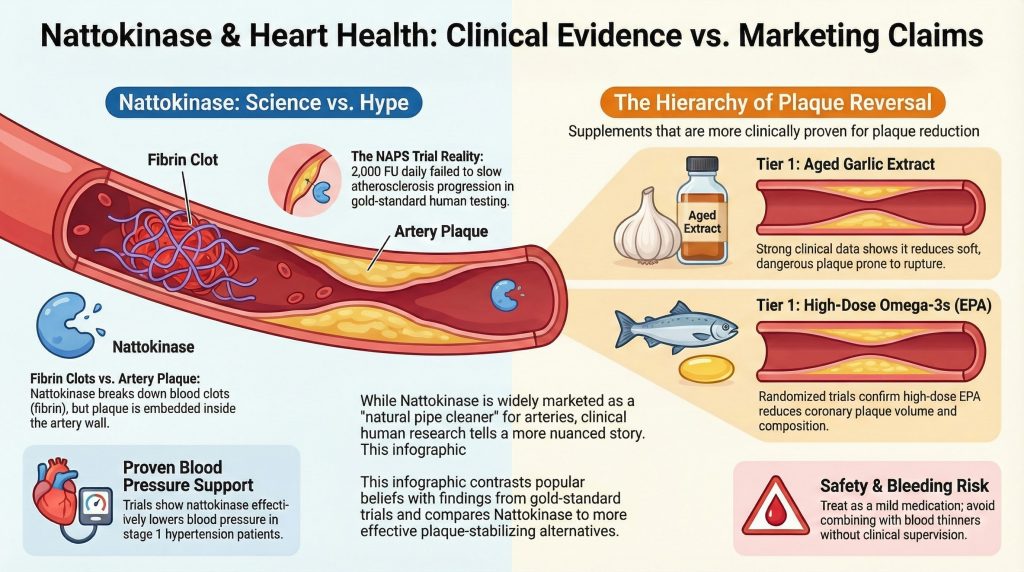
Nattokinase is a fibrinolytic enzyme—it breaks down fibrin, a protein that forms the mesh of blood clots. This often confuses people.
- Fibrin clots form in the bloodstream and can block flow acutely.
- Plaque is embedded in the artery wall itself.
While nattokinase may improve blood flow by affecting clotting factors, that does not automatically mean it “scrubs” plaque out of the vessel wall. The real question is: Does this biological mechanism translate to shrinking plaque in humans?
3. The Strongest Evidence: The NAPS Trial
The most critical study for anyone considering this supplement is the Nattokinase Atherothrombotic Prevention Study (NAPS).²,¹⁰ This was a randomized, double-blind, placebo-controlled trial—the gold standard of research.
- Dose: 2,000 Fibrinolytic Units (FU) per day (the standard dose in most bottles).
- Outcome: They measured the progression of subclinical atherosclerosis using carotid ultrasound (CIMT) and arterial stiffness.
The Result: At the standard 2,000 FU dose, the study did not find that nattokinase slowed the progression of atherosclerosis compared to placebo.²
This doesn’t mean nattokinase is useless, but it is a reality check. The best-designed trial we have at the most common dose failed to support the “plaque reversal” narrative.
4. The “Positive” Studies: Context Matters
You will often hear about other studies that claim positive results, such as the trial by Ren et al. (2017).³ This study focused on patients with carotid atherosclerosis and hyperlipidemia and reported benefits.
Why the discrepancy? In supplement research, we often see a pattern where smaller, pilot studies or those using higher doses show promise, while larger, more rigorous trials show null results. While the positive data exists, it has not been consistently replicated in multi-center trials with standardized imaging.³
The Verdict: While there are signals of benefit in specific populations, we lack the definitive, high-quality evidence needed to claim it works for everyone.
5. Blood Pressure and Other Risk Factors
While plaque regression is unproven, nattokinase is not an inert pill. It has measurable effects on physiology.
- Blood Pressure: A randomized trial (Kim et al., 2008) showed nattokinase could lower blood pressure in patients with pre-hypertension or stage 1 hypertension.⁴
- Lipids & Clotting: A 2023 meta-analysis suggested it may favorably impact cardiovascular risk factors, though the effect sizes varied widely depending on the dose.⁵
If your goal is modulating risk factors like blood pressure, the evidence is stronger than it is for dissolving plaque.
6. Safety: The “Natural” Blood Thinner?
Because nattokinase influences the clotting system, “natural” does not mean “risk-free.”
- Bleeding Risk: Theoretical and case-report evidence suggests a risk of bleeding, particularly if combined with aspirin, Plavix, Xarelto, Eliquis, or even high-dose fish oil.
- Drug Interactions: It should be treated with the same caution as a mild medication. If you are having surgery or take anticoagulants, this is not a supplement to take casually.
- How It Compares to Other Supplements
If your main goal is stabilizing or reducing plaque, how does nattokinase stack up against the competition?
Tier 1: Strongest Human Imaging Data
- Aged Garlic Extract (AGE): This has perhaps the most impressive imaging data. A randomized trial (Matsumoto et al., 2016) used cardiac CT scans and found that AGE reduced “low-attenuation plaque”—the soft, dangerous type of plaque prone to rupture.⁶,¹¹
- Omega-3s (EPA/DHA): Specific formulations (often high-dose EPA) have been shown in RCTs using CCTA to affect coronary plaque volume and composition.⁷,⁸
Tier 2: Mechanism-Based or Mixed Data
- Red Yeast Rice: Contains monacolin K (natural lovastatin), so it works via the proven LDL-lowering pathway.⁹ It works, but quality control is a nightmare.
- Nattokinase: Good for blood pressure and flow, but the direct plaque-shrinking evidence is weak at standard doses.²,⁵
- Vitamin K2: Promising for preventing arterial calcification, particularly studied in kidney disease patients, but the data on reversing existing hardening in healthy people is less established.¹⁰
Summary: The Strategic Approach
If you are taking nattokinase 2,000 FU expecting it to scour your arteries clean, the best science we have (the NAPS trial) suggests you may be disappointed.
However, if you view it as part of a broader strategy to manage blood pressure and blood viscosity, it has a role. But for those strictly focused on coronary plaque, the human imaging data for Aged Garlic Extract and pharmaceutical-grade Omega-3s is currently superior.
References
- Chen H, McGowan EM, Ren N, et al. Nattokinase: A Promising Alternative in Prevention and Treatment of Cardiovascular Diseases. Biomark Insights. 2018;13:1177271918785130. Published 2018 Jul 5. doi:10.1177/1177271918785130
- Hodis HN, Mack WJ, Meiselman HJ, et al. Nattokinase atherothrombotic prevention study: A randomized controlled trial. Clin Hemorheol Microcirc. 2021;78(4):339-353. doi:10.3233/CH-211147
- Ren NN, Chen HJ, Li Y, Mcgowan GW, Lin YG. Zhonghua Yi Xue Za Zhi. 2017;97(26):2038-2042. doi:10.3760/cma.j.issn.0376-2491.2017.26.005
- Kim JY, Gum SN, Paik JK, et al. Effects of nattokinase on blood pressure: a randomized, controlled trial. Hypertens Res. 2008;31(8):1583-1588. doi:10.1291/hypres.31.1583
- Li X, Long J, Gao Q, et al. Nattokinase Supplementation and Cardiovascular Risk Factors: A Systematic Review and Meta-Analysis of Randomized Controlled Trials. Rev Cardiovasc Med. 2023;24(8):234. Published 2023 Aug 15. doi:10.31083/j.rcm2408234
- Matsumoto S, Nakanishi R, Li D, et al. Aged Garlic Extract Reduces Low Attenuation Plaque in Coronary Arteries of Patients with Metabolic Syndrome in a Prospective Randomized Double-Blind Study. J Nutr. 2016;146(2):427S-432S. doi:10.3945/jn.114.202424
- Alfaddagh A, Elajami TK, Ashfaque H, Saleh M, Bistrian BR, Welty FK. Effect of Eicosapentaenoic and Docosahexaenoic Acids Added to Statin Therapy on Coronary Artery Plaque in Patients With Coronary Artery Disease: A Randomized Clinical Trial. J Am Heart Assoc. 2017;6(12):e006981. Published 2017 Dec 15. doi:10.1161/JAHA.117.006981
- Feuchtner G, Langer C, Barbieri F, et al. The effect of omega-3 fatty acids on coronary atherosclerosis quantified by coronary computed tomography angiography. Clin Nutr. 2021;40(3):1123-1129. doi:10.1016/j.clnu.2020.07.016
- Cicero AFG, Fogacci F, Banach M. Red Yeast Rice for Hypercholesterolemia. Methodist Debakey Cardiovasc J. 2019;15(3):192-199. doi:10.14797/mdcj-15-3-192
- Kurnatowska I, Grzelak P, Masajtis-Zagajewska A, et al. Effect of vitamin K2 on progression of atherosclerosis and vascular calcification in nondialyzed patients with chronic kidney disease stages 3-5. Pol Arch Med Wewn. 2015;125(9):631-640. doi:10.20452/pamw.3041
- Efendy JL, Simmons DL, Campbell GR, Campbell JH. The effect of the aged garlic extract, ‘Kyolic’, on the development of experimental atherosclerosis. Atherosclerosis. 1997;132(1):37-42. doi:10.1016/s0021-9150(97)00078-6