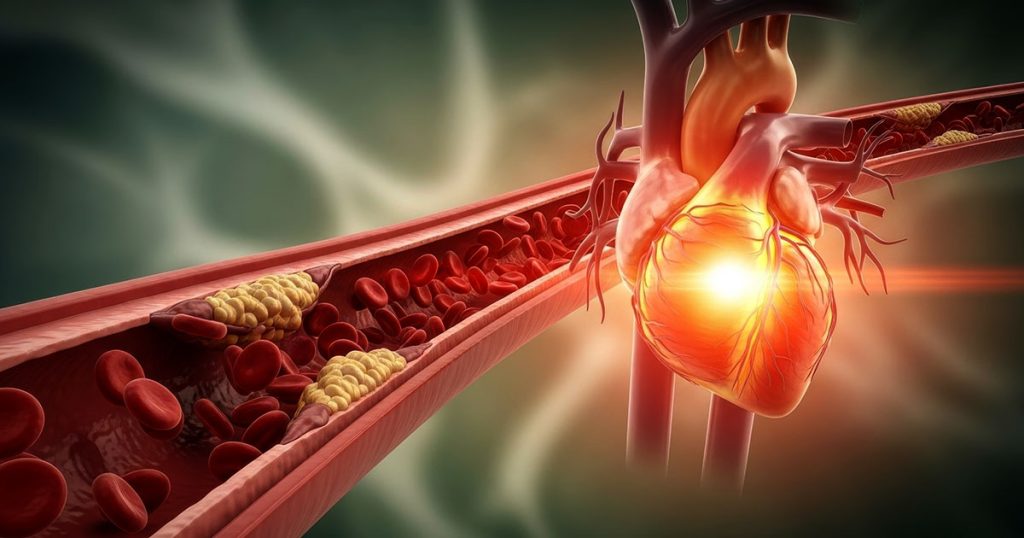
Le persone vogliono risposte semplici a problemi complessi. Aterosclerotica placca—quell’accumulo di grasso e infiammazione all’interno arteria pareti — sembra quasi qualcosa che si dovrebbe poter “pulire” come un tubo intasato. Questa speranza alimenta un enorme interesse per gli integratori che promettono di “sciogliere la placca”, “sbloccare le arterie” o “invertire le malattie cardiache ”naturalmente.»
Nattokinasi è attualmente uno degli integratori più popolari in questa categoria. Si tratta di un enzima derivato dal natto (soia fermentata), ampiamente commercializzato per favorire la circolazione, pressione sanguigna, e la regressione della placca. Ma il marketing non costituisce una prova.
Per comprendere la realtà dei fatti, dobbiamo esaminare ciò che emerge effettivamente dalla ricerca clinica sull’uomo: quali dosi sono state utilizzate, quali risultati sono stati misurati e come si colloca rispetto ad altri integratori per i quali sono disponibili dati relativi alla placca, quali l’estratto di aglio invecchiato, gli omega-3 e vitamina K2.¹–¹¹
(Avviso: queste sono informazioni a scopo informativo, non costituiscono un parere medico. Se soffri di placca arteriosa o assumi anticoagulanti, consulta il tuo medico prima di assumere integratori.)
1. Cosa significa realmente “inversione della placca”
Aterosclerosi non è solo colesterolo aderito alla parete di un’arteria; è un organismo vivente lesione che contiene cellule immunitarie, tessuto fibroso e, spesso, calcio. “Invertire” questo processo non significa solo ridurne le dimensioni, ma anche stabilizzarlo in modo da renderlo meno soggetto a rottura.
Quando i ricercatori misurano inversione, non si basano su come il paziente “si sente”. Utilizzano tecniche di imaging riproducibili:
- Ecografia carotidea: Misurazione dello spessore della parete arteriosa (CIMT) o delle dimensioni della placca.
- Angiografia coronarica mediante TC (CCTA): Misurare il volume e la composizione della placca (ad esempio: è morbida e pericolosa, oppure calcificata e stabile?).
- Calcio delle arterie coronarie: Un punteggio di rischio, sebbene non sia sempre un indicatore perfetto ai fini della regressione.
Le affermazioni concrete relative alla regressione richiedono questo tipo di dati concreti, idealmente provenienti da studi clinici randomizzati controllati (studi randomizzati controllati).
2. Il meccanismo: fibrina contro placca
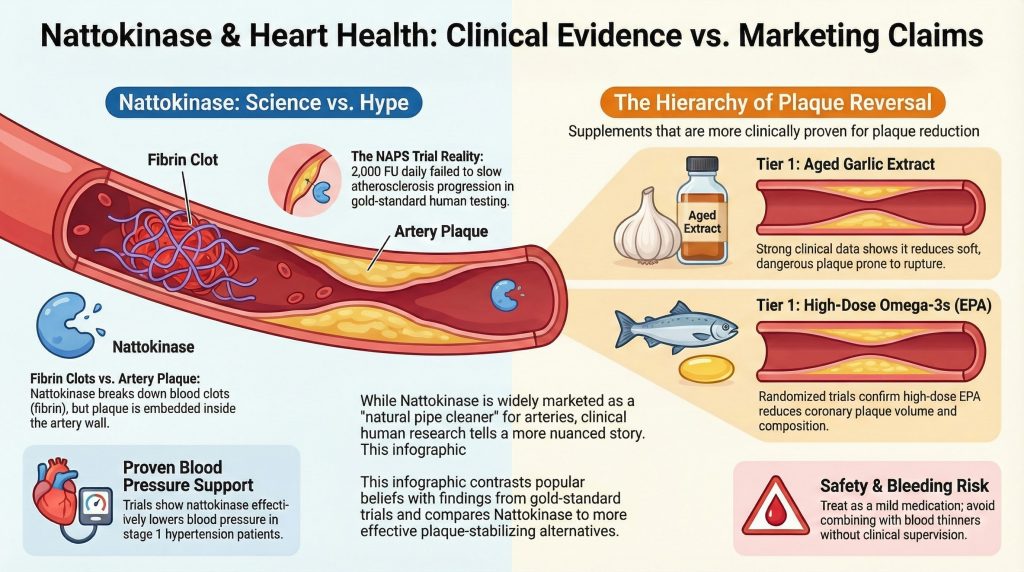
La nattokinasi è una enzima fibrinolitico—scompone la fibrina, una proteina che costituisce la maglia di coaguli di sangue. Questo spesso crea confusione.
- Coaguli di fibrina si formano nel flusso sanguigno e possono causare un'ostruzione acuta del flusso.
- Placca è incorporato nella parete dell'arteria stessa.
Sebbene la nattokinasi possa migliorare la circolazione sanguigna agendo sui fattori della coagulazione, ciò non significa automaticamente che “rimuova” la placca dalla parete dei vasi sanguigni. La vera domanda è: questo meccanismo biologico si traduce in una riduzione della placca negli esseri umani?
3. La prova più convincente: lo studio NAPS
Lo studio più importante per chiunque stia valutando l'assunzione di questo integratore è il Studio sulla prevenzione aterotrombotica con nattokinasi (NAPS).²,¹⁰ Si trattava di uno studio randomizzato, in doppio cieco e controllato con placebo, ovvero il “gold standard” della ricerca.
- Dose: 2,000 Unità fibrinolitiche (FU) al giorno (la dose standard contenuta nella maggior parte dei flaconi).
- Risultato: Hanno misurato la progressione di aterosclerosi subclinica utilizzando l’ecografia carotidea (CIMT) e la rigidità arteriosa.
Il risultato: Alla dose standard di 2.000 FU, lo studio non è stato riscontrato che la nattokinasi rallentasse la progressione dell'aterosclerosi rispetto a placebo.²
Questo non significa che la nattokinasi sia inutile, ma ci induce a fare i conti con la realtà. Lo studio clinico meglio progettato di cui disponiamo, condotto con la dose più comunemente utilizzata, non è riuscito a confermare la “inversione della placca” narrazione.
4. Gli studi “positivi”: il contesto è importante
Si sente spesso parlare di altri studi che riportano risultati positivi, come ad esempio la sperimentazione condotta da Ren et al. (2017).³ Questo studio si è concentrato su pazienti affetti da aterosclerosi carotidea e iperlipidemia e ha riportato benefici.
Perché questa discrepanza? Nella ricerca sugli integratori, si osserva spesso un andamento secondo cui studi pilota su scala ridotta o quelli che utilizzano dosi più elevate si dimostrano promettenti, mentre studi clinici più ampi e rigorosi mostrano risultati nulli. Sebbene esistano dati positivi, questi non sono stati replicati in modo coerente in studi multicentrici con tecniche di imaging standardizzate.³
Il verdetto: Sebbene vi siano segnali di benefici in determinate popolazioni, non disponiamo delle prove definitive e di alta qualità necessarie per affermare che funzioni per tutti.
5. Pressione arteriosa e altri fattori di rischio
Sebbene la regressione della placca non sia stata dimostrata, la nattokinasi non è una pillola inerte. Ha effetti misurabili sulla fisiologia.
- Pressione arteriosa: Uno studio randomizzato (Kim et al., 2008) ha dimostrato che la nattokinasi può abbassare la pressione arteriosa nei pazienti affetti da preipertensione oppure fase 1 ipertensione.⁴
- Lipidi e coagulazione: A 2023 meta-analisi ha suggerito che potrebbe avere un effetto positivo sul sistema cardiovascolare fattori di rischio, sebbene l'entità dell'effetto variasse notevolmente a seconda della dose.⁵
Se il tuo obiettivo è quello di tenere sotto controllo fattori di rischio come la pressione arteriosa, le prove scientifiche a sostegno di questo approccio sono più solide rispetto a quelle relative alla rimozione della placca.
6. Sicurezza: l’anticoagulante “naturale”?
Poiché la nattokinasi influisce sul sistema della coagulazione, “naturale” non significa “privo di rischi”.”
- Rischio di emorragia: I dati teorici e i casi clinici riportati suggeriscono un rischio di sanguinamento, in particolare se associato a aspirina, Plavix, Xarelto, Eliquis o persino olio di pesce ad alto dosaggio.
- Interazioni farmacologiche: Va trattato con la stessa cautela di un farmaco a bassa potenza. Se devi sottoporti a un intervento chirurgico o se assumi anticoagulanti, questo non è un integratore da assumere con leggerezza.
- Confronto con altri integratori
Se il tuo obiettivo principale è stabilizzare o ridurre la placca, come si posiziona la nattokinasi rispetto alla concorrenza?
Livello 1: Dati di imaging umano più significativi
- Estratto di aglio invecchiato (AGE): Questo studio presenta forse i dati di imaging più impressionanti. Uno studio randomizzato (Matsumoto et al., 2016), che ha utilizzato scansioni TC cardiache, ha rilevato che l’AGE ha ridotto “placca a bassa attenuazione”—quel tipo di placca morbida e pericolosa, soggetta a rottura.⁶,¹¹
- Omega-3 (EPA/DHA): È stato dimostrato, in studi randomizzati controllati (RCT) che utilizzano la CCTA, che alcune formulazioni specifiche (spesso a dosaggio elevato di EPA) influenzano il volume e la composizione della placca coronarica.⁷,⁸
Livello 2: Dati basati su meccanismi o dati misti
- Riso al lievito rosso: Contiene monacolina K (lovastatina naturale), quindi agisce attraverso il meccanismo comprovato di riduzione del colesterolo LDL.⁹ Funziona, ma il controllo di qualità è un incubo.
- Nattokinasi: È utile per la pressione arteriosa e la circolazione, ma le prove a sostegno di una riduzione diretta della placca sono deboli alle dosi standard.²,⁵
- Vitamina K2: Promettente per la prevenzione calcificazione arteriosa, oggetto di studi approfonditi in malattia renale nei pazienti, ma i dati relativi alla regressione dell’indurimento già in atto nelle persone sane sono meno consolidati.¹⁰
Sintesi: L'approccio strategico
Se state assumendo 2.000 FU di nattokinasi sperando che vi pulisca a fondo le arterie, i dati scientifici più attendibili di cui disponiamo (lo studio NAPS) indicano che potreste rimanere delusi.
Tuttavia, se lo si considera parte di una strategia più ampia volta a gestire la pressione arteriosa e la viscosità del sangue, ha comunque una sua importanza. Ma per chi si concentra esclusivamente su placca coronarica, i dati di imaging umano relativi a Estratto di aglio invecchiato e di qualità farmaceutica Omega-3 è attualmente superiore.
Riferimenti
- Chen H, McGowan EM, Ren N, et al. Nattokinase: A Promising Alternative in Prevention and Treatment of Cardiovascular Diseases. Biomark Insights. 2018;13:1177271918785130. Published 2018 Jul 5. doi:10.1177/1177271918785130
- Hodis HN, Mack WJ, Meiselman HJ, et al. Nattokinase atherothrombotic prevention study: A randomized controlled trial. Clin Hemorheol Microcirc. 2021;78(4):339-353. doi:10.3233/CH-211147
- Ren NN, Chen HJ, Li Y, Mcgowan GW, Lin YG. Zhonghua Yi Xue Za Zhi. 2017;97(26):2038-2042. doi:10.3760/cma.j.issn.0376-2491.2017.26.005
- Kim JY, Gum SN, Paik JK, et al. Effects of nattokinase on blood pressure: a randomized, controlled trial. Hypertens Res. 2008;31(8):1583-1588. doi:10.1291/hypres.31.1583
- Li X, Long J, Gao Q, et al. Nattokinase Supplementation and Cardiovascular Risk Factors: A Systematic Review and Meta-Analysis of Randomized Controlled Trials. Rev Cardiovasc Med. 2023;24(8):234. Published 2023 Aug 15. doi:10.31083/j.rcm2408234
- Matsumoto S, Nakanishi R, Li D, et al. Aged Garlic Extract Reduces Low Attenuation Plaque in Coronary Arteries of Patients with Metabolic Syndrome in a Prospective Randomized Double-Blind Study. J Nutr. 2016;146(2):427S-432S. doi:10.3945/jn.114.202424
- Alfaddagh A, Elajami TK, Ashfaque H, Saleh M, Bistrian BR, Welty FK. Effect of Eicosapentaenoic and Docosahexaenoic Acids Added to Statin Therapy on Coronary Artery Plaque in Patients With Coronary Artery Disease: A Randomized Clinical Trial. J Am Heart Assoc. 2017;6(12):e006981. Published 2017 Dec 15. doi:10.1161/JAHA.117.006981
- Feuchtner G, Langer C, Barbieri F, et al. The effect of omega-3 fatty acids on coronary atherosclerosis quantified by coronary computed tomography angiography. Clin Nutr. 2021;40(3):1123-1129. doi:10.1016/j.clnu.2020.07.016
- Cicero AFG, Fogacci F, Banach M. Red Yeast Rice for Hypercholesterolemia. Methodist Debakey Cardiovasc J. 2019;15(3):192-199. doi:10.14797/mdcj-15-3-192
- Kurnatowska I, Grzelak P, Masajtis-Zagajewska A, et al. Effect of vitamin K2 on progression of atherosclerosis and vascular calcification in nondialyzed patients with chronic kidney disease stages 3-5. Pol Arch Med Wewn. 2015;125(9):631-640. doi:10.20452/pamw.3041
- Efendy JL, Simmons DL, Campbell GR, Campbell JH. The effect of the aged garlic extract, ‘Kyolic’, on the development of experimental atherosclerosis. Atherosclerosis. 1997;132(1):37-42. doi:10.1016/s0021-9150(97)00078-6