Are seed oils healthy? True or False
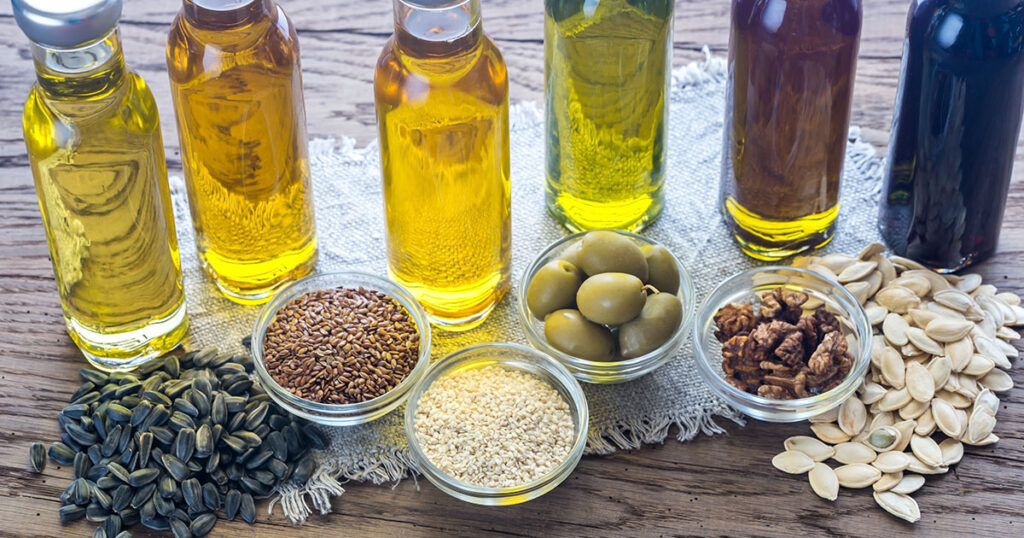
A Critical Scientific Review of Seed OilsSeed oils are cooking oils pressed from seeds — soybean, sunflower, canola, corn, safflower. Versus Olive OilL'huile d'olive est la principale matière grasse du régime méditerranéen, riche en graisses mono-insaturées et, dans sa forme extra vierge, en composés végétaux appelés polyphénols., Saturated FatLes graisses saturées sont celles qui restent solides à température ambiante — le beurre, la graisse de la viande rouge, l'huile de noix de coco et l'huile de palme., and Whole-Food Fat Sources
Résumé
The dietary fat debate has evolved from a low-fat paradigm to a lipid-specific one. Historically, guidelines advised replacing saturated fatty acids with polyunsaturated fatty acids to lower serum cholestérolLe cholestérol est une substance cireuse dont votre corps a besoin. Il entre dans la composition des parois cellulaires, des hormones, de la vitamine D et de la bile qui digère vos aliments. Vous en mettriez sans lui. and prevent maladie coronarienneLa coronaropathie est le rétrécissement ou le blocage des artères qui irriguent le muscle cardiaque, causé par l'accumulation de plaque athéromateuse ; c'est la principale cause de crise cardiaque et de mort cardiaque dans le monde.. Over the past decade this guidance has been challenged by the hypothesis that industrial seed oils rich in omega-6 acide linoléiqueLinoleic acid is the main polyunsaturated fat in seed oils such as soybean, sunflower, and corn oil. Your body cannot make it, so you must get it from food. promote systemic inflammationL'inflammation est la réponse de votre système immunitaire à une blessure ou à quelque chose qu'il traite comme un envahisseur. Elle entraîne gonflement, chaleur et cellules de nettoyage. et peroxydation lipidiqueLipid peroxidation is a chain reaction in which reactive oxygen species attack the double bonds in unsaturated fatty acids, breaking them down into potentially harmful oxidation products; polyunsaturated fats in seed oils are more susceptible to this process than saturated or monounsaturated fats, particularly under heat or repeated frying., alongside growing interest in the cardiovascular benefits of extra virgin olive oil and whole-food fat matrices. This review evaluates the physiological, mechanistic, and essai cliniqueUn essai clinique est une étude dans laquelle des chercheurs administrent un traitement à un groupe et un placebo ou des soins standard à un autre groupe, puis comparent les résultats. evidence, treating apolipoprotéineUne apolipoprotéine est une protéine attachée à une particule transporteuse de graisses dans votre sang. Les graisses et l'eau ne se mélangeant pas, ces protéines agissent comme une enveloppe qui permet aux graisses de voyager en toute sécurité dans la circulation sanguine. BApoBL'ApoB est une protéine située à la surface de chaque particule de cholestérol susceptible de se coincer dans la paroi de vos artères et de provoquer de la plaque. Chacune de ces particules transporte exactement une ApoB.)-contenant lipoprotéinesUne lipoprotéine est un tout petit paquet qui transporte les graisses et le cholestérol dans votre circulation sanguine. Comme la graisse ne se dissout pas dans l'eau, elle a besoin d'une enveloppe protéique pour voyager. as the causal driver of athéroscléroseL'athérosclérose est la maladie à l'origine de la plupart des crises cardiaques et de nombreux accidents vasculaires cérébraux. Des particules de cholestérol se coincent dans la paroi d'une artère, le corps envoie des cellules immunitaires pour nettoyer, et au fil des ans, ce désordre durcit pour former de la plaque.. Throughout, a deliberate distinction is drawn between mechanistic and marqueurs de substitutionUn marqueur de substitution est une mesure de remplacement utilisée parce que ce qui vous intéresse vraiment prend trop de temps à observer., such as flow-mediated dilation and inflammatory biomarqueursUn biomarqueur est un élément mesurable dans l'organisme qui renseigne sur la santé ou la maladie — une valeur de laboratoire, un résultat de scanner, une lecture de la pression artérielle., and hard clinical endpoints such as infarctus du myocardeVoir Crise cardiaque pour l'article complet., accident vasculaire cérébralUn accident vasculaire cérébral se produit lorsque le flux sanguin vers une partie du cerveau s'arrête, soit en raison d'un blocage, soit d'une hémorragie., and cardiovascular death. Quantitative claims are drawn from peer-reviewed primary studies and systematic evidence syntheses; claims that could not be verified against a published source have been removed.
1. Introduction
The nutritional debate surrounding dietary fat has shifted from a simple low-fat model toward a complex, lipid-specific analysis. Public health guidelines historically recommended substituting saturated fatty acids (SFAs)Saturated fatty acids are fat molecules with no carbon-carbon double bonds, found abundantly in butter, coconut oil, and fatty meat; they raise LDL cholesterol and ApoB-containing lipoprotein levels more than unsaturated plant oils, which is why replacing them with unsaturated fats is a central public-health recommendation. with polyunsaturated fatty acids (PUFAs)Fatty acids containing two or more carbon-carbon double bonds; they include the omega-6 family (linoleic acid, dominant in most seed oils) and the omega-3 family (alpha-linolenic acid, EPA, DHA), and they lower LDL cholesterol when substituted for saturated fats. to reduce serum cholestérol totalLe cholestérol total additionne le cholestérol de toutes vos particules, qu'elles soient nocives ou bénéfiques. (TC) and prevent coronary heart disease (CHD). Over the past decade this guidance has been challenged by the hypothesis that industrial seed oils rich in omega-6 linoleic acid (LA, 18:2n-6) promote chronic systemic inflammation and lipid peroxidation. Concurrently, evidence has accumulated for the cardiovascular benefits of extra virgin olive oil (EVOO)Cold-pressed olive oil that meets international standards for low acidity and sensory quality; unlike refined olive oil, it retains natural polyphenols and other minor bioactive compounds that may have antioxidant and anti-inflammatory properties. and lipid matrices derived from whole foods. [1]
This review provides a balanced evaluation of unrefined and refined seed oils and contrasts them with EVOO, refined olive oil, SFAs, and whole-food fat sources. Central to the analysis is the role of ApoB-containing lipoproteins as the causal drivers of atherosclerosis, while examining whether the postprandialPostprandial signifie ' après un repas ' ; les études postprandiales mesurent la façon dont l'organisme — notamment les vaisseaux sanguins, les taux de lipides et les marqueurs inflammatoires — réagit dans les heures qui suivent immédiatement la consommation de nourriture, plutôt que lors d'une mesure à jeun de référence. and vascular effects of extracted fats contribute to risk independently of their effects on circulating lipids. [2], [3]
2. Are Seed Oils Uniquely Harmful?
The hypothesis that seed oils containing varying amounts of linoleic acid (soybean, corn, sunflower, safflower, canola, cottonseed, grapeseed, and rice bran oils) possess unique adverse effects beyond those of other refined lipids remains under active study. Canola oil is grouped here by convention but is predominantly monounsaturated and also supplies alpha-linolenic acid, so it should not be treated as interchangeable with high-linoleic oils. The concern is rooted in chemical structure: PUFAs contain multiple double bonds separated by bis-allylic methylene groupsA carbon atom flanked on both sides by carbon-carbon double bonds in a fatty acid chain; this configuration is particularly vulnerable to free-radical attack and is the structural reason polyunsaturated fats oxidize faster than saturated or monounsaturated fats., making them susceptible to hydrogen abstraction and lipid peroxidation. [6]
In modern diets these oils are consumed largely as ingredients in processed and ultra-processed food matrices, which confounds observational studies because the effects of refined seed oils are difficult to isolate from those of refined glucideLes glucides sont les sucres et les amidons présents dans les aliments : pain, riz, pâtes, fruits, pommes de terre, bonbons., high sodium, and low fibreLes fibres sont la partie des aliments d'origine végétale que votre corps ne peut pas digérer. On les trouve dans les haricots, l'avoine, les légumes, les fruits et les grains entiers..
When evaluated as isolated dietary components in controlled trials, seed oils have not demonstrated unique adverse cardiometabolic effects attributable to them as a class. Instead they show predictable lipid-modulating effects based on their fatty acid profiles. Compared with butter and other SFA-rich fats, unsaturated plant oils consistently lower low-density lipoprotein cholesterol (LDL-C); high-oleic oil substitution trials also demonstrate modest ApoB reductions. [4], [5]
2.1 Fatty Acid Profiles and Oxidative Stability
The fatty acid profiles and relative oxidative stabilities of the major added fats are summarized in Table 1. Susceptibility to autoxidationAutoxidation is the spontaneous reaction of fats with atmospheric oxygen, initiated and propagated without an external ignition source; the rate increases with the number of double bonds in a fatty acid, making highly polyunsaturated seed oils more prone to going rancid during storage or repeated heating than saturated or monounsaturated fats. rises with the number of double bonds, so saturated and acides gras mono-insaturésMonounsaturated fat is the main fat in olive oil, avocados, and most nuts. are far more oxidatively stable than polyunsaturated seed oils. Conventional high-linoleic seed oils and their high-oleic cultivars are chemically distinct: high-oleic sunflower, safflower, and soybean oils are dominated by monounsaturated oleic acid and are correspondingly more stable than their conventional high-linoleic counterparts. [6]
| Fat / Oil | Primary Class | Dominant Fatty Acid(s) | Double Bonds | Oxidation Susceptibility |
| Huile de cocoCoconut oil is a cooking fat that got marketed as a superfood despite being very high in saturated fat. | Saturated | Lauric (12:0), myristic (14:0) | 0 | Très bas |
| Butter | Saturated | Palmitic (16:0), stearic (18:0) | 0 | Très bas |
| Extra virgin olive oil | Monounsaturated | Oleic (18:1n-9) | 1 | Low (protected by polyphénolsPolyphenols are a broad class of plant-derived compounds with antioxidant properties; extra virgin olive oil is particularly rich in them, and they are often cited as the reason EVOO may be more protective than refined olive oil, though trials measuring hard cardiovascular endpoints have not confirmed a meaningful clinical benefit.) |
| Canola oil | MUFA / PUFA | Oleic (18:1n-9), linoleic (18:2n-6), alpha-linolenic (18:3n-3) | 1 to 3 | Modéré |
| Soybean oil | Polyunsaturated | Linoleic (18:2n-6) | 2 | Haut |
| Corn oil | Polyunsaturated | Linoleic (18:2n-6) | 2 | Haut |
| Safflower (high-linoleic) | Polyunsaturated | Linoleic (18:2n-6) | 2 | Très élevé |
| Safflower (high-oleic) | Monounsaturated | Oleic (18:1n-9) | 1 | Faible |
Table 1. Fatty acid composition and relative oxidative stability of major added fats. Compositional data reflect standard lipid chemistry references. Oxidation susceptibility rankings are qualitative and relative, applying to comparable storage and heating conditions; they are not measured universal values, and actual oxidative stability varies with refining, tocopherol and antioxydantAn antioxidant is a substance that mops up damaging molecules in the body. Vitamin E and beta-carotene are examples. content, temperature, oxygen exposure, and fatty acid composition.
2.2 Industry Funding and Interpretation
Evaluation of the dietary fat literature is complicated by the prevalence of industry-funded nutrition research. A methodological analysis of beverage studies found that industry sponsorship was strongly associated with conclusions favorable to the sponsor; among interventional studies, the odds ratio for a favorable versus unfavorable conclusion comparing all-industry to no-industry funding was 7.61 (95% CI 1.27 to 45.73), and none of the sixteen all-industry interventional studies reported an unfavorable conclusion. [7]
That analysis concerned beverages rather than dietary fats, and no fat-specific odds ratio can be derived from it. It is cited here only to illustrate the general direction of funding bias. Consistency requires acknowledging that this scrutiny applies symmetrically across the fat debate: commodity and producer funding occurs on both sides, in seed oil research and in olive oil research alike. Commercial sponsorship does not by itself invalidate a study, but it underscores the value of replication by independent, non-commercially funded research on all sides of the debate. [7]
3. Is the Principal Issue Added Oils Rather than Seed Oils?
An alternative hypothesis holds that the primary determinant of postprandial vascular dysfunction is the consumption of extracted, purified oils of any type, including olive oil, rather than the specific fatty acid profile of seed oils. Under this model, mechanical or chemical extraction strips lipids of their protective cellular structures, fibers, and micronutrient matrices, converting them into highly bioavailable, calorie-dense liquids. [3]
Extracted oils can be more rapidly bioaccessible than intact food matrices in the upper gastrointestinal tract, producing a swifter postprandial rise in circulating chylomicronsA chylomicron is a very large particle that carries fat from a meal out of your intestines and into your bloodstream. and triglyceride-rich lipoproteins. This can trigger transient stress oxydatifLe stress oxydatif est un déséquilibre entre des molécules réactives dommageables et la capacité de l'organisme à les neutraliser. et dysfonction endothélialeLa dysfonction endothéliale se produit lorsque cette fine doublure cesse de bien faire son travail. Les vaisseaux ne se dilatent pas correctement et la barrière devient plus perméable.. Consuming fats within intact whole-food matrices yields a slower, more controlled absorption profile, because dietary fiber and intact plant cell walls act as a physical barrier that slows lipase access. This has been demonstrated directly in almonds, where a randomized crossover trial in 20 men comparing meals matched at 54 g of fat found a substantially smaller postprandial triglyceride response to whole almond particles than to almond oil with defatted almond flour. Consistent with the symmetry principle of Section 2.2, that trial was supported by a grant from the Almond Board of California, and the almond food-matrix literature more broadly has received almond-industry support. Comparable controlled comparisons have not been performed for olives, soybeans, or avocados, so extension beyond nuts remains an inference. [25], [26]
3.1 Mechanistic Impact of Added Lipids on Vascular Physiology
Several interrelated pathways have been proposed by which extracted oils may affect vascular health. These are mechanistic proposals supported by postprandial physiology rather than by hard-outcome trials, and are presented as such. [3]
- Nitric oxideLe monoxyde d'azote est un gaz produit par la paroi de vos vaisseaux sanguins pour leur indiquer de se détendre et de s'élargir. et fonction endothélialeLa capacité de la paroi interne des vaisseaux sanguins à réguler le tonus vasculaire, l'inflammation et la coagulation ; des cellules endothéliales saines libèrent de l'oxyde nitrique pour maintenir les artères détendues et résistantes à la formation de plaques.: Large postprandial lipid surges are proposed to increase superoxide production and reduce biodisponibilité de l'oxyde nitriqueLe degré auquel l'endothélium peut produire et maintenir des niveaux adéquats d'oxyde nitrique, une molécule de signalisation qui maintient les vaisseaux sanguins dilatés, inhibe l'agrégation plaquettaire et empêche les cellules inflammatoires d'adhérer à la paroi artérielle., causing transient vasoconstrictive impairment. In one controlled human study, antioxidant vitamins C and E attenuated the postprandial impairment by 71%, implicating oxidative stress in the response. [8]
- Lipoprotein entry and retention: Postprandial endothelial perturbation has been hypothesized to facilitate entry of ApoB-containing lipoproteins into the subendothelial matrix, the initiating step in athérogenèseAtherogenesis is the step-by-step process of a plaque forming., though the postprandial literature does not itself demonstrate arterial-wall penetration. [2], [3]
The available mechanistic evidence raises the possibility that extracted oils, irrespective of fatty acid composition, may contribute to transient postprandial endothelial dysfunction. Repeated postprandial endothelial dysfunction represents a biologically plausible mechanism deserving further investigation. Although biologically plausible, no human trial has demonstrated that repeated transient FMD impairment independently accelerates plaqueLa plaque est une accumulation de cholestérol, de cellules immunitaires, de tissu cicatriciel et de calcium à l'intérieur de la paroi d'une artère. progression after adjustment for ApoB exposure, and no trial has directly shown this pathway progressing to plaque in humans. [3]
4. Flow-Mediated Dilation and Endothelial Function
Flow-mediated dilation (FMD)La dilatation médiée par le flux est une mesure échographique non invasive de l'élargissement d'une artère conductrice — généralement l'artère brachiale — en réponse à une augmentation du débit sanguin, servant de marqueur de la signalisation endothéliale par l'oxyde nitrique et de la fonction endothéliale. du brachial artèreUne artère est un vaisseau sanguin qui transporte le sang du cœur vers le reste du corps. is an established noninvasive measure of nitric oxide-dependent endothelial function and is prospectively associated with cardiovascular events. In a méta-analyseUne méta-analyse combine statistiquement les résultats de nombreuses études distinctes en une seule estimation globale. of 14 observational studies comprising 5,547 participants, impaired brachial FMD was significantly associated with future cardiovascular events, with a pooled risque relatifLe risque relatif compare deux groupes : ce groupe a enregistré 30 pour cent d'infarctus en moins que cet autre groupe. of 0.87 per one percent absolute increase in FMD. [27] That is a prognostic association rather than validation of FMD as a surrogate endpointA surrogate endpoint is a measurable biological marker — such as LDL cholesterol, CIMT, or coronary artery calcium — used in trials as a stand-in for a clinical outcome like a heart attack; favorable changes in surrogates support plausibility of benefit but do not by themselves prove that a treatment prevents heart attacks or death. for treatment effects. It is important to state plainly that FMD is a surrogate measure, not a clinical endpoint: it measures a physiological property of the vasculature, and a change in FMD does not by itself constitute a crise cardiaqueUne crise cardiaque survient lorsque le flux sanguin vers une partie du muscle cardiaque est interrompu et que ce muscle commence à mourir., stroke, or death prevented. Its value lies in mechanistic insight, not in quantifying clinical benefit. [27]
4.1 Postprandial Endothelial Responses to Lipids
A revue systématiqueUne revue systématique recherche toutes les études portant sur une question en utilisant une méthode pré-déclarée, puis les évalue selon des critères cohérents. and meta-analysis of the acute effects of a single high-fat meal on endothelial function (131 studies, 90 in the quantitative synthesis) found statistically significant postprandial reductions in brachial artery FMDBrachial artery flow-mediated dilation (FMD) is a noninvasive ultrasound test that measures how much the brachial artery in the upper arm widens in response to increased blood flow, reflecting nitric oxide-dependent endothelial function; it is a surrogate marker associated with cardiovascular risk in observational studies but is not itself a clinical endpoint like heart attack or stroke.. [3]
- At 2 hours: FMD decreased by 1.02 percentage points (95% CI -1.34 to -0.70; P < 0.01). [3]
- At 3 hours: FMD decreased by 1.04 percentage points (95% CI -1.48 to -0.59; P < 0.001). [3]
- At 4 hours: FMD decreased by 1.19 percentage points (95% CI -1.53 to -0.84; P < 0.01). [3]
The percentage of energy from fat was inversely associated with the change in FMD at 3 hours (P < 0.01), consistent with a dose-related postprandial effect; triglyceride-rich lipemia and oxidative stress are candidate mechanisms rather than demonstrated ones. [3] (Figure 1)
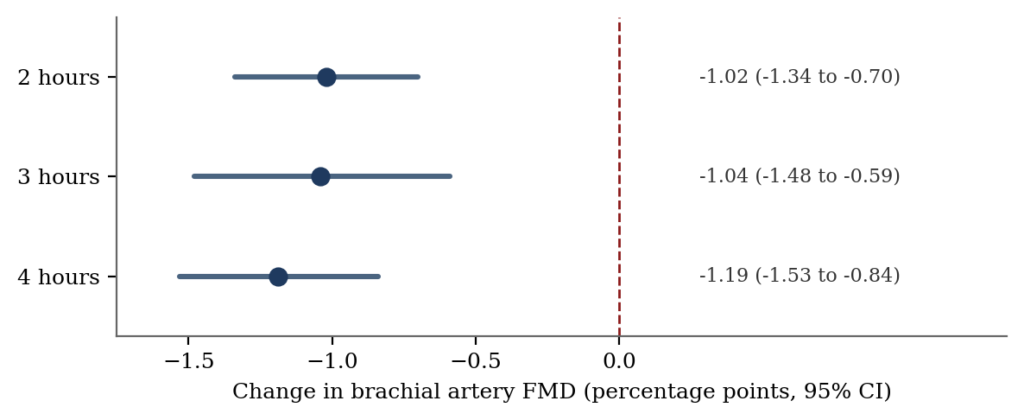
Figure 1. Change in brachial artery flow-mediated dilation after a single high-fat meal, pooled across trials. Values are mean differences in percentage points with 95% confidence intervalsUn intervalle de confiance est la plage de valeurs qui sont statistiquement compatibles avec ce qu'une étude a révélé.. FMD is a surrogate measure of endothelial function, not a clinical endpoint. Data from reference [3].
4.2 The Olive Oil FMD Paradox
A key observation in vascular biology is the olive oil FMD paradox described by Vogel and colleagues. Ten healthy, normolipidemic subjects consumed meals of 900 kcal containing 50 g of fat from different sources. [8]
The olive oil meal reduced postprandial FMD by 31%, from 14.3% to 9.9% (P = 0.008), whereas canola oil and salmon meals produced no significant decline. An inverse correlation was observed between the postprandial change in serum triglycéridesLes triglycérides constituent la principale forme de graisse dans votre sang et dans les réserves de votre corps. and the change in FMD (r = -0.47; P < 0.05). When the olive oil meal was accompanied by antioxidant-rich foods or by vitamins C and E, the reduction was substantially prevented (by 65% and 71%, respectively). This experiment shows that a high extra virgin olive oil meal did not prevent postprandial FMD impairment under these conditions. It is a ten-person acute high-fat challenge: the experimental meal contained approximately 50 g of fat, considerably greater than a typical single-meal fat intake for many individuals, so neither the magnitude of the response nor the ranking of oils should be extrapolated directly to habitual consumption. [8]
The preservation of endothelial function by extra virgin olive oil is often attributed to its hydrophilic secoiridoid phenolics, including hydroxytyrosol, oleuropein, oléocanthalUn composé phénolique présent naturellement dans l'huile d'olive extra-vierge qui inhibe les enzymes inflammatoires d'une manière similaire à l'ibuprofène ; il est proposé comme l'un des mécanismes par lesquels le régime méditerranéen réduit l'inflammation vasculaire., and oleacein, which act in vitro as free radical scavengers. This attribution should be treated with caution, and this review does not present it as established. Funding in this literature is mixed and must be described case by case rather than in aggregate. A positive postprandial trial, a randomized controlled crossover study in 20 adults at risk for type 2 diabèteLe diabète est une affection où la glycémie reste trop élevée, soit parce que l'organisme produit trop peu d'insuline, soit parce qu'il cesse de répondre à l'insuline qu'il produit., reported that a single 50 mL dose of high-polyphenol extra virgin olive oil improved endothelial function relative to refined olive oil; that trial was funded by an olive oil producer which also supplied the study oils, with additional support from the Centers for Disease Control and Prevention. [28] The largest phenolic trial, EUROLIVE, was supported by the European Commission under grant QLK1-CT-2001-00287 and its authors declared no financial conflicts of interest. [17] A three-week crossover trial in 46 healthy volunteers comparing phenol-rich with phenol-poor extra virgin olive oil found no effect on the resistance of LDLLe LDL, ou lipoprotéine de basse densité, est la principale particule qui transporte le cholesterol dans votre sang, et la principale qui se coince dans les parois artérielles. ou HDLLe HDL, ou lipoprotéine de haute densité, est la particule souvent appelée " bon cholestérol ". Il récupère le cholestérol des tissus et le ramène vers le foie. to oxidation; that trial was supported by the International Olive Oil Council and the Foundation for Nutrition and Health Research, and one author was affiliated with the Unilever Health Institute. [29] The accurate summary is that this literature contains producer-funded positive trials, an independently funded positive trial, and an olive-industry-funded null trial, that its results are mixed in direction, and that every one of these studies measures a surrogate. Sponsorship therefore does not align neatly with study outcome, and on the evidence available the claim that olive oil polyphenols independently improve human endothelial function is not established.
| Fat / Oil | Fatty Acid Backbone | Secondary Components | Postprandial FMD Effect |
| Butter | SFA (16:0, 18:0) | SFA-rich dairy matrix; cholesterol present | Acute high-fat meals commonly reduce FMD; butter-specific inference not established by ref. [3] |
| Refined seed oils | PUFA (18:2n-6) | Tocopherols (variable) | Variable and context dependent; acute high-fat meals frequently reduce FMD |
| Refined olive oil | MUFA (18:1n-9) | Very low polyphenols | Reduction reported in some acute comparisons; context dependent |
| Extra virgin olive oil | MUFA (18:1n-9) | Secoiridoid polyphenols | Mixed; context dependent |
| Canola oil | MUFA (18:1n-9) | PhytosterolsLes phytostérols sont les équivalents végétaux du cholestérol, présents dans les noix, les graines et les huiles végétales, et ajoutés à certaines margarines., ALA (18:3n-3) | No significant reduction in the single acute experiment cited; generalizability uncertain |
Table 2. Reported postprandial flow-mediated dilation effects of major fat sources. Directional effects reflect the cited controlled studies; magnitudes vary by meal composition. FMD is a surrogate marker.
5. Omega-6 Fatty Acid Biology and Metabolism
To evaluate the hypothesis that seed oils promote systemic inflammation, the metabolic fate of linoleic acid (18:2n-6) must be examined. LA undergoes enzymatic conversion via a shared cascade of desaturation and elongation enzymes, ultimately yielding arachidonic acidArachidonic acid is a long-chain omega-6 fatty acid produced in the body from linoleic acid; it serves as a precursor to both pro-inflammatory and anti-inflammatory signaling molecules called eicosanoids, meaning its role in inflammation is more complex than the simple 'seed oils cause inflammation' narrative suggests. (AA, 20:4n-6), the substrate for eicosanoid synthesis through the cyclooxygenase, lipoxygenase, and cytochrome P450 pathways. [9]
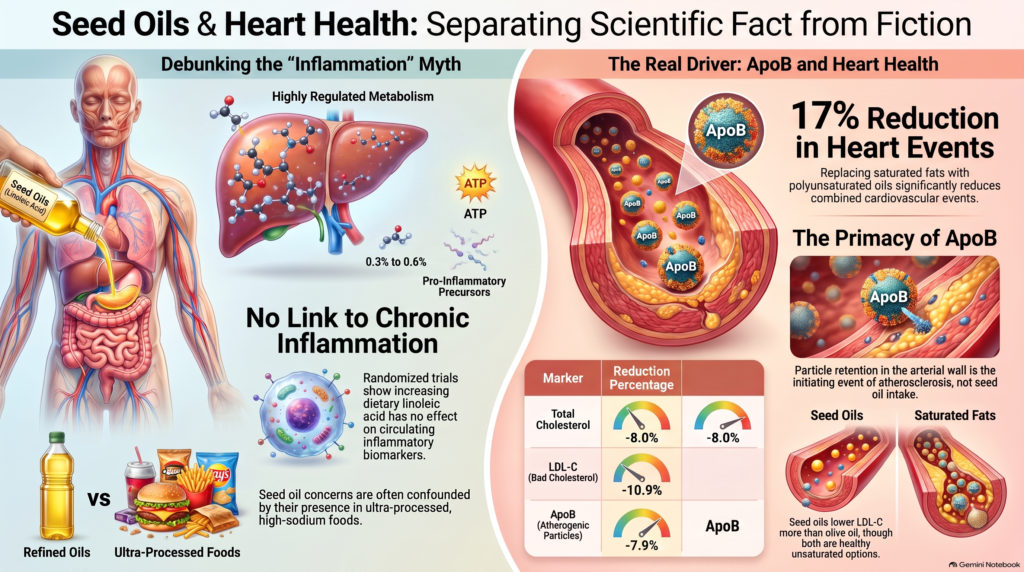
The omega-6 hypothesis proposes that high dietary LA enriches membranes with AA, overproducing pro-inflammatory mediators. Human stable-isotope tracer studies show this model is not supported at usual Western dietary intakes. The fractional conversion of dietary LA to AA is estimated at only 0.3% to 0.6%, reflecting low activity of the rate-limiting delta-6-desaturase in adult human tissue. [9], [10]
A systematic review of human interventions found that decreasing dietary LA by up to 90% was not significantly correlated with the AA content of plasma or serum phospholipids (P = 0.39), and increasing dietary LA severalfold was likewise uncorrelated with AA (P = 0.72). Excess dietary LA is primarily beta-oxidized for energy or stored in adipose tissue rather than converted to AA. [9]
Arachidonic acid metabolism is also intrinsically balanced. Established eicosanoid biochemistry shows that AA is the precursor not only to pro-inflammatory mediators but also to prostacyclin, a vasodilator and inhibitor of platelet activation, and to lipoxins, which are specialized pro-resolving mediators that actively down-regulate inflammation. A simple model in which more dietary LA yields uniformly more inflammation is therefore inconsistent with the underlying biochemistry. [31]
6. Does Omega-6 Increase Chronic Inflammation?
A systematic review of essais contrôlés randomisésUn essai contrôlé randomisé assigne des personnes à un groupe de traitement ou à un groupe de comparaison de manière purement aléatoire, puis suit les deux groupes. examining dietary LA and chronic inflammation in healthy, non-infant populations found no evidence of harm. Across trials, increasing dietary LA had no significant effect on circulating Protéine C-réactiveLa protéine C-réactive, ou CRP, est une substance produite par votre foie lorsqu'il y a une inflammation quelque part dans votre corps. Une version sensible du test, la hs-CRP, est utilisée pour évaluer le risque cardiaque. (CRP), fibrinogen, plasminogèneUne protéine sanguine qui est convertie en plasmine, une enzyme qui dissout les caillots ; l'apo(a) de la Lp(a) présente une forte homologie structurelle avec le plasminogène, ce qui permet à la Lp(a) d'interférer de manière compétitive avec la dégradation des caillots. activator inhibitor-1, interleukine-6 (IL-6)Une protéine de signalisation produite en réponse à l'IL-1β lors de l'inflammation de la plaque, qui se déplace vers le foie et stimule la production de CRP ; une élévation de l'IL-6 circulante reflète donc une inflammation vasculaire active., tumor necrosis factor-alpha (TNF-alpha), or soluble adhesion molecules. [11]
The clinical evidence therefore does not support the hypothesis that high dietary omega-6 intake promotes systemic inflammation in humans. This conclusion rests on controlled human trials with objective biomarker endpoints rather than on mechanistic extrapolation from eicosanoid pathways. [11]
For transparency, and consistent with the funding considerations in Section 2, the linoleic acid inflammation review was supported by an unrestricted grant from an industry technical committee, and the high-oleic oil review discussed below was funded by a commodity board. These disclosures are made for transparency; they neither invalidate the findings nor are they offset by unrelated evidence on lipids and clinical outcomes, which does not bear on whether linoleic acid raises inflammatory biomarkers. [11]
7. Seed Oils Versus Saturated Fat
7.1 Metabolic and Lipid Effects
Replacing saturated fats with polyunsaturated seed oils substantially lowers atherogenic lipids. A network meta-analysis of 54 randomized trials ranked oils and solid fats by their effects on blood lipids. Safflower oil had the highest probability of reducing LDL-C (SUCRA 82%) and total cholesterol (SUCRA 90%), followed by rapeseed (canola) oil (SUCRA 76% for LDL-C, 85% for total cholesterol). Unsaturated oils reduced LDL-C by roughly 0.23 to 0.42 mmol/L relative to butter. [4] The mechanism generally invoked for this effect is up-regulation of hepatic Récepteurs des LDLLe récepteur des LDL est un point d'amarrage sur les cellules hépatiques qui capture les particules de LDL dans le sang et les attire pour les décomposer., which increases clearance of circulating particules contenant de l'ApoBLes lipoprotéines — y compris les LDL, IDL, VLDL et leurs restes — qui portent chacune une molécule d'apolipoprotéine B à leur surface ; le nombre de particules (plutôt que la masse de cholestérol seule) est un facteur clé de l'athérosclérose car chaque particule peut être retenue dans la paroi artérielle.; that mechanism is established in the lipoprotein literature rather than demonstrated by the network meta-analysis itself. [21]
A systematic review of high-oleic vegetable oil substitutions quantified the ApoB effect directly: replacing saturated fats with high-oleic oilsHigh-oleic oils are cultivar-bred versions of conventional seed oils—such as high-oleic sunflower or safflower—in which oleic acid (a monounsaturated fat) replaces most of the linoleic acid, making them considerably more resistant to oxidation and heat degradation than their standard counterparts. reduced total cholesterol by 8.0%, LDL-C by 10.9%, and ApoB by 7.9% (all P < 0.05). The relevant intervention is replacement rather than unrestricted addition: the evidence supports substituting graisse insaturéeLes graisses insaturées sont liquides à température ambiante et proviennent des plantes et des poissons — huile d'olive, noix, graines, avocat, huiles de graines. for saturated fat within the range of roughly 5 to 10 percent of total energy intake, not the unlimited addition of oils on top of an existing diet. [5] (Figure 2)
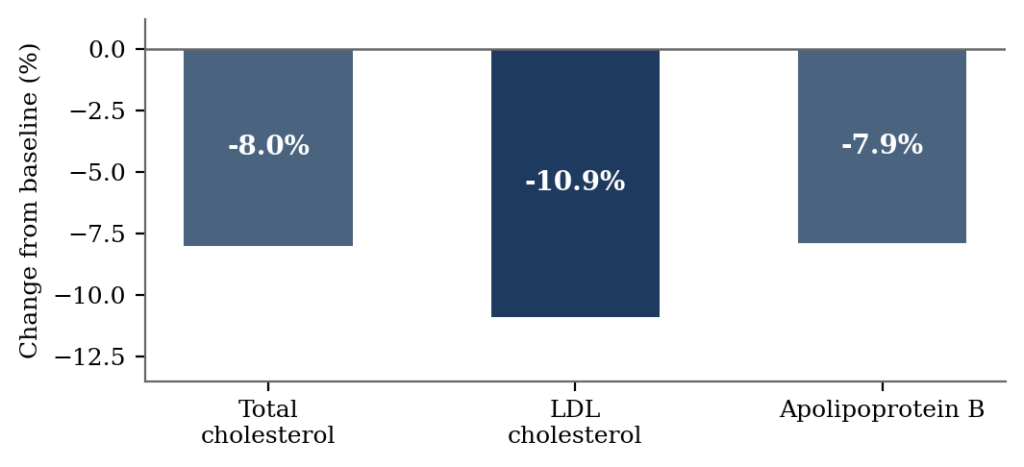
Figure 2. Change in atherogenic lipid measures when saturated fat is replaced with high-oleic vegetable oils. All changes P < 0.05. The relevant intervention is isocaloric replacement, not addition of oil to an existing diet. Data from reference [5].
7.2 Clinical Cardiovascular Outcomes
An updated Cochrane systematic review of reducing saturated fat intake pooled 15 randomized controlled trials comprising 56,675 participants who reduced saturated fat for at least two years. Reducing saturated fat produced a statistically significant 17% reduction in combined cardiovascular events (risk ratio 0.83; 95% CI 0.70 to 0.98; I-squared 67%). [18]
Subgroup analysis and meta-regression indicated the benefit was driven by replacing saturated fat with graisse polyinsaturéePolyunsaturated fat is found in seed oils, nuts, seeds, and fish. Omega-3 and omega-6 fats both belong to this family. or high-quality carbohydrate, with greater cholesterol reductions predicting greater protection. The nombre nécessaire à traiterNumber needed to treat, or NNT, is how many people must take a treatment for one of them to benefit. was 56 in prévention primaireLa prévention primaire consiste à traiter une personne qui n'a jamais eu de crise cardiaque ou d'accident vasculaire cérébral, afin d'empêcher qu'un premier événement ne se produise. and 53 in prévention secondaireLa prévention secondaire consiste à traiter une personne ayant déjà eu une crise cardiaque, un accident vasculaire cérébral ou la pose d'un stent, afin d'en empêcher une récidive.. [18]
Despite the reduction in combined events, reducing saturated fat had little or no effect on mortalité toutes causes confonduesLa morbimortalité globale désigne le décès quelle qu'en soit la cause, et pas seulement les maladies cardiaques — le critère d'évaluation le plus large et le plus difficile à fausser qu'une étude puisse mesurer. (55,858 participants, 11 trials) or cardiovascular mortality (53,421 participants, 10 trials), both with moderate-quality evidence. This dissociation between event reduction and mortality is itself important and is discussed further in Section 12. [18]
7.3 Critical Re-Evaluation of Historical Controversies
Critics of the diet-heart hypothesis frequently cite recovered data from two historical trials re-analyzed by Ramsden and colleagues.
- Minnesota Coronary Experiment: A double-blind randomized trial of 9,423 institutionalized participants comparing a diet in which saturated fat was replaced with corn oil against a saturated-fat control. The corn oil intervention lowered serum cholesterol by 13.8% versus 1.0% in controls (P < 0.001), yet produced no survival benefit. In covariate-adjusted models, a 30 mg/dL reduction in serum cholesterol was associated with a 22% higher risk of death (rapport des cotesUn rapport des risques instantanés compare la rapidité avec laquelle les événements se produisent dans deux groupes. Un rapport de 0,75 signifie que les événements se sont produits à un rythme égal aux trois quarts dans le groupe traité. 1.22; 95% CI 1.14 to 1.32; P < 0.001). [13]
- Sydney Diet Heart Study: A randomized trial in 458 men with a recent coronary event found that replacing saturated fat with safflower oil increased all-cause mortality (17.6% versus 11.8%; hazard ratio 1.62; 95% CI 1.00 to 2.64), cardiovascular mortality (hazard ratio 1.70; 95% CI 1.03 to 2.80), and coronary mortality (hazard ratio 1.74; 95% CI 1.04 to 2.92). [14]
Both trials have important limitations that constrain their relevance to modern recommendations. The interventions selectively increased linoleic acid without increasing n-3 PUFA intake, and in the Sydney trial the trans fatTrans fat is an artificially altered fat once used to make processed foods last longer on the shelf. content of the study margarine was not recorded, leaving contemporaneous trans fat exposure uncertain against a background in which common margarines and shortenings of the period themselves contained trans fats. The historical trials also had important limitations in the duration of controlled dietary exposure, in follow-up, and in participant retention. [13], [14]
8. Seed Oils Versus Olive Oil
8.1 Direct Lipid-Modulating Effects
Because of their higher polyunsaturated content, linoleic-acid-rich seed oils lower total cholesterol and LDL-C somewhat more than monounsaturated-rich olive oil. A meta-analysis of 27 randomized placebo-controlled trials (1,089 participants) found that olive oil reduced LDL-C less than other plant oils by a weighted mean difference of 4.2 mg/dL (95% CI 1.4 to 7.01; P = 0.003) and reduced total cholesterol less by 6.27 mg/dL (95% CI 2.8 to 10.6). Although statistically significant, the magnitude of this LDL-C difference relative to olive oil is modest, and readers should not interpret it as a large clinical separation between the two. [15]
Conversely, olive oil raised high-density lipoprotein cholesterol (HDL-C) more than other plant oils, with a pooled weighted mean difference across all 27 trials of 1.37 mg/dL (95% CI 0.40 to 2.36). The effect is small and of uncertain clinical consequence. [15]
8.2 Olive Oil Grades
The term olive oil encompasses several distinct products that readers frequently conflate. Virgin olive oils are produced by mechanical means without chemical treatment; extra virgin olive oil is the highest noteGRADE (Grading of Recommendations, Assessment, Development and Evaluations) est un cadre largement utilisé pour évaluer le degré de certitude des données probantes sous-tendant une découverte clinique, en le classant comme élevé, modéré, faible ou très faible sur la base de facteurs tels que la conception de l'étude, le risque de biais, la cohérence, la directivité et la précision des résultats., meeting stricter sensory and free-acidity criteria and retaining substantially more native phenolic compounds. Refined olive oil is virgin oil that has been chemically or physically refined to remove defects, a process that strips the great majority of its polyphenols while leaving the oleic acid backbone intact. Olive pomace oil is extracted from the residual paste using solvents and then refined. Some surrogate effects have been associated with phenolic content rather than with oleic acid content, so these grades should not be treated as interchangeable, and evidence generated with high-polyphenol extra virgin oil should not be assumed to apply to refined or pomace grades. [17]
8.3 Vascular, Endothelial, and Inflammatory Profiles
Olive oil is sometimes said to outperform refined seed oils on vascular inflammation and endothelial function, but that claim rests on surrogate endpoints and is not relied upon here for clinical conclusions. A meta-analysis of 30 randomized controlled trials in 3,106 participants reported that olive oil consumption was associated with lower IL-6L'interleukine-6, ou IL-6, est une molécule de signalisation que le système immunitaire utilise pour diffuser un message inflammatoire dans tout le corps. (mean difference -0.29 pg/mL; 95% CI -0.57 to -0.02), lower soluble E-selectin (mean difference -3.16; 95% CI -4.07 to -2.25), and higher FMD (mean difference 0.76%; 95% CI 0.27 to 1.24). These are surrogate markers, not clinical events. The meta-analysis pools trials of heterogeneous design, duration, and sponsorship, and does not itself report a funding analysis, so no conclusion about the sponsorship profile of the underlying literature can be drawn from it. Because the results are surrogate improvements of uncertain clinical meaning, they should not be extrapolated to event reduction, and no conclusion of endothelial superiority for olive oil over other unsaturated oils can be drawn from them. [16]
8.4 Isolating the Contribution of Polyphenols
To determine whether the benefits of EVOO derive from its oleic acid backbone or its minor bioactive compounds, the EUROLIVE study fed 200 healthy men 25 mL/day of olive oils with low (2.7 mg/kg), medium (164 mg/kg), or high (366 mg/kg) polyphenol content in a randomized crossover design. HDL-C rose linearly with polyphenol content (change of +0.045 mmol/L at the highest dose; 95% CI 0.02 to 0.06), and LDL oxydéLes LDL oxydées sont des particules de LDL qui ont été chimiquement altérées après s'être coincées dans la paroi d'une artère. fell linearly (change of -3.21 U/L at the highest dose; 95% CI -5.1 to -0.8), while the low-polyphenol oil increased oxidized LDL. [17]
These dose-dependent findings underpin the European Union authorized health claim for olive oil polyphenols, which may be applied only to oils containing at least 5 mg of hydroxytyrosol and its derivatives per 20 g of oil. [30] EUROLIVE was funded by the European Commission under grant QLK1-CT-2001-00287 and its authors declared no financial conflicts of interest, so it is properly read as an independently funded trial. [17] Its principal limitation is not sponsorship but endpoint. HDL-C and oxidized LDL are surrogate markers, and no trial has shown that raising olive oil polyphenol intake reduces myocardial infarction, stroke, or cardiovascular death. A three-week crossover trial in 46 healthy volunteers found that phenol-rich oil did not increase the resistance of LDL or HDL to oxidation relative to a phenol-poor control; that trial was supported by the International Olive Oil Council and also included a commercial food-industry affiliation, so it is not an independent test either. [29] The polyphenol mechanism is therefore supported by surrogate-endpoint evidence of mixed direction and mixed sponsorship, and it does not by itself justify recommending olive oil over other unsaturated fats for cardiovascular outcomes. A further caution applies to generalization: EUROLIVE compared olive oils that differed in phenolic concentration but were otherwise similar, so its low-phenolic comparator should not be treated as equivalent to every commercially refined olive oil.
| Marker | Extra Virgin Olive Oil | Refined Olive Oil | Refined Seed Oils |
| LDL-C lowering | Modéré | Modéré | Variable; generally greater with PUFA-rich oils |
| HDL-C effect | Small increase reported for olive oil overall | Not established separately by grade | Variable |
| LDL oxydées | Decrease reported with high-polyphenol olive oil | Increase reported with low-polyphenol olive oil in EUROLIVE | Variable / not consistently improved |
| Systemic inflammation (IL-6) | Some trials and meta-analyses report modest improvement | Insufficient grade-specific evidence | Generally no increase in chronic inflammatory biomarkers |
| Postprandial FMD | Mixed; context dependent | Context-dependent transient reduction | Context-dependent transient reduction |
| Oxidative stability | Relativement élevé | Moderate to relatively high | Variable: higher for high-oleic formulations, lower for PUFA-rich formulations |
Table 3. Comparative lipid, oxidative, and vascular profiles of extra virgin olive oil, refined olive oil, and refined seed oils, based on the cited trials.
9. Whole Foods Versus Extracted Oils
Comparing extracted oils with their whole-food counterparts reveals differences in bioavailability, postprandial kinetics, and satiétéThe feeling of fullness and suppression of appetite following a meal; protein is the most satiating macronutrient per calorie, and higher-protein diets exploit this property to reduce total energy intake and support weight loss.. Extraction removes cellular structure and dietary fiber. In almonds, where this has been measured directly, intact cell walls limit lipid bioaccessibility so that a portion of fat passes unabsorbed into the lower gastrointestinal tract, and measured metabolizable energy falls below Atwater prediction. Equivalent controlled measurements are not available for olives, avocados, and most seeds, so the extension of this mechanism to whole-food fats generally remains an inference from a nut-specific literature. [25], [26]
The whole-food form also carries measurable lipid benefit. A systematic review, meta-analysis, and relation dose-effetUne relation dose-effet signifie qu'une plus grande quantité de quelque chose produit un effet plus important, selon un gradient constant. of 61 controlled trials (2,582 participants) found that tree nut consumption lowered total cholesterol and LDL-C in a nonlinear fashion, with stronger effects above roughly 60 g/day, and lowered ApoB and triglycerides in a linear dose-response. This is consistent with the ApoB-centered framework of this review, since whole nuts reduce the particule athérogèneLes particules athérogènes sont les lipoprotéines contenant de l'ApoB — notamment les LDL, IDL, VLDL et la lipoprotéine(a) — qui peuvent pénétrer et être retenues dans la paroi artérielle pour initier et alimenter la croissance de la plaque ; l'article utilise ce terme pour décrire ce qui doit être abaissé de manière substantielle et durable pour obtenir la régression de la plaque. burden directly. [24]
Extracted oils are among the most calorie-dense foods in the diet, providing approximately 9 kcal/g, or roughly 120 kcal per tablespoon, with negligible fiber or protéineLes protéines sont le nutriment que votre corps utilise pour développer et réparer les muscles et les tissus.. Energy densityThe number of calories per gram (or per unit volume) of a food; high-fibre, water-rich plant foods have low energy density, meaning larger volumes can be eaten for fewer calories, promoting satiety and spontaneous calorie reduction without deliberate restriction. of this magnitude can promote positive energy balance, which matters because excess adiposity is itself a cardiovascular facteur de risqueUn facteur de risque est quelque chose qui augmente votre probabilité de développer une maladie : des particules de cholestérol élevées, une tension artérielle élevée, le tabagisme, le diabète, des antécédents familiaux.. Olive oil, seed oil, and butter are all energy-dense, so any of them, consumed in excess, can contribute to weight gain independent of fatty acid quality.
Controlled human data support a functional difference between whole foods and their oils: walnuts preserved postprandial endothelial function relative to olive oil in patients with hypercholestérolémieL'hypercholestérolémie est un taux anormalement élevé de particules porteuses de cholestérol dans le sang, généralement provoqué chez les primates par la consommation d'un régime riche en cholestérol alimentaire et en graisses saturées, et associé à une formation accélérée de plaques dans la paroi des artères., an effect attributed to their combined fatty acid, antioxidant, and L-arginine content. [22]
Tree nuts lower circulating ApoB directly in randomized trials, and the almond food-matrix studies demonstrate reduced lipid bioaccessibility and a smaller postprandial triglyceride response relative to extracted oil. Evidence that all whole-food fat sources improve satiety per calorie, postprandial metabolism, or ApoB relative to isolated oils has not been established, and should not be asserted. Randomized trials have likewise not established that whole-food fat sources produce superior cardiovascular event reduction compared with high-quality dietary patterns containing unsaturated oils, because few long-term trials directly compare oil-free whole-food diets with oil-containing diets. The case for whole foods therefore rests on convergent intermediate evidence and biological plausibility, not on proven event reduction, and this distinction should be kept in view when translating mechanism into recommendation. [24], [25], [26]
10. Lipid Oxidation during Processing, Storage, and Cooking
The rate of lipid autoxidation is proportional to the number of double bonds in the fatty acid chain, so PUFAs are highly susceptible to free radical attack. When refined high-PUFA seed oils are heated for prolonged periods, especially under repeated commercial frying conditions, they undergo thermal oxidation, hydrolysis, and polymerization. Oxidation is also accelerated by repeated fryer reuse, air and light exposure, and prolonged storage, and is retarded by dark glass, cool storage, and inert-gas flushing. [6], [12]
This degradation generates primary lipid hydroperoxides that decompose into reactive secondary products, including aldehydes such as malondialdehyde and 4-hydroxynonenal, and oxidized linoleic acid metabolites such as 9-HODE and 13-HODE. In humans, lowering dietary linoleic acid measurably reduces circulating bioactive oxidized linoleic acid metabolites, confirming a diet-responsive pathway. An interpretive caution applies throughout this literature: circulating oxidized-LDL and oxidized-metabolite measurements correlate with, but do not directly demonstrate, oxidation occurring within the plaque artérielleA deposit within the artery wall made up of lipids, immune cells, cellular debris, and fibrous tissue that accumulates over time and can narrow or block blood flow; also called an atherosclerotic lesion or atheroma. itself, and the two should not be equated. [6], [23]
By contrast, monounsaturated and saturated fats have far fewer double bonds and lack vulnerable bis-allylic carbons, making them more resistant to thermal breakdown. These oxidation-product mechanisms are biologically plausible contributors to endothelial and mitochondrial stress, but the magnitude of their clinical contribution relative to circulating ApoB remains a proposed rather than an established pathway. A crucial distinction, frequently conflated in popular discussion, is that these concerns apply to repeatedly heated and thermally degraded oils, not to fresh, unheated seed oils; the oxidation products of abused frying oil are not a property of the fresh oil itself. [6], [12]
11. Endothelial Injury, Atherosclerosis, and the Primacy of ApoB
The vascular failure hypothesis proposes that repeated postprandial endothelial stress from extracted oils contributes over decades to increased endothelial permeability, lipoprotein entry, and vascular inflammation. Repeated transient endothelial dysfunction represents a biologically plausible mechanism that could contribute to long-term vascular injury, although direct clinical evidence demonstrating this pathway in humans remains limited. It is best regarded as a contributory hypothesis, not an established initiating cause. [3]
Vascular biology establishes that atherosclerotic plaque formation requires the entry and retention of ApoB-containing lipoproteins in the arterial wall. The European Atherosclerosis Society consensus concludes that the retention and accumulation of cholesterol-rich ApoB-containing lipoproteins within the arterial intimaL'intima est la couche la plus interne de la paroi d'une artère, située juste sous laL'intima est la couche la plus interne de la paroi d'une artère, située juste en dessous de la doublure lisse. is the initiating event of atherogenesis, with risk accruing in a dose-dependent manner. ApoB is generally a more direct measure of circulating nombre de particules athérogènesThe total count of ApoB-containing lipoprotein particles circulating in the bloodstream—including LDL, VLDL remnants, and Lp(a)—as distinct from the cholesterol mass they carry; the European Atherosclerosis Society consensus holds that particle number, best captured by ApoB measurement, is a more accurate predictor of atherosclerotic risk than LDL-C concentration alone. than cholestérol LDLLe cholestérol LDL, ou LDL-C, correspond à la quantité de cholestérol contenue dans vos particules de LDL. C'est le chiffre qui figure sur presque tous les bilans sanguins standards., because each atherogenic particle carries a single ApoB molecule. Any dietary change that lowers circulating ApoB reduces the charge particulaireLa charge particulaire désigne le nombre total de particules de lipoprotéines athérogènes circulant dans le plasma, mesuré au mieux par l'ApoB ; elle se distingue de la masse de cholestérol, car c'est le compte physique des particules — et non la quantité de cholestérol qu'elles transportent — qui détermine la fréquence à laquelle les lipoprotéines s'infiltrent et se piégent dans la paroi artérielle. available to penetrate and be retained in the arterial wall. This framework is consistent with the long-term clinical benefit observed when saturated fat is replaced by unsaturated fat, despite the transient postprandial FMD findings described above; no trial has directly tested that comparison. Randomisation mendélienneMendelian randomization is a clever research method that uses the genes people were born with as a natural experiment. studies reinforce the framework, showing that genetically lower LDL and ApoB reduce cardiovascular risk irrespective of the mechanism by which they are lowered. [2], [21]
12. Clinical Outcomes and Population Subgroups
Long-term randomized evidence indicates that reducing saturated fat lowers combined cardiovascular events, with benefit appearing greater when saturated fat is replaced by polyunsaturated fat, and with the magnitude of cholesterol lowering correlating with the magnitude of protection. This supports reduction of circulating ApoB as the principal mechanism. The effect on stroke and on total mortality is less pronounced in pooled randomized data. [18], [21]
12.1 Olive Oil and the Mediterranean Pattern
For established coronary disease, the Essai CORDIOPREVCORDIOPREV is a randomized controlled trial that compared a Mediterranean diet to a modestly low-fat diet (approximately 28–30% of calories from fat) in patients with established coronary artery disease; it confirmed Mediterranean dietary superiority over that comparator but did not test the ultra-low-fat ( randomized 1,002 patients to a régime méditerranéenLe régime méditerranéen fait la part belle aux légumes, aux fruits, aux légumineuses, aux céréales complètes, aux fruits à coque et à l'huile d'olive, en y ajoutant du poisson et peu de viande rouge. rich in EVOO or a low-fat diet over seven years. The primary point de terminaison compositeUn critère d'évaluation composite regroupe plusieurs issues différentes et comptabilise celle qui survient en premier. occurred at 28.1 versus 37.7 events per 1,000 person-years, and multivariable-adjusted hazard ratios across models ranged from 0.719 (95% CI 0.541 to 0.957) to 0.753 (95% CI 0.568 to 0.998) in favor of the Mediterranean diet. Two interpretive points apply: the low-fat comparator reduced total fat only to roughly 32 percent of calories, short of a strict low-fat target, and the trial carried mixed funding, including Spanish governmental and European Union sources alongside olive-oil organizations. The achieved comparator diet and the mixed funding should both be considered when interpreting generalizability. [20]
The landmark primary-prevention trial is PREDIMEDPREDIMED a réparti au hasard des milliers d'adultes espagnols à haut risque entre un régime méditerranéen enrichi en huile d'olive, le même régime enrichi en fruits à coque, ou un régime témoin pauvre en graisses., which randomized 7,447 high-risk participants to a Mediterranean diet supplemented with extra virgin olive oil, the same diet supplemented with nuts, or a reduced-fat control. In the republished intention-to-treat analysis, the adjusted hazard ratio for major cardiovascular events was 0.69 (95% CI 0.53 to 0.91) for the olive oil arm and 0.72 (95% CI 0.54 to 0.95) for the nut arm, roughly a 30% relative reduction. Three caveats are essential. First, the original 2013 report was retracted and republished in 2018 after a baseline-data audit found that randomisationLa randomisation est le processus qui consiste à assigner les participants à un essai à des groupes de traitement ou témoins par le hasard, garantissant ainsi que les facteurs de confusion connus et inconnus sont répartis de manière égale ; lorsque la randomisation échoue — comme l'ont constaté des auditeurs dans le cas de PREDIMED —, les groupes peuvent différer d'une manière qui fausse l'effet apparent du traitement. had been compromised for approximately 1,588 of the 7,447 participants (about 21 percent), including household members assigned en masse and a clinic randomized as a unit; it is best described as a randomized trial with important protocol deviations in assignment procedures, addressed in the 2018 reanalysis, which reported that results remained similar after excluding the affected assignments. Second, the intervention was an entire Mediterranean dietary pattern, not olive oil in isolation, so the benefit cannot be attributed to olive oil alone. Third, on funding, the intervention foods were donated by olive-oil and nut producers and commodity organizations, whereas the trial itself received extensive public research funding, and the investigators reported that the sponsors had no role in study design, analysis, or reporting. [19]
12.2 Absolute Risk Reduction and the Limits of Surrogate Markers
A recurring gap in discussions of dietary fat is the leap from surrogate markers to implied clinical benefit. Improvements in LDL-C, HDL-C, oxidized LDL, FMD, and IL-6 are meaningful mechanistically, but readers are ultimately concerned with heart attacks and deaths prevented, and the two do not always move in proportion. The clearest absolute figures come from the Cochrane saturated fat review, where the number needed to treat to prevent one cardiovascular event over the trial durations was 56 in primary prevention and 53 in secondary prevention, while all-cause and cardiovascular mortality were not significantly reduced. [18] The overall certainty of the edible-oil literature is also lower than its volume suggests. An revue d'ensembleA systematic review of multiple existing meta-analyses on a topic, providing a high-level synthesis of evidence across many studies; cited in the article to summarize findings on plant-based diets and cardiovascular outcomes. of 48 systematic reviews containing 206 meta-analyses graded 67.5 percent of the associations as very low certainty, 21.8 percent as low and 9.7 percent as moderate, with only 1 percent rated high; on the AMSTAR-2 instrument, a single one of the 48 reviews reached high confidence and 14.6 percent moderate, while 62.5 percent were low and 20.8 percent critically low. [32] (Figure 3)

Figure 3. Certainty and methodological confidence of the edible-oil evidence base. Left: GRADE certainty across 206 meta-analyses. Right: AMSTAR-2 confidence across the 48 systematic reviews containing them. Percentages may not sum to 100 because of rounding. Data from reference [32].
For olive oil specifically, no randomized trial has tested olive oil alone against a control for hard cardiovascular endpoints. The event-reduction evidence attributed to olive oil derives from whole-pattern Mediterranean diet trials such as PREDIMED and CORDIOPREVCORDIOPREV a comparé un régime méditerranéen à un régime pauvre en graisses chez des personnes ayant déjà une coronaropathie, en les suivant pendant sept ans., in which olive oil was one component among many. Consequently, the precise risque absoluLe risque absolu est la probabilité réelle que quelque chose vous arrive, exprimée en pourcentage. Si votre risque absolu de faire une crise cardiaque au cours des dix prochaines années est de 12 pour cent, cela signifie qu'environ 12 personnes sur 100 ayant le même profil que vous en feraient une. reduction attributable to olive oil as an isolated intervention is not known. Accordingly, estimates that olive oil alone reduces myocardial infarction by a specific percentage cannot presently be supported by randomized evidence. Where olive oil has been pooled against comparators for hard endpoints, the summary estimates are null: no significant effect on cardiovascular events (RR 0.97; 95% CI 0.67 to 1.39), cardiovascular deaths (RR 1.07; 95% CI 0.77 to 1.48), or all-cause deaths (RR 0.99; 95% CI 0.85 to 1.15). [32] This is an honest limitation rather than a weakness of the underlying dietary advice. [19], [20] (Figure 4)
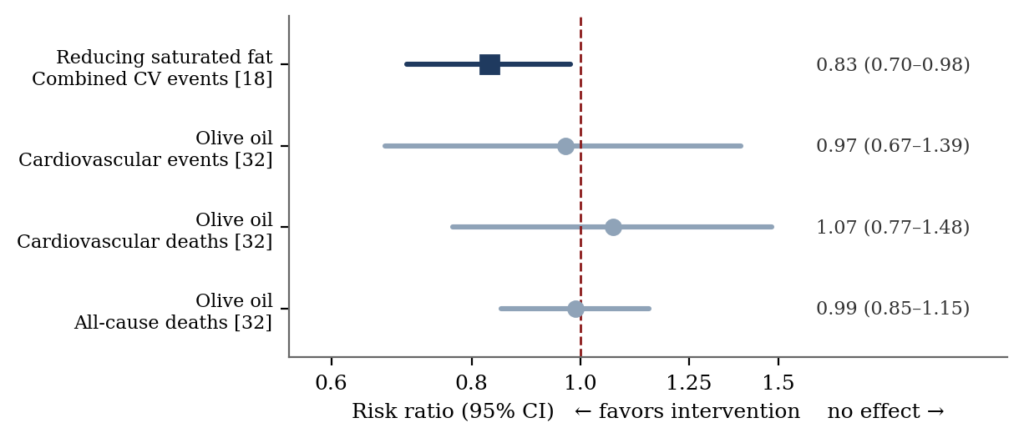
Figure 4. Randomized and pooled evidence for hard clinical endpoints. Reducing saturated fat lowers combined cardiovascular events; pooled estimates for olive oil against comparators are null for events and for mortality. Square denotes a statistically significant estimate. Note that the two rows are not a head-to-head comparison: the interventions, comparators, and trial populations differ. Data from references [18] et [32].
12.3 Population Subgroups
For patients with hypercholestérolémie familialeL'hypercholestérolémie familiale, ou HF, est une affection héréditaire dans laquelle le foie ne parvient pas à éliminer correctement le cholestérol du sang. Les taux sont très élevés dès la naissance., who have genetically reduced LDL receptor function and high lifetime ApoB exposure, dietary saturated-fat restriction with substitution of unsaturated plant oils can complement pharmacotherapy, although pharmacologic LDL lowering remains central to management. Across subgroups, the unifying principle remains reduction of lifetime ApoB exposure. [2], [21]
13. Synthesis and Answers to Core Questions
- Are seed oils uniquely harmful compared with other added oils?
No. There is no convincing human evidence that commonly consumed seed oils have a unique cardiometabolic toxicity when substituted isocalorically for other dietary fats. Controlled human evidence does not show increased chronic inflammatory biomarkers, and lipid effects are generally favorable when they replace saturated fat. Their frequent occurrence in aliments ultra-transformésProduits alimentaires industriels formulés à partir d'ingrédients raffinés et d'additifs — tels que des émulsifiants, des colorants et des exhausteurs de goût — ayant peu de rapport avec les aliments bruts ; les produits ultra-transformés, qu'ils soient d'origine végétale ou animale, sont associés à un risque cardiovasculaire accru, ce qui valide l'argument de l'article selon lequel le niveau de transformation importe autant que la source des aliments. is an important observational facteur de confusionA confounder is a variable that is associated with both the exposure being studied (such as TMAO) and the outcome (such as heart disease), making it appear as though one causes the other when a third factor is actually responsible. The article lists renal function, insulin resistance, systemic inflammation, and age as major confounders that inflate the apparent cardiovascular risk of high TMAO in…. [4], [11]
- Do omega-6 fatty acids increase chronic inflammation in humans?
No. Randomized controlled trials show that dietary linoleic acid does not increase circulating inflammatory biomarkers. Conversion of linoleic acid to arachidonic acid is only 0.3% to 0.6% and tightly regulated, and arachidonic acid gives rise to both pro-inflammatory and pro-resolving mediators. [9], [11]
- Do seed oils impair endothelial function differently from olive oil?
No dependable difference has been established. Postprandial FMD changes are influenced by meal size and composition, and are associated in some studies with the magnitude of the postprandial triglyceride response; in the acute experiment cited here a canola oil meal produced no significant fall while an extra virgin olive oil meal did. [8] The trials comparing high-polyphenol with refined olive oil report mixed results under mixed sponsorship: a positive postprandial trial funded by a producer that supplied the study oil [28], a three-week crossover trial funded by the International Olive Oil Council that found no effect of phenol content on LDL oxidation resistance [29], and EUROLIVE, funded by the European Commission with no declared conflicts, which reported dose-dependent changes in HDL-C and oxidized LDL [17]. A predominantly oleic-acid fatty-acid profile alone has not been shown to prevent postprandial FMD impairment, and FMD is in any case only a surrogate marker.
- Is the primary concern extracted oils regardless of fatty acid composition?
Direct whole-food-versus-oil evidence, strongest for almonds, demonstrates substantially greater lipid bioaccessibility and lipémie postprandialeLa lipémie postprandiale est l'augmentation des particules de graisse dans le sang dans les heures qui suivent un repas contenant des graisses. from extracted oil than from the intact seed; generalization to all food matrices remains plausible but incompletely tested. Extracted oils are also calorie-dense. Whether either property translates into long-term risk independent of ApoB lowering remains uncertain. High-polyphenol EVOO is sometimes proposed as a partial exception on the grounds that its antioxidant fraction counteracts lipid-induced endothelial stress, but the trials supporting that proposition are few, mixed in result, and measure only surrogate endpoints. [3], [8], [25], [28], [29]
- Does replacing saturated fat with seed oils improve outcomes primarily through LDL-C and ApoB?
Yes. The benefit is likely mediated substantially by reductions in LDL and ApoB-containing lipoprotein exposure. Saturated fats down-regulate hepatic LDL receptors, and replacing them with unsaturated oils up-regulates receptor activity and sustainably lowers circulating ApoB for as long as the dietary change is maintained. [5], [21]
- Do whole-food fat sources provide superior cardiovascular outcomes?
Tree nuts lower ApoB directly in randomized trials, and almond food-matrix studies show reduced lipid bioaccessibility relative to extracted oil. Whether that advantage generalizes to all whole-food fat sources has not been established. For hard clinical endpoints the evidence is limited, because few long-term randomized trials compare oil-free with oil-containing diets. [24], [25], [26]
- What role does acute postprandial FMD impairment play in long-term atherosclerosis?
It is a reproducible marker of transient vascular stress but remains secondary to ApoB retention. Atherosclerotic plaque formation requires the entry and retention of ApoB-containing lipoproteins in the arterial wall. Long-term outcome evidence currently favors the clinical importance of sustained ApoB lowering over concern about transient FMD changes, though the two have never been compared directly in a trial. [2], [21]
13.1 Evidence-Based Recommendations
The totality of evidence supports a dietary pattern that prioritizes replacing saturated fat with plant-derived unsaturated fats, particularly for those with elevated ApoB, familial hypercholesterolemia, or established coronary disease; treats olive oil and other unsaturated plant oils as reasonable substitutes for animal fat on the basis of their LDL and ApoB effects rather than any demonstrated endothelial or polyphenol advantage, since the polyphenol evidence rests entirely on surrogate endpoints and has never been tested against clinical events; favors minimally processed whole-food fat sources such as nuts, seeds, avocados, and olives, among which tree nuts carry the strongest randomized evidence for modest reductions in LDL-C and ApoB, while noting that comparable ApoB evidence does not exist for every food in that list; and minimizes thermally degraded, repeatedly heated, or deep-fried oils. Where surrogate markers improve, the honest framing is that these are mechanistically favorable changes whose translation into event reduction is best evidenced for whole dietary patterns rather than for any single oil in isolation. [18], [24], [25], [26], [6]
Références
- Sacks FM, Lichtenstein AH, Wu JHY, et al. Dietary Fats and Cardiovascular Disease: A Presidential Advisory From the American Heart Association. Circulation. 2017;136(3):e1-e23. doi:10.1161/CIR.0000000000000510
- Ference BA, Ginsberg HN, Graham I, et al. Low-density lipoproteins cause atherosclerotic cardiovascular disease. 1. Evidence from genetic, epidemiologic, and clinical studies. A consensus statement from the European Atherosclerosis Society Consensus Panel. Eur Heart J. 2017;38(32):2459-2472. doi:10.1093/eurheartj/ehx144
- Fewkes JJ, Kellow NJ, Cowan SF, Williamson G, Dordevic AL. A single, high-fat meal adversely affects postprandial endothelial function: a systematic review and meta-analysis. Am J Clin Nutr. 2022;116(3):699-729. doi:10.1093/ajcn/nqac153
- Schwingshackl L, Bogensberger B, Benčič A, Knüppel S, Boeing H, Hoffmann G. Effects of oils and solid fats on blood lipids: a systematic review and network meta-analysis. J Lipid Res. 2018;59(9):1771-1782. doi:10.1194/jlr.P085522
- Huth PJ, Fulgoni VL 3rd, Larson BT. A systematic review of high-oleic vegetable oil substitutions for other fats and oils on cardiovascular disease risk factors: implications for novel high-oleic soybean oils. Adv Nutr. 2015;6(6):674-693. Published 2015 Nov 13. doi:10.3945/an.115.008979
- Grootveld M. Evidence-Based Challenges to the Continued Recommendation and Use of Peroxidatively-Susceptible Polyunsaturated Fatty Acid-Rich Culinary Oils for High-Temperature Frying Practises: Experimental Revelations Focused on Toxic Aldehydic Lipid Oxidation Products. Front Nutr. 2022;8:711640. Published 2022 Jan 5. doi:10.3389/fnut.2021.711640
- Lesser LI, Ebbeling CB, Goozner M, Wypij D, Ludwig DS. Relationship between funding source and conclusion among nutrition-related scientific articles. PLoS Med. 2007;4(1):e5. doi:10.1371/journal.pmed.0040005
- Vogel RA, Corretti MC, Plotnick GD. The postprandial effect of components of the Mediterranean diet on endothelial function. J Am Coll Cardiol. 2000;36(5):1455-1460. doi:10.1016/s0735-1097(00)00896-2
- Rett BS, Whelan J. Increasing dietary linoleic acid does not increase tissue arachidonic acid content in adults consuming Western-type diets: a systematic review. Nutr Metab (Lond). 2011;8:36. Published 2011 Jun 10. doi:10.1186/1743-7075-8-36
- Demmelmair H, Iser B, Rauh-Pfeiffer A, Koletzko B. Comparison of bolus versus fractionated oral applications of [13C]-linoleic acid in humans. Eur J Clin Invest. 1999;29(7):603-609. doi:10.1046/j.1365-2362.1999.00477.x
- Johnson GH, Fritsche K. Effect of dietary linoleic acid on markers of inflammation in healthy persons: a systematic review of randomized controlled trials. J Acad Nutr Diet. 2012;112(7):1029-1041.e10415. doi:10.1016/j.jand.2012.03.029
- Bazina N, Ahmed T, Almdaaf M, Abu Hallalah HMO, Jibia S. Chemical Changes in Deep-Fat Frying: Reaction Mechanisms, Oil Degradation, and Health Implications. Food Sci Nutr. 2025;13(10):e70969. Published 2025 Oct 13. doi:10.1002/fsn3.70969
- Ramsden CE, Zamora D, Majchrzak-Hong S, et al. Re-evaluation of the traditional diet-heart hypothesis: analysis of recovered data from Minnesota Coronary Experiment (1968-73). BMJ. 2016;353:i1246. Published 2016 Apr 12. doi:10.1136/bmj.i1246
- Ramsden CE, Zamora D, Leelarthaepin B, et al. Use of dietary linoleic acid for secondary prevention of coronary heart disease and death: evaluation of recovered data from the Sydney Diet Heart Study and updated meta-analysis. BMJ. 2013;346:e8707. Published 2013 Feb 4. doi:10.1136/bmj.e8707
- Ghobadi S, Hassanzadeh-Rostami Z, Mohammadian F, et al. Comparison of blood lipid-lowering effects of olive oil and other plant oils: A systematic review and meta-analysis of 27 randomized placebo-controlled clinical trials. Crit Rev Food Sci Nutr. 2019;59(13):2110-2124. doi:10.1080/10408398.2018.1438349
- Schwingshackl L, Christoph M, Hoffmann G. Effects of Olive Oil on Markers of Inflammation and Endothelial Function-A Systematic Review and Meta-Analysis. Nutrients. 2015;7(9):7651-7675. Published 2015 Sep 11. doi:10.3390/nu7095356
- Covas MI, Nyyssönen K, Poulsen HE, et al. The effect of polyphenols in olive oil on heart disease risk factors: a randomized trial. Ann Intern Med. 2006;145(5):333-341. doi:10.7326/0003-4819-145-5-200609050-00006
- Hooper L, Martin N, Jimoh OF, Kirk C, Foster E, Abdelhamid AS. Reduction in saturated fat intake for cardiovascular disease. Cochrane Database Syst Rev. 2020;8(8):CD011737. Published 2020 Aug 21. doi:10.1002/14651858.CD011737.pub3
- Estruch R, Ros E, Salas-Salvadó J, et al. Primary Prevention of Cardiovascular Disease with a Mediterranean Diet Supplemented with Extra-Virgin Olive Oil or Nuts. N Engl J Med. 2018;378(25):e34. doi:10.1056/NEJMoa1800389
- Delgado-Lista J, Alcala-Diaz JF, Torres-Peña JD, et al. Long-term secondary prevention of cardiovascular disease with a Mediterranean diet and a low-fat diet (CORDIOPREV): a randomised controlled trial. Lancet. 2022;399(10338):1876-1885. doi:10.1016/S0140-6736(22)00122-2
- Borén J, Chapman MJ, Krauss RM, et al. Low-density lipoproteins cause atherosclerotic cardiovascular disease: pathophysiological, genetic, and therapeutic insights: a consensus statement from the European Atherosclerosis Society Consensus Panel. Eur Heart J. 2020;41(24):2313-2330. doi:10.1093/eurheartj/ehz962
- Cortés B, Núñez I, Cofán M, et al. Acute effects of high-fat meals enriched with walnuts or olive oil on postprandial endothelial function. J Am Coll Cardiol. 2006;48(8):1666-1671. doi:10.1016/j.jacc.2006.06.057
- Ramsden CE, Ringel A, Feldstein AE, et al. Lowering dietary linoleic acid reduces bioactive oxidized linoleic acid metabolites in humans. Prostaglandins Leukot Essent Fatty Acids. 2012;87(4-5):135-141. doi:10.1016/j.plefa.2012.08.004
- Del Gobbo LC, Falk MC, Feldman R, Lewis K, Mozaffarian D. Effects of tree nuts on blood lipids, apolipoproteins, and blood pressure: systematic review, meta-analysis, and dose-response of 61 controlled intervention trials. Am J Clin Nutr. 2015;102(6):1347-1356. doi:10.3945/ajcn.115.110965
- Berry SE, Tydeman EA, Lewis HB, et al. Manipulation of lipid bioaccessibility of almond seeds influences postprandial lipemia in healthy human subjects. Am J Clin Nutr. 2008;88(4):922-929. doi:10.1093/ajcn/88.4.922
- Novotny JA, Gebauer SK, Baer DJ. Discrepancy between the Atwater factor predicted and empirically measured energy values of almonds in human diets. Am J Clin Nutr. 2012;96(2):296-301. doi:10.3945/ajcn.112.035782
- Inaba Y, Chen JA, Bergmann SR. Prediction of future cardiovascular outcomes by flow-mediated vasodilatation of brachial artery: a meta-analysis. Int J Cardiovasc Imaging. 2010;26(6):631-640. doi:10.1007/s10554-010-9616-1
- Njike VY, Ayettey R, Treu JA, Doughty KN, Katz DL. Post-prandial effects of high-polyphenolic extra virgin olive oil on endothelial function in adults at risk for type 2 diabetes: a randomized controlled crossover trial. Int J Cardiol. 2021;330:171-176. doi:10.1016/j.ijcard.2021.01.062
- Vissers MN, Zock PL, Wiseman SA, Meyboom S, Katan MB. Effect of phenol-rich extra virgin olive oil on markers of oxidation in healthy volunteers. Eur J Clin Nutr. 2001;55(5):334-341. doi:10.1038/sj.ejcn.1601161
- EFSA Panel on Dietetic Products, Nutrition and Allergies (NDA). Scientific opinion on the substantiation of health claims related to polyphenols in olive and protection of LDL particles from oxidative damage, pursuant to Article 13(1) of Regulation (EC) No 1924/2006. EFSA Journal. 2011;9(4):2033. doi:10.2903/j.efsa.2011.2033. Authorized wording established by Commission Regulation (EU) No 432/2012 of 16 May 2012.
- Serhan CN. Pro-resolving lipid mediators are leads for resolution physiology. Nature. 2014;510(7503):92-101. doi:10.1038/nature13479
- Voon PT, Ng CM, Ng YT, et al. Health effects of various edible vegetable oil: an umbrella review. Adv Nutr. 2024;15(9):100276. doi:10.1016/j.advnut.2024.100276. Several authors are affiliated with the Malaysian Palm Oil Board; the authors declared no conflicts of interest and no funding.